1333年に鎌倉は落ちたが、一派の最大の時代はその後に来た。師の水準で鍛える貞宗、皆焼を大成した広光と秋広。相州風は軍勢とともに広がり、一時は国じゅうの様式となった。
 NihontoWatchNihontoWatch
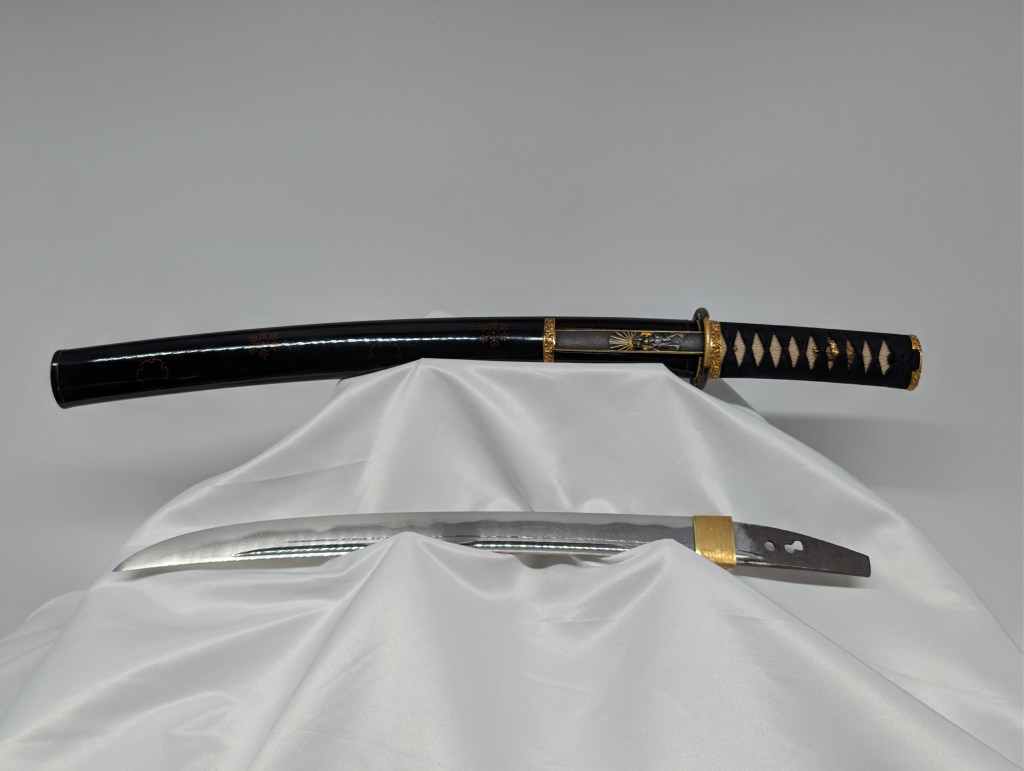
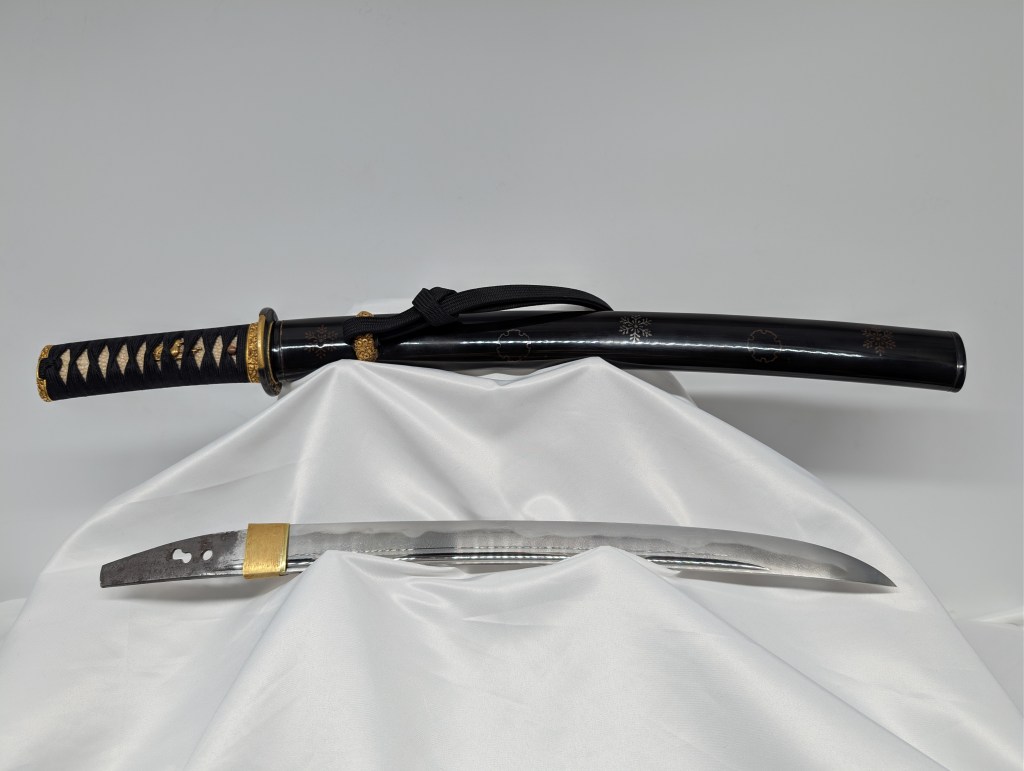
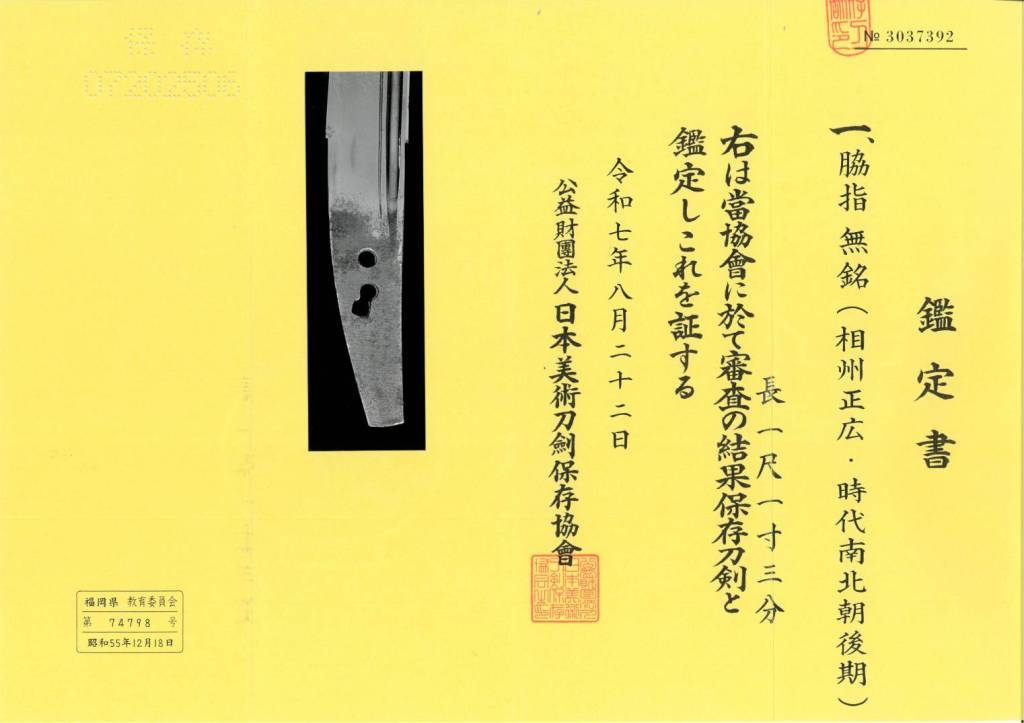
a masterpiece by Masamune’s Grandson Following the rise of new masters in Sagami Province, such as Hiromitsu and Akihiro, continuous branches of their descendants forged swords into the Muromachi Period, leaving indelible prints on the world of nihonto that permeate into the modern day. The topic of today’s article is a sunnobi tanto from one of these branch founders, that being the son of Soshu Hiromitsu, Masahiro. The blade has a marvelous shape, whose dimensions match daggers of the late Nanbokucho Period, namely, a wide mihaba, an extended curvature, and a partially extended frame along the monouchi. Looking toward metallurgy, the surface grain is comprised of a coarse, tight ko-mokume throughout the blade’s length. The jiba is extremely bright, being filled with ji-nie, which sparkle and create a whiter surface than the works of Soshu School predecessors, especially Masamune and his disciples. Moving to the cutting edge, the hamon is composed of a gunome-notare-based hitatsura in nie-deki. The hamon begins in a wide, undulating notare before becoming more aggressive by the midpoint of the nagasa, increasing in activity as well. Works of Masahiro are generally lacking in hataraki, although this work is a clear exception, including multilayered sunagashi and faint kinsuji, alongside the typical ashi of various lengths. As a work of hitatsura, occasional tobiyaki are also noted, although they do not sit as high on the ji as examples from his father. This flamboyant temper continues up into the tip of the blade, finishing in a loud midare-komi boshi, coming to an end with a sharp kaeri. With the discussion of the blade’s appearance and metalwork concluded, relevant measurements are listed below. The nakago of the blade is nakago-naoshi with a kiri-jiri tip. Due to the straightening of this blade’s tang, any signature that may have been on this blade has been removed. The remaining tang has three mekugi-ana, indicating a history of changing fittings, implying centuries of care and valuation of the dagger. The blade’s shape is in hira-zukuri, with a mitsu-mune. This is the most common shape for the smithing of tanto, originating from the late Heian Period and continuing into the modern day. Despite this fact, through differences in the dimensions of the blade, the sword’s period of smithing can be determined, namely, due to its wider frame and pronounced curvature, which are emblematic of the period. Besides period differences, the shape of this blade is also accentuated through the inclusion of a tasteful bo-hi and soe-hi engraving along the length of the blade. The blade is rated “Hozon” by the NBTHK, indicating that the blade has a baseline quality that is expected for a Japanese sword. Furthermore, the appraisal establishes an identity for the swordsmith, alongside a timeframe during which the sword was forged. Although the lowest rank for a Japanese sword, the rank is a floor, rather than a ceiling, opening up higher avenues of appraisal. Included with this blade is a set of i-ssaku tanto koshirae crafted by the Goto School in the mid-Edo Period. The scabbard is finished in a gorgeous kuro-urushi lacquer, which is accentuated nicely with the inclusion of gold “Sekka Monyou” (snow-flake) motifs. Finishing the saya are matching kojiri and koiguchi, which are carved from black horn, fitting the monochromatic theme of the fittings. Moving to metal accessories, the ko-tsuka sheath and kurigata are both formed of gold, inscribed with floral patterns. This style matches the fuchi and kashira of the hilt, which are formed in the same style. Fitted inside the scabbard is a fine kogatana mounted with a shakudo nanako ko-suka. The ko-tsuka has gilded edges and a raised figure of a farmer. The tsuka is mounted with white rayskin and finely tied with black silk, matching the silk sageo haphazardly tied to the kurigata. Inlaid into the tsukamaki is a golden menuki with chicken motifs, complementing the agrarian theme of the ko-tsuka. Finally, the koshirae is finished with a fine guard in shakudo with gilded sides, alongside butterfly motifs, coming together with the rest of the fittings to accentuate the luxury of both Nanbokucho Soshu work, alongside the skill of the Goto craftsmen. Following Masamune and Sadamune, a second generation of masters inherited the Soshu School, becoming prominent tanto smiths known for perfecting the “hitatsura” style of tempering. These two smiths were Soshu Akihiro and Soshu Hiromitsu. Of these two, Hiromitsu was able to produce a long line of descendants, surviving up into the modern day as the “Yamamura Tsunahiro” line of swordsmiths. These smiths were directly descended from both the Masahiro Branch, alongside the Odawara-Soshu group, which comprised the latter aspect of this branch, which had renamed themselves as “Tsunahiro”, taking the character from the daimyo Hojo Ujitsuna, of whom they entered his service. Returning to the Nanbokucho Period, this long line of swordsmiths began with the son of Hiromitsu, that being the first-generation Masahiro. Various birthdates and activity periods are listed for the swordsmith, due to the variety of conflicting records available for the Soshu School. Taking the broadest of these records into note, Masahiro would have operated from 1347 CE up into roughly 1393 CE, spanning nearly the entirety of the Nanbokucho Period. This period would have been split into two distinctive eras of Masahiro’s work those being his work as a pupil, which lasted from 1347 CE to 1368 CE, and his work as the grandmaster of the Soshu School, which comprised works from 1368 CE to 1393 CE. The greater curve seen on the blade implies a later forge date, leading one to assume that the work was made during Masahiro’s stint as the grandmaster of the Soshu School. Following this period, five generations of Masahiro smiths continued their work in Sagami Province before eventually being recruited as swordsmiths for the Hojo Clan in Odawara, bringing an end to the Masahiro Branch’s activity in the province, setting the stage for future swordsmiths to take up forging in the region as the Edo Period loomed on. Overall, this sunnobi tanto is an excellent example of later Soshu work, reaching the pinnacle of what would be considered “Sue-Soshu”. In addition, the inclusion of tasteful fittings from one of the Edo Period’s most renowned groups of craftsmen elevates the piece further, creating a matched set which is not only representative of nearly a millennium of history, but also of greater status and luxury within the world of Japanese swords. ~ Photographs from Charlie White’s Facebook page; Blade in Possession of Charlie White and written by Nicholas Zogu~
(翻訳なし) 店主の原文のまま表示しています。正確さの確認を通った翻訳のみを表示します。
相州伝 · 相模
現在21点販売中
末相州は、相模国に興った相州伝が、正宗とその後を継いだ広光・秋広らの南北朝の頂点を過ぎた後、室町期に至ってなお同地に伝えられた一群を指す。その手は鎌倉と小田原の二つの面に分かれ、室町中期には広正の名が南北朝期から数代にわたって連綿と切られて系の中核をなし、室町後期には後北条氏の庇護のもとに小田原へ拠点が移る。説明書は、天文年間に活躍した初代綱広を広正の子孫と伝え、初銘を正広といい、北条氏綱に召されて小田原に住し綱の一字を賜って改銘したと記す。以後、綱広・綱家らが小田原八幡山に代々続いて後北条氏に仕え、相州住の五字銘を低く切る在銘・生ぶの作を遺した。鎌倉に残って正宗以来の地に鍛えた正広のごとき手と、小田原に移って北条のもとに鍛えた一群とが併存し、後者を総称して小田原相州と呼ぶ。説明書はこの一派を、相州伝の掉尾を飾る工として位置づける。 作風は、肌立った板目に杢目・流れ肌を交えた相州の地鉄に、皆焼を本領とする点を共通の語法とする。互の目乱れに丁子・矢筈の刃・尖り刃・小のたれを交え、先へ刃幅を増して焼き、飛焼・湯走り・棟焼を地に及ぼして総体に皆焼となる態で、匂口は締まりごころに小沸よくつき、足・葉入り、砂流しを交える。この皆焼は広光・秋広以来の手と伝えられ、説明書は綱広をその系譜に置きつつ、現存作にあって彼らとは形状を異にすると明記して、襲ぐ名手その人とその手とを区別する。彫物もまた一派を貫く見どころで、真および草の倶利迦羅、梵字、三鈷剣、護摩箸、蓮台、八幡大菩薩や南無妙法蓮華経の陰刻文字を表裏に密に施し、樋中・櫃中の浮彫を得意とする。中でも総宗は彫の巧緻において長く名があり、末相州独特の構図の倶利伽羅を据える。古典相州の頂点と分かつのは、沸の深さと鉄の冴えにおける差であって、小田原の手は締まりごころの匂勝ちの匂口に角がかる互の目を複式・腰開きの態に焼き、地は肌立ちながらも締まる傾きを見せ、姿は短寸に先反りつくものが多い。一派のうちでも振れ幅があり、皮焼の手前の互の目交りの小乱れに控える静かな作から、棟焼まで覆う厚い華やかな皆焼に開く作までを含む。 鑑定の勘どころは、この一群を古典相州の名作から分かつところにある。すなわち、沸の冴えにおいて南北朝の頂点に一歩を譲りつつ、肌立つ板目杢に角がかり複式に傾く互の目乱れと、信仰に基づく緻密な彫物とを併せ持つ点を読む。主要工としては、室町中期に系の中核を定めた広正、相州伝の最末に立って皆焼と矢筈の刃を本領とし知名度も技量も高いとされる初代綱広、これと並び称せられて皆焼と彫物に優れた綱家が挙げられ、彫の巧緻によって一派から分かたれる総宗がこれに続く。鎌倉の面に立つ正広は南北朝以来の系を室町に伝え、皆焼風の乱れと彫物を遺す。なお江戸期の清平は加州兼若の系から稲葉家の抱工として小田原に転じた工で、相州在住の点で一派の名に連なるが、その作風は柾がかる加州物を基盤として別系をなす。伝来は概して大名家や寺社の格別な来歴を伴わず、その品位を支えるのは名高い由緒よりも、説明書が一口ごとに称える彫と鉄の質、そして在銘・生ぶに達した室町相州の稀少にある。在銘年紀の作はことに各代を読み分ける基準作となり、末期相州を学ぶ者にとって、相州伝の室町の様相を一口のうちに収める手がかりとなる。 詳しく見る →
南北朝時代の相州
1333年に鎌倉は落ちたが、一派の最大の時代はその後に来た。師の水準で鍛える貞宗、皆焼を大成した広光と秋広。相州風は軍勢とともに広がり、一時は国じゅうの様式となった。
海外からの返品は原則としてお受けしておりません。デポジットをお支払いいただいた時点で、商品を最長3か月間お取り置きします。頭金は返金不可です。