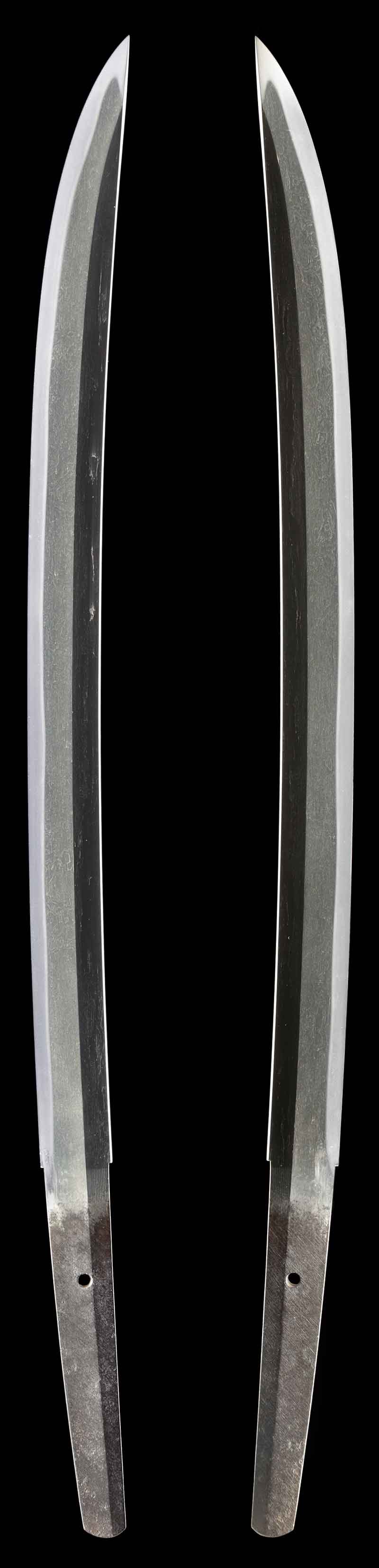
Sixty years of war between two courts drove blades long and broad, and Osafune met the demand: Kanemitsu and Chōgi led forges serving the provincial warriors who did the fighting, while Sōshū influence arrived with the armies to create Sōden-Bizen.
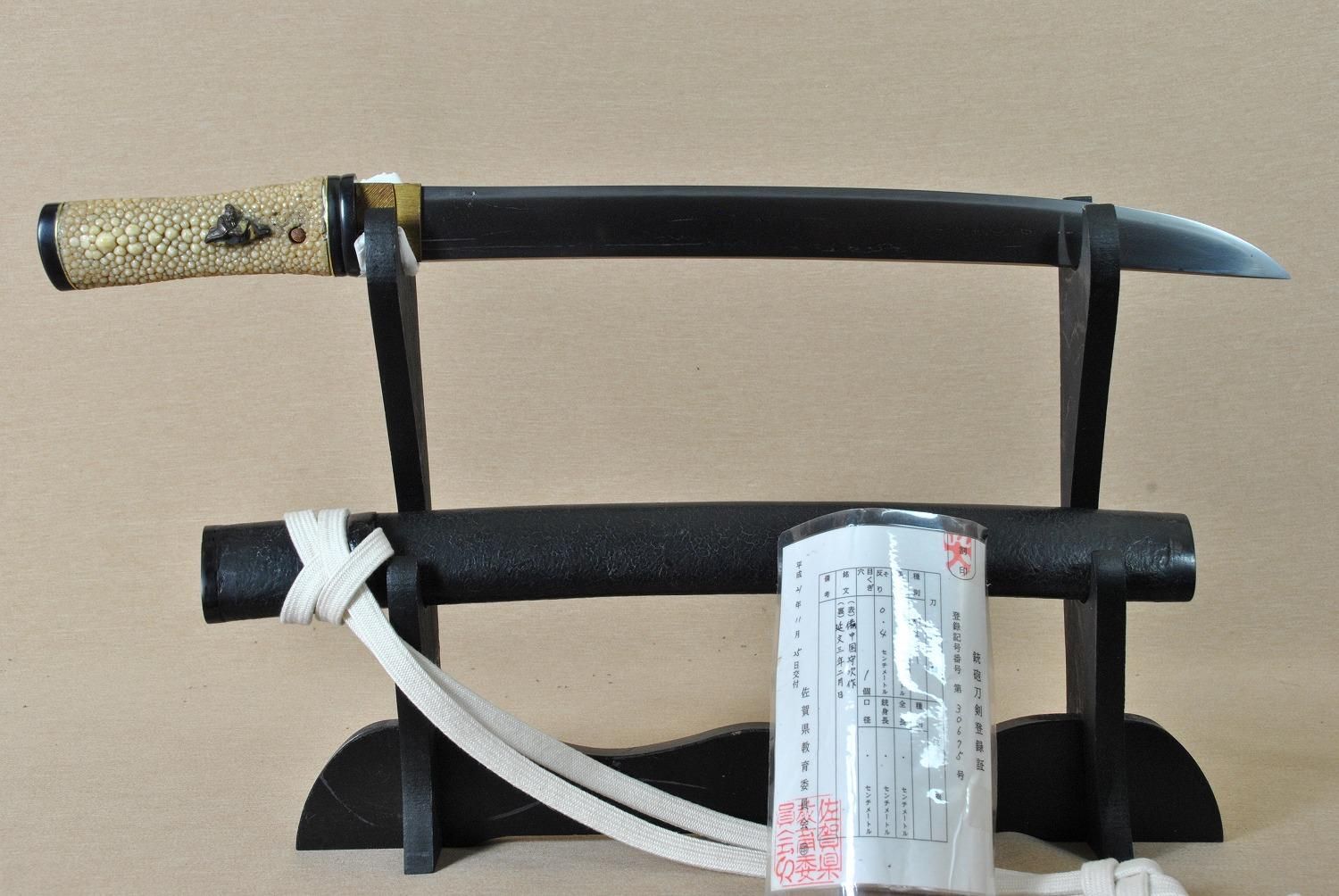
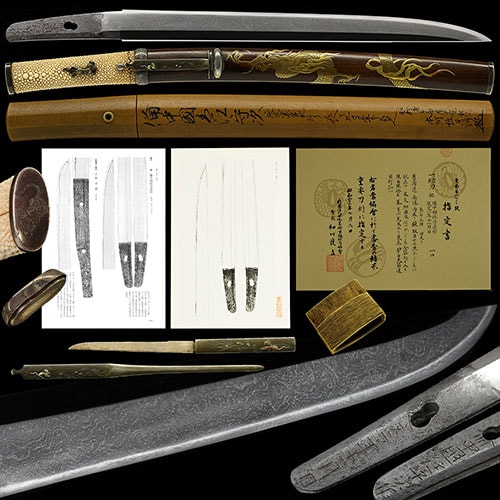
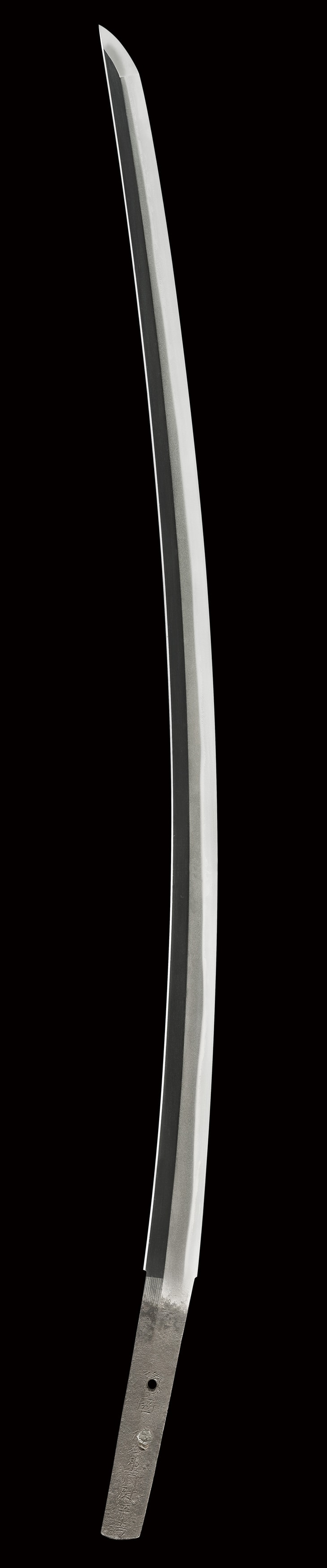
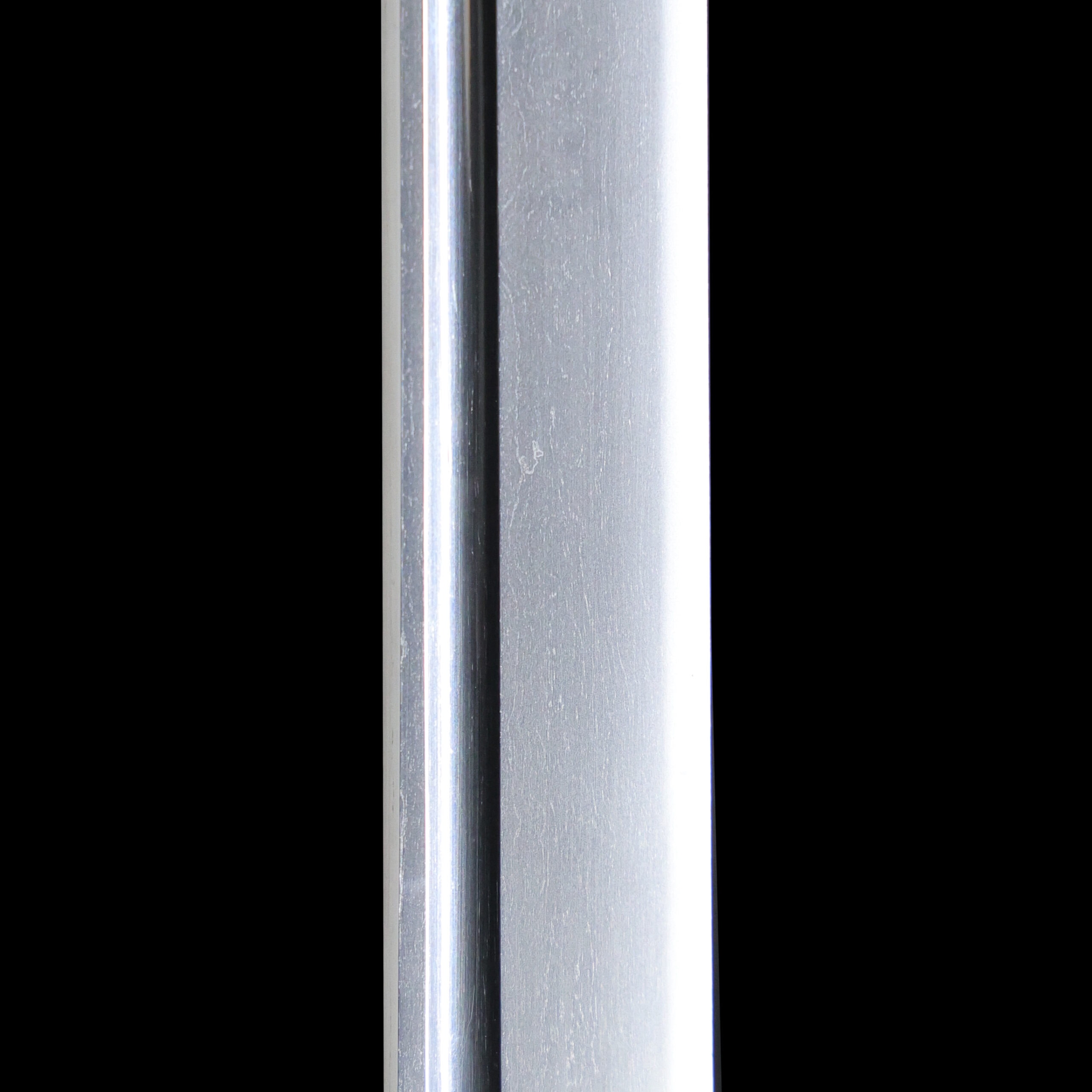
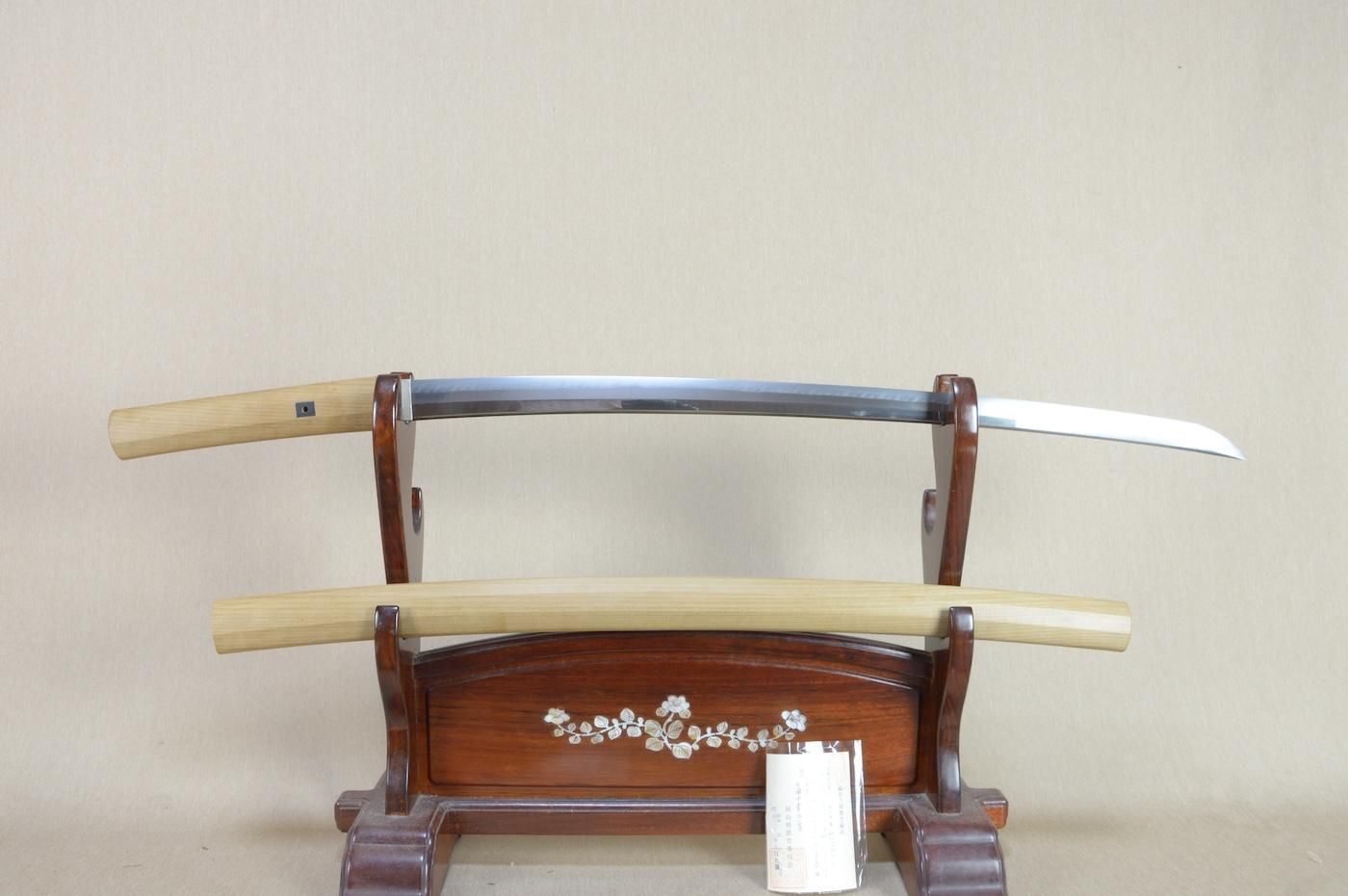
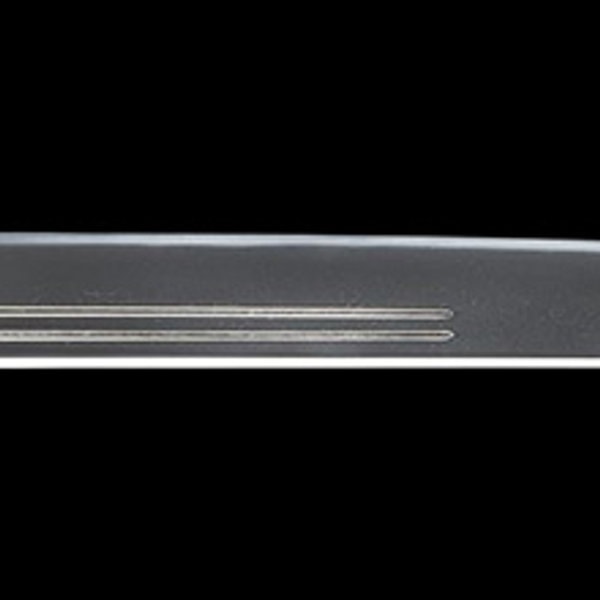
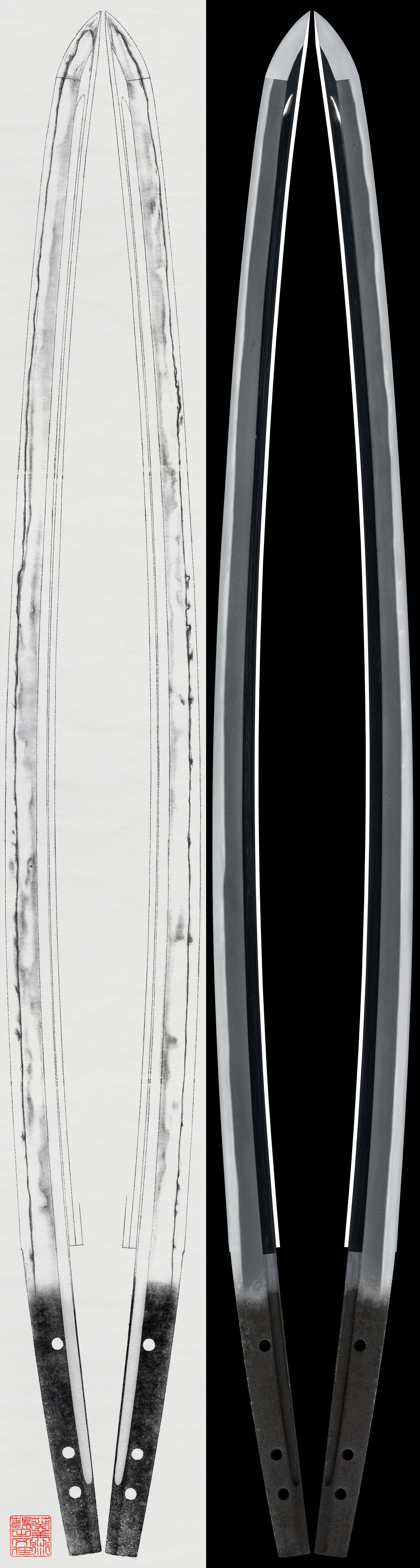
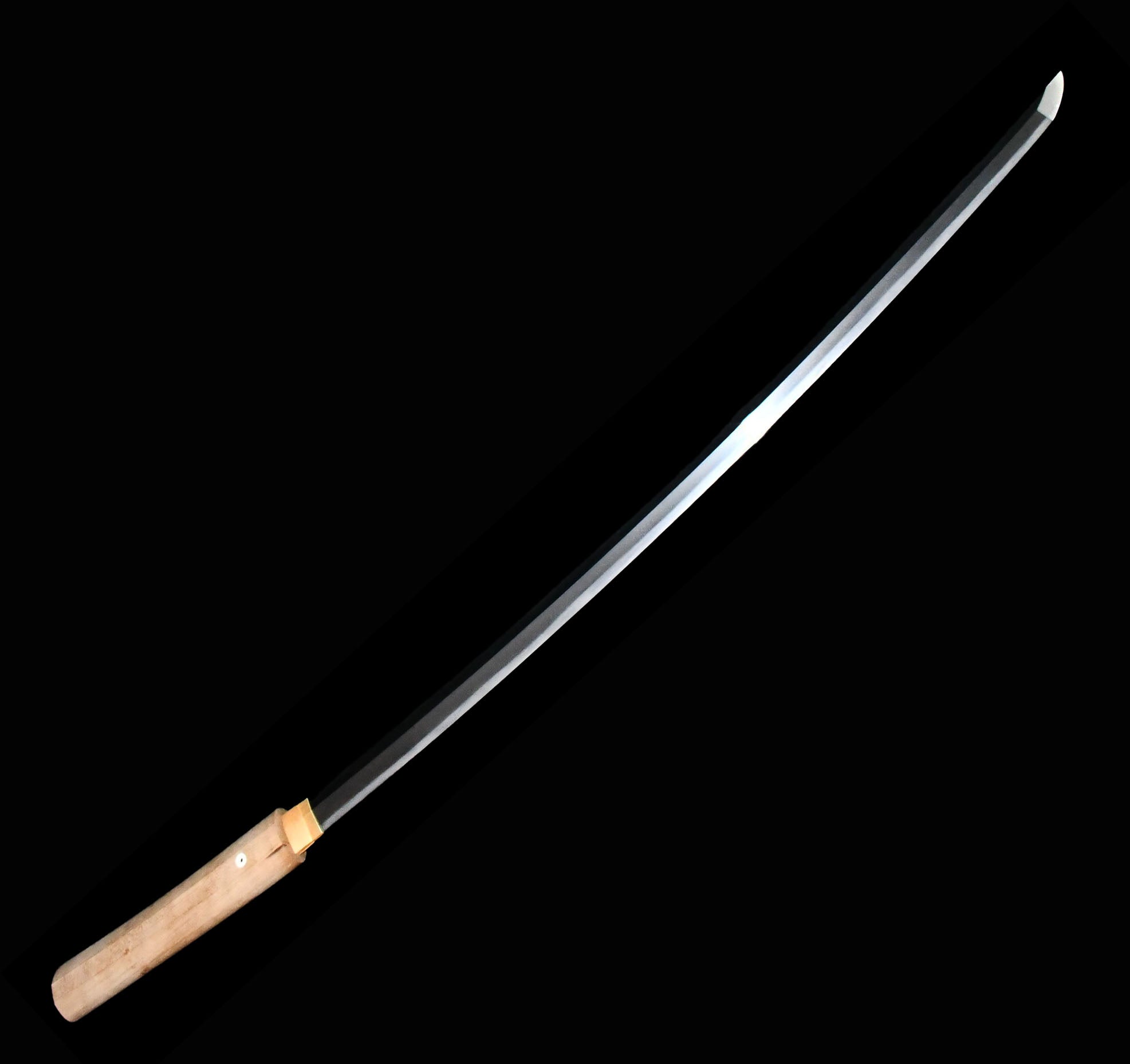
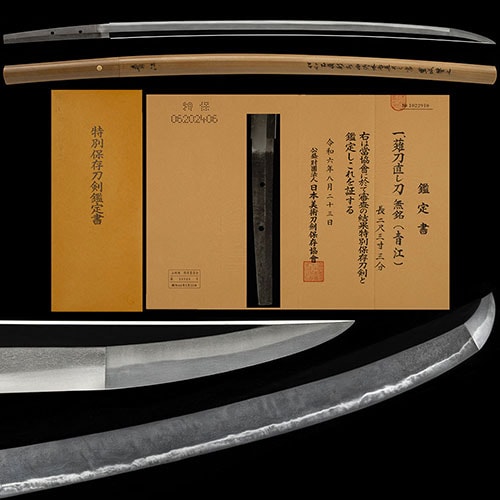
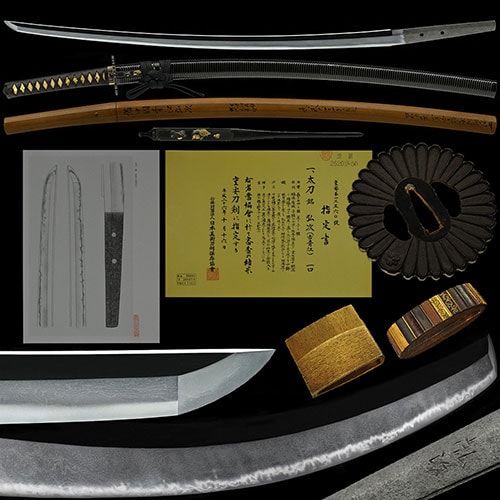
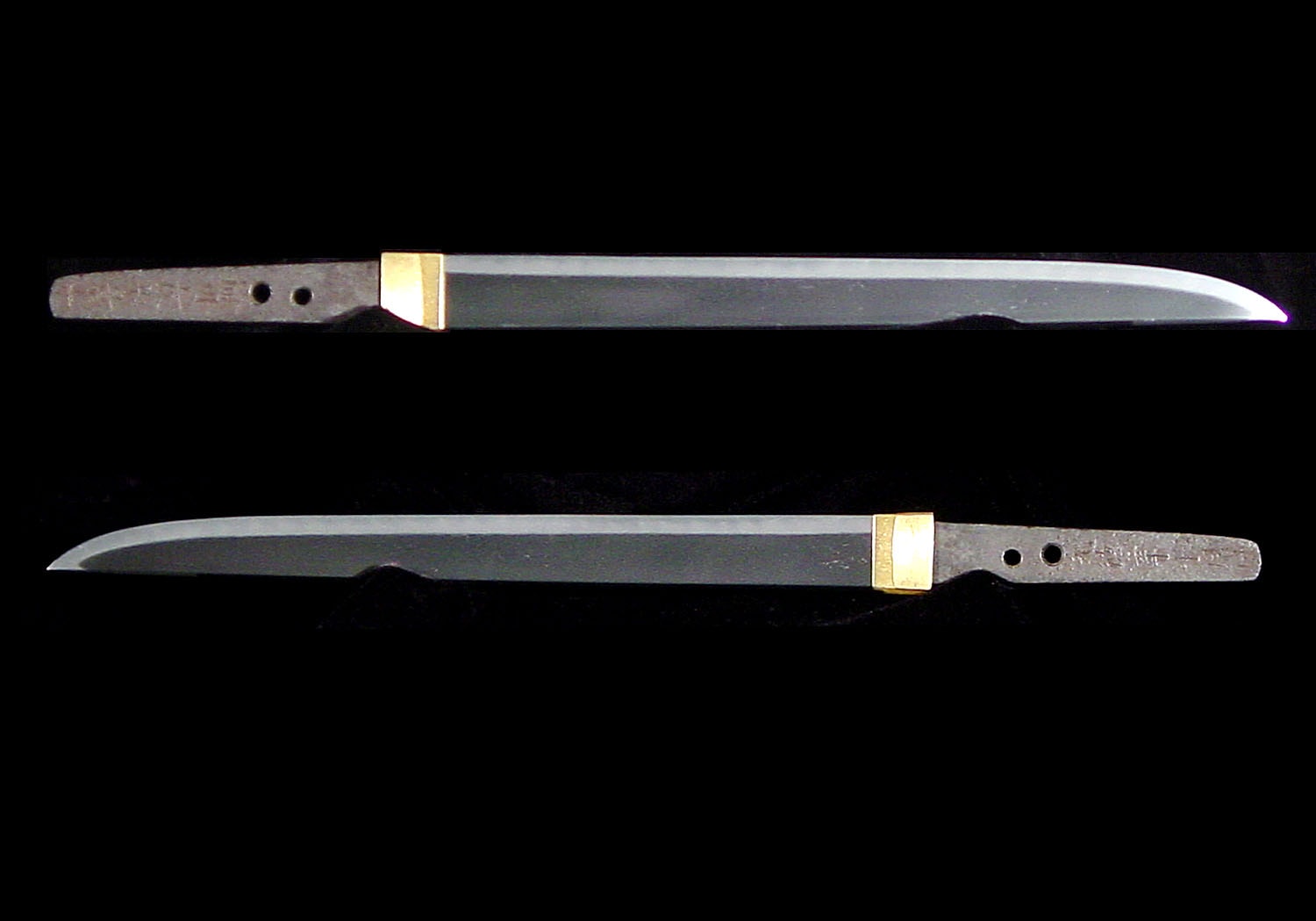
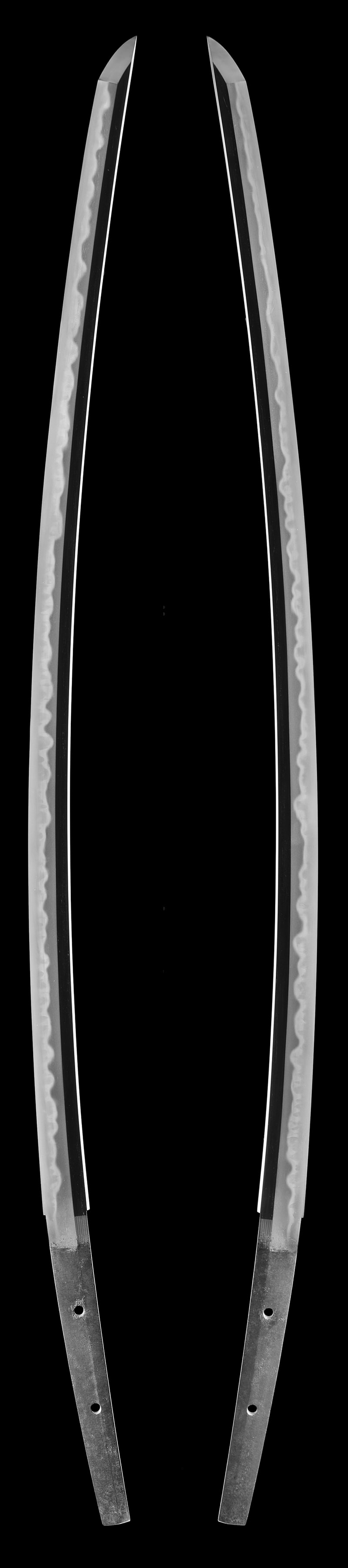
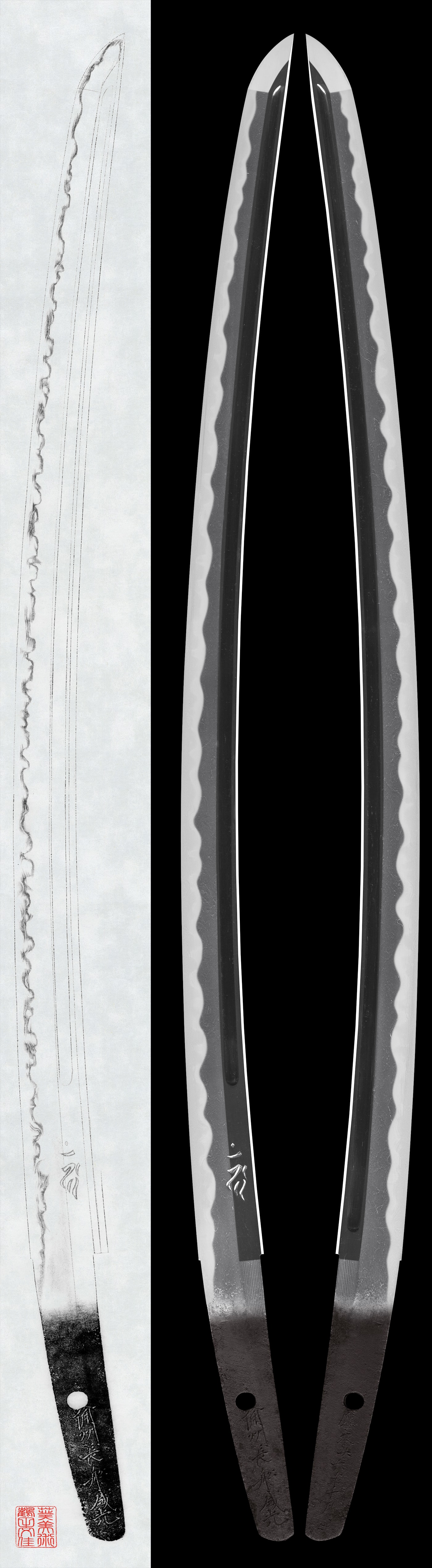
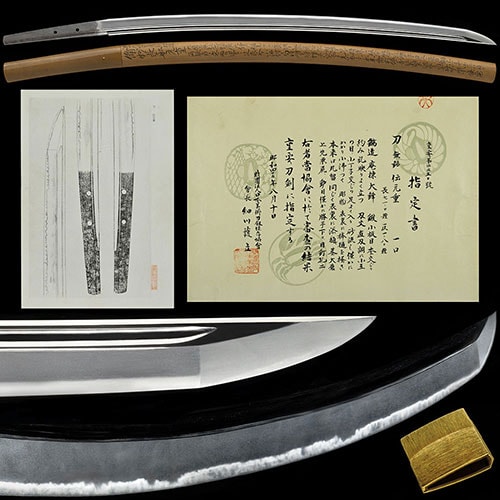
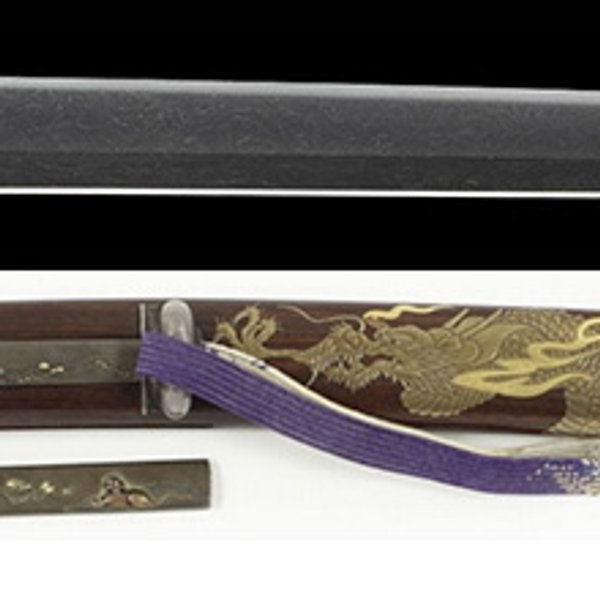
This is a tanto by Moritsugu, a swordsmith of the Aoe school in Bitchu province. This particular piece was made during the Nanbokucho period, specifically in the Enbun era. It features a prominent itame hada, showcasing a dignified beauty.
 NihontoWatch
mei · Aoe · Nanbokucho
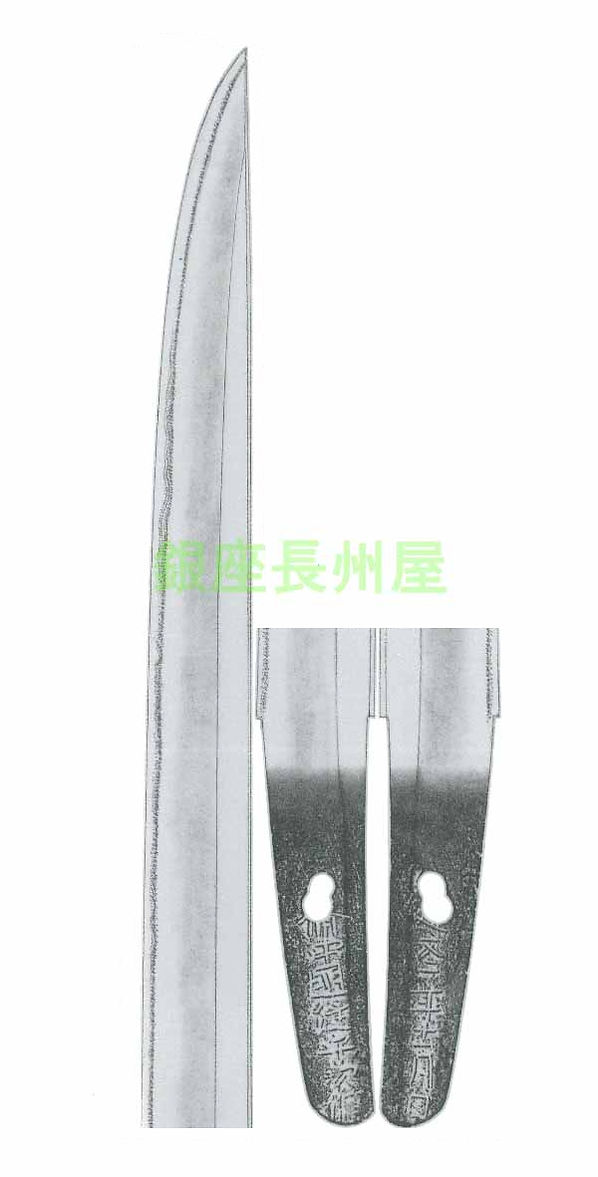
Aoe (Bitchu) · Bitchu · around 1356-1361
Fujishiro Jo saku · Tōken Taikan top 10%
Moritsugu is an Aoe smith of Bitchū, his name traditionally derived from Yasutsugu, the founder of the Aoe lineage, and carried by several hands from the Ko-Aoe period down into the Nanbokuchō. The published sources are careful with the name: the Meikan lists more than one smith called Moritsugu even within Ko-Aoe, and the name passed on afterward, so that surviving works range from blades judged to the end of Kamakura through dated pieces of the Bunwa and Enbun years in the middle of the Nanbokuchō. His record falls into two faces, an early powerful tachi and a group of dated late tantō, and of the latter the commentary on one Enbun piece says plainly that this is the work of the last bearer of the name, 'the Moritsugu who brought that tradition to its close'[[c:1]].
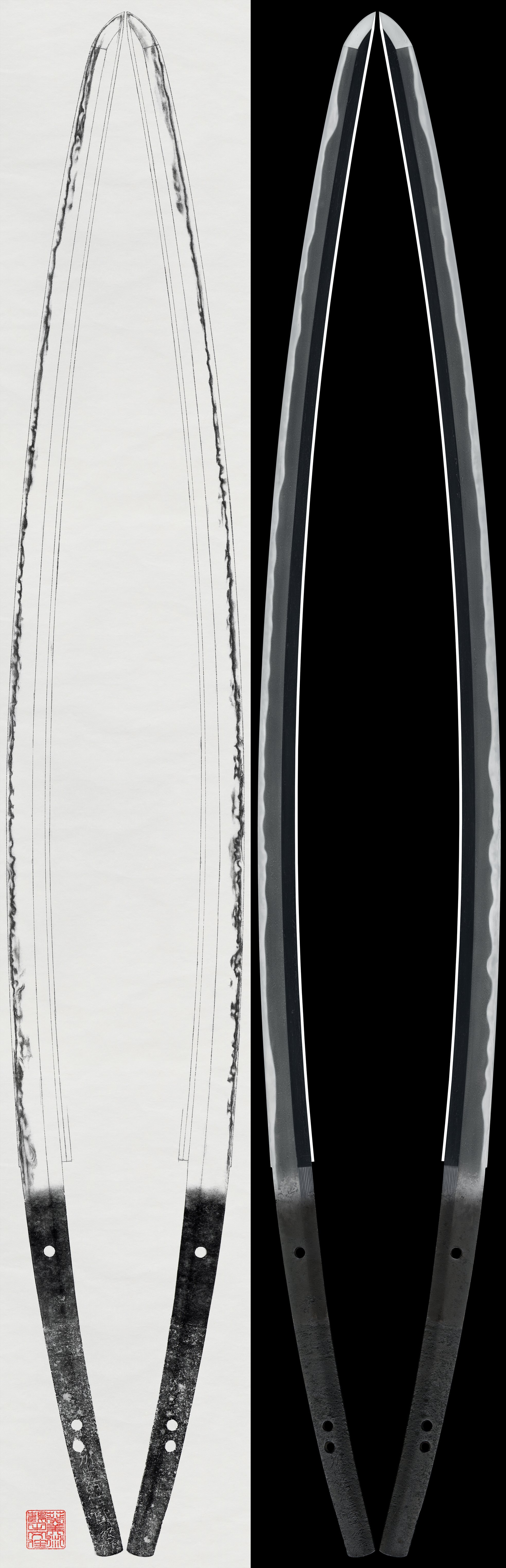
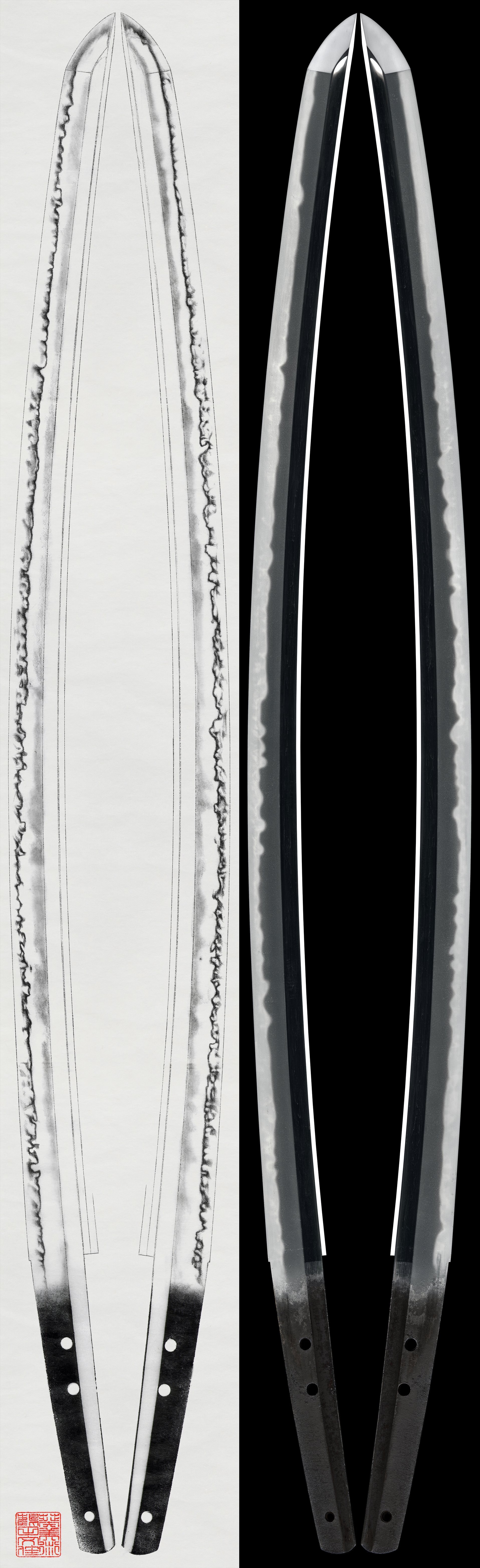
The hand that runs through both faces is a calm, bright suguha. On the late tantō the temper is nioi-dominant and clear, the nioiguchi drawn tight, ko-nie gathered along it; one Bunwa tantō the published record calls a textbook of Nanbokuchō Aoe suguha work. On the early tachi the same line is a suguha base into which ko-gunome and ko-chōji are set, ko-ashi entering, fine kinsuji running, the nioiguchi bright. The judges single out this quality above all: the way a tight, bright suguha is tempered to produce a deep shio-ai, a salt-like depth in the hardened edge, they call 'superb'[[c:2]], and from it 'the high technical level of Moritsugu can be perceived'[[c:3]].
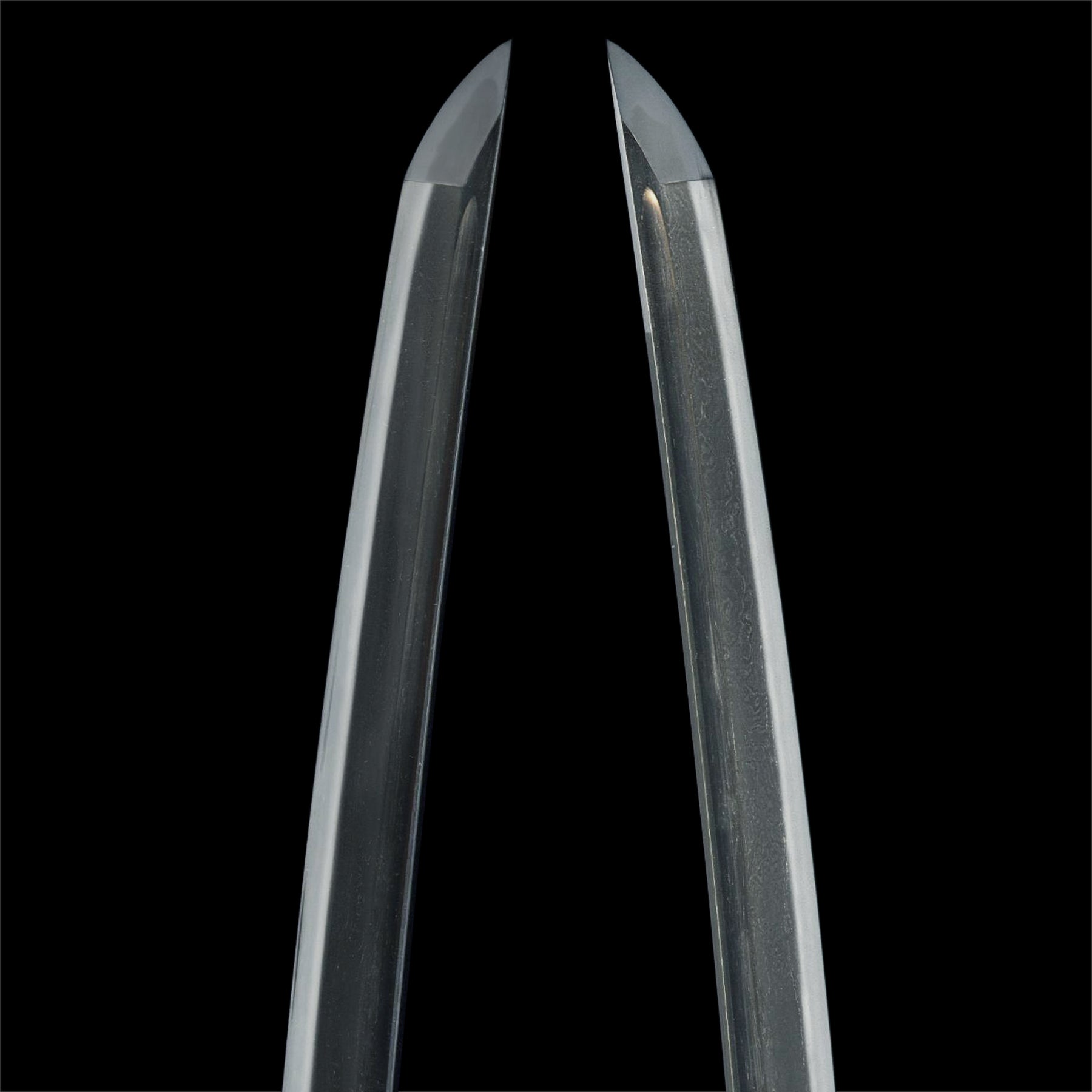
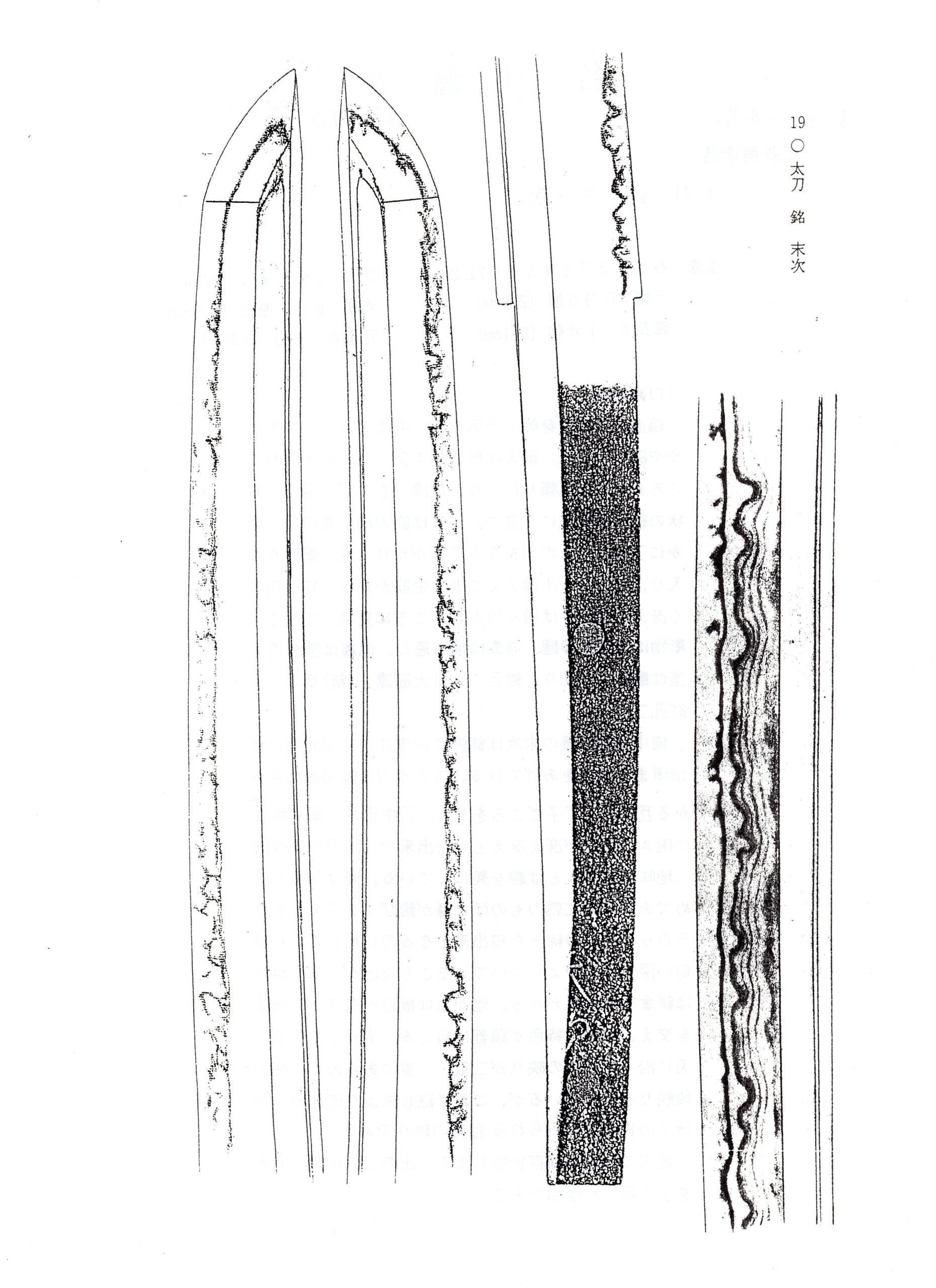
The jigane is the Aoe steel at two strengths. On the early two-character tachi it is a ko-itame mixed with ko-mokume, the grain finely standing, ji-nie adhering throughout in fine particles, chikei entering, and from the hamon boundary a somewhat faint midare-utsuri rising, the most refined jigane in his record. On the dated tantō the forging stands a little more, an itame that at times flows, mixed with jifu and chihan-like mottling, with a clear utsuri over it. The bōshi on both is essentially straight, turning back in a ko-maru, sometimes with hakikake, and on the tachi a bō-hi is carved through into the tang.
Within the dated work the published sources draw the period's central observation. The Aoe of this generation, they note, shows little conspicuous nie and becomes for the most part nioi-deki, and in it 'there are two manners, the traditional suguha and a splendid saka-chōji not seen before'[[c:4]]. Moritsugu's own work belongs to the first of these, the traditional suguha; the second, the reverse-slanting line, touches his hand only in the saka-inclined gunome of his Jūyō Bijutsuhin tantō, where the temper is a moist nioi-deki with reverse-leaning gunome mixed in. His shapes are of their moment: the early tachi wide and powerful with high koshizori, thick kasane and funbari in the Kenmu manner, the tantō hira-zukuri with a sun-nobi feeling or a faint uchizori, and one rare shōbu-zukuri piece the sources note as unusual for the smith and the school alike. Several of the tantō carry a sankō-ken or goma-bashi devotional carving in the groove.
What sets him within the school is the very thing the judges name. Against the flamboyant saka-chōji the late Aoe was then inventing, Moritsugu keeps the school's older line, a bright midare-utsuri over a fine ko-itame and a tight, luminous suguha. His powerful early tachi belongs to the classic Aoe manner of suguha and utsuri, while the dated tantō bring the long Moritsugu name to its end; one of his blades is judged so close in workmanship to the school's standard that its claim rests on era and lineage as much as on a personal tell. The strongest external anchor is documentary: the published sources find that the manner of cutting the signature on his finest tachi matches exactly the hand of the tachi long held by the Uesugi family, the Important Cultural Property known as the Rinpō Tachi, differing only in that his bō-hi carried through the tang forced the signature onto the hira-ji rather than toward the mune.
For the collector he is a rare and quiet name. Fujishiro grades him Jō saku; the Tōkō Taikan values his work in the upper-middle range. He has no National Treasures. His record runs instead through the Important Cultural Property tier, three blades among them, one Special Jūyō tachi and four Jūyō, with a single prewar Jūyō Bijutsuhin tantō, so that nine designated works stand on record. The most storied of them, the Rinpō Tachi descended through Uesugi Kenshin and his house, is preserved in the Tokyo National Museum, patrimony rather than property; the Jūyō Bijutsuhin tantō was certified in the Suzuki collection of Yamagata. Of the remainder the Special Jūyō and Jūyō tachi are the pieces that survive in private and recorded hands, and even these come to light only seldom, since extant Moritsugu of this period are few. A signed Aoe Moritsugu reaching a collector is an uncommon event, and a document of how the Aoe school carried its old suguha down to the close of its line.
Where Moritsugu stands among comparable artisans: across all of nihontō, and within tradition, era, and period. The tiers (Foremost · Leading · Major · Notable) weigh official designations from the NBTHK and Japan's Agency for Cultural Affairs, together with historical honors of lasting repute such as the Sansaku and Meibutsu-chō.
Select a lens to see how it's measured.
Years he was demonstrably active, proven by signed-and-dated blades
Bizen-den · Bitchu
Phase: Chū-Aoe中青江· 1235–1334
8 pieces on the market now
The Chu-Aoe school represents the middle and culminating phase of the Aoe tradition of Bitchu Province, encompassing smiths active from the late Kamakura period through the Nanbokucho era. The lineage traces its origins to an ancient swordmaking heritage in the lower basin of the Takahashi River, a tradition already celebrated in the eleventh-century Shin Sarugakki, which counted "the swords of Bitchu" among the notable products of the provinces. Scholars conventionally distinguish earlier Ko-Aoe production, extending through the mid-Kamakura period, from the Chu-Aoe and later Sue-Aoe phases that carried the tradition forward. The name Sadatsugu -- transmitted since the Kanchiin-bon Meizukushi as one of the goban-kaji appointed to serve Retired Emperor Gotoba and accorded the highest valuation in the Shinkan Hiden-sho -- stands as the school's most prestigious lineage name, while Yoshitsugu, Naotsugu, Tsunetsugu, and Hidetsugu represent the principal working smiths whose signed and dated examples anchor the chronology of the late Kamakura Aoe group. With the transition into the Nanbokucho period, a second flowering emerged under Tsugunao, Tsuguyoshi, and Moritsugu, who are consistently identified by the NBTHK as the representative smiths of Aoe in that era. The technical identity of Chu-Aoe is defined by a constellation of traits that recur with remarkable consistency across the school's members. The forging characteristically displays tightly packed ko-itame-hada mixed with mokume, upon which extremely fine ji-nie adheres thickly and delicate chikei are interwoven. A mottled, patch-like jifu texture frequently appears, and the distinctive crepe-like surface known as chirimen-hada is encountered among several smiths. Most diagnostic of all is the school's utsuri, which manifests in multiple forms: midare-utsuri, the stepped dan-utsuri in which linear utsuri near the edge transitions to midare-utsuri toward the mune, and the dark-toned sumihada. The hamon is fundamentally suguha-based, ranging from narrow hoso-suguha to medium chu-suguha with shallow notare, into which ko-gunome, ko-choji, and saka-ashi are mixed. The nioiguchi is universally described as tight, bright, and clear -- the single most defining quality of the school -- producing a deep shio-ai that is repeatedly praised in NBTHK assessments.
The boshi characteristically runs straight, turning back in ko-maru with a tendency toward a pointed tip. A critical stylistic evolution occurred within the Nanbokucho period: while the late Kamakura smiths worked predominantly in suguha, the later generation developed a splendid, flamboyant saka-choji-midare that became the school's most celebrated mode. Tsugunao is recognized as "a master of saka-choji," producing tempering of such florid brilliance that the NBTHK characterizes it as "the exclusive forte of this group" -- an emblematic and highly individual domain. The reverse-slanting tendencies visible in earlier Kamakura-period works are understood as precursors to this splendid later development. The Chu-Aoe school occupies a position of enduring prestige within the Japanese sword canon. The Hon'ami family developed a longstanding practice of rendering Sadatsugu appraisals for unsigned Aoe works of particularly fine workmanship, treating the name as a mark of the highest quality within the tradition. Naotsugu and Yoshitsugu, whose signed examples bearing official court titles and era dates from Gentoku through Kanno survive in exceptional condition, furnish irreplaceable documentary material for the study of Bitchu swordmaking. Works from the school have been transmitted through distinguished collections -- the Choshu Mori, the Nabeshima of Hizen, the Uesugi, and the Maeda of Kaga -- attesting to sustained appreciation across centuries. Naotsugu occupies a pivotal position at the transition from the ko-nie-deki manner of the Kamakura period to the tighter, brighter nioi-deki workmanship of the Nanbokucho era, while Moritsugu's rare surviving works bridge the late Kamakura and early Nanbokucho phases with tanto displaying both the traditional suguha and a saka-choji not previously encountered in the school. In both the quiet restraint of their suguha and the gorgeous brilliance of their saka-choji-midare, the smiths of Chu-Aoe demonstrate the Bitchu tradition at its most refined and accomplished -- a school whose tightly forged steel, luminous nioiguchi, and distinctive utsuri constitute an aesthetic achievement of the first order. Learn more →
| Smith | Era | Designated |
|---|---|---|
| Tsugunao次直 | 1345-1361 | 25 |
| Naotsugu直次 | 1335-1364 | 15 |
| Yoshitsugu吉次 | 1326-1332 | 17 |
| Moritsugu守次 | 1356-1361 | 9 |
| Tsuguyoshi次吉 | 1338-1358 | 19 |
Bizen in the Nanbokuchō period
Sixty years of war between two courts drove blades long and broad, and Osafune met the demand: Kanemitsu and Chōgi led forges serving the provincial warriors who did the fighting, while Sōshū influence arrived with the armies to create Sōden-Bizen.
We could not find an authenticity certificate on the seller’s listing. Japanese swords and fittings are normally papered by the NBTHK (or the NTHK). Without one, the attribution is the seller’s own assessment and has not been independently verified — treat it with caution and ask the dealer about certification before buying.
If, due to our fault, the item differs significantly from its proper condition, the item may be returned. Cooling-off is within one week of the item's arrival.

This is a tanto by Moritsugu, a swordsmith of the Aoe school in Bitchu province. This particular piece was made during the Nanbokucho period, specifically in the Enbun era. It features a prominent itame hada, showcasing a dignified beauty.
NihontoWatchmei · Aoe · Nanbokucho
Aoe (Bitchu) · Bitchu · around 1356-1361
Fujishiro Jo saku · Tōken Taikan top 10%
Moritsugu is an Aoe smith of Bitchū, his name traditionally derived from Yasutsugu, the founder of the Aoe lineage, and carried by several hands from the Ko-Aoe period down into the Nanbokuchō. The published sources are careful with the name: the Meikan lists more than one smith called Moritsugu even within Ko-Aoe, and the name passed on afterward, so that surviving works range from blades judged to the end of Kamakura through dated pieces of the Bunwa and Enbun years in the middle of the Nanbokuchō. His record falls into two faces, an early powerful tachi and a group of dated late tantō, and of the latter the commentary on one Enbun piece says plainly that this is the work of the last bearer of the name, 'the Moritsugu who brought that tradition to its close'[[c:1]].
The hand that runs through both faces is a calm, bright suguha. On the late tantō the temper is nioi-dominant and clear, the nioiguchi drawn tight, ko-nie gathered along it; one Bunwa tantō the published record calls a textbook of Nanbokuchō Aoe suguha work. On the early tachi the same line is a suguha base into which ko-gunome and ko-chōji are set, ko-ashi entering, fine kinsuji running, the nioiguchi bright. The judges single out this quality above all: the way a tight, bright suguha is tempered to produce a deep shio-ai, a salt-like depth in the hardened edge, they call 'superb'[[c:2]], and from it 'the high technical level of Moritsugu can be perceived'[[c:3]].
The jigane is the Aoe steel at two strengths. On the early two-character tachi it is a ko-itame mixed with ko-mokume, the grain finely standing, ji-nie adhering throughout in fine particles, chikei entering, and from the hamon boundary a somewhat faint midare-utsuri rising, the most refined jigane in his record. On the dated tantō the forging stands a little more, an itame that at times flows, mixed with jifu and chihan-like mottling, with a clear utsuri over it. The bōshi on both is essentially straight, turning back in a ko-maru, sometimes with hakikake, and on the tachi a bō-hi is carved through into the tang.
Within the dated work the published sources draw the period's central observation. The Aoe of this generation, they note, shows little conspicuous nie and becomes for the most part nioi-deki, and in it 'there are two manners, the traditional suguha and a splendid saka-chōji not seen before'[[c:4]]. Moritsugu's own work belongs to the first of these, the traditional suguha; the second, the reverse-slanting line, touches his hand only in the saka-inclined gunome of his Jūyō Bijutsuhin tantō, where the temper is a moist nioi-deki with reverse-leaning gunome mixed in. His shapes are of their moment: the early tachi wide and powerful with high koshizori, thick kasane and funbari in the Kenmu manner, the tantō hira-zukuri with a sun-nobi feeling or a faint uchizori, and one rare shōbu-zukuri piece the sources note as unusual for the smith and the school alike. Several of the tantō carry a sankō-ken or goma-bashi devotional carving in the groove.
What sets him within the school is the very thing the judges name. Against the flamboyant saka-chōji the late Aoe was then inventing, Moritsugu keeps the school's older line, a bright midare-utsuri over a fine ko-itame and a tight, luminous suguha. His powerful early tachi belongs to the classic Aoe manner of suguha and utsuri, while the dated tantō bring the long Moritsugu name to its end; one of his blades is judged so close in workmanship to the school's standard that its claim rests on era and lineage as much as on a personal tell. The strongest external anchor is documentary: the published sources find that the manner of cutting the signature on his finest tachi matches exactly the hand of the tachi long held by the Uesugi family, the Important Cultural Property known as the Rinpō Tachi, differing only in that his bō-hi carried through the tang forced the signature onto the hira-ji rather than toward the mune.
For the collector he is a rare and quiet name. Fujishiro grades him Jō saku; the Tōkō Taikan values his work in the upper-middle range. He has no National Treasures. His record runs instead through the Important Cultural Property tier, three blades among them, one Special Jūyō tachi and four Jūyō, with a single prewar Jūyō Bijutsuhin tantō, so that nine designated works stand on record. The most storied of them, the Rinpō Tachi descended through Uesugi Kenshin and his house, is preserved in the Tokyo National Museum, patrimony rather than property; the Jūyō Bijutsuhin tantō was certified in the Suzuki collection of Yamagata. Of the remainder the Special Jūyō and Jūyō tachi are the pieces that survive in private and recorded hands, and even these come to light only seldom, since extant Moritsugu of this period are few. A signed Aoe Moritsugu reaching a collector is an uncommon event, and a document of how the Aoe school carried its old suguha down to the close of its line.
Where Moritsugu stands among comparable artisans: across all of nihontō, and within tradition, era, and period. The tiers (Foremost · Leading · Major · Notable) weigh official designations from the NBTHK and Japan's Agency for Cultural Affairs, together with historical honors of lasting repute such as the Sansaku and Meibutsu-chō.
Select a lens to see how it's measured.
Years he was demonstrably active, proven by signed-and-dated blades
Bizen-den · Bitchu
Phase: Chū-Aoe中青江· 1235–1334
8 pieces on the market now
The Chu-Aoe school represents the middle and culminating phase of the Aoe tradition of Bitchu Province, encompassing smiths active from the late Kamakura period through the Nanbokucho era. The lineage traces its origins to an ancient swordmaking heritage in the lower basin of the Takahashi River, a tradition already celebrated in the eleventh-century Shin Sarugakki, which counted "the swords of Bitchu" among the notable products of the provinces. Scholars conventionally distinguish earlier Ko-Aoe production, extending through the mid-Kamakura period, from the Chu-Aoe and later Sue-Aoe phases that carried the tradition forward. The name Sadatsugu -- transmitted since the Kanchiin-bon Meizukushi as one of the goban-kaji appointed to serve Retired Emperor Gotoba and accorded the highest valuation in the Shinkan Hiden-sho -- stands as the school's most prestigious lineage name, while Yoshitsugu, Naotsugu, Tsunetsugu, and Hidetsugu represent the principal working smiths whose signed and dated examples anchor the chronology of the late Kamakura Aoe group. With the transition into the Nanbokucho period, a second flowering emerged under Tsugunao, Tsuguyoshi, and Moritsugu, who are consistently identified by the NBTHK as the representative smiths of Aoe in that era. The technical identity of Chu-Aoe is defined by a constellation of traits that recur with remarkable consistency across the school's members. The forging characteristically displays tightly packed ko-itame-hada mixed with mokume, upon which extremely fine ji-nie adheres thickly and delicate chikei are interwoven. A mottled, patch-like jifu texture frequently appears, and the distinctive crepe-like surface known as chirimen-hada is encountered among several smiths. Most diagnostic of all is the school's utsuri, which manifests in multiple forms: midare-utsuri, the stepped dan-utsuri in which linear utsuri near the edge transitions to midare-utsuri toward the mune, and the dark-toned sumihada. The hamon is fundamentally suguha-based, ranging from narrow hoso-suguha to medium chu-suguha with shallow notare, into which ko-gunome, ko-choji, and saka-ashi are mixed. The nioiguchi is universally described as tight, bright, and clear -- the single most defining quality of the school -- producing a deep shio-ai that is repeatedly praised in NBTHK assessments.
The boshi characteristically runs straight, turning back in ko-maru with a tendency toward a pointed tip. A critical stylistic evolution occurred within the Nanbokucho period: while the late Kamakura smiths worked predominantly in suguha, the later generation developed a splendid, flamboyant saka-choji-midare that became the school's most celebrated mode. Tsugunao is recognized as "a master of saka-choji," producing tempering of such florid brilliance that the NBTHK characterizes it as "the exclusive forte of this group" -- an emblematic and highly individual domain. The reverse-slanting tendencies visible in earlier Kamakura-period works are understood as precursors to this splendid later development. The Chu-Aoe school occupies a position of enduring prestige within the Japanese sword canon. The Hon'ami family developed a longstanding practice of rendering Sadatsugu appraisals for unsigned Aoe works of particularly fine workmanship, treating the name as a mark of the highest quality within the tradition. Naotsugu and Yoshitsugu, whose signed examples bearing official court titles and era dates from Gentoku through Kanno survive in exceptional condition, furnish irreplaceable documentary material for the study of Bitchu swordmaking. Works from the school have been transmitted through distinguished collections -- the Choshu Mori, the Nabeshima of Hizen, the Uesugi, and the Maeda of Kaga -- attesting to sustained appreciation across centuries. Naotsugu occupies a pivotal position at the transition from the ko-nie-deki manner of the Kamakura period to the tighter, brighter nioi-deki workmanship of the Nanbokucho era, while Moritsugu's rare surviving works bridge the late Kamakura and early Nanbokucho phases with tanto displaying both the traditional suguha and a saka-choji not previously encountered in the school. In both the quiet restraint of their suguha and the gorgeous brilliance of their saka-choji-midare, the smiths of Chu-Aoe demonstrate the Bitchu tradition at its most refined and accomplished -- a school whose tightly forged steel, luminous nioiguchi, and distinctive utsuri constitute an aesthetic achievement of the first order. Learn more →
| Smith | Era | Designated |
|---|---|---|
| Tsugunao次直 | 1345-1361 | 25 |
| Naotsugu直次 | 1335-1364 | 15 |
| Yoshitsugu吉次 | 1326-1332 | 17 |
| Moritsugu守次 | 1356-1361 | 9 |
| Tsuguyoshi次吉 | 1338-1358 | 19 |
Bizen in the Nanbokuchō period
Sixty years of war between two courts drove blades long and broad, and Osafune met the demand: Kanemitsu and Chōgi led forges serving the provincial warriors who did the fighting, while Sōshū influence arrived with the armies to create Sōden-Bizen.
We could not find an authenticity certificate on the seller’s listing. Japanese swords and fittings are normally papered by the NBTHK (or the NTHK). Without one, the attribution is the seller’s own assessment and has not been independently verified — treat it with caution and ask the dealer about certification before buying.
If, due to our fault, the item differs significantly from its proper condition, the item may be returned. Cooling-off is within one week of the item's arrival.