Edo was the sword’s age of connoisseurship: the Hon’ami appraisers, the shogunal register of famous blades of 1719, and a thriving literature turned the sword into an object of study even as it ceased to be drawn in war.
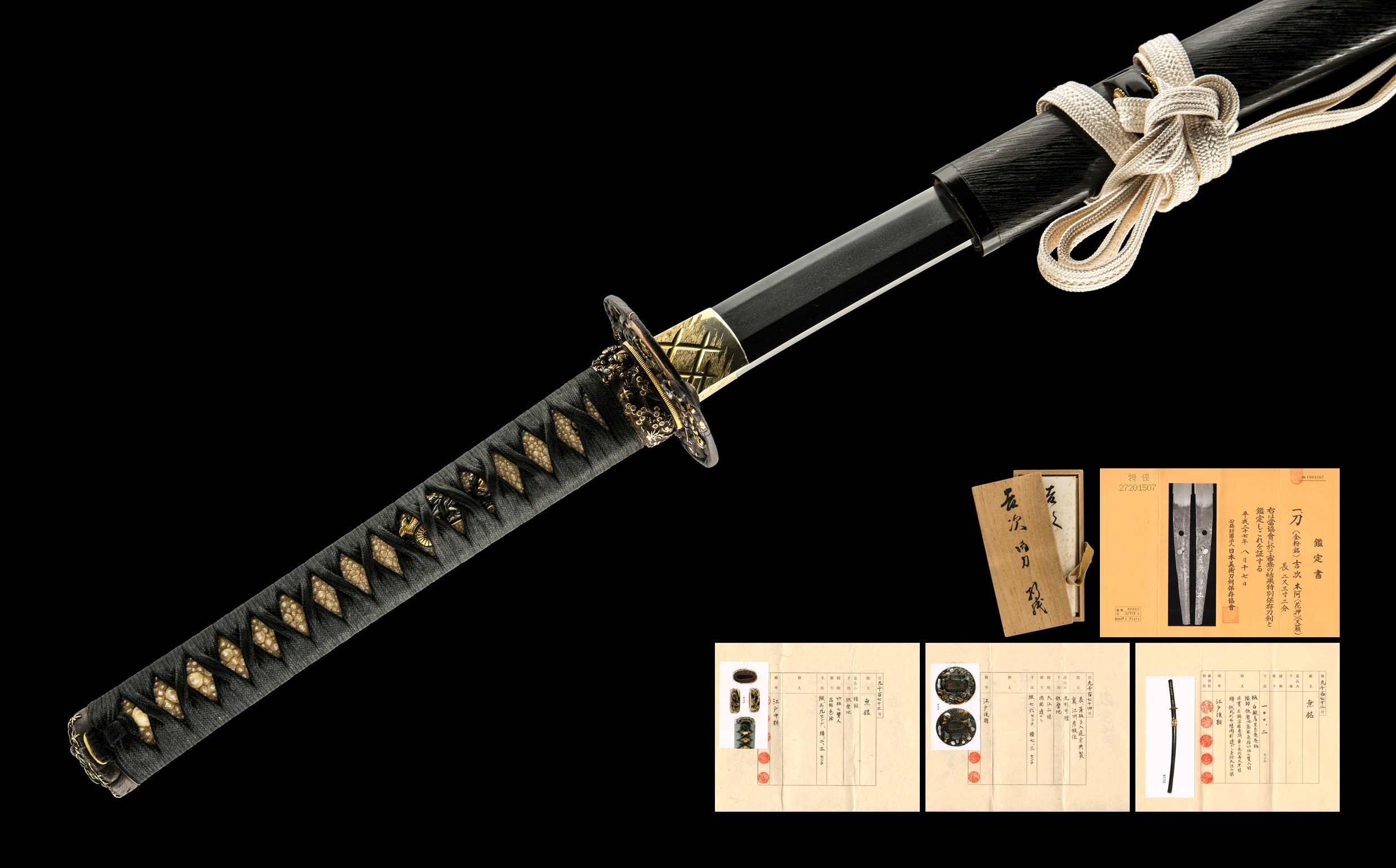
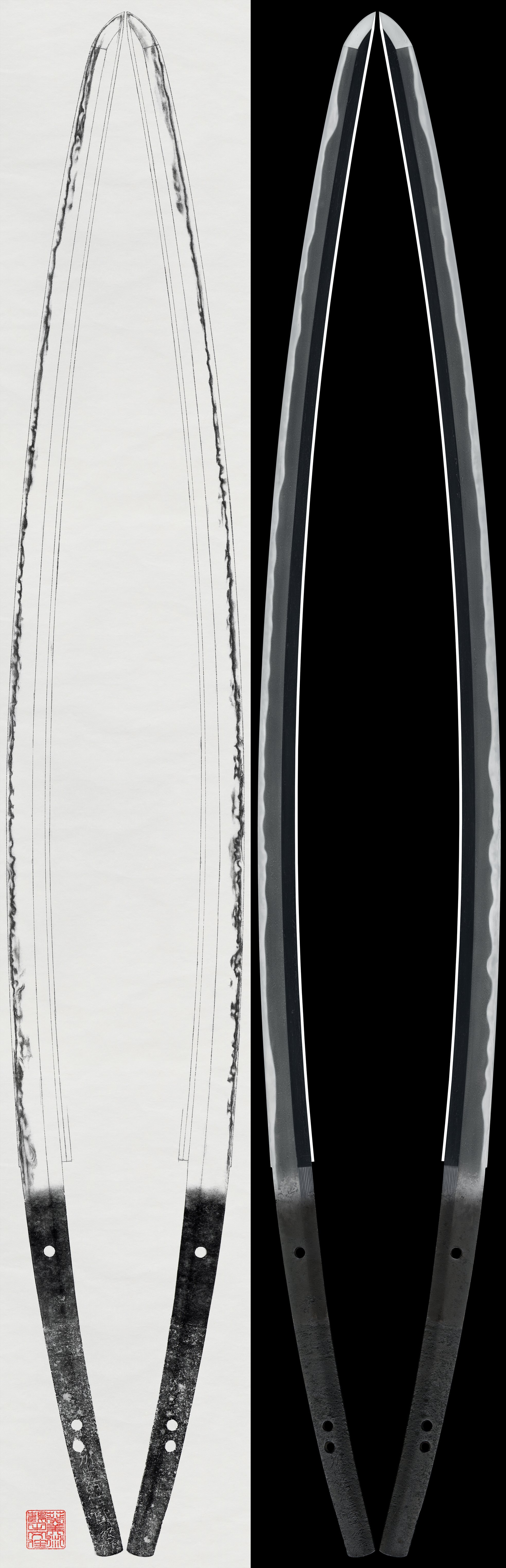
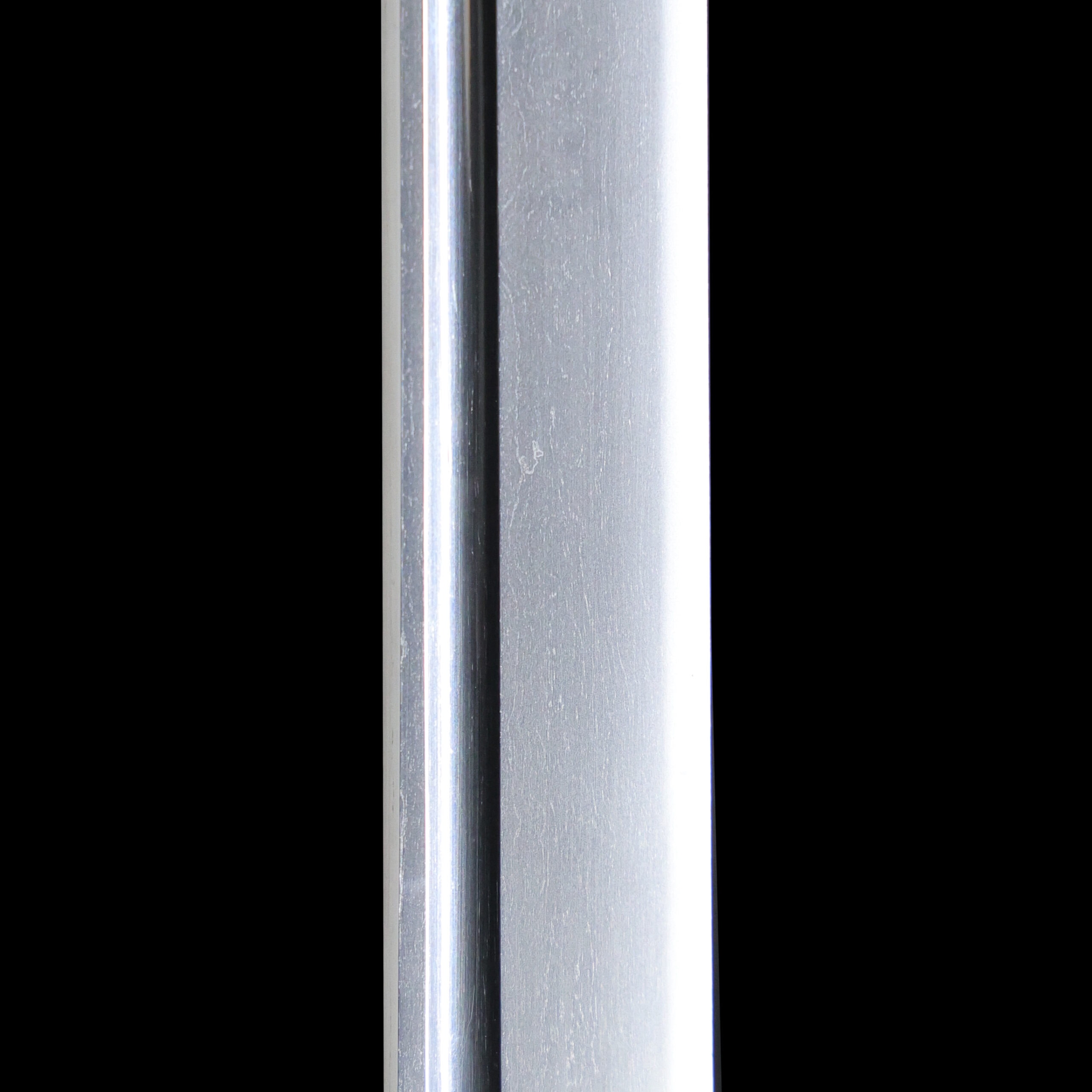
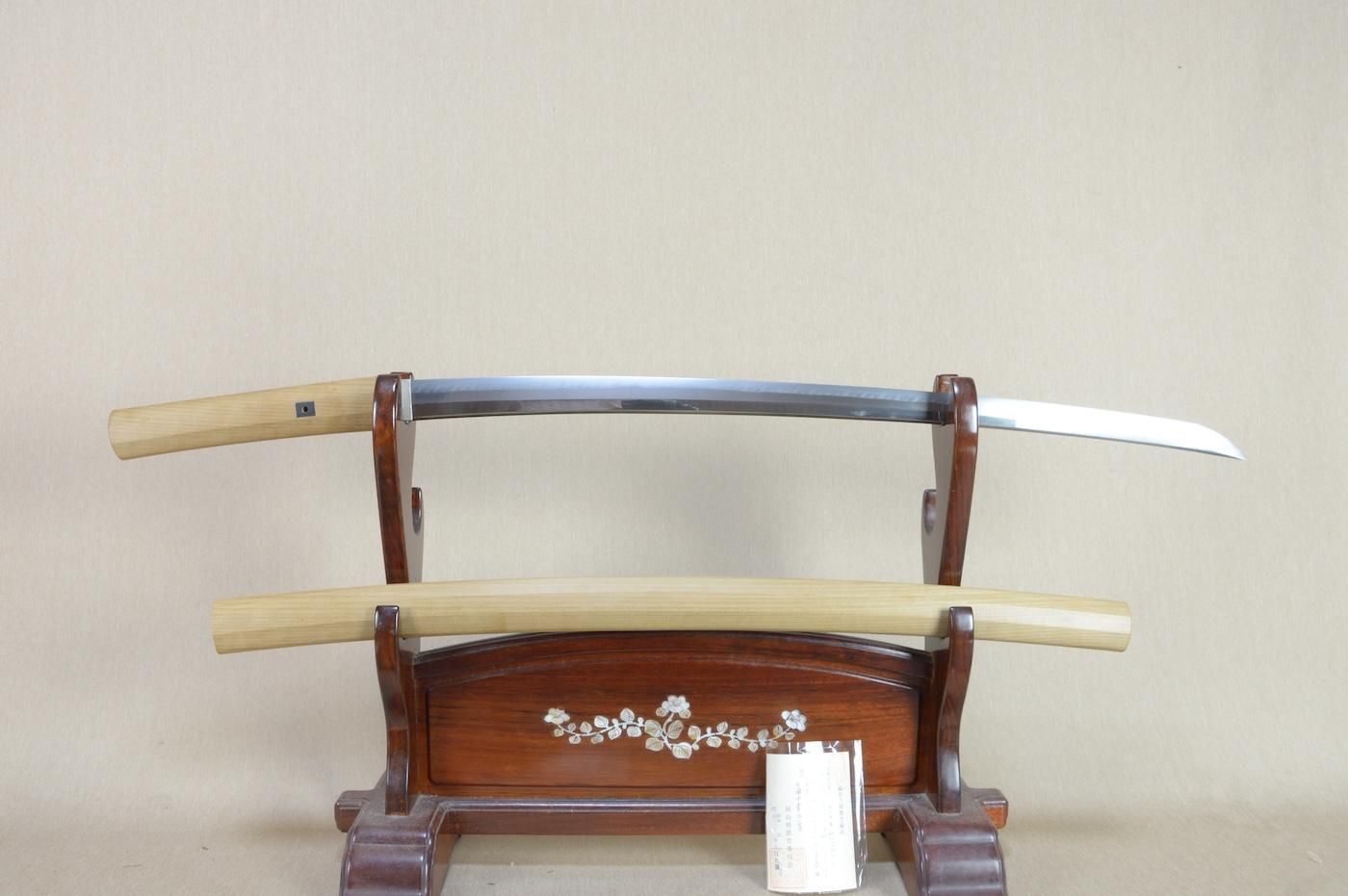
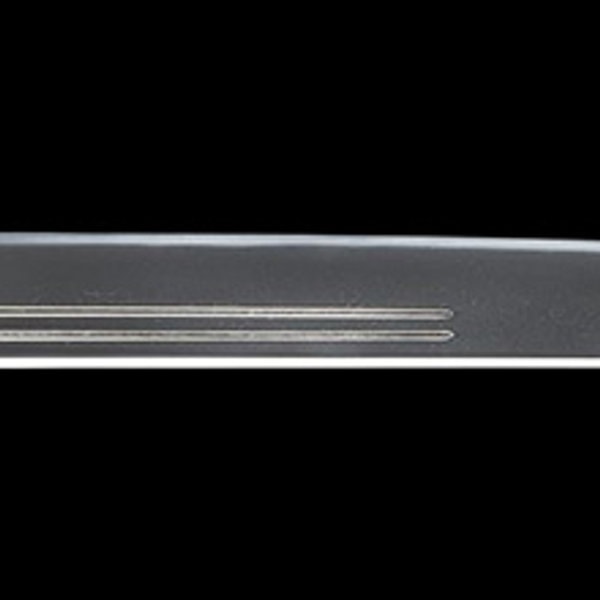
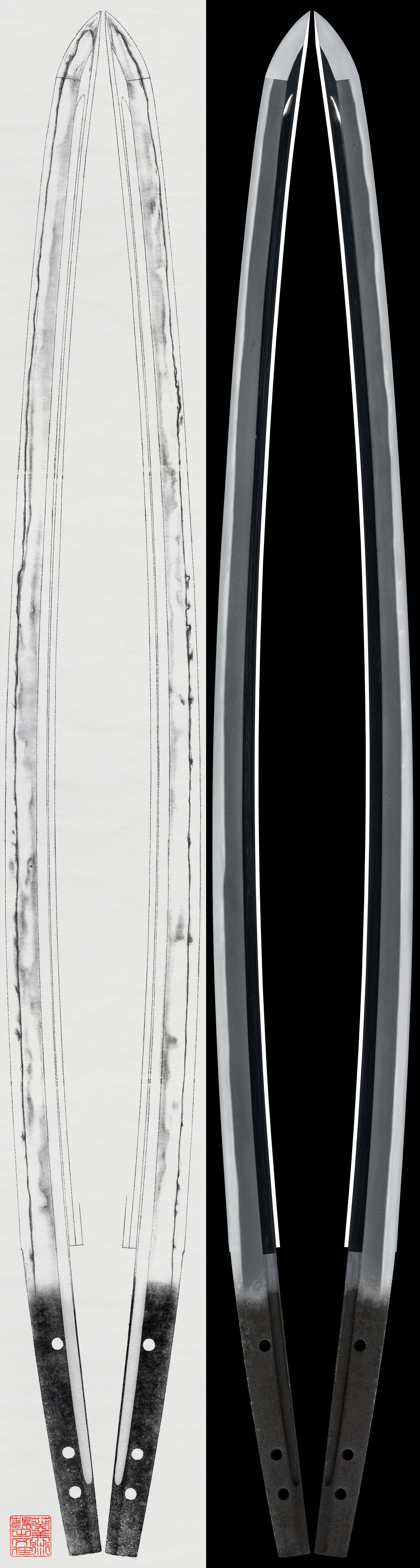
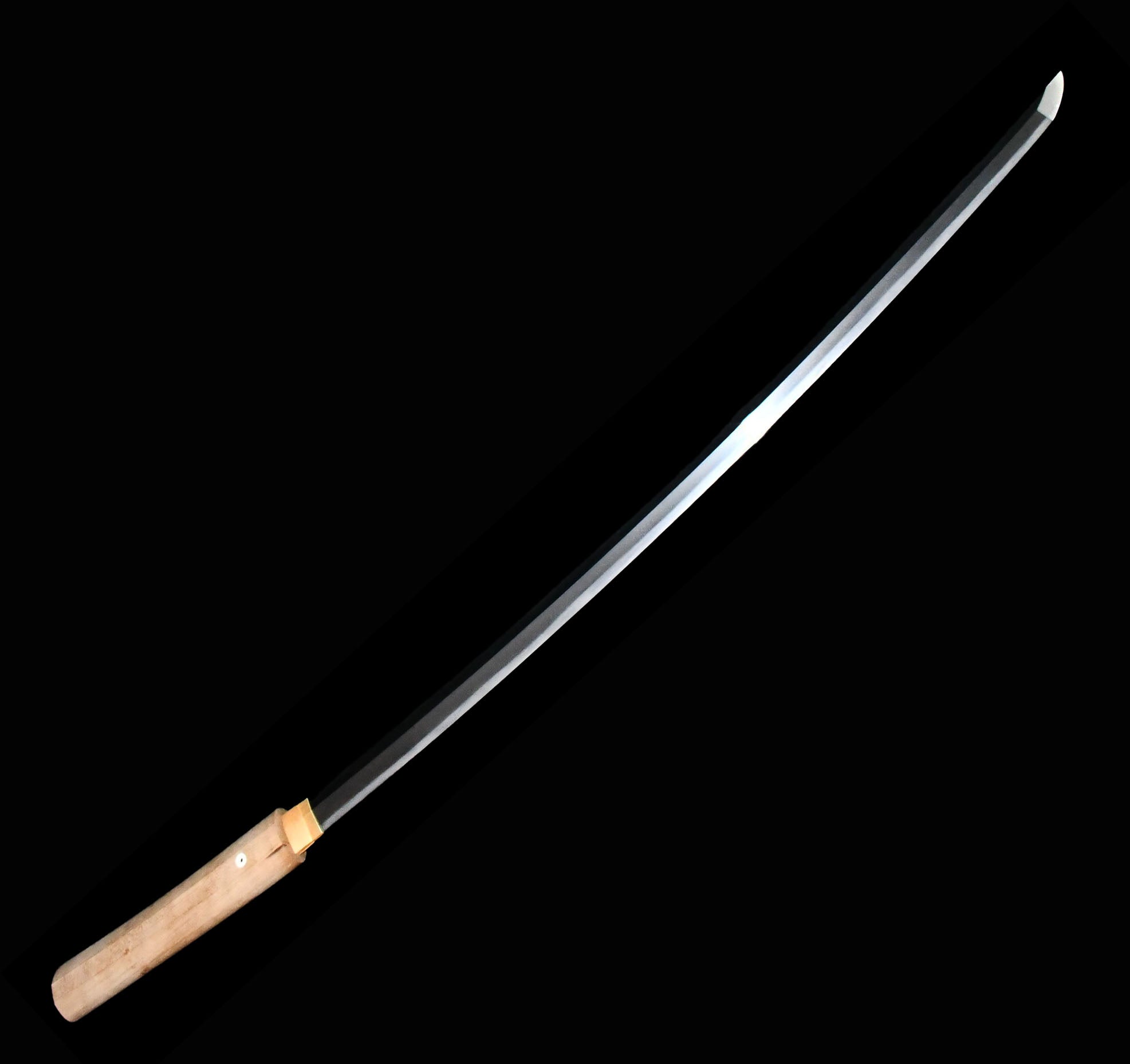
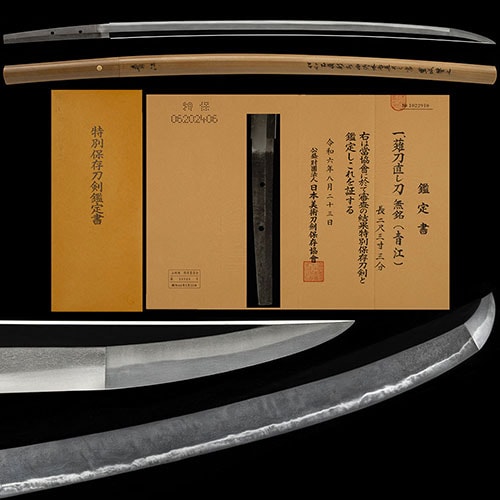
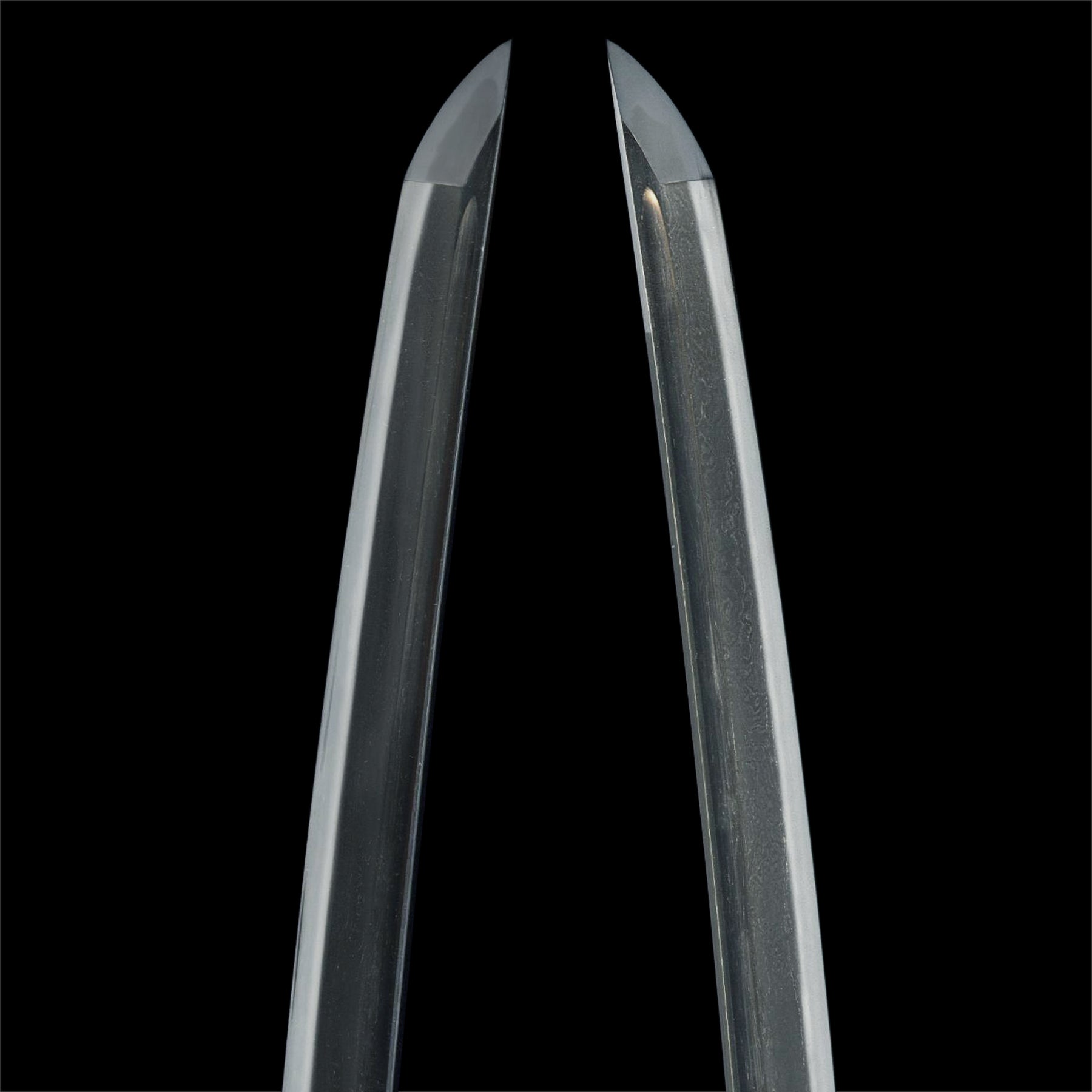
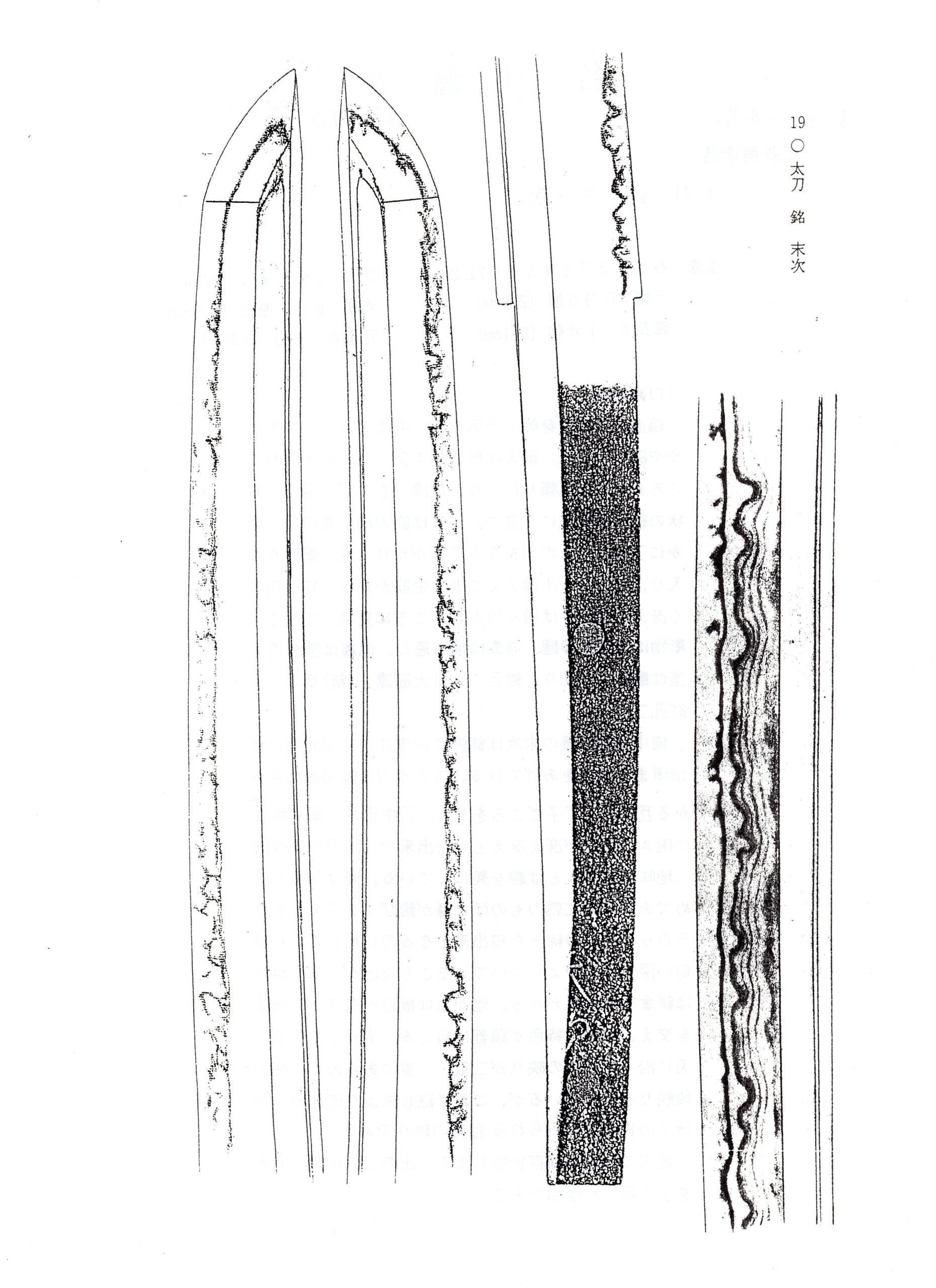
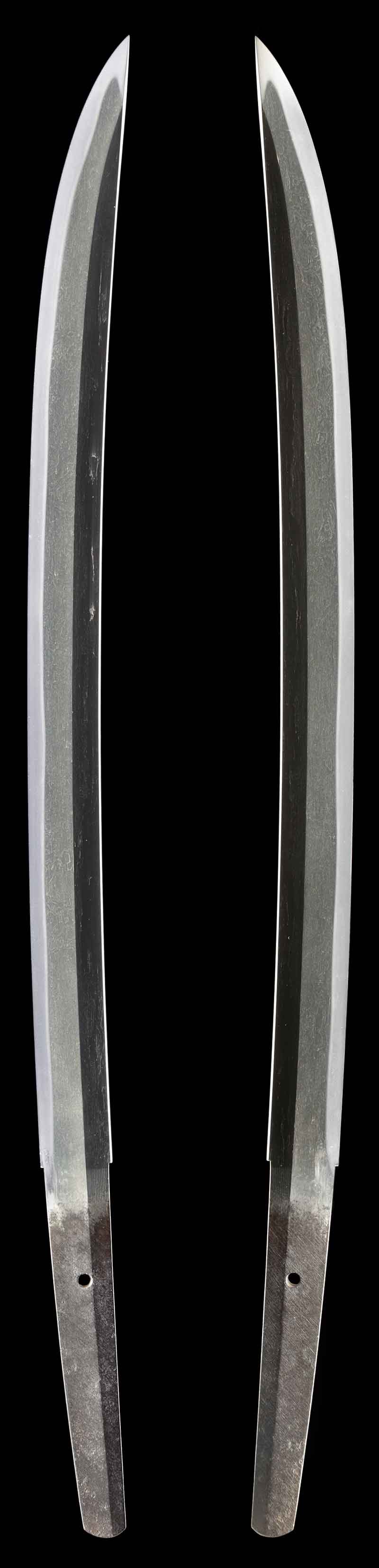
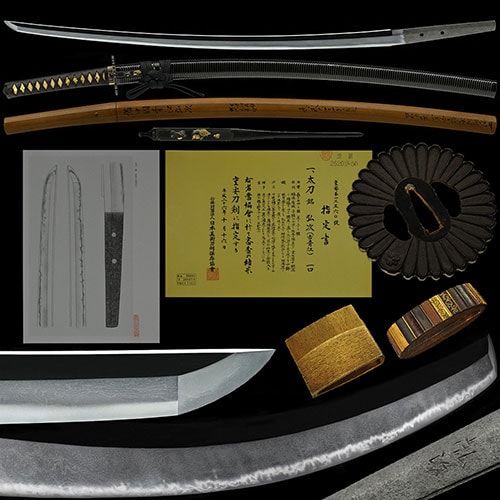
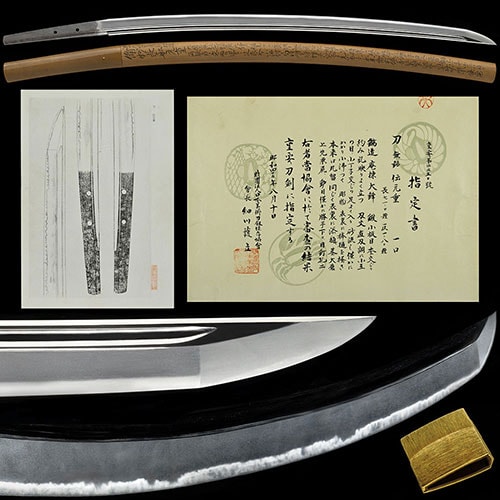
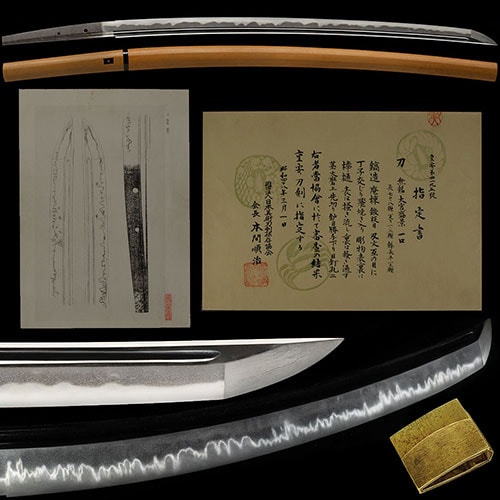
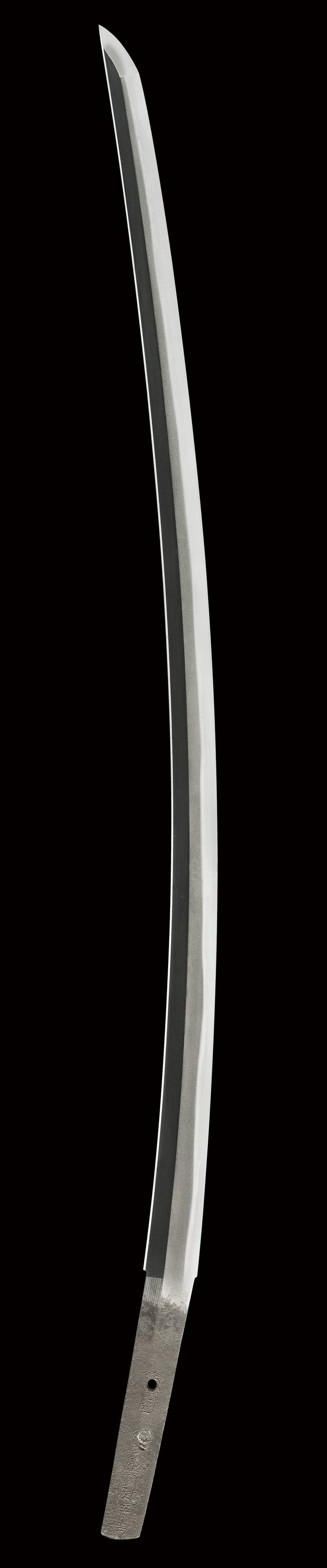
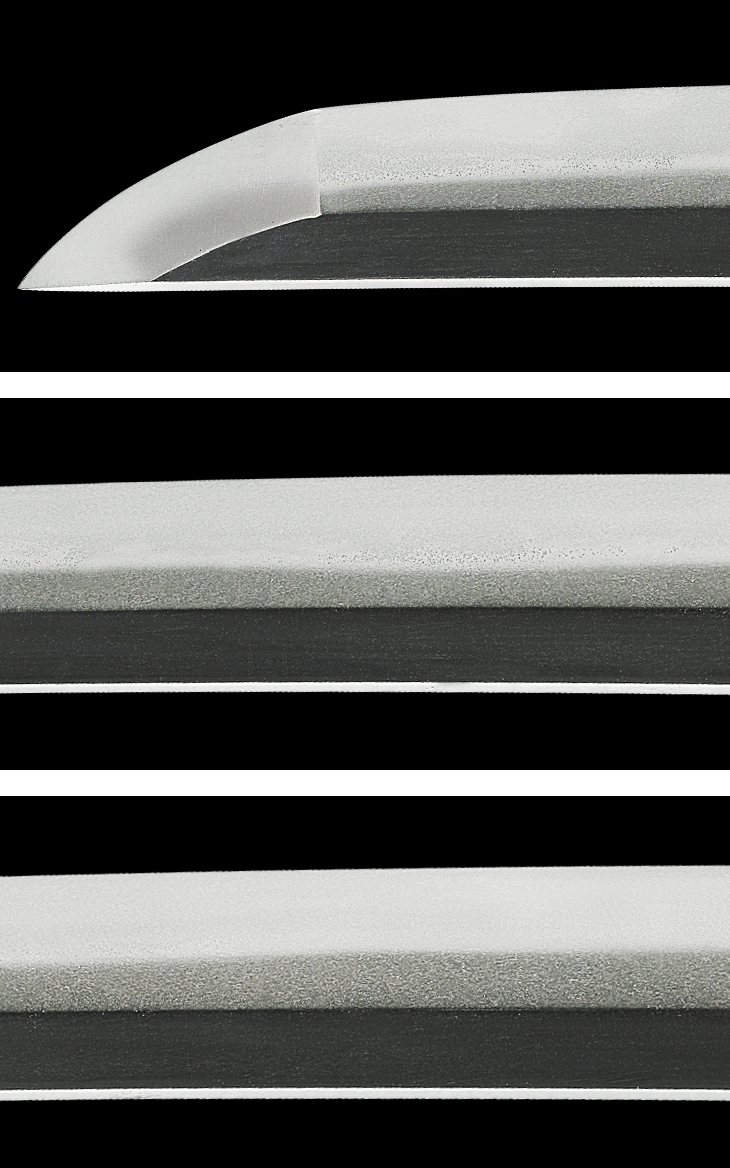
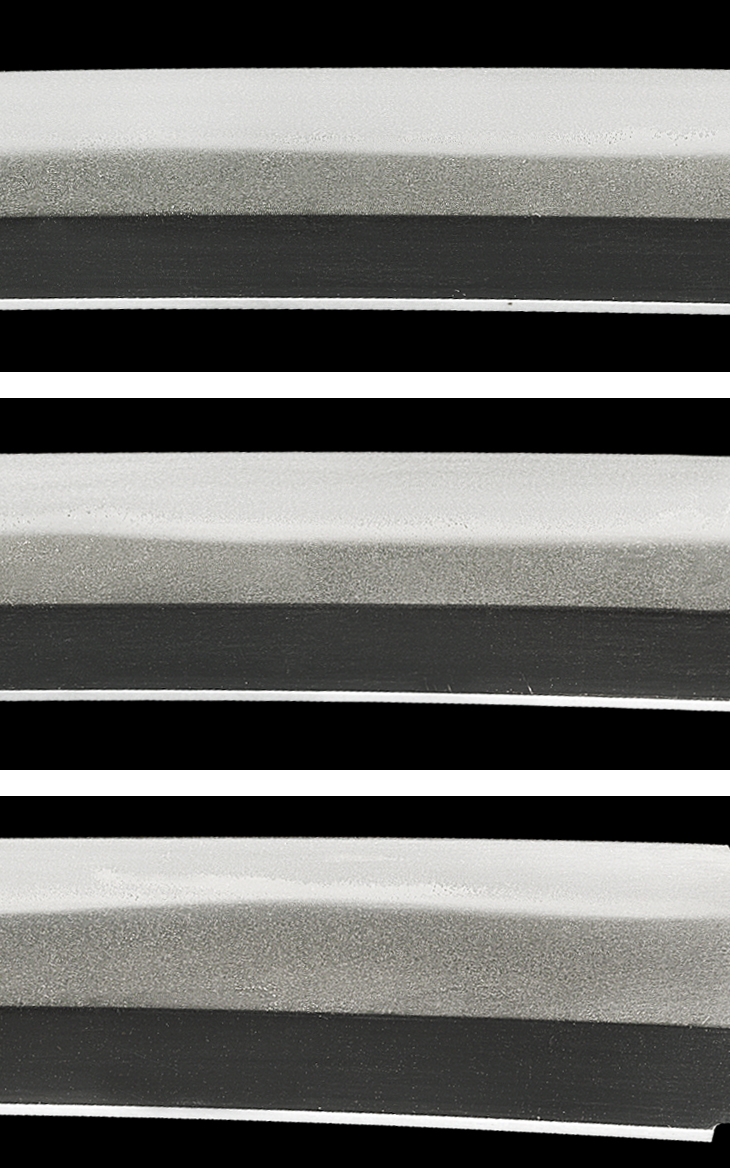
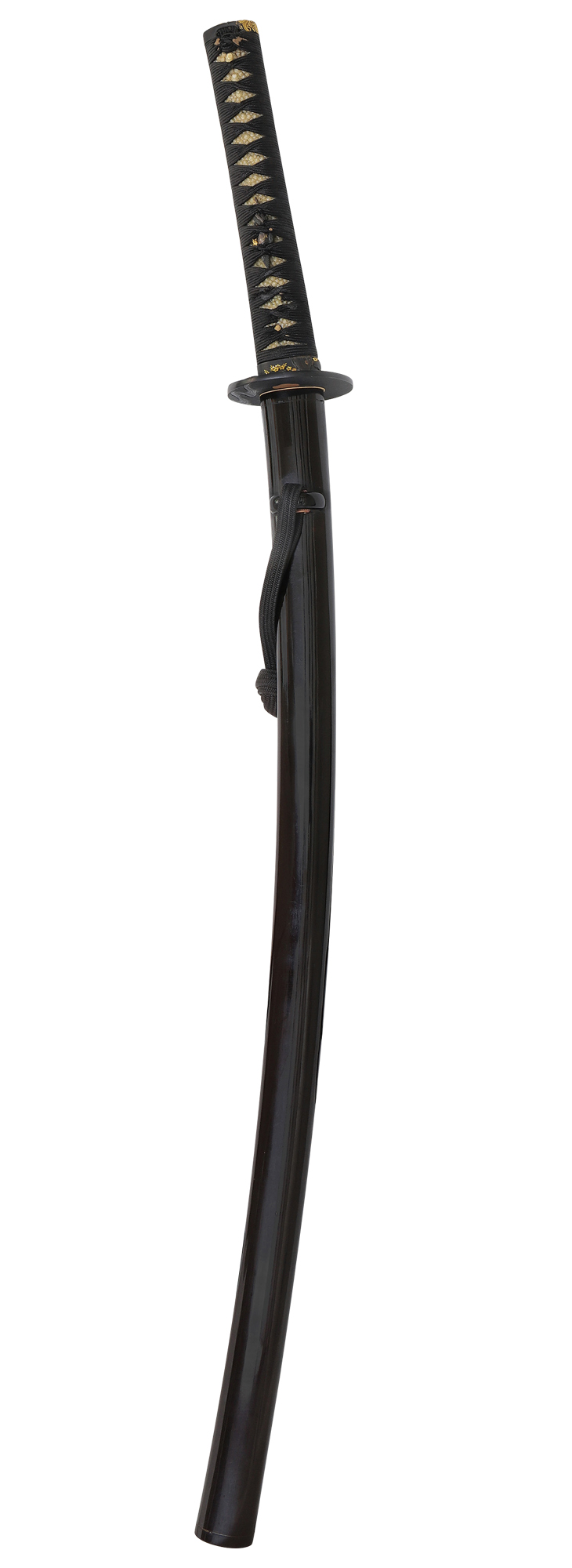
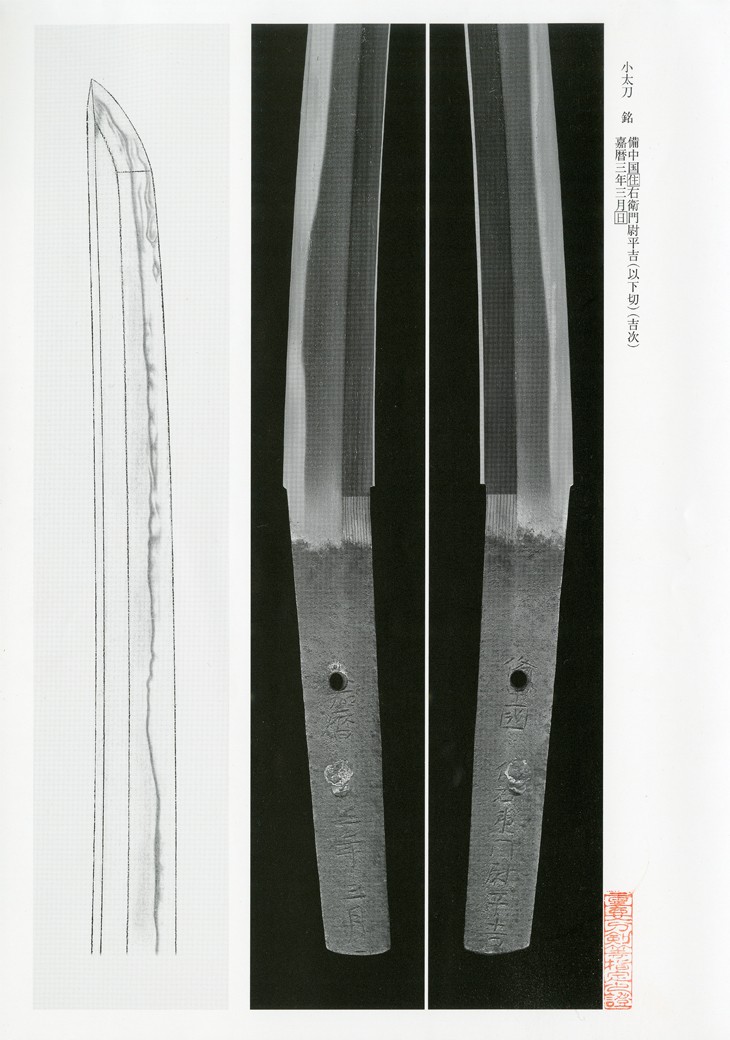
This is a Juyo Token designated Kodachi by Uemonnojo Tairano Yoshitsugu of the Aoe school, dating to the very end of the Kamakura period (1328). It features a refined jigane with chiremen-hada and various utsuri, and a hamon of wide suguha-cho mixed with gunome and midare. The blade comes with a koshirae from the late Edo period and a shirasaya.
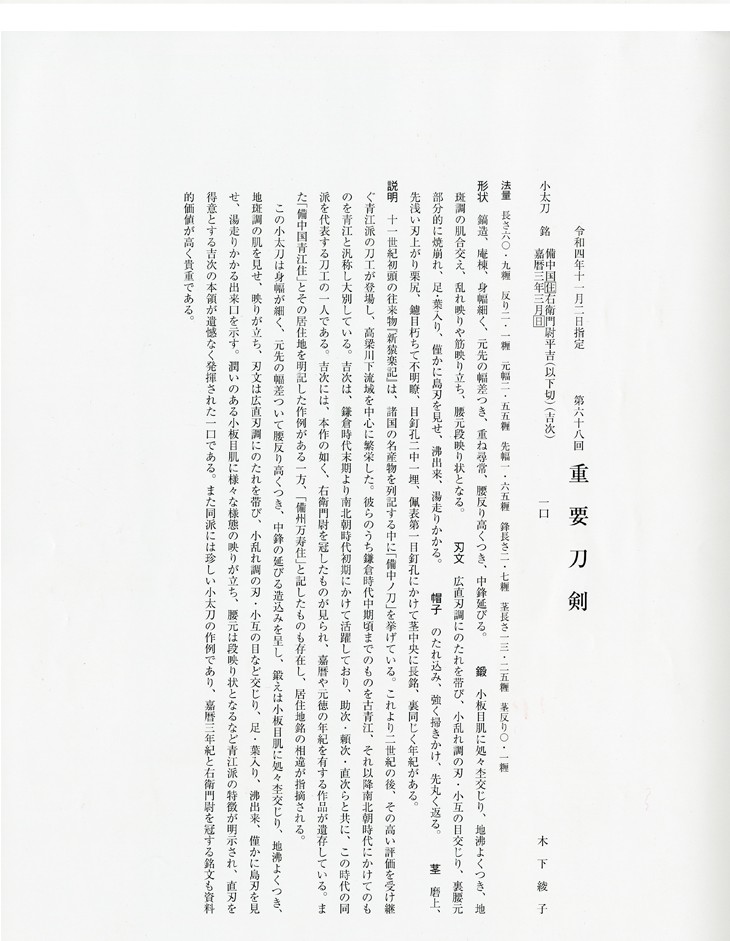
十一世紀初頭の往来物『新猿楽記』は、諸国の名産物を列記する中に「備中ノ刀」を挙げている。これより二世紀の後、その高い評価を受け継ぐ青江派の刀工が登場し、高梁川下流域を中心に繁栄した。彼らのうち鎌倉時代中期頃までのものを古青江、それ以降南北朝時代にかけてのものを青江と汎称し大別している。吉次は、鎌倉時代末期より南北朝時代初期にかけて活躍しており、助次・頼次・直次らと共に、この時代の同派を代表する刀工の一人である。吉次には、本作の如く、右衛門尉を冠したものが見られ、嘉暦や元徳の年紀を有する作品が遺存している。また「備中国青江住」とその居住地を明記した作例がある一方、「備州万寿住」と記したものも存在し、居住地銘の相違が指摘される。 この小太刀は身幅が細く、元先の幅差ついて腰反り高くつき、中鋒の延びる造込みを呈し、鍛えは小板目肌に処々杢交じり、地沸よくつき、地斑調の肌を見せ、映りが立ち、刃文は広直刃調にのたれを帯び、小乱れ調の刃・小互の目など交じり、足・葉入り、沸出来、僅かに島刃を見せ、湯走りかかる出来栄を示す。潤いのある小板目肌に様々な様態の映りが立ち、腰元は段映り状となるなど青江派の特徴が明示され、直刃を得意とする吉次の本領が遺憾なく発揮された一口である。また同派には珍しい小太刀の作例であり、嘉暦三年紀と右衛門尉を冠する銘文も資料的価値が高く貴重である。
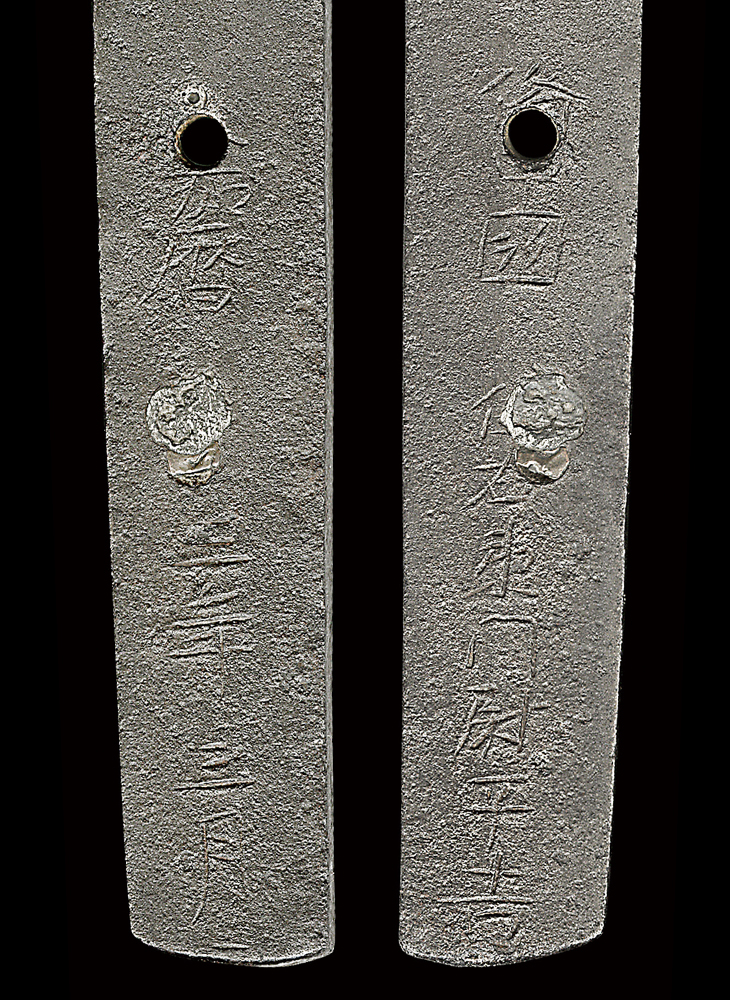
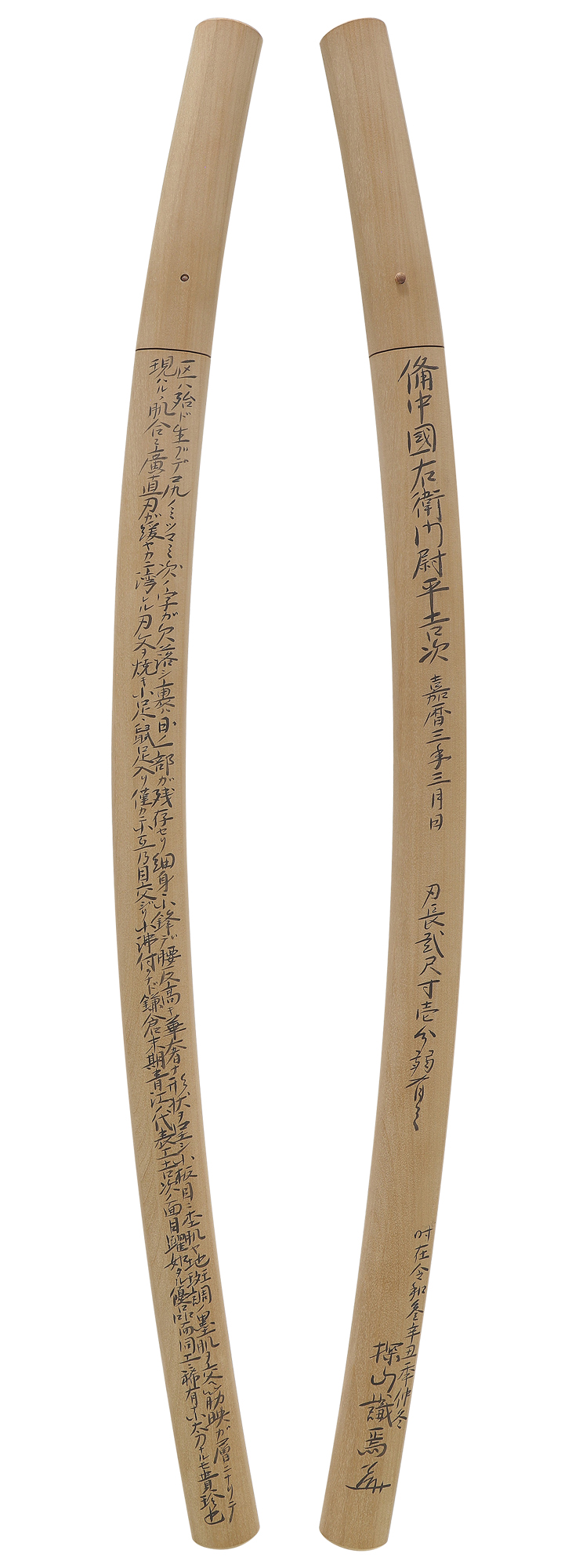
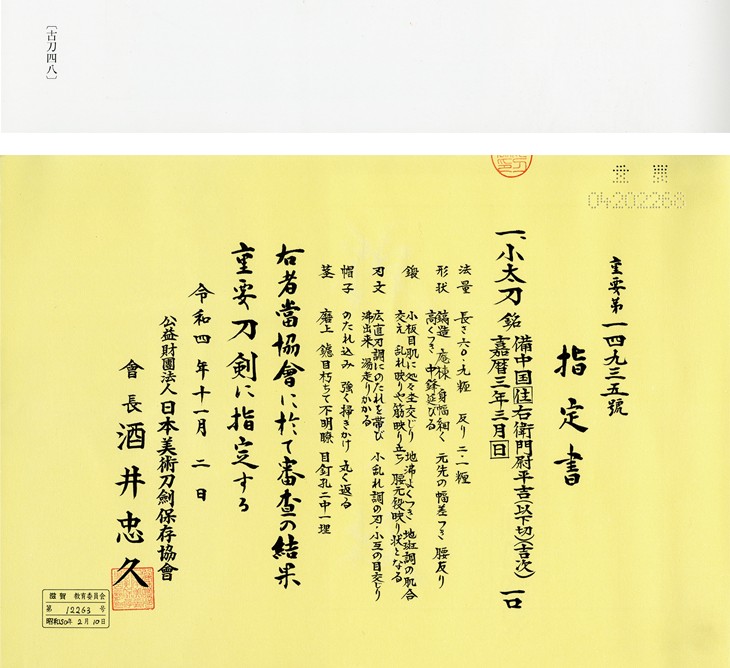
Certificate reading — 銘 備中国住右衛門尉平吉(以下切)(吉次) 嘉暦三年三月日
 NihontoWatch
mei · Aoe · Edo · nagasa 60.9cm · sori 2.1cm
Aoe (Bitchu) · Bitchu · around 1326-1332
Fujishiro Jo-jo saku · Tōken Taikan top 8%
1 piece on the market now
In the eleventh month of Karyaku 3 (1328) Yoshitsugu (吉次) of Bitchū signed an ubu tantō "Bitchū no kuni jū Uemon no jō Taira Yoshitsugu saku"[[c:1]], an inscription the NBTHK judges of high documentary value. He belongs to the Aoe school, which flourished along the lower Takahashi river in a province the early eleventh-century Shin Sarugakuki already names for "the swords of Bitchū"[[c:2]]; work to about mid-Kamakura is called Ko-Aoe, what follows simply Aoe. The records name him, "together with Suketsugu, Yoritsugu and Naotsugu, one of the representative smiths of the school in this era"[[c:3]], and an older record calls him outright "the representative smith of the chū-Aoe"[[c:4]]. His dated works carry Karyaku (1326-29) and Gentoku (1329-31), and the residence in his long signatures is written now "Bitchū no kuni Aoe jū"[[c:5]], now "Bishū Manju jū"[[c:6]], a divergence the records expressly point out.
His foundation, and his declared strength, is the suguha of this generation at its calmest. Of the Karyaku 3 kodachi the judges write that it is "a blade in which the true mettle of Yoshitsugu, a smith whose forte is suguha, is displayed without reserve"[[c:7]]. The line is a chū-suguha, undulating shallowly in places, mixing ko-gunome, ko-chōji and ko-midare; ko-ashi and yō enter with saka-ashi among them, yet the slanting habit that marks the Aoe ha shows in him only partially, here and there. The nioiguchi tightens, carries ko-nie, and is bright and clear; fine kinsuji and sunagashi run through, and intermittent yubashiri near the base raises a nijūba-like effect. On the tantō the line narrows to a hoso-suguha with fine hotsure, the temper carried down through the hamachi, a habit shared also by the Gentoku 1 tantō of Sahyōe no jō Naotsugu[[c:8]]; of the Karyaku 3 tantō the record writes that the quiet suguha yakiba "overflows with a deep savor"[[c:9]].
The jigane is Bitchū's own. He forges a well-knit ko-itame mixed with ko-mokume and flowing hada, the ji-nie thick and extremely fine, minute chikei entering; jifu (地斑) recurs blade after blade, the clear sumihada (澄肌) of the school appears, and on the gold-inlaid Nabeshima katana the finely standing ko-itame takes on a crepe-like complexion[[c:10]]. Over this a faint midare-utsuri rises, and on the small works the utsuri divides, "a midare-utsuri toward the mune and a linear utsuri toward the ha"[[c:11]], the so-called dan-utsuri (段映り). The bōshi runs straight to a ko-maru return, at times tending to a point or lightly brushed with hakikake. Of the niji-mei tantō the judges write that the scenery of the utsuri and the tight, bright nioiguchi of the suguha are "Aoe through and through"[[c:12]].
The signed and dated core of his work is anchored on the title. He often cut long signatures headed Uemon no jō with the Taira clan name; among the signed reference works the published sources name a tachi in the Tokyo National Museum dated Gentoku 2 and a katana-mei blade at Hie Shrine, both Important Cultural Properties. His small works are rare survivals, "surviving examples of Yoshitsugu's tantō are exceedingly rare"[[c:13]], and the signed kodachi is likewise a form seldom seen in the school. A two-character mei cut on the haki-ura of one slender tachi is read as his earlier work, predating the long-signature pieces. At the far edge of the name stands a generation question: the Jūyō Bijutsuhin record matches the folded-signature katana of the Owari Tokugawa, a wide work in gunome-deki, to the Yoshitsugu the Meikan places in Nanbokuchō around Jōwa (1345-50), and calls the smith of the Karyaku tantō "presumably his predecessor"[[c:14]]; Honma adds the caveat that "appraisals to individual names within Aoe will always invite both assent and dissent"[[c:15]]. The designation records meanwhile draw the line by manner, noting of his quiet suguha tantō that "they differ in feeling from the works of the school of the Nanbokuchō period"[[c:16]].
A second register stands on kiwame. Ō-suriage mumei katana of deep curvature and ample hiraniku carry his attribution. The Nabeshima katana bears a gold-inlaid attribution, not a signature, recording its shortening in Genna 5 (1619), and its workmanship is judged "the typical late-Kamakura make of the Aoe school in both ji and ha"[[c:17]]. The mumei katana under a Kyōhō 9 (1724) origami of Hon'ami Kōchū, valued at 150 kan, is judged "an outstanding piece even among the Yoshitsugu attributions"[[c:18]], "a robust figure, heavy in the hand"[[c:19]]. The kiwame are honest: of the katana descended in the Naitō family the judges write that at a glance it might also be appraised as Bizen Motoshige or the like, "and it is difficult to assert Yoshitsugu definitively"[[c:20]], while holding it a late-Kamakura Aoe blade. Within the school his place is the quiet pole of the generation: where Naotsugu signs Sahyōe no jō, Yoshitsugu answers with Uemon no jō (右衛門尉) and the Taira name, and where the slanting chōji of Aoe comes out in force elsewhere, his blades keep the calm bright line, the saka element only glimpsed.
He is rated Jō-jō saku by Fujishiro, and seventeen designated works stand on the official record: two Tokubetsu Jūyō and ten Jūyō, twelve blades in those two tiers; three Jūyō Bijutsuhin; one Important Cultural Property, a signed blade preserved at Fujishima Jinja; and a signed blade, once of the Imperial Family and the Mōri family, now in the Kyoto National Museum. Eleven of the seventeen carry a mei, five are mumei under kiwame, and the Nabeshima katana carries its attribution in gold inlay. The provenance runs through great houses: the gold-inlaid katana descended in the Hizen Ogi branch of the Nabeshima family, recorded in the Tsuchiya Oshigata as "an ancestral sword worn at the first assault on Hara castle"[[c:21]], the blade of the Shimabara rising; the Naitō katana of Murakami carries the family tradition "Aoe Yoshitsugu bestowed by the Taikō"[[c:22]], received from Hideyoshi at the Odawara campaign of 1590; the folded-signature katana descended in the Owari Tokugawa and remains with the Tokugawa Reimeikai; the Karyaku-dated Jūyō Bijutsuhin tantō now belongs to the Sano Art Museum. The Important Cultural Property and the shrine and museum pieces are preserved as cultural patrimony and will not trade; a collector may realistically encounter the Tokubetsu Jūyō and Jūyō tier, twelve blades among them the dated tantō and tachi and the quiet suguha katana under kiwame, and one comes to the open market only rarely, a quiet masterpiece of the Aoe suguha at its calmest when it does.
Where Yoshitsugu stands among comparable artisans: across all of nihontō, and within tradition, era, and period. The tiers (Foremost · Leading · Major · Notable) weigh official designations from the NBTHK and Japan's Agency for Cultural Affairs, together with historical honors of lasting repute such as the Sansaku and Meibutsu-chō.
Select a lens to see how it's measured.
Years he was demonstrably active, proven by signed-and-dated blades
Bizen-den · Bitchu
Phase: Chū-Aoe中青江· 1235–1334
8 pieces on the market now
The Chu-Aoe school represents the middle and culminating phase of the Aoe tradition of Bitchu Province, encompassing smiths active from the late Kamakura period through the Nanbokucho era. The lineage traces its origins to an ancient swordmaking heritage in the lower basin of the Takahashi River, a tradition already celebrated in the eleventh-century Shin Sarugakki, which counted "the swords of Bitchu" among the notable products of the provinces. Scholars conventionally distinguish earlier Ko-Aoe production, extending through the mid-Kamakura period, from the Chu-Aoe and later Sue-Aoe phases that carried the tradition forward. The name Sadatsugu -- transmitted since the Kanchiin-bon Meizukushi as one of the goban-kaji appointed to serve Retired Emperor Gotoba and accorded the highest valuation in the Shinkan Hiden-sho -- stands as the school's most prestigious lineage name, while Yoshitsugu, Naotsugu, Tsunetsugu, and Hidetsugu represent the principal working smiths whose signed and dated examples anchor the chronology of the late Kamakura Aoe group. With the transition into the Nanbokucho period, a second flowering emerged under Tsugunao, Tsuguyoshi, and Moritsugu, who are consistently identified by the NBTHK as the representative smiths of Aoe in that era. The technical identity of Chu-Aoe is defined by a constellation of traits that recur with remarkable consistency across the school's members. The forging characteristically displays tightly packed ko-itame-hada mixed with mokume, upon which extremely fine ji-nie adheres thickly and delicate chikei are interwoven. A mottled, patch-like jifu texture frequently appears, and the distinctive crepe-like surface known as chirimen-hada is encountered among several smiths. Most diagnostic of all is the school's utsuri, which manifests in multiple forms: midare-utsuri, the stepped dan-utsuri in which linear utsuri near the edge transitions to midare-utsuri toward the mune, and the dark-toned sumihada. The hamon is fundamentally suguha-based, ranging from narrow hoso-suguha to medium chu-suguha with shallow notare, into which ko-gunome, ko-choji, and saka-ashi are mixed. The nioiguchi is universally described as tight, bright, and clear -- the single most defining quality of the school -- producing a deep shio-ai that is repeatedly praised in NBTHK assessments.
The boshi characteristically runs straight, turning back in ko-maru with a tendency toward a pointed tip. A critical stylistic evolution occurred within the Nanbokucho period: while the late Kamakura smiths worked predominantly in suguha, the later generation developed a splendid, flamboyant saka-choji-midare that became the school's most celebrated mode. Tsugunao is recognized as "a master of saka-choji," producing tempering of such florid brilliance that the NBTHK characterizes it as "the exclusive forte of this group" -- an emblematic and highly individual domain. The reverse-slanting tendencies visible in earlier Kamakura-period works are understood as precursors to this splendid later development. The Chu-Aoe school occupies a position of enduring prestige within the Japanese sword canon. The Hon'ami family developed a longstanding practice of rendering Sadatsugu appraisals for unsigned Aoe works of particularly fine workmanship, treating the name as a mark of the highest quality within the tradition. Naotsugu and Yoshitsugu, whose signed examples bearing official court titles and era dates from Gentoku through Kanno survive in exceptional condition, furnish irreplaceable documentary material for the study of Bitchu swordmaking. Works from the school have been transmitted through distinguished collections -- the Choshu Mori, the Nabeshima of Hizen, the Uesugi, and the Maeda of Kaga -- attesting to sustained appreciation across centuries. Naotsugu occupies a pivotal position at the transition from the ko-nie-deki manner of the Kamakura period to the tighter, brighter nioi-deki workmanship of the Nanbokucho era, while Moritsugu's rare surviving works bridge the late Kamakura and early Nanbokucho phases with tanto displaying both the traditional suguha and a saka-choji not previously encountered in the school. In both the quiet restraint of their suguha and the gorgeous brilliance of their saka-choji-midare, the smiths of Chu-Aoe demonstrate the Bitchu tradition at its most refined and accomplished -- a school whose tightly forged steel, luminous nioiguchi, and distinctive utsuri constitute an aesthetic achievement of the first order. Learn more →
| Smith | Era | Designated |
|---|---|---|
| Tsugunao次直 | 1345-1361 | 25 |
| Naotsugu直次 | 1335-1364 | 15 |
| Yoshitsugu吉次 | 1326-1332 | 17 |
| Moritsugu守次 | 1356-1361 | 9 |
| Tsuguyoshi次吉 | 1338-1358 | 19 |
The Edo period (1615 to 1868)
Edo was the sword’s age of connoisseurship: the Hon’ami appraisers, the shogunal register of famous blades of 1719, and a thriving literature turned the sword into an object of study even as it ceased to be drawn in war.
A blade of top-grade workmanship and condition, formally judged to rank with a nationally recognized Important Art Object (Jūyō Bijutsuhin). Awarded only at the NBTHK’s competitive annual examination.
Of Japan’s roughly 2.5 million registered swords, only 12,307 (about 1 in 203) have ever attained Jūyō.
The NBTHK (Nihon Bijutsu Tōken Hozon Kyōkai, the Society for the Preservation of Japanese Art Swords) is a public-interest incorporated foundation founded in 1948 and supervised by Japan’s Agency for Cultural Affairs (Bunkachō); it is based at the Japanese Sword Museum in Tokyo. Its expert panels physically examine each submitted work (shinsa) and issue a certificate (kanteishō) ranking it by artistic and historical merit. NBTHK papers are the most widely recognized standard of authentication for Japanese swords and fittings.
NBTHK official siteFor one-of-a-kind items such as swords, sword fittings, and antiques, please contact us about a return within 3 days of the item's arrival and ship it back within 8 days. Refunds are issued the same day the returned item arrives.

¥6,500,000
This is a Juyo Token designated Kodachi by Uemonnojo Tairano Yoshitsugu of the Aoe school, dating to the very end of the Kamakura period (1328). It features a refined jigane with chiremen-hada and various utsuri, and a hamon of wide suguha-cho mixed with gunome and midare. The blade comes with a koshirae from the late Edo period and a shirasaya.
十一世紀初頭の往来物『新猿楽記』は、諸国の名産物を列記する中に「備中ノ刀」を挙げている。これより二世紀の後、その高い評価を受け継ぐ青江派の刀工が登場し、高梁川下流域を中心に繁栄した。彼らのうち鎌倉時代中期頃までのものを古青江、それ以降南北朝時代にかけてのものを青江と汎称し大別している。吉次は、鎌倉時代末期より南北朝時代初期にかけて活躍しており、助次・頼次・直次らと共に、この時代の同派を代表する刀工の一人である。吉次には、本作の如く、右衛門尉を冠したものが見られ、嘉暦や元徳の年紀を有する作品が遺存している。また「備中国青江住」とその居住地を明記した作例がある一方、「備州万寿住」と記したものも存在し、居住地銘の相違が指摘される。 この小太刀は身幅が細く、元先の幅差ついて腰反り高くつき、中鋒の延びる造込みを呈し、鍛えは小板目肌に処々杢交じり、地沸よくつき、地斑調の肌を見せ、映りが立ち、刃文は広直刃調にのたれを帯び、小乱れ調の刃・小互の目など交じり、足・葉入り、沸出来、僅かに島刃を見せ、湯走りかかる出来栄を示す。潤いのある小板目肌に様々な様態の映りが立ち、腰元は段映り状となるなど青江派の特徴が明示され、直刃を得意とする吉次の本領が遺憾なく発揮された一口である。また同派には珍しい小太刀の作例であり、嘉暦三年紀と右衛門尉を冠する銘文も資料的価値が高く貴重である。
Certificate reading — 銘 備中国住右衛門尉平吉(以下切)(吉次) 嘉暦三年三月日
NihontoWatchmei · Aoe · Edo · nagasa 60.9cm · sori 2.1cm
Aoe (Bitchu) · Bitchu · around 1326-1332
Fujishiro Jo-jo saku · Tōken Taikan top 8%
1 piece on the market now
In the eleventh month of Karyaku 3 (1328) Yoshitsugu (吉次) of Bitchū signed an ubu tantō "Bitchū no kuni jū Uemon no jō Taira Yoshitsugu saku"[[c:1]], an inscription the NBTHK judges of high documentary value. He belongs to the Aoe school, which flourished along the lower Takahashi river in a province the early eleventh-century Shin Sarugakuki already names for "the swords of Bitchū"[[c:2]]; work to about mid-Kamakura is called Ko-Aoe, what follows simply Aoe. The records name him, "together with Suketsugu, Yoritsugu and Naotsugu, one of the representative smiths of the school in this era"[[c:3]], and an older record calls him outright "the representative smith of the chū-Aoe"[[c:4]]. His dated works carry Karyaku (1326-29) and Gentoku (1329-31), and the residence in his long signatures is written now "Bitchū no kuni Aoe jū"[[c:5]], now "Bishū Manju jū"[[c:6]], a divergence the records expressly point out.
His foundation, and his declared strength, is the suguha of this generation at its calmest. Of the Karyaku 3 kodachi the judges write that it is "a blade in which the true mettle of Yoshitsugu, a smith whose forte is suguha, is displayed without reserve"[[c:7]]. The line is a chū-suguha, undulating shallowly in places, mixing ko-gunome, ko-chōji and ko-midare; ko-ashi and yō enter with saka-ashi among them, yet the slanting habit that marks the Aoe ha shows in him only partially, here and there. The nioiguchi tightens, carries ko-nie, and is bright and clear; fine kinsuji and sunagashi run through, and intermittent yubashiri near the base raises a nijūba-like effect. On the tantō the line narrows to a hoso-suguha with fine hotsure, the temper carried down through the hamachi, a habit shared also by the Gentoku 1 tantō of Sahyōe no jō Naotsugu[[c:8]]; of the Karyaku 3 tantō the record writes that the quiet suguha yakiba "overflows with a deep savor"[[c:9]].
The jigane is Bitchū's own. He forges a well-knit ko-itame mixed with ko-mokume and flowing hada, the ji-nie thick and extremely fine, minute chikei entering; jifu (地斑) recurs blade after blade, the clear sumihada (澄肌) of the school appears, and on the gold-inlaid Nabeshima katana the finely standing ko-itame takes on a crepe-like complexion[[c:10]]. Over this a faint midare-utsuri rises, and on the small works the utsuri divides, "a midare-utsuri toward the mune and a linear utsuri toward the ha"[[c:11]], the so-called dan-utsuri (段映り). The bōshi runs straight to a ko-maru return, at times tending to a point or lightly brushed with hakikake. Of the niji-mei tantō the judges write that the scenery of the utsuri and the tight, bright nioiguchi of the suguha are "Aoe through and through"[[c:12]].
The signed and dated core of his work is anchored on the title. He often cut long signatures headed Uemon no jō with the Taira clan name; among the signed reference works the published sources name a tachi in the Tokyo National Museum dated Gentoku 2 and a katana-mei blade at Hie Shrine, both Important Cultural Properties. His small works are rare survivals, "surviving examples of Yoshitsugu's tantō are exceedingly rare"[[c:13]], and the signed kodachi is likewise a form seldom seen in the school. A two-character mei cut on the haki-ura of one slender tachi is read as his earlier work, predating the long-signature pieces. At the far edge of the name stands a generation question: the Jūyō Bijutsuhin record matches the folded-signature katana of the Owari Tokugawa, a wide work in gunome-deki, to the Yoshitsugu the Meikan places in Nanbokuchō around Jōwa (1345-50), and calls the smith of the Karyaku tantō "presumably his predecessor"[[c:14]]; Honma adds the caveat that "appraisals to individual names within Aoe will always invite both assent and dissent"[[c:15]]. The designation records meanwhile draw the line by manner, noting of his quiet suguha tantō that "they differ in feeling from the works of the school of the Nanbokuchō period"[[c:16]].
A second register stands on kiwame. Ō-suriage mumei katana of deep curvature and ample hiraniku carry his attribution. The Nabeshima katana bears a gold-inlaid attribution, not a signature, recording its shortening in Genna 5 (1619), and its workmanship is judged "the typical late-Kamakura make of the Aoe school in both ji and ha"[[c:17]]. The mumei katana under a Kyōhō 9 (1724) origami of Hon'ami Kōchū, valued at 150 kan, is judged "an outstanding piece even among the Yoshitsugu attributions"[[c:18]], "a robust figure, heavy in the hand"[[c:19]]. The kiwame are honest: of the katana descended in the Naitō family the judges write that at a glance it might also be appraised as Bizen Motoshige or the like, "and it is difficult to assert Yoshitsugu definitively"[[c:20]], while holding it a late-Kamakura Aoe blade. Within the school his place is the quiet pole of the generation: where Naotsugu signs Sahyōe no jō, Yoshitsugu answers with Uemon no jō (右衛門尉) and the Taira name, and where the slanting chōji of Aoe comes out in force elsewhere, his blades keep the calm bright line, the saka element only glimpsed.
He is rated Jō-jō saku by Fujishiro, and seventeen designated works stand on the official record: two Tokubetsu Jūyō and ten Jūyō, twelve blades in those two tiers; three Jūyō Bijutsuhin; one Important Cultural Property, a signed blade preserved at Fujishima Jinja; and a signed blade, once of the Imperial Family and the Mōri family, now in the Kyoto National Museum. Eleven of the seventeen carry a mei, five are mumei under kiwame, and the Nabeshima katana carries its attribution in gold inlay. The provenance runs through great houses: the gold-inlaid katana descended in the Hizen Ogi branch of the Nabeshima family, recorded in the Tsuchiya Oshigata as "an ancestral sword worn at the first assault on Hara castle"[[c:21]], the blade of the Shimabara rising; the Naitō katana of Murakami carries the family tradition "Aoe Yoshitsugu bestowed by the Taikō"[[c:22]], received from Hideyoshi at the Odawara campaign of 1590; the folded-signature katana descended in the Owari Tokugawa and remains with the Tokugawa Reimeikai; the Karyaku-dated Jūyō Bijutsuhin tantō now belongs to the Sano Art Museum. The Important Cultural Property and the shrine and museum pieces are preserved as cultural patrimony and will not trade; a collector may realistically encounter the Tokubetsu Jūyō and Jūyō tier, twelve blades among them the dated tantō and tachi and the quiet suguha katana under kiwame, and one comes to the open market only rarely, a quiet masterpiece of the Aoe suguha at its calmest when it does.
Where Yoshitsugu stands among comparable artisans: across all of nihontō, and within tradition, era, and period. The tiers (Foremost · Leading · Major · Notable) weigh official designations from the NBTHK and Japan's Agency for Cultural Affairs, together with historical honors of lasting repute such as the Sansaku and Meibutsu-chō.
Select a lens to see how it's measured.
Years he was demonstrably active, proven by signed-and-dated blades
Bizen-den · Bitchu
Phase: Chū-Aoe中青江· 1235–1334
8 pieces on the market now
The Chu-Aoe school represents the middle and culminating phase of the Aoe tradition of Bitchu Province, encompassing smiths active from the late Kamakura period through the Nanbokucho era. The lineage traces its origins to an ancient swordmaking heritage in the lower basin of the Takahashi River, a tradition already celebrated in the eleventh-century Shin Sarugakki, which counted "the swords of Bitchu" among the notable products of the provinces. Scholars conventionally distinguish earlier Ko-Aoe production, extending through the mid-Kamakura period, from the Chu-Aoe and later Sue-Aoe phases that carried the tradition forward. The name Sadatsugu -- transmitted since the Kanchiin-bon Meizukushi as one of the goban-kaji appointed to serve Retired Emperor Gotoba and accorded the highest valuation in the Shinkan Hiden-sho -- stands as the school's most prestigious lineage name, while Yoshitsugu, Naotsugu, Tsunetsugu, and Hidetsugu represent the principal working smiths whose signed and dated examples anchor the chronology of the late Kamakura Aoe group. With the transition into the Nanbokucho period, a second flowering emerged under Tsugunao, Tsuguyoshi, and Moritsugu, who are consistently identified by the NBTHK as the representative smiths of Aoe in that era. The technical identity of Chu-Aoe is defined by a constellation of traits that recur with remarkable consistency across the school's members. The forging characteristically displays tightly packed ko-itame-hada mixed with mokume, upon which extremely fine ji-nie adheres thickly and delicate chikei are interwoven. A mottled, patch-like jifu texture frequently appears, and the distinctive crepe-like surface known as chirimen-hada is encountered among several smiths. Most diagnostic of all is the school's utsuri, which manifests in multiple forms: midare-utsuri, the stepped dan-utsuri in which linear utsuri near the edge transitions to midare-utsuri toward the mune, and the dark-toned sumihada. The hamon is fundamentally suguha-based, ranging from narrow hoso-suguha to medium chu-suguha with shallow notare, into which ko-gunome, ko-choji, and saka-ashi are mixed. The nioiguchi is universally described as tight, bright, and clear -- the single most defining quality of the school -- producing a deep shio-ai that is repeatedly praised in NBTHK assessments.
The boshi characteristically runs straight, turning back in ko-maru with a tendency toward a pointed tip. A critical stylistic evolution occurred within the Nanbokucho period: while the late Kamakura smiths worked predominantly in suguha, the later generation developed a splendid, flamboyant saka-choji-midare that became the school's most celebrated mode. Tsugunao is recognized as "a master of saka-choji," producing tempering of such florid brilliance that the NBTHK characterizes it as "the exclusive forte of this group" -- an emblematic and highly individual domain. The reverse-slanting tendencies visible in earlier Kamakura-period works are understood as precursors to this splendid later development. The Chu-Aoe school occupies a position of enduring prestige within the Japanese sword canon. The Hon'ami family developed a longstanding practice of rendering Sadatsugu appraisals for unsigned Aoe works of particularly fine workmanship, treating the name as a mark of the highest quality within the tradition. Naotsugu and Yoshitsugu, whose signed examples bearing official court titles and era dates from Gentoku through Kanno survive in exceptional condition, furnish irreplaceable documentary material for the study of Bitchu swordmaking. Works from the school have been transmitted through distinguished collections -- the Choshu Mori, the Nabeshima of Hizen, the Uesugi, and the Maeda of Kaga -- attesting to sustained appreciation across centuries. Naotsugu occupies a pivotal position at the transition from the ko-nie-deki manner of the Kamakura period to the tighter, brighter nioi-deki workmanship of the Nanbokucho era, while Moritsugu's rare surviving works bridge the late Kamakura and early Nanbokucho phases with tanto displaying both the traditional suguha and a saka-choji not previously encountered in the school. In both the quiet restraint of their suguha and the gorgeous brilliance of their saka-choji-midare, the smiths of Chu-Aoe demonstrate the Bitchu tradition at its most refined and accomplished -- a school whose tightly forged steel, luminous nioiguchi, and distinctive utsuri constitute an aesthetic achievement of the first order. Learn more →
| Smith | Era | Designated |
|---|---|---|
| Tsugunao次直 | 1345-1361 | 25 |
| Naotsugu直次 | 1335-1364 | 15 |
| Yoshitsugu吉次 | 1326-1332 | 17 |
| Moritsugu守次 | 1356-1361 | 9 |
| Tsuguyoshi次吉 | 1338-1358 | 19 |
The Edo period (1615 to 1868)
Edo was the sword’s age of connoisseurship: the Hon’ami appraisers, the shogunal register of famous blades of 1719, and a thriving literature turned the sword into an object of study even as it ceased to be drawn in war.
A blade of top-grade workmanship and condition, formally judged to rank with a nationally recognized Important Art Object (Jūyō Bijutsuhin). Awarded only at the NBTHK’s competitive annual examination.
Of Japan’s roughly 2.5 million registered swords, only 12,307 (about 1 in 203) have ever attained Jūyō.
The NBTHK (Nihon Bijutsu Tōken Hozon Kyōkai, the Society for the Preservation of Japanese Art Swords) is a public-interest incorporated foundation founded in 1948 and supervised by Japan’s Agency for Cultural Affairs (Bunkachō); it is based at the Japanese Sword Museum in Tokyo. Its expert panels physically examine each submitted work (shinsa) and issue a certificate (kanteishō) ranking it by artistic and historical merit. NBTHK papers are the most widely recognized standard of authentication for Japanese swords and fittings.
NBTHK official siteFor one-of-a-kind items such as swords, sword fittings, and antiques, please contact us about a return within 3 days of the item's arrival and ship it back within 8 days. Refunds are issued the same day the returned item arrives.
¥6,500,000