NihontoWatch MonNihontoWatch
Market
Encyclopedia
Kantei
NihontoWatch MonNihontoWatch
Market
Encyclopedia
Kantei

Description

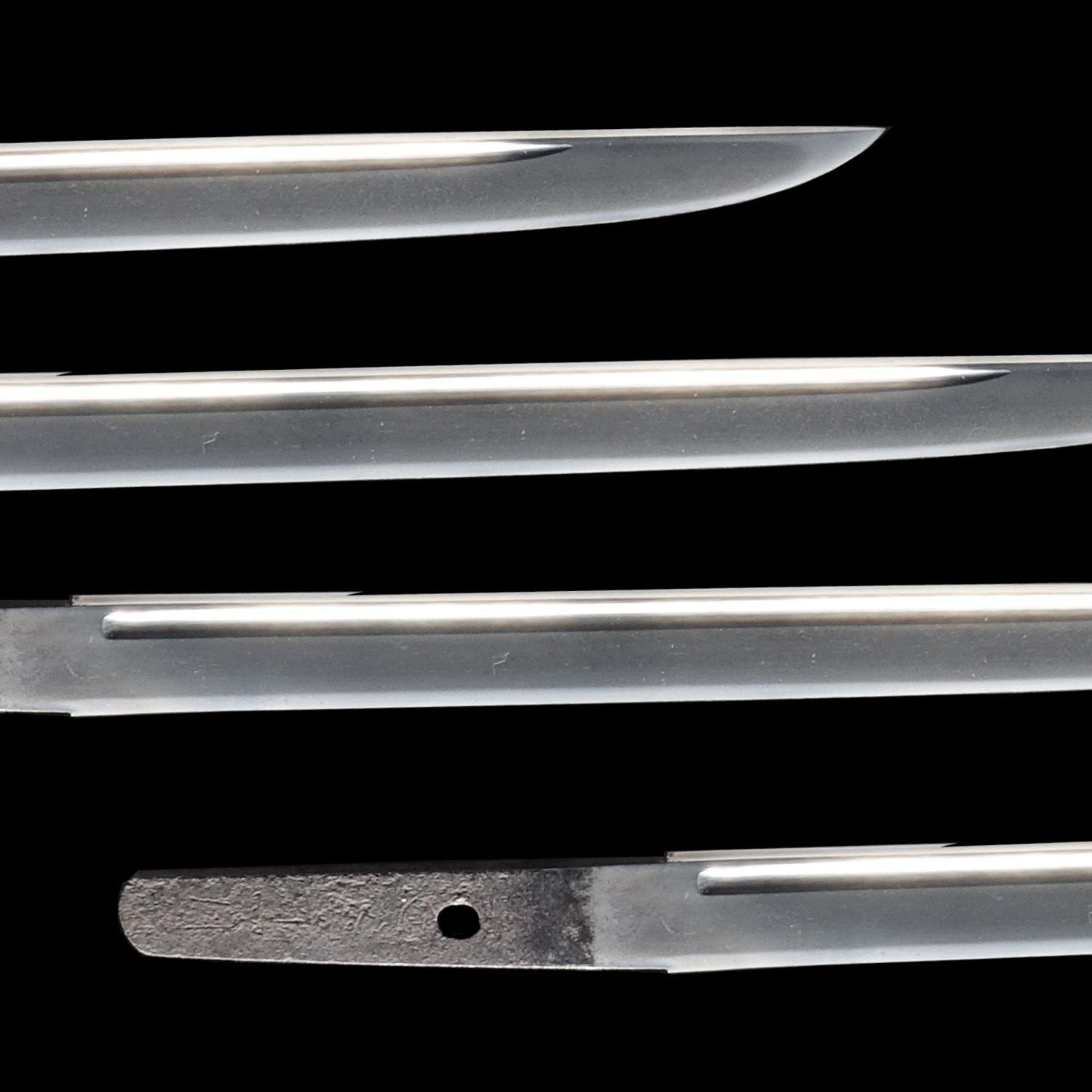
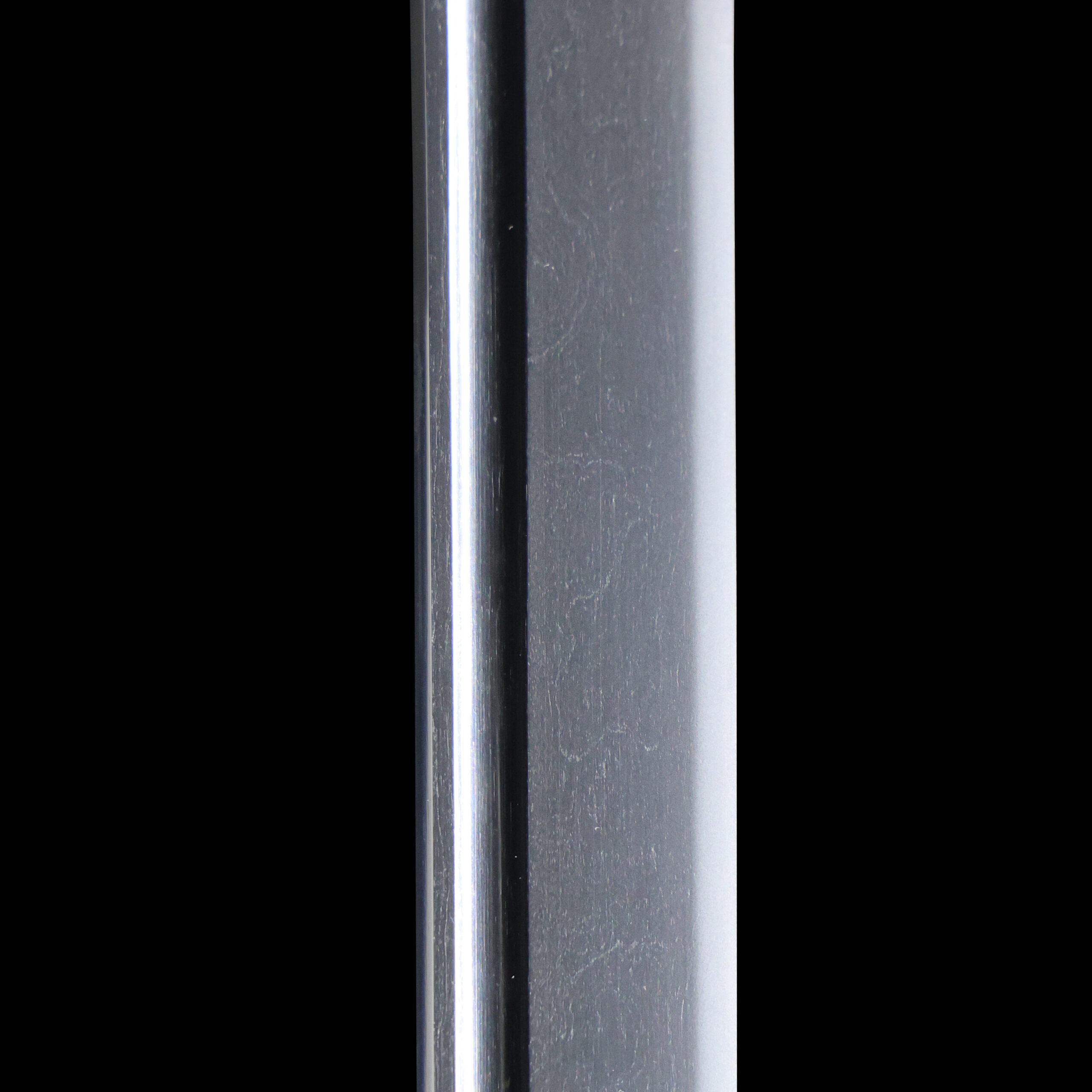
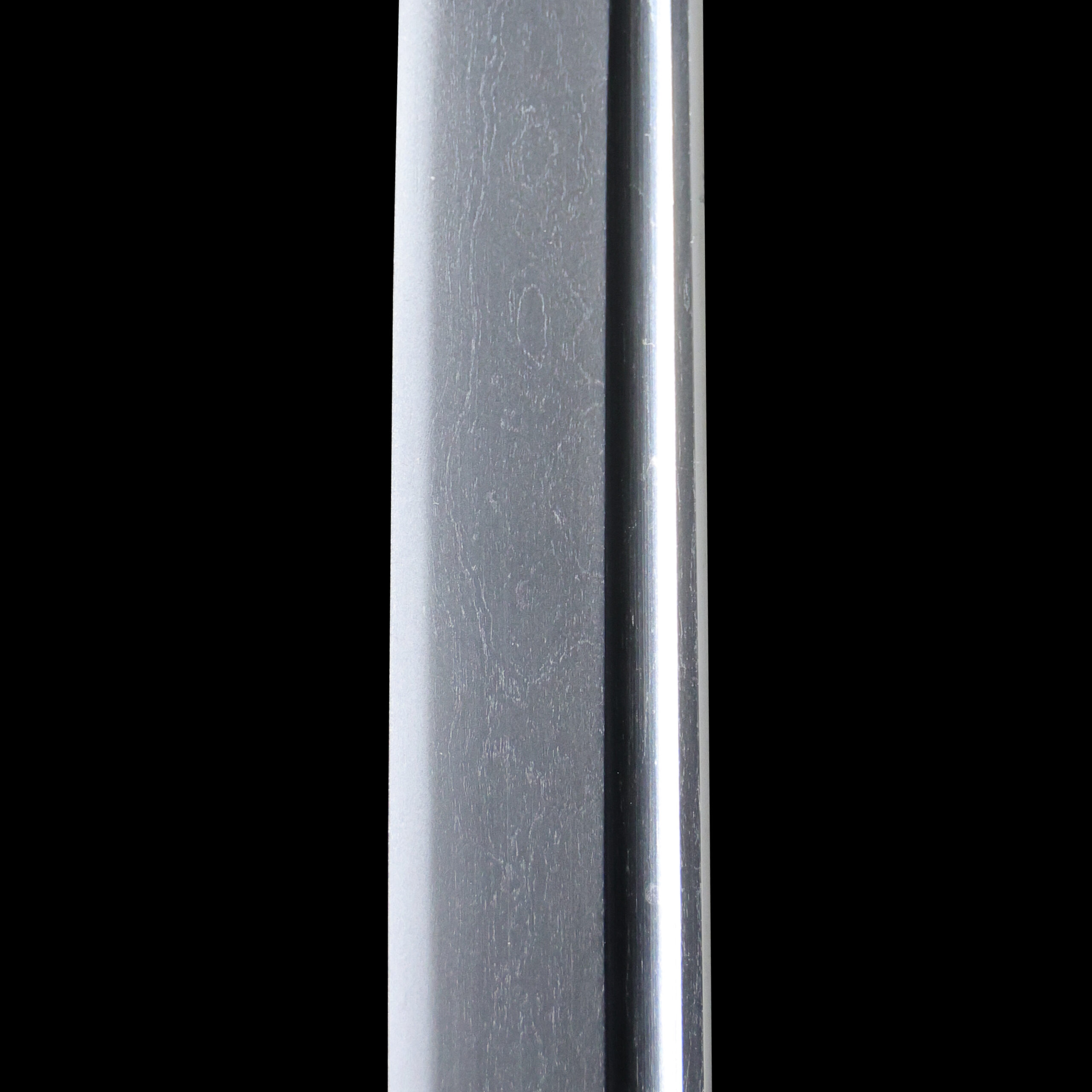
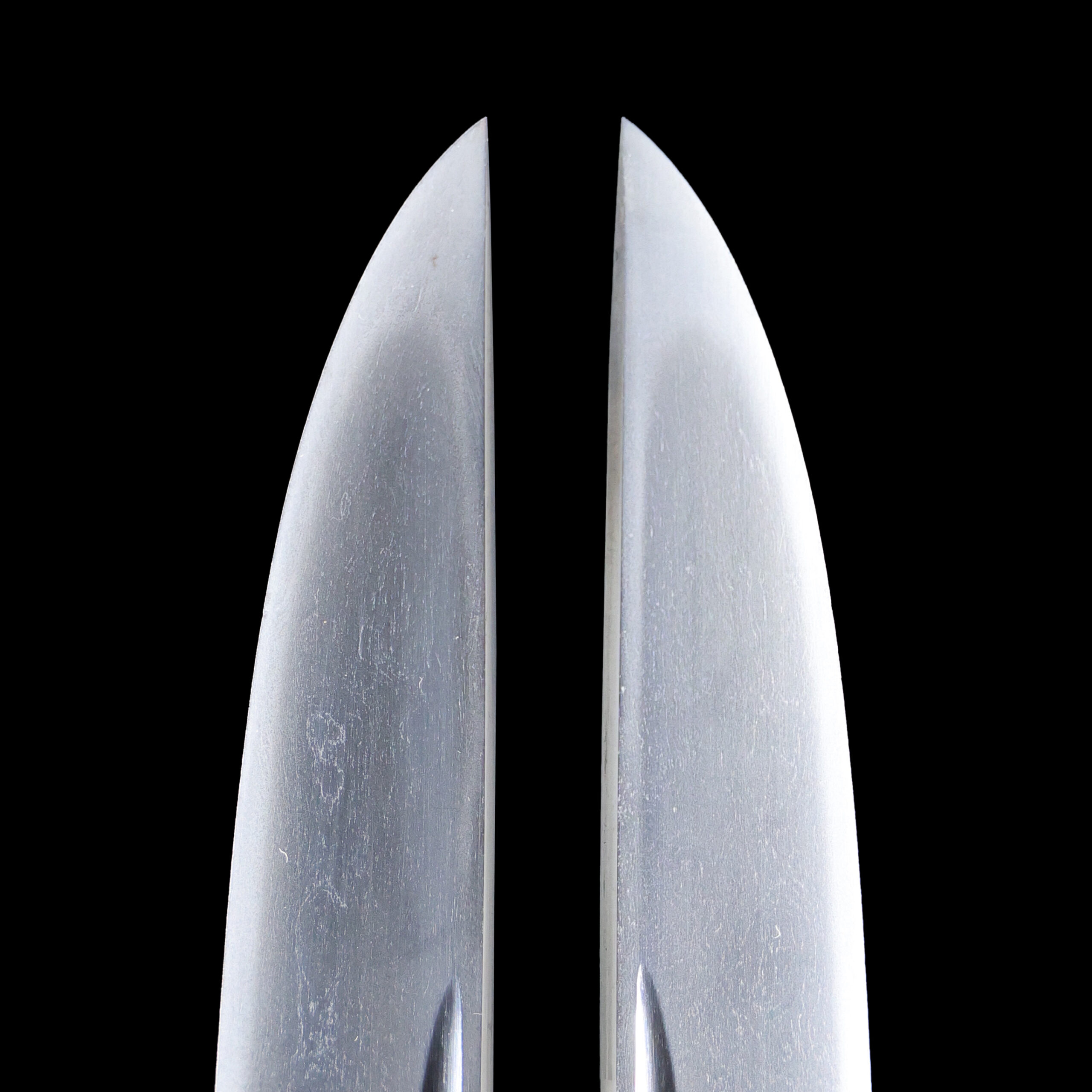
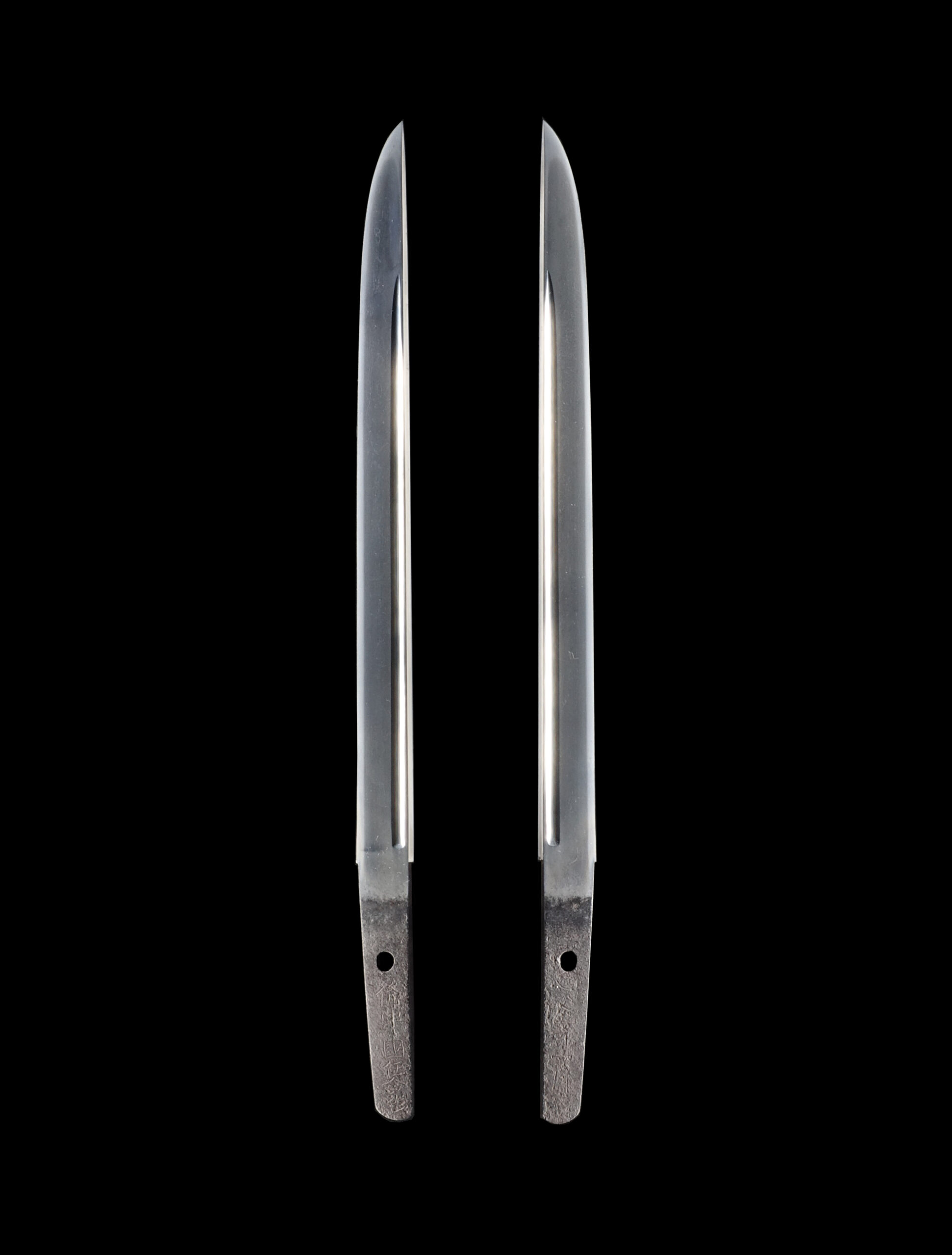
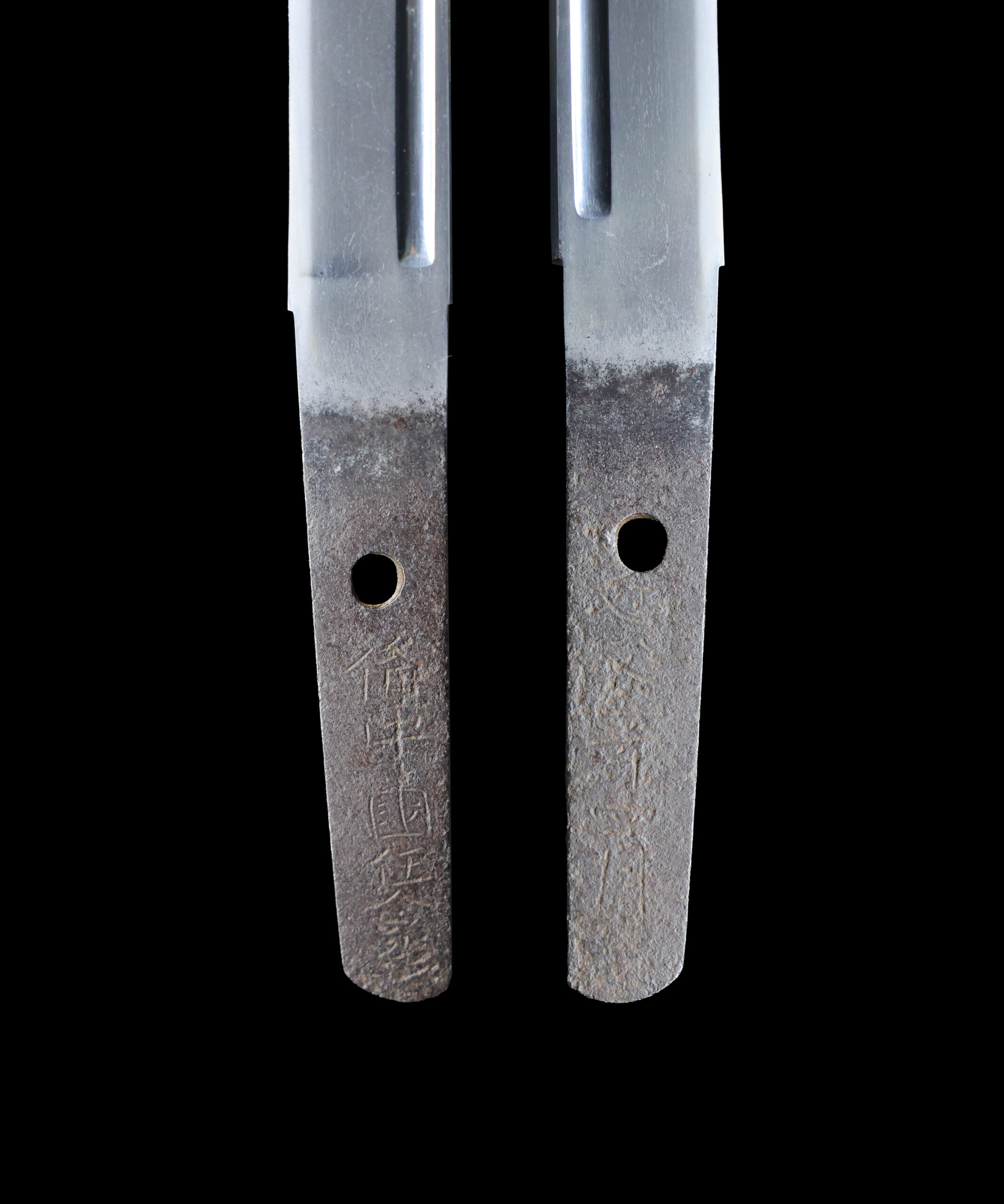
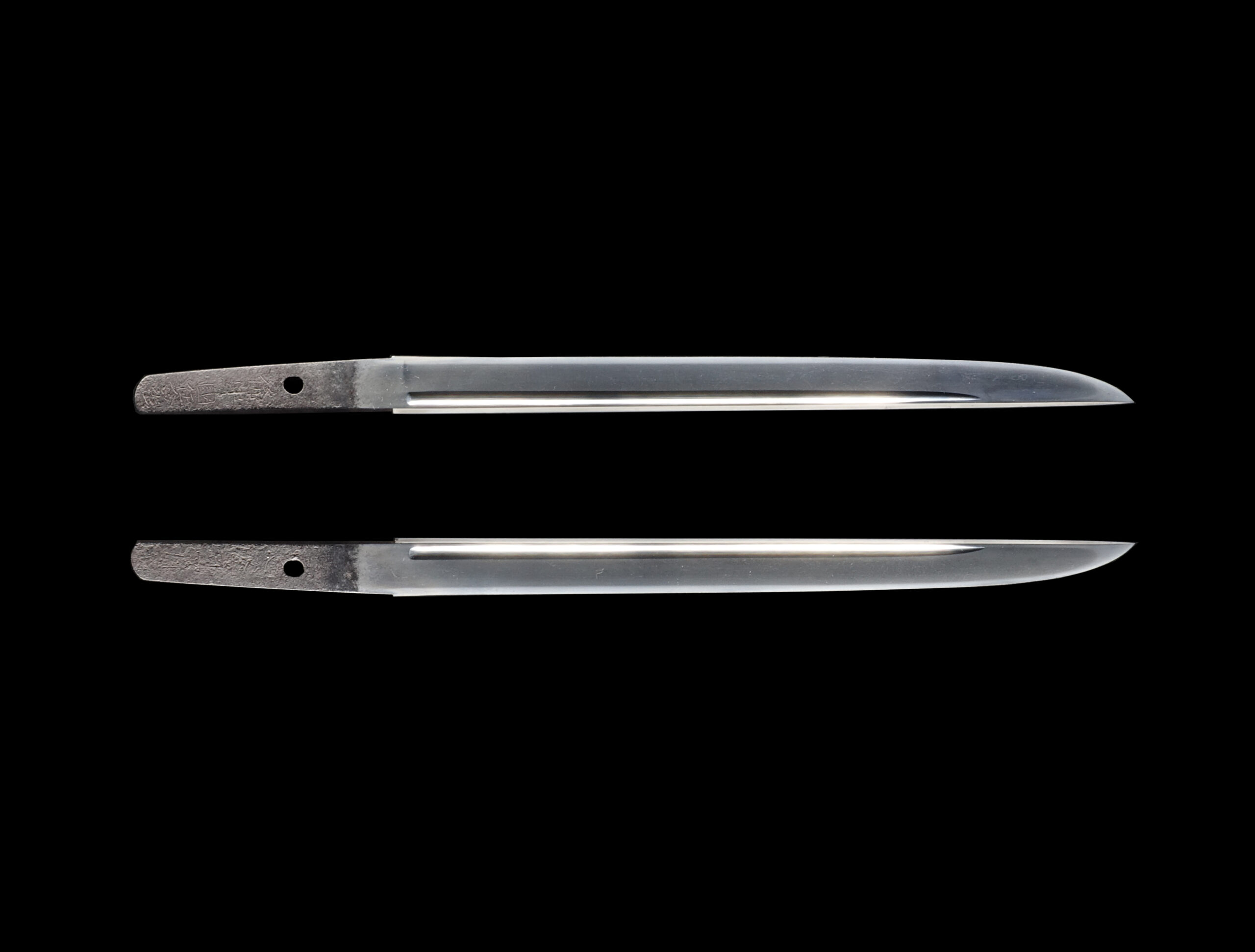
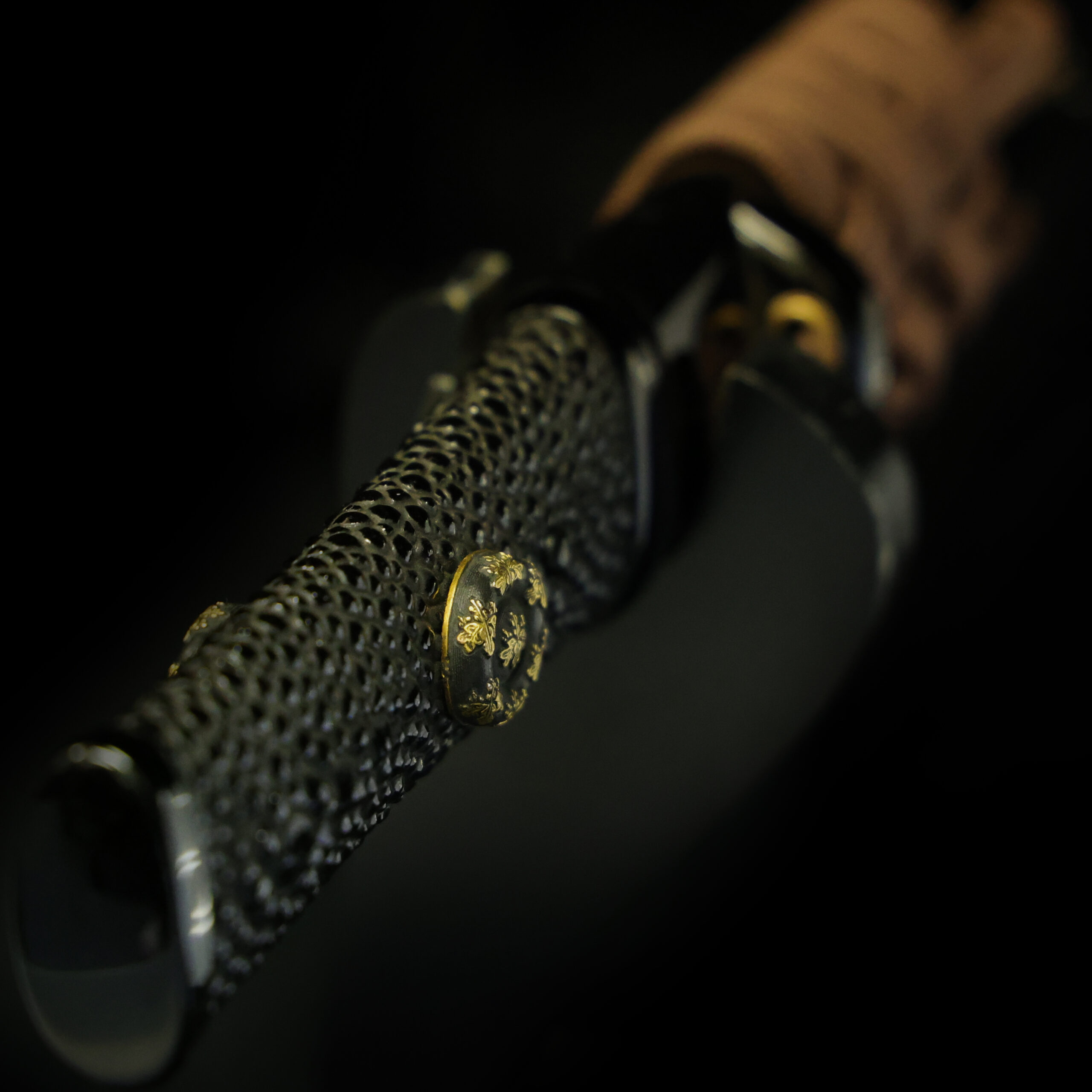
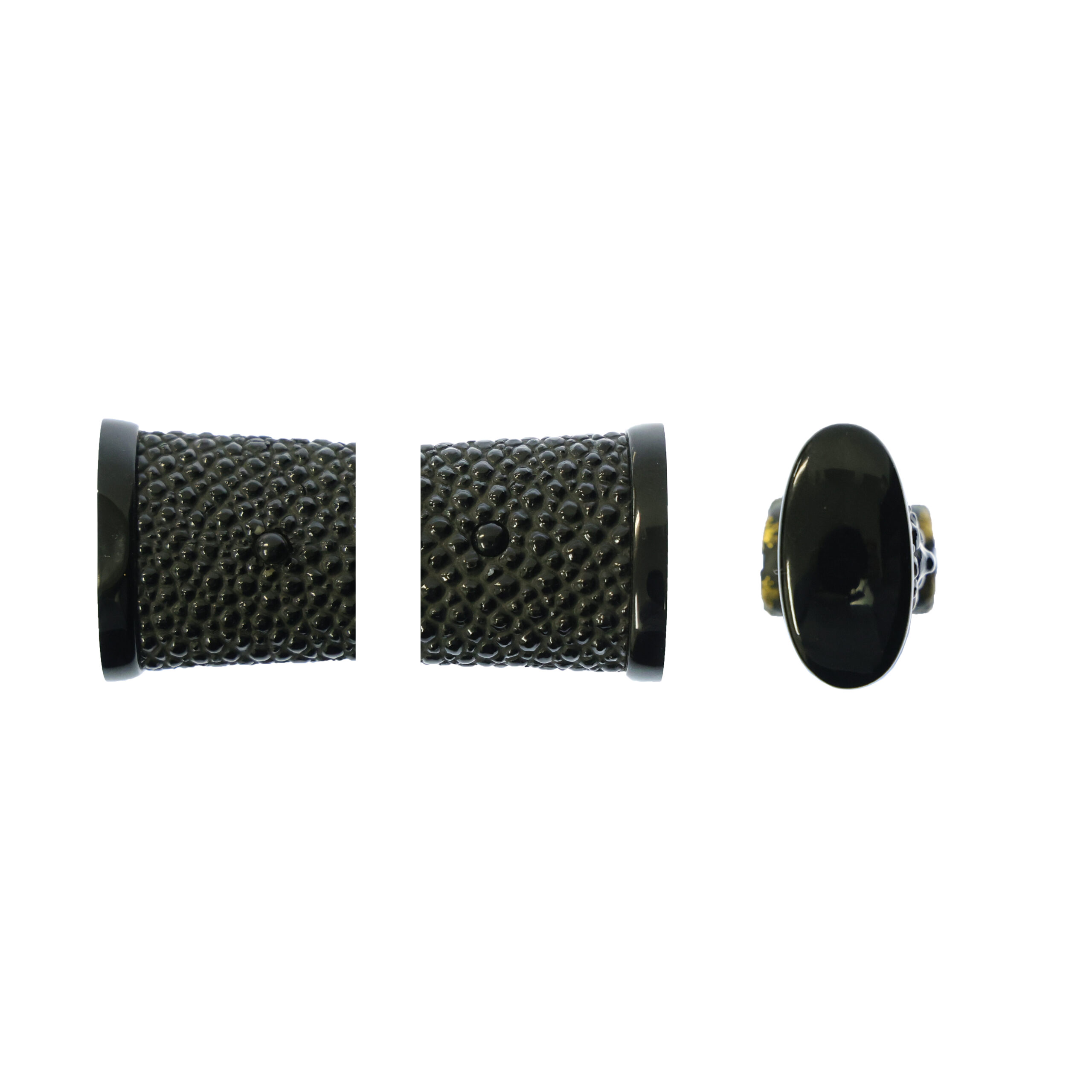
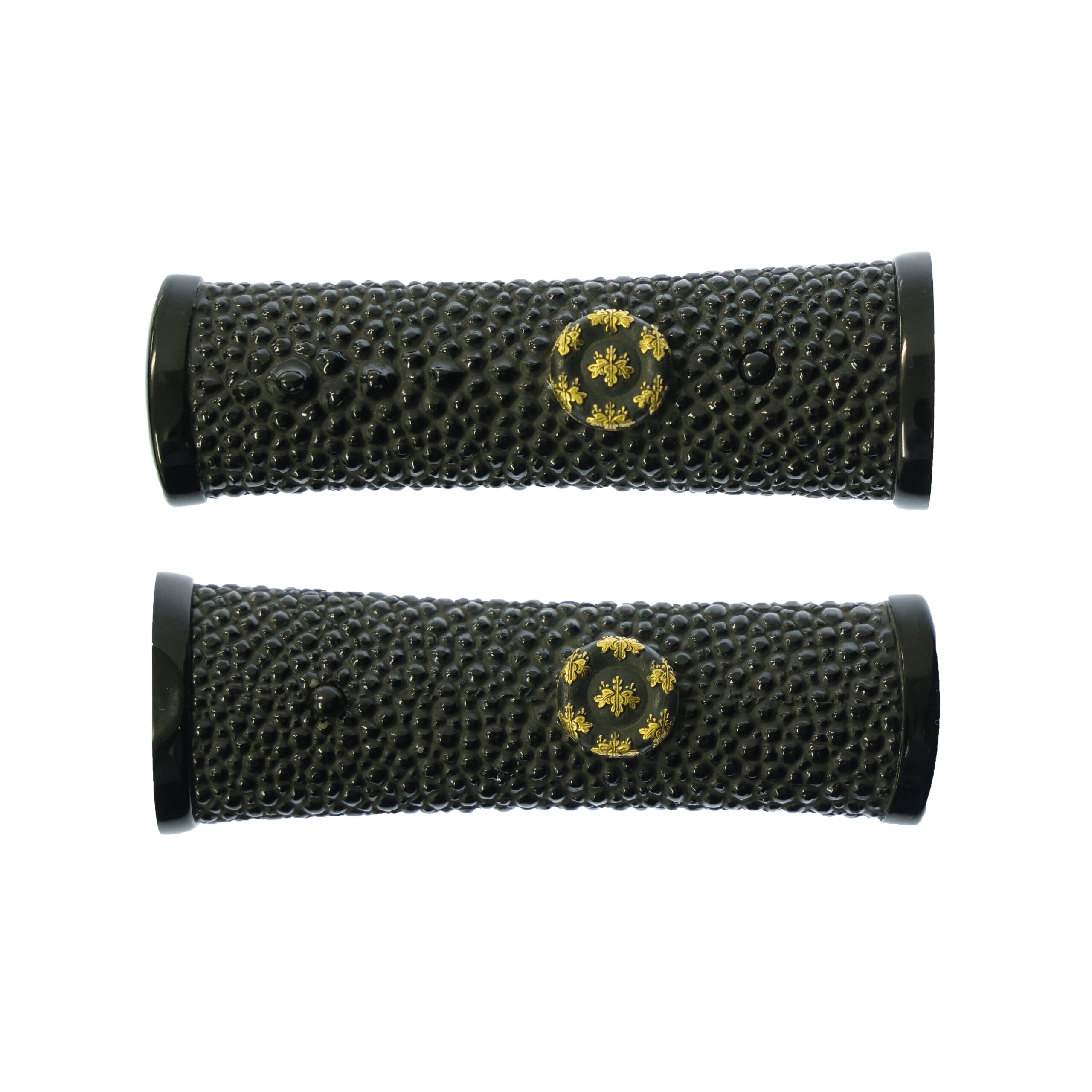
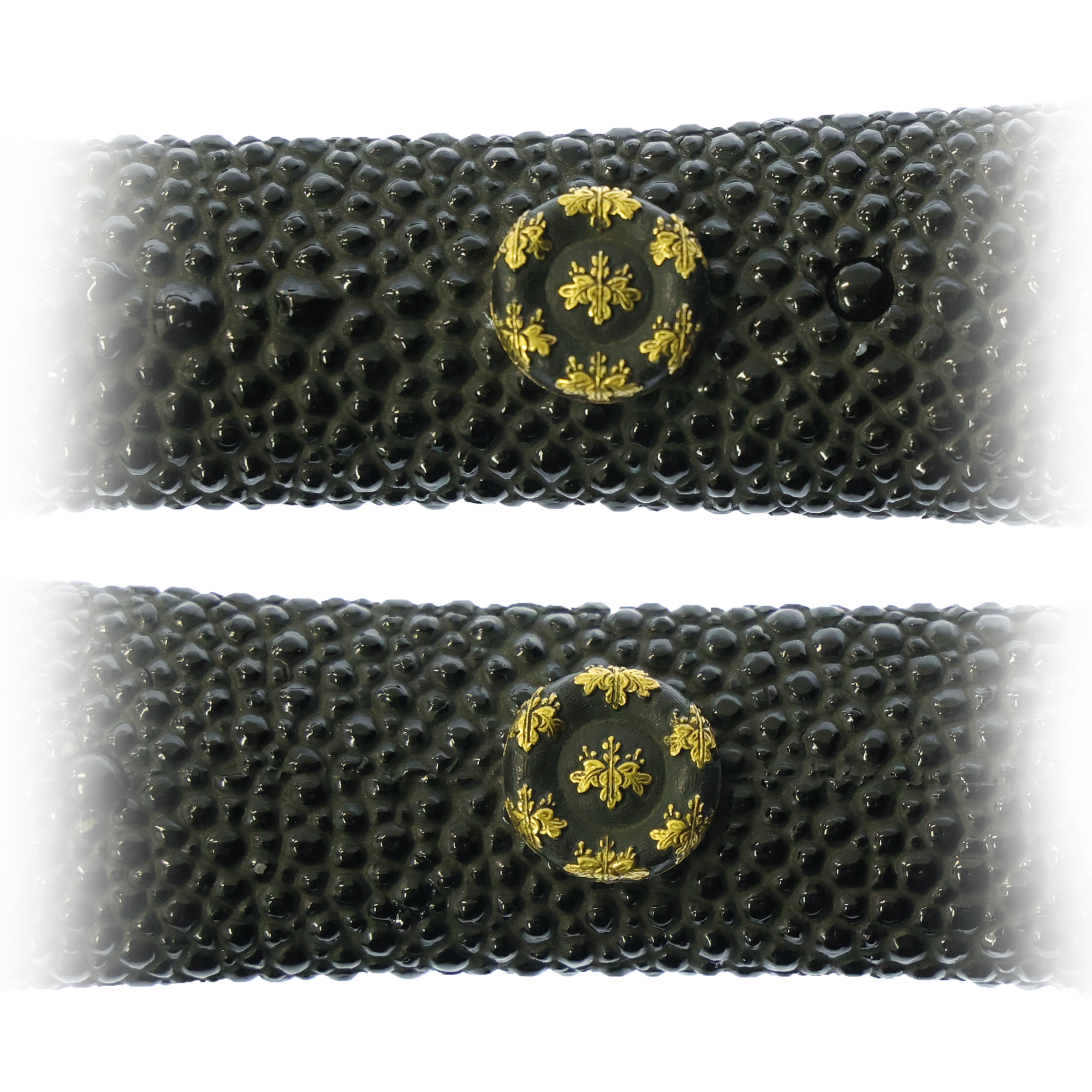
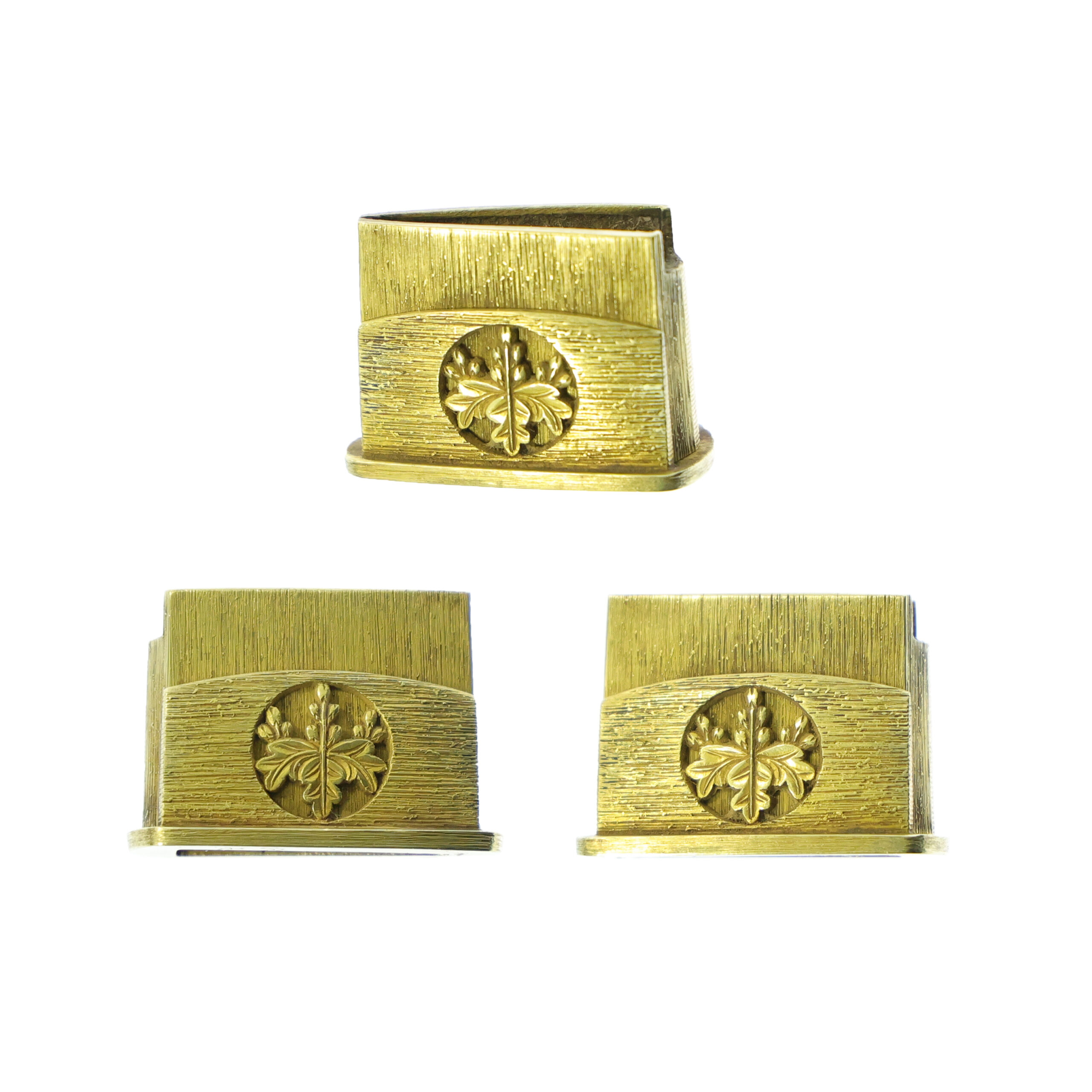
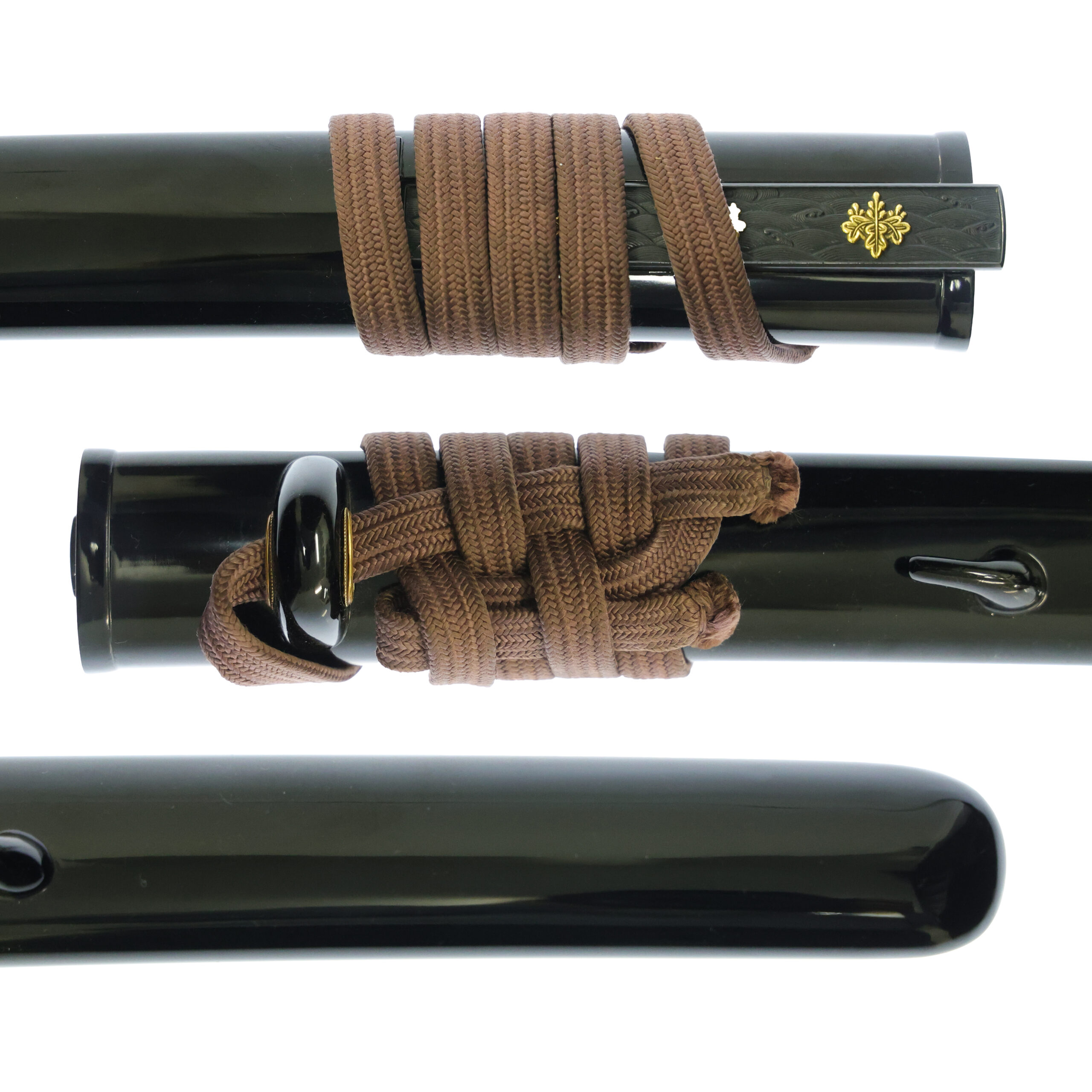
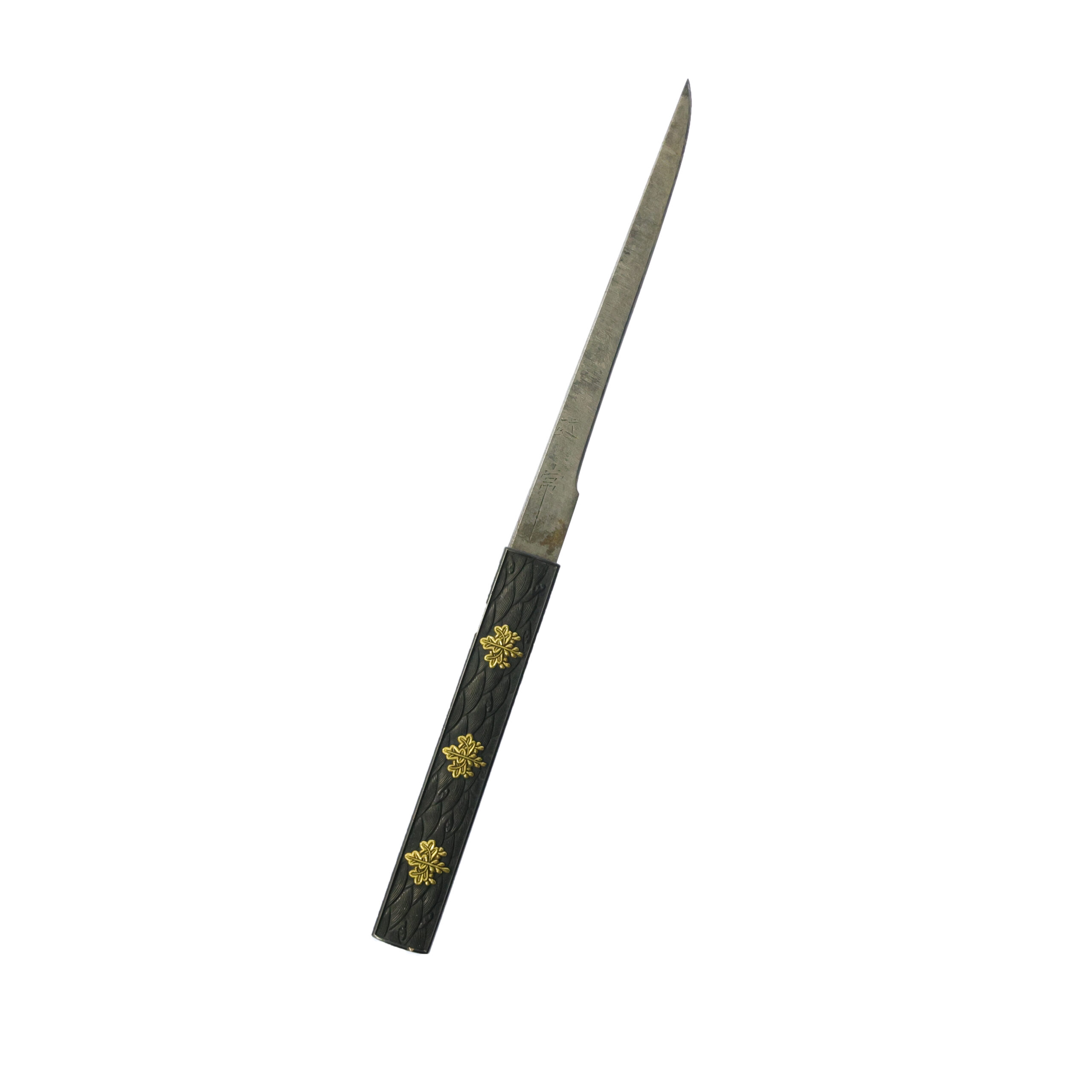
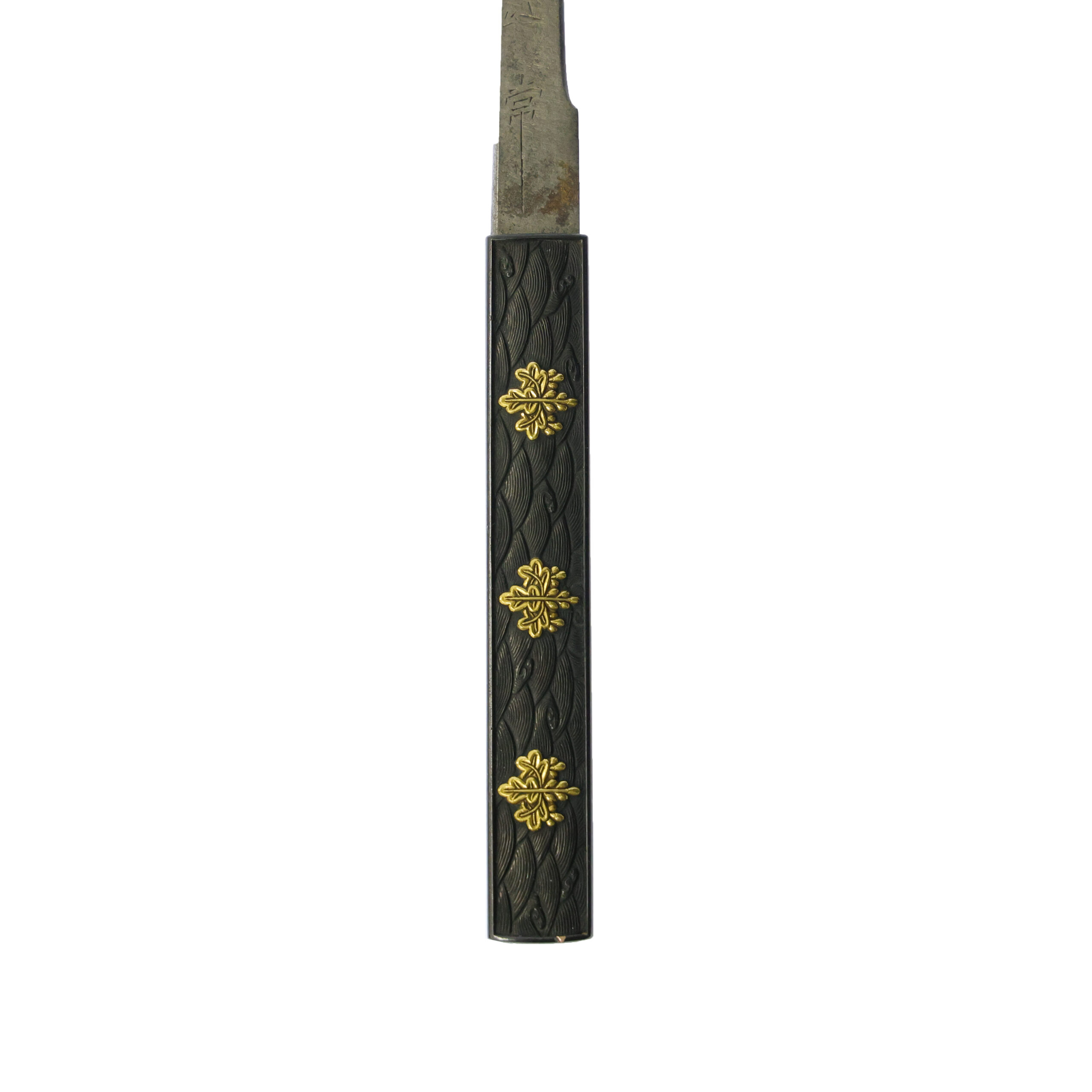
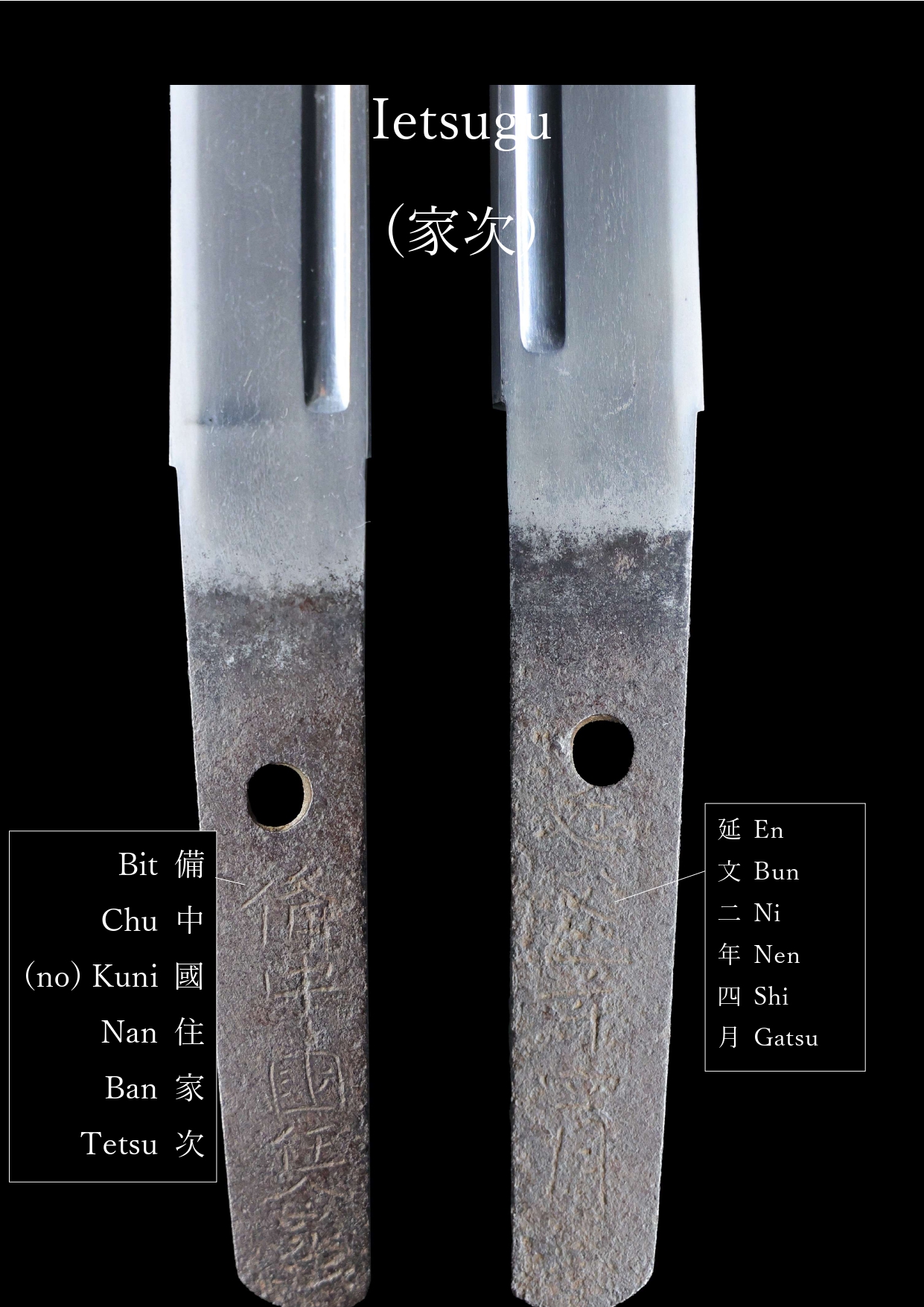
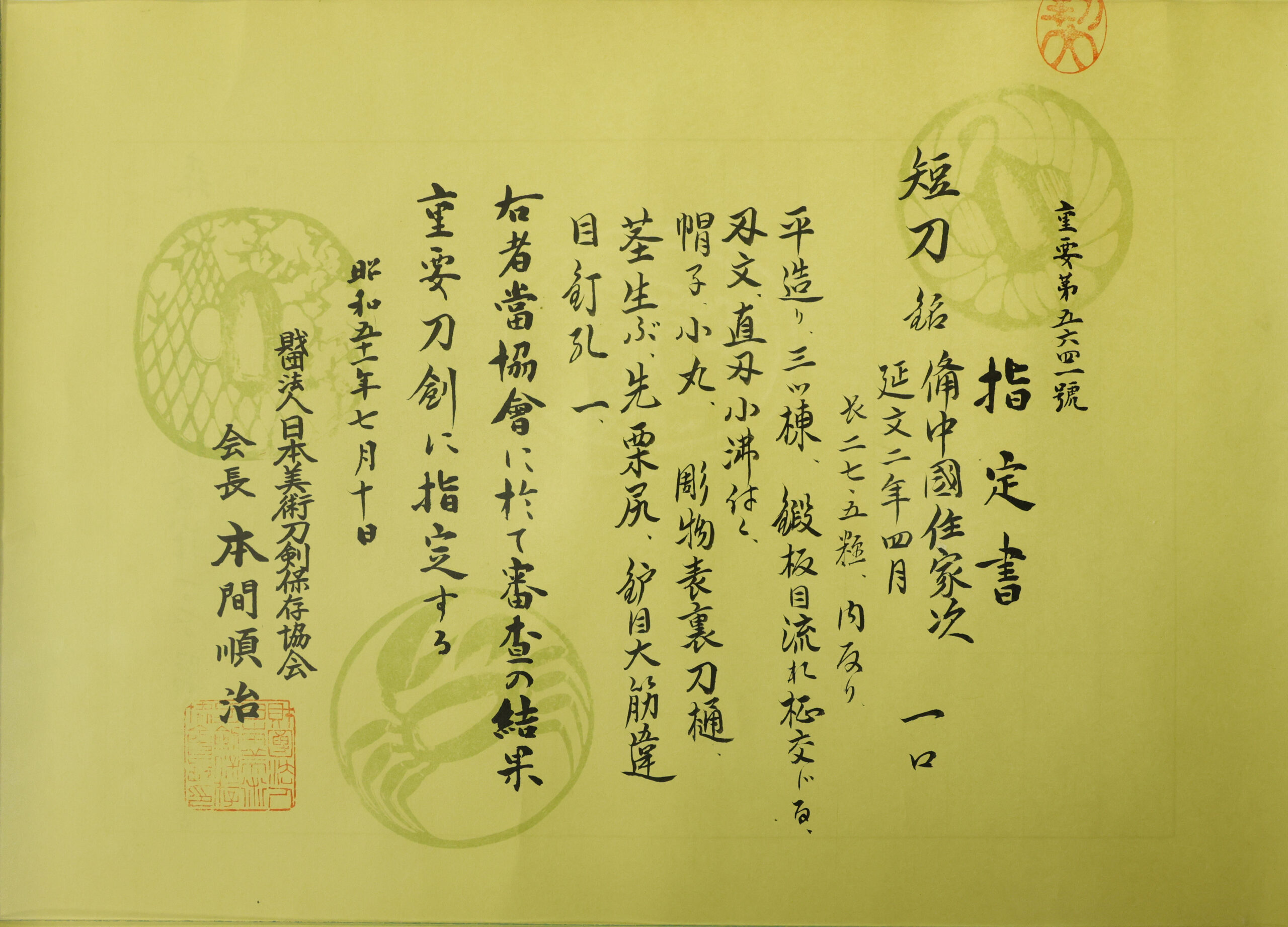
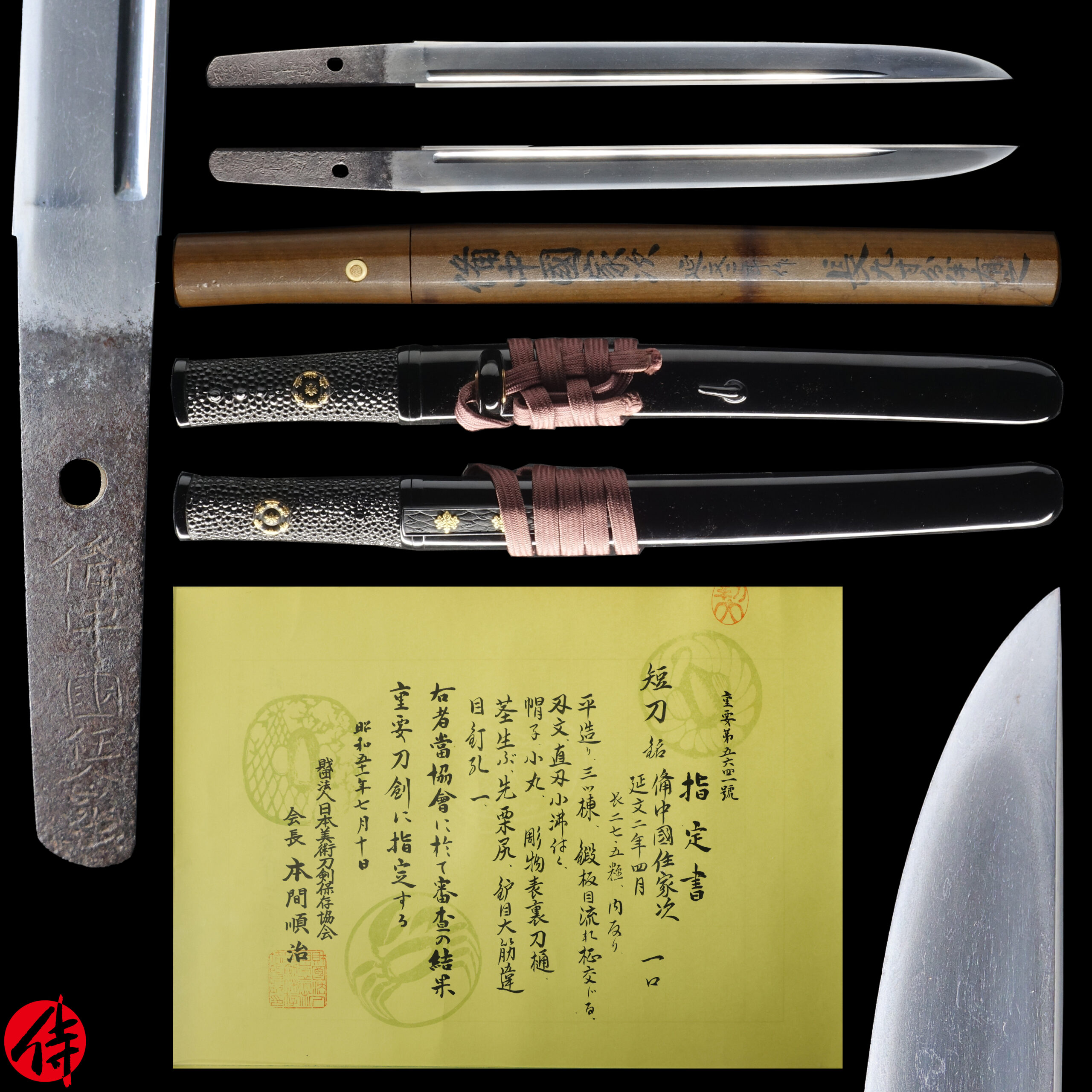
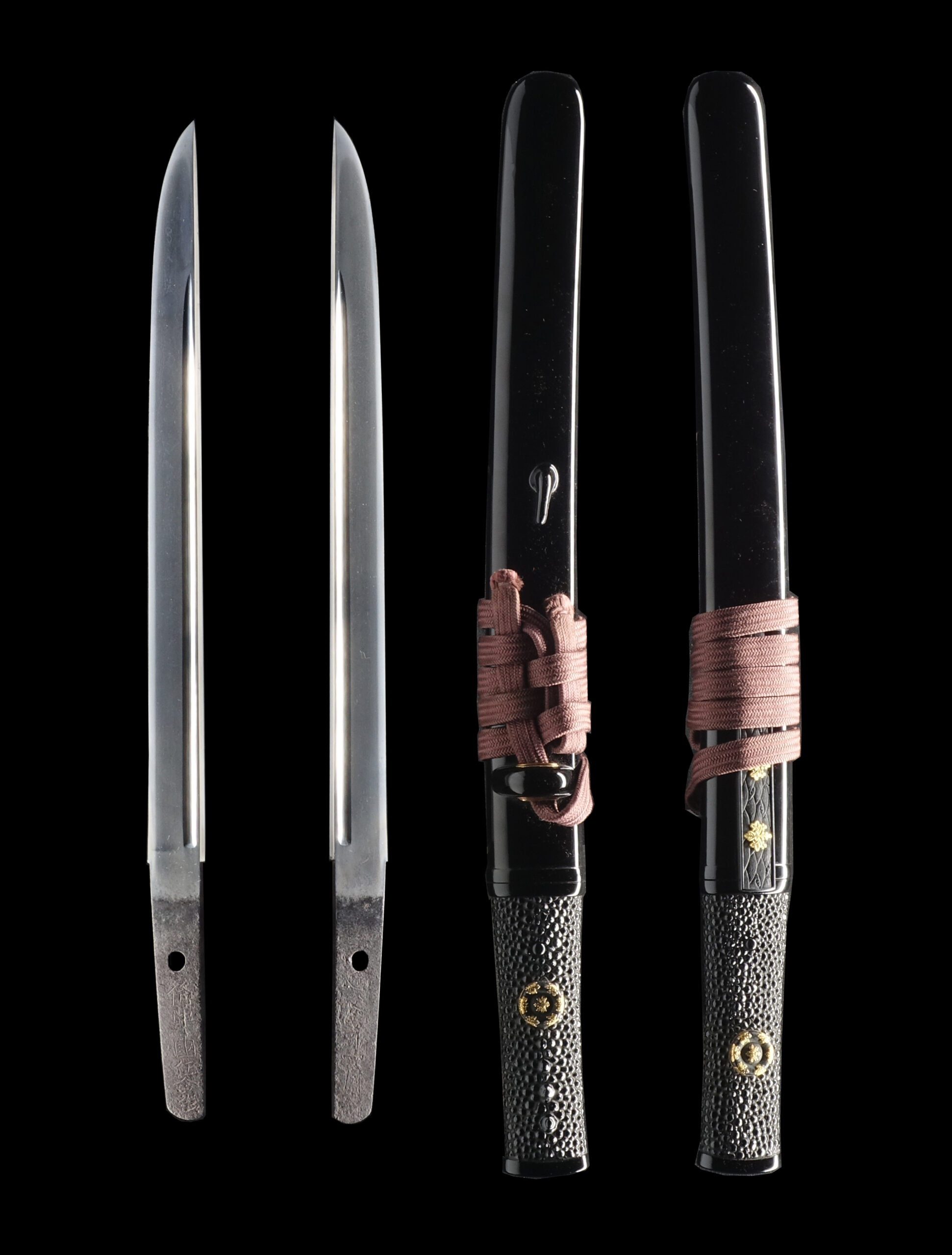
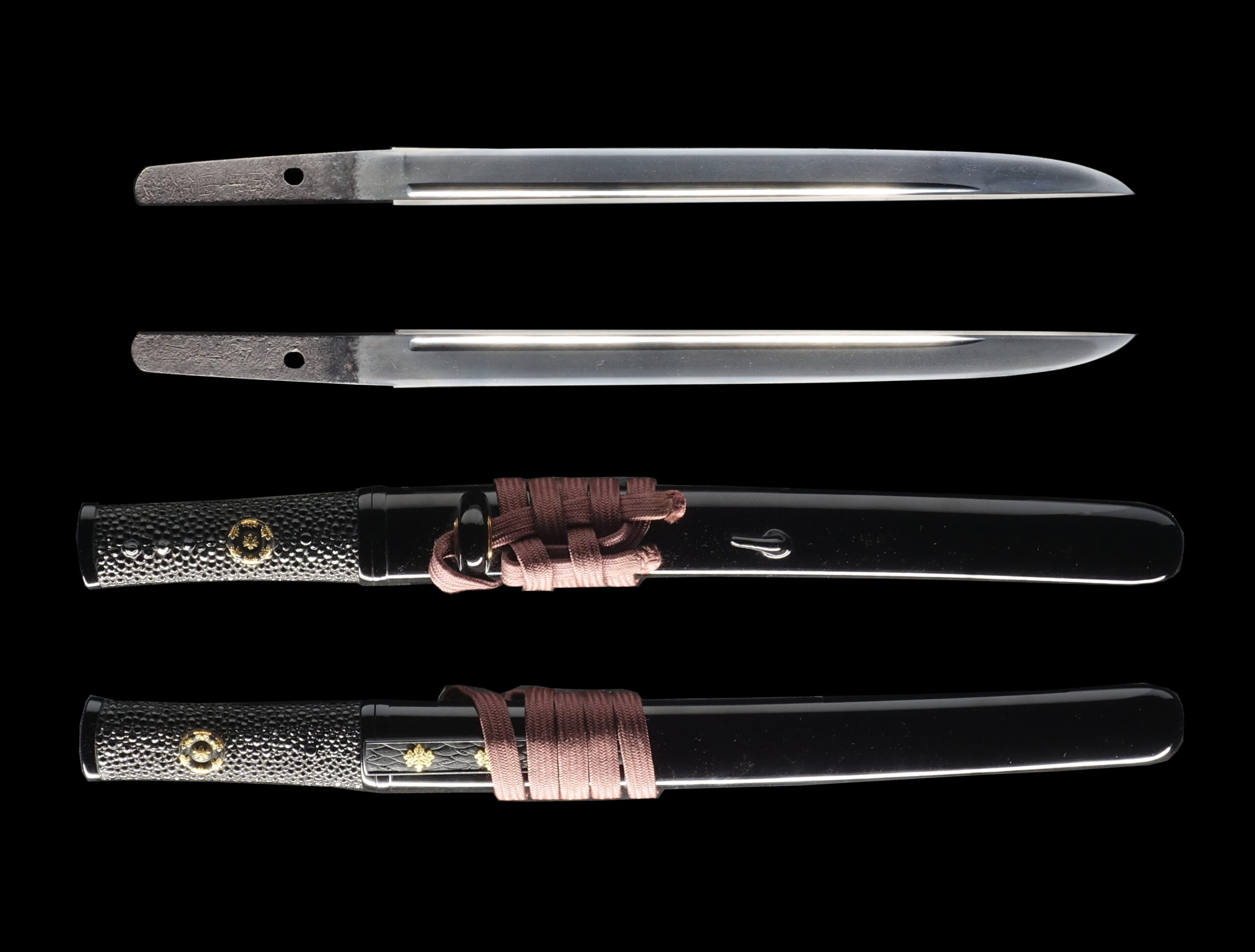
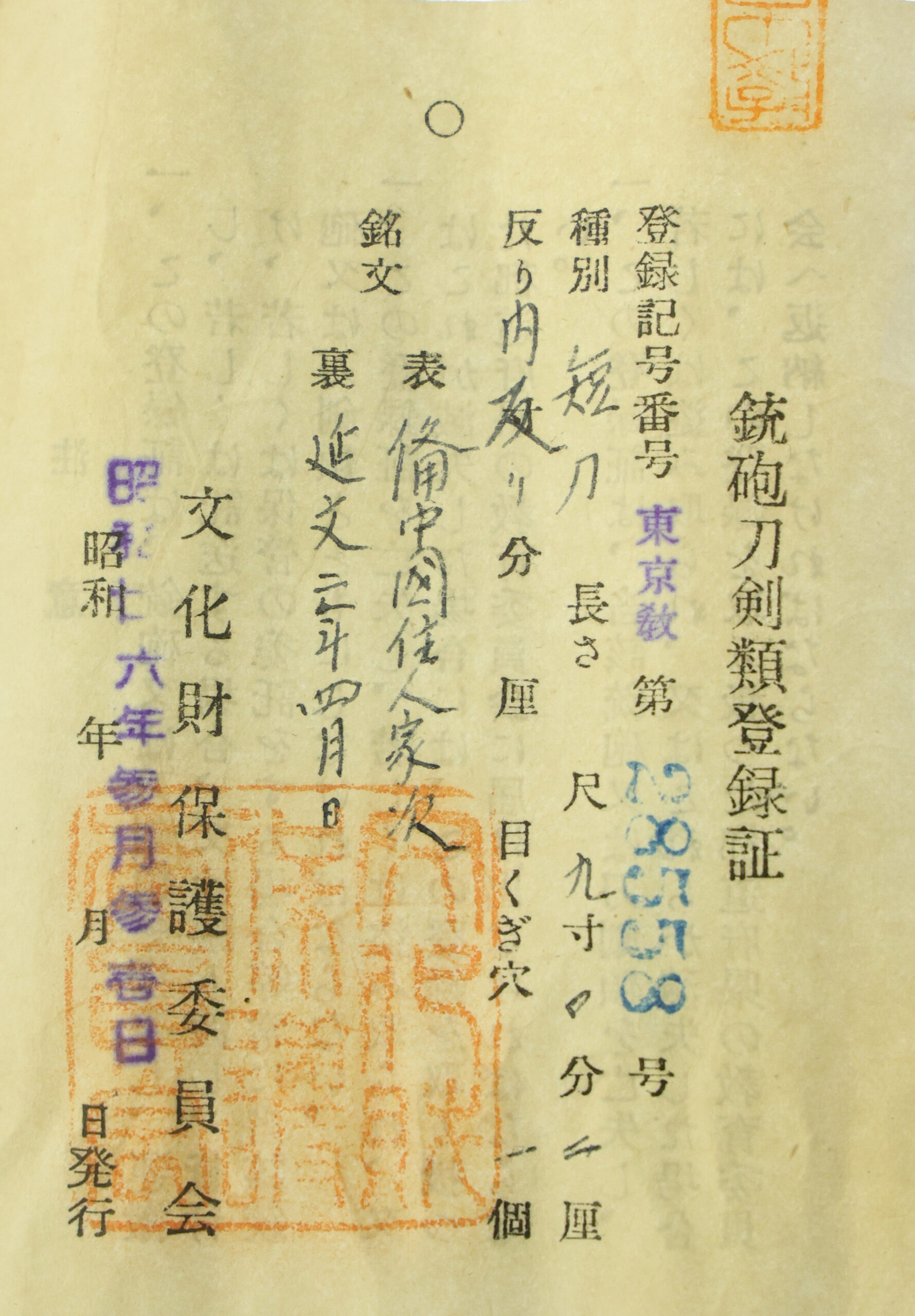
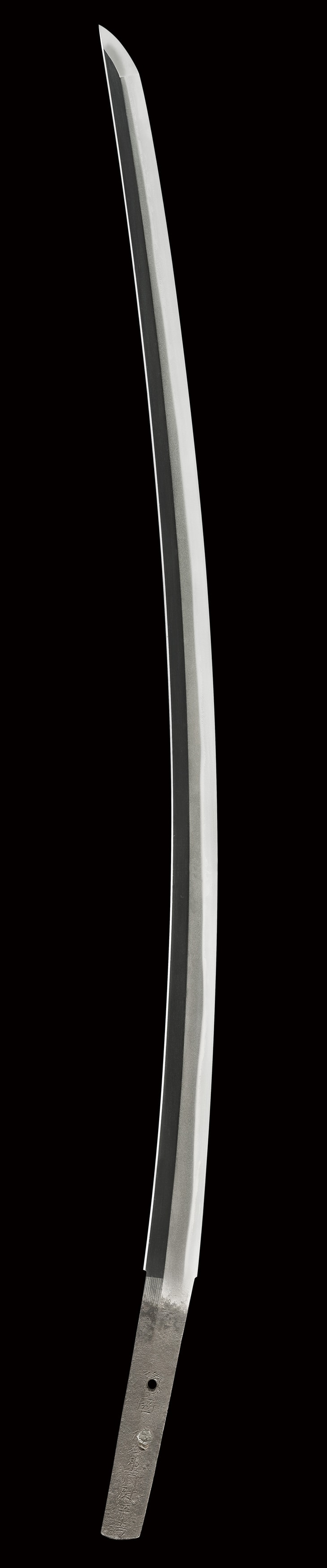
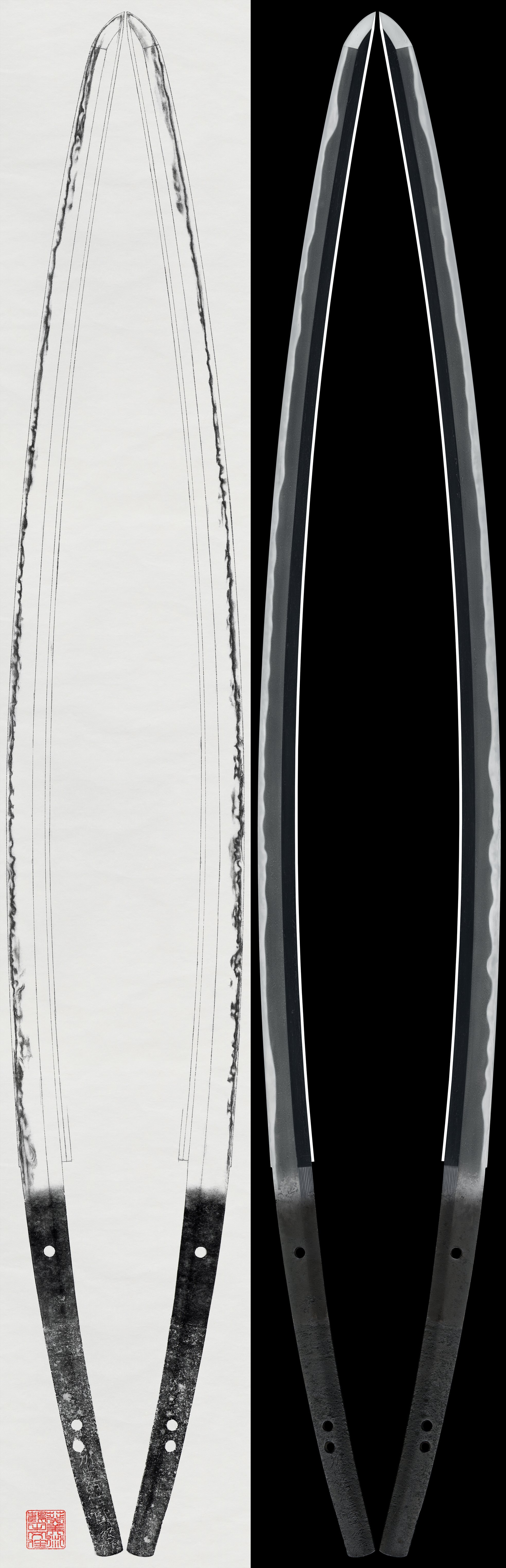
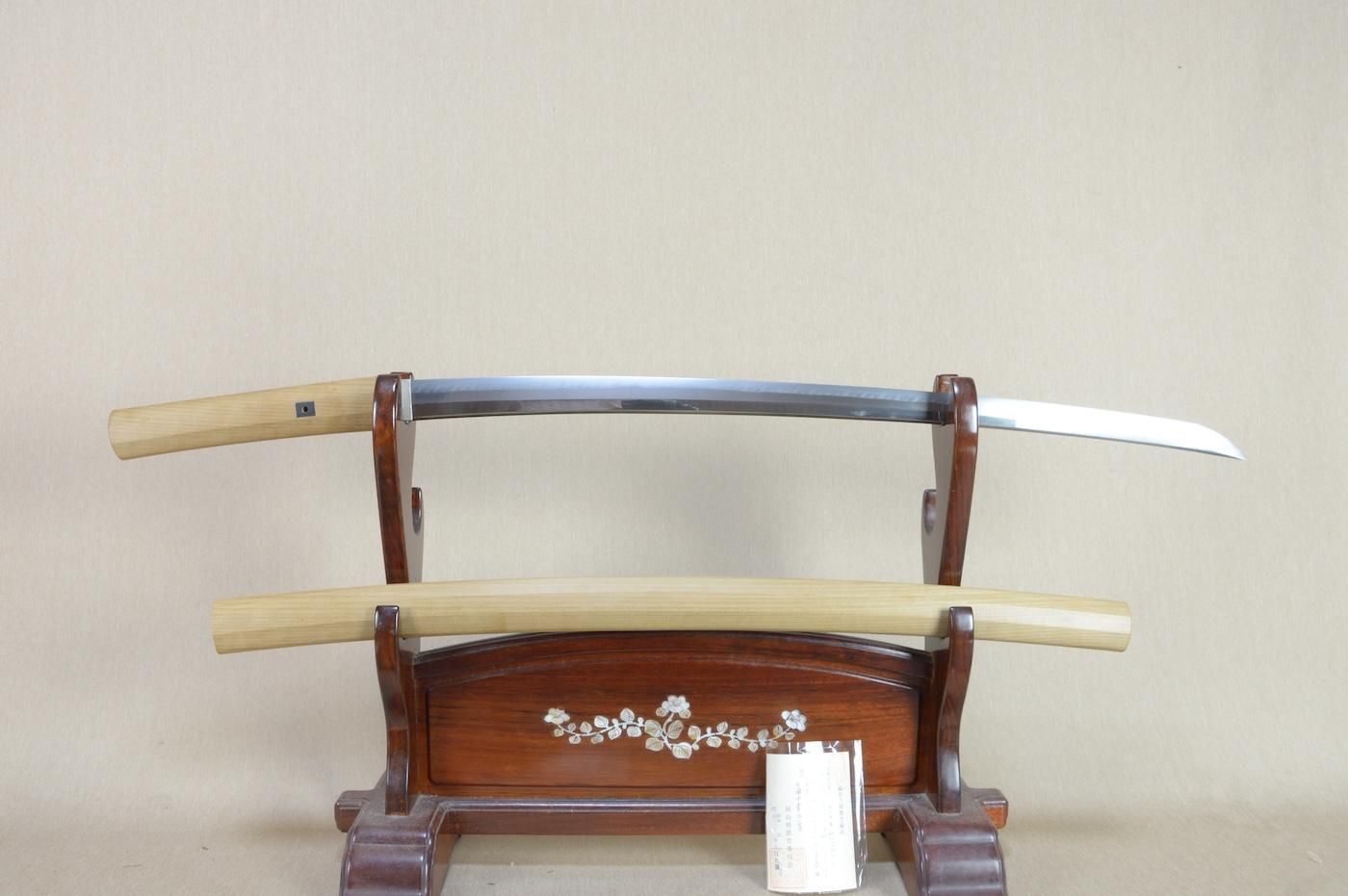
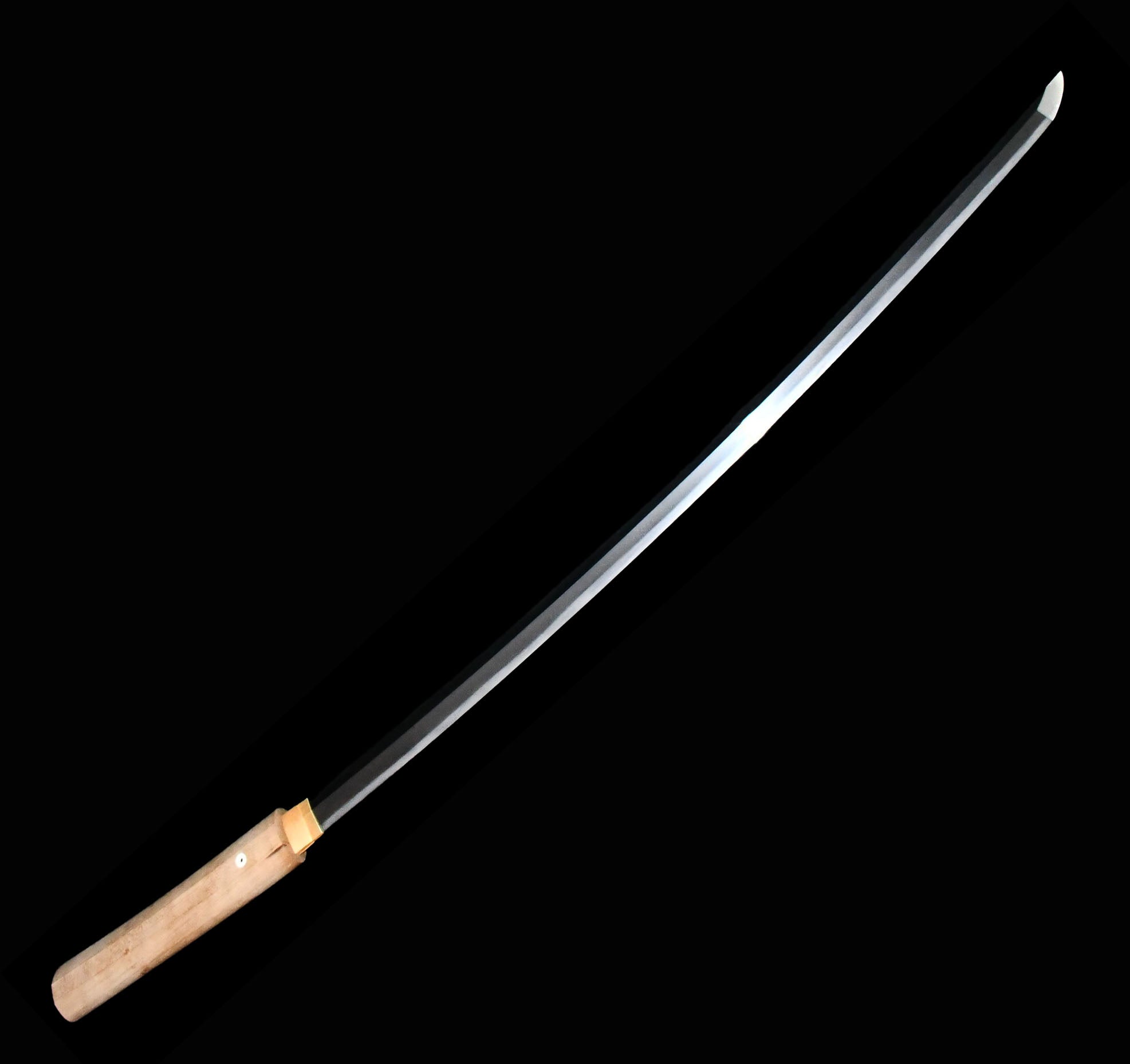
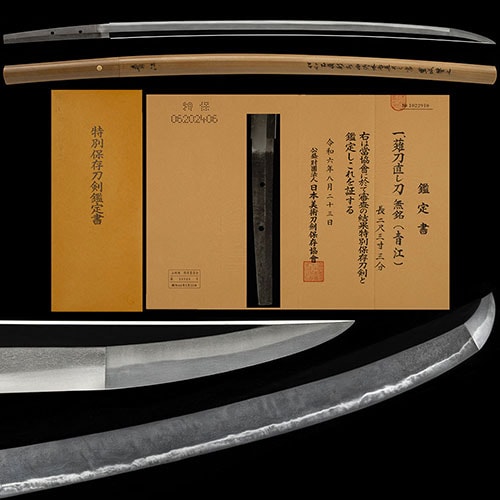
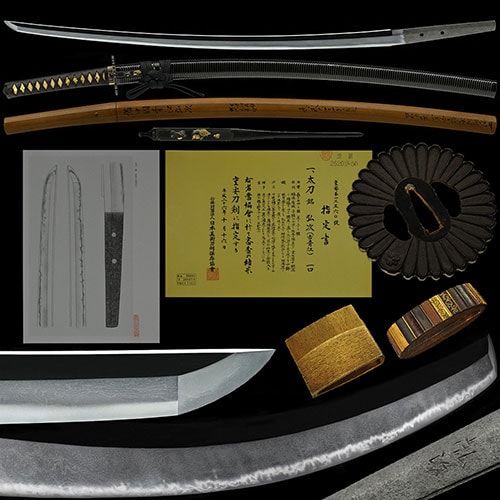
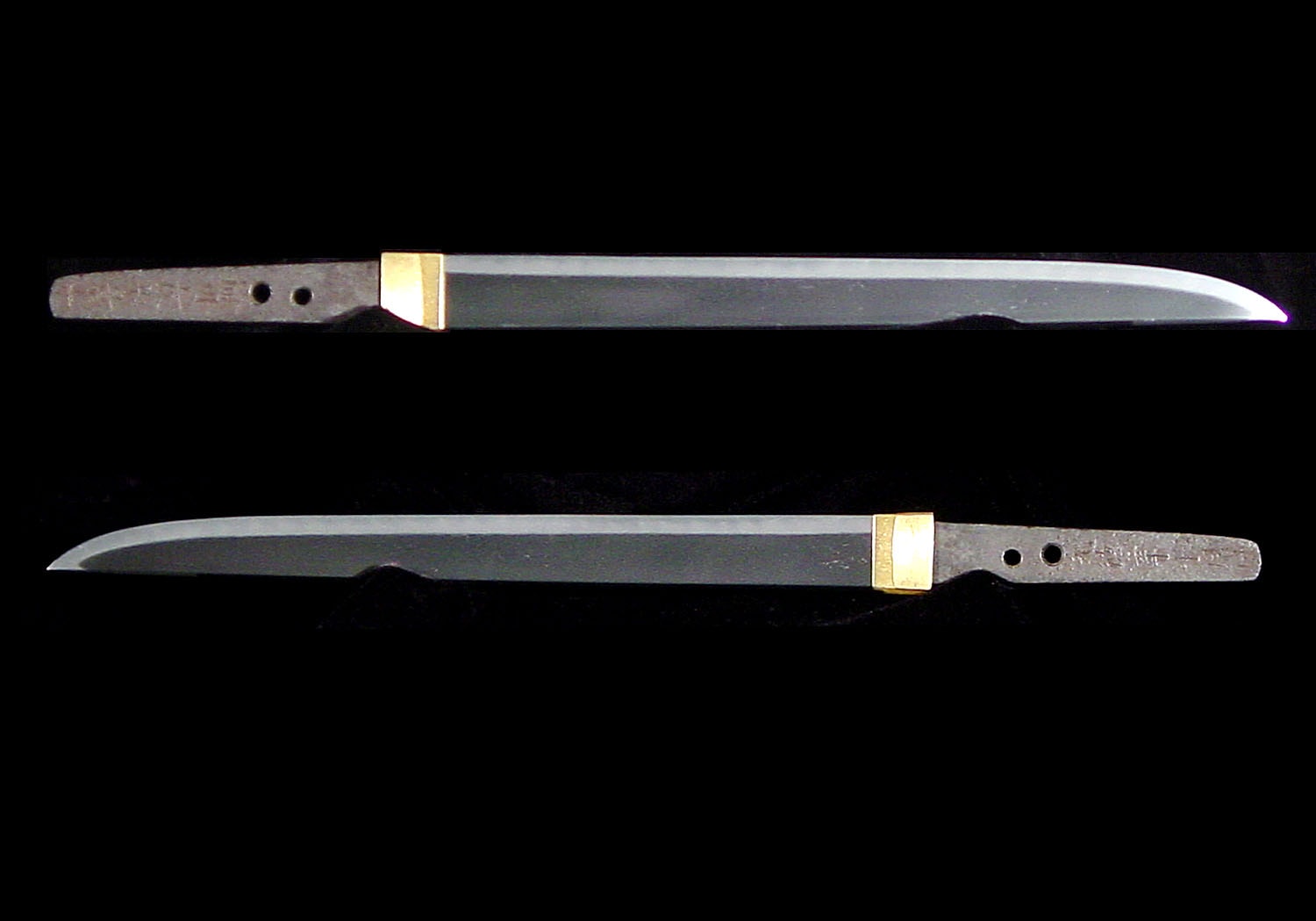
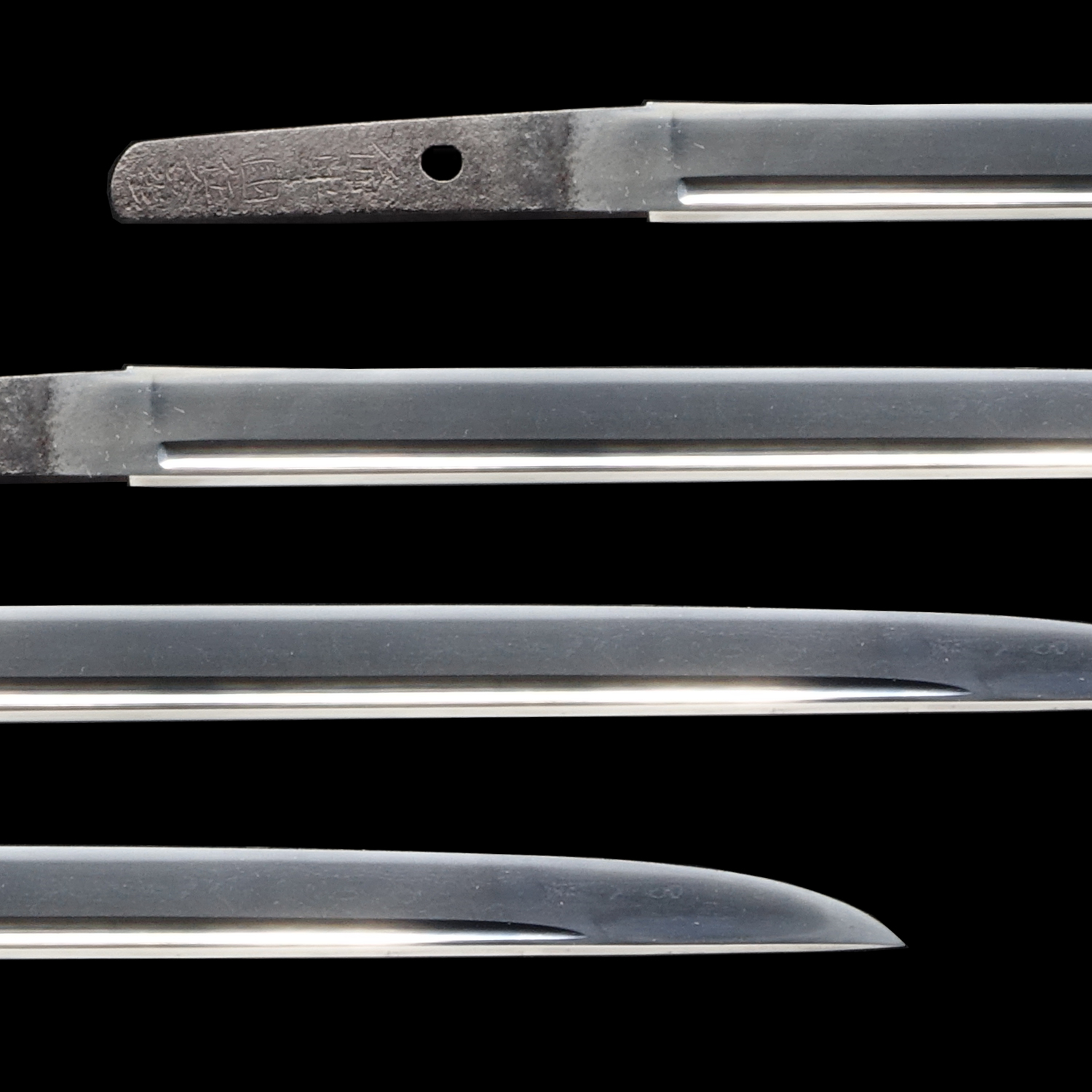
This Tanto is signed by Bitchu no Kuni ju Ietsugu, a prominent smith of the Aoe school during the mid-Nanbokucho period (1357). The blade is accompanied by an NBTHK Juyo Token certificate, indicating its exceptional quality and historical value. It comes with both a koshirae (decorative sword mounting) featuring Gosan-no-Kiri Mon and a shirasaya case.

NBTHK Setsumei

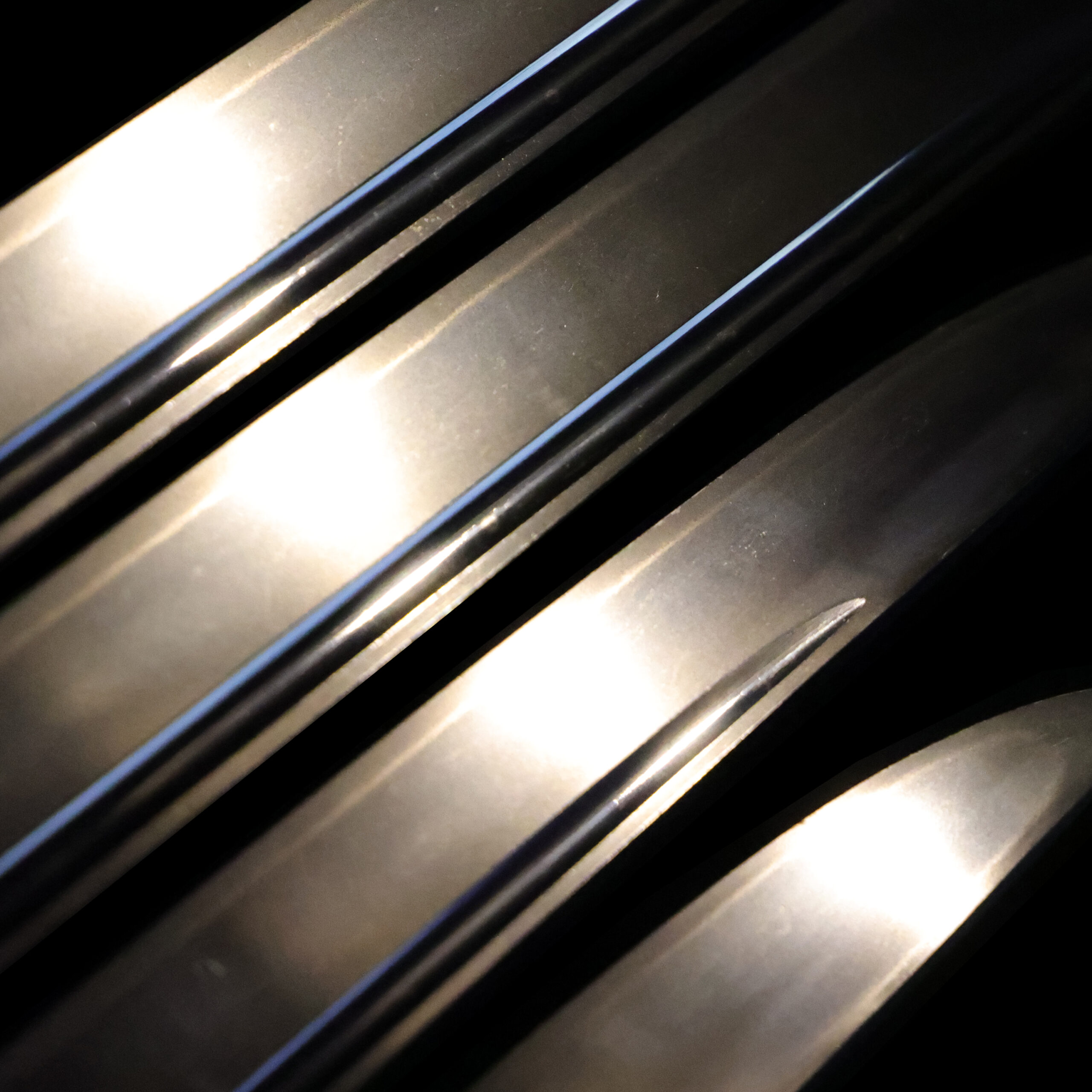
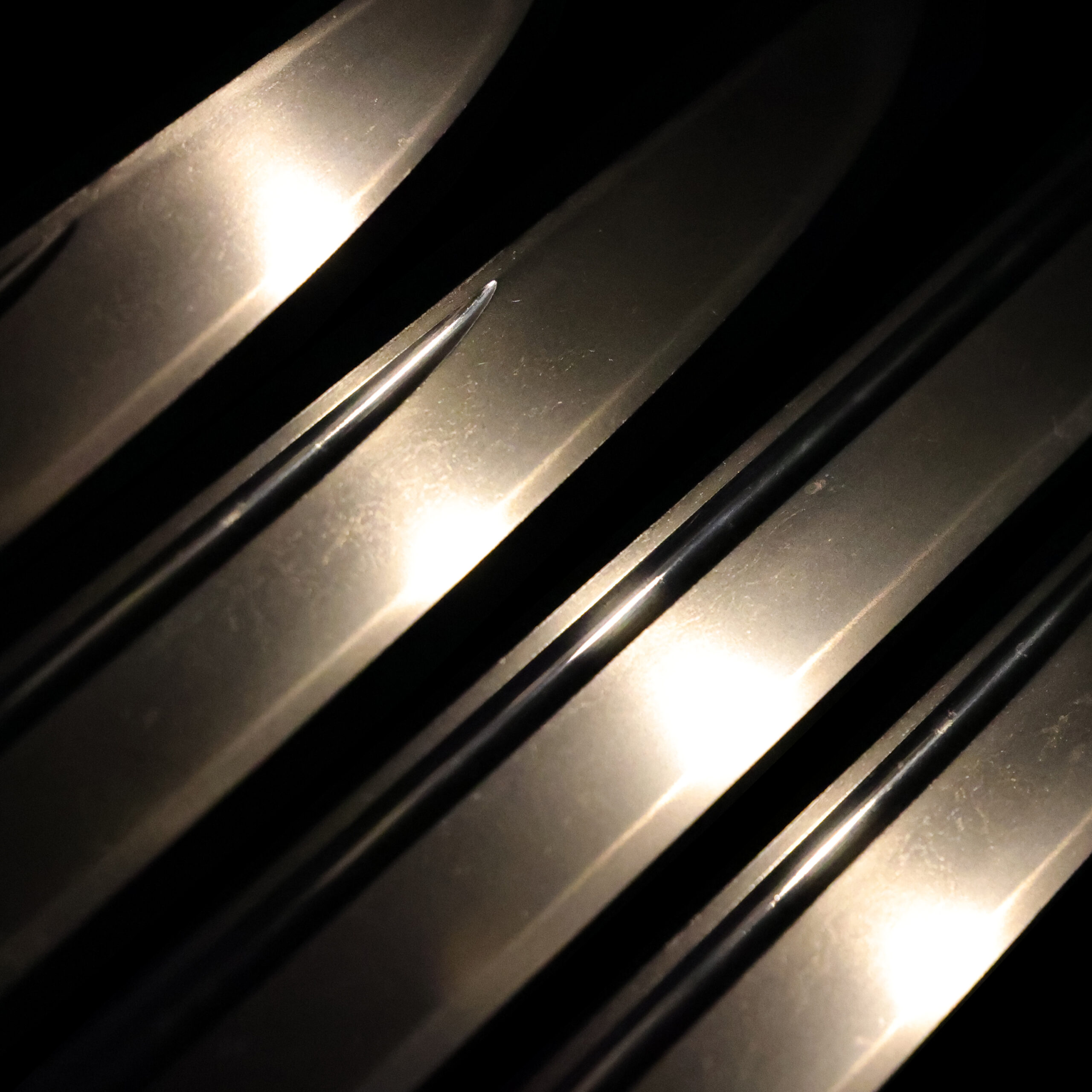
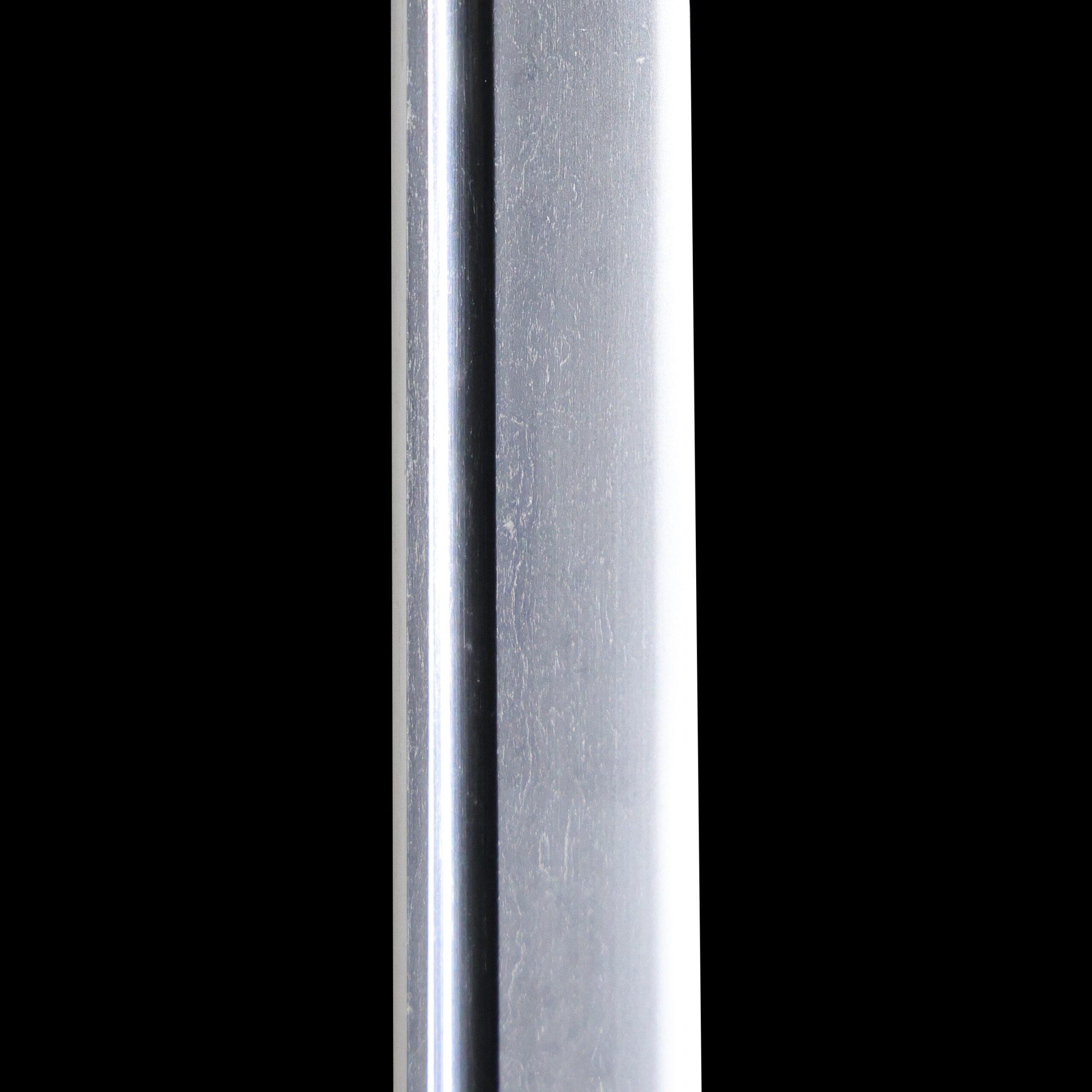
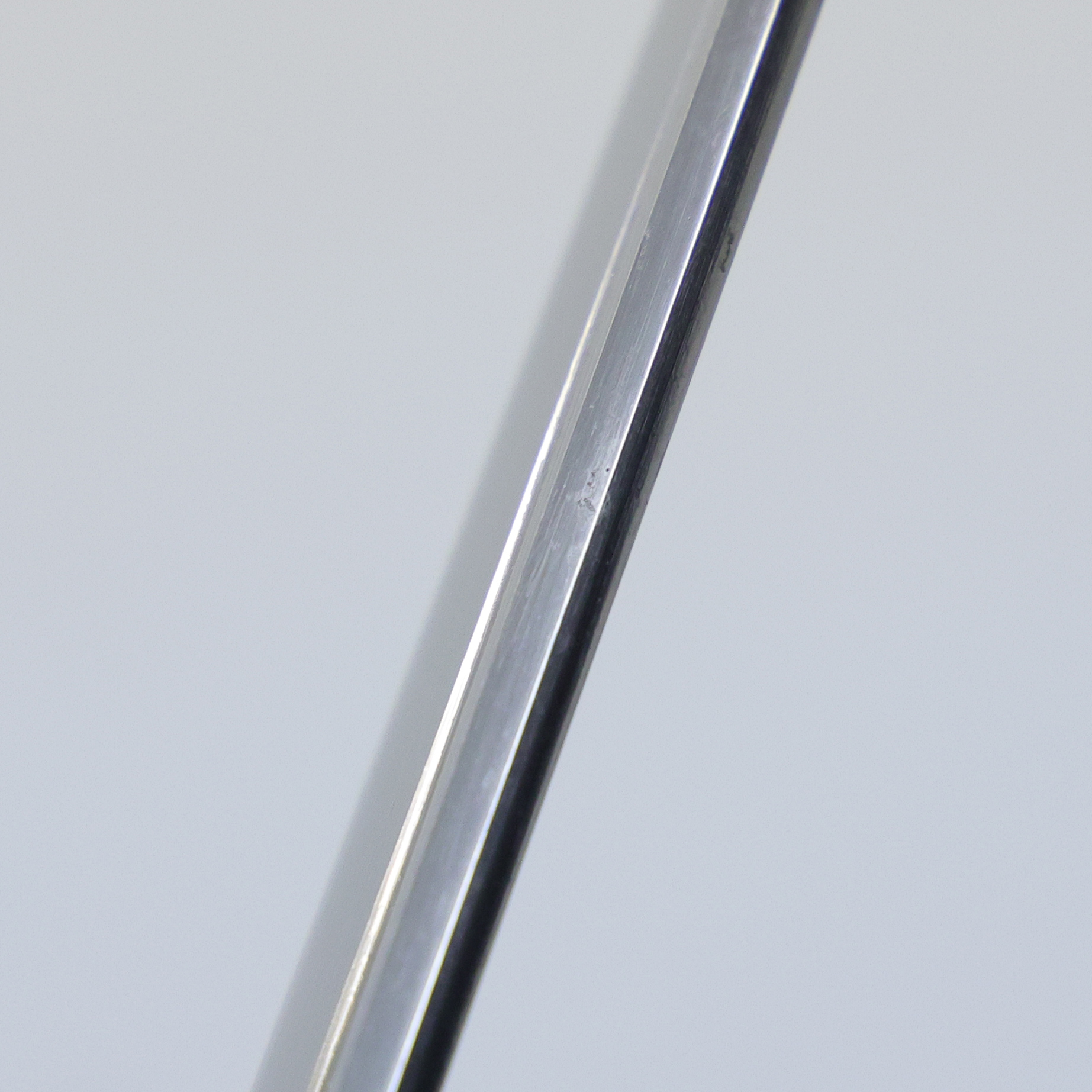
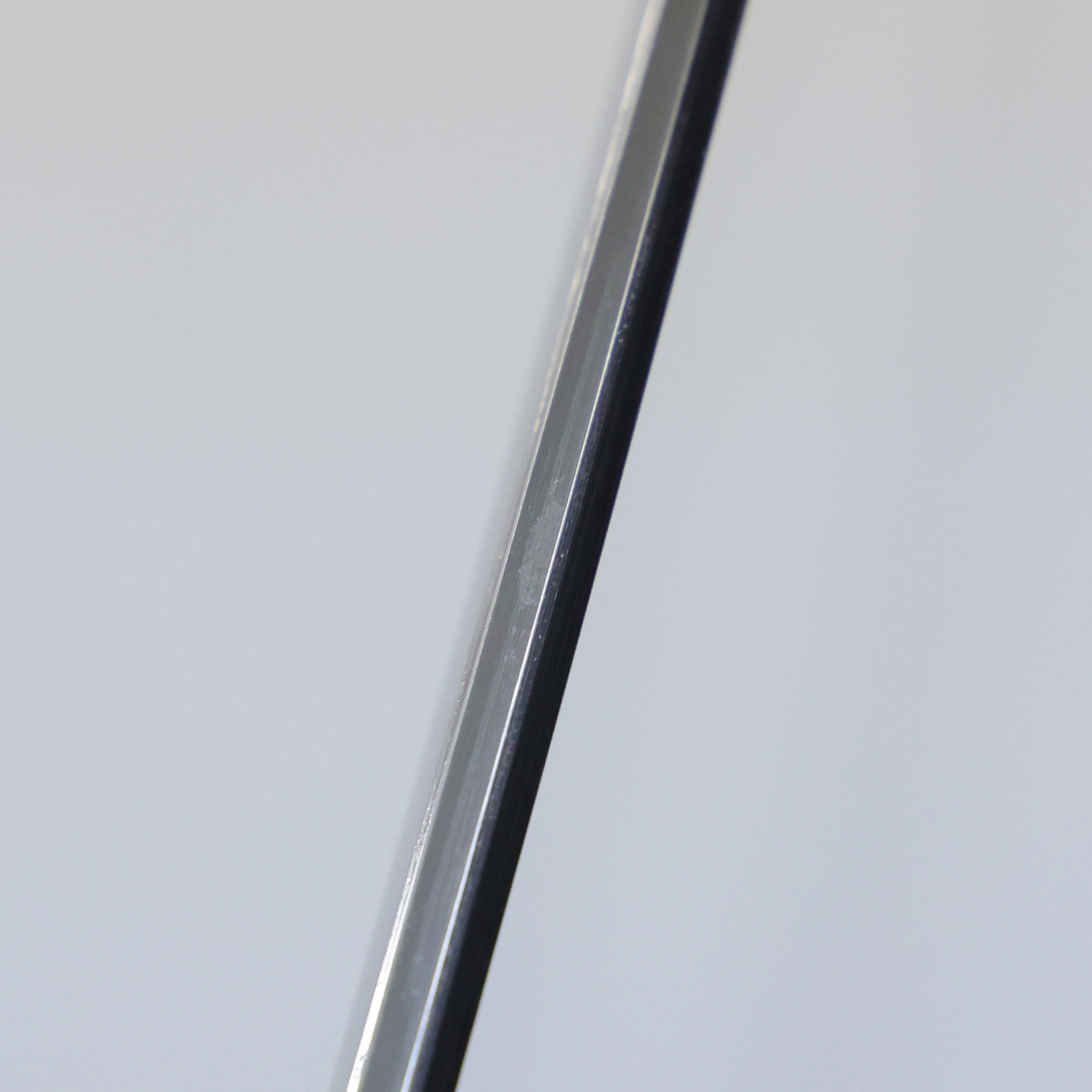
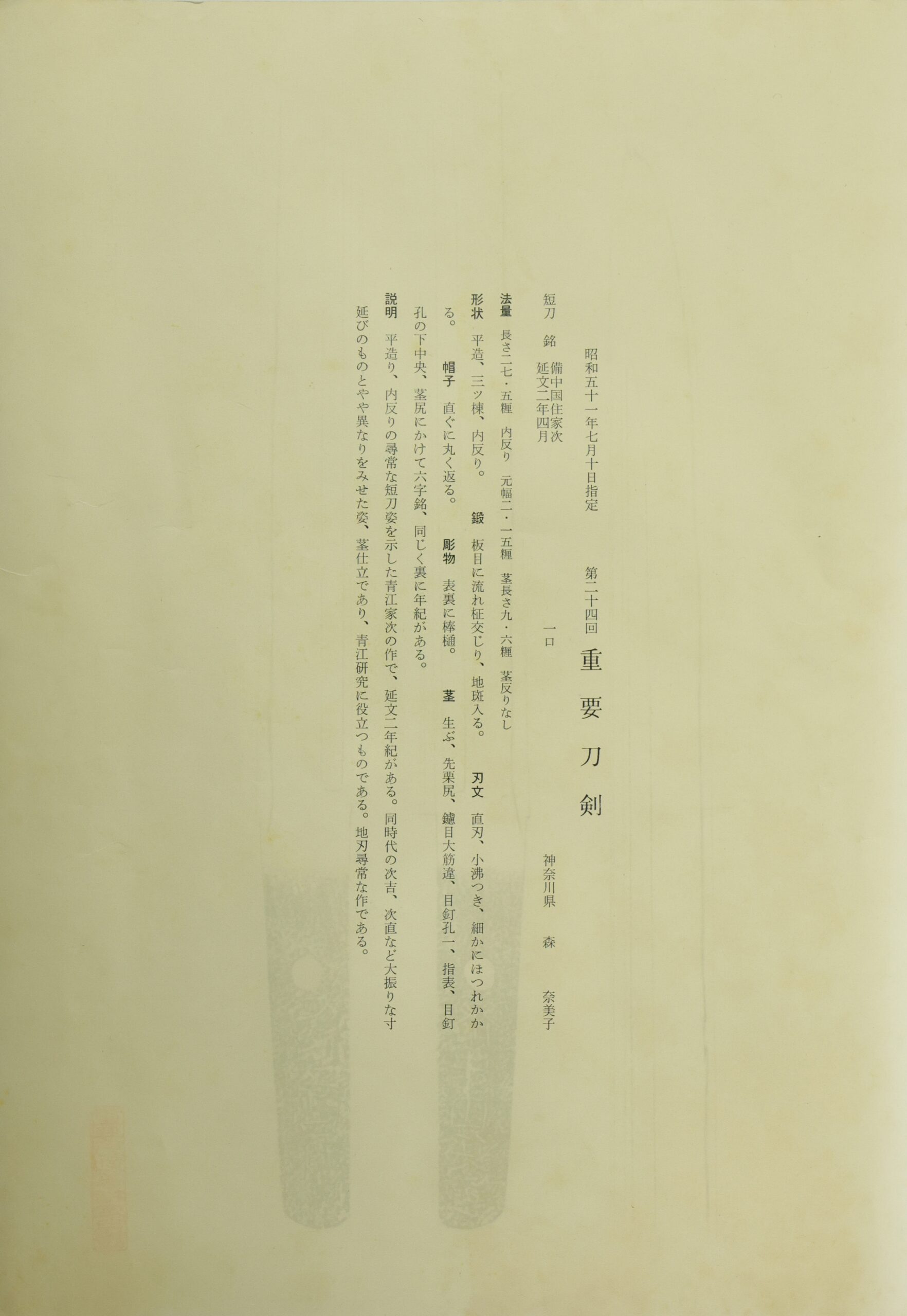
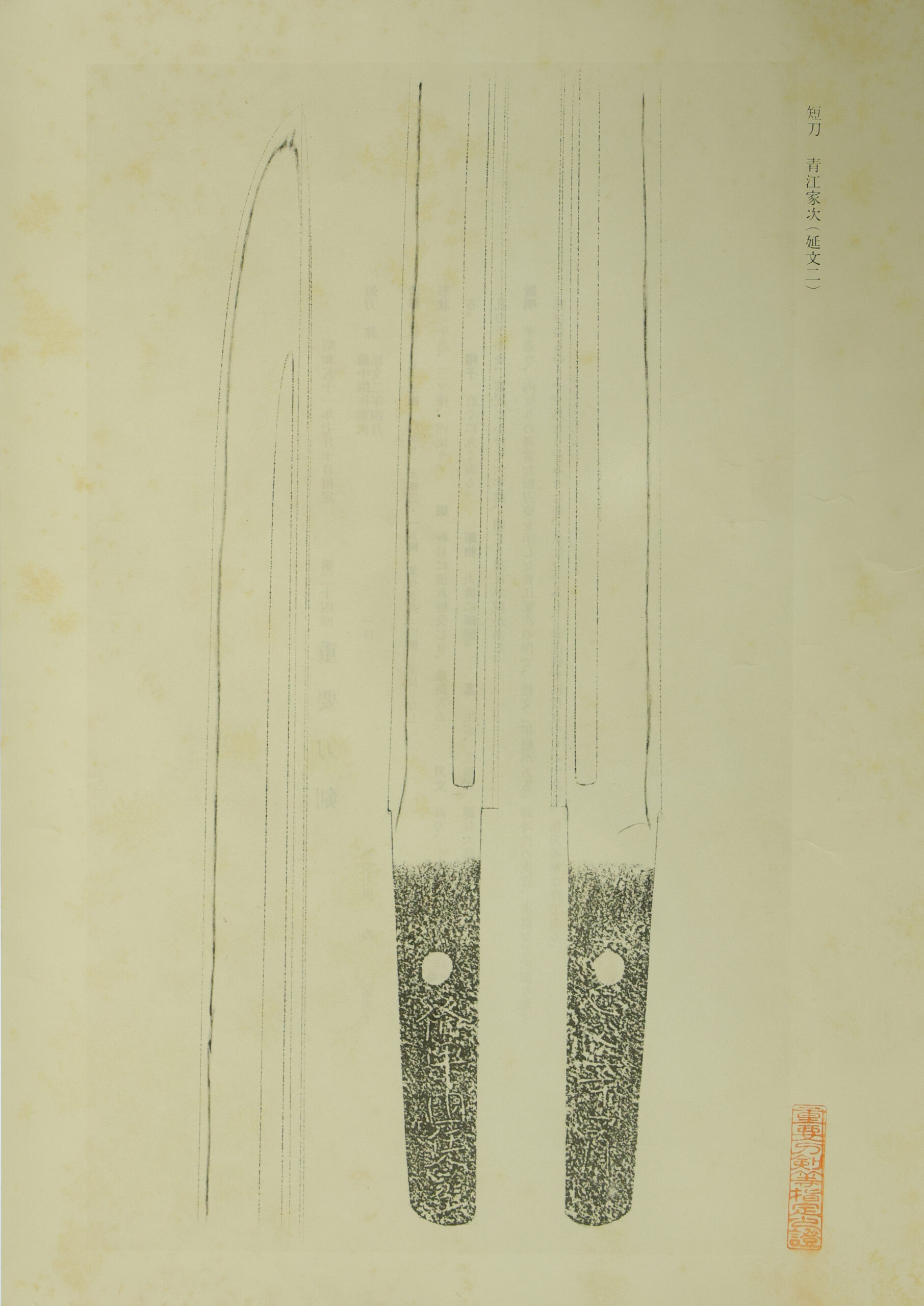
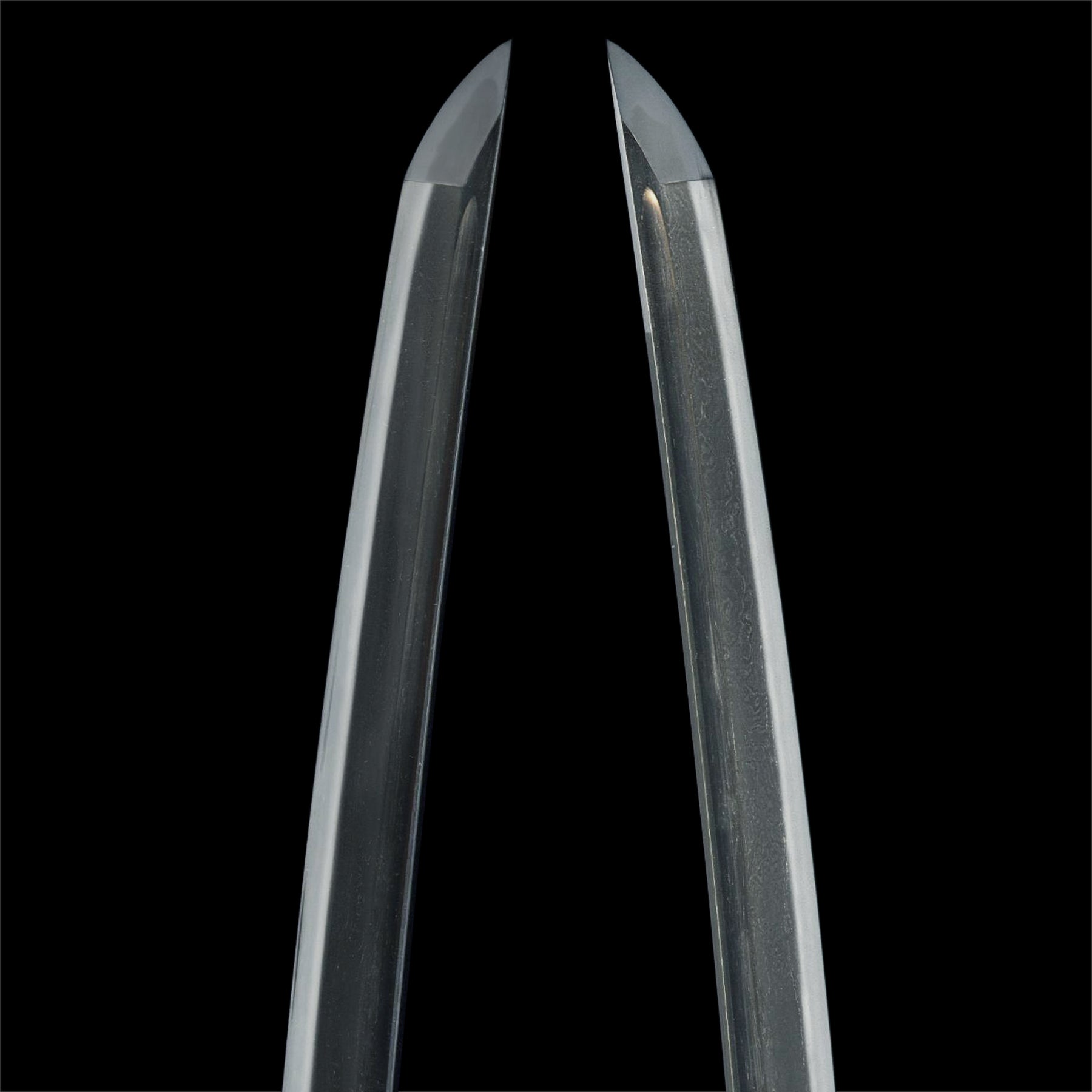
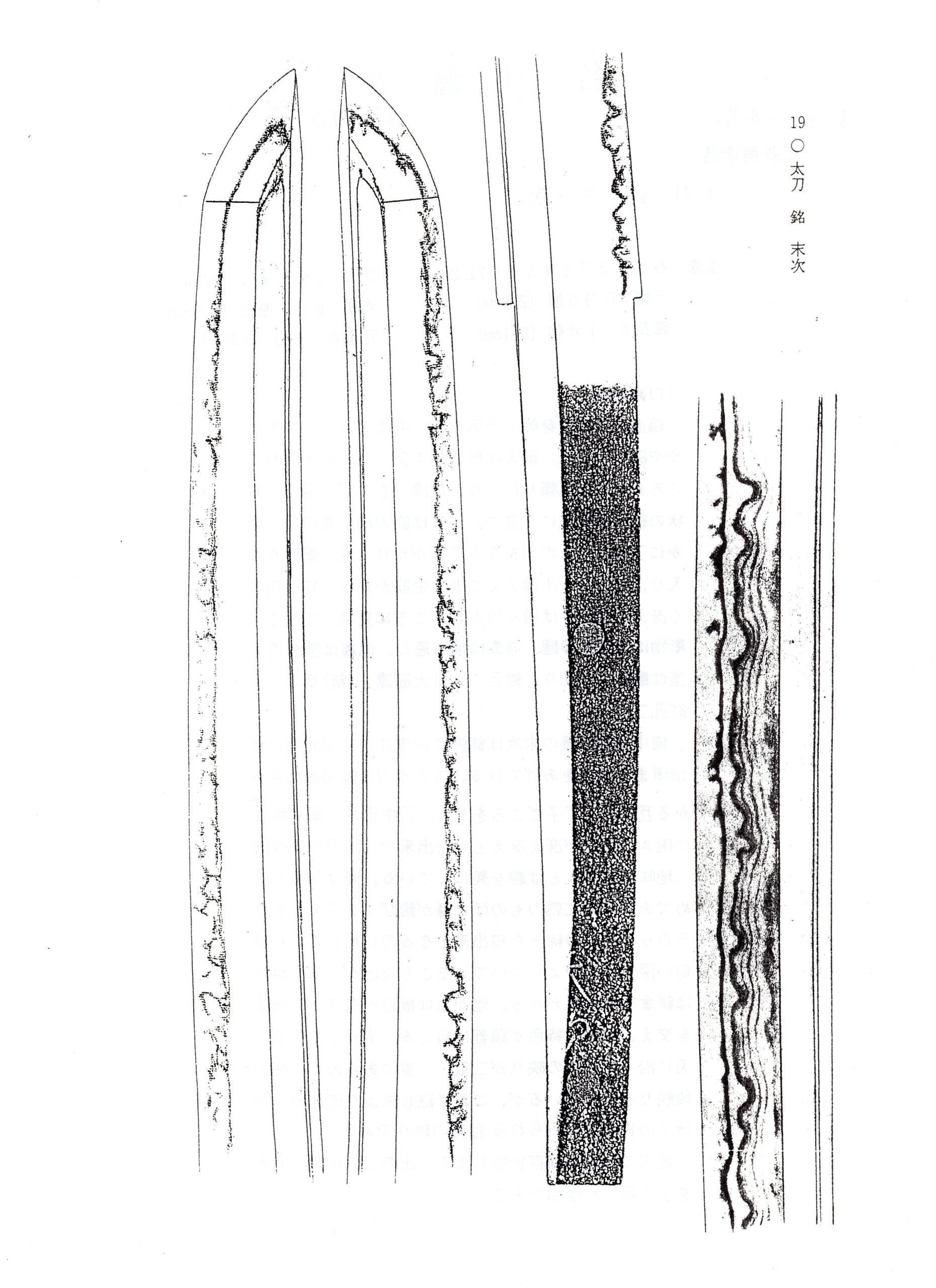
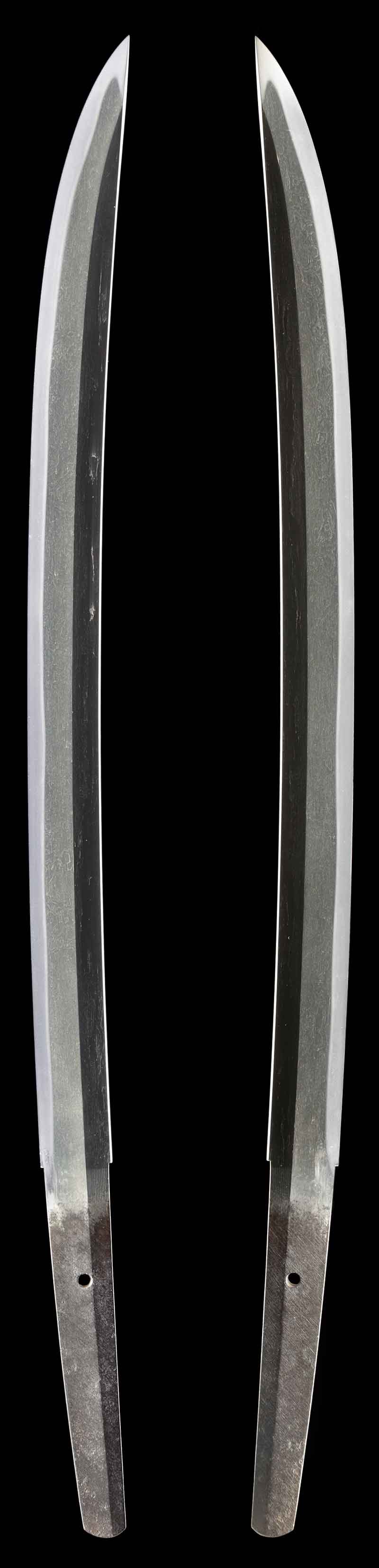
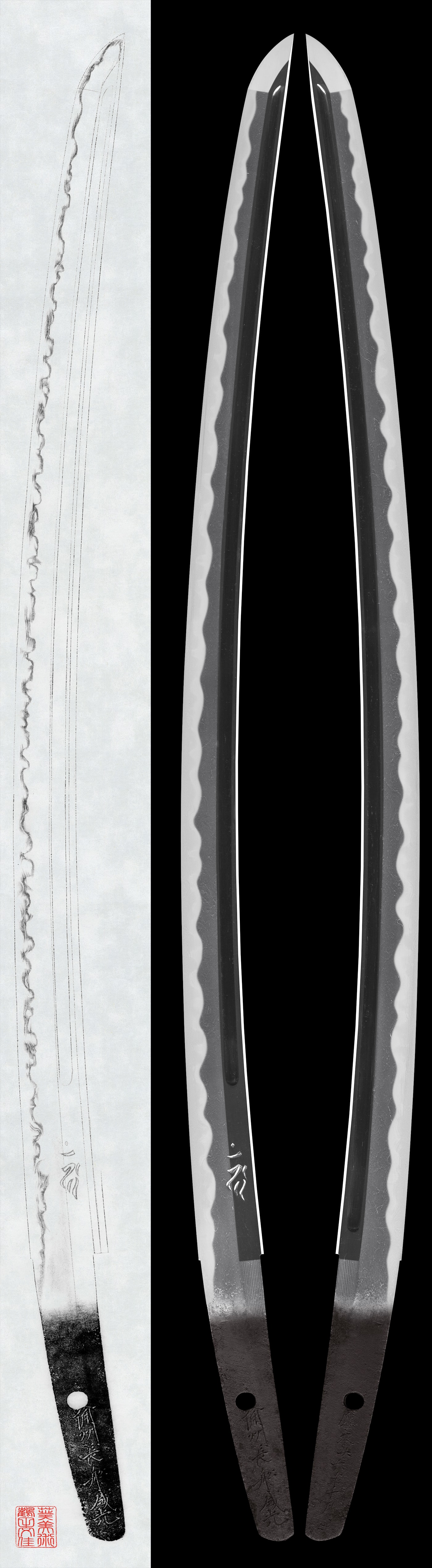
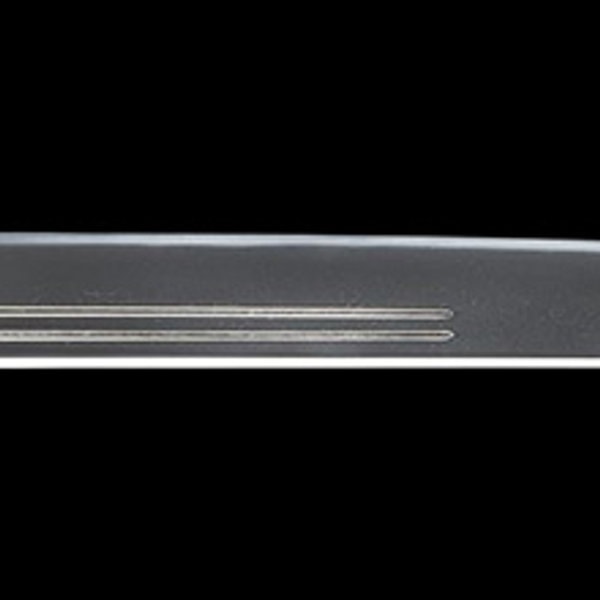
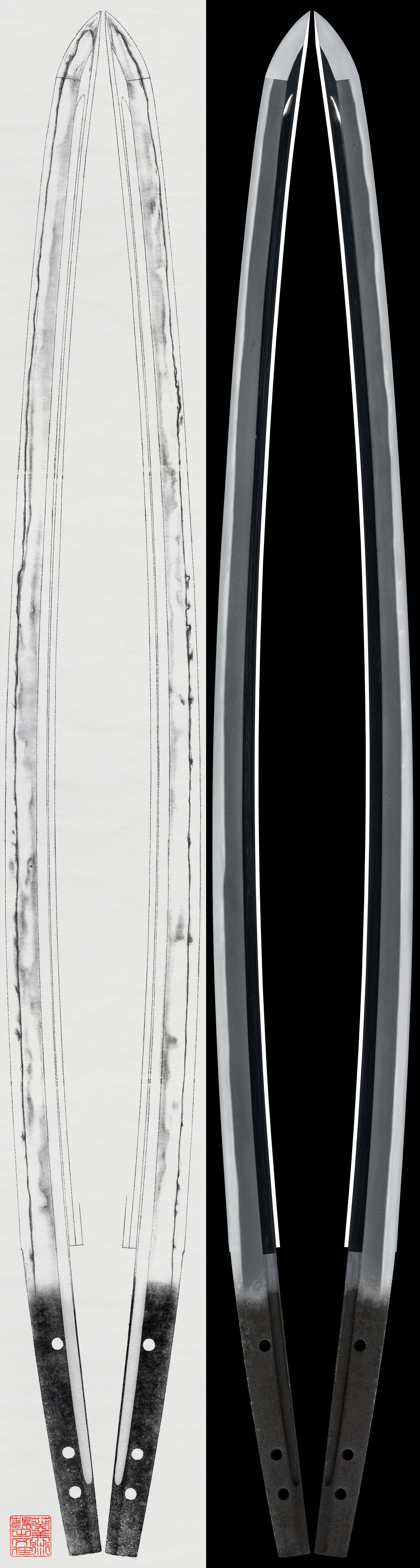
Jūyō-Tōken, 24th Session — Designated July 10, 1976 Tantō, mei: Bitchū no Kuni jū Ietsugu (備中国住家次) Measurements Nagasa 27.5 cm, sori (uchizori) 0.1 cm, motohaba 2.15 cm, nakago-nagasa 9.6 cm, nakago-sori none Description Keijō: hira-zukuri, mitsu-mune, with uchizori. Kitae: itame-hada with flowing tendency, mixed with masame; jifu appears. Hamon: suguha with ko-nie; finely tending toward hotsure. Bōshi: sugu with a rounded turn-back. Horimono: bō-hi on both omote and ura. Nakago: ubu; kurijiri; file marks are ō-sujikai; one mekugi-ana. On the sashi-omote, below the mekugi-ana at the center, a six-character signature is cut down toward the tang tip; likewise, on the reverse there is a date inscription. Artisan Aoe Ietsugu (家次) Era Nanbokuchō period; dated Enbun 2 (1357), 4th month Explanation This is a work by Aoe Ietsugu showing a standard tantō shape in hira-zukuri with uchizori, and it bears the date inscription “Enbun 2, fourth month.” Its form and tang construction differ somewhat from the large, elongated examples made by contemporaries such as Tsuguyoshi and Tsugunao. Accordingly, it is a piece that is useful for research on the Aoe school. The ji and ha are of ordinary workmanship.

NihontoWatch MonNihontoWatch
MarketEncyclopediaKantei
Swords›Bizen-den›Aoe›Chu-Aoe›Ietsugu›Antique Japanese Sword Tanto Signed by Aoe Ietsugu with NBTHK Juyo Token Certificate
tantoJūyō
Chu-Aoe Ietsugu

Antique Japanese Sword Tanto Signed by Aoe Ietsugu with NBTHK Juyo Token Certificate

signed · Aoe · Koto · nagasa 27.3cm

¥4,950,000
Visit seller website →
Chu-Aoe Ietsugu (家次) · Aoe · Koto1 work for sale →
TantoJūyō
Could you name the smith from the blade alone? Today’s kantei →
Chu-Aoe Ietsugu — 1 of 30
Chu-Aoe Ietsugu — 2 of 30
Chu-Aoe Ietsugu — 3 of 30
Chu-Aoe Ietsugu — 4 of 30
Chu-Aoe Ietsugu — 5 of 30
Chu-Aoe Ietsugu — 6 of 30
Chu-Aoe Ietsugu — 7 of 30
Chu-Aoe Ietsugu — 8 of 30
Chu-Aoe Ietsugu — 9 of 30
Chu-Aoe Ietsugu — 10 of 30
Chu-Aoe Ietsugu — 11 of 30
Chu-Aoe Ietsugu — 12 of 30
Chu-Aoe Ietsugu — 13 of 30
Chu-Aoe Ietsugu — 14 of 30
Chu-Aoe Ietsugu — 15 of 30
Chu-Aoe Ietsugu — 16 of 30
Chu-Aoe Ietsugu — 17 of 30
Chu-Aoe Ietsugu — 18 of 30
Chu-Aoe Ietsugu — 19 of 30
Chu-Aoe Ietsugu — 20 of 30
Chu-Aoe Ietsugu — 21 of 30
Chu-Aoe Ietsugu — 22 of 30
Chu-Aoe Ietsugu — 23 of 30
Chu-Aoe Ietsugu — 24 of 30
Chu-Aoe Ietsugu — 25 of 30
Chu-Aoe Ietsugu — 26 of 30
Chu-Aoe Ietsugu — 27 of 30
Chu-Aoe Ietsugu — 28 of 30
Chu-Aoe Ietsugu — 29 of 30
Chu-Aoe Ietsugu — 30 of 30
1 / 30
1 / 30
Chu-Aoe Ietsugu — 1 of 30Chu-Aoe Ietsugu — 2 of 30Chu-Aoe Ietsugu — 3 of 30Chu-Aoe Ietsugu — 4 of 30Chu-Aoe Ietsugu — 5 of 30Chu-Aoe Ietsugu — 6 of 30Chu-Aoe Ietsugu — 7 of 30Chu-Aoe Ietsugu — 8 of 30Chu-Aoe Ietsugu — 9 of 30Chu-Aoe Ietsugu — 10 of 30Chu-Aoe Ietsugu — 11 of 30Chu-Aoe Ietsugu — 12 of 30Chu-Aoe Ietsugu — 13 of 30Chu-Aoe Ietsugu — 14 of 30Chu-Aoe Ietsugu — 15 of 30Chu-Aoe Ietsugu — 16 of 30Chu-Aoe Ietsugu — 17 of 30Chu-Aoe Ietsugu — 18 of 30Chu-Aoe Ietsugu — 19 of 30Chu-Aoe Ietsugu — 20 of 30Chu-Aoe Ietsugu — 21 of 30Chu-Aoe Ietsugu — 22 of 30Chu-Aoe Ietsugu — 23 of 30Chu-Aoe Ietsugu — 24 of 30Chu-Aoe Ietsugu — 25 of 30Chu-Aoe Ietsugu — 26 of 30Chu-Aoe Ietsugu — 27 of 30Chu-Aoe Ietsugu — 28 of 30Chu-Aoe Ietsugu — 29 of 30Chu-Aoe Ietsugu — 30 of 30
Chu-Aoe Ietsugu (家次) · Aoe · Koto1 work for sale →
TantoJūyō
Could you name the smith from the blade alone? Today’s kantei →
Measurements & details
Smith
Chu-Aoe Ietsugu
Type
Tanto
School
Chu-Aoe
Period
Around 1356–1357(Kenpo)
Province
Bitchu
Signature
Signed(100% of this smith's designated works are signed)
Measurements
Nagasa 27.3cmSori 0cm
Description

This Tanto is signed by Bitchu no Kuni ju Ietsugu, a prominent smith of the Aoe school during the mid-Nanbokucho period (1357). The blade is accompanied by an NBTHK Juyo Token certificate, indicating its exceptional quality and historical value. It comes with both a koshirae (decorative sword mounting) featuring Gosan-no-Kiri Mon and a shirasaya case.

NBTHK Zufu Commentary

Juyo #24

AI translation — may contain errors

-, 24th Session — Designated July 10, 1976

, : no jū Ietsugu (備中国住家次)

Measurements 27.5 cm, () 0.1 cm, 2.15 cm, 9.6 cm, none

Description Keijō: , , with . : with flowing tendency, mixed with ; appears. : with ; finely tending toward . : with a rounded turn-back. : on both and . : ; ; file marks are ; one . On the , below the at the center, a six-character signature is cut down toward the tang tip; likewise, on the reverse there is a date inscription.

Artisan Ietsugu (家次)

Era period; dated Enbun 2 (1357), 4th month

Explanation This is a work by Ietsugu showing a standard shape in with , and it bears the date inscription “Enbun 2, fourth month.” Its form and tang construction differ somewhat from the large, elongated examples made by contemporaries such as Tsuguyoshi and Tsugunao. Accordingly, it is a piece that is useful for research on the school. The and are of ordinary workmanship.

About the maker

Ietsugu

家次

Bizen-den · Bitchu · around 1356-1357

Fujishiro Jo saku · Tōken Taikan top 8%

1 piece on the market now

›

Ietsugu belonged to the Aoe school of Bitchu Province, a lineage whose activity spanned from the mid-Kamakura period through the late Nanbokucho era. He is recorded in the Meikan as a son of Moritsugu, and his works are appraised across two distinct periods: a tachi bearing a tachi-style signature is attributed to the Naka-Aoe group of the middle to late Kamakura period, while dated works inscribed Enbun 2 (1357) and Shitoku 3 (1386) place him firmly in the Nanbokucho era. This range suggests either a long working life or, more likely, successive generations operating under the same name.

The Naka-Aoe tachi displays the school's hallmark qualities: a dense ko-itame-hada with ji-nie and utsuri standing out, paired with a suguha-cho temper where the nioiguchi tends toward tightness with abundant ko-ashi and adhering ko-nie. The NBTHK notes that "the characteristic features of this lineage are well expressed in both the jihada and the hamon." The later tachi dated Shitoku 3 is especially significant, as signed works of the Aoe school from this period are described as "extremely rare — not only those by Ietsugu, but in general." Despite workmanship the NBTHK candidly assesses as not rising to a high level, the piece is valued as "exceedingly precious as documentary material."

What emerges from the designated corpus is an artisan of considerable documentary importance to the study of the Aoe tradition. His tanto dated Enbun 2 differs in form from the large, elongated examples of contemporaries such as Tsuguyoshi and Tsugunao, making it "useful for research on the Aoe school." Across his surviving works, Ietsugu preserves the essential vocabulary of Bitchu craftsmanship while documenting the school's evolution through its final active centuries.

Historical importance

Where Ietsugu stands among comparable artisans: across all of nihontō, and within tradition, era, and period. The tiers (Foremost · Leading · Major · Notable) weigh official designations from the NBTHK and Japan's Agency for Cultural Affairs, together with historical honors of lasting repute such as the Sansaku and Meibutsu-chō.

随一
Foremost
屈指
Leading
有数
Major
著名
Notable

Select a lens to see how it's measured.

Designation record
2 designated works
Jūyō
2
1 work by Ietsugu on the market→
Ietsugu — full profileBizen-den school

Dated Works

Years he was demonstrably active, proven by signed-and-dated blades

Active period
1357Editorial estimate: 1356–1357
1 of 2 designated works carry a date

Study this maker →

About the school

Chu-Aoe

中青江

Bizen-den · Bitchu

Phase: Chū-Aoe中青江· 1235–1334

8 pieces on the market now

›

The Chu-Aoe school represents the middle and culminating phase of the Aoe tradition of Bitchu Province, encompassing smiths active from the late Kamakura period through the Nanbokucho era. The lineage traces its origins to an ancient swordmaking heritage in the lower basin of the Takahashi River, a tradition already celebrated in the eleventh-century Shin Sarugakki, which counted "the swords of Bitchu" among the notable products of the provinces. Scholars conventionally distinguish earlier Ko-Aoe production, extending through the mid-Kamakura period, from the Chu-Aoe and later Sue-Aoe phases that carried the tradition forward. The name Sadatsugu -- transmitted since the Kanchiin-bon Meizukushi as one of the goban-kaji appointed to serve Retired Emperor Gotoba and accorded the highest valuation in the Shinkan Hiden-sho -- stands as the school's most prestigious lineage name, while Yoshitsugu, Naotsugu, Tsunetsugu, and Hidetsugu represent the principal working smiths whose signed and dated examples anchor the chronology of the late Kamakura Aoe group. With the transition into the Nanbokucho period, a second flowering emerged under Tsugunao, Tsuguyoshi, and Moritsugu, who are consistently identified by the NBTHK as the representative smiths of Aoe in that era. The technical identity of Chu-Aoe is defined by a constellation of traits that recur with remarkable consistency across the school's members. The forging characteristically displays tightly packed ko-itame-hada mixed with mokume, upon which extremely fine ji-nie adheres thickly and delicate chikei are interwoven. A mottled, patch-like jifu texture frequently appears, and the distinctive crepe-like surface known as chirimen-hada is encountered among several smiths. Most diagnostic of all is the school's utsuri, which manifests in multiple forms: midare-utsuri, the stepped dan-utsuri in which linear utsuri near the edge transitions to midare-utsuri toward the mune, and the dark-toned sumihada. The hamon is fundamentally suguha-based, ranging from narrow hoso-suguha to medium chu-suguha with shallow notare, into which ko-gunome, ko-choji, and saka-ashi are mixed. The nioiguchi is universally described as tight, bright, and clear -- the single most defining quality of the school -- producing a deep shio-ai that is repeatedly praised in NBTHK assessments.

The boshi characteristically runs straight, turning back in ko-maru with a tendency toward a pointed tip. A critical stylistic evolution occurred within the Nanbokucho period: while the late Kamakura smiths worked predominantly in suguha, the later generation developed a splendid, flamboyant saka-choji-midare that became the school's most celebrated mode. Tsugunao is recognized as "a master of saka-choji," producing tempering of such florid brilliance that the NBTHK characterizes it as "the exclusive forte of this group" -- an emblematic and highly individual domain. The reverse-slanting tendencies visible in earlier Kamakura-period works are understood as precursors to this splendid later development. The Chu-Aoe school occupies a position of enduring prestige within the Japanese sword canon. The Hon'ami family developed a longstanding practice of rendering Sadatsugu appraisals for unsigned Aoe works of particularly fine workmanship, treating the name as a mark of the highest quality within the tradition. Naotsugu and Yoshitsugu, whose signed examples bearing official court titles and era dates from Gentoku through Kanno survive in exceptional condition, furnish irreplaceable documentary material for the study of Bitchu swordmaking. Works from the school have been transmitted through distinguished collections -- the Choshu Mori, the Nabeshima of Hizen, the Uesugi, and the Maeda of Kaga -- attesting to sustained appreciation across centuries. Naotsugu occupies a pivotal position at the transition from the ko-nie-deki manner of the Kamakura period to the tighter, brighter nioi-deki workmanship of the Nanbokucho era, while Moritsugu's rare surviving works bridge the late Kamakura and early Nanbokucho phases with tanto displaying both the traditional suguha and a saka-choji not previously encountered in the school. In both the quiet restraint of their suguha and the gorgeous brilliance of their saka-choji-midare, the smiths of Chu-Aoe demonstrate the Bitchu tradition at its most refined and accomplished -- a school whose tightly forged steel, luminous nioiguchi, and distinctive utsuri constitute an aesthetic achievement of the first order. Learn more →

Leading smiths
SmithEraDesignated
Tsugunao次直1345-136125
Naotsugu直次1335-136415
Yoshitsugu吉次1326-133217
Moritsugu守次1356-13619
Tsuguyoshi次吉1338-135819
Explore the Chu-Aoe school →

Historical context

Bizen in the Nanbokuchō period

›

Sixty years of war between two courts drove blades long and broad, and Osafune met the demand: Kanemitsu and Chōgi led forges serving the provincial warriors who did the fighting, while Sōshū influence arrived with the armies to create Sōden-Bizen.

Bizen in the Nanbokuchō period →

NBTHK Certificate
Jūyō Tōken重要刀剣
Important Sword
›

A blade of top-grade workmanship and condition, formally judged to rank with a nationally recognized Important Art Object (Jūyō Bijutsuhin). Awarded only at the NBTHK’s competitive annual examination.

Of Japan’s roughly 2.5 million registered swords, only 12,307 (about 1 in 203) have ever attained Jūyō.

About the NBTHK›

The NBTHK (Nihon Bijutsu Tōken Hozon Kyōkai, the Society for the Preservation of Japanese Art Swords) is a public-interest incorporated foundation founded in 1948 and supervised by Japan’s Agency for Cultural Affairs (Bunkachō); it is based at the Japanese Sword Museum in Tokyo. Its expert panels physically examine each submitted work (shinsa) and issue a certificate (kanteishō) ranking it by artistic and historical merit. NBTHK papers are the most widely recognized standard of authentication for Japanese swords and fittings.

NBTHK official site→
Seller
S
Samurai Museum
🇯🇵Ships from Japan
›
✓Verified dealersamuraimuseum.jp
Settles in JPY
✓Ships worldwide✓English supportPayPalCredit card
Return policy

Returns/exchanges limited to defects caused by shipping (except willful misconduct or gross negligence by the company); customers must contact within 72 hours of receiving the product.

View all of Samurai Museum’s listings→View this item on the dealer’s site→

More from the Chu-Aoe school

View all →
Samurai Nippon
Jūyō
Kodachi - Jūyō - by Chu-Aoe Yoshitsugu - Kodachi: Bitchu no Kuni ju Uemonnojo Tairano Yoshitsugu (Aoe)Kodachi - Jūyō - by Chu-Aoe Yoshitsugu - Kodachi: Bitchu no Kuni ju Uemonnojo Tairano Yoshitsugu (Aoe)

Kodachi

ByChu-Aoe Yoshitsugu
¥6,500,000
Aoi Art
Jūyō
Katana - Jūyō - by Chu-Aoe Moritsugu - Bishu Nakaji Ju Moritsugu SakuKatana - Jūyō - by Chu-Aoe Moritsugu - Bishu Nakaji Ju Moritsugu Saku

Katana

ByChu-Aoe Moritsugu
¥6,500,000
Eirakudo
Jūyō Bijutsuhin
Katana - Jubi - by Chu-Aoe School - Aoe Sadatsugu - Juyo BijutsuhinKatana - Jubi - by Chu-Aoe School - Aoe Sadatsugu - Juyo Bijutsuhin

Katana

ByChu-Aoe School
Ask
Choshuya
Tokuho
Tanto - Tokuho - by Chu-Aoe Sadatsugu - Signed Bicchu no shu ju Sadatsugu, Genko 3rd year, 10th monthTanto - Tokuho - by Chu-Aoe Sadatsugu - Signed Bicchu no shu ju Sadatsugu, Genko 3rd year, 10th month

Tantō

ByChu-Aoe Sadatsugu
Ask
Katanahanbai
Jūyō
Tachi - Jūyō - by Chu-Aoe Sanenaga - Sanenaga (Bitchu) - Juyo TokenTachi - Jūyō - by Chu-Aoe Sanenaga - Sanenaga (Bitchu) - Juyo Token

Tachi

ByChu-Aoe Sanenaga
Ask
Ikeda Art
Gendaitō
Katana - by Chu-Aoe Yasutsugu - 【A blade reminiscent of Aoe】"Yasutsugu" 66.4cm, for appreciation!!!Katana - by Chu-Aoe Yasutsugu - 【A blade reminiscent of Aoe】"Yasutsugu" 66.4cm, for appreciation!!!

Katana

ByChu-Aoe Yasutsugu
¥330,000
Choshuya
Tanto - by Chu-Aoe Sadatsugu - Japanese Sword for Sale | Ginza Choshuya | Signed Bitchu-ju SadatsuguTanto - by Chu-Aoe Sadatsugu - Japanese Sword for Sale | Ginza Choshuya | Signed Bitchu-ju Sadatsugu

Tantō

ByChu-Aoe Sadatsugu
Ask

More from the Aoe school

View all →
Aoi Art
Jūyō
Katana - Jūyō - by Aoe School - Mumei (Aoe school)Katana - Jūyō - by Aoe School - Mumei (Aoe school)

Katana

ByAoe School
¥3,200,000
Toyuukai
Jūyō
Katana - Jūyō - by Aoe School - Mumei (Aoe) - 51st Juyo TokenKatana - Jūyō - by Aoe School - Mumei (Aoe) - 51st Juyo Token

Katana

ByAoe School
¥5,500,000
Eirakudo
Tokuho
Tokuho - by Aoe School - Aoe Katana Tokubetsu Hozon TokenTokuho - by Aoe School - Aoe Katana Tokubetsu Hozon Token

Aoe Katana Tokubetsu Hozon Token

ByAoe School
¥2,380,000
Token-Net
Jūyō
Jūyō - by Aoe School - Naginata Naoshi Katana: Mumei (Aoe)Jūyō - by Aoe School - Naginata Naoshi Katana: Mumei (Aoe)

Naginata Naoshi Katana: Mumei (Aoe)

ByAoe School
¥3,200,000
Samurai Store
Tokuho
Katana - Tokuho - by Aoe School - Antique Katana sword in Ornate Mounting Kamakura Period NBTHK Tokubetsu Hozon certificatedKatana - Tokuho - by Aoe School - Antique Katana sword in Ornate Mounting Kamakura Period NBTHK Tokubetsu Hozon certificated

Katana

ByAoe School
¥2,700,000
Goushuya
Jūyō Bijutsuhin
Tachi - Jubi - by Ko-Aoe School - Important Art Object Tachi: Sueyoshi of Ko-Aoe, Passed down in the Naito Family, Lord of Murakami Domain, Echigo ProvinceTachi - Jubi - by Ko-Aoe School - Important Art Object Tachi: Sueyoshi of Ko-Aoe, Passed down in the Naito Family, Lord of Murakami Domain, Echigo Province

Tachi

ByKo-Aoe School
Ask
Tsuruginoya
Tokuho
Tokuho - by Aoe School - Naginata-naoshi Wakizashi: AoeTokuho - by Aoe School - Naginata-naoshi Wakizashi: Aoe

Naginata-naoshi Wakizashi: Aoe

ByAoe School
¥650,000
Eirakudo
Jūyō
Tachi - Jūyō - by Ko-Aoe Hirotsugu - Mei Hirotsugu - Juyo TokenTachi - Jūyō - by Ko-Aoe Hirotsugu - Mei Hirotsugu - Juyo Token

Tachi

ByKo-Aoe Hirotsugu
Ask

More from the Bizen tradition

View all →
Nihonto.com
Jūyō
Tanto - Jūyō - by Osafune Kagemitsu - Juyo Tanto by Bizen KagemitsuTanto - Jūyō - by Osafune Kagemitsu - Juyo Tanto by Bizen Kagemitsu

Tantō

ByOsafune Kagemitsu
¥89,500
Aoi Art
Jūyō Bijutsuhin
Daisho - Jubi - by Osafune Nagamitsu - Dai Sho: Katana (Important Art Object): Mumei (Attributed to Nagamitsu) / Wakizashi: Mumei (Attributed to Sekishu Naotsuna)Daisho - Jubi - by Osafune Nagamitsu - Dai Sho: Katana (Important Art Object): Mumei (Attributed to Nagamitsu) / Wakizashi: Mumei (Attributed to Sekishu Naotsuna)

Daishō

ByOsafune Nagamitsu
Ask
Tsuruginoya
Jūyō
Katana - Jūyō - by Fukuoka Ichimonji School - Mumei Fukuoka IchimonjiKatana - Jūyō - by Fukuoka Ichimonji School - Mumei Fukuoka Ichimonji

Katana

ByFukuoka Ichimonji School
Ask
Hyozaemon
Tokuho
Tokuho - by Fukuoka Ichimonji Yoshifusa - Naginata Naoshi Wakizashi by Fukuoka Ichimonji Yoshifusa, a Master of IchimonjiTokuho - by Fukuoka Ichimonji Yoshifusa - Naginata Naoshi Wakizashi by Fukuoka Ichimonji Yoshifusa, a Master of Ichimonji

Naginata Naoshi Wakizashi by Fukuoka Ichimonji Yoshifusa, a Master of Ichimonji

ByFukuoka Ichimonji Yoshifusa
Ask
Aoi Art
Tokuho
Wakizashi - Tokuho - by Oei-Bizen Morimitsu - Bishū Osafune Morimitsu, dated Ōei 26 (1419) - NBTHK Tokubetsu Hozon TokenWakizashi - Tokuho - by Oei-Bizen Morimitsu - Bishū Osafune Morimitsu, dated Ōei 26 (1419) - NBTHK Tokubetsu Hozon Token

Wakizashi

ByOei-Bizen Morimitsu
Starting Bid¥1,500,000
Eirakudo
Tokuho
Katana - Tokuho - by Katayama Ichimonji School - Katayama Ichimonji - Tokubetsu Hozon TokenKatana - Tokuho - by Katayama Ichimonji School - Katayama Ichimonji - Tokubetsu Hozon Token

Katana

ByKatayama Ichimonji School
¥4,500,000
Eirakudo
Jūyō
Katana - Jūyō - by Motoshige - Motoshige - Juyo TokenKatana - Jūyō - by Motoshige - Motoshige - Juyo Token

Katana

ByMotoshige
¥6,000,000
Giheiya
Hozon
Katana - Hozon - by Takada School - Mumei (Hira Takada) - 72.1cm, with Koshirae and ShirasayaKatana - Hozon - by Takada School - Mumei (Hira Takada) - 72.1cm, with Koshirae and Shirasaya

Katana

ByTakada School
¥350,000

Swords

  • Katana
  • Wakizashi
  • Tantō
  • Tachi
  • Naginata
  • Yari
  • Japanese Swords
  • Samurai Swords

Fittings

  • Tsuba
  • Fuchi-Kashira
  • Kozuka
  • Menuki
  • Sword Guards (Tsuba)

Armor

  • Kabuto
  • Samurai Armor
  • All Samurai Armor

By Certification

  • Tokujū
  • Jūyō
  • Tokuho
  • Hozon

Resources

  • Dealer Directory
  • Artist Directory
  • The Daily Kantei
  • Glossary
  • Browse All
Nihontowatch© 2026
TermsPrivacyCookiesAbout

¥4,950,000

View on Samurai Museum

Description

This Tanto is signed by Bitchu no Kuni ju Ietsugu, a prominent smith of the Aoe school during the mid-Nanbokucho period (1357). The blade is accompanied by an NBTHK Juyo Token certificate, indicating its exceptional quality and historical value. It comes with both a koshirae (decorative sword mounting) featuring Gosan-no-Kiri Mon and a shirasaya case.

NBTHK Setsumei

Jūyō-Tōken, 24th Session — Designated July 10, 1976 Tantō, mei: Bitchū no Kuni jū Ietsugu (備中国住家次) Measurements Nagasa 27.5 cm, sori (uchizori) 0.1 cm, motohaba 2.15 cm, nakago-nagasa 9.6 cm, nakago-sori none Description Keijō: hira-zukuri, mitsu-mune, with uchizori. Kitae: itame-hada with flowing tendency, mixed with masame; jifu appears. Hamon: suguha with ko-nie; finely tending toward hotsure. Bōshi: sugu with a rounded turn-back. Horimono: bō-hi on both omote and ura. Nakago: ubu; kurijiri; file marks are ō-sujikai; one mekugi-ana. On the sashi-omote, below the mekugi-ana at the center, a six-character signature is cut down toward the tang tip; likewise, on the reverse there is a date inscription. Artisan Aoe Ietsugu (家次) Era Nanbokuchō period; dated Enbun 2 (1357), 4th month Explanation This is a work by Aoe Ietsugu showing a standard tantō shape in hira-zukuri with uchizori, and it bears the date inscription “Enbun 2, fourth month.” Its form and tang construction differ somewhat from the large, elongated examples made by contemporaries such as Tsuguyoshi and Tsugunao. Accordingly, it is a piece that is useful for research on the Aoe school. The ji and ha are of ordinary workmanship.

NihontoWatch MonNihontoWatch
MarketEncyclopediaKantei
Swords›Bizen-den›Aoe›Chu-Aoe›Ietsugu›Antique Japanese Sword Tanto Signed by Aoe Ietsugu with NBTHK Juyo Token Certificate
tantoJūyō
Chu-Aoe Ietsugu

Antique Japanese Sword Tanto Signed by Aoe Ietsugu with NBTHK Juyo Token Certificate

signed · Aoe · Koto · nagasa 27.3cm

¥4,950,000
Visit seller website →
Chu-Aoe Ietsugu (家次) · Aoe · Koto1 work for sale →
TantoJūyō
Could you name the smith from the blade alone? Today’s kantei →
Chu-Aoe Ietsugu — 1 of 30
Chu-Aoe Ietsugu — 2 of 30
Chu-Aoe Ietsugu — 3 of 30
Chu-Aoe Ietsugu — 4 of 30
Chu-Aoe Ietsugu — 5 of 30
Chu-Aoe Ietsugu — 6 of 30
Chu-Aoe Ietsugu — 7 of 30
Chu-Aoe Ietsugu — 8 of 30
Chu-Aoe Ietsugu — 9 of 30
Chu-Aoe Ietsugu — 10 of 30
Chu-Aoe Ietsugu — 11 of 30
Chu-Aoe Ietsugu — 12 of 30
Chu-Aoe Ietsugu — 13 of 30
Chu-Aoe Ietsugu — 14 of 30
Chu-Aoe Ietsugu — 15 of 30
Chu-Aoe Ietsugu — 16 of 30
Chu-Aoe Ietsugu — 17 of 30
Chu-Aoe Ietsugu — 18 of 30
Chu-Aoe Ietsugu — 19 of 30
Chu-Aoe Ietsugu — 20 of 30
Chu-Aoe Ietsugu — 21 of 30
Chu-Aoe Ietsugu — 22 of 30
Chu-Aoe Ietsugu — 23 of 30
Chu-Aoe Ietsugu — 24 of 30
Chu-Aoe Ietsugu — 25 of 30
Chu-Aoe Ietsugu — 26 of 30
Chu-Aoe Ietsugu — 27 of 30
Chu-Aoe Ietsugu — 28 of 30
Chu-Aoe Ietsugu — 29 of 30
Chu-Aoe Ietsugu — 30 of 30
1 / 30
1 / 30
Chu-Aoe Ietsugu — 1 of 30Chu-Aoe Ietsugu — 2 of 30Chu-Aoe Ietsugu — 3 of 30Chu-Aoe Ietsugu — 4 of 30Chu-Aoe Ietsugu — 5 of 30Chu-Aoe Ietsugu — 6 of 30Chu-Aoe Ietsugu — 7 of 30Chu-Aoe Ietsugu — 8 of 30Chu-Aoe Ietsugu — 9 of 30Chu-Aoe Ietsugu — 10 of 30Chu-Aoe Ietsugu — 11 of 30Chu-Aoe Ietsugu — 12 of 30Chu-Aoe Ietsugu — 13 of 30Chu-Aoe Ietsugu — 14 of 30Chu-Aoe Ietsugu — 15 of 30Chu-Aoe Ietsugu — 16 of 30Chu-Aoe Ietsugu — 17 of 30Chu-Aoe Ietsugu — 18 of 30Chu-Aoe Ietsugu — 19 of 30Chu-Aoe Ietsugu — 20 of 30Chu-Aoe Ietsugu — 21 of 30Chu-Aoe Ietsugu — 22 of 30Chu-Aoe Ietsugu — 23 of 30Chu-Aoe Ietsugu — 24 of 30Chu-Aoe Ietsugu — 25 of 30Chu-Aoe Ietsugu — 26 of 30Chu-Aoe Ietsugu — 27 of 30Chu-Aoe Ietsugu — 28 of 30Chu-Aoe Ietsugu — 29 of 30Chu-Aoe Ietsugu — 30 of 30
Chu-Aoe Ietsugu (家次) · Aoe · Koto1 work for sale →
TantoJūyō
Could you name the smith from the blade alone? Today’s kantei →
Measurements & details
Smith
Chu-Aoe Ietsugu
Type
Tanto
School
Chu-Aoe
Period
Around 1356–1357(Kenpo)
Province
Bitchu
Signature
Signed(100% of this smith's designated works are signed)
Measurements
Nagasa 27.3cmSori 0cm
Description

This Tanto is signed by Bitchu no Kuni ju Ietsugu, a prominent smith of the Aoe school during the mid-Nanbokucho period (1357). The blade is accompanied by an NBTHK Juyo Token certificate, indicating its exceptional quality and historical value. It comes with both a koshirae (decorative sword mounting) featuring Gosan-no-Kiri Mon and a shirasaya case.

NBTHK Zufu Commentary

Juyo #24

AI translation — may contain errors

-, 24th Session — Designated July 10, 1976

, : no jū Ietsugu (備中国住家次)

Measurements 27.5 cm, () 0.1 cm, 2.15 cm, 9.6 cm, none

Description Keijō: , , with . : with flowing tendency, mixed with ; appears. : with ; finely tending toward . : with a rounded turn-back. : on both and . : ; ; file marks are ; one . On the , below the at the center, a six-character signature is cut down toward the tang tip; likewise, on the reverse there is a date inscription.

Artisan Ietsugu (家次)

Era period; dated Enbun 2 (1357), 4th month

Explanation This is a work by Ietsugu showing a standard shape in with , and it bears the date inscription “Enbun 2, fourth month.” Its form and tang construction differ somewhat from the large, elongated examples made by contemporaries such as Tsuguyoshi and Tsugunao. Accordingly, it is a piece that is useful for research on the school. The and are of ordinary workmanship.

About the maker

Ietsugu

家次

Bizen-den · Bitchu · around 1356-1357

Fujishiro Jo saku · Tōken Taikan top 8%

1 piece on the market now

›

Ietsugu belonged to the Aoe school of Bitchu Province, a lineage whose activity spanned from the mid-Kamakura period through the late Nanbokucho era. He is recorded in the Meikan as a son of Moritsugu, and his works are appraised across two distinct periods: a tachi bearing a tachi-style signature is attributed to the Naka-Aoe group of the middle to late Kamakura period, while dated works inscribed Enbun 2 (1357) and Shitoku 3 (1386) place him firmly in the Nanbokucho era. This range suggests either a long working life or, more likely, successive generations operating under the same name.

The Naka-Aoe tachi displays the school's hallmark qualities: a dense ko-itame-hada with ji-nie and utsuri standing out, paired with a suguha-cho temper where the nioiguchi tends toward tightness with abundant ko-ashi and adhering ko-nie. The NBTHK notes that "the characteristic features of this lineage are well expressed in both the jihada and the hamon." The later tachi dated Shitoku 3 is especially significant, as signed works of the Aoe school from this period are described as "extremely rare — not only those by Ietsugu, but in general." Despite workmanship the NBTHK candidly assesses as not rising to a high level, the piece is valued as "exceedingly precious as documentary material."

What emerges from the designated corpus is an artisan of considerable documentary importance to the study of the Aoe tradition. His tanto dated Enbun 2 differs in form from the large, elongated examples of contemporaries such as Tsuguyoshi and Tsugunao, making it "useful for research on the Aoe school." Across his surviving works, Ietsugu preserves the essential vocabulary of Bitchu craftsmanship while documenting the school's evolution through its final active centuries.

Historical importance

Where Ietsugu stands among comparable artisans: across all of nihontō, and within tradition, era, and period. The tiers (Foremost · Leading · Major · Notable) weigh official designations from the NBTHK and Japan's Agency for Cultural Affairs, together with historical honors of lasting repute such as the Sansaku and Meibutsu-chō.

随一
Foremost
屈指
Leading
有数
Major
著名
Notable

Select a lens to see how it's measured.

Designation record
2 designated works
Jūyō
2
1 work by Ietsugu on the market→
Ietsugu — full profileBizen-den school

Dated Works

Years he was demonstrably active, proven by signed-and-dated blades

Active period
1357Editorial estimate: 1356–1357
1 of 2 designated works carry a date

Study this maker →

About the school

Chu-Aoe

中青江

Bizen-den · Bitchu

Phase: Chū-Aoe中青江· 1235–1334

8 pieces on the market now

›

The Chu-Aoe school represents the middle and culminating phase of the Aoe tradition of Bitchu Province, encompassing smiths active from the late Kamakura period through the Nanbokucho era. The lineage traces its origins to an ancient swordmaking heritage in the lower basin of the Takahashi River, a tradition already celebrated in the eleventh-century Shin Sarugakki, which counted "the swords of Bitchu" among the notable products of the provinces. Scholars conventionally distinguish earlier Ko-Aoe production, extending through the mid-Kamakura period, from the Chu-Aoe and later Sue-Aoe phases that carried the tradition forward. The name Sadatsugu -- transmitted since the Kanchiin-bon Meizukushi as one of the goban-kaji appointed to serve Retired Emperor Gotoba and accorded the highest valuation in the Shinkan Hiden-sho -- stands as the school's most prestigious lineage name, while Yoshitsugu, Naotsugu, Tsunetsugu, and Hidetsugu represent the principal working smiths whose signed and dated examples anchor the chronology of the late Kamakura Aoe group. With the transition into the Nanbokucho period, a second flowering emerged under Tsugunao, Tsuguyoshi, and Moritsugu, who are consistently identified by the NBTHK as the representative smiths of Aoe in that era. The technical identity of Chu-Aoe is defined by a constellation of traits that recur with remarkable consistency across the school's members. The forging characteristically displays tightly packed ko-itame-hada mixed with mokume, upon which extremely fine ji-nie adheres thickly and delicate chikei are interwoven. A mottled, patch-like jifu texture frequently appears, and the distinctive crepe-like surface known as chirimen-hada is encountered among several smiths. Most diagnostic of all is the school's utsuri, which manifests in multiple forms: midare-utsuri, the stepped dan-utsuri in which linear utsuri near the edge transitions to midare-utsuri toward the mune, and the dark-toned sumihada. The hamon is fundamentally suguha-based, ranging from narrow hoso-suguha to medium chu-suguha with shallow notare, into which ko-gunome, ko-choji, and saka-ashi are mixed. The nioiguchi is universally described as tight, bright, and clear -- the single most defining quality of the school -- producing a deep shio-ai that is repeatedly praised in NBTHK assessments.

The boshi characteristically runs straight, turning back in ko-maru with a tendency toward a pointed tip. A critical stylistic evolution occurred within the Nanbokucho period: while the late Kamakura smiths worked predominantly in suguha, the later generation developed a splendid, flamboyant saka-choji-midare that became the school's most celebrated mode. Tsugunao is recognized as "a master of saka-choji," producing tempering of such florid brilliance that the NBTHK characterizes it as "the exclusive forte of this group" -- an emblematic and highly individual domain. The reverse-slanting tendencies visible in earlier Kamakura-period works are understood as precursors to this splendid later development. The Chu-Aoe school occupies a position of enduring prestige within the Japanese sword canon. The Hon'ami family developed a longstanding practice of rendering Sadatsugu appraisals for unsigned Aoe works of particularly fine workmanship, treating the name as a mark of the highest quality within the tradition. Naotsugu and Yoshitsugu, whose signed examples bearing official court titles and era dates from Gentoku through Kanno survive in exceptional condition, furnish irreplaceable documentary material for the study of Bitchu swordmaking. Works from the school have been transmitted through distinguished collections -- the Choshu Mori, the Nabeshima of Hizen, the Uesugi, and the Maeda of Kaga -- attesting to sustained appreciation across centuries. Naotsugu occupies a pivotal position at the transition from the ko-nie-deki manner of the Kamakura period to the tighter, brighter nioi-deki workmanship of the Nanbokucho era, while Moritsugu's rare surviving works bridge the late Kamakura and early Nanbokucho phases with tanto displaying both the traditional suguha and a saka-choji not previously encountered in the school. In both the quiet restraint of their suguha and the gorgeous brilliance of their saka-choji-midare, the smiths of Chu-Aoe demonstrate the Bitchu tradition at its most refined and accomplished -- a school whose tightly forged steel, luminous nioiguchi, and distinctive utsuri constitute an aesthetic achievement of the first order. Learn more →
Leading smiths
SmithEraDesignated
Tsugunao次直1345-136125
Naotsugu直次1335-136415
Yoshitsugu吉次1326-133217
Moritsugu守次1356-13619
Tsuguyoshi次吉1338-135819
Explore the Chu-Aoe school →
Historical context

Bizen in the Nanbokuchō period

›

Sixty years of war between two courts drove blades long and broad, and Osafune met the demand: Kanemitsu and Chōgi led forges serving the provincial warriors who did the fighting, while Sōshū influence arrived with the armies to create Sōden-Bizen.

Bizen in the Nanbokuchō period →
NBTHK Certificate
Jūyō Tōken重要刀剣
Important Sword
›

A blade of top-grade workmanship and condition, formally judged to rank with a nationally recognized Important Art Object (Jūyō Bijutsuhin). Awarded only at the NBTHK’s competitive annual examination.

Of Japan’s roughly 2.5 million registered swords, only 12,307 (about 1 in 203) have ever attained Jūyō.

About the NBTHK›

The NBTHK (Nihon Bijutsu Tōken Hozon Kyōkai, the Society for the Preservation of Japanese Art Swords) is a public-interest incorporated foundation founded in 1948 and supervised by Japan’s Agency for Cultural Affairs (Bunkachō); it is based at the Japanese Sword Museum in Tokyo. Its expert panels physically examine each submitted work (shinsa) and issue a certificate (kanteishō) ranking it by artistic and historical merit. NBTHK papers are the most widely recognized standard of authentication for Japanese swords and fittings.

NBTHK official site→
Seller
S
Samurai Museum
🇯🇵Ships from Japan
›
✓Verified dealersamuraimuseum.jp
Settles in JPY
✓Ships worldwide✓English supportPayPalCredit card
Return policy

Returns/exchanges limited to defects caused by shipping (except willful misconduct or gross negligence by the company); customers must contact within 72 hours of receiving the product.

View all of Samurai Museum’s listings→View this item on the dealer’s site→

More from the Chu-Aoe school

View all →
Samurai Nippon
Jūyō
Kodachi - Jūyō - by Chu-Aoe Yoshitsugu - Kodachi: Bitchu no Kuni ju Uemonnojo Tairano Yoshitsugu (Aoe)Kodachi - Jūyō - by Chu-Aoe Yoshitsugu - Kodachi: Bitchu no Kuni ju Uemonnojo Tairano Yoshitsugu (Aoe)

Kodachi

ByChu-Aoe Yoshitsugu
¥6,500,000
Aoi Art
Jūyō
Katana - Jūyō - by Chu-Aoe Moritsugu - Bishu Nakaji Ju Moritsugu SakuKatana - Jūyō - by Chu-Aoe Moritsugu - Bishu Nakaji Ju Moritsugu Saku

Katana

ByChu-Aoe Moritsugu
¥6,500,000
Eirakudo
Jūyō Bijutsuhin
Katana - Jubi - by Chu-Aoe School - Aoe Sadatsugu - Juyo BijutsuhinKatana - Jubi - by Chu-Aoe School - Aoe Sadatsugu - Juyo Bijutsuhin

Katana

ByChu-Aoe School
Ask
Choshuya
Tokuho
Tanto - Tokuho - by Chu-Aoe Sadatsugu - Signed Bicchu no shu ju Sadatsugu, Genko 3rd year, 10th monthTanto - Tokuho - by Chu-Aoe Sadatsugu - Signed Bicchu no shu ju Sadatsugu, Genko 3rd year, 10th month

Tantō

ByChu-Aoe Sadatsugu
Ask
Katanahanbai
Jūyō
Tachi - Jūyō - by Chu-Aoe Sanenaga - Sanenaga (Bitchu) - Juyo TokenTachi - Jūyō - by Chu-Aoe Sanenaga - Sanenaga (Bitchu) - Juyo Token

Tachi

ByChu-Aoe Sanenaga
Ask
Ikeda Art
Gendaitō
Katana - by Chu-Aoe Yasutsugu - 【A blade reminiscent of Aoe】"Yasutsugu" 66.4cm, for appreciation!!!Katana - by Chu-Aoe Yasutsugu - 【A blade reminiscent of Aoe】"Yasutsugu" 66.4cm, for appreciation!!!

Katana

ByChu-Aoe Yasutsugu
¥330,000
Choshuya
Tanto - by Chu-Aoe Sadatsugu - Japanese Sword for Sale | Ginza Choshuya | Signed Bitchu-ju SadatsuguTanto - by Chu-Aoe Sadatsugu - Japanese Sword for Sale | Ginza Choshuya | Signed Bitchu-ju Sadatsugu

Tantō

ByChu-Aoe Sadatsugu
Ask

More from the Aoe school

View all →
Aoi Art
Jūyō
Katana - Jūyō - by Aoe School - Mumei (Aoe school)Katana - Jūyō - by Aoe School - Mumei (Aoe school)

Katana

ByAoe School
¥3,200,000
Toyuukai
Jūyō
Katana - Jūyō - by Aoe School - Mumei (Aoe) - 51st Juyo TokenKatana - Jūyō - by Aoe School - Mumei (Aoe) - 51st Juyo Token

Katana

ByAoe School
¥5,500,000
Eirakudo
Tokuho
Tokuho - by Aoe School - Aoe Katana Tokubetsu Hozon TokenTokuho - by Aoe School - Aoe Katana Tokubetsu Hozon Token

Aoe Katana Tokubetsu Hozon Token

ByAoe School
¥2,380,000
Token-Net
Jūyō
Jūyō - by Aoe School - Naginata Naoshi Katana: Mumei (Aoe)Jūyō - by Aoe School - Naginata Naoshi Katana: Mumei (Aoe)

Naginata Naoshi Katana: Mumei (Aoe)

ByAoe School
¥3,200,000
Samurai Store
Tokuho
Katana - Tokuho - by Aoe School - Antique Katana sword in Ornate Mounting Kamakura Period NBTHK Tokubetsu Hozon certificatedKatana - Tokuho - by Aoe School - Antique Katana sword in Ornate Mounting Kamakura Period NBTHK Tokubetsu Hozon certificated

Katana

ByAoe School
¥2,700,000
Goushuya
Jūyō Bijutsuhin
Tachi - Jubi - by Ko-Aoe School - Important Art Object Tachi: Sueyoshi of Ko-Aoe, Passed down in the Naito Family, Lord of Murakami Domain, Echigo ProvinceTachi - Jubi - by Ko-Aoe School - Important Art Object Tachi: Sueyoshi of Ko-Aoe, Passed down in the Naito Family, Lord of Murakami Domain, Echigo Province

Tachi

ByKo-Aoe School
Ask
Tsuruginoya
Tokuho
Tokuho - by Aoe School - Naginata-naoshi Wakizashi: AoeTokuho - by Aoe School - Naginata-naoshi Wakizashi: Aoe

Naginata-naoshi Wakizashi: Aoe

ByAoe School
¥650,000
Eirakudo
Jūyō
Tachi - Jūyō - by Ko-Aoe Hirotsugu - Mei Hirotsugu - Juyo TokenTachi - Jūyō - by Ko-Aoe Hirotsugu - Mei Hirotsugu - Juyo Token

Tachi

ByKo-Aoe Hirotsugu
Ask

More from the Bizen tradition

View all →
Nihonto.com
Jūyō
Tanto - Jūyō - by Osafune Kagemitsu - Juyo Tanto by Bizen KagemitsuTanto - Jūyō - by Osafune Kagemitsu - Juyo Tanto by Bizen Kagemitsu

Tantō

ByOsafune Kagemitsu
¥89,500
Aoi Art
Jūyō Bijutsuhin
Daisho - Jubi - by Osafune Nagamitsu - Dai Sho: Katana (Important Art Object): Mumei (Attributed to Nagamitsu) / Wakizashi: Mumei (Attributed to Sekishu Naotsuna)Daisho - Jubi - by Osafune Nagamitsu - Dai Sho: Katana (Important Art Object): Mumei (Attributed to Nagamitsu) / Wakizashi: Mumei (Attributed to Sekishu Naotsuna)

Daishō

ByOsafune Nagamitsu
Ask
Tsuruginoya
Jūyō
Katana - Jūyō - by Fukuoka Ichimonji School - Mumei Fukuoka IchimonjiKatana - Jūyō - by Fukuoka Ichimonji School - Mumei Fukuoka Ichimonji

Katana

ByFukuoka Ichimonji School
Ask
Hyozaemon
Tokuho
Tokuho - by Fukuoka Ichimonji Yoshifusa - Naginata Naoshi Wakizashi by Fukuoka Ichimonji Yoshifusa, a Master of IchimonjiTokuho - by Fukuoka Ichimonji Yoshifusa - Naginata Naoshi Wakizashi by Fukuoka Ichimonji Yoshifusa, a Master of Ichimonji

Naginata Naoshi Wakizashi by Fukuoka Ichimonji Yoshifusa, a Master of Ichimonji

ByFukuoka Ichimonji Yoshifusa
Ask
Aoi Art
Tokuho
Wakizashi - Tokuho - by Oei-Bizen Morimitsu - Bishū Osafune Morimitsu, dated Ōei 26 (1419) - NBTHK Tokubetsu Hozon TokenWakizashi - Tokuho - by Oei-Bizen Morimitsu - Bishū Osafune Morimitsu, dated Ōei 26 (1419) - NBTHK Tokubetsu Hozon Token

Wakizashi

ByOei-Bizen Morimitsu
Starting Bid¥1,500,000
Eirakudo
Tokuho
Katana - Tokuho - by Katayama Ichimonji School - Katayama Ichimonji - Tokubetsu Hozon TokenKatana - Tokuho - by Katayama Ichimonji School - Katayama Ichimonji - Tokubetsu Hozon Token

Katana

ByKatayama Ichimonji School
¥4,500,000
Eirakudo
Jūyō
Katana - Jūyō - by Motoshige - Motoshige - Juyo TokenKatana - Jūyō - by Motoshige - Motoshige - Juyo Token

Katana

ByMotoshige
¥6,000,000
Giheiya
Hozon
Katana - Hozon - by Takada School - Mumei (Hira Takada) - 72.1cm, with Koshirae and ShirasayaKatana - Hozon - by Takada School - Mumei (Hira Takada) - 72.1cm, with Koshirae and Shirasaya

Katana

ByTakada School
¥350,000

Swords

  • Katana
  • Wakizashi
  • Tantō
  • Tachi
  • Naginata
  • Yari
  • Japanese Swords
  • Samurai Swords

Fittings

  • Tsuba
  • Fuchi-Kashira
  • Kozuka
  • Menuki
  • Sword Guards (Tsuba)

Armor

  • Kabuto
  • Samurai Armor
  • All Samurai Armor

By Certification

  • Tokujū
  • Jūyō
  • Tokuho
  • Hozon

Resources

  • Dealer Directory
  • Artist Directory
  • The Daily Kantei
  • Glossary
  • Browse All
Nihontowatch© 2026
TermsPrivacyCookiesAbout

¥4,950,000

View on Samurai Museum
NihontoWatch MonNihontoWatch
Market
Encyclopedia
Kantei
NihontoWatch MonNihontoWatch
Market
Encyclopedia
Kantei