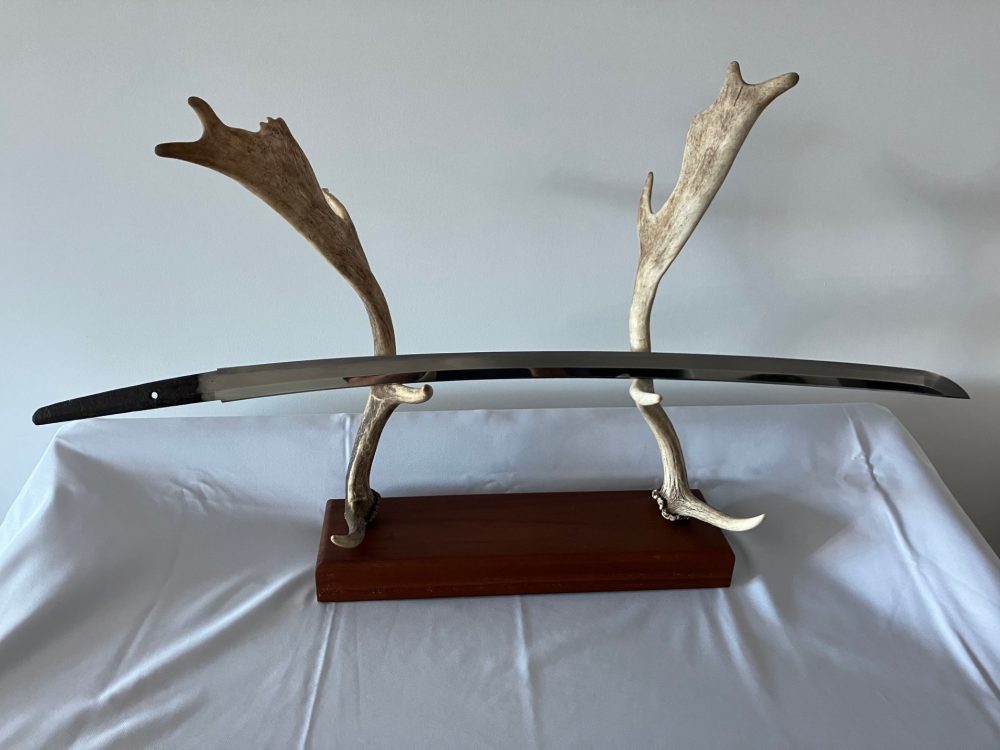
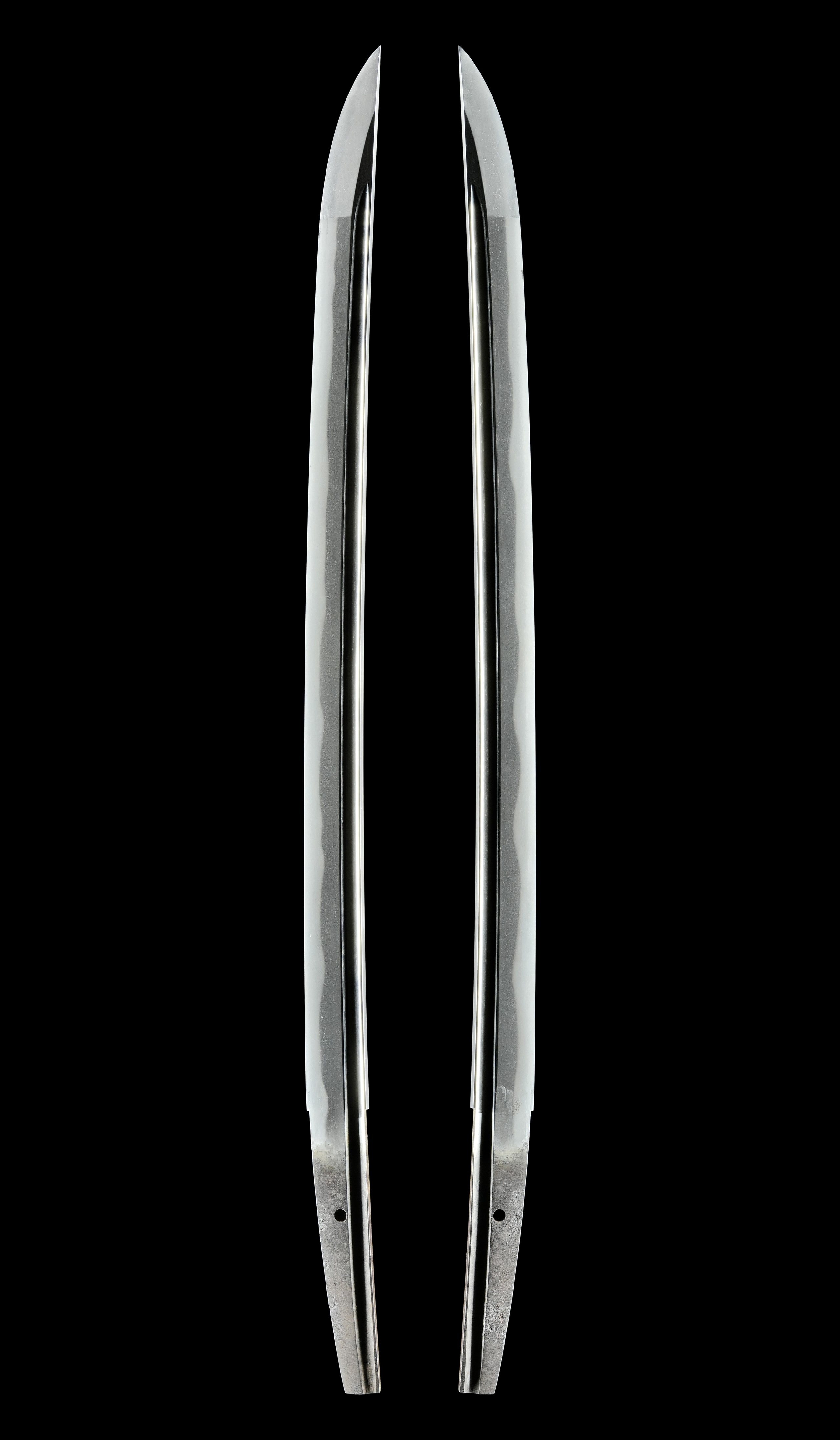
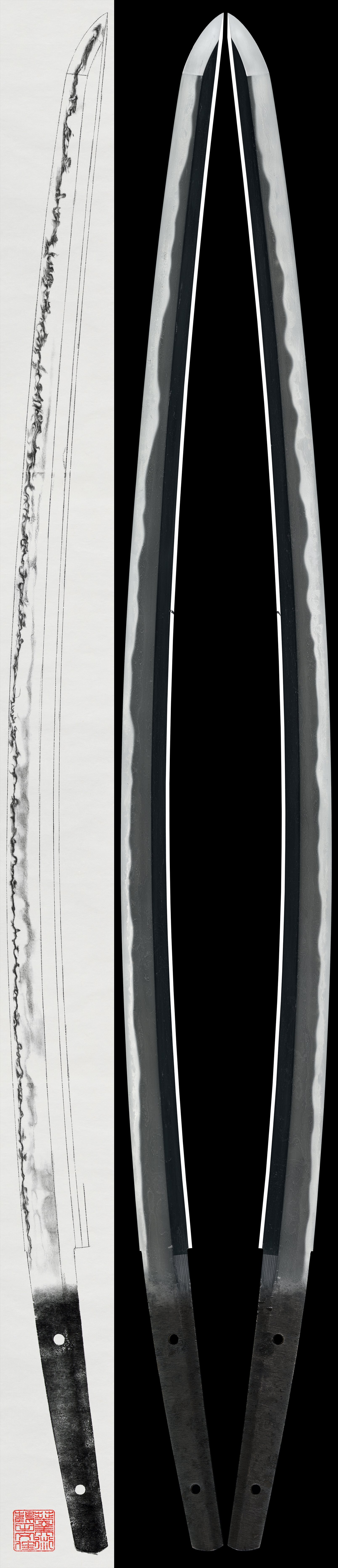
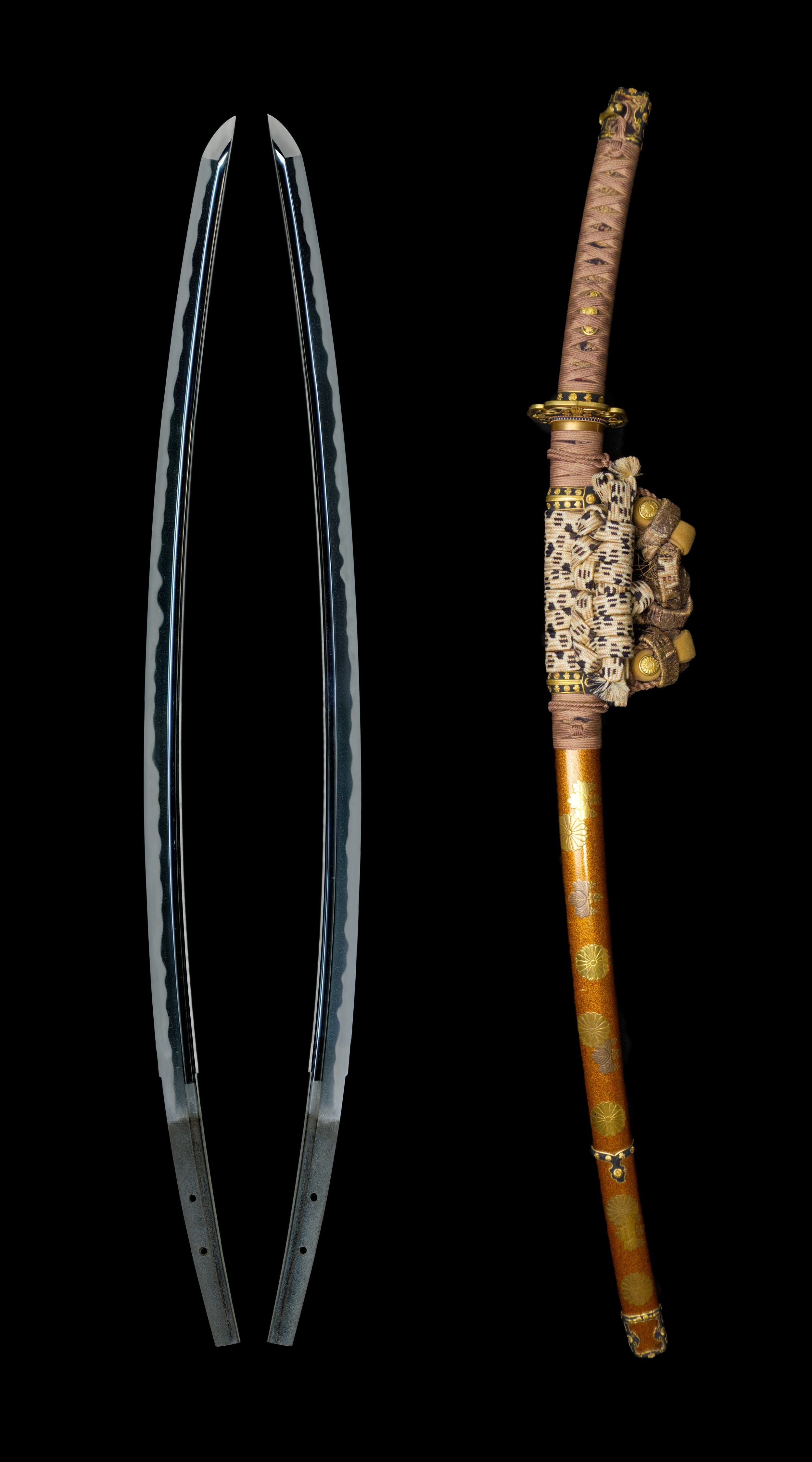
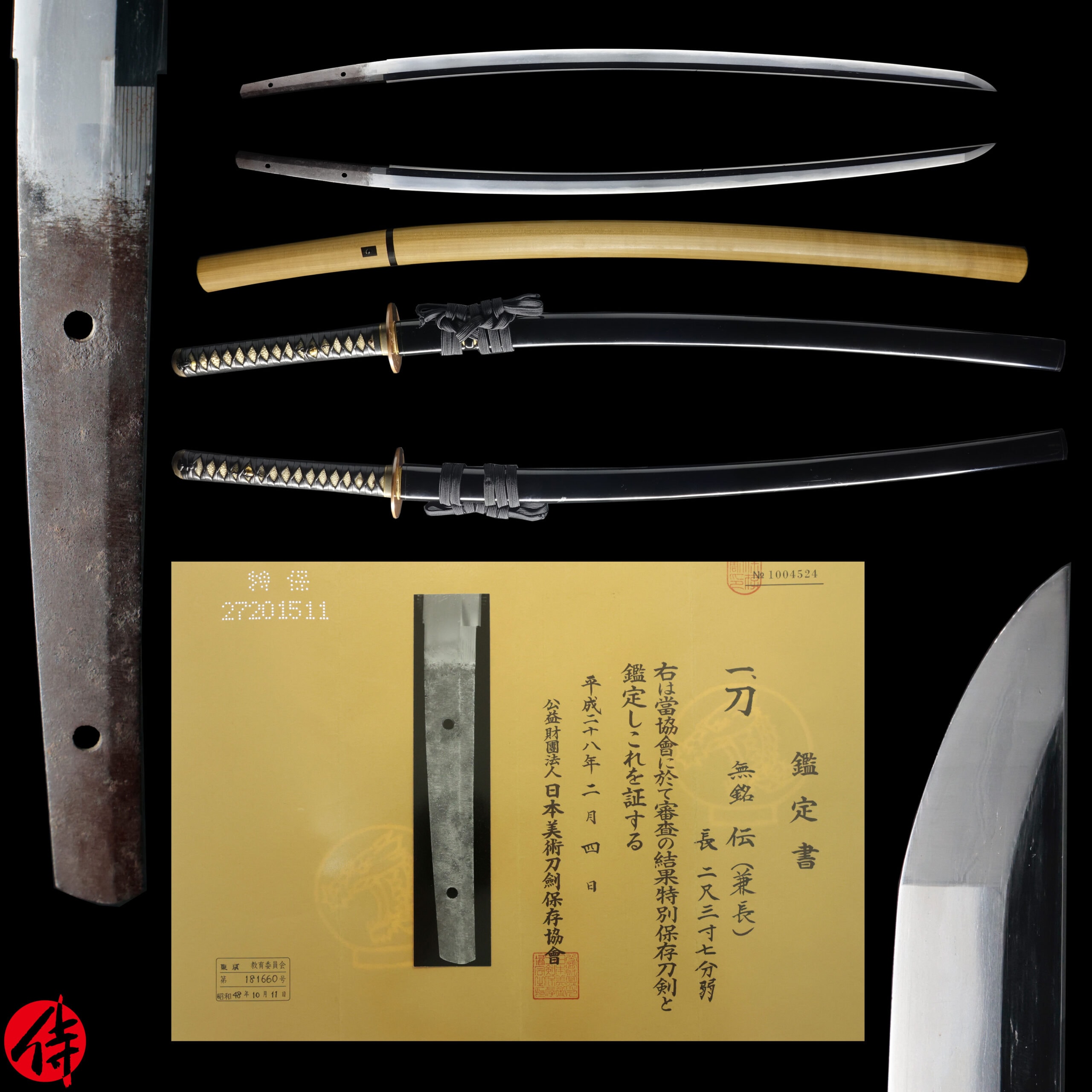
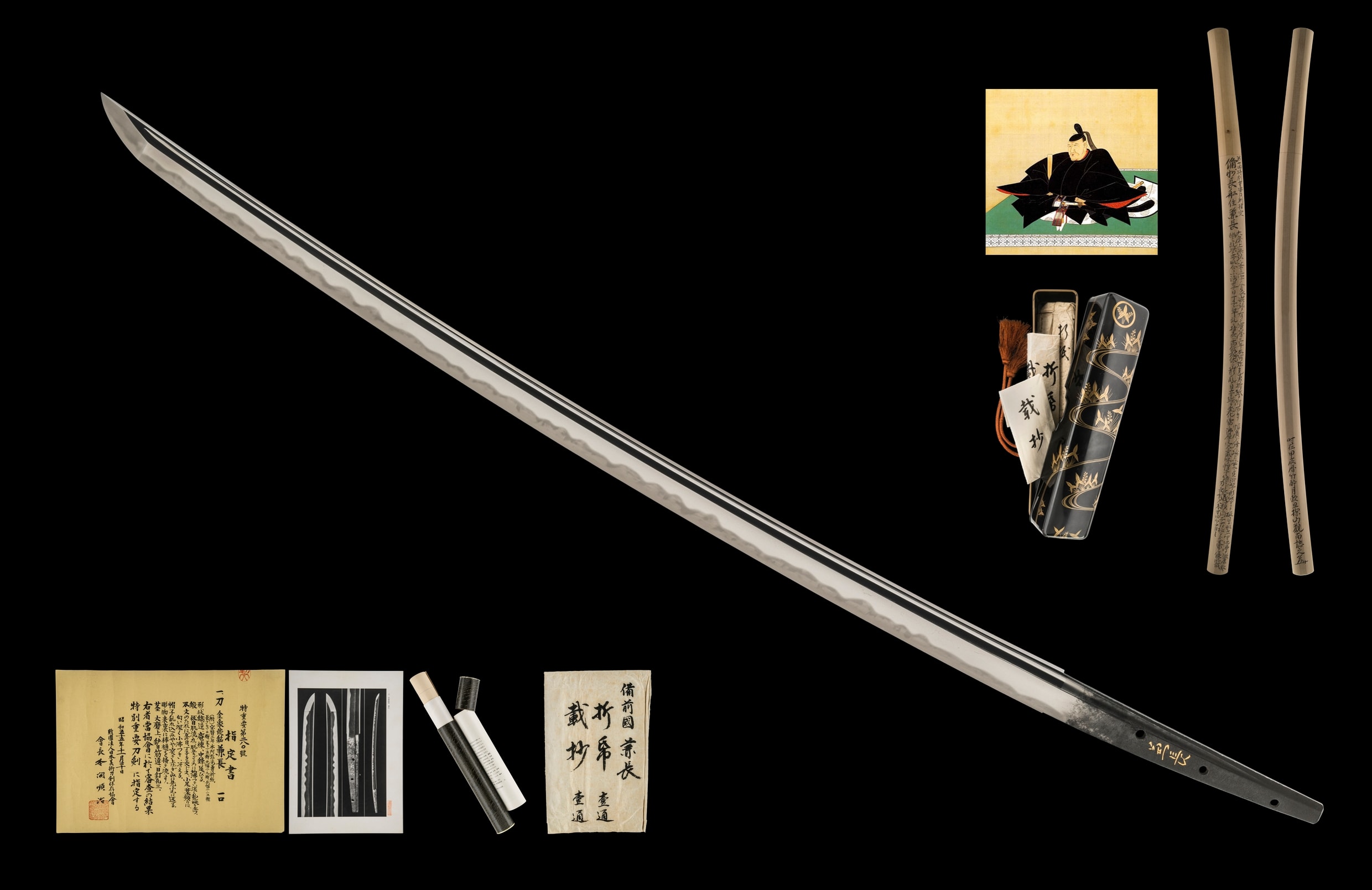
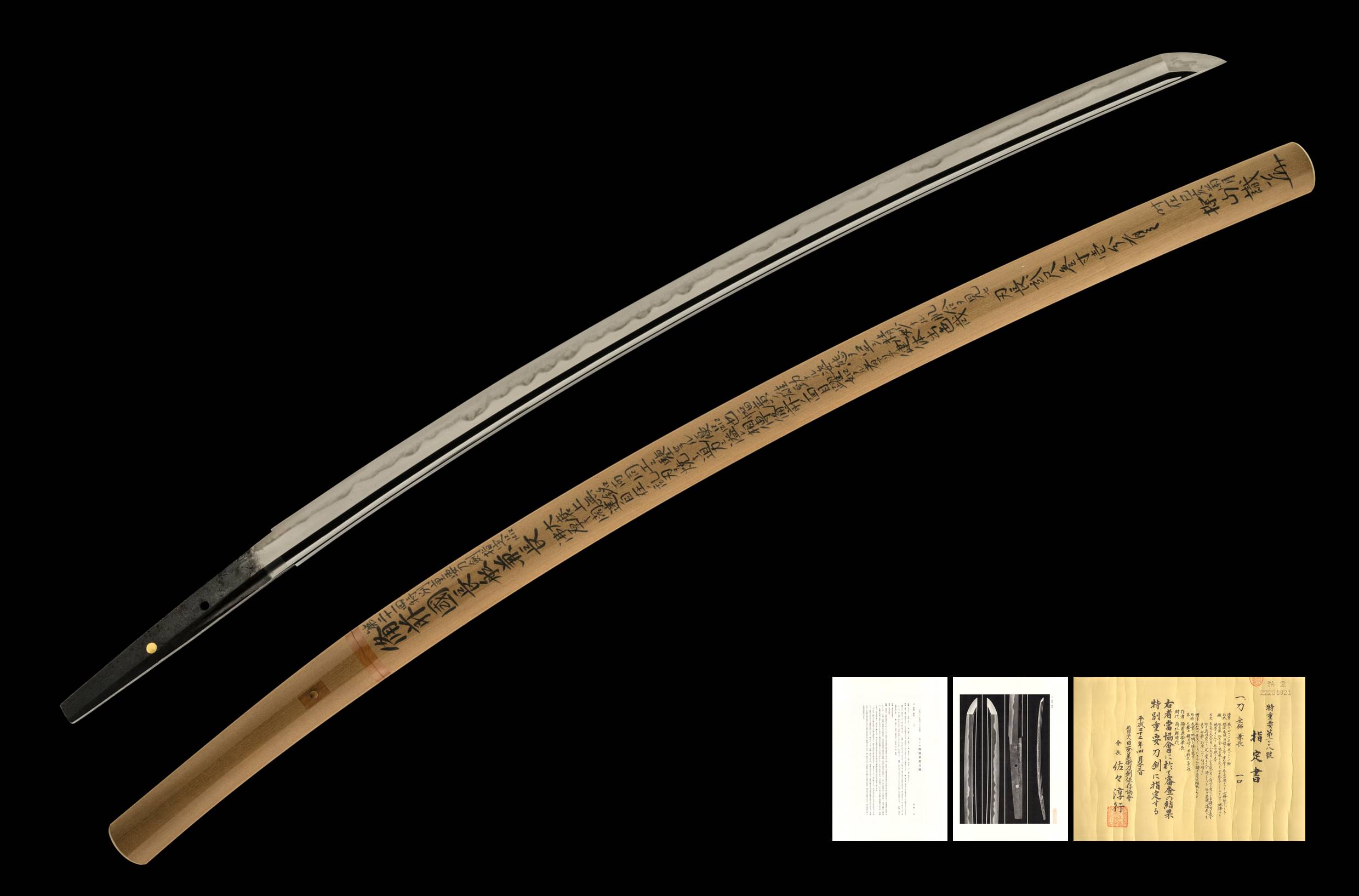
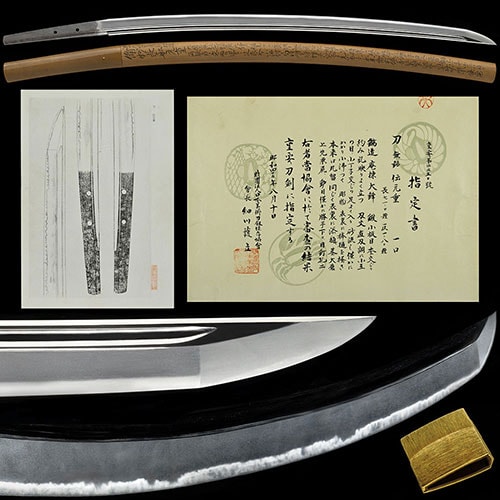
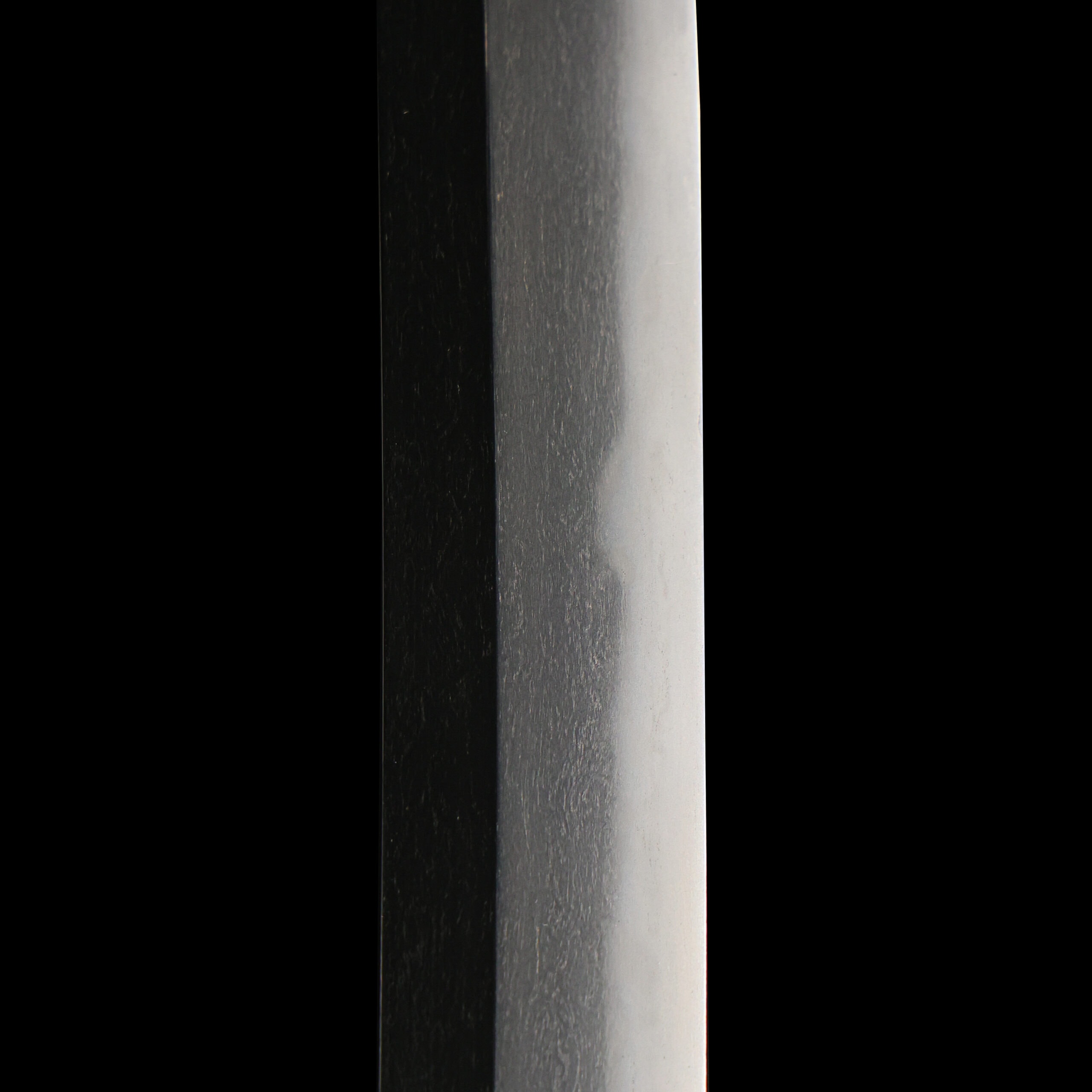
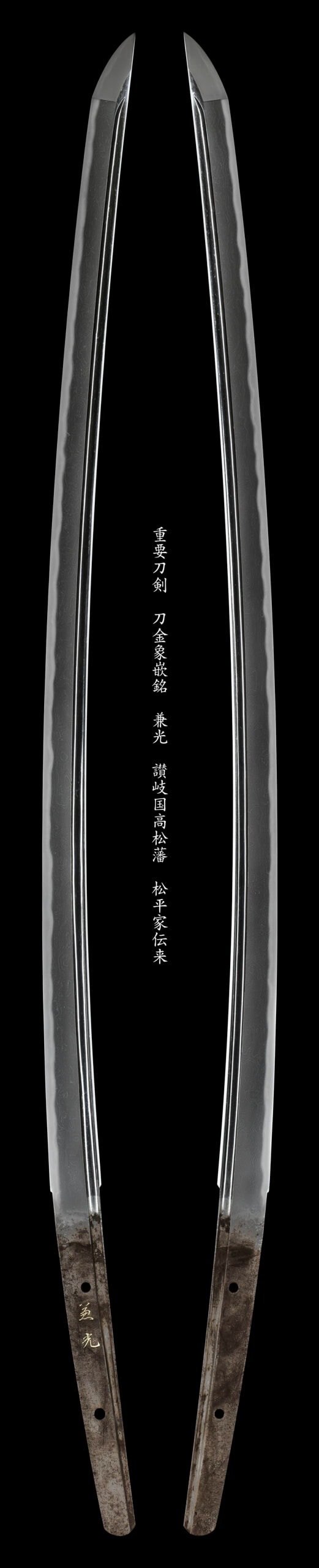
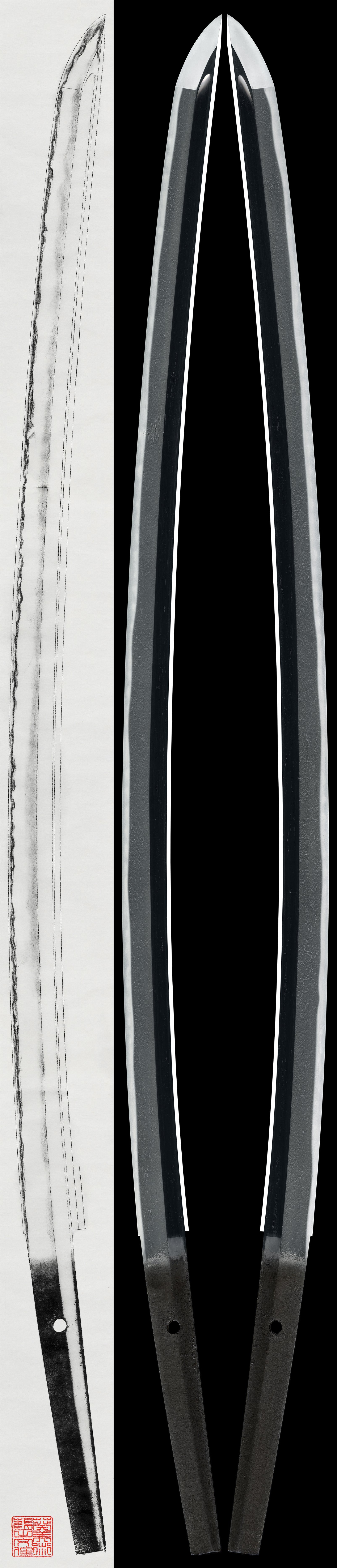
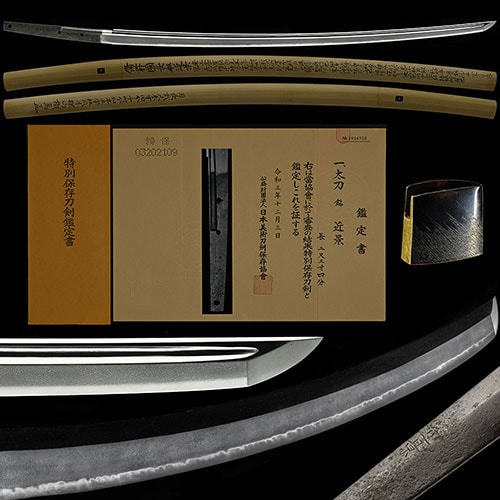
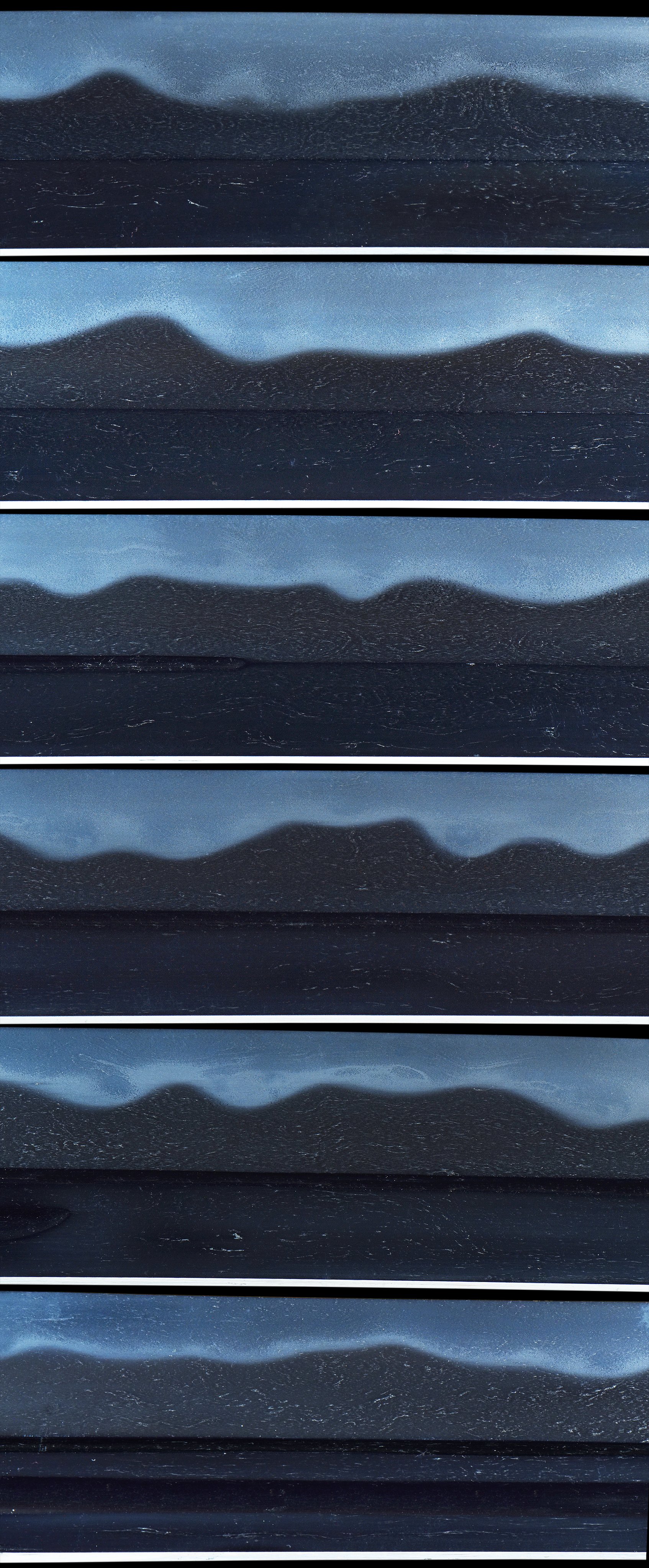
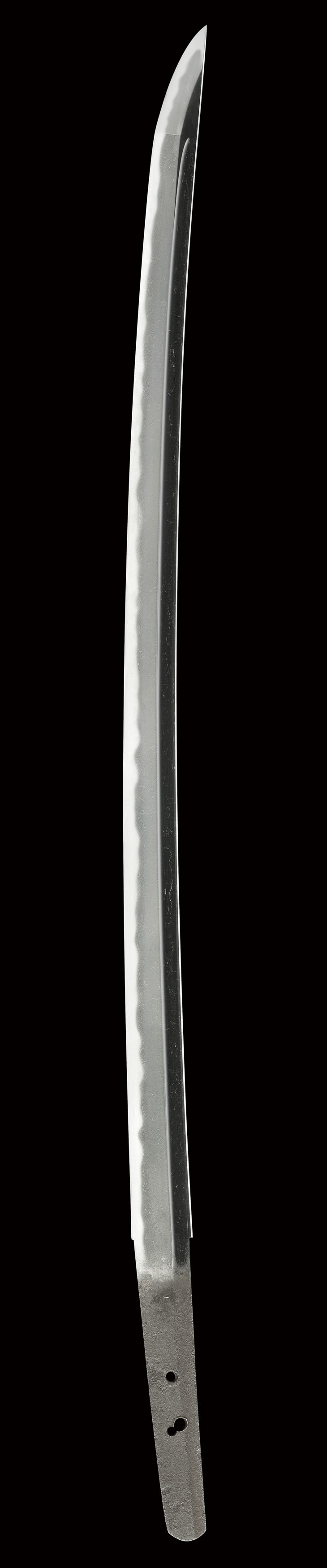
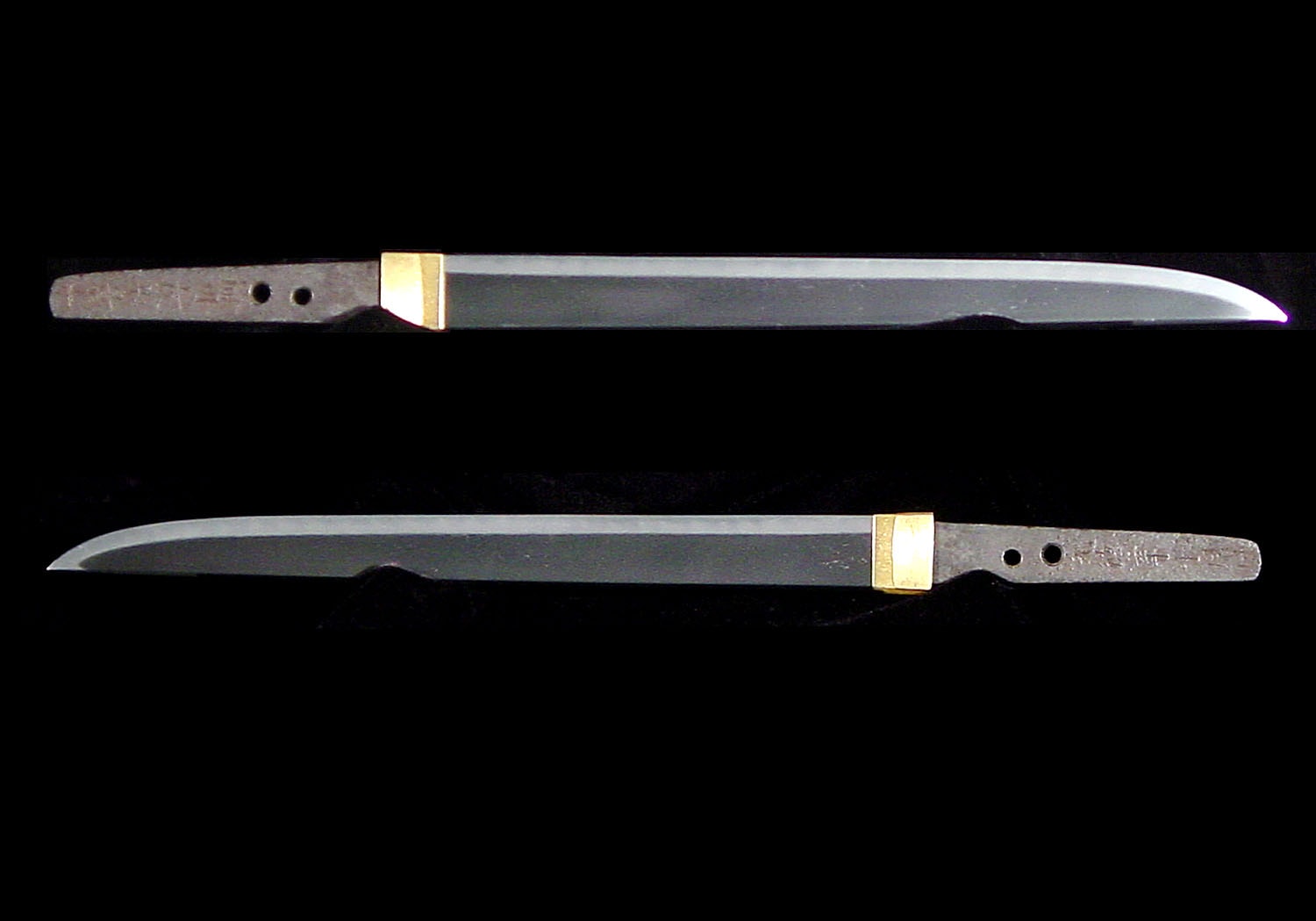
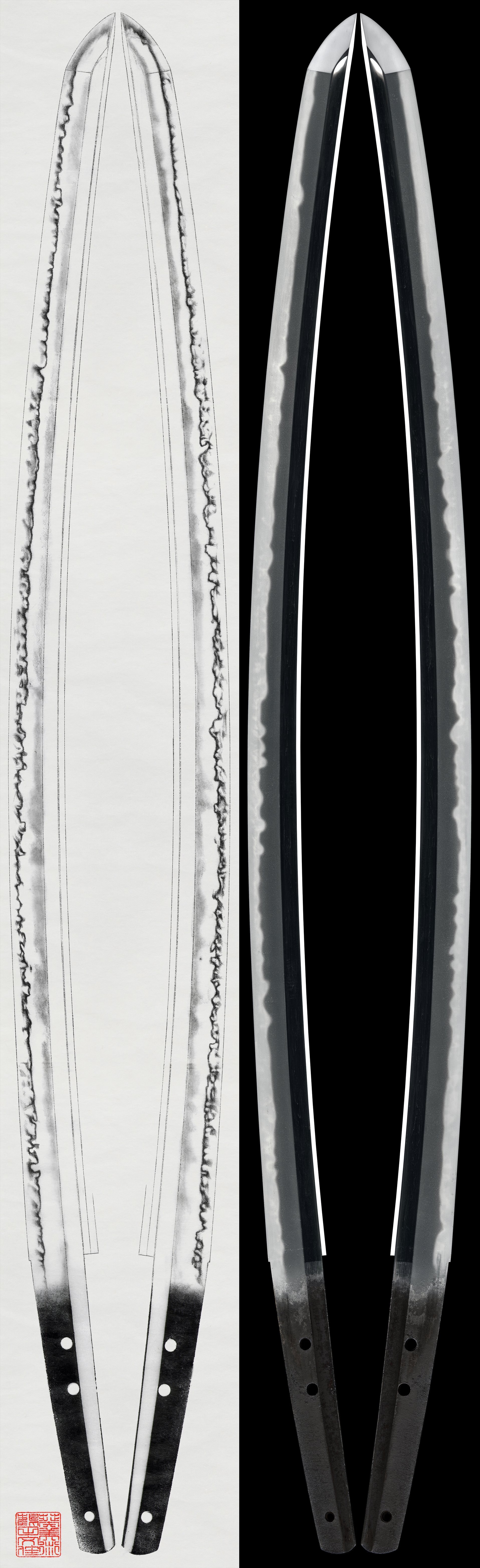
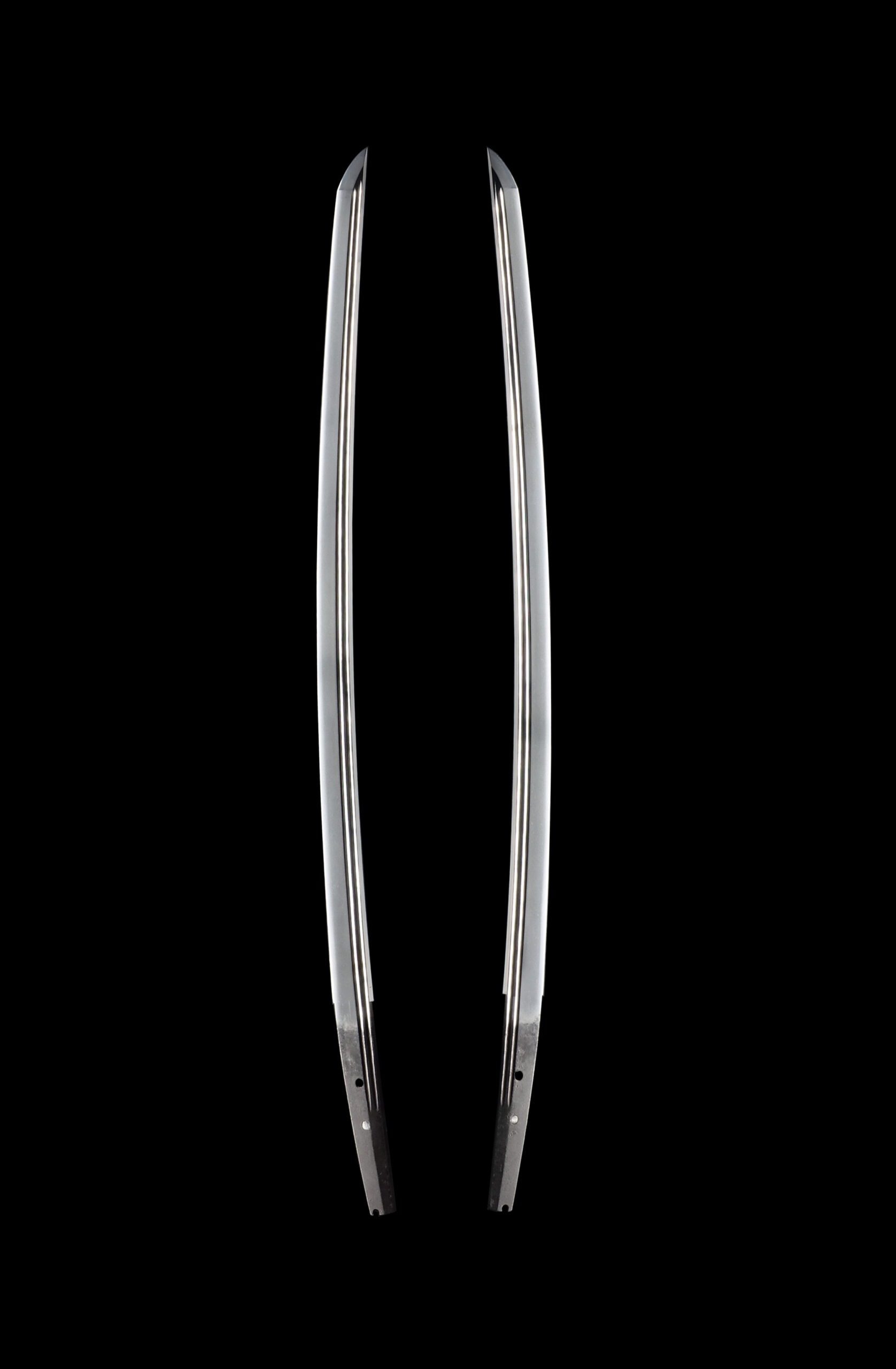
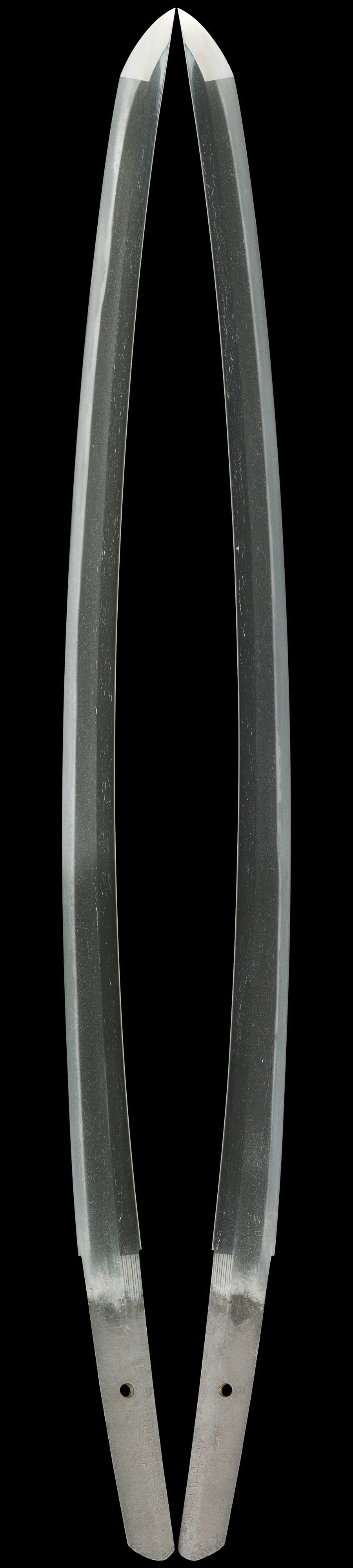
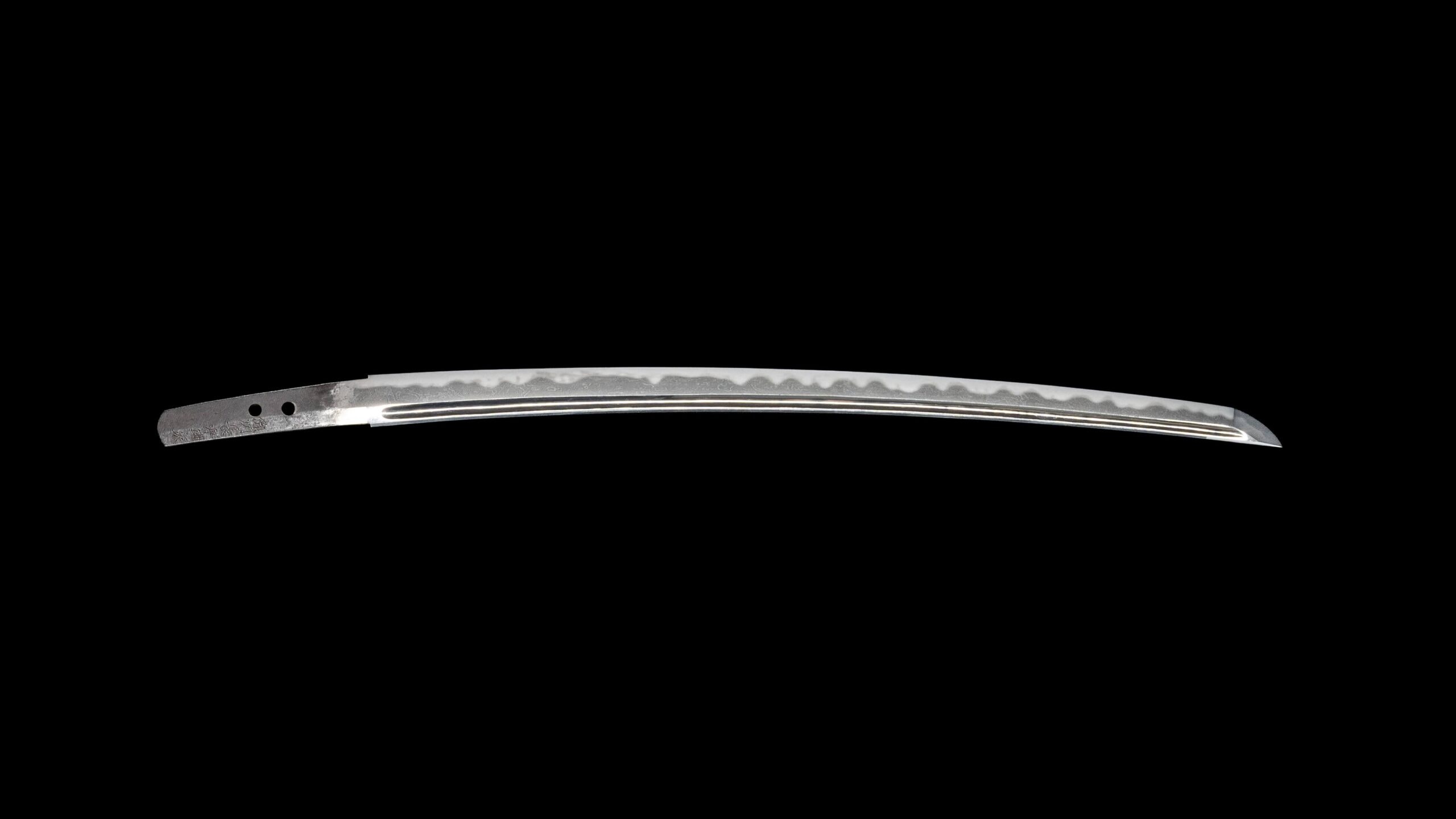
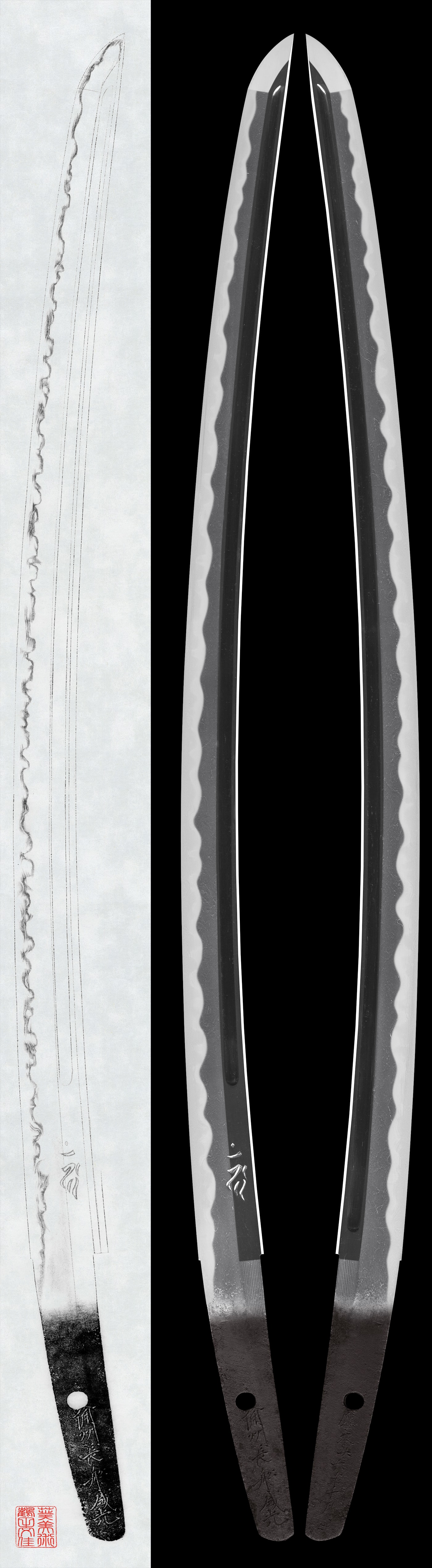
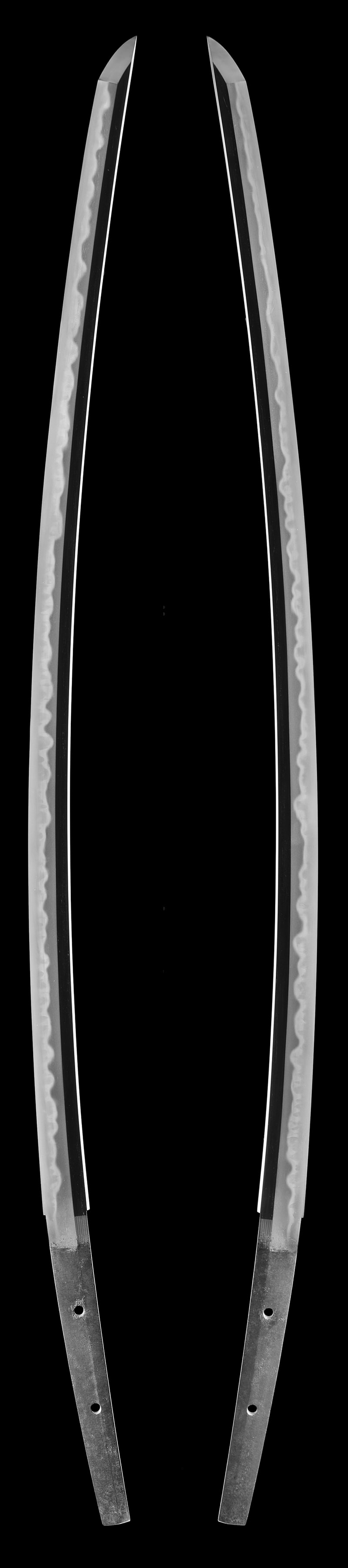
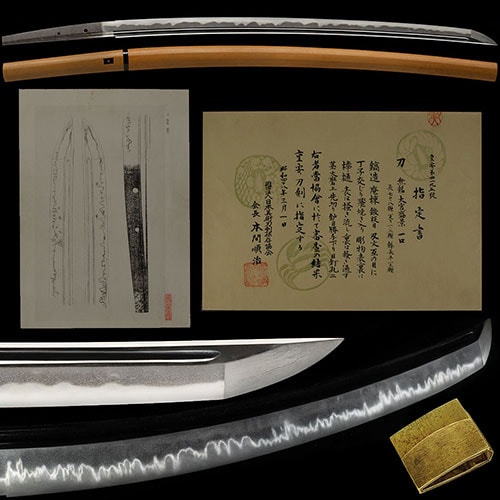
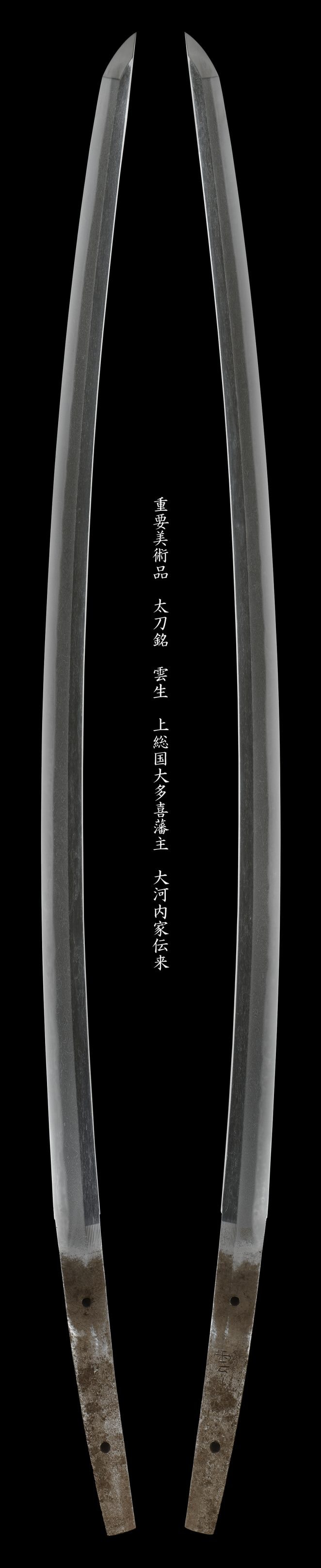
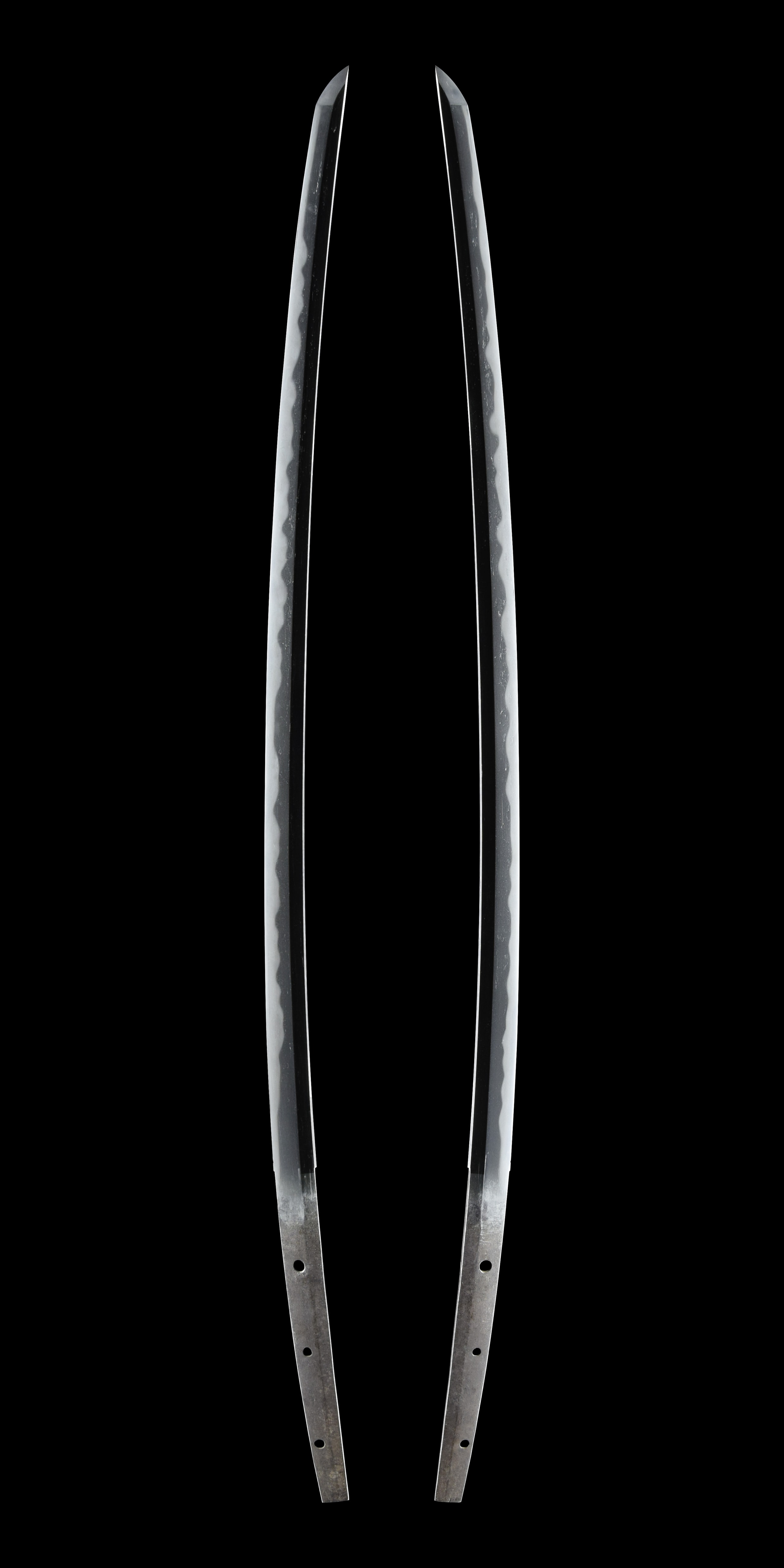
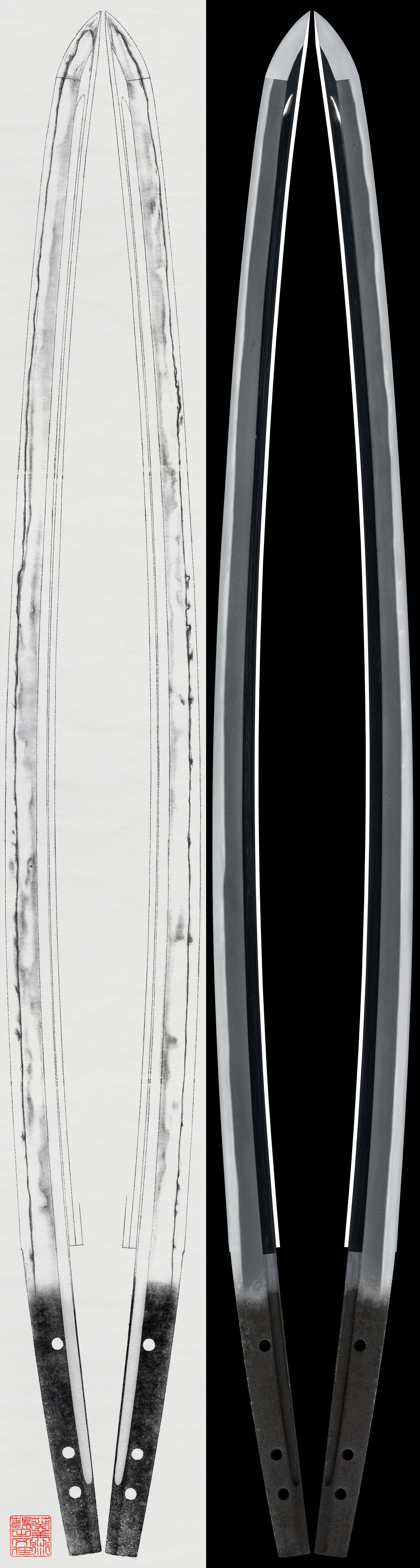
Juyo Token "Kanenaga" Token Classification: "Katana" Mumei: "Kanenaga" Nihonto Certificate: "Nippon Bijutsu Token Hozon Kyokai - Juyo Token" NBTHK "Juyo Paper" Period: "Nanbokucho Period, around Joji era" Production age: "AD1362" Kanenaga is said to have been a student of Osafune Chogi. While extant signed examples are extremely rare, there is a wakizashi among his works certified as a Juyo Bijutsuhin dated Joji 5th year, which exhibits a hitatsura-style workmanship. In contrast, there remain daggers (tanto) designated as Juyo Token dated Shitoku 4th year and Tokubetsu Juyo Token dated Kakei 2nd year; these two show even stronger nie than the former, with abundant activities (hataraki) in the ji and ha. It is noteworthy that while their style approximates that of Chogi, they exhibit a workmanship where the Soshu-den influence is even more emphasized. In the case of katana, almost all are mumei attributions (kiwame), but many are seen with even stronger nie than Chogi and active hataraki within the blade, or large-patterned midare compositions mixed with choji-style elements. This katana features a kitae of itame mixed with moku, with jinie appearing finely and densely, interspersed with jifu and fine chikei, and a faint midare-style utsuri appearing. The hamon has a high yakiba, mixed with various types of ha in a large-patterned midare, showing a workmanship rich in hataraki such as ashi, yo, kinsuji, sunagashi, and yubashiri. Among Kanenaga attributions, this is a superior work with a particularly high yakiba and large-patterned midare; combined with the grand taihai of wide mihaba and a chu-kissaki nobikokoro, it displays a powerful, dignified presence rich in variety. "Keijo": Shinogi-zukuri, iori-mune, wide mihaba, some difference between moto-haba and saki-haba, thick kasane, somewhat shallow sori, chu-kissaki nobikokoro. "Kitae": Itame-hada, somewhat hada-tachi, slightly mixed with moku, jinie attached minutely, fine chikei enters, faint midare-style utsuri appears. "Hamon": Overall high yakiba, frequently mixing gunome, choji, angular ha, and koshino-aita ha, large-patterned midare, ashi and yo enter well, konie attached, small yubashiri and tobiyaki mixed in places, kinsuji and sunagashi appearing, nioiguchi somewhat shimari-kokoro. "Boshi": Omote is midare-komi, returning roundly in jizo-style; ura is notare-komi becoming komaru. "Nakago": O-suriage, saki-kiri, yasurime katte-sagari, two mekugi-ana. Mumei. "Horimono": Bo-hi on both omote and ura, maru-dome within the nakago; on the ura of the nakago, traces of a tsume (claw) below the maru-dome. "Koshirae": Shirasaya "Size" Nagasa: 66.4 cm, Sori: 1.9 cm, Motohaba: 3.1 cm, Sakihaba: 2.2 cm, Moto-kasane: 0.7 cm, Saki-kasane: 0.45 cm
 NihontoWatch
mumei · Osafune · Nanbokucho · nagasa 66.4cm · sori 1.9cm
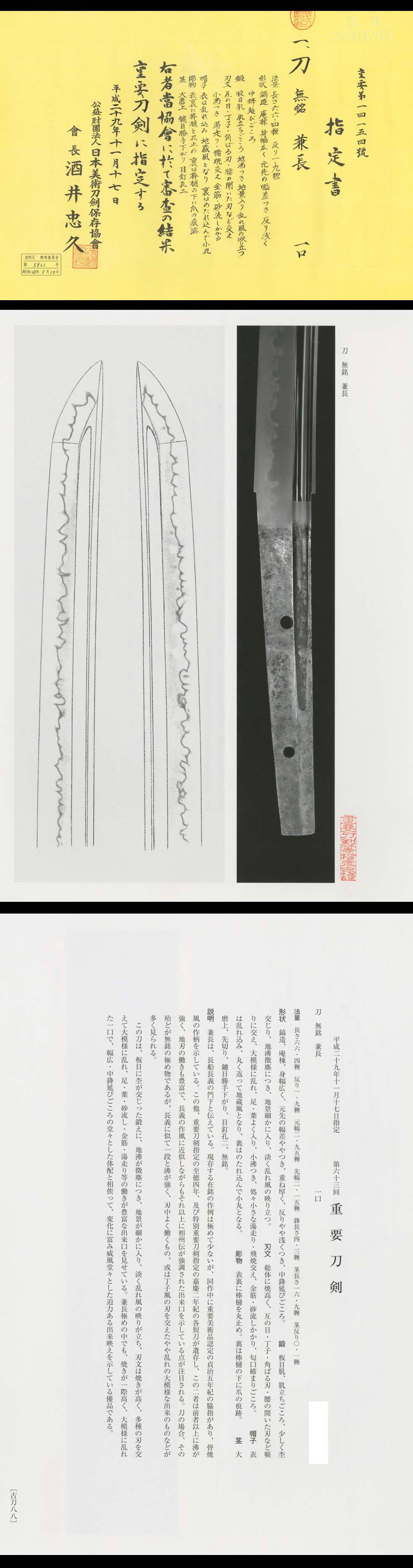






Osafune Kanenaga
Nanbokuchō
Bizen
Unsigned
Tokujū (NBTHK)
Osafune Chogi school (Soden-Bizen) · Bizen · around 1362-1388
Fujishiro Jo saku · Tōken Taikan top 10%
3 pieces on the market now
Kanenaga of Bizen, written 兼長, is transmitted in the published sources as a pupil of Osafune Chōgi[[c:1]], and so as a smith of the Soden-Bizen line in which the Sōshū manner of Masamune was carried into the Bizen workshop. The published record is candid about how little signed work survives: extant in-mei examples are exceedingly few. The standards are a wakizashi dated Jōji 5 (1366), designated an Important Art Object, and tantō dated Shitoku 4 (1387) and Kakei 2 (1388), the latter two showing nie stronger and ji-ha activity richer than the first. From these few dated blades the published sources draw the judgment that anchors the whole attribution: his workmanship approaches that of Chōgi yet pushes the Sōshū side further still[[c:2]]. The reality of the kantei, however, lies elsewhere, since almost everything that survives under his name is a grand o-suriage mumei katana attributed to him by workmanship rather than by a signature.
In that majority register the published sources describe a katana that resembles Chōgi but is, in their words, more strongly nie-laden, with activity working freely within the temper[[c:3]]. The form they record is itself part of the recognition: wide mihaba with almost no taper from base to tip, thick kasane, a rather deep sori, and an ō-kissaki or an extended chū-kissaki, the bold Nanbokuchō shape preserved by ō-suriage. The temper they describe is a large-pattern midare on a notare or gunome base, mixing gunome and ko-gunome with chōji, angular ha, pointed togari elements, and the waist-open koshi-biraki shapes that give his work its swing. Ashi and yō enter well, the nioiguchi runs deep and bright, and the nie clots and in places coarsens, with kinsuji and sunagashi running frequently. Small yubashiri and detached tobiyaki break out above the temper, and the bōshi runs midare-komi, often pointed and sweeping into hakikake or a flame-like kaen tip.
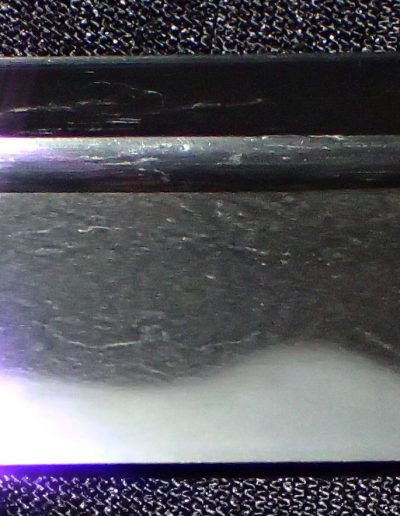
The jigane is the Bizen base over which that Sōshū temper is laid. The published sources describe itame mixed with mokume and ō-mokume, areas of nagare-hada, and a grain that stands out (hada-dachi); over it fine ji-nie adheres densely and chikei enter thickly and well. The Bizen utsuri is present but faint, recorded again and again as a midare-utsuri that stands only dimly[[c:4]]. That thin reflection is itself a tell: the more the Sōshū side is pushed, the less the old Bizen jigane shows its utsuri, and on the most Sōshū of his blades the reflection recedes almost to nothing. The published commentary reads the surviving utsuri as the proof of his province, judging one such katana, because the reflection appears at all, to be Soden-Bizen[[c:5]].
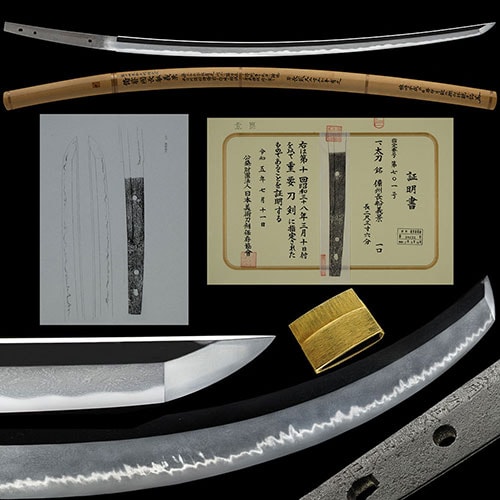
The work therefore divides in two. The rare dated signed pieces are the calibration: the Jōji wakizashi runs toward a hitatsura tone, and the Shitoku and Kakei tantō carry the Sōshū manner so far that the published sources liken them to Norishige, written as blades that at a glance could be confused for him in their emphasized Sōshū-den[[c:6]]. The signature style and the chisel-work of these dated pieces confirm, the sources say, that this hand belongs to the Chōgi line. Against that calibration stands the great body of ō-suriage mumei katana, more flamboyant and bolder in pattern than Chōgi himself. The published record also preserves a dating question, attributed to Honma: the Jōji Kanenaga signature differs from Chōgi's, whereas the later Shitoku, Kakei and Meitoku pieces match the signature style of Chōgi's Ōan years, so that the received account ought to be re-examined[[c:7]], and the earlier Jōji Kanenaga may be a separate line while the later Kanenaga is the true Chōgi pupil[[c:8]]. The sources present this as an open question of scholarship, not a settled fact.
Within the Chōgi group his place is the most Sōshū-emphasized extreme. The published commentary repeatedly distinguishes him from Chōgi by degree: where the ordinary ō-suriage mumei attribution to Chōgi runs a step quieter, his is the bolder, larger-patterned, more strongly nie-laden hand, and one Tokubetsu Jūyō katana is judged, among the Chōgi group, the work most properly attributed to Kanenaga himself[[c:9]]. His waist-open gunome is the most particular of these tells, a swing the orthodox-Bizen members of the group do not show; his sunagashi and kinsuji are the most profuse, and his detached tobiyaki the most insistent. He stands thereby apart from the more orthodox-Bizen Kanemitsu and Motoshige, whose work keeps closer to the Bizen chōji line, and beside Chōgi as the pupil who carried the Sōshū side of Soden-Bizen the furthest.
Kanenaga is Jō saku in Fujishiro's grading, with a Tōkō Taikan valuation of 900. Despite the near-absent signed record, the weight of designation behind his name is substantial: none of his blades carry a national heritage designation, but eleven have reached Tokubetsu Jūyō and seventy-nine more are Jūyō, ninety in the two top tiers, with several further designated Juyo Bijutsuhin. The provenance recorded against his blades carries names of standing, the Sanada Family, the Tōdō Family, Sakai Tadayoshi, the Tsuchiya Family of Tsuchiura, the Yamauchi, and the American collector Walter A. Compton. Of recorded whereabouts, two examples are held by institutions, the Bizen Osafune Sword Museum and Itsukushima Jinja, the rest by private hands. Because almost nothing signed survives and the attributed katana are themselves uncommon, a Kanenaga reaches the market only rarely; with no blade locked in the highest heritage tiers, the recorded examples sit in the Tokubetsu Jūyō and Jūyō tiers, most of them held rather than traded, so that an example coming into open hands is a landmark when it does, not a thing to be sought at will.
Where Kanenaga stands among comparable artisans: across all of nihontō, and within tradition, era, and period. The tiers (Foremost · Leading · Major · Notable) weigh official designations from the NBTHK and Japan's Agency for Cultural Affairs, together with historical honors of lasting repute such as the Sansaku and Meibutsu-chō.
Select a lens to see how it's measured.
Years he was demonstrably active, proven by signed-and-dated blades
Bizen-den
Phase: Sōden-Bizen相伝備前· 1330–1394
8 pieces on the market now
The Soden Bizen school encompasses the group of Nanbokucho-period Osafune smiths in Bizen Province whose work absorbed the technical influence of the Soshu-den, producing a distinctive synthesis that stands apart from both orthodox Bizen and pure Sagami practice. The school divides into two principal lineages: the Kanemitsu group, representing the direct main line of Osafune that descends from Mitsutada through Nagamitsu and Kagemitsu; and the Chogi group, a collateral branch whose members carried the Soshu idiom to its most expressive extremes within Bizen. Kanemitsu, the chakuryu heir of Kagemitsu, pioneered the broad, relaxed notare-based midare that defines the mature Nanbokucho Osafune manner, while Chogi -- described by the NBTHK as the smith "who departs furthest from Bizen" among Bizen makers -- pushed nie-dominant forging to a level that rivals the output of the great Sagami smiths themselves. Together with disciples and contemporaries including Tomomitsu, Motomitsu, Masamitsu, Yoshimitsu, Kanenaga, Nagashige, and Nagamori, they constitute one of the most prolific and technically accomplished groups in the history of Japanese swordsmithing. The school's collective technical identity is anchored in a shared jigane of itame-hada mixed with mokume, with fine ji-nie adhering thickly, chikei entering well, and midare-utsuri standing out -- a persistent Bizen hallmark that survives even in the most Soshu-inflected work. The sugata overwhelmingly reflects the grand Nanbokucho taihai: wide mihaba with little taper between base and tip, and an extended chu-kissaki or o-kissaki conveying martial vigor. Within this shared framework, two distinct temperaments emerge.
" Yoshimitsu likewise inherits the small-pattern tendency, producing ko-gunome mixed with ko-choji whose restraint the NBTHK praises as "upper rank" Soden Bizen. The Chogi lineage, by contrast, emphasizes powerful nie in both ji and ha: Chogi's flamboyant large-scale midare weaves together gunome, choji, togariba, and koshi-hiraki forms with tobiyaki and yubashiri scattering freely, while kinsuji and sunagashi streak through the hardened edge. " Nagashige, now thought to be Chogi's elder brother rather than his junior, works a gentler, smaller-patterned midare yet with nie so strong as to "even surpass Chogi," while Nagamori occupies an intermediate position, his "somewhat smaller patterning" accompanied by rich internal activity. The historical significance of the Soden Bizen school lies in its demonstration that the Soshu influence, far from merely displacing Bizen conventions, catalyzed an extraordinary expansion of the Osafune repertoire. " The NBTHK's evaluative language across the school converges on consistent themes: the forging is "meticulous" and "excellent-quality," the nioiguchi "bright and clear," and the finest examples display a kenzen condition that attests to the soundness of Bizen steel at its peak. The abundance of dated inscriptions -- from Kanemitsu's forty-five-year span through Masamitsu's four-decade career extending into the early Muromachi period -- provides an unusually well-documented chronological framework, with later works by Masamitsu and Yoshimitsu pointing toward the subsequent development of Oei Bizen. Within the broader canon, the Soden Bizen school stands as the fullest realization of the creative possibilities that emerged when two of Japan's greatest forging traditions met and merged. Learn more →
| Smith | Era | Designated |
|---|---|---|
| Chogi長義 | 1356-1379 | 108 |
| Kanenaga兼長 | 1362-1388 | 94 |
| Nagashige長重 | 1334-1342 | 16 |
| Yoshikage義景 | 1334-1363 | 66 |
| Nagashige長重 | 1356-1361 | 0 |
The NBTHK’s highest grade, reserved for the rare Jūyō blades of exceptional artistry, condition, and historical value, judged on par with a nationally designated Important Cultural Property (Jūyō Bunkazai).
Only 1,211 swords have ever reached Tokubetsu Jūyō, about 1 in 2,064 registered blades.
The NBTHK (Nihon Bijutsu Tōken Hozon Kyōkai, the Society for the Preservation of Japanese Art Swords) is a public-interest incorporated foundation founded in 1948 and supervised by Japan’s Agency for Cultural Affairs (Bunkachō); it is based at the Japanese Sword Museum in Tokyo. Its expert panels physically examine each submitted work (shinsa) and issue a certificate (kanteishō) ranking it by artistic and historical merit. NBTHK papers are the most widely recognized standard of authentication for Japanese swords and fittings.
NBTHK official siteWhen the item reaches you, please check immediately for damage and that it matches your order. We bear the shipping cost for a return; please send it freight-collect. Costs other than the item price cannot be refunded.

Juyo Token "Kanenaga" Token Classification: "Katana" Mumei: "Kanenaga" Nihonto Certificate: "Nippon Bijutsu Token Hozon Kyokai - Juyo Token" NBTHK "Juyo Paper" Period: "Nanbokucho Period, around Joji era" Production age: "AD1362" Kanenaga is said to have been a student of Osafune Chogi. While extant signed examples are extremely rare, there is a wakizashi among his works certified as a Juyo Bijutsuhin dated Joji 5th year, which exhibits a hitatsura-style workmanship. In contrast, there remain daggers (tanto) designated as Juyo Token dated Shitoku 4th year and Tokubetsu Juyo Token dated Kakei 2nd year; these two show even stronger nie than the former, with abundant activities (hataraki) in the ji and ha. It is noteworthy that while their style approximates that of Chogi, they exhibit a workmanship where the Soshu-den influence is even more emphasized. In the case of katana, almost all are mumei attributions (kiwame), but many are seen with even stronger nie than Chogi and active hataraki within the blade, or large-patterned midare compositions mixed with choji-style elements. This katana features a kitae of itame mixed with moku, with jinie appearing finely and densely, interspersed with jifu and fine chikei, and a faint midare-style utsuri appearing. The hamon has a high yakiba, mixed with various types of ha in a large-patterned midare, showing a workmanship rich in hataraki such as ashi, yo, kinsuji, sunagashi, and yubashiri. Among Kanenaga attributions, this is a superior work with a particularly high yakiba and large-patterned midare; combined with the grand taihai of wide mihaba and a chu-kissaki nobikokoro, it displays a powerful, dignified presence rich in variety. "Keijo": Shinogi-zukuri, iori-mune, wide mihaba, some difference between moto-haba and saki-haba, thick kasane, somewhat shallow sori, chu-kissaki nobikokoro. "Kitae": Itame-hada, somewhat hada-tachi, slightly mixed with moku, jinie attached minutely, fine chikei enters, faint midare-style utsuri appears. "Hamon": Overall high yakiba, frequently mixing gunome, choji, angular ha, and koshino-aita ha, large-patterned midare, ashi and yo enter well, konie attached, small yubashiri and tobiyaki mixed in places, kinsuji and sunagashi appearing, nioiguchi somewhat shimari-kokoro. "Boshi": Omote is midare-komi, returning roundly in jizo-style; ura is notare-komi becoming komaru. "Nakago": O-suriage, saki-kiri, yasurime katte-sagari, two mekugi-ana. Mumei. "Horimono": Bo-hi on both omote and ura, maru-dome within the nakago; on the ura of the nakago, traces of a tsume (claw) below the maru-dome. "Koshirae": Shirasaya "Size" Nagasa: 66.4 cm, Sori: 1.9 cm, Motohaba: 3.1 cm, Sakihaba: 2.2 cm, Moto-kasane: 0.7 cm, Saki-kasane: 0.45 cm
NihontoWatchmumei · Osafune · Nanbokucho · nagasa 66.4cm · sori 1.9cm
Osafune Kanenaga
Nanbokuchō
Bizen
Unsigned
Tokujū (NBTHK)
Osafune Chogi school (Soden-Bizen) · Bizen · around 1362-1388
Fujishiro Jo saku · Tōken Taikan top 10%
3 pieces on the market now
Kanenaga of Bizen, written 兼長, is transmitted in the published sources as a pupil of Osafune Chōgi[[c:1]], and so as a smith of the Soden-Bizen line in which the Sōshū manner of Masamune was carried into the Bizen workshop. The published record is candid about how little signed work survives: extant in-mei examples are exceedingly few. The standards are a wakizashi dated Jōji 5 (1366), designated an Important Art Object, and tantō dated Shitoku 4 (1387) and Kakei 2 (1388), the latter two showing nie stronger and ji-ha activity richer than the first. From these few dated blades the published sources draw the judgment that anchors the whole attribution: his workmanship approaches that of Chōgi yet pushes the Sōshū side further still[[c:2]]. The reality of the kantei, however, lies elsewhere, since almost everything that survives under his name is a grand o-suriage mumei katana attributed to him by workmanship rather than by a signature.
In that majority register the published sources describe a katana that resembles Chōgi but is, in their words, more strongly nie-laden, with activity working freely within the temper[[c:3]]. The form they record is itself part of the recognition: wide mihaba with almost no taper from base to tip, thick kasane, a rather deep sori, and an ō-kissaki or an extended chū-kissaki, the bold Nanbokuchō shape preserved by ō-suriage. The temper they describe is a large-pattern midare on a notare or gunome base, mixing gunome and ko-gunome with chōji, angular ha, pointed togari elements, and the waist-open koshi-biraki shapes that give his work its swing. Ashi and yō enter well, the nioiguchi runs deep and bright, and the nie clots and in places coarsens, with kinsuji and sunagashi running frequently. Small yubashiri and detached tobiyaki break out above the temper, and the bōshi runs midare-komi, often pointed and sweeping into hakikake or a flame-like kaen tip.
The jigane is the Bizen base over which that Sōshū temper is laid. The published sources describe itame mixed with mokume and ō-mokume, areas of nagare-hada, and a grain that stands out (hada-dachi); over it fine ji-nie adheres densely and chikei enter thickly and well. The Bizen utsuri is present but faint, recorded again and again as a midare-utsuri that stands only dimly[[c:4]]. That thin reflection is itself a tell: the more the Sōshū side is pushed, the less the old Bizen jigane shows its utsuri, and on the most Sōshū of his blades the reflection recedes almost to nothing. The published commentary reads the surviving utsuri as the proof of his province, judging one such katana, because the reflection appears at all, to be Soden-Bizen[[c:5]].
The work therefore divides in two. The rare dated signed pieces are the calibration: the Jōji wakizashi runs toward a hitatsura tone, and the Shitoku and Kakei tantō carry the Sōshū manner so far that the published sources liken them to Norishige, written as blades that at a glance could be confused for him in their emphasized Sōshū-den[[c:6]]. The signature style and the chisel-work of these dated pieces confirm, the sources say, that this hand belongs to the Chōgi line. Against that calibration stands the great body of ō-suriage mumei katana, more flamboyant and bolder in pattern than Chōgi himself. The published record also preserves a dating question, attributed to Honma: the Jōji Kanenaga signature differs from Chōgi's, whereas the later Shitoku, Kakei and Meitoku pieces match the signature style of Chōgi's Ōan years, so that the received account ought to be re-examined[[c:7]], and the earlier Jōji Kanenaga may be a separate line while the later Kanenaga is the true Chōgi pupil[[c:8]]. The sources present this as an open question of scholarship, not a settled fact.
Within the Chōgi group his place is the most Sōshū-emphasized extreme. The published commentary repeatedly distinguishes him from Chōgi by degree: where the ordinary ō-suriage mumei attribution to Chōgi runs a step quieter, his is the bolder, larger-patterned, more strongly nie-laden hand, and one Tokubetsu Jūyō katana is judged, among the Chōgi group, the work most properly attributed to Kanenaga himself[[c:9]]. His waist-open gunome is the most particular of these tells, a swing the orthodox-Bizen members of the group do not show; his sunagashi and kinsuji are the most profuse, and his detached tobiyaki the most insistent. He stands thereby apart from the more orthodox-Bizen Kanemitsu and Motoshige, whose work keeps closer to the Bizen chōji line, and beside Chōgi as the pupil who carried the Sōshū side of Soden-Bizen the furthest.
Kanenaga is Jō saku in Fujishiro's grading, with a Tōkō Taikan valuation of 900. Despite the near-absent signed record, the weight of designation behind his name is substantial: none of his blades carry a national heritage designation, but eleven have reached Tokubetsu Jūyō and seventy-nine more are Jūyō, ninety in the two top tiers, with several further designated Juyo Bijutsuhin. The provenance recorded against his blades carries names of standing, the Sanada Family, the Tōdō Family, Sakai Tadayoshi, the Tsuchiya Family of Tsuchiura, the Yamauchi, and the American collector Walter A. Compton. Of recorded whereabouts, two examples are held by institutions, the Bizen Osafune Sword Museum and Itsukushima Jinja, the rest by private hands. Because almost nothing signed survives and the attributed katana are themselves uncommon, a Kanenaga reaches the market only rarely; with no blade locked in the highest heritage tiers, the recorded examples sit in the Tokubetsu Jūyō and Jūyō tiers, most of them held rather than traded, so that an example coming into open hands is a landmark when it does, not a thing to be sought at will.
Where Kanenaga stands among comparable artisans: across all of nihontō, and within tradition, era, and period. The tiers (Foremost · Leading · Major · Notable) weigh official designations from the NBTHK and Japan's Agency for Cultural Affairs, together with historical honors of lasting repute such as the Sansaku and Meibutsu-chō.
Select a lens to see how it's measured.
Years he was demonstrably active, proven by signed-and-dated blades
Bizen-den
Phase: Sōden-Bizen相伝備前· 1330–1394
8 pieces on the market now
The Soden Bizen school encompasses the group of Nanbokucho-period Osafune smiths in Bizen Province whose work absorbed the technical influence of the Soshu-den, producing a distinctive synthesis that stands apart from both orthodox Bizen and pure Sagami practice. The school divides into two principal lineages: the Kanemitsu group, representing the direct main line of Osafune that descends from Mitsutada through Nagamitsu and Kagemitsu; and the Chogi group, a collateral branch whose members carried the Soshu idiom to its most expressive extremes within Bizen. Kanemitsu, the chakuryu heir of Kagemitsu, pioneered the broad, relaxed notare-based midare that defines the mature Nanbokucho Osafune manner, while Chogi -- described by the NBTHK as the smith "who departs furthest from Bizen" among Bizen makers -- pushed nie-dominant forging to a level that rivals the output of the great Sagami smiths themselves. Together with disciples and contemporaries including Tomomitsu, Motomitsu, Masamitsu, Yoshimitsu, Kanenaga, Nagashige, and Nagamori, they constitute one of the most prolific and technically accomplished groups in the history of Japanese swordsmithing. The school's collective technical identity is anchored in a shared jigane of itame-hada mixed with mokume, with fine ji-nie adhering thickly, chikei entering well, and midare-utsuri standing out -- a persistent Bizen hallmark that survives even in the most Soshu-inflected work. The sugata overwhelmingly reflects the grand Nanbokucho taihai: wide mihaba with little taper between base and tip, and an extended chu-kissaki or o-kissaki conveying martial vigor. Within this shared framework, two distinct temperaments emerge.
" Yoshimitsu likewise inherits the small-pattern tendency, producing ko-gunome mixed with ko-choji whose restraint the NBTHK praises as "upper rank" Soden Bizen. The Chogi lineage, by contrast, emphasizes powerful nie in both ji and ha: Chogi's flamboyant large-scale midare weaves together gunome, choji, togariba, and koshi-hiraki forms with tobiyaki and yubashiri scattering freely, while kinsuji and sunagashi streak through the hardened edge. " Nagashige, now thought to be Chogi's elder brother rather than his junior, works a gentler, smaller-patterned midare yet with nie so strong as to "even surpass Chogi," while Nagamori occupies an intermediate position, his "somewhat smaller patterning" accompanied by rich internal activity. The historical significance of the Soden Bizen school lies in its demonstration that the Soshu influence, far from merely displacing Bizen conventions, catalyzed an extraordinary expansion of the Osafune repertoire. " The NBTHK's evaluative language across the school converges on consistent themes: the forging is "meticulous" and "excellent-quality," the nioiguchi "bright and clear," and the finest examples display a kenzen condition that attests to the soundness of Bizen steel at its peak. The abundance of dated inscriptions -- from Kanemitsu's forty-five-year span through Masamitsu's four-decade career extending into the early Muromachi period -- provides an unusually well-documented chronological framework, with later works by Masamitsu and Yoshimitsu pointing toward the subsequent development of Oei Bizen. Within the broader canon, the Soden Bizen school stands as the fullest realization of the creative possibilities that emerged when two of Japan's greatest forging traditions met and merged. Learn more →
| Smith | Era | Designated |
|---|---|---|
| Chogi長義 | 1356-1379 | 108 |
| Kanenaga兼長 | 1362-1388 | 94 |
| Nagashige長重 | 1334-1342 | 16 |
| Yoshikage義景 | 1334-1363 | 66 |
| Nagashige長重 | 1356-1361 | 0 |
The NBTHK’s highest grade, reserved for the rare Jūyō blades of exceptional artistry, condition, and historical value, judged on par with a nationally designated Important Cultural Property (Jūyō Bunkazai).
Only 1,211 swords have ever reached Tokubetsu Jūyō, about 1 in 2,064 registered blades.
The NBTHK (Nihon Bijutsu Tōken Hozon Kyōkai, the Society for the Preservation of Japanese Art Swords) is a public-interest incorporated foundation founded in 1948 and supervised by Japan’s Agency for Cultural Affairs (Bunkachō); it is based at the Japanese Sword Museum in Tokyo. Its expert panels physically examine each submitted work (shinsa) and issue a certificate (kanteishō) ranking it by artistic and historical merit. NBTHK papers are the most widely recognized standard of authentication for Japanese swords and fittings.
NBTHK official siteWhen the item reaches you, please check immediately for damage and that it matches your order. We bear the shipping cost for a return; please send it freight-collect. Costs other than the item price cannot be refunded.