NihontoWatch Mon

NihontoWatch

MarketAuctions
Encyclopedia
NihontoWatch Mon

NihontoWatch

MarketAuctions
Encyclopedia

Description

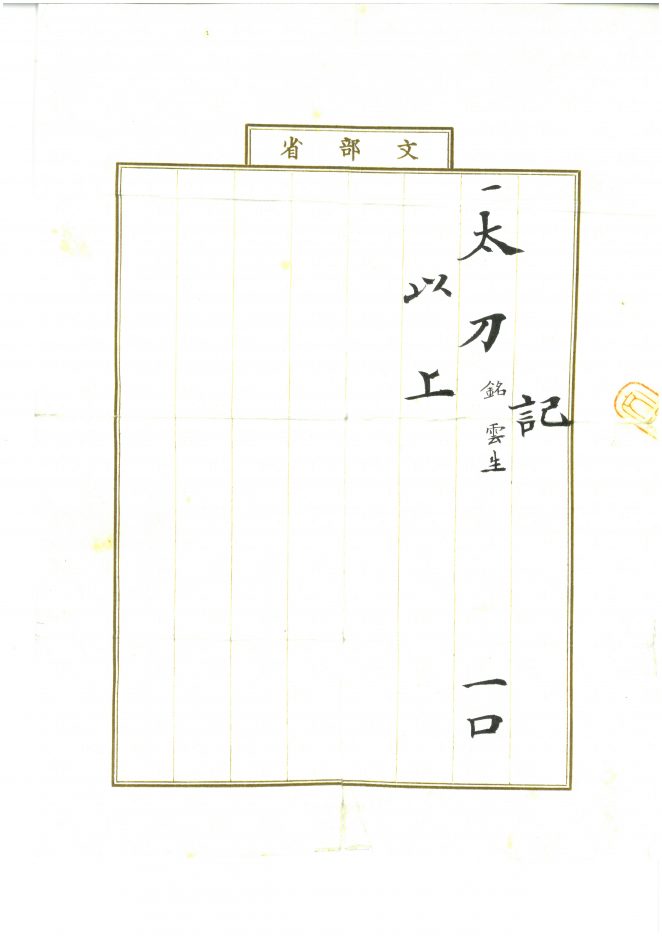
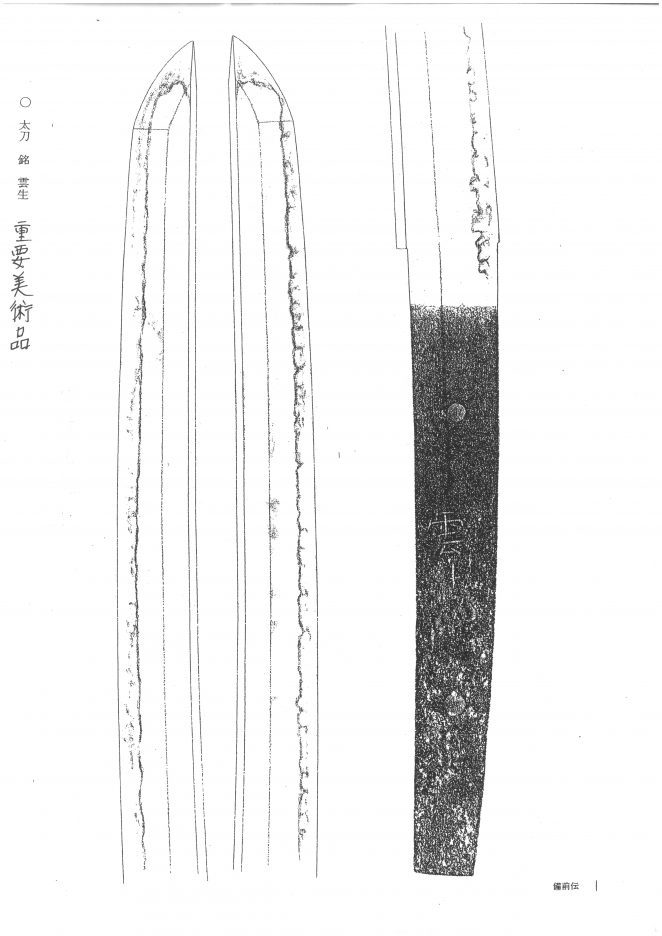
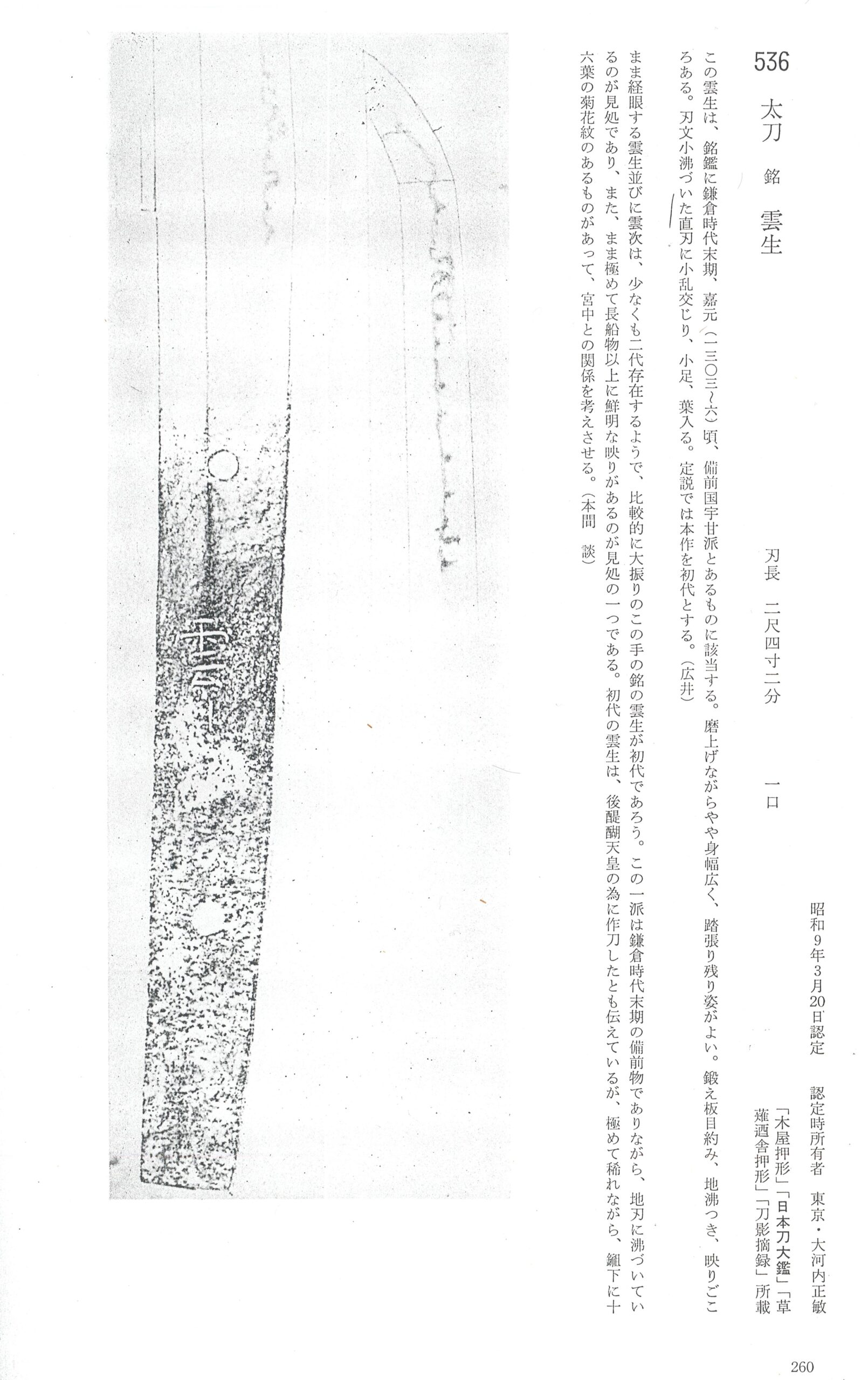
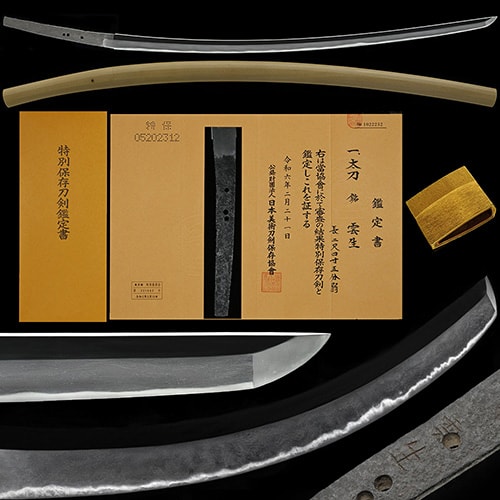
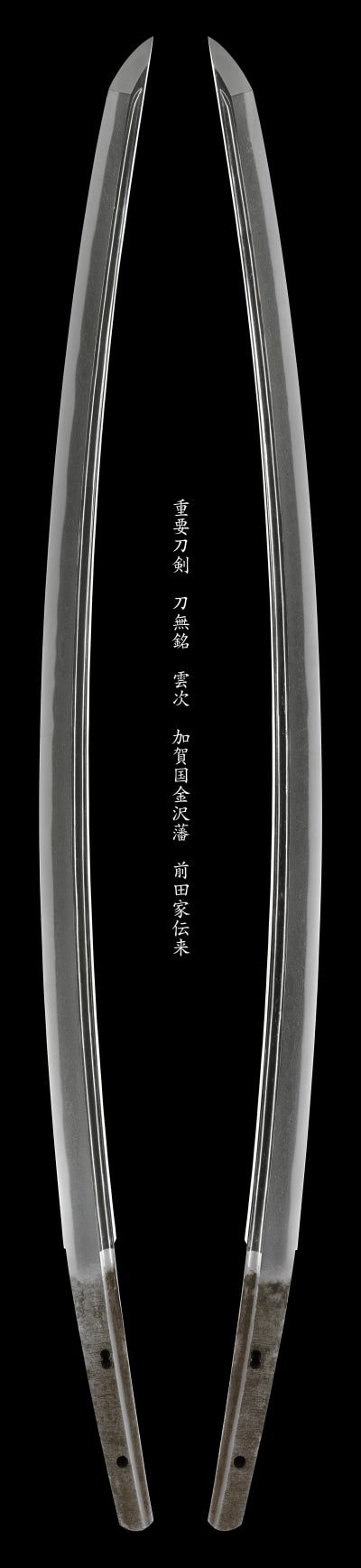
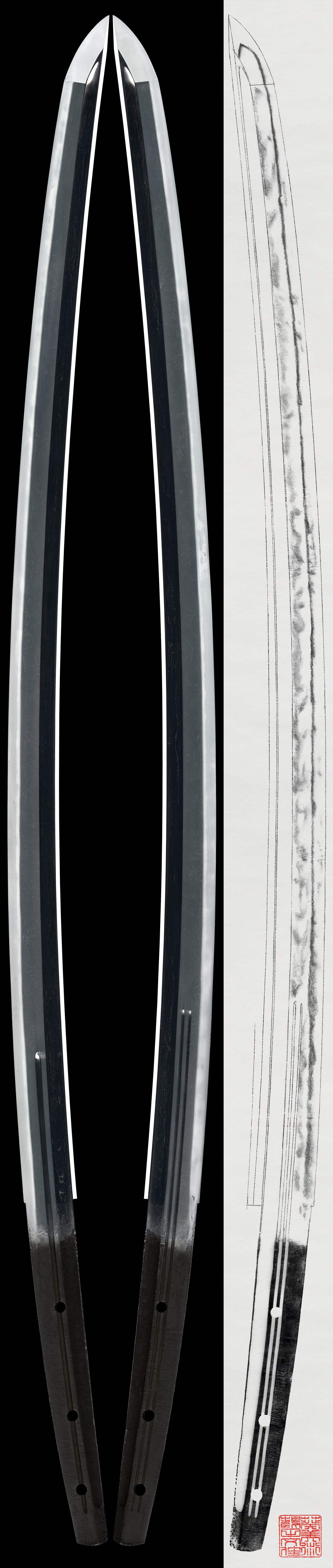
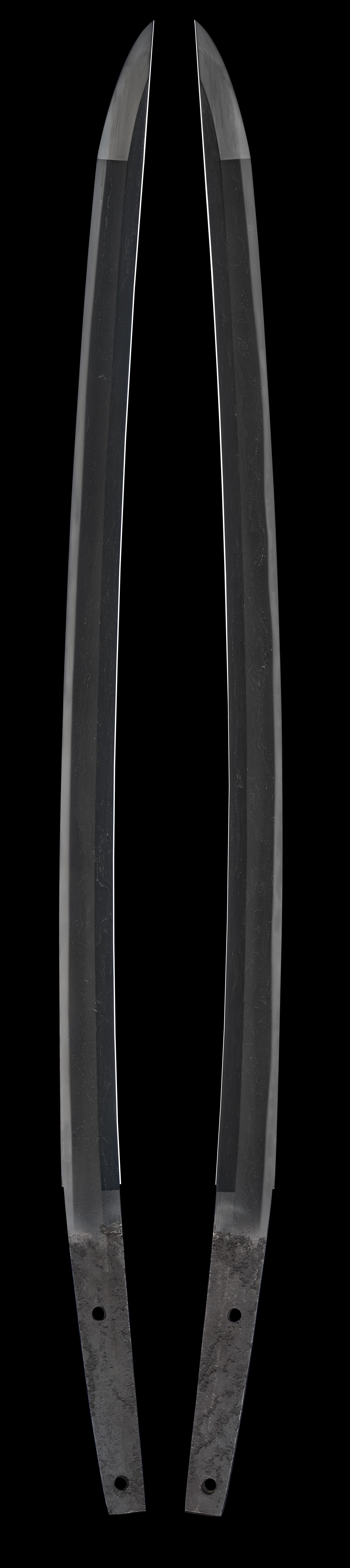
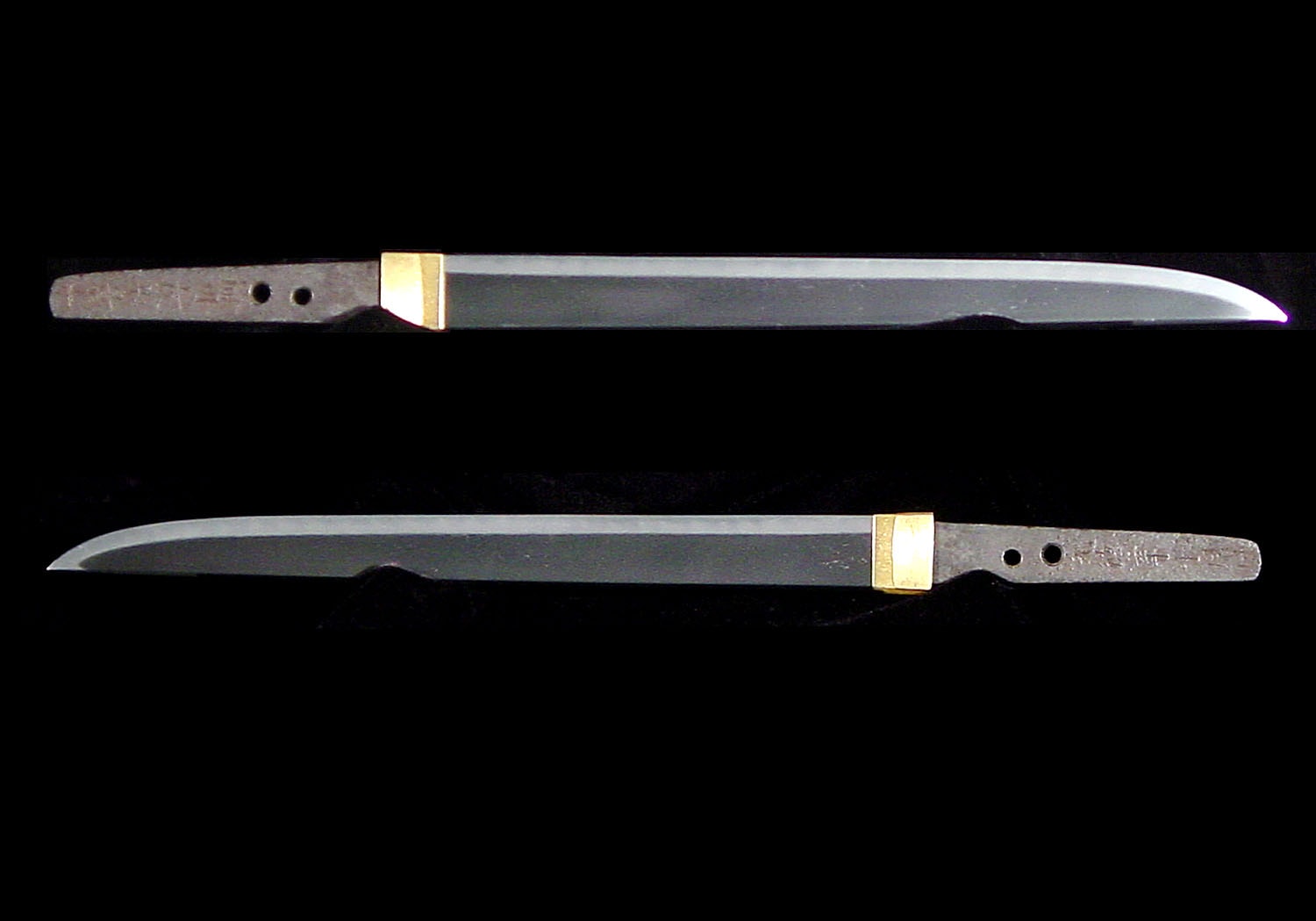
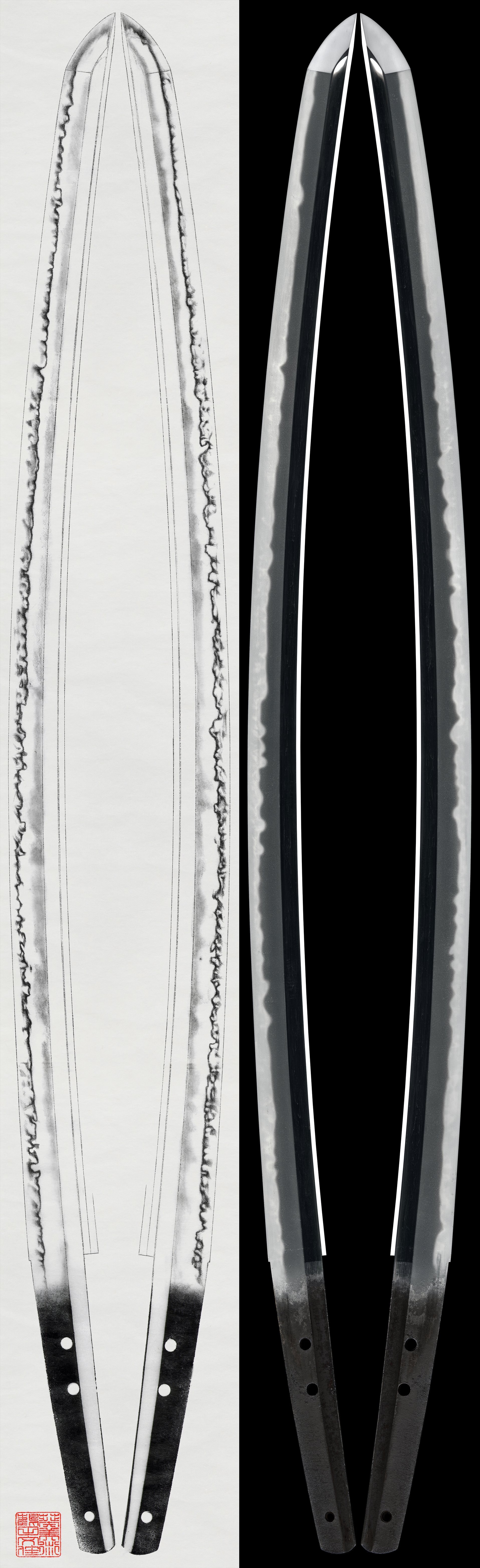
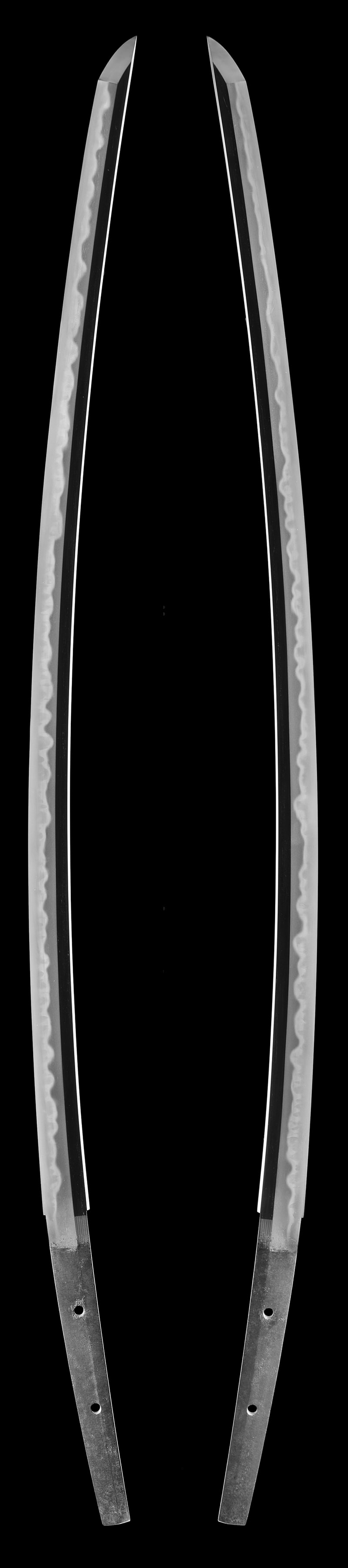
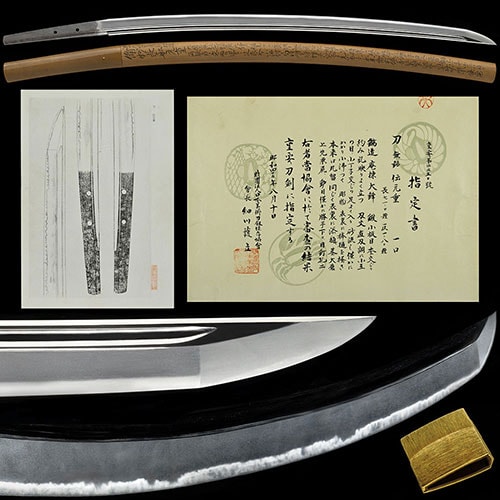
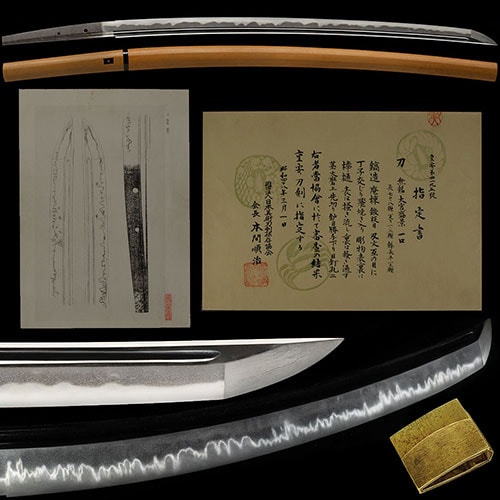
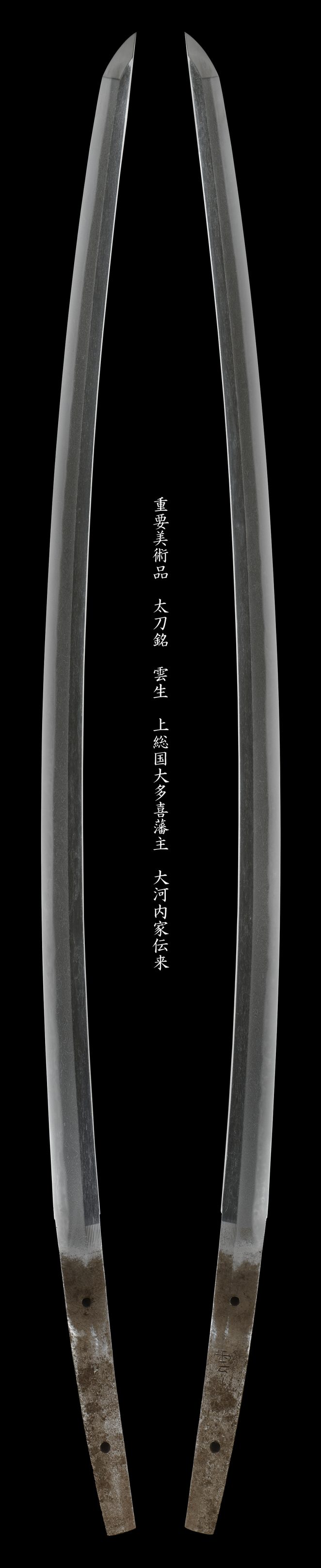
This is a tachi by Kumoio from the Ukai school in Bizen province, dating back to the late Kamakura period. It was passed down in the Okouchi family, lords of the Otaki Domain in Kazusa Province. The blade features a straight temper line with small notare and clove shapes, and the forging pattern is a mix of itame and mokume.

NihontoWatch MonNihontoWatch
MarketAuctionsEncyclopedia
Swords›Bizen-den›Ukai›Unsho›Tachi: Kumoio - From the collection of the Okouchi family, lord of Otaki Domain, Kazusa Province
tachiJūyō Bijutsuhin
Ukai Unsho

Tachi: Kumoio - From the collection of the Okouchi family, lord of Otaki Domain, Kazusa Province

Kamakura · nagasa 73.63cm · sori 2.12cm

Price on request
Visit seller website →
Ukai Unsho — 1 of 5
Ukai Unsho — 2 of 5
Ukai Unsho — 3 of 5
Ukai Unsho — 4 of 5
Ukai Unsho — 5 of 5
1 / 5
1 / 5
Ukai Unsho — 1 of 5Ukai Unsho — 2 of 5Ukai Unsho — 3 of 5Ukai Unsho — 4 of 5Ukai Unsho — 5 of 5
Measurements & details
Smith
Ukai Unsho
Type
Tachi
School
Ukai
Period
Around 1303–1306(Kagen)
Measurements
Nagasa 73.63cmSori 2.12cmMotohaba 2.9cmSakihaba 1.8cmKasane 0.55cm
Description

This is a tachi by Kumoio from the Ukai school in Bizen province, dating back to the late Kamakura period. It was passed down in the Okouchi family, lords of the Otaki Domain in Kazusa Province. The blade features a straight temper line with small notare and clove shapes, and the forging pattern is a mix of itame and mokume.

About the maker

Unsho

雲生

Ukai / Unrui (Bizen) · Bizen · around 1303-1306

Fujishiro Jo saku · Tōken Taikan top 8%

1 piece on the market now

›

From the end of the Kamakura period into the Nanbokucho, the swordsmiths Unsho, Unji and Unshige worked at Ukan-no-sho in Bizen Province, a place name later also written Ukai. From their residence the line is called the Ukan or Ukai school; because every smith set the character Un, the cloud, at the head of his name, the published sources also know them as the Unrui. Unsho is named outright the school's "de facto founder"[[c:1]]. No dated work of his survives; the registers place the first generation around Kengen and Kagen (1302 to 1306), and his years are fixed through the dated blades of Unji in Showa, Bunpo and Kenmu. Tradition holds that he went up to the capital with Unji, learned forging from the Yamashiro smiths, and served the Emperor Go-Daigo as duty smith (後醍醐天皇の御番鍛冶); Honma notes the rare blades with a sixteen-petal chrysanthemum crest[[c:2]] below the habaki that lend the tradition weight. In the school's work "Yamashiro-style elements are intermingled within the Bizen tradition"[[c:3]], with no small influence from the Aoe school of neighboring Bitchu besides, so that the line is called "a distinctive presence among Bizen works"[[c:4]]. Fujishiro grades Unsho Jo saku.

The trait the judges name first is the curvature: a slender tachi with funbari at the base and a small point, arching evenly in a high wa-zori, the torii curve. The published sources observe that "whereas the Osafune work of the same period is koshizori, it presents wa-zori"[[c:5]]. He excelled in suguha, narrow to medium, mixed with ko-gunome, ko-choji and shallow notare. The ashi slant in reverse in the Aoe manner, and here and there wedge-shaped shadowy togariba enter. The nioiguchi tightens, carries ko-nie and at times sinks subdued; kinsuji and fine sunagashi run along the edge. Now and then the temper falls away slightly at the hamachi, and the published sources note that "the yakiotoshi at the base may be called Unsho's individuality"[[c:6]]. The boshi turns back round, ko-maru or tending larger; even of a blade steeped in Aoe character the published record observes that his particularity shows exactly where "the boshi does not point"[[c:7]]. The two-character mei sits toward the mune above the mekugi-ana, the character Sho set right of Un, his habit of hand; Honma takes the comparatively large mei of this type for the first generation.

The jigane is itame, in places knit to ko-itame or mixed with mokume, with ji-nie and fine chikei, and a midare-utsuri stands. Characteristically it is what the published sources describe as "the black jifu-utsuri peculiar to the Unrui, as if pressed in with the pad of a finger"[[c:8]], and the steel color besides tends somewhat blackish. Honma counts it a point of interest that these late Kamakura Bizen blades carry nie in both ji and ha, at times with "an utsuri even more vivid than in Osafune work"[[c:9]].

The published sources state his range in one sentence: "his representative manners are two"[[c:10]]. In one, standing itame with mokume, ko-midare in the suguha with a reverse tendency, nie and sunagashi; in the other, closely knit ko-itame, the utsuri especially distinct, the suguha nioiguchi tight. The ubu tachi of Tokubetsu Juyo session 7 belongs to the former, with an old-toned utsuri as if pressed in with a finger[[c:11]]. Beyond the pair lies a stronger vein. "Unsho's manner is mostly low in temper and somewhat lonely in its activity"[[c:12]], yet other works are known with a somewhat wider yakiba, conspicuous ashi and yo and strongly attached nie, a make that connects to Unji; the folded-signature katana of Tokubetsu Juyo session 21 is read exactly so, his work at full power. At least two generations are recognized, the second placed around Bunpo or Kenmu; the registers transmit the first Unji as his son, or by another account his younger brother. Long signatures are exceptional: the tanto signed Bizen no kuni Unsho[[c:13]] is called a signature almost without parallel[[c:14]].

His position within Bizen is the published sources' own formula: the work of the line, beginning with its curvature, is reckoned "the closest to Kyoto work"[[c:15]] among Bizen products, and individual blades can be confounded with the Rai school or with neighboring Aoe. His suguha holds the Kyoto level while his ashi run saka in the Aoe way. Yet the clearly defined midare-utsuri keeps the flavor of his native tradition strongly present, and where the make breathes Aoe, the round boshi remains his own. The judges divide the kin by the temper: his yakiba mostly low and quiet in its activity, that of Unji wider and strongly nie-laden, with ashi and yo standing out. The more powerful of his own blades are read as approaching his successor; the line continues through Unshige.

Seventy-four designated works stand on record. Six are Important Cultural Properties, held as cultural patrimony, and nine more were designated Juyo Bijutsuhin before the war, among them a tachi counted one of the thirty-five blades hand-picked by Uesugi Kagekatsu[[c:16]], the ubu tachi of Iwasaki Koyata, now in the Seikado Bunko Art Museum, and the tachi passed from Tokugawa Iesato to the Sano Art Museum. Fifty-seven blades stand in the Tokubetsu Juyo and Juyo tiers. Signed works are comparatively numerous for so early a smith, thirty-eight signed against thirty-four unsigned here, nearly all the two-character mei. Ten blades carry recorded provenance: the Tokubetsu Juyo tachi of session 12 descends in the Uda Mori, a cadet line of the Nagato Mori; an Asano house katana carries a Hon'ami Kocho origami of 1676 valuing it at ten gold pieces; others passed through the Okochi house and the Imperial Family. The Important Cultural Properties and the museum holdings will not move. What a collector may realistically encounter is a Juyo blade, an osuriage katana attributed on the wa-zori, the dark jifu-utsuri and the saka-laced suguha, or one of the signed tachi; a signed ubu tachi comes to open hands only rarely, and is an event in the field when it does.

Historical importance

Where Unsho stands among comparable artisans: across all of nihontō, and within tradition, era, and period. The tiers (Foremost · Leading · Major · Notable) weigh official designations from the NBTHK and Japan's Agency for Cultural Affairs, together with historical honors of lasting repute such as the Sansaku and Meibutsu-chō.

随一
Foremost
屈指
Leading
有数
Major
著名
Notable

Select a lens to see how it's measured.

Designation record
72 designated works
Jūyō Bunkazai
6
Jūyō Bijutsuhin
7
Gyobutsu (Imperial)
2
Tokubetsu Jūyō
3
Jūyō
54
1 work by Unsho on the market→
Unsho — full profileUkai / Unrui (Bizen) school
About the school

Ukai

鵜飼

Bizen-den · Bizen

8 pieces on the market now

›

At Ukan-no-shō in Bizen Province, a place name later written Ukai, a small group of smiths worked from the close of the Kamakura period into the first decades of Nanbokuchō, every one of them setting the character Un, the cloud, at the head of his name; for that habit the published sources know them equally as the Ukai school and as the Unrui, the cloud group. Learn more →

6 recorded smiths268 designated works
Leading smiths
SmithEraDesignated
Unsho雲生1303-130672
Unji雲次1315-1335131
Unju雲重1352-137560
Unsho雲生1317-13190
Morikage守景1352-13560
Explore the Ukai school →
Government Designation
Jūyō Bijutsuhin重要美術品
Important Art Object
›

A blade designated by the Japanese government for its high artistic and historical value, a standing comparable to an Important Sword. The designation carries an export restriction: a Jūyō Bijutsuhin is kept within Japan and forfeits its status if it ever leaves the country.

About this designation›

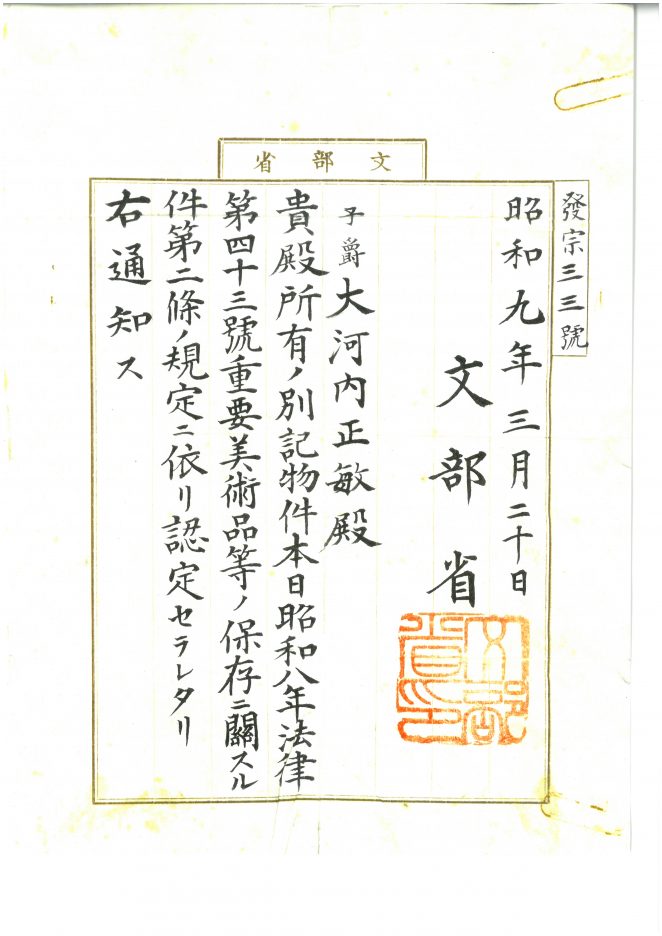
The Important Art Object (Jūyō Bijutsuhin) designation dates to the 1933 Law for the Preservation of Important Works of Fine Arts, passed during the Great Depression to stem the outflow of Japan’s cultural treasures abroad. The systems of Important Cultural Property and National Treasure did not yet cover privately-held works, so accreditation by the Minister of Education marked an object as a quasi-National Treasure that could not be exported. About 8,300 works were accredited before the system closed, roughly 1,000 of them swords. The 1950 Law for the Protection of Cultural Properties superseded it: higher-ranked pieces were promoted to Important Cultural Property, the rest kept their standing Jūyō Bijutsuhin status, and no new designations have been made since.

Seller
G
Goushuya
🇯🇵Ships from Japan
›
✓Verified dealergoushuya-nihontou.com
Wire transfer
View all of Goushuya’s listings→View this item on the dealer’s site→

Previously sold by Ukai Unsho

Eirakudo
Tokuho
Tachi - Tokuho - by Ukai Unsho - Unsho - Ubu-Nakago, Tokubetsu Hozon TokenTachi - Tokuho - by Ukai Unsho - Unsho - Ubu-Nakago, Tokubetsu Hozon Token
Sold

Tachi

ByUkai Unsho
SOLD
Kusanagi
Tokuho
Katana - Tokuho - by Ukai Unsho - Go-Daigo Tenno Goban Kaji Ukai-ha So Kamakura Period Zaimē "Kumoo" Masterpiece, Healthy, Tokubetsu Hozon TokenKatana - Tokuho - by Ukai Unsho - Go-Daigo Tenno Goban Kaji Ukai-ha So Kamakura Period Zaimē "Kumoo" Masterpiece, Healthy, Tokubetsu Hozon Token
Sold

Katana

ByUkai Unsho
SOLD

More from the Ukai school

View all →
Token-Net
Jūyō
Wakizashi - Jūyō - by Ukai Unji - Mumei (Unji) (Bizen)Wakizashi - Jūyō - by Ukai Unji - Mumei (Unji) (Bizen)

Wakizashi

ByUkai Unji
¥2,500,000
Goushuya
Jūyō
Katana - Jūyō - by Ukai Unji - Juyo Token: Mumei (unsigned) KumonjiKatana - Jūyō - by Ukai Unji - Juyo Token: Mumei (unsigned) Kumonji

Katana

ByUkai Unji
Ask
Aoi Art
Tokuho
Katana - Tokuho - by Ukai School - Mumei (Unju) with NBTHK Tokubetsu Hozon Token (Copy of NBTHK Tokubetsu Kicho Paper)(Origami)Katana - Tokuho - by Ukai School - Mumei (Unju) with NBTHK Tokubetsu Hozon Token (Copy of NBTHK Tokubetsu Kicho Paper)(Origami)

Katana

ByUkai School
¥1,750,000
Katanahanbai
Tokuho
Katana - Tokuho - by Ukai School - Mumei UnjuKatana - Tokuho - by Ukai School - Mumei Unju

Katana

ByUkai School
¥1,350,000
Token-Net
Jūyō
Wakizashi - Jūyō - by Ukai Unji - Mumei (Unji) (Bizen) (Sanyodo)Wakizashi - Jūyō - by Ukai Unji - Mumei (Unji) (Bizen) (Sanyodo)

Wakizashi

ByUkai Unji
¥2,500,000
Aoi Art
Tokuho
Katana - Tokuho - by Ukai School - Mumei (attributed to Unju) (Consignment Sale)Katana - Tokuho - by Ukai School - Mumei (attributed to Unju) (Consignment Sale)

Katana

ByUkai School
¥980,000
Choshuya
by Ukai School - Unsigned Unjiby Ukai School - Unsigned Unji

Unsigned Unji

ByUkai School
Ask

More from the Bizen tradition

View all →
Katanahanbai
Tokuho
Wakizashi - Tokuho - by Osafune Tomomitsu - Bishu Osafune Tomomitsu - Dated Teiji 5th Year, 8th MonthWakizashi - Tokuho - by Osafune Tomomitsu - Bishu Osafune Tomomitsu - Dated Teiji 5th Year, 8th Month

Wakizashi

ByOsafune Tomomitsu
¥4,800,000
Eirakudo
Jūyō Bijutsuhin
Katana - Jubi - by Chu-Aoe Sadatsugu - Aoe Sadatsugu - Juyo BijutsuhinKatana - Jubi - by Chu-Aoe Sadatsugu - Aoe Sadatsugu - Juyo Bijutsuhin

Katana

ByChu-Aoe Sadatsugu
Ask
Tsuruginoya
Jūyō
Katana - Jūyō - by Fukuoka Ichimonji School - Mumei Fukuoka IchimonjiKatana - Jūyō - by Fukuoka Ichimonji School - Mumei Fukuoka Ichimonji

Katana

ByFukuoka Ichimonji School
¥10,000,000
Nihonto.com
Jūyō
Tanto - Jūyō - by Osafune Kagemitsu - Juyo Tanto by Bizen KagemitsuTanto - Jūyō - by Osafune Kagemitsu - Juyo Tanto by Bizen Kagemitsu

Tantō

ByOsafune Kagemitsu
¥89,500
Eirakudo
Jūyō
Tachi - Jūyō - by Fukuoka Ichimonji School - Fukuoka Ichimonji - Juyo TokenTachi - Jūyō - by Fukuoka Ichimonji School - Fukuoka Ichimonji - Juyo Token

Tachi

ByFukuoka Ichimonji School
Ask
Aoi Art
Tokuho
Katana - Tokuho - by Osafune Motomitsu - Mumei (Attributed to Osafune Motomitsu)Katana - Tokuho - by Osafune Motomitsu - Mumei (Attributed to Osafune Motomitsu)

Katana

ByOsafune Motomitsu
¥1,200,000
Aoi Art
Jūyō
Katana - Jūyō - by Yoshioka Ichimonji Sukemitsu - Ichi Bizen-koku Yoshioka Sakon Sho (Sukemitsu)Katana - Jūyō - by Yoshioka Ichimonji Sukemitsu - Ichi Bizen-koku Yoshioka Sakon Sho (Sukemitsu)

Katana

ByYoshioka Ichimonji Sukemitsu
¥9,500,000
Goushuya
Jūyō
Katana - Jūyō - by Osafune Kanemitsu - Kanemitsu with Gold Inlay InscriptionKatana - Jūyō - by Osafune Kanemitsu - Kanemitsu with Gold Inlay Inscription

Katana

ByOsafune Kanemitsu
Ask

Swords

  • Katana
  • Wakizashi
  • Tantō
  • Tachi
  • Naginata
  • Yari

Fittings

  • Tsuba
  • Fuchi-Kashira
  • Kozuka
  • Menuki

By Certification

  • Tokujū
  • Jūyō
  • Tokuho
  • Hozon

Resources

  • Dealer Directory
  • Artist Directory
  • Glossary
  • Browse All
Nihontowatch© 2026
TermsPrivacyCookiesAbout

Description

This is a tachi by Kumoio from the Ukai school in Bizen province, dating back to the late Kamakura period. It was passed down in the Okouchi family, lords of the Otaki Domain in Kazusa Province. The blade features a straight temper line with small notare and clove shapes, and the forging pattern is a mix of itame and mokume.

NihontoWatch MonNihontoWatch
MarketAuctionsEncyclopedia
Swords›Bizen-den›Ukai›Unsho›Tachi: Kumoio - From the collection of the Okouchi family, lord of Otaki Domain, Kazusa Province
tachiJūyō Bijutsuhin
Ukai Unsho

Tachi: Kumoio - From the collection of the Okouchi family, lord of Otaki Domain, Kazusa Province

Kamakura · nagasa 73.63cm · sori 2.12cm

Price on request
Visit seller website →
Ukai Unsho — 1 of 5
Ukai Unsho — 2 of 5
Ukai Unsho — 3 of 5
Ukai Unsho — 4 of 5
Ukai Unsho — 5 of 5
1 / 5
1 / 5
Ukai Unsho — 1 of 5Ukai Unsho — 2 of 5Ukai Unsho — 3 of 5Ukai Unsho — 4 of 5Ukai Unsho — 5 of 5
Measurements & details
Smith
Ukai Unsho
Type
Tachi
School
Ukai
Period
Around 1303–1306(Kagen)
Measurements
Nagasa 73.63cmSori 2.12cmMotohaba 2.9cmSakihaba 1.8cmKasane 0.55cm
Description

This is a tachi by Kumoio from the Ukai school in Bizen province, dating back to the late Kamakura period. It was passed down in the Okouchi family, lords of the Otaki Domain in Kazusa Province. The blade features a straight temper line with small notare and clove shapes, and the forging pattern is a mix of itame and mokume.

About the maker

Unsho

雲生

Ukai / Unrui (Bizen) · Bizen · around 1303-1306

Fujishiro Jo saku · Tōken Taikan top 8%

1 piece on the market now

›

From the end of the Kamakura period into the Nanbokucho, the swordsmiths Unsho, Unji and Unshige worked at Ukan-no-sho in Bizen Province, a place name later also written Ukai. From their residence the line is called the Ukan or Ukai school; because every smith set the character Un, the cloud, at the head of his name, the published sources also know them as the Unrui. Unsho is named outright the school's "de facto founder"[[c:1]]. No dated work of his survives; the registers place the first generation around Kengen and Kagen (1302 to 1306), and his years are fixed through the dated blades of Unji in Showa, Bunpo and Kenmu. Tradition holds that he went up to the capital with Unji, learned forging from the Yamashiro smiths, and served the Emperor Go-Daigo as duty smith (後醍醐天皇の御番鍛冶); Honma notes the rare blades with a sixteen-petal chrysanthemum crest[[c:2]] below the habaki that lend the tradition weight. In the school's work "Yamashiro-style elements are intermingled within the Bizen tradition"[[c:3]], with no small influence from the Aoe school of neighboring Bitchu besides, so that the line is called "a distinctive presence among Bizen works"[[c:4]]. Fujishiro grades Unsho Jo saku.

The trait the judges name first is the curvature: a slender tachi with funbari at the base and a small point, arching evenly in a high wa-zori, the torii curve. The published sources observe that "whereas the Osafune work of the same period is koshizori, it presents wa-zori"[[c:5]]. He excelled in suguha, narrow to medium, mixed with ko-gunome, ko-choji and shallow notare. The ashi slant in reverse in the Aoe manner, and here and there wedge-shaped shadowy togariba enter. The nioiguchi tightens, carries ko-nie and at times sinks subdued; kinsuji and fine sunagashi run along the edge. Now and then the temper falls away slightly at the hamachi, and the published sources note that "the yakiotoshi at the base may be called Unsho's individuality"[[c:6]]. The boshi turns back round, ko-maru or tending larger; even of a blade steeped in Aoe character the published record observes that his particularity shows exactly where "the boshi does not point"[[c:7]]. The two-character mei sits toward the mune above the mekugi-ana, the character Sho set right of Un, his habit of hand; Honma takes the comparatively large mei of this type for the first generation.

The jigane is itame, in places knit to ko-itame or mixed with mokume, with ji-nie and fine chikei, and a midare-utsuri stands. Characteristically it is what the published sources describe as "the black jifu-utsuri peculiar to the Unrui, as if pressed in with the pad of a finger"[[c:8]], and the steel color besides tends somewhat blackish. Honma counts it a point of interest that these late Kamakura Bizen blades carry nie in both ji and ha, at times with "an utsuri even more vivid than in Osafune work"[[c:9]].

The published sources state his range in one sentence: "his representative manners are two"[[c:10]]. In one, standing itame with mokume, ko-midare in the suguha with a reverse tendency, nie and sunagashi; in the other, closely knit ko-itame, the utsuri especially distinct, the suguha nioiguchi tight. The ubu tachi of Tokubetsu Juyo session 7 belongs to the former, with an old-toned utsuri as if pressed in with a finger[[c:11]]. Beyond the pair lies a stronger vein. "Unsho's manner is mostly low in temper and somewhat lonely in its activity"[[c:12]], yet other works are known with a somewhat wider yakiba, conspicuous ashi and yo and strongly attached nie, a make that connects to Unji; the folded-signature katana of Tokubetsu Juyo session 21 is read exactly so, his work at full power. At least two generations are recognized, the second placed around Bunpo or Kenmu; the registers transmit the first Unji as his son, or by another account his younger brother. Long signatures are exceptional: the tanto signed Bizen no kuni Unsho[[c:13]] is called a signature almost without parallel[[c:14]].

His position within Bizen is the published sources' own formula: the work of the line, beginning with its curvature, is reckoned "the closest to Kyoto work"[[c:15]] among Bizen products, and individual blades can be confounded with the Rai school or with neighboring Aoe. His suguha holds the Kyoto level while his ashi run saka in the Aoe way. Yet the clearly defined midare-utsuri keeps the flavor of his native tradition strongly present, and where the make breathes Aoe, the round boshi remains his own. The judges divide the kin by the temper: his yakiba mostly low and quiet in its activity, that of Unji wider and strongly nie-laden, with ashi and yo standing out. The more powerful of his own blades are read as approaching his successor; the line continues through Unshige.

Seventy-four designated works stand on record. Six are Important Cultural Properties, held as cultural patrimony, and nine more were designated Juyo Bijutsuhin before the war, among them a tachi counted one of the thirty-five blades hand-picked by Uesugi Kagekatsu[[c:16]], the ubu tachi of Iwasaki Koyata, now in the Seikado Bunko Art Museum, and the tachi passed from Tokugawa Iesato to the Sano Art Museum. Fifty-seven blades stand in the Tokubetsu Juyo and Juyo tiers. Signed works are comparatively numerous for so early a smith, thirty-eight signed against thirty-four unsigned here, nearly all the two-character mei. Ten blades carry recorded provenance: the Tokubetsu Juyo tachi of session 12 descends in the Uda Mori, a cadet line of the Nagato Mori; an Asano house katana carries a Hon'ami Kocho origami of 1676 valuing it at ten gold pieces; others passed through the Okochi house and the Imperial Family. The Important Cultural Properties and the museum holdings will not move. What a collector may realistically encounter is a Juyo blade, an osuriage katana attributed on the wa-zori, the dark jifu-utsuri and the saka-laced suguha, or one of the signed tachi; a signed ubu tachi comes to open hands only rarely, and is an event in the field when it does.
Historical importance

Where Unsho stands among comparable artisans: across all of nihontō, and within tradition, era, and period. The tiers (Foremost · Leading · Major · Notable) weigh official designations from the NBTHK and Japan's Agency for Cultural Affairs, together with historical honors of lasting repute such as the Sansaku and Meibutsu-chō.

随一
Foremost
屈指
Leading
有数
Major
著名
Notable

Select a lens to see how it's measured.

Designation record
72 designated works
Jūyō Bunkazai
6
Jūyō Bijutsuhin
7
Gyobutsu (Imperial)
2
Tokubetsu Jūyō
3
Jūyō
54
1 work by Unsho on the market→
Unsho — full profileUkai / Unrui (Bizen) school
About the school

Ukai

鵜飼

Bizen-den · Bizen

8 pieces on the market now

›

At Ukan-no-shō in Bizen Province, a place name later written Ukai, a small group of smiths worked from the close of the Kamakura period into the first decades of Nanbokuchō, every one of them setting the character Un, the cloud, at the head of his name; for that habit the published sources know them equally as the Ukai school and as the Unrui, the cloud group. Learn more →

6 recorded smiths268 designated works
Leading smiths
SmithEraDesignated
Unsho雲生1303-130672
Unji雲次1315-1335131
Unju雲重1352-137560
Unsho雲生1317-13190
Morikage守景1352-13560
Explore the Ukai school →
Government Designation
Jūyō Bijutsuhin重要美術品
Important Art Object
›

A blade designated by the Japanese government for its high artistic and historical value, a standing comparable to an Important Sword. The designation carries an export restriction: a Jūyō Bijutsuhin is kept within Japan and forfeits its status if it ever leaves the country.

About this designation›

The Important Art Object (Jūyō Bijutsuhin) designation dates to the 1933 Law for the Preservation of Important Works of Fine Arts, passed during the Great Depression to stem the outflow of Japan’s cultural treasures abroad. The systems of Important Cultural Property and National Treasure did not yet cover privately-held works, so accreditation by the Minister of Education marked an object as a quasi-National Treasure that could not be exported. About 8,300 works were accredited before the system closed, roughly 1,000 of them swords. The 1950 Law for the Protection of Cultural Properties superseded it: higher-ranked pieces were promoted to Important Cultural Property, the rest kept their standing Jūyō Bijutsuhin status, and no new designations have been made since.

Seller
G
Goushuya
🇯🇵Ships from Japan
›
✓Verified dealergoushuya-nihontou.com
Wire transfer
View all of Goushuya’s listings→View this item on the dealer’s site→

Previously sold by Ukai Unsho

Eirakudo
Tokuho
Tachi - Tokuho - by Ukai Unsho - Unsho - Ubu-Nakago, Tokubetsu Hozon TokenTachi - Tokuho - by Ukai Unsho - Unsho - Ubu-Nakago, Tokubetsu Hozon Token
Sold

Tachi

ByUkai Unsho
SOLD
Kusanagi
Tokuho
Katana - Tokuho - by Ukai Unsho - Go-Daigo Tenno Goban Kaji Ukai-ha So Kamakura Period Zaimē "Kumoo" Masterpiece, Healthy, Tokubetsu Hozon TokenKatana - Tokuho - by Ukai Unsho - Go-Daigo Tenno Goban Kaji Ukai-ha So Kamakura Period Zaimē "Kumoo" Masterpiece, Healthy, Tokubetsu Hozon Token
Sold

Katana

ByUkai Unsho
SOLD

More from the Ukai school

View all →
Token-Net
Jūyō
Wakizashi - Jūyō - by Ukai Unji - Mumei (Unji) (Bizen)Wakizashi - Jūyō - by Ukai Unji - Mumei (Unji) (Bizen)

Wakizashi

ByUkai Unji
¥2,500,000
Goushuya
Jūyō
Katana - Jūyō - by Ukai Unji - Juyo Token: Mumei (unsigned) KumonjiKatana - Jūyō - by Ukai Unji - Juyo Token: Mumei (unsigned) Kumonji

Katana

ByUkai Unji
Ask
Aoi Art
Tokuho
Katana - Tokuho - by Ukai School - Mumei (Unju) with NBTHK Tokubetsu Hozon Token (Copy of NBTHK Tokubetsu Kicho Paper)(Origami)Katana - Tokuho - by Ukai School - Mumei (Unju) with NBTHK Tokubetsu Hozon Token (Copy of NBTHK Tokubetsu Kicho Paper)(Origami)

Katana

ByUkai School
¥1,750,000
Katanahanbai
Tokuho
Katana - Tokuho - by Ukai School - Mumei UnjuKatana - Tokuho - by Ukai School - Mumei Unju

Katana

ByUkai School
¥1,350,000
Token-Net
Jūyō
Wakizashi - Jūyō - by Ukai Unji - Mumei (Unji) (Bizen) (Sanyodo)Wakizashi - Jūyō - by Ukai Unji - Mumei (Unji) (Bizen) (Sanyodo)

Wakizashi

ByUkai Unji
¥2,500,000
Aoi Art
Tokuho
Katana - Tokuho - by Ukai School - Mumei (attributed to Unju) (Consignment Sale)Katana - Tokuho - by Ukai School - Mumei (attributed to Unju) (Consignment Sale)

Katana

ByUkai School
¥980,000
Choshuya
by Ukai School - Unsigned Unjiby Ukai School - Unsigned Unji

Unsigned Unji

ByUkai School
Ask

More from the Bizen tradition

View all →
Katanahanbai
Tokuho
Wakizashi - Tokuho - by Osafune Tomomitsu - Bishu Osafune Tomomitsu - Dated Teiji 5th Year, 8th MonthWakizashi - Tokuho - by Osafune Tomomitsu - Bishu Osafune Tomomitsu - Dated Teiji 5th Year, 8th Month

Wakizashi

ByOsafune Tomomitsu
¥4,800,000
Eirakudo
Jūyō Bijutsuhin
Katana - Jubi - by Chu-Aoe Sadatsugu - Aoe Sadatsugu - Juyo BijutsuhinKatana - Jubi - by Chu-Aoe Sadatsugu - Aoe Sadatsugu - Juyo Bijutsuhin

Katana

ByChu-Aoe Sadatsugu
Ask
Tsuruginoya
Jūyō
Katana - Jūyō - by Fukuoka Ichimonji School - Mumei Fukuoka IchimonjiKatana - Jūyō - by Fukuoka Ichimonji School - Mumei Fukuoka Ichimonji

Katana

ByFukuoka Ichimonji School
¥10,000,000
Nihonto.com
Jūyō
Tanto - Jūyō - by Osafune Kagemitsu - Juyo Tanto by Bizen KagemitsuTanto - Jūyō - by Osafune Kagemitsu - Juyo Tanto by Bizen Kagemitsu

Tantō

ByOsafune Kagemitsu
¥89,500
Eirakudo
Jūyō
Tachi - Jūyō - by Fukuoka Ichimonji School - Fukuoka Ichimonji - Juyo TokenTachi - Jūyō - by Fukuoka Ichimonji School - Fukuoka Ichimonji - Juyo Token

Tachi

ByFukuoka Ichimonji School
Ask
Aoi Art
Tokuho
Katana - Tokuho - by Osafune Motomitsu - Mumei (Attributed to Osafune Motomitsu)Katana - Tokuho - by Osafune Motomitsu - Mumei (Attributed to Osafune Motomitsu)

Katana

ByOsafune Motomitsu
¥1,200,000
Aoi Art
Jūyō
Katana - Jūyō - by Yoshioka Ichimonji Sukemitsu - Ichi Bizen-koku Yoshioka Sakon Sho (Sukemitsu)Katana - Jūyō - by Yoshioka Ichimonji Sukemitsu - Ichi Bizen-koku Yoshioka Sakon Sho (Sukemitsu)

Katana

ByYoshioka Ichimonji Sukemitsu
¥9,500,000
Goushuya
Jūyō
Katana - Jūyō - by Osafune Kanemitsu - Kanemitsu with Gold Inlay InscriptionKatana - Jūyō - by Osafune Kanemitsu - Kanemitsu with Gold Inlay Inscription

Katana

ByOsafune Kanemitsu
Ask

Swords

  • Katana
  • Wakizashi
  • Tantō
  • Tachi
  • Naginata
  • Yari

Fittings

  • Tsuba
  • Fuchi-Kashira
  • Kozuka
  • Menuki

By Certification

  • Tokujū
  • Jūyō
  • Tokuho
  • Hozon

Resources

  • Dealer Directory
  • Artist Directory
  • Glossary
  • Browse All
Nihontowatch© 2026
TermsPrivacyCookiesAbout
NihontoWatch Mon

NihontoWatch

MarketAuctions
Encyclopedia
NihontoWatch Mon

NihontoWatch

MarketAuctions
Encyclopedia