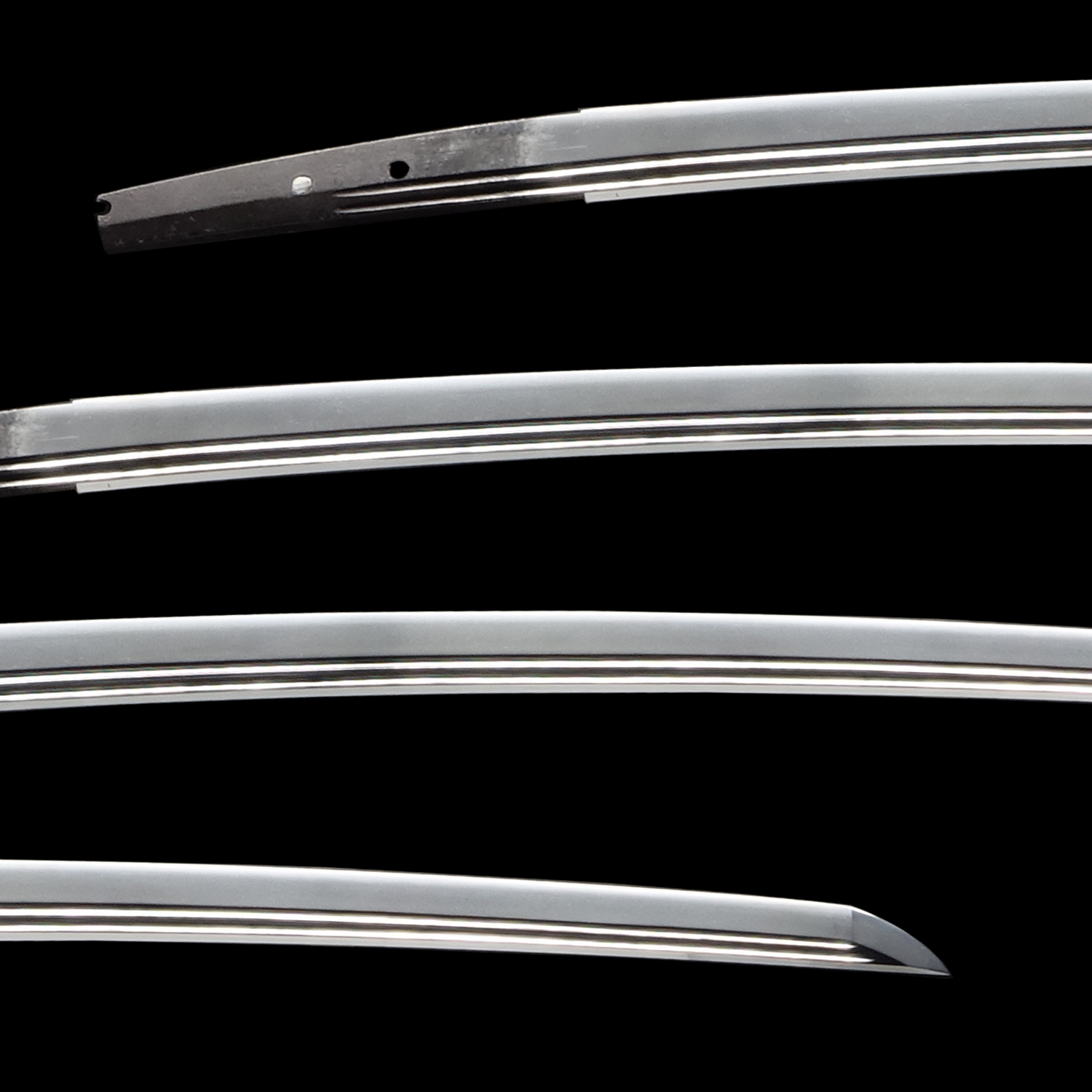
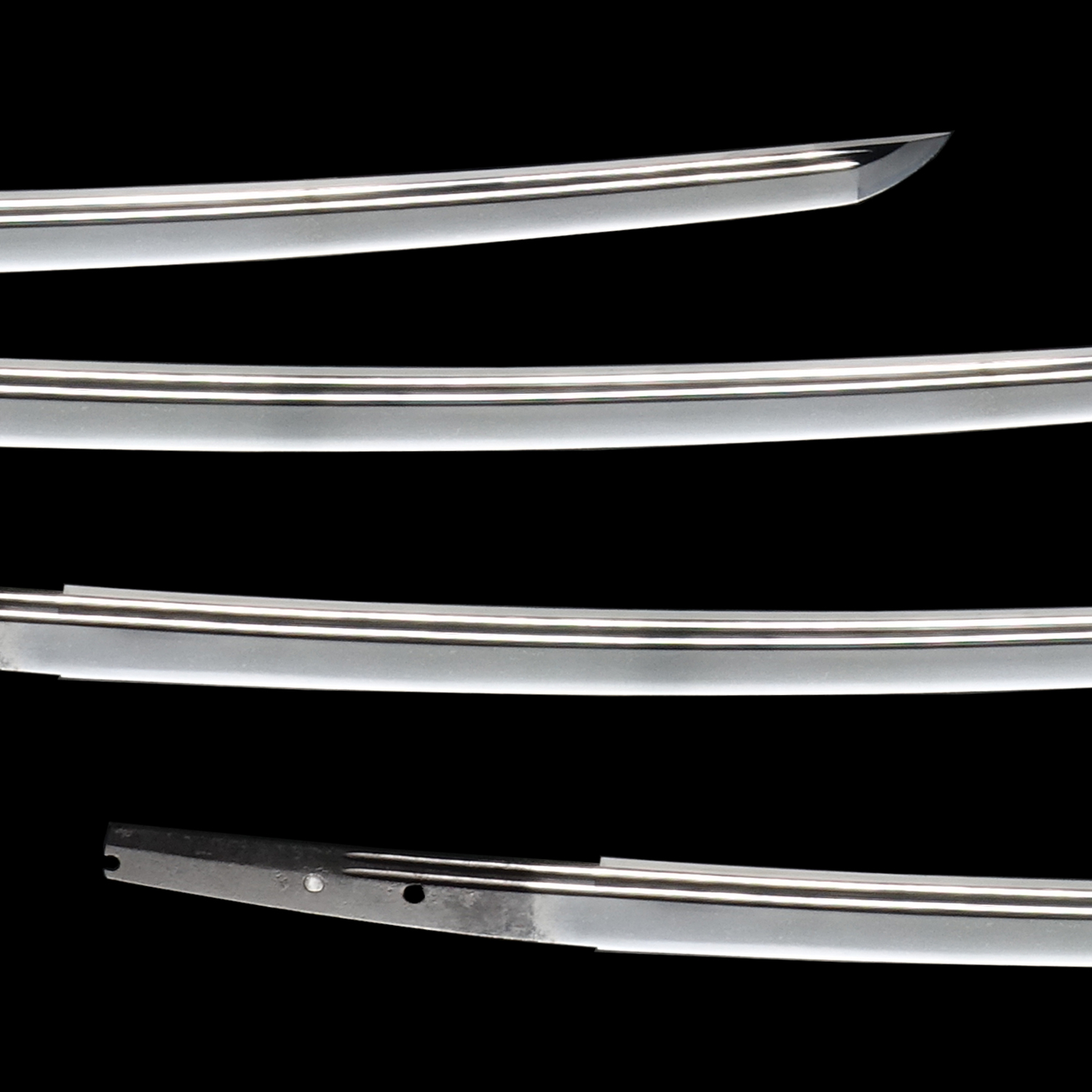
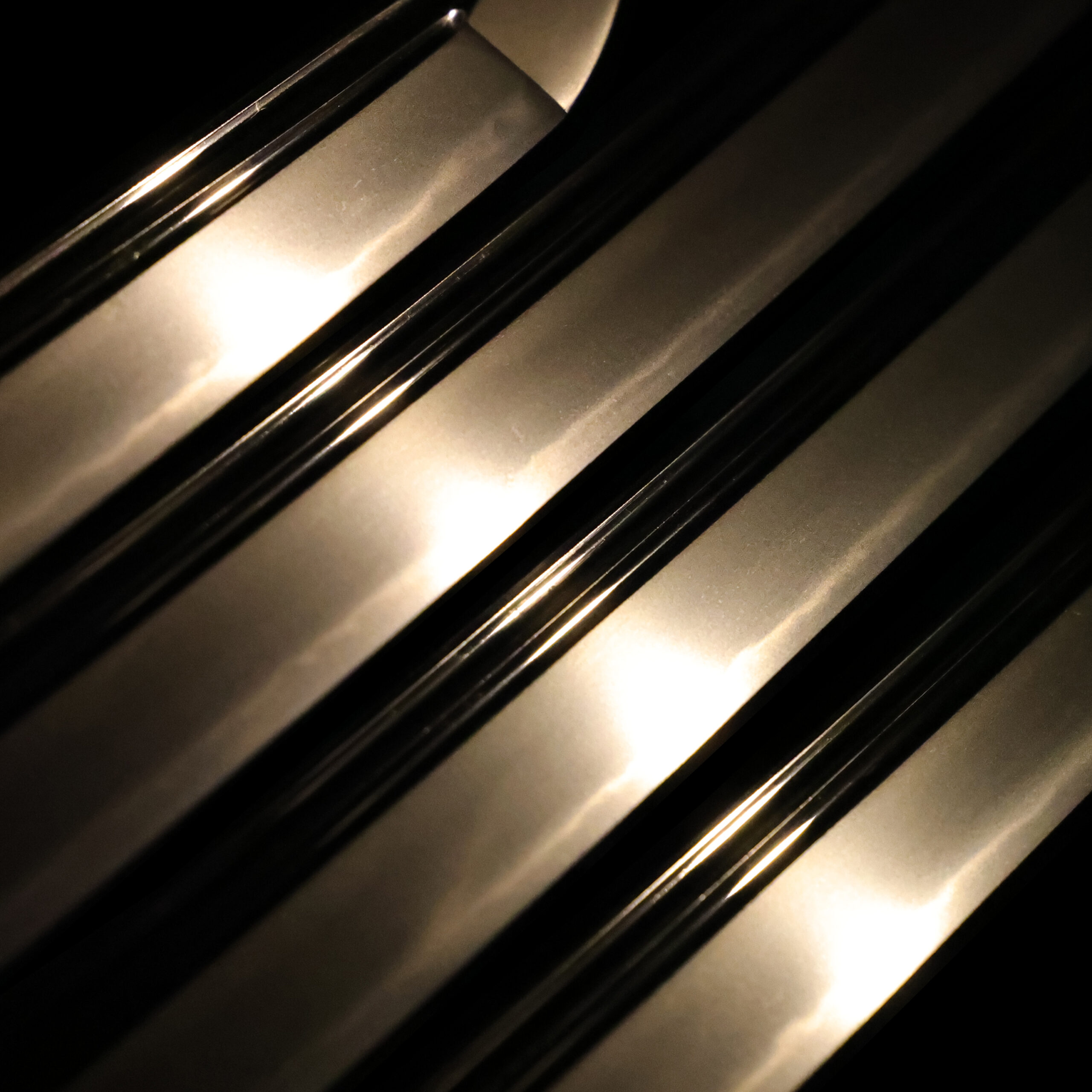
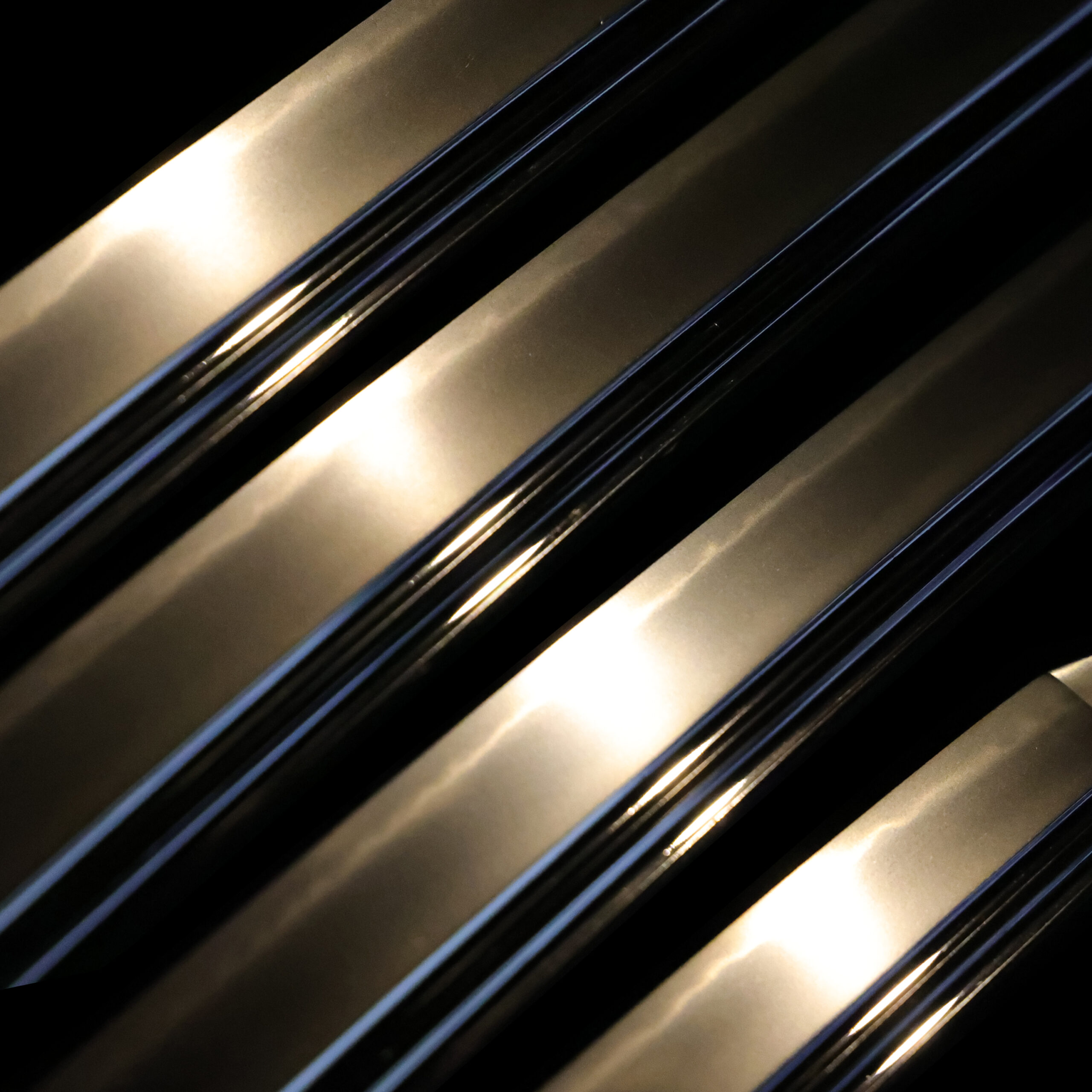
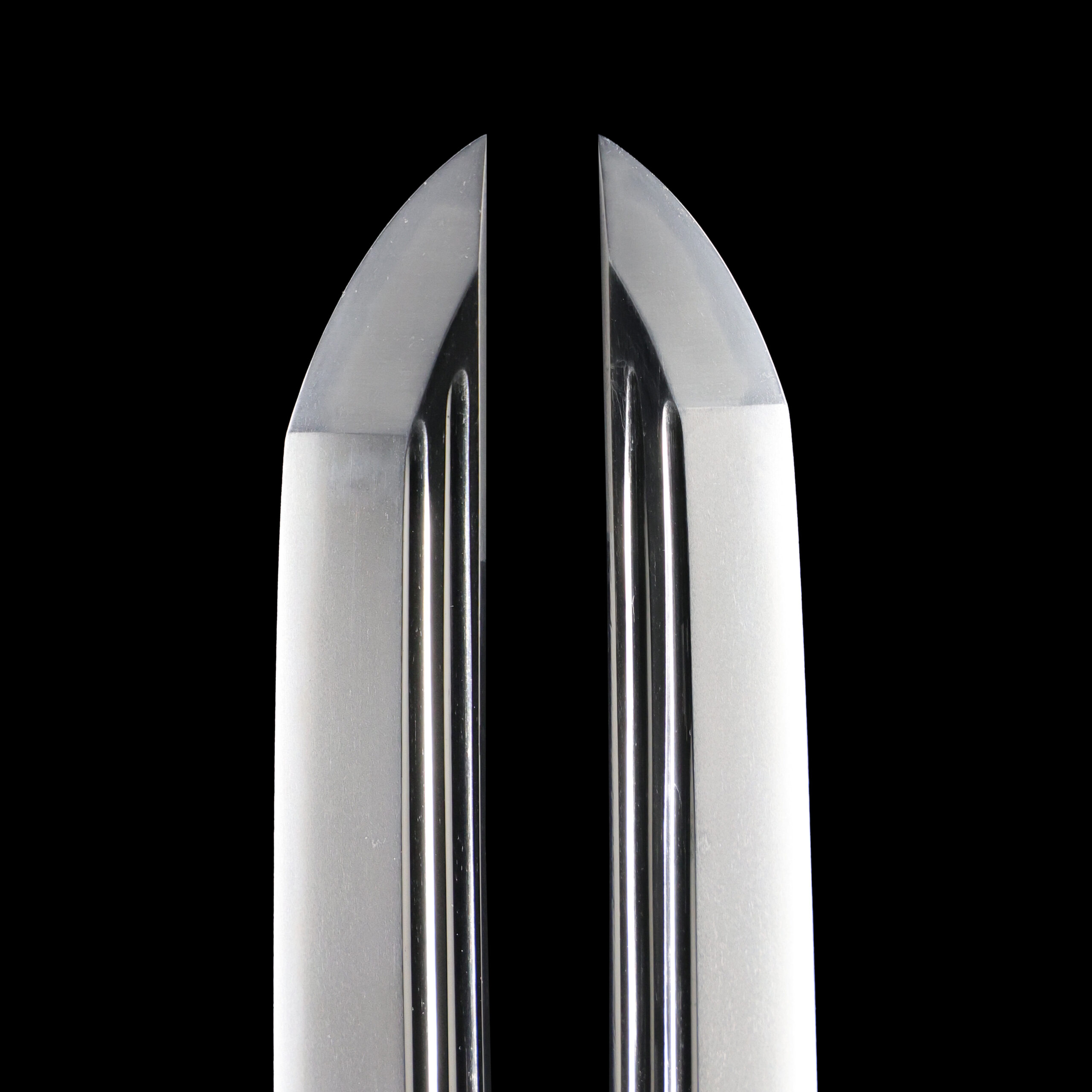
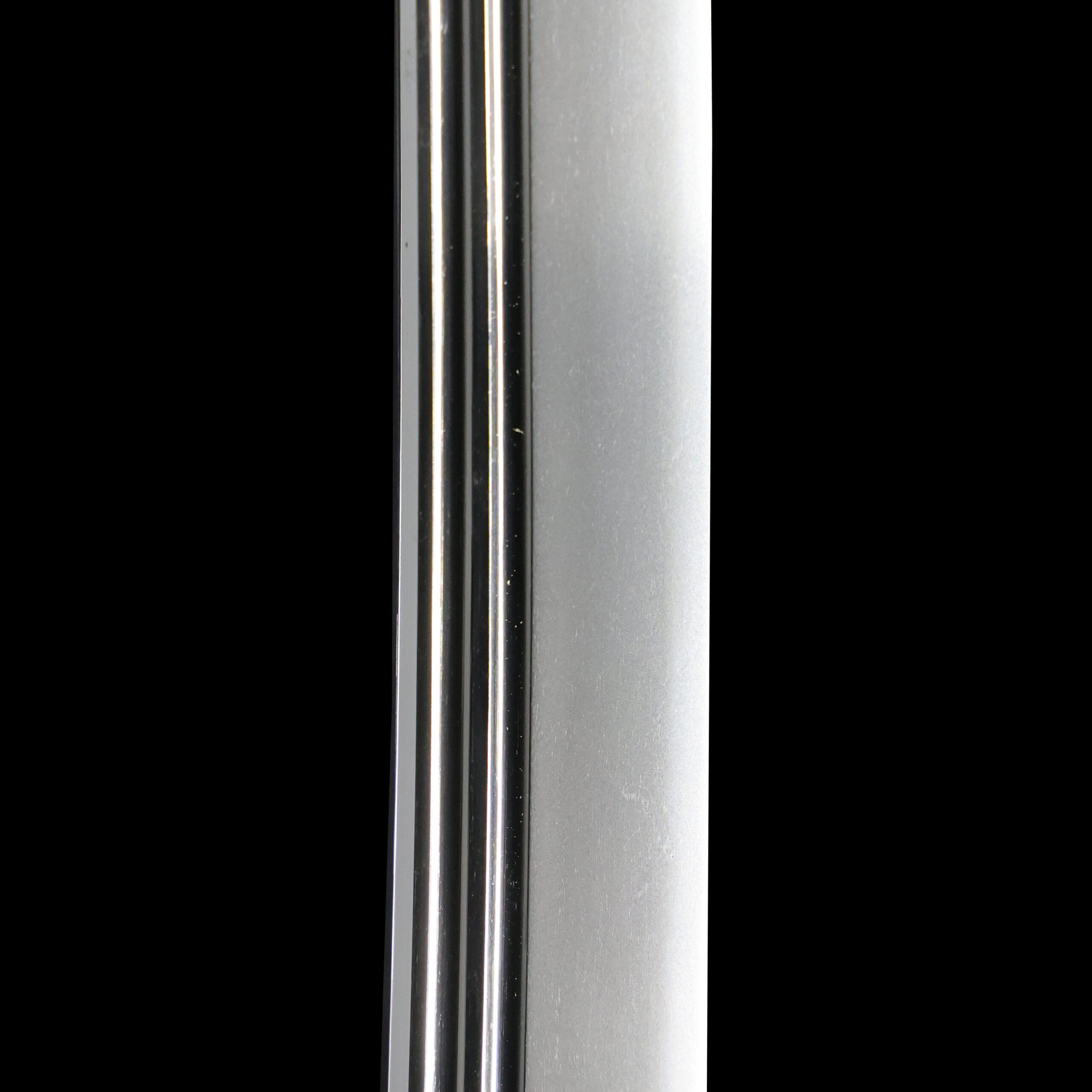
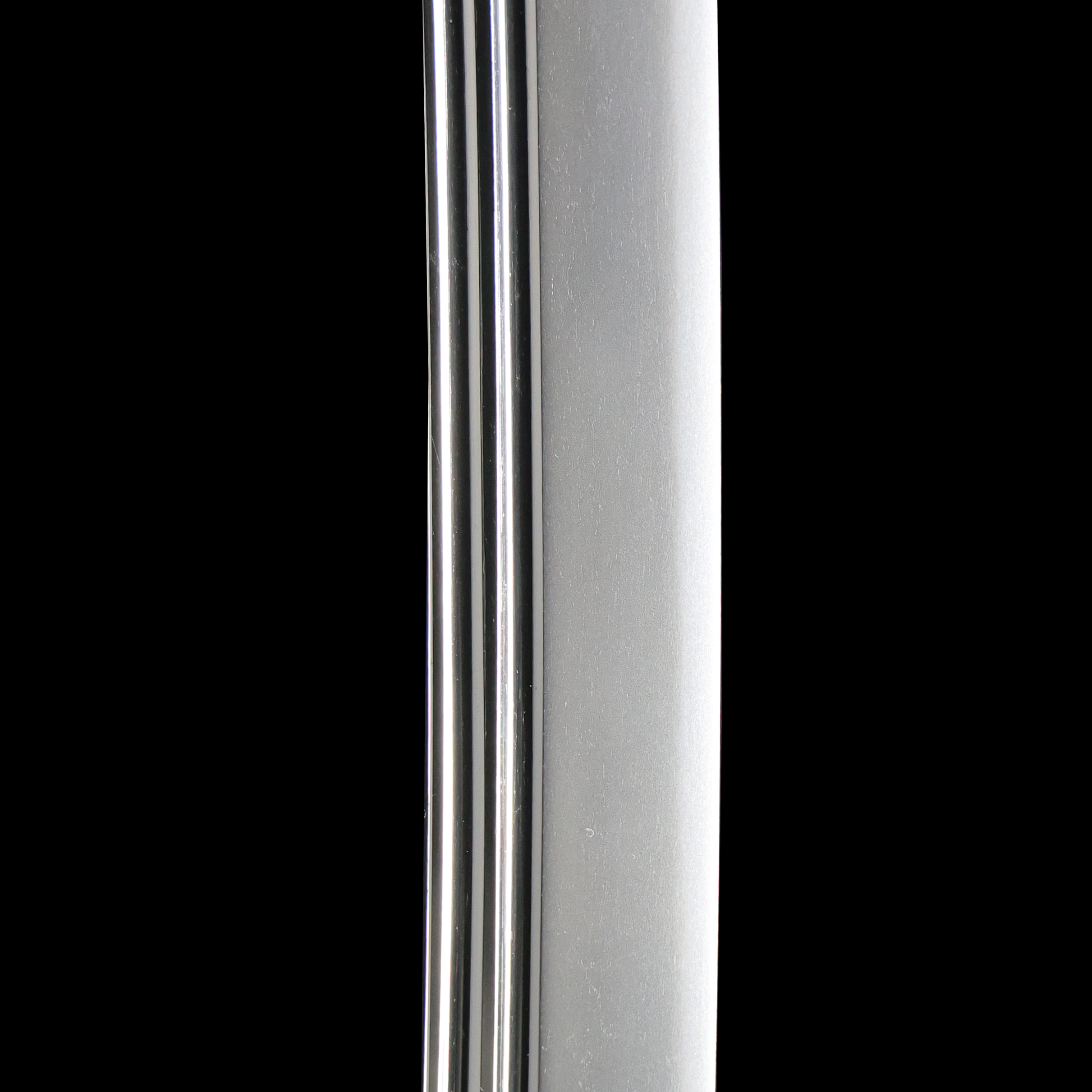
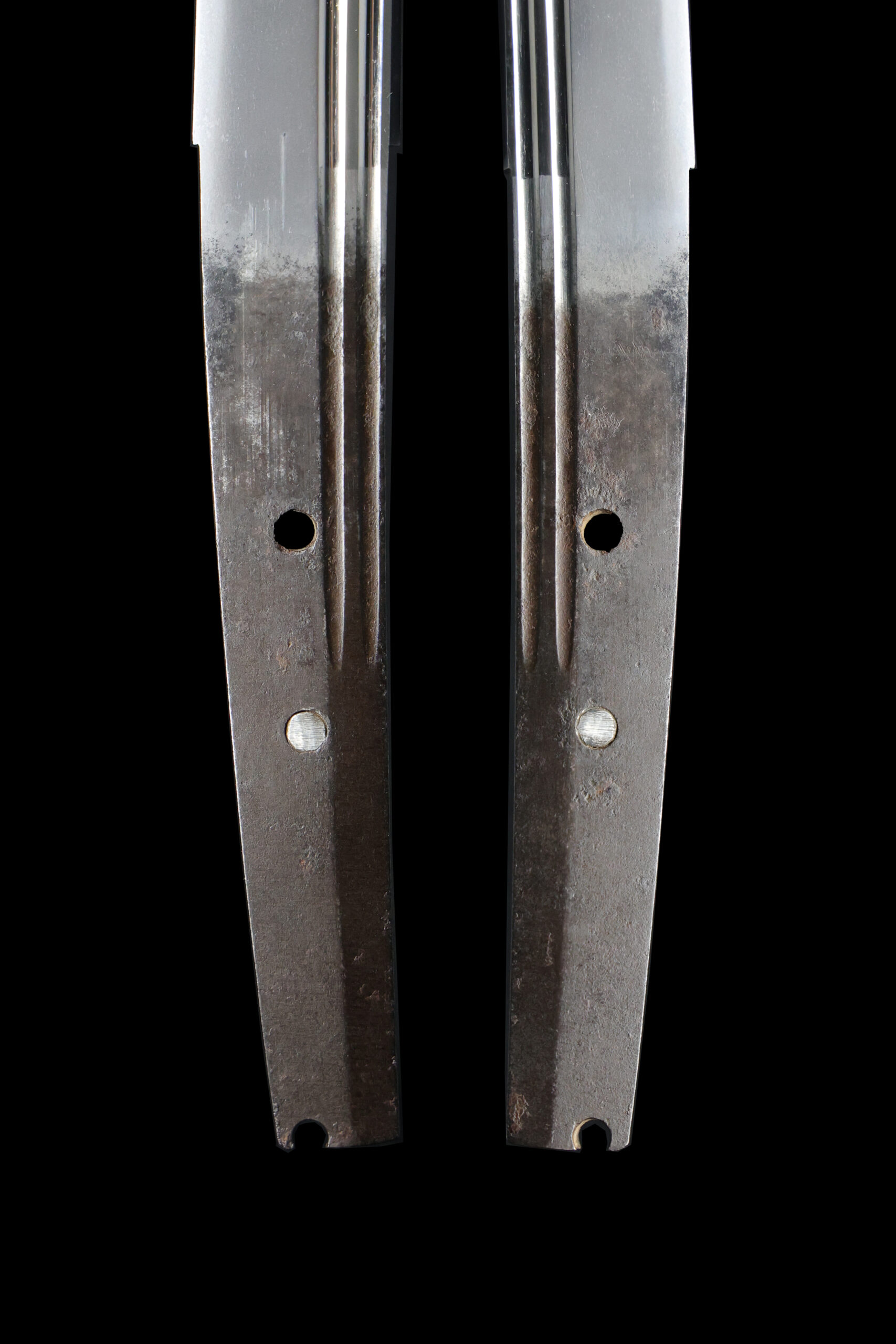
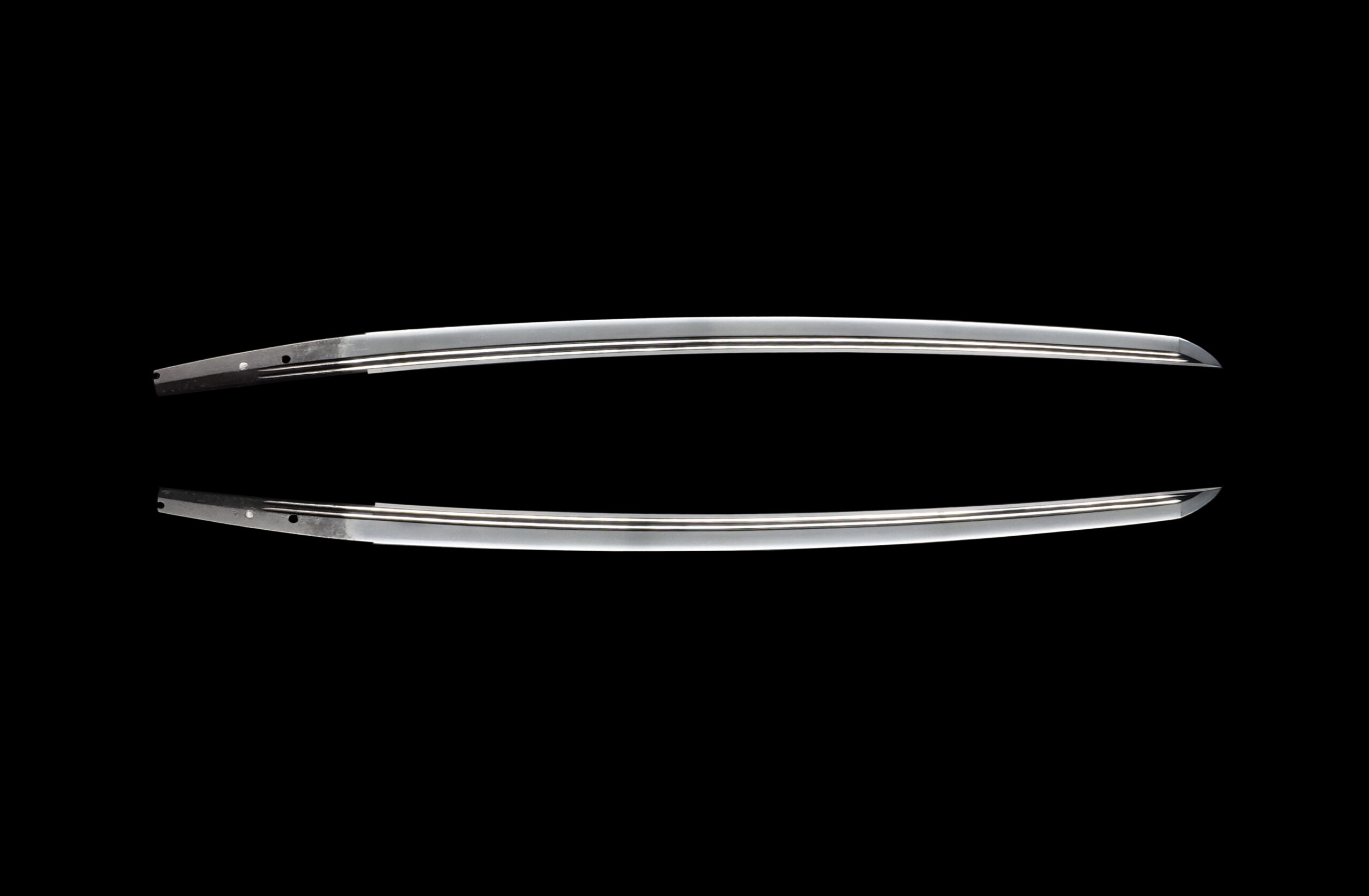
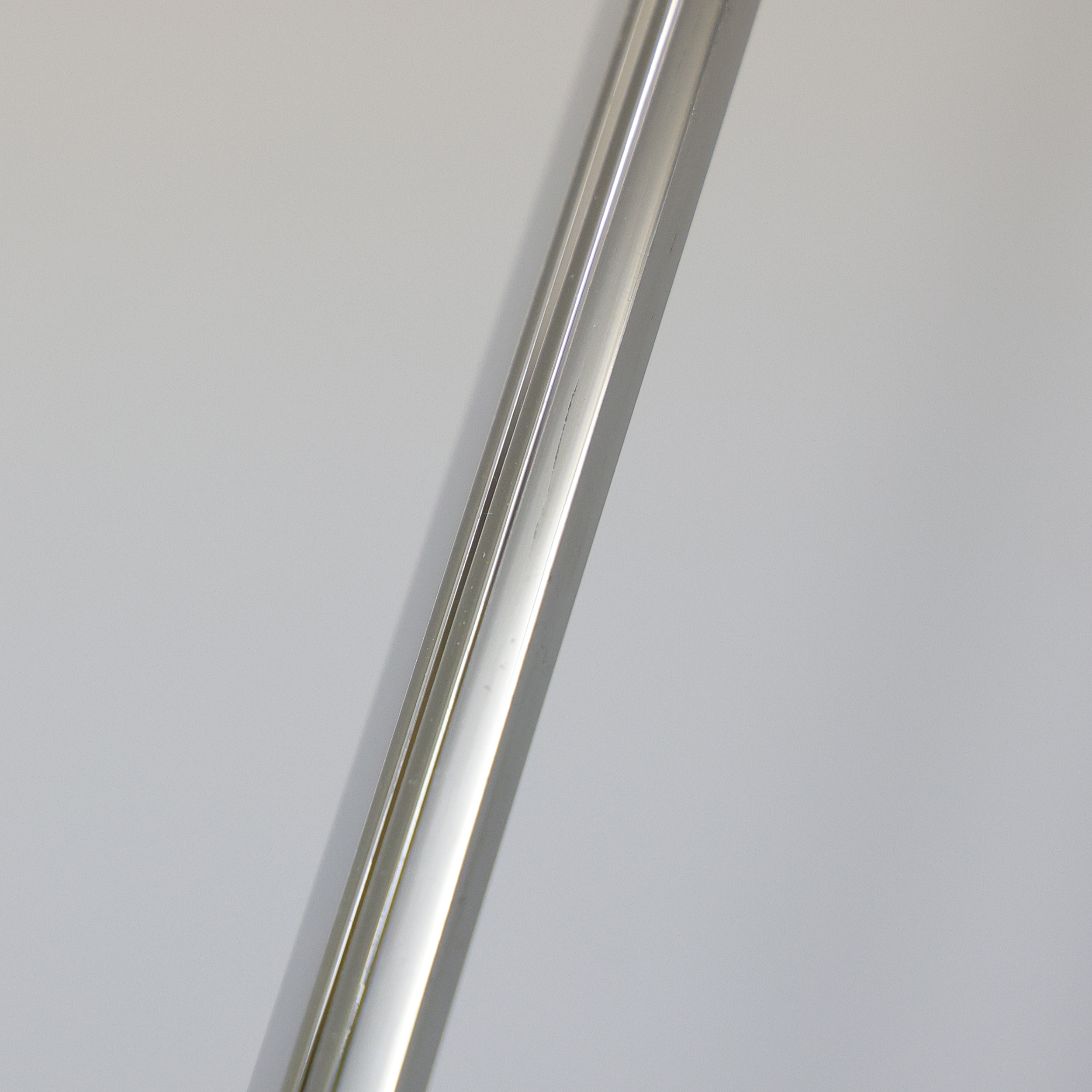
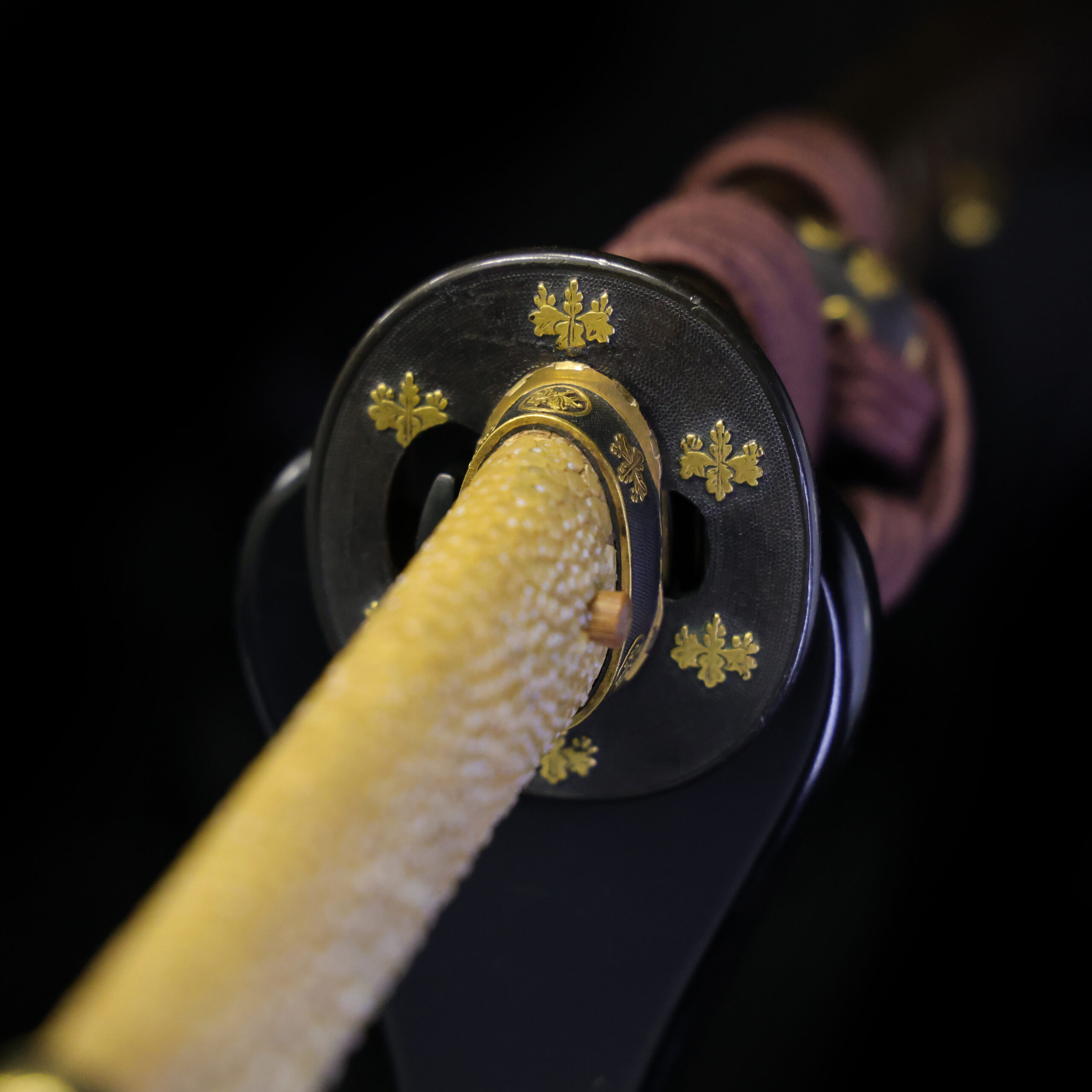
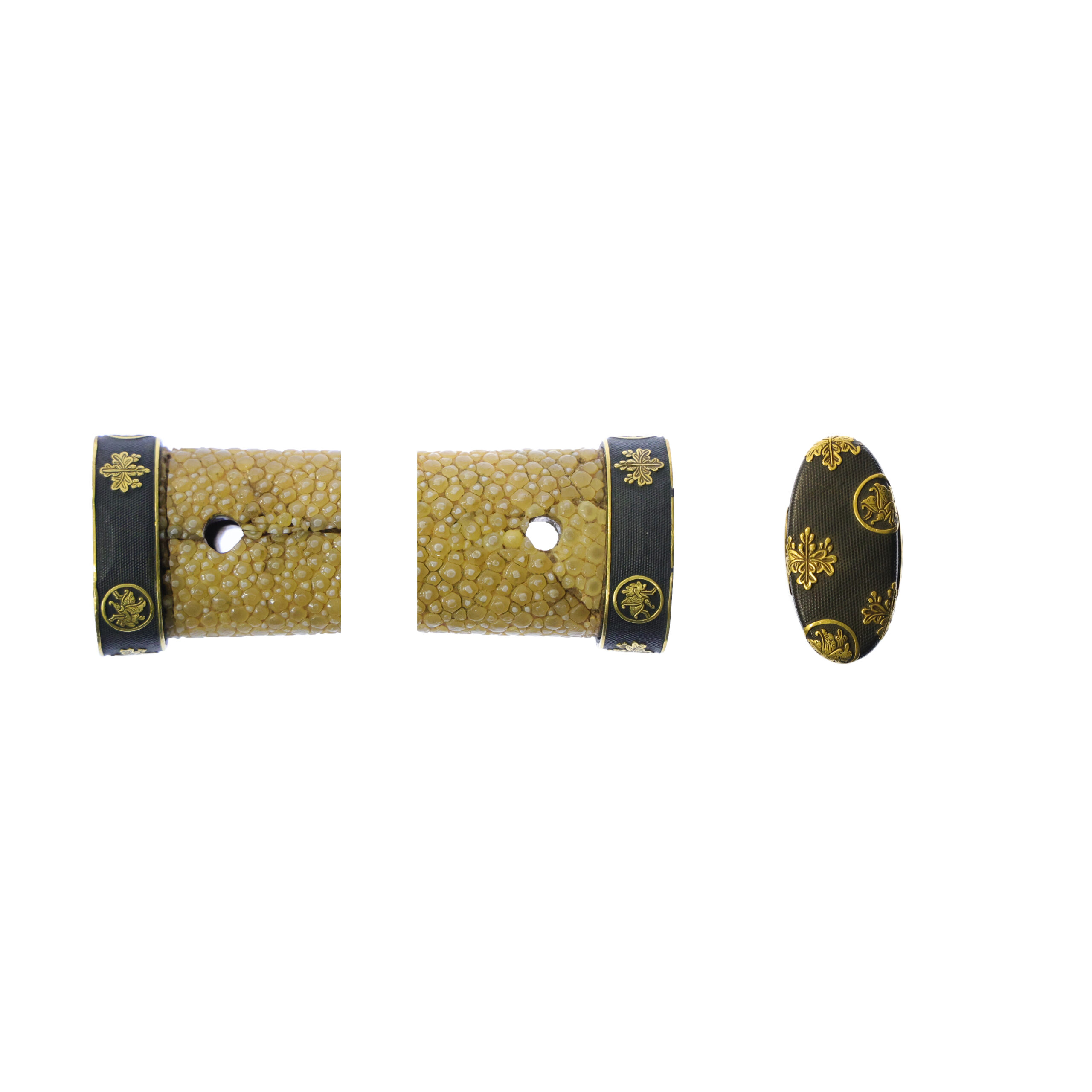
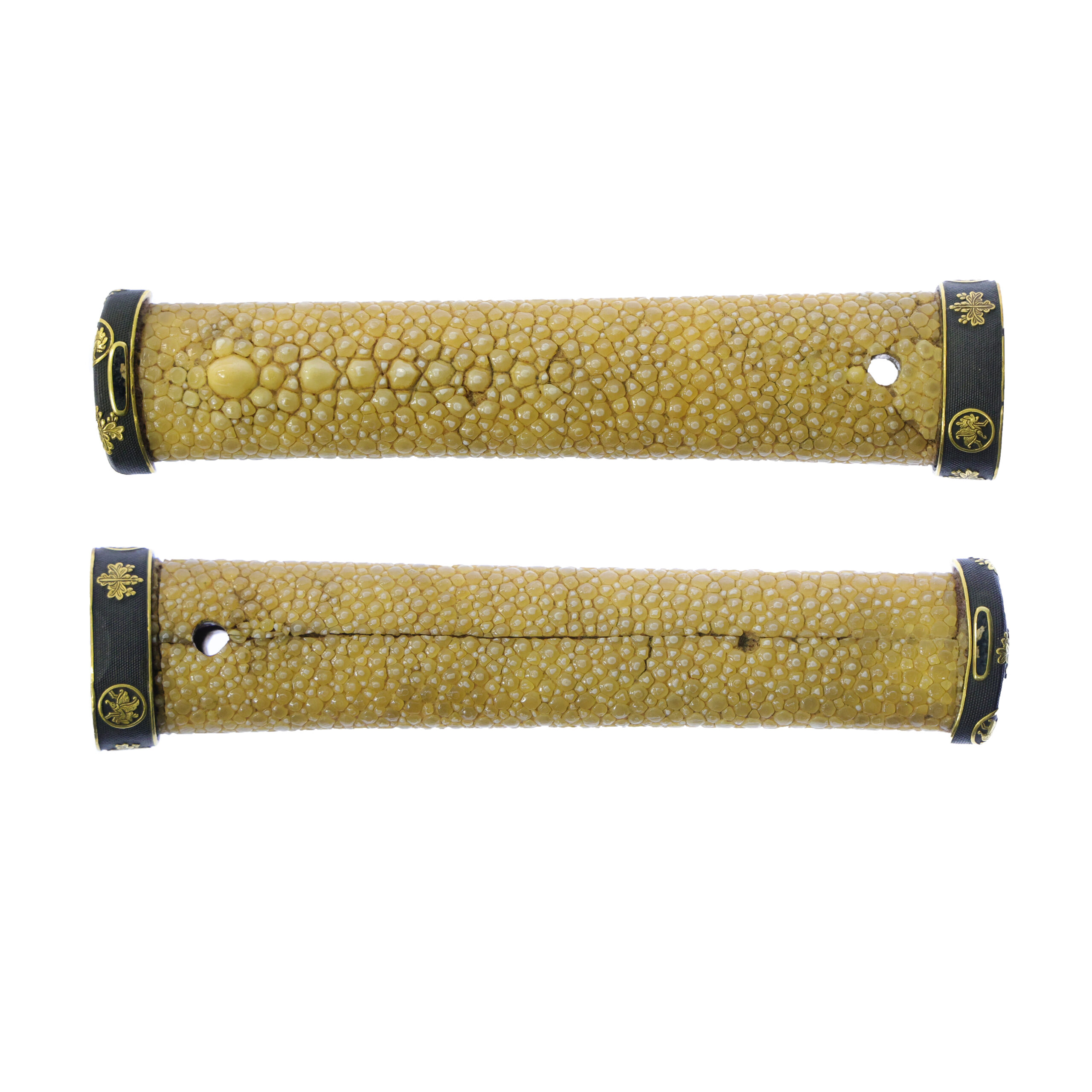
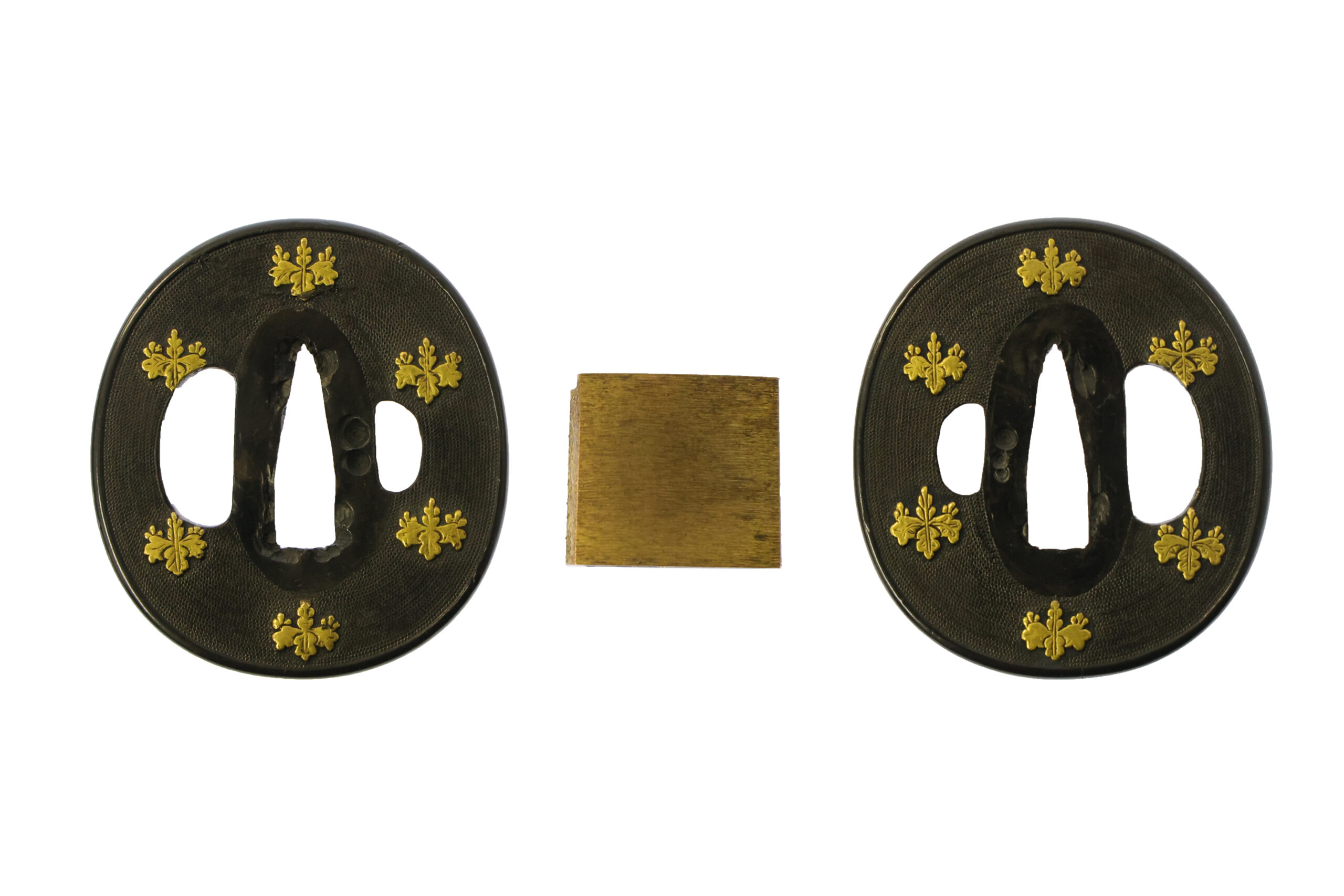
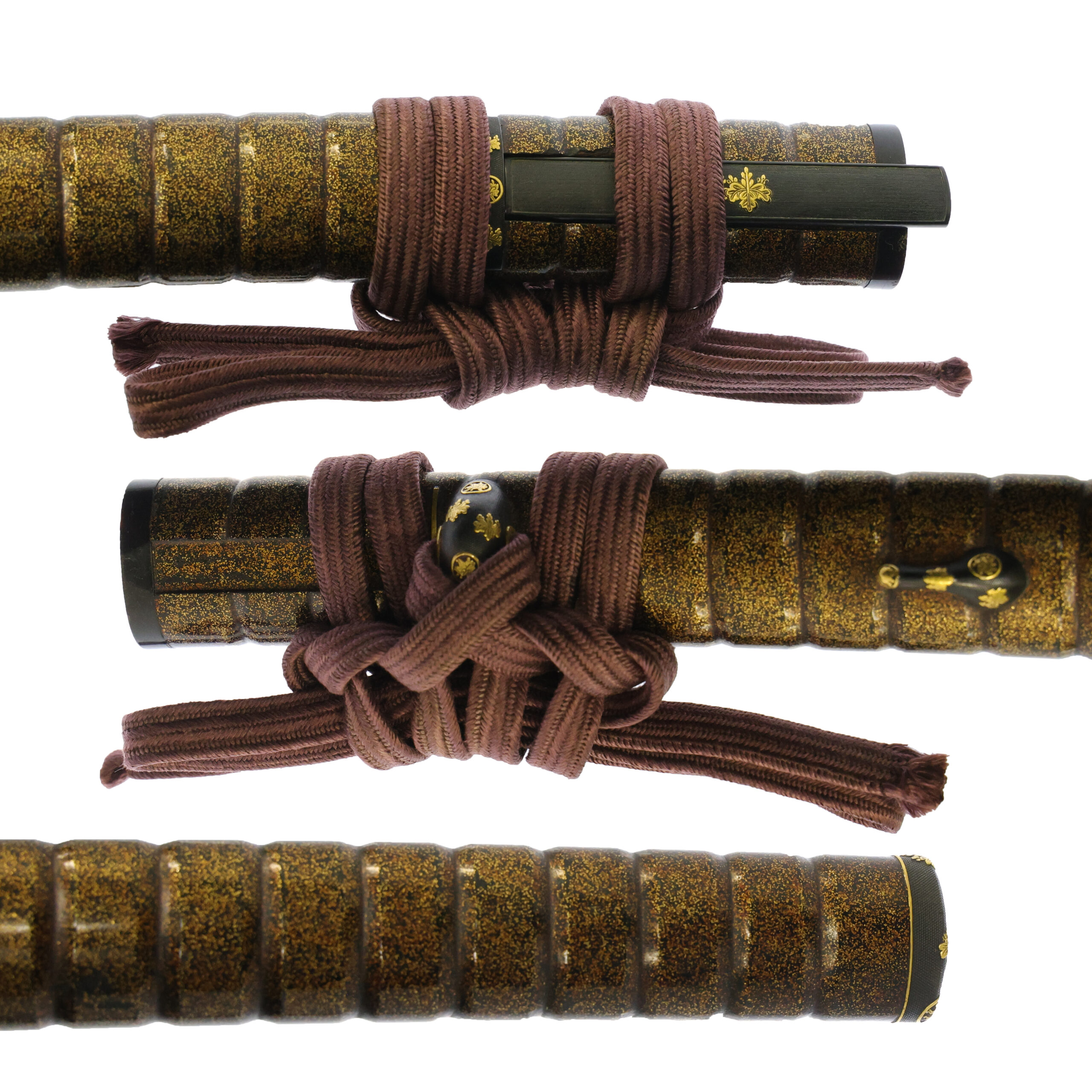
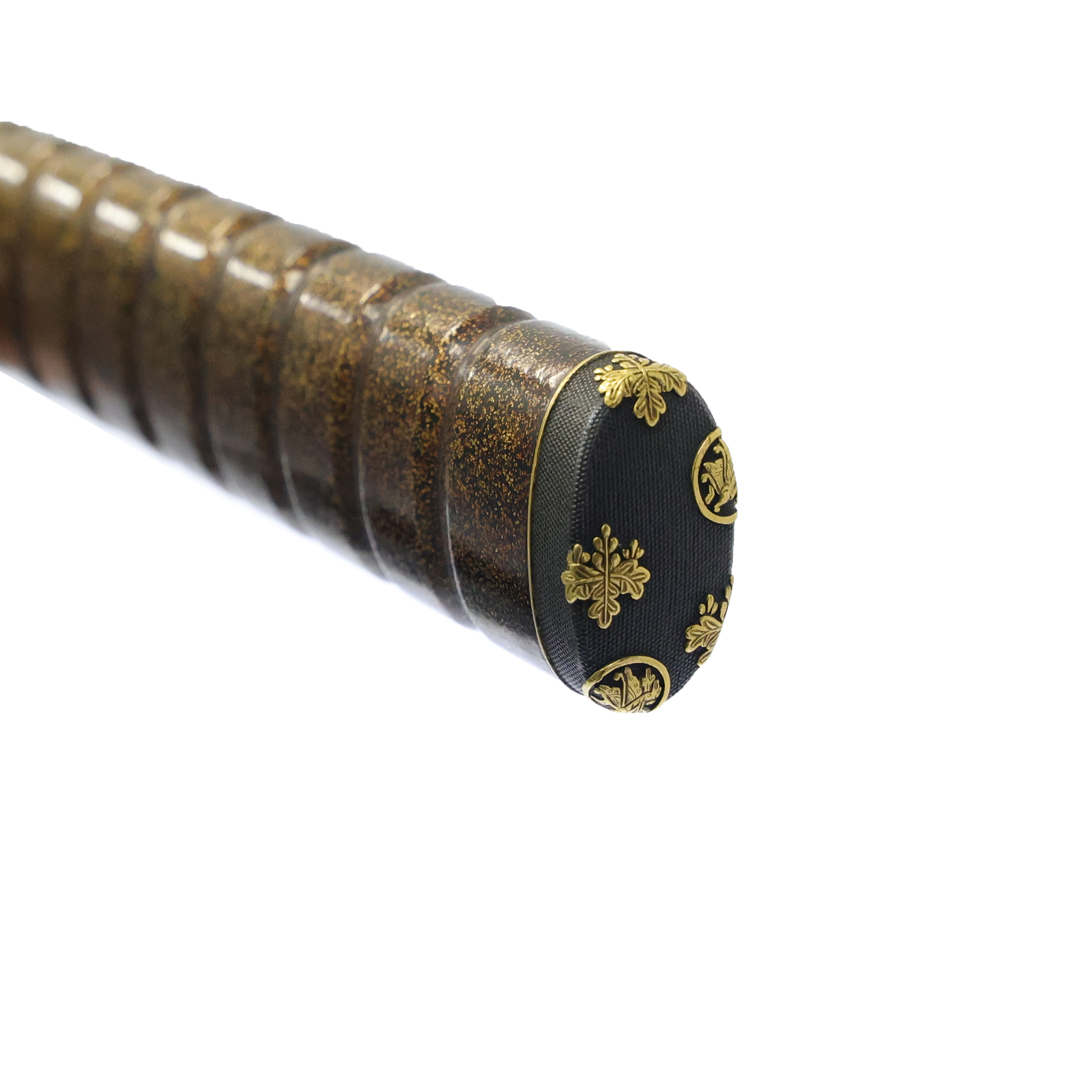
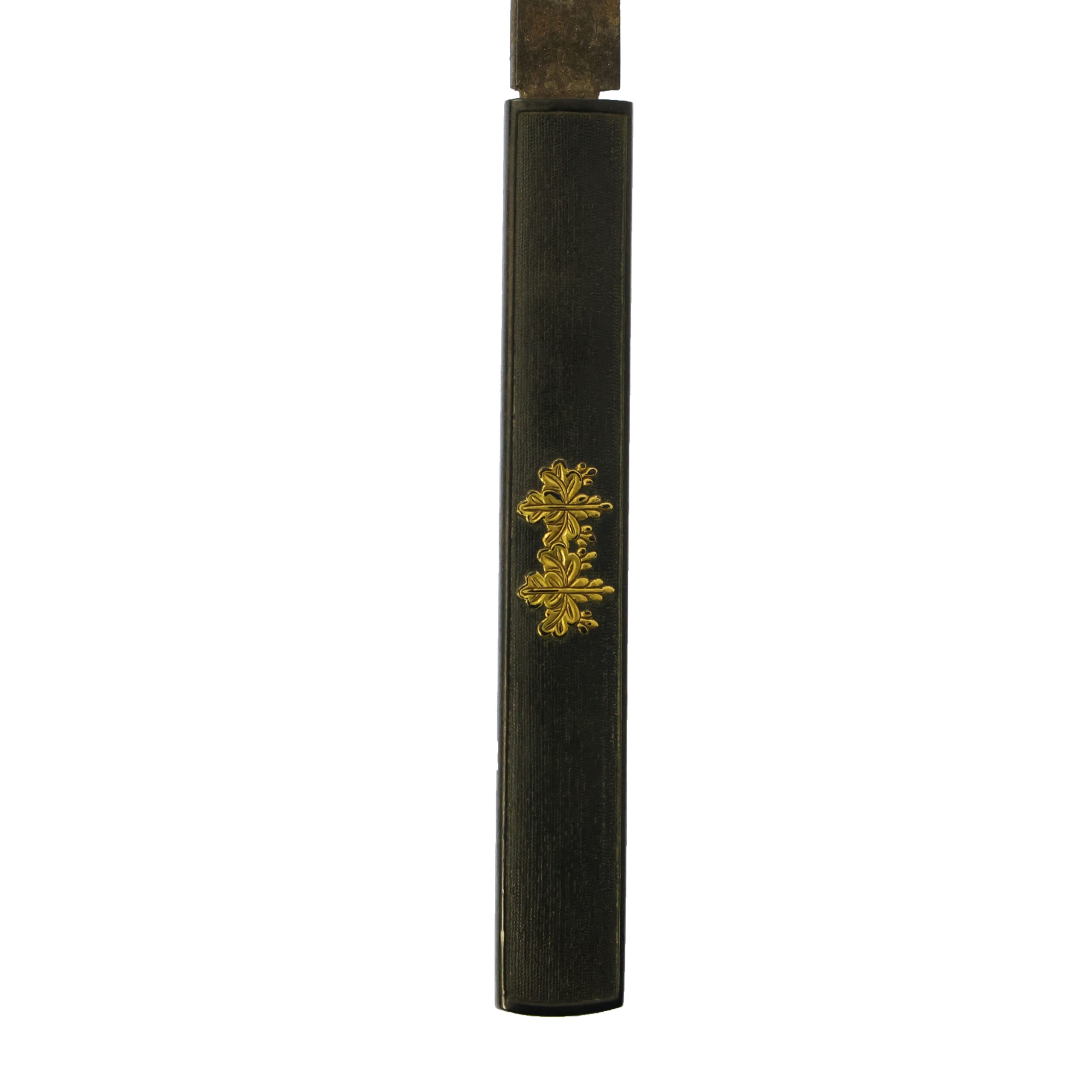
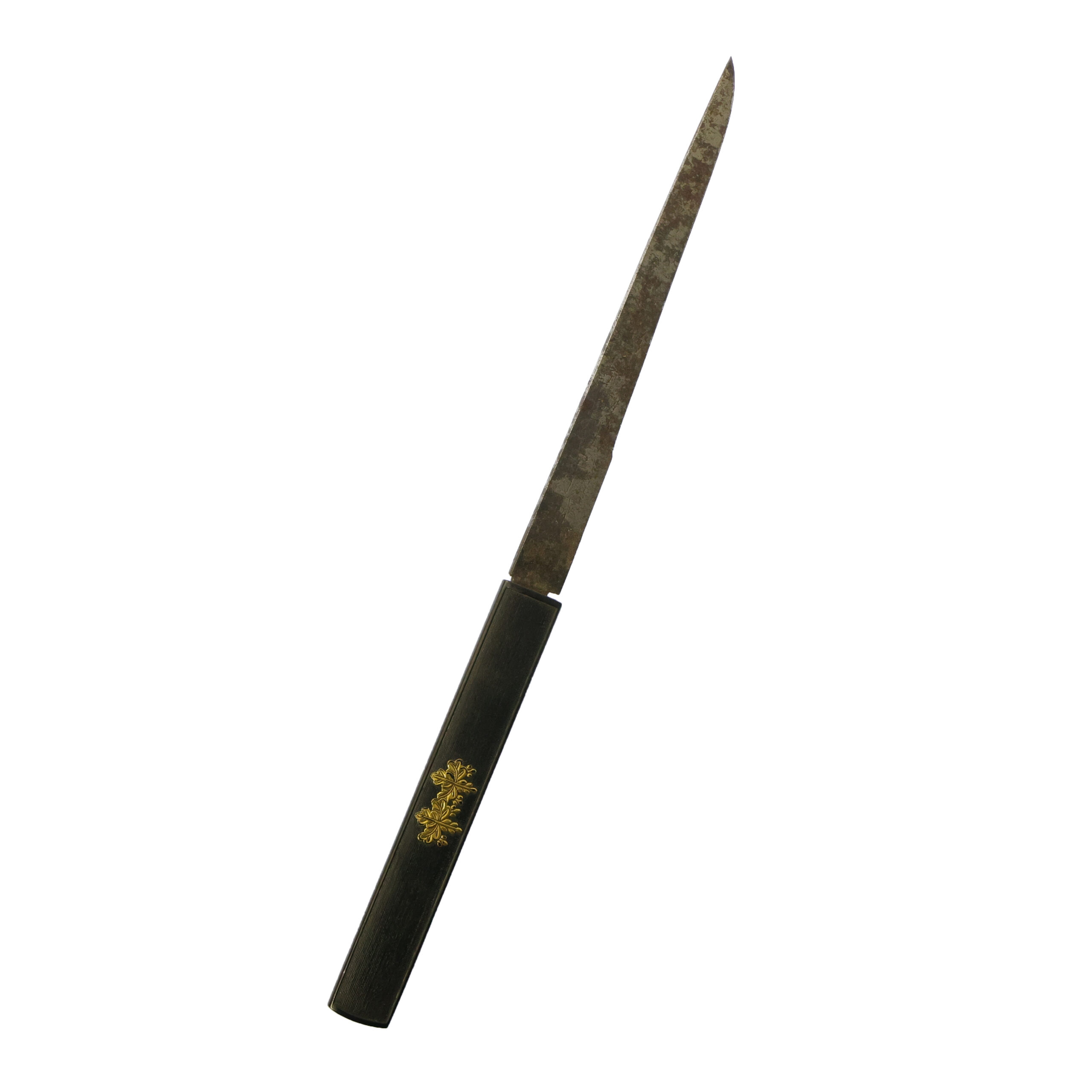
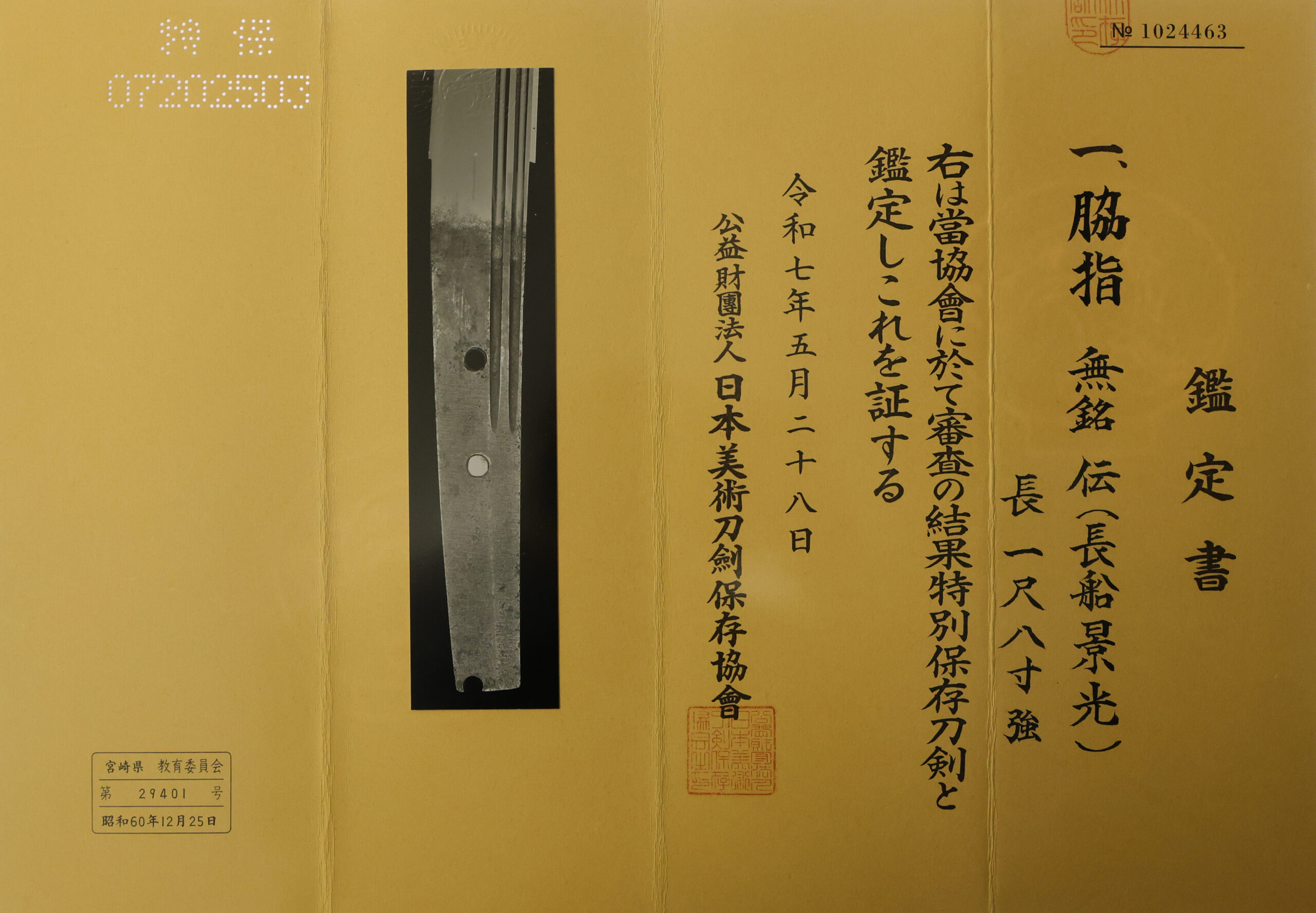
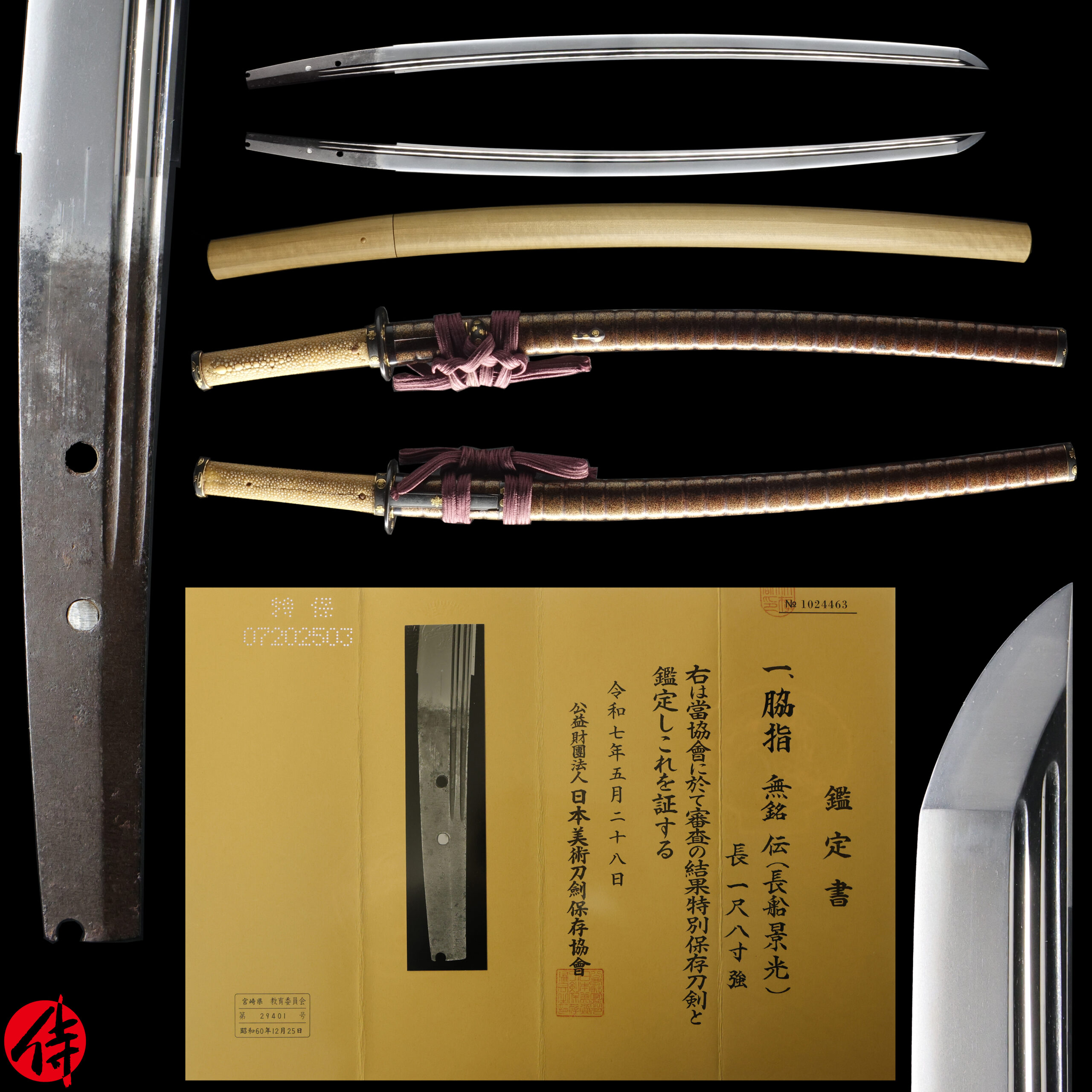
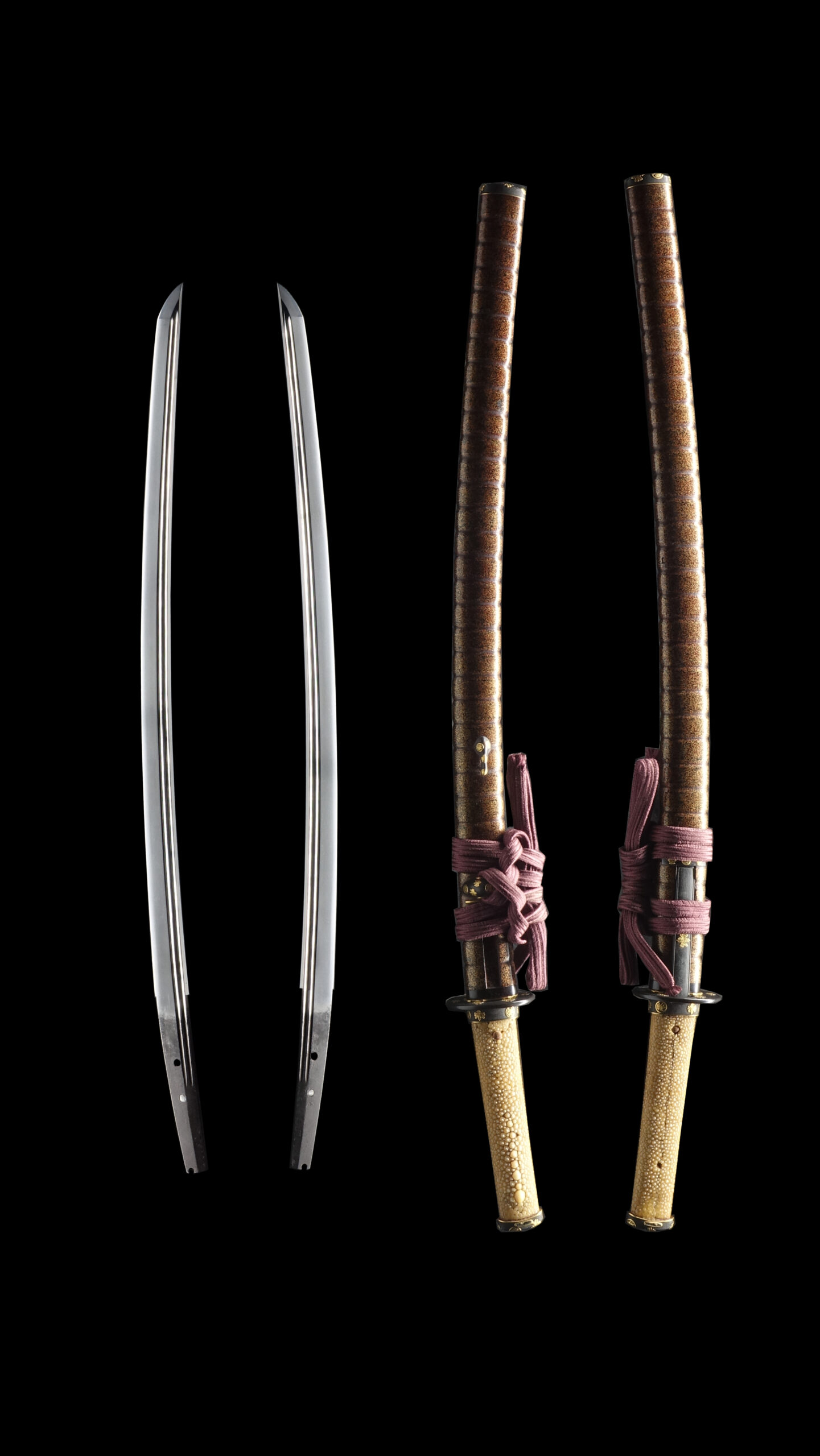
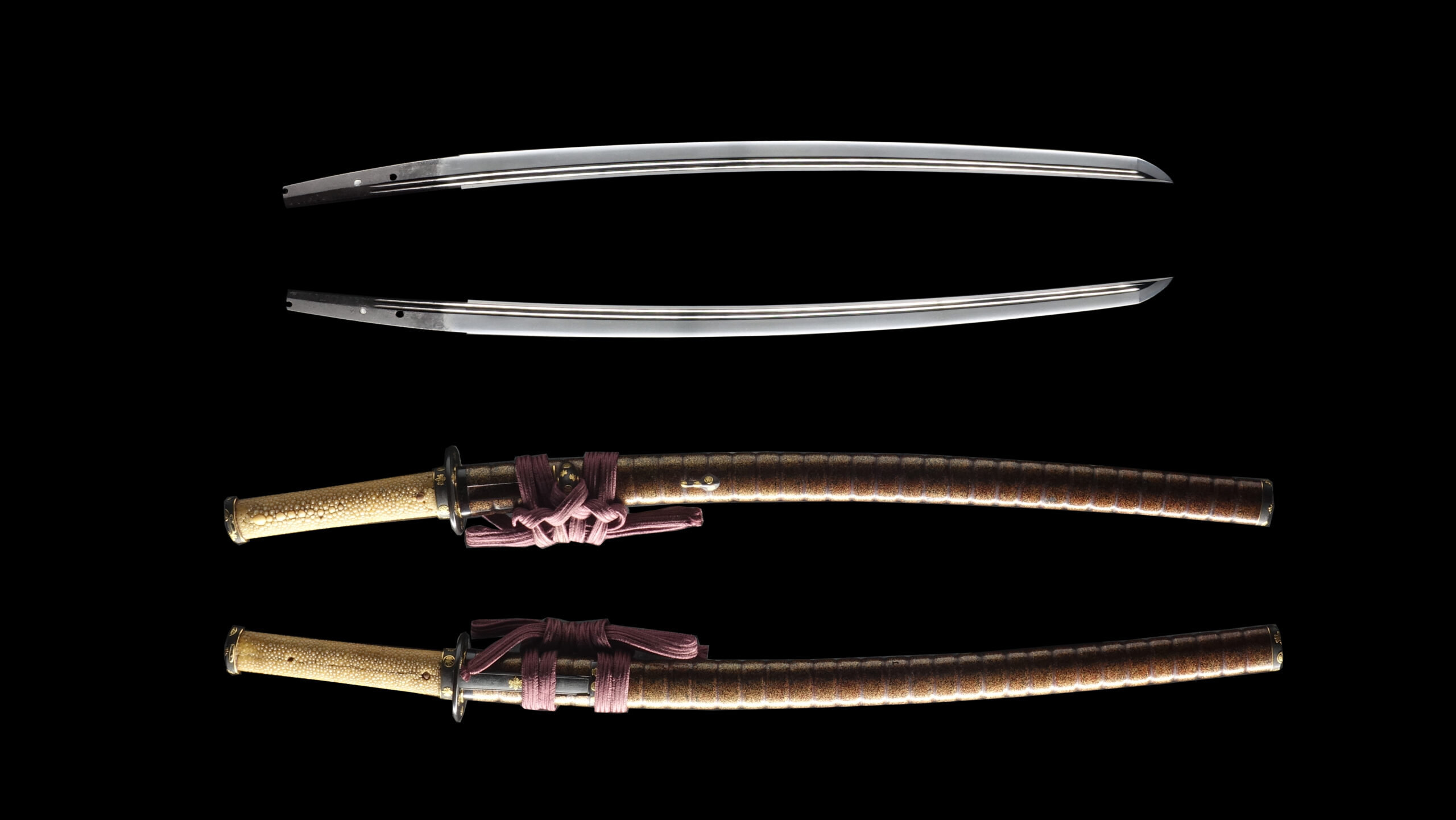
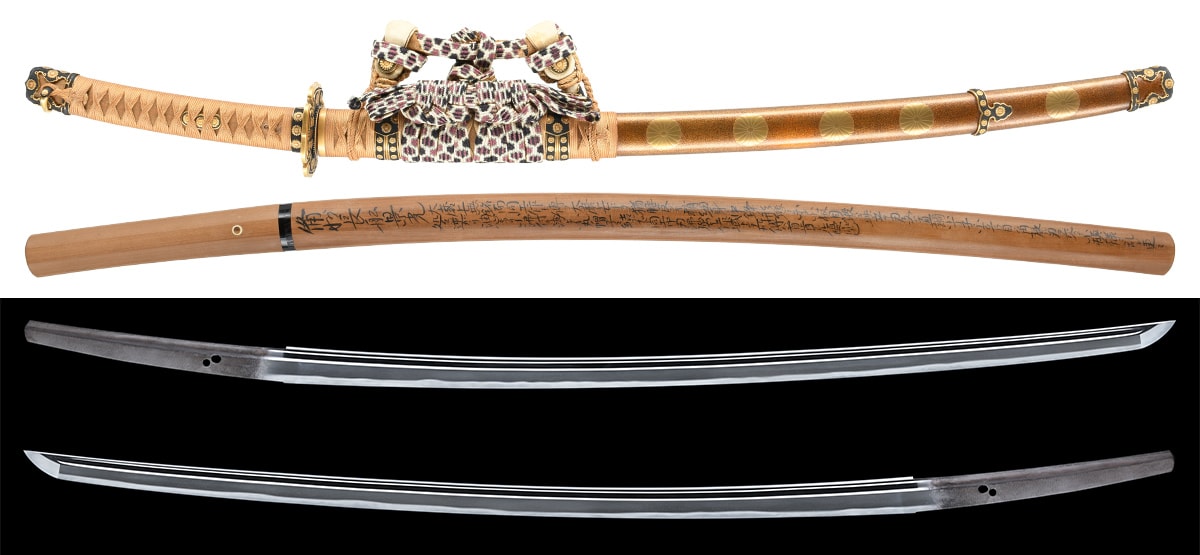
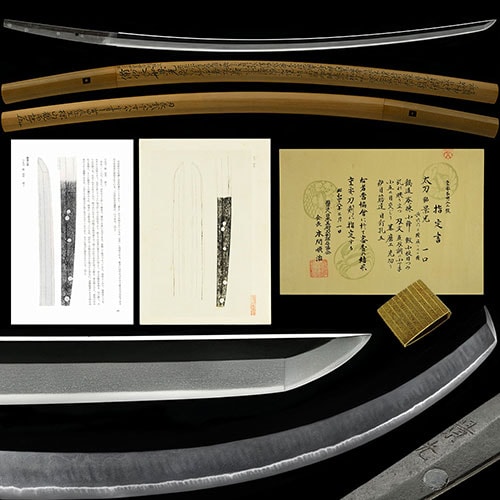
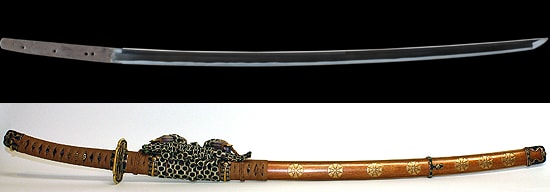
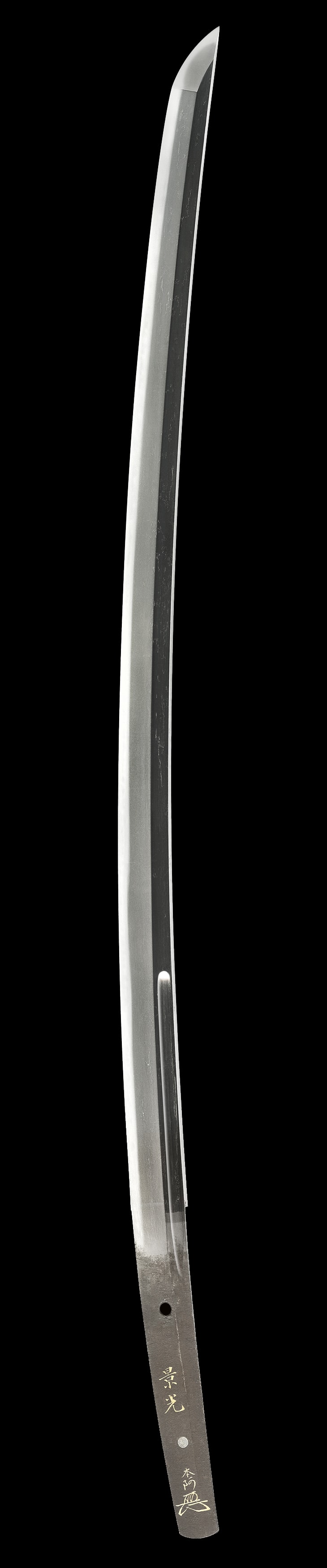
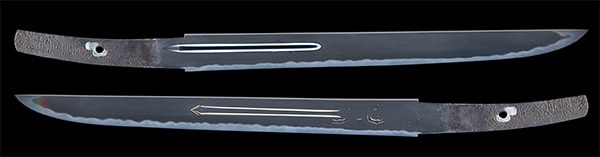
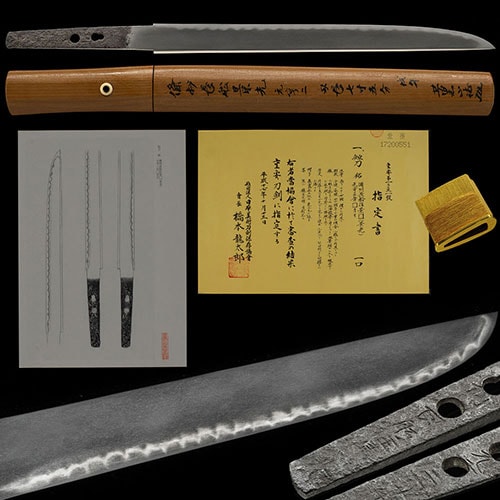
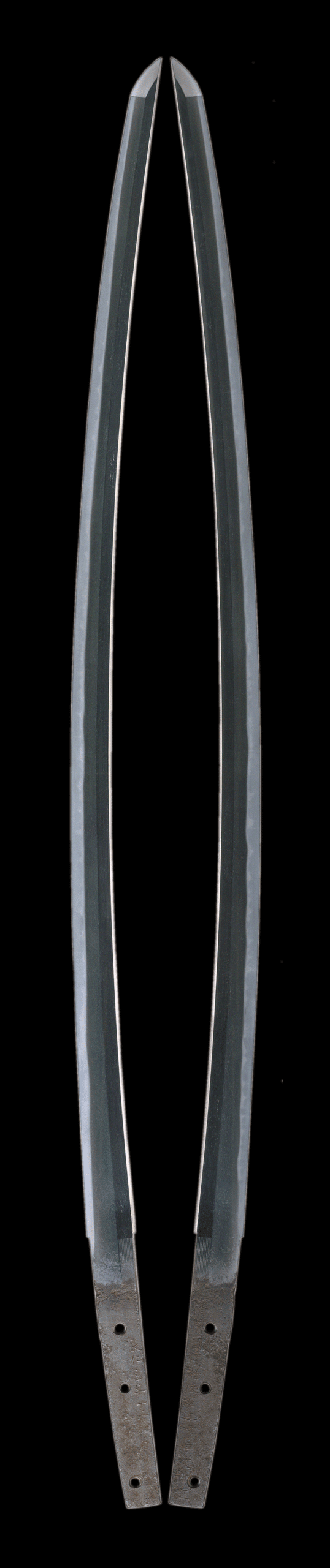
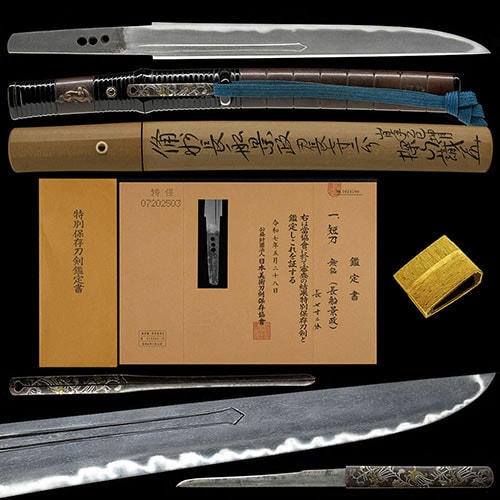
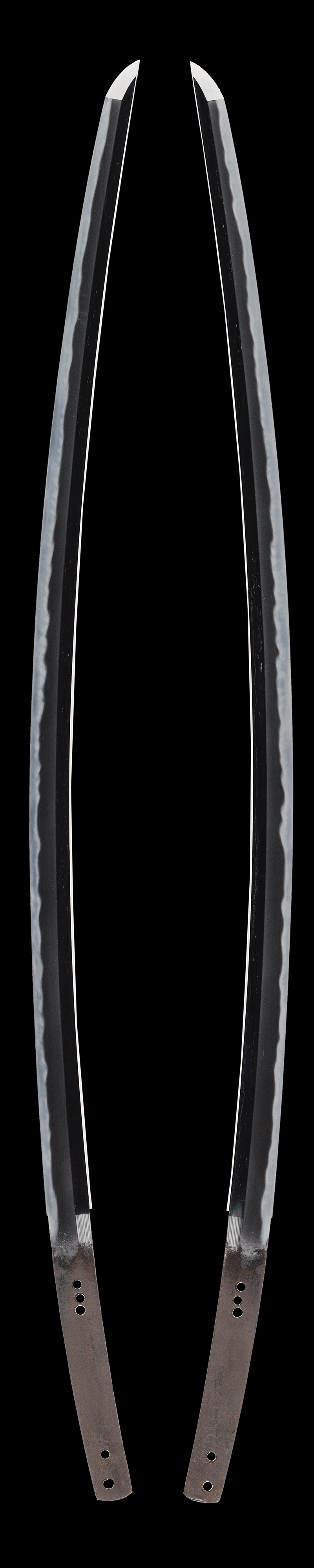
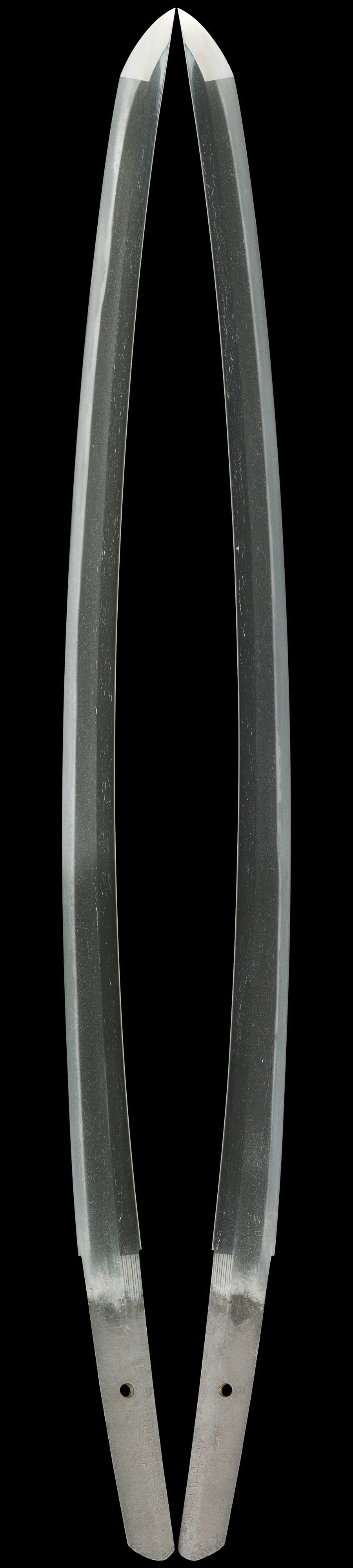
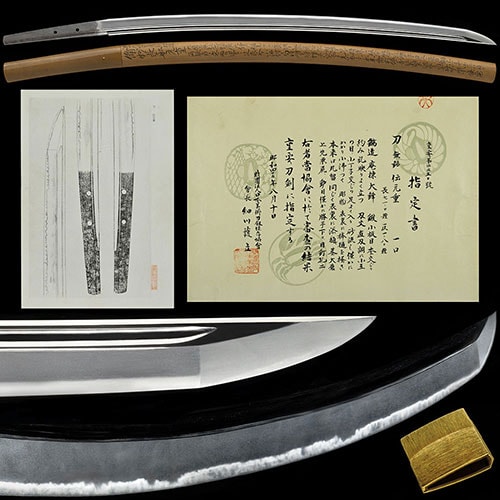
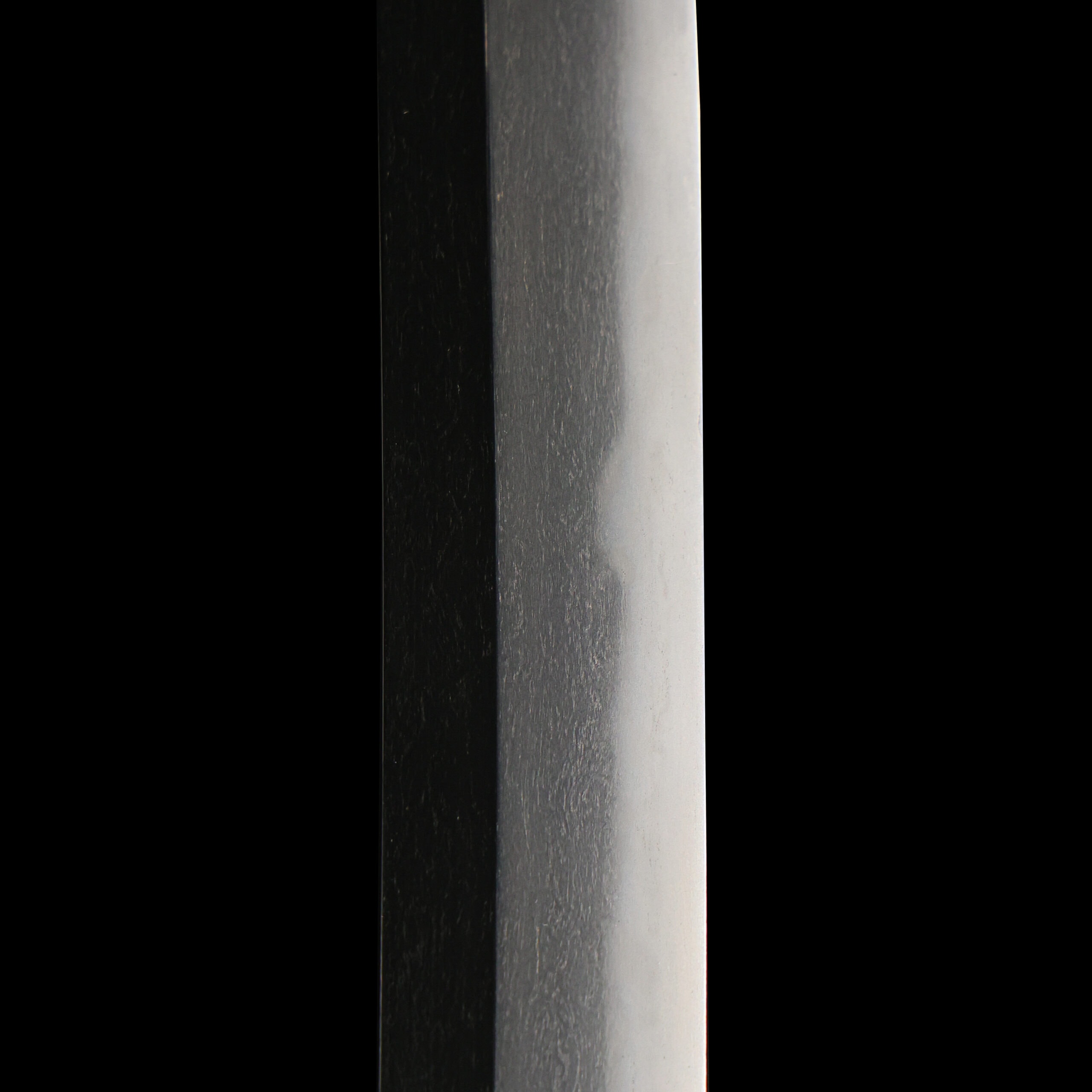
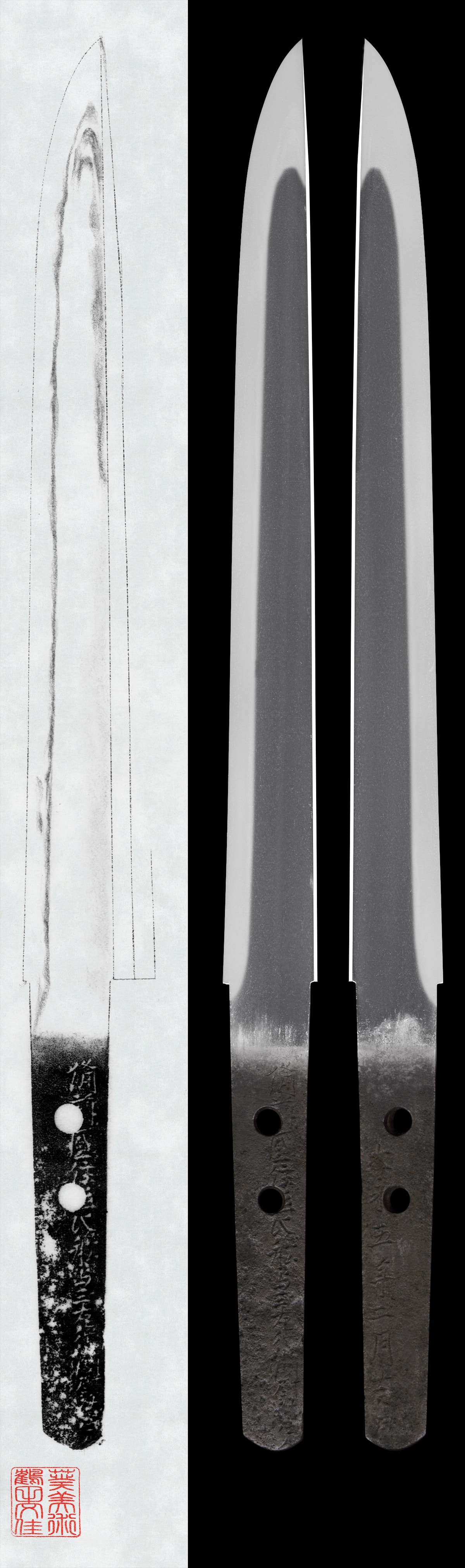
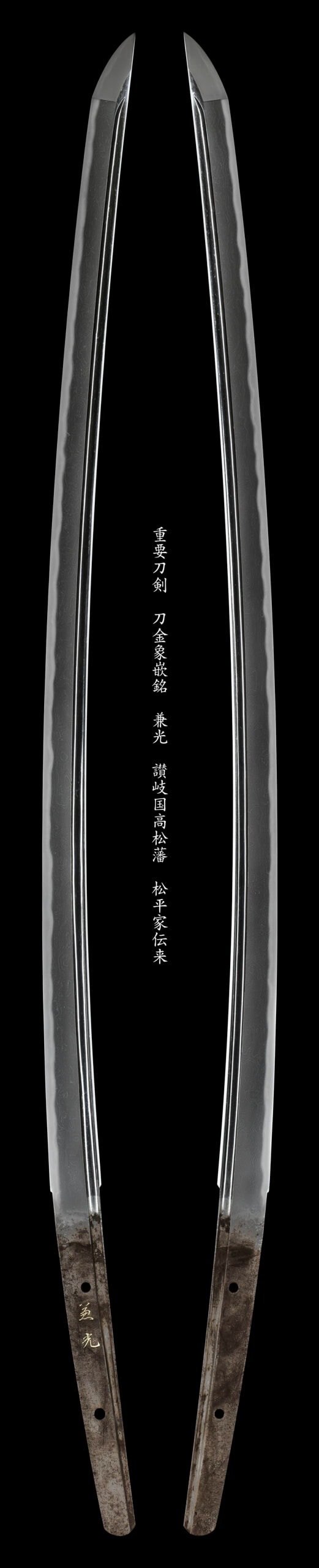
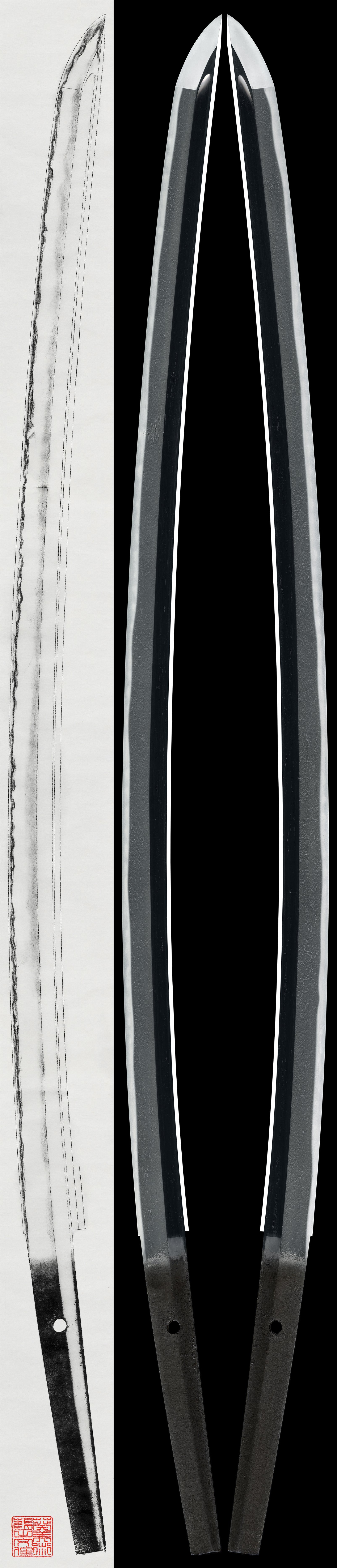
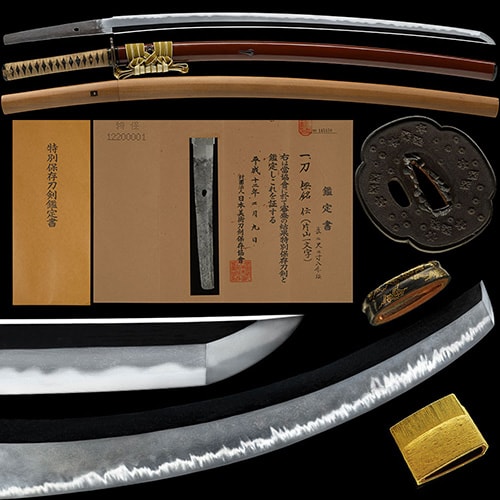
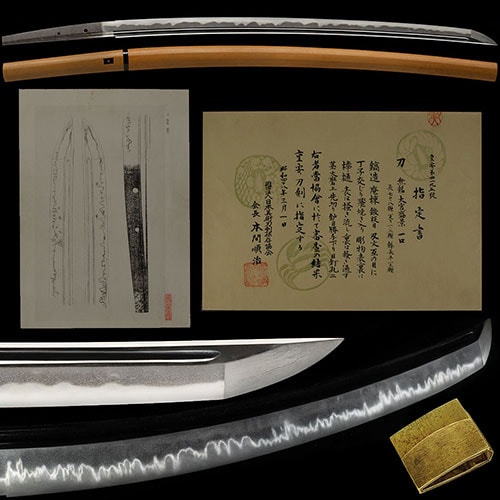
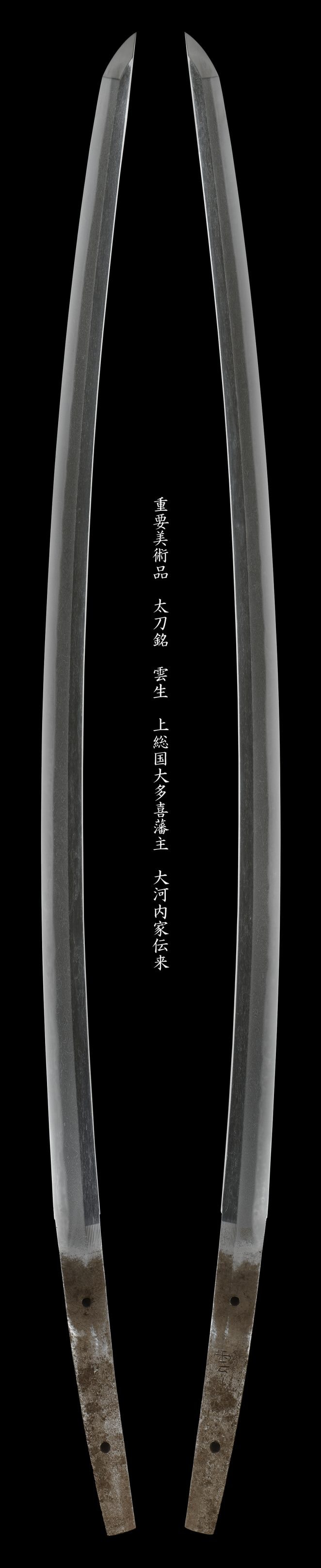
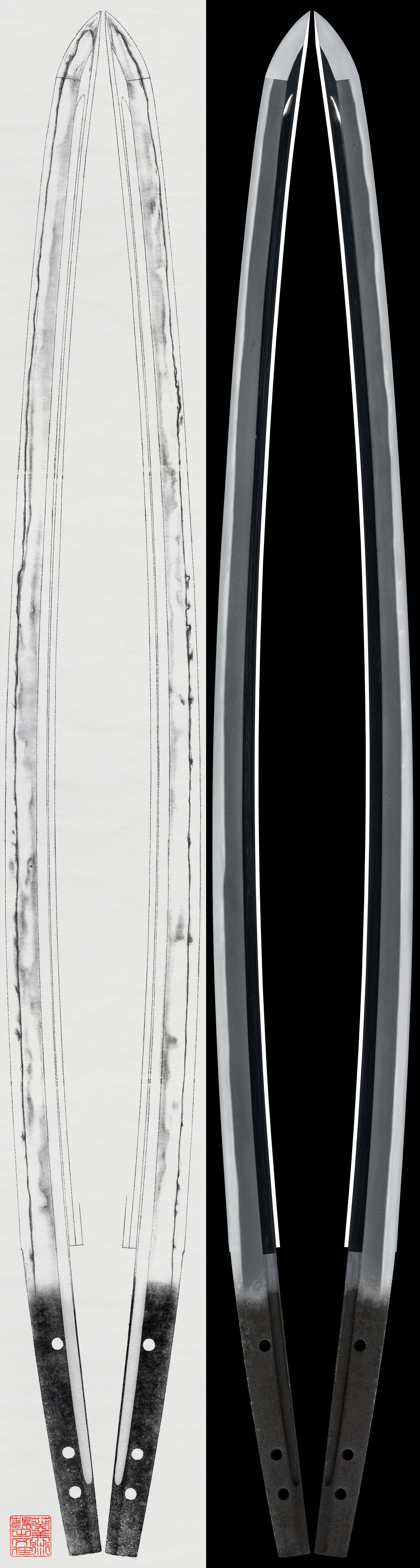
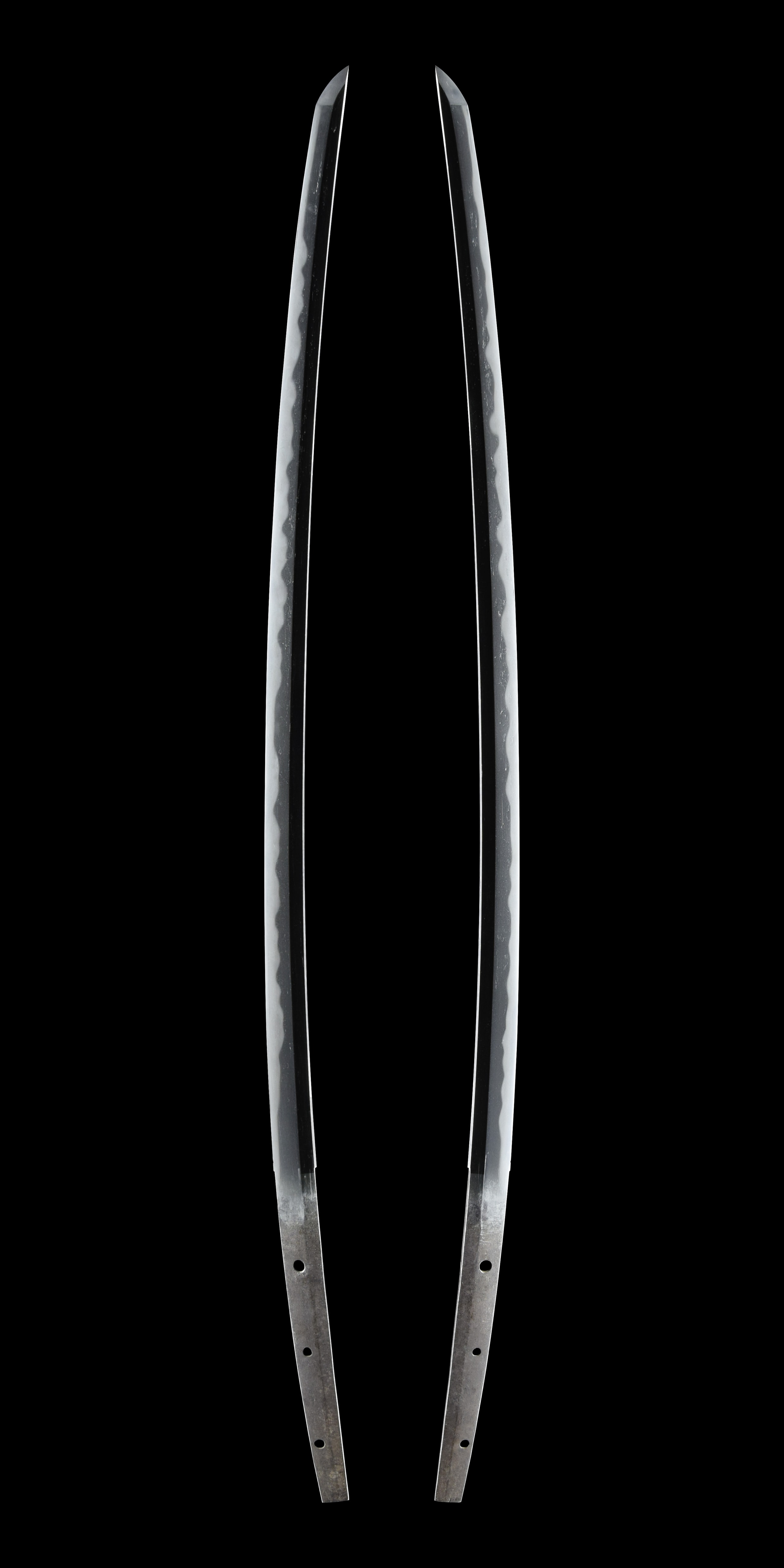
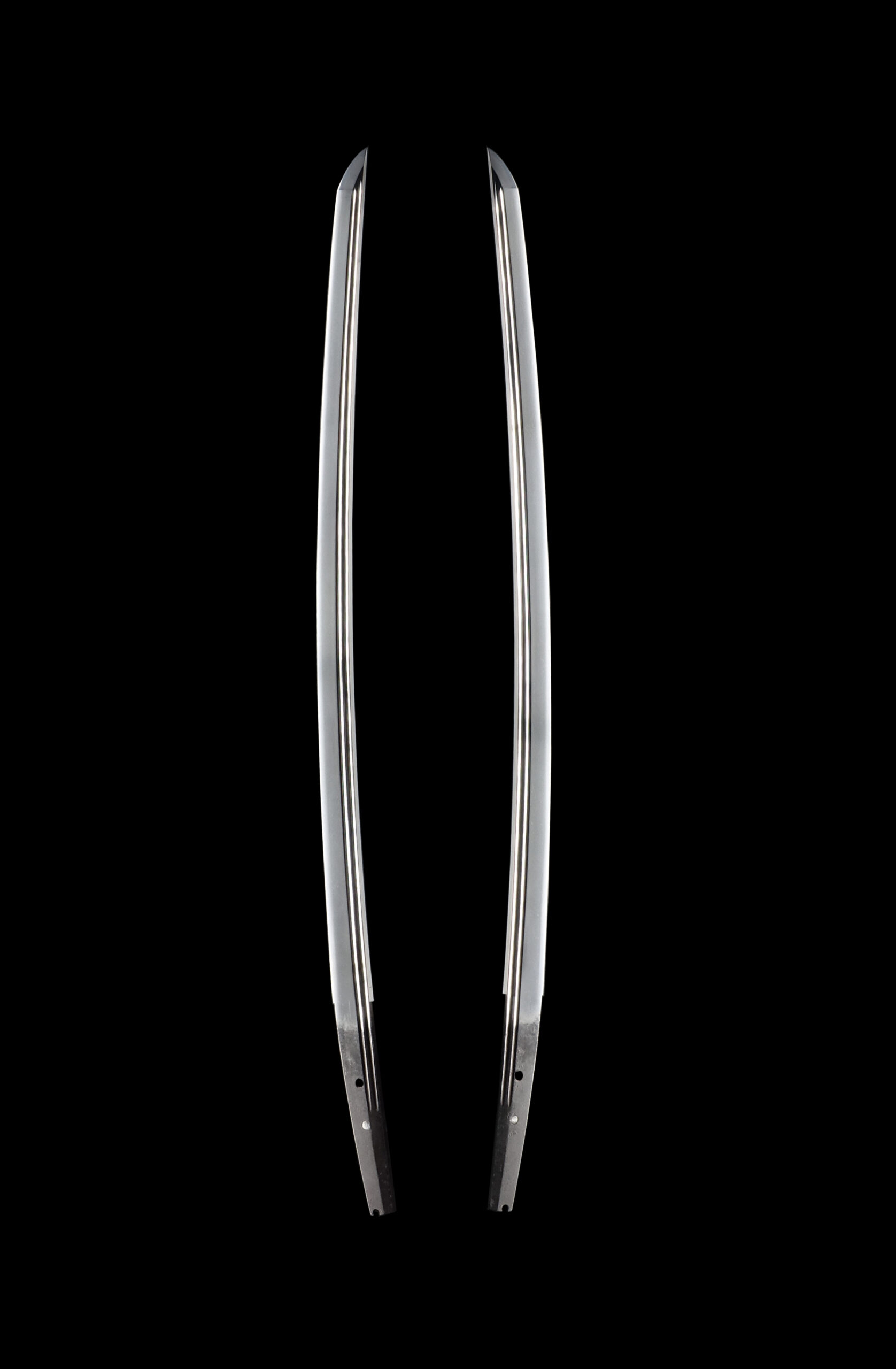
This antique Japanese Wakizashi is attributed to Den Osafune Kagemitsu, a prominent swordsmith of the Osafune school in Bizen Province during the late Kamakura to early Nanbokucho period. It comes with an NBTHK Tokubetsu Hozon Certificate, confirming its authenticity and artistic value. The blade features a cutting edge length of 54.7 cm and is accompanied by both a shirasaya and a koshirae, which includes a tsuba decorated with a Kamon-chirashi design and fuchi-kashira with Go-san no Kiri and butterfly motifs.
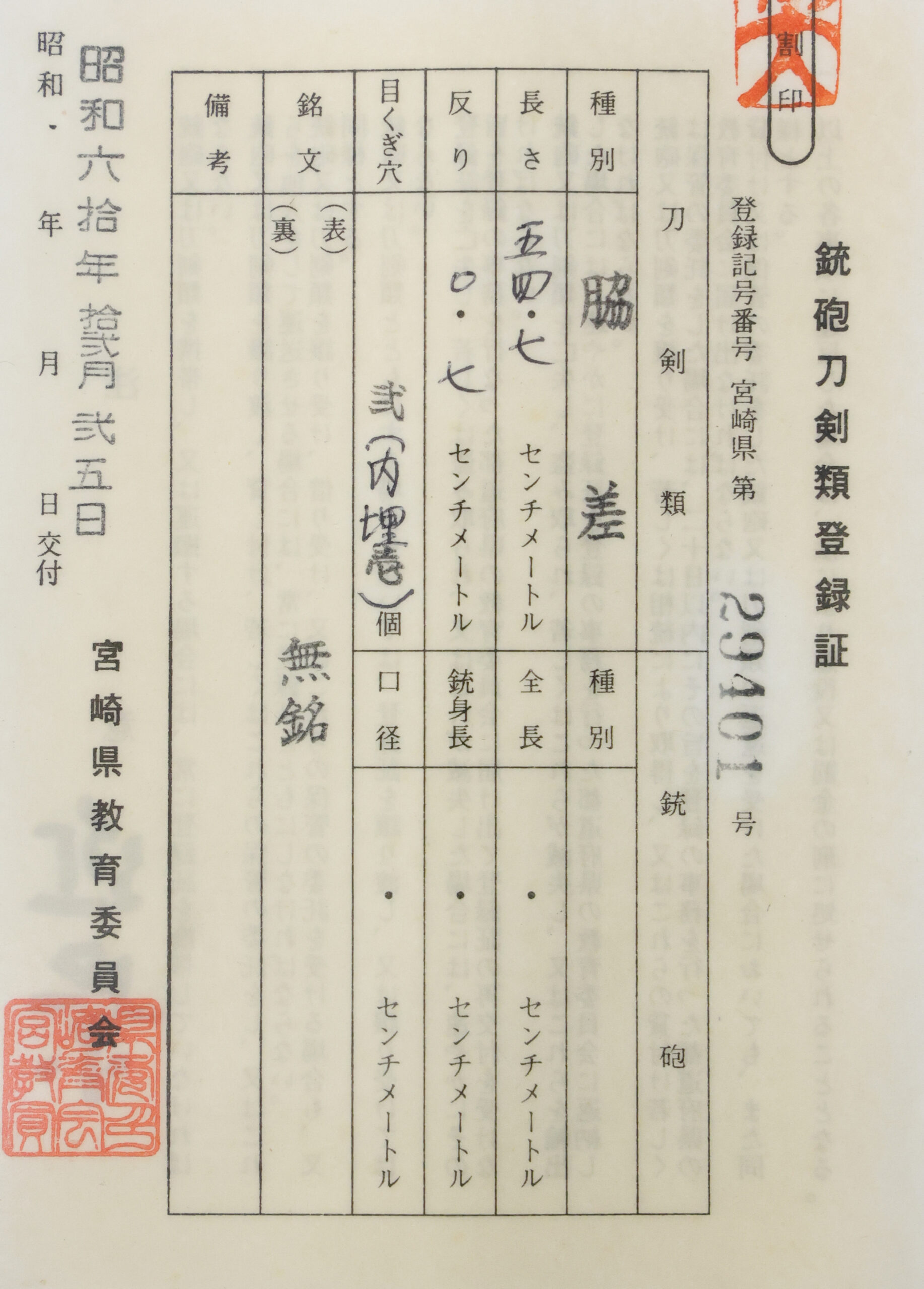
Certificate reading — 無銘(長船景光)
mumei · Osafune · Kagen-Kenmu (1303-1336) · nagasa 54.7cm · sori 0.7cm


Osafune (Bizen) · Bizen · around 1303-1336
Fujishiro Sai-jo saku · Tōken Taikan top 5%
3 pieces on the market now
Kagemitsu is the third master of the Osafune mainline, the son of Nagamitsu and grandson of Mitsutada. The published sources put the matter plainly: he 'is the son of Nagamitsu and the third generation of Osafune, famed for having completed the kataochi-gunome'[[c:1]]. Where his grandfather set the school's flamboyant standard and his father gave it the round choji, Kagemitsu took the saw-tooth temper that had only budded in his father's tanto and made it the family's last great invention.
Recognize him first by that temper. The kataochi-gunome, a gunome whose shoulders drop away in even steps, runs over a suguha base, its ashi and choji leaning back in the slanting saka-gakari (逆がかり) that is his personal hallmark, the heads of the teeth squared rather than rounded. The published record frames his hand as the quieter one in the family: his style 'has little of his father's flamboyance, being on the whole milder than Nagamitsu, whether a suguha base with gunome mixed in and slanting back, or a temper led by kataochi-gunome'[[c:2]]. On the tanto the hamon is at its most regular, an angular gunome with kataochi-gunome worked in.
His jigane matches that precision. The itame and ko-itame are tight and well worked, the ji-nie fine, chikei present. Quiet though the temper is, the sources reserve their highest note for his forging: 'in the quality of the forging, pieces are seen that in particular surpass even his father, and this is worthy of note'[[c:3]]. Across the ji runs not his father's flowing midare-utsuri alone but, at his best, an orderly bo-utsuri (棒映り) and a banded, stepped reflection that the connoisseurs liken to the Aoe school, where one Tokuju blade is said to 'show the flavour of Aoe dan-utsuri'[[c:4]].
The boshi follows the temper rather than overruling it. On the tanto it is small and runs in midare-komi, returning ko-maru on the omote and pointed in feeling on the ura, the published account reading 'the boshi is small and runs in midare-komi, the tip ko-maru on the omote, turning back with a pointed feeling on the ura'[[c:5]]. On the tachi the same ko-maru recurs out of a shallow notare, sometimes with a touch of hakikake. It is the unforced, contained boshi of a maker whose drama is carried by the body of the hamon.
His output divides cleanly by form. The tanto carry the pure, regular kataochi-gunome and the most elaborate carving in the family, with bonji (梵字), kurikara (倶利迦羅) and sanko-ken (三鈷剣) horimono cut far beyond anything his grandfather or father attempted; the tachi keep a suguha base with kataochi only in part. He is also among the most precisely datable of all Kamakura smiths, his signed and dated chronology running across more than thirty years, and the published sources add that, unlike his father, 'many tanto survive, which is also among his distinctions'[[c:6]].
Kagemitsu completes the three-generation arc that defines Kamakura Bizen, his grandfather Mitsutada founding the school, his father Nagamitsu setting its classical standard, and Kagemitsu bringing both temper and forging to their finished form before handing the manner to his pupil Chikakage, whose work is close enough that some signed Kagemitsu blades are read as Chikakage's daimei. For the collector he is Sai-jo saku in Fujishiro's grading, with three National Treasures, fifteen Important Cultural Properties and eleven Tokubetsu Juyo on record. The most famous of his blades is the Kogaryu Kagemitsu, a National Treasure named for the little dragon of its carved kurikara, carried by tradition by Kusunoki Masashige and in modern times held by the Meiji Emperor; other blades passed through Uesugi Kenshin, the Tokugawa shoguns, and the Date, Maeda and Shimazu houses. Of the three Osafune masters he is the one whose hand can be followed most exactly, signed, dated and carved more fully than either his father or his grandfather.
Where Kagemitsu stands among comparable artisans: across all of nihontō, and within tradition, era, and period. The tiers (Foremost · Leading · Major · Notable) weigh official designations from the NBTHK and Japan's Agency for Cultural Affairs, together with historical honors of lasting repute such as the Sansaku and Meibutsu-chō.
Select a lens to see how it's measured.
Years he was demonstrably active, proven by signed-and-dated blades
Bizen-den · Bizen
222 pieces on the market now
No single workshop in the history of Japanese swordmaking grew larger or lasted longer than Osafune, the riverside village in Bizen Province whose name became, across three centuries, a byword for the province's mainline. Its de facto founder was Mitsutada (光忠), working at Osafune in the middle Kamakura period; tradition makes him the son of Chikatada, and the genealogies derive his line from the Ko-Bizen Masatsune group already settled in the village. Learn more →
| Smith | Era | Designated |
|---|---|---|
| Mitsutada光忠 | 1238-1239 | 60 |
| Nagamitsu長光 | 1274-1304 | 244 |
| Kagemitsu景光 | 1303-1336 | 144 |
| Kanemitsu兼光 | 1323-1370 | 233 |
| Sanenaga眞長 | 1299-1309 | 64 |
A Hozon-certified blade judged to show notably superior workmanship and a better state of preservation. The bar is higher: re-tempered blades and most unsigned Muromachi/Edo works are excluded.
The NBTHK (Nihon Bijutsu Tōken Hozon Kyōkai, the Society for the Preservation of Japanese Art Swords) is a public-interest incorporated foundation founded in 1948 and supervised by Japan’s Agency for Cultural Affairs (Bunkachō); it is based at the Japanese Sword Museum in Tokyo. Its expert panels physically examine each submitted work (shinsa) and issue a certificate (kanteishō) ranking it by artistic and historical merit. NBTHK papers are the most widely recognized standard of authentication for Japanese swords and fittings.
NBTHK official siteReturns/exchanges limited to defects caused by shipping (except willful misconduct or gross negligence by the company); customers must contact within 72 hours of receiving the product.
This antique Japanese Wakizashi is attributed to Den Osafune Kagemitsu, a prominent swordsmith of the Osafune school in Bizen Province during the late Kamakura to early Nanbokucho period. It comes with an NBTHK Tokubetsu Hozon Certificate, confirming its authenticity and artistic value. The blade features a cutting edge length of 54.7 cm and is accompanied by both a shirasaya and a koshirae, which includes a tsuba decorated with a Kamon-chirashi design and fuchi-kashira with Go-san no Kiri and butterfly motifs.
Certificate reading — 無銘(長船景光)
mumei · Osafune · Kagen-Kenmu (1303-1336) · nagasa 54.7cm · sori 0.7cm


Osafune (Bizen) · Bizen · around 1303-1336
Fujishiro Sai-jo saku · Tōken Taikan top 5%
3 pieces on the market now
Kagemitsu is the third master of the Osafune mainline, the son of Nagamitsu and grandson of Mitsutada. The published sources put the matter plainly: he 'is the son of Nagamitsu and the third generation of Osafune, famed for having completed the kataochi-gunome'[[c:1]]. Where his grandfather set the school's flamboyant standard and his father gave it the round choji, Kagemitsu took the saw-tooth temper that had only budded in his father's tanto and made it the family's last great invention.
Recognize him first by that temper. The kataochi-gunome, a gunome whose shoulders drop away in even steps, runs over a suguha base, its ashi and choji leaning back in the slanting saka-gakari (逆がかり) that is his personal hallmark, the heads of the teeth squared rather than rounded. The published record frames his hand as the quieter one in the family: his style 'has little of his father's flamboyance, being on the whole milder than Nagamitsu, whether a suguha base with gunome mixed in and slanting back, or a temper led by kataochi-gunome'[[c:2]]. On the tanto the hamon is at its most regular, an angular gunome with kataochi-gunome worked in.
His jigane matches that precision. The itame and ko-itame are tight and well worked, the ji-nie fine, chikei present. Quiet though the temper is, the sources reserve their highest note for his forging: 'in the quality of the forging, pieces are seen that in particular surpass even his father, and this is worthy of note'[[c:3]]. Across the ji runs not his father's flowing midare-utsuri alone but, at his best, an orderly bo-utsuri (棒映り) and a banded, stepped reflection that the connoisseurs liken to the Aoe school, where one Tokuju blade is said to 'show the flavour of Aoe dan-utsuri'[[c:4]].
The boshi follows the temper rather than overruling it. On the tanto it is small and runs in midare-komi, returning ko-maru on the omote and pointed in feeling on the ura, the published account reading 'the boshi is small and runs in midare-komi, the tip ko-maru on the omote, turning back with a pointed feeling on the ura'[[c:5]]. On the tachi the same ko-maru recurs out of a shallow notare, sometimes with a touch of hakikake. It is the unforced, contained boshi of a maker whose drama is carried by the body of the hamon.
His output divides cleanly by form. The tanto carry the pure, regular kataochi-gunome and the most elaborate carving in the family, with bonji (梵字), kurikara (倶利迦羅) and sanko-ken (三鈷剣) horimono cut far beyond anything his grandfather or father attempted; the tachi keep a suguha base with kataochi only in part. He is also among the most precisely datable of all Kamakura smiths, his signed and dated chronology running across more than thirty years, and the published sources add that, unlike his father, 'many tanto survive, which is also among his distinctions'[[c:6]].
Kagemitsu completes the three-generation arc that defines Kamakura Bizen, his grandfather Mitsutada founding the school, his father Nagamitsu setting its classical standard, and Kagemitsu bringing both temper and forging to their finished form before handing the manner to his pupil Chikakage, whose work is close enough that some signed Kagemitsu blades are read as Chikakage's daimei. For the collector he is Sai-jo saku in Fujishiro's grading, with three National Treasures, fifteen Important Cultural Properties and eleven Tokubetsu Juyo on record. The most famous of his blades is the Kogaryu Kagemitsu, a National Treasure named for the little dragon of its carved kurikara, carried by tradition by Kusunoki Masashige and in modern times held by the Meiji Emperor; other blades passed through Uesugi Kenshin, the Tokugawa shoguns, and the Date, Maeda and Shimazu houses. Of the three Osafune masters he is the one whose hand can be followed most exactly, signed, dated and carved more fully than either his father or his grandfather.
Where Kagemitsu stands among comparable artisans: across all of nihontō, and within tradition, era, and period. The tiers (Foremost · Leading · Major · Notable) weigh official designations from the NBTHK and Japan's Agency for Cultural Affairs, together with historical honors of lasting repute such as the Sansaku and Meibutsu-chō.

Select a lens to see how it's measured.
Years he was demonstrably active, proven by signed-and-dated blades
Bizen-den · Bizen
222 pieces on the market now
No single workshop in the history of Japanese swordmaking grew larger or lasted longer than Osafune, the riverside village in Bizen Province whose name became, across three centuries, a byword for the province's mainline. Its de facto founder was Mitsutada (光忠), working at Osafune in the middle Kamakura period; tradition makes him the son of Chikatada, and the genealogies derive his line from the Ko-Bizen Masatsune group already settled in the village. Learn more →
| Smith | Era | Designated |
|---|---|---|
| Mitsutada光忠 | 1238-1239 | 60 |
| Nagamitsu長光 | 1274-1304 | 244 |
| Kagemitsu景光 | 1303-1336 | 144 |
| Kanemitsu兼光 | 1323-1370 | 233 |
| Sanenaga眞長 | 1299-1309 | 64 |
A Hozon-certified blade judged to show notably superior workmanship and a better state of preservation. The bar is higher: re-tempered blades and most unsigned Muromachi/Edo works are excluded.
The NBTHK (Nihon Bijutsu Tōken Hozon Kyōkai, the Society for the Preservation of Japanese Art Swords) is a public-interest incorporated foundation founded in 1948 and supervised by Japan’s Agency for Cultural Affairs (Bunkachō); it is based at the Japanese Sword Museum in Tokyo. Its expert panels physically examine each submitted work (shinsa) and issue a certificate (kanteishō) ranking it by artistic and historical merit. NBTHK papers are the most widely recognized standard of authentication for Japanese swords and fittings.
NBTHK official siteReturns/exchanges limited to defects caused by shipping (except willful misconduct or gross negligence by the company); customers must contact within 72 hours of receiving the product.