NihontoWatch Mon

NihontoWatchBETA

MarketAuctions
Encyclopedia
NihontoWatch Mon

NihontoWatchBETA

MarketAuctions
Encyclopedia

Description

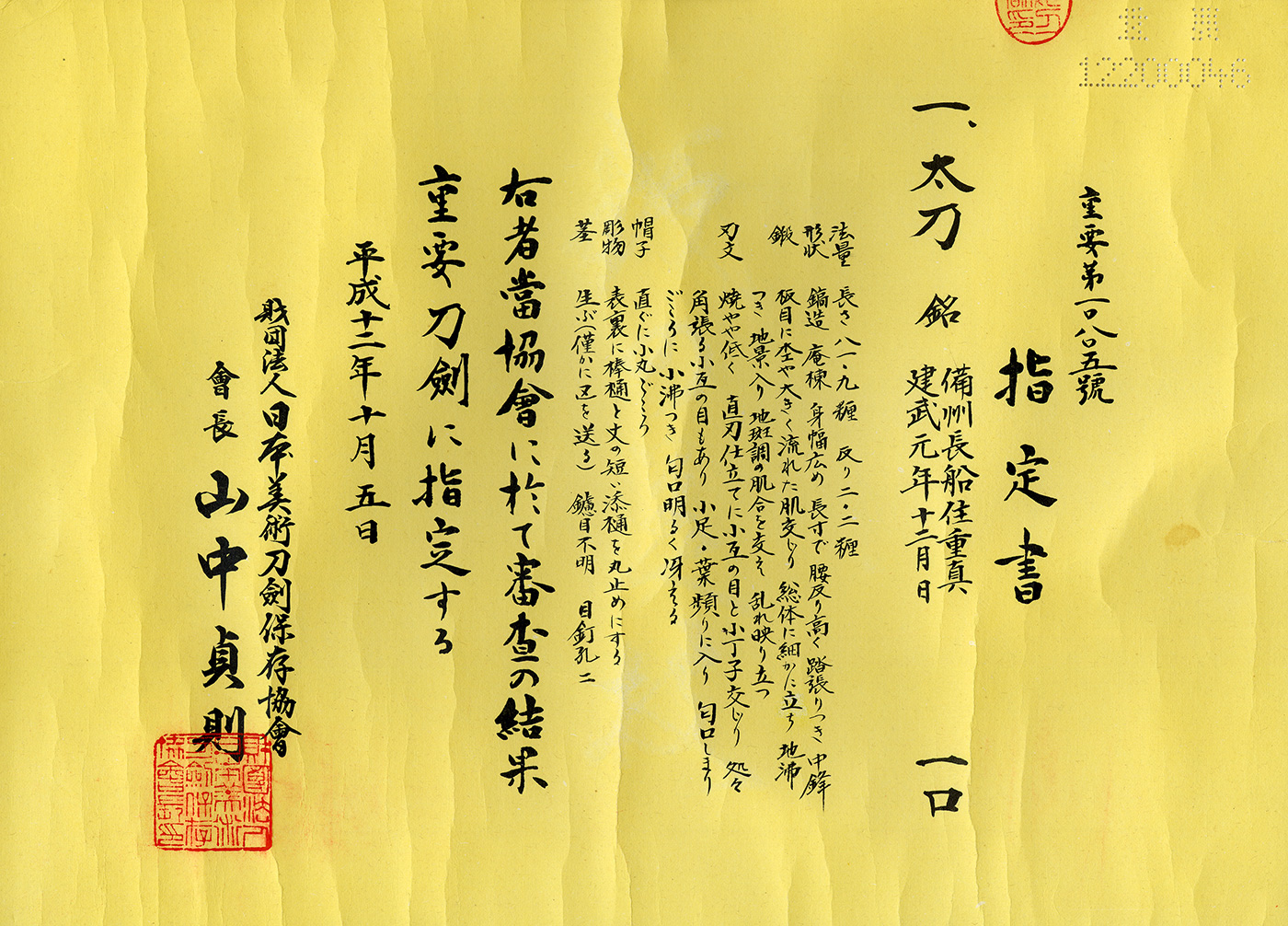
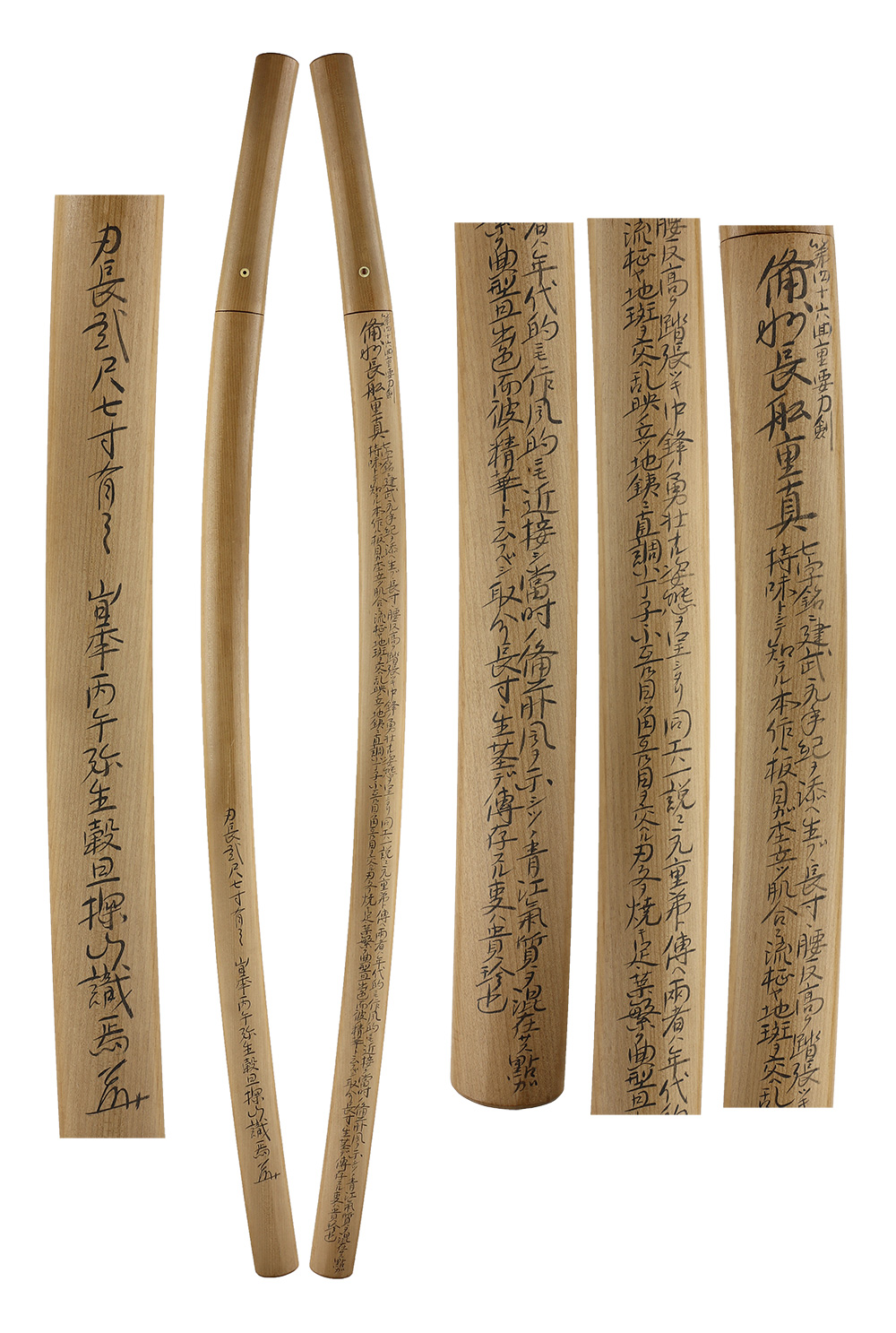
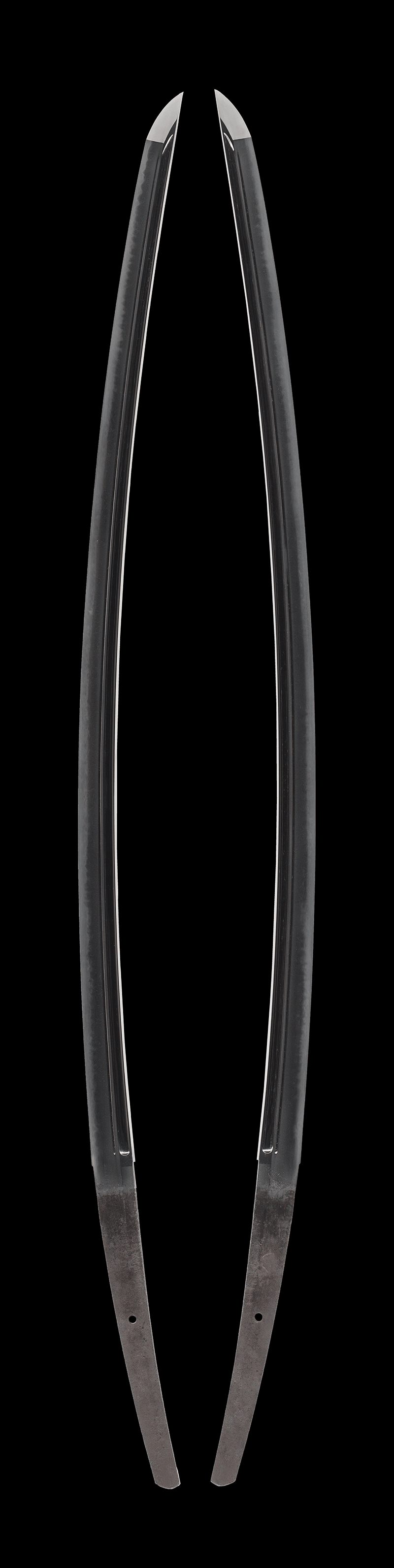
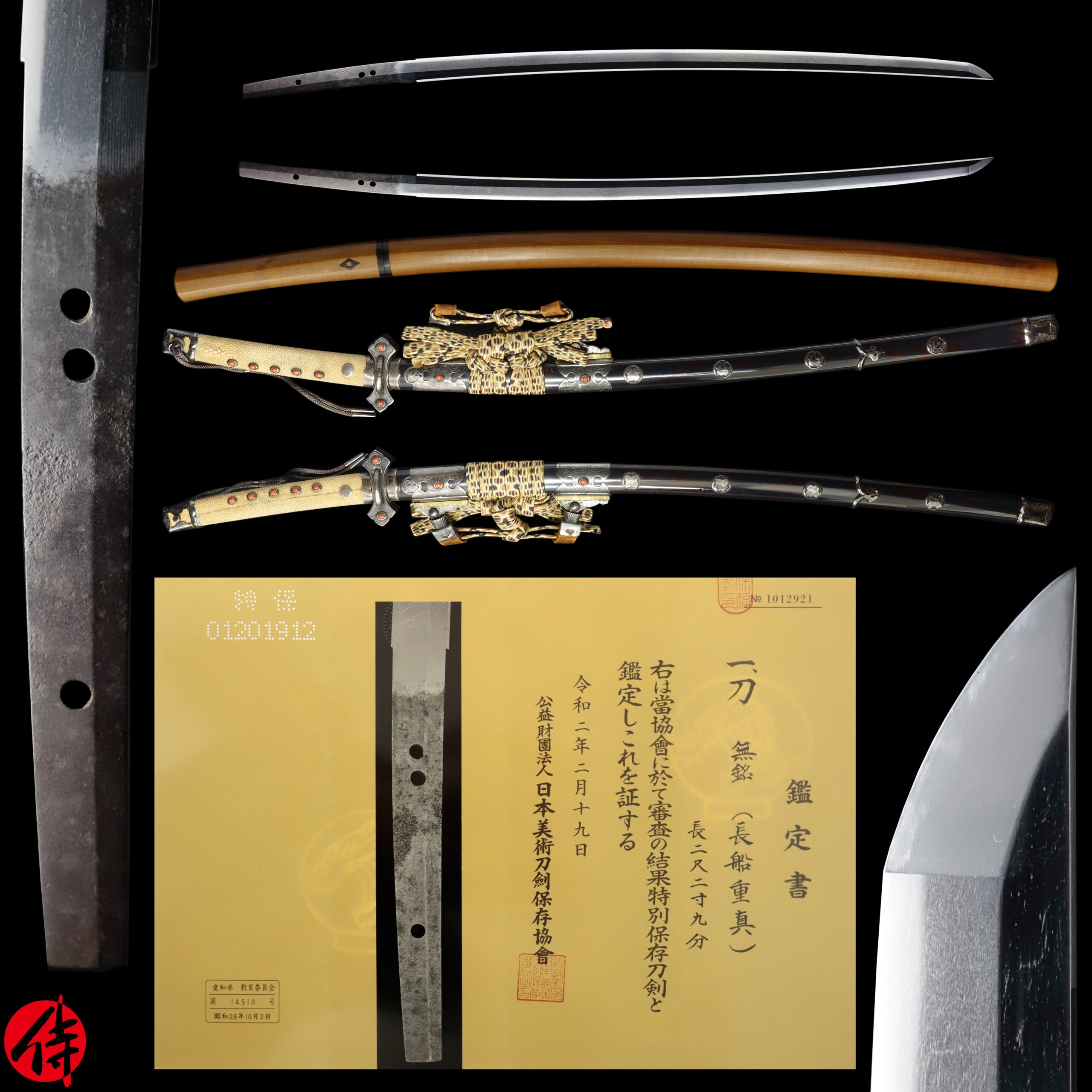
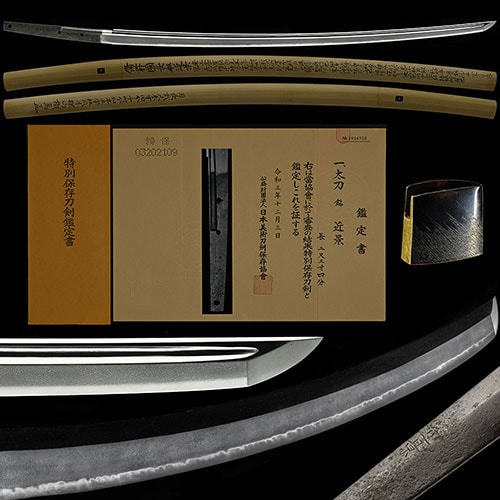
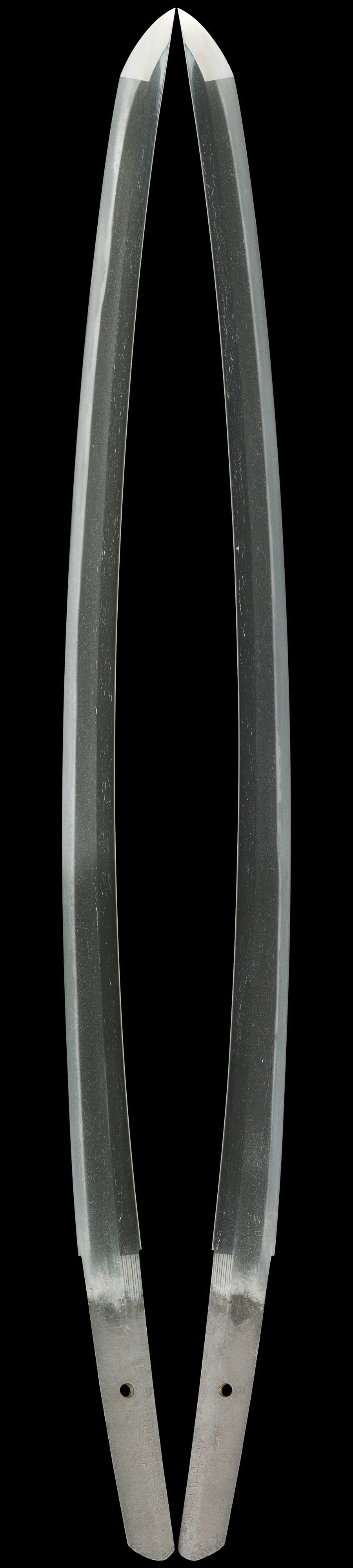
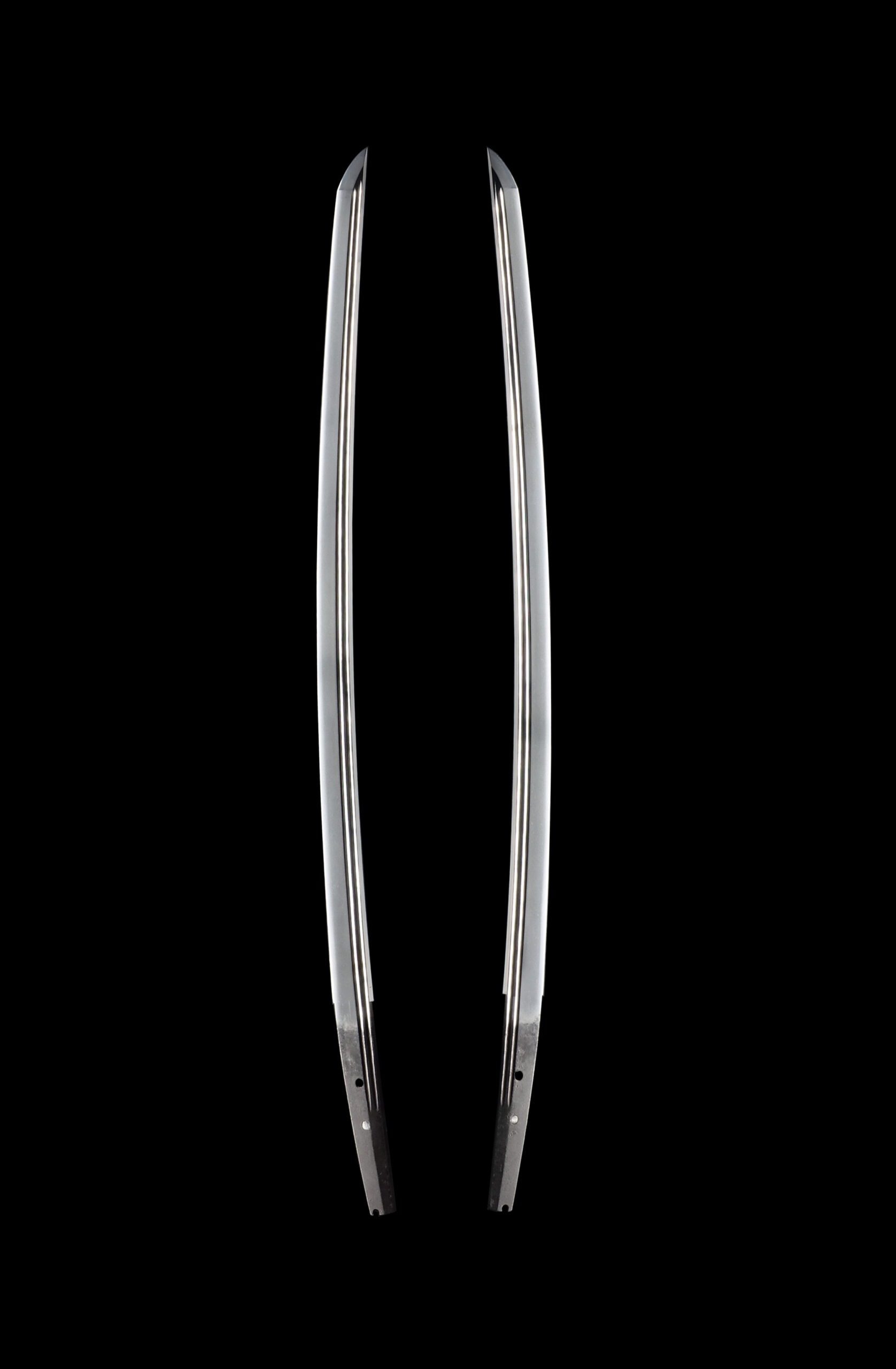
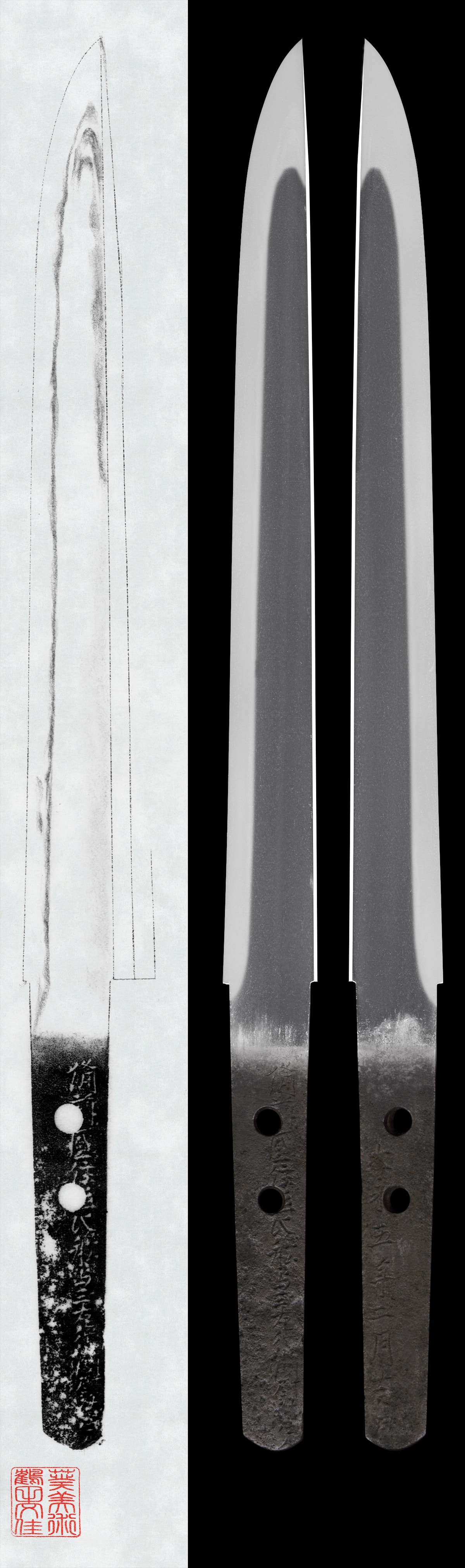
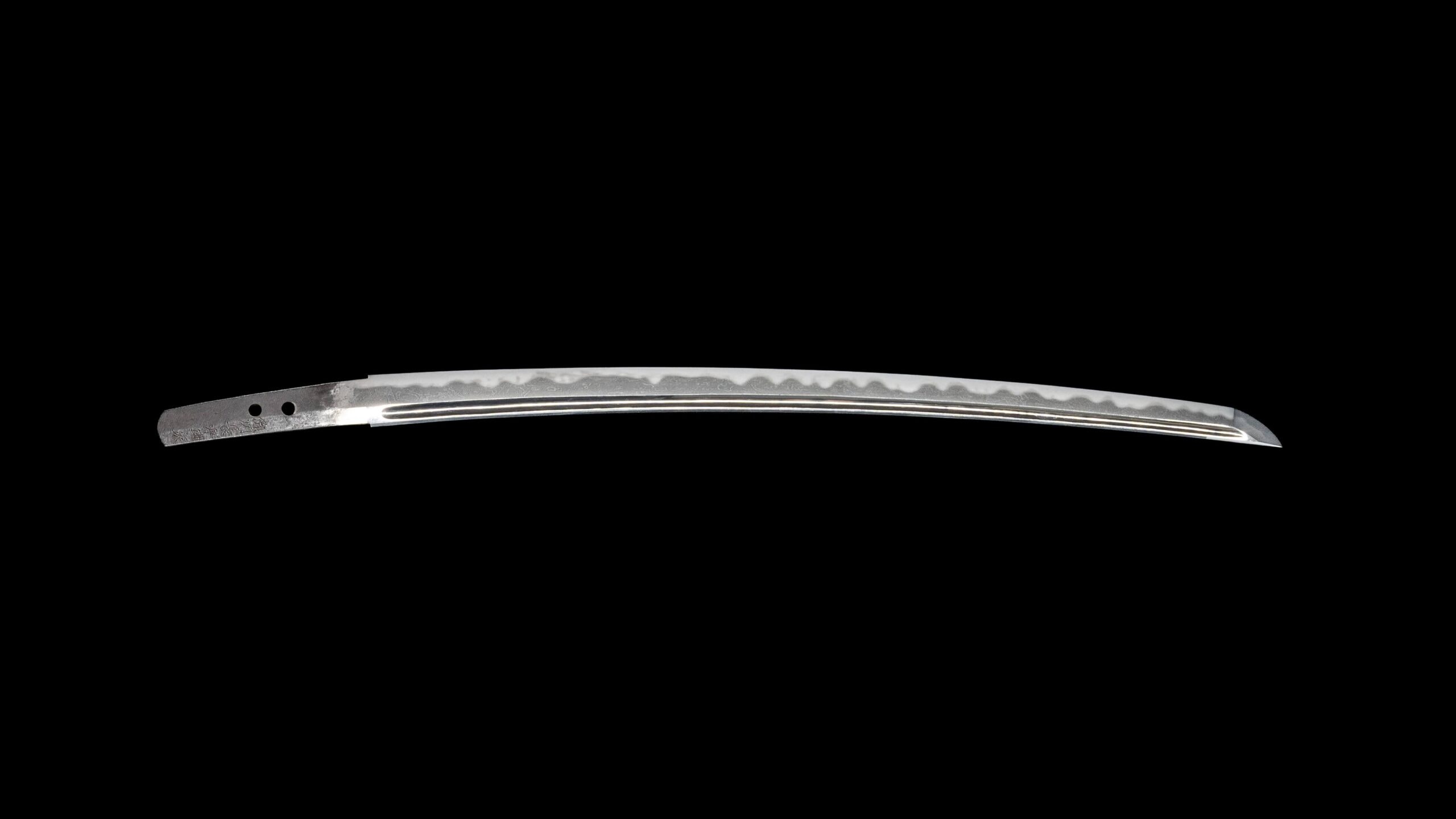
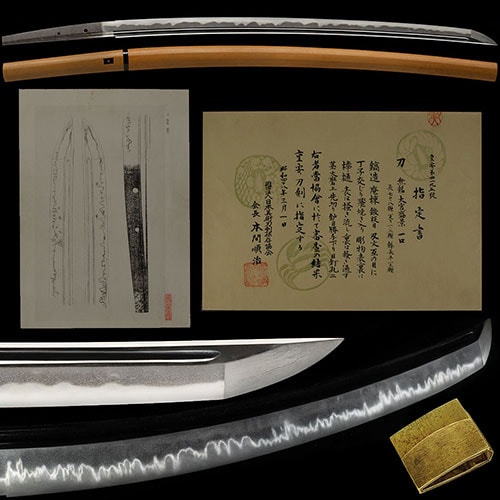
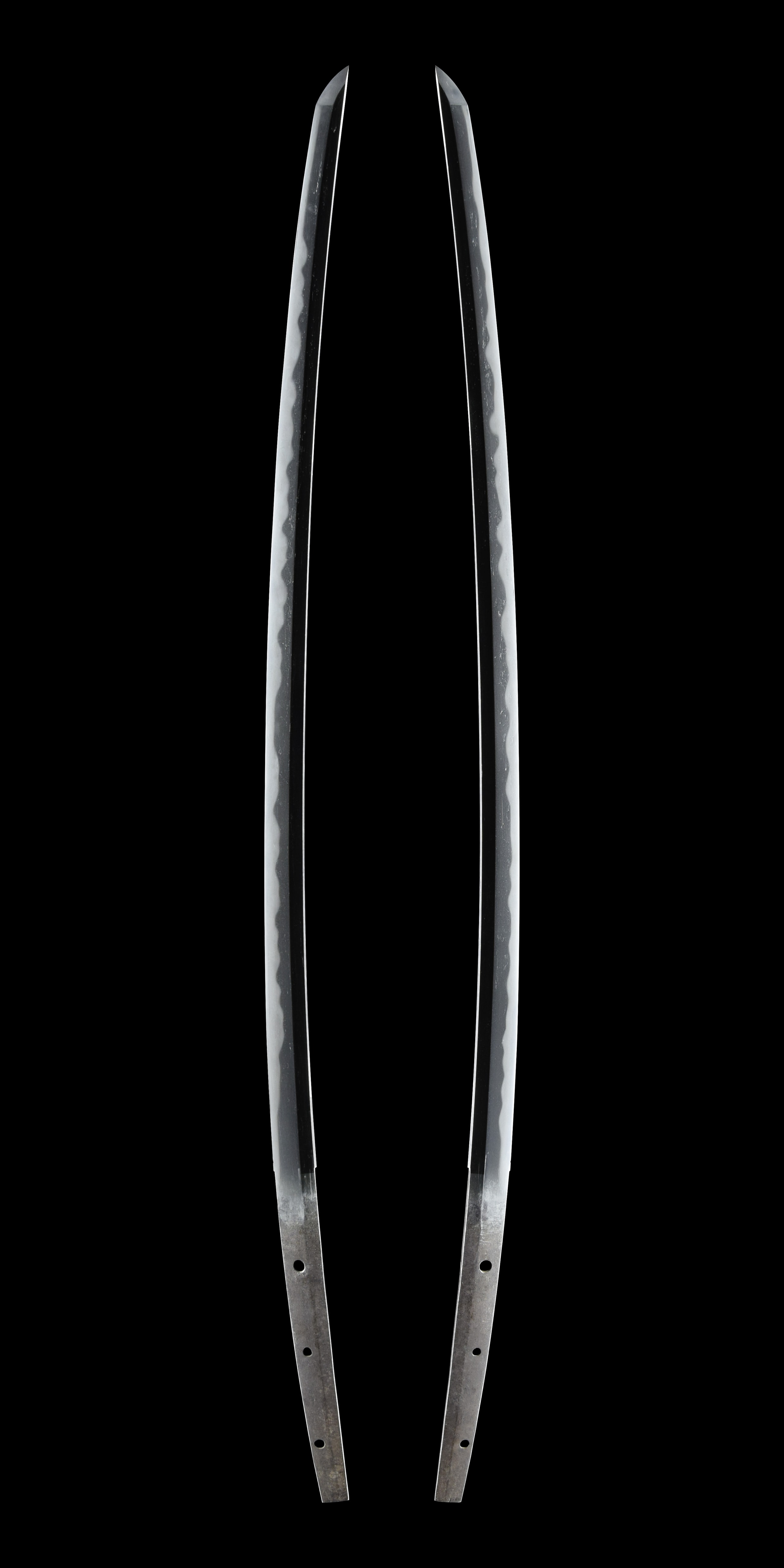
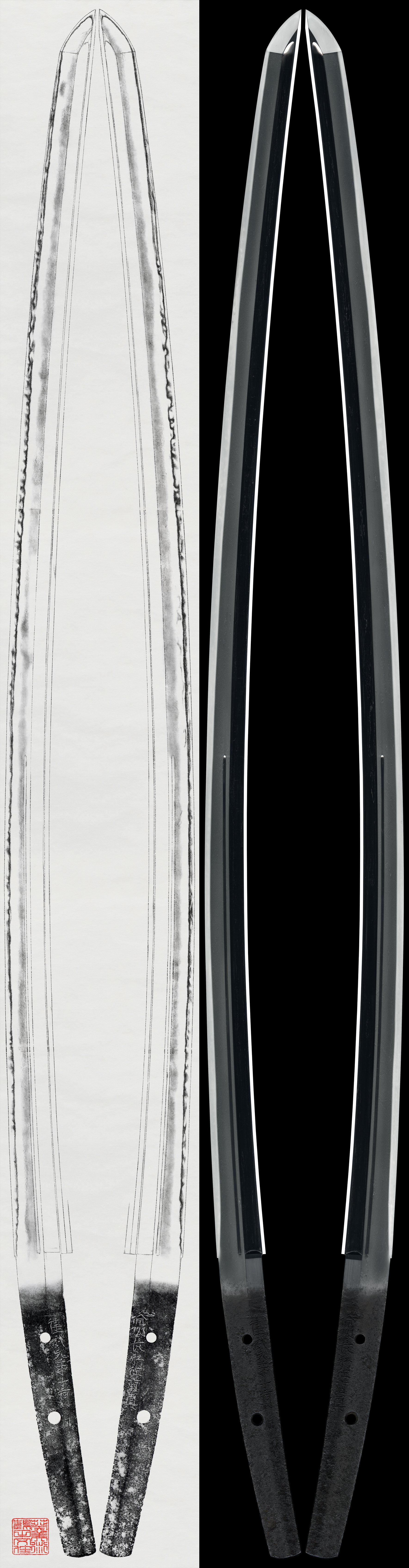
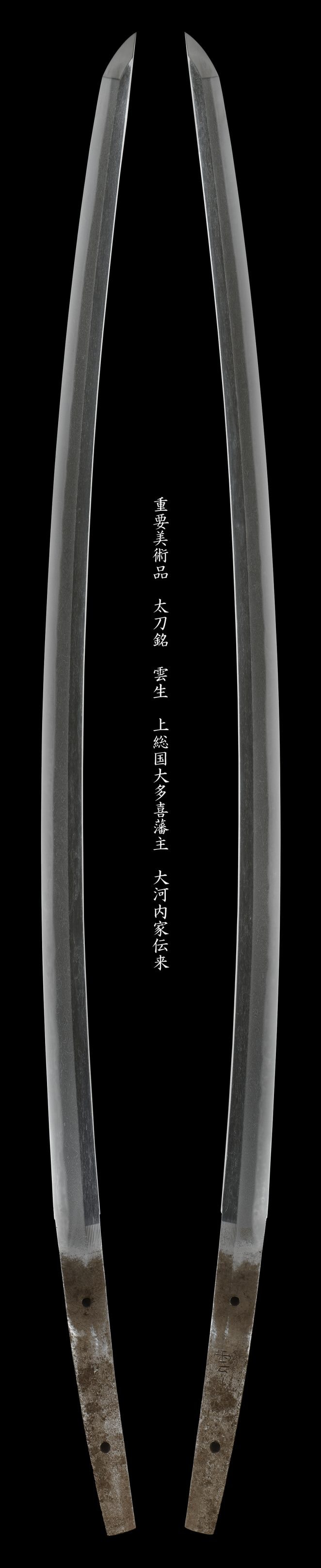
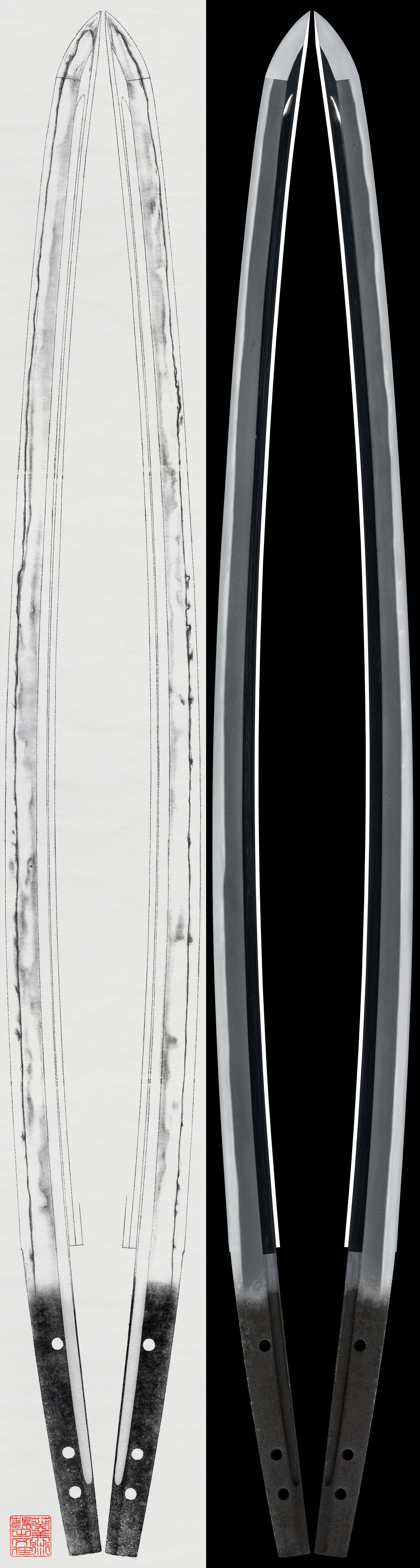
This is a tachi by Bizen Osafune Ju Shigemasa, dated December 1334. It is ranked as Saijyo Saku (the highest level) among the works of Bizen Osafune ju Shigemasa and has been designated as the 46th Juyo Token. The blade retains its original long tachi form with an ubu tang and bears a date inscription from 1334, making it a work of considerable historical and documentary importance.

NBTHK Setsumei

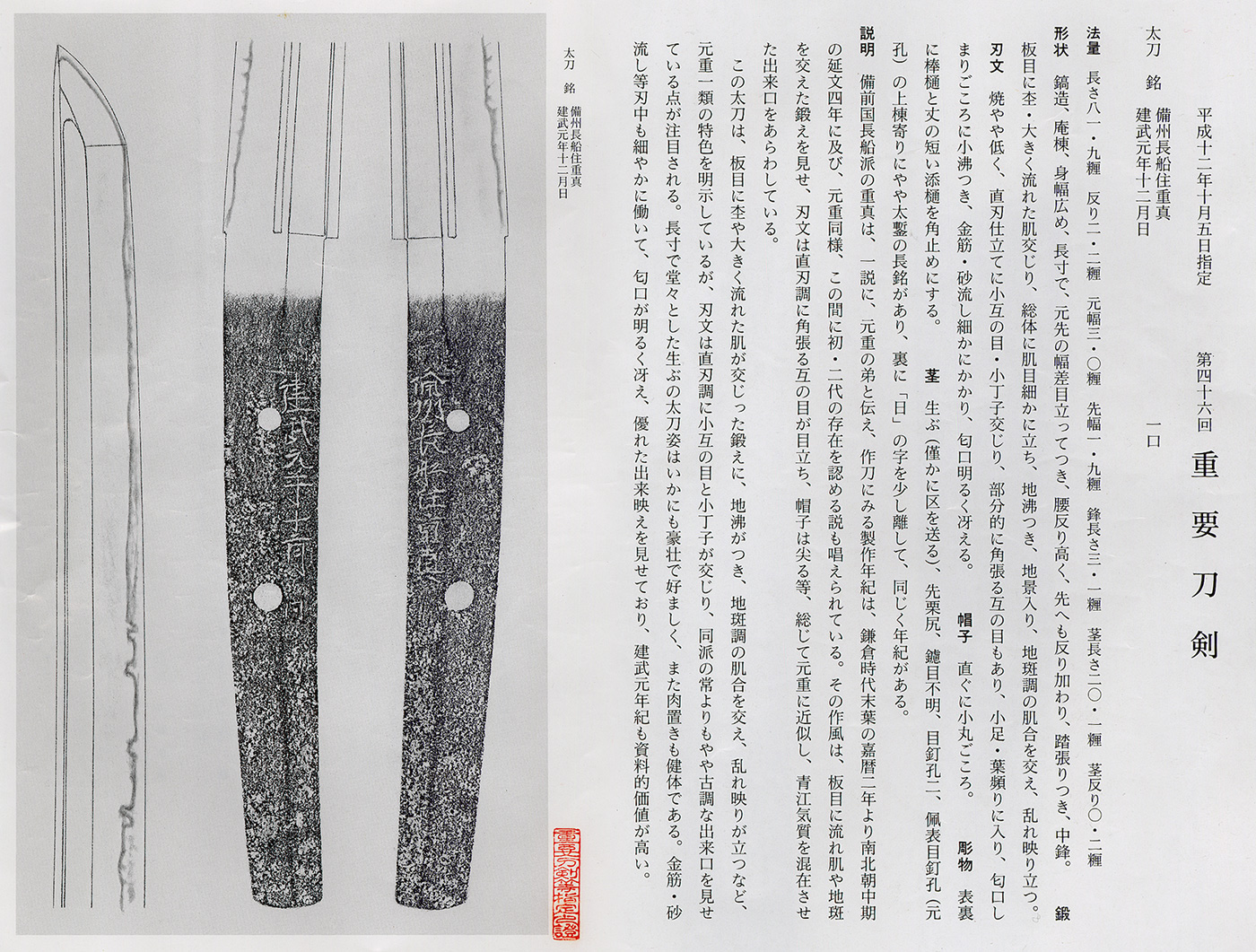
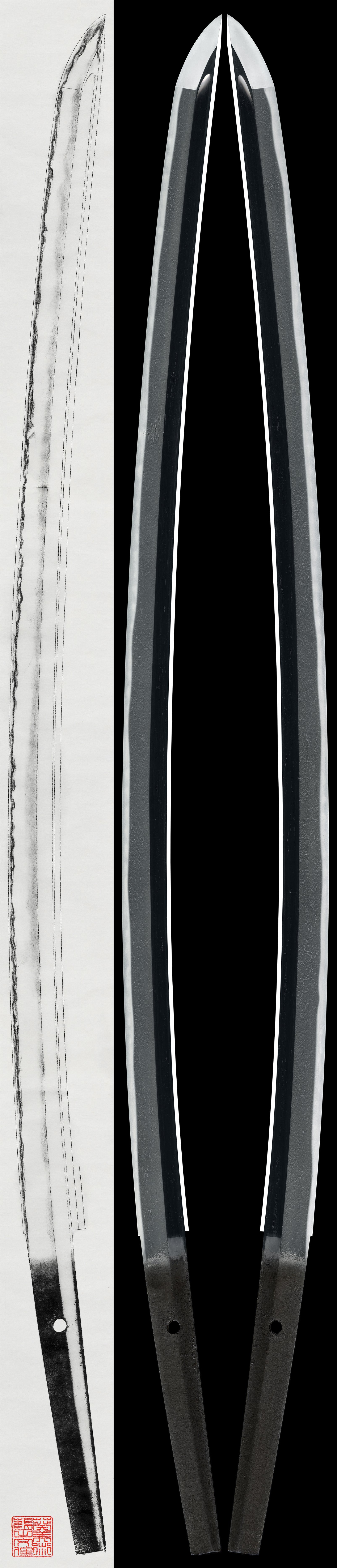
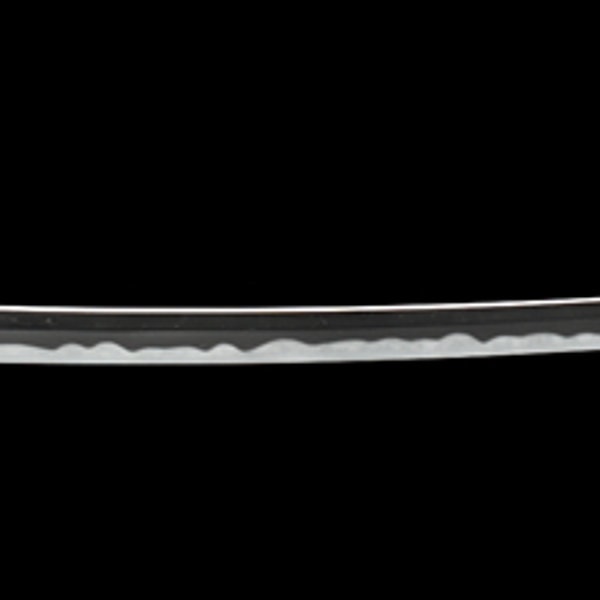
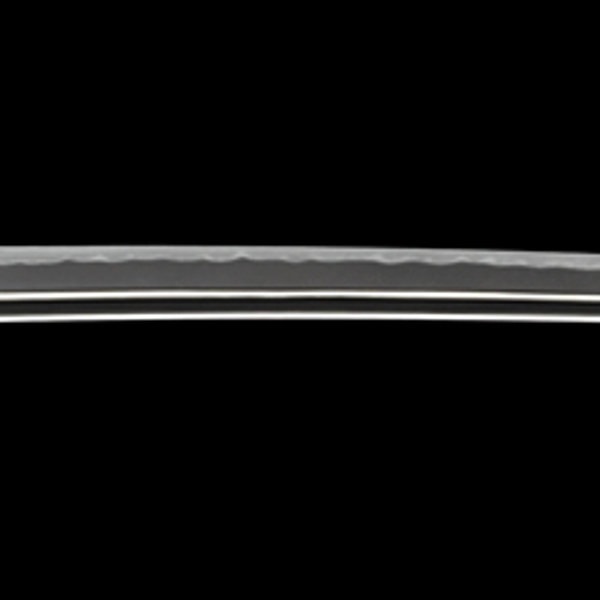
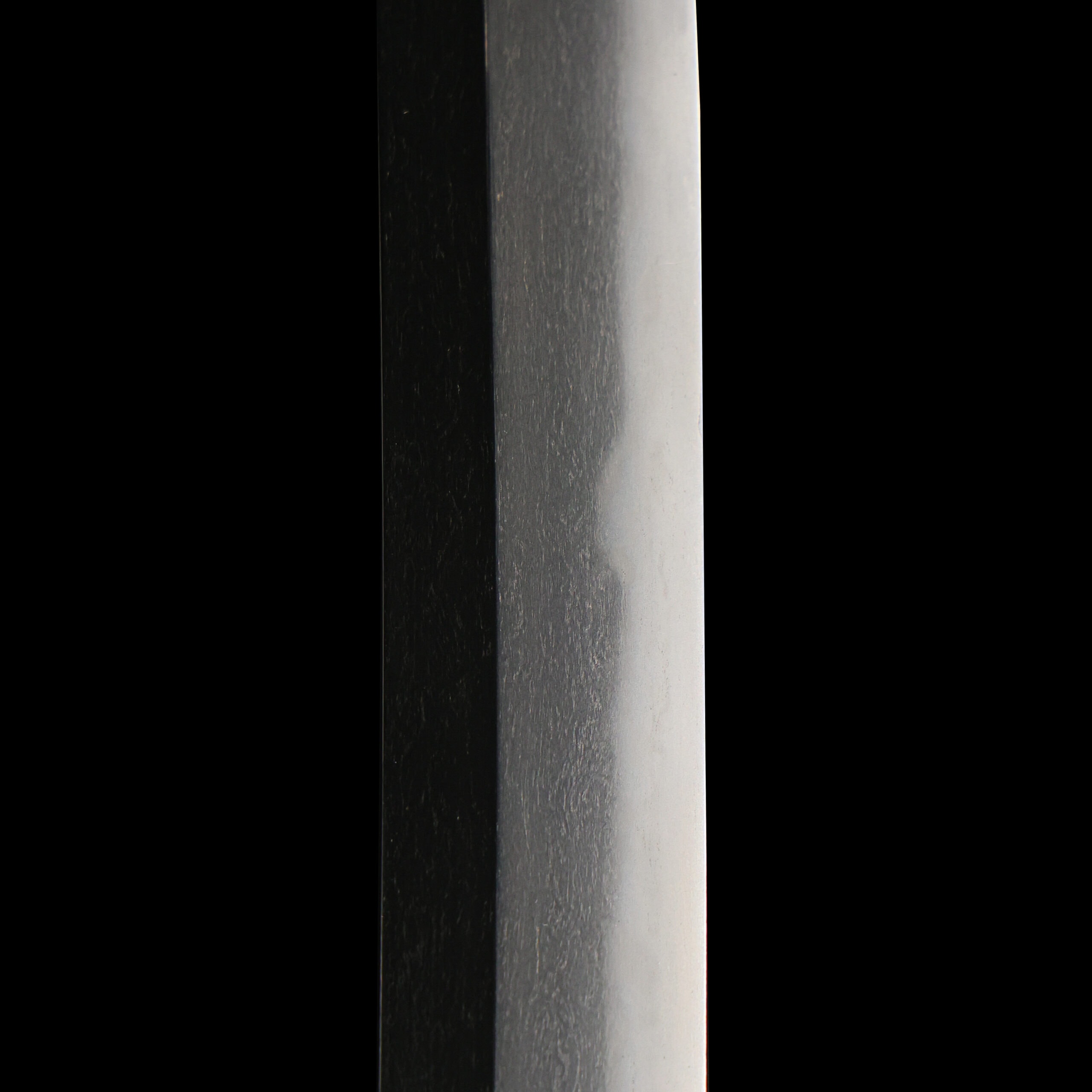
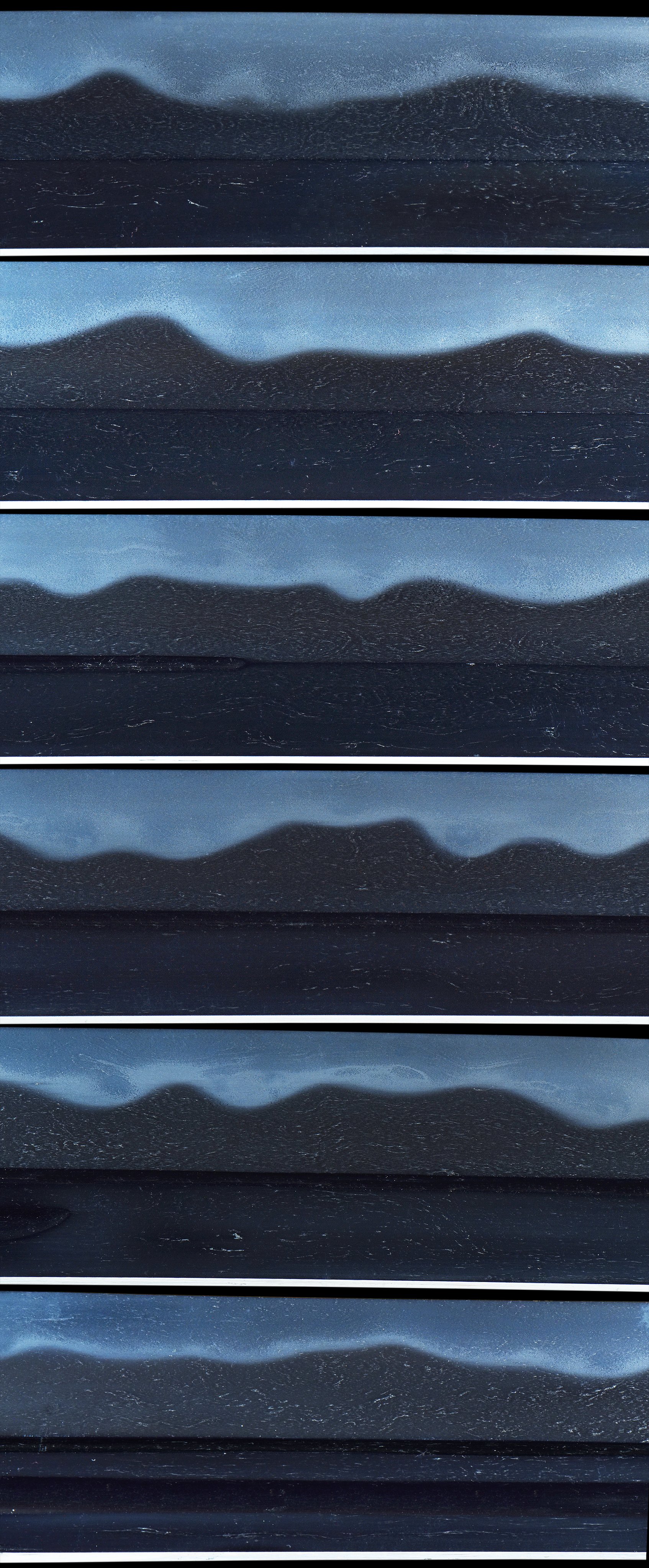
Jūyō-Tōken, 46th Session — Designated October 5, 2000 Tachi, mei: Bishū Osafune-jū Shigezane (備州長船住重真) Measurements Nagasa 81.9 cm, sori 2.2 cm, motohaba 3.0 cm, sakihaba 1.9 cm, kissaki-nagasa 3.1 cm, nakago-nagasa 20.1 cm, nakago-sori 0.2 cm Description Keijō: shinogi-zukuri, iori-mune; somewhat wide mihaba and long nagasa; conspicuous difference between base and tip widths; high koshizori with additional curvature toward the tip; with funbari; chū-kissaki. Kitae: itame-hada mixed with mokume and large, flowing (nagare) grain; overall the hada stands finely; with ji-nie, chikei, and intermingled patches of jifu-like complexion; midare-utsuri appears. Hamon: Tempering set somewhat low; a suguha-based hamon mixed with ko-gunome and ko-chōji, including places with angular gunome; ko-ashi and yō enter frequently; nioiguchi has a slightly shizumi (subdued) tendency with attached ko-nie; fine kinsuji and sunagashi run throughout; the nioiguchi is bright and clear. Bōshi: Straight, with a tendency to ko-maru. Horimono: On both sides, bō-hi with short accompanying grooves (soe-hi), finished in kaku-dome. Nakago: ubu (with the machi very slightly advanced); tip kurijiri; yasurime indistinct; two mekugi-ana. On the ha-omote, above the mekugi-ana (the original hole) and slightly toward the ridge, there is a long signature cut with somewhat thick chisel work; on the reverse, the character 「日」 is set slightly apart, and the date inscription is likewise present. Artisan Osafune Shigemasa of Bizen (Bishū) Era Dated Kenmu 1 (1334), 12th month (day unspecified) Explanation Shigezane of the Osafune group in Bizen Province is, according to one tradition, said to have been the younger brother of Motoshige. The dated works that can be confirmed range from Karyaku 2 (late Kamakura) through Enbun 4 (mid–Nanbokuchō). As with Motoshige, there is also a view that recognizes the existence of a first and second generation within this span. In terms of style, Shigemasa typically shows a forging pattern of itame with mixed flowing grain and patches of jifu-like complexion. The hamon is characteristically suguha-toned with conspicuous angular gunome; the bōshi may show a pointed tendency. Overall, these features are close to Motoshige, and a discernible Aoe temperament is intermingled, revealing the school’s manner of workmanship. This tachi displays the hallmark traits of the Motoshige line with particular clarity: an itame forging with mokume and large, flowing grain; ji-nie; intermingled jifu-like areas; and a standing midare-utsuri. At the same time, the hamon—suguha-toned with mixed ko-gunome and ko-chōji—shows a slightly more archaic flavor than is usual within the same group, a point that merits attention. Its imposing, long, and dignified ubu tachi sugata is unmistakably bold and appealing, and the blade also retains robust niku (flesh). Within the hamon, fine activities such as kinsuji and sunagashi appear in a detailed manner; the nioiguchi is bright and clear, presenting an excellent workmanship overall. Moreover, the Kenmu 1 date carries high documentary value.

NihontoWatch MonNihontoWatchBETA
MarketAuctionsEncyclopedia
Swords›Bizen-den›Osafune›Sōden-Bizen›Shigezane›Tachi: Bizen Osafune Ju Shigemasa (December 1334)(the 46th Juyo Token)
tachiJūyō
Osafune Shigezane

Tachi: Bizen Osafune Ju Shigemasa (December 1334)(the 46th Juyo Token)

mei · Osafune · Nanbokucho · nagasa 81.9cm · sori 2.1cm

SOLD
Osafune Shigezane — 1 of 6
Osafune Shigezane — 2 of 6
Osafune Shigezane — 3 of 6
Osafune Shigezane — 4 of 6
Osafune Shigezane — 5 of 6
Osafune Shigezane — 6 of 6
1 / 6
1 / 6
Osafune Shigezane — 1 of 6Osafune Shigezane — 2 of 6Osafune Shigezane — 3 of 6Osafune Shigezane — 4 of 6Osafune Shigezane — 5 of 6Osafune Shigezane — 6 of 6
Measurements & details
Smith
Osafune Shigezane
Type
Tachi
School
Osafune
Period
Around 1327–1358(Kenmu ND)
Province
Bizen
Signature
Signed(20% of this smith's designated works are signed)
Measurements
Nagasa 81.9cmSori 2.1cmMotohaba 3.23cmSakihaba 2.08cmKasane 0.62cmWeight 795g
Description

This is a tachi by Bizen Osafune Ju Shigemasa, dated December 1334. It is ranked as Saijyo Saku (the highest level) among the works of Bizen Osafune ju Shigemasa and has been designated as the 46th Juyo Token. The blade retains its original long tachi form with an ubu tang and bears a date inscription from 1334, making it a work of considerable historical and documentary importance.

NBTHK Zufu Commentary

Juyo #46

AI translation — may contain errors

-, 46th Session — Designated October 5, 2000

, : Bishū -jū Shigezane (備州長船住重真)

Measurements 81.9 cm, 2.2 cm, 3.0 cm, 1.9 cm, 3.1 cm, 20.1 cm, 0.2 cm

Description Keijō: , ; somewhat wide and long ; conspicuous difference between base and tip widths; high with additional curvature toward the tip; with ; . : mixed with and large, flowing () grain; overall the stands finely; with , , and intermingled patches of -like complexion; appears. : Tempering set somewhat low; a -based mixed with and , including places with angular ; and enter frequently; has a slightly (subdued) tendency with attached ; fine and run throughout; the is bright and clear. : Straight, with a tendency to . : On both sides, with short accompanying grooves (), finished in . : (with the very slightly advanced); tip ; indistinct; two . On the , above the (the original hole) and slightly toward the ridge, there is a long signature cut with somewhat thick chisel work; on the reverse, the character 「日」 is set slightly apart, and the date inscription is likewise present.

Artisan Shigemasa of (Bishū)

Era Dated Kenmu 1 (1334), 12th month (day unspecified)

Explanation Shigezane of the group in Province is, according to one tradition, said to have been the younger brother of Motoshige. The dated works that can be confirmed range from Karyaku 2 (late ) through Enbun 4 (mid–). As with Motoshige, there is also a view that recognizes the existence of a first and second generation within this span.

In terms of style, Shigemasa typically shows a forging pattern of with mixed flowing grain and patches of -like complexion. The is characteristically -toned with conspicuous angular ; the may show a pointed tendency. Overall, these features are close to Motoshige, and a discernible temperament is intermingled, revealing the school’s manner of workmanship.

This displays the hallmark traits of the Motoshige line with particular clarity: an forging with and large, flowing grain; ; intermingled -like areas; and a standing . At the time, the —-toned with mixed and —shows a slightly more archaic flavor than is usual within the group, a point that merits attention.

Its imposing, long, and dignified is unmistakably bold and appealing, and the blade also retains robust (flesh). Within the , fine activities such as and appear in a detailed manner; the is bright and clear, presenting an excellent workmanship overall. Moreover, the Kenmu 1 date carries high documentary value.

About the maker

Shigezane

重眞

Osafune (Bizen), Motoshige line · Bizen · around 1327-1358

Fujishiro Jo-jo saku · Tōken Taikan top 10%

2 pieces on the market now

›

Shigezane is an Osafune swordsmith of the Motoshige line, working from the close of the Kamakura period into the Nanbokucho, whose earliest dated work is a slightly elongated tanto of Karyaku 2 (1327) and whose latest reaches Enbun 4 of the Nanbokucho, a documented span of thirty-three years. The published sources record him by old tradition as the younger brother, or in another account a pupil, of the first-generation Motoshige, and they place his hand squarely within the Soden-Bizen of the late Osafune workshop. His is not the brilliant clove-flower of the older Bizen; it is the quieter, more angular manner of the Motoshige group, read by the published commentary as close to Motoshige with the character of Aoe mixed in. Authenticated signed examples are exceedingly few, so much of what survives under his name is judged from the bearing of the blade and the structure of its temper rather than from a signature.

The feature that most distinguishes his work is the temper. Over a suguha-toned base he sets angular gunome, the squared shoulder that reads as Motoshige-line rather than the rounded clove of Fukuoka, joined by the kataochi-gunome that is the structural tell of the group, the asymmetric saw-tooth slanting toward the base. The line frequently leans saka-gakari, the elements inclining in reverse, and into it run ashi and yo with ko-nie gathering and fine sunagashi and kinsuji passing through. The nioiguchi tends to sink to a subdued shizumi, the calm, slightly dimmed temper that the published sources name again and again as the mark of the Motoshige hand. The boshi enters in midare-komi and turns back pointed, at times a ko-maru or a yakizume sweep.

The jigane keeps the attribution in Bizen even where the temper alone might read as Soden. He forges a standing itame, often run through with nagare-hada and mixed with mokume and patches of jifu, the ji-nie thick and chikei entering, the grain a little raised. Across it rises a clear midare-utsuri, the bright reflection of old Bizen steel, sometimes a fainter bo-utsuri along the edge. The steel on his finest pieces takes a bluish-black tonality with a cold clarity, the nioiguchi bright and the activity within the ha abundant, with places where coarse nie glitters strongly.

His record divides into three registers. The mainstream is the suguha-toned, angular-gunome work that the published sources read as close to Motoshige, the manner that anchors his many o-suriage mumei attributions. Against it stands a rare exception, the ubu signed tachi dated Enbun 3, of which the commentary remarks that the workmanship 'is not in a Motoshige-like manner'[[c:1]], opening instead into a frank choji-midare with pointed gunome at the monouchi. The third register is the body of his surviving work, the greatly shortened mumei katana, several originally large tachi exceeding three shaku, wide in body and shallow in sori in the Nanbokucho mode. As with Motoshige, the published sources propose a first and a second generation across his dated span, the bold two-character signature taken for the first and the smaller signature cut 'Saemon-no-jo Shigezane'[[c:2]] for the second, a question still left for further study.

What sets him apart within the late Osafune is exactly what the judges name. His angular gunome and kataochi-gunome, his saka-gakari temper and subdued nioiguchi, and the bright midare-utsuri over his standing itame place him with Motoshige and apart from the rounder, showier Bizen of Fukuoka and Yoshioka, while the published sources read into his forging a manner that incorporates the character of Aoe, the workmanship they call 'a hand with Aoe character mixed in'[[c:3]]. On a mumei katana judged to him the commentary allows that views of 'Unrui or Chikakage'[[c:4]] are possible, the panel narrowing it to Shigezane only on close reading of the whole taihai together with the detail of ji and ha, the clear midare-utsuri leaving no doubt of Bizen.

For the collector Shigezane is a scarce signed name. Fujishiro grades him Jo-jo saku, and his record runs not through National Treasures or Important Cultural Properties, of which he has none, but through a single Tokubetsu Juyo and many Juyo, forty-five blades across the two tiers. The value of his best pieces lies in their documentary weight: the Tokubetsu Juyo katana with its folded-back long signature, called 'a representative work of this smith'[[c:5]]; the Karyaku 2 tanto, the earliest of his dated works and a foothold for his study; and a naginata preserved in its original form, 'a precious example that survives as a naginata without having been reshaped into a sword'[[c:6]]. Of recorded whereabouts a few are held in public collections, among them the Hayashibara Museum of Art and the Bizen Osafune Sword Museum, and the denrai of his blades passes through daimyo and old houses, the Matsudaira family with Matsudaira Ukon-no-suke Terusada and the Takasaki domain, and the Niwa family on to Tokugawa Yoshinobu. A signed Shigezane comes to light only seldom, and a privately held example, especially an ubu or dated one, is a notable thing for a collector to encounter, a document of how the Motoshige hand carried Bizen into the Nanbokucho.

Historical importance

Where Shigezane stands among comparable artisans: across all of nihontō, and within tradition, era, and period. The tiers (Foremost · Leading · Major · Notable) weigh official designations from the NBTHK and Japan's Agency for Cultural Affairs, together with historical honors of lasting repute such as the Sansaku and Meibutsu-chō.

随一
Foremost
屈指
Leading
有数
Major
著名
Notable

Select a lens to see how it's measured.

Designation record
44 designated works
Tokubetsu Jūyō
1
Jūyō
43
2 works by Shigezane on the market→
Shigezane — full profileOsafune (Bizen), Motoshige line school

Dated Works

Years he was demonstrably active, proven by signed-and-dated blades

Active period
1327–1358
3 of 9 designated works carry a date
1320
1330
1340
1350
1360
About the school

Osafune

長船

Bizen-den · Bizen

222 pieces on the market now

›

No single workshop in the history of Japanese swordmaking grew larger or lasted longer than Osafune, the riverside village in Bizen Province whose name became, across three centuries, a byword for the province's mainline. Its de facto founder was Mitsutada (光忠), working at Osafune in the middle Kamakura period; tradition makes him the son of Chikatada, and the genealogies derive his line from the Ko-Bizen Masatsune group already settled in the village. Learn more →

113 recorded smiths2013 designated works
Leading smiths
SmithEraDesignated
Mitsutada光忠1238-123960
Nagamitsu長光1274-1304244
Kagemitsu景光1303-1336144
Kanemitsu兼光1323-1370233
Sanenaga眞長1299-130964
Explore the Osafune school →
NBTHK Certificate
Jūyō Tōken重要刀剣
Important Sword
›

A blade of top-grade workmanship and condition, formally judged to rank with a nationally recognized Important Art Object (Jūyō Bijutsuhin). Awarded only at the NBTHK’s competitive annual examination.

Of Japan’s roughly 2.5 million registered swords, only 12,307 (about 1 in 203) have ever attained Jūyō.

About the NBTHK›

The NBTHK (Nihon Bijutsu Tōken Hozon Kyōkai, the Society for the Preservation of Japanese Art Swords) is a public-interest incorporated foundation founded in 1948 and supervised by Japan’s Agency for Cultural Affairs (Bunkachō); it is based at the Japanese Sword Museum in Tokyo. Its expert panels physically examine each submitted work (shinsa) and issue a certificate (kanteishō) ranking it by artistic and historical merit. NBTHK papers are the most widely recognized standard of authentication for Japanese swords and fittings.

NBTHK official site→
Seller
A
Aoi Art
🇯🇵Ships from Japan
›
✓Verified dealeraoijapan.com
✓Ships worldwide✓English supportWire transferPayPalCredit card
Return policy

If you wish to return an item, please notify us within 3 days of receipt. After this period we cannot accept cancellations. Please ship the return to us within 5 business days. Cancellation is conditional on the item being kept in the same condition as at the time of sale, so please handle it with care.

View all of Aoi Art’s listings→View this item on the dealer’s site→

More works by Osafune Shigezane

View all →
Iida Koendo
Jūyō
Tachi - Jūyō - by Osafune Shigezane - Bishu Osafune ju Shigezane, Enbun 3rd year, 12th monthTachi - Jūyō - by Osafune Shigezane - Bishu Osafune ju Shigezane, Enbun 3rd year, 12th month

Tachi

ByOsafune Shigezane
¥33,000,000
Token-Net
Jūyō
Katana - Jūyō - by Osafune Shigezane - Mumei ShigemaKatana - Jūyō - by Osafune Shigezane - Mumei Shigema

Katana

ByOsafune Shigezane
¥4,800,000

Previously sold by Osafune Shigezane

Samurai Museum
Hozon
Tanto - Hozon - by Osafune Shigezane - Antique Japanese Sword Tanto Signed by Shigezane NBTHK Hozon CertificateTanto - Hozon - by Osafune Shigezane - Antique Japanese Sword Tanto Signed by Shigezane NBTHK Hozon Certificate
Sold

Tantō

ByOsafune Shigezane
SOLD
World Seiyudo
Tokuho
Katana - Tokuho - by Osafune Shigezane - Mumei (Osafune Shigezane) - Tokubetsu Hozon TokenKatana - Tokuho - by Osafune Shigezane - Mumei (Osafune Shigezane) - Tokubetsu Hozon Token
Sold

Katana

ByOsafune Shigezane
SOLD
Choshuya
Katana - by Osafune Shigezane - Attributed to Osafune Shigezane (O-suriage Mumei, Ryowazamono)Katana - by Osafune Shigezane - Attributed to Osafune Shigezane (O-suriage Mumei, Ryowazamono)
Sold

Katana

ByOsafune Shigezane
SOLD
Choshuya
Tachi - by Osafune Shigezane - Bishu Osafune ju Shigezane, Bunwa 4th Year, 11th MonthTachi - by Osafune Shigezane - Bishu Osafune ju Shigezane, Bunwa 4th Year, 11th Month
Sold

Tachi

ByOsafune Shigezane
SOLD
Eirakudo
Tokuho
Wakizashi - Tokuho - by Osafune Shigezane - Osafune ShigezaneWakizashi - Tokuho - by Osafune Shigezane - Osafune Shigezane
Sold

Wakizashi

ByOsafune Shigezane
SOLD
Unique Japan
Jūyō
Jūyō - by Osafune Shigezane - Naginata-Naoshi Katana: ShigezaneJūyō - by Osafune Shigezane - Naginata-Naoshi Katana: Shigezane
Sold

Naginata-Naoshi Katana: Shigezane

ByOsafune Shigezane
SOLD
Eirakudo
Jūyō
Katana - Jūyō - by Osafune Shigezane - Osafune Shigezane - Juyo TokenKatana - Jūyō - by Osafune Shigezane - Osafune Shigezane - Juyo Token
Sold

Katana

ByOsafune Shigezane
SOLD
Unique Japan
Jūyō
Katana - Jūyō - by Osafune Shigezane - Shigezane - Ô-suriage mumeiKatana - Jūyō - by Osafune Shigezane - Shigezane - Ô-suriage mumei
Sold

Katana

ByOsafune Shigezane
SOLD

More Sōden-Bizen works

View all →
Aoi Art
Tokuho
Katana - Tokuho - by Osafune Motomitsu - Mumei (Attributed to Osafune Motomitsu)Katana - Tokuho - by Osafune Motomitsu - Mumei (Attributed to Osafune Motomitsu)

Katana

ByOsafune Motomitsu
Starting Bid¥1,200,000
Goushuya
Jūyō
Katana - Jūyō - by Osafune Kanemitsu - Kanemitsu with Gold Inlay InscriptionKatana - Jūyō - by Osafune Kanemitsu - Kanemitsu with Gold Inlay Inscription

Katana

ByOsafune Kanemitsu
Ask
Eirakudo
Jūyō
Katana - Jūyō - by Motoshige - Motoshige - Juyo TokenKatana - Jūyō - by Motoshige - Motoshige - Juyo Token

Katana

ByMotoshige
¥6,000,000
Nihonto Antiques
Jūyō
Katana - Jūyō - by Chogi - Den Chōgi (Nagayoshi) - JuyoKatana - Jūyō - by Chogi - Den Chōgi (Nagayoshi) - Juyo

Katana

ByChogi
Ask
Choshuya
Jūyō
Tachi - Jūyō - by Osafune Motomitsu - Signed Bishu (ika kire) den Osafune MotomitsuTachi - Jūyō - by Osafune Motomitsu - Signed Bishu (ika kire) den Osafune Motomitsu

Tachi

ByOsafune Motomitsu
¥8,500,000
Samurai Museum
Katana - by Osafune Kanemitsu - Attributed to Den Osafune Kanemitsu with NTHK Yushu Saku Kanteisho CertificateKatana - by Osafune Kanemitsu - Attributed to Den Osafune Kanemitsu with NTHK Yushu Saku Kanteisho Certificate

Katana

ByOsafune Kanemitsu
¥26,971
Choshuya
Tokuho
Katana - Tokuho - by Osafune Arimitsu - Bishu Osafune Arimitsu, Bunmei 10th year, 8th monthKatana - Tokuho - by Osafune Arimitsu - Bishu Osafune Arimitsu, Bunmei 10th year, 8th month

Katana

ByOsafune Arimitsu
¥2,800,000
Tsuruginoya
Jūyō
Tachi - Jūyō - by Osafune Masamitsu - Bizen Osafune MasamitsuTachi - Jūyō - by Osafune Masamitsu - Bizen Osafune Masamitsu

Tachi

ByOsafune Masamitsu
¥4,800,000

More from the Osafune school

View all →
Aoi Art
Jūyō Bijutsuhin
Daisho - Jubi - by Osafune Nagamitsu - Dai Sho: Katana (Important Art Object): Mumei (Den Nagamitsu) / Wakizashi: Mumei (Sekishu Naotsuna)Daisho - Jubi - by Osafune Nagamitsu - Dai Sho: Katana (Important Art Object): Mumei (Den Nagamitsu) / Wakizashi: Mumei (Sekishu Naotsuna)

Daishō

ByOsafune Nagamitsu
Ask
Eirakudo
Tokuho
Tachi - Tokuho - by Osafune Sanenaga - Sanenaga Tachi: Tokubetsu Hozon TokenTachi - Tokuho - by Osafune Sanenaga - Sanenaga Tachi: Tokubetsu Hozon Token

Tachi

ByOsafune Sanenaga
¥7,500,000
Nihonto.com
Jūyō
Tanto - Jūyō - by Osafune Kagemitsu - Juyo Tanto by Bizen KagemitsuTanto - Jūyō - by Osafune Kagemitsu - Juyo Tanto by Bizen Kagemitsu

Tantō

ByOsafune Kagemitsu
¥89,500
Iida Koendo
Jūyō
Tachi - Jūyō - by Osafune Nagamitsu - Bizenkoku Osafune ju Sakonshogen Nagamitsu tsukuru, Einin Gannen Junigatsu Hi (December 1293)Tachi - Jūyō - by Osafune Nagamitsu - Bizenkoku Osafune ju Sakonshogen Nagamitsu tsukuru, Einin Gannen Junigatsu Hi (December 1293)

Tachi

ByOsafune Nagamitsu
¥55,000,000
Iida Koendo
Jūyō
Tachi - Jūyō - by Osafune Nagamitsu - NagamitsuTachi - Jūyō - by Osafune Nagamitsu - Nagamitsu

Tachi

ByOsafune Nagamitsu
¥33,000,000
Tozando
Hozon
Katana - Hozon - by Sukesada - Bishū Osafune Sukesada - NBTHK Hozon Token Certified, Dated Eiroku 8 (1565)Katana - Hozon - by Sukesada - Bishū Osafune Sukesada - NBTHK Hozon Token Certified, Dated Eiroku 8 (1565)

Katana

BySukesada
¥1,620,000
Samurai Museum
Tokuho
Wakizashi - Tokuho - by Osafune Kagemitsu - Antique Japanese Sword Wakizashi Attributed to Den Osafune Kagemitsu NBTHK Tokubetsu Hozon CertificateWakizashi - Tokuho - by Osafune Kagemitsu - Antique Japanese Sword Wakizashi Attributed to Den Osafune Kagemitsu NBTHK Tokubetsu Hozon Certificate

Wakizashi

ByOsafune Kagemitsu
¥20,234
Tosa Touken Do
Tokujū
Tachi - Tokuju - by Osafune Kagemasa - Ko Osafune KagemasaTachi - Tokuju - by Osafune Kagemasa - Ko Osafune Kagemasa

Tachi

ByOsafune Kagemasa
Ask

More from the Bizen tradition

View all →
Eirakudo
Jūyō
Tachi - Jūyō - by Fukuoka Ichimonji School - Fukuoka Ichimonji - Juyo TokenTachi - Jūyō - by Fukuoka Ichimonji School - Fukuoka Ichimonji - Juyo Token

Tachi

ByFukuoka Ichimonji School
Ask
Tsuruginoya
Jūyō
Katana - Jūyō - by Fukuoka Ichimonji School - Mumei Fukuoka IchimonjiKatana - Jūyō - by Fukuoka Ichimonji School - Mumei Fukuoka Ichimonji

Katana

ByFukuoka Ichimonji School
¥10,000,000
Hyozaemon
Tokuho
Wakizashi - Tokuho - by Fukuoka Ichimonji Yoshifusa - Fukuoka Ichimonji YoshifusaWakizashi - Tokuho - by Fukuoka Ichimonji Yoshifusa - Fukuoka Ichimonji Yoshifusa

Wakizashi

ByFukuoka Ichimonji Yoshifusa
Ask
Eirakudo
Jūyō
Katana - Jūyō - by Omiya Morikage - Ohmiya Morikage - Juyo TokenKatana - Jūyō - by Omiya Morikage - Ohmiya Morikage - Juyo Token

Katana

ByOmiya Morikage
¥4,000,000
Aoi Art
Jūyō
Katana - Jūyō - by Yoshioka Ichimonji Sukemitsu - Ichi Bizen-koku Yoshioka Sakon Sho (Sukemitsu)Katana - Jūyō - by Yoshioka Ichimonji Sukemitsu - Ichi Bizen-koku Yoshioka Sakon Sho (Sukemitsu)

Katana

ByYoshioka Ichimonji Sukemitsu
¥9,500,000
Aoi Art
Jūyō
Katana - Jūyō - by Aoe School - Mumei (Aoe school)Katana - Jūyō - by Aoe School - Mumei (Aoe school)

Katana

ByAoe School
¥3,200,000
Token-Net
Jūyō
Jūyō - by Aoe School - Naginata Naoshi Katana Mumei (Aoe)Jūyō - by Aoe School - Naginata Naoshi Katana Mumei (Aoe)

Naginata Naoshi Katana Mumei (Aoe)

ByAoe School
¥3,200,000
Goushuya
Jūyō Bijutsuhin
Tachi - Jubi - by Ukai Unsho - Kumoio - From the collection of the Okouchi family, lord of Otaki Domain, Kazusa ProvinceTachi - Jubi - by Ukai Unsho - Kumoio - From the collection of the Okouchi family, lord of Otaki Domain, Kazusa Province

Tachi

ByUkai Unsho
Ask

Swords

  • Katana
  • Wakizashi
  • Tantō
  • Tachi
  • Naginata
  • Yari

Fittings

  • Tsuba
  • Fuchi-Kashira
  • Kozuka
  • Menuki

By Certification

  • Tokujū
  • Jūyō
  • Tokuho
  • Hozon

Resources

  • Dealer Directory
  • Artist Directory
  • Glossary
  • Browse All
Nihontowatch© 2026
TermsPrivacyCookiesAbout

Description

This is a tachi by Bizen Osafune Ju Shigemasa, dated December 1334. It is ranked as Saijyo Saku (the highest level) among the works of Bizen Osafune ju Shigemasa and has been designated as the 46th Juyo Token. The blade retains its original long tachi form with an ubu tang and bears a date inscription from 1334, making it a work of considerable historical and documentary importance.

NBTHK Setsumei

Jūyō-Tōken, 46th Session — Designated October 5, 2000 Tachi, mei: Bishū Osafune-jū Shigezane (備州長船住重真) Measurements Nagasa 81.9 cm, sori 2.2 cm, motohaba 3.0 cm, sakihaba 1.9 cm, kissaki-nagasa 3.1 cm, nakago-nagasa 20.1 cm, nakago-sori 0.2 cm Description Keijō: shinogi-zukuri, iori-mune; somewhat wide mihaba and long nagasa; conspicuous difference between base and tip widths; high koshizori with additional curvature toward the tip; with funbari; chū-kissaki. Kitae: itame-hada mixed with mokume and large, flowing (nagare) grain; overall the hada stands finely; with ji-nie, chikei, and intermingled patches of jifu-like complexion; midare-utsuri appears. Hamon: Tempering set somewhat low; a suguha-based hamon mixed with ko-gunome and ko-chōji, including places with angular gunome; ko-ashi and yō enter frequently; nioiguchi has a slightly shizumi (subdued) tendency with attached ko-nie; fine kinsuji and sunagashi run throughout; the nioiguchi is bright and clear. Bōshi: Straight, with a tendency to ko-maru. Horimono: On both sides, bō-hi with short accompanying grooves (soe-hi), finished in kaku-dome. Nakago: ubu (with the machi very slightly advanced); tip kurijiri; yasurime indistinct; two mekugi-ana. On the ha-omote, above the mekugi-ana (the original hole) and slightly toward the ridge, there is a long signature cut with somewhat thick chisel work; on the reverse, the character 「日」 is set slightly apart, and the date inscription is likewise present. Artisan Osafune Shigemasa of Bizen (Bishū) Era Dated Kenmu 1 (1334), 12th month (day unspecified) Explanation Shigezane of the Osafune group in Bizen Province is, according to one tradition, said to have been the younger brother of Motoshige. The dated works that can be confirmed range from Karyaku 2 (late Kamakura) through Enbun 4 (mid–Nanbokuchō). As with Motoshige, there is also a view that recognizes the existence of a first and second generation within this span. In terms of style, Shigemasa typically shows a forging pattern of itame with mixed flowing grain and patches of jifu-like complexion. The hamon is characteristically suguha-toned with conspicuous angular gunome; the bōshi may show a pointed tendency. Overall, these features are close to Motoshige, and a discernible Aoe temperament is intermingled, revealing the school’s manner of workmanship. This tachi displays the hallmark traits of the Motoshige line with particular clarity: an itame forging with mokume and large, flowing grain; ji-nie; intermingled jifu-like areas; and a standing midare-utsuri. At the same time, the hamon—suguha-toned with mixed ko-gunome and ko-chōji—shows a slightly more archaic flavor than is usual within the same group, a point that merits attention. Its imposing, long, and dignified ubu tachi sugata is unmistakably bold and appealing, and the blade also retains robust niku (flesh). Within the hamon, fine activities such as kinsuji and sunagashi appear in a detailed manner; the nioiguchi is bright and clear, presenting an excellent workmanship overall. Moreover, the Kenmu 1 date carries high documentary value.

NihontoWatch MonNihontoWatchBETA
MarketAuctionsEncyclopedia
Swords›Bizen-den›Osafune›Sōden-Bizen›Shigezane›Tachi: Bizen Osafune Ju Shigemasa (December 1334)(the 46th Juyo Token)
tachiJūyō
Osafune Shigezane

Tachi: Bizen Osafune Ju Shigemasa (December 1334)(the 46th Juyo Token)

mei · Osafune · Nanbokucho · nagasa 81.9cm · sori 2.1cm

SOLD
Osafune Shigezane — 1 of 6
Osafune Shigezane — 2 of 6
Osafune Shigezane — 3 of 6
Osafune Shigezane — 4 of 6
Osafune Shigezane — 5 of 6
Osafune Shigezane — 6 of 6
1 / 6
1 / 6
Osafune Shigezane — 1 of 6Osafune Shigezane — 2 of 6Osafune Shigezane — 3 of 6Osafune Shigezane — 4 of 6Osafune Shigezane — 5 of 6Osafune Shigezane — 6 of 6
Measurements & details
Smith
Osafune Shigezane
Type
Tachi
School
Osafune
Period
Around 1327–1358(Kenmu ND)
Province
Bizen
Signature
Signed(20% of this smith's designated works are signed)
Measurements
Nagasa 81.9cmSori 2.1cmMotohaba 3.23cmSakihaba 2.08cmKasane 0.62cmWeight 795g
Description

This is a tachi by Bizen Osafune Ju Shigemasa, dated December 1334. It is ranked as Saijyo Saku (the highest level) among the works of Bizen Osafune ju Shigemasa and has been designated as the 46th Juyo Token. The blade retains its original long tachi form with an ubu tang and bears a date inscription from 1334, making it a work of considerable historical and documentary importance.

NBTHK Zufu Commentary

Juyo #46

AI translation — may contain errors

-, 46th Session — Designated October 5, 2000

, : Bishū -jū Shigezane (備州長船住重真)

Measurements 81.9 cm, 2.2 cm, 3.0 cm, 1.9 cm, 3.1 cm, 20.1 cm, 0.2 cm

Description Keijō: , ; somewhat wide and long ; conspicuous difference between base and tip widths; high with additional curvature toward the tip; with ; . : mixed with and large, flowing () grain; overall the stands finely; with , , and intermingled patches of -like complexion; appears. : Tempering set somewhat low; a -based mixed with and , including places with angular ; and enter frequently; has a slightly (subdued) tendency with attached ; fine and run throughout; the is bright and clear. : Straight, with a tendency to . : On both sides, with short accompanying grooves (), finished in . : (with the very slightly advanced); tip ; indistinct; two . On the , above the (the original hole) and slightly toward the ridge, there is a long signature cut with somewhat thick chisel work; on the reverse, the character 「日」 is set slightly apart, and the date inscription is likewise present.

Artisan Shigemasa of (Bishū)

Era Dated Kenmu 1 (1334), 12th month (day unspecified)

Explanation Shigezane of the group in Province is, according to one tradition, said to have been the younger brother of Motoshige. The dated works that can be confirmed range from Karyaku 2 (late ) through Enbun 4 (mid–). As with Motoshige, there is also a view that recognizes the existence of a first and second generation within this span.

In terms of style, Shigemasa typically shows a forging pattern of with mixed flowing grain and patches of -like complexion. The is characteristically -toned with conspicuous angular ; the may show a pointed tendency. Overall, these features are close to Motoshige, and a discernible temperament is intermingled, revealing the school’s manner of workmanship.

This displays the hallmark traits of the Motoshige line with particular clarity: an forging with and large, flowing grain; ; intermingled -like areas; and a standing . At the time, the —-toned with mixed and —shows a slightly more archaic flavor than is usual within the group, a point that merits attention.

Its imposing, long, and dignified is unmistakably bold and appealing, and the blade also retains robust (flesh). Within the , fine activities such as and appear in a detailed manner; the is bright and clear, presenting an excellent workmanship overall. Moreover, the Kenmu 1 date carries high documentary value.

About the maker

Shigezane

重眞

Osafune (Bizen), Motoshige line · Bizen · around 1327-1358

Fujishiro Jo-jo saku · Tōken Taikan top 10%

2 pieces on the market now

›

Shigezane is an Osafune swordsmith of the Motoshige line, working from the close of the Kamakura period into the Nanbokucho, whose earliest dated work is a slightly elongated tanto of Karyaku 2 (1327) and whose latest reaches Enbun 4 of the Nanbokucho, a documented span of thirty-three years. The published sources record him by old tradition as the younger brother, or in another account a pupil, of the first-generation Motoshige, and they place his hand squarely within the Soden-Bizen of the late Osafune workshop. His is not the brilliant clove-flower of the older Bizen; it is the quieter, more angular manner of the Motoshige group, read by the published commentary as close to Motoshige with the character of Aoe mixed in. Authenticated signed examples are exceedingly few, so much of what survives under his name is judged from the bearing of the blade and the structure of its temper rather than from a signature.

The feature that most distinguishes his work is the temper. Over a suguha-toned base he sets angular gunome, the squared shoulder that reads as Motoshige-line rather than the rounded clove of Fukuoka, joined by the kataochi-gunome that is the structural tell of the group, the asymmetric saw-tooth slanting toward the base. The line frequently leans saka-gakari, the elements inclining in reverse, and into it run ashi and yo with ko-nie gathering and fine sunagashi and kinsuji passing through. The nioiguchi tends to sink to a subdued shizumi, the calm, slightly dimmed temper that the published sources name again and again as the mark of the Motoshige hand. The boshi enters in midare-komi and turns back pointed, at times a ko-maru or a yakizume sweep.

The jigane keeps the attribution in Bizen even where the temper alone might read as Soden. He forges a standing itame, often run through with nagare-hada and mixed with mokume and patches of jifu, the ji-nie thick and chikei entering, the grain a little raised. Across it rises a clear midare-utsuri, the bright reflection of old Bizen steel, sometimes a fainter bo-utsuri along the edge. The steel on his finest pieces takes a bluish-black tonality with a cold clarity, the nioiguchi bright and the activity within the ha abundant, with places where coarse nie glitters strongly.

His record divides into three registers. The mainstream is the suguha-toned, angular-gunome work that the published sources read as close to Motoshige, the manner that anchors his many o-suriage mumei attributions. Against it stands a rare exception, the ubu signed tachi dated Enbun 3, of which the commentary remarks that the workmanship 'is not in a Motoshige-like manner'[[c:1]], opening instead into a frank choji-midare with pointed gunome at the monouchi. The third register is the body of his surviving work, the greatly shortened mumei katana, several originally large tachi exceeding three shaku, wide in body and shallow in sori in the Nanbokucho mode. As with Motoshige, the published sources propose a first and a second generation across his dated span, the bold two-character signature taken for the first and the smaller signature cut 'Saemon-no-jo Shigezane'[[c:2]] for the second, a question still left for further study.

What sets him apart within the late Osafune is exactly what the judges name. His angular gunome and kataochi-gunome, his saka-gakari temper and subdued nioiguchi, and the bright midare-utsuri over his standing itame place him with Motoshige and apart from the rounder, showier Bizen of Fukuoka and Yoshioka, while the published sources read into his forging a manner that incorporates the character of Aoe, the workmanship they call 'a hand with Aoe character mixed in'[[c:3]]. On a mumei katana judged to him the commentary allows that views of 'Unrui or Chikakage'[[c:4]] are possible, the panel narrowing it to Shigezane only on close reading of the whole taihai together with the detail of ji and ha, the clear midare-utsuri leaving no doubt of Bizen.

For the collector Shigezane is a scarce signed name. Fujishiro grades him Jo-jo saku, and his record runs not through National Treasures or Important Cultural Properties, of which he has none, but through a single Tokubetsu Juyo and many Juyo, forty-five blades across the two tiers. The value of his best pieces lies in their documentary weight: the Tokubetsu Juyo katana with its folded-back long signature, called 'a representative work of this smith'[[c:5]]; the Karyaku 2 tanto, the earliest of his dated works and a foothold for his study; and a naginata preserved in its original form, 'a precious example that survives as a naginata without having been reshaped into a sword'[[c:6]]. Of recorded whereabouts a few are held in public collections, among them the Hayashibara Museum of Art and the Bizen Osafune Sword Museum, and the denrai of his blades passes through daimyo and old houses, the Matsudaira family with Matsudaira Ukon-no-suke Terusada and the Takasaki domain, and the Niwa family on to Tokugawa Yoshinobu. A signed Shigezane comes to light only seldom, and a privately held example, especially an ubu or dated one, is a notable thing for a collector to encounter, a document of how the Motoshige hand carried Bizen into the Nanbokucho.

Historical importance

Where Shigezane stands among comparable artisans: across all of nihontō, and within tradition, era, and period. The tiers (Foremost · Leading · Major · Notable) weigh official designations from the NBTHK and Japan's Agency for Cultural Affairs, together with historical honors of lasting repute such as the Sansaku and Meibutsu-chō.

随一
Foremost
屈指
Leading
有数
Major
著名
Notable

Select a lens to see how it's measured.

Designation record
44 designated works
Tokubetsu Jūyō
1
Jūyō
43
2 works by Shigezane on the market→
Shigezane — full profileOsafune (Bizen), Motoshige line school

Dated Works

Years he was demonstrably active, proven by signed-and-dated blades

Active period
1327–1358
3 of 9 designated works carry a date
1320
1330
1340
1350
1360
About the school

Osafune

長船

Bizen-den · Bizen

222 pieces on the market now

›

No single workshop in the history of Japanese swordmaking grew larger or lasted longer than Osafune, the riverside village in Bizen Province whose name became, across three centuries, a byword for the province's mainline. Its de facto founder was Mitsutada (光忠), working at Osafune in the middle Kamakura period; tradition makes him the son of Chikatada, and the genealogies derive his line from the Ko-Bizen Masatsune group already settled in the village. Learn more →

113 recorded smiths2013 designated works
Leading smiths
SmithEraDesignated
Mitsutada光忠1238-123960
Nagamitsu長光1274-1304244
Kagemitsu景光1303-1336144
Kanemitsu兼光1323-1370233
Sanenaga眞長1299-130964
Explore the Osafune school →
NBTHK Certificate
Jūyō Tōken重要刀剣
Important Sword
›

A blade of top-grade workmanship and condition, formally judged to rank with a nationally recognized Important Art Object (Jūyō Bijutsuhin). Awarded only at the NBTHK’s competitive annual examination.

Of Japan’s roughly 2.5 million registered swords, only 12,307 (about 1 in 203) have ever attained Jūyō.

About the NBTHK›

The NBTHK (Nihon Bijutsu Tōken Hozon Kyōkai, the Society for the Preservation of Japanese Art Swords) is a public-interest incorporated foundation founded in 1948 and supervised by Japan’s Agency for Cultural Affairs (Bunkachō); it is based at the Japanese Sword Museum in Tokyo. Its expert panels physically examine each submitted work (shinsa) and issue a certificate (kanteishō) ranking it by artistic and historical merit. NBTHK papers are the most widely recognized standard of authentication for Japanese swords and fittings.
NBTHK official site→
Seller
A
Aoi Art
🇯🇵Ships from Japan
›
✓Verified dealeraoijapan.com
✓Ships worldwide✓English supportWire transferPayPalCredit card
Return policy

If you wish to return an item, please notify us within 3 days of receipt. After this period we cannot accept cancellations. Please ship the return to us within 5 business days. Cancellation is conditional on the item being kept in the same condition as at the time of sale, so please handle it with care.

View all of Aoi Art’s listings→View this item on the dealer’s site→

More works by Osafune Shigezane

View all →
Iida Koendo
Jūyō
Tachi - Jūyō - by Osafune Shigezane - Bishu Osafune ju Shigezane, Enbun 3rd year, 12th monthTachi - Jūyō - by Osafune Shigezane - Bishu Osafune ju Shigezane, Enbun 3rd year, 12th month

Tachi

ByOsafune Shigezane
¥33,000,000
Token-Net
Jūyō
Katana - Jūyō - by Osafune Shigezane - Mumei ShigemaKatana - Jūyō - by Osafune Shigezane - Mumei Shigema

Katana

ByOsafune Shigezane
¥4,800,000

Previously sold by Osafune Shigezane

Samurai Museum
Hozon
Tanto - Hozon - by Osafune Shigezane - Antique Japanese Sword Tanto Signed by Shigezane NBTHK Hozon CertificateTanto - Hozon - by Osafune Shigezane - Antique Japanese Sword Tanto Signed by Shigezane NBTHK Hozon Certificate
Sold

Tantō

ByOsafune Shigezane
SOLD
World Seiyudo
Tokuho
Katana - Tokuho - by Osafune Shigezane - Mumei (Osafune Shigezane) - Tokubetsu Hozon TokenKatana - Tokuho - by Osafune Shigezane - Mumei (Osafune Shigezane) - Tokubetsu Hozon Token
Sold

Katana

ByOsafune Shigezane
SOLD
Choshuya
Katana - by Osafune Shigezane - Attributed to Osafune Shigezane (O-suriage Mumei, Ryowazamono)Katana - by Osafune Shigezane - Attributed to Osafune Shigezane (O-suriage Mumei, Ryowazamono)
Sold

Katana

ByOsafune Shigezane
SOLD
Choshuya
Tachi - by Osafune Shigezane - Bishu Osafune ju Shigezane, Bunwa 4th Year, 11th MonthTachi - by Osafune Shigezane - Bishu Osafune ju Shigezane, Bunwa 4th Year, 11th Month
Sold

Tachi

ByOsafune Shigezane
SOLD
Eirakudo
Tokuho
Wakizashi - Tokuho - by Osafune Shigezane - Osafune ShigezaneWakizashi - Tokuho - by Osafune Shigezane - Osafune Shigezane
Sold

Wakizashi

ByOsafune Shigezane
SOLD
Unique Japan
Jūyō
Jūyō - by Osafune Shigezane - Naginata-Naoshi Katana: ShigezaneJūyō - by Osafune Shigezane - Naginata-Naoshi Katana: Shigezane
Sold

Naginata-Naoshi Katana: Shigezane

ByOsafune Shigezane
SOLD
Eirakudo
Jūyō
Katana - Jūyō - by Osafune Shigezane - Osafune Shigezane - Juyo TokenKatana - Jūyō - by Osafune Shigezane - Osafune Shigezane - Juyo Token
Sold

Katana

ByOsafune Shigezane
SOLD
Unique Japan
Jūyō
Katana - Jūyō - by Osafune Shigezane - Shigezane - Ô-suriage mumeiKatana - Jūyō - by Osafune Shigezane - Shigezane - Ô-suriage mumei
Sold

Katana

ByOsafune Shigezane
SOLD

More Sōden-Bizen works

View all →
Aoi Art
Tokuho
Katana - Tokuho - by Osafune Motomitsu - Mumei (Attributed to Osafune Motomitsu)Katana - Tokuho - by Osafune Motomitsu - Mumei (Attributed to Osafune Motomitsu)

Katana

ByOsafune Motomitsu
Starting Bid¥1,200,000
Goushuya
Jūyō
Katana - Jūyō - by Osafune Kanemitsu - Kanemitsu with Gold Inlay InscriptionKatana - Jūyō - by Osafune Kanemitsu - Kanemitsu with Gold Inlay Inscription

Katana

ByOsafune Kanemitsu
Ask
Eirakudo
Jūyō
Katana - Jūyō - by Motoshige - Motoshige - Juyo TokenKatana - Jūyō - by Motoshige - Motoshige - Juyo Token

Katana

ByMotoshige
¥6,000,000
Nihonto Antiques
Jūyō
Katana - Jūyō - by Chogi - Den Chōgi (Nagayoshi) - JuyoKatana - Jūyō - by Chogi - Den Chōgi (Nagayoshi) - Juyo

Katana

ByChogi
Ask
Choshuya
Jūyō
Tachi - Jūyō - by Osafune Motomitsu - Signed Bishu (ika kire) den Osafune MotomitsuTachi - Jūyō - by Osafune Motomitsu - Signed Bishu (ika kire) den Osafune Motomitsu

Tachi

ByOsafune Motomitsu
¥8,500,000
Samurai Museum
Katana - by Osafune Kanemitsu - Attributed to Den Osafune Kanemitsu with NTHK Yushu Saku Kanteisho CertificateKatana - by Osafune Kanemitsu - Attributed to Den Osafune Kanemitsu with NTHK Yushu Saku Kanteisho Certificate

Katana

ByOsafune Kanemitsu
¥26,971
Choshuya
Tokuho
Katana - Tokuho - by Osafune Arimitsu - Bishu Osafune Arimitsu, Bunmei 10th year, 8th monthKatana - Tokuho - by Osafune Arimitsu - Bishu Osafune Arimitsu, Bunmei 10th year, 8th month

Katana

ByOsafune Arimitsu
¥2,800,000
Tsuruginoya
Jūyō
Tachi - Jūyō - by Osafune Masamitsu - Bizen Osafune MasamitsuTachi - Jūyō - by Osafune Masamitsu - Bizen Osafune Masamitsu

Tachi

ByOsafune Masamitsu
¥4,800,000

More from the Osafune school

View all →
Aoi Art
Jūyō Bijutsuhin
Daisho - Jubi - by Osafune Nagamitsu - Dai Sho: Katana (Important Art Object): Mumei (Den Nagamitsu) / Wakizashi: Mumei (Sekishu Naotsuna)Daisho - Jubi - by Osafune Nagamitsu - Dai Sho: Katana (Important Art Object): Mumei (Den Nagamitsu) / Wakizashi: Mumei (Sekishu Naotsuna)

Daishō

ByOsafune Nagamitsu
Ask
Eirakudo
Tokuho
Tachi - Tokuho - by Osafune Sanenaga - Sanenaga Tachi: Tokubetsu Hozon TokenTachi - Tokuho - by Osafune Sanenaga - Sanenaga Tachi: Tokubetsu Hozon Token

Tachi

ByOsafune Sanenaga
¥7,500,000
Nihonto.com
Jūyō
Tanto - Jūyō - by Osafune Kagemitsu - Juyo Tanto by Bizen KagemitsuTanto - Jūyō - by Osafune Kagemitsu - Juyo Tanto by Bizen Kagemitsu

Tantō

ByOsafune Kagemitsu
¥89,500
Iida Koendo
Jūyō
Tachi - Jūyō - by Osafune Nagamitsu - Bizenkoku Osafune ju Sakonshogen Nagamitsu tsukuru, Einin Gannen Junigatsu Hi (December 1293)Tachi - Jūyō - by Osafune Nagamitsu - Bizenkoku Osafune ju Sakonshogen Nagamitsu tsukuru, Einin Gannen Junigatsu Hi (December 1293)

Tachi

ByOsafune Nagamitsu
¥55,000,000
Iida Koendo
Jūyō
Tachi - Jūyō - by Osafune Nagamitsu - NagamitsuTachi - Jūyō - by Osafune Nagamitsu - Nagamitsu

Tachi

ByOsafune Nagamitsu
¥33,000,000
Tozando
Hozon
Katana - Hozon - by Sukesada - Bishū Osafune Sukesada - NBTHK Hozon Token Certified, Dated Eiroku 8 (1565)Katana - Hozon - by Sukesada - Bishū Osafune Sukesada - NBTHK Hozon Token Certified, Dated Eiroku 8 (1565)

Katana

BySukesada
¥1,620,000
Samurai Museum
Tokuho
Wakizashi - Tokuho - by Osafune Kagemitsu - Antique Japanese Sword Wakizashi Attributed to Den Osafune Kagemitsu NBTHK Tokubetsu Hozon CertificateWakizashi - Tokuho - by Osafune Kagemitsu - Antique Japanese Sword Wakizashi Attributed to Den Osafune Kagemitsu NBTHK Tokubetsu Hozon Certificate

Wakizashi

ByOsafune Kagemitsu
¥20,234
Tosa Touken Do
Tokujū
Tachi - Tokuju - by Osafune Kagemasa - Ko Osafune KagemasaTachi - Tokuju - by Osafune Kagemasa - Ko Osafune Kagemasa

Tachi

ByOsafune Kagemasa
Ask

More from the Bizen tradition

View all →
Eirakudo
Jūyō
Tachi - Jūyō - by Fukuoka Ichimonji School - Fukuoka Ichimonji - Juyo TokenTachi - Jūyō - by Fukuoka Ichimonji School - Fukuoka Ichimonji - Juyo Token

Tachi

ByFukuoka Ichimonji School
Ask
Tsuruginoya
Jūyō
Katana - Jūyō - by Fukuoka Ichimonji School - Mumei Fukuoka IchimonjiKatana - Jūyō - by Fukuoka Ichimonji School - Mumei Fukuoka Ichimonji

Katana

ByFukuoka Ichimonji School
¥10,000,000
Hyozaemon
Tokuho
Wakizashi - Tokuho - by Fukuoka Ichimonji Yoshifusa - Fukuoka Ichimonji YoshifusaWakizashi - Tokuho - by Fukuoka Ichimonji Yoshifusa - Fukuoka Ichimonji Yoshifusa

Wakizashi

ByFukuoka Ichimonji Yoshifusa
Ask
Eirakudo
Jūyō
Katana - Jūyō - by Omiya Morikage - Ohmiya Morikage - Juyo TokenKatana - Jūyō - by Omiya Morikage - Ohmiya Morikage - Juyo Token

Katana

ByOmiya Morikage
¥4,000,000
Aoi Art
Jūyō
Katana - Jūyō - by Yoshioka Ichimonji Sukemitsu - Ichi Bizen-koku Yoshioka Sakon Sho (Sukemitsu)Katana - Jūyō - by Yoshioka Ichimonji Sukemitsu - Ichi Bizen-koku Yoshioka Sakon Sho (Sukemitsu)

Katana

ByYoshioka Ichimonji Sukemitsu
¥9,500,000
Aoi Art
Jūyō
Katana - Jūyō - by Aoe School - Mumei (Aoe school)Katana - Jūyō - by Aoe School - Mumei (Aoe school)

Katana

ByAoe School
¥3,200,000
Token-Net
Jūyō
Jūyō - by Aoe School - Naginata Naoshi Katana Mumei (Aoe)Jūyō - by Aoe School - Naginata Naoshi Katana Mumei (Aoe)

Naginata Naoshi Katana Mumei (Aoe)

ByAoe School
¥3,200,000
Goushuya
Jūyō Bijutsuhin
Tachi - Jubi - by Ukai Unsho - Kumoio - From the collection of the Okouchi family, lord of Otaki Domain, Kazusa ProvinceTachi - Jubi - by Ukai Unsho - Kumoio - From the collection of the Okouchi family, lord of Otaki Domain, Kazusa Province

Tachi

ByUkai Unsho
Ask

Swords

  • Katana
  • Wakizashi
  • Tantō
  • Tachi
  • Naginata
  • Yari

Fittings

  • Tsuba
  • Fuchi-Kashira
  • Kozuka
  • Menuki

By Certification

  • Tokujū
  • Jūyō
  • Tokuho
  • Hozon

Resources

  • Dealer Directory
  • Artist Directory
  • Glossary
  • Browse All
Nihontowatch© 2026
TermsPrivacyCookiesAbout
NihontoWatch Mon

NihontoWatchBETA

MarketAuctions
Encyclopedia
NihontoWatch Mon

NihontoWatchBETA

MarketAuctions
Encyclopedia