NihontoWatch MonNihontoWatch
Market
Encyclopedia
Kantei

Description

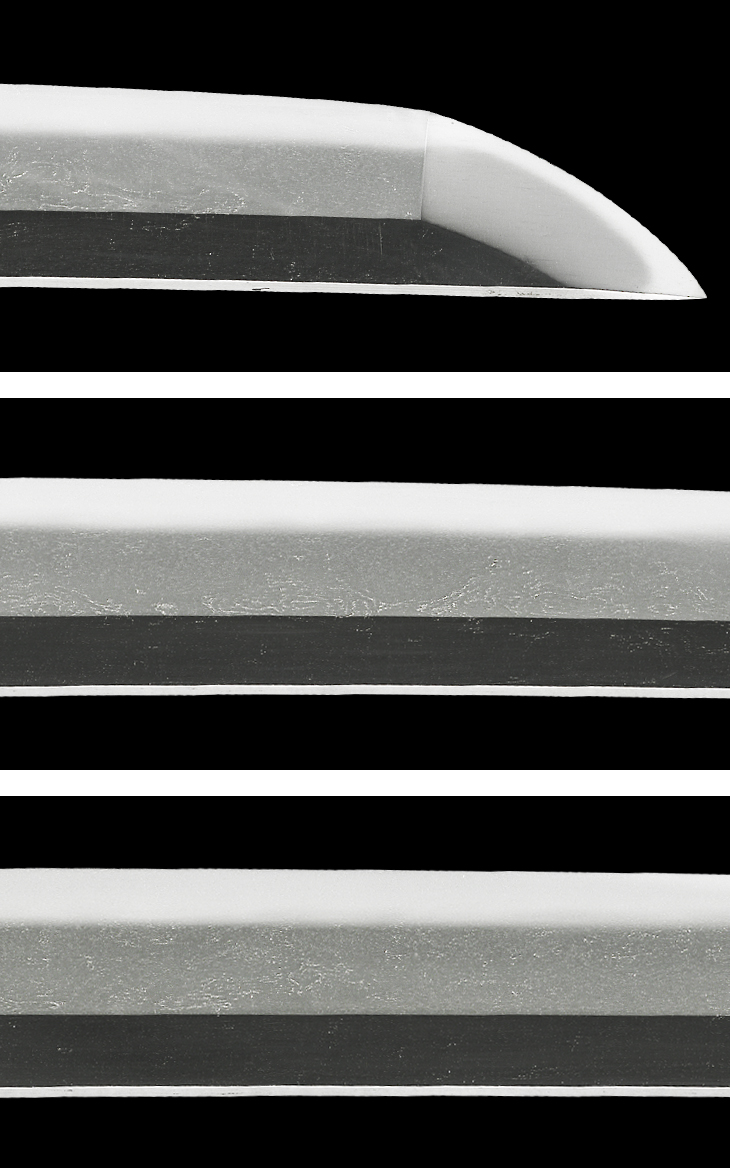
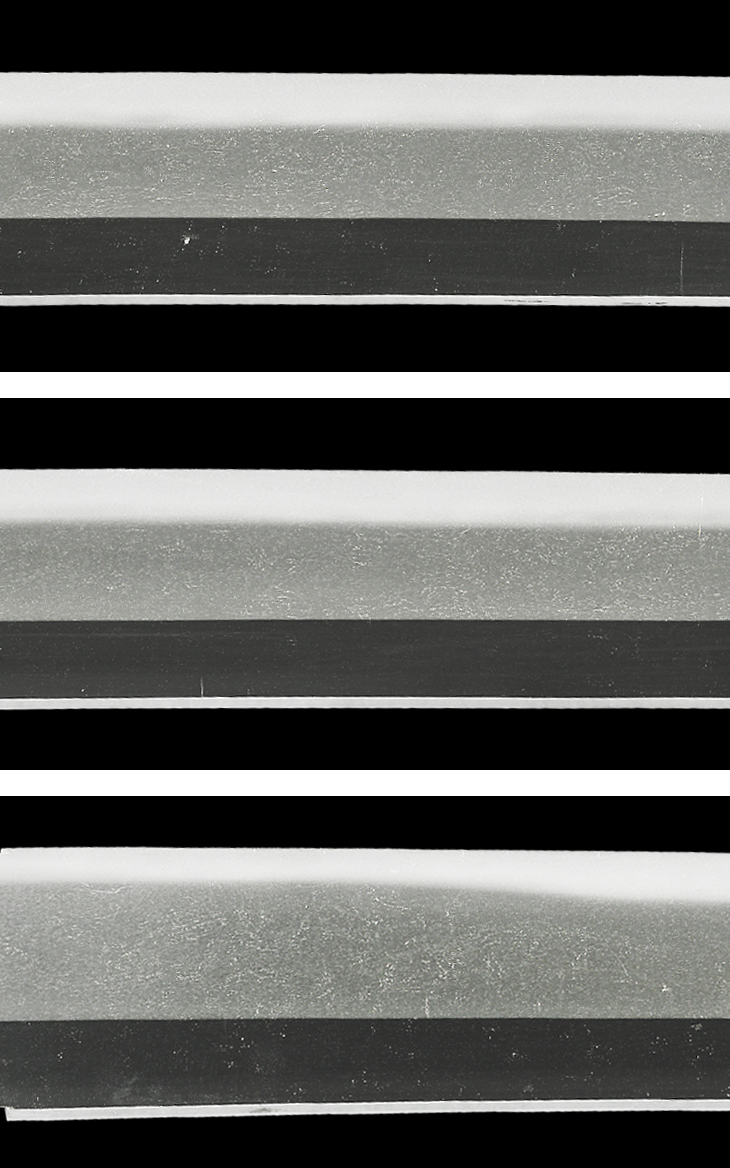
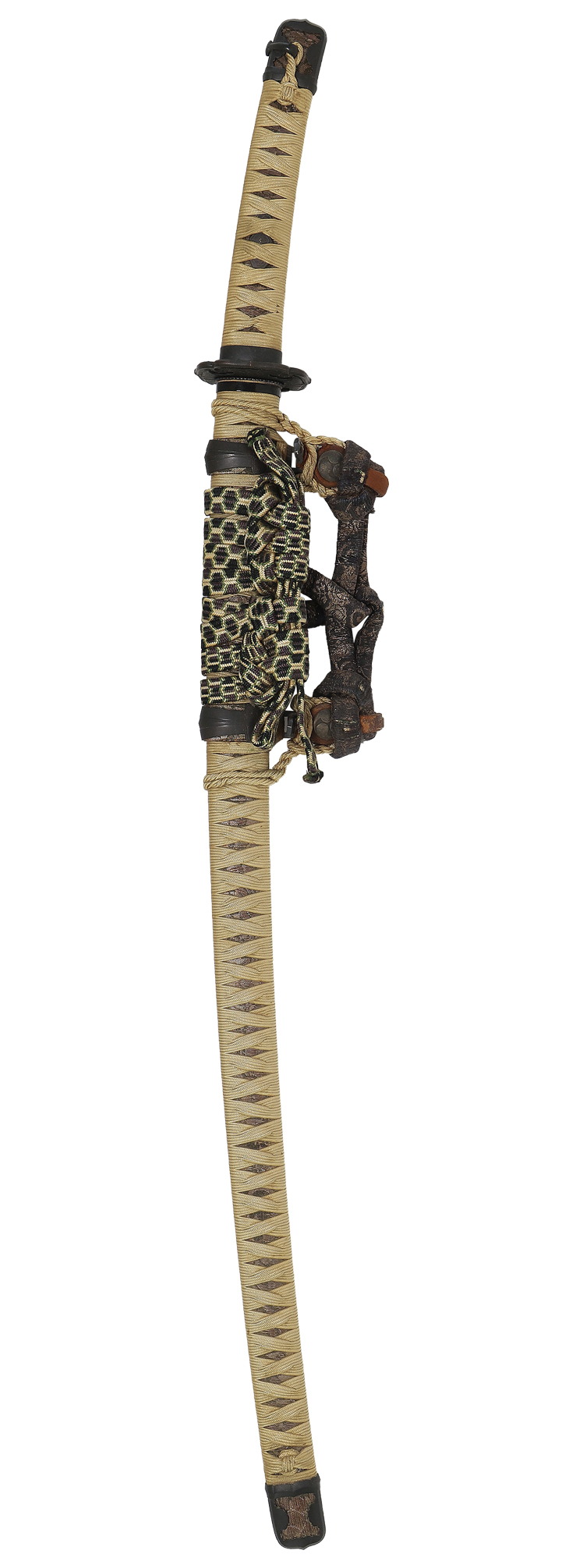
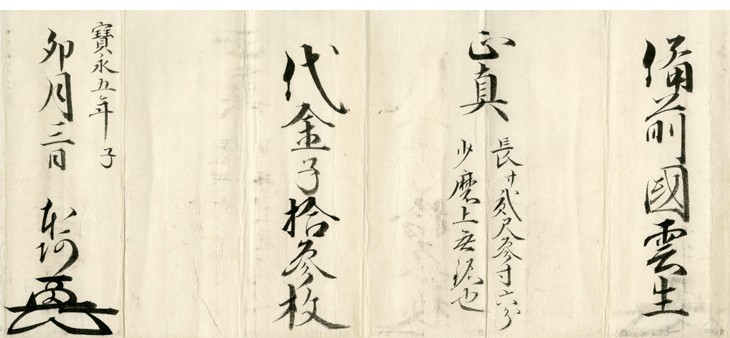
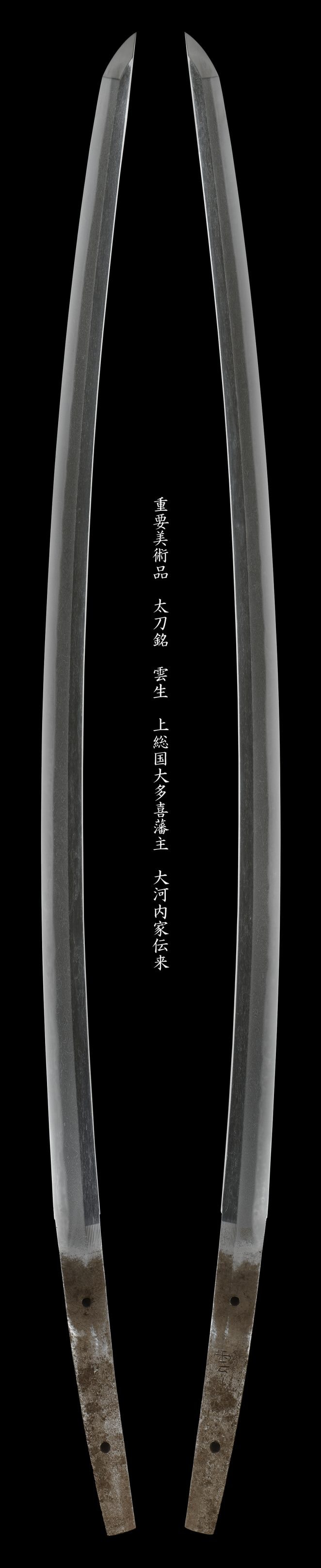
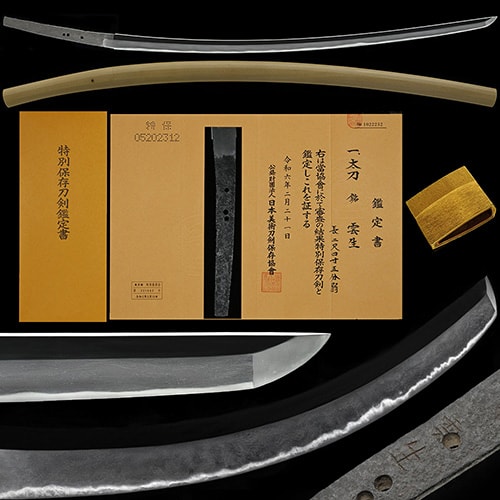
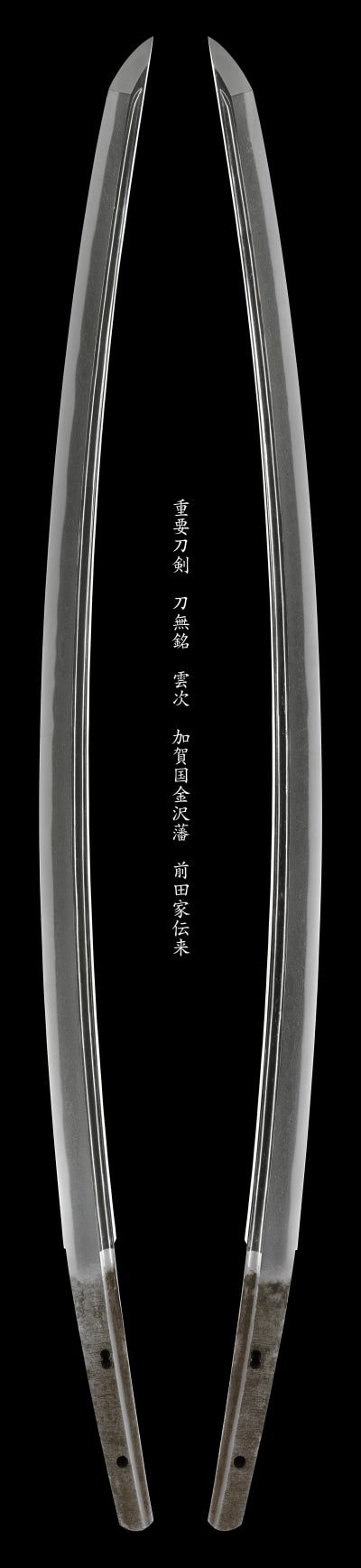
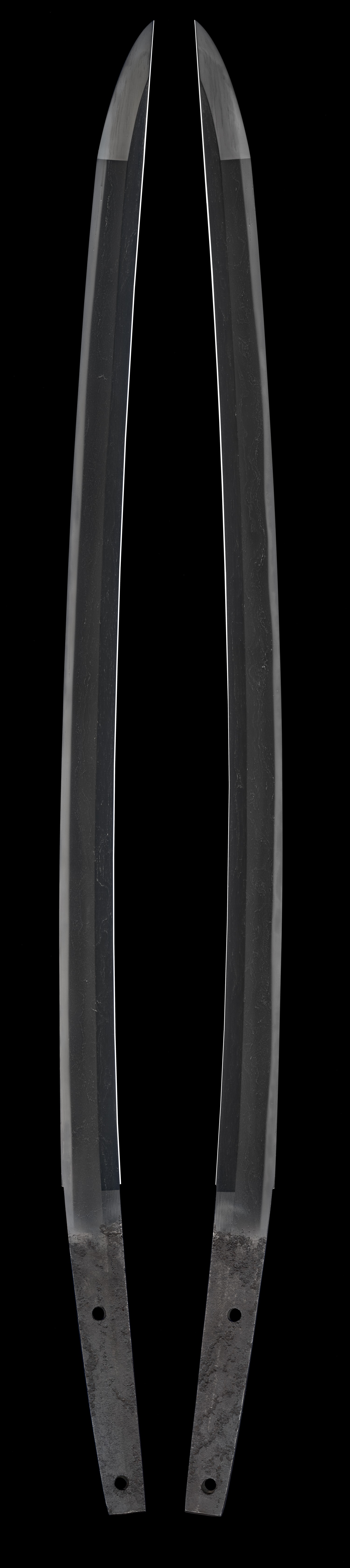
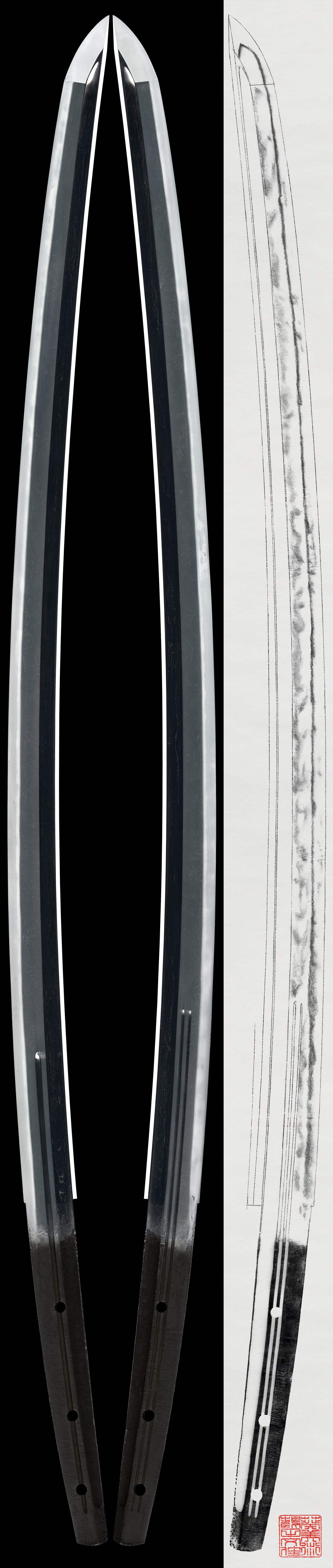
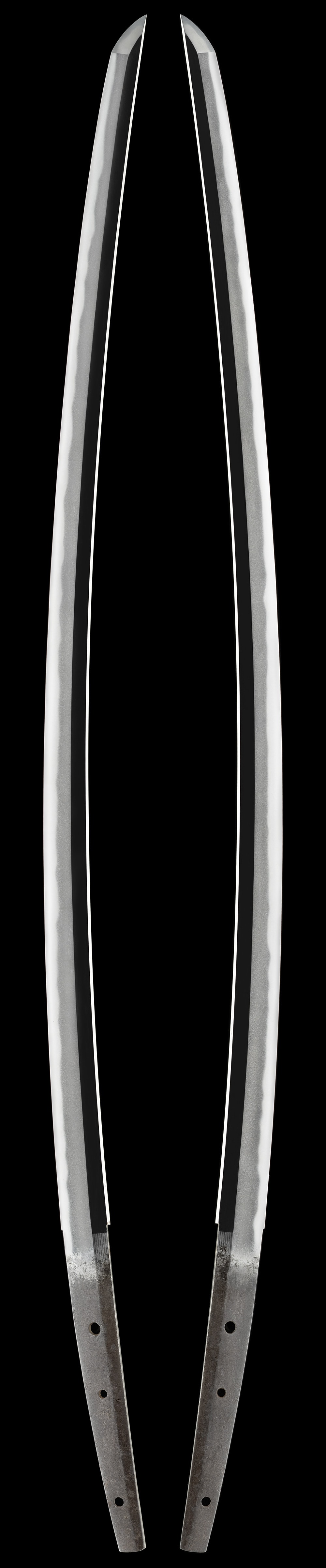
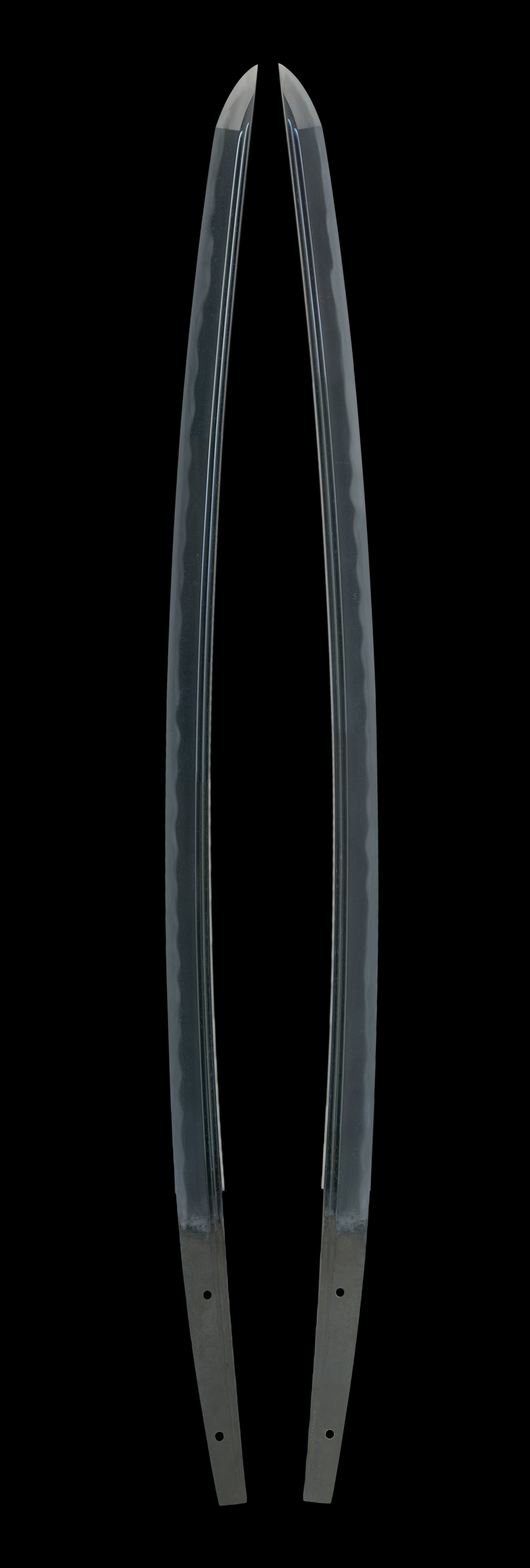
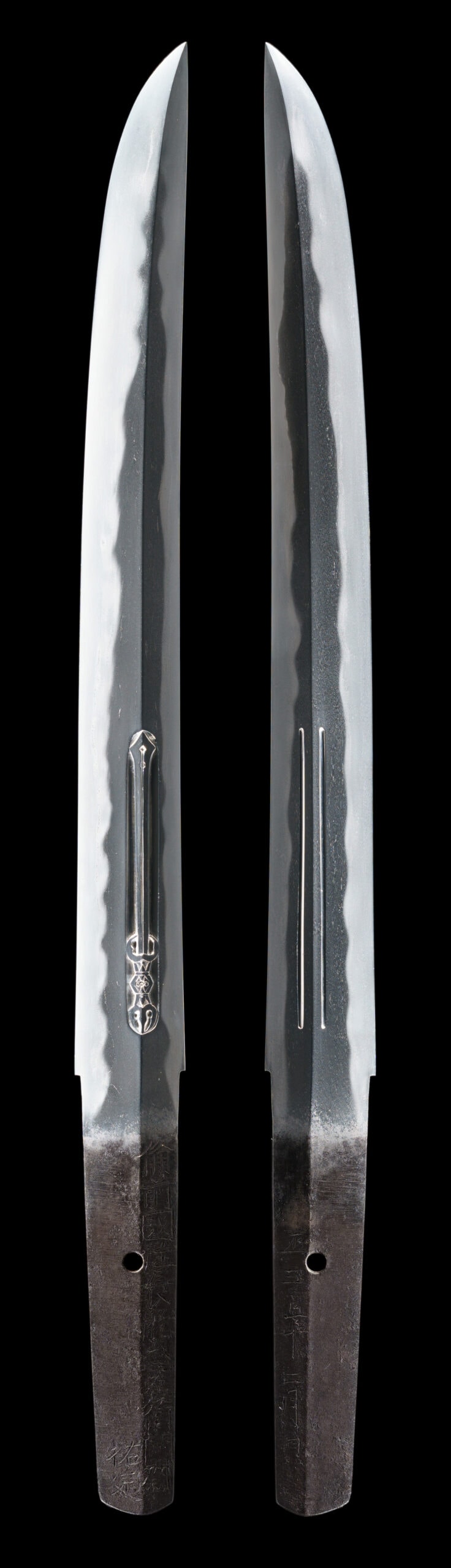
This is a Juyo Token designated katana attributed to Unsho, a master smith of the Ukai school in Bizen province during the late Kamakura period. It features a beautiful and elegant form, accompanied by a Hon'ami Mitsutada origami from Hoei 5 (1708), attesting to its quality. The blade exhibits a well-forged ko-itame hada with ji-nie and a bright hamon in suguha-cho with ko-gunome and ko-choji mixed in, showing excellent activity. It comes with both a shirasaya and a tachi koshirae from the late Edo period.

NBTHK Setsumei

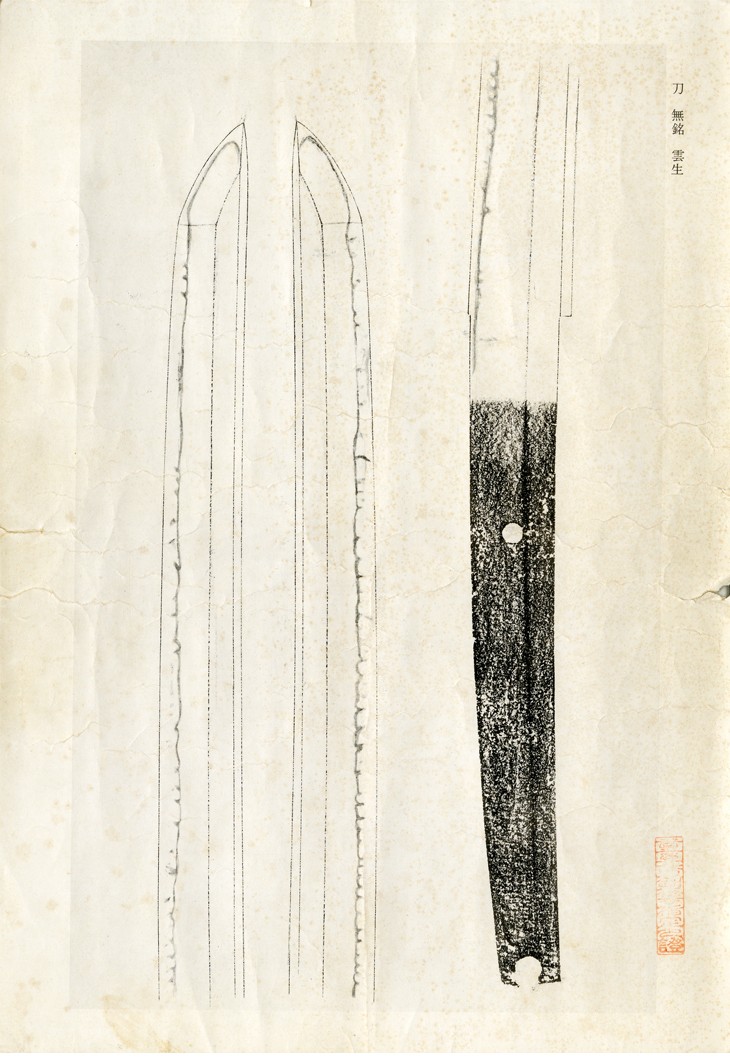
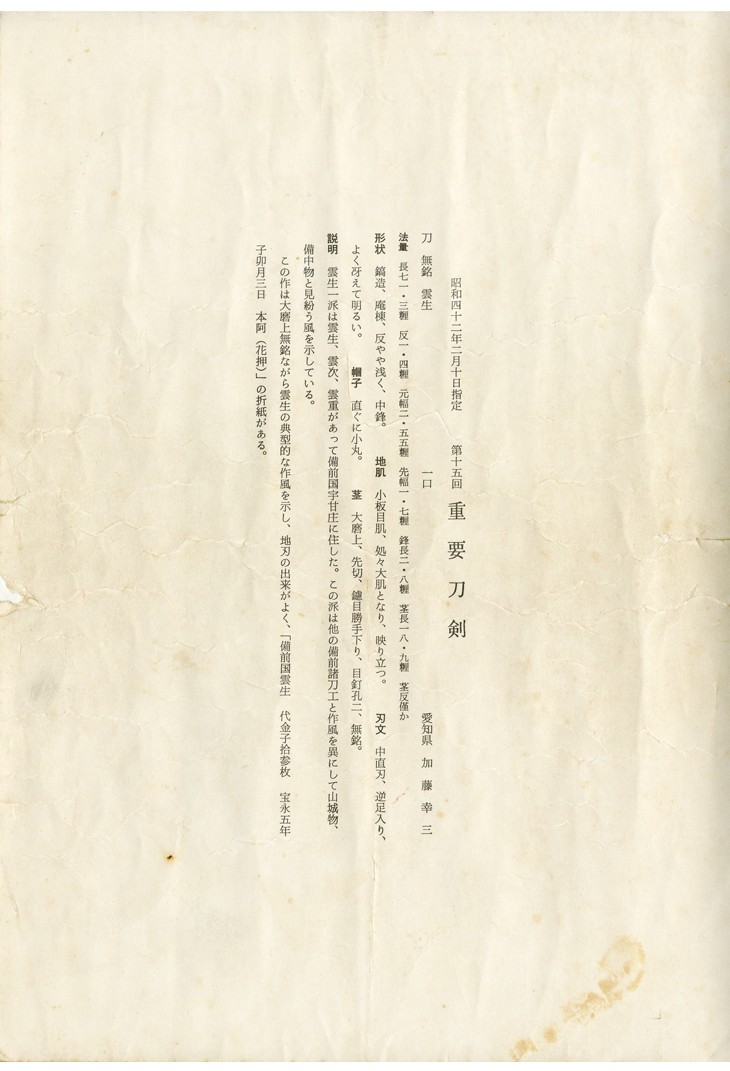
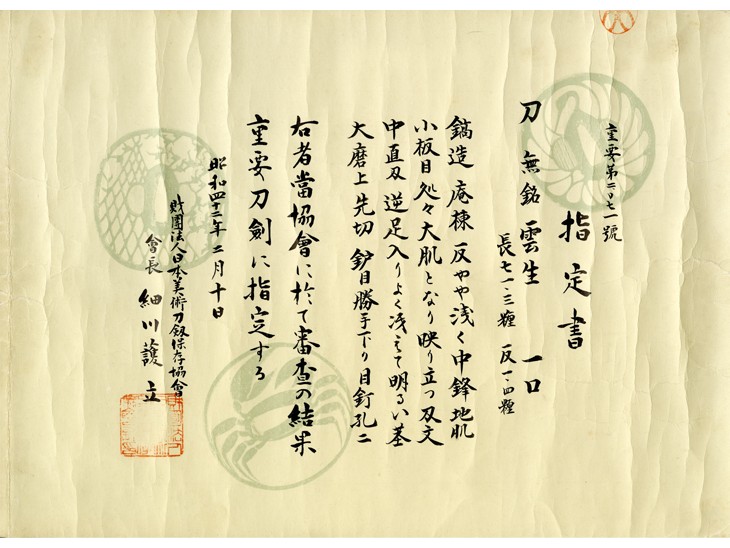
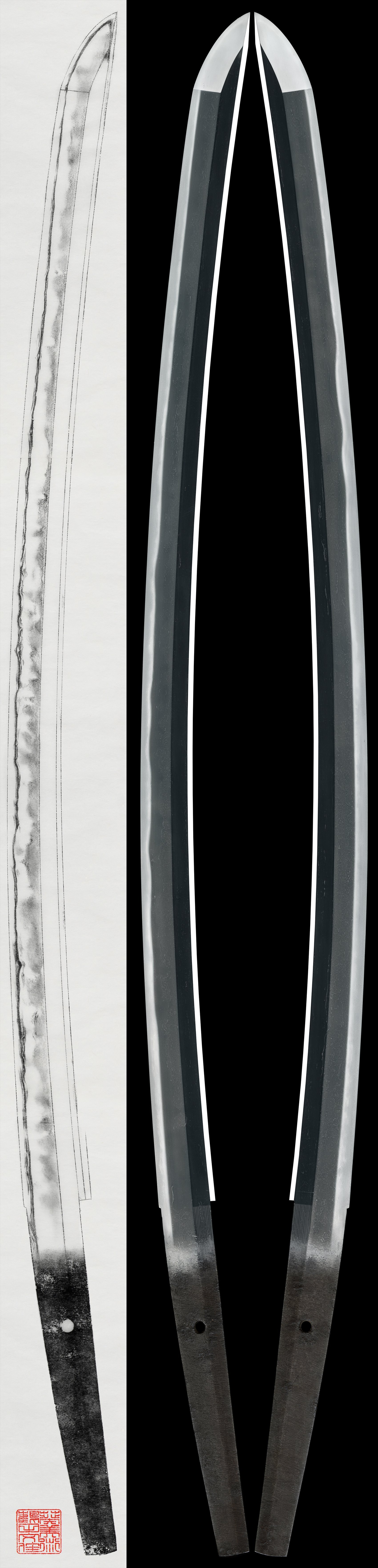
Jūyō-Tōken, 15th Session — Designated February 10, 1967 Katana, mumei: Unshō (雲生) Measurements Nagasa 71.3 cm, sori 1.4 cm, motohaba 2.55 cm, sakihaba 1.7 cm, kissaki-nagasa 2.8 cm, nakago-nagasa 18.9 cm, nakago-sori slight Description Keijō: shinogi-zukuri, iori-mune; somewhat shallow sori; chū-kissaki. Kitae: ko-itame-hada; in places becoming ō-hada; utsuri stands out. Hamon: chū-suguha, with saka-ashi; very saeru (clear) and bright. Bōshi: Straight, turning back in ko-maru. Horimono: None. Nakago: Greatly shortened (ō-suriage), kiri-jiri; katte-sagari yasurime; two mekugi-ana; unsigned. Artisan Unshō (雲生) Era Not stated. Explanation The Unshō lineage comprised Unshō, Unji (雲次), and Unshige (雲重), and resided at Ukan-no-shō (宇甘庄) in Bizen Province. The workmanship of this group differs from that of other Bizen smiths, showing a manner that can be mistaken for Yamashiro work or Bitchū work. Although this blade is greatly shortened and unsigned, it displays the typical style of Unshō, and the forging and tempering are of good quality. Moreover, it is accompanied by an appraisal document (origami) reading: “Bizen Province, Unshō; value: thirteen gold coins; Hōei 5, year of the Rat, 4th month (Uzuki), 3rd day; Hon’a (with kaō).”

NihontoWatch MonNihontoWatch
MarketEncyclopediaKantei
Swords›Bizen-den›Ukai›Unsho›Katana: Unsho (Mumei)
katanaJūyō
Ukai Unsho

Katana: Unsho (Mumei)

mumei · Ukai · Kamakura · nagasa 71.3cm · sori 1.4cm

¥5,900,000
Visit seller website →
Ukai Unsho (雲生) · Ukai · Kamakura2 works for sale →
KatanaJūyō
Could you name the smith from the blade alone? Today’s kantei →
Ukai Unsho — 1 of 8
Ukai Unsho — 2 of 8
Ukai Unsho — 3 of 8
Ukai Unsho — 4 of 8
Ukai Unsho — 5 of 8
Ukai Unsho — 6 of 8
Ukai Unsho — 7 of 8
Ukai Unsho — 8 of 8
1 / 8
1 / 8
Ukai Unsho — 1 of 8Ukai Unsho — 2 of 8Ukai Unsho — 3 of 8Ukai Unsho — 4 of 8Ukai Unsho — 5 of 8Ukai Unsho — 6 of 8Ukai Unsho — 7 of 8Ukai Unsho — 8 of 8
Ukai Unsho (雲生) · Ukai · Kamakura2 works for sale →
KatanaJūyō
Could you name the smith from the blade alone? Today’s kantei →
Measurements & details
Smith
Ukai Unsho
Type
Katana
School
Ukai
Period
Around 1303–1306(Kagen)
Province
Bizen
Signature
Unsigned(51% of this smith's designated works are signed)
Measurements
Nagasa 71.3cmSori 1.4cmMotohaba 2.65cmSakihaba 1.75cmKasane 0.6cm
Description

This is a Juyo Token designated katana attributed to Unsho, a master smith of the Ukai school in Bizen province during the late Kamakura period. It features a beautiful and elegant form, accompanied by a Hon'ami Mitsutada origami from Hoei 5 (1708), attesting to its quality. The blade exhibits a well-forged ko-itame hada with ji-nie and a bright hamon in suguha-cho with ko-gunome and ko-choji mixed in, showing excellent activity. It comes with both a shirasaya and a tachi koshirae from the late Edo period.

NBTHK Zufu Commentary

Juyo #15

AI translation — may contain errors

-, 15th Session — Designated February 10, 1967

, : Unshō (雲生)

Measurements 71.3 cm, 1.4 cm, 2.55 cm, 1.7 cm, 2.8 cm, 18.9 cm, slight

Description Keijō: , ; somewhat shallow ; . : ; in places becoming ō-hada; stands out. : , with ; very (clear) and bright. : Straight, turning back in . : None. : Greatly shortened (), ; ; two ; unsigned.

Artisan Unshō (雲生)

Era Not stated.

Explanation The Unshō lineage comprised Unshō, Unji (雲次), and Unshige (雲重), and resided at Ukan-no-shō (宇甘庄) in Province. The workmanship of this group differs from that of other smiths, showing a manner that can be mistaken for Yamashiro work or work.

Although this blade is greatly shortened and unsigned, it displays the typical style of Unshō, and the forging and tempering are of good quality. Moreover, it is accompanied by an appraisal document () reading: “ Province, Unshō; value: thirteen gold coins; Hōei 5, year of the Rat, 4th month (Uzuki), 3rd day; Hon’a (with ).”

About the maker

Unsho

雲生

Ukai / Unrui (Bizen) · Bizen · around 1303-1306

Fujishiro Jo saku · Tōken Taikan top 8%

2 pieces on the market now

›

From the end of the Kamakura period into the Nanbokucho, the swordsmiths Unsho, Unji and Unshige worked at Ukan-no-sho in Bizen Province, a place name later also written Ukai. From their residence the line is called the Ukan or Ukai school; because every smith set the character Un, the cloud, at the head of his name, the published sources also know them as the Unrui. Unsho is named outright the school's "de facto founder"[[c:1]]. No dated work of his survives; the registers place the first generation around Kengen and Kagen (1302 to 1306), and his years are fixed through the dated blades of Unji in Showa, Bunpo and Kenmu. Tradition holds that he went up to the capital with Unji, learned forging from the Yamashiro smiths, and served the Emperor Go-Daigo as duty smith (後醍醐天皇の御番鍛冶); Honma notes the rare blades with a sixteen-petal chrysanthemum crest[[c:2]] below the habaki that lend the tradition weight. In the school's work "Yamashiro-style elements are intermingled within the Bizen tradition"[[c:3]], with no small influence from the Aoe school of neighboring Bitchu besides, so that the line is called "a distinctive presence among Bizen works"[[c:4]]. Fujishiro grades Unsho Jo saku.

The trait the judges name first is the curvature: a slender tachi with funbari at the base and a small point, arching evenly in a high wa-zori, the torii curve. The published sources observe that "whereas the Osafune work of the same period is koshizori, it presents wa-zori"[[c:5]]. He excelled in suguha, narrow to medium, mixed with ko-gunome, ko-choji and shallow notare. The ashi slant in reverse in the Aoe manner, and here and there wedge-shaped shadowy togariba enter. The nioiguchi tightens, carries ko-nie and at times sinks subdued; kinsuji and fine sunagashi run along the edge. Now and then the temper falls away slightly at the hamachi, and the published sources note that "the yakiotoshi at the base may be called Unsho's individuality"[[c:6]]. The boshi turns back round, ko-maru or tending larger; even of a blade steeped in Aoe character the published record observes that his particularity shows exactly where "the boshi does not point"[[c:7]]. The two-character mei sits toward the mune above the mekugi-ana, the character Sho set right of Un, his habit of hand; Honma takes the comparatively large mei of this type for the first generation.

The jigane is itame, in places knit to ko-itame or mixed with mokume, with ji-nie and fine chikei, and a midare-utsuri stands. Characteristically it is what the published sources describe as "the black jifu-utsuri peculiar to the Unrui, as if pressed in with the pad of a finger"[[c:8]], and the steel color besides tends somewhat blackish.

Honma counts it a point of interest that these late Kamakura Bizen blades carry nie in both ji and ha, at times with "an utsuri even more vivid than in Osafune work"[[c:9]]. The published sources state his range in one sentence: "his representative manners are two"[[c:10]]. In one, standing itame with mokume, ko-midare in the suguha with a reverse tendency, nie and sunagashi; in the other, closely knit ko-itame, the utsuri especially distinct, the suguha nioiguchi tight. The ubu tachi of Tokubetsu Juyo session 7 belongs to the former, with an old-toned utsuri as if pressed in with a finger[[c:11]]. Beyond the pair lies a stronger vein. "Unsho's manner is mostly low in temper and somewhat lonely in its activity"[[c:12]], yet other works are known with a somewhat wider yakiba, conspicuous ashi and yo and strongly attached nie, a make that connects to Unji; the folded-signature katana of Tokubetsu Juyo session 21 is read exactly so, his work at full power. At least two generations are recognized, the second placed around Bunpo or Kenmu; the registers transmit the first Unji as his son, or by another account his younger brother. Long signatures are exceptional: the tanto signed Bizen no kuni Unsho[[c:13]] is called a signature almost without parallel[[c:14]].

His position within Bizen is the published sources' own formula: the work of the line, beginning with its curvature, is reckoned "the closest to Kyoto work"[[c:15]] among Bizen products, and individual blades can be confounded with the Rai school or with neighboring Aoe. His suguha holds the Kyoto level while his ashi run saka in the Aoe way. Yet the clearly defined midare-utsuri keeps the flavor of his native tradition strongly present, and where the make breathes Aoe, the round boshi remains his own. The judges divide the kin by the temper: his yakiba mostly low and quiet in its activity, that of Unji wider and strongly nie-laden, with ashi and yo standing out. The more powerful of his own blades are read as approaching his successor; the line continues through Unshige.

Seventy-four designated works stand on record. Six are Important Cultural Properties, held as cultural patrimony, and nine more were designated Juyo Bijutsuhin before the war, among them a tachi counted one of the thirty-five blades hand-picked by Uesugi Kagekatsu[[c:16]], the ubu tachi of Iwasaki Koyata, now in the Seikado Bunko Art Museum, and the tachi passed from Tokugawa Iesato to the Sano Art Museum. Fifty-seven blades stand in the Tokubetsu Juyo and Juyo tiers. Signed works are comparatively numerous for so early a smith, thirty-eight signed against thirty-three unsigned here, nearly all the two-character mei. Ten blades carry recorded provenance: the Tokubetsu Juyo tachi of session 12 descends in the Uda Mori, a cadet line of the Nagato Mori; an Asano house katana carries a Hon'ami Kocho origami of 1676 valuing it at ten gold pieces; others passed through the Okochi house and the Imperial Family. The Important Cultural Properties and the museum holdings will not move. What a collector may realistically encounter is a Juyo blade, an osuriage katana attributed on the wa-zori, the dark jifu-utsuri and the saka-laced suguha, or one of the signed tachi; a signed ubu tachi comes to open hands only rarely, and is an event in the field when it does.

Historical importance

Where Unsho stands among comparable artisans: across all of nihontō, and within tradition, era, and period. The tiers (Foremost · Leading · Major · Notable) weigh official designations from the NBTHK and Japan's Agency for Cultural Affairs, together with historical honors of lasting repute such as the Sansaku and Meibutsu-chō.

随一
Foremost
屈指
Leading
有数
Major
著名
Notable

Select a lens to see how it's measured.

Designation record
74 designated works
Jūyō Bunkazai
6
Jūyō Bijutsuhin
9
Gyobutsu (Imperial)
2
Tokubetsu Jūyō
3
Jūyō
54
2 works by Unsho on the market→
Unsho — full profileUkai / Unrui (Bizen) school

Study this maker →

About the school

Ukai

鵜飼

Bizen-den · Bizen

11 pieces on the market now

›

At Ukan-no-shō in Bizen Province, a place name later written Ukai, a small group of smiths worked from the close of the Kamakura period into the first decades of Nanbokuchō, every one of them setting the character Un, the cloud, at the head of his name; for that habit the published sources know them equally as the Ukai school and as the Unrui, the cloud group. Unshō is named the line's de facto founder, his years fixed around Kengen and Kagen (1302 to 1306) through the dated blades of his son Unji, who alone among the early hands left work inscribed with eras, the Shōwa, Bunpō and Kenmu nengō; Unju, read also Unshige, carries the line a third remove into the mid-Nanbokuchō, his dated Jōji tachi of 1368 set against the founders before him. Tradition holds that Unshō and Unji went up to the capital, learned forging from the Yamashiro smiths, and served Retired Emperor Go-Daigo as duty smiths, and the rare blades with a sixteen-petal chrysanthemum crest below the habaki lend that account its weight. The make that resulted stands apart from the Osafune mainstream: within an essentially Bizen body the members describe a Yamashiro cast intermingled, with no small influence from the Aoe school of neighboring Bitchū besides, so that the published sources call the line a distinctive presence among Bizen works. The shared vocabulary begins with the curvature: a slender tachi with funbari at the base and a small point, arching evenly in a high wa-zori where the Osafune work of the same generation runs koshizori, the papers reading that even arch as close to Kyoto work. Against the chōji of the mainline the Ukai hands temper suguha, narrow to medium, mixed with ko-gunome, ko-chōji, shallow notare and a small midare, the ashi and yō entering thickly and slanting in reverse in the Aoe manner; kinsuji, sunagashi and hotsure work along the edge, and the nioiguchi now tightens under ko-nie, now sinks subdued. The jigane is itame mixed with mokume, knit to ko-itame on the finer blades, with ji-nie, fine chikei and a steel color tending blackish, across which stands a midare-utsuri; the group's own signature is what the papers call the black jifu-utsuri peculiar to the Unrui, as if pressed in with the pad of a finger.

The bōshi turns back round, ko-maru, and the round turn that does not point is held the school's particularity even where the make breathes Aoe. Within that common ground the members divide by temper: Unshō's yakiba is mostly low and quiet in its activity; Unji is the nie hand, his line wider and strongly nie-laden with ashi and yō standing out, his hada flowing and at times masa-tinged; Unju presses the idiom toward the Nanbokuchō with deepening nie and a scantier utsuri, his most Yamato-leaning blades running almost into masame with kuichigai-ba and a yakizume sweep. To kantei Ukai work is to read the line as the closest to Kyoto work among Bizen products: the wa-zori and even arch, the dark jifu-utsuri, the suguha laced with saka-ashi, and the round bōshi that settles a blade which might at first sight be confounded with the Rai school or with neighboring Aoe. The judges separate the hands by the activity of the ha, hotsure and stronger nie carrying an unsigned blade to Unji rather than Unshō, the reverse-chisel strokes of the mei and the date cut straight beneath a long signature answering to Aoe practice on Unju's signed pieces. Among the members Unji is the name a collector is likeliest to meet and the chronological anchor of the whole group, Unshō the founder whose stronger blades approach his successor, Unju the rare and individual third hand. What survives privately is most often an ō-suriage mumei katana attributed on the silhouette and the cloud-group traits, or, far less often, a signed tachi; provenance runs through the Uesugi hand-picked thirty-five, the Mōri, Ikeda, Maeda and Date houses and the Imperial Family, while the patrimonial pieces and museum holdings do not move. Learn more →

6 recorded smiths277 designated works
Leading smiths
SmithEraDesignated
Unsho雲生1303-130674
Unji雲次1315-1335138
Unju雲重1352-137560
Unsho雲生1317-13190
Morikage守景1352-13560
Explore the Ukai school →

Historical context

Bizen in the Kamakura period

›

Kamakura was Bizen’s summit. Tradition places Ichimonji smiths among Go-Toba’s goban kaji, Mitsutada founded the Osafune line at mid-century, and orders flowed from the court and the warrior government alike. No province holds more National Treasure blades.

Bizen in the Kamakura period →

NBTHK Certificate
Jūyō Tōken重要刀剣
Important Sword
›

A blade of top-grade workmanship and condition, formally judged to rank with a nationally recognized Important Art Object (Jūyō Bijutsuhin). Awarded only at the NBTHK’s competitive annual examination.

Of Japan’s roughly 2.5 million registered swords, only 12,357 (about 1 in 202) have ever attained Jūyō.

About the NBTHK›

The NBTHK (Nihon Bijutsu Tōken Hozon Kyōkai, the Society for the Preservation of Japanese Art Swords) is a public-interest incorporated foundation founded in 1948 and supervised by Japan’s Agency for Cultural Affairs (Bunkachō); it is based at the Japanese Sword Museum in Tokyo. Its expert panels physically examine each submitted work (shinsa) and issue a certificate (kanteishō) ranking it by artistic and historical merit. NBTHK papers are the most widely recognized standard of authentication for Japanese swords and fittings.

NBTHK official site→
Seller
S
Samurai Nippon
Established 1977 · 49 yrs on the market
🇯🇵Ships from Japan
›
✓Verified dealersamurai-nippon.net
Settles in JPY
✓Ships worldwide✓English supportWire transferPayPalCredit card
Return policy

For one-of-a-kind items such as swords, sword fittings, and antiques, please contact us about a return within 3 days of the item's arrival and ship it back within 8 days. Refunds are issued the same day the returned item arrives.

View all of Samurai Nippon’s listings→View this item on the dealer’s site→

More works by Ukai Unsho

View all →
Goushuya
Jūyō Bijutsuhin
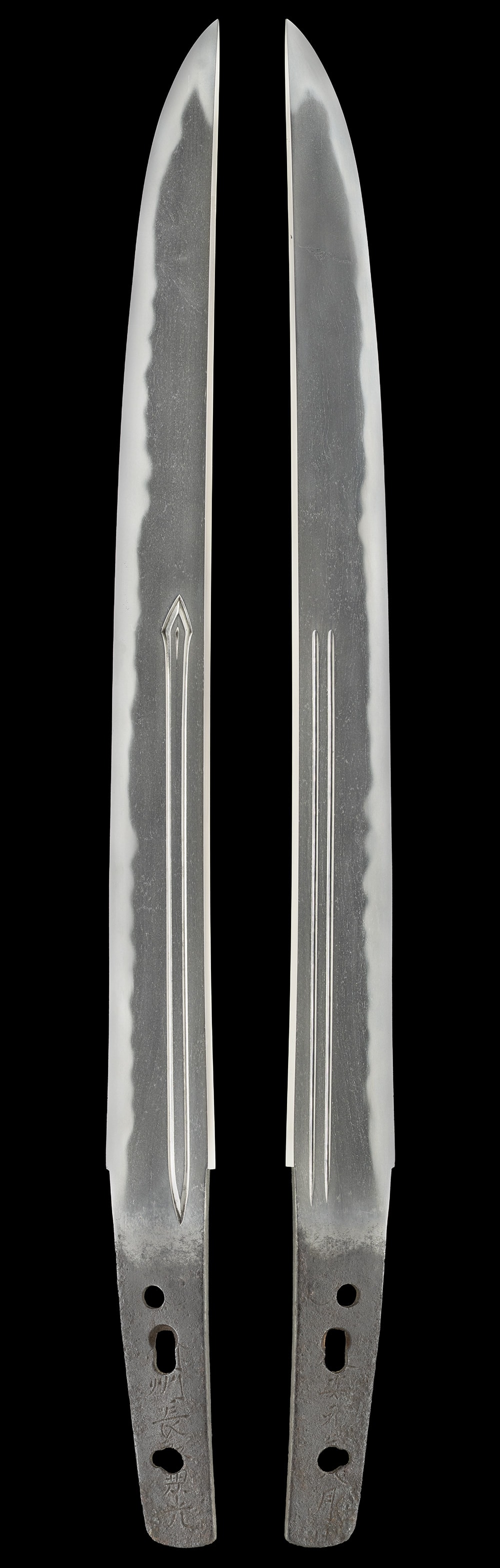
Tachi - Jubi - by Ukai Unsho - Juyo Bijutsuhin Tachi by Unsho, formerly owned by the Ogochi family, lords of Otaki Domain in Kazusa ProvinceTachi - Jubi - by Ukai Unsho - Juyo Bijutsuhin Tachi by Unsho, formerly owned by the Ogochi family, lords of Otaki Domain in Kazusa Province

Tachi

ByUkai Unsho
Ask

Previously sold by Ukai Unsho

View all →
Eirakudo
Tokuho
Tachi - Tokuho - by Ukai Unsho - Mei Unsho Ubu-Nakago Tachi Tokubetsu Hozon TokenTachi - Tokuho - by Ukai Unsho - Mei Unsho Ubu-Nakago Tachi Tokubetsu Hozon Token
Sold

Tachi

ByUkai Unsho
SOLD
Kusanagi
Tokuho
Tachi - Tokuho - by Ukai Unsho - Tokubetsu Hozon Tachi by Unsho, Master Swordsmith to Emperor Go-Daigo, Ukai School Founder, Kamakura Period, Signed, Masterpiece and SoundTachi - Tokuho - by Ukai Unsho - Tokubetsu Hozon Tachi by Unsho, Master Swordsmith to Emperor Go-Daigo, Ukai School Founder, Kamakura Period, Signed, Masterpiece and Sound
Sold

Tachi

ByUkai Unsho
SOLD

More from the Ukai school

View all →
Token-Net
Jūyō
Wakizashi - Jūyō - by Ukai Unji - Mumei (Unji) - BizenWakizashi - Jūyō - by Ukai Unji - Mumei (Unji) - Bizen

Wakizashi

ByUkai Unji
¥2,500,000
Goushuya
Jūyō
Katana - Jūyō - by Ukai Unji - Juyo Token Mumei Katana by UnjiKatana - Jūyō - by Ukai Unji - Juyo Token Mumei Katana by Unji
Koshirae

Katana

ByUkai Unji
Ask
Nipponto
Tokuho
Katana - Tokuho - by Ukai School - Japanese Sword Katana by Unju (Grandson of Unsho of Unrui Ukai School) with Tokubetsu Hozon CertificateKatana - Tokuho - by Ukai School - Japanese Sword Katana by Unju (Grandson of Unsho of Unrui Ukai School) with Tokubetsu Hozon Certificate

Katana

ByUkai School
¥2,600,000
Aoi Art
Tokuho
Katana - Tokuho - by Ukai School - Mumei (Attributed to Unju) - NBTHK Tokubetsu Hozon TokenKatana - Tokuho - by Ukai School - Mumei (Attributed to Unju) - NBTHK Tokubetsu Hozon Token

Katana

ByUkai School
Starting price¥100,000
Tosa Touken Do
Hozon
Hozon - by Ukai School - Mumei Ukai Naginata-Naoshi KatanaHozon - by Ukai School - Mumei Ukai Naginata-Naoshi Katana

Mumei Ukai Naginata-Naoshi Katana

ByUkai School
Ask
Katanahanbai
Tokuho
Katana - Tokuho - by Ukai School - Mumei UnjuKatana - Tokuho - by Ukai School - Mumei Unju

Katana

ByUkai School
¥1,350,000
Aoi Art
Tokuho
Katana - Tokuho - by Ukai School - Mumei (Unju) - NBTHK Tokubetsu Hozon TokenKatana - Tokuho - by Ukai School - Mumei (Unju) - NBTHK Tokubetsu Hozon Token

Katana

ByUkai School
¥1,750,000
Token-Net
Jūyō
Wakizashi - Jūyō - by Ukai Unji - Mumei (Unji) (Bizen) (Sanyodo)Wakizashi - Jūyō - by Ukai Unji - Mumei (Unji) (Bizen) (Sanyodo)

Wakizashi

ByUkai Unji
¥2,500,000

More from the Bizen tradition

View all →
Eirakudo
Jūyō
Katana - Jūyō - by Osafune Kagemitsu - Kagemitsu - Juyo TokenKatana - Jūyō - by Osafune Kagemitsu - Kagemitsu - Juyo Token

Katana

ByOsafune Kagemitsu
Ask
Nipponto
Tokuho
Tachi - Tokuho - by Hatakeda Moriie - Japanese Sword Tachi by Moriie (Friend of Mitsutada, Founder of Hatakeda School)Tachi - Tokuho - by Hatakeda Moriie - Japanese Sword Tachi by Moriie (Friend of Mitsutada, Founder of Hatakeda School)
Koshirae

Tachi

ByHatakeda Moriie
¥5,800,000
Nipponto
Tokuho
Wakizashi - Tokuho - by Fukuoka Ichimonji Yoshihira - Japanese Sword Wakizashi by Yoshihira (Fukuoka Ichimonji) with Gaku-Mei, attributed as an excellent piece by Tanobe-sensei, a representative smith of the peak period of Bizen Fukuoka IchimonjiWakizashi - Tokuho - by Fukuoka Ichimonji Yoshihira - Japanese Sword Wakizashi by Yoshihira (Fukuoka Ichimonji) with Gaku-Mei, attributed as an excellent piece by Tanobe-sensei, a representative smith of the peak period of Bizen Fukuoka Ichimonji
Koshirae

Wakizashi

ByFukuoka Ichimonji Yoshihira
Ask
Eirakudo
Tokuho
Tanto - Tokuho - by Osafune Kanemitsu - Kanemitsu - Tokubetsu Hozon TokenTanto - Tokuho - by Osafune Kanemitsu - Kanemitsu - Tokubetsu Hozon Token

Tantō

ByOsafune Kanemitsu
¥4,500,000
Toukentakarado
Jūyō
Katana - Jūyō - by Osafune Tomomitsu - Mumei Attributed to TomomitsuKatana - Jūyō - by Osafune Tomomitsu - Mumei Attributed to Tomomitsu
Koshirae

Katana

ByOsafune Tomomitsu
¥6,300,000
Hyozaemon
Hozon
Tanto - Hozon - by Sukesada - Sue-Bizen, Yozaemonjo Sukesada with common name, magnificent double-edged tantoTanto - Hozon - by Sukesada - Sue-Bizen, Yozaemonjo Sukesada with common name, magnificent double-edged tanto
Koshirae

Tantō

BySukesada
¥2,900,000
Tsuruginoya
Jūyō
Katana - Jūyō - by Fukuoka Ichimonji School - Mumei Fukuoka IchimonjiKatana - Jūyō - by Fukuoka Ichimonji School - Mumei Fukuoka Ichimonji
Koshirae

Katana

ByFukuoka Ichimonji School
Ask
World Seiyudo
Tokuho
Katana - Tokuho - by Sukesada - Bizen-koku-ju Osafune Sukesada - NBTHK Tokubetsu Hozon TokenKatana - Tokuho - by Sukesada - Bizen-koku-ju Osafune Sukesada - NBTHK Tokubetsu Hozon Token

Katana

BySukesada
¥2,600,000

Swords

  • Katana
  • Wakizashi
  • Tantō
  • Tachi
  • Naginata
  • Yari
  • Japanese Swords
  • Samurai Swords

Fittings

  • Tsuba
  • Fuchi-Kashira
  • Kozuka
  • Menuki
  • Sword Guards (Tsuba)

Armor

  • Kabuto
  • Samurai Armor
  • All Samurai Armor

By Certification

  • Tokujū
  • Jūyō
  • Tokuho
  • Hozon

Resources

  • Dealer Directory
  • Artist Directory
  • The Daily Kantei
  • Glossary
  • Browse All
Nihontowatch© 2026
TermsPrivacyCookiesAbout

¥5,900,000

View on Samurai Nippon
NihontoWatch MonNihontoWatch
Market
Encyclopedia
Kantei