NihontoWatch Mon

NihontoWatch

Market
Encyclopedia
Kantei
NihontoWatch Mon

NihontoWatch

Market
Encyclopedia
Kantei

Description

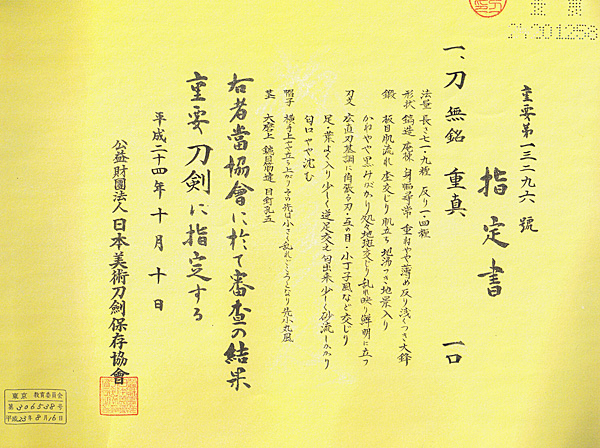
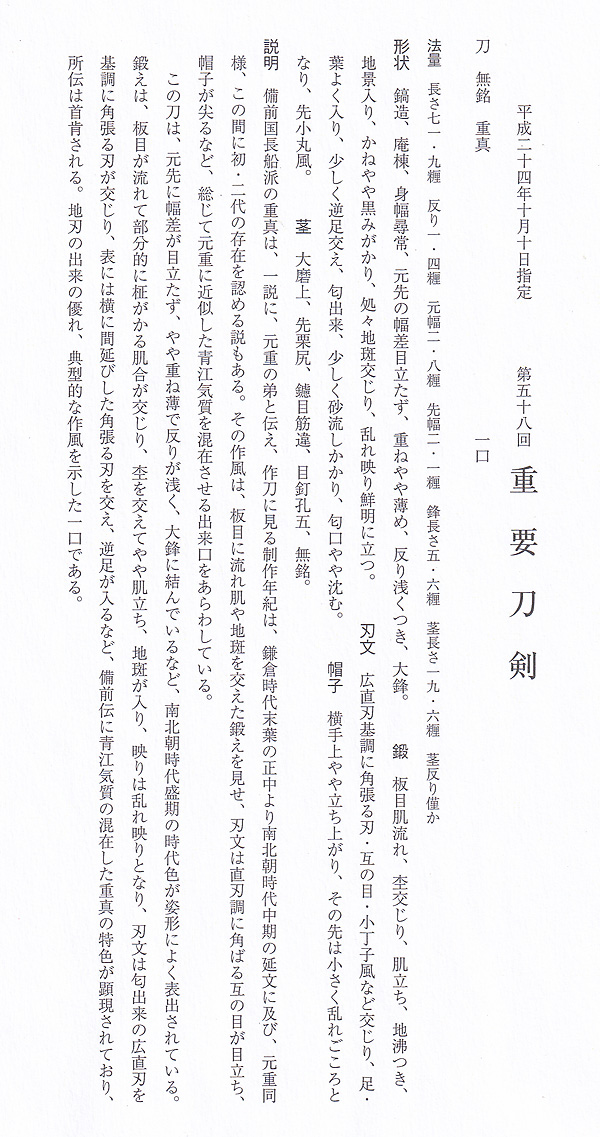
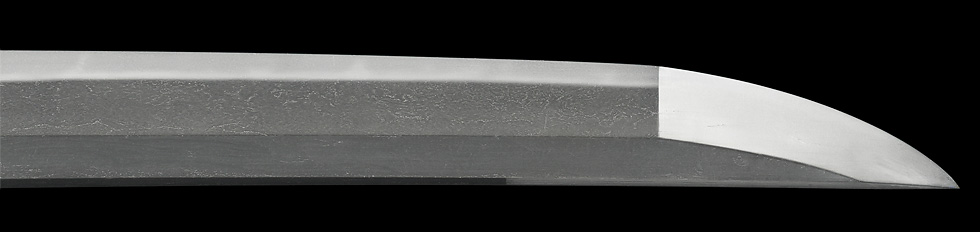
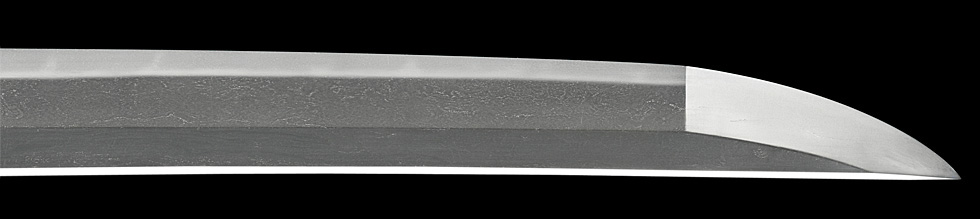
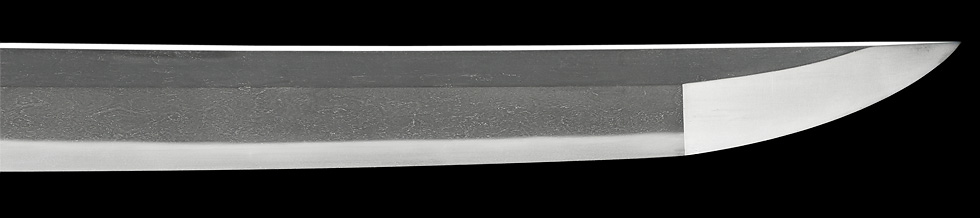
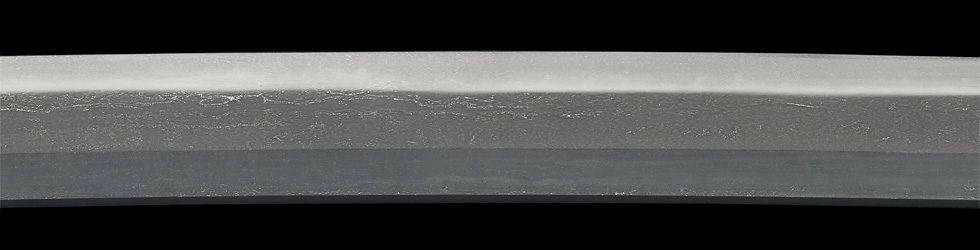
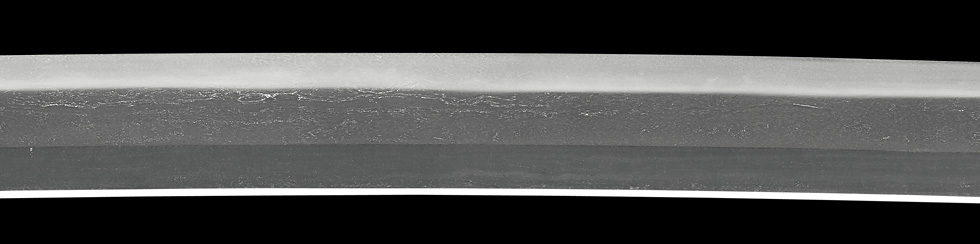
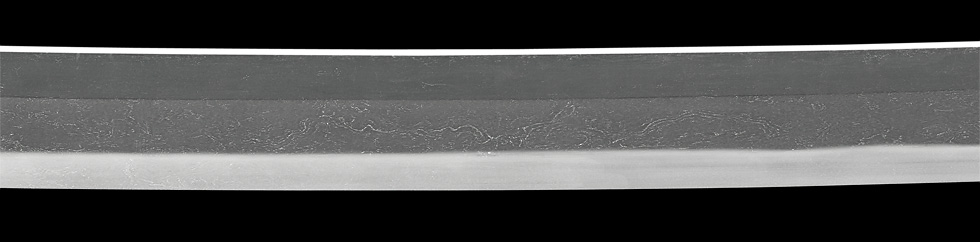
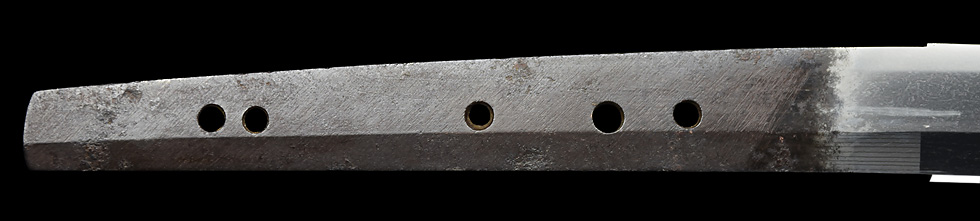
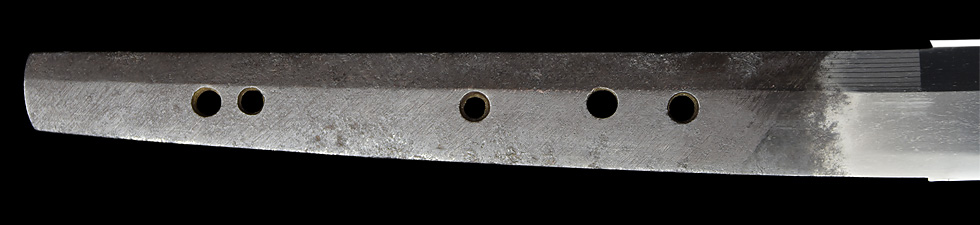
This is an unsigned katana attributed to Shigema, designated as a 58th Juyo Token. It features a hira-zukuri iori-mune construction with an o-suriage nakago. The hada is itame mixed with mokume, slightly standing out with ji-nie and chi-kei. The hamon is a wide suguha with gunome and ko-choji mixed in, with active ashi, yo, kinsuji, and sunagashi.

NBTHK Setsumei

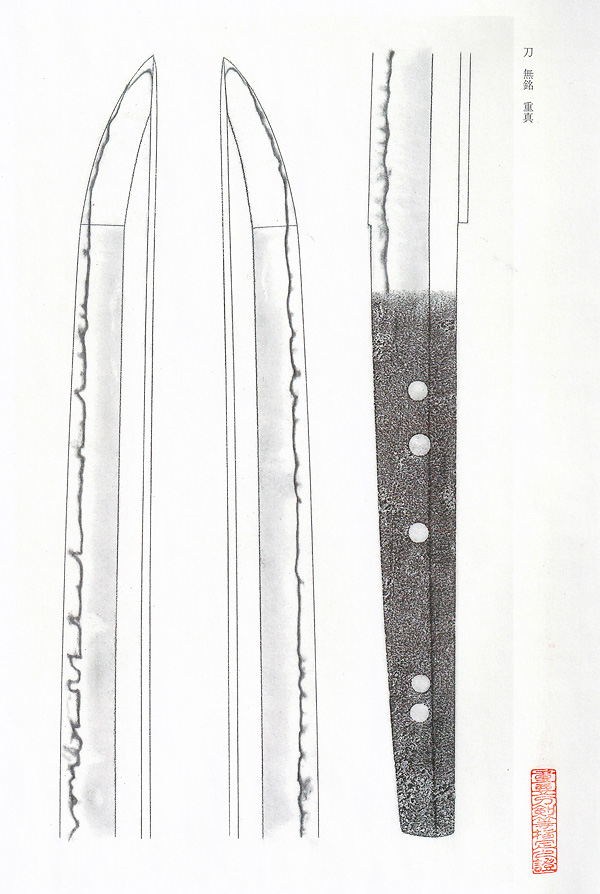
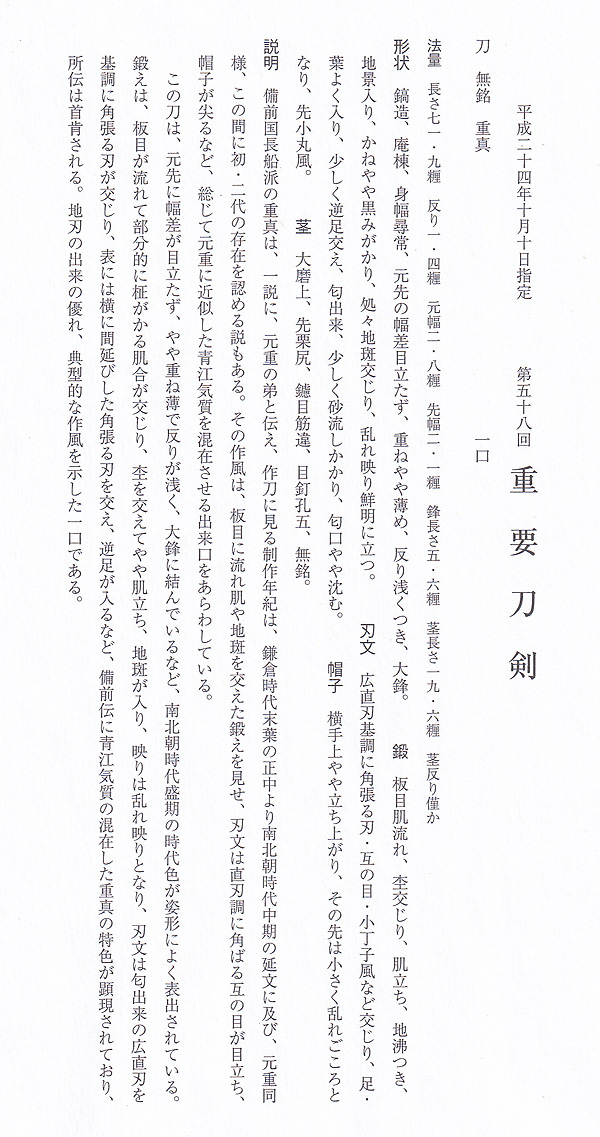
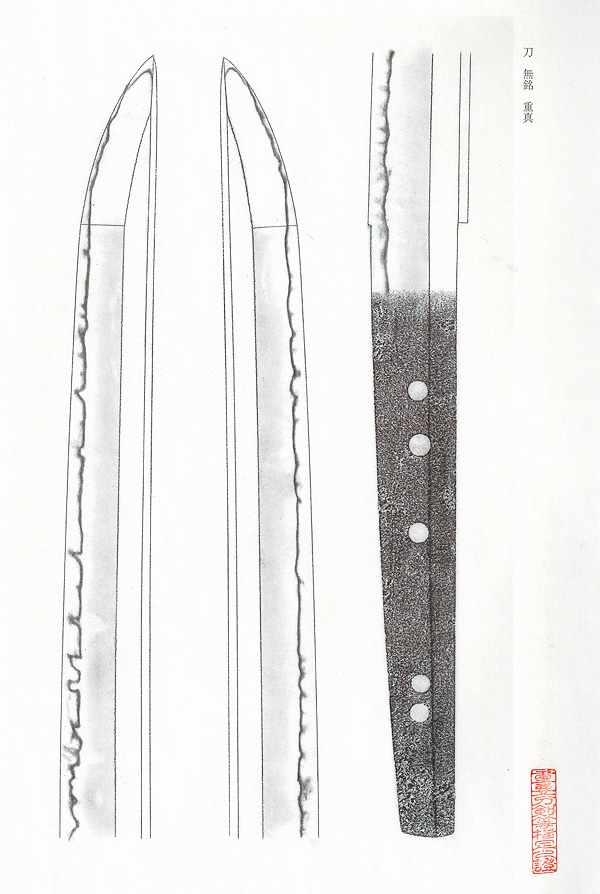
Jūyō-Tōken, 58th Session — Designated October 10, 2012 Katana, mumei: Shigemasa (重真) Measurements Nagasa 71.9 cm, sori 1.4 cm, motohaba 2.8 cm, sakihaba 2.1 cm, kissaki-nagasa 5.6 cm, nakago-nagasa 19.6 cm, nakago-sori slight Description Keijō: Shinogi-zukuri, iori-mune; standard mihaba with little difference between base and tip widths; somewhat thin kasane; shallow sori; ō-kissaki. Kitae: Flowing itame-hada mixed with mokume; the grain stands somewhat (hada-dachi); ji-nie adheres; chikei appears; the steel shows a slightly blackish tone, with scattered jifu; vivid midare-utsuri stands out clearly. Hamon: A hiro-suguha basis, mixed with angular elements, gunome, and ko-chōji-like forms; ashi and yō enter well, with some saka-ashi; nioi-deki; slight sunagashi; the nioiguchi shows a slight shizumi (subdued) tendency. Bōshi: Rises somewhat above the yokote; then shows a slight suggestion of midare, finishing in a small ko-maru-like turn. Horimono: None. Nakago: Greatly shortened (ō-suriage); kurijiri tip; sujikai file marks; five mekugi-ana; unsigned. Artisan Shigemasa (Osafune school, Bizen) Era Nanbokuchō period (mid-14th century) Explanation Shigemasa of the Osafune group in Bizen Province is traditionally regarded—according to one view—as a younger brother of Motoshige. Dates seen among his extant works range from Shōchū in the late Kamakura period through Enbun in the middle Nanbokuchō period. As with Motoshige, there is also a theory that within this span one may recognize the existence of a first and second generation. In terms of style, his forging shows itame mixed with flowing grain and jifu; his temper is characterized by a suguha-based manner in which angular gunome stands out, and by pointed tendencies in the bōshi. Overall, his work manifests workmanship close to Motoshige’s, while also revealing a mixed-in Aoe character. This katana shows little visible taper between the base and the tip, has a slightly thin kasane and shallow curvature, and culminates in an ō-kissaki—features that strongly express the period character of the height of the Nanbokuchō era. In the forging, the itame flows and locally tends toward masame, with mokume mixed in; the grain stands somewhat, jifu appears, and the utsuri is a clear midare-utsuri. The hamon is fundamentally a nioi-deki wide suguha, mixed with angular elements; on the omote there are horizontally elongated, angular forms, and saka-ashi also enters. In these points, the distinctive features of Shigemasa—Bizen tradition with an admixture of Aoe character—are plainly evident, and the traditional attribution is accordingly persuasive. This is an excellent work, showing superior ji and ha and presenting a typical example of the smith’s manner.

NihontoWatch Mon

NihontoWatch

Market
Encyclopedia
Kantei
Swords›Bizen-den›Osafune›Sōden-Bizen›Shigezane›Katana: Mumei Shigema (58th Juyo Token)
katanaJūyō
Osafune Shigezane

Katana: Mumei Shigema (58th Juyo Token)

mumei · Kamakura · nagasa 71.9cm · sori 1.4cm

¥5,300,000
Visit seller website →
Osafune Shigezane — 1 of 3
Osafune Shigezane — 2 of 3
Osafune Shigezane — 3 of 3
1 / 3
1 / 3
Osafune Shigezane — 1 of 3Osafune Shigezane — 2 of 3Osafune Shigezane — 3 of 3
Measurements & details
Smith
Osafune Shigezane
Type
Katana
School
Osafune
Period
Around 1327–1358(Kenmu ND)
Signature
Unsigned(20% of this smith's designated works are signed)
Measurements
Nagasa 71.9cmSori 1.4cm
Description

This is an unsigned katana attributed to Shigema, designated as a 58th Juyo Token. It features a hira-zukuri iori-mune construction with an o-suriage nakago. The hada is itame mixed with mokume, slightly standing out with ji-nie and chi-kei. The hamon is a wide suguha with gunome and ko-choji mixed in, with active ashi, yo, kinsuji, and sunagashi.

NBTHK Zufu Commentary

Juyo #58

AI translation — may contain errors

-, 58th Session — Designated October 10, 2012

, : Shigemasa (重真)

Measurements 71.9 cm, 1.4 cm, 2.8 cm, 2.1 cm, 5.6 cm, 19.6 cm, slight

Description Keijō: , ; standard with little difference between base and tip widths; somewhat thin ; shallow ; . : Flowing mixed with ; the grain stands somewhat (); adheres; appears; the steel shows a slightly blackish tone, with scattered ; vivid stands out clearly. : A basis, mixed with angular elements, , and -like forms; and enter well, with some ; ; slight ; the shows a slight (subdued) tendency. : Rises somewhat above the ; then shows a slight suggestion of , finishing in a small -like turn. : None. : Greatly shortened (); tip; file marks; five ; unsigned.

Artisan Shigemasa ( school, )

Era period (mid-14th century)

Explanation Shigemasa of the group in Province is traditionally regarded—according to one view—as a younger brother of Motoshige. Dates seen among his extant works range from Shōchū in the late period through Enbun in the middle period. As with Motoshige, there is also a theory that within this span one may recognize the existence of a first and second generation. In terms of style, his forging shows mixed with flowing grain and ; his temper is characterized by a -based manner in which angular stands out, and by pointed tendencies in the . Overall, his work manifests workmanship close to Motoshige’s, while also revealing a mixed-in character.

This shows little visible taper between the base and the tip, has a slightly thin and shallow curvature, and culminates in an —features that strongly express the period character of the height of the era.

In the forging, the flows and locally tends toward , with mixed in; the grain stands somewhat, appears, and the is a clear . The is fundamentally a wide , mixed with angular elements; on the there are horizontally elongated, angular forms, and also enters. In these points, the distinctive features of Shigemasa— tradition with an admixture of character—are plainly evident, and the traditional attribution is accordingly persuasive. This is an excellent work, showing superior and and presenting a typical example of the smith’s manner.

[ 25]

About the maker

Shigezane

重眞

Osafune (Bizen), Motoshige line · Bizen · around 1327-1358

Fujishiro Jo-jo saku · Tōken Taikan top 10%

1 piece on the market now

›

Shigezane is an Osafune swordsmith of the Motoshige line, working from the close of the Kamakura period into the Nanbokucho, whose earliest dated work is a slightly elongated tanto of Karyaku 2 (1327) and whose latest reaches Enbun 4 of the Nanbokucho, a documented span of thirty-three years. The published sources record him by old tradition as the younger brother, or in another account a pupil, of the first-generation Motoshige, and they place his hand squarely within the Soden-Bizen of the late Osafune workshop. His is not the brilliant clove-flower of the older Bizen; it is the quieter, more angular manner of the Motoshige group, read by the published commentary as close to Motoshige with the character of Aoe mixed in. Authenticated signed examples are exceedingly few, so much of what survives under his name is judged from the bearing of the blade and the structure of its temper rather than from a signature.

The feature that most distinguishes his work is the temper. Over a suguha-toned base he sets angular gunome, the squared shoulder that reads as Motoshige-line rather than the rounded clove of Fukuoka, joined by the kataochi-gunome that is the structural tell of the group, the asymmetric saw-tooth slanting toward the base. The line frequently leans saka-gakari, the elements inclining in reverse, and into it run ashi and yo with ko-nie gathering and fine sunagashi and kinsuji passing through. The nioiguchi tends to sink to a subdued shizumi, the calm, slightly dimmed temper that the published sources name again and again as the mark of the Motoshige hand. The boshi enters in midare-komi and turns back pointed, at times a ko-maru or a yakizume sweep.

The jigane keeps the attribution in Bizen even where the temper alone might read as Soden. He forges a standing itame, often run through with nagare-hada and mixed with mokume and patches of jifu, the ji-nie thick and chikei entering, the grain a little raised. Across it rises a clear midare-utsuri, the bright reflection of old Bizen steel, sometimes a fainter bo-utsuri along the edge. The steel on his finest pieces takes a bluish-black tonality with a cold clarity, the nioiguchi bright and the activity within the ha abundant, with places where coarse nie glitters strongly.

His record divides into three registers. The mainstream is the suguha-toned, angular-gunome work that the published sources read as close to Motoshige, the manner that anchors his many o-suriage mumei attributions. Against it stands a rare exception, the ubu signed tachi dated Enbun 3, of which the commentary remarks that the workmanship 'is not in a Motoshige-like manner'[[c:1]], opening instead into a frank choji-midare with pointed gunome at the monouchi. The third register is the body of his surviving work, the greatly shortened mumei katana, several originally large tachi exceeding three shaku, wide in body and shallow in sori in the Nanbokucho mode. As with Motoshige, the published sources propose a first and a second generation across his dated span, the bold two-character signature taken for the first and the smaller signature cut 'Saemon-no-jo Shigezane'[[c:2]] for the second, a question still left for further study.

What sets him apart within the late Osafune is exactly what the judges name. His angular gunome and kataochi-gunome, his saka-gakari temper and subdued nioiguchi, and the bright midare-utsuri over his standing itame place him with Motoshige and apart from the rounder, showier Bizen of Fukuoka and Yoshioka, while the published sources read into his forging a manner that incorporates the character of Aoe, the workmanship they call 'a hand with Aoe character mixed in'[[c:3]]. On a mumei katana judged to him the commentary allows that views of 'Unrui or Chikakage'[[c:4]] are possible, the panel narrowing it to Shigezane only on close reading of the whole taihai together with the detail of ji and ha, the clear midare-utsuri leaving no doubt of Bizen.

For the collector Shigezane is a scarce signed name. Fujishiro grades him Jo-jo saku, and his record runs not through National Treasures or Important Cultural Properties, of which he has none, but through a single Tokubetsu Juyo and many Juyo, forty-five blades across the two tiers. The value of his best pieces lies in their documentary weight: the Tokubetsu Juyo katana with its folded-back long signature, called 'a representative work of this smith'[[c:5]]; the Karyaku 2 tanto, the earliest of his dated works and a foothold for his study; and a naginata preserved in its original form, 'a precious example that survives as a naginata without having been reshaped into a sword'[[c:6]]. Of recorded whereabouts a few are held in public collections, among them the Hayashibara Museum of Art and the Bizen Osafune Sword Museum, and the denrai of his blades passes through daimyo and old houses, the Matsudaira family with Matsudaira Ukon-no-suke Terusada and the Takasaki domain, and the Niwa family on to Tokugawa Yoshinobu. A signed Shigezane comes to light only seldom, and a privately held example, especially an ubu or dated one, is a notable thing for a collector to encounter, a document of how the Motoshige hand carried Bizen into the Nanbokucho.

Historical importance

Where Shigezane stands among comparable artisans: across all of nihontō, and within tradition, era, and period. The tiers (Foremost · Leading · Major · Notable) weigh official designations from the NBTHK and Japan's Agency for Cultural Affairs, together with historical honors of lasting repute such as the Sansaku and Meibutsu-chō.

随一
Foremost
屈指
Leading
有数
Major
著名
Notable

Select a lens to see how it's measured.

Designation record
44 designated works
Tokubetsu Jūyō
1
Jūyō
43
1 work by Shigezane on the market→
Shigezane — full profileOsafune (Bizen), Motoshige line school

Dated Works

Years he was demonstrably active, proven by signed-and-dated blades

Active period
1327–1358
3 of 9 designated works carry a date
1320
1330
1340
1350
1360
About the school

Osafune

長船

Bizen-den · Bizen

236 pieces on the market now

›

No single workshop in the history of Japanese swordmaking grew larger or lasted longer than Osafune, the riverside village in Bizen Province whose name became, across three centuries, a byword for the province's mainline. Its de facto founder was Mitsutada (光忠), working at Osafune in the middle Kamakura period; tradition makes him the son of Chikatada, and the genealogies derive his line from the Ko-Bizen Masatsune group already settled in the village. His blades, bold and imposing with a jigane so refined the sources say it can at a glance suggest Kyoto work, were treasured from old as the swords of commanders, and from his hand the school spread immediately: his sons Nagamitsu (長光) and Sanenaga (眞長), his grandson Kagemitsu (景光), and outward through pupils and collaterals until, by the late Kamakura years, Osafune was less a family than an industry. The line is conventionally read as a three-generation spine, Mitsutada founding it, Nagamitsu setting its classical standard, Kagemitsu bringing both temper and forging to their finished form before handing the manner to his pupil Chikakage (近景), whose echo of the master is so close that signed Kagemitsu blades are sometimes read as Chikakage daimei. What binds the membership is a shared steel before any shared temper. The forging is itame mixed with mokume, tightening on the finest blades into a dense ko-itame; fine ji-nie adheres, chikei enter, and over all of it stands the midare-utsuri that anchors even the most Kyoto-like jigane back to Bizen. On that floor the founding generation tempers a flamboyant choji-midare mixed with gunome: Mitsutada's tadpole-headed kawazuko-choji, Nagamitsu's round-topped plump choji, the deep nioi with ko-nie, the bright nioiguchi. From here the school divides by hand and by era. Sanenaga draws the calm pole, a gentle chu-suguha of tightened nioiguchi; Kagemitsu completes the slanting, square-shouldered kataochi-gunome over a suguha base, the family's last great Kamakura invention, carried on by his close kinsman Kagemasa (景政). The Nanbokucho generation then turns toward Soshu-den: Kanemitsu (兼光), fourth master of the mainline, pioneers a broad notare and is read, with Chogi (長義), as the head of Soden-Bizen, the Bizen wing that worked Soshu nie into a jigane that still throws a Bizen utsuri.

Chogi is called the most un-Bizen of Bizen smiths, his ear-shaped mimigata his tell; around him Nagashige (長重), Yoshikage (義景), Tomomitsu (倫光) and Kanenaga (兼長) press the Soshu side by degrees, while Motoshige (元重), of a separate Hatakeda descent, carries an Aoe-tinged squared, slanting ha. Two generations later the Oei revival returns to Kamakura: Yasumitsu (康光) and Morimitsu (盛光), the twin pillars of Oei-Bizen, revive the tachi shape and the choji temper over a wide-waisted koshibiraki-gunome, both finishing in the pointed rosoku-no-shin (candle-wick) boshi that gives the late date away. For the collector the school is a school of discriminations, and to kantei it is to read those fine partitions. The constant midare-utsuri over a bright ko-itame fixes the province; the boshi then sorts the maker, Mitsutada's pointed midare-komi against Nagamitsu's composed ko-maru Sansaku turn, Kagemitsu's contained return, the candle-wick tongue of Oei. Within a single phase the calls turn on a half-step: Nagamitsu's plump crests against Sanenaga's cooler nioiguchi, Kagemasa's freer play against Kagemitsu's tighter order, Nagashige read out of Chogi by a nie that surpasses his brother's. The standing of the best is matched by their patrimony. Mitsutada, Nagamitsu and Kagemitsu each hold National Treasures and stand at the head of Fujishiro's Sai-jo saku; their named blades, the Daihannya Nagamitsu, the Kogaryu Kagemitsu, the O-Kanemitsu, passed through Nobunaga, Ieyasu, Uesugi Kenshin and the great daimyo houses. Because Nagamitsu and the Nanbokucho masters signed and survived in number, Osafune offers what most peerage names cannot, a deep field of Tokubetsu Juyo and Juyo work that a patient collector may still realistically hold. Through every register the same hand declares itself: the bright steel, the vivid reflection, and a temper that runs, across three centuries, as the spine of Bizen. Learn more →

113 recorded smiths2013 designated works
Leading smiths
SmithEraDesignated
Mitsutada光忠1238-123960
Nagamitsu長光1274-1304244
Kagemitsu景光1303-1336143
Kanemitsu兼光1323-1370231
Sanenaga眞長1299-130964
Explore the Osafune school →

Historical context

Kamakura was Bizen’s summit. Tradition places Ichimonji smiths among Go-Toba’s goban kaji, Mitsutada founded the Osafune line at mid-century, and orders flowed from the court and the warrior government alike. No province holds more National Treasure blades.

Bizen in the Kamakura period →

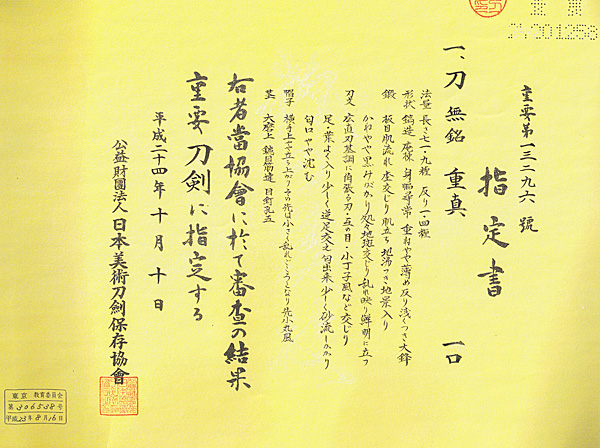
NBTHK Certificate
Jūyō Tōken重要刀剣
Important Sword
›

A blade of top-grade workmanship and condition, formally judged to rank with a nationally recognized Important Art Object (Jūyō Bijutsuhin). Awarded only at the NBTHK’s competitive annual examination.

Of Japan’s roughly 2.5 million registered swords, only 12,307 (about 1 in 203) have ever attained Jūyō.

Unsigned (attr. Osafune Shigezane)
As written on the certificate
About the NBTHK›

The NBTHK (Nihon Bijutsu Tōken Hozon Kyōkai, the Society for the Preservation of Japanese Art Swords) is a public-interest incorporated foundation founded in 1948 and supervised by Japan’s Agency for Cultural Affairs (Bunkachō); it is based at the Japanese Sword Museum in Tokyo. Its expert panels physically examine each submitted work (shinsa) and issue a certificate (kanteishō) ranking it by artistic and historical merit. NBTHK papers are the most widely recognized standard of authentication for Japanese swords and fittings.

NBTHK official site→
Seller
T
Token-Net
Established 1981 · 45 yrs on the market
🇯🇵Ships from Japan
›
✓Verified dealertoken-net.com
Settles in JPY
✓Ships worldwideWire transferCredit card
Return policy

Within one week of the item's arrival (cooling-off is possible within Japan only). For defects that differ from the purchase conditions, we will accept the return and refund the payment. For other cases such as overseas, we will consult separately.

View all of Token-Net’s listings→View this item on the dealer’s site→

Previously sold by Osafune Shigezane

View all →
Samurai Museum
Tokuho
Tanto - Tokuho - by Osafune Shigezane - Antique Japanese Sword Tanto signed by ShigezaneTanto - Tokuho - by Osafune Shigezane - Antique Japanese Sword Tanto signed by Shigezane
Sold

Tantō

ByOsafune Shigezane
SOLD
World Seiyudo
Tokuho
Katana - Tokuho - by Osafune Shigezane - Mumei (Osafune Shigezane) - Tokubetsu Hozon TokenKatana - Tokuho - by Osafune Shigezane - Mumei (Osafune Shigezane) - Tokubetsu Hozon Token
Sold

Katana

ByOsafune Shigezane
SOLD
Iida Koendo
Jūyō
Tachi - Jūyō - by Osafune Shigezane - Bishu Osafune ju Shigezane, Enbun 3rd year, 12th monthTachi - Jūyō - by Osafune Shigezane - Bishu Osafune ju Shigezane, Enbun 3rd year, 12th month
Sold

Tachi

ByOsafune Shigezane
SOLD
Choshuya
Tachi - by Osafune Shigezane - Japanese Sword for Sale | Ginza Choshuya | Mei: Bishu Osafune ju Shigezane, Bunwa 4th Year, November DayTachi - by Osafune Shigezane - Japanese Sword for Sale | Ginza Choshuya | Mei: Bishu Osafune ju Shigezane, Bunwa 4th Year, November Day
Sold

Tachi

ByOsafune Shigezane
SOLD
Choshuya
Katana - by Osafune Shigezane - Attributed to Osafune Shigezane (O-suriage Mumei, Ryowazamono)Katana - by Osafune Shigezane - Attributed to Osafune Shigezane (O-suriage Mumei, Ryowazamono)
Sold

Katana

ByOsafune Shigezane
SOLD
Aoi Art
Jūyō
Tachi - Jūyō - by Osafune Shigezane - Bizen Osafune Ju Shigemasa (December 1334)Tachi - Jūyō - by Osafune Shigezane - Bizen Osafune Ju Shigemasa (December 1334)
Sold

Tachi

ByOsafune Shigezane
SOLD
Unique Japan
Jūyō
Katana - Jūyō - by Osafune Shigezane - Shigezane - Ô-suriage mumeiKatana - Jūyō - by Osafune Shigezane - Shigezane - Ô-suriage mumei
Sold

Katana

ByOsafune Shigezane
SOLD
Eirakudo
Tokuho
Wakizashi - Tokuho - by Osafune Shigezane - Osafune ShigezaneWakizashi - Tokuho - by Osafune Shigezane - Osafune Shigezane
Sold

Wakizashi

ByOsafune Shigezane
SOLD

More Sōden-Bizen works

View all →
Goushuya
Jūyō
Katana - Jūyō - by Osafune Kanemitsu - Kanemitsu with Gold Inlay InscriptionKatana - Jūyō - by Osafune Kanemitsu - Kanemitsu with Gold Inlay Inscription

Katana

ByOsafune Kanemitsu
Ask
Katanahanbai
Tokuho
Wakizashi - Tokuho - by Osafune Tomomitsu - Bishu Osafune Tomomitsu - Teiji 5th Year, 8th MonthWakizashi - Tokuho - by Osafune Tomomitsu - Bishu Osafune Tomomitsu - Teiji 5th Year, 8th Month

Wakizashi

ByOsafune Tomomitsu
¥4,800,000
Samurai Museum
Katana - by Osafune Kanemitsu - Attributed to Den Osafune Kanemitsu - NTHK Yushu Saku Kanteisho CertificateKatana - by Osafune Kanemitsu - Attributed to Den Osafune Kanemitsu - NTHK Yushu Saku Kanteisho Certificate

Katana

ByOsafune Kanemitsu
¥27,052
Eirakudo
Jūyō
Katana - Jūyō - by Motoshige - Motoshige - Juyo TokenKatana - Jūyō - by Motoshige - Motoshige - Juyo Token

Katana

ByMotoshige
¥6,000,000
Eirakudo
Tokuho
Tachi - Tokuho - by Osafune Chikakage - Chikakage - Tokubetsu Hozon TokenTachi - Tokuho - by Osafune Chikakage - Chikakage - Tokubetsu Hozon Token

Tachi

ByOsafune Chikakage
¥5,500,000
Nihonto Antiques
Jūyō
Katana - Jūyō - by Chogi - Den Chōgi (Nagayoshi) - JuyoKatana - Jūyō - by Chogi - Den Chōgi (Nagayoshi) - Juyo

Katana

ByChogi
Ask
Iida Koendo
Jūyō
Katana - Jūyō - by Osafune Kanemitsu - KanemitsuKatana - Jūyō - by Osafune Kanemitsu - Kanemitsu

Katana

ByOsafune Kanemitsu
¥11,000,000
Choshuya
Jūyō
Tachi - Jūyō - by Osafune Masamitsu - Bishu Osafune (Ika-kire Masamitsu) Meitoku 3 nen 8 gatsu (Ika-kire)Tachi - Jūyō - by Osafune Masamitsu - Bishu Osafune (Ika-kire Masamitsu) Meitoku 3 nen 8 gatsu (Ika-kire)

Tachi

ByOsafune Masamitsu
¥4,300,000

More from the Osafune school

View all →
Aoi Art
Jūyō Bijutsuhin
Daisho - Jubi - by Osafune Nagamitsu - Dai Sho: Katana (Important Art Object): Mumei (Den Nagamitsu) / Wakizashi: Mumei (Sekishu Naotsuna)Daisho - Jubi - by Osafune Nagamitsu - Dai Sho: Katana (Important Art Object): Mumei (Den Nagamitsu) / Wakizashi: Mumei (Sekishu Naotsuna)

Daishō

ByOsafune Nagamitsu
Ask
Nihonto.com
Jūyō
Tanto - Jūyō - by Osafune Kagemitsu - Juyo Tanto by Bizen KagemitsuTanto - Jūyō - by Osafune Kagemitsu - Juyo Tanto by Bizen Kagemitsu

Tantō

ByOsafune Kagemitsu
¥89,500
Eirakudo
Hozon
Katana - Hozon - by Sukesada - Yosouzaemonnojo Sukesada - Hozon TokenKatana - Hozon - by Sukesada - Yosouzaemonnojo Sukesada - Hozon Token

Katana

BySukesada
¥3,800,000
Samurai Museum
Tokuho
Wakizashi - Tokuho - by Osafune Kagemitsu - Antique Japanese Sword Wakizashi attributed to Den Osafune Kagemitsu NBTHK Tokubetsu Hozon CertificateWakizashi - Tokuho - by Osafune Kagemitsu - Antique Japanese Sword Wakizashi attributed to Den Osafune Kagemitsu NBTHK Tokubetsu Hozon Certificate

Wakizashi

ByOsafune Kagemitsu
¥20,748
Choshuya
Tokuho
Katana - Tokuho - by Katsumitsu - Bishu Osafune Katsumitsu - Bunmei 18 nen 2 gatsujitsu (O Wazamono)Katana - Tokuho - by Katsumitsu - Bishu Osafune Katsumitsu - Bunmei 18 nen 2 gatsujitsu (O Wazamono)

Katana

ByKatsumitsu
¥1,200,000
World Seiyudo
Tokuho
Wakizashi - Tokuho - by Sukesada - Kawachi-No-Kami SukesadaWakizashi - Tokuho - by Sukesada - Kawachi-No-Kami Sukesada

Wakizashi

BySukesada
¥1,400,000
Tosa Touken Do
Tokujū
Tachi - Tokuju - by Osafune Kagemasa - Ko Osafune KagemasaTachi - Tokuju - by Osafune Kagemasa - Ko Osafune Kagemasa

Tachi

ByOsafune Kagemasa
Ask
Iida Koendo
Jūyō
Tachi - Jūyō - by Osafune Nagamitsu - Bizenkoku Osafune ju Sakonshogen Nagamitsu tsukuru, Einin Gannen Junigatsu HiTachi - Jūyō - by Osafune Nagamitsu - Bizenkoku Osafune ju Sakonshogen Nagamitsu tsukuru, Einin Gannen Junigatsu Hi

Tachi

ByOsafune Nagamitsu
¥55,000,000

More from the Bizen tradition

View all →
Aoi Art
Jūyō
Jūyō - by Ichimonji School - Naginata-Naoshi Katana: Mumei (Ichimonji)Jūyō - by Ichimonji School - Naginata-Naoshi Katana: Mumei (Ichimonji)

Naginata-Naoshi Katana: Mumei (Ichimonji)

ByIchimonji School
Starting Bid¥9,500,000
Tsuruginoya
Jūyō
Katana - Jūyō - by Fukuoka Ichimonji School - Mumei Fukuoka IchimonjiKatana - Jūyō - by Fukuoka Ichimonji School - Mumei Fukuoka Ichimonji

Katana

ByFukuoka Ichimonji School
Ask
Eirakudo
Jūyō Bijutsuhin
Katana - Jubi - by Chu-Aoe School - Aoe Sadatsugu Katana Juyo BijutsuhinKatana - Jubi - by Chu-Aoe School - Aoe Sadatsugu Katana Juyo Bijutsuhin

Katana

ByChu-Aoe School
Ask
Toyuukai
Jūyō
Katana - Jūyō - by Aoe School - Mumei (Aoe) - 51st Juyo TokenKatana - Jūyō - by Aoe School - Mumei (Aoe) - 51st Juyo Token

Katana

ByAoe School
¥5,500,000
Aoi Art
Tokuho
Tanto - Tokuho - by Yoshii Morinori - Bishu-koku Yoshii Morinori (November 1419)Tanto - Tokuho - by Yoshii Morinori - Bishu-koku Yoshii Morinori (November 1419)

Tantō

ByYoshii Morinori
Starting Bid¥400,000
Goushuya
Jūyō Bijutsuhin
Tachi - Jubi - by Ukai Unsho - Kumoio - From the collection of the Okouchi family, lord of Otaki Domain, Kazusa ProvinceTachi - Jubi - by Ukai Unsho - Kumoio - From the collection of the Okouchi family, lord of Otaki Domain, Kazusa Province

Tachi

ByUkai Unsho
Ask
Eirakudo
Tokuho
Wakizashi - Tokuho - by Ichimonji School - Fukuoka Ichimonji Wakizashi - Tokubetsu Hozon TokenWakizashi - Tokuho - by Ichimonji School - Fukuoka Ichimonji Wakizashi - Tokubetsu Hozon Token

Wakizashi

ByIchimonji School
¥3,500,000
Token-Net
Jūyō
Wakizashi - Jūyō - by Ukai Unji - Mumei (Unji) (Bizen)Wakizashi - Jūyō - by Ukai Unji - Mumei (Unji) (Bizen)

Wakizashi

ByUkai Unji
¥2,500,000

Swords

  • Katana
  • Wakizashi
  • Tantō
  • Tachi
  • Naginata
  • Yari

Fittings

  • Tsuba
  • Fuchi-Kashira
  • Kozuka
  • Menuki

Armor

  • Kabuto
  • Samurai Armor

By Certification

  • Tokujū
  • Jūyō
  • Tokuho
  • Hozon

Resources

  • Dealer Directory
  • Artist Directory
  • The Daily Kantei
  • Glossary
  • Browse All
Nihontowatch© 2026
TermsPrivacyCookiesAbout

Description

This is an unsigned katana attributed to Shigema, designated as a 58th Juyo Token. It features a hira-zukuri iori-mune construction with an o-suriage nakago. The hada is itame mixed with mokume, slightly standing out with ji-nie and chi-kei. The hamon is a wide suguha with gunome and ko-choji mixed in, with active ashi, yo, kinsuji, and sunagashi.

NBTHK Setsumei

Jūyō-Tōken, 58th Session — Designated October 10, 2012 Katana, mumei: Shigemasa (重真) Measurements Nagasa 71.9 cm, sori 1.4 cm, motohaba 2.8 cm, sakihaba 2.1 cm, kissaki-nagasa 5.6 cm, nakago-nagasa 19.6 cm, nakago-sori slight Description Keijō: Shinogi-zukuri, iori-mune; standard mihaba with little difference between base and tip widths; somewhat thin kasane; shallow sori; ō-kissaki. Kitae: Flowing itame-hada mixed with mokume; the grain stands somewhat (hada-dachi); ji-nie adheres; chikei appears; the steel shows a slightly blackish tone, with scattered jifu; vivid midare-utsuri stands out clearly. Hamon: A hiro-suguha basis, mixed with angular elements, gunome, and ko-chōji-like forms; ashi and yō enter well, with some saka-ashi; nioi-deki; slight sunagashi; the nioiguchi shows a slight shizumi (subdued) tendency. Bōshi: Rises somewhat above the yokote; then shows a slight suggestion of midare, finishing in a small ko-maru-like turn. Horimono: None. Nakago: Greatly shortened (ō-suriage); kurijiri tip; sujikai file marks; five mekugi-ana; unsigned. Artisan Shigemasa (Osafune school, Bizen) Era Nanbokuchō period (mid-14th century) Explanation Shigemasa of the Osafune group in Bizen Province is traditionally regarded—according to one view—as a younger brother of Motoshige. Dates seen among his extant works range from Shōchū in the late Kamakura period through Enbun in the middle Nanbokuchō period. As with Motoshige, there is also a theory that within this span one may recognize the existence of a first and second generation. In terms of style, his forging shows itame mixed with flowing grain and jifu; his temper is characterized by a suguha-based manner in which angular gunome stands out, and by pointed tendencies in the bōshi. Overall, his work manifests workmanship close to Motoshige’s, while also revealing a mixed-in Aoe character. This katana shows little visible taper between the base and the tip, has a slightly thin kasane and shallow curvature, and culminates in an ō-kissaki—features that strongly express the period character of the height of the Nanbokuchō era. In the forging, the itame flows and locally tends toward masame, with mokume mixed in; the grain stands somewhat, jifu appears, and the utsuri is a clear midare-utsuri. The hamon is fundamentally a nioi-deki wide suguha, mixed with angular elements; on the omote there are horizontally elongated, angular forms, and saka-ashi also enters. In these points, the distinctive features of Shigemasa—Bizen tradition with an admixture of Aoe character—are plainly evident, and the traditional attribution is accordingly persuasive. This is an excellent work, showing superior ji and ha and presenting a typical example of the smith’s manner.

NihontoWatch Mon

NihontoWatch

Market
Encyclopedia
Kantei
Swords›Bizen-den›Osafune›Sōden-Bizen›Shigezane›Katana: Mumei Shigema (58th Juyo Token)
katanaJūyō
Osafune Shigezane

Katana: Mumei Shigema (58th Juyo Token)

mumei · Kamakura · nagasa 71.9cm · sori 1.4cm

¥5,300,000
Visit seller website →
Osafune Shigezane — 1 of 3
Osafune Shigezane — 2 of 3
Osafune Shigezane — 3 of 3
1 / 3
1 / 3
Osafune Shigezane — 1 of 3Osafune Shigezane — 2 of 3Osafune Shigezane — 3 of 3
Measurements & details
Smith
Osafune Shigezane
Type
Katana
School
Osafune
Period
Around 1327–1358(Kenmu ND)
Signature
Unsigned(20% of this smith's designated works are signed)
Measurements
Nagasa 71.9cmSori 1.4cm
Description

This is an unsigned katana attributed to Shigema, designated as a 58th Juyo Token. It features a hira-zukuri iori-mune construction with an o-suriage nakago. The hada is itame mixed with mokume, slightly standing out with ji-nie and chi-kei. The hamon is a wide suguha with gunome and ko-choji mixed in, with active ashi, yo, kinsuji, and sunagashi.

NBTHK Zufu Commentary

Juyo #58

AI translation — may contain errors

-, 58th Session — Designated October 10, 2012

, : Shigemasa (重真)

Measurements 71.9 cm, 1.4 cm, 2.8 cm, 2.1 cm, 5.6 cm, 19.6 cm, slight

Description Keijō: , ; standard with little difference between base and tip widths; somewhat thin ; shallow ; . : Flowing mixed with ; the grain stands somewhat (); adheres; appears; the steel shows a slightly blackish tone, with scattered ; vivid stands out clearly. : A basis, mixed with angular elements, , and -like forms; and enter well, with some ; ; slight ; the shows a slight (subdued) tendency. : Rises somewhat above the ; then shows a slight suggestion of , finishing in a small -like turn. : None. : Greatly shortened (); tip; file marks; five ; unsigned.

Artisan Shigemasa ( school, )

Era period (mid-14th century)

Explanation Shigemasa of the group in Province is traditionally regarded—according to one view—as a younger brother of Motoshige. Dates seen among his extant works range from Shōchū in the late period through Enbun in the middle period. As with Motoshige, there is also a theory that within this span one may recognize the existence of a first and second generation. In terms of style, his forging shows mixed with flowing grain and ; his temper is characterized by a -based manner in which angular stands out, and by pointed tendencies in the . Overall, his work manifests workmanship close to Motoshige’s, while also revealing a mixed-in character.

This shows little visible taper between the base and the tip, has a slightly thin and shallow curvature, and culminates in an —features that strongly express the period character of the height of the era.

In the forging, the flows and locally tends toward , with mixed in; the grain stands somewhat, appears, and the is a clear . The is fundamentally a wide , mixed with angular elements; on the there are horizontally elongated, angular forms, and also enters. In these points, the distinctive features of Shigemasa— tradition with an admixture of character—are plainly evident, and the traditional attribution is accordingly persuasive. This is an excellent work, showing superior and and presenting a typical example of the smith’s manner.

[ 25]

About the maker

Shigezane

重眞

Osafune (Bizen), Motoshige line · Bizen · around 1327-1358

Fujishiro Jo-jo saku · Tōken Taikan top 10%

1 piece on the market now

›

Shigezane is an Osafune swordsmith of the Motoshige line, working from the close of the Kamakura period into the Nanbokucho, whose earliest dated work is a slightly elongated tanto of Karyaku 2 (1327) and whose latest reaches Enbun 4 of the Nanbokucho, a documented span of thirty-three years. The published sources record him by old tradition as the younger brother, or in another account a pupil, of the first-generation Motoshige, and they place his hand squarely within the Soden-Bizen of the late Osafune workshop. His is not the brilliant clove-flower of the older Bizen; it is the quieter, more angular manner of the Motoshige group, read by the published commentary as close to Motoshige with the character of Aoe mixed in. Authenticated signed examples are exceedingly few, so much of what survives under his name is judged from the bearing of the blade and the structure of its temper rather than from a signature.

The feature that most distinguishes his work is the temper. Over a suguha-toned base he sets angular gunome, the squared shoulder that reads as Motoshige-line rather than the rounded clove of Fukuoka, joined by the kataochi-gunome that is the structural tell of the group, the asymmetric saw-tooth slanting toward the base. The line frequently leans saka-gakari, the elements inclining in reverse, and into it run ashi and yo with ko-nie gathering and fine sunagashi and kinsuji passing through. The nioiguchi tends to sink to a subdued shizumi, the calm, slightly dimmed temper that the published sources name again and again as the mark of the Motoshige hand. The boshi enters in midare-komi and turns back pointed, at times a ko-maru or a yakizume sweep.

The jigane keeps the attribution in Bizen even where the temper alone might read as Soden. He forges a standing itame, often run through with nagare-hada and mixed with mokume and patches of jifu, the ji-nie thick and chikei entering, the grain a little raised. Across it rises a clear midare-utsuri, the bright reflection of old Bizen steel, sometimes a fainter bo-utsuri along the edge. The steel on his finest pieces takes a bluish-black tonality with a cold clarity, the nioiguchi bright and the activity within the ha abundant, with places where coarse nie glitters strongly.

His record divides into three registers. The mainstream is the suguha-toned, angular-gunome work that the published sources read as close to Motoshige, the manner that anchors his many o-suriage mumei attributions. Against it stands a rare exception, the ubu signed tachi dated Enbun 3, of which the commentary remarks that the workmanship 'is not in a Motoshige-like manner'[[c:1]], opening instead into a frank choji-midare with pointed gunome at the monouchi. The third register is the body of his surviving work, the greatly shortened mumei katana, several originally large tachi exceeding three shaku, wide in body and shallow in sori in the Nanbokucho mode. As with Motoshige, the published sources propose a first and a second generation across his dated span, the bold two-character signature taken for the first and the smaller signature cut 'Saemon-no-jo Shigezane'[[c:2]] for the second, a question still left for further study.

What sets him apart within the late Osafune is exactly what the judges name. His angular gunome and kataochi-gunome, his saka-gakari temper and subdued nioiguchi, and the bright midare-utsuri over his standing itame place him with Motoshige and apart from the rounder, showier Bizen of Fukuoka and Yoshioka, while the published sources read into his forging a manner that incorporates the character of Aoe, the workmanship they call 'a hand with Aoe character mixed in'[[c:3]]. On a mumei katana judged to him the commentary allows that views of 'Unrui or Chikakage'[[c:4]] are possible, the panel narrowing it to Shigezane only on close reading of the whole taihai together with the detail of ji and ha, the clear midare-utsuri leaving no doubt of Bizen.

For the collector Shigezane is a scarce signed name. Fujishiro grades him Jo-jo saku, and his record runs not through National Treasures or Important Cultural Properties, of which he has none, but through a single Tokubetsu Juyo and many Juyo, forty-five blades across the two tiers. The value of his best pieces lies in their documentary weight: the Tokubetsu Juyo katana with its folded-back long signature, called 'a representative work of this smith'[[c:5]]; the Karyaku 2 tanto, the earliest of his dated works and a foothold for his study; and a naginata preserved in its original form, 'a precious example that survives as a naginata without having been reshaped into a sword'[[c:6]]. Of recorded whereabouts a few are held in public collections, among them the Hayashibara Museum of Art and the Bizen Osafune Sword Museum, and the denrai of his blades passes through daimyo and old houses, the Matsudaira family with Matsudaira Ukon-no-suke Terusada and the Takasaki domain, and the Niwa family on to Tokugawa Yoshinobu. A signed Shigezane comes to light only seldom, and a privately held example, especially an ubu or dated one, is a notable thing for a collector to encounter, a document of how the Motoshige hand carried Bizen into the Nanbokucho.
Historical importance

Where Shigezane stands among comparable artisans: across all of nihontō, and within tradition, era, and period. The tiers (Foremost · Leading · Major · Notable) weigh official designations from the NBTHK and Japan's Agency for Cultural Affairs, together with historical honors of lasting repute such as the Sansaku and Meibutsu-chō.

随一
Foremost
屈指
Leading
有数
Major
著名
Notable

Select a lens to see how it's measured.

Designation record
44 designated works
Tokubetsu Jūyō
1
Jūyō
43
1 work by Shigezane on the market→
Shigezane — full profileOsafune (Bizen), Motoshige line school

Dated Works

Years he was demonstrably active, proven by signed-and-dated blades

Active period
1327–1358
3 of 9 designated works carry a date
1320
1330
1340
1350
1360
About the school

Osafune

長船

Bizen-den · Bizen

236 pieces on the market now

›

No single workshop in the history of Japanese swordmaking grew larger or lasted longer than Osafune, the riverside village in Bizen Province whose name became, across three centuries, a byword for the province's mainline. Its de facto founder was Mitsutada (光忠), working at Osafune in the middle Kamakura period; tradition makes him the son of Chikatada, and the genealogies derive his line from the Ko-Bizen Masatsune group already settled in the village. His blades, bold and imposing with a jigane so refined the sources say it can at a glance suggest Kyoto work, were treasured from old as the swords of commanders, and from his hand the school spread immediately: his sons Nagamitsu (長光) and Sanenaga (眞長), his grandson Kagemitsu (景光), and outward through pupils and collaterals until, by the late Kamakura years, Osafune was less a family than an industry. The line is conventionally read as a three-generation spine, Mitsutada founding it, Nagamitsu setting its classical standard, Kagemitsu bringing both temper and forging to their finished form before handing the manner to his pupil Chikakage (近景), whose echo of the master is so close that signed Kagemitsu blades are sometimes read as Chikakage daimei. What binds the membership is a shared steel before any shared temper. The forging is itame mixed with mokume, tightening on the finest blades into a dense ko-itame; fine ji-nie adheres, chikei enter, and over all of it stands the midare-utsuri that anchors even the most Kyoto-like jigane back to Bizen. On that floor the founding generation tempers a flamboyant choji-midare mixed with gunome: Mitsutada's tadpole-headed kawazuko-choji, Nagamitsu's round-topped plump choji, the deep nioi with ko-nie, the bright nioiguchi. From here the school divides by hand and by era. Sanenaga draws the calm pole, a gentle chu-suguha of tightened nioiguchi; Kagemitsu completes the slanting, square-shouldered kataochi-gunome over a suguha base, the family's last great Kamakura invention, carried on by his close kinsman Kagemasa (景政). The Nanbokucho generation then turns toward Soshu-den: Kanemitsu (兼光), fourth master of the mainline, pioneers a broad notare and is read, with Chogi (長義), as the head of Soden-Bizen, the Bizen wing that worked Soshu nie into a jigane that still throws a Bizen utsuri.

Chogi is called the most un-Bizen of Bizen smiths, his ear-shaped mimigata his tell; around him Nagashige (長重), Yoshikage (義景), Tomomitsu (倫光) and Kanenaga (兼長) press the Soshu side by degrees, while Motoshige (元重), of a separate Hatakeda descent, carries an Aoe-tinged squared, slanting ha. Two generations later the Oei revival returns to Kamakura: Yasumitsu (康光) and Morimitsu (盛光), the twin pillars of Oei-Bizen, revive the tachi shape and the choji temper over a wide-waisted koshibiraki-gunome, both finishing in the pointed rosoku-no-shin (candle-wick) boshi that gives the late date away. For the collector the school is a school of discriminations, and to kantei it is to read those fine partitions. The constant midare-utsuri over a bright ko-itame fixes the province; the boshi then sorts the maker, Mitsutada's pointed midare-komi against Nagamitsu's composed ko-maru Sansaku turn, Kagemitsu's contained return, the candle-wick tongue of Oei. Within a single phase the calls turn on a half-step: Nagamitsu's plump crests against Sanenaga's cooler nioiguchi, Kagemasa's freer play against Kagemitsu's tighter order, Nagashige read out of Chogi by a nie that surpasses his brother's. The standing of the best is matched by their patrimony. Mitsutada, Nagamitsu and Kagemitsu each hold National Treasures and stand at the head of Fujishiro's Sai-jo saku; their named blades, the Daihannya Nagamitsu, the Kogaryu Kagemitsu, the O-Kanemitsu, passed through Nobunaga, Ieyasu, Uesugi Kenshin and the great daimyo houses. Because Nagamitsu and the Nanbokucho masters signed and survived in number, Osafune offers what most peerage names cannot, a deep field of Tokubetsu Juyo and Juyo work that a patient collector may still realistically hold. Through every register the same hand declares itself: the bright steel, the vivid reflection, and a temper that runs, across three centuries, as the spine of Bizen. Learn more →

113 recorded smiths2013 designated works
Leading smiths
SmithEraDesignated
Mitsutada光忠1238-123960
Nagamitsu長光1274-1304244
Kagemitsu景光1303-1336143
Kanemitsu兼光1323-1370231
Sanenaga眞長1299-130964
Explore the Osafune school →

Historical context

Kamakura was Bizen’s summit. Tradition places Ichimonji smiths among Go-Toba’s goban kaji, Mitsutada founded the Osafune line at mid-century, and orders flowed from the court and the warrior government alike. No province holds more National Treasure blades.

Bizen in the Kamakura period →

NBTHK Certificate
Jūyō Tōken重要刀剣
Important Sword
›

A blade of top-grade workmanship and condition, formally judged to rank with a nationally recognized Important Art Object (Jūyō Bijutsuhin). Awarded only at the NBTHK’s competitive annual examination.

Of Japan’s roughly 2.5 million registered swords, only 12,307 (about 1 in 203) have ever attained Jūyō.

Unsigned (attr. Osafune Shigezane)
As written on the certificate
About the NBTHK›

The NBTHK (Nihon Bijutsu Tōken Hozon Kyōkai, the Society for the Preservation of Japanese Art Swords) is a public-interest incorporated foundation founded in 1948 and supervised by Japan’s Agency for Cultural Affairs (Bunkachō); it is based at the Japanese Sword Museum in Tokyo. Its expert panels physically examine each submitted work (shinsa) and issue a certificate (kanteishō) ranking it by artistic and historical merit. NBTHK papers are the most widely recognized standard of authentication for Japanese swords and fittings.

NBTHK official site→
Seller
T
Token-Net
Established 1981 · 45 yrs on the market
🇯🇵Ships from Japan
›
✓Verified dealertoken-net.com
Settles in JPY
✓Ships worldwideWire transferCredit card
Return policy

Within one week of the item's arrival (cooling-off is possible within Japan only). For defects that differ from the purchase conditions, we will accept the return and refund the payment. For other cases such as overseas, we will consult separately.

View all of Token-Net’s listings→View this item on the dealer’s site→

Previously sold by Osafune Shigezane

View all →
Samurai Museum
Tokuho
Tanto - Tokuho - by Osafune Shigezane - Antique Japanese Sword Tanto signed by ShigezaneTanto - Tokuho - by Osafune Shigezane - Antique Japanese Sword Tanto signed by Shigezane
Sold

Tantō

ByOsafune Shigezane
SOLD
World Seiyudo
Tokuho
Katana - Tokuho - by Osafune Shigezane - Mumei (Osafune Shigezane) - Tokubetsu Hozon TokenKatana - Tokuho - by Osafune Shigezane - Mumei (Osafune Shigezane) - Tokubetsu Hozon Token
Sold

Katana

ByOsafune Shigezane
SOLD
Iida Koendo
Jūyō
Tachi - Jūyō - by Osafune Shigezane - Bishu Osafune ju Shigezane, Enbun 3rd year, 12th monthTachi - Jūyō - by Osafune Shigezane - Bishu Osafune ju Shigezane, Enbun 3rd year, 12th month
Sold

Tachi

ByOsafune Shigezane
SOLD
Choshuya
Tachi - by Osafune Shigezane - Japanese Sword for Sale | Ginza Choshuya | Mei: Bishu Osafune ju Shigezane, Bunwa 4th Year, November DayTachi - by Osafune Shigezane - Japanese Sword for Sale | Ginza Choshuya | Mei: Bishu Osafune ju Shigezane, Bunwa 4th Year, November Day
Sold

Tachi

ByOsafune Shigezane
SOLD
Choshuya
Katana - by Osafune Shigezane - Attributed to Osafune Shigezane (O-suriage Mumei, Ryowazamono)Katana - by Osafune Shigezane - Attributed to Osafune Shigezane (O-suriage Mumei, Ryowazamono)
Sold

Katana

ByOsafune Shigezane
SOLD
Aoi Art
Jūyō
Tachi - Jūyō - by Osafune Shigezane - Bizen Osafune Ju Shigemasa (December 1334)Tachi - Jūyō - by Osafune Shigezane - Bizen Osafune Ju Shigemasa (December 1334)
Sold

Tachi

ByOsafune Shigezane
SOLD
Unique Japan
Jūyō
Katana - Jūyō - by Osafune Shigezane - Shigezane - Ô-suriage mumeiKatana - Jūyō - by Osafune Shigezane - Shigezane - Ô-suriage mumei
Sold

Katana

ByOsafune Shigezane
SOLD
Eirakudo
Tokuho
Wakizashi - Tokuho - by Osafune Shigezane - Osafune ShigezaneWakizashi - Tokuho - by Osafune Shigezane - Osafune Shigezane
Sold

Wakizashi

ByOsafune Shigezane
SOLD

More Sōden-Bizen works

View all →
Goushuya
Jūyō
Katana - Jūyō - by Osafune Kanemitsu - Kanemitsu with Gold Inlay InscriptionKatana - Jūyō - by Osafune Kanemitsu - Kanemitsu with Gold Inlay Inscription

Katana

ByOsafune Kanemitsu
Ask
Katanahanbai
Tokuho
Wakizashi - Tokuho - by Osafune Tomomitsu - Bishu Osafune Tomomitsu - Teiji 5th Year, 8th MonthWakizashi - Tokuho - by Osafune Tomomitsu - Bishu Osafune Tomomitsu - Teiji 5th Year, 8th Month

Wakizashi

ByOsafune Tomomitsu
¥4,800,000
Samurai Museum
Katana - by Osafune Kanemitsu - Attributed to Den Osafune Kanemitsu - NTHK Yushu Saku Kanteisho CertificateKatana - by Osafune Kanemitsu - Attributed to Den Osafune Kanemitsu - NTHK Yushu Saku Kanteisho Certificate

Katana

ByOsafune Kanemitsu
¥27,052
Eirakudo
Jūyō
Katana - Jūyō - by Motoshige - Motoshige - Juyo TokenKatana - Jūyō - by Motoshige - Motoshige - Juyo Token

Katana

ByMotoshige
¥6,000,000
Eirakudo
Tokuho
Tachi - Tokuho - by Osafune Chikakage - Chikakage - Tokubetsu Hozon TokenTachi - Tokuho - by Osafune Chikakage - Chikakage - Tokubetsu Hozon Token

Tachi

ByOsafune Chikakage
¥5,500,000
Nihonto Antiques
Jūyō
Katana - Jūyō - by Chogi - Den Chōgi (Nagayoshi) - JuyoKatana - Jūyō - by Chogi - Den Chōgi (Nagayoshi) - Juyo

Katana

ByChogi
Ask
Iida Koendo
Jūyō
Katana - Jūyō - by Osafune Kanemitsu - KanemitsuKatana - Jūyō - by Osafune Kanemitsu - Kanemitsu

Katana

ByOsafune Kanemitsu
¥11,000,000
Choshuya
Jūyō
Tachi - Jūyō - by Osafune Masamitsu - Bishu Osafune (Ika-kire Masamitsu) Meitoku 3 nen 8 gatsu (Ika-kire)Tachi - Jūyō - by Osafune Masamitsu - Bishu Osafune (Ika-kire Masamitsu) Meitoku 3 nen 8 gatsu (Ika-kire)

Tachi

ByOsafune Masamitsu
¥4,300,000

More from the Osafune school

View all →
Aoi Art
Jūyō Bijutsuhin
Daisho - Jubi - by Osafune Nagamitsu - Dai Sho: Katana (Important Art Object): Mumei (Den Nagamitsu) / Wakizashi: Mumei (Sekishu Naotsuna)Daisho - Jubi - by Osafune Nagamitsu - Dai Sho: Katana (Important Art Object): Mumei (Den Nagamitsu) / Wakizashi: Mumei (Sekishu Naotsuna)

Daishō

ByOsafune Nagamitsu
Ask
Nihonto.com
Jūyō
Tanto - Jūyō - by Osafune Kagemitsu - Juyo Tanto by Bizen KagemitsuTanto - Jūyō - by Osafune Kagemitsu - Juyo Tanto by Bizen Kagemitsu

Tantō

ByOsafune Kagemitsu
¥89,500
Eirakudo
Hozon
Katana - Hozon - by Sukesada - Yosouzaemonnojo Sukesada - Hozon TokenKatana - Hozon - by Sukesada - Yosouzaemonnojo Sukesada - Hozon Token

Katana

BySukesada
¥3,800,000
Samurai Museum
Tokuho
Wakizashi - Tokuho - by Osafune Kagemitsu - Antique Japanese Sword Wakizashi attributed to Den Osafune Kagemitsu NBTHK Tokubetsu Hozon CertificateWakizashi - Tokuho - by Osafune Kagemitsu - Antique Japanese Sword Wakizashi attributed to Den Osafune Kagemitsu NBTHK Tokubetsu Hozon Certificate

Wakizashi

ByOsafune Kagemitsu
¥20,748
Choshuya
Tokuho
Katana - Tokuho - by Katsumitsu - Bishu Osafune Katsumitsu - Bunmei 18 nen 2 gatsujitsu (O Wazamono)Katana - Tokuho - by Katsumitsu - Bishu Osafune Katsumitsu - Bunmei 18 nen 2 gatsujitsu (O Wazamono)

Katana

ByKatsumitsu
¥1,200,000
World Seiyudo
Tokuho
Wakizashi - Tokuho - by Sukesada - Kawachi-No-Kami SukesadaWakizashi - Tokuho - by Sukesada - Kawachi-No-Kami Sukesada

Wakizashi

BySukesada
¥1,400,000
Tosa Touken Do
Tokujū
Tachi - Tokuju - by Osafune Kagemasa - Ko Osafune KagemasaTachi - Tokuju - by Osafune Kagemasa - Ko Osafune Kagemasa

Tachi

ByOsafune Kagemasa
Ask
Iida Koendo
Jūyō
Tachi - Jūyō - by Osafune Nagamitsu - Bizenkoku Osafune ju Sakonshogen Nagamitsu tsukuru, Einin Gannen Junigatsu HiTachi - Jūyō - by Osafune Nagamitsu - Bizenkoku Osafune ju Sakonshogen Nagamitsu tsukuru, Einin Gannen Junigatsu Hi

Tachi

ByOsafune Nagamitsu
¥55,000,000

More from the Bizen tradition

View all →
Aoi Art
Jūyō
Jūyō - by Ichimonji School - Naginata-Naoshi Katana: Mumei (Ichimonji)Jūyō - by Ichimonji School - Naginata-Naoshi Katana: Mumei (Ichimonji)

Naginata-Naoshi Katana: Mumei (Ichimonji)

ByIchimonji School
Starting Bid¥9,500,000
Tsuruginoya
Jūyō
Katana - Jūyō - by Fukuoka Ichimonji School - Mumei Fukuoka IchimonjiKatana - Jūyō - by Fukuoka Ichimonji School - Mumei Fukuoka Ichimonji

Katana

ByFukuoka Ichimonji School
Ask
Eirakudo
Jūyō Bijutsuhin
Katana - Jubi - by Chu-Aoe School - Aoe Sadatsugu Katana Juyo BijutsuhinKatana - Jubi - by Chu-Aoe School - Aoe Sadatsugu Katana Juyo Bijutsuhin

Katana

ByChu-Aoe School
Ask
Toyuukai
Jūyō
Katana - Jūyō - by Aoe School - Mumei (Aoe) - 51st Juyo TokenKatana - Jūyō - by Aoe School - Mumei (Aoe) - 51st Juyo Token

Katana

ByAoe School
¥5,500,000
Aoi Art
Tokuho
Tanto - Tokuho - by Yoshii Morinori - Bishu-koku Yoshii Morinori (November 1419)Tanto - Tokuho - by Yoshii Morinori - Bishu-koku Yoshii Morinori (November 1419)

Tantō

ByYoshii Morinori
Starting Bid¥400,000
Goushuya
Jūyō Bijutsuhin
Tachi - Jubi - by Ukai Unsho - Kumoio - From the collection of the Okouchi family, lord of Otaki Domain, Kazusa ProvinceTachi - Jubi - by Ukai Unsho - Kumoio - From the collection of the Okouchi family, lord of Otaki Domain, Kazusa Province

Tachi

ByUkai Unsho
Ask
Eirakudo
Tokuho
Wakizashi - Tokuho - by Ichimonji School - Fukuoka Ichimonji Wakizashi - Tokubetsu Hozon TokenWakizashi - Tokuho - by Ichimonji School - Fukuoka Ichimonji Wakizashi - Tokubetsu Hozon Token

Wakizashi

ByIchimonji School
¥3,500,000
Token-Net
Jūyō
Wakizashi - Jūyō - by Ukai Unji - Mumei (Unji) (Bizen)Wakizashi - Jūyō - by Ukai Unji - Mumei (Unji) (Bizen)

Wakizashi

ByUkai Unji
¥2,500,000

Swords

  • Katana
  • Wakizashi
  • Tantō
  • Tachi
  • Naginata
  • Yari

Fittings

  • Tsuba
  • Fuchi-Kashira
  • Kozuka
  • Menuki

Armor

  • Kabuto
  • Samurai Armor

By Certification

  • Tokujū
  • Jūyō
  • Tokuho
  • Hozon

Resources

  • Dealer Directory
  • Artist Directory
  • The Daily Kantei
  • Glossary
  • Browse All
Nihontowatch© 2026
TermsPrivacyCookiesAbout

Certificate Reading

Certificate reading — 無銘(重真)

Certificate Reading

Certificate reading — 無銘(重真)