天下統一は大量の市場を閉じ、関の鍛冶は新しい富の在り処へ移った。三品の一門は受領名を得て京に、大道系は諸国の城下町に。美濃は新刀時代の最大の祖先となった。
 NihontoWatchNihontoWatch
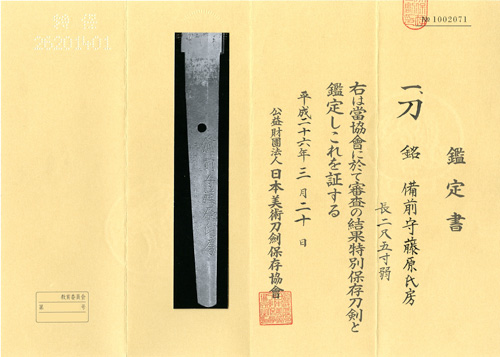
Blade construction: Shinogi-zukuri with Iori mune. The blade is elongated, with a wide base, thick in Kasane (blade thickness), and moderate curvature, giving it a robust and substantial feel impression holding on hands. Forging Pattern (hada): Itame-hada (wood grain pattern) with partial areas of flowing patterns. The steel surface is enriched with thick Ii-nie (steel particles) and vibrant chikei (lines of hardened steel), resulting in a resilient and robust forging. Hamon (Blade Tempering Pattern): A wide, straight Suguha with slight ko-midare (small undulations), exhibiting subtle wavy elements. Small gunome (rounded patterns) are mixed in, with frequent Ashi (downward streaks) entering the hamon. The blade edge is marked by thick clusters of Ko-nie, with floating YOU (spots of tempered steel) in the quenching area, creating a bright appearance. Boshi : The temper continues straight high Suguha that transits into a high almost whole quenching "Ichimai" and returns deeply into the Mune. Tang (Nakago): Ubu (unaltered). The tang end is shaped in a Ha-agari Kurijiri style, with slanting left (katte-sagari) Yasurime. The blade notch (ha-machi) is deep, and the tang is gradually tapered and creates in a ship-bottom Funa-gata style. There is a single Mekugi-ana (peg hole). The front side bears a long, elegant signature reading “Bizen-no-Kami Fujiwara UJIFUSA”備前守藤原氏房 positioned near the back ridge of Mune below the Mekugi-ana. The smith Bizen-no-Kami Ujifusa 備前守氏房 was the heir of the second-generation Hida-no-Kami Ujifusa 飛騨守氏房(note). Born in Kiyosu in 1595 (Bunroku 4), he was first known by the childhood name Isechiyo 伊勢千代 and later took the name Chōjirō 長次郎. On the 22nd day, in the 8th month 1621 (Gen'na 7) at the age of 27, he received the title of Bizen-no-Kami 備前守 and began signing blades as Bizen-no-Kami Fujiwara Ujifusa 備前守藤原氏房 or simply Bizen-no-Kami Ujifusa 備前守氏房. He exclusively served as a retained craftsman for Tokugawa Yoshinao 徳川義直, the lord of Owari. In the 1st month in 1631 (Kan’ei 8), at the age of 37, he succeeded his father, Hida-no-Kami Ujifusa 飛騨守氏房, as the head of the family. By the spring of 1634 (Kan’ei 11), he retired at age 40 and adopted the signature Bizen-no-Kami Ujifusa Nyudō 備前守氏房入道. He passed on the family legacy to his son, Sankurō 三九郎, who became the 4th-generation Hida-no-Kami Ujifusa 飛騨守氏房. Bizen-no-Kami Ujifusa 備前守氏房 passed away on October 25, 1666 (Kanbun 6) at the age of 72. This sublime sword is a work of Bizen-no-Kami Ujifusa 備前守氏房, crafted during his matured years from 1631 to 1634 (Kan’ei 8 - 11). With an extended length of approximately 2 shaku 5 sun (75.7 cm), thick in Kasane, heavy on both hands and a well-harmonized curvature, it features a medium tip (chu-kissaki) and brimmed with both power and refinement. The structure aligns with the robust styles popular during the Kan’ei era. The forging displays Itame-hada mixed with Masame-hada, with fine Ji-nie covering the surface. Chikei lines lengthwise and crosswise, revealing the robust character of the steel. The Hamon, with its bright and clear edge, is defined by thick clusters of Ko-nie and a dynamic presence of Ko-gunome and Ashi. The clear, frosty Nioi particles in the tempered area add an elegant, serene quality. The deeply tempered bōshi, returning in an Ichimai style, reflects inspiration from earlier masterpieces, particularly the Gō Yoshihiro 郷義弘. The Nakago remains in excellent condition, with an excellent taste of patina. Its tapered shape caters to the slender grip preferences of Owari samurai. The robust signature, starting below the Mekugi-ana and boldly inscribed, demonstrates masterful chisel work. The character "原" (hara) in "Fujiwara" is notably styled with the fourth stroke extending into the second, such handwriting also observed in the works from the later period of his father, Hida-no-Kami Fujiwara Ujifusa 飛騨守藤原氏房. This blade exemplifies the craftsmanship and artistic ambition of Bizen-no-Kami Ujifusa 備前守氏房 while fully matured of his career. Silver foiled single layer Habaki collar, preserved in a Shirasaya plain wood mounting (note) Hida-no-kami UJIFUSA 飛騨守氏房, real name of initially Kawamura Isechiyo 河村伊勢千代, later changed to Kawamura Heijur? 河村平十郎, was born in the 10th year of Eiroku(1567). His father Wakasa-no-kami Ujifusa 若狭守氏房 won the praise from the daimyo Oda Nobunaga 織田信長 to exclusively belong to him. In the 5th year of Tensho (1577), Hida-no-kami Ujifusa 飛騨守氏房 moved to Azuchi castle town in Oumi province along with his father Wakasa-no-kami Ujifusa 若狭守氏房 to work exclusively as a page of Oda Nobutaka 織田信孝 who is the 3 rd son of Oda Nobunaga. After the Incident at Honnō-ji (本能寺の変, Honnō-ji no Hen) referred to the forced suicide in the 21th day, the sixth month, the 10 th year of Tensho (1582) of Oda Nobunaga, UJIFUSAs parent and son returned to his home town Gifu with Oda Nobutaka's help then again came back to Kiyosu castle town under the support of Sakuma Masakatsu 佐久間正勝. After his father Wakasa-no-kami Ujifusa passed away in the 11 th day, the 5 th month, 18 th year of Tensho (1590), he learned from his uncle Nobutaka 信高 of 1 st generation and officially enjoyed Hida-no-kami 飛騨守 title in the 11 th day, the 5 th month, 20 th year of Tensho (1592). On after Nagoya castle relocation in 1610, he moved from Kiyosu to Kaji town, in Nagoya (now in 3 chome Marunouchi,Naka-ku) then was in retirement 1631 to yield his position as head of the Ujifusa to his eldest son - the 3 rd generation Bizen-no-kami Ujifusa 備前守氏房. Hida-no-kami Ujifusa 飛騨守氏房 was passed away in the same year in 1631, was 65 years old. reference : Iwata Atou, Owari Toko-fu, Nagoya citry Board of Education, 1984


(翻訳なし)
Owari-Seki (Mino-derived Owari shinto; retained by the Owari Tokugawa) · 尾張 · 1596-1615頃
藤代 上作 · 刀剣大鑑 上位26%
現在5点販売中
飛騨守藤原氏房は若狭守氏房の子として濃州関に生まれ、初め河村伊勢千代、後に平十郎と称した。説明書の多くは永禄十年の生まれとし、一書は天文十年とする。説明書はその経歴を丹念に追う。織田信孝の側小姓に仕え、主君の死後は浪人となり、尾州の佐久間正勝の幕下を経て清洲に移り、天正十七年頃より作刀を始めた。天正十九年、関白秀次が清洲の領主となると、氏房・政常・信高の三名は聚楽第で謁見を許されて各自の作刀を献上し、氏房は飛騨守を賜わった。慶長十五、六年頃に名古屋へ移って徳川義直の抱工となり、寛永八年に備前守氏房へ家督を譲って同年六十五歳で没した。同名は三代あって、初代は飛騨守、二代は備前守、三代は同じく飛騨守を受領し、本コードはその初代である。
本領は大らかなのたれである。身幅広く反り浅く大鋒の、説明書が「慶長新刀の典型的姿」[[c:1]]と呼ぶ刀に、大のたれを主調として互の目・小のたれを交え、足・葉入り、小沸よくつき、処々むら沸・湯走りを交える。同じ大らかな手は薙刀にも、寸延びの平造脇指にも及ぶ。説明書はその脇指の一口を「同工の本領を遺憾なく発揮した」[[c:2]]作とし、慶長十一年紀の刀でも、互の目交じりの大らかなのたれを典型作と見る。
この大らかな作の地鉄は多く肌立ちごころで、板目に時に大板目あるいはザングリとした地を見せ、杢を交え、鎬地は柾に流れ、地沸つく。しかし最上の刀は鍛えを異にする。そのうち二口は小板目肌よくつんで地沸つき、その上に小乱れあるいは小のたれに互の目・尖り刃を交える。説明書は一口を同作中の白眉とし、美濃本国の「志津風を最もよく現わしている」[[c:3]]と評し、他の一口も同作中の優品で美濃の志津風をよく現わすとする。帽子は焼深く、のたれ込んで小丸あるいは大丸となり、長く返って掃きかける。短刀その他数口では突き上げて先尖り、三品風の帽子となる。
一つの手の中に、説明書はさらに二つの面を引き出す。第一は最も多い作で、身幅広く反り浅く大鋒の、南北朝期の大磨上を思わせる姿であるが、説明書は先反りとなる点に慶長作の証を見る。その中には一見村正などの作に見えるものもあるとする。第二は稀な作で、説明書は二度にわたり同工としては珍しいとする。中直刃を基調に小互の目交じり、小足盛んに入り、ほつれ、刃中の働き豊富で、鍛えよく錬れ、帽子は焼深く尖る。説明書はこれに相州上工、就中郷や左文字への私淑を読み、「相州上工に私淑したような古色の趣」[[c:4]]を感じるとする。慶長七年紀の短刀は三品帽子風に一見越前康継を思わせるが、のたれの大模様で沸の強くむらにつく点に氏房の特色が窺われるとされる。
本工を分かつのは、判者が繰り返し立ち返る組み合わせである。出自は関の工であり、肌立ち流れて鎬地に柾の出る地鉄、三品風の尖る帽子、最上の刀に見る志津風は、いずれもその美濃の根を示す。一方、身幅広く力強い慶長新刀の姿、深い沸、直刃の作に見る相州への志向は、徳川に仕えた尾張の工を示す。彫物は刀の棒樋・薙刀の薙刀樋のほかは少なく、ある寸延びの平造の一口に文字と達磨の浮彫を彫るものを説明書は珍しいとする。
収集の上では、伝説の稀品というよりも記録のよく残る初代である。藤代は上作とする。国宝・重要文化財はなく、記録は重要刀剣の格を通じ、十六口が指定され、すべて在銘で、初代の刀・脇指・短刀・薙刀を含む。数口に慶長の年紀があり、説明書はこれを「飛騨守氏房研究の好資料」[[c:5]]とし、「藤原朝臣」銘は少ないと記す。伝来の記録は乏しく、個人の所蔵と言うほかない。長銘を大振りに切った初代の在銘の氏房は折に触れて市場に現れ、年紀入りの一口は尾張新刀を学ぶ者が最も出会いを望む作である。
氏房の位置づけを、日本刀全体および伝法・時代・時期ごとに示します。各区分(随一・屈指・有数・著名)は、NBTHK および文化庁による指定に加え、三作や名物帳などの歴史的栄誉を加味したものです。
各項目を選ぶと評価方法が表示されます。
在銘年紀作が示す、確実に活動していた年代
美濃伝 · 尾張
現在16点販売中
氏房は尾張国に興った一門で、その作は桃山末から江戸初期、いわゆる新古境いの時代に位置づけられる。説示は若狭守氏房・飛騨守氏房を本流の手本として繰り返し挙げ、これに連なる工として、若狭守氏房の次男と伝える越後守氏恒、初代氏房の子と伝える出雲守氏貞らを記す。氏恒は河村平十郎、初銘を氏重とし、元和六年に越後守を受領、明暦二年に尾州名古屋にて歿したと美濃刀大鑑が伝える。氏貞は出雲守を受領し、左近少将あるいは権少将と銘した。一門は美濃を根として尾張に移り、徳川・尾張の地で代々その作風を継いだ。 作風は美濃伝を基調とする。鍛えは板目がつみ、杢や流れ肌を交え、地沸が微塵に厚くつき、地景が細かに入る。刃文は直ぐの焼出しごころを見せたうえ、下半は浅いのたれを基調に小互の目を連れて交え、上半は小のたれに大互の目や尖りごころの互の目を交える。のたれが角がかり、小足・葉が入り、沸がつき、処々荒めの沸を交えてむらづき、金筋・砂流しがかかり、随処に飛焼・棟焼を交えて匂口が幾分沈みごころとなる。帽子は焼深く、三品風に先が尖り、あるいは一枚風となって長く焼き下げ、掃きかける。短刀には平造に草の倶利迦羅や護摩箸に蓮台の彫物を加えるものがあり、師伝をよく踏襲する。大きくのたれた刃に大乱れを焼き、飛焼を交えて皆焼風となる一類もある。見分けは、のたれの角がかりと沸のむらづき、匂口の沈みごころ、そして三品風に先の尖る帽子に求められる。 伝来し指定された作には、越後守氏恒の幅広・大鋒で重ね厚く長寸の豪壮な刀、左近権少将氏貞の天正五年紀を切る彫物入りの短刀、氏貞の皆焼風を示す刀などがある。鑑定の要点は、若狭守及び飛騨守氏房の作柄を髣髴とさせる地刃の総体にあり、肉置き豊かな体配と大模様の刃文が相俟って迫力ある一作風を成す。寡作の工にあっても抜群の出来を示し、長大な姿にして破綻のないところに、この一門の力量がうかがわれる。 詳しく見る →
桃山時代の美濃
天下統一は大量の市場を閉じ、関の鍛冶は新しい富の在り処へ移った。三品の一門は受領名を得て京に、大道系は諸国の城下町に。美濃は新刀時代の最大の祖先となった。
保存刀剣のうち、出来が一層優れ、保存状態も良好と認められたものです。再刃や、室町・江戸期の多くの無銘作は対象外となり、保存刀剣より高い基準が課されます。
日本美術刀剣保存協会(NBTHK)は、1948年に設立され、文化庁の監督を受ける公益財団法人で、東京・刀剣博物館に本部を置きます。専門の審査員が出品作を直接審査し、美術的・歴史的価値に応じた鑑定書を発行します。NBTHKの鑑定書は、日本刀および刀装具の真正性を示す最も広く認知された基準です。
NBTHK公式サイト返品は商品到着後7日以内に当社までご連絡ください。お客様のご指定による寸法などの仕様の変更を行った際はご返品を受けかねます。送料および振込み手数料はお客様のご負担とさせていただきます。
¥1,350,000
Certificate reading — 銘 備前守藤原氏房