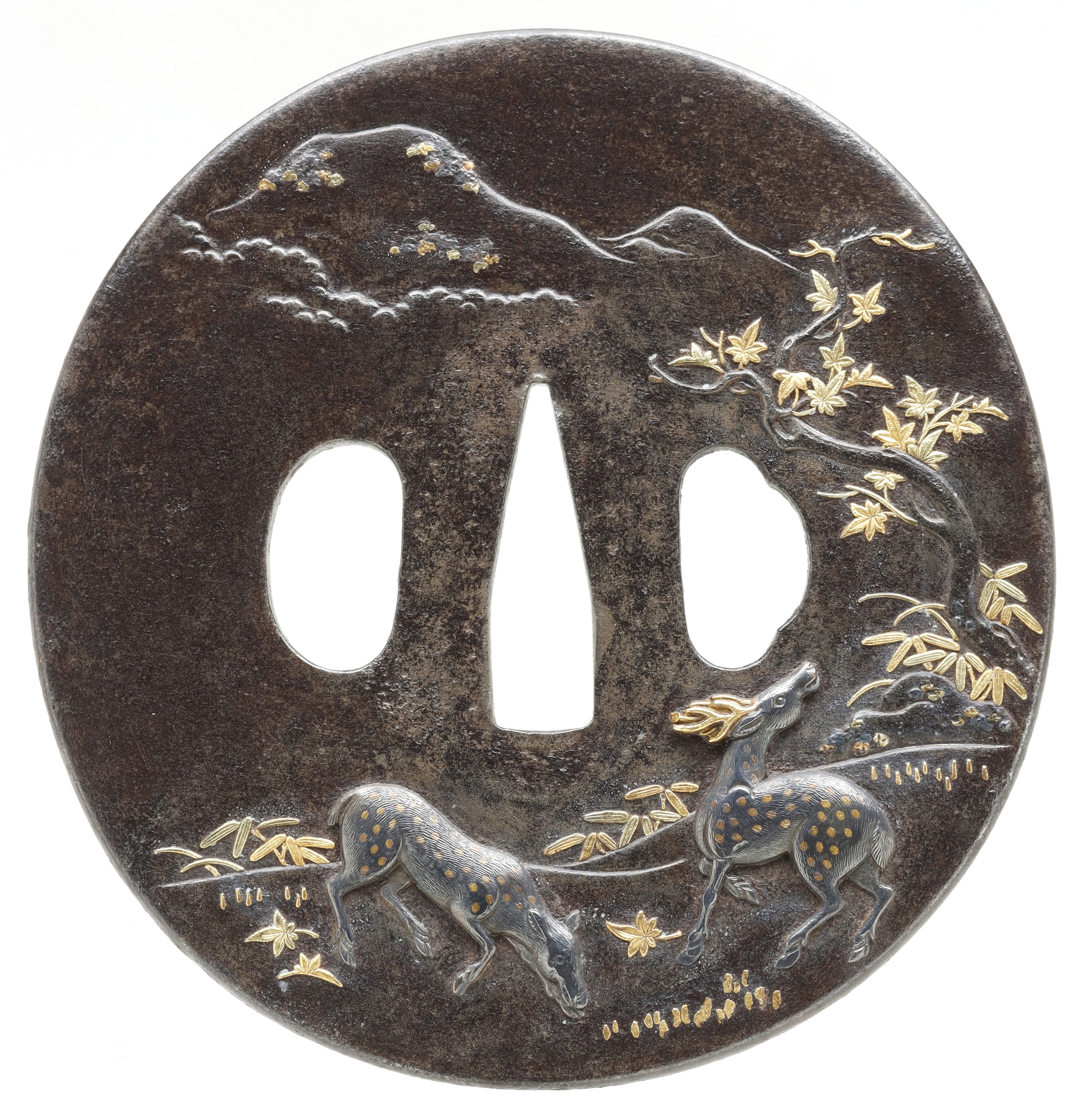
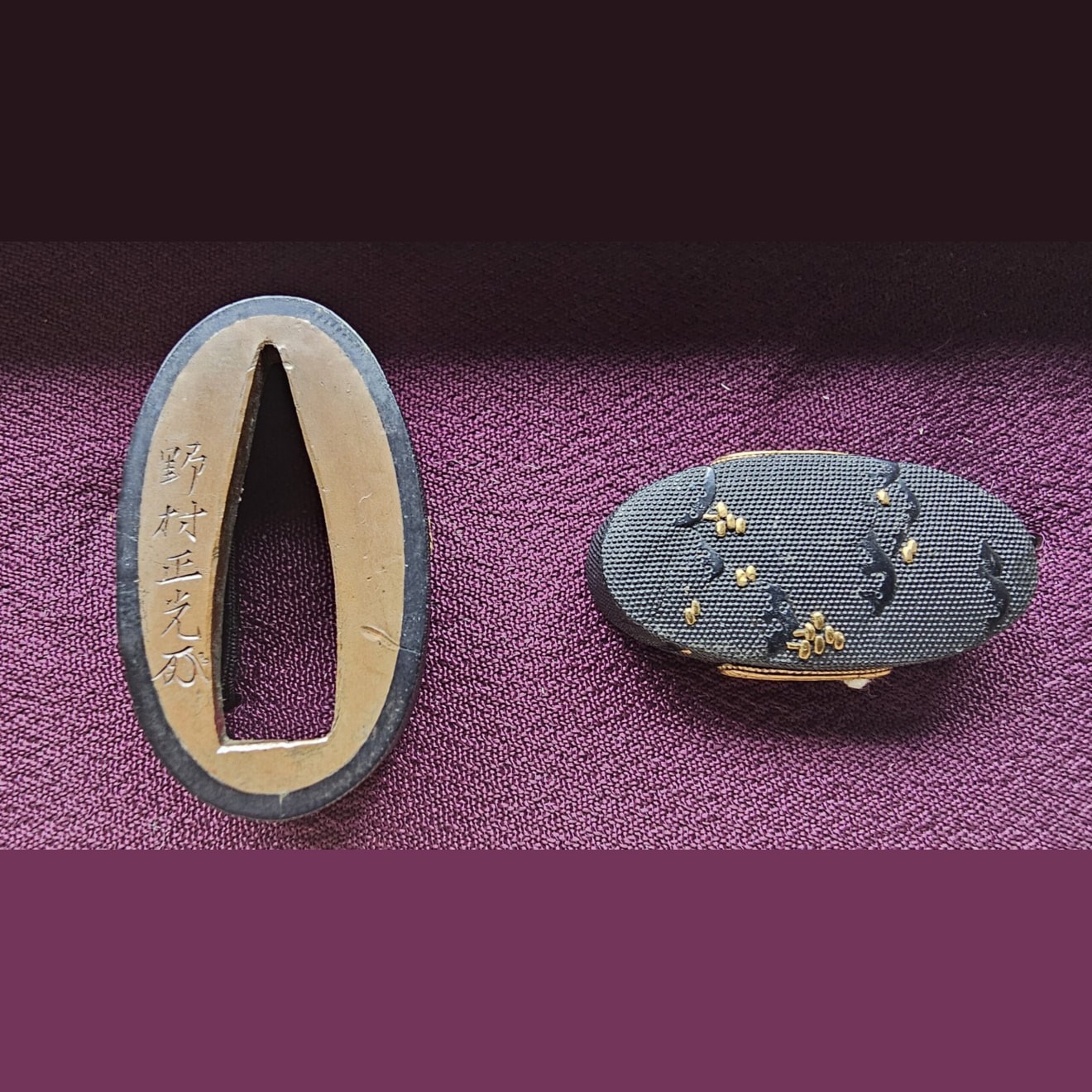
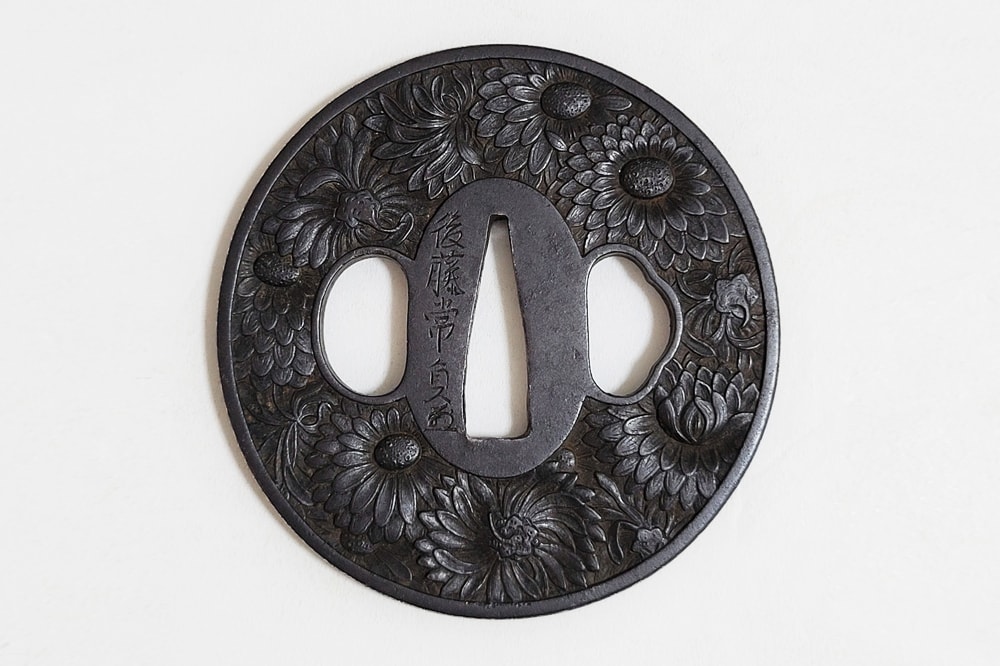
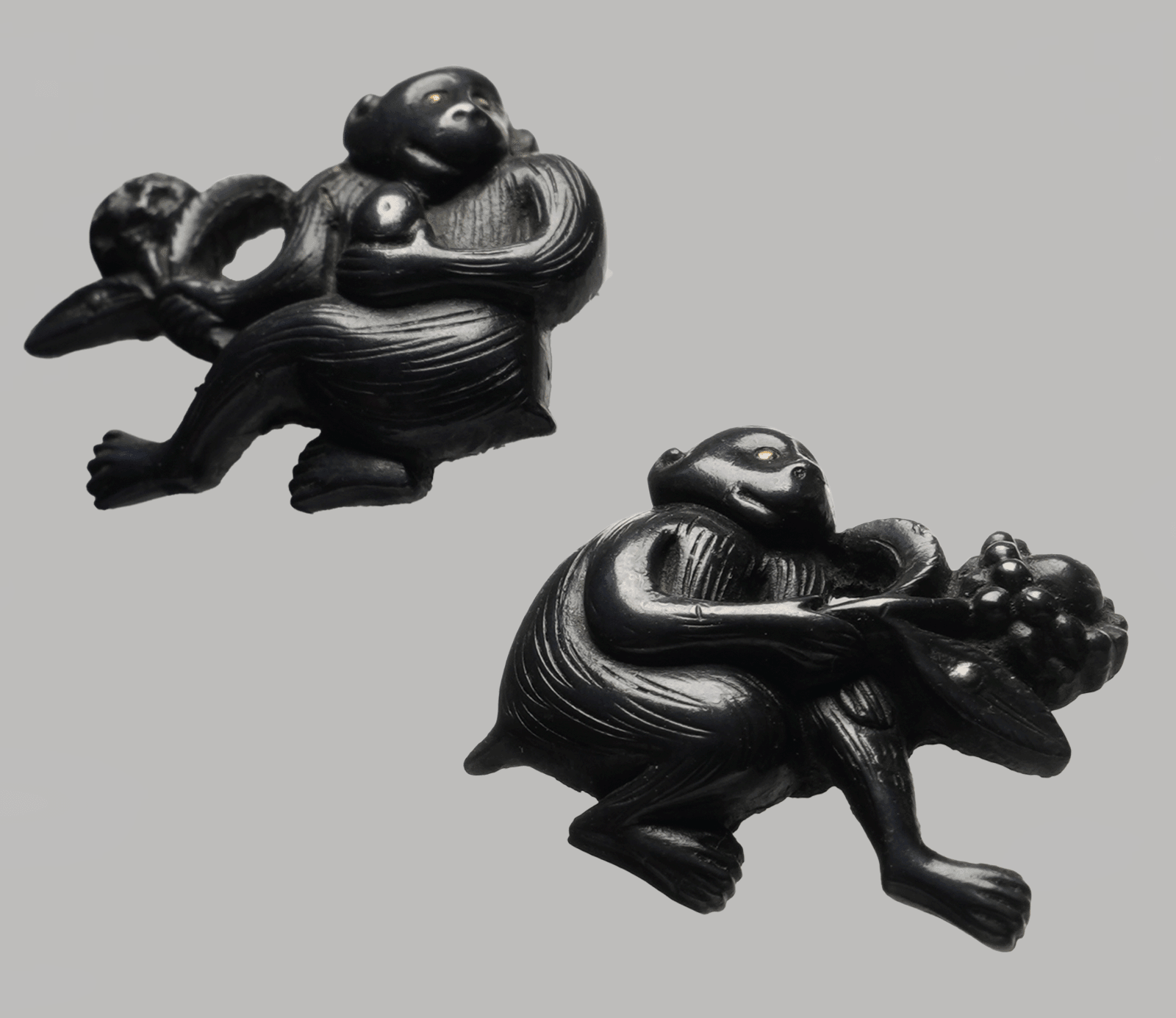
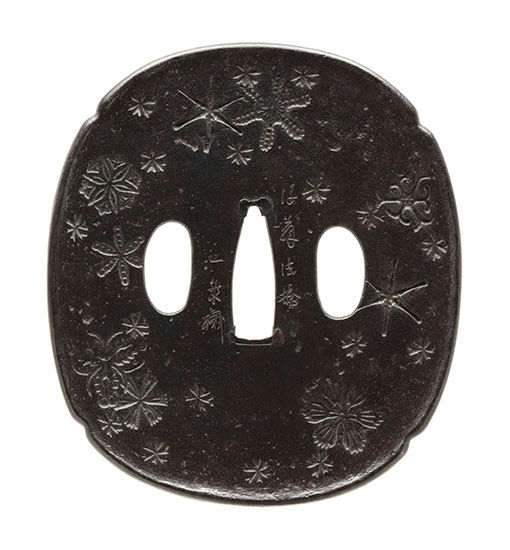
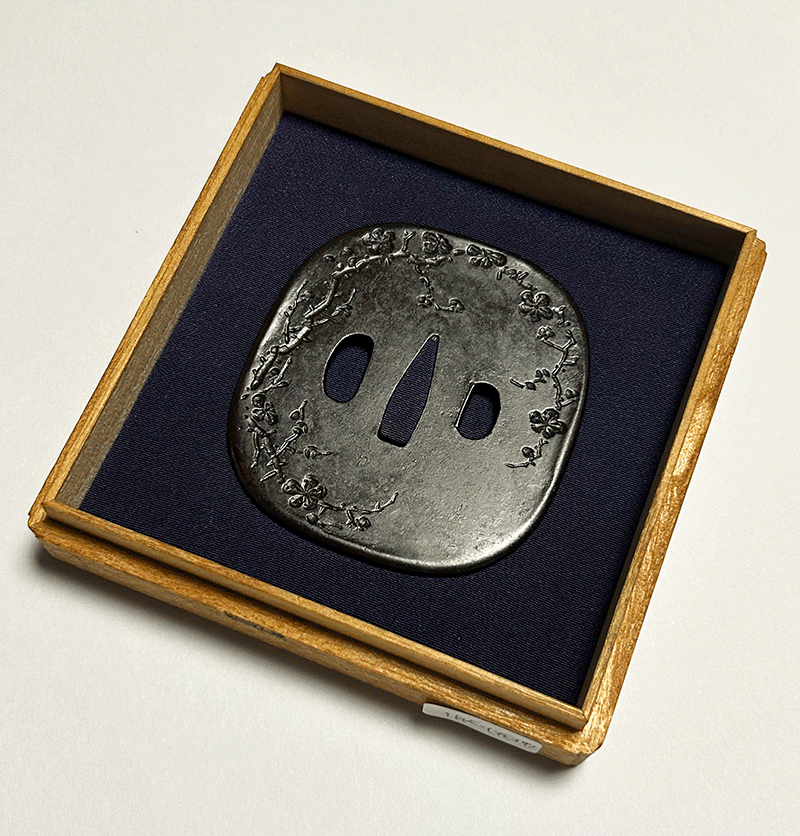
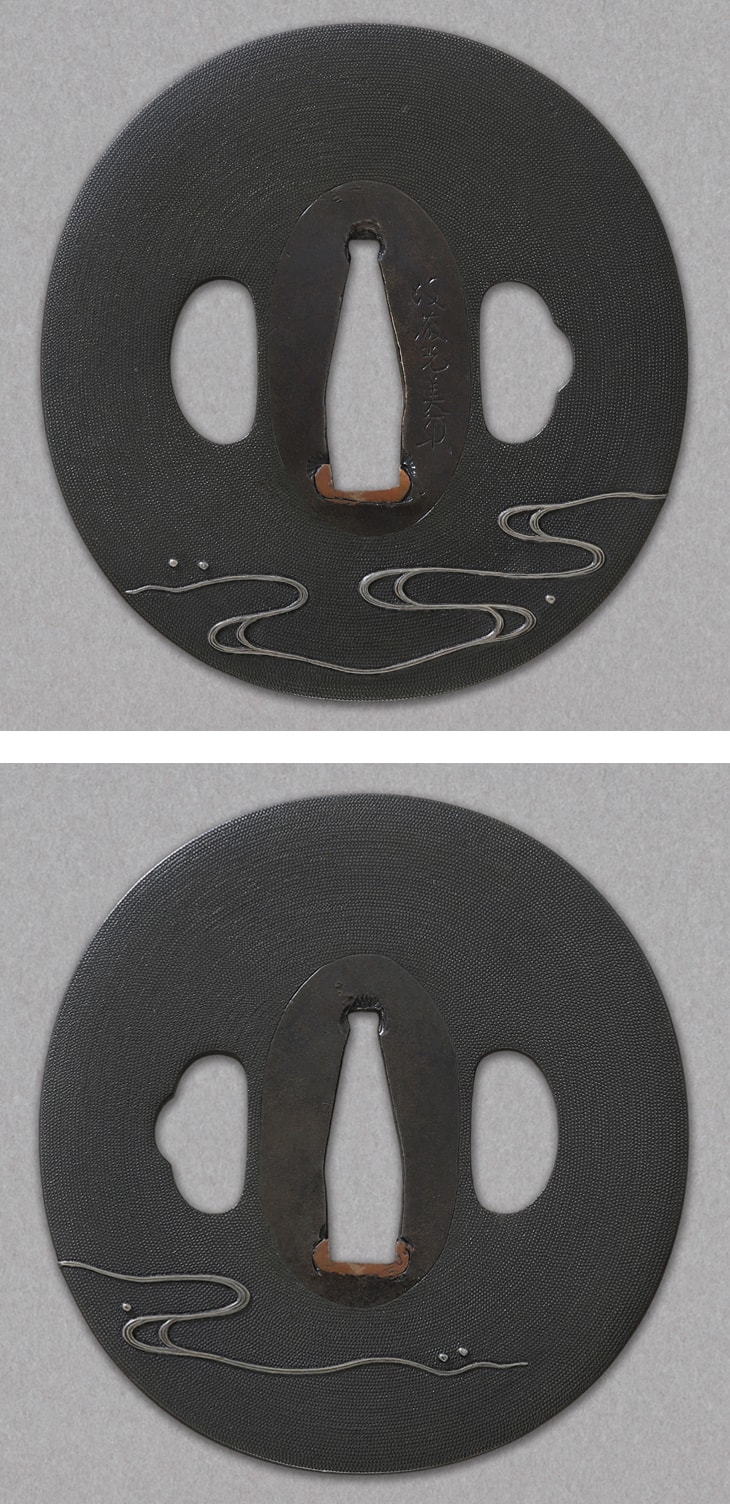
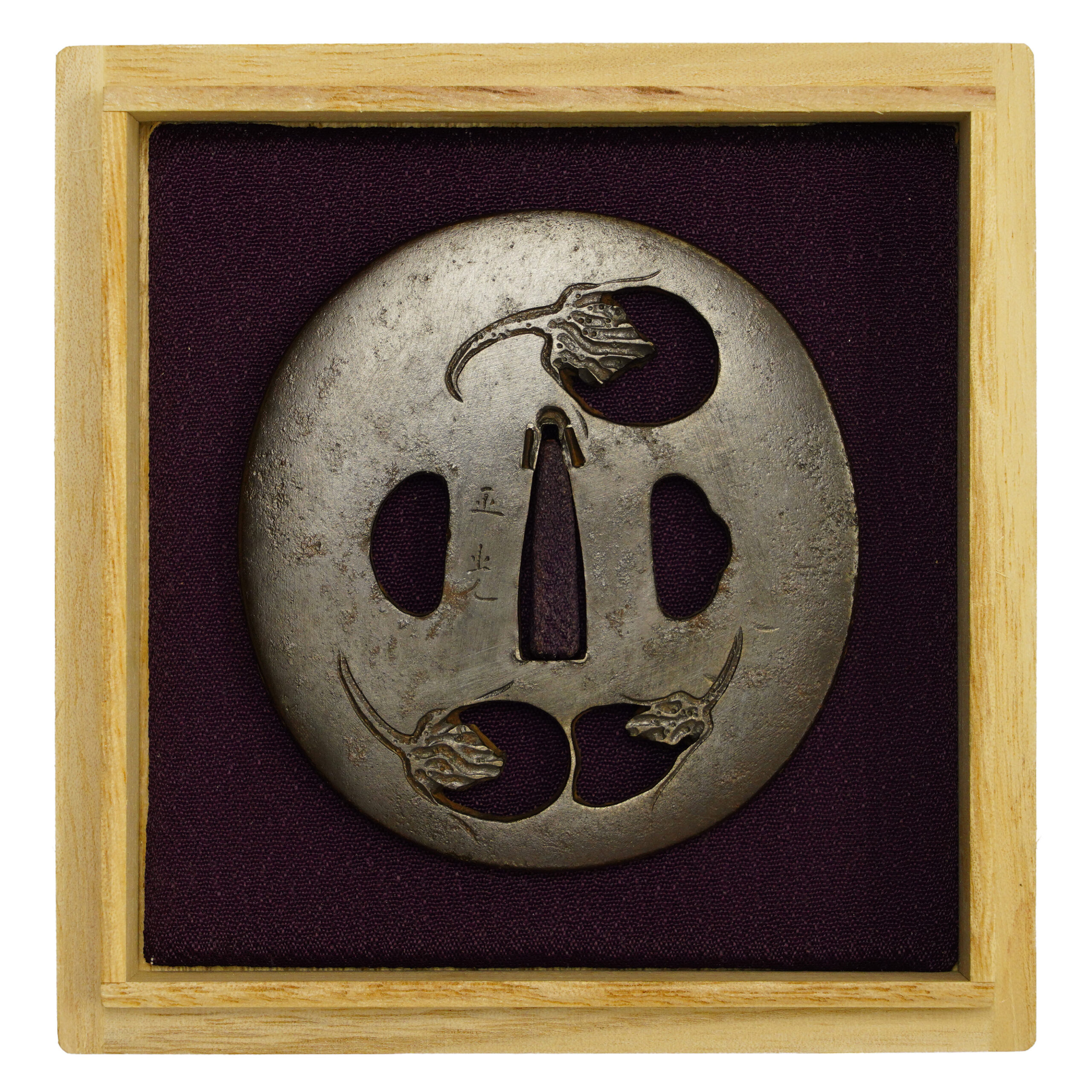
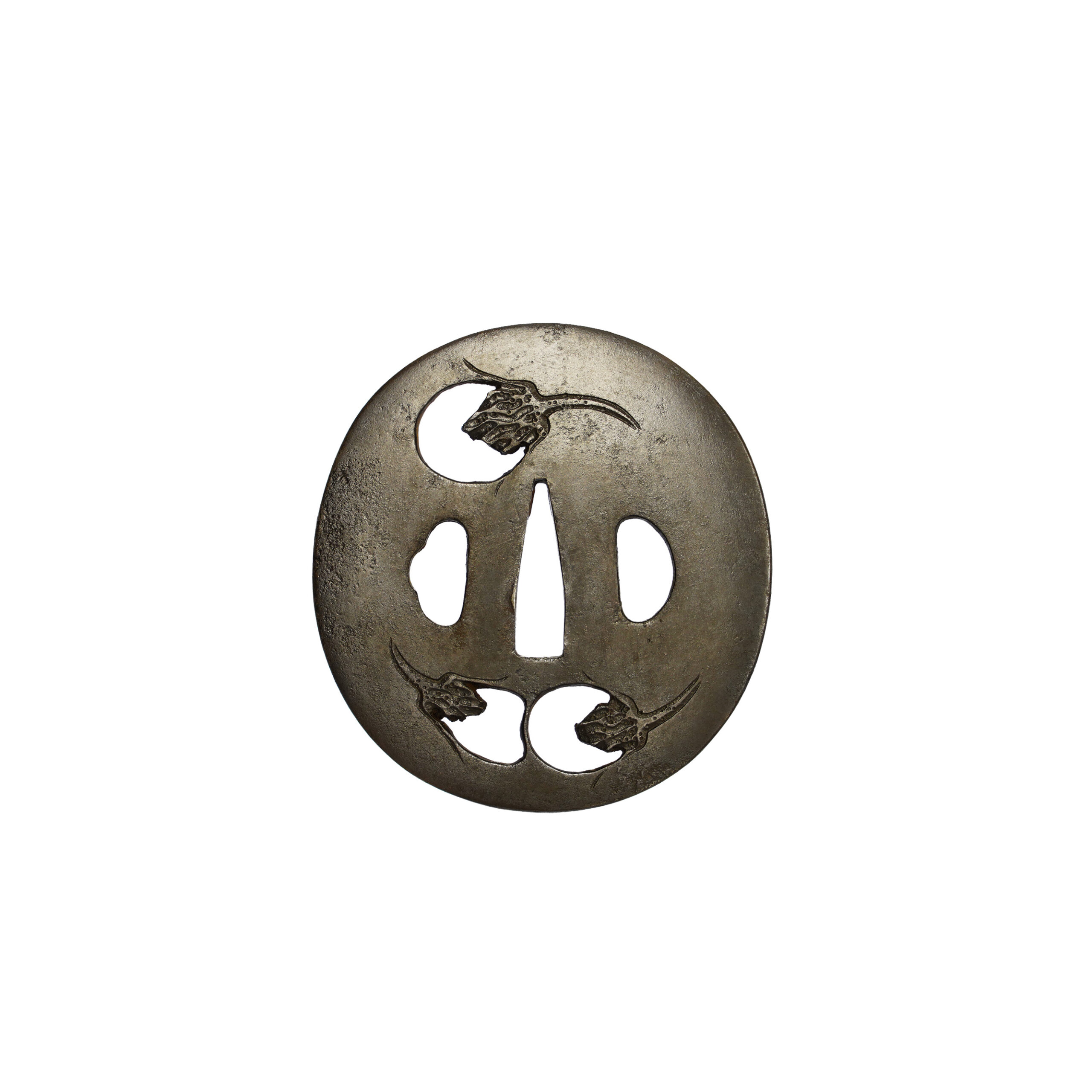
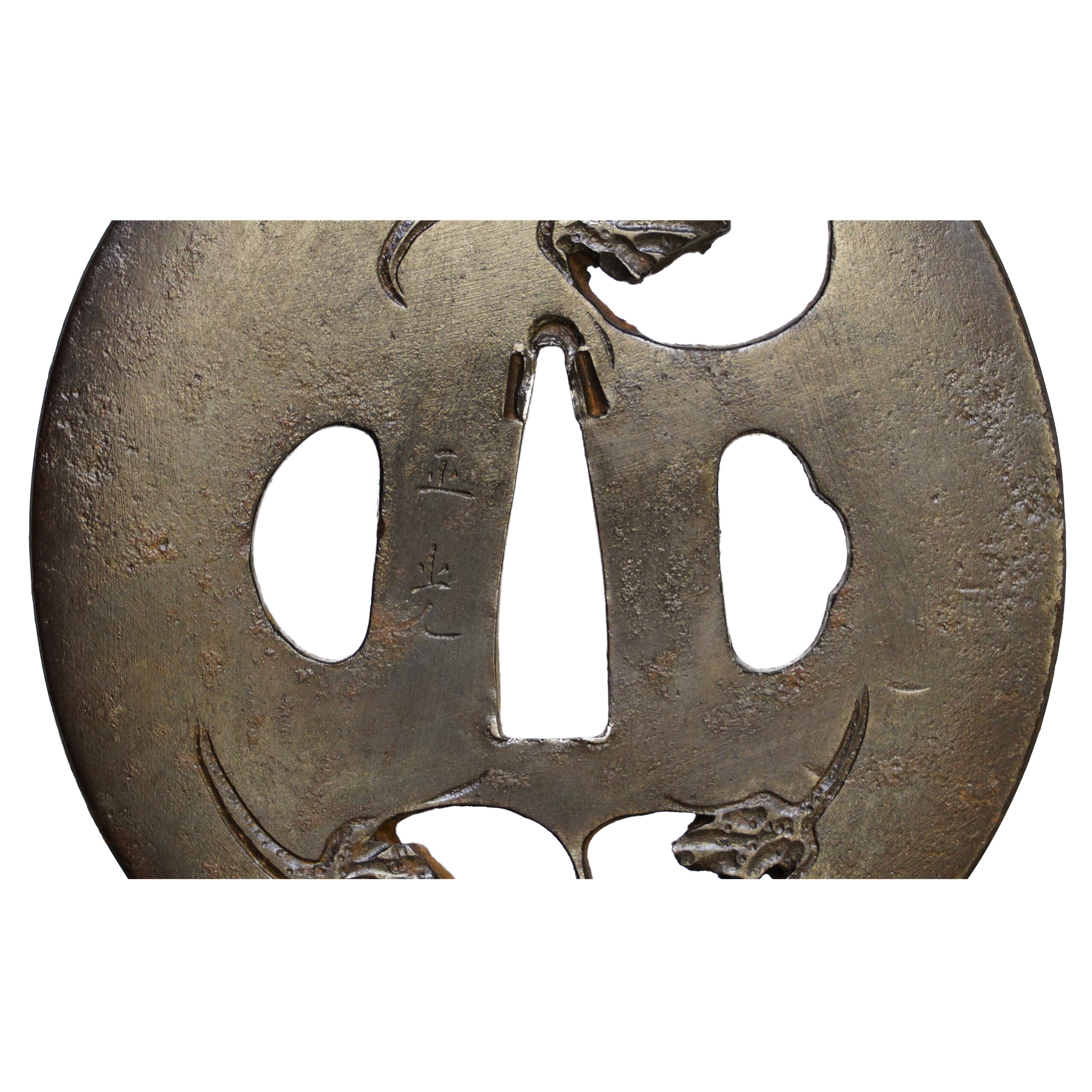
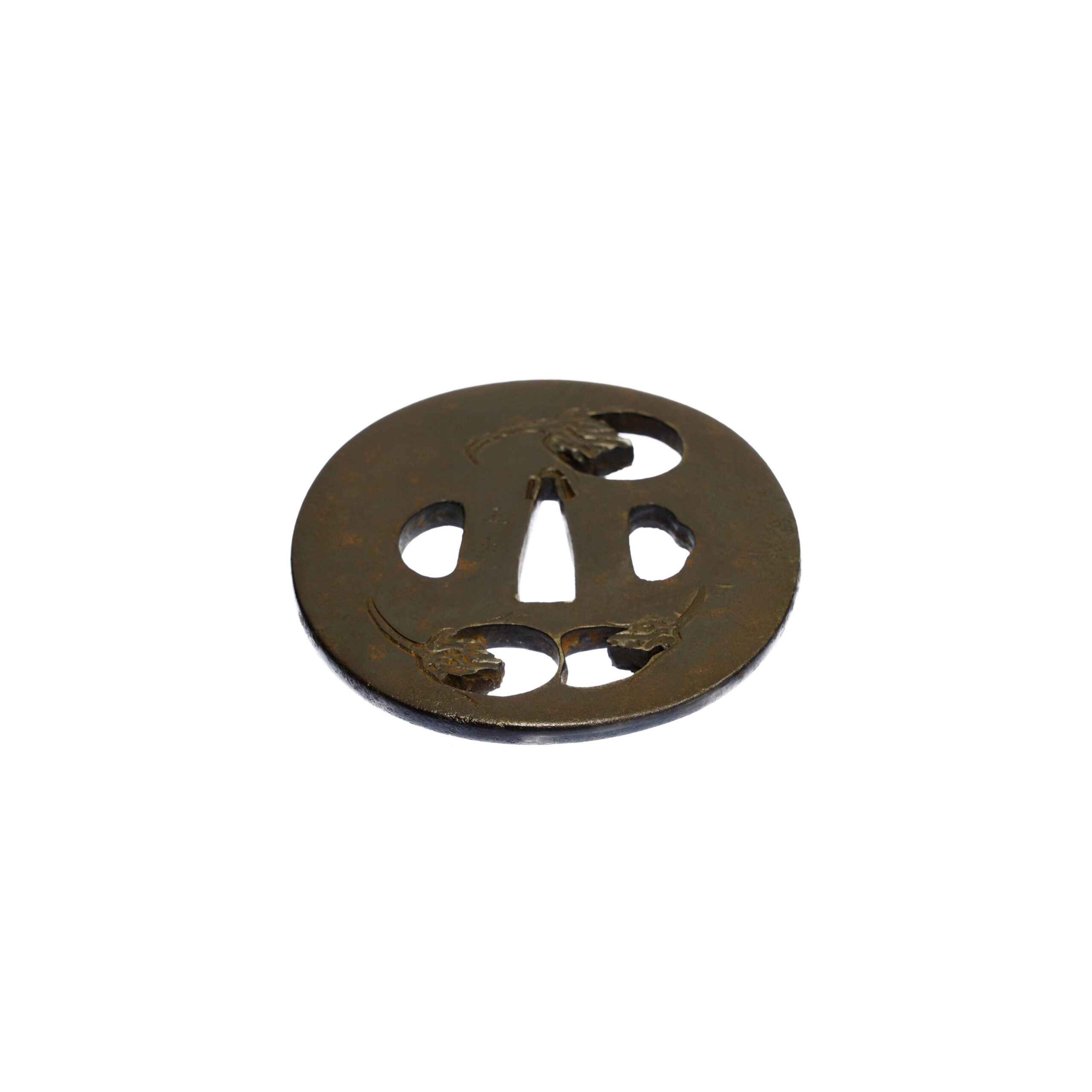
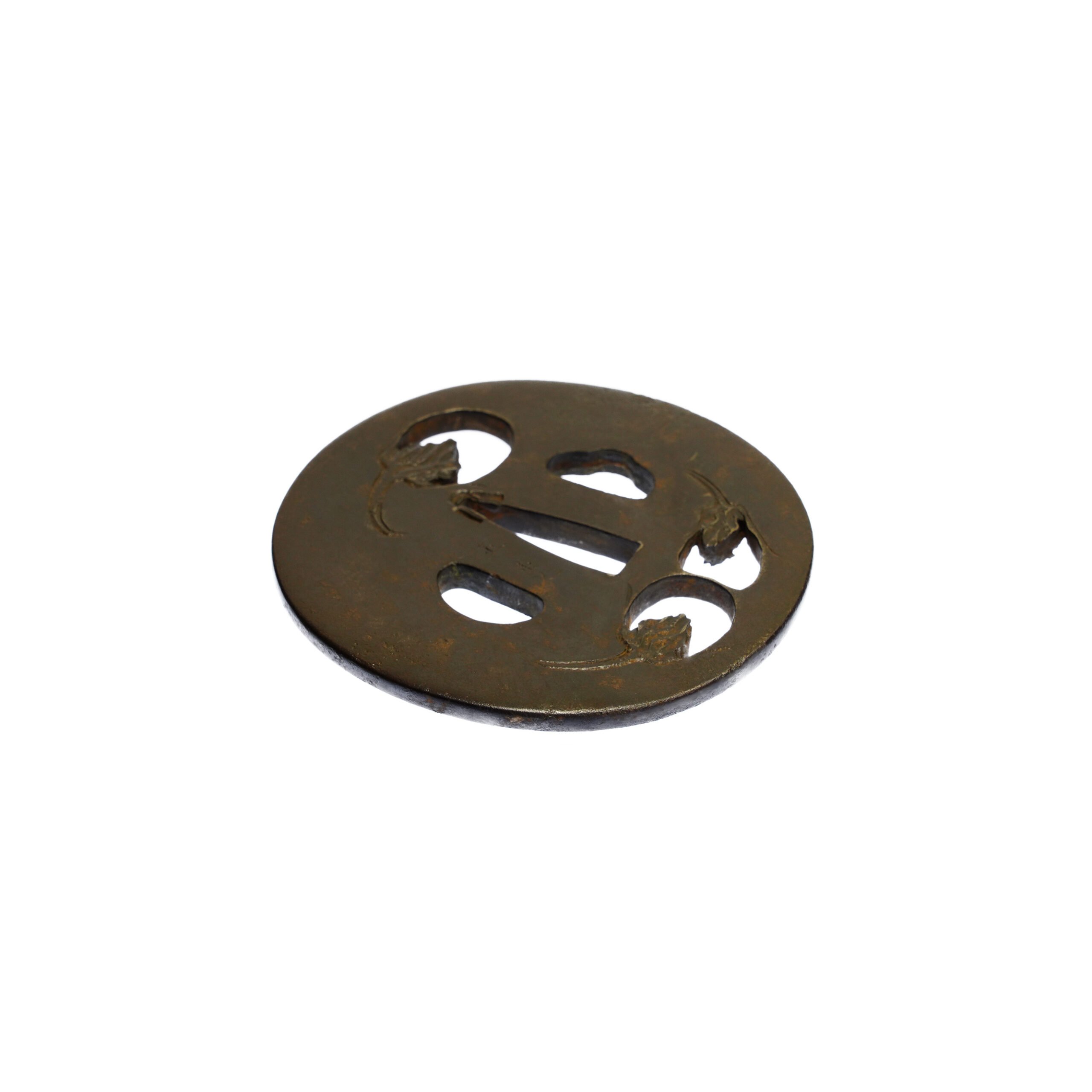
Title: Nasu Sukashi Zu Description If you focus on the center part of this Tsuba, you will find an engraved inscription. It is written as 正光 (Masamitsu), and it shows us the name of the metalworker. We think this Tsuba’s motif is the Nasu (茄子, eggplant). Three eggplants are engraved with openwork. This vegetable design has been treated as an auspicious motif. For example, there is an expression that says, “Ichi-Fuji Ni-Taka San-Nasubi (一富士 二鷹 三茄子, one Mt. Fuji, two hawks, and three eggplants).” In Japan, these are considered auspicious signs if they appear in the first dream of the new year. There are several theories why these motifs were chosen. According to an idea, it is because Tokugawa Ieyasu (徳川 家康, 1543-1616), who opened the Edo Shogunate, appreciated Mt. Fuji, falconry and the first eggplant of the season. As three eggplants are designed for this Tsuba, its design might have been inspired by 一富士 二鷹 三茄子 idea. Another idea is, it is also said that each object’s name compared to a good meaning word as follows; Fuji (富士) and Buji (無事, safe, safely), Taka (鷹) and Takai (高い, high), and Nasu (茄子) and Nasu (成す, make, achieve). *As this item is an antique, please check each photo and ensure its condition. We hope you would enjoy this tasteful work. What is Tsuba? Tsuba is the hand-guard of the Japanese sword. High-class Samurai wore his Katana sword with its beautiful sword mountings such as Tsuba. Tsuba’s front design tends to be more decorative as this part was often seen by other Samurais when he was walking on the streets. Why is it that the sword mounting was important for Samurai? The sword mountings of the Japanese sword have many kinds of decorations such as handguards (Tsuba), sword hilt (Menuki), pommel (Fuchi Kashira). The Japanese sword worked as a weapon and as an object to show who he was. For example, it shows their personalities and beliefs. You could say that it is like decorations for smartphones today. We recommend you zoom in on the pictures of the sword fittings. When you do so, you can see the skill of Japanese metal engraving techniques. They are mainly made of iron and copper with inlays of gold, silver, and bronze. When it comes to handguard (Tsuba), each one has a different outline and weight. These sword fittings that have lived with Japanese swords of the same age might be worth as much as the Japanese swords. They are inconspicuous parts of the Japanese sword. Nevertheless, if you are knowledgeable or particular about it, you will become a connoisseur of the Samurai. 【About us】 Samurai Museum is located in Tokyo, Japan, exhibiting antique artifacts related to the Samurai history. Samurai Museum Shop is the place for those who are interested in Japanese culture and craftsmanship. We deal with antique Samurai swords/armor, traditional crafts made in Japan and so on. 【Payment method】 We accept payment through Stripe (Credit card), PayPal , Apple Pay or ChromePay, all of which are secure payment methods. Also, you don’t need to make an account on Stripe for the checkout. If you prefer other payment method, please contact us. You may either pay in JPY , USD , AUD , CAD , EUR , CHF or GBP . The price is set in Japanese Yen. Prices in other currencies are automatically calculated based on the latest exchange rate. 【Shipping duration】 We normally ship via EMS (Express Mail Service) provided by Japan Post. It usually takes at least 5-14 days to deliver the package after you place an order. Time of delivery is estimated as accurately as possible by the carrier but does not take into account any delays beyond our control such as by inclement weather, post office holiday seasons. We offer Free International Shipping as long as we can ship your order by EMS. If you prefer other shipping carriers, please contact us. We will inform you of the order’s tracking number via email. Please make sure you fill out your valid email address correctly. *Please keep in mind that due to the spread of COVID-19, there might be
 NihontoWatch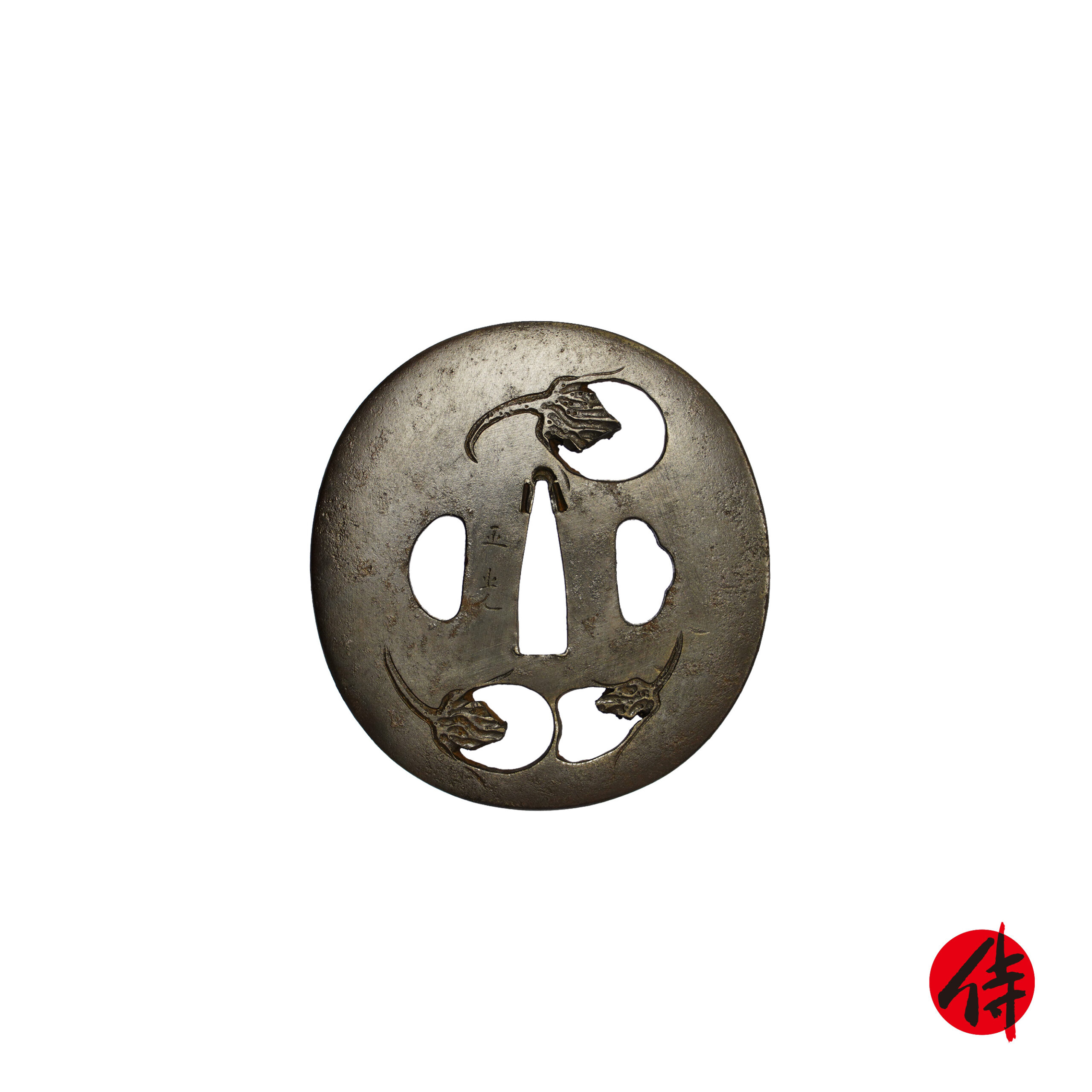
家彫 · 陸奥 · 1670頃
現在3点販売中
正光の位置づけを、日本刀全体および伝統・時代・時期ごとに示します。各位(随一・屈指・有数・著名)は、NBTHK および文化庁による指定に加え、三作や名物帳などの歴史的栄誉を加味したものです。
各項目を選ぶと評価方法が表示されます。
家彫 · 山城
現在325点販売中
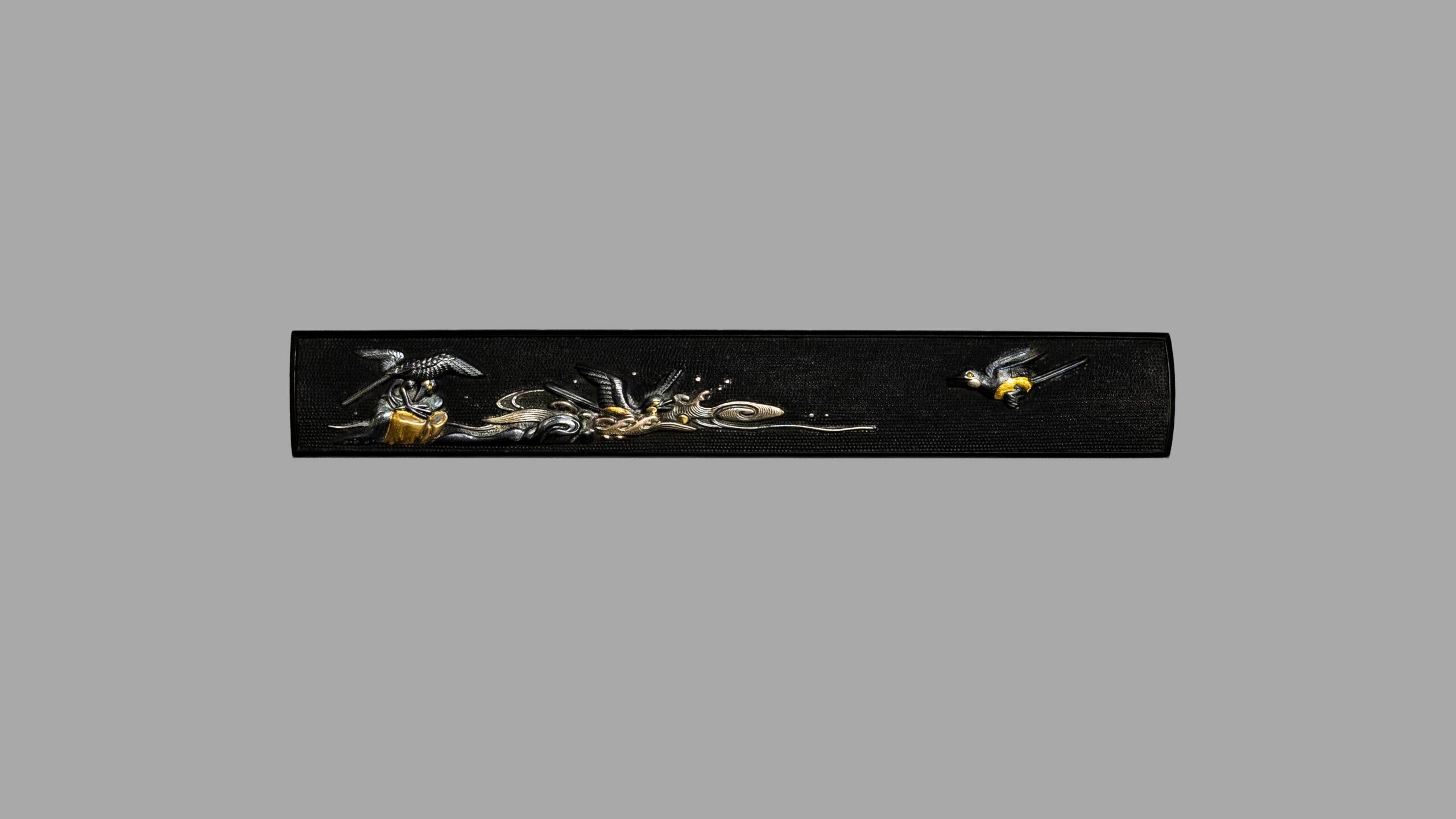
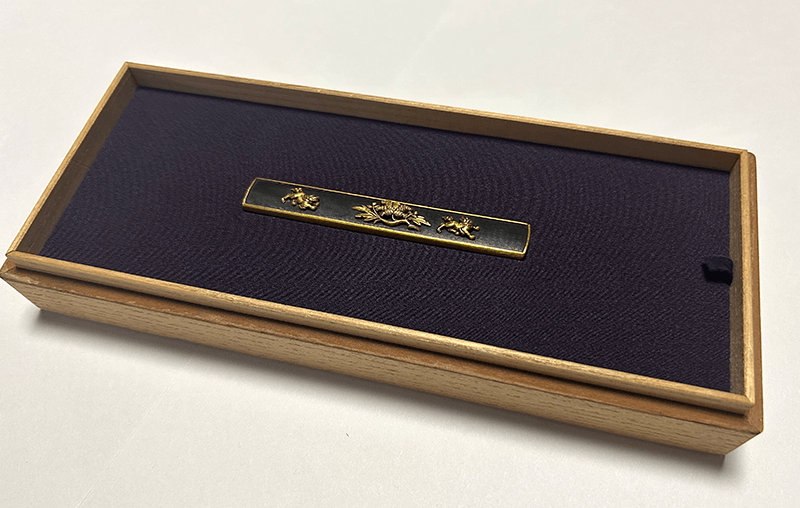
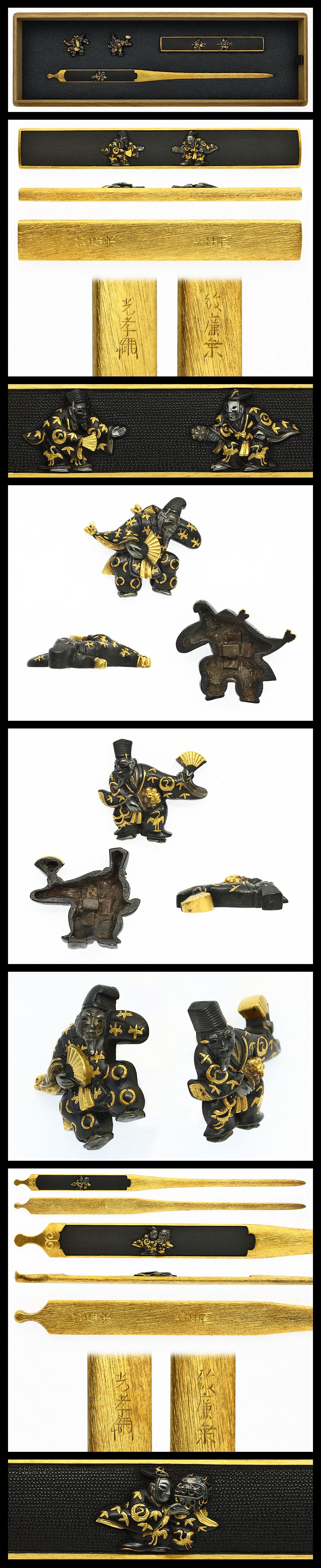
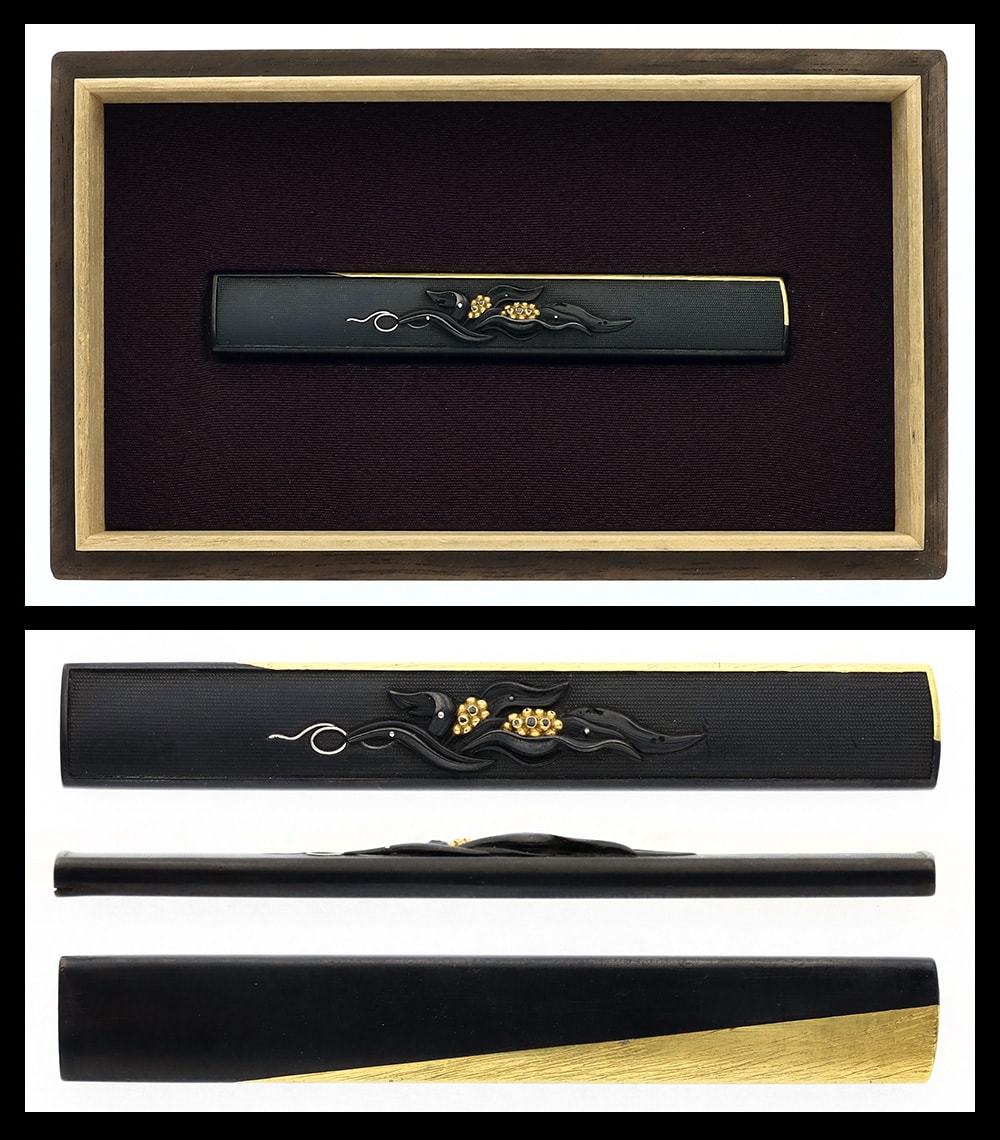
後藤派は、室町時代中期に初代祐乗が将軍足利義政に仕えて創始した彫金の宗家であり、「日本彫物の元祖」と仰がれ、「古今独歩の鏨師」と賞賛される祐乗を祖として十五代にわたり嫡流の技を継承した。祐乗の作品は東山御物として数多く取り上げられ、後世に名を残した名工は挙って後藤家の祐乗に範をとっている。四代光乗・五代徳乗は織田信長、次いで豊臣秀吉に仕え、大判・分銅・彫物の三役を担い、桃山時代の豪華美を格調高く表示した。幕末には一乗が「後藤家の掉尾を飾る名工」として家風を大成し、門下の荒木東明・中川一勝らが一派の技を継承した。 後藤派の作域は三所物・縁頭・鐔・揃金具と多岐にわたり、赤銅魚子地を基調とした高彫金色絵を家風の根幹とする。金紋裏哺金仕立の小柄笄、金無垢地容彫の目貫など、素材と技法の選択に一貫した格式が認められる。三代乗真は「大振りで力強く、量感の豊かな彫技」[[c:1]]を特徴とし、紋の肉取りが豊かで鏨使いが手強く、赤銅の色相も漆黒で麗わしい。桃山期の作には鋤出高彫に金・銀・素銅の象嵌色絵を駆使した豪華絢爛の大名道具が見られ、近世には四分一磨地や朧銀地に甲鋤毛彫・平象嵌を組み合わせた多彩な表現も展開された。龍・獅子・鶏・犀・鯰といった動物意匠から、松竹梅・桐紋・粟穂・四季草花に至るまで画題は広範であり、各代が武家好みの吉祥意匠を格調高く仕上げている。 後藤派に帰せられる作品には「気品があって格調が高く」[[c:2]]「力漲る」と評される一貫した品格が通底する。歴代の折紙制度によって初代祐乗以来の作が厳格に鑑定・伝承され、「家彫の誇りは確実に後代に伝わっている」[[c:3]]と繰り返し認められる。後藤流に熟達した門弟の作が「後藤家御家彫と見紛うまでの出来」[[c:4]]と称されることからも、その規範性の高さが窺える。日本金工史において、後藤派は赤銅魚子地高彫金色絵という技法体系を確立し、室町から明治に至る四百余年の間、彫金の最高規範として君臨した一門である。 詳しく見る →
販売店の出品ページで鑑定書を確認できませんでした。日本刀および刀装具は通常、NBTHK(または NTHK)の鑑定を受けます。鑑定書がない場合、極めは販売店の見解にとどまり、第三者による確認は行われていません。ご購入前に販売店へ鑑定書の有無をお問い合わせのうえ、慎重にご判断ください。
Returns/exchanges limited to defects caused by shipping (except willful misconduct or gross negligence by the company); customers must contact within 72 hours of receiving the product.
Title: Nasu Sukashi Zu Description If you focus on the center part of this Tsuba, you will find an engraved inscription. It is written as 正光 (Masamitsu), and it shows us the name of the metalworker. We think this Tsuba’s motif is the Nasu (茄子, eggplant). Three eggplants are engraved with openwork. This vegetable design has been treated as an auspicious motif. For example, there is an expression that says, “Ichi-Fuji Ni-Taka San-Nasubi (一富士 二鷹 三茄子, one Mt. Fuji, two hawks, and three eggplants).” In Japan, these are considered auspicious signs if they appear in the first dream of the new year. There are several theories why these motifs were chosen. According to an idea, it is because Tokugawa Ieyasu (徳川 家康, 1543-1616), who opened the Edo Shogunate, appreciated Mt. Fuji, falconry and the first eggplant of the season. As three eggplants are designed for this Tsuba, its design might have been inspired by 一富士 二鷹 三茄子 idea. Another idea is, it is also said that each object’s name compared to a good meaning word as follows; Fuji (富士) and Buji (無事, safe, safely), Taka (鷹) and Takai (高い, high), and Nasu (茄子) and Nasu (成す, make, achieve). *As this item is an antique, please check each photo and ensure its condition. We hope you would enjoy this tasteful work. What is Tsuba? Tsuba is the hand-guard of the Japanese sword. High-class Samurai wore his Katana sword with its beautiful sword mountings such as Tsuba. Tsuba’s front design tends to be more decorative as this part was often seen by other Samurais when he was walking on the streets. Why is it that the sword mounting was important for Samurai? The sword mountings of the Japanese sword have many kinds of decorations such as handguards (Tsuba), sword hilt (Menuki), pommel (Fuchi Kashira). The Japanese sword worked as a weapon and as an object to show who he was. For example, it shows their personalities and beliefs. You could say that it is like decorations for smartphones today. We recommend you zoom in on the pictures of the sword fittings. When you do so, you can see the skill of Japanese metal engraving techniques. They are mainly made of iron and copper with inlays of gold, silver, and bronze. When it comes to handguard (Tsuba), each one has a different outline and weight. These sword fittings that have lived with Japanese swords of the same age might be worth as much as the Japanese swords. They are inconspicuous parts of the Japanese sword. Nevertheless, if you are knowledgeable or particular about it, you will become a connoisseur of the Samurai. 【About us】 Samurai Museum is located in Tokyo, Japan, exhibiting antique artifacts related to the Samurai history. Samurai Museum Shop is the place for those who are interested in Japanese culture and craftsmanship. We deal with antique Samurai swords/armor, traditional crafts made in Japan and so on. 【Payment method】 We accept payment through Stripe (Credit card), PayPal , Apple Pay or ChromePay, all of which are secure payment methods. Also, you don’t need to make an account on Stripe for the checkout. If you prefer other payment method, please contact us. You may either pay in JPY , USD , AUD , CAD , EUR , CHF or GBP . The price is set in Japanese Yen. Prices in other currencies are automatically calculated based on the latest exchange rate. 【Shipping duration】 We normally ship via EMS (Express Mail Service) provided by Japan Post. It usually takes at least 5-14 days to deliver the package after you place an order. Time of delivery is estimated as accurately as possible by the carrier but does not take into account any delays beyond our control such as by inclement weather, post office holiday seasons. We offer Free International Shipping as long as we can ship your order by EMS. If you prefer other shipping carriers, please contact us. We will inform you of the order’s tracking number via email. Please make sure you fill out your valid email address correctly. *Please keep in mind that due to the spread of COVID-19, there might be
NihontoWatch家彫 · 陸奥 · 1670頃
現在3点販売中
正光の位置づけを、日本刀全体および伝統・時代・時期ごとに示します。各位(随一・屈指・有数・著名)は、NBTHK および文化庁による指定に加え、三作や名物帳などの歴史的栄誉を加味したものです。
各項目を選ぶと評価方法が表示されます。
家彫 · 山城
現在325点販売中
後藤派は、室町時代中期に初代祐乗が将軍足利義政に仕えて創始した彫金の宗家であり、「日本彫物の元祖」と仰がれ、「古今独歩の鏨師」と賞賛される祐乗を祖として十五代にわたり嫡流の技を継承した。祐乗の作品は東山御物として数多く取り上げられ、後世に名を残した名工は挙って後藤家の祐乗に範をとっている。四代光乗・五代徳乗は織田信長、次いで豊臣秀吉に仕え、大判・分銅・彫物の三役を担い、桃山時代の豪華美を格調高く表示した。幕末には一乗が「後藤家の掉尾を飾る名工」として家風を大成し、門下の荒木東明・中川一勝らが一派の技を継承した。 後藤派の作域は三所物・縁頭・鐔・揃金具と多岐にわたり、赤銅魚子地を基調とした高彫金色絵を家風の根幹とする。金紋裏哺金仕立の小柄笄、金無垢地容彫の目貫など、素材と技法の選択に一貫した格式が認められる。三代乗真は「大振りで力強く、量感の豊かな彫技」[[c:1]]を特徴とし、紋の肉取りが豊かで鏨使いが手強く、赤銅の色相も漆黒で麗わしい。桃山期の作には鋤出高彫に金・銀・素銅の象嵌色絵を駆使した豪華絢爛の大名道具が見られ、近世には四分一磨地や朧銀地に甲鋤毛彫・平象嵌を組み合わせた多彩な表現も展開された。龍・獅子・鶏・犀・鯰といった動物意匠から、松竹梅・桐紋・粟穂・四季草花に至るまで画題は広範であり、各代が武家好みの吉祥意匠を格調高く仕上げている。 後藤派に帰せられる作品には「気品があって格調が高く」[[c:2]]「力漲る」と評される一貫した品格が通底する。歴代の折紙制度によって初代祐乗以来の作が厳格に鑑定・伝承され、「家彫の誇りは確実に後代に伝わっている」[[c:3]]と繰り返し認められる。後藤流に熟達した門弟の作が「後藤家御家彫と見紛うまでの出来」[[c:4]]と称されることからも、その規範性の高さが窺える。日本金工史において、後藤派は赤銅魚子地高彫金色絵という技法体系を確立し、室町から明治に至る四百余年の間、彫金の最高規範として君臨した一門である。 詳しく見る →
販売店の出品ページで鑑定書を確認できませんでした。日本刀および刀装具は通常、NBTHK(または NTHK)の鑑定を受けます。鑑定書がない場合、極めは販売店の見解にとどまり、第三者による確認は行われていません。ご購入前に販売店へ鑑定書の有無をお問い合わせのうえ、慎重にご判断ください。
Returns/exchanges limited to defects caused by shipping (except willful misconduct or gross negligence by the company); customers must contact within 72 hours of receiving the product.