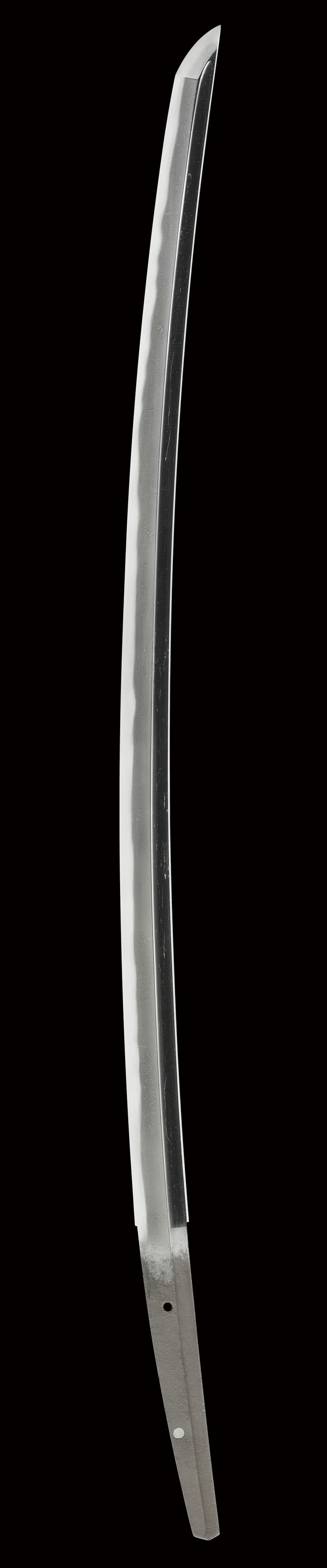
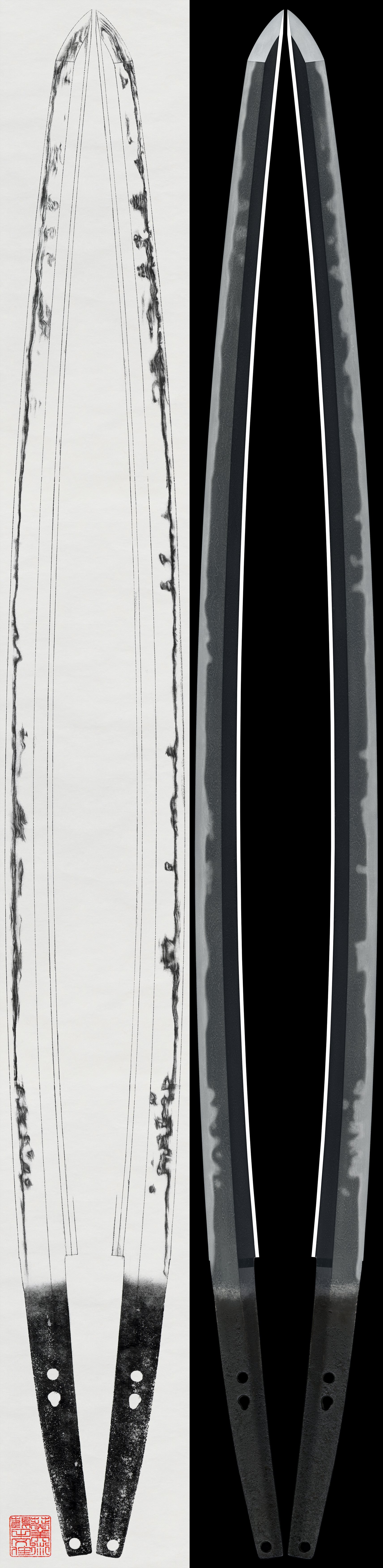
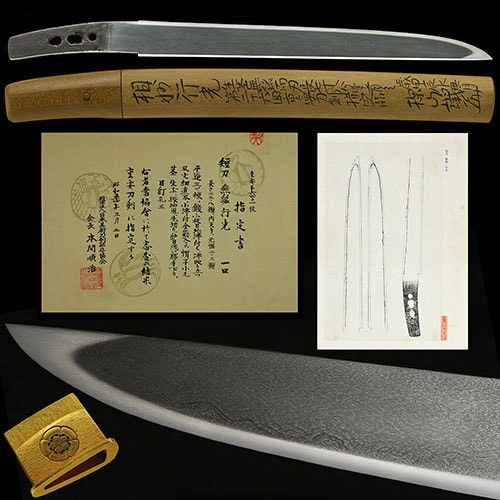
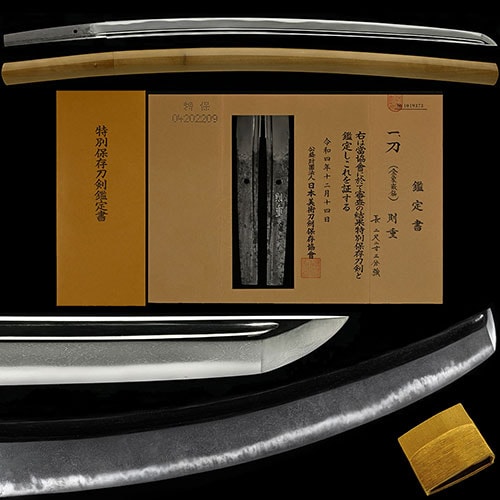
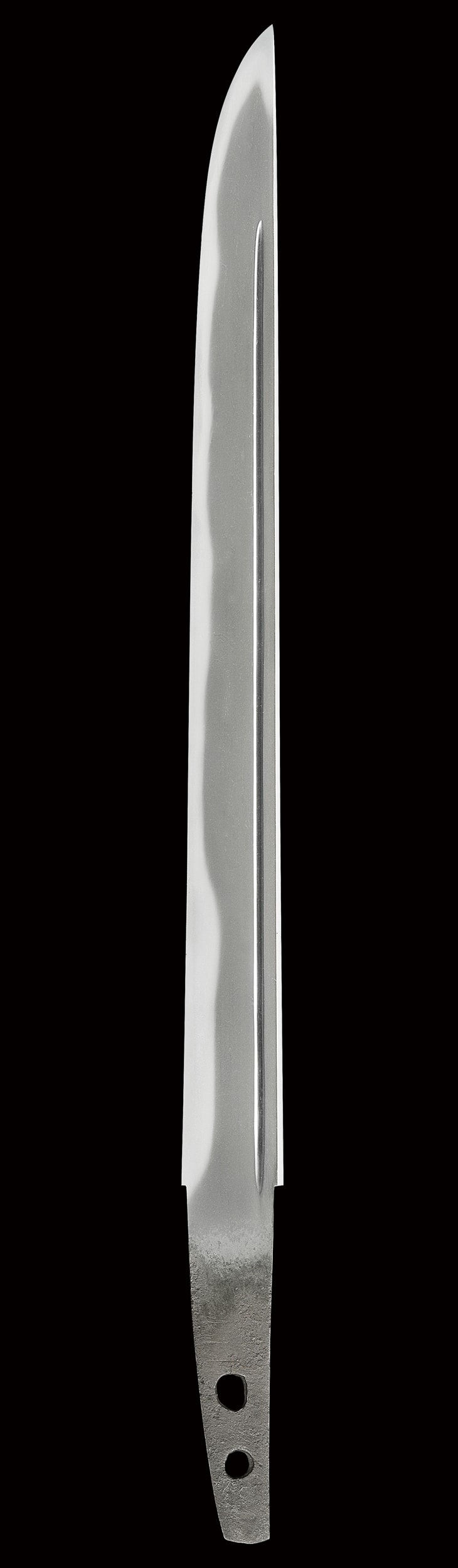
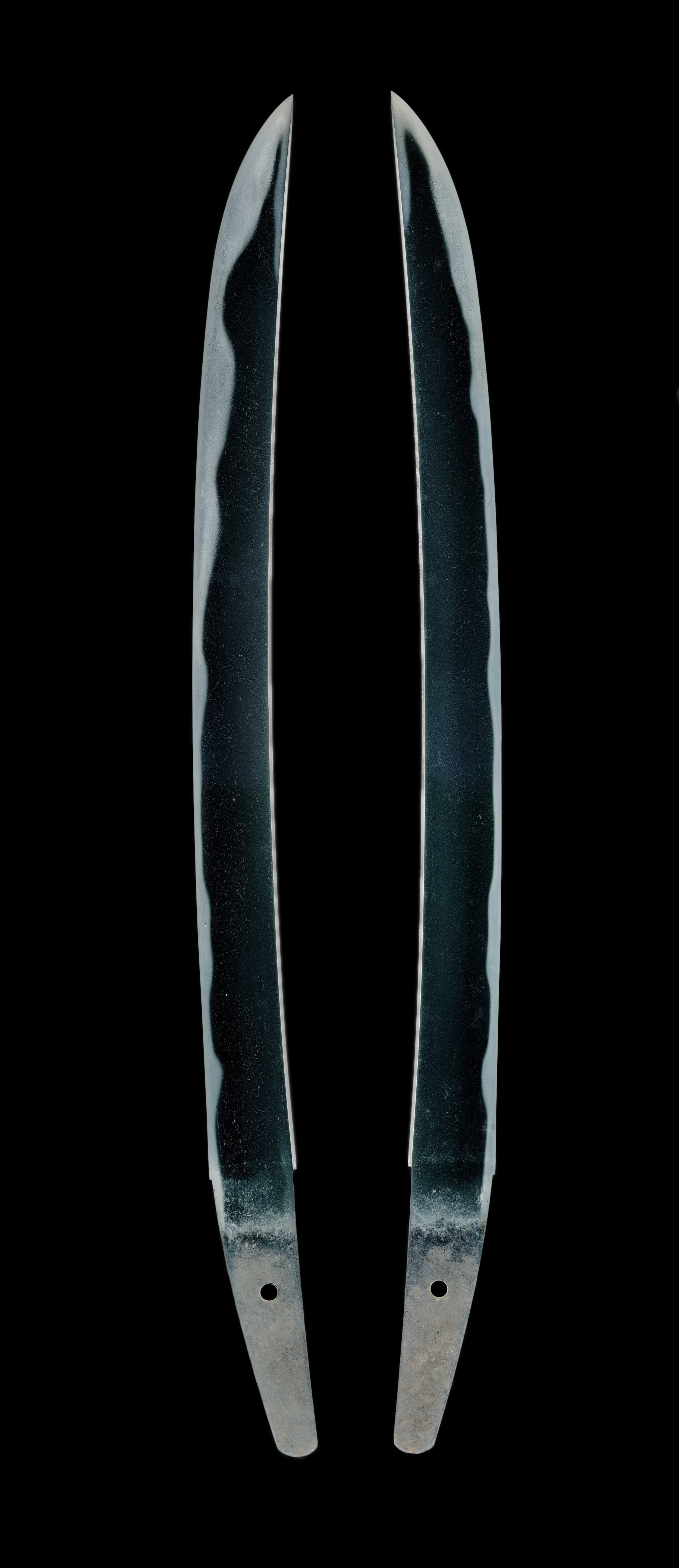
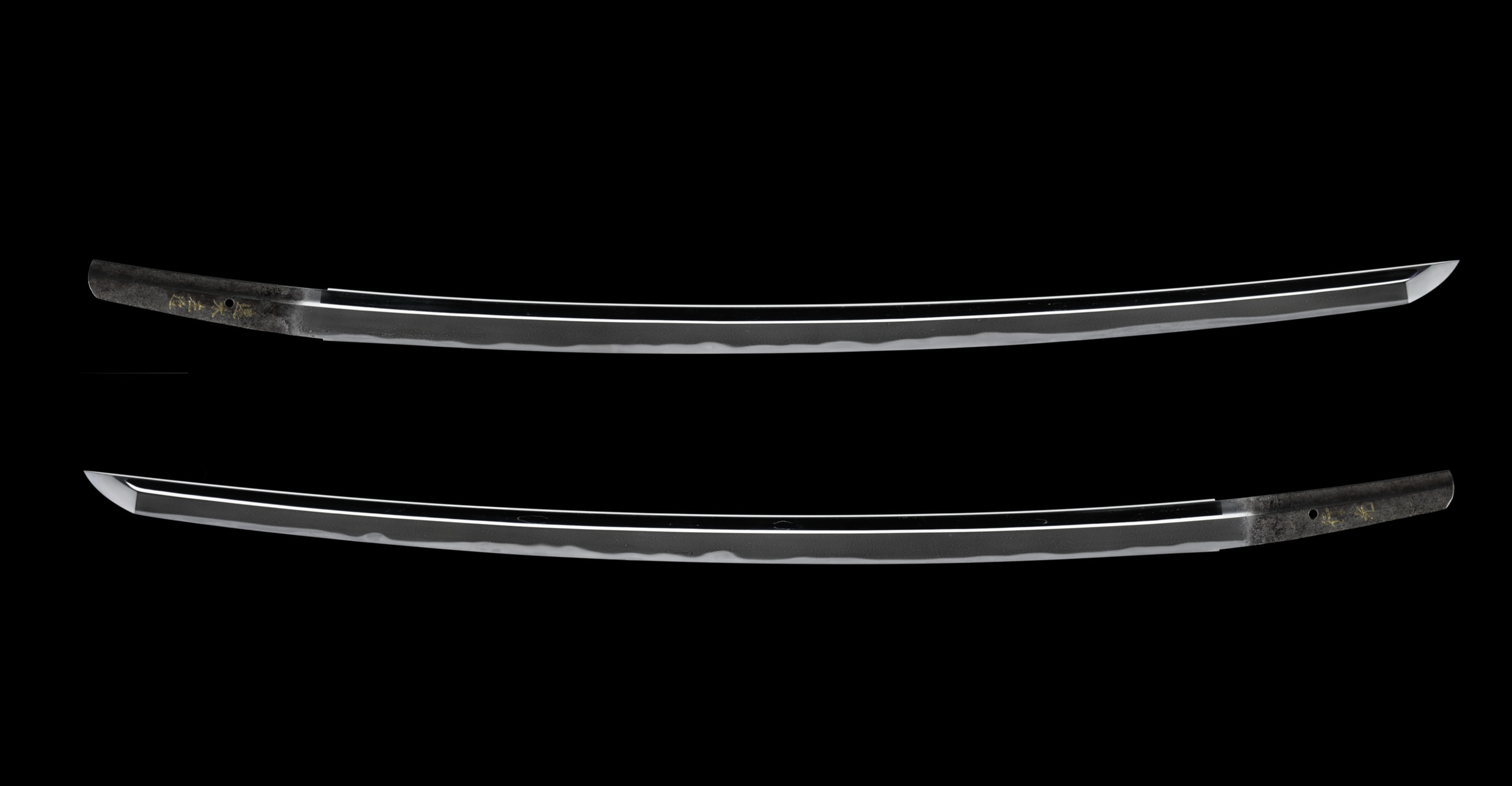
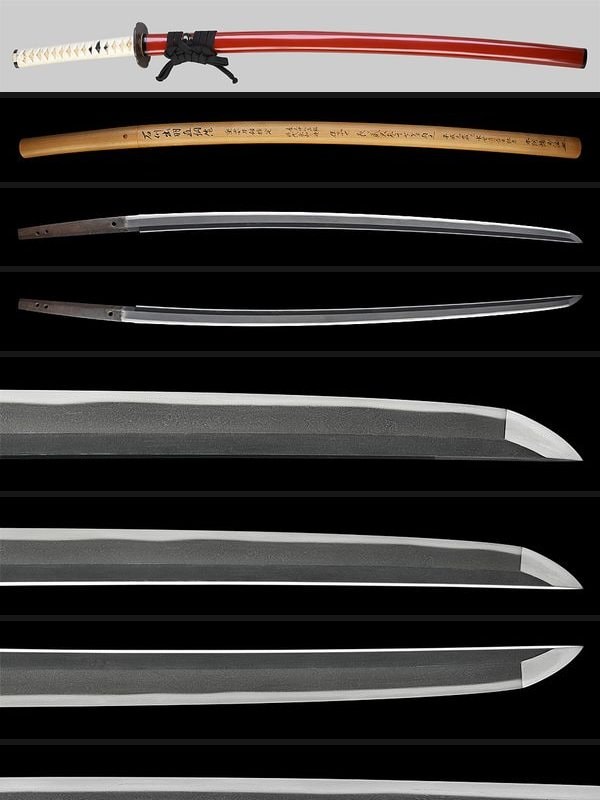
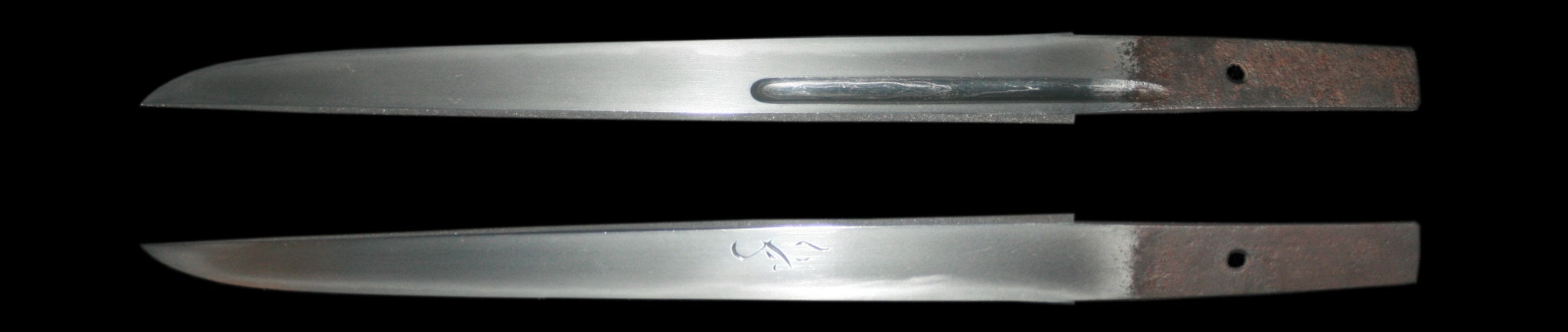
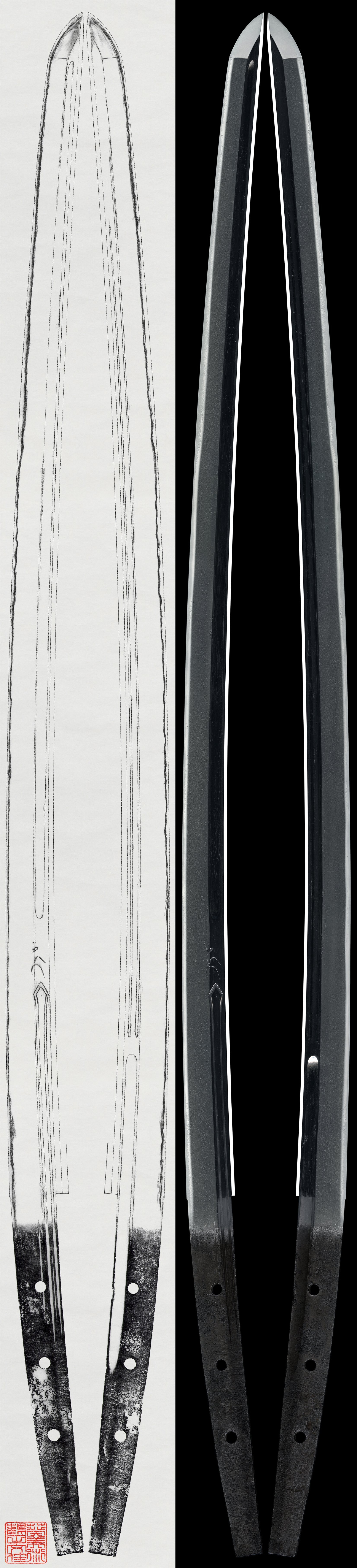
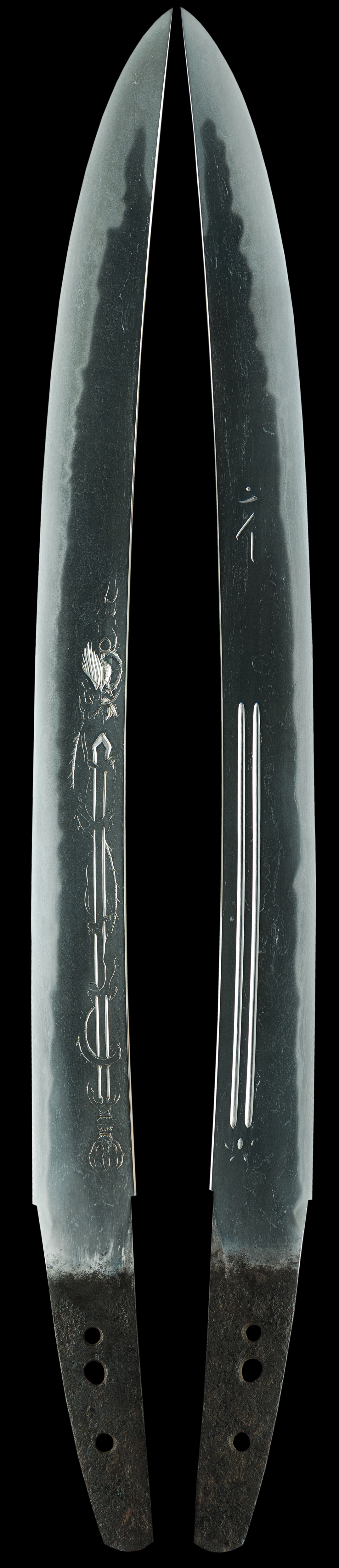
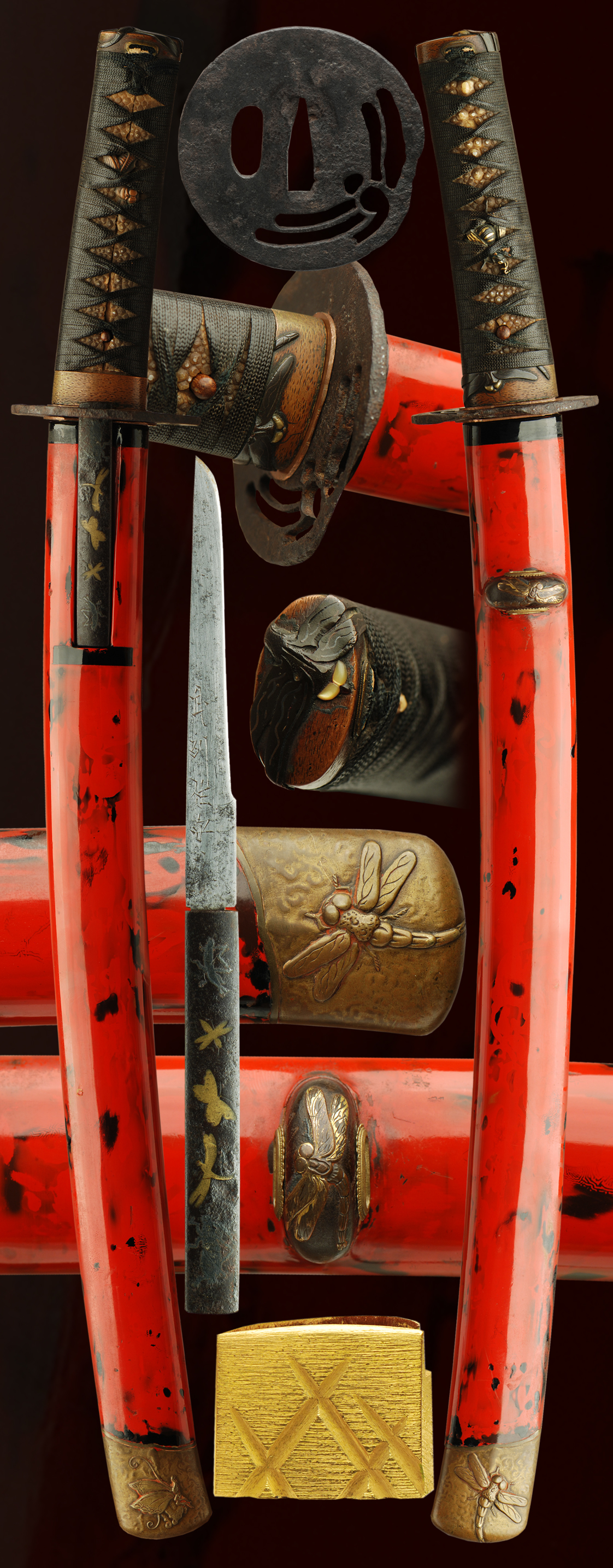
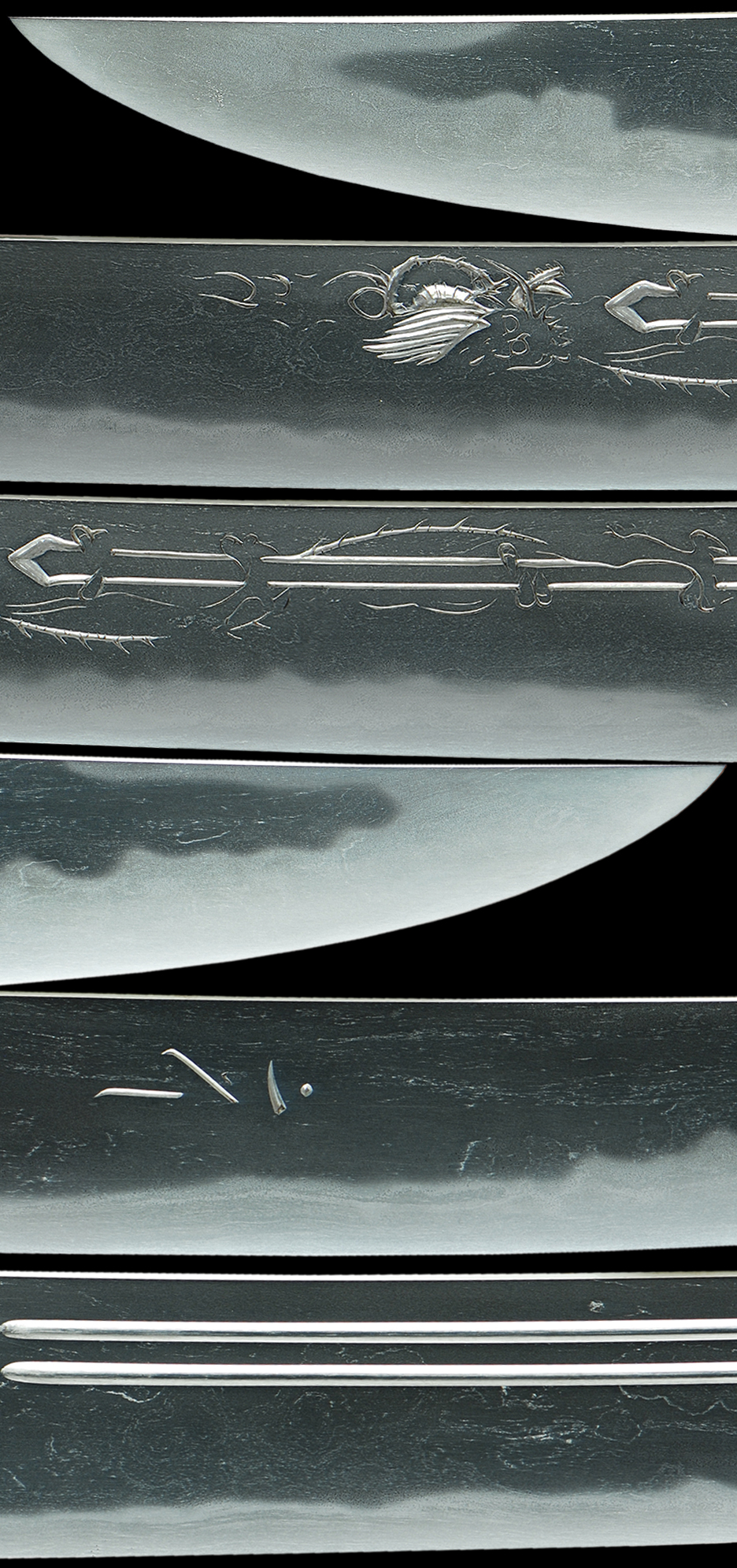
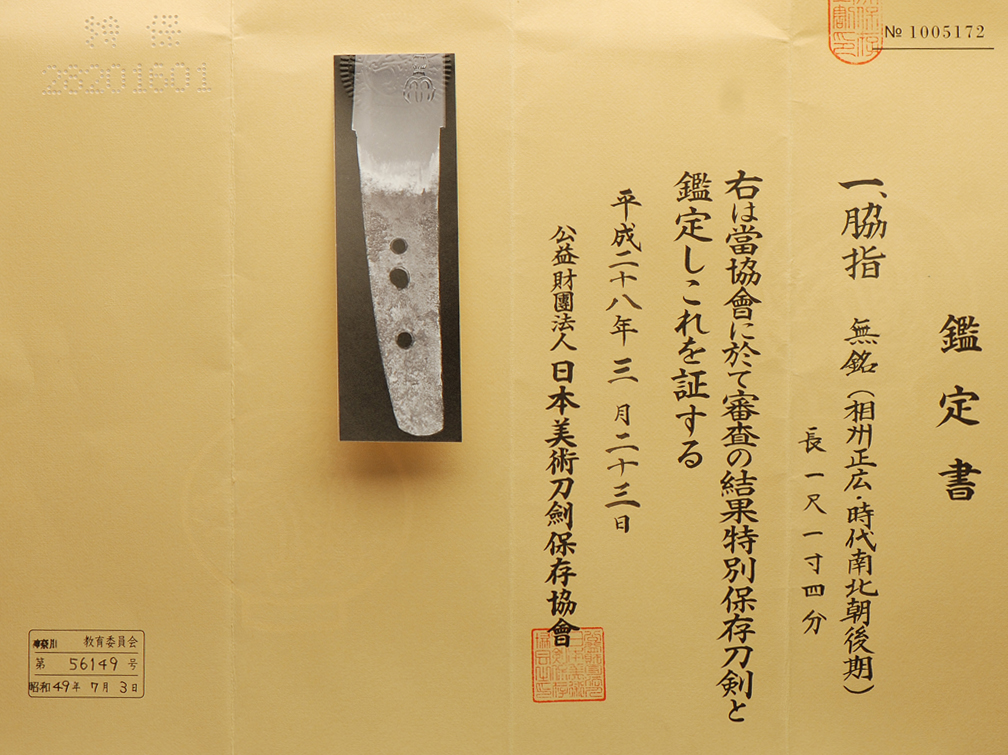
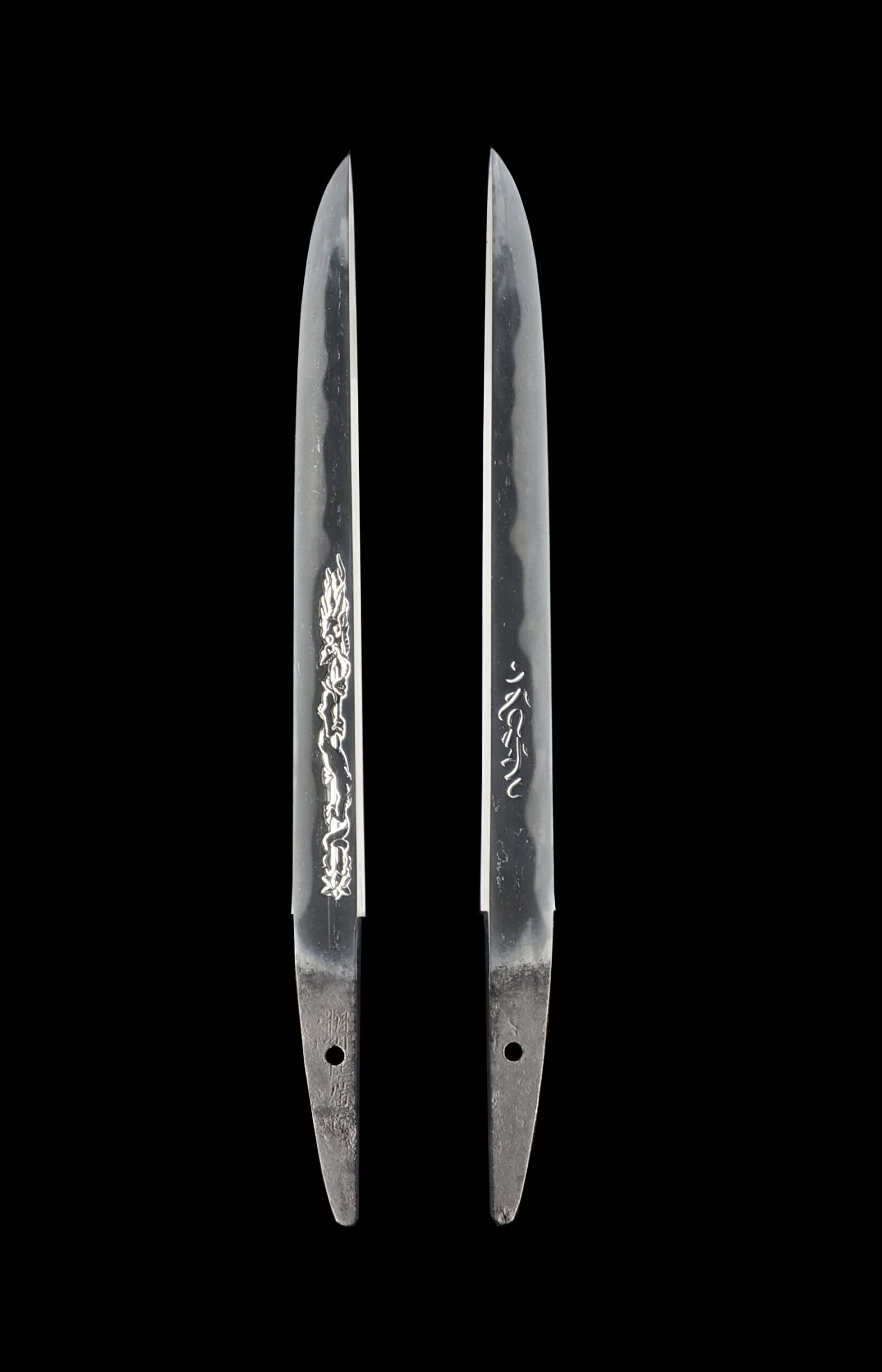
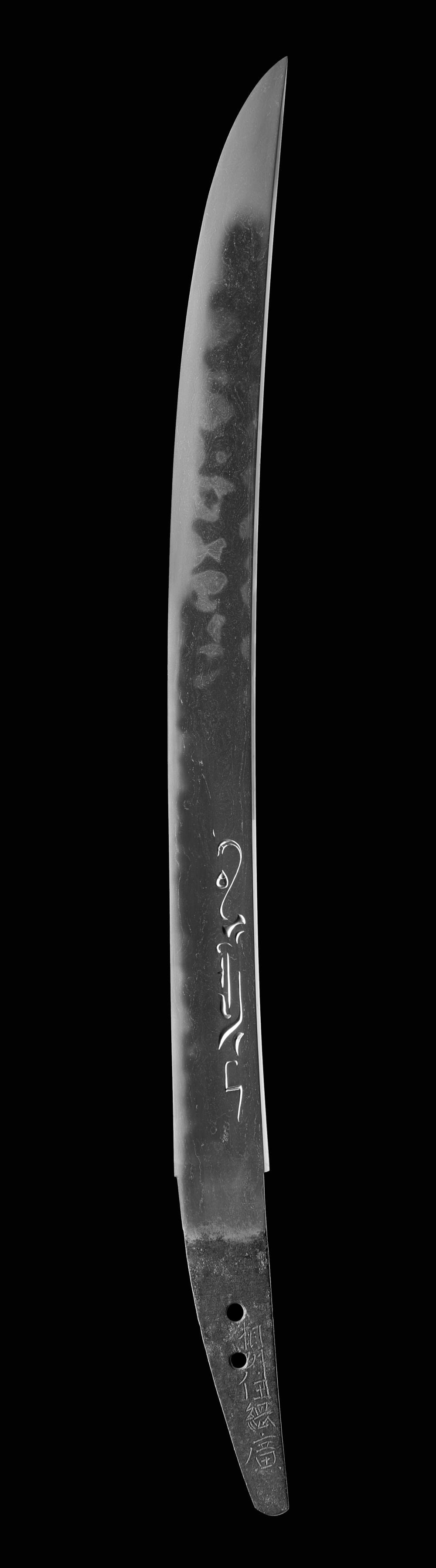
We are pleased to be able to offer an extremely rare Nambokucho era Soshu Masahiro. This blade is loaded with hataraki and horimono as can be seen in the pictures. One side has a carving of a Dragon wrapped around a ken with vajra or ” Shin no Kurikara “. The other side has a Bonji representing “Fudo Myoo ” with Gomabashi and Rendai or lotus blossums”. There is sunagashi, kinsuji and chikei. Ji-nie also abounds. There is a unique 3 dimensional quality to the steel as if looking through a pool of water at the hataraki, rarely seen and can be found on the best of Soshu blades. A great sword for the connoisseur of the early Soshu school just a couple of generations from Masamune. His influence can be greatly felt in this piece.This is a true Sunobi Tanto from the Nambokucho era, ubu with 3 holes. The sword is wide and beautiful to behold. A true Soshu masterpiece. It has Mitsumune and in an exquisite polish. This sword has very nice Nambokucho style horimonoThe koshirae is ensuite with a myriad of Dragonflies as the motif:“Dragonfly:According to legend, a passing soulcan take the shape of a dragonfly, especially duringBon, the Buddhist Day of the Dead.”The Fuchi/Kashira are in soft metal with the eyes made of Radon or mother of pearl and appear to glow!. Truly spectacular. The kodzuka is of 2 dragonfly of different type and butterfly and very old. The kodzuka blade is hand forged with kanji. The tsuba is of Iron Sukashi style of dragonfly motif and very old also. This may date to the momoyama period or older and a bit worn and narrow on one side. The menuki are of high quality and of Bees. The tsuka appears very old also with old Same and an original black silk tsuka ito. The kurikata and Kojiri stay with the dragonfly theme and a butterfly appears.THERE IS SHIRASAYA ALSO FOR THE BLADE THOUGH NOT SHOWN IN THE PICTURES.The Papers are Tokubetsu Hozon which attests to the authenticy and quality of the blade. The papers state late Nambokucho as the era. Below are the 2 generations of Masahiro from the late Nambokucho period.MASAHIRO (正広), 2nd gen., Meitoku (明徳, 1390-1394), Sagami – “Sōshū-jū Masahiro” (相州住正広), “Masahiro” (正広), suguha-chō mixed with slightly undulating notare, gunome, ashi, yō, sunagashi and small tobiyaki in nie-deki, higher gunome elements towards the bōshi area can be connected to the kaeri and muneyakiMASAHIRO (正広), 3rd gen., Ōei (応永, 1394-1428), Sagami – “Sagami no Kuni-jūnin Masahiro” (相模国住人正広), “Sōshū-jū Masahiro” (相州住正広),, “Sōshū-jūnin Masahiro” (相州住人正広), only few blades are extant by him, the jiba is no longer noticeably nie-laden with his generationUsually with these lineages, the NBTHK does not go the extra mile and give a clear generation. They just say it it is most likely not the first generation who was active around heyday Nanbokucho (Joji 1362-1368). And also it isn’t one of the Muromachi smiths as otherwise they would have stated “Kodai Masahiro,” i.e. later generation Masahiro.SOSHU Masahiro lived in Odawara and made a very active soshu style hamon very similar to Akihiro and Hiromitsu especially when producing hitatsura.This Hamon is a very active and wonderful example of a soshu masahiro sunobi tanto. The blade has a beautiful polish and full of activity. Inside of the hamon, there is kinsuji, sunagashi, ji-nie and much more.The sword is papered tokubetsu hozon and a wonderful sword.The Habaki is a gold washed higo style.The NBTHK papers date this to the late nambokucho era: Mei:MumeiDate:late Nanbokuchô periodNagasa:13-1/2 inchesSori:7.5. mmWidth at the ha-machi:30.8 mmThickness at the mune-machi:5.5 mmConstruction:Shinogi zukuriMune:IoriNakago:UbuKitae:ItameHamon:Midare GunomeBoshi:MaruCondition:Good polish kantei-sho (鑑定書) No 1005172 wakizashi, mumei: Sôshû Masahiro (相州正広) (Jidai Nanbokuchô kôki, 時代南北朝後期)nagasa 1 shaku 1 sun 4 bu Migi wa tô-kyôkai ni oite shinsa no kekka, tokubetsu-hozon-tôken to kantei-shi kore o shô-suru.(右は當協會に於て審査の結果特別保存刀剣と鑑定しこれを証する)Heisei nijûhachinen sangatsu nijûsannichi (平成二十八年三月二十三日)kôeki-zaidan-hôjin (公益財團法人): Nihon Bijutsu Tôken Hozon Kyôkai (日本美術刀劍保存協會)Appraisalwakizashi, unsigned: Sôshû Masahiro (late Nanbokuchô period)nagasa ~ 34.5 cm According to the result of the shinsa committee of our society we judged this work as authentic and designateit as tokubetsu-hozon-tôken. March 23rd 2016[Foundation] NBTHK Subscribe for the Latest Updates!Join our mailing list to receive the latest News & Updates fromNihonto Antiques.SUBSCRIBEYou have Successfully Subscribed!Your email address will be kept private & will only be used to send updates from this site!
 NihontoWatchBETA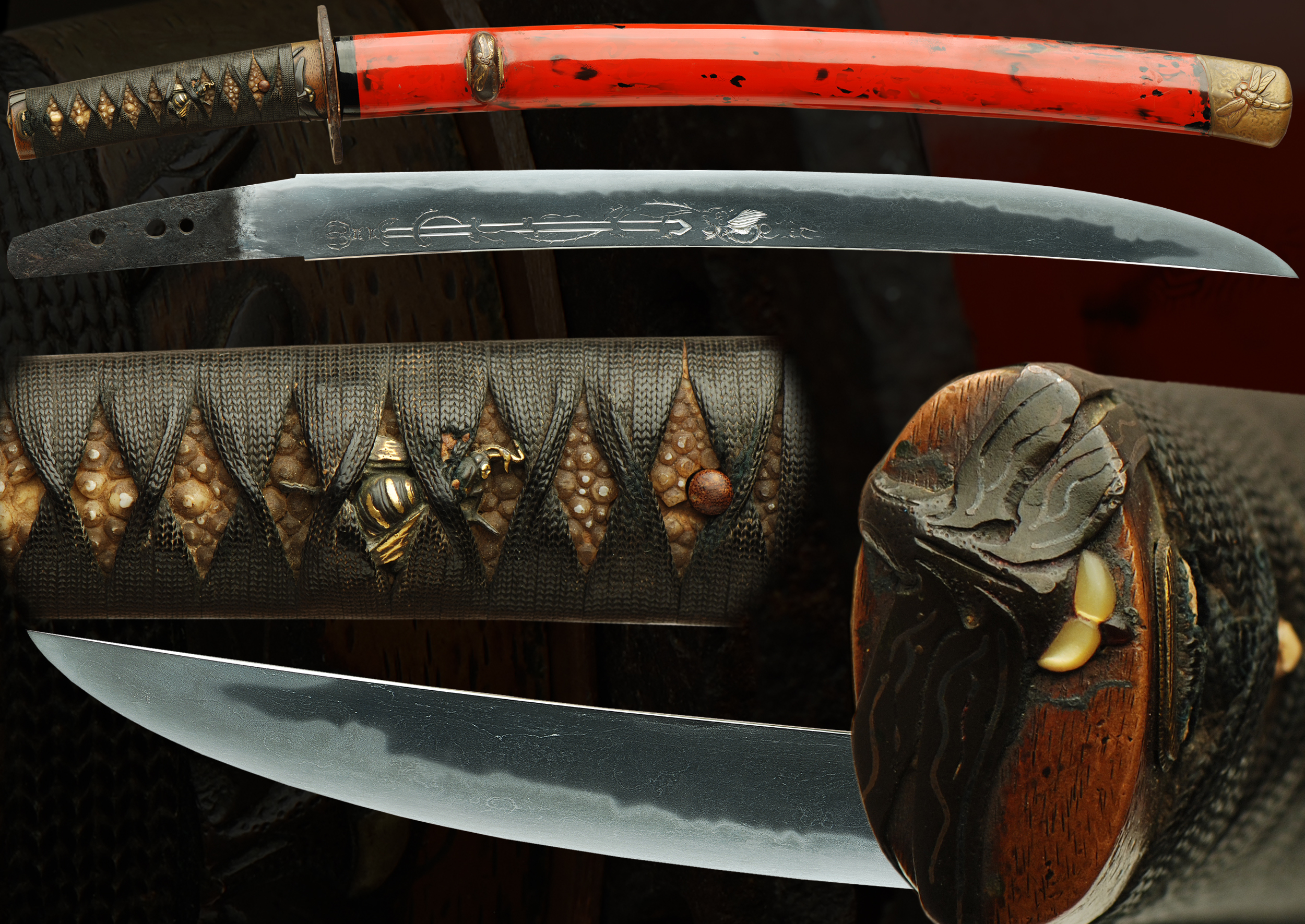
相州伝 · 相模
現在18点販売中
末相州は、相模国に興った相州伝が、正宗とその後を継いだ広光・秋広らの南北朝の頂点を過ぎた後、室町期に至ってなお同地に伝えられた一群を指す。その手は鎌倉と小田原の二つの面に分かれ、室町中期には広正の名が南北朝期から数代にわたって連綿と切られて系の中核をなし、室町後期には後北条氏の庇護のもとに小田原へ拠点が移る。説明書は、天文年間に活躍した初代綱広を広正の子孫と伝え、初銘を正広といい、北条氏綱に召されて小田原に住し綱の一字を賜って改銘したと記す。以後、綱広・綱家らが小田原八幡山に代々続いて後北条氏に仕え、相州住の五字銘を低く切る在銘・生ぶの作を遺した。鎌倉に残って正宗以来の地に鍛えた正広のごとき手と、小田原に移って北条のもとに鍛えた一群とが併存し、後者を総称して小田原相州と呼ぶ。説明書はこの一派を、相州伝の掉尾を飾る工として位置づける。 作風は、肌立った板目に杢目・流れ肌を交えた相州の地鉄に、皆焼を本領とする点を共通の語法とする。互の目乱れに丁子・矢筈の刃・尖り刃・小のたれを交え、先へ刃幅を増して焼き、飛焼・湯走り・棟焼を地に及ぼして総体に皆焼となる態で、匂口は締まりごころに小沸よくつき、足・葉入り、砂流しを交える。この皆焼は広光・秋広以来の手と伝えられ、説明書は綱広をその系譜に置きつつ、現存作にあって彼らとは形状を異にすると明記して、襲ぐ名手その人とその手とを区別する。彫物もまた一派を貫く見どころで、真および草の倶利迦羅、梵字、三鈷剣、護摩箸、蓮台、八幡大菩薩や南無妙法蓮華経の陰刻文字を表裏に密に施し、樋中・櫃中の浮彫を得意とする。中でも総宗は彫の巧緻において長く名があり、末相州独特の構図の倶利伽羅を据える。古典相州の頂点と分かつのは、沸の深さと鉄の冴えにおける差であって、小田原の手は締まりごころの匂勝ちの匂口に角がかる互の目を複式・腰開きの態に焼き、地は肌立ちながらも締まる傾きを見せ、姿は短寸に先反りつくものが多い。一派のうちでも振れ幅があり、皮焼の手前の互の目交りの小乱れに控える静かな作から、棟焼まで覆う厚い華やかな皆焼に開く作までを含む。 鑑定の勘どころは、この一群を古典相州の名作から分かつところにある。すなわち、沸の冴えにおいて南北朝の頂点に一歩を譲りつつ、肌立つ板目杢に角がかり複式に傾く互の目乱れと、信仰に基づく緻密な彫物とを併せ持つ点を読む。主要工としては、室町中期に系の中核を定めた広正、相州伝の最末に立って皆焼と矢筈の刃を本領とし知名度も技量も高いとされる初代綱広、これと並び称せられて皆焼と彫物に優れた綱家が挙げられ、彫の巧緻によって一派から分かたれる総宗がこれに続く。鎌倉の面に立つ正広は南北朝以来の系を室町に伝え、皆焼風の乱れと彫物を遺す。なお江戸期の清平は加州兼若の系から稲葉家の抱工として小田原に転じた工で、相州在住の点で一派の名に連なるが、その作風は柾がかる加州物を基盤として別系をなす。伝来は概して大名家や寺社の格別な来歴を伴わず、その品位を支えるのは名高い由緒よりも、説明書が一口ごとに称える彫と鉄の質、そして在銘・生ぶに達した室町相州の稀少にある。在銘年紀の作はことに各代を読み分ける基準作となり、末期相州を学ぶ者にとって、相州伝の室町の様相を一口のうちに収める手がかりとなる。
保存刀剣のうち、出来が一層優れ、保存状態も良好と認められたものです。再刃や、室町・江戸期の多くの無銘作は対象外となり、保存刀剣より高い基準が課されます。
日本美術刀剣保存協会(NBTHK)は、1948年に設立され、文化庁の監督を受ける公益財団法人で、東京・刀剣博物館に本部を置きます。専門の審査員が出品作を直接審査し、美術的・歴史的価値に応じた鑑定書を発行します。NBTHKの鑑定書は、日本刀および刀装具の真正性を示す最も広く認知された基準です。
NBTHK公式サイトWe offer a 48 hour inspection period for all Antique items shipped within the United States only. If the item is not to your satisfaction, we will gladly refund your money less any shipping and handling fees. All sales are final after the 48 hour inspection period. Please note that all discounted items are a final sale and not returnable.
We are pleased to be able to offer an extremely rare Nambokucho era Soshu Masahiro. This blade is loaded with hataraki and horimono as can be seen in the pictures. One side has a carving of a Dragon wrapped around a ken with vajra or ” Shin no Kurikara “. The other side has a Bonji representing “Fudo Myoo ” with Gomabashi and Rendai or lotus blossums”. There is sunagashi, kinsuji and chikei. Ji-nie also abounds. There is a unique 3 dimensional quality to the steel as if looking through a pool of water at the hataraki, rarely seen and can be found on the best of Soshu blades. A great sword for the connoisseur of the early Soshu school just a couple of generations from Masamune. His influence can be greatly felt in this piece.This is a true Sunobi Tanto from the Nambokucho era, ubu with 3 holes. The sword is wide and beautiful to behold. A true Soshu masterpiece. It has Mitsumune and in an exquisite polish. This sword has very nice Nambokucho style horimonoThe koshirae is ensuite with a myriad of Dragonflies as the motif:“Dragonfly:According to legend, a passing soulcan take the shape of a dragonfly, especially duringBon, the Buddhist Day of the Dead.”The Fuchi/Kashira are in soft metal with the eyes made of Radon or mother of pearl and appear to glow!. Truly spectacular. The kodzuka is of 2 dragonfly of different type and butterfly and very old. The kodzuka blade is hand forged with kanji. The tsuba is of Iron Sukashi style of dragonfly motif and very old also. This may date to the momoyama period or older and a bit worn and narrow on one side. The menuki are of high quality and of Bees. The tsuka appears very old also with old Same and an original black silk tsuka ito. The kurikata and Kojiri stay with the dragonfly theme and a butterfly appears.THERE IS SHIRASAYA ALSO FOR THE BLADE THOUGH NOT SHOWN IN THE PICTURES.The Papers are Tokubetsu Hozon which attests to the authenticy and quality of the blade. The papers state late Nambokucho as the era. Below are the 2 generations of Masahiro from the late Nambokucho period.MASAHIRO (正広), 2nd gen., Meitoku (明徳, 1390-1394), Sagami – “Sōshū-jū Masahiro” (相州住正広), “Masahiro” (正広), suguha-chō mixed with slightly undulating notare, gunome, ashi, yō, sunagashi and small tobiyaki in nie-deki, higher gunome elements towards the bōshi area can be connected to the kaeri and muneyakiMASAHIRO (正広), 3rd gen., Ōei (応永, 1394-1428), Sagami – “Sagami no Kuni-jūnin Masahiro” (相模国住人正広), “Sōshū-jū Masahiro” (相州住正広),, “Sōshū-jūnin Masahiro” (相州住人正広), only few blades are extant by him, the jiba is no longer noticeably nie-laden with his generationUsually with these lineages, the NBTHK does not go the extra mile and give a clear generation. They just say it it is most likely not the first generation who was active around heyday Nanbokucho (Joji 1362-1368). And also it isn’t one of the Muromachi smiths as otherwise they would have stated “Kodai Masahiro,” i.e. later generation Masahiro.SOSHU Masahiro lived in Odawara and made a very active soshu style hamon very similar to Akihiro and Hiromitsu especially when producing hitatsura.This Hamon is a very active and wonderful example of a soshu masahiro sunobi tanto. The blade has a beautiful polish and full of activity. Inside of the hamon, there is kinsuji, sunagashi, ji-nie and much more.The sword is papered tokubetsu hozon and a wonderful sword.The Habaki is a gold washed higo style.The NBTHK papers date this to the late nambokucho era: Mei:MumeiDate:late Nanbokuchô periodNagasa:13-1/2 inchesSori:7.5. mmWidth at the ha-machi:30.8 mmThickness at the mune-machi:5.5 mmConstruction:Shinogi zukuriMune:IoriNakago:UbuKitae:ItameHamon:Midare GunomeBoshi:MaruCondition:Good polish kantei-sho (鑑定書) No 1005172 wakizashi, mumei: Sôshû Masahiro (相州正広) (Jidai Nanbokuchô kôki, 時代南北朝後期)nagasa 1 shaku 1 sun 4 bu Migi wa tô-kyôkai ni oite shinsa no kekka, tokubetsu-hozon-tôken to kantei-shi kore o shô-suru.(右は當協會に於て審査の結果特別保存刀剣と鑑定しこれを証する)Heisei nijûhachinen sangatsu nijûsannichi (平成二十八年三月二十三日)kôeki-zaidan-hôjin (公益財團法人): Nihon Bijutsu Tôken Hozon Kyôkai (日本美術刀劍保存協會)Appraisalwakizashi, unsigned: Sôshû Masahiro (late Nanbokuchô period)nagasa ~ 34.5 cm According to the result of the shinsa committee of our society we judged this work as authentic and designateit as tokubetsu-hozon-tôken. March 23rd 2016[Foundation] NBTHK Subscribe for the Latest Updates!Join our mailing list to receive the latest News & Updates fromNihonto Antiques.SUBSCRIBEYou have Successfully Subscribed!Your email address will be kept private & will only be used to send updates from this site!
NihontoWatchBETA相州伝 · 相模
現在18点販売中
末相州は、相模国に興った相州伝が、正宗とその後を継いだ広光・秋広らの南北朝の頂点を過ぎた後、室町期に至ってなお同地に伝えられた一群を指す。その手は鎌倉と小田原の二つの面に分かれ、室町中期には広正の名が南北朝期から数代にわたって連綿と切られて系の中核をなし、室町後期には後北条氏の庇護のもとに小田原へ拠点が移る。説明書は、天文年間に活躍した初代綱広を広正の子孫と伝え、初銘を正広といい、北条氏綱に召されて小田原に住し綱の一字を賜って改銘したと記す。以後、綱広・綱家らが小田原八幡山に代々続いて後北条氏に仕え、相州住の五字銘を低く切る在銘・生ぶの作を遺した。鎌倉に残って正宗以来の地に鍛えた正広のごとき手と、小田原に移って北条のもとに鍛えた一群とが併存し、後者を総称して小田原相州と呼ぶ。説明書はこの一派を、相州伝の掉尾を飾る工として位置づける。 作風は、肌立った板目に杢目・流れ肌を交えた相州の地鉄に、皆焼を本領とする点を共通の語法とする。互の目乱れに丁子・矢筈の刃・尖り刃・小のたれを交え、先へ刃幅を増して焼き、飛焼・湯走り・棟焼を地に及ぼして総体に皆焼となる態で、匂口は締まりごころに小沸よくつき、足・葉入り、砂流しを交える。この皆焼は広光・秋広以来の手と伝えられ、説明書は綱広をその系譜に置きつつ、現存作にあって彼らとは形状を異にすると明記して、襲ぐ名手その人とその手とを区別する。彫物もまた一派を貫く見どころで、真および草の倶利迦羅、梵字、三鈷剣、護摩箸、蓮台、八幡大菩薩や南無妙法蓮華経の陰刻文字を表裏に密に施し、樋中・櫃中の浮彫を得意とする。中でも総宗は彫の巧緻において長く名があり、末相州独特の構図の倶利伽羅を据える。古典相州の頂点と分かつのは、沸の深さと鉄の冴えにおける差であって、小田原の手は締まりごころの匂勝ちの匂口に角がかる互の目を複式・腰開きの態に焼き、地は肌立ちながらも締まる傾きを見せ、姿は短寸に先反りつくものが多い。一派のうちでも振れ幅があり、皮焼の手前の互の目交りの小乱れに控える静かな作から、棟焼まで覆う厚い華やかな皆焼に開く作までを含む。 鑑定の勘どころは、この一群を古典相州の名作から分かつところにある。すなわち、沸の冴えにおいて南北朝の頂点に一歩を譲りつつ、肌立つ板目杢に角がかり複式に傾く互の目乱れと、信仰に基づく緻密な彫物とを併せ持つ点を読む。主要工としては、室町中期に系の中核を定めた広正、相州伝の最末に立って皆焼と矢筈の刃を本領とし知名度も技量も高いとされる初代綱広、これと並び称せられて皆焼と彫物に優れた綱家が挙げられ、彫の巧緻によって一派から分かたれる総宗がこれに続く。鎌倉の面に立つ正広は南北朝以来の系を室町に伝え、皆焼風の乱れと彫物を遺す。なお江戸期の清平は加州兼若の系から稲葉家の抱工として小田原に転じた工で、相州在住の点で一派の名に連なるが、その作風は柾がかる加州物を基盤として別系をなす。伝来は概して大名家や寺社の格別な来歴を伴わず、その品位を支えるのは名高い由緒よりも、説明書が一口ごとに称える彫と鉄の質、そして在銘・生ぶに達した室町相州の稀少にある。在銘年紀の作はことに各代を読み分ける基準作となり、末期相州を学ぶ者にとって、相州伝の室町の様相を一口のうちに収める手がかりとなる。
保存刀剣のうち、出来が一層優れ、保存状態も良好と認められたものです。再刃や、室町・江戸期の多くの無銘作は対象外となり、保存刀剣より高い基準が課されます。
日本美術刀剣保存協会(NBTHK)は、1948年に設立され、文化庁の監督を受ける公益財団法人で、東京・刀剣博物館に本部を置きます。専門の審査員が出品作を直接審査し、美術的・歴史的価値に応じた鑑定書を発行します。NBTHKの鑑定書は、日本刀および刀装具の真正性を示す最も広く認知された基準です。
NBTHK公式サイトWe offer a 48 hour inspection period for all Antique items shipped within the United States only. If the item is not to your satisfaction, we will gladly refund your money less any shipping and handling fees. All sales are final after the 48 hour inspection period. Please note that all discounted items are a final sale and not returnable.

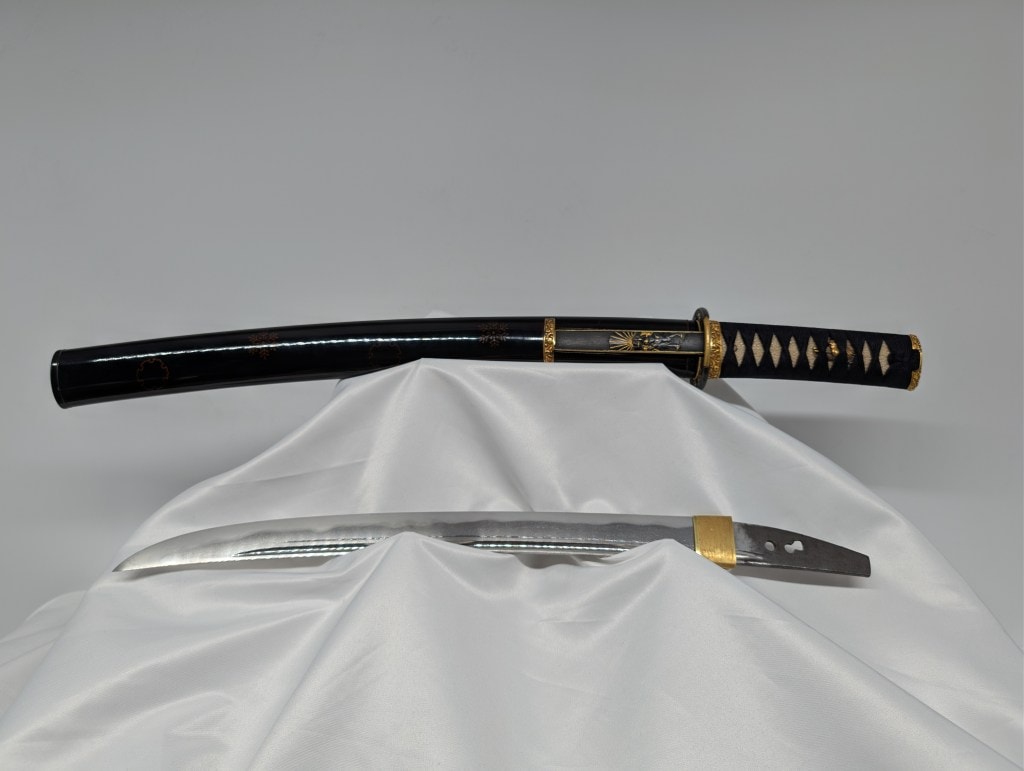
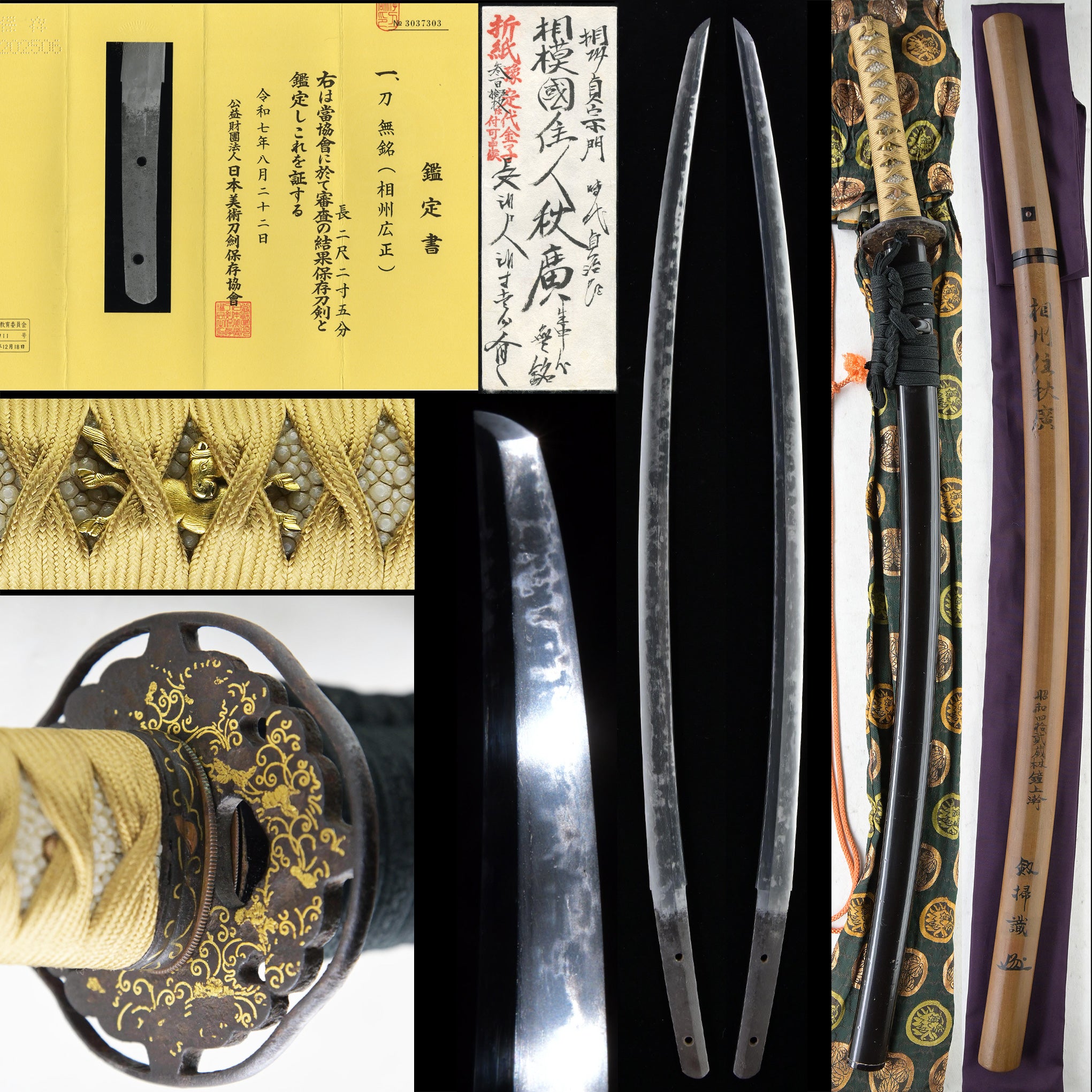
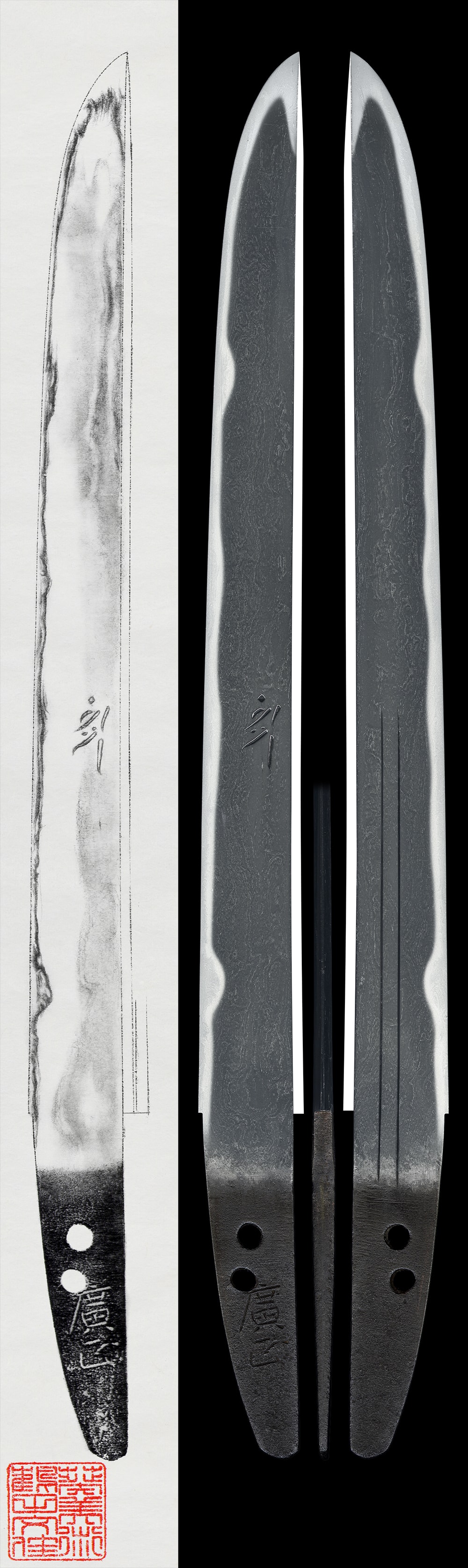
![Tanto - Tokuho - by Sue-Soshu School - 短刀[広正][日本美術刀剣保存協会]特別保存刀剣](/_next/image?url=https%3A%2F%2Fitbhfhyptogxcjbjfzwx.supabase.co%2Fstorage%2Fv1%2Fobject%2Fpublic%2Flisting-images%2Fworld-seiyudo%2FL31437%2F00.jpg&w=2560&q=90)



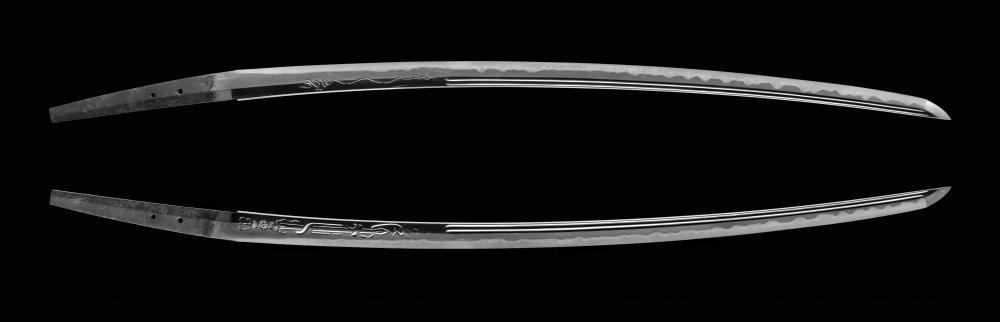

![Tanto - Hozon - by Sue-Soshu Hiromasa - 短刀 □□[住]広正(相州・時代室町末期)](/_next/image?url=https%3A%2F%2Fitbhfhyptogxcjbjfzwx.supabase.co%2Fstorage%2Fv1%2Fobject%2Fpublic%2Flisting-images%2Fe-sword%2FL00277%2F01.jpg&w=2560&q=90)