二つの朝廷が争った六十年、刀身は長大化し、長船がその需要に応えた。兼光と長義の工房は実際に戦う国人層の武士に仕え、軍勢とともに相州風が届いて相伝備前が生まれた。
 NihontoWatchNihontoWatch
Although typically defined within the constraints of the Goka-den, various styles among different branches of this philosophy often coalesced into unique swordsmithing practices, which are now classified as “majiwari-mono” in modern terms. Although generally used to denote later works of the Muromachi and more recent periods, examples of this practice originate as far back as the Heian Period, with the practice becoming more common in the era between the late Kamakura Period and the Nanbokucho Period. Such an example will be analyzed in the form of a naginata-naoshi katana from the lesser-understood Ukai School. Looking at the blade’s form, the blade has a thicker kasane and a thinner, straighter frame, denoting its straightening into a katana after shortening. The lack of a prominent kissaki-sori, however, implies a less curved geometry from the conception of this piece, falling into the “Shizuka-gata” classification of naginata blades. Looking to the metallurgy of the blade, the kitae is composed of a tight ko-itame hada with burls of o-mokume interspersed throughout, especially in the shinogi-ji. Ji-nie is abundant, resulting in a sparkling appearance to the steel, alongside a strong, sky-blue coloration. Spots of kitae-ware are present in the blade, which, although unfortunate, are understandable due to both the blade’s age and the use of the weapon as a battlefield implement. Looking toward the cutting edge, the temper is composed of a suguha-based ko-choji midare in nioi-deki. This hamon is particularly active, with hataraki in both horizontal and vertical varieties, including ashi of various sizes, nie-hotsure, sunagashi, and kinsuji within the ha itself. Ko-nie structures also follow along the habuchi and cluster in small areas within the hamon, creating spots of yo and yubashiri, especially approaching the monouchi. This pattern continues throughout the hamon, terminating at the kissaki in a gentle midare-komi boshi with a pronounced kaeri. Parallel to the hamon is an inconspicuous midare-utsuri combined with spots of jifu, calling back to works of Bitchu Province. With the aesthetic features discussed, relevant measurements are listed below. The nakago of the blade is o-suriage with a kiri-jiri tip. Due to the blade’s shortening, any signature that would have been present on the tang is now absent. Two mekugi-ana have been punched into the nakago, with remnants of a third being present on the nakago-jiri, implying a long history of alterations as battlefield circumstances changed. The blade’s shape is in shobu-zukuri, with a mitsu-mune. Although used in some tachi and a variety of tanto, this geometry is often used in naginata, likely originating in this type of glaive as early as the Heian Period, continuing use through over a millennium up into the present day. Among different varieties of naginata, this particular piece falls within the “Shizuka-gata” designation, primarily due to its thinner frame and less pronounced curvature, especially at the tip, which often widens and curves greatly in the opposing “Tomoe-gata” form. The blade lacks any intricate horimono carvings, allowing the unique workmanship of this school of smiths to stand out, while also corroborating the blade’s construction as a martial tool rather than a commissioned art piece. The blade is currently rated “Hozon” by the NBTHK, confirming a baseline degree of quality expected for a Japanese sword. In addition, the receipt of this ranking provides an accurate attribution based on the workmanship and style present in the blade. Although the lowest rank given by the NBTHK, blades of particular merit are capable of increasing their station with subsequent appraisals by the organization, and as such, Hozon should be viewed as a floor for quality rather than a ceiling. Although swordsmithing in Bizen Province primarily sat upon the Yoshii River and Asahi River via the villages of Osafune and Fukuoka, lesser-known smiths also operated within the region, often originating from provincial villages, including areas such as Hatakeda and Wake-no-Sho. Among the more famous of these sub-groups is the Ukai School, named for its origin in the village of Ukai-no-Sho. These smiths are also collectively known as the Unrui Group due to the presence of the character “Un” (雲), meaning “cloud” in their names. Unlike the province’s representatives in Osafune, these swordsmiths often incorporated other swordsmithing traditions into their work, with debate continuing over whether the school’s founder, Unjo, had origins in either the Yamashiro or Yamato traditions, with Dr. Michihiro Tanobe firmly holding to the Yamato Tradition theory. Other theories, however, hinge on the similarity in forging styles between the Ukai School and the Rai School of Yamashiro, especially in the formation of their jigane, alongside the Aoe School, primarily due to the suguha-based ko-choji hamon practiced by the school, alongside their use of blended utsuri similar to dan-utsuri, often combining elements of a midare and jifu-utsuri. Regardless of the alleged origins of Unjo, what is known is that the smith operated from the year 1293 CE to 1303 CE before stepping down, although no extant blades have been discovered for this smith. As such, his son, who took the name Unsho, is widely regarded as the de facto founder of the school. Operating from 1303 CE to 1315 CE. During this period, the works of the schools maintain a classical style emblematic of the late Kamakura era, including a graceful ko-kissaki and gentler mihaba. This style transitioned with the succession of Unji, the son of Unsho, as grandmaster of the school, due to the shift from the Kamakura to the Nanbokucho Period. Unlike Unsho, who operated within a consistent framework, the dominance of the Soshu School, alongside the coming of civil war between the Imperial Court under Emperor Go-Daigo and the Ashikaga Clan, led to adaptation in creating swords to better account for changing aesthetic trends and military requirements, leading to blades that were, in general, wider and longer, with a longer kissaki, creating a distinctive split between Unji’s early period, which spanned from 1315 CE to 1334 CE, and later period, which spanned into 1350 CE. Of the three smiths who headed this school, Unju most expertly translated the trends of the Nanbokucho Period into steel, working from 1352 CE to 1387 CE and producing many nagamaki (of which many are now o-suriage blades), alongside odachi. Due to the unorthodox shape of this blade, it is difficult to pin it to any one smith from the school directly; however, since the blade was originally a naginata, it is more likely that the sword was a later work, placing it in either the latter half of Unji’s work or into Unju’s volume of works. Overall, this piece is an excellent example of the later Ukai School’s works, displaying a high level of workmanship from one of Bizen Province’s more unorthodox swordsmithing practices. In addition to this, the blade’s original construction reveals a wider variety of weapon types produced by this school, remaining a rare example of such based on the Unrui Group’s preference for tachi, allowing for appreciation from a historical paradigm rather than purely the sword’s workmanship. ~Photographs from Charlie White’s Facebook page; Blade in Possession of Charlie White, article by Nicholas Zogu~
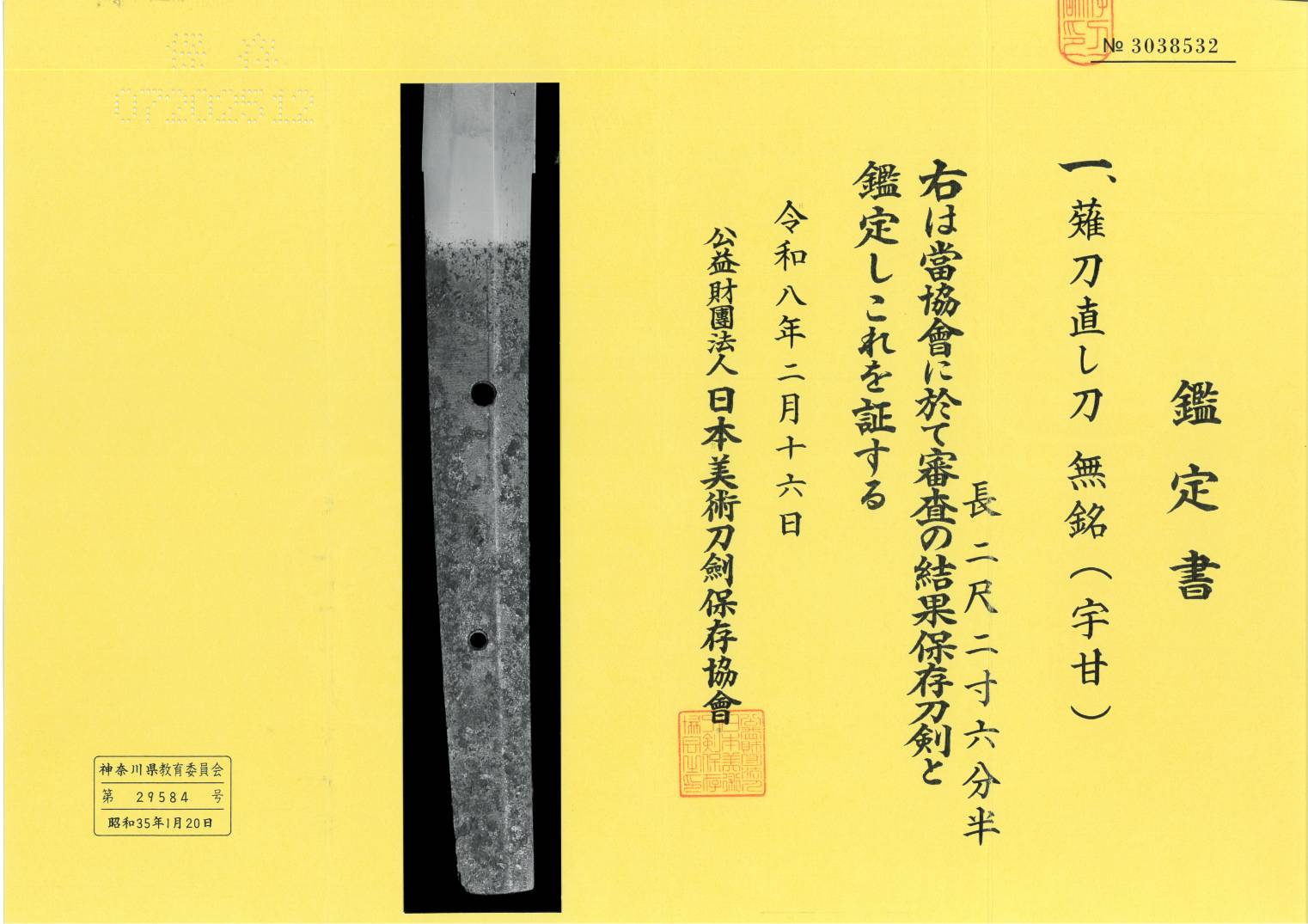
販売店の記載のまま
(翻訳なし) 店主の原文のまま表示しています。正確さの確認を通った翻訳のみを表示します。
備前伝 · 備前
現在12点販売中
備前国宇甘庄、後に鵜飼とも書かれた地に、鎌倉時代末期から南北朝時代にかけて、名に皆「雲」の字を冠する刀工の一群が住した。その居住地から宇甘派あるいは鵜飼派と呼ばれ、銘字の特徴から雲類とも称される。一派の事実上の祖は雲生で、これに雲次、雲重が続く。銘鑑は雲次を雲生の子あるいは弟と伝え、雲重を二代雲生の子とする。雲生には年紀作が現存せず、一派の年代の拠り所はもっぱら雲次の正和・文保・建武の年紀作にあり、雲重に至って文和・貞治・応安の年紀が加わる。雲生・雲次の代に京に上って山城鍛冶に学び、後醍醐天皇の御番鍛冶を勤めたと伝え、雲次には茎に十六葉の菊花紋を刻した太刀があって、宮中との関係を考えさせる稀有な作とされる。その作風は同時代の長船本流と趣を異にし、備前伝の中に山城風が混在し、隣国備中青江派の影響も少なからず受けて、備前物中異色の存在と評される。 作風はいずれも直刃を基調とする点で一致し、これが丁子を焼く長船本流との分かれ目となる。太刀姿は身幅尋常で反りが輪反りごころとなり、同時代の長船物が腰反りを呈するのに対し均整のとれた反り格好を示して京風を帯び、生ぶのものには踏張りが残る。刃文は細直刃ないし中直刃に小互の目・小丁子・小乱れを交え、足・葉がよく入って青江風に逆がかり、処々に角張る刃や陰の尖り刃を見せる。匂口は締まりごころに小沸つき、時に沈みごころとなって金筋・砂流し・ほつれがかかる。帽子は丸く返って尖らず、これを雲類の見どころとする。鍛えは板目に杢を交えてやや肌立ち、約んだものは小板目となり、地沸つき地景細かに入って鉄色はやや黒みがかる。地には指の腹で押したような黒い地斑の映りが立ち、これを同派独特の見どころとする。銘は棟寄りに切り、「生」「次」等の銘字に逆鏨を用いるのが一派共通の手癖である。もっとも三工の間には差異もあり、雲生は焼きが低く働きがやや寂しく、雲次は焼幅広く沸強く足・葉が目立ち、雲重は大和の風情を加味してほつれ・喰違刃・打のけを交え、最も傾いた作では鍛えが殆ど柾となって帽子が焼詰めとなる。 鑑定の勘所は、まず一派が備前物の中で最も京物に近いという座標にある。直刃は来物の格に達して紛れることがあり、足は青江風に逆がかり、年紀のある静かな直刃の作はしばしば一見青江に紛れる。しかも地には鮮明な乱れ映りが立って生国備前の趣が濃く、青江気質を帯びた作でも帽子は丸く返るところに同派の証が残る。派内の見分けは焼きをもって分かたれ、雲生の力強い作は雲次に近づき、雲重は相伝の影響を受けてこれを南北朝へと押し進めた。一派は薙刀の製作にも巧みで、雲次・雲重と極められた無銘の薙刀直しが少なからず存し、直しに際して鋒の棟を削いだため帽子が自然焼詰めとなり、薙刀樋に添樋の彫が残ることが多い。主要工としては、一派の祖にして焼き低く京物に近い作風を示す雲生、正和以下の年紀作を遺して一派の年代を支え沸の働きに長じた雲次、年紀作をもって南北朝中期に確と据わり大和を加味した雲重の三工が柱をなし、ほかに雲重らに連なる工が一派を支える。在銘作は雲類の中では比較的多いものの、その大半は秘蔵されて市に現れることは稀であり、無銘の磨上や薙刀直しに対して生ぶ茎在銘の太刀は一段と稀有である。伝来の録された作は旧家や機関に伝わり、上杉景勝御手選びに数えられた菊紋の太刀、武田信虎の所持銘を切付けた雲次の太刀など、銘文の資料性において貴ばれるものが含まれる。 詳しく見る →
南北朝時代の備前
二つの朝廷が争った六十年、刀身は長大化し、長船がその需要に応えた。兼光と長義の工房は実際に戦う国人層の武士に仕え、軍勢とともに相州風が届いて相伝備前が生まれた。
銘が正しい、または無銘でも年代・国・系統を確実に指摘できる、保存に値する真正の作と鑑定されたものです。
日本美術刀剣保存協会(日刀保)は、1948年に設立され、文化庁の監督を受ける公益財団法人で、東京・刀剣博物館に本部を置きます。専門の審査員が出品作を直接審査し、美術的・歴史的価値に応じた鑑定書を発行します。日刀保の鑑定書は、日本刀および刀装具の真正性を示す最も広く認知された基準です。
日刀保公式サイト海外からの返品は原則としてお受けしておりません。デポジットをお支払いいただいた時点で、商品を最長3か月間お取り置きします。頭金は返金不可です。
$6,500