NihontoWatch MonNihontoWatchBETA
MarketEncyclopedia
NihontoWatch Mon

NihontoWatchBETA

Market
Encyclopedia
Overview·Kantei·Designations·Provenance·Blade Forms·Signatures·Lineage·School
OverviewKanteiDesignationsProvenanceBlade FormsSignaturesLineageSchool
  1. Schools
  2. Ukai
  3. Unji

Ukai Unji

雲次

Tokujū
Vol. 14, No. 24 · Tachi

Ukai Unji

雲次

138 ranked works

ProvinceBizenEraBunpo (1317–1319)PeriodNanbokuchōSchoolUkaiTraditionBizen-denGeneration1stTeacherUnshoFujishiroJo-jo sakuToko Taikan1,500(top 5%)TypeSwordsmithCodeUNJ1
7Jūyō Bunkazai
13Jūyō Bijutsuhin
6Tokubetsu Jūyō112Jūyō Tōken

Overview

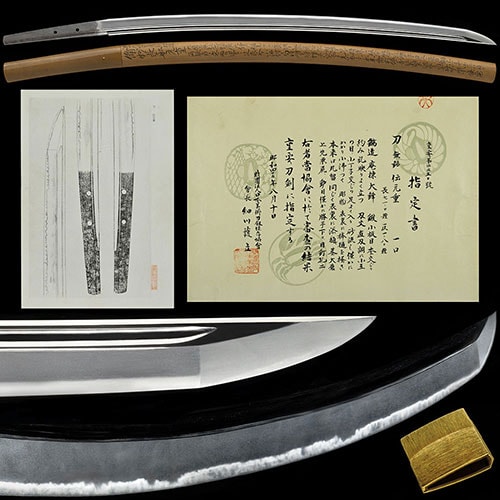
From the end of the period into the first years of , the smiths of Ukan-no-sho in Province, a place name later written Ukai, all set the character , the cloud, at the head of their names, and the published sources know them as the Ukai school or the Unrui. Unji is the chronological anchor of the line. Tradition makes him the son of the first Unsho, and he alone left dated work: blades of the Showa, Bunpo and Kenmu eras survive, among them pieces dated Showa 4 (1315) and Kenmu 2 (1335), and the repeats that "his period of activity is plain" (その活躍年代は明らかである). Since no dated blade of Unsho exists, the years of the whole school are fixed through these. Their make stands apart from the mainstream: within the tradition a Yamashiro cast intermingles with no small influence from neighboring , and the published sources call the line "a distinctive presence among works" (備前物中異色の存在). Fujishiro grades Unji Jo-jo .

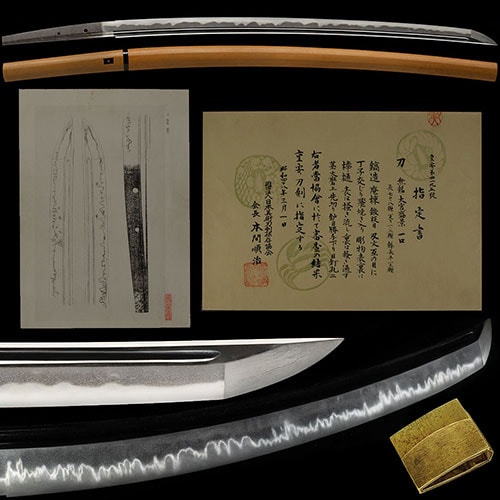
The work leans away from at every point the published record names. His are of standard width, the curvature tending to wa-zori, an even arch the papers read as Kyoto-like, the set somewhat high; pieces keep . Where the mainline of his generation tempers , Unji tempers : a narrow to medium line with , and mingled, the and entering thickly and slanting in reverse in the way. The papers state that kinship outright: "the tight with entering passes to work" (直刃締り逆足入る出来は備中物に通じ). The is now tight and -led, now sinking subdued under , and , and work along the edge. One paper gathers the recognition into a single sentence: "the points of this smith are shown in the uniquely dark , the that turns back round, and the " (暗部の濃い独得の映りと丸く返る帽子と大筋違の鑢目に此工の見どころを示している). To these the published sources add the habit of the chisel: the reverse-slanted strokes (逆鏨) emphasized in the are the hand of the whole school, not of Unji alone.

The is mixed with , knit to on the finer blades, in places flowing toward the edge, with thick , fine , and a steel color that tends somewhat blackish. Across it stands a , and characteristically the dark the papers call peculiar to the Unrui mingles in the , and paper after paper describes "a black as if pressed in with a finger" (指で押した様な黒い映り). The is old-fashioned (古調な映り) and answers to the temper: of one strongly -laden the record observes that "the of and is strong, and for that reason the of the ji hardly stands at all" (地刃の沸がつよく、ために地映りは殆んど立っていない).

The 's own division of his work is twofold: "broadly the workmanship comes in two manners" (大別して作風は二様あって). In the first the is well knit and the tightens, the make that can be taken for Kyoto work or for ; in the second the stands, a reverse-slanting mingles into the , and the comes on strongly. On either the archaic rises, "though it is the clearer in the former" (前者の方が鮮明である). The -laden manner carries and and a swept , and the paper reads these as a borrowing from a third tradition: "a Yamato flavor is added" (大和風が加味されている). A register of form crosses both: nineteen of his hundred and thirty-seven papers are or blades reworked from them, the of the point stoned away in the conversion so that the runs off the end in , the with its companion groove often remaining. From the unsigned works attributed to Unji and Unju (雲重), the papers conclude that "they were also skilled in the production of " (彼らは薙刀の製作にも巧みであったことが窺われる). One fully intact signed stands among his ; signed , by contrast, are rare.

The discrimination from his father is drawn by the papers themselves. Judging a , one paper decides: "compared with Unsho of the school, and the like enter the edge and the is felt somewhat stronger" (同派の雲生に比し、刃縁にほつれ等が入り沸がやや強く感ぜられ), and the attribution falls to Unji. He is the school's hand: the flowing, at times masa-tinged belongs to him rather than to his father, his and run more freely, while the tightened is the more Unsho's. A court legend attaches to both: "Unsho and Unji are said to have gone up to the capital and served Emperor Go-Daigo, and among works theirs is the style closest to Kyoto work" (雲生・雲次は京に出て後醍醐天皇の御用を勤めたと伝え、備前物の中では最も京物に近い作風をみせている); another paper notes that "there is a by Unji with a sixteen-petal chrysanthemum crest on the tang" (雲次には茎に十六葉の菊花紋のある太刀がある). The attributes simply to Unji and lets the nengo divide the generations: one or two namesakes are recognized into , and Honma writes that "the long-signed Unji I have examined seem in the main to be the first generation, but among the two-character signatures there are those in which the first and second generations are hard to tell apart" (二字銘には初、二代を区別し難いものがある).

His designated record stands at one hundred and thirty-eight works: seven Important Cultural Properties, six , one hundred and twelve and thirteen Bijutsuhin, with no National Treasure among them. Forty-seven are signed against eighty-eight unsigned, nearly all of them , with either the long signature no ju Unji (備前国住雲次), at times dated, or the two-character Unji (雲次); the dated Showa 4 is itself an Important Cultural Property. The seven Important Cultural Properties are patrimony and do not trade. Of recorded whereabouts his blades rest at the Kyoto National Museum, Atsuta Jingu, Itsukushima Jinja and the Tokugawa Art Museum; the prewar certifications add the Tokugawa Reimeikai, the Nezu Museum and the Yomei Bunko, holder of the long-signed from Konoe Fumimaro. The provenance roll runs through the Ikeda family of , the Maeda, Akimoto and Mitsui families and the Imperial Family, and one carries on its tang a later possession inscription, an owner's cutting and not a signature, made in Tenbun 3 (1534) for Takeda Mutsu no kami Minamoto no ason Nobutora, of which the record says "the inscription is precious also as a document" (銘文は資料的にも貴重である). With one hundred and eighteen blades in the and tiers, Unji is, among the Unrui, the name a collector is likeliest to meet; even so, designated pieces are held far more often than traded; an example reaches the market only from time to time, most often a or a , a signed rarer still.

Kantei

one school manner in the two grounds the papers state outright (the tight, Kyoto-leaning suguha type and the standing, nie-laden type with a Yamato cast), plus the naginata-naoshi register keyed to the form; the dated works run Showa to Kenmu and the name continues into Nanbokucho, the generations attributed together under Unji

Unji, by tradition the son of the first Unsho, is the dated anchor of the Ukai school of Ukan-no-sho, the smiths who all carry the character in their names and are called the Unrui: his blades of Showa, Bunpo and Kenmu fix the school's years from the end of into the first years of . His work is the anomaly at full strength: a -based with small and small , the slanting in the way, over an carrying the school's dark and the old-fashioned as if pressed in with a finger, the leaning to wa-zori with a high in the Yamashiro manner. The papers split his make into two grounds, a tightly forged with a tight that recalls the Kyoto smiths, and a standing, flowing with -tinged , strong , and and a swept that adds a Yamato cast; he is besides the school's hand, and blades with a pass to him in numbers. The reverse-slanted chisel strokes of the signature are the hand habit of the whole school.

Diagnostic discriminators

87% of his works · 2.8× vs Osafune Nagamitsu

31% of his works · 15.5× vs Osafune Nagamitsu

unique vs Unsho, Nagamitsu, Kagemitsu and Mitsutada together

15% of his works · 3.8× vs Unsho

Observation by phase

The classic Unji manner (his signature)

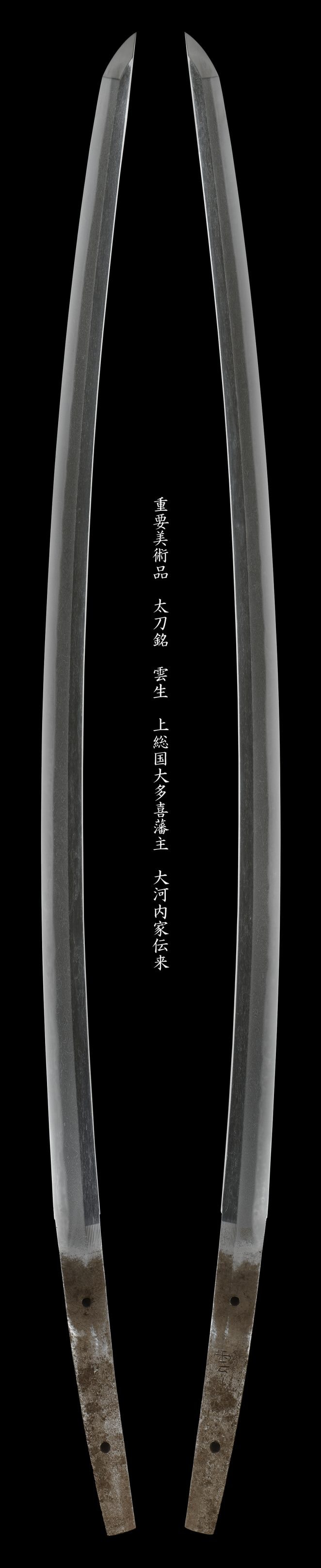
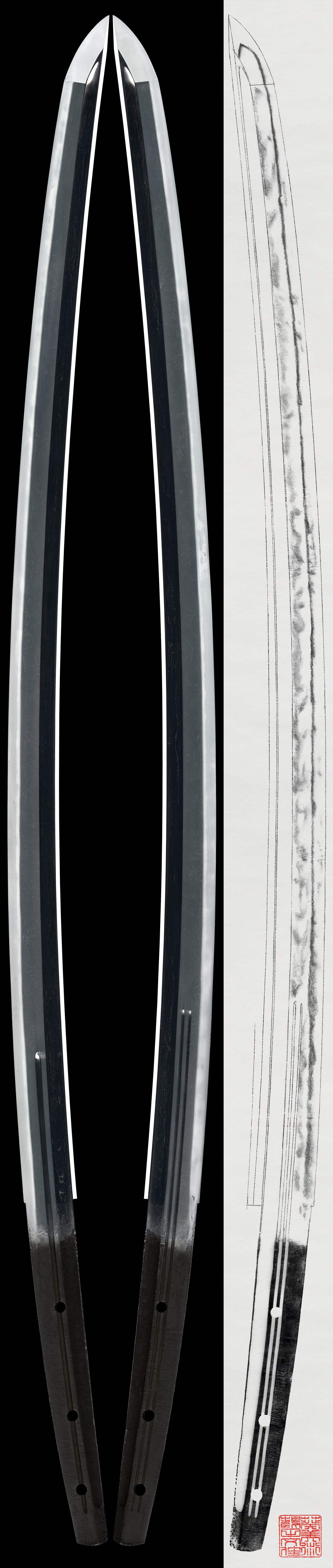
A or of standard width, the curvature tending to wa-zori, the arch the papers read as Kyoto-like, with the set high; pieces keep . The is with , in the finer ground , with and fine ; a stands, characteristically with the dark the papers call peculiar to the Unrui, the old-fashioned as if pressed in with a finger with its deep dark patches. The is a base, narrow to medium, with , and mingled, and entering thickly and slanting in the way, in places squared, the now tight and -led, now sinking subdued under , with , , and working through the edge. The runs and turns back round, to , often lightly swept, and the round return is named one of this smith's great points of recognition, with the coarse beside it.

Sugata 姿
Jigane 地鉄
Hamon 刃文
Bōshi 帽子
The tight ground: ko-itame well forged, the utsuri distinct, the suguha nioiguchi tight, the make the judges read toward the Kyoto smiths and Bitchu— the first of the two manners the papers state outright; its utsuri is called the more distinct of the two, and the tight suguha with saka-ashi is said to pass toward Bitchu work
The standing ground: itame standing with flowing hada, saka-tinged ko-midare in the suguha, strong nie, sunagashi and a swept boshi, the Yamato cast— the second of the two manners the papers state; the strongly nie-laden pieces are said to add a Yamato cast, and on them the utsuri stands faintly or hardly at all, the Tokubetsu Juyo tachi of sessions 7 and 8 both belonging here

The naginata-naoshi register (the school's naginata hand)

the form: 19 of his 137 papers are naginata or naginata-naoshi (14%), and on them the yakitsume boshi runs 63% against 3% on his tachi

A large group of his attributions are and blades, or with the of the point stoned down in the conversion, so that the runs off the end in as a matter of construction; the with a companion groove often remains. The papers state that unsigned works attributed to Unji and to Unju survive in some numbers, and read them as proof that these smiths excelled in the production of . The and inside the form are his usual make, the base with and , in the ground and the standing.

Bōshi 帽子
Scholarship

Dated blades of Showa, Bunpo and Kenmu survive, and the papers state again and again that they make his period of activity plain, from the end of Kamakura into the first years of Nanbokucho; they are besides the only dated anchors of the whole school.

One or two namesakes are recognized into Nanbokucho; Honma judges the long signatures he has seen to be in the main the first generation, while among the two-character signatures the first and second generations are hard to tell apart.

He signs the long signature Bizen no kuni ju Unji, on tachi of the period also with date, and the two-character signature Unji; the papers note that the reverse-slanted chisel strokes emphasized in the signature are the hand habit not of Unji alone but of the whole school, with the coarse o-sujikai yasurime beside it.

The round-returning boshi is named one of this smith's great points of recognition, the deep dark patches of the utsuri and the o-sujikai yasurime with it.

Designations

Kokuhō—
Jūyō Bunkazai7
Jūyō Bijutsuhin13
Gyobutsu—
Tokubetsu Jūyō6
Jūyō Tōken112

Elite Standing

0.54 across 138 designated works

Top 5% among smiths

Provenance

16 documented provenances across certified works by Unji

Provenance Standing

5 works held in elite collections across 16 documented provenances

Top 11% among smiths

Raw score: 2.47 / 10

Blade Forms

Distribution across 138 ranked works

Signatures

Signature types across 138 ranked works

Currently Available

Lineage

TeacherUnsho
Unji
Students (5)
  1. 1.Unju雲重1 for sale60designated
  2. 2.Aritada有忠
  3. 3.Kagesada景定1designated
  4. 4.Unji雲次
  5. 5.Yoshinori吉則1designated

Ukai School

Other artisans of the Ukai school

  1. 1.Unsho雲生2 for sale74designated
  2. 2.Unju雲重1 for sale60designated
  3. 3.Toshinaga利長1designated
  4. 4.Moritsugu守次1designated
  5. 5.Moritsugu守次2designated