NihontoWatch MonNihontoWatch
Market
Encyclopedia
Kantei
NihontoWatch MonNihontoWatch
Market
Encyclopedia
Kantei

Description

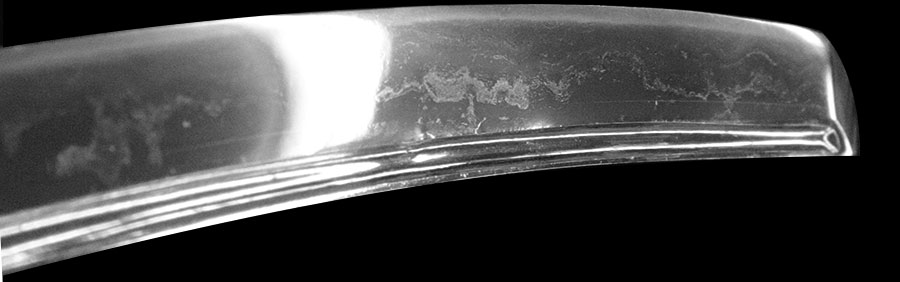
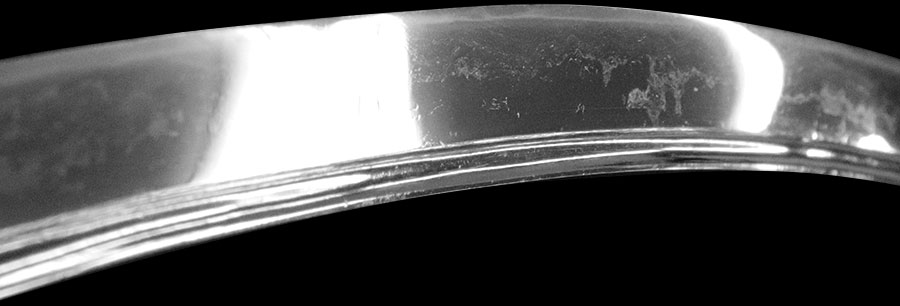
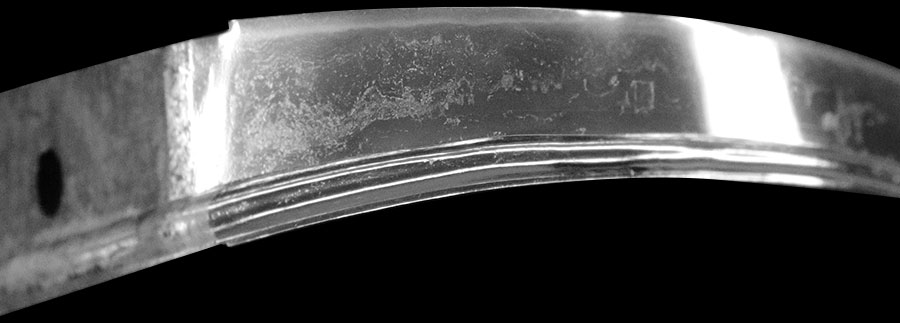
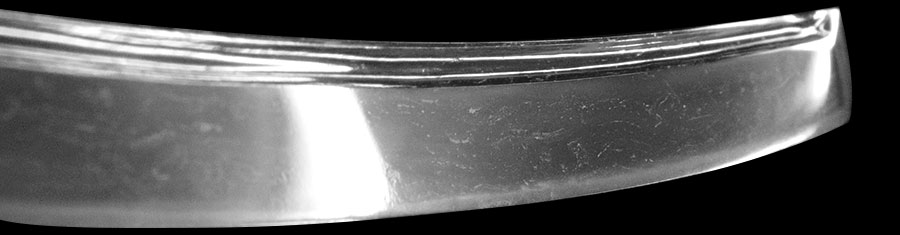
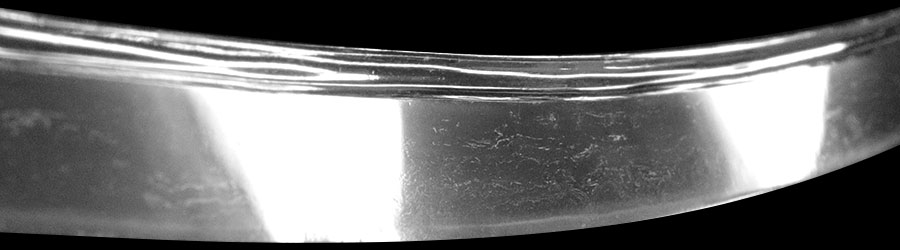
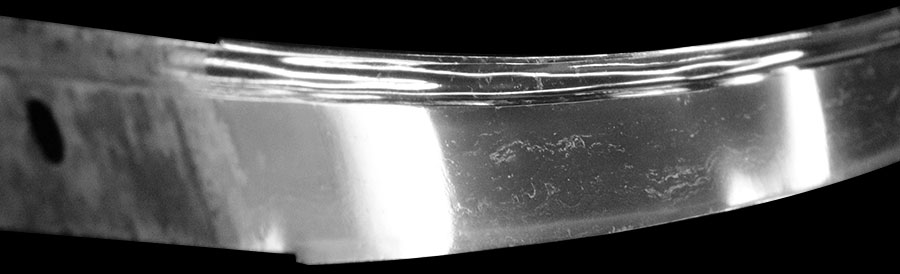
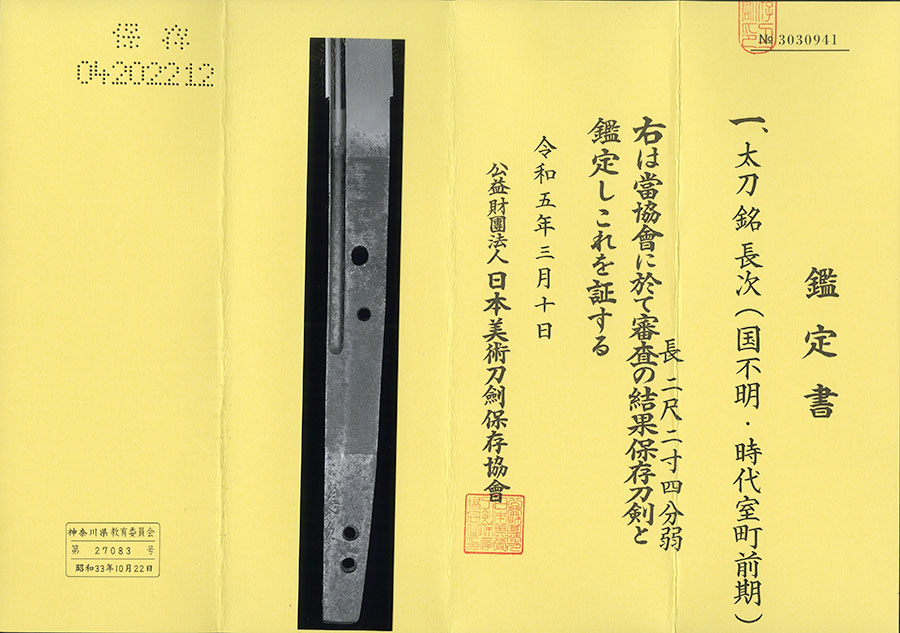
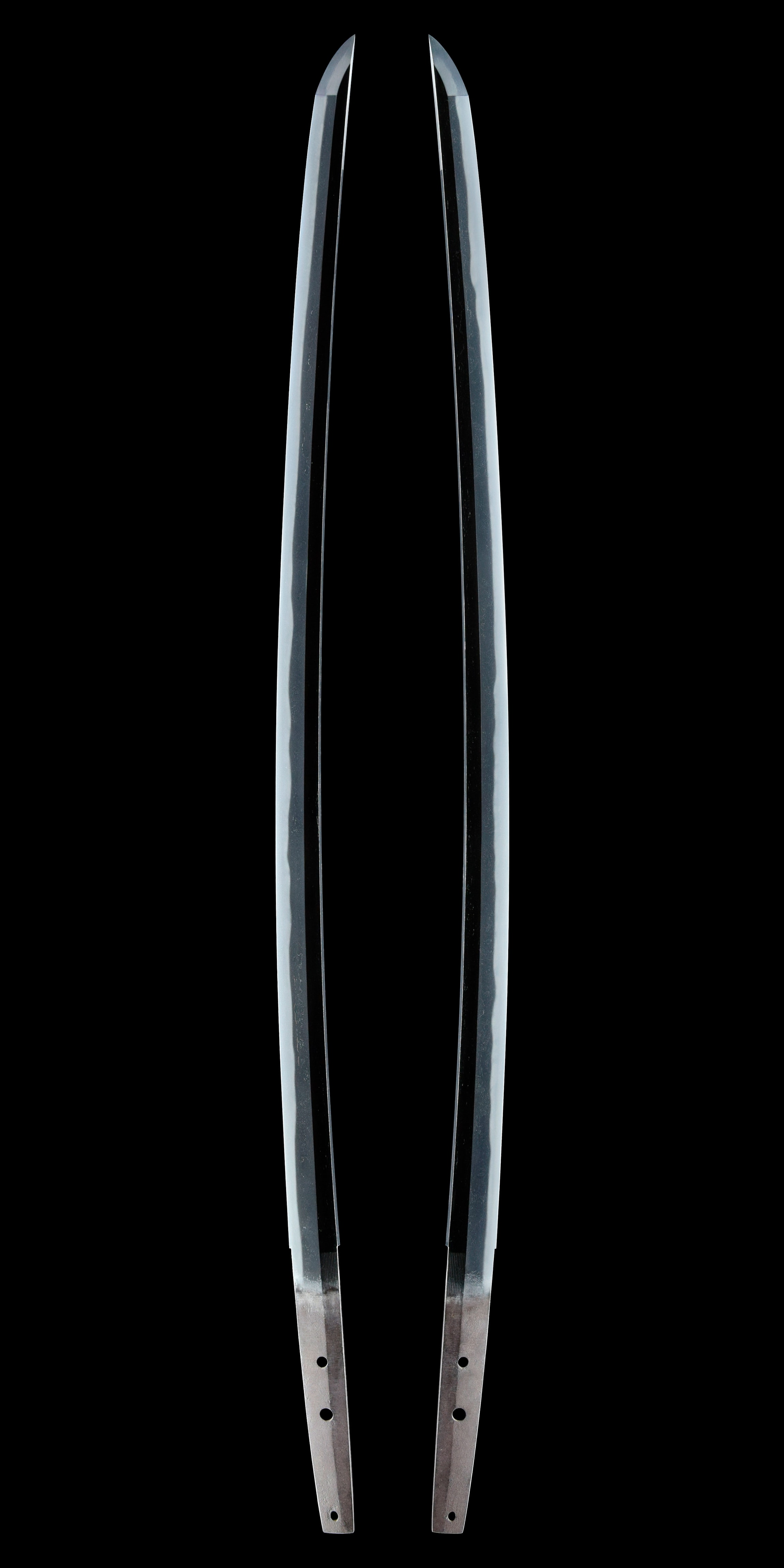
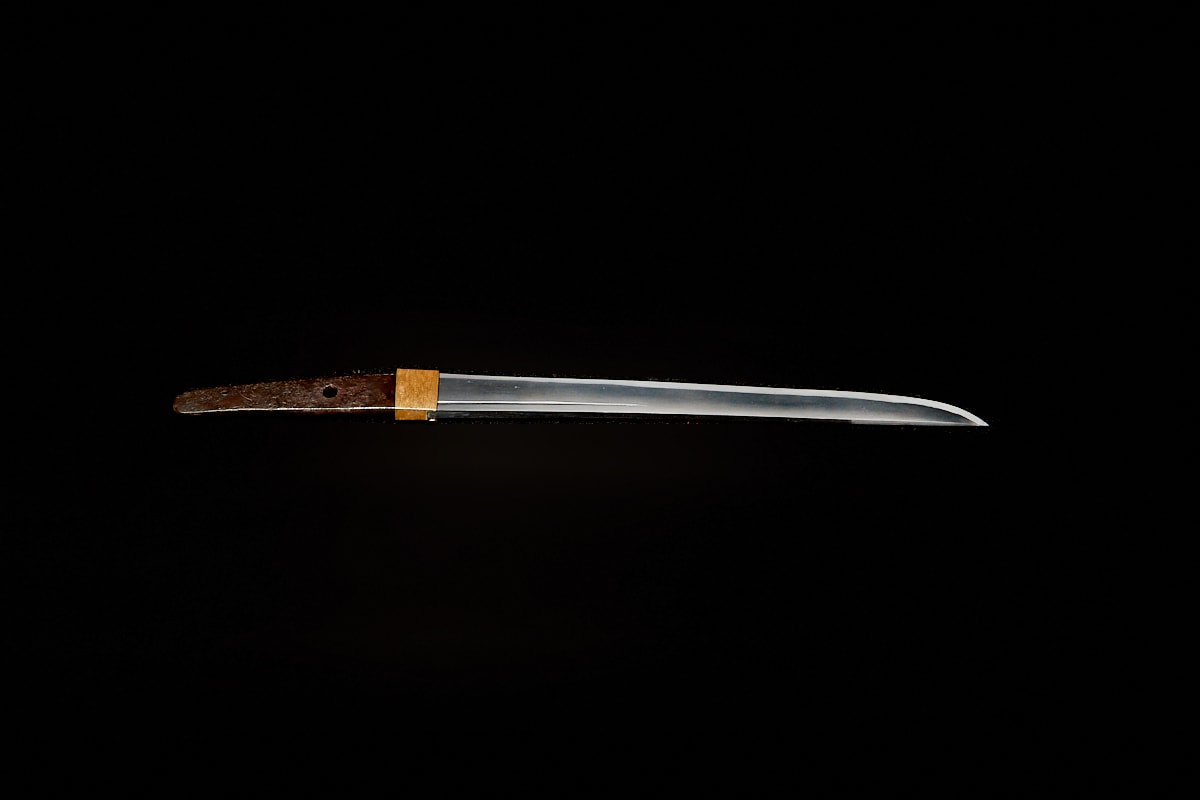
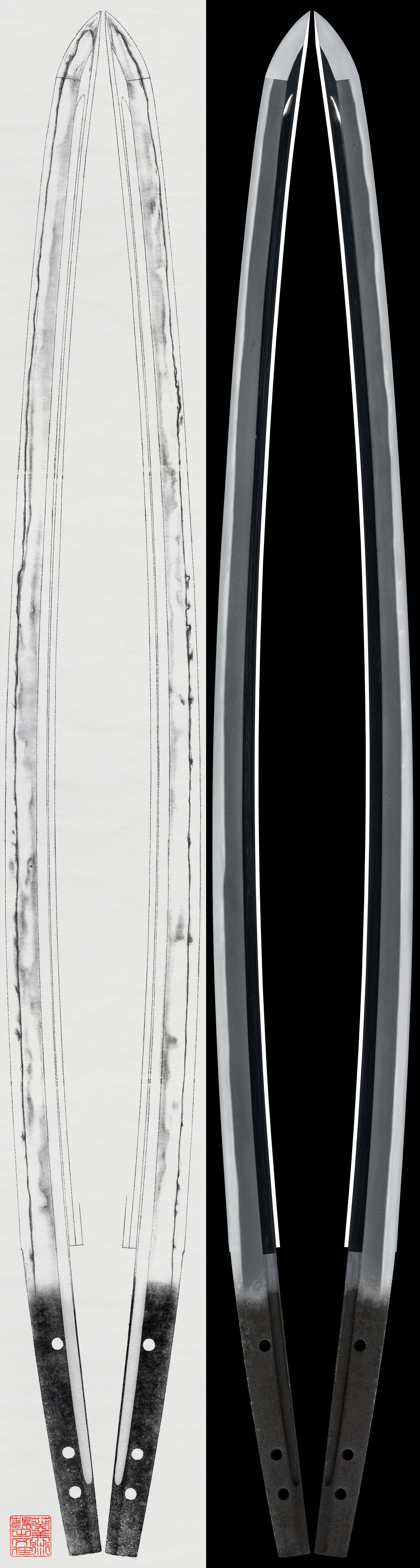
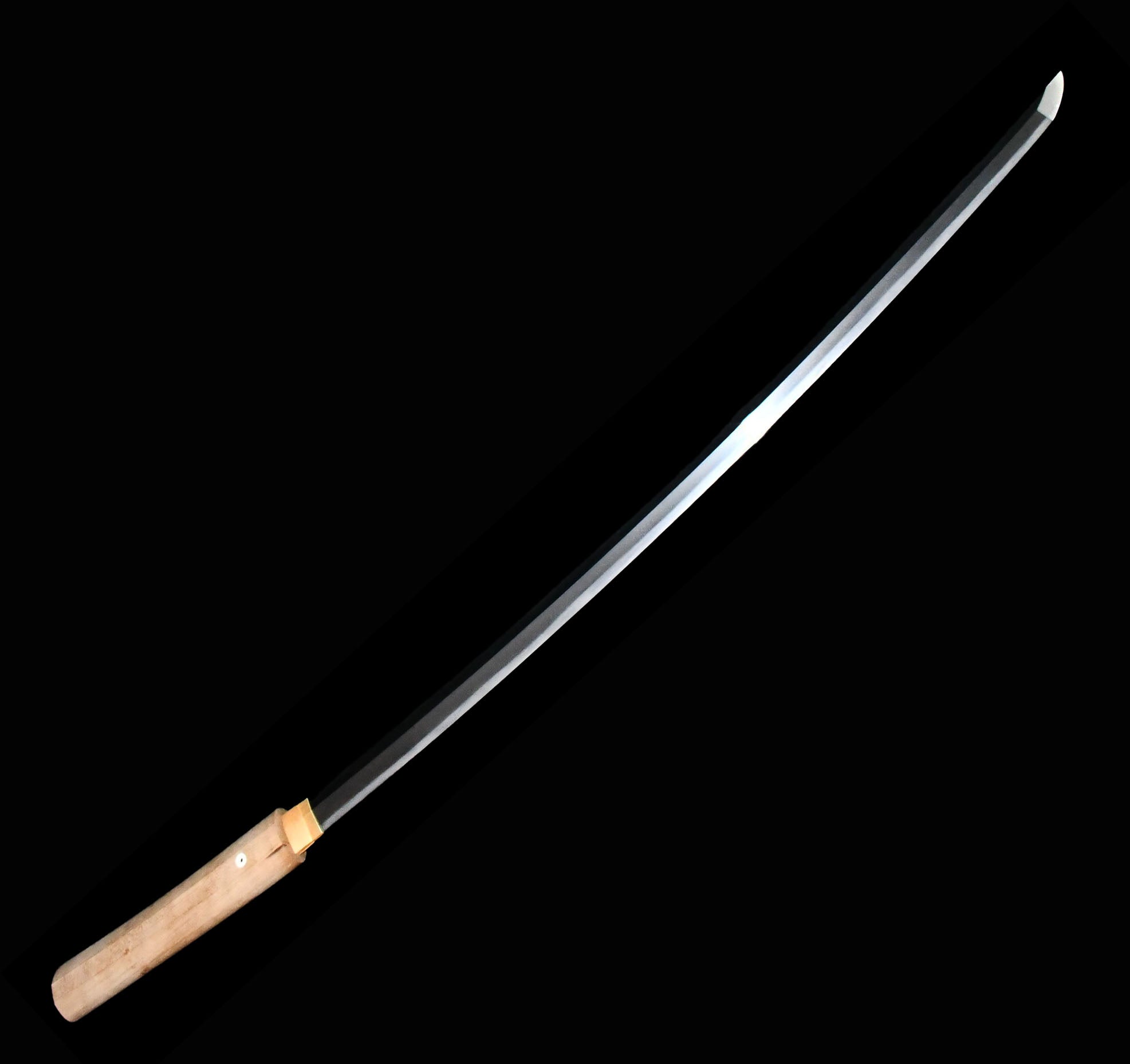
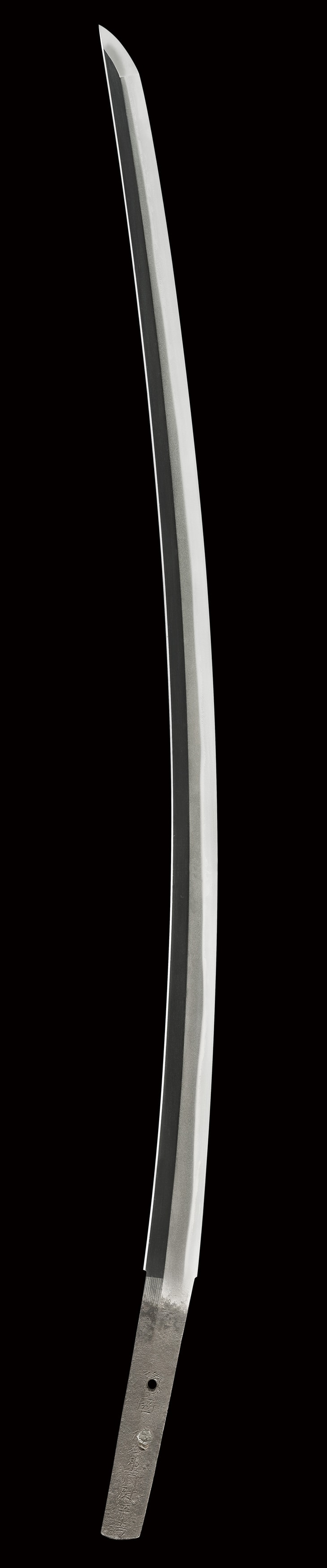
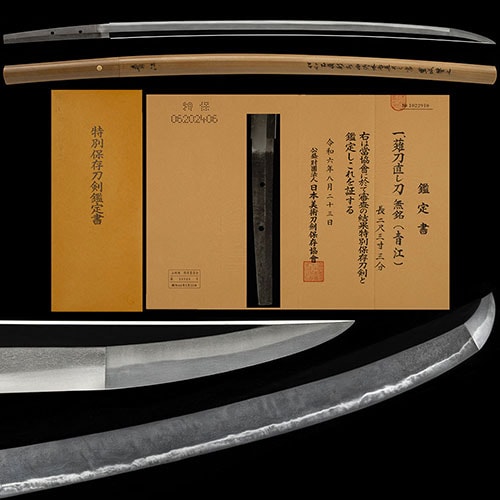
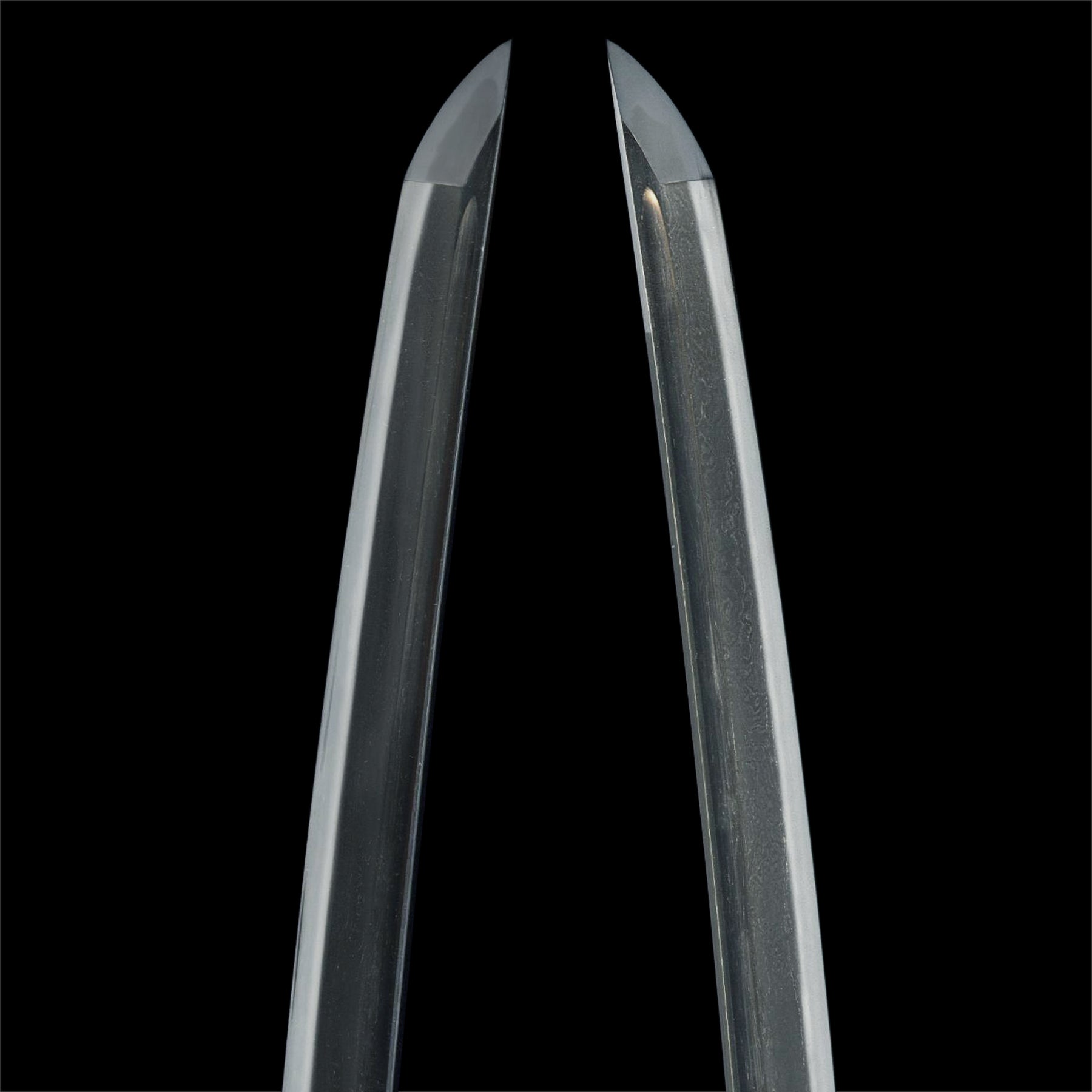
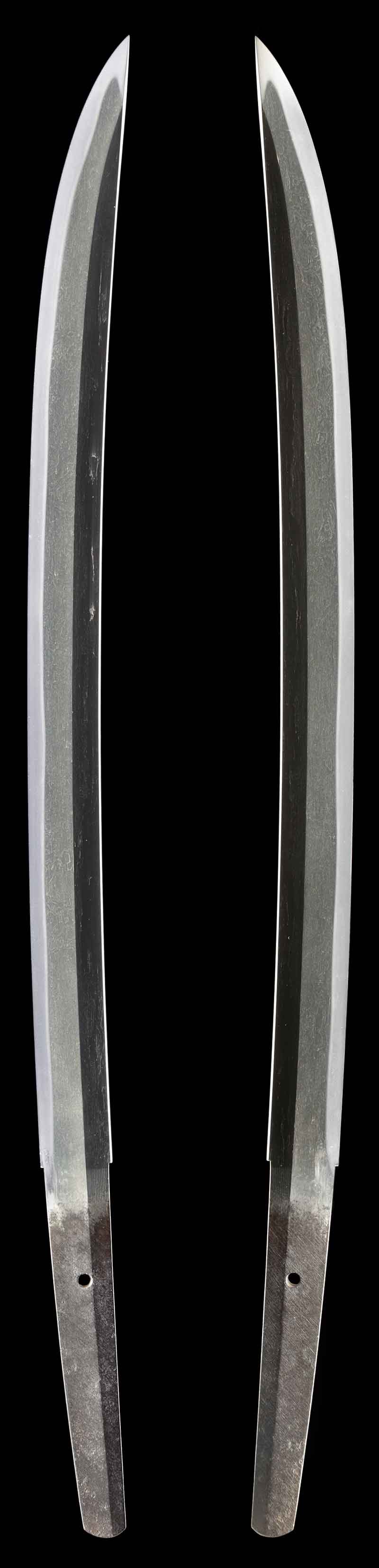
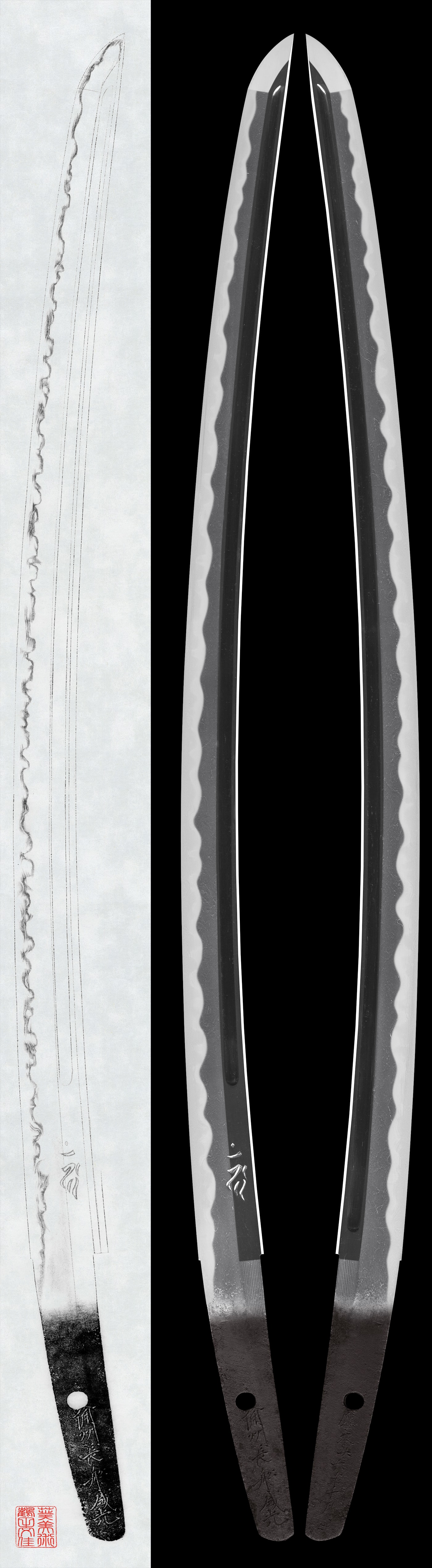
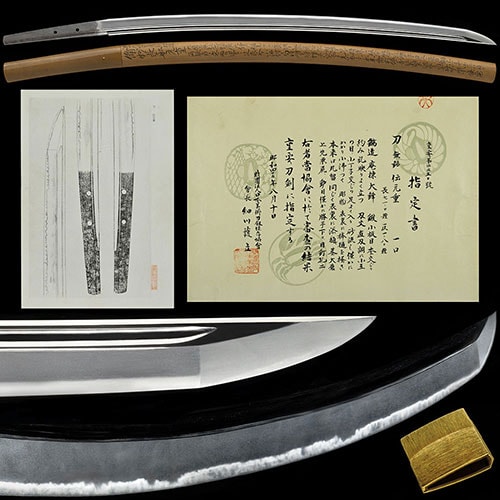
It has arrived, it has arrived! Although the association lists the province as unknown, this tachi is a celebrated sword handed down through generations as the work of Bitchu Aoe Nagatsugu, a lineage continuing since the Showa era of the Kamakura period (circa 1313, 710 years ago). This blade is by the 3rd generation Nagatsugu from the Oei era of the early Muromachi period (circa 1394, 629 years ago); while listed as province unknown, I will provide the commentary identifying it as Sue-Aoe Nagatsugu in accordance with the sayagaki. Regarding the sugata of this tachi, it was originally a long tachi of 2 shaku 6 sun, shortened by a later warrior to suit his own swordsmanship for use as a sashiryo. It presents an elegant tachi sugata with a high sori and little difference between the moto-mihaba and saki-mihaba. The jigane is a well-tightened ko-itame hada, exhibiting sumihada in places with midare-utsuri appearing in the ji. The horimono consists of bo-hi. The hamon is a sharply defined nioi-deki suguruha, truly manifesting the characteristics of an Aoe masterpiece. The jigane is exceptionally good, and both the ji and ha are healthy; it is a tachi that beautifully displays the traits of Aoe from the early Muromachi period. Although listed as province unknown, chronologically Nagatsugu only existed in Aoe during this period, so it is safe to consider it Aoe Nagatsugu. Owning an Aoe sword is a true object of desire for sword collectors. Having received this from an old connoisseur with the request to pass it on to the next generation at a low price, we are offering it at a special bargain. Aoe produced many master smiths such as Sadatsugu, Tsunetsugu, and Tsuguie, who are famous as Goban Kaji for Emperor Go-Toba. Please do enjoy this piece.

NihontoWatch MonNihontoWatch
MarketEncyclopediaKantei
Swords›Bizen-den›Aoe›Sue-Aoe›Nagatsugu›Nagatsugu (Tachi-mei) (Province unknown, early Muromachi, Oei era) (Sayagaki: Bitchu Aoe Nagatsugu)
katanaHozon
Sue-Aoe Nagatsugu

Nagatsugu (Tachi-mei) (Province unknown, early Muromachi, Oei era) (Sayagaki: Bitchu Aoe Nagatsugu)

Oei (1394-1428) · nagasa 67.8cm · sori 1.8cm

SOLD
Sue-Aoe Nagatsugu (長次) · Oei (1394-1428)1 work for sale →
KatanaHozon
Could you name the smith from the blade alone? Today’s kantei →
Sue-Aoe Nagatsugu — 1 of 25
Sue-Aoe Nagatsugu — 2 of 25
Sue-Aoe Nagatsugu — 3 of 25
Sue-Aoe Nagatsugu — 4 of 25
Sue-Aoe Nagatsugu — 5 of 25
Sue-Aoe Nagatsugu — 6 of 25
Sue-Aoe Nagatsugu — 7 of 25
Sue-Aoe Nagatsugu — 8 of 25
Sue-Aoe Nagatsugu — 9 of 25
Sue-Aoe Nagatsugu — 10 of 25
Sue-Aoe Nagatsugu — 11 of 25
Sue-Aoe Nagatsugu — 12 of 25
Sue-Aoe Nagatsugu — 13 of 25
Sue-Aoe Nagatsugu — 14 of 25
Sue-Aoe Nagatsugu — 15 of 25
Sue-Aoe Nagatsugu — 16 of 25
Sue-Aoe Nagatsugu — 17 of 25
Sue-Aoe Nagatsugu — 18 of 25
Sue-Aoe Nagatsugu — 19 of 25
Sue-Aoe Nagatsugu — 20 of 25
Sue-Aoe Nagatsugu — 21 of 25
Sue-Aoe Nagatsugu — 22 of 25
Sue-Aoe Nagatsugu — 23 of 25
Sue-Aoe Nagatsugu — 24 of 25
Sue-Aoe Nagatsugu — 25 of 25
1 / 25
1 / 25
Sue-Aoe Nagatsugu — 1 of 25Sue-Aoe Nagatsugu — 2 of 25Sue-Aoe Nagatsugu — 3 of 25Sue-Aoe Nagatsugu — 4 of 25Sue-Aoe Nagatsugu — 5 of 25Sue-Aoe Nagatsugu — 6 of 25Sue-Aoe Nagatsugu — 7 of 25Sue-Aoe Nagatsugu — 8 of 25Sue-Aoe Nagatsugu — 9 of 25Sue-Aoe Nagatsugu — 10 of 25Sue-Aoe Nagatsugu — 11 of 25Sue-Aoe Nagatsugu — 12 of 25Sue-Aoe Nagatsugu — 13 of 25Sue-Aoe Nagatsugu — 14 of 25Sue-Aoe Nagatsugu — 15 of 25Sue-Aoe Nagatsugu — 16 of 25Sue-Aoe Nagatsugu — 17 of 25Sue-Aoe Nagatsugu — 18 of 25Sue-Aoe Nagatsugu — 19 of 25Sue-Aoe Nagatsugu — 20 of 25Sue-Aoe Nagatsugu — 21 of 25Sue-Aoe Nagatsugu — 22 of 25Sue-Aoe Nagatsugu — 23 of 25Sue-Aoe Nagatsugu — 24 of 25Sue-Aoe Nagatsugu — 25 of 25
Sue-Aoe Nagatsugu (長次) · Oei (1394-1428)1 work for sale →
KatanaHozon
Could you name the smith from the blade alone? Today’s kantei →
Measurements & details
Smith
Sue-Aoe Nagatsugu
Type
Katana
School
Sue-Aoe
Period
Around 1394–1428(Oei)
Province
備中
Measurements
Nagasa 67.8cmSori 1.8cmMotohaba 2.68cmSakihaba 1.84cmKasane 0.6cm
Description

It has arrived, it has arrived! Although the association lists the province as unknown, this tachi is a celebrated sword handed down through generations as the work of Bitchu Aoe Nagatsugu, a lineage continuing since the Showa era of the Kamakura period (circa 1313, 710 years ago). This blade is by the 3rd generation Nagatsugu from the Oei era of the early Muromachi period (circa 1394, 629 years ago); while listed as province unknown, I will provide the commentary identifying it as Sue-Aoe Nagatsugu in accordance with the sayagaki. Regarding the sugata of this tachi, it was originally a long tachi of 2 shaku 6 sun, shortened by a later warrior to suit his own swordsmanship for use as a sashiryo. It presents an elegant tachi sugata with a high sori and little difference between the moto-mihaba and saki-mihaba. The jigane is a well-tightened ko-itame hada, exhibiting sumihada in places with midare-utsuri appearing in the ji. The horimono consists of bo-hi. The hamon is a sharply defined nioi-deki suguruha, truly manifesting the characteristics of an Aoe masterpiece. The jigane is exceptionally good, and both the ji and ha are healthy; it is a tachi that beautifully displays the traits of Aoe from the early Muromachi period. Although listed as province unknown, chronologically Nagatsugu only existed in Aoe during this period, so it is safe to consider it Aoe Nagatsugu. Owning an Aoe sword is a true object of desire for sword collectors. Having received this from an old connoisseur with the request to pass it on to the next generation at a low price, we are offering it at a special bargain. Aoe produced many master smiths such as Sadatsugu, Tsunetsugu, and Tsuguie, who are famous as Goban Kaji for Emperor Go-Toba. Please do enjoy this piece.

About the maker

Nagatsugu

長次

Bizen-den · Bitchu · around 1394-1428

Fujishiro Chu saku · Tōken Taikan top 39%

1 piece on the market now

›

Historical importance

Where Nagatsugu stands among comparable artisans: across all of nihontō, and within tradition, era, and period. The tiers (Foremost · Leading · Major · Notable) weigh official designations from the NBTHK and Japan's Agency for Cultural Affairs, together with historical honors of lasting repute such as the Sansaku and Meibutsu-chō.

随一
Foremost
屈指
Leading
有数
Major
著名
Notable

Select a lens to see how it's measured.

Designation record
2 designated works
Jūyō
2
1 work by Nagatsugu on the market→
Nagatsugu — full profileBizen-den school

Dated Works

Years he was demonstrably active, proven by signed-and-dated blades

Active period
1401Editorial estimate: 1394–1428
1 of 2 designated works carry a date

Study this maker →

About the school

Sue-Aoe

末青江

Bizen-den · Bitchu

Phase: Sue-Aoe末青江· 1334–1500

3 pieces on the market now

›

Sue-Aoe names the closing chapter of the Bitchū tradition, the work made after the Aoe smiths reached the height of their powers in the Nanbokuchō era and then carried the lineage forward into Muromachi decline. The window is anchored by the hands the NBTHK repeatedly groups together as the representative smiths of the period: Tsuguyoshi (次吉), Tsugunao or Tsuginao (次直), and Moritsugu (守次), with Naotsugu (直次), Yoshitsugu (吉次), and a Sadatsugu (貞次) name carried down from the late Kamakura masters into this later age. Dated blades fix the chronology firmly, from a Moritsugu tantō of Enbun 3 (1358) and a Naotsugu in the Ryakuō years through Tsuguyoshi pieces of Teiji 2 (1363) and Kōan 2 (1362). These men succeeded the late-Kamakura-into-early-Nanbokuchō generation that produced Sadatsugu and the earlier Moritsugu, and they worked at the moment the Southern Court's fortunes were turning, after which the school thinned out. The very tail of the line surfaces in obscure later Bitchū hands such as Munesada and Sōtei of Kasaoka, dated Bunmei 13 (1481), whose lineage the records leave unknown and whose work the setsumei describe as nearly indistinguishable from late Bizen. Sugata is the first tell. Setsumei after setsumei records a wide mihaba with little taper from base to tip, thin kasane, sun-nobi proportion in the tantō and an extended chū-kissaki or outright ō-kissaki in the larger blades, the broad Nanbokuchō build that the earlier Aoe never carried. The jihada keeps the school signature of ko-itame mixed with mokume, finely standing, with mottled jifu and patches of sumihada drifting through the steel. Above all the period is read in its utsuri: streak-like suji-utsuri rises near the edge and stacks into the layered dan-utsuri the catalogues prize, seen plainly on the Tsugiyoshi tachi of Tokuju 21 and the dated Tsuguyoshi tantō of Juyo 58.

Two tempers divide the leading hands. Tsuguyoshi favors a tight, bright suguha with ko-ashi and saka-ashi; Tsugunao favors the flamboyant saka-chōji-midare with its reverse slant, ashi and yō pouring in, that matured around Enbun. Against this the Ko-Aoe of the mid-Kamakura ran ko-nie-deki with a subdued, shizumi nioiguchi over a refined chirimen-hada, while the late-Kamakura Chū-Aoe of Sadatsugu and Moritsugu stood between, the nie growing calmer and the reverse-slanting yakiba only beginning to foreshadow the later drama. Crucially the period remained nioi-deki where other provinces took up Sōshū nie, a holding distinction the setsumei mark out by name. For kantei the cluster reads together. A broad Nanbokuchō sugata, dan-utsuri over sumihada, ō-sujikai file marks on the tang, and a nioiguchi that is tight and clear point to this window rather than to Bizen of the same age; the choice between bright suguha and reverse saka-chōji then separates Tsuguyoshi from Tsugunao, while Naotsugu's forceful reverse-chisel mei and nezumi-ashi, and Moritsugu's kinsuji in a tight suguha, mark their own hands. The named masters carry strong provenance: a Tsugiyoshi wakizashi dated Enbun 2 descended in the Maeda family, a Yoshitsugu tantō passed to the Sakai of Himeji by gift of Tokugawa Ietsuna, and an ō-suriage den Tsuguyoshi katana ran through the Yanagisawa house with Hon'ami origami from Mitsuatsu. Honma's own remark singling out Tsugiyoshi and Tsuginao as the makers of the clearest chōji in tantō fixes their standing at the close of the Aoe story. Learn more →

Leading smiths
SmithEraDesignated
Tsuguyoshi次吉1357-136816
Kagetsugu景次1379-13810
Arihiro有弘1381-13840
Arisue有末1489-14920
Toshitsugu年次1394-14280
Explore the Sue-Aoe school →

Historical context

Bizen in the Muromachi period

›

War at home and trade abroad made Muromachi Bizen the busiest forge region in Japan: a century of Sengoku demand after the Ōnin War, and export missions to Ming China carrying blades by the tens of thousands.

Bizen in the Muromachi period →

NBTHK Certificate
Hozon Tōken保存刀剣
Sword Worthy of Preservation
›

Certifies a genuine blade worth preserving: a signature confirmed correct, or, if unsigned, an era, province, and school that the NBTHK can reliably identify.

About the NBTHK›

The NBTHK (Nihon Bijutsu Tōken Hozon Kyōkai, the Society for the Preservation of Japanese Art Swords) is a public-interest incorporated foundation founded in 1948 and supervised by Japan’s Agency for Cultural Affairs (Bunkachō); it is based at the Japanese Sword Museum in Tokyo. Its expert panels physically examine each submitted work (shinsa) and issue a certificate (kanteishō) ranking it by artistic and historical merit. NBTHK papers are the most widely recognized standard of authentication for Japanese swords and fittings.

NBTHK official site→
Seller
N
Nipponto
Established 1953 · 73 yrs on the market
🇯🇵Ships from Japan
›
✓Verified dealernipponto.co.jp
✓Ships worldwide✓English supportPayPalCredit card
Return policy

For returns due to customer circumstances, the cost is the customer's responsibility. For returns due to our mis-shipment or a defective item, we bear the cost.

View all of Nipponto’s listings→View this item on the dealer’s site→

More works by Sue-Aoe Nagatsugu

View all →
Toushin
Tokuho
Katana - Tokuho - by Sue-Aoe Nagatsugu - Aoe Nagatsugu (Mumei)Katana - Tokuho - by Sue-Aoe Nagatsugu - Aoe Nagatsugu (Mumei)

Katana

BySue-Aoe Nagatsugu
¥1,815,000

Previously sold by Sue-Aoe Nagatsugu

View all →
World Seiyudo
Tokuho
Katana - Tokuho - by Sue-Aoe Nagatsugu - Mumei Den Aoe Nagatsugu - NBTHK Tokubetsu Hozon TokenKatana - Tokuho - by Sue-Aoe Nagatsugu - Mumei Den Aoe Nagatsugu - NBTHK Tokubetsu Hozon Token
Sold

Katana

BySue-Aoe Nagatsugu
SOLD

More from the Sue-Aoe school

View all →
Yushindou
Hozon
Tanto - Hozon - by Sue-Aoe Kagetsugu - Kageyoshi (in Shirasaya)Tanto - Hozon - by Sue-Aoe Kagetsugu - Kageyoshi (in Shirasaya)

Tantō

BySue-Aoe Kagetsugu
¥400,000
Katana Ando
脇差Photos not published
Wakizashi - by Sue-Aoe Ietsugu - Wakizashi Ietsugu

Wakizashi

BySue-Aoe Ietsugu
Ask

More from the Aoe school

View all →
Aoi Art
Jūyō
Katana - Jūyō - by Aoe School - Mumei (Aoe school)Katana - Jūyō - by Aoe School - Mumei (Aoe school)

Katana

ByAoe School
¥3,200,000
Toyuukai
Jūyō
Katana - Jūyō - by Aoe School - Mumei (Aoe) - 51st Juyo TokenKatana - Jūyō - by Aoe School - Mumei (Aoe) - 51st Juyo Token

Katana

ByAoe School
¥5,500,000
Samurai Nippon
Jūyō
Kodachi - Jūyō - by Chu-Aoe Yoshitsugu - Kodachi: Bitchu no Kuni ju Uemonnojo Tairano Yoshitsugu (Aoe)Kodachi - Jūyō - by Chu-Aoe Yoshitsugu - Kodachi: Bitchu no Kuni ju Uemonnojo Tairano Yoshitsugu (Aoe)

Kodachi

ByChu-Aoe Yoshitsugu
¥6,500,000
Eirakudo
Tokuho
Tokuho - by Aoe School - Aoe Katana Tokubetsu Hozon TokenTokuho - by Aoe School - Aoe Katana Tokubetsu Hozon Token

Aoe Katana Tokubetsu Hozon Token

ByAoe School
¥2,380,000
Token-Net
Jūyō
Jūyō - by Aoe School - Naginata Naoshi Katana: Mumei (Aoe)Jūyō - by Aoe School - Naginata Naoshi Katana: Mumei (Aoe)

Naginata Naoshi Katana: Mumei (Aoe)

ByAoe School
¥3,200,000
Samurai Store
Tokuho
Katana - Tokuho - by Aoe School - Antique Katana sword in Ornate Mounting Kamakura Period NBTHK Tokubetsu Hozon certificatedKatana - Tokuho - by Aoe School - Antique Katana sword in Ornate Mounting Kamakura Period NBTHK Tokubetsu Hozon certificated

Katana

ByAoe School
¥2,700,000
Goushuya
Jūyō Bijutsuhin
Tachi - Jubi - by Ko-Aoe School - Important Art Object Tachi: Sueyoshi of Ko-Aoe, Passed down in the Naito Family, Lord of Murakami Domain, Echigo ProvinceTachi - Jubi - by Ko-Aoe School - Important Art Object Tachi: Sueyoshi of Ko-Aoe, Passed down in the Naito Family, Lord of Murakami Domain, Echigo Province

Tachi

ByKo-Aoe School
Ask
Tsuruginoya
Tokuho
Tokuho - by Aoe School - Naginata-naoshi Wakizashi: AoeTokuho - by Aoe School - Naginata-naoshi Wakizashi: Aoe

Naginata-naoshi Wakizashi: Aoe

ByAoe School
¥650,000

More from the Bizen tradition

View all →
Nihonto.com
Jūyō
Tanto - Jūyō - by Osafune Kagemitsu - Juyo Tanto by Bizen KagemitsuTanto - Jūyō - by Osafune Kagemitsu - Juyo Tanto by Bizen Kagemitsu

Tantō

ByOsafune Kagemitsu
¥89,500
Aoi Art
Jūyō Bijutsuhin
Daisho - Jubi - by Osafune Nagamitsu - Dai Sho: Katana (Important Art Object): Mumei (Attributed to Nagamitsu) / Wakizashi: Mumei (Attributed to Sekishu Naotsuna)Daisho - Jubi - by Osafune Nagamitsu - Dai Sho: Katana (Important Art Object): Mumei (Attributed to Nagamitsu) / Wakizashi: Mumei (Attributed to Sekishu Naotsuna)

Daishō

ByOsafune Nagamitsu
Ask
Tsuruginoya
Jūyō
Katana - Jūyō - by Fukuoka Ichimonji School - Mumei Fukuoka IchimonjiKatana - Jūyō - by Fukuoka Ichimonji School - Mumei Fukuoka Ichimonji

Katana

ByFukuoka Ichimonji School
Ask
Hyozaemon
Tokuho
Tokuho - by Fukuoka Ichimonji Yoshifusa - Naginata Naoshi Wakizashi by Fukuoka Ichimonji Yoshifusa, a Master of IchimonjiTokuho - by Fukuoka Ichimonji Yoshifusa - Naginata Naoshi Wakizashi by Fukuoka Ichimonji Yoshifusa, a Master of Ichimonji

Naginata Naoshi Wakizashi by Fukuoka Ichimonji Yoshifusa, a Master of Ichimonji

ByFukuoka Ichimonji Yoshifusa
Ask
Aoi Art
Tokuho
Wakizashi - Tokuho - by Oei-Bizen Morimitsu - Bishū Osafune Morimitsu, dated Ōei 26 (1419) - NBTHK Tokubetsu Hozon TokenWakizashi - Tokuho - by Oei-Bizen Morimitsu - Bishū Osafune Morimitsu, dated Ōei 26 (1419) - NBTHK Tokubetsu Hozon Token

Wakizashi

ByOei-Bizen Morimitsu
Starting Bid¥1,500,000
Eirakudo
Tokuho
Katana - Tokuho - by Katayama Ichimonji School - Katayama Ichimonji - Tokubetsu Hozon TokenKatana - Tokuho - by Katayama Ichimonji School - Katayama Ichimonji - Tokubetsu Hozon Token

Katana

ByKatayama Ichimonji School
¥4,500,000
Eirakudo
Jūyō
Katana - Jūyō - by Motoshige - Motoshige - Juyo TokenKatana - Jūyō - by Motoshige - Motoshige - Juyo Token

Katana

ByMotoshige
¥6,000,000
Giheiya
Hozon
Katana - Hozon - by Takada School - Mumei (Hira Takada) - 72.1cm, with Koshirae and ShirasayaKatana - Hozon - by Takada School - Mumei (Hira Takada) - 72.1cm, with Koshirae and Shirasaya

Katana

ByTakada School
¥350,000

Swords

  • Katana
  • Wakizashi
  • Tantō
  • Tachi
  • Naginata
  • Yari
  • Japanese Swords
  • Samurai Swords

Fittings

  • Tsuba
  • Fuchi-Kashira
  • Kozuka
  • Menuki
  • Sword Guards (Tsuba)

Armor

  • Kabuto
  • Samurai Armor
  • All Samurai Armor

By Certification

  • Tokujū
  • Jūyō
  • Tokuho
  • Hozon

Resources

  • Dealer Directory
  • Artist Directory
  • The Daily Kantei
  • Glossary
  • Browse All
Nihontowatch© 2026
TermsPrivacyCookiesAbout
Sold

Description

It has arrived, it has arrived! Although the association lists the province as unknown, this tachi is a celebrated sword handed down through generations as the work of Bitchu Aoe Nagatsugu, a lineage continuing since the Showa era of the Kamakura period (circa 1313, 710 years ago). This blade is by the 3rd generation Nagatsugu from the Oei era of the early Muromachi period (circa 1394, 629 years ago); while listed as province unknown, I will provide the commentary identifying it as Sue-Aoe Nagatsugu in accordance with the sayagaki. Regarding the sugata of this tachi, it was originally a long tachi of 2 shaku 6 sun, shortened by a later warrior to suit his own swordsmanship for use as a sashiryo. It presents an elegant tachi sugata with a high sori and little difference between the moto-mihaba and saki-mihaba. The jigane is a well-tightened ko-itame hada, exhibiting sumihada in places with midare-utsuri appearing in the ji. The horimono consists of bo-hi. The hamon is a sharply defined nioi-deki suguruha, truly manifesting the characteristics of an Aoe masterpiece. The jigane is exceptionally good, and both the ji and ha are healthy; it is a tachi that beautifully displays the traits of Aoe from the early Muromachi period. Although listed as province unknown, chronologically Nagatsugu only existed in Aoe during this period, so it is safe to consider it Aoe Nagatsugu. Owning an Aoe sword is a true object of desire for sword collectors. Having received this from an old connoisseur with the request to pass it on to the next generation at a low price, we are offering it at a special bargain. Aoe produced many master smiths such as Sadatsugu, Tsunetsugu, and Tsuguie, who are famous as Goban Kaji for Emperor Go-Toba. Please do enjoy this piece.

NihontoWatch MonNihontoWatch
MarketEncyclopediaKantei
Swords›Bizen-den›Aoe›Sue-Aoe›Nagatsugu›Nagatsugu (Tachi-mei) (Province unknown, early Muromachi, Oei era) (Sayagaki: Bitchu Aoe Nagatsugu)
katanaHozon
Sue-Aoe Nagatsugu

Nagatsugu (Tachi-mei) (Province unknown, early Muromachi, Oei era) (Sayagaki: Bitchu Aoe Nagatsugu)

Oei (1394-1428) · nagasa 67.8cm · sori 1.8cm

SOLD
Sue-Aoe Nagatsugu (長次) · Oei (1394-1428)1 work for sale →
KatanaHozon
Could you name the smith from the blade alone? Today’s kantei →
Sue-Aoe Nagatsugu — 1 of 25
Sue-Aoe Nagatsugu — 2 of 25
Sue-Aoe Nagatsugu — 3 of 25
Sue-Aoe Nagatsugu — 4 of 25
Sue-Aoe Nagatsugu — 5 of 25
Sue-Aoe Nagatsugu — 6 of 25
Sue-Aoe Nagatsugu — 7 of 25
Sue-Aoe Nagatsugu — 8 of 25
Sue-Aoe Nagatsugu — 9 of 25
Sue-Aoe Nagatsugu — 10 of 25
Sue-Aoe Nagatsugu — 11 of 25
Sue-Aoe Nagatsugu — 12 of 25
Sue-Aoe Nagatsugu — 13 of 25
Sue-Aoe Nagatsugu — 14 of 25
Sue-Aoe Nagatsugu — 15 of 25
Sue-Aoe Nagatsugu — 16 of 25
Sue-Aoe Nagatsugu — 17 of 25
Sue-Aoe Nagatsugu — 18 of 25
Sue-Aoe Nagatsugu — 19 of 25
Sue-Aoe Nagatsugu — 20 of 25
Sue-Aoe Nagatsugu — 21 of 25
Sue-Aoe Nagatsugu — 22 of 25
Sue-Aoe Nagatsugu — 23 of 25
Sue-Aoe Nagatsugu — 24 of 25
Sue-Aoe Nagatsugu — 25 of 25
1 / 25
1 / 25
Sue-Aoe Nagatsugu — 1 of 25Sue-Aoe Nagatsugu — 2 of 25Sue-Aoe Nagatsugu — 3 of 25Sue-Aoe Nagatsugu — 4 of 25Sue-Aoe Nagatsugu — 5 of 25Sue-Aoe Nagatsugu — 6 of 25Sue-Aoe Nagatsugu — 7 of 25Sue-Aoe Nagatsugu — 8 of 25Sue-Aoe Nagatsugu — 9 of 25Sue-Aoe Nagatsugu — 10 of 25Sue-Aoe Nagatsugu — 11 of 25Sue-Aoe Nagatsugu — 12 of 25Sue-Aoe Nagatsugu — 13 of 25Sue-Aoe Nagatsugu — 14 of 25Sue-Aoe Nagatsugu — 15 of 25Sue-Aoe Nagatsugu — 16 of 25Sue-Aoe Nagatsugu — 17 of 25Sue-Aoe Nagatsugu — 18 of 25Sue-Aoe Nagatsugu — 19 of 25Sue-Aoe Nagatsugu — 20 of 25Sue-Aoe Nagatsugu — 21 of 25Sue-Aoe Nagatsugu — 22 of 25Sue-Aoe Nagatsugu — 23 of 25Sue-Aoe Nagatsugu — 24 of 25Sue-Aoe Nagatsugu — 25 of 25
Sue-Aoe Nagatsugu (長次) · Oei (1394-1428)1 work for sale →
KatanaHozon
Could you name the smith from the blade alone? Today’s kantei →
Measurements & details
Smith
Sue-Aoe Nagatsugu
Type
Katana
School
Sue-Aoe
Period
Around 1394–1428(Oei)
Province
備中
Measurements
Nagasa 67.8cmSori 1.8cmMotohaba 2.68cmSakihaba 1.84cmKasane 0.6cm
Description

It has arrived, it has arrived! Although the association lists the province as unknown, this tachi is a celebrated sword handed down through generations as the work of Bitchu Aoe Nagatsugu, a lineage continuing since the Showa era of the Kamakura period (circa 1313, 710 years ago). This blade is by the 3rd generation Nagatsugu from the Oei era of the early Muromachi period (circa 1394, 629 years ago); while listed as province unknown, I will provide the commentary identifying it as Sue-Aoe Nagatsugu in accordance with the sayagaki. Regarding the sugata of this tachi, it was originally a long tachi of 2 shaku 6 sun, shortened by a later warrior to suit his own swordsmanship for use as a sashiryo. It presents an elegant tachi sugata with a high sori and little difference between the moto-mihaba and saki-mihaba. The jigane is a well-tightened ko-itame hada, exhibiting sumihada in places with midare-utsuri appearing in the ji. The horimono consists of bo-hi. The hamon is a sharply defined nioi-deki suguruha, truly manifesting the characteristics of an Aoe masterpiece. The jigane is exceptionally good, and both the ji and ha are healthy; it is a tachi that beautifully displays the traits of Aoe from the early Muromachi period. Although listed as province unknown, chronologically Nagatsugu only existed in Aoe during this period, so it is safe to consider it Aoe Nagatsugu. Owning an Aoe sword is a true object of desire for sword collectors. Having received this from an old connoisseur with the request to pass it on to the next generation at a low price, we are offering it at a special bargain. Aoe produced many master smiths such as Sadatsugu, Tsunetsugu, and Tsuguie, who are famous as Goban Kaji for Emperor Go-Toba. Please do enjoy this piece.

About the maker

Nagatsugu

長次

Bizen-den · Bitchu · around 1394-1428

Fujishiro Chu saku · Tōken Taikan top 39%

1 piece on the market now

›

Historical importance

Where Nagatsugu stands among comparable artisans: across all of nihontō, and within tradition, era, and period. The tiers (Foremost · Leading · Major · Notable) weigh official designations from the NBTHK and Japan's Agency for Cultural Affairs, together with historical honors of lasting repute such as the Sansaku and Meibutsu-chō.

随一
Foremost
屈指
Leading
有数
Major
著名
Notable

Select a lens to see how it's measured.

Designation record
2 designated works
Jūyō
2
1 work by Nagatsugu on the market→
Nagatsugu — full profileBizen-den school

Dated Works

Years he was demonstrably active, proven by signed-and-dated blades

Active period
1401Editorial estimate: 1394–1428
1 of 2 designated works carry a date

Study this maker →

About the school

Sue-Aoe

末青江

Bizen-den · Bitchu

Phase: Sue-Aoe末青江· 1334–1500

3 pieces on the market now

›

Sue-Aoe names the closing chapter of the Bitchū tradition, the work made after the Aoe smiths reached the height of their powers in the Nanbokuchō era and then carried the lineage forward into Muromachi decline. The window is anchored by the hands the NBTHK repeatedly groups together as the representative smiths of the period: Tsuguyoshi (次吉), Tsugunao or Tsuginao (次直), and Moritsugu (守次), with Naotsugu (直次), Yoshitsugu (吉次), and a Sadatsugu (貞次) name carried down from the late Kamakura masters into this later age. Dated blades fix the chronology firmly, from a Moritsugu tantō of Enbun 3 (1358) and a Naotsugu in the Ryakuō years through Tsuguyoshi pieces of Teiji 2 (1363) and Kōan 2 (1362). These men succeeded the late-Kamakura-into-early-Nanbokuchō generation that produced Sadatsugu and the earlier Moritsugu, and they worked at the moment the Southern Court's fortunes were turning, after which the school thinned out. The very tail of the line surfaces in obscure later Bitchū hands such as Munesada and Sōtei of Kasaoka, dated Bunmei 13 (1481), whose lineage the records leave unknown and whose work the setsumei describe as nearly indistinguishable from late Bizen. Sugata is the first tell. Setsumei after setsumei records a wide mihaba with little taper from base to tip, thin kasane, sun-nobi proportion in the tantō and an extended chū-kissaki or outright ō-kissaki in the larger blades, the broad Nanbokuchō build that the earlier Aoe never carried. The jihada keeps the school signature of ko-itame mixed with mokume, finely standing, with mottled jifu and patches of sumihada drifting through the steel. Above all the period is read in its utsuri: streak-like suji-utsuri rises near the edge and stacks into the layered dan-utsuri the catalogues prize, seen plainly on the Tsugiyoshi tachi of Tokuju 21 and the dated Tsuguyoshi tantō of Juyo 58.

Two tempers divide the leading hands. Tsuguyoshi favors a tight, bright suguha with ko-ashi and saka-ashi; Tsugunao favors the flamboyant saka-chōji-midare with its reverse slant, ashi and yō pouring in, that matured around Enbun. Against this the Ko-Aoe of the mid-Kamakura ran ko-nie-deki with a subdued, shizumi nioiguchi over a refined chirimen-hada, while the late-Kamakura Chū-Aoe of Sadatsugu and Moritsugu stood between, the nie growing calmer and the reverse-slanting yakiba only beginning to foreshadow the later drama. Crucially the period remained nioi-deki where other provinces took up Sōshū nie, a holding distinction the setsumei mark out by name. For kantei the cluster reads together. A broad Nanbokuchō sugata, dan-utsuri over sumihada, ō-sujikai file marks on the tang, and a nioiguchi that is tight and clear point to this window rather than to Bizen of the same age; the choice between bright suguha and reverse saka-chōji then separates Tsuguyoshi from Tsugunao, while Naotsugu's forceful reverse-chisel mei and nezumi-ashi, and Moritsugu's kinsuji in a tight suguha, mark their own hands. The named masters carry strong provenance: a Tsugiyoshi wakizashi dated Enbun 2 descended in the Maeda family, a Yoshitsugu tantō passed to the Sakai of Himeji by gift of Tokugawa Ietsuna, and an ō-suriage den Tsuguyoshi katana ran through the Yanagisawa house with Hon'ami origami from Mitsuatsu. Honma's own remark singling out Tsugiyoshi and Tsuginao as the makers of the clearest chōji in tantō fixes their standing at the close of the Aoe story. Learn more →

Leading smiths
SmithEraDesignated
Tsuguyoshi次吉1357-136816
Kagetsugu景次1379-13810
Arihiro有弘1381-13840
Arisue有末1489-14920
Toshitsugu年次1394-14280
Explore the Sue-Aoe school →

Historical context

Bizen in the Muromachi period

›

War at home and trade abroad made Muromachi Bizen the busiest forge region in Japan: a century of Sengoku demand after the Ōnin War, and export missions to Ming China carrying blades by the tens of thousands.

Bizen in the Muromachi period →

NBTHK Certificate
Hozon Tōken保存刀剣
Sword Worthy of Preservation
›

Certifies a genuine blade worth preserving: a signature confirmed correct, or, if unsigned, an era, province, and school that the NBTHK can reliably identify.

About the NBTHK›

The NBTHK (Nihon Bijutsu Tōken Hozon Kyōkai, the Society for the Preservation of Japanese Art Swords) is a public-interest incorporated foundation founded in 1948 and supervised by Japan’s Agency for Cultural Affairs (Bunkachō); it is based at the Japanese Sword Museum in Tokyo. Its expert panels physically examine each submitted work (shinsa) and issue a certificate (kanteishō) ranking it by artistic and historical merit. NBTHK papers are the most widely recognized standard of authentication for Japanese swords and fittings.

NBTHK official site→
Seller
N
Nipponto
Established 1953 · 73 yrs on the market
🇯🇵Ships from Japan
›
✓Verified dealernipponto.co.jp
✓Ships worldwide✓English supportPayPalCredit card
Return policy

For returns due to customer circumstances, the cost is the customer's responsibility. For returns due to our mis-shipment or a defective item, we bear the cost.

View all of Nipponto’s listings→View this item on the dealer’s site→

More works by Sue-Aoe Nagatsugu

View all →
Toushin
Tokuho
Katana - Tokuho - by Sue-Aoe Nagatsugu - Aoe Nagatsugu (Mumei)Katana - Tokuho - by Sue-Aoe Nagatsugu - Aoe Nagatsugu (Mumei)

Katana

BySue-Aoe Nagatsugu
¥1,815,000

Previously sold by Sue-Aoe Nagatsugu

View all →
World Seiyudo
Tokuho
Katana - Tokuho - by Sue-Aoe Nagatsugu - Mumei Den Aoe Nagatsugu - NBTHK Tokubetsu Hozon TokenKatana - Tokuho - by Sue-Aoe Nagatsugu - Mumei Den Aoe Nagatsugu - NBTHK Tokubetsu Hozon Token
Sold

Katana

BySue-Aoe Nagatsugu
SOLD

More from the Sue-Aoe school

View all →
Yushindou
Hozon
Tanto - Hozon - by Sue-Aoe Kagetsugu - Kageyoshi (in Shirasaya)Tanto - Hozon - by Sue-Aoe Kagetsugu - Kageyoshi (in Shirasaya)

Tantō

BySue-Aoe Kagetsugu
¥400,000
Katana Ando
脇差Photos not published
Wakizashi - by Sue-Aoe Ietsugu - Wakizashi Ietsugu

Wakizashi

BySue-Aoe Ietsugu
Ask

More from the Aoe school

View all →
Aoi Art
Jūyō
Katana - Jūyō - by Aoe School - Mumei (Aoe school)Katana - Jūyō - by Aoe School - Mumei (Aoe school)

Katana

ByAoe School
¥3,200,000
Toyuukai
Jūyō
Katana - Jūyō - by Aoe School - Mumei (Aoe) - 51st Juyo TokenKatana - Jūyō - by Aoe School - Mumei (Aoe) - 51st Juyo Token

Katana

ByAoe School
¥5,500,000
Samurai Nippon
Jūyō
Kodachi - Jūyō - by Chu-Aoe Yoshitsugu - Kodachi: Bitchu no Kuni ju Uemonnojo Tairano Yoshitsugu (Aoe)Kodachi - Jūyō - by Chu-Aoe Yoshitsugu - Kodachi: Bitchu no Kuni ju Uemonnojo Tairano Yoshitsugu (Aoe)

Kodachi

ByChu-Aoe Yoshitsugu
¥6,500,000
Eirakudo
Tokuho
Tokuho - by Aoe School - Aoe Katana Tokubetsu Hozon TokenTokuho - by Aoe School - Aoe Katana Tokubetsu Hozon Token

Aoe Katana Tokubetsu Hozon Token

ByAoe School
¥2,380,000
Token-Net
Jūyō
Jūyō - by Aoe School - Naginata Naoshi Katana: Mumei (Aoe)Jūyō - by Aoe School - Naginata Naoshi Katana: Mumei (Aoe)

Naginata Naoshi Katana: Mumei (Aoe)

ByAoe School
¥3,200,000
Samurai Store
Tokuho
Katana - Tokuho - by Aoe School - Antique Katana sword in Ornate Mounting Kamakura Period NBTHK Tokubetsu Hozon certificatedKatana - Tokuho - by Aoe School - Antique Katana sword in Ornate Mounting Kamakura Period NBTHK Tokubetsu Hozon certificated

Katana

ByAoe School
¥2,700,000
Goushuya
Jūyō Bijutsuhin
Tachi - Jubi - by Ko-Aoe School - Important Art Object Tachi: Sueyoshi of Ko-Aoe, Passed down in the Naito Family, Lord of Murakami Domain, Echigo ProvinceTachi - Jubi - by Ko-Aoe School - Important Art Object Tachi: Sueyoshi of Ko-Aoe, Passed down in the Naito Family, Lord of Murakami Domain, Echigo Province

Tachi

ByKo-Aoe School
Ask
Tsuruginoya
Tokuho
Tokuho - by Aoe School - Naginata-naoshi Wakizashi: AoeTokuho - by Aoe School - Naginata-naoshi Wakizashi: Aoe

Naginata-naoshi Wakizashi: Aoe

ByAoe School
¥650,000

More from the Bizen tradition

View all →
Nihonto.com
Jūyō
Tanto - Jūyō - by Osafune Kagemitsu - Juyo Tanto by Bizen KagemitsuTanto - Jūyō - by Osafune Kagemitsu - Juyo Tanto by Bizen Kagemitsu

Tantō

ByOsafune Kagemitsu
¥89,500
Aoi Art
Jūyō Bijutsuhin
Daisho - Jubi - by Osafune Nagamitsu - Dai Sho: Katana (Important Art Object): Mumei (Attributed to Nagamitsu) / Wakizashi: Mumei (Attributed to Sekishu Naotsuna)Daisho - Jubi - by Osafune Nagamitsu - Dai Sho: Katana (Important Art Object): Mumei (Attributed to Nagamitsu) / Wakizashi: Mumei (Attributed to Sekishu Naotsuna)

Daishō

ByOsafune Nagamitsu
Ask
Tsuruginoya
Jūyō
Katana - Jūyō - by Fukuoka Ichimonji School - Mumei Fukuoka IchimonjiKatana - Jūyō - by Fukuoka Ichimonji School - Mumei Fukuoka Ichimonji

Katana

ByFukuoka Ichimonji School
Ask
Hyozaemon
Tokuho
Tokuho - by Fukuoka Ichimonji Yoshifusa - Naginata Naoshi Wakizashi by Fukuoka Ichimonji Yoshifusa, a Master of IchimonjiTokuho - by Fukuoka Ichimonji Yoshifusa - Naginata Naoshi Wakizashi by Fukuoka Ichimonji Yoshifusa, a Master of Ichimonji

Naginata Naoshi Wakizashi by Fukuoka Ichimonji Yoshifusa, a Master of Ichimonji

ByFukuoka Ichimonji Yoshifusa
Ask
Aoi Art
Tokuho
Wakizashi - Tokuho - by Oei-Bizen Morimitsu - Bishū Osafune Morimitsu, dated Ōei 26 (1419) - NBTHK Tokubetsu Hozon TokenWakizashi - Tokuho - by Oei-Bizen Morimitsu - Bishū Osafune Morimitsu, dated Ōei 26 (1419) - NBTHK Tokubetsu Hozon Token

Wakizashi

ByOei-Bizen Morimitsu
Starting Bid¥1,500,000
Eirakudo
Tokuho
Katana - Tokuho - by Katayama Ichimonji School - Katayama Ichimonji - Tokubetsu Hozon TokenKatana - Tokuho - by Katayama Ichimonji School - Katayama Ichimonji - Tokubetsu Hozon Token

Katana

ByKatayama Ichimonji School
¥4,500,000
Eirakudo
Jūyō
Katana - Jūyō - by Motoshige - Motoshige - Juyo TokenKatana - Jūyō - by Motoshige - Motoshige - Juyo Token

Katana

ByMotoshige
¥6,000,000
Giheiya
Hozon
Katana - Hozon - by Takada School - Mumei (Hira Takada) - 72.1cm, with Koshirae and ShirasayaKatana - Hozon - by Takada School - Mumei (Hira Takada) - 72.1cm, with Koshirae and Shirasaya

Katana

ByTakada School
¥350,000

Swords

  • Katana
  • Wakizashi
  • Tantō
  • Tachi
  • Naginata
  • Yari
  • Japanese Swords
  • Samurai Swords

Fittings

  • Tsuba
  • Fuchi-Kashira
  • Kozuka
  • Menuki
  • Sword Guards (Tsuba)

Armor

  • Kabuto
  • Samurai Armor
  • All Samurai Armor

By Certification

  • Tokujū
  • Jūyō
  • Tokuho
  • Hozon

Resources

  • Dealer Directory
  • Artist Directory
  • The Daily Kantei
  • Glossary
  • Browse All
Nihontowatch© 2026
TermsPrivacyCookiesAbout
Sold
NihontoWatch MonNihontoWatch
Market
Encyclopedia
Kantei
NihontoWatch MonNihontoWatch
Market
Encyclopedia
Kantei