Edo was the sword’s age of connoisseurship: the Hon’ami appraisers, the shogunal register of famous blades of 1719, and a thriving literature turned the sword into an object of study even as it ceased to be drawn in war.
 NihontoWatchNihontoWatch
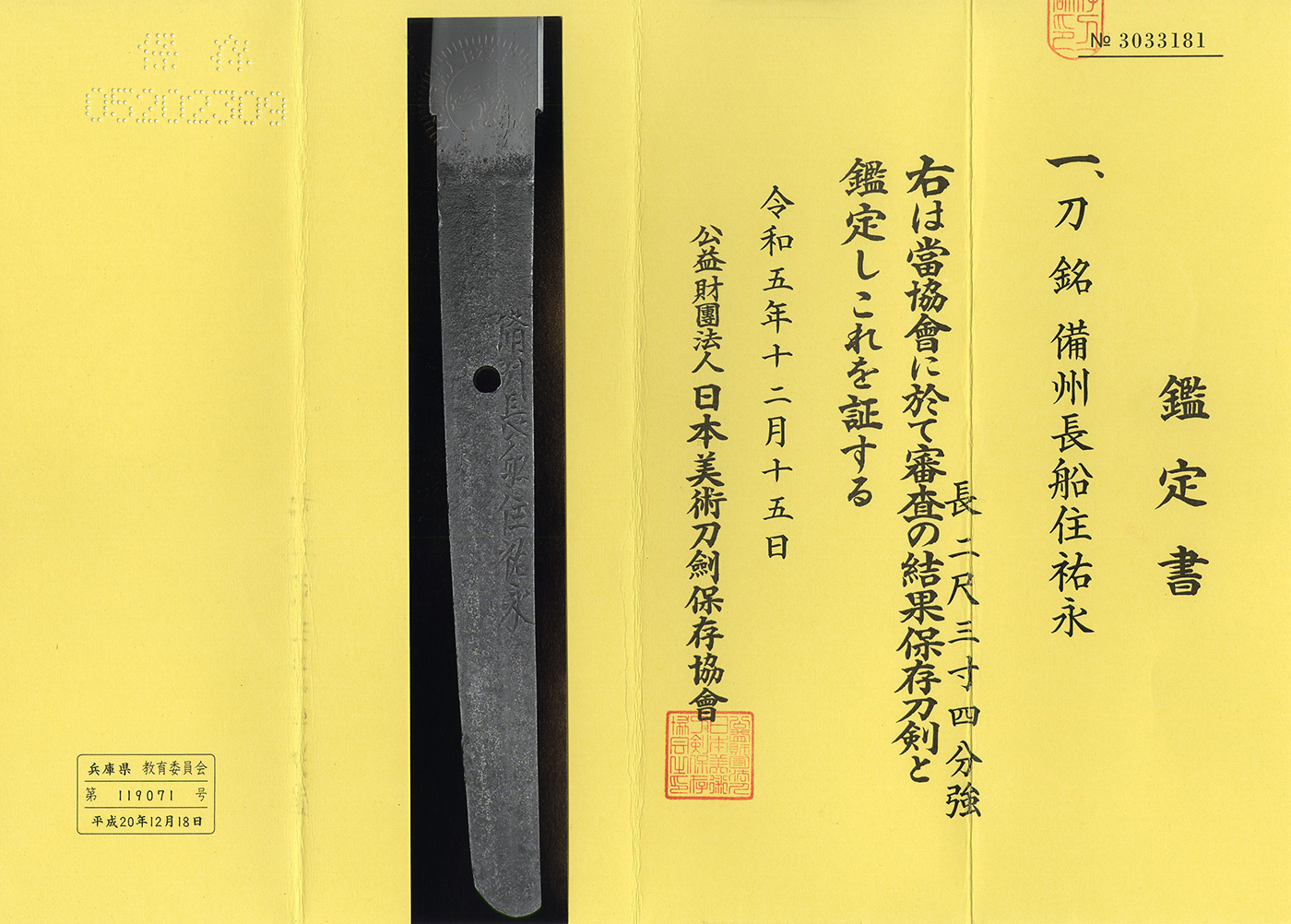
Ordering Number: 25653Katana in Shirasaya with Koshirae (NBTHK Hozon Token)Signature: Bishu Osafune Sukenaga 備州長船祐永(We divide 4 sections for each sword as Saijyo Saku, Jyojyo Saku, Jyo Saku and Regular Saku).This work ranks as Jyo Saku among the works of Bishu Osafune Sukenaga.Habaki: single copper habaki colored in goldBlade Length: 71.0cm (27.95in)Curvature: 1.6cm (0.63in)Mekugi-ana: 1Motohaba: 3.03cm (1.19in)Sakihaba: 2.12cm (0.83in)Kasane: 0.65cm (0.26in)Weight: 795gEra: the late Edo period, circa19th centuryShape: Wide width, slightly thick kasane, slightly shallow curvature, and a long tang.Jigane: paced koitame hada looks plain surfaceHamon: Nioi-deki Gunome and Choji midare with tight nioikuchi and Ashi.Features:Yokoyama Sukenaga was a Bizen swordsmith active in the late Edo period. 1rst generation signed himself as the “56th descendant of Tomonari,” while the second generation inscribed “57th descendant of Tomonari.” Their works feature a well-forged ko-itame hada and a brilliant choji-midare hamon with a tight nioikuchi.Koshirae:Tsuba: Mokko-shaped iron tsuba carved with Landscape Scene with Small BoatsFuchikashira: Silver ground carved with wave designs.Kojiri: Carved with arrowhead designs.Menuki: Dragon design with gold-colored decoration.NBTHK Hozon CertificateAoiArt estimation paper: Whole Oshigata.*Overseas shipping fee is not included in the price.Price:850,000JPYOrder FormRelated Items:Tachi:Bishū Osafune Tomosada (Ko-zori)(48th NBTHK Juyo Token)Tachi : Bishu Osafune Yukihisa (NBTHK Tokubetsu Hozon Token)Daisho: Tsuda Sukehiro and Osafune Yasumitsu(NBTHK TH for each)(Koshirae: NBTHK TH Tosogu)Katana: Mumei (Unsigned)(Osafune Morishige) (NBTHK Tokubetsu Hozon Token)Katana:: Mumei (Ichimonji) (NBTHK Tokubetsu Hozon Token) (Consignment Sale)Katana: Mumei (Iwato Ichimonji) (also known as Shochu Ichimonji)(NBTHK Tokubetsu Hozon Token)
Certificate reading — 銘 備州長船住祐永
NihontoWatchOffered by Aoi Art
This piece has sold
Get an email when a new Yokoyama Sukenaga piece hits the market.





Bizen-den · Bizen · around 1830-1844
Fujishiro Jo saku · Tōken Taikan top 63%
6 pieces on the market now
Bizen-den · Bizen
24 pieces on the market now
| Smith | Era | Designated |
|---|---|---|
| Sukenobu祐信 | 1830-1844 | 0 |
| Suketaka祐高 | 1865-1868 | 0 |
| Sukeharu祐春 | 1864-1865 | 0 |
| Sukehiro祐廣 | 1854-1860 | 0 |
| Sukekane祐包 | 1868-1912 | 0 |
The Edo period (1615 to 1868)
Edo was the sword’s age of connoisseurship: the Hon’ami appraisers, the shogunal register of famous blades of 1719, and a thriving literature turned the sword into an object of study even as it ceased to be drawn in war.
Certifies a genuine blade worth preserving: a signature confirmed correct, or, if unsigned, an era, province, and school that the NBTHK can reliably identify.
The NBTHK (Nihon Bijutsu Tōken Hozon Kyōkai, the Society for the Preservation of Japanese Art Swords) is a public-interest incorporated foundation founded in 1948 and supervised by Japan’s Agency for Cultural Affairs (Bunkachō); it is based at the Japanese Sword Museum in Tokyo. Its expert panels physically examine each submitted work (shinsa) and issue a certificate (kanteishō) ranking it by artistic and historical merit. NBTHK papers are the most widely recognized standard of authentication for Japanese swords and fittings.
NBTHK official siteIf you wish to return an item, please notify us within 3 days of receipt. After this period we cannot accept cancellations. Please ship the return to us within 5 business days. Cancellation is conditional on the item being kept in the same condition as at the time of sale, so please handle it with care.