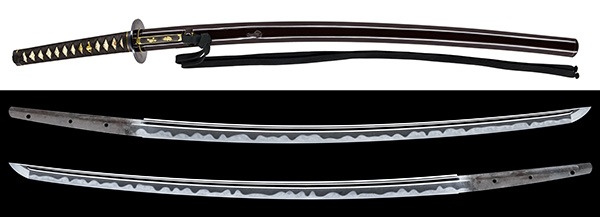
Sixty years of war between two courts drove blades long and broad, and Osafune met the demand: Kanemitsu and Chōgi led forges serving the provincial warriors who did the fighting, while Sōshū influence arrived with the armies to create Sōden-Bizen.
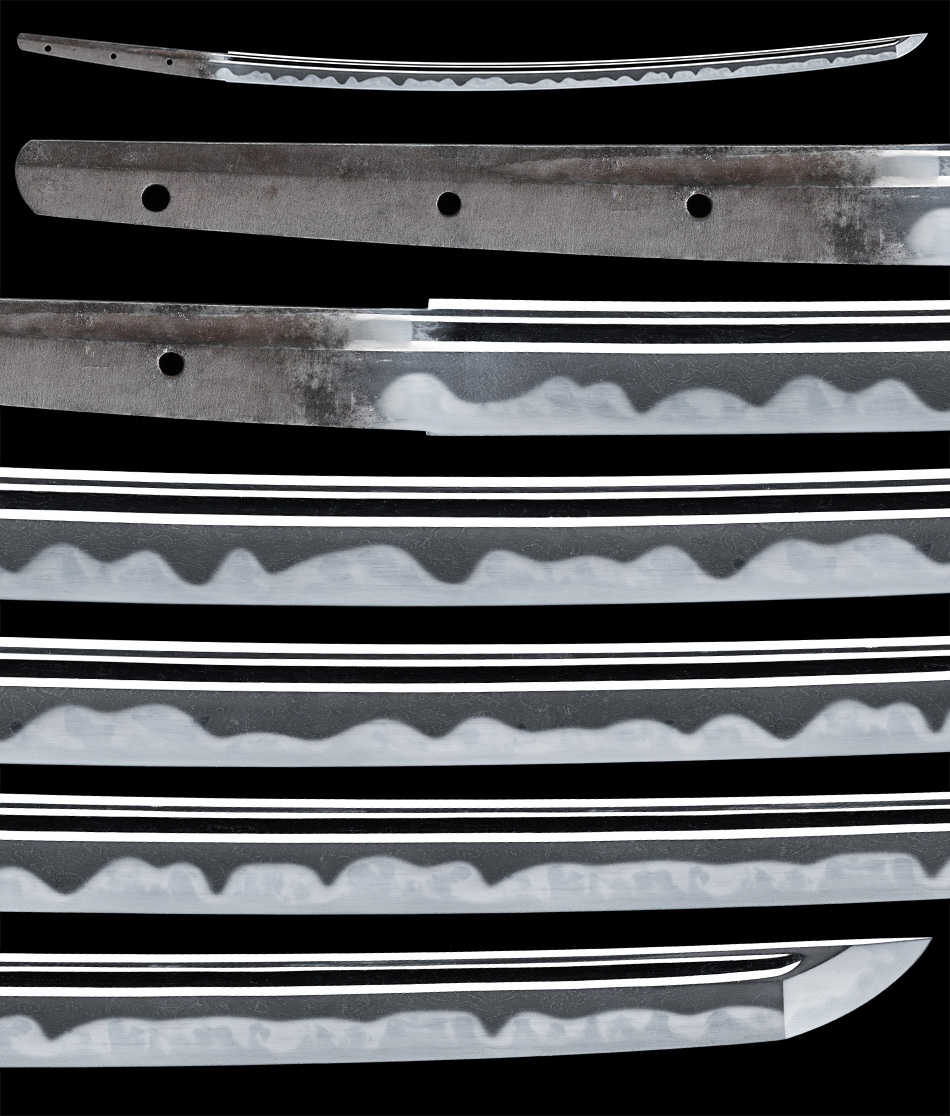
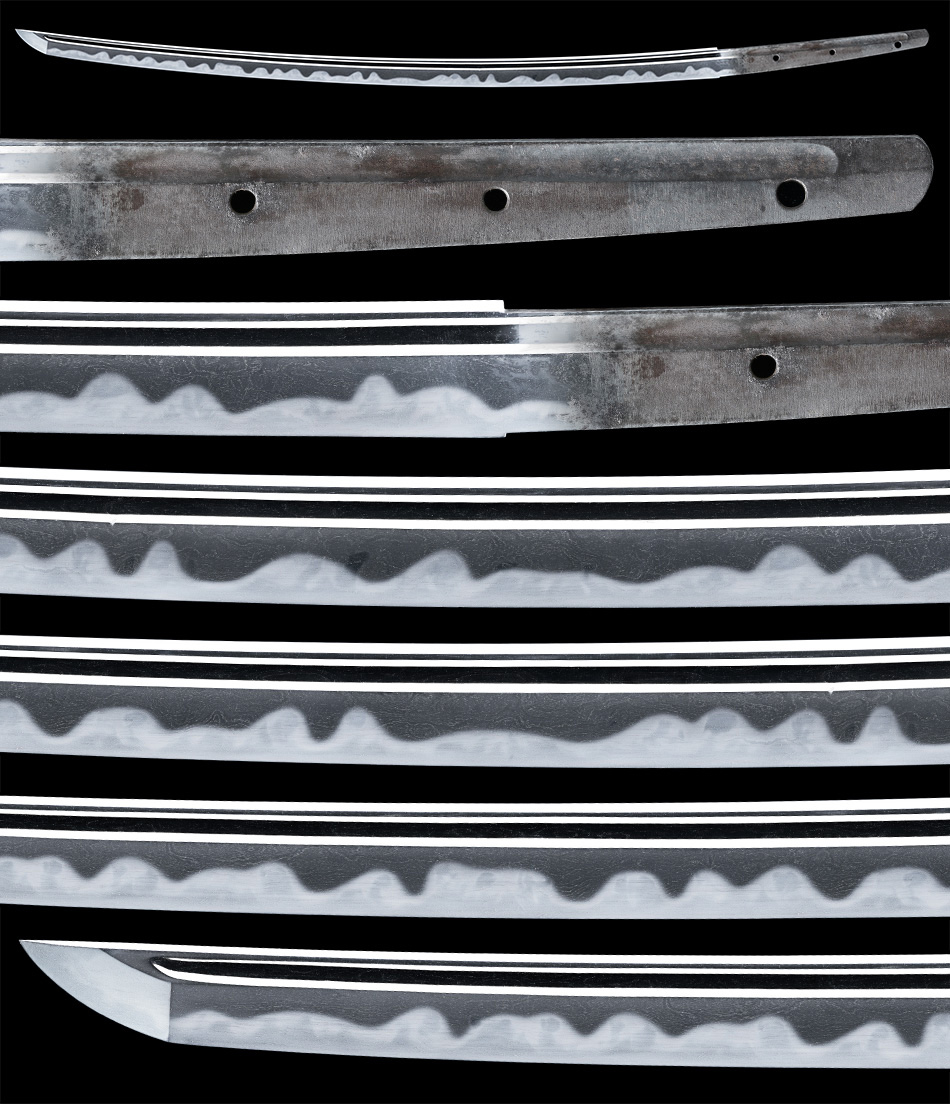
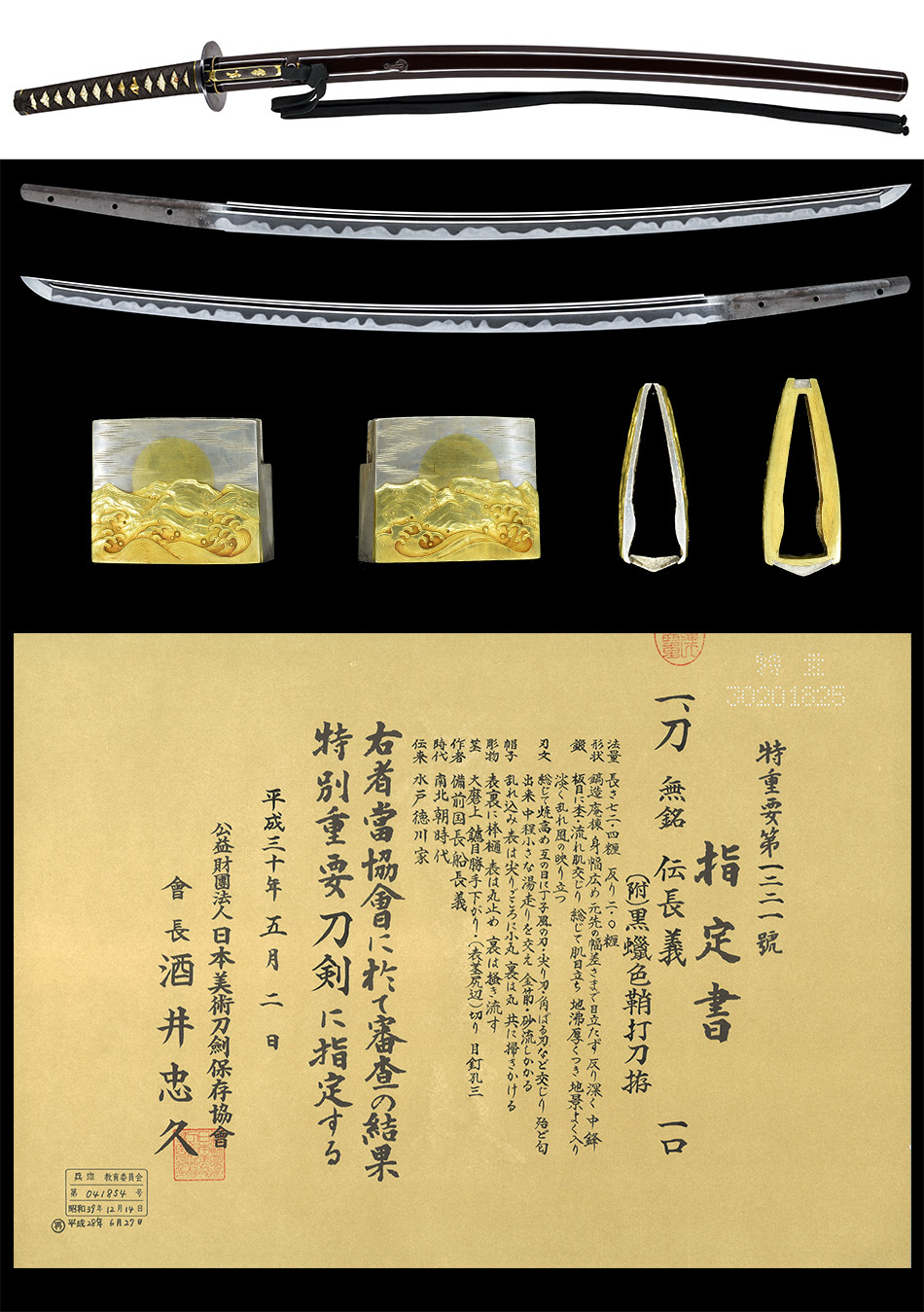
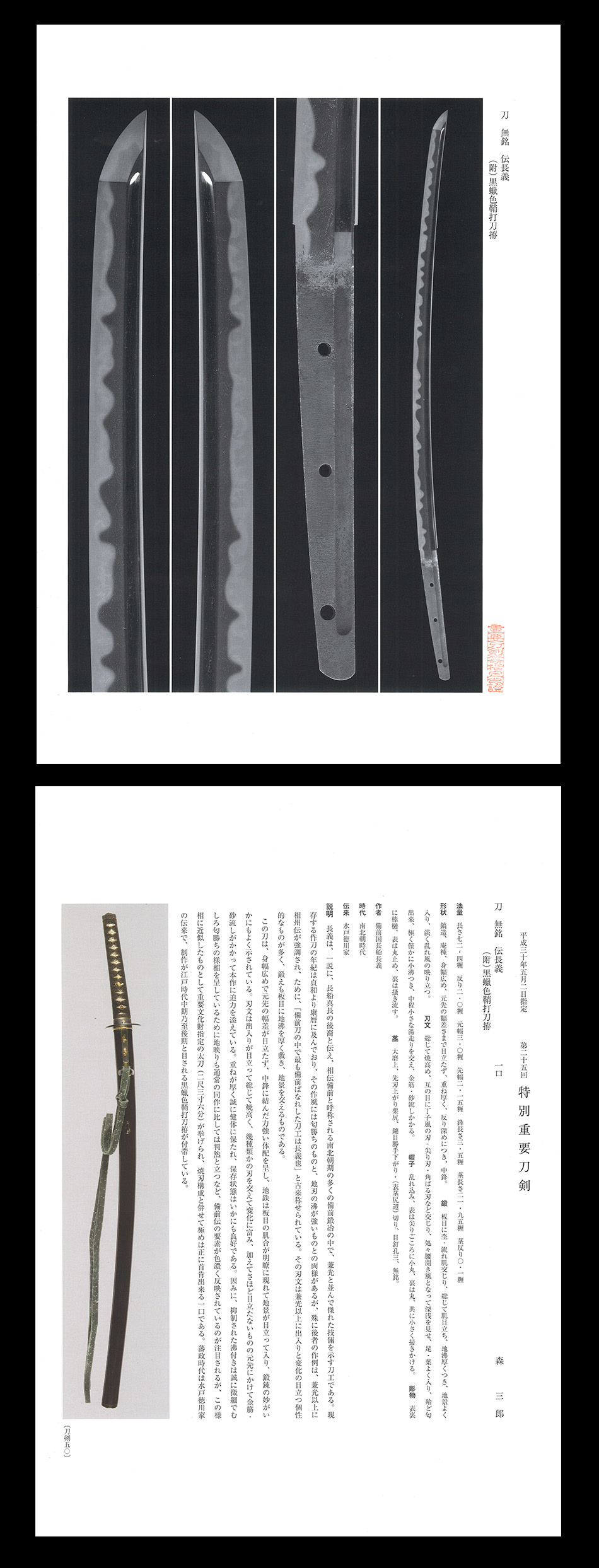
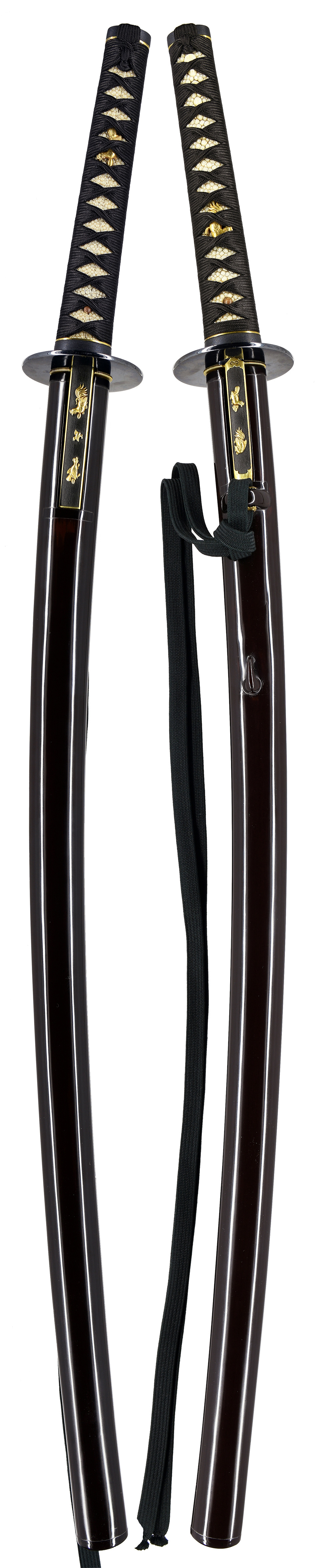
【重要刀剣図譜より】 法量 長さ七二・四糎 反り二・〇糎 元幅三・○糎 先幅二・一五糎 鋒長さ三・五糎 茎長さ二一九五糎 茎反り〇・一糎 形状 鎬造、庵棟、身幅広め、元先の幅差さまで目立たず、重ね厚く、反り深めにつき、中鋒。 地肌 板目杢・流れ肌交り、総じて肌目立ち、地沸厚くつき、地景よく入り、淡く乱れ風の映り立つ。 刃文 総じて焼高め、互の目に丁子風の刃・尖り刃・角ばる刃など交り、処々腰開き風となって深浅を店・業よく入り、殆ど匂出来、極く僅かに小沸つき、中程小さな湯走りを交え、金筋・砂流しかかる。 帽子 乱れこみ、表はとがりごころに小丸、裏は丸、共に小さく掃きかける。 彫物 表裏に棒樋、表は丸止め、裏は掻き流す。 茎 大磨上、先刃上がり栗尻、鑢目勝手下がり・(表茎尻辺)切り、目釘孔三、無銘、 [説明]長義は、一説に、長船真長の後裔と伝え、相伝備前と呼称される南北朝の多くの備前鍛冶の中で、兼光と並んで傑れた技倆を示す刀工である。現存する作刀の年紀は貞和より康暦に及んでおり、その作風には匂勝ちのものと、地刃の沸が強いものとの両様があるが、殊に後者の作例は、兼光以上に相州伝が強調され、ために、「備前刀の中でも最も備前離れした刀工は長義也」と古来称せられている。その刃文は兼光以上に出入りと変化の目立つ個性的なものが多く、鍛えも板目に地沸を厚く敷き、地景を交えるものである。この刀は、身幅広めで元先の肌差が目立たず、中棟に結んだ力強い体配を呈し、地鉄は板目の肌合が明瞭に現れて地景が目立って入り、鍛錬の妙がいかにもよく示されている。刃文は出入りが目立って総じて焼高く、幾種類かの刃を交えて変化に富み、加えてさほど目立たないものの元先にかけて金筋・砂流しがかかって本作に迫力を添えている。重ねが厚く誠に健体に保たれ、保存状態はいかにも良好である。因みに、 抑制された沸付きは誠に微細でむしろ匂勝ちの様相を呈しているために地映りも通常の堂作に比しては判然と立つなど、備前伝の要素が色濃く反映されているのが注目されるが、この様相に近似したものとして重要文化財指定の太刀(二尺三寸六分)が挙げられ、焼刃構成と併せて極めは正に首肯出来る一口である。藩政時代は水戸徳川家の伝来で、制作が江戸時代中期乃至後期と目される黒蝋色鞘打刀拵が付帯している。
Offered by World Seiyudo
This piece has sold
Get an email when a new Chogi piece hits the market.


(Translation unavailable)
Chogi (Soden-Bizen) · Bizen · around 1356-1379
Fujishiro Sai-jo saku
1 piece on the market now
Chogi (長義) was the leading Bizen smith of the Nanbokucho age, a master whom the published sources name in the same breath as Kanemitsu as one who, together with Kanemitsu, displayed outstanding skill among the many Bizen smiths of the period grouped under the appellation Soden-Bizen. One tradition transmits him as a descendant of the Osafune mainline smith Sanenaga, and the dated blades that survive run from the Jowa years through Koryaku, so his career sits squarely in the high Nanbokucho decades of Enbun and Joji. Whether the latest dated work is his own the sources leave open: one paper records that "by one account the Kōryaku works are the second generation"[[c:1]], and an unsigned katana judged a Kōryaku second Chōgi is described as "somewhat different in manner from the first"[[c:2]], but no division of his blades has been settled, and the record is kept here as one. The sources draw a clear line between two faces of his work, one in which nioi prevails and one in which the nie of the jigane and hamon runs strong, and it is the second of these that earned him the phrase repeated again and again across his papers, that of all Bizen smiths Chogi is the one whose work departs furthest from Bizen.
The first thing to look for is not a borrowed resemblance but his own typical hand. Over a base of notare he tempers a bold, varied midare in which gunome, choji, angular ha and pointed togari elements crowd together, and at intervals two gunome lean head to head into an ear shape, the mimigata that the sources single out as the form to watch for in his work. On the Shotoku wakizashi the judges write that the notare-toned hamon mixing ear-shaped ha is this smith's typical work, and on a signed tanto they describe the notare ha whose head splits in two into the ear-shaped ha. This is the surest Chogi tell, more reliable than any single famous comparison, because it recurs across signed and attributed blades alike and belongs to no other hand in quite this form.
Within the temper the activity is profuse and Soshu in feeling. Ashi and yo enter freely, the nie gathers thick and at times clustered, kinsuji and sunagashi run through the ha, and tobiyaki and yubashiri drift above it, so that the nioiguchi is now bright, now slightly subdued. The judges note that in his nie-strong work the Soshu manner is emphasized even more than in Kanemitsu, which is precisely why the old saying about the most un-Bizen of Bizen smiths attaches to him. Yet the hamon never loses its Bizen footing, and the choji and mountain-shaped clusters keep the reading anchored in the province.
The jigane answers the temper. The itame stands, often a touch hada-tatsu, carries thick ji-nie and abundant well-entering chikei, and beneath the Soshu fire a midare-utsuri rises, faint on some blades and vivid on others. It is this doubling, Soshu nie worked into a jigane that still throws a Bizen utsuri, that lets a Chogi be read at sight, and the sources say plainly that his forging lays thick ji-nie over itame and mixes in chikei. The boshi follows the disorder of the ha. It runs midare-komi, often turning pointed in togari, with hakikake sweeping the tip and at times a thrusting-up tsukiage before a short ko-maru turn-back, a strong and restless point that the judges repeatedly single out for its force.
The shape is the grand Nanbokucho figure, broad in the mihaba with little taper from base to tip, shallow in the sori and extended into an o-kissaki, imposing and o-buri. Most of his surviving blades are osuriage-mumei o-dachi later shortened, their bearing still vividly of the Enbun and Joji peak, and among the signed work are fine nie-rich tanto and a dated tanto of Oan. The most celebrated piece is the Yamanbagiri Chogi, an Important Cultural Property and the very blade that Horikawa Kunihiro famously copied, though that history comes from outside the published sources rather than from the catalog records themselves.
For the collector Chogi is, by the measure of a name this great, comparatively within reach. Fujishiro grades him Sai-jo saku, and he holds no National Treasure, but five of his blades are Important Cultural Properties and a strong body of his work carries Tokubetsu Juyo and Juyo papers, with thirty-two at the Tokubetsu Juyo tier. The provenance is illustrious: blades descend through the Mito Tokugawa and Kishu Tokugawa houses, one passed through the Hori family of the Iida domain in Shinano and the collection of Ito Miyoji. Held across public institutions and long-private hands, a Chogi surfaces only occasionally, and is a major acquisition whenever it does.
Where Chogi stands among comparable artisans: across all of nihontō, and within tradition, era, and period. The tiers (Foremost · Leading · Major · Notable) weigh official designations from the NBTHK and Japan's Agency for Cultural Affairs, together with historical honors of lasting repute such as the Sansaku and Meibutsu-chō.
Select a lens to see how it's measured.
Years he was demonstrably active, proven by signed-and-dated blades
Bizen-den
Phase: Sōden-Bizen相伝備前· 1330–1394
7 pieces on the market now
The Soden Bizen school encompasses the group of Nanbokucho-period Osafune smiths in Bizen Province whose work absorbed the technical influence of the Soshu-den, producing a distinctive synthesis that stands apart from both orthodox Bizen and pure Sagami practice. The school divides into two principal lineages: the Kanemitsu group, representing the direct main line of Osafune that descends from Mitsutada through Nagamitsu and Kagemitsu; and the Chogi group, a collateral branch whose members carried the Soshu idiom to its most expressive extremes within Bizen. Kanemitsu, the chakuryu heir of Kagemitsu, pioneered the broad, relaxed notare-based midare that defines the mature Nanbokucho Osafune manner, while Chogi -- described by the NBTHK as the smith "who departs furthest from Bizen" among Bizen makers -- pushed nie-dominant forging to a level that rivals the output of the great Sagami smiths themselves. Together with disciples and contemporaries including Tomomitsu, Motomitsu, Masamitsu, Yoshimitsu, Kanenaga, Nagashige, and Nagamori, they constitute one of the most prolific and technically accomplished groups in the history of Japanese swordsmithing. The school's collective technical identity is anchored in a shared jigane of itame-hada mixed with mokume, with fine ji-nie adhering thickly, chikei entering well, and midare-utsuri standing out -- a persistent Bizen hallmark that survives even in the most Soshu-inflected work. The sugata overwhelmingly reflects the grand Nanbokucho taihai: wide mihaba with little taper between base and tip, and an extended chu-kissaki or o-kissaki conveying martial vigor. Within this shared framework, two distinct temperaments emerge.
" Yoshimitsu likewise inherits the small-pattern tendency, producing ko-gunome mixed with ko-choji whose restraint the NBTHK praises as "upper rank" Soden Bizen. The Chogi lineage, by contrast, emphasizes powerful nie in both ji and ha: Chogi's flamboyant large-scale midare weaves together gunome, choji, togariba, and koshi-hiraki forms with tobiyaki and yubashiri scattering freely, while kinsuji and sunagashi streak through the hardened edge. " Nagashige, now thought to be Chogi's elder brother rather than his junior, works a gentler, smaller-patterned midare yet with nie so strong as to "even surpass Chogi," while Nagamori occupies an intermediate position, his "somewhat smaller patterning" accompanied by rich internal activity. The historical significance of the Soden Bizen school lies in its demonstration that the Soshu influence, far from merely displacing Bizen conventions, catalyzed an extraordinary expansion of the Osafune repertoire. " The NBTHK's evaluative language across the school converges on consistent themes: the forging is "meticulous" and "excellent-quality," the nioiguchi "bright and clear," and the finest examples display a kenzen condition that attests to the soundness of Bizen steel at its peak. The abundance of dated inscriptions -- from Kanemitsu's forty-five-year span through Masamitsu's four-decade career extending into the early Muromachi period -- provides an unusually well-documented chronological framework, with later works by Masamitsu and Yoshimitsu pointing toward the subsequent development of Oei Bizen. Within the broader canon, the Soden Bizen school stands as the fullest realization of the creative possibilities that emerged when two of Japan's greatest forging traditions met and merged. Learn more →
| Smith | Era | Designated |
|---|---|---|
| Chogi長義 | 1356-1379 | 109 |
| Kanenaga兼長 | 1362-1388 | 95 |
| Nagashige長重 | 1334-1342 | 16 |
| Yoshikage義景 | 1334-1363 | 67 |
| Nagashige長重 | 1356-1361 | 0 |
Bizen in the Nanbokuchō period
Sixty years of war between two courts drove blades long and broad, and Osafune met the demand: Kanemitsu and Chōgi led forges serving the provincial warriors who did the fighting, while Sōshū influence arrived with the armies to create Sōden-Bizen.
No cooling-off period or returns; refund only if the purchased sword is proven fake, capped at purchase price (excludes commission sales, accessories, auction items).