NihontoWatch Mon

NihontoWatch

MarketAuctions
Encyclopedia
NihontoWatch Mon

NihontoWatch

MarketAuctions
Encyclopedia

Description

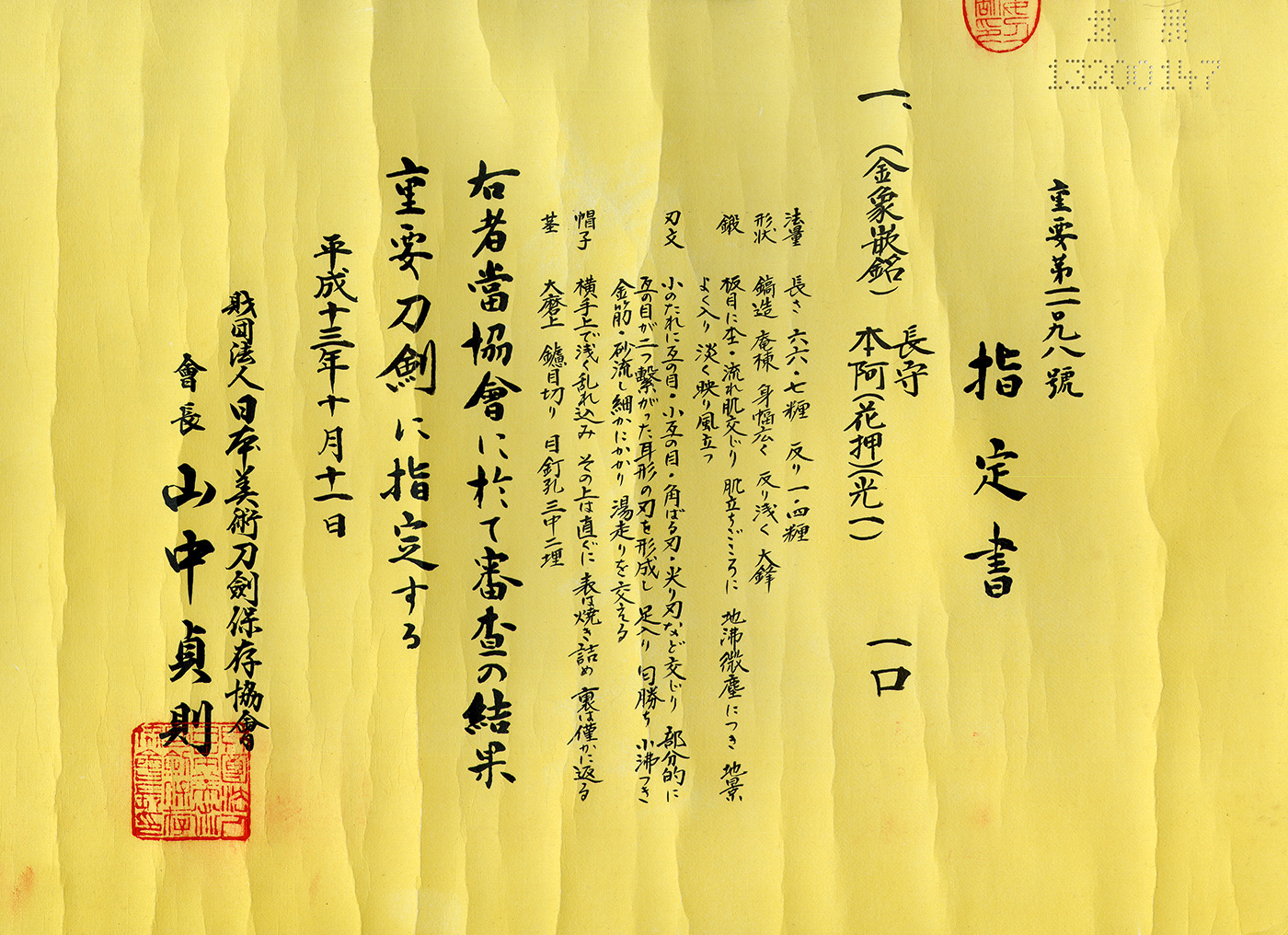
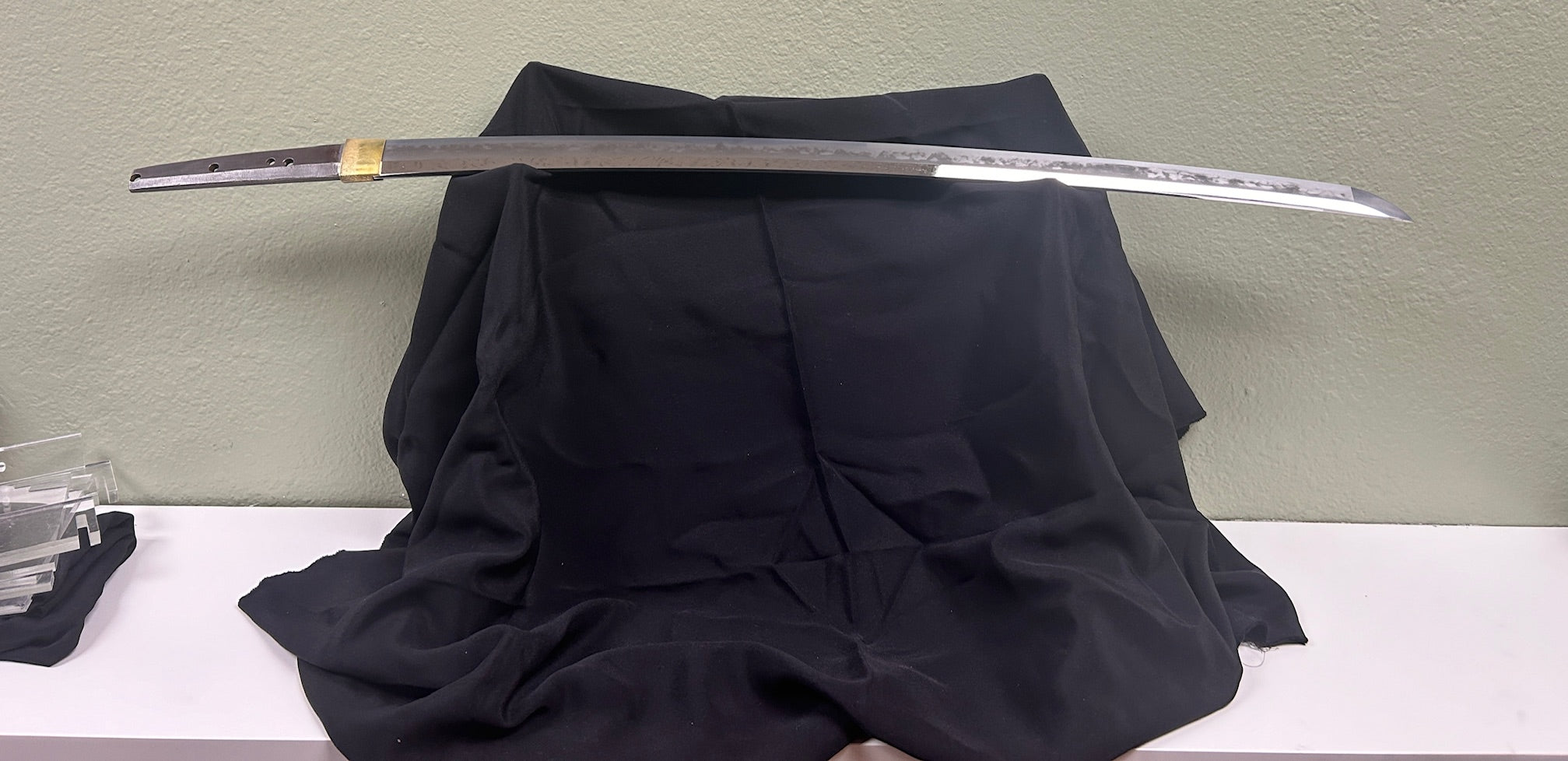
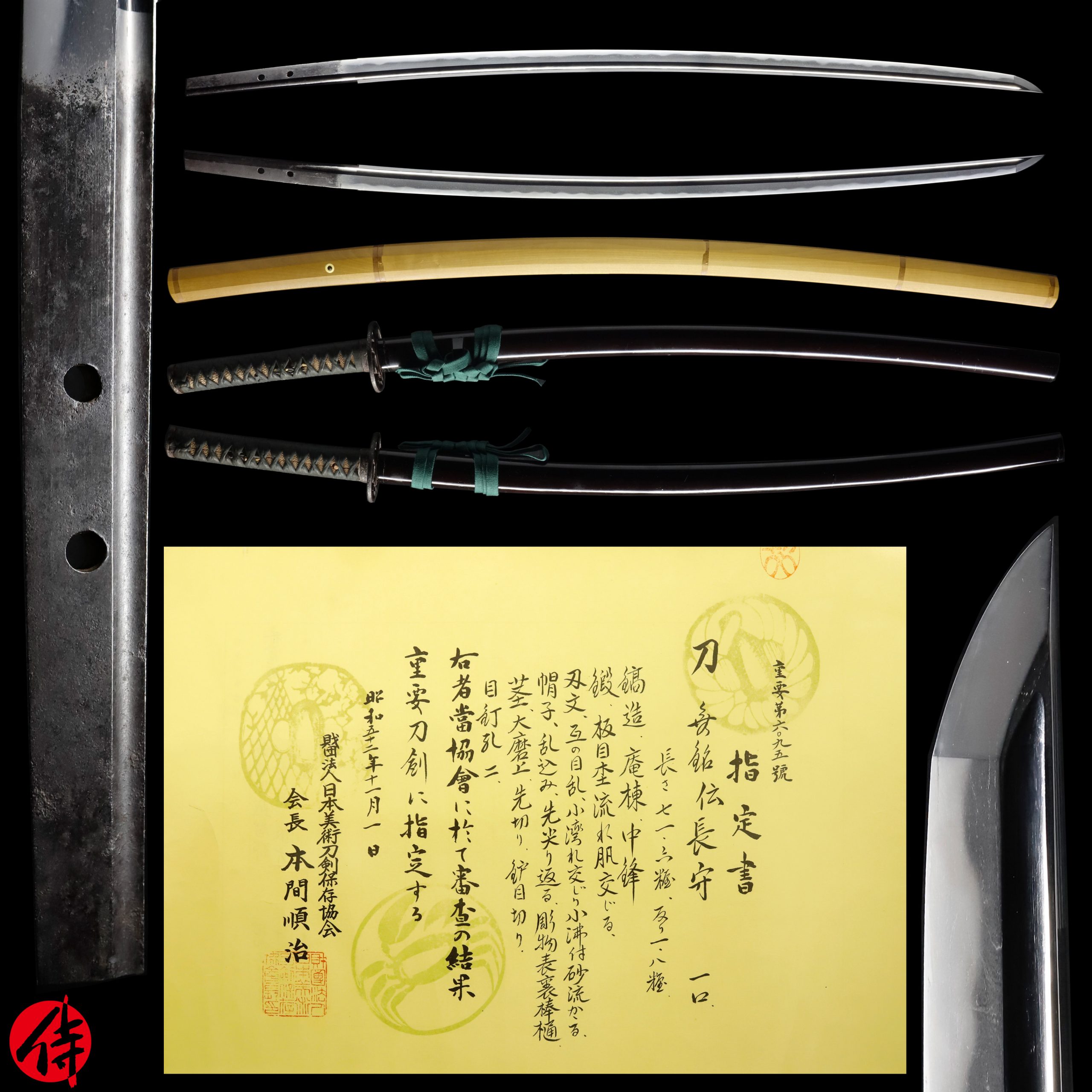
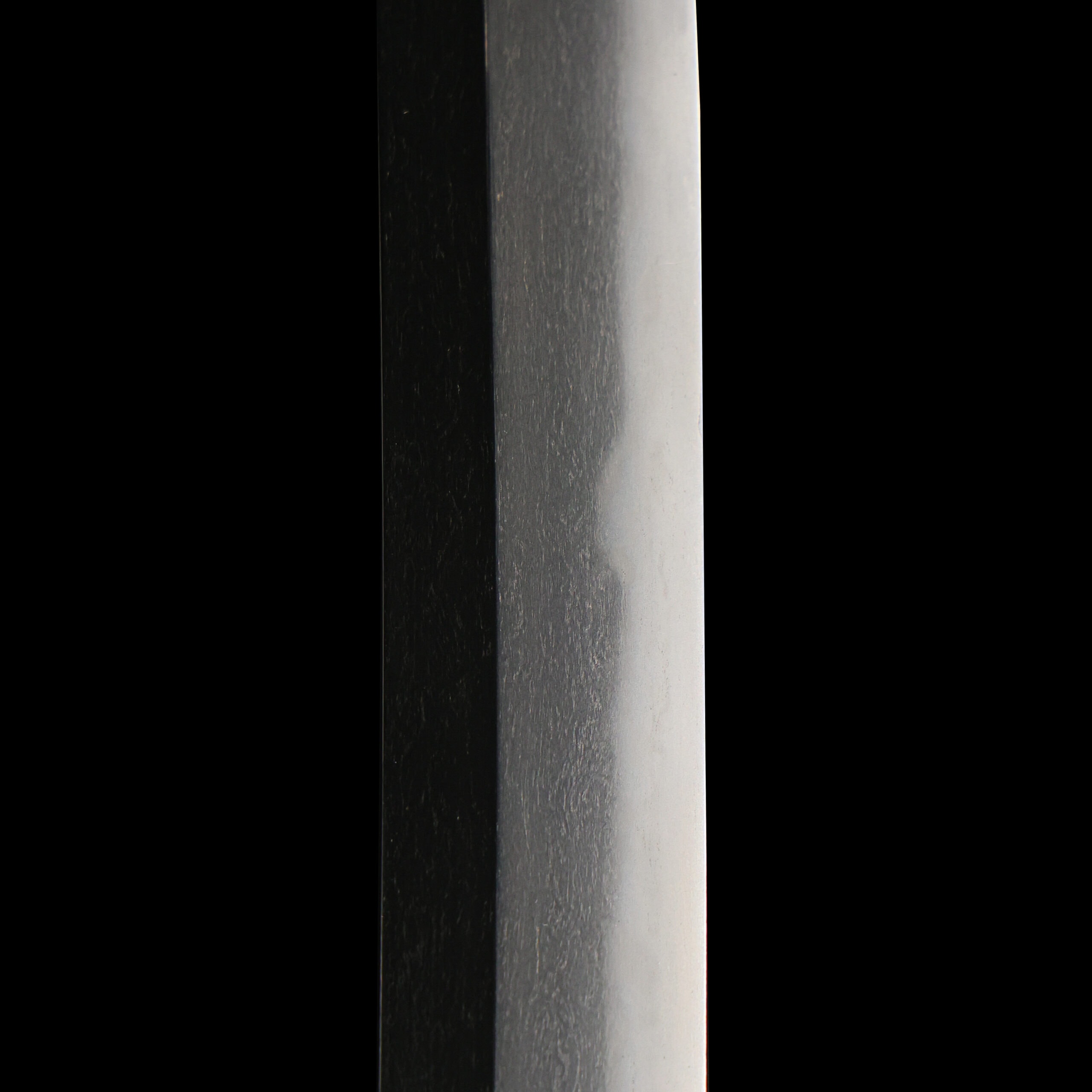
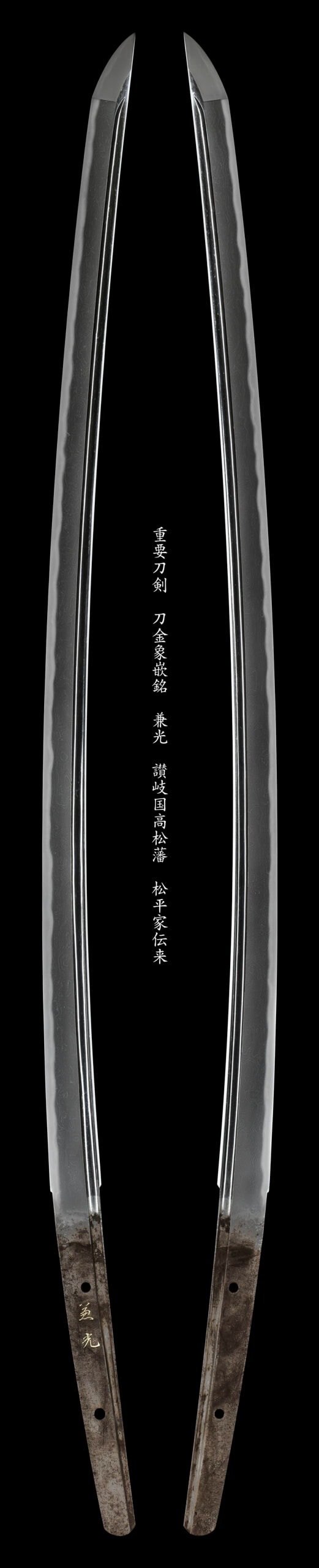
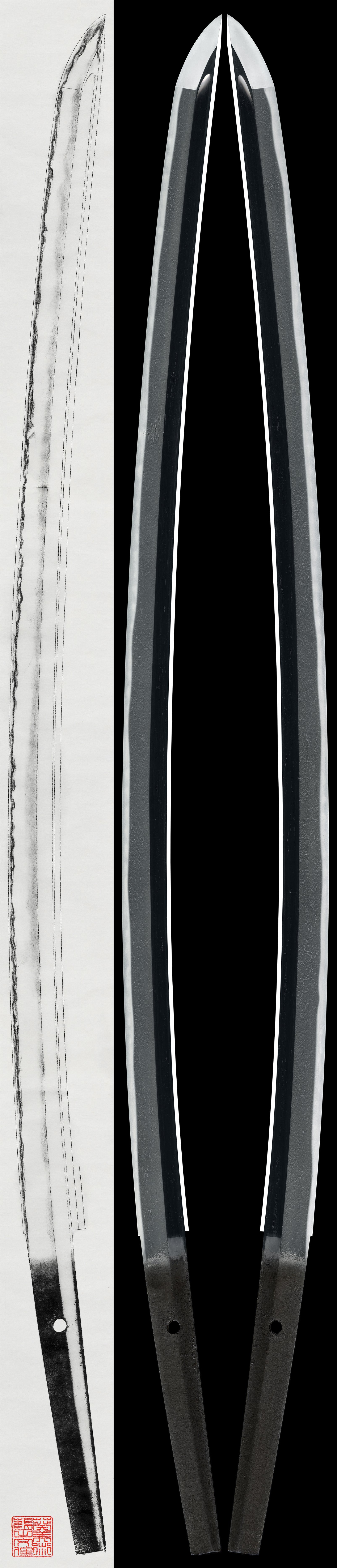
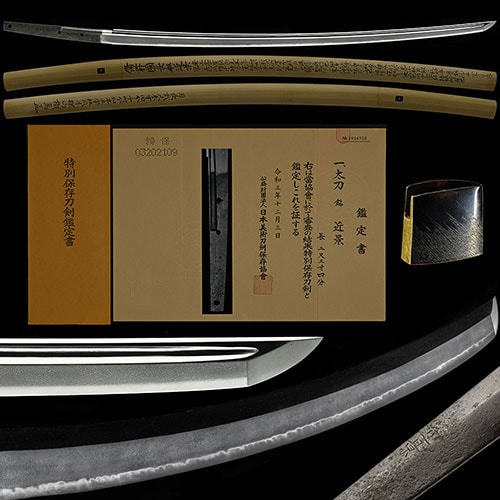
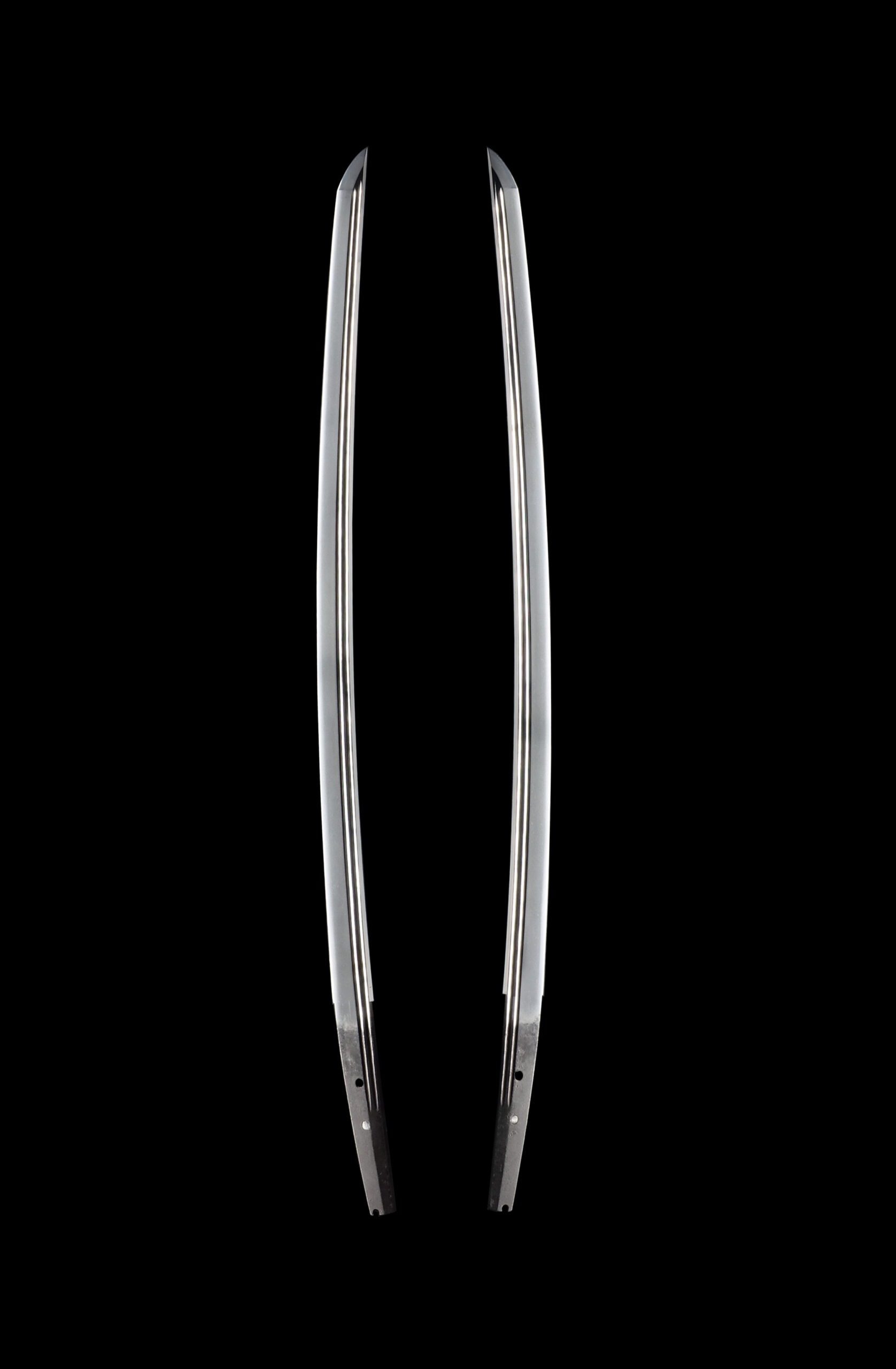
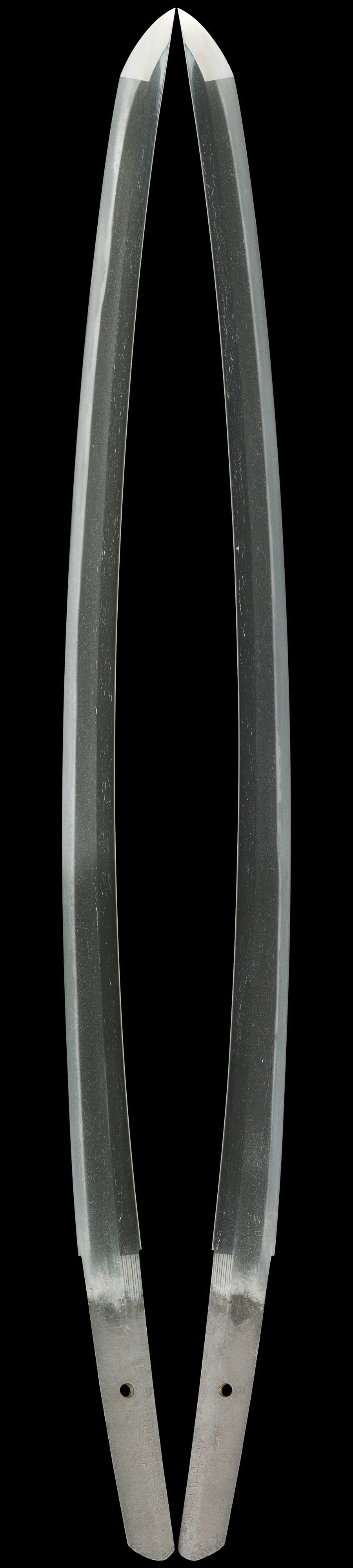
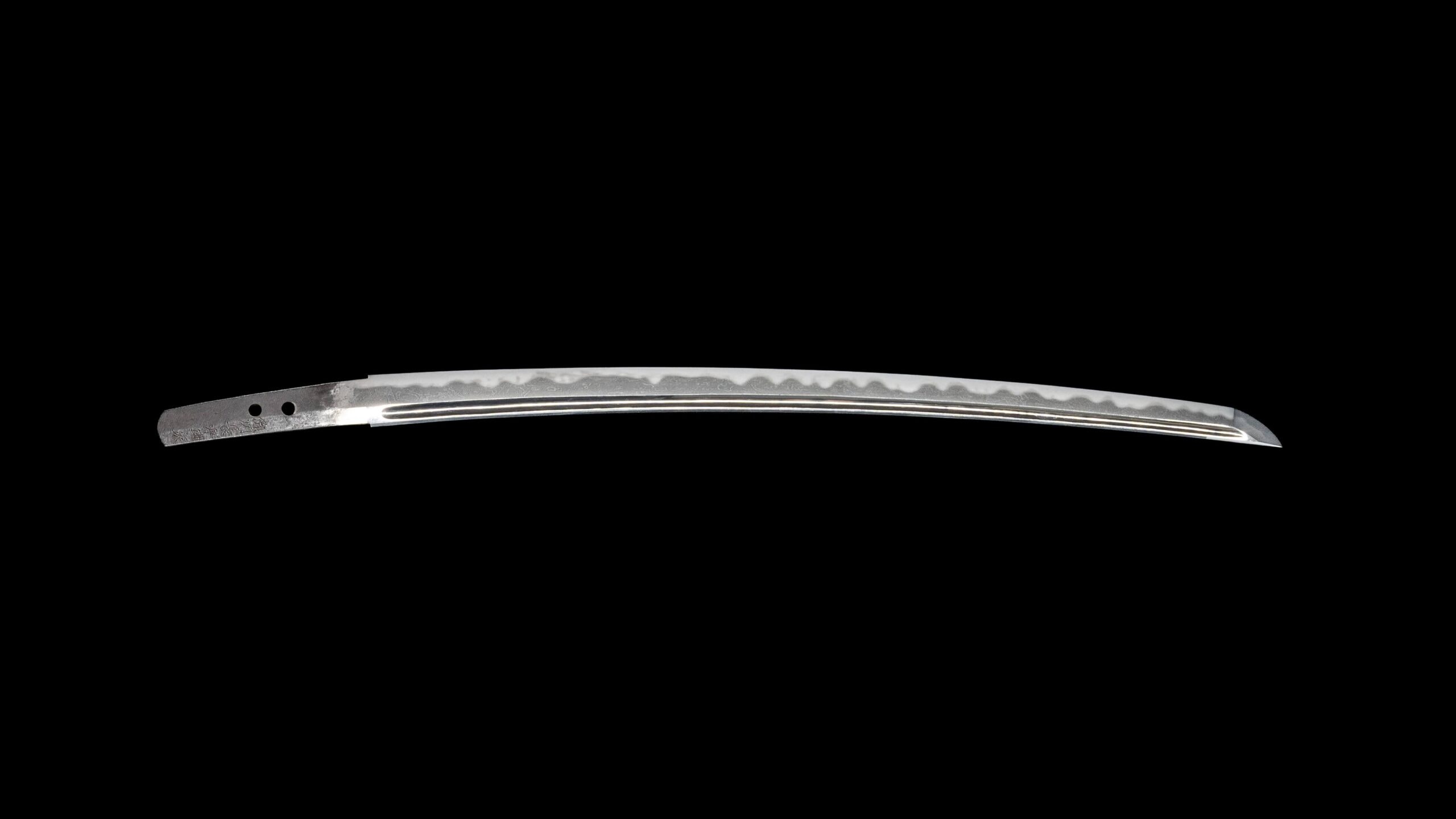
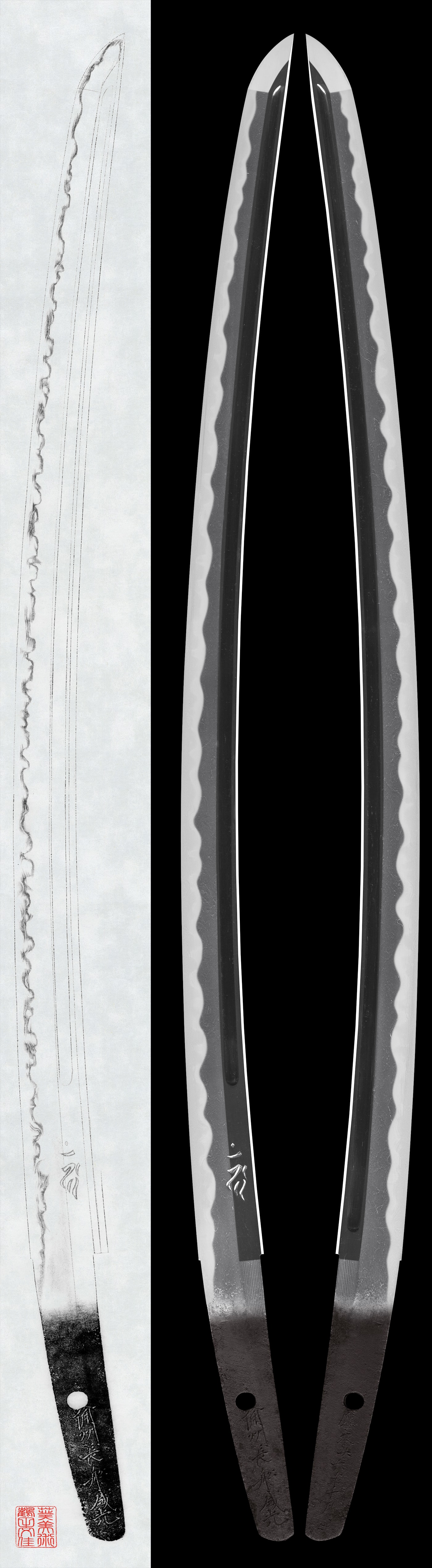
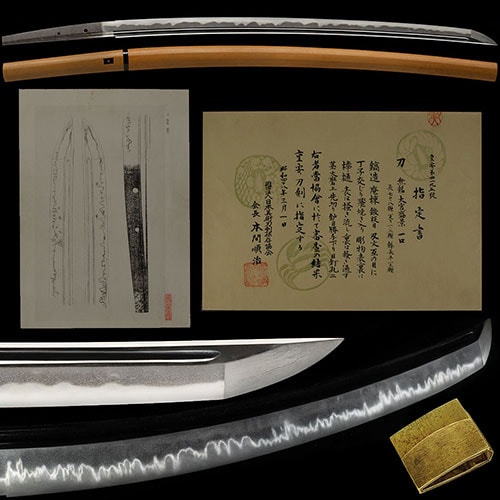
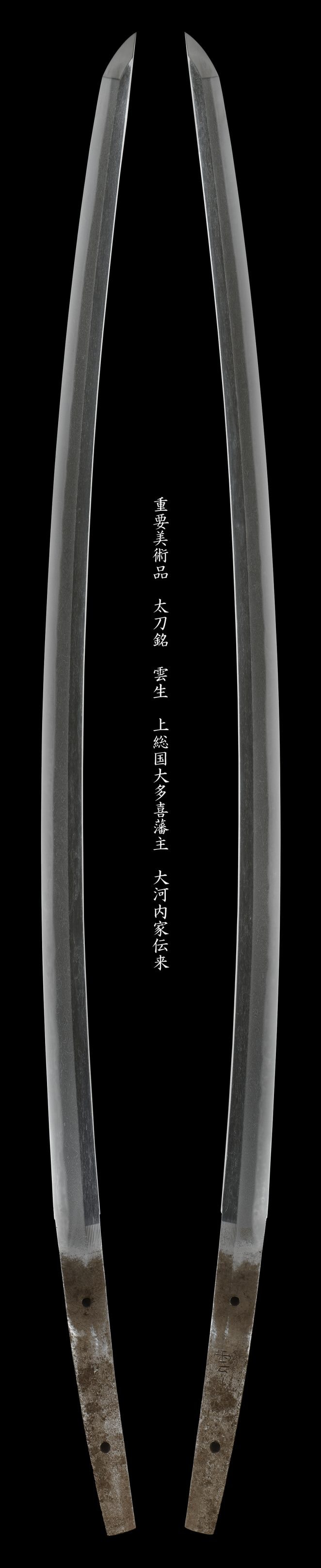
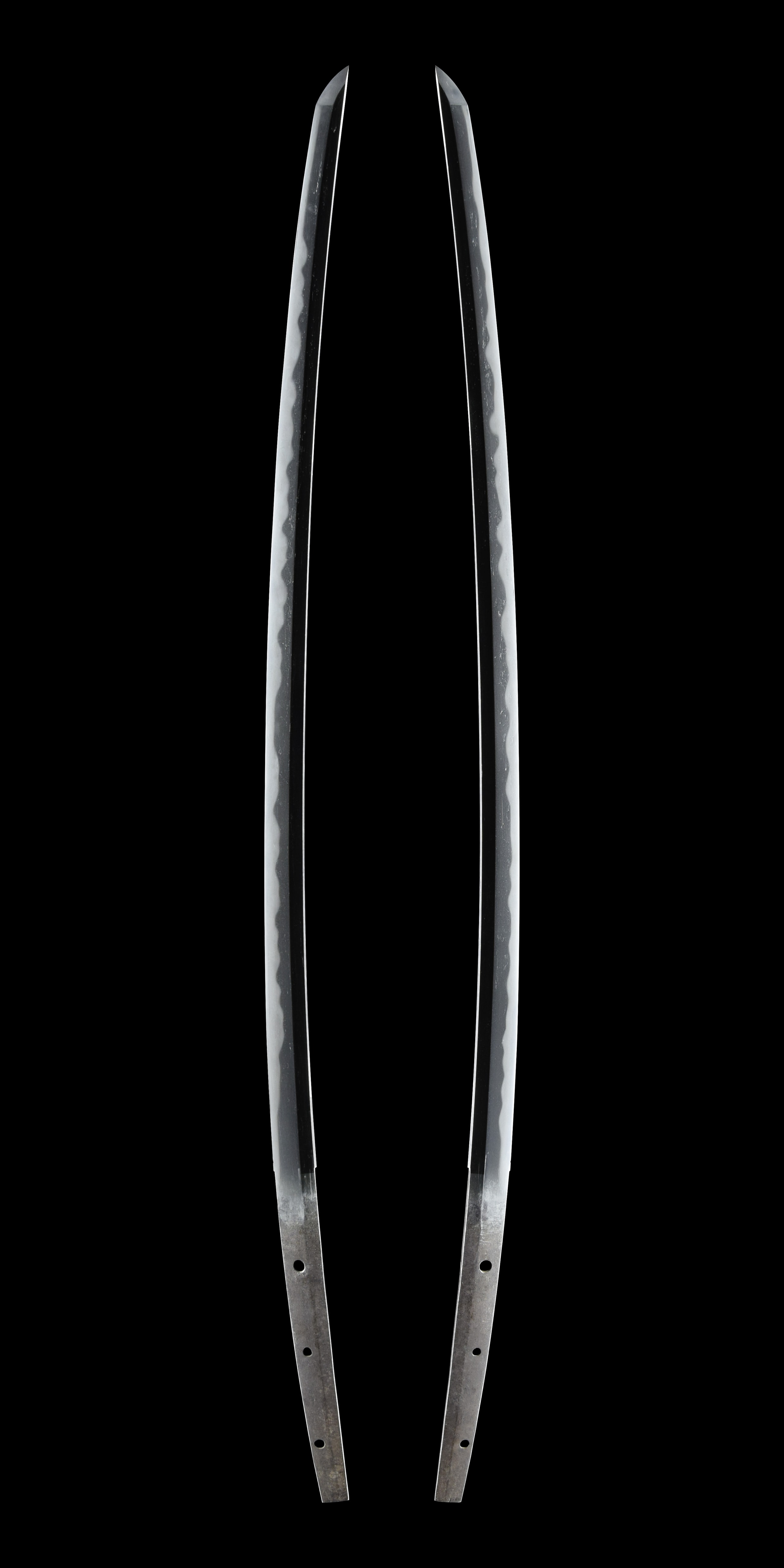
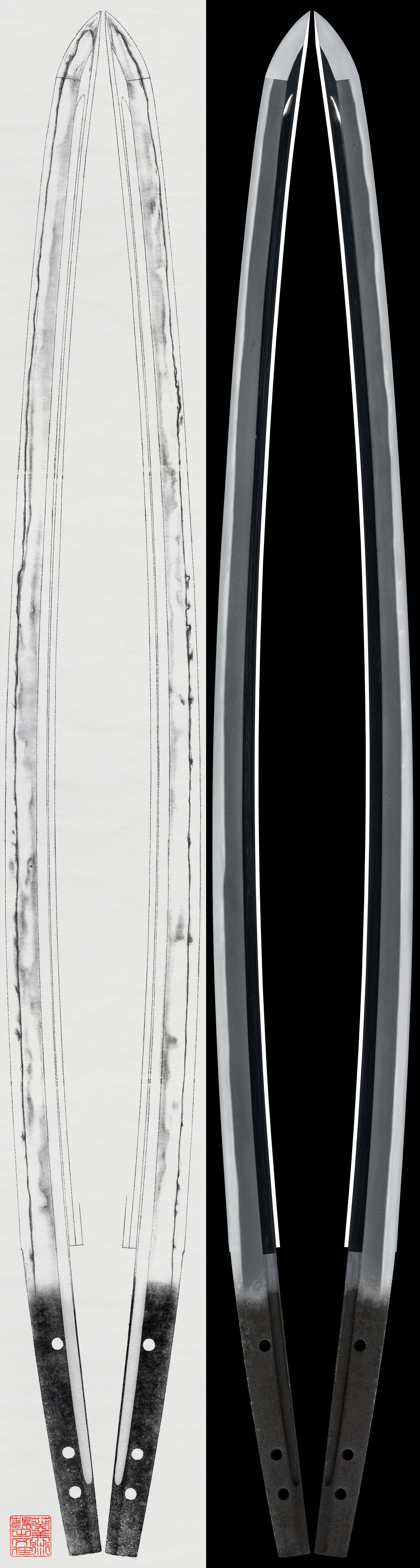
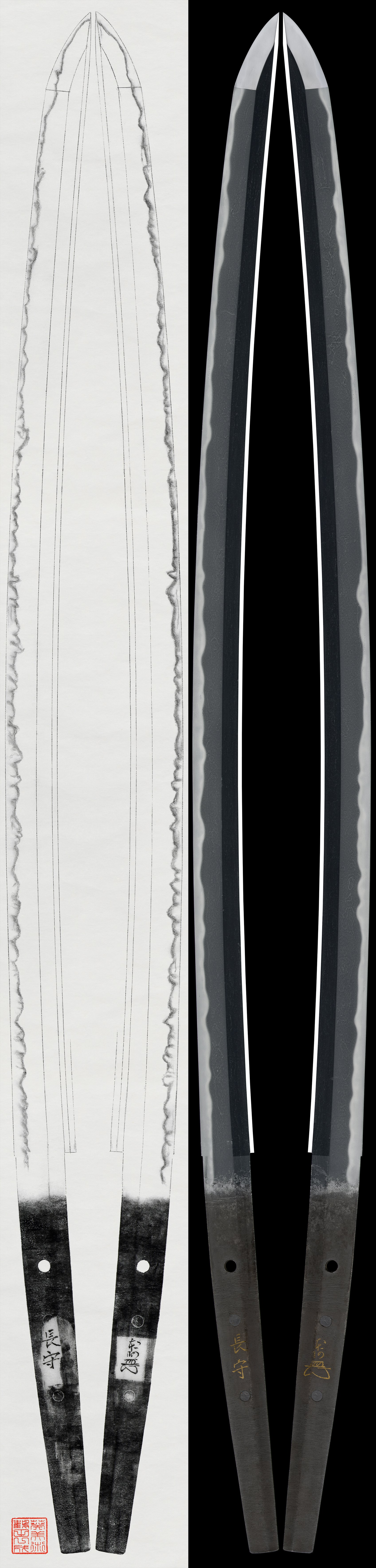
This is a katana signed Nagamori, with gold inlay, certified as 47th NBTHK Juyo Token. Nagamori was said to be a disciple of Osafune Chogi, but they were from the same period. The blade features an irregularly varied midare Hamon with ashi, sunagashi, and kinsuji.

NBTHK Setsumei

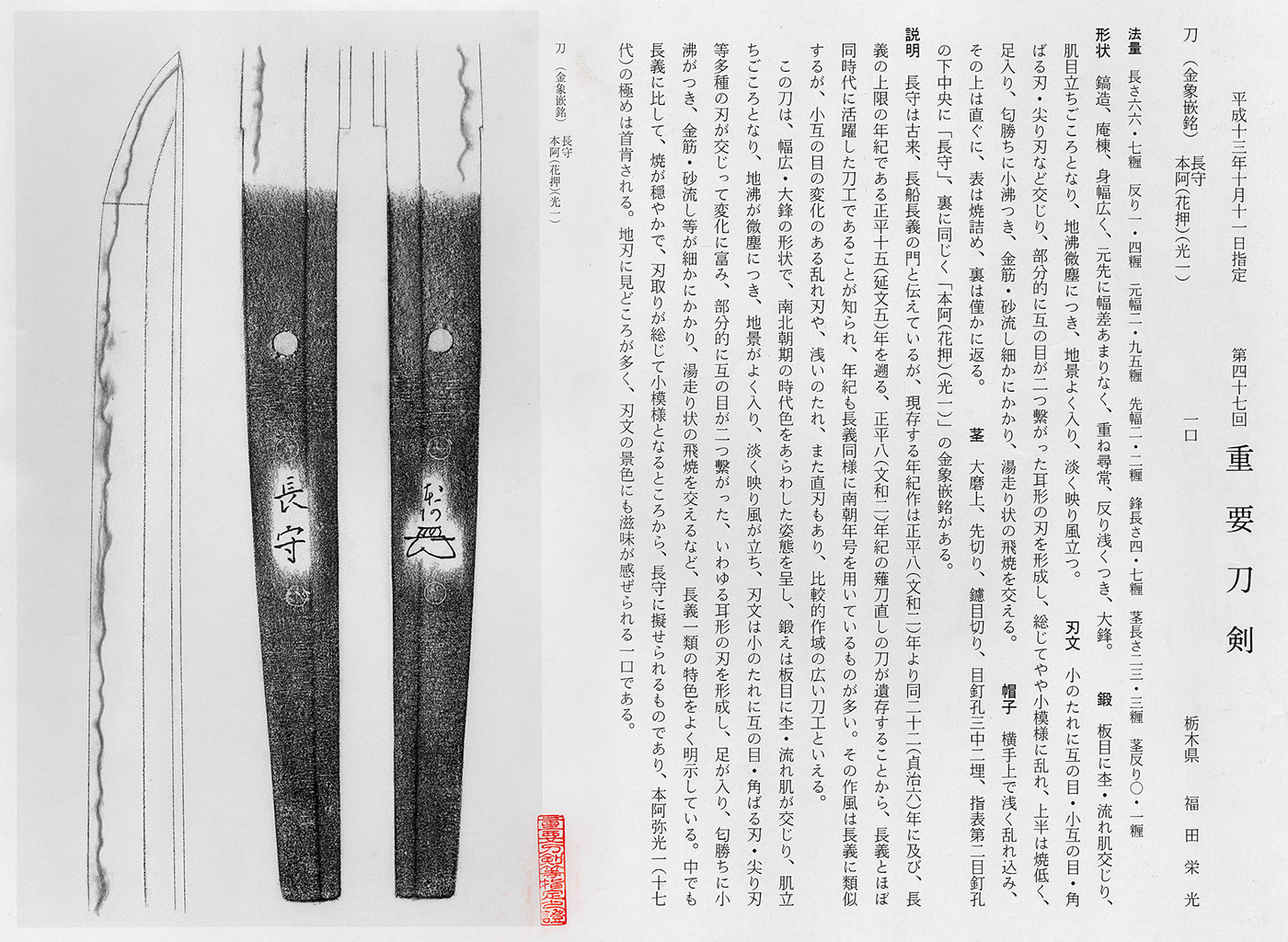
Jūyō-Tōken, 47th Session — Designated October 11, 2001 Katana, kinzogan-mei: Nagamori (長守) Measurements Nagasa 66.7 cm, sori 1.4 cm, motohaba 2.95 cm, sakihaba 2.1 cm, kissaki-nagasa 4.7 cm, nakago-nagasa 23.3 cm, nakago-sori 0 cm Description Keijō: Shinogi-zukuri, iori-mune; wide mihaba with little difference between base and tip, moderate kasane; shallow sori; ō-kissaki. Kitae: Itame-hada mixed with mokume and nagare-hada; tending toward standing grain; fine ji-nie; chikei entering well; faint utsuri appears and utsuri-like “winds” rise. Hamon: Ko-notare mixed with gunome, ko-gunome, angular ha, and pointed ha; in places forms so-called “ear-shaped” (mimi-gata) gunome where two gunome join; overall a rather small-patterned midare with the yaki lower in the upper half; ashi enter; nioi-dominant with ko-nie; fine kinsuji and sunagashi run throughout; mixed with tobiyaki in a yubashiri-like manner. Bōshi: above the yokote enters a shallow midare-komi, then becomes sugu; on the omote it is yakizume; on the ura it turns back only slightly. Horimono: None. Nakago: Greatly shortened (ō-suriage), tip cut straight (kiri); file marks kiri; three mekugi-ana (two plugged). Below the second mekugi-ana on the sashi-omote, there is a gold-inlaid inscription “Nagamori,” and on the reverse likewise a gold-inlaid inscription “Hon’a (kaō) (Kōichi).” Artisan Nagamori (長守) Era Nanbokuchō period Explanation Nagamori has traditionally been regarded since olden times as a member of the circle of Osafune Chōgi. Extant works bearing dates range from Shōhei 8 (Bunna 2) through Shōhei 22 (Jōji 6). Since there survives a naginata-naoshi katana dated Shōhei 8 (Bunna 2)—a date earlier than the upper limit among Chōgi’s dated works, Shōhei 15 (Enbun 5)—it is understood that Nagamori was active in roughly the same era as Chōgi. As with Chōgi, many of his dated pieces employ Southern Court era names. In workmanship his style resembles that of Chōgi; however, one finds midare-ba with varied ko-gunome, shallow notare, and also suguha, so he may be described as a smith with a comparatively broad range of expression. This katana, with its wide blade and large kissaki, presents a shape that clearly manifests the period character of the Nanbokuchō era. The forging is itame mixed with mokume and nagare-hada, tending toward standing grain; fine ji-nie adheres, chikei enters well, and faint utsuri rises with a wind-like aspect. The hamon is a ko-notare into which are mixed many varieties—gunome, angular ha, pointed ha, and others—rich in variation; in places it forms the so-called “ear-shaped” joined-gunome. With ashi, nioi prevailing and ko-nie present, fine kinsuji and sunagashi run through it, and it further mixes tobiyaki in a yubashiri-like manner. Altogether, it clearly displays the hallmarks of the Chōgi lineage. In particular, compared with Chōgi the yaki is calmer and the habatori is, in general, of smaller pattern; for this reason the blade is properly assigned to Nagamori, and the attribution by Hon’ami Kōichi (17th generation) is readily accepted. Both ji and ha offer many points of appreciation, and the scenery within the hamon is felt to possess an added depth of flavor—this is an impressive work.

NihontoWatch MonNihontoWatch
MarketAuctionsEncyclopedia
Swords›Bizen-den›Osafune›Sōden-Bizen›Nagamori›Katana: Nagamori (Gold Inlaid) - 47th NBTHK Juyo Token
katanaJūyō
Osafune Nagamori

Katana: Nagamori (Gold Inlaid) - 47th NBTHK Juyo Token

kinzogan-mei · Osafune · Nanbokucho · nagasa 66.7cm · sori 1.4cm

SOLD
Osafune Nagamori — 1 of 7
Osafune Nagamori — 2 of 7
Osafune Nagamori — 3 of 7
Osafune Nagamori — 4 of 7
Osafune Nagamori — 5 of 7
Osafune Nagamori — 6 of 7
Osafune Nagamori — 7 of 7
1 / 7
1 / 7
Osafune Nagamori — 1 of 7Osafune Nagamori — 2 of 7Osafune Nagamori — 3 of 7Osafune Nagamori — 4 of 7Osafune Nagamori — 5 of 7Osafune Nagamori — 6 of 7Osafune Nagamori — 7 of 7
Measurements & details
Smith
Osafune Nagamori
Type
Katana
School
Osafune
Period
Around 1346–1370(Shohei)
Province
Bizen
Signature
kinzogan-mei(20% of this smith's designated works are signed)
Measurements
Nagasa 66.7cmSori 1.4cmMotohaba 3.04cmSakihaba 2.2cmKasane 0.66cmWeight 785g
Description

This is a katana signed Nagamori, with gold inlay, certified as 47th NBTHK Juyo Token. Nagamori was said to be a disciple of Osafune Chogi, but they were from the same period. The blade features an irregularly varied midare Hamon with ashi, sunagashi, and kinsuji.

NBTHK Zufu Commentary

Juyo #47

AI translation — may contain errors

-, 47th Session — Designated October 11, 2001

, : Nagamori (長守)

Measurements 66.7 cm, 1.4 cm, 2.95 cm, 2.1 cm, 4.7 cm, 23.3 cm, 0 cm

Description Keijō: , ; wide with little difference between base and tip, moderate ; shallow ; . : mixed with and ; tending toward standing grain; fine ; entering well; faint appears and -like “winds” rise. : mixed with , , angular , and pointed ; in places forms so-called “ear-shaped” () where two join; overall a rather small-patterned with the lower in the upper half; enter; -dominant with ; fine and run throughout; mixed with in a -like manner. : above the enters a shallow , then becomes ; on the it is ; on the it turns back only slightly. : None. : Greatly shortened (), tip cut straight (); file marks ; three (two plugged). Below the second on the , there is a gold-inlaid inscription “Nagamori,” and on the reverse likewise a gold-inlaid inscription “Hon’a () (Kōichi).”

Artisan Nagamori (長守)

Era period

Explanation Nagamori has traditionally been regarded since olden times as a member of the circle of Chōgi. Extant works bearing dates range from Shōhei 8 (Bunna 2) through Shōhei 22 (Jōji 6). Since there survives a dated Shōhei 8 (Bunna 2)—a date earlier than the upper limit among Chōgi’s dated works, Shōhei 15 (Enbun 5)—it is understood that Nagamori was active in roughly the era as Chōgi. As with Chōgi, many of his dated pieces employ Southern Court era names.

In workmanship his style resembles that of Chōgi; however, one finds -ba with varied , shallow , and also , so he may be described as a smith with a comparatively broad range of expression.

This , with its wide blade and large , presents a shape that clearly manifests the period character of the era. The forging is mixed with and , tending toward standing grain; fine adheres, enters well, and faint rises with a wind-like aspect. The is a into which are mixed many varieties—, angular , pointed , and others—rich in variation; in places it forms the so-called “ear-shaped” joined-. With , prevailing and present, fine and run through it, and it further mixes in a -like manner. Altogether, it clearly displays the hallmarks of the Chōgi lineage.

In particular, compared with Chōgi the is calmer and the habatori is, in general, of smaller pattern; for this reason the blade is properly assigned to Nagamori, and the attribution by Hon’ami Kōichi (17th generation) is readily accepted. Both and offer many points of appreciation, and the scenery within the is felt to possess an added depth of flavor—this is an impressive work.

About the maker

Nagamori

長守

Osafune (Bizen), Chōgi line · Bizen · around 1346-1370

Fujishiro Jo saku · Tōken Taikan top 23%

1 piece on the market now

›

A tantō dated Shōhei 5, the fifth month of 1350, anchors the career of Nagamori of Bizen Osafune, for its date raised the previously known upper limit of his signed work and made him, the published sources say, contemporaneous with his teacher rather than a generation behind. Nagamori has been transmitted since old times as a son or pupil of Chōgi, whose personal name was Nagayoshi. When his dated blades are read together, running from Shōhei 5 (1350) and Shōhei 8 (1353) through Shōhei 22 (1367), into the Kentoku years, and on to the lately surfaced Eiwa 4 (1378) and Kōō 1 (1389), they place him in almost the same years as Chōgi; like his teacher he signed overwhelmingly with Southern Court era names. Because a Chōgi tantō dated Jōwa 6, equivalent to Shōhei 5, survives as Chōgi's earliest dated piece, the two stand together at the head of the dated record, and one Tokubetsu Jūyō wakizashi goes so far as to suggest he may be slightly earlier, that he 「長義よりやや時代がさかのぼるともみられる」[[c:1]].

His is a Bizen hand carried over into the Sōshū idiom of the Chōgi line. The temper that names him is a gunome-midare whose waists open in the Chōgi manner, into which run chōji, ko-gunome, angular elements and a pointed tendency, the line wide and various, with ashi and yō entering, ko-nie adhering, and fine yubashiri and tobiyaki mixed through it. Across the ha lie kinsuji and sunagashi, and the nioiguchi stays bright and clear. Yet the published sources do not let the resemblance to Chōgi stand as the whole story. They grant the affinity in the opened waists and the diversity of the temper, then settle his attribution on a single distinction: in his work the midare resolves into somewhat smaller patterning than the teacher's, so that the judges write of a blade that 「乱れが幾分小模様となる態に長守の極めが首肯される」[[c:2]]. The smaller scale of the irregularity is the tell, and it is read as a manner that falls a little short of Chōgi and Kanenaga in vigour and technical refinement.

The jigane is the constant beneath that temper. He forges an itame mixed with mokume, the grain standing a little and in places flowing toward masame, with ji-nie laid on thickly as fine particles and chikei entering well. The strong ji- and ha-nie that the published sources name as the Chōgi line's Sōshū-den character is exactly what gives his steel its depth. Over it a midare-utsuri stands, though often only faintly, and the published commentary is candid that it is not always present: in blades of this type, it observes, there are examples in which 「映りの全く立たないものがある」[[c:3]]. The bōshi answers the temper, running into the irregularity and turning back in a ko-maru, at times rising to a pointed tip with hakikake; on the signed pieces it sweeps up and turns back long. Bō-hi is carved through on most of the shortened katana, while the signed tantō carry devotional su-ken and gomabashi at the base.

Two registers divide his record. The first is the small body of ubu signed and dated work, almost all of it tantō and short tachi or wakizashi, with a long signature on the omote and a date on the ura: the Shōhei 16 wakizashi in the Tokubetsu Jūyō, hira-zukuri and wide and elongated, tempered in a large gunome-midare with deep nioi and abundant nie that the judges read as strongly Sōshū in character, and which they call 「長守中屈指の一口」[[c:4]], one of the very foremost among his works. The second register, far the larger, is the ō-suriage mumei katana, wide in body with an extended or large kissaki in the Nanbokuchō shape, attributed to him by the smaller-patterned reading of the Chōgi style. The published sources stress that he ranges more broadly than the single flamboyant manner, leaving beside the opened gunome a varied small ko-gunome midare, shallow notare, and even suguha-toned work, so that he may be called 「比較的作域の広い刀工といえる」[[c:5]], a smith of comparatively broad range. That very breadth, set against how few signatures survive, is part of why the mumei attributions turn on so fine a point.

Within the Osafune of the Nanbokuchō he belongs to the Chōgi group, beside Kanenaga and the other Sōshū-den hands of the school. The comparison the judges draw most often is with Chōgi himself. His midare-utsuri and the brightness of both ji and ha keep him a Bizen smith, while the thick ji-nie, the abundant chikei and the kinsuji and sunagashi keep him within the Chōgi line's Sōshū inflection; what separates him from the master is not a different vocabulary but a quieter scale, the irregularity gathered into smaller forms and the whole a degree less forceful. One blade is praised for its bold and splendid air, varied and showy in its midare and rich in the activity within the temper, an excellent work decisively attributed to him; another is read by elimination, its restraint itself the basis of the appraisal.

Fujishiro grades Nagamori at the Jō level. He has no National Treasures and no Important Cultural Properties; his record runs instead through one Tokubetsu Jūyō and thirty-nine Jūyō blades, forty across the two tiers, together with a Gyobutsu tantō held in the Imperial collection. Of recorded whereabouts the survivors are few and largely institutional, among them the Tokyo and Kyoto National Museums, while the Imperial tantō descended through Fukushima Sōbe-no-suke and Tagaya Eishi before entering the Imperial Household. Because authenticated signatures are extremely rare, the dated pieces are valued less as objects than as evidence, the Shōhei tantō in particular being, in the words of the published sources, 「正平年紀の作は, これまでの年紀の上限を引き上げる作であり, 長守を研究する上で貴重な資料である」[[c:6]], valuable material for the study of the smith. A signed Nagamori comes to market only seldom; the mumei katana attributed to him appear more readily, a Chōgi-line Sōshū-den blade of bright steel and varied temper within the reach of a patient collector, and a documented signed example a notable thing to encounter.

Historical importance

Where Nagamori stands among comparable artisans: across all of nihontō, and within tradition, era, and period. The tiers (Foremost · Leading · Major · Notable) weigh official designations from the NBTHK and Japan's Agency for Cultural Affairs, together with historical honors of lasting repute such as the Sansaku and Meibutsu-chō.

随一
Foremost
屈指
Leading
有数
Major
著名
Notable

Select a lens to see how it's measured.

Designation record
40 designated works
Gyobutsu (Imperial)
1
Tokubetsu Jūyō
1
Jūyō
38
1 work by Nagamori on the market→
Nagamori — full profileOsafune (Bizen), Chōgi line school

Dated Works

Years he was demonstrably active, proven by signed-and-dated blades

Active period
1351–1362Editorial estimate: 1346–1370
3 of 7 designated works carry a date
1350
1360
1370
About the school

Osafune

長船

Bizen-den · Bizen

Phase: Sōden-Bizen相伝備前· 1330–1394

231 pieces on the market now

›

The Soden Bizen school encompasses the group of Nanbokucho-period Osafune smiths in Bizen Province whose work absorbed the technical influence of the Soshu-den, producing a distinctive synthesis that stands apart from both orthodox Bizen and pure Sagami practice. Learn more →

113 recorded smiths2013 designated works
Leading smiths
SmithEraDesignated
Mitsutada光忠1238-123960
Nagamitsu長光1274-1304244
Kagemitsu景光1303-1336143
Kanemitsu兼光1323-1370231
Sanenaga眞長1299-130964
Explore the Osafune school →
NBTHK Certificate
Jūyō Tōken重要刀剣
Important Sword
›

A blade of top-grade workmanship and condition, formally judged to rank with a nationally recognized Important Art Object (Jūyō Bijutsuhin). Awarded only at the NBTHK’s competitive annual examination.

Of Japan’s roughly 2.5 million registered swords, only 12,307 (about 1 in 203) have ever attained Jūyō.

About the NBTHK›

The NBTHK (Nihon Bijutsu Tōken Hozon Kyōkai, the Society for the Preservation of Japanese Art Swords) is a public-interest incorporated foundation founded in 1948 and supervised by Japan’s Agency for Cultural Affairs (Bunkachō); it is based at the Japanese Sword Museum in Tokyo. Its expert panels physically examine each submitted work (shinsa) and issue a certificate (kanteishō) ranking it by artistic and historical merit. NBTHK papers are the most widely recognized standard of authentication for Japanese swords and fittings.

NBTHK official site→
Seller
A
Aoi Art
🇯🇵Ships from Japan
›
✓Verified dealeraoijapan.com
✓Ships worldwide✓English supportWire transferPayPalCredit card
Return policy

If you wish to return an item, please notify us within 3 days of receipt. After this period we cannot accept cancellations. Please ship the return to us within 5 business days. Cancellation is conditional on the item being kept in the same condition as at the time of sale, so please handle it with care.

View all of Aoi Art’s listings→View this item on the dealer’s site→

More works by Osafune Nagamori

View all →
Tetsugendo
Tokuho
Katana - Tokuho - by Osafune Nagamori - Unsigned Nagamori attributed to Osafune Nagamori with NBTHK Tokubetsu Hozon and Sayagaki by Tanobe Michihiro senseiKatana - Tokuho - by Osafune Nagamori - Unsigned Nagamori attributed to Osafune Nagamori with NBTHK Tokubetsu Hozon and Sayagaki by Tanobe Michihiro sensei

Katana

ByOsafune Nagamori
¥22,000

Previously sold by Osafune Nagamori

Choshuya
Tanto - by Osafune Nagamori - Nagamori, Bishu Osafune, dated Eiwa 4th yearTanto - by Osafune Nagamori - Nagamori, Bishu Osafune, dated Eiwa 4th year
Sold

Tantō

ByOsafune Nagamori
SOLD
Eirakudo
Hozon
Katana - Hozon - by Osafune Nagamori - Osafune Nagamori - Hozon TokenKatana - Hozon - by Osafune Nagamori - Osafune Nagamori - Hozon Token
Sold

Katana

ByOsafune Nagamori
SOLD
Samurai Museum
Jūyō
Katana - Jūyō - by Osafune Nagamori - Antique Japanese Sword Katana Attributed to Nagamori NBTHK JUYO TOKEN CertificateKatana - Jūyō - by Osafune Nagamori - Antique Japanese Sword Katana Attributed to Nagamori NBTHK JUYO TOKEN Certificate
Sold

Katana

ByOsafune Nagamori
SOLD

More Sōden-Bizen works

View all →
Katanahanbai
Tokuho
Wakizashi - Tokuho - by Osafune Tomomitsu - Bishu Osafune Tomomitsu - Dated Teiji 5th Year, 8th MonthWakizashi - Tokuho - by Osafune Tomomitsu - Bishu Osafune Tomomitsu - Dated Teiji 5th Year, 8th Month

Wakizashi

ByOsafune Tomomitsu
¥4,800,000
Aoi Art
Tokuho
Katana - Tokuho - by Osafune Motomitsu - Mumei (Attributed to Osafune Motomitsu)Katana - Tokuho - by Osafune Motomitsu - Mumei (Attributed to Osafune Motomitsu)

Katana

ByOsafune Motomitsu
¥1,200,000
Goushuya
Jūyō
Katana - Jūyō - by Osafune Kanemitsu - Kanemitsu with Gold Inlay InscriptionKatana - Jūyō - by Osafune Kanemitsu - Kanemitsu with Gold Inlay Inscription

Katana

ByOsafune Kanemitsu
Ask
Iida Koendo
Jūyō
Tachi - Jūyō - by Osafune Shigezane - Bishu Osafune ju Shigezane, Enbun 3rd year, 12th monthTachi - Jūyō - by Osafune Shigezane - Bishu Osafune ju Shigezane, Enbun 3rd year, 12th month

Tachi

ByOsafune Shigezane
¥33,000,000
Choshuya
Jūyō
Tachi - Jūyō - by Osafune Motomitsu - Signed Bishu (ika kire) den Osafune MotomitsuTachi - Jūyō - by Osafune Motomitsu - Signed Bishu (ika kire) den Osafune Motomitsu

Tachi

ByOsafune Motomitsu
¥8,500,000
Eirakudo
Jūyō
Katana - Jūyō - by Motoshige - Motoshige - Juyo TokenKatana - Jūyō - by Motoshige - Motoshige - Juyo Token

Katana

ByMotoshige
¥6,000,000
Samurai Museum
Katana - by Osafune Kanemitsu - Antique Japanese Sword Katana Attributed to Den Osafune Kanemitsu NTHK Yushu Saku Kanteisho CertificateKatana - by Osafune Kanemitsu - Antique Japanese Sword Katana Attributed to Den Osafune Kanemitsu NTHK Yushu Saku Kanteisho Certificate

Katana

ByOsafune Kanemitsu
¥27,569
Eirakudo
Tokuho
Tachi - Tokuho - by Osafune Chikakage - Zaimei Chikakage Tachi - Tokubetsu Hozon TokenTachi - Tokuho - by Osafune Chikakage - Zaimei Chikakage Tachi - Tokubetsu Hozon Token

Tachi

ByOsafune Chikakage
¥5,500,000

More from the Osafune school

View all →
Nihonto.com
Jūyō
Tanto - Jūyō - by Osafune Kagemitsu - Juyo Tanto by Bizen KagemitsuTanto - Jūyō - by Osafune Kagemitsu - Juyo Tanto by Bizen Kagemitsu

Tantō

ByOsafune Kagemitsu
¥89,500
Iida Koendo
Jūyō
Tachi - Jūyō - by Osafune Nagamitsu - Bizenkoku Osafune ju Sakonshogen Nagamitsu tsukuru, Einin Gannen Junigatsu Hi (December 1293)Tachi - Jūyō - by Osafune Nagamitsu - Bizenkoku Osafune ju Sakonshogen Nagamitsu tsukuru, Einin Gannen Junigatsu Hi (December 1293)

Tachi

ByOsafune Nagamitsu
¥55,000,000
Eirakudo
Tokuho
Tachi - Tokuho - by Osafune Sanenaga - Sanenaga - Tokubetsu Hozon TokenTachi - Tokuho - by Osafune Sanenaga - Sanenaga - Tokubetsu Hozon Token

Tachi

ByOsafune Sanenaga
¥7,500,000
Samurai Museum
Tokuho
Wakizashi - Tokuho - by Osafune Kagemitsu - Antique Japanese Sword Wakizashi Attributed to Den Osafune Kagemitsu NBTHK Tokubetsu Hozon CertificateWakizashi - Tokuho - by Osafune Kagemitsu - Antique Japanese Sword Wakizashi Attributed to Den Osafune Kagemitsu NBTHK Tokubetsu Hozon Certificate

Wakizashi

ByOsafune Kagemitsu
¥20,966
Ginza Seikodo
Jūyō
Katana - Jūyō - by Sukesada - Katana Signed Bizen no Kuni Ju Osafune Hikobeno Jo Sukesada SakuKatana - Jūyō - by Sukesada - Katana Signed Bizen no Kuni Ju Osafune Hikobeno Jo Sukesada Saku

Katana

BySukesada
Ask
Iida Koendo
Jūyō
Tachi - Jūyō - by Osafune Nagamitsu - NagamitsuTachi - Jūyō - by Osafune Nagamitsu - Nagamitsu

Tachi

ByOsafune Nagamitsu
¥33,000,000
Tosa Touken Do
Tokujū
Tachi - Tokuju - by Osafune Kagemasa - Ko Osafune KagemasaTachi - Tokuju - by Osafune Kagemasa - Ko Osafune Kagemasa

Tachi

ByOsafune Kagemasa
Ask
Hyozaemon
Jūyō
Tachi - Jūyō - by Osafune Kagemitsu - Osafune KagemitsuTachi - Jūyō - by Osafune Kagemitsu - Osafune Kagemitsu

Tachi

ByOsafune Kagemitsu
Ask

More from the Bizen tradition

View all →
Eirakudo
Jūyō Bijutsuhin
Katana - Jubi - by Chu-Aoe Sadatsugu - Aoe Sadatsugu - Juyo BijutsuhinKatana - Jubi - by Chu-Aoe Sadatsugu - Aoe Sadatsugu - Juyo Bijutsuhin

Katana

ByChu-Aoe Sadatsugu
Ask
Tsuruginoya
Jūyō
Katana - Jūyō - by Fukuoka Ichimonji School - Mumei Fukuoka IchimonjiKatana - Jūyō - by Fukuoka Ichimonji School - Mumei Fukuoka Ichimonji

Katana

ByFukuoka Ichimonji School
¥10,000,000
Eirakudo
Jūyō
Tachi - Jūyō - by Fukuoka Ichimonji School - Fukuoka Ichimonji - Juyo TokenTachi - Jūyō - by Fukuoka Ichimonji School - Fukuoka Ichimonji - Juyo Token

Tachi

ByFukuoka Ichimonji School
Ask
Aoi Art
Jūyō
Katana - Jūyō - by Yoshioka Ichimonji Sukemitsu - Ichi Bizen-koku Yoshioka Sakon Sho (Sukemitsu)Katana - Jūyō - by Yoshioka Ichimonji Sukemitsu - Ichi Bizen-koku Yoshioka Sakon Sho (Sukemitsu)

Katana

ByYoshioka Ichimonji Sukemitsu
¥9,500,000
Hyozaemon
Tokuho
Wakizashi - Tokuho - by Fukuoka Ichimonji Yoshifusa - Fukuoka Ichimonji YoshifusaWakizashi - Tokuho - by Fukuoka Ichimonji Yoshifusa - Fukuoka Ichimonji Yoshifusa

Wakizashi

ByFukuoka Ichimonji Yoshifusa
Ask
Goushuya
Jūyō Bijutsuhin
Tachi - Jubi - by Ukai Unsho - Kumoio - From the collection of the Okouchi family, lord of Otaki Domain, Kazusa ProvinceTachi - Jubi - by Ukai Unsho - Kumoio - From the collection of the Okouchi family, lord of Otaki Domain, Kazusa Province

Tachi

ByUkai Unsho
Ask
Token-Net
Jūyō
Jūyō - by Aoe School - Naginata Naoshi Katana: Mumei (Aoe)Jūyō - by Aoe School - Naginata Naoshi Katana: Mumei (Aoe)

Naginata Naoshi Katana: Mumei (Aoe)

ByAoe School
¥3,200,000
Eirakudo
Tokuho
Tokuho - by Aoe School - Aoe Katana Tokubetsu Hozon TokenTokuho - by Aoe School - Aoe Katana Tokubetsu Hozon Token

Aoe Katana Tokubetsu Hozon Token

ByAoe School
¥2,380,000

Swords

  • Katana
  • Wakizashi
  • Tantō
  • Tachi
  • Naginata
  • Yari

Fittings

  • Tsuba
  • Fuchi-Kashira
  • Kozuka
  • Menuki

By Certification

  • Tokujū
  • Jūyō
  • Tokuho
  • Hozon

Resources

  • Dealer Directory
  • Artist Directory
  • Glossary
  • Browse All
Nihontowatch© 2026
TermsPrivacyCookiesAbout

Description

This is a katana signed Nagamori, with gold inlay, certified as 47th NBTHK Juyo Token. Nagamori was said to be a disciple of Osafune Chogi, but they were from the same period. The blade features an irregularly varied midare Hamon with ashi, sunagashi, and kinsuji.

NBTHK Setsumei

Jūyō-Tōken, 47th Session — Designated October 11, 2001 Katana, kinzogan-mei: Nagamori (長守) Measurements Nagasa 66.7 cm, sori 1.4 cm, motohaba 2.95 cm, sakihaba 2.1 cm, kissaki-nagasa 4.7 cm, nakago-nagasa 23.3 cm, nakago-sori 0 cm Description Keijō: Shinogi-zukuri, iori-mune; wide mihaba with little difference between base and tip, moderate kasane; shallow sori; ō-kissaki. Kitae: Itame-hada mixed with mokume and nagare-hada; tending toward standing grain; fine ji-nie; chikei entering well; faint utsuri appears and utsuri-like “winds” rise. Hamon: Ko-notare mixed with gunome, ko-gunome, angular ha, and pointed ha; in places forms so-called “ear-shaped” (mimi-gata) gunome where two gunome join; overall a rather small-patterned midare with the yaki lower in the upper half; ashi enter; nioi-dominant with ko-nie; fine kinsuji and sunagashi run throughout; mixed with tobiyaki in a yubashiri-like manner. Bōshi: above the yokote enters a shallow midare-komi, then becomes sugu; on the omote it is yakizume; on the ura it turns back only slightly. Horimono: None. Nakago: Greatly shortened (ō-suriage), tip cut straight (kiri); file marks kiri; three mekugi-ana (two plugged). Below the second mekugi-ana on the sashi-omote, there is a gold-inlaid inscription “Nagamori,” and on the reverse likewise a gold-inlaid inscription “Hon’a (kaō) (Kōichi).” Artisan Nagamori (長守) Era Nanbokuchō period Explanation Nagamori has traditionally been regarded since olden times as a member of the circle of Osafune Chōgi. Extant works bearing dates range from Shōhei 8 (Bunna 2) through Shōhei 22 (Jōji 6). Since there survives a naginata-naoshi katana dated Shōhei 8 (Bunna 2)—a date earlier than the upper limit among Chōgi’s dated works, Shōhei 15 (Enbun 5)—it is understood that Nagamori was active in roughly the same era as Chōgi. As with Chōgi, many of his dated pieces employ Southern Court era names. In workmanship his style resembles that of Chōgi; however, one finds midare-ba with varied ko-gunome, shallow notare, and also suguha, so he may be described as a smith with a comparatively broad range of expression. This katana, with its wide blade and large kissaki, presents a shape that clearly manifests the period character of the Nanbokuchō era. The forging is itame mixed with mokume and nagare-hada, tending toward standing grain; fine ji-nie adheres, chikei enters well, and faint utsuri rises with a wind-like aspect. The hamon is a ko-notare into which are mixed many varieties—gunome, angular ha, pointed ha, and others—rich in variation; in places it forms the so-called “ear-shaped” joined-gunome. With ashi, nioi prevailing and ko-nie present, fine kinsuji and sunagashi run through it, and it further mixes tobiyaki in a yubashiri-like manner. Altogether, it clearly displays the hallmarks of the Chōgi lineage. In particular, compared with Chōgi the yaki is calmer and the habatori is, in general, of smaller pattern; for this reason the blade is properly assigned to Nagamori, and the attribution by Hon’ami Kōichi (17th generation) is readily accepted. Both ji and ha offer many points of appreciation, and the scenery within the hamon is felt to possess an added depth of flavor—this is an impressive work.

NihontoWatch MonNihontoWatch
MarketAuctionsEncyclopedia
Swords›Bizen-den›Osafune›Sōden-Bizen›Nagamori›Katana: Nagamori (Gold Inlaid) - 47th NBTHK Juyo Token
katanaJūyō
Osafune Nagamori

Katana: Nagamori (Gold Inlaid) - 47th NBTHK Juyo Token

kinzogan-mei · Osafune · Nanbokucho · nagasa 66.7cm · sori 1.4cm

SOLD
Osafune Nagamori — 1 of 7
Osafune Nagamori — 2 of 7
Osafune Nagamori — 3 of 7
Osafune Nagamori — 4 of 7
Osafune Nagamori — 5 of 7
Osafune Nagamori — 6 of 7
Osafune Nagamori — 7 of 7
1 / 7
1 / 7
Osafune Nagamori — 1 of 7Osafune Nagamori — 2 of 7Osafune Nagamori — 3 of 7Osafune Nagamori — 4 of 7Osafune Nagamori — 5 of 7Osafune Nagamori — 6 of 7Osafune Nagamori — 7 of 7
Measurements & details
Smith
Osafune Nagamori
Type
Katana
School
Osafune
Period
Around 1346–1370(Shohei)
Province
Bizen
Signature
kinzogan-mei(20% of this smith's designated works are signed)
Measurements
Nagasa 66.7cmSori 1.4cmMotohaba 3.04cmSakihaba 2.2cmKasane 0.66cmWeight 785g
Description

This is a katana signed Nagamori, with gold inlay, certified as 47th NBTHK Juyo Token. Nagamori was said to be a disciple of Osafune Chogi, but they were from the same period. The blade features an irregularly varied midare Hamon with ashi, sunagashi, and kinsuji.

NBTHK Zufu Commentary

Juyo #47

AI translation — may contain errors

-, 47th Session — Designated October 11, 2001

, : Nagamori (長守)

Measurements 66.7 cm, 1.4 cm, 2.95 cm, 2.1 cm, 4.7 cm, 23.3 cm, 0 cm

Description Keijō: , ; wide with little difference between base and tip, moderate ; shallow ; . : mixed with and ; tending toward standing grain; fine ; entering well; faint appears and -like “winds” rise. : mixed with , , angular , and pointed ; in places forms so-called “ear-shaped” () where two join; overall a rather small-patterned with the lower in the upper half; enter; -dominant with ; fine and run throughout; mixed with in a -like manner. : above the enters a shallow , then becomes ; on the it is ; on the it turns back only slightly. : None. : Greatly shortened (), tip cut straight (); file marks ; three (two plugged). Below the second on the , there is a gold-inlaid inscription “Nagamori,” and on the reverse likewise a gold-inlaid inscription “Hon’a () (Kōichi).”

Artisan Nagamori (長守)

Era period

Explanation Nagamori has traditionally been regarded since olden times as a member of the circle of Chōgi. Extant works bearing dates range from Shōhei 8 (Bunna 2) through Shōhei 22 (Jōji 6). Since there survives a dated Shōhei 8 (Bunna 2)—a date earlier than the upper limit among Chōgi’s dated works, Shōhei 15 (Enbun 5)—it is understood that Nagamori was active in roughly the era as Chōgi. As with Chōgi, many of his dated pieces employ Southern Court era names.

In workmanship his style resembles that of Chōgi; however, one finds -ba with varied , shallow , and also , so he may be described as a smith with a comparatively broad range of expression.

This , with its wide blade and large , presents a shape that clearly manifests the period character of the era. The forging is mixed with and , tending toward standing grain; fine adheres, enters well, and faint rises with a wind-like aspect. The is a into which are mixed many varieties—, angular , pointed , and others—rich in variation; in places it forms the so-called “ear-shaped” joined-. With , prevailing and present, fine and run through it, and it further mixes in a -like manner. Altogether, it clearly displays the hallmarks of the Chōgi lineage.

In particular, compared with Chōgi the is calmer and the habatori is, in general, of smaller pattern; for this reason the blade is properly assigned to Nagamori, and the attribution by Hon’ami Kōichi (17th generation) is readily accepted. Both and offer many points of appreciation, and the scenery within the is felt to possess an added depth of flavor—this is an impressive work.

About the maker

Nagamori

長守

Osafune (Bizen), Chōgi line · Bizen · around 1346-1370

Fujishiro Jo saku · Tōken Taikan top 23%

1 piece on the market now

›

A tantō dated Shōhei 5, the fifth month of 1350, anchors the career of Nagamori of Bizen Osafune, for its date raised the previously known upper limit of his signed work and made him, the published sources say, contemporaneous with his teacher rather than a generation behind. Nagamori has been transmitted since old times as a son or pupil of Chōgi, whose personal name was Nagayoshi. When his dated blades are read together, running from Shōhei 5 (1350) and Shōhei 8 (1353) through Shōhei 22 (1367), into the Kentoku years, and on to the lately surfaced Eiwa 4 (1378) and Kōō 1 (1389), they place him in almost the same years as Chōgi; like his teacher he signed overwhelmingly with Southern Court era names. Because a Chōgi tantō dated Jōwa 6, equivalent to Shōhei 5, survives as Chōgi's earliest dated piece, the two stand together at the head of the dated record, and one Tokubetsu Jūyō wakizashi goes so far as to suggest he may be slightly earlier, that he 「長義よりやや時代がさかのぼるともみられる」[[c:1]].

His is a Bizen hand carried over into the Sōshū idiom of the Chōgi line. The temper that names him is a gunome-midare whose waists open in the Chōgi manner, into which run chōji, ko-gunome, angular elements and a pointed tendency, the line wide and various, with ashi and yō entering, ko-nie adhering, and fine yubashiri and tobiyaki mixed through it. Across the ha lie kinsuji and sunagashi, and the nioiguchi stays bright and clear. Yet the published sources do not let the resemblance to Chōgi stand as the whole story. They grant the affinity in the opened waists and the diversity of the temper, then settle his attribution on a single distinction: in his work the midare resolves into somewhat smaller patterning than the teacher's, so that the judges write of a blade that 「乱れが幾分小模様となる態に長守の極めが首肯される」[[c:2]]. The smaller scale of the irregularity is the tell, and it is read as a manner that falls a little short of Chōgi and Kanenaga in vigour and technical refinement.

The jigane is the constant beneath that temper. He forges an itame mixed with mokume, the grain standing a little and in places flowing toward masame, with ji-nie laid on thickly as fine particles and chikei entering well. The strong ji- and ha-nie that the published sources name as the Chōgi line's Sōshū-den character is exactly what gives his steel its depth. Over it a midare-utsuri stands, though often only faintly, and the published commentary is candid that it is not always present: in blades of this type, it observes, there are examples in which 「映りの全く立たないものがある」[[c:3]]. The bōshi answers the temper, running into the irregularity and turning back in a ko-maru, at times rising to a pointed tip with hakikake; on the signed pieces it sweeps up and turns back long. Bō-hi is carved through on most of the shortened katana, while the signed tantō carry devotional su-ken and gomabashi at the base.

Two registers divide his record. The first is the small body of ubu signed and dated work, almost all of it tantō and short tachi or wakizashi, with a long signature on the omote and a date on the ura: the Shōhei 16 wakizashi in the Tokubetsu Jūyō, hira-zukuri and wide and elongated, tempered in a large gunome-midare with deep nioi and abundant nie that the judges read as strongly Sōshū in character, and which they call 「長守中屈指の一口」[[c:4]], one of the very foremost among his works. The second register, far the larger, is the ō-suriage mumei katana, wide in body with an extended or large kissaki in the Nanbokuchō shape, attributed to him by the smaller-patterned reading of the Chōgi style. The published sources stress that he ranges more broadly than the single flamboyant manner, leaving beside the opened gunome a varied small ko-gunome midare, shallow notare, and even suguha-toned work, so that he may be called 「比較的作域の広い刀工といえる」[[c:5]], a smith of comparatively broad range. That very breadth, set against how few signatures survive, is part of why the mumei attributions turn on so fine a point.

Within the Osafune of the Nanbokuchō he belongs to the Chōgi group, beside Kanenaga and the other Sōshū-den hands of the school. The comparison the judges draw most often is with Chōgi himself. His midare-utsuri and the brightness of both ji and ha keep him a Bizen smith, while the thick ji-nie, the abundant chikei and the kinsuji and sunagashi keep him within the Chōgi line's Sōshū inflection; what separates him from the master is not a different vocabulary but a quieter scale, the irregularity gathered into smaller forms and the whole a degree less forceful. One blade is praised for its bold and splendid air, varied and showy in its midare and rich in the activity within the temper, an excellent work decisively attributed to him; another is read by elimination, its restraint itself the basis of the appraisal.

Fujishiro grades Nagamori at the Jō level. He has no National Treasures and no Important Cultural Properties; his record runs instead through one Tokubetsu Jūyō and thirty-nine Jūyō blades, forty across the two tiers, together with a Gyobutsu tantō held in the Imperial collection. Of recorded whereabouts the survivors are few and largely institutional, among them the Tokyo and Kyoto National Museums, while the Imperial tantō descended through Fukushima Sōbe-no-suke and Tagaya Eishi before entering the Imperial Household. Because authenticated signatures are extremely rare, the dated pieces are valued less as objects than as evidence, the Shōhei tantō in particular being, in the words of the published sources, 「正平年紀の作は, これまでの年紀の上限を引き上げる作であり, 長守を研究する上で貴重な資料である」[[c:6]], valuable material for the study of the smith. A signed Nagamori comes to market only seldom; the mumei katana attributed to him appear more readily, a Chōgi-line Sōshū-den blade of bright steel and varied temper within the reach of a patient collector, and a documented signed example a notable thing to encounter.

Historical importance

Where Nagamori stands among comparable artisans: across all of nihontō, and within tradition, era, and period. The tiers (Foremost · Leading · Major · Notable) weigh official designations from the NBTHK and Japan's Agency for Cultural Affairs, together with historical honors of lasting repute such as the Sansaku and Meibutsu-chō.

随一
Foremost
屈指
Leading
有数
Major
著名
Notable

Select a lens to see how it's measured.

Designation record
40 designated works
Gyobutsu (Imperial)
1
Tokubetsu Jūyō
1
Jūyō
38
1 work by Nagamori on the market→
Nagamori — full profileOsafune (Bizen), Chōgi line school

Dated Works

Years he was demonstrably active, proven by signed-and-dated blades

Active period
1351–1362Editorial estimate: 1346–1370
3 of 7 designated works carry a date
1350
1360
1370
About the school

Osafune

長船

Bizen-den · Bizen

Phase: Sōden-Bizen相伝備前· 1330–1394

231 pieces on the market now

›

The Soden Bizen school encompasses the group of Nanbokucho-period Osafune smiths in Bizen Province whose work absorbed the technical influence of the Soshu-den, producing a distinctive synthesis that stands apart from both orthodox Bizen and pure Sagami practice. Learn more →

113 recorded smiths2013 designated works
Leading smiths
SmithEraDesignated
Mitsutada光忠1238-123960
Nagamitsu長光1274-1304244
Kagemitsu景光1303-1336143
Kanemitsu兼光1323-1370231
Sanenaga眞長1299-130964
Explore the Osafune school →
NBTHK Certificate
Jūyō Tōken重要刀剣
Important Sword
›

A blade of top-grade workmanship and condition, formally judged to rank with a nationally recognized Important Art Object (Jūyō Bijutsuhin). Awarded only at the NBTHK’s competitive annual examination.

Of Japan’s roughly 2.5 million registered swords, only 12,307 (about 1 in 203) have ever attained Jūyō.

About the NBTHK›

The NBTHK (Nihon Bijutsu Tōken Hozon Kyōkai, the Society for the Preservation of Japanese Art Swords) is a public-interest incorporated foundation founded in 1948 and supervised by Japan’s Agency for Cultural Affairs (Bunkachō); it is based at the Japanese Sword Museum in Tokyo. Its expert panels physically examine each submitted work (shinsa) and issue a certificate (kanteishō) ranking it by artistic and historical merit. NBTHK papers are the most widely recognized standard of authentication for Japanese swords and fittings.

NBTHK official site→
Seller
A
Aoi Art
🇯🇵Ships from Japan
›
✓Verified dealeraoijapan.com
✓Ships worldwide✓English supportWire transferPayPalCredit card
Return policy

If you wish to return an item, please notify us within 3 days of receipt. After this period we cannot accept cancellations. Please ship the return to us within 5 business days. Cancellation is conditional on the item being kept in the same condition as at the time of sale, so please handle it with care.

View all of Aoi Art’s listings→View this item on the dealer’s site→

More works by Osafune Nagamori

View all →
Tetsugendo
Tokuho
Katana - Tokuho - by Osafune Nagamori - Unsigned Nagamori attributed to Osafune Nagamori with NBTHK Tokubetsu Hozon and Sayagaki by Tanobe Michihiro senseiKatana - Tokuho - by Osafune Nagamori - Unsigned Nagamori attributed to Osafune Nagamori with NBTHK Tokubetsu Hozon and Sayagaki by Tanobe Michihiro sensei

Katana

ByOsafune Nagamori
¥22,000

Previously sold by Osafune Nagamori

Choshuya
Tanto - by Osafune Nagamori - Nagamori, Bishu Osafune, dated Eiwa 4th yearTanto - by Osafune Nagamori - Nagamori, Bishu Osafune, dated Eiwa 4th year
Sold

Tantō

ByOsafune Nagamori
SOLD
Eirakudo
Hozon
Katana - Hozon - by Osafune Nagamori - Osafune Nagamori - Hozon TokenKatana - Hozon - by Osafune Nagamori - Osafune Nagamori - Hozon Token
Sold

Katana

ByOsafune Nagamori
SOLD
Samurai Museum
Jūyō
Katana - Jūyō - by Osafune Nagamori - Antique Japanese Sword Katana Attributed to Nagamori NBTHK JUYO TOKEN CertificateKatana - Jūyō - by Osafune Nagamori - Antique Japanese Sword Katana Attributed to Nagamori NBTHK JUYO TOKEN Certificate
Sold

Katana

ByOsafune Nagamori
SOLD

More Sōden-Bizen works

View all →
Katanahanbai
Tokuho
Wakizashi - Tokuho - by Osafune Tomomitsu - Bishu Osafune Tomomitsu - Dated Teiji 5th Year, 8th MonthWakizashi - Tokuho - by Osafune Tomomitsu - Bishu Osafune Tomomitsu - Dated Teiji 5th Year, 8th Month

Wakizashi

ByOsafune Tomomitsu
¥4,800,000
Aoi Art
Tokuho
Katana - Tokuho - by Osafune Motomitsu - Mumei (Attributed to Osafune Motomitsu)Katana - Tokuho - by Osafune Motomitsu - Mumei (Attributed to Osafune Motomitsu)

Katana

ByOsafune Motomitsu
¥1,200,000
Goushuya
Jūyō
Katana - Jūyō - by Osafune Kanemitsu - Kanemitsu with Gold Inlay InscriptionKatana - Jūyō - by Osafune Kanemitsu - Kanemitsu with Gold Inlay Inscription

Katana

ByOsafune Kanemitsu
Ask
Iida Koendo
Jūyō
Tachi - Jūyō - by Osafune Shigezane - Bishu Osafune ju Shigezane, Enbun 3rd year, 12th monthTachi - Jūyō - by Osafune Shigezane - Bishu Osafune ju Shigezane, Enbun 3rd year, 12th month

Tachi

ByOsafune Shigezane
¥33,000,000
Choshuya
Jūyō
Tachi - Jūyō - by Osafune Motomitsu - Signed Bishu (ika kire) den Osafune MotomitsuTachi - Jūyō - by Osafune Motomitsu - Signed Bishu (ika kire) den Osafune Motomitsu

Tachi

ByOsafune Motomitsu
¥8,500,000
Eirakudo
Jūyō
Katana - Jūyō - by Motoshige - Motoshige - Juyo TokenKatana - Jūyō - by Motoshige - Motoshige - Juyo Token

Katana

ByMotoshige
¥6,000,000
Samurai Museum
Katana - by Osafune Kanemitsu - Antique Japanese Sword Katana Attributed to Den Osafune Kanemitsu NTHK Yushu Saku Kanteisho CertificateKatana - by Osafune Kanemitsu - Antique Japanese Sword Katana Attributed to Den Osafune Kanemitsu NTHK Yushu Saku Kanteisho Certificate

Katana

ByOsafune Kanemitsu
¥27,569
Eirakudo
Tokuho
Tachi - Tokuho - by Osafune Chikakage - Zaimei Chikakage Tachi - Tokubetsu Hozon TokenTachi - Tokuho - by Osafune Chikakage - Zaimei Chikakage Tachi - Tokubetsu Hozon Token

Tachi

ByOsafune Chikakage
¥5,500,000

More from the Osafune school

View all →
Nihonto.com
Jūyō
Tanto - Jūyō - by Osafune Kagemitsu - Juyo Tanto by Bizen KagemitsuTanto - Jūyō - by Osafune Kagemitsu - Juyo Tanto by Bizen Kagemitsu

Tantō

ByOsafune Kagemitsu
¥89,500
Iida Koendo
Jūyō
Tachi - Jūyō - by Osafune Nagamitsu - Bizenkoku Osafune ju Sakonshogen Nagamitsu tsukuru, Einin Gannen Junigatsu Hi (December 1293)Tachi - Jūyō - by Osafune Nagamitsu - Bizenkoku Osafune ju Sakonshogen Nagamitsu tsukuru, Einin Gannen Junigatsu Hi (December 1293)

Tachi

ByOsafune Nagamitsu
¥55,000,000
Eirakudo
Tokuho
Tachi - Tokuho - by Osafune Sanenaga - Sanenaga - Tokubetsu Hozon TokenTachi - Tokuho - by Osafune Sanenaga - Sanenaga - Tokubetsu Hozon Token

Tachi

ByOsafune Sanenaga
¥7,500,000
Samurai Museum
Tokuho
Wakizashi - Tokuho - by Osafune Kagemitsu - Antique Japanese Sword Wakizashi Attributed to Den Osafune Kagemitsu NBTHK Tokubetsu Hozon CertificateWakizashi - Tokuho - by Osafune Kagemitsu - Antique Japanese Sword Wakizashi Attributed to Den Osafune Kagemitsu NBTHK Tokubetsu Hozon Certificate

Wakizashi

ByOsafune Kagemitsu
¥20,966
Ginza Seikodo
Jūyō
Katana - Jūyō - by Sukesada - Katana Signed Bizen no Kuni Ju Osafune Hikobeno Jo Sukesada SakuKatana - Jūyō - by Sukesada - Katana Signed Bizen no Kuni Ju Osafune Hikobeno Jo Sukesada Saku

Katana

BySukesada
Ask
Iida Koendo
Jūyō
Tachi - Jūyō - by Osafune Nagamitsu - NagamitsuTachi - Jūyō - by Osafune Nagamitsu - Nagamitsu

Tachi

ByOsafune Nagamitsu
¥33,000,000
Tosa Touken Do
Tokujū
Tachi - Tokuju - by Osafune Kagemasa - Ko Osafune KagemasaTachi - Tokuju - by Osafune Kagemasa - Ko Osafune Kagemasa

Tachi

ByOsafune Kagemasa
Ask
Hyozaemon
Jūyō
Tachi - Jūyō - by Osafune Kagemitsu - Osafune KagemitsuTachi - Jūyō - by Osafune Kagemitsu - Osafune Kagemitsu

Tachi

ByOsafune Kagemitsu
Ask

More from the Bizen tradition

View all →
Eirakudo
Jūyō Bijutsuhin
Katana - Jubi - by Chu-Aoe Sadatsugu - Aoe Sadatsugu - Juyo BijutsuhinKatana - Jubi - by Chu-Aoe Sadatsugu - Aoe Sadatsugu - Juyo Bijutsuhin

Katana

ByChu-Aoe Sadatsugu
Ask
Tsuruginoya
Jūyō
Katana - Jūyō - by Fukuoka Ichimonji School - Mumei Fukuoka IchimonjiKatana - Jūyō - by Fukuoka Ichimonji School - Mumei Fukuoka Ichimonji

Katana

ByFukuoka Ichimonji School
¥10,000,000
Eirakudo
Jūyō
Tachi - Jūyō - by Fukuoka Ichimonji School - Fukuoka Ichimonji - Juyo TokenTachi - Jūyō - by Fukuoka Ichimonji School - Fukuoka Ichimonji - Juyo Token

Tachi

ByFukuoka Ichimonji School
Ask
Aoi Art
Jūyō
Katana - Jūyō - by Yoshioka Ichimonji Sukemitsu - Ichi Bizen-koku Yoshioka Sakon Sho (Sukemitsu)Katana - Jūyō - by Yoshioka Ichimonji Sukemitsu - Ichi Bizen-koku Yoshioka Sakon Sho (Sukemitsu)

Katana

ByYoshioka Ichimonji Sukemitsu
¥9,500,000
Hyozaemon
Tokuho
Wakizashi - Tokuho - by Fukuoka Ichimonji Yoshifusa - Fukuoka Ichimonji YoshifusaWakizashi - Tokuho - by Fukuoka Ichimonji Yoshifusa - Fukuoka Ichimonji Yoshifusa

Wakizashi

ByFukuoka Ichimonji Yoshifusa
Ask
Goushuya
Jūyō Bijutsuhin
Tachi - Jubi - by Ukai Unsho - Kumoio - From the collection of the Okouchi family, lord of Otaki Domain, Kazusa ProvinceTachi - Jubi - by Ukai Unsho - Kumoio - From the collection of the Okouchi family, lord of Otaki Domain, Kazusa Province

Tachi

ByUkai Unsho
Ask
Token-Net
Jūyō
Jūyō - by Aoe School - Naginata Naoshi Katana: Mumei (Aoe)Jūyō - by Aoe School - Naginata Naoshi Katana: Mumei (Aoe)

Naginata Naoshi Katana: Mumei (Aoe)

ByAoe School
¥3,200,000
Eirakudo
Tokuho
Tokuho - by Aoe School - Aoe Katana Tokubetsu Hozon TokenTokuho - by Aoe School - Aoe Katana Tokubetsu Hozon Token

Aoe Katana Tokubetsu Hozon Token

ByAoe School
¥2,380,000

Swords

  • Katana
  • Wakizashi
  • Tantō
  • Tachi
  • Naginata
  • Yari

Fittings

  • Tsuba
  • Fuchi-Kashira
  • Kozuka
  • Menuki

By Certification

  • Tokujū
  • Jūyō
  • Tokuho
  • Hozon

Resources

  • Dealer Directory
  • Artist Directory
  • Glossary
  • Browse All
Nihontowatch© 2026
TermsPrivacyCookiesAbout
NihontoWatch Mon

NihontoWatch

MarketAuctions
Encyclopedia
NihontoWatch Mon

NihontoWatch

MarketAuctions
Encyclopedia