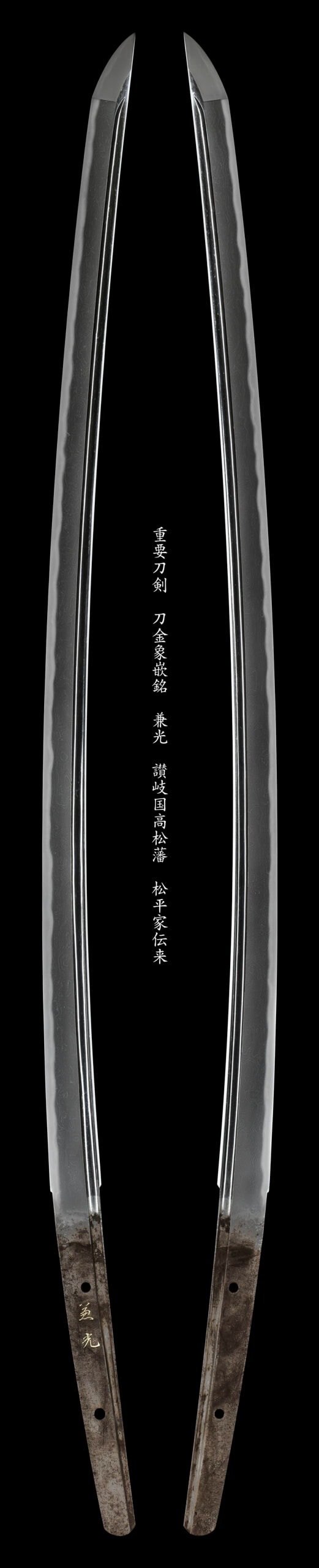
Sixty years of war between two courts drove blades long and broad, and Osafune met the demand: Kanemitsu and Chōgi led forges serving the provincial warriors who did the fighting, while Sōshū influence arrived with the armies to create Sōden-Bizen.
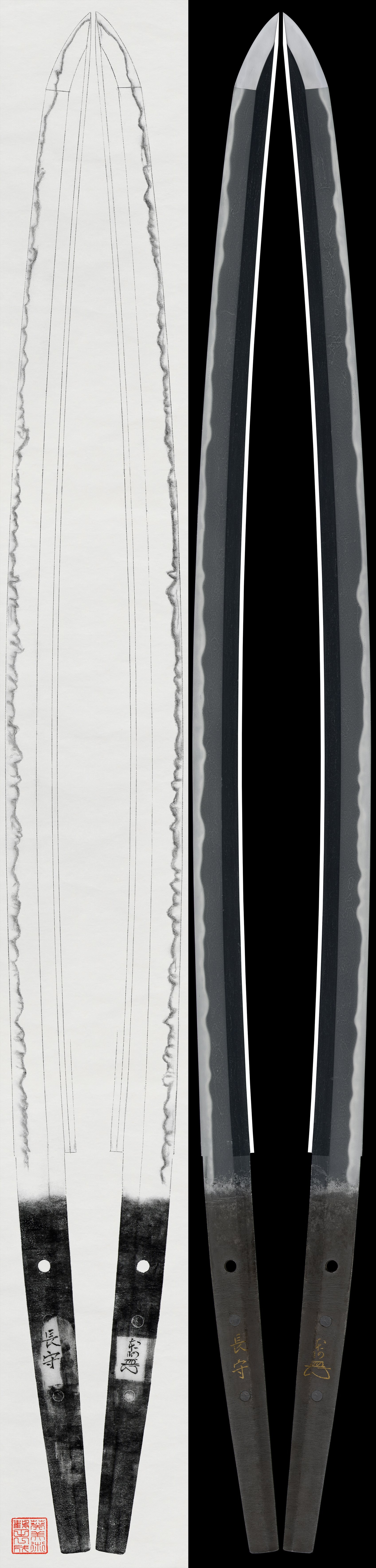
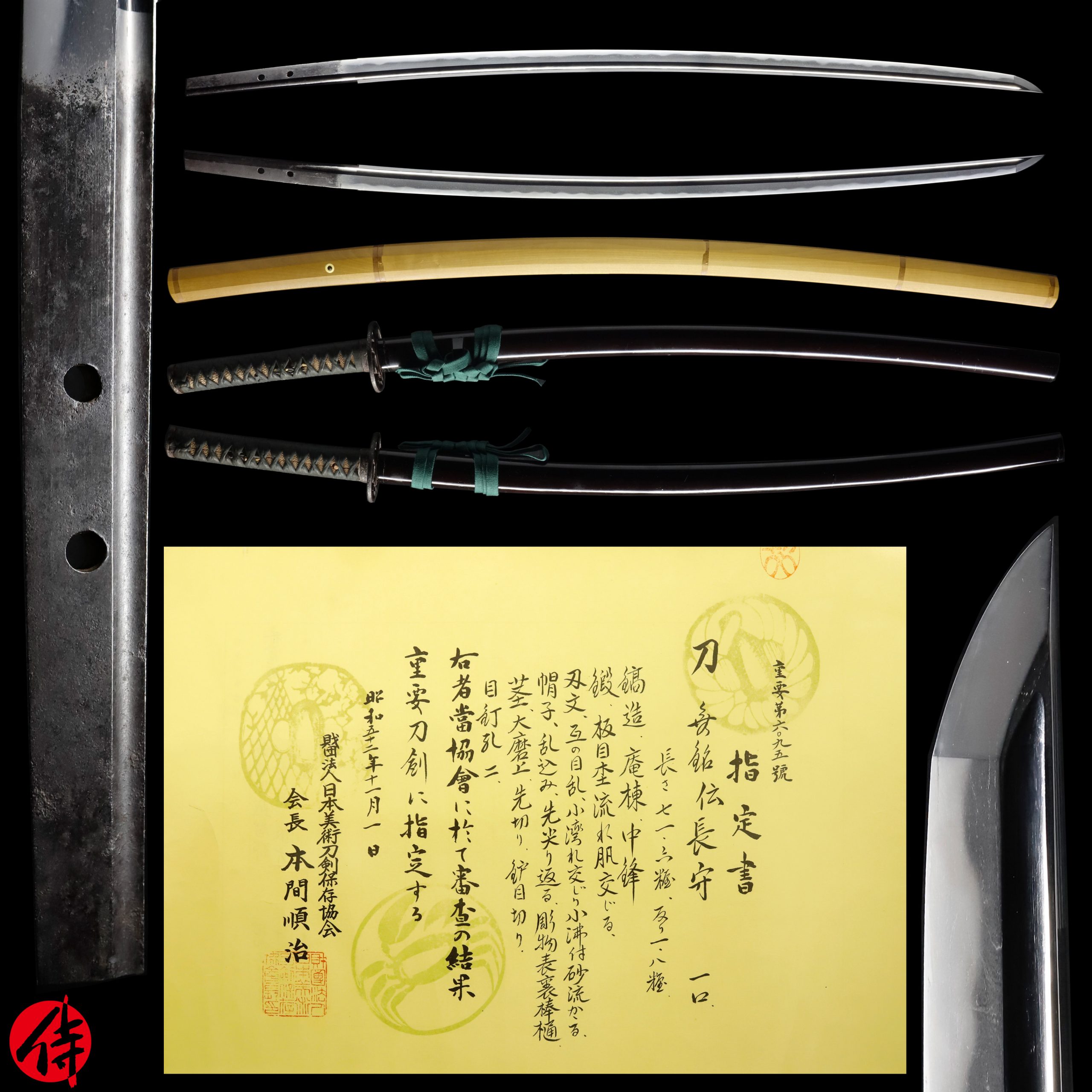
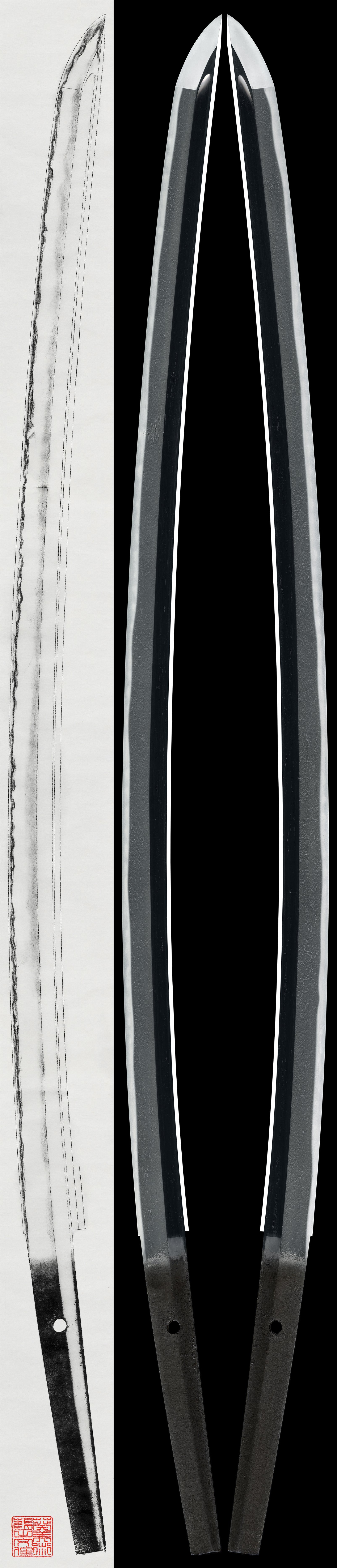
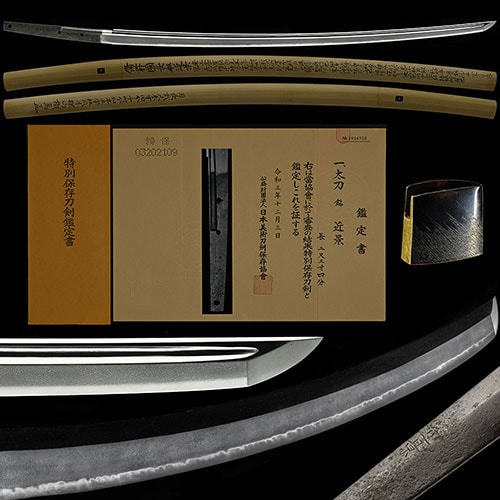
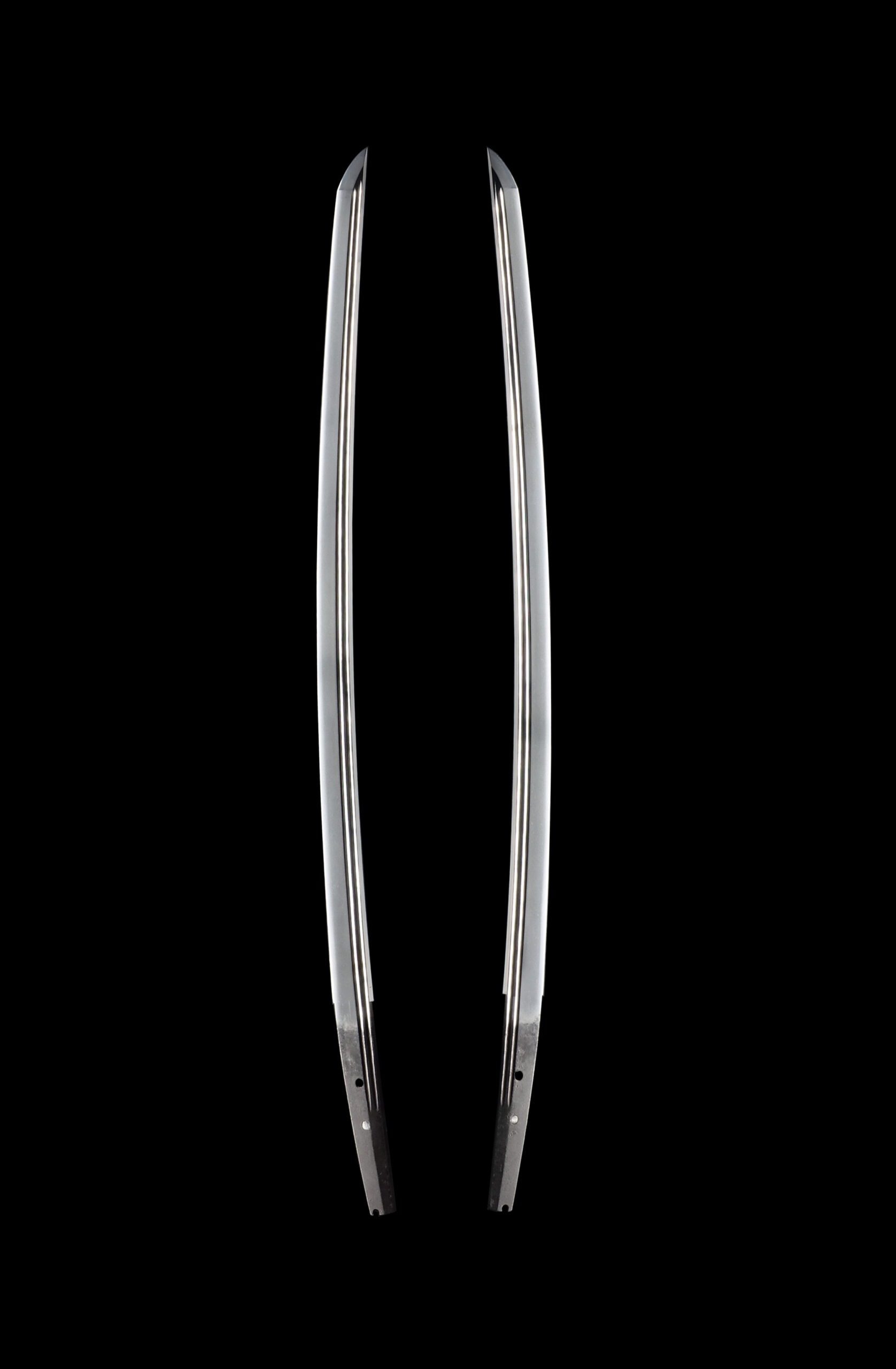
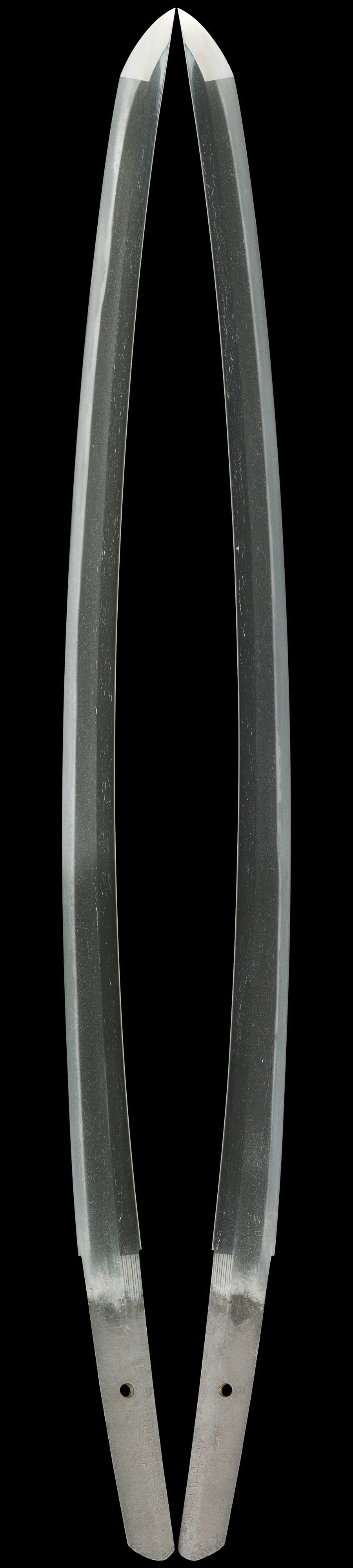
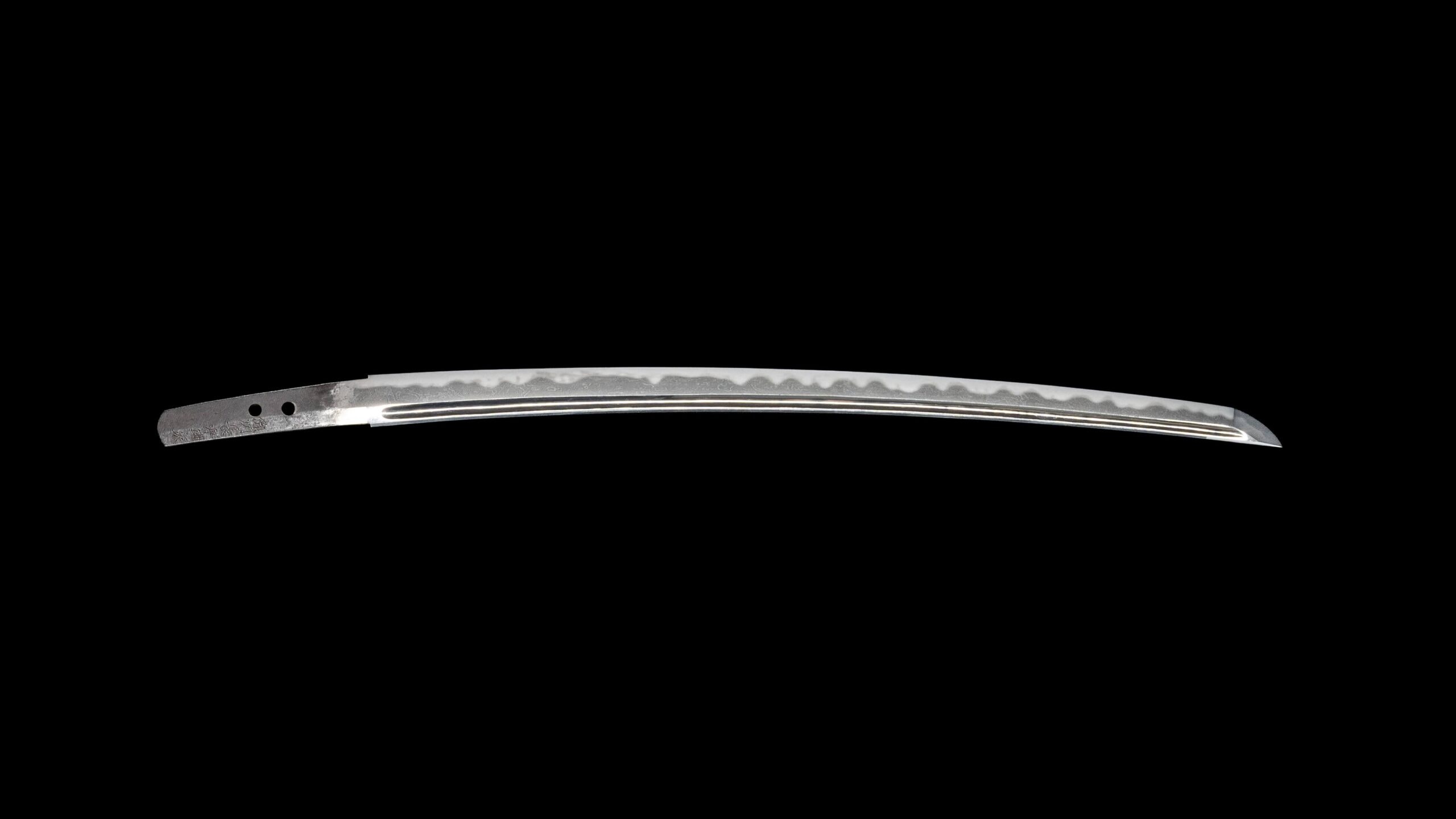
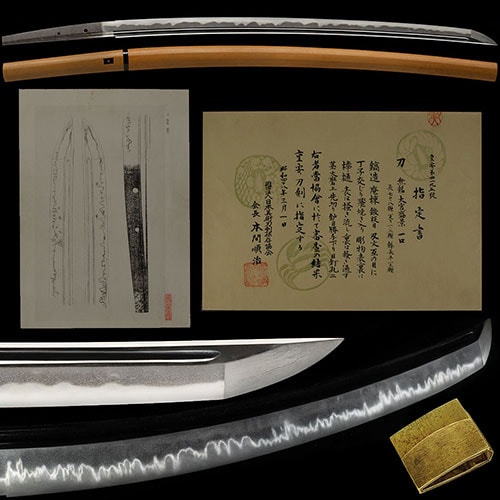
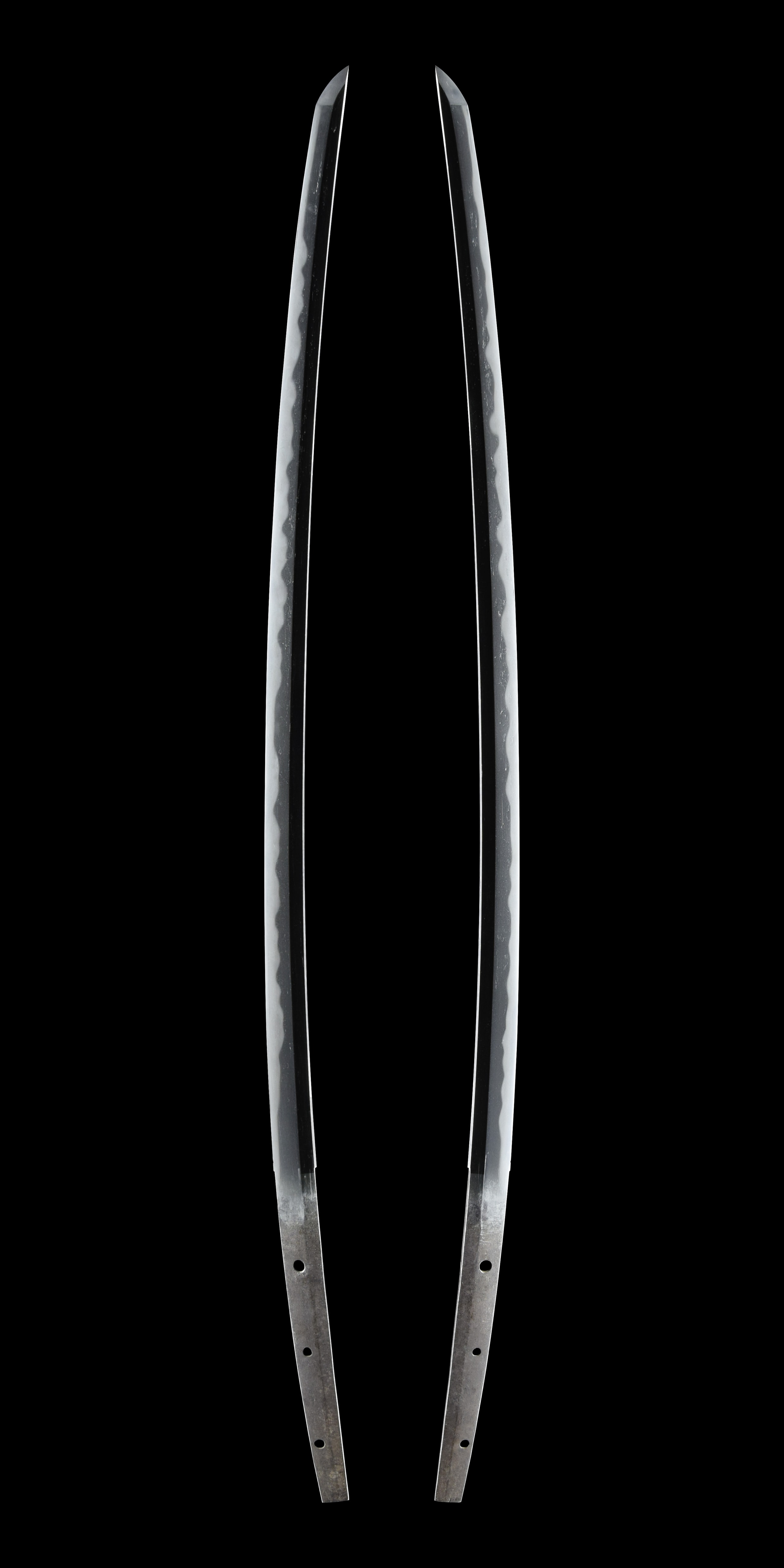
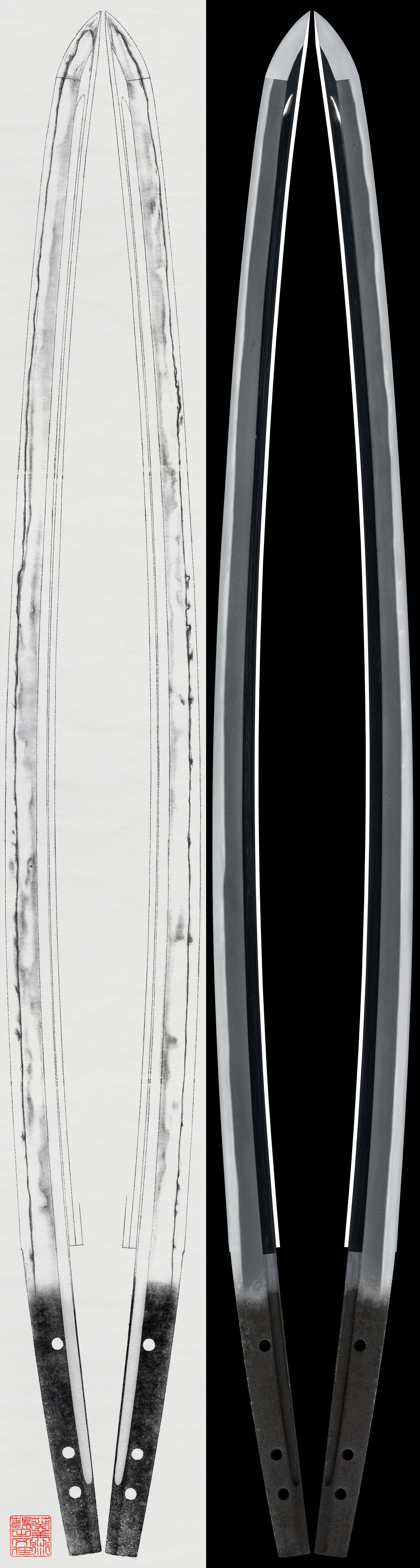
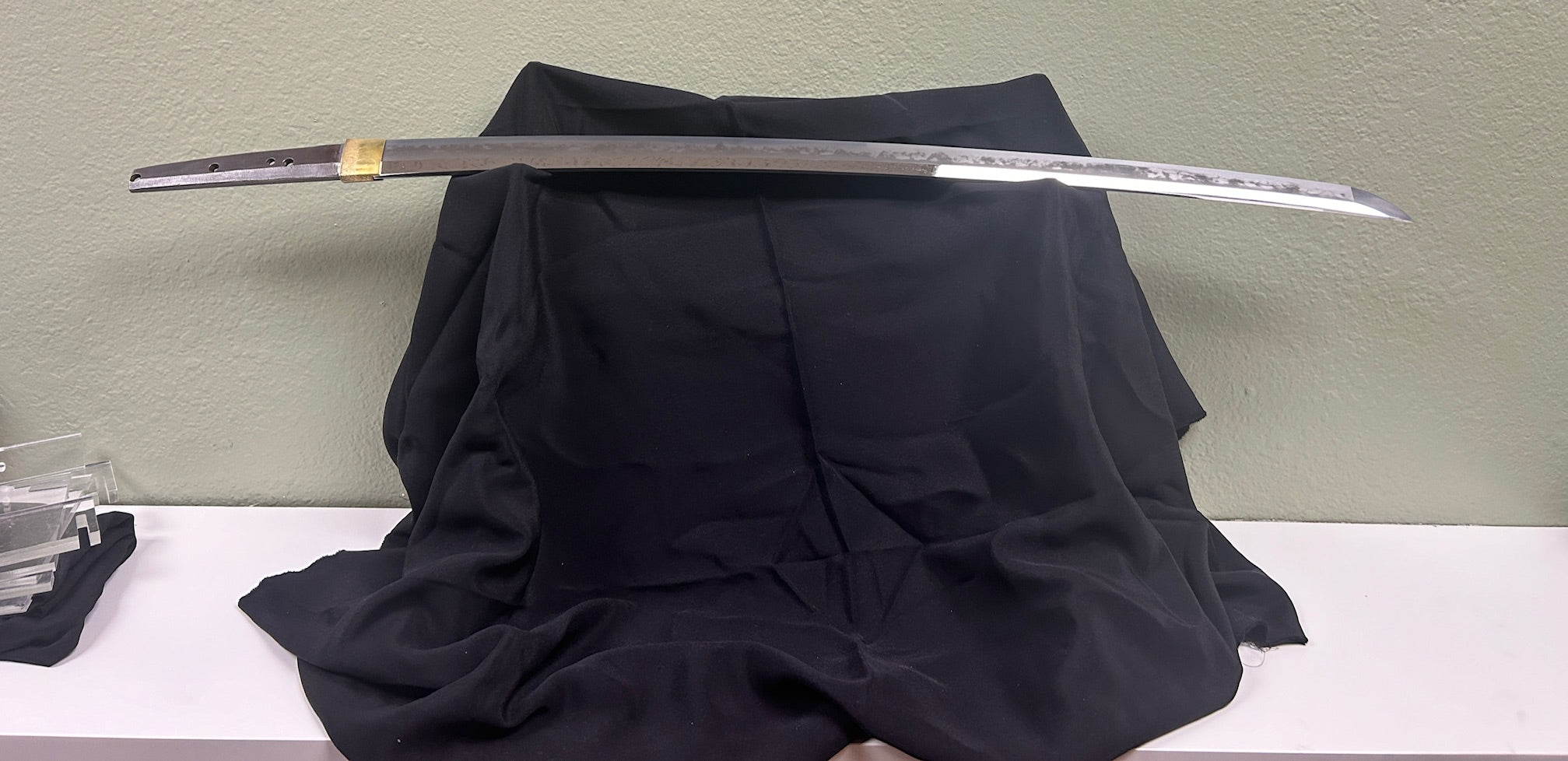
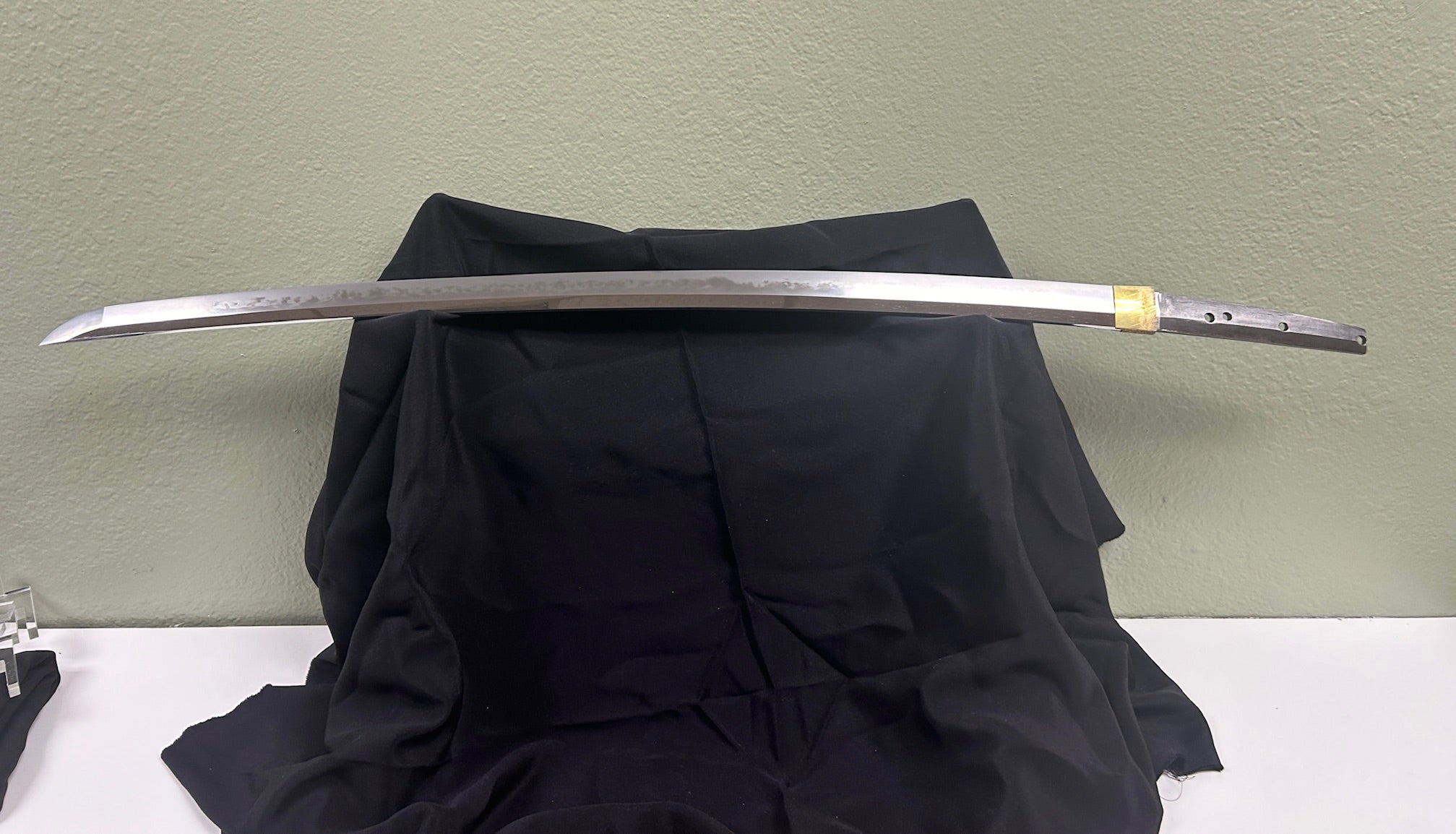
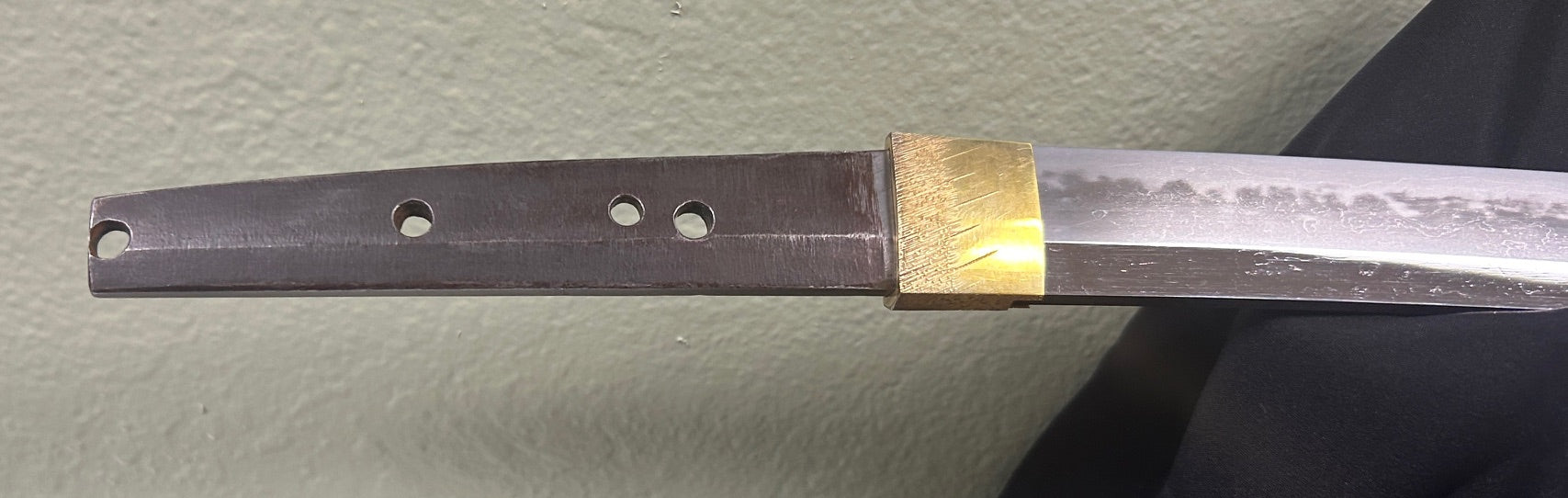
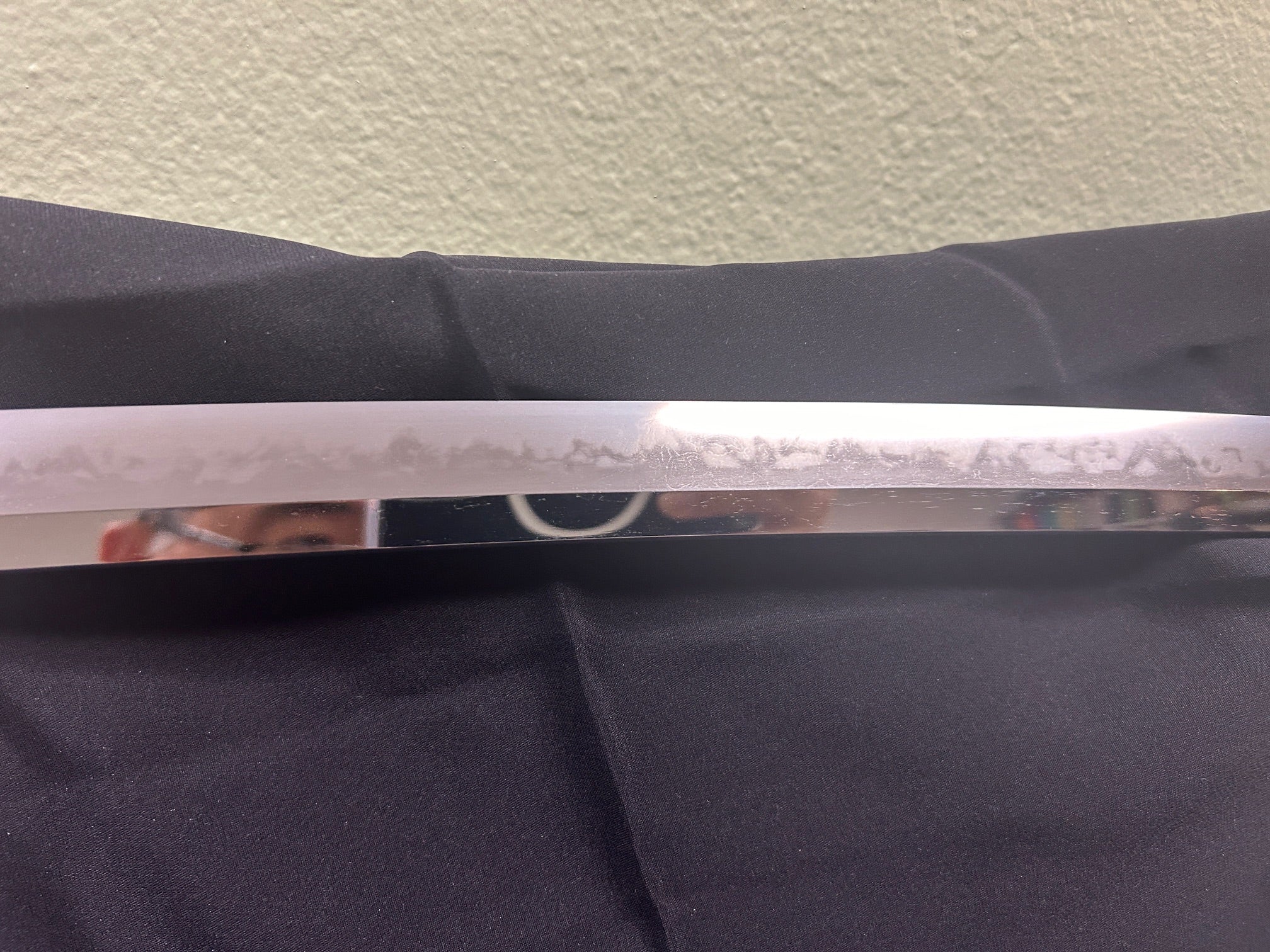
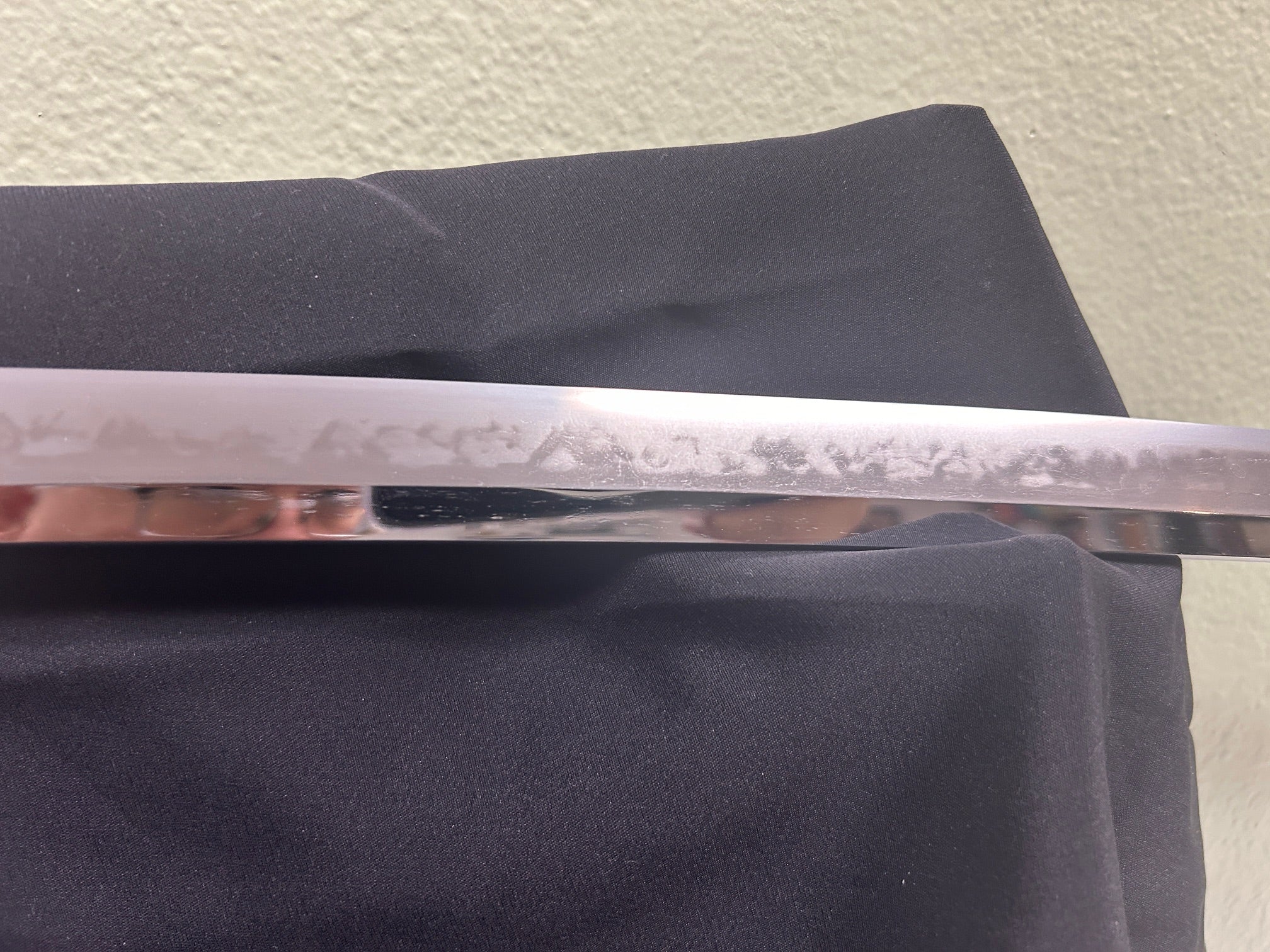
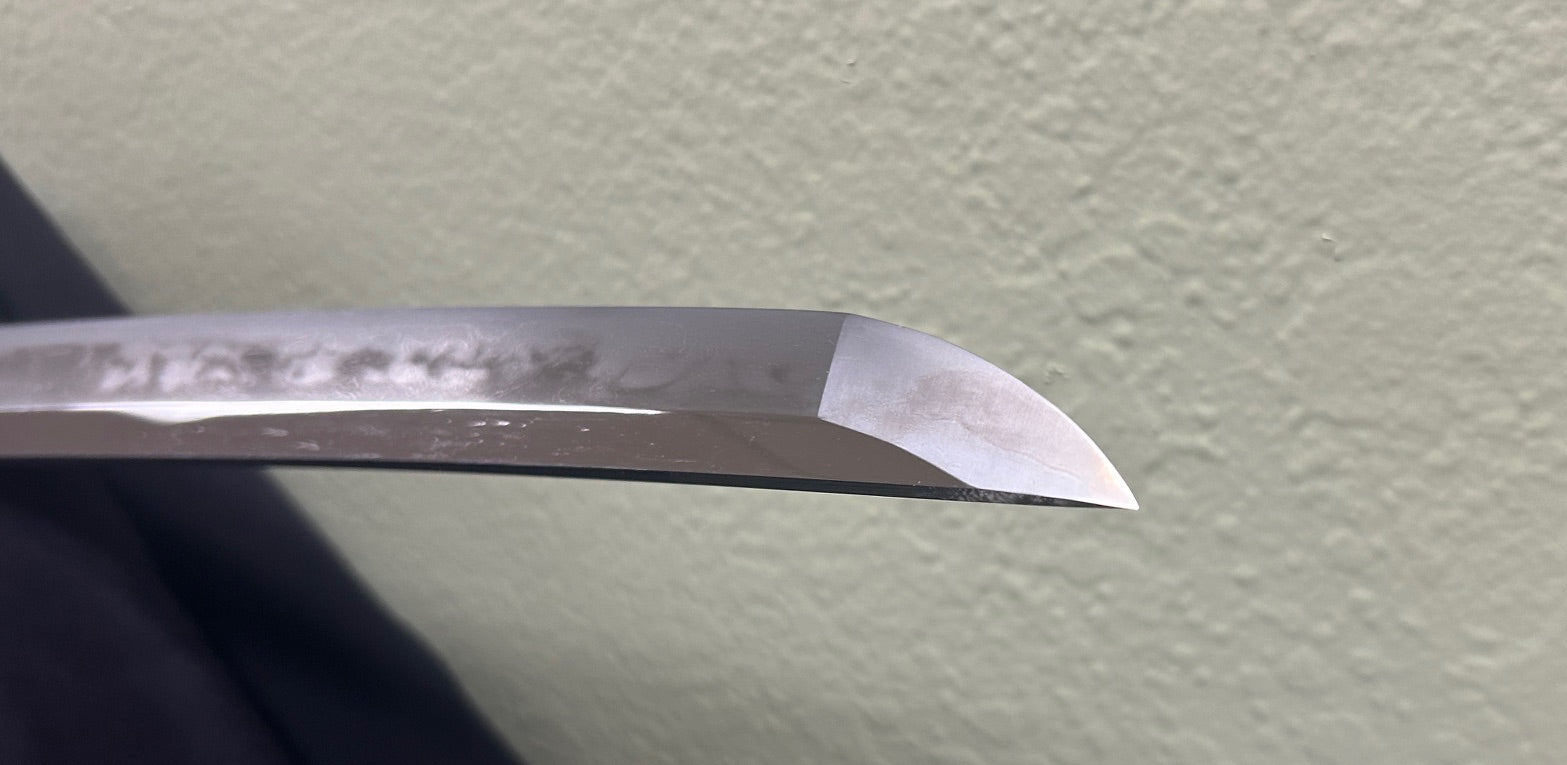
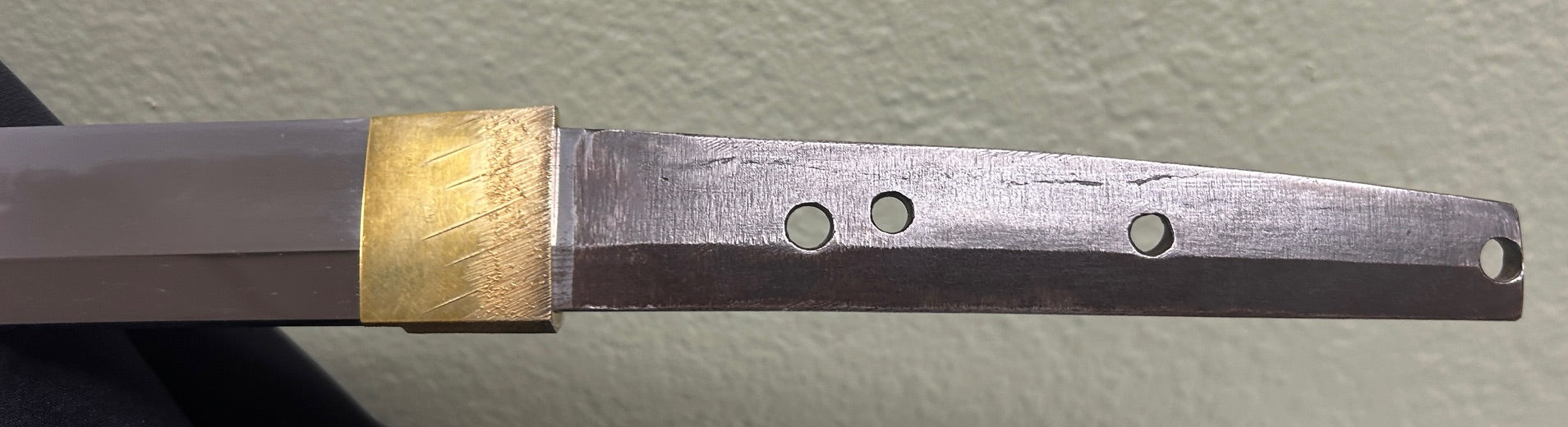
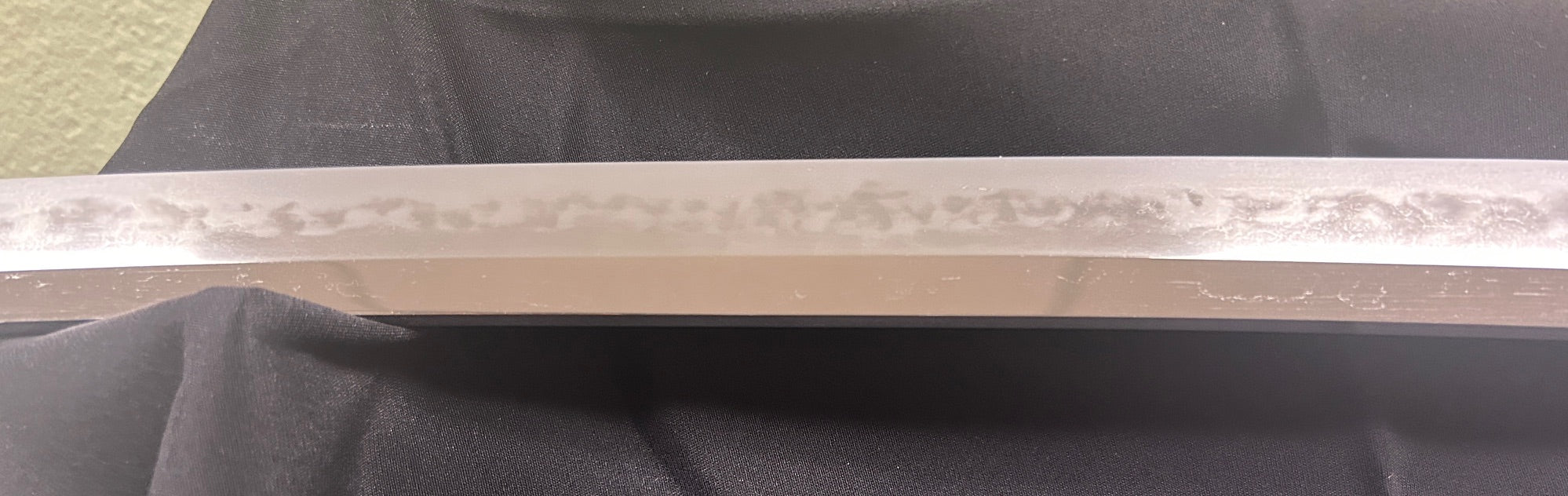
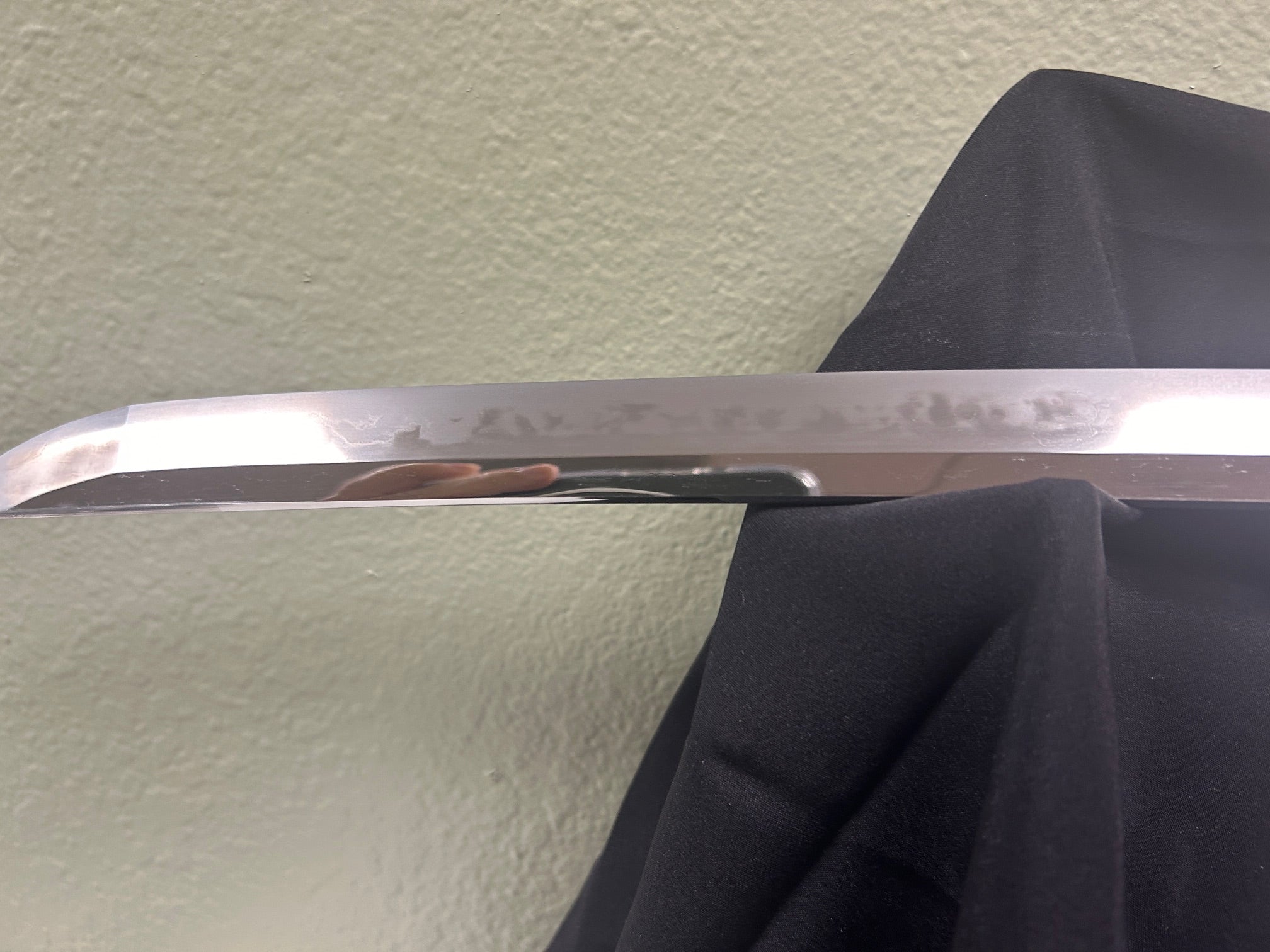
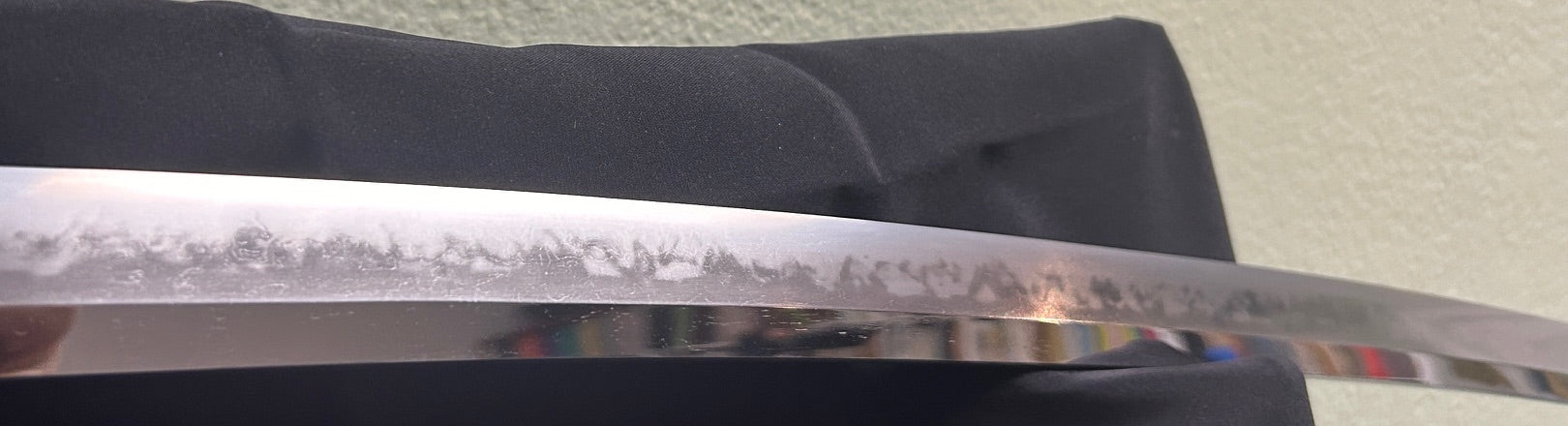
This is a beautiful katana attributed to Nagamori of the Soden Bizen school, active in the 1300s. The blade features a highly active midare hamon with clear utsuri in the ji and above the hamon, showcasing the smith's skill. It is an example of Tensho suriage, a shortening style from the 1500s, and comes with NBTHK Tokubetsu Hozon certification and a sayagaki by Tanobe Michihiro sensei.
 NihontoWatch
mumei · Soden Bizen · Shohei (1346-1370) · nagasa 69.06cm
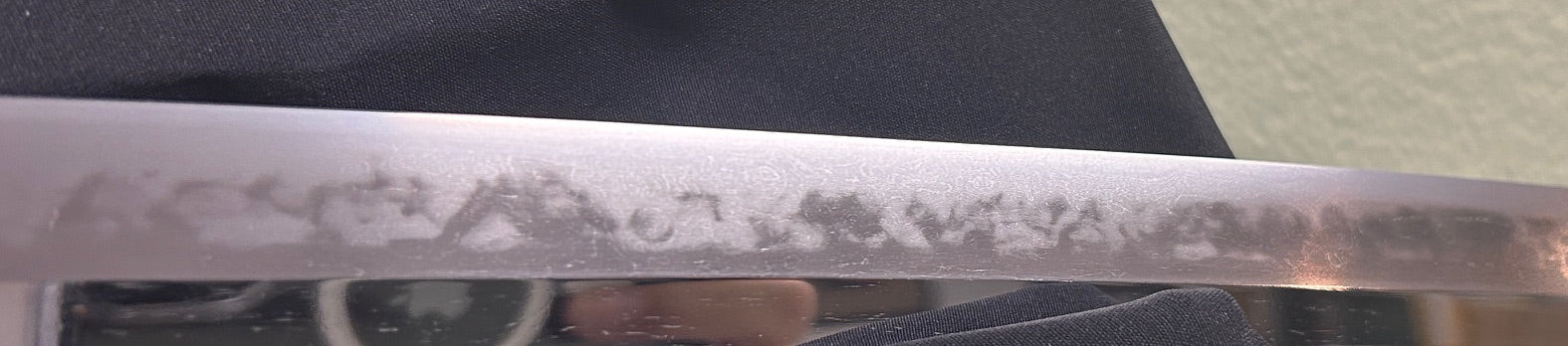
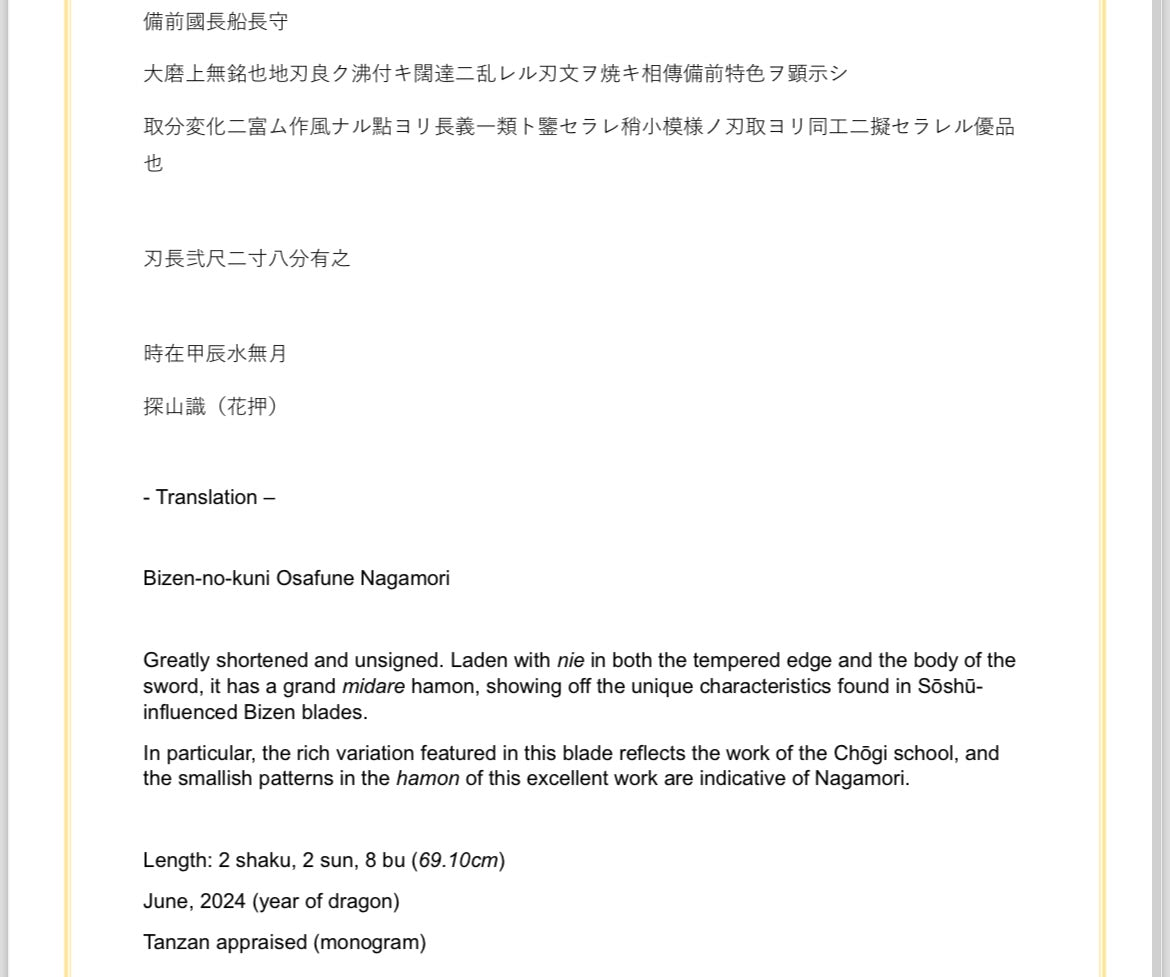
Osafune (Bizen), Chōgi line · Bizen · around 1346-1370
Fujishiro Jo saku · Tōken Taikan top 23%
1 piece on the market now
A tantō dated Shōhei 5, the fifth month of 1350, anchors the career of Nagamori of Bizen Osafune, for its date raised the previously known upper limit of his signed work and made him, the published sources say, contemporaneous with his teacher rather than a generation behind. Nagamori has been transmitted since old times as a son or pupil of Chōgi, whose personal name was Nagayoshi. When his dated blades are read together, running from Shōhei 5 (1350) and Shōhei 8 (1353) through Shōhei 22 (1367), into the Kentoku years, and on to the lately surfaced Eiwa 4 (1378) and Kōō 1 (1389), they place him in almost the same years as Chōgi; like his teacher he signed overwhelmingly with Southern Court era names. Because a Chōgi tantō dated Jōwa 6, equivalent to Shōhei 5, survives as Chōgi's earliest dated piece, the two stand together at the head of the dated record, and one Tokubetsu Jūyō wakizashi goes so far as to suggest he may be slightly earlier, that he 「長義よりやや時代がさかのぼるともみられる」[[c:1]].
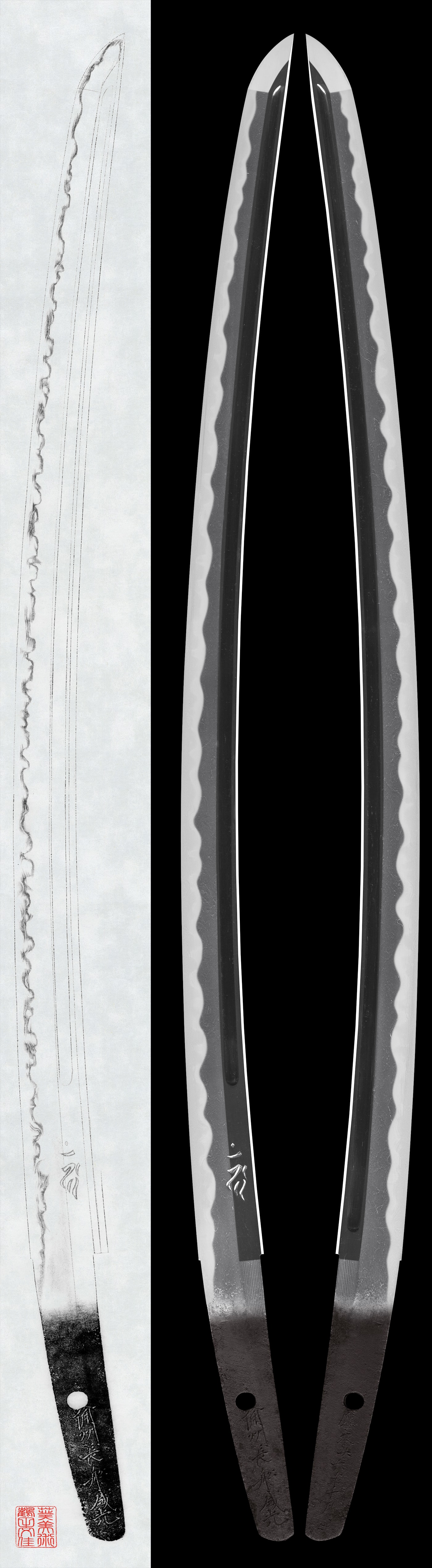
His is a Bizen hand carried over into the Sōshū idiom of the Chōgi line. The temper that names him is a gunome-midare whose waists open in the Chōgi manner, into which run chōji, ko-gunome, angular elements and a pointed tendency, the line wide and various, with ashi and yō entering, ko-nie adhering, and fine yubashiri and tobiyaki mixed through it. Across the ha lie kinsuji and sunagashi, and the nioiguchi stays bright and clear. Yet the published sources do not let the resemblance to Chōgi stand as the whole story. They grant the affinity in the opened waists and the diversity of the temper, then settle his attribution on a single distinction: in his work the midare resolves into somewhat smaller patterning than the teacher's, so that the judges write of a blade that 「乱れが幾分小模様となる態に長守の極めが首肯される」[[c:2]]. The smaller scale of the irregularity is the tell, and it is read as a manner that falls a little short of Chōgi and Kanenaga in vigour and technical refinement.
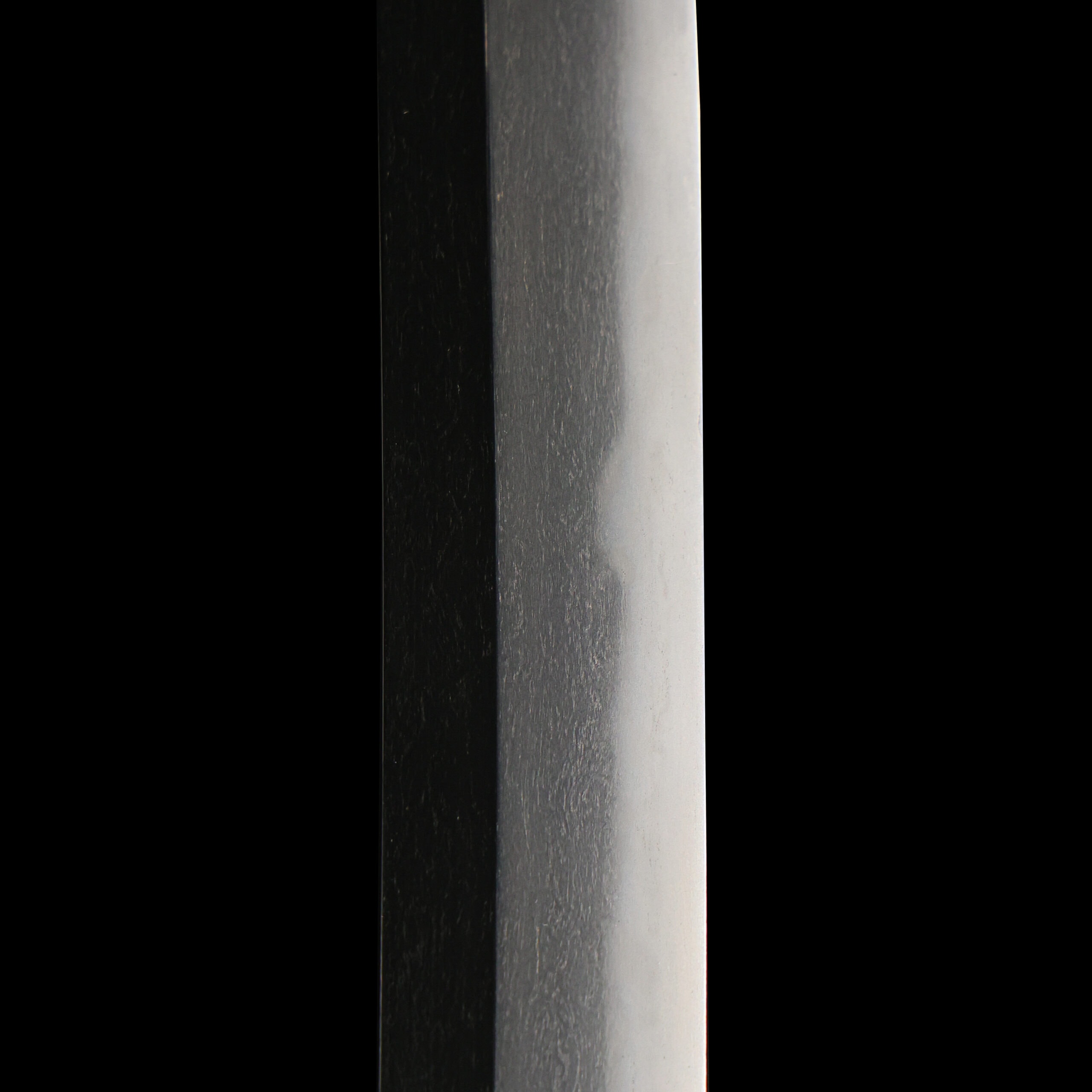
The jigane is the constant beneath that temper. He forges an itame mixed with mokume, the grain standing a little and in places flowing toward masame, with ji-nie laid on thickly as fine particles and chikei entering well. The strong ji- and ha-nie that the published sources name as the Chōgi line's Sōshū-den character is exactly what gives his steel its depth. Over it a midare-utsuri stands, though often only faintly, and the published commentary is candid that it is not always present: in blades of this type, it observes, there are examples in which 「映りの全く立たないものがある」[[c:3]]. The bōshi answers the temper, running into the irregularity and turning back in a ko-maru, at times rising to a pointed tip with hakikake; on the signed pieces it sweeps up and turns back long. Bō-hi is carved through on most of the shortened katana, while the signed tantō carry devotional su-ken and gomabashi at the base.
Two registers divide his record. The first is the small body of ubu signed and dated work, almost all of it tantō and short tachi or wakizashi, with a long signature on the omote and a date on the ura: the Shōhei 16 wakizashi in the Tokubetsu Jūyō, hira-zukuri and wide and elongated, tempered in a large gunome-midare with deep nioi and abundant nie that the judges read as strongly Sōshū in character, and which they call 「長守中屈指の一口」[[c:4]], one of the very foremost among his works. The second register, far the larger, is the ō-suriage mumei katana, wide in body with an extended or large kissaki in the Nanbokuchō shape, attributed to him by the smaller-patterned reading of the Chōgi style. The published sources stress that he ranges more broadly than the single flamboyant manner, leaving beside the opened gunome a varied small ko-gunome midare, shallow notare, and even suguha-toned work, so that he may be called 「比較的作域の広い刀工といえる」[[c:5]], a smith of comparatively broad range. That very breadth, set against how few signatures survive, is part of why the mumei attributions turn on so fine a point.
Within the Osafune of the Nanbokuchō he belongs to the Chōgi group, beside Kanenaga and the other Sōshū-den hands of the school. The comparison the judges draw most often is with Chōgi himself. His midare-utsuri and the brightness of both ji and ha keep him a Bizen smith, while the thick ji-nie, the abundant chikei and the kinsuji and sunagashi keep him within the Chōgi line's Sōshū inflection; what separates him from the master is not a different vocabulary but a quieter scale, the irregularity gathered into smaller forms and the whole a degree less forceful. One blade is praised for its bold and splendid air, varied and showy in its midare and rich in the activity within the temper, an excellent work decisively attributed to him; another is read by elimination, its restraint itself the basis of the appraisal.
Fujishiro grades Nagamori at the Jō level. He has no National Treasures and no Important Cultural Properties; his record runs instead through one Tokubetsu Jūyō and thirty-nine Jūyō blades, forty across the two tiers, together with a Gyobutsu tantō held in the Imperial collection. Of recorded whereabouts the survivors are few and largely institutional, among them the Tokyo and Kyoto National Museums, while the Imperial tantō descended through Fukushima Sōbe-no-suke and Tagaya Eishi before entering the Imperial Household. Because authenticated signatures are extremely rare, the dated pieces are valued less as objects than as evidence, the Shōhei tantō in particular being, in the words of the published sources, 「正平年紀の作は, これまでの年紀の上限を引き上げる作であり, 長守を研究する上で貴重な資料である」[[c:6]], valuable material for the study of the smith. A signed Nagamori comes to market only seldom; the mumei katana attributed to him appear more readily, a Chōgi-line Sōshū-den blade of bright steel and varied temper within the reach of a patient collector, and a documented signed example a notable thing to encounter.
Where Nagamori stands among comparable artisans: across all of nihontō, and within tradition, era, and period. The tiers (Foremost · Leading · Major · Notable) weigh official designations from the NBTHK and Japan's Agency for Cultural Affairs, together with historical honors of lasting repute such as the Sansaku and Meibutsu-chō.
Select a lens to see how it's measured.
Years he was demonstrably active, proven by signed-and-dated blades
Bizen-den · Bizen
Phase: Sōden-Bizen相伝備前· 1330–1394
236 pieces on the market now
The Soden Bizen school encompasses the group of Nanbokucho-period Osafune smiths in Bizen Province whose work absorbed the technical influence of the Soshu-den, producing a distinctive synthesis that stands apart from both orthodox Bizen and pure Sagami practice. The school divides into two principal lineages: the Kanemitsu group, representing the direct main line of Osafune that descends from Mitsutada through Nagamitsu and Kagemitsu; and the Chogi group, a collateral branch whose members carried the Soshu idiom to its most expressive extremes within Bizen. Kanemitsu, the chakuryu heir of Kagemitsu, pioneered the broad, relaxed notare-based midare that defines the mature Nanbokucho Osafune manner, while Chogi -- described by the NBTHK as the smith "who departs furthest from Bizen" among Bizen makers -- pushed nie-dominant forging to a level that rivals the output of the great Sagami smiths themselves. Together with disciples and contemporaries including Tomomitsu, Motomitsu, Masamitsu, Yoshimitsu, Kanenaga, Nagashige, and Nagamori, they constitute one of the most prolific and technically accomplished groups in the history of Japanese swordsmithing. The school's collective technical identity is anchored in a shared jigane of itame-hada mixed with mokume, with fine ji-nie adhering thickly, chikei entering well, and midare-utsuri standing out -- a persistent Bizen hallmark that survives even in the most Soshu-inflected work. The sugata overwhelmingly reflects the grand Nanbokucho taihai: wide mihaba with little taper between base and tip, and an extended chu-kissaki or o-kissaki conveying martial vigor. Within this shared framework, two distinct temperaments emerge.
" Yoshimitsu likewise inherits the small-pattern tendency, producing ko-gunome mixed with ko-choji whose restraint the NBTHK praises as "upper rank" Soden Bizen. The Chogi lineage, by contrast, emphasizes powerful nie in both ji and ha: Chogi's flamboyant large-scale midare weaves together gunome, choji, togariba, and koshi-hiraki forms with tobiyaki and yubashiri scattering freely, while kinsuji and sunagashi streak through the hardened edge. " Nagashige, now thought to be Chogi's elder brother rather than his junior, works a gentler, smaller-patterned midare yet with nie so strong as to "even surpass Chogi," while Nagamori occupies an intermediate position, his "somewhat smaller patterning" accompanied by rich internal activity. The historical significance of the Soden Bizen school lies in its demonstration that the Soshu influence, far from merely displacing Bizen conventions, catalyzed an extraordinary expansion of the Osafune repertoire. " The NBTHK's evaluative language across the school converges on consistent themes: the forging is "meticulous" and "excellent-quality," the nioiguchi "bright and clear," and the finest examples display a kenzen condition that attests to the soundness of Bizen steel at its peak. The abundance of dated inscriptions -- from Kanemitsu's forty-five-year span through Masamitsu's four-decade career extending into the early Muromachi period -- provides an unusually well-documented chronological framework, with later works by Masamitsu and Yoshimitsu pointing toward the subsequent development of Oei Bizen. Within the broader canon, the Soden Bizen school stands as the fullest realization of the creative possibilities that emerged when two of Japan's greatest forging traditions met and merged. Learn more →
| Smith | Era | Designated |
|---|---|---|
| Mitsutada光忠 | 1238-1239 | 60 |
| Nagamitsu長光 | 1274-1304 | 244 |
| Kagemitsu景光 | 1303-1336 | 143 |
| Kanemitsu兼光 | 1323-1370 | 231 |
| Sanenaga眞長 | 1299-1309 | 64 |
Bizen in the Nanbokuchō period
Sixty years of war between two courts drove blades long and broad, and Osafune met the demand: Kanemitsu and Chōgi led forges serving the provincial warriors who did the fighting, while Sōshū influence arrived with the armies to create Sōden-Bizen.
We could not find an authenticity certificate on the seller’s listing. Japanese swords and fittings are normally papered by the NBTHK (or the NTHK). Without one, the attribution is the seller’s own assessment and has not been independently verified — treat it with caution and ask the dealer about certification before buying.

$22,000
This is a beautiful katana attributed to Nagamori of the Soden Bizen school, active in the 1300s. The blade features a highly active midare hamon with clear utsuri in the ji and above the hamon, showcasing the smith's skill. It is an example of Tensho suriage, a shortening style from the 1500s, and comes with NBTHK Tokubetsu Hozon certification and a sayagaki by Tanobe Michihiro sensei.
NihontoWatchmumei · Soden Bizen · Shohei (1346-1370) · nagasa 69.06cm
Osafune (Bizen), Chōgi line · Bizen · around 1346-1370
Fujishiro Jo saku · Tōken Taikan top 23%
1 piece on the market now
A tantō dated Shōhei 5, the fifth month of 1350, anchors the career of Nagamori of Bizen Osafune, for its date raised the previously known upper limit of his signed work and made him, the published sources say, contemporaneous with his teacher rather than a generation behind. Nagamori has been transmitted since old times as a son or pupil of Chōgi, whose personal name was Nagayoshi. When his dated blades are read together, running from Shōhei 5 (1350) and Shōhei 8 (1353) through Shōhei 22 (1367), into the Kentoku years, and on to the lately surfaced Eiwa 4 (1378) and Kōō 1 (1389), they place him in almost the same years as Chōgi; like his teacher he signed overwhelmingly with Southern Court era names. Because a Chōgi tantō dated Jōwa 6, equivalent to Shōhei 5, survives as Chōgi's earliest dated piece, the two stand together at the head of the dated record, and one Tokubetsu Jūyō wakizashi goes so far as to suggest he may be slightly earlier, that he 「長義よりやや時代がさかのぼるともみられる」[[c:1]].
His is a Bizen hand carried over into the Sōshū idiom of the Chōgi line. The temper that names him is a gunome-midare whose waists open in the Chōgi manner, into which run chōji, ko-gunome, angular elements and a pointed tendency, the line wide and various, with ashi and yō entering, ko-nie adhering, and fine yubashiri and tobiyaki mixed through it. Across the ha lie kinsuji and sunagashi, and the nioiguchi stays bright and clear. Yet the published sources do not let the resemblance to Chōgi stand as the whole story. They grant the affinity in the opened waists and the diversity of the temper, then settle his attribution on a single distinction: in his work the midare resolves into somewhat smaller patterning than the teacher's, so that the judges write of a blade that 「乱れが幾分小模様となる態に長守の極めが首肯される」[[c:2]]. The smaller scale of the irregularity is the tell, and it is read as a manner that falls a little short of Chōgi and Kanenaga in vigour and technical refinement.
The jigane is the constant beneath that temper. He forges an itame mixed with mokume, the grain standing a little and in places flowing toward masame, with ji-nie laid on thickly as fine particles and chikei entering well. The strong ji- and ha-nie that the published sources name as the Chōgi line's Sōshū-den character is exactly what gives his steel its depth. Over it a midare-utsuri stands, though often only faintly, and the published commentary is candid that it is not always present: in blades of this type, it observes, there are examples in which 「映りの全く立たないものがある」[[c:3]]. The bōshi answers the temper, running into the irregularity and turning back in a ko-maru, at times rising to a pointed tip with hakikake; on the signed pieces it sweeps up and turns back long. Bō-hi is carved through on most of the shortened katana, while the signed tantō carry devotional su-ken and gomabashi at the base.
Two registers divide his record. The first is the small body of ubu signed and dated work, almost all of it tantō and short tachi or wakizashi, with a long signature on the omote and a date on the ura: the Shōhei 16 wakizashi in the Tokubetsu Jūyō, hira-zukuri and wide and elongated, tempered in a large gunome-midare with deep nioi and abundant nie that the judges read as strongly Sōshū in character, and which they call 「長守中屈指の一口」[[c:4]], one of the very foremost among his works. The second register, far the larger, is the ō-suriage mumei katana, wide in body with an extended or large kissaki in the Nanbokuchō shape, attributed to him by the smaller-patterned reading of the Chōgi style. The published sources stress that he ranges more broadly than the single flamboyant manner, leaving beside the opened gunome a varied small ko-gunome midare, shallow notare, and even suguha-toned work, so that he may be called 「比較的作域の広い刀工といえる」[[c:5]], a smith of comparatively broad range. That very breadth, set against how few signatures survive, is part of why the mumei attributions turn on so fine a point.
Within the Osafune of the Nanbokuchō he belongs to the Chōgi group, beside Kanenaga and the other Sōshū-den hands of the school. The comparison the judges draw most often is with Chōgi himself. His midare-utsuri and the brightness of both ji and ha keep him a Bizen smith, while the thick ji-nie, the abundant chikei and the kinsuji and sunagashi keep him within the Chōgi line's Sōshū inflection; what separates him from the master is not a different vocabulary but a quieter scale, the irregularity gathered into smaller forms and the whole a degree less forceful. One blade is praised for its bold and splendid air, varied and showy in its midare and rich in the activity within the temper, an excellent work decisively attributed to him; another is read by elimination, its restraint itself the basis of the appraisal.
Fujishiro grades Nagamori at the Jō level. He has no National Treasures and no Important Cultural Properties; his record runs instead through one Tokubetsu Jūyō and thirty-nine Jūyō blades, forty across the two tiers, together with a Gyobutsu tantō held in the Imperial collection. Of recorded whereabouts the survivors are few and largely institutional, among them the Tokyo and Kyoto National Museums, while the Imperial tantō descended through Fukushima Sōbe-no-suke and Tagaya Eishi before entering the Imperial Household. Because authenticated signatures are extremely rare, the dated pieces are valued less as objects than as evidence, the Shōhei tantō in particular being, in the words of the published sources, 「正平年紀の作は, これまでの年紀の上限を引き上げる作であり, 長守を研究する上で貴重な資料である」[[c:6]], valuable material for the study of the smith. A signed Nagamori comes to market only seldom; the mumei katana attributed to him appear more readily, a Chōgi-line Sōshū-den blade of bright steel and varied temper within the reach of a patient collector, and a documented signed example a notable thing to encounter.
Where Nagamori stands among comparable artisans: across all of nihontō, and within tradition, era, and period. The tiers (Foremost · Leading · Major · Notable) weigh official designations from the NBTHK and Japan's Agency for Cultural Affairs, together with historical honors of lasting repute such as the Sansaku and Meibutsu-chō.
Select a lens to see how it's measured.
Years he was demonstrably active, proven by signed-and-dated blades
Bizen-den · Bizen
Phase: Sōden-Bizen相伝備前· 1330–1394
236 pieces on the market now
The Soden Bizen school encompasses the group of Nanbokucho-period Osafune smiths in Bizen Province whose work absorbed the technical influence of the Soshu-den, producing a distinctive synthesis that stands apart from both orthodox Bizen and pure Sagami practice. The school divides into two principal lineages: the Kanemitsu group, representing the direct main line of Osafune that descends from Mitsutada through Nagamitsu and Kagemitsu; and the Chogi group, a collateral branch whose members carried the Soshu idiom to its most expressive extremes within Bizen. Kanemitsu, the chakuryu heir of Kagemitsu, pioneered the broad, relaxed notare-based midare that defines the mature Nanbokucho Osafune manner, while Chogi -- described by the NBTHK as the smith "who departs furthest from Bizen" among Bizen makers -- pushed nie-dominant forging to a level that rivals the output of the great Sagami smiths themselves. Together with disciples and contemporaries including Tomomitsu, Motomitsu, Masamitsu, Yoshimitsu, Kanenaga, Nagashige, and Nagamori, they constitute one of the most prolific and technically accomplished groups in the history of Japanese swordsmithing. The school's collective technical identity is anchored in a shared jigane of itame-hada mixed with mokume, with fine ji-nie adhering thickly, chikei entering well, and midare-utsuri standing out -- a persistent Bizen hallmark that survives even in the most Soshu-inflected work. The sugata overwhelmingly reflects the grand Nanbokucho taihai: wide mihaba with little taper between base and tip, and an extended chu-kissaki or o-kissaki conveying martial vigor. Within this shared framework, two distinct temperaments emerge.
" Yoshimitsu likewise inherits the small-pattern tendency, producing ko-gunome mixed with ko-choji whose restraint the NBTHK praises as "upper rank" Soden Bizen. The Chogi lineage, by contrast, emphasizes powerful nie in both ji and ha: Chogi's flamboyant large-scale midare weaves together gunome, choji, togariba, and koshi-hiraki forms with tobiyaki and yubashiri scattering freely, while kinsuji and sunagashi streak through the hardened edge. " Nagashige, now thought to be Chogi's elder brother rather than his junior, works a gentler, smaller-patterned midare yet with nie so strong as to "even surpass Chogi," while Nagamori occupies an intermediate position, his "somewhat smaller patterning" accompanied by rich internal activity. The historical significance of the Soden Bizen school lies in its demonstration that the Soshu influence, far from merely displacing Bizen conventions, catalyzed an extraordinary expansion of the Osafune repertoire. " The NBTHK's evaluative language across the school converges on consistent themes: the forging is "meticulous" and "excellent-quality," the nioiguchi "bright and clear," and the finest examples display a kenzen condition that attests to the soundness of Bizen steel at its peak. The abundance of dated inscriptions -- from Kanemitsu's forty-five-year span through Masamitsu's four-decade career extending into the early Muromachi period -- provides an unusually well-documented chronological framework, with later works by Masamitsu and Yoshimitsu pointing toward the subsequent development of Oei Bizen. Within the broader canon, the Soden Bizen school stands as the fullest realization of the creative possibilities that emerged when two of Japan's greatest forging traditions met and merged. Learn more →
| Smith | Era | Designated |
|---|---|---|
| Mitsutada光忠 | 1238-1239 | 60 |
| Nagamitsu長光 | 1274-1304 | 244 |
| Kagemitsu景光 | 1303-1336 | 143 |
| Kanemitsu兼光 | 1323-1370 | 231 |
| Sanenaga眞長 | 1299-1309 | 64 |
Bizen in the Nanbokuchō period
Sixty years of war between two courts drove blades long and broad, and Osafune met the demand: Kanemitsu and Chōgi led forges serving the provincial warriors who did the fighting, while Sōshū influence arrived with the armies to create Sōden-Bizen.
We could not find an authenticity certificate on the seller’s listing. Japanese swords and fittings are normally papered by the NBTHK (or the NTHK). Without one, the attribution is the seller’s own assessment and has not been independently verified — treat it with caution and ask the dealer about certification before buying.
$22,000