南北朝の戦乱は、山城の精緻を支えた公家社会を疲弊させた。来派最後の巨匠たちをもって古典の系譜は閉じ、長谷部と信国が新しい相州風を都に持ち込んでいる。
 NihontoWatchNihontoWatch
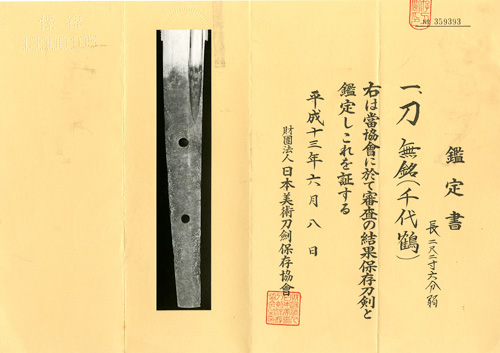
Sugata (Shape): Shinogi-zukuri with an Iori-mune. Wide mihaba and a thick kasane at the base, giving the blade a powerful and massive build. A shallow sori that curves toward an extended ō-kissaki, reflecting the bold construction widely seen during the Nanbokuchō period. Weight excluding the Habaki: 768 grams, giving a substantial feel in hand. Jitetsu (Forging Pattern): Itame-hada, mixed in places with large streaming grain and showing areas tending toward Masame hada. Fine Ji-nie is thickly applied overall, with places showing Yubashiri-like activity. Horimono (Carvings): A Naginata-hi carved near the base, chiselled half way into the Nakago. The Shinogi-ji has been shaved off where a groove of bō-hi is carved. Hamon (Temper Line): Nie-deki Suguha-based shallow Notare mixed with ko-gunome, including ko-gunome with a slanting tendencies. The boundary Ha-buchi is thickly covered with ko-Nie; ko-ashi appear frequently and isolating dots of Yō can be seen within the Hamon. In the Hira-ji, there are Yubashiri reminiscent of Tobiyaki. Bōshi: On both Omote and Ura, the Bōshi is an irregular Midare-komi with a sweeping Hakikake finish, tending toward Yakizume-end. Nakago: Ō-suriage, unsigned. Nakago-heel is horizontal Kiri. Two mekugi-ana. Yasurime is horizontal Kiri. “Chiyozuru” 千代鶴 refers to swords forged by the Chiyozuru Kuniyasu school 千代鶴国安 active in Echizen Province from the mid to late Nanbokuchō period. Chiyozuru Kuniyasu 千代鶴国安 is said to have been the grandson of Rai Kunisue 来国末 of Yamashiro Province. According to tradition, Rai Kuniyasu 来国安 moved to Echizen around the Jōji era, becoming the founder of the Chiyozuru school 千代鶴. Kuniyasu 国安 is known to have signed both “Chiyozuru” 千代鶴 and “Rai Kuniyasu”来国安. Together with smiths such as Rai Munemitsu 来宗光 and Morihiro 守弘 the Chiyozuru group is also collectively referred to as Echizen Rai 越前来. This sword has a strong and robust construction with a thick Kasane at the base, while the Shinogi-ji has been pared down to emphasize cutting-thgough ability. Its form follows the Nagamaki-zukuri style that became prevalent during the Nanbokuchō period, particularly around the Enbun and Jōji eras. The Jigane is slightly dark in tone, with a mixture of Itame and flowing hada, showing an outstanding grain. Fine Ji-nie is densely applied, with delicate Chikei appearing frequently. The Hamon consists of a wide Suguha-based shallow Notare mixed with ko-gunome and Saka-ashi and the Bōshi is irregular with sweeping Hakikake. While the blade clearly exhibits Rai-school characteristics of the Nanbokuchō period in both Ji and Ha, it also possesses a distinct northern provincial character, leading to its attribution as Chiyozuru 千代鶴. Fitted with a solid silver single-layer Habaki. Preserved in a Shirasaya. reference: Masakuni Ishii, Kanzan Honma, Nihontō Meikan, Yūzankaku, 1975 (Shōwa 50)


(翻訳なし)
山城伝 · 越前
現在9点販売中
千代鶴派は越前を本拠とした一門である。説示によれば、その祖は来国安に求められる。来国安は生国を山城とし、一説に来国末の孫といい、のちに越前へ移住して千代鶴派の祖となったと伝え、銘鑑はその年代を貞治の頃とする。あわせて越前には来国安の弟子と伝える千代鶴国安なる工があり[[c:1]]、これを祖とする伝えもあって、時代を同じく貞治の頃という。いずれにせよ一門は山城の来派を源流に置き、これを越前の地に移したものとして説示は位置づけている。以後この派は室町期まで続き、国安系の守弘が現れる。守弘は同名に複数代があり、銘鑑は初代を応永、二代を嘉吉あるいは文安の頃とし、藤左衛門尉と称した者もあるという。さらに越前敦賀の光行のごとく[[c:2]]、一説に越前国行の門と伝える年紀作の工も説示に名を連ねる。 作風は、来派を承けた地刃に越前という地方色が加わる点に特徴がある。鍛えは板目に杢目や流れ肌を交え、総じて肌立ちごころとなり、地沸が厚くつき、地景がしきりに入り、白けごころを帯び、鉄色がやや黒みがかるものがある。刃文は来国安に擬せられる一類では中直刃を基調に小互の目を交え、足が入り、刃縁にほつれ・喰違刃・二重刃が現れ、沸がよくついて匂口が明るい。一方、守弘ら国安系の作では互の目調の乱れ刃となり、丁子ごころや尖りごころの刃を交え、飛焼が入り、棟焼がしきりにかかり、砂流し・金筋がかかって地刃ともによく沸づくものが目立つ。帽子は直ぐごころに小丸となるもの、乱れ込んで掃きかけるもの、焼き詰めるものなど作により変化する。見分けにあたっては、肌立ちと白けごころ、黒みがかる鉄色、帽子に見える野趣ある働きなどが手掛かりとなる。 鑑定では、一見すると山城本国の来国光あたりにも見えるが、注視すれば地刃の出来に一歩を譲り、肌立ちが強く帽子の働きが本国以上に野趣を示すところに、来国安の極めが首肯される、と説示はくり返し述べる。守弘の作は互の目調の乱れ刃で地刃ともによく沸え、来風とは趣を異にするとされ、有銘作が珍重される。代表的な遺例としては、無銘ながら身幅広く大鋒に結ぶ南北朝期の姿を示す来国安極めの刀、互の目調の乱れ刃を焼いた守弘の太刀や年紀ある脇指、越前敦賀の光行の年紀短刀などが説示に挙げられる。現存する作刀は少なく、来派の正系を越前に伝えた一門として位置づけられている。 詳しく見る →
南北朝時代の山城
南北朝の戦乱は、山城の精緻を支えた公家社会を疲弊させた。来派最後の巨匠たちをもって古典の系譜は閉じ、長谷部と信国が新しい相州風を都に持ち込んでいる。
保存刀剣のうち、出来が一層優れ、保存状態も良好と認められたものです。再刃や、室町・江戸期の多くの無銘作は対象外となり、保存刀剣より高い基準が課されます。
日本美術刀剣保存協会(NBTHK)は、1948年に設立され、文化庁の監督を受ける公益財団法人で、東京・刀剣博物館に本部を置きます。専門の審査員が出品作を直接審査し、美術的・歴史的価値に応じた鑑定書を発行します。NBTHKの鑑定書は、日本刀および刀装具の真正性を示す最も広く認知された基準です。
NBTHK公式サイト返品は商品到着後7日以内に当社までご連絡ください。お客様のご指定による寸法などの仕様の変更を行った際はご返品を受けかねます。送料および振込み手数料はお客様のご負担とさせていただきます。
¥850,000