When the Southern Court made its capital at Yoshino, in Yamato itself, the province’s schools were at their height: the late Tegai line, Shikkake Norinaga, and the pure masame of Hōshō. Their technique was already spreading across the provinces.
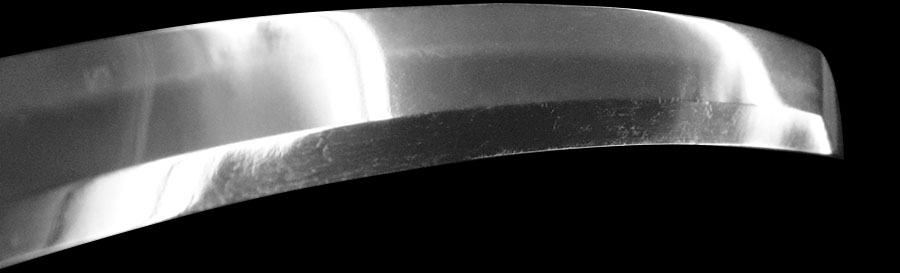
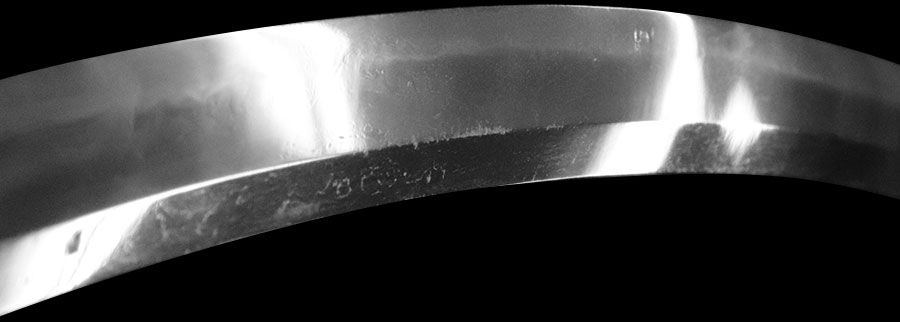
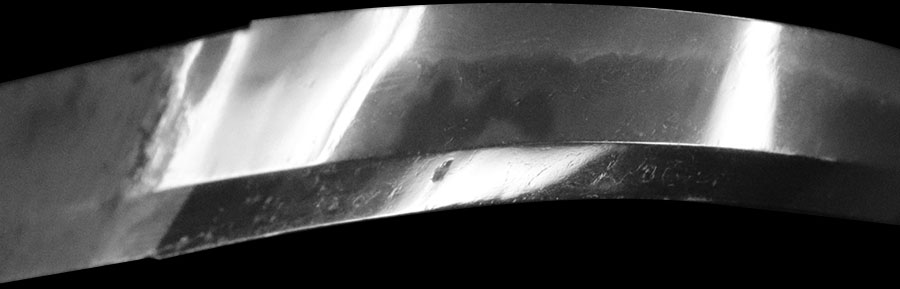
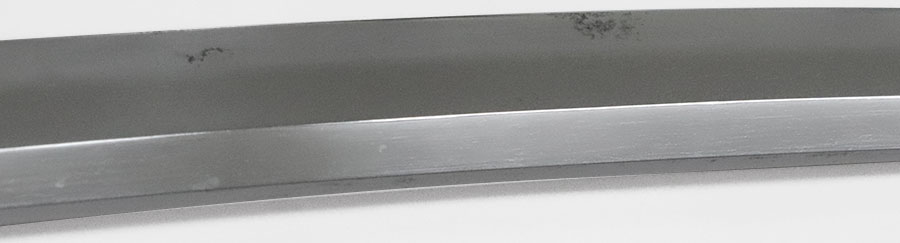
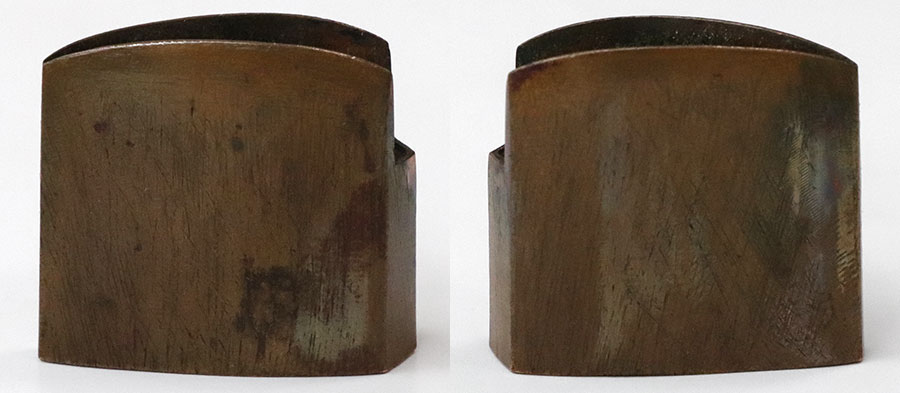
(Kanekiyo was a tosho who belonged to Todaiji in Nara, famous for the Daibutsu) (Extant signed Yamato swords are few and truly precious items; this is a meito whose popularity will continue to rise rapidly in the future) It has appeared, it has appeared; works by ancient Yamato smiths are refined like oxidized silver, simple and sturdy, honest, lacking flashiness, and moreover, signed works do not exist, making them rare and precious swords since ancient times. This time, a precious signed meito by Tegai Kanekiyo has appeared. Because Yamato smiths belonged to massive, great temples since long ago, there was no need to sell to the general public, and absolutely no need to include a tosho mei, which is a brand name for commercial sales; therefore, most remain as mumei works. However, here has appeared a precious signed meito by Tegai Kanekiyo, who belonged to Todaiji in Nara, famous for the Daibutsu, for whom signed works are truly few. The first generation Kanekiyo of the Tegai school, who belonged to Nara Todaiji, was the child of Yamato Tegai Kanenaga and was a tosho of the Kamakura period, around Karyaku (1326) (700 years ago); this sword is the precious eighth generation Tegai school Washu Ju Fujiwara Kanekiyo from about 200 years later, around the Muromachi period Tenbun (1543) (483 years ago), exactly when firearms were introduced to Tanegashima from Portugal. Because many Yamato tosho among the five Yamato schools (Senjuin, Taima, Hosho, Tegai, Shikkake) belonged to respective massive temples, there was no need to include a tosho mei brand name for sales, and most were issued mumei; thus, signed works have been extremely few since ancient times, and this sword by Kanekiyo, who belonged to Nara Todaiji famous for the Daibutsu, is precious. The sugata of this precious Washu Ju Fujiwara Kanekiyo sword shows the characteristic high shinogi of the Yamato-den with koshizori having sori at the moto, and a difference between the moto-mihaba and saki-mihaba, manifesting a sugata optimal for nukiuchi; the jigane is ko-itame hada mixed with masame hada, manifesting a magnificent midare-utsuri from the habaki-moto, which is kocho. The hamon is a sugu-style ha in nioi-deki with gunome no ashi, and is truly elegant. Because it is an old sword of nearly 500 years, its mere existence is something to be grateful for; please cherish it greatly, treating any slight itami as a charming proof of having endured the wind and snow of old eras. This time, because we received this from an old sukisha who said, "I have also grown old, so please pass this on cheaply to someone who will treasure it," we are offering this meito by Tegai Kanekiyo from nearly 500 years ago at a special, ultra-low price. Please by all means enjoy this precious meito by Washu Ju Fujiwara Kanekiyo of the Tegai school, who belonged to Nara Todaiji, famous for the Daibutsu, representing and symbolizing the history of Yamato, which is registered as a UNESCO World Cultural Heritage site.
Offered by Nipponto
2 on the market


As written by the shop
Machine translation from the shop's Japanese · may contain errors ·
Tegai (Yamato) · Yamato · around 1429-1441
Tōken Taikan top 26%
2 pieces on the market now
Kanekiyo is a smith of the Tegai school of Yamato, which the published sources call the largest of the five Yamato traditions. The school is said to take its name from the branch that lived and forged outside the Tegai Gate, the western main gate of Todai-ji, with Kanenaga as its progenitor. The name Kanekiyo began, by tradition, with a son of the first Kanenaga, and the reference works count seven successive Kanekiyo from the Karyaku era of the late Kamakura period to the Tenbun era of the late Muromachi. The three blades on record under this code, two tanto and a wakizashi, are all signed and ubu, and the published sources read them as the work of the Kanekiyo active around the Oei era, judging from the workmanship of the ji and ha and from the manner of the signature.
His hand is a Yamato suguha animated from within. Over an itame, or a dense ko-itame, that flows toward the edge and mixes masame, he tempers a suguha base into which slight ko-notare and linked small gunome enter, with ashi. The nioiguchi inclines toward tightness and ko-nie adheres well. The activity is the Tegai repertoire: hotsure along the habuchi, an uchi-noke suggestion turning toward nijuba, kuichigai-ba, a two-tiered ni-danba impression, yubashiri reaching into the ha, and kinsuji. Of one tanto the published sources conclude that these traits "clearly display the characteristic style of the Yamato Tegai group"[[c:1]].
The jigane carries the same reading. Thick ji-nie gathers, chikei enter, and on both tanto a nie-utsuri stands, toward the mune on one of them. On the signed tanto with the long Saemon no Jo Taira signature the hada rises on the omote and flows with masame. The boshi runs straight and pointed to its turnback, or comes in as a midare-komi that points and returns. On the two-character tanto he carves a suken on both faces, which the published sources describe as "cut deeply and with force, a feature characteristic of Yamato work"[[c:2]].
The record shows two registers of the one Oei hand. The core is the hira-zukuri tanto with mitsu-mune, its kasane thick and its construction sturdy, without sori. Of the long-signed example the published sources note the masame in the forging and the Yamato kuichigai-ba and nijuba in the temper, and judge it "a work that does not descend later than the early Muromachi period"[[c:3]]. Beside them stands a wide hira-zukuri wakizashi that carries the Oei sugata at its clearest. Its mihaba is somewhat wide, the blade large and sun-nobi for its width, with slight uchizori. The suguha takes on a shallow notare feeling with a bright nioiguchi, and the published sources write that "strongly lustrous nijuba sparkle intermittently along the edge"[[c:4]]. Its boshi runs straight to a ko-maru on both faces, the kaeri somewhat deep, with nijuba and hakikake.
Within his school he is set apart by his own attested traits. His is a well-worked itame that flows and leans toward masame only near the ha, and a suguha whose interest lies in the linked small gunome, the kuichigai-ba and the lustrous nijuba rather than in any wide irregular pattern. The published sources call the wakizashi "a typical work that fully manifests the distinctive features of the early-Muromachi Tegai school"[[c:5]]. That is the standing his record supports: a representative Oei-period Tegai hand, carrying the Yamato grammar of the school at the opening of the Muromachi period.
For the collector the record is small and entirely at the Juyo level. Three blades by this Kanekiyo hold Juyo papers, all of them signed. Nothing of his stands in the higher tiers, and none carries a recorded provenance or a named holder. He is known from a handful of designated works rather than from a roll of famous pieces, and the forms in which he survives are the signed tanto and the sun-nobi wakizashi. A signed, ubu Tegai blade of the Oei period comes to market only from time to time and with patience, and a recorded example remains a deliberate find rather than a casual one.
Where Kanekiyo stands among comparable artisans: across all of nihontō, and within tradition, era, and period. The tiers (Foremost · Leading · Major · Notable) weigh official designations from the NBTHK and Japan's Agency for Cultural Affairs, together with historical honors of lasting repute such as the Sansaku and Meibutsu-chō.
Select a lens to see how it's measured.
Yamato-den · Yamato
Phase: Sue-Tegai末手掻· 1390–1700
22 pieces on the market now
Sue-Tegai (末手掻) is the late phase of the Tegai school, from the Ōei era through the Muromachi period (with a thin tail of name-bearers into the early Edo period). The term 末手掻 is used directly in NBTHK setsumei to set this generation apart from the classical Ko-Tegai of the founder Kanenaga. Its representative smiths are Kanezane (包眞), Kanetoshi (包俊 / 包利), Kaneyoshi (包吉), and Kaneyuki (包行), names that recur across several generations as the workshop continued to supply blades through the fifteenth and sixteenth centuries. The Sue-Tegai idiom is a tightening and quieting of the classical Yamato manner.
The jigane becomes a closely-forged ko-itame mixed with prominent masame that frequently takes on a whitish (shirake) cast — a hallmark of the late phase — while the hamon narrows to a nioi-based suguha that frays into hotsure and ko-midare, with a komaru bōshi. The hiogi (檜垣) file-mark on the nakago is a recurring diagnostic. Production shifts toward tantō and wakizashi in standard Muromachi forms alongside some katana, and the NBTHK observes that the work shows comparatively little individual character, faithfully preserving the traditional house style rather than the bold personal expression of the Kamakura founders. The phase represents the orthodox Yamato tradition carried, with conservative consistency, to the close of the Muromachi age. Learn more →
| Smith | Era | Designated |
|---|---|---|
| Kanenaga包永 | 1288-1312 | 66 |
| Kanekiyo包清 | 1362-1370 | 8 |
| Kanetoshi包俊 | 1381-1384 | 4 |
| Kanetsugu包次 | 1317-1333 | 4 |
| Kanekiyo包清 | 1429-1441 | 3 |
Yamato in the Nanbokuchō period
When the Southern Court made its capital at Yoshino, in Yamato itself, the province’s schools were at their height: the late Tegai line, Shikkake Norinaga, and the pure masame of Hōshō. Their technique was already spreading across the provinces.
Certifies a genuine blade worth preserving: a signature confirmed correct, or, if unsigned, an era, province, and school that the NBTHK can reliably identify.
The NBTHK (Nihon Bijutsu Tōken Hozon Kyōkai, the Society for the Preservation of Japanese Art Swords) is a public-interest incorporated foundation founded in 1948 and supervised by Japan’s Agency for Cultural Affairs (Bunkachō); it is based at the Japanese Sword Museum in Tokyo. Its expert panels physically examine each submitted work (shinsa) and issue a certificate (kanteishō) ranking it by artistic and historical merit. NBTHK papers are the most widely recognized standard of authentication for Japanese swords and fittings.
NBTHK official siteFor returns due to customer circumstances, the cost is the customer's responsibility. For returns due to our mis-shipment or a defective item, we bear the cost.
¥480,000
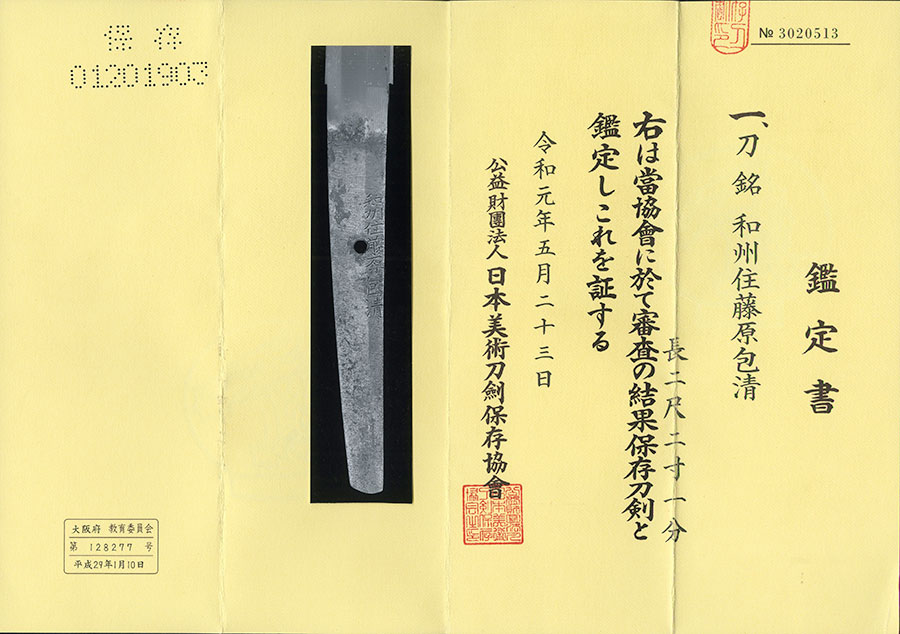
Certificate reading — 銘 和州住藤原包清