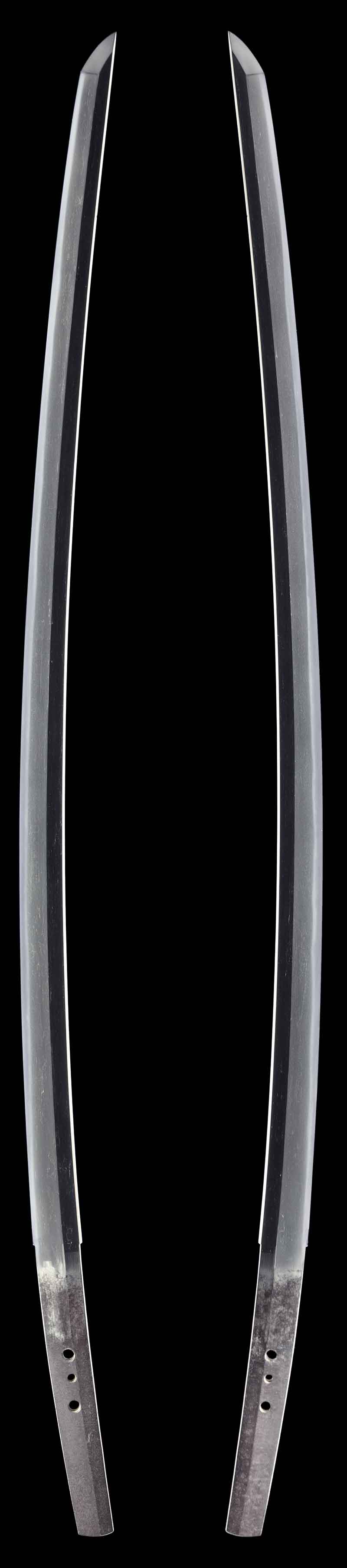
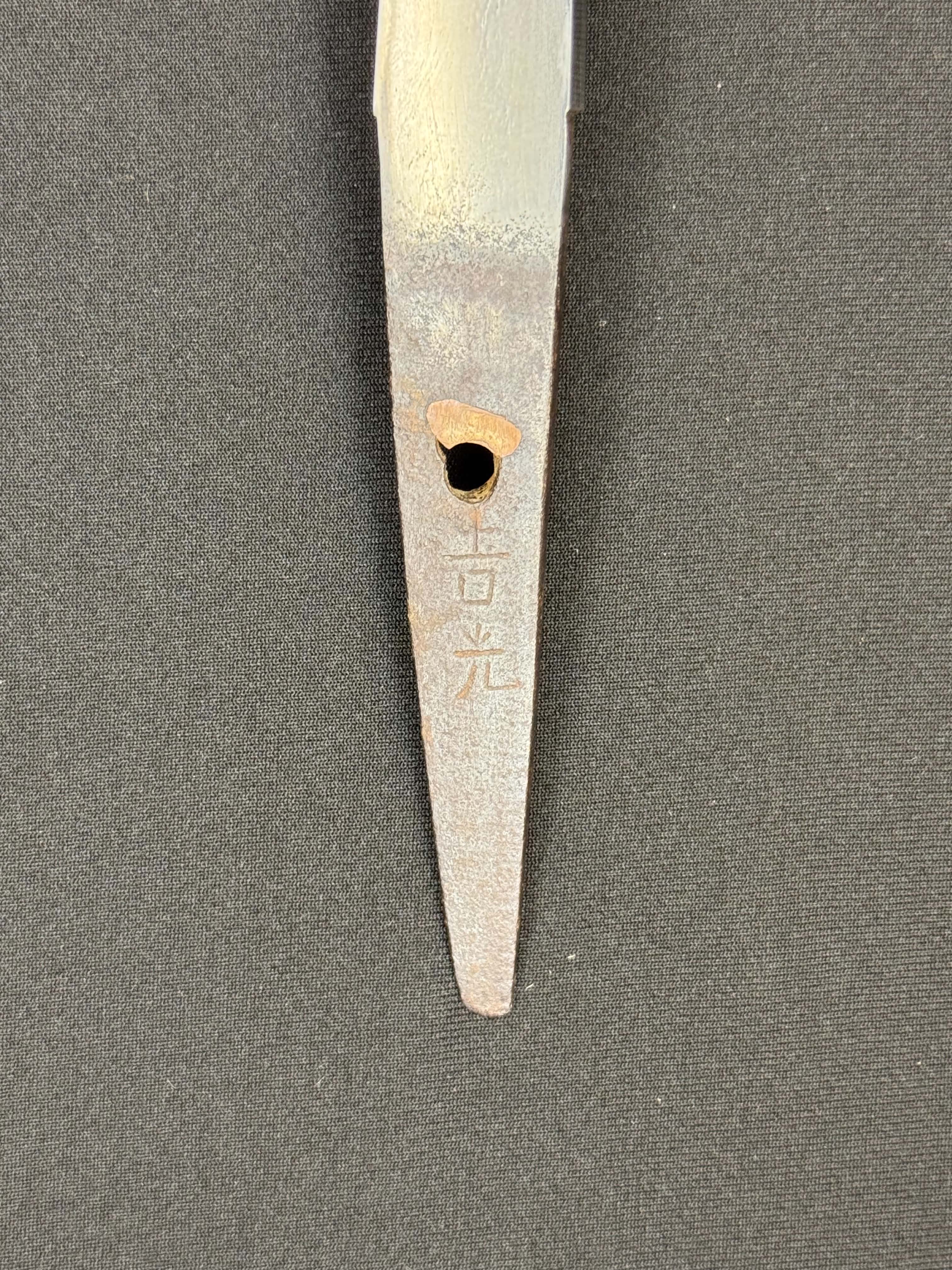
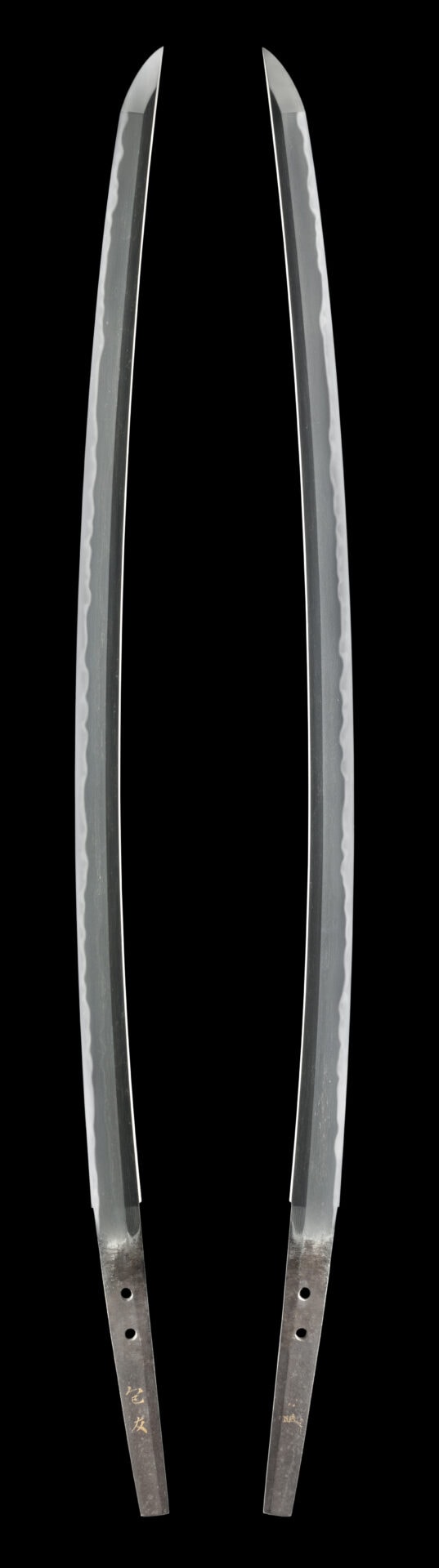
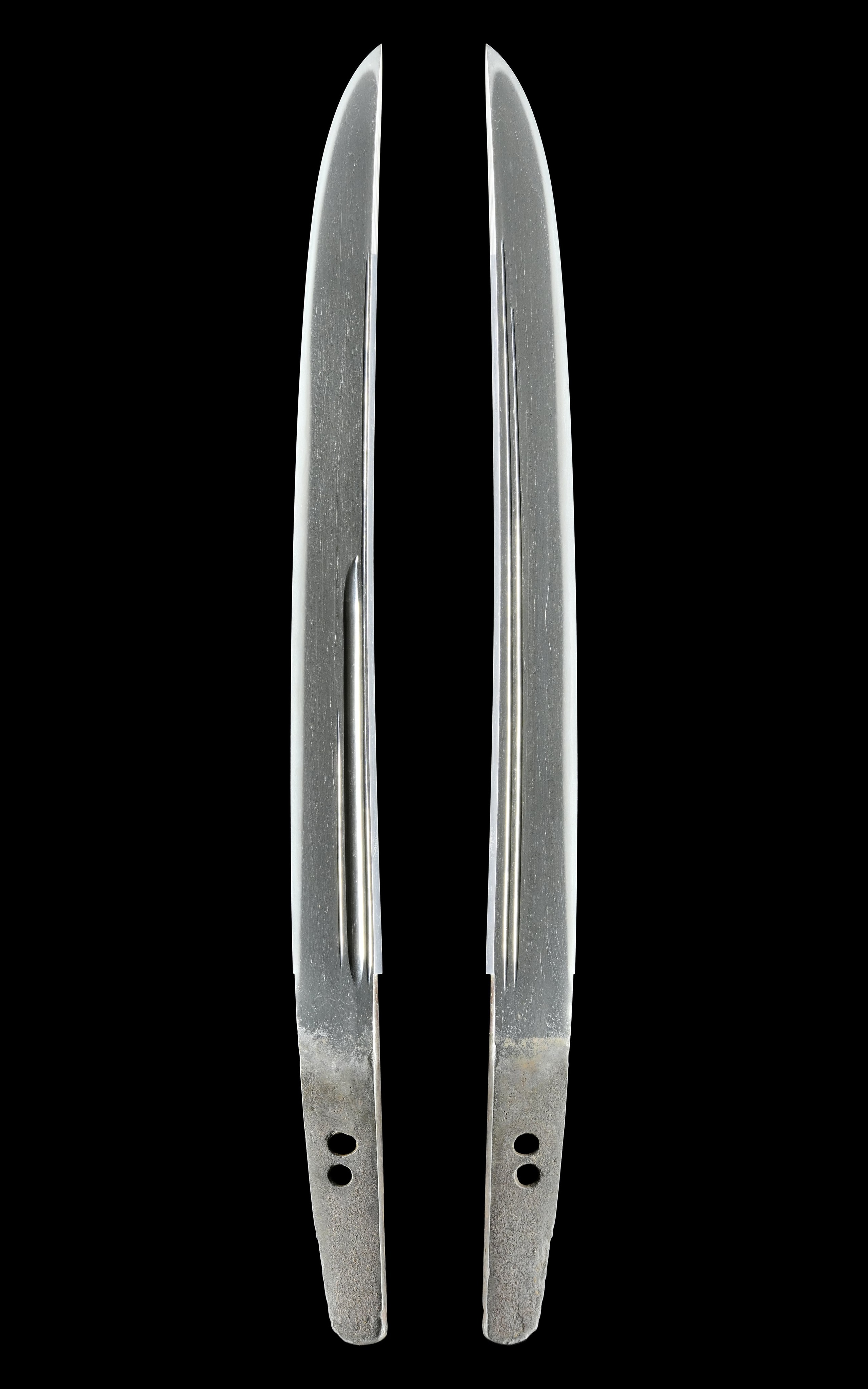
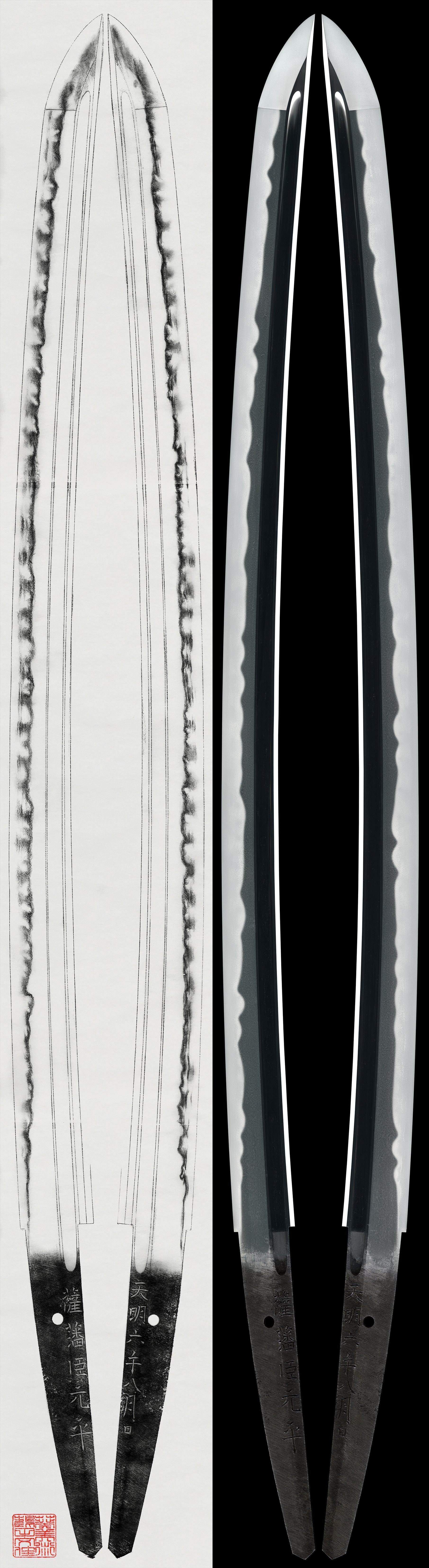
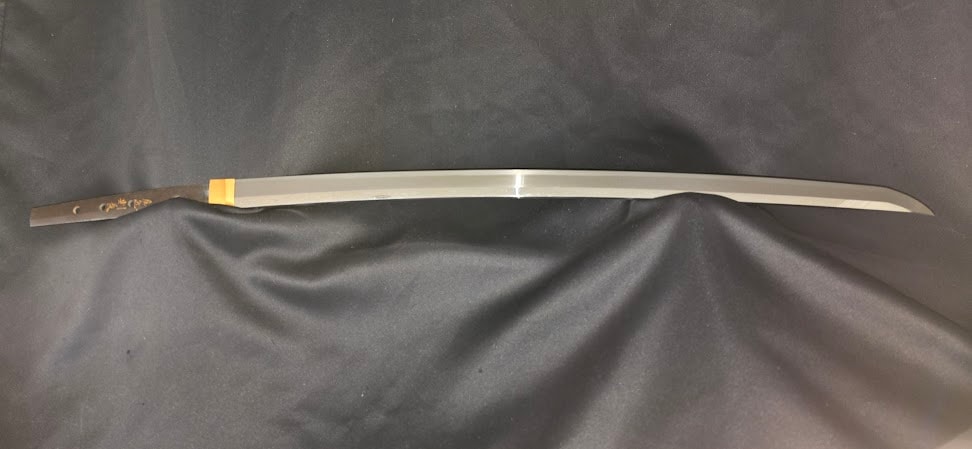
A dated to the second month of 3 (1370) carries the long signature Kuchū Saemon no Jō Kanekiyo , and it is the dated cornerstone of a name that the published record otherwise reconstructs from style alone. Kanekiyo was a swordsmith of the Yamato school, the line that resided outside the Tengaimon, the western great gate of Tōdai-ji, and that worked in a dependent relationship with the temple. The reference works transmit the first Kanekiyo as a son or a disciple of Kanenaga, with one tradition making him a son of the second-generation Kanenaga, and an extant dated Karyaku 4 (1329) anchors the family at the earliest end. The name was then carried across several generations down into the period. Of the five Yamato schools the published sources call the most prosperous, the one line that in the age appears to have absorbed the others so that it essentially alone continued, and Kanekiyo stands within that long descent as a representative hand.
His is a Yamato hand read first in the steel. Over a forging in which stands out, mixed with and a flowing grain, the lies thick and enter, he tempers a narrow that is never left plain. Along its edge run the activities by which the Yamato schools are known: that frays the , doubling the line, where the temper steps and crosses, with and fine sweeping through, the whole well charged with and the bright and clear. The answers the , running straight to a small and finishing in , the swept brushstroke at the point, the at times somewhat deep. On the the construction itself reads as Yamato, the standing high and the comparatively wide, a frame the published sources name when they accept the traditional attribution. Of one such the writes that the characteristics of the style are well manifested in both the and the , calling it a 「地刃に手掻流の特色がよく示され」 and a 「健全で出来のよい短刀」.
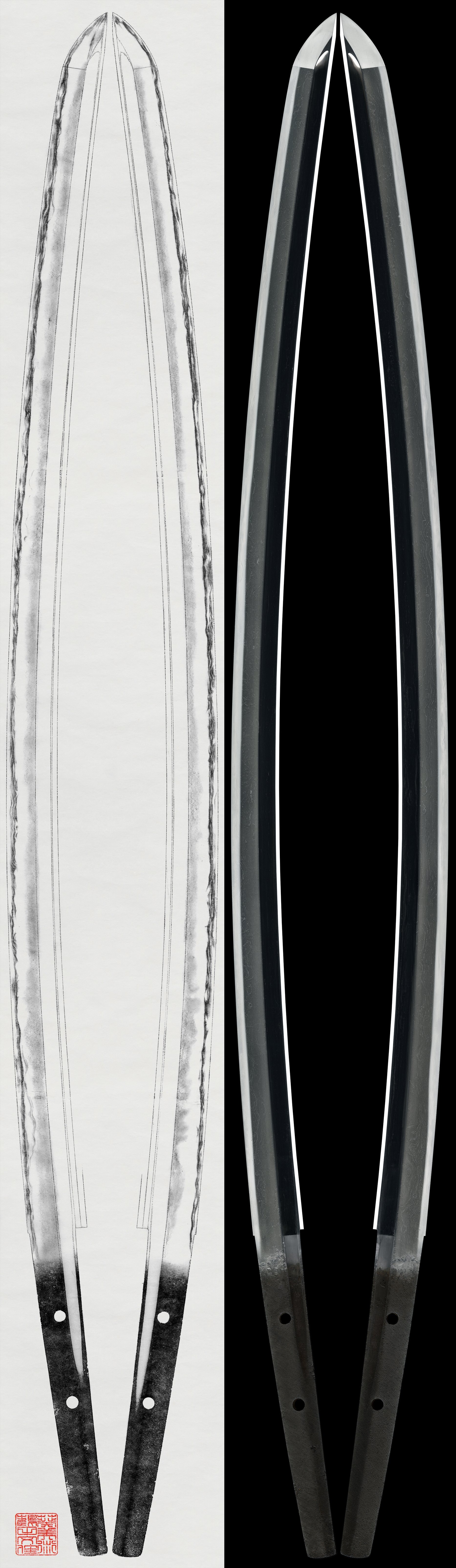
The is the more telling half of the pair. Where many Yamato hands run a quieter , Kanekiyo's grain stands and flows at once, the conspicuous on the wide-ridged and closing in beneath it, applied thickly and entering well, so that the surface carries a restrained brightness rather than the misty whiteness of plainer Yamato work. A faint whitish shows on the smaller pieces, the natural reflection of a steel forged in standing grain rather than a deliberate effect. Against this the keeps its discipline, but the activity never lets it settle: on the signed the line frays into and doubles into , the well formed with and entering, and the published sources find the school's hallmark precisely where the coarse sparkles, 「輝く荒目の沸がつくところに手掻派の特徴がよくあらわれており」. It is in this register that his work is most securely his own, a animated by Yamato and kept clear in its .
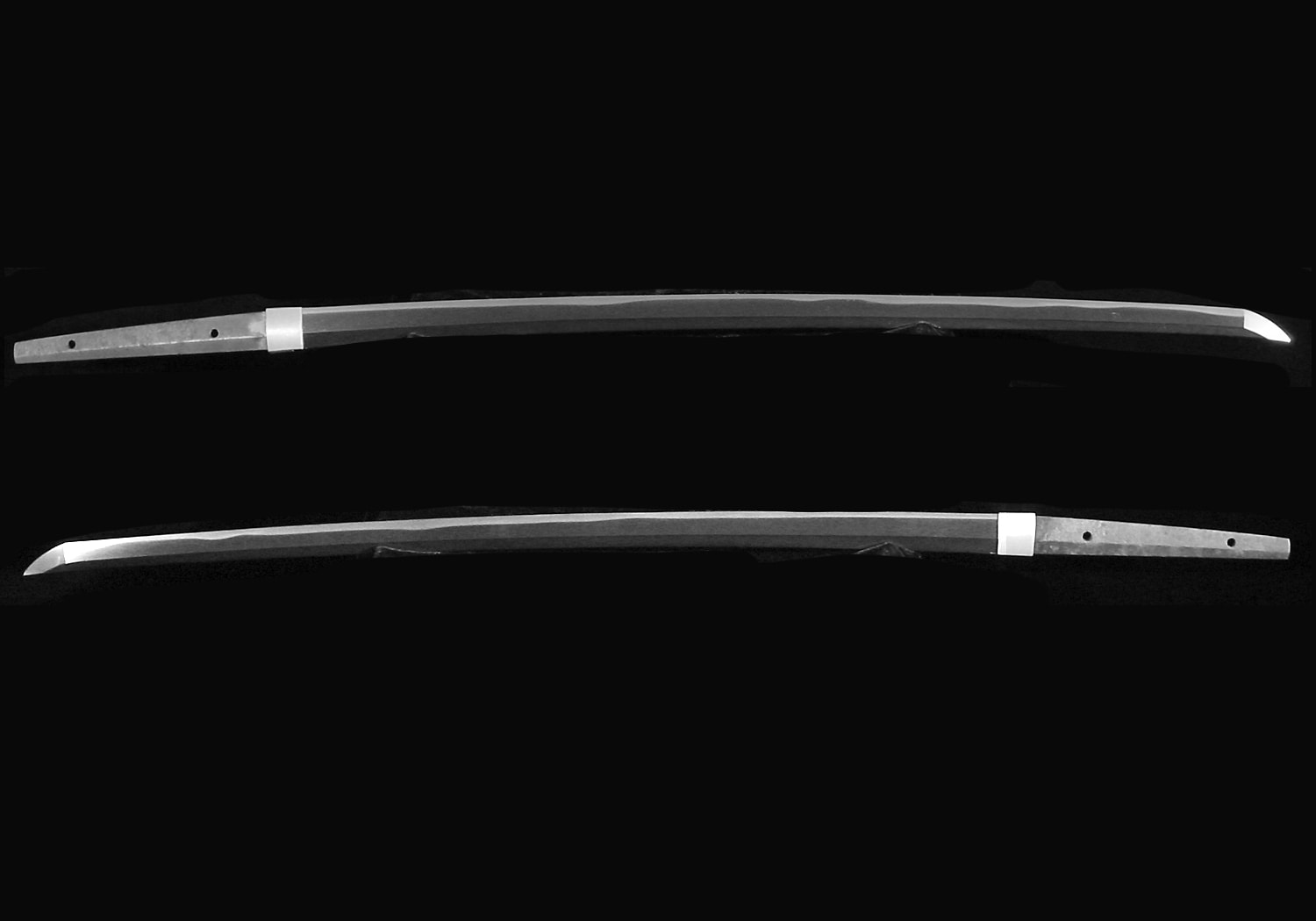
The corpus draws three points along a single descent. The bulk of the blades are the prime, -based and -laden, most of them and unsigned and attributed to Kanekiyo by the judges, the signed carrying the identical hand. The dated of 3 stands apart from these: somewhat wide in and slightly , its a shallow, large mixed with small and fraying into , strongly -laden with and , the growing especially strong and coarse in the upper half, the a jizō-gokoro on one face and a pointed turnback on the other. The published sources read this as the work that the genealogies place as a son of the second-generation Kanenaga, and they value its inscription as much as its forging, noting that 「銘文は資料的に貴重である」. The latest piece departs furthest: a signed in a bold five-character hand -jū Kanekiyo, whose ō-gunome-midare in a tone, with the also tempered and scattered into a tendency, the published sources read as closely resembling Sengo Muramasa, 「千子村正の作に近似する」, and prize as 「末手搔の作域を知る上でも好資料」 for the working range of late .
What sets him apart within his own school is best taken from his own blades rather than from contrast. His stands more openly than the quieter Yamato grain, his is fuller of and than a plain Hōshō line, and his is at its most characteristic where it grows coarse and bright along the upper edge. When the judges weigh a softening of the older manner they do so on his terms, finding one early , comparable to the contemporaneous Kaneshige and Kanetoshi in its deeply tempered , nonetheless 「同時代のものの中で優れたものである」. Toward the end of the line that gives way to the close to Muramasa, and the school whose founder Kanenaga worked a is thereby traced, through Kanekiyo's hand, down into the Eishō and Kyōroku eras. The arc from a to a late is the descent of late itself, told in one name.
Kanekiyo is held entirely in the tier rather than the topmost ranks: the record carries eight blades and none in the higher designations, and the smith's toko-taikan standing is mid-range among names. Several of the are pieces brought to him by appraisal, one bearing a gold-inlaid attribution by Kōichi that the published sources read as indicating not Kanenaga himself but a smith of slightly later date. No provenance attaches to the recorded blades, and no current institutional holder is on record, so the honest picture is of a smith preserved in private and designated hands rather than in the great museum collections. For a collector this means a Kanekiyo is among the more attainable of the old Yamato names without ever being common: his blades come to market from time to time, the signed and dated a rarity to be met with patience, the the likelier encounter, and the late -jū a singular reference piece. Of the soundest of his the writes 「地刃健やかにして出来がよく、同工極めの優品である」, and in another the character is judged 「手掻派の特色が十分に示されている」, the verdicts by which his work is best valued and met.