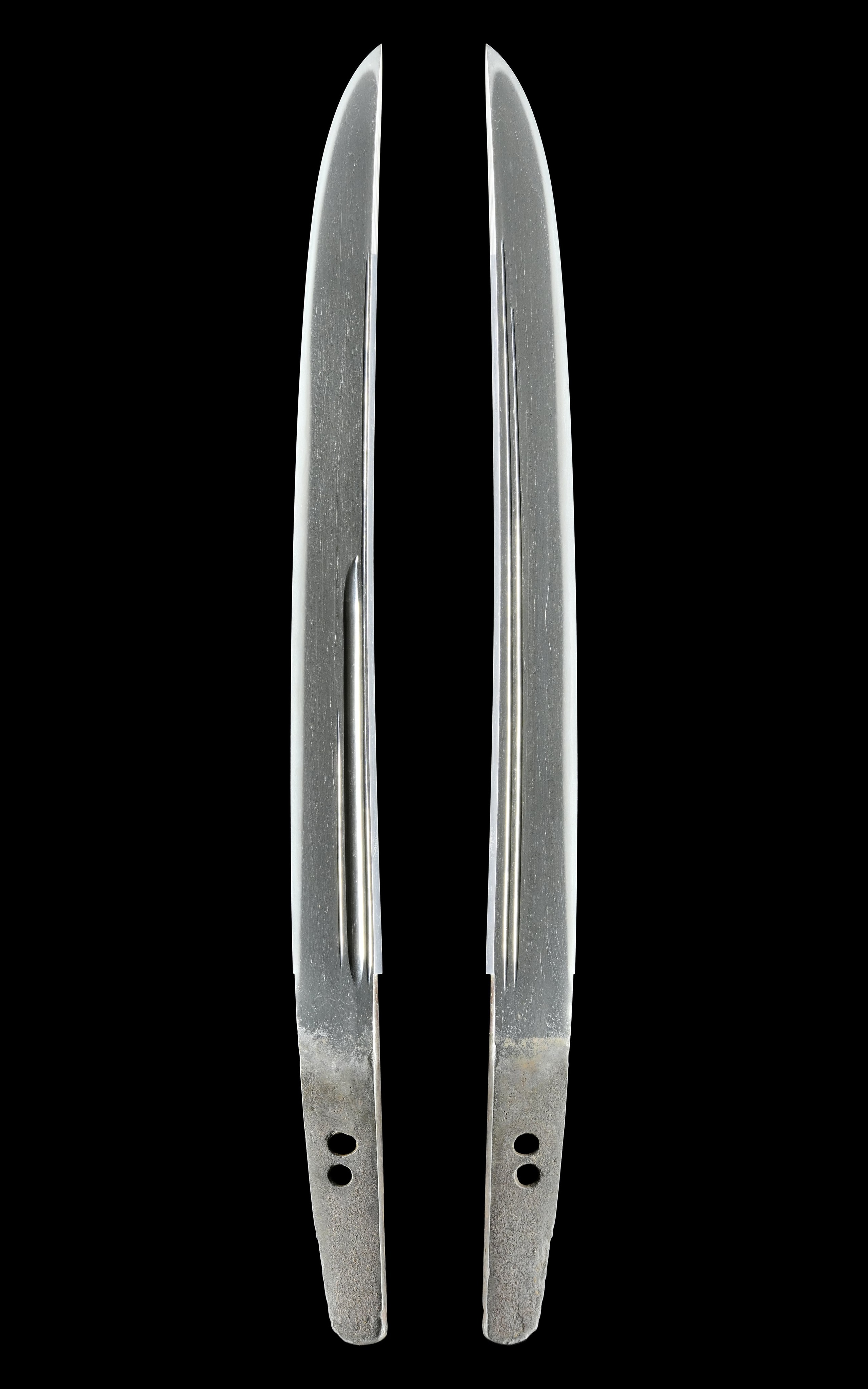
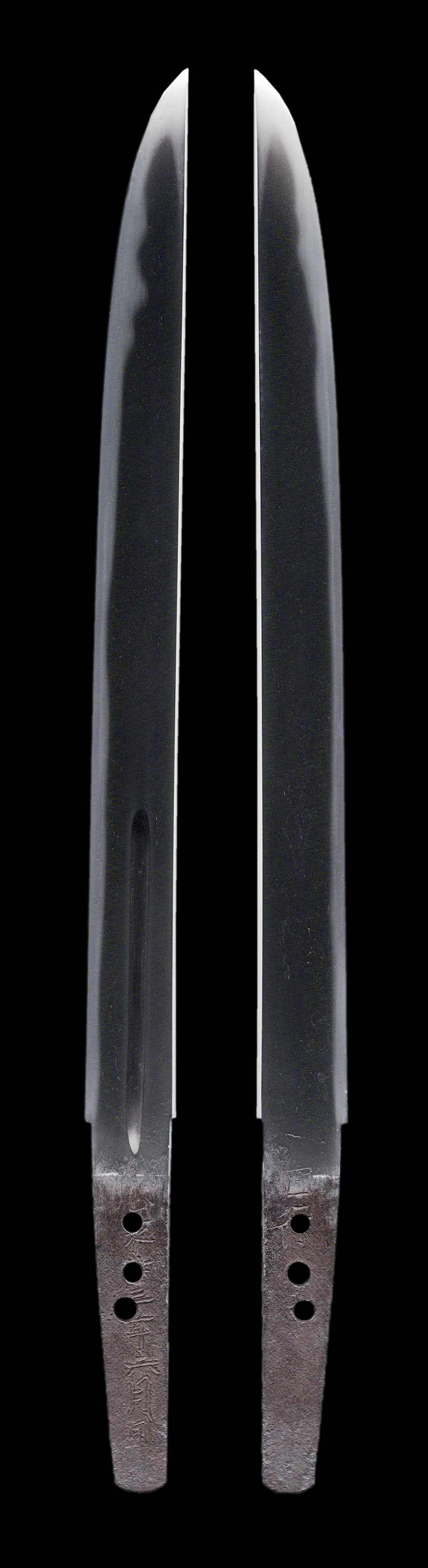
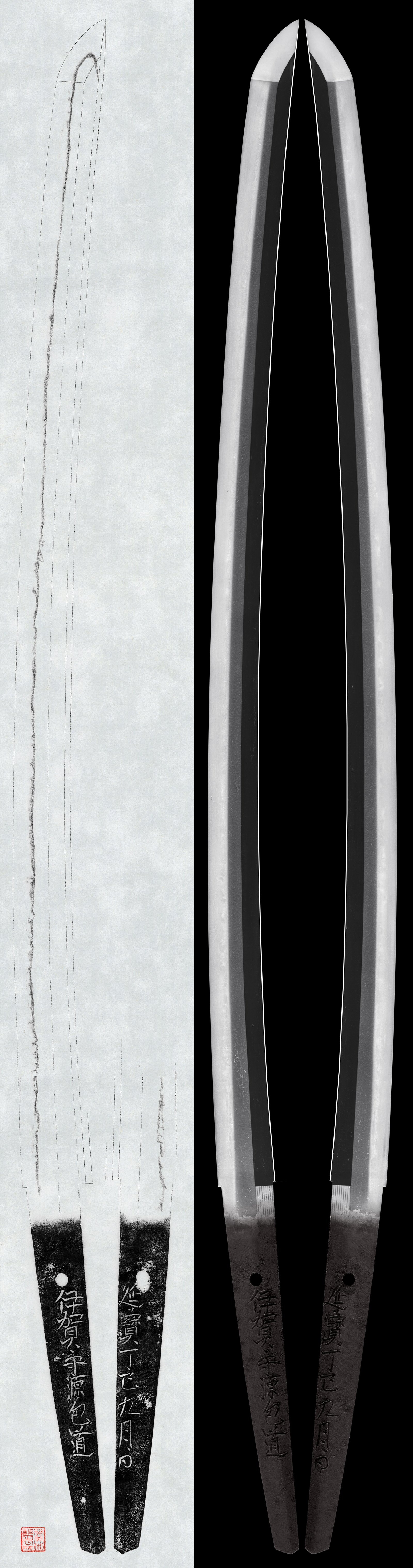
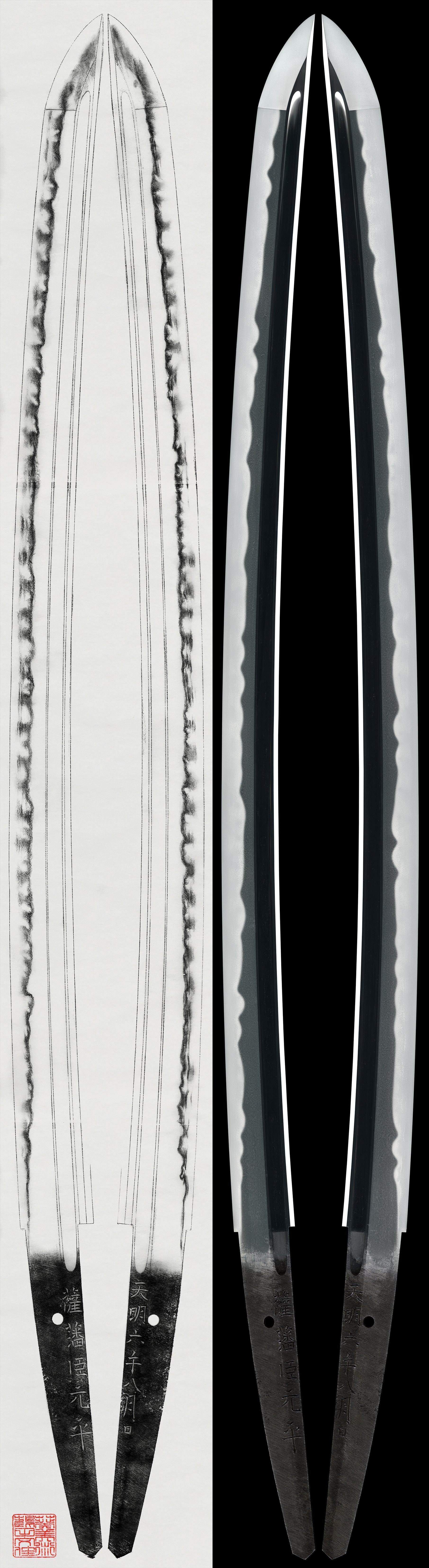
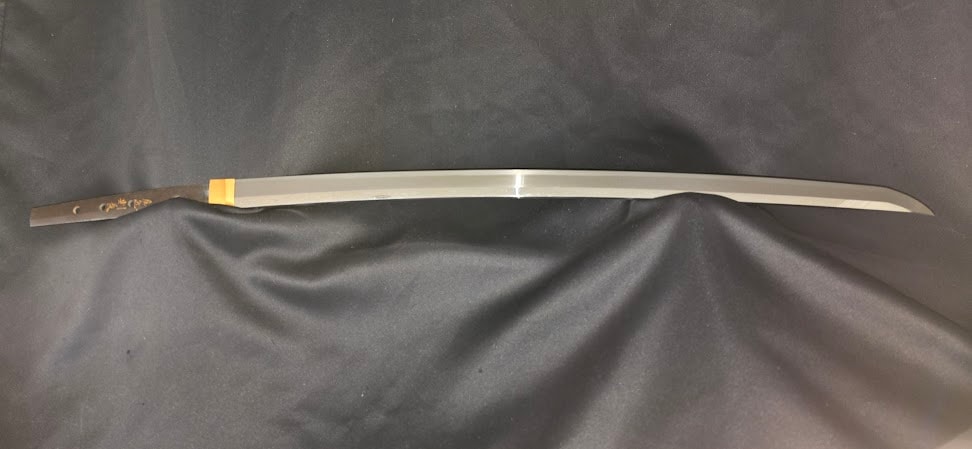
Among the four blades on record under this code is a signed dated Kyoroku 2 (1529) and inscribed Yamato-no- -ju Kanekiyo , a long signature cut high and prominent across the tang. The piece fixes the smith squarely within the school of Yamato, the line that the published sources call the largest of the five Yamato traditions and that is said to have taken its name from the branch which resided and forged outside the Gate, the western great gate of Todai-. Kanekiyo was a name carried across several generations, beginning by tradition with a son of the founder Kanenaga; the reference works count seven successive Kanekiyo spanning from the Karyaku era at the close of the period through the Tenbun era at the end of the . This particular hand the reads, from the workmanship of the and and the manner of the signature, as the Kanekiyo active around the Oei era of the early period, and his record is almost entirely one of signed, blades rather than the attributions that gather under the older generations of the school.
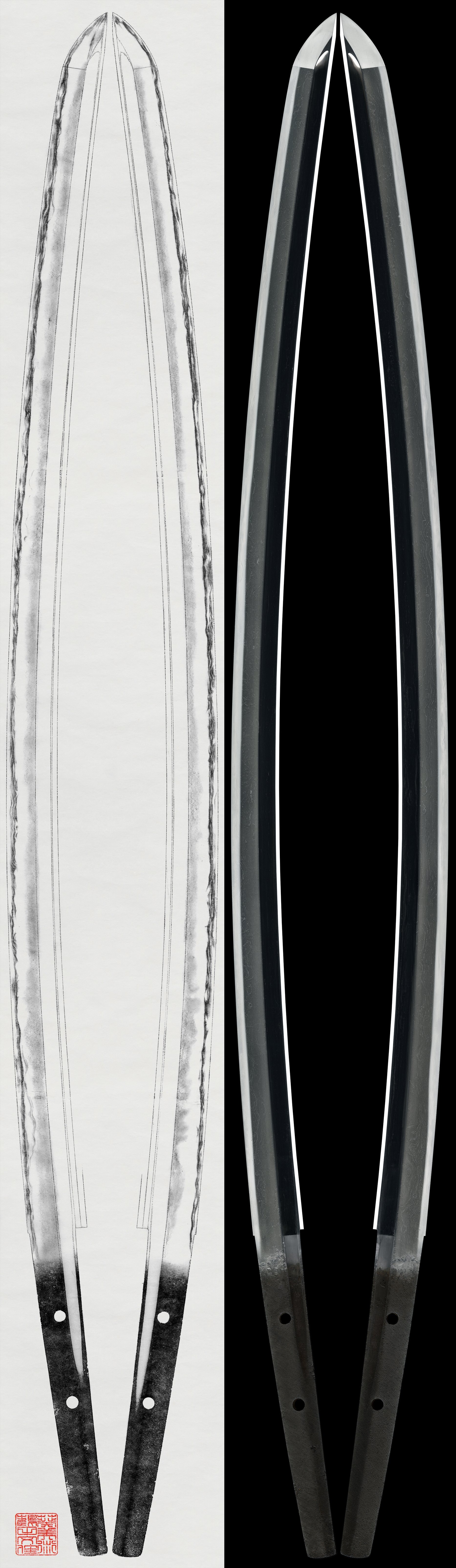
The hand is a Yamato animated from within rather than a flamboyant one. Over a forging of , or a dense , that takes on a flowing and turns toward as it nears the edge, he tempers a base into which slight and linked small enter, the whole laced with the activity the school is known for. The published sources describe one as with and mixed in, the showing and the suggestion of uchi-noke, the tight with well adhering and appearing, and conclude that such traits 「大和手掻派の作風をよく示している」, that they clearly display the characteristic style of the Yamato group. Crossing and mismatched , a two-tiered impression, drifting into the , all belong to the register. It is a restrained temper read at close range, where the lies in the Yamato details worked into a calm line rather than in any large pattern.
The carries the Yamato reading. The is well worked and dense, but toward the edge it flows and stands in grain, and on one the published sources note that the rises and mixes outright. Thick gathers across it, enter, and a whitish can stand toward the , described in one case as and in the late dated as a cast that stands up in the steel. The follows the Yamato grammar of the school: it runs straight to a pointed turnback with on most blades, or comes in as a that points and returns, the at times carried somewhat deep. On the he adds a that the published sources single out, a carved on both faces and described as 「彫深く、力があり、大和物に見る特色あるものである」, cut deeply and with force, a distinctive feature of Yamato work.
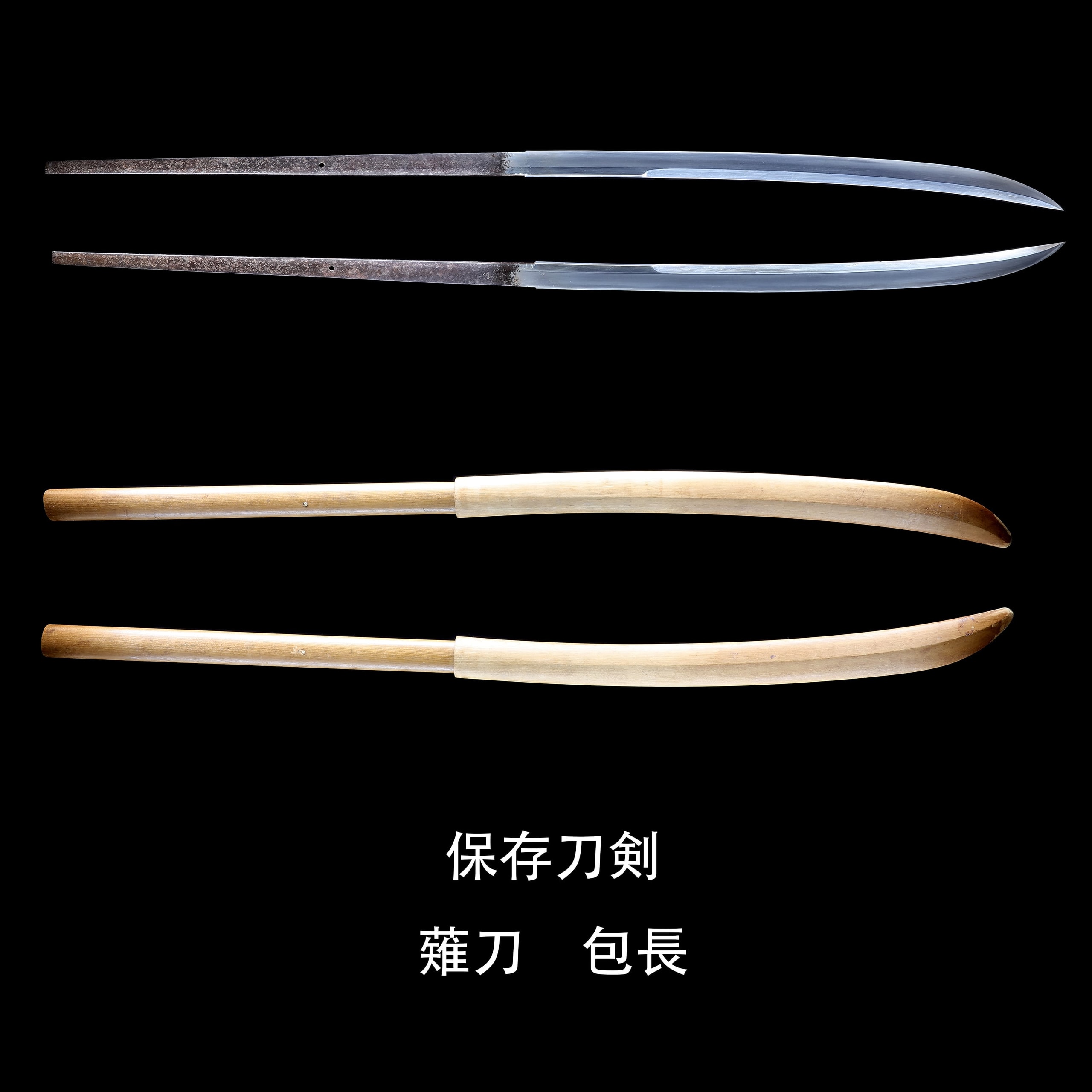
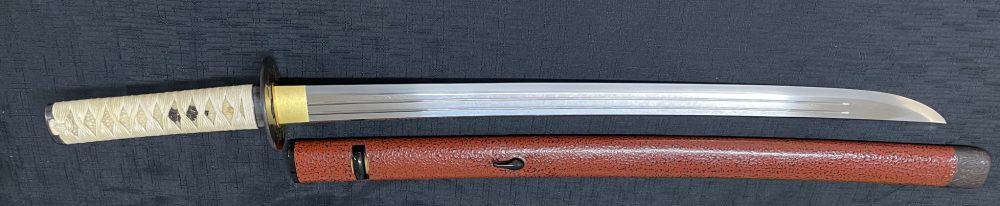
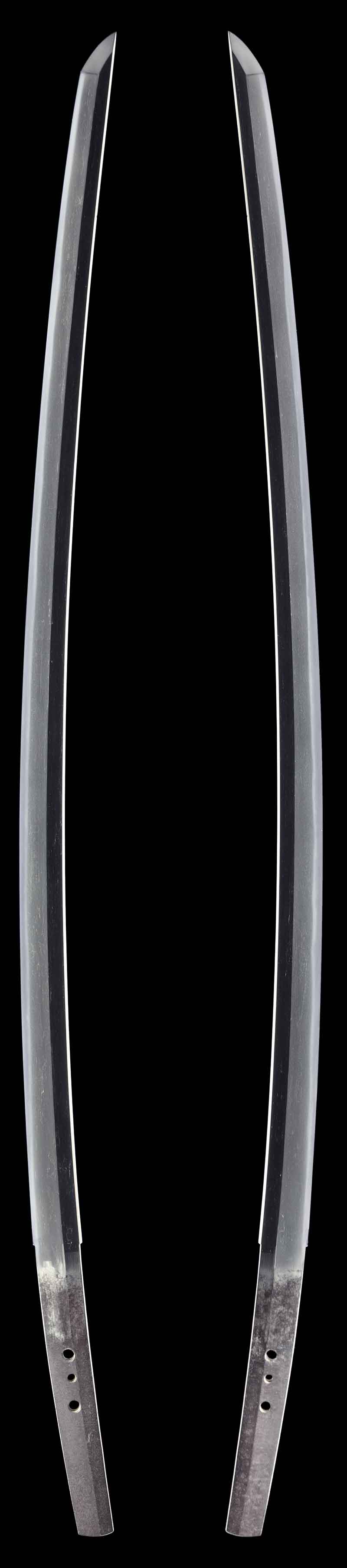
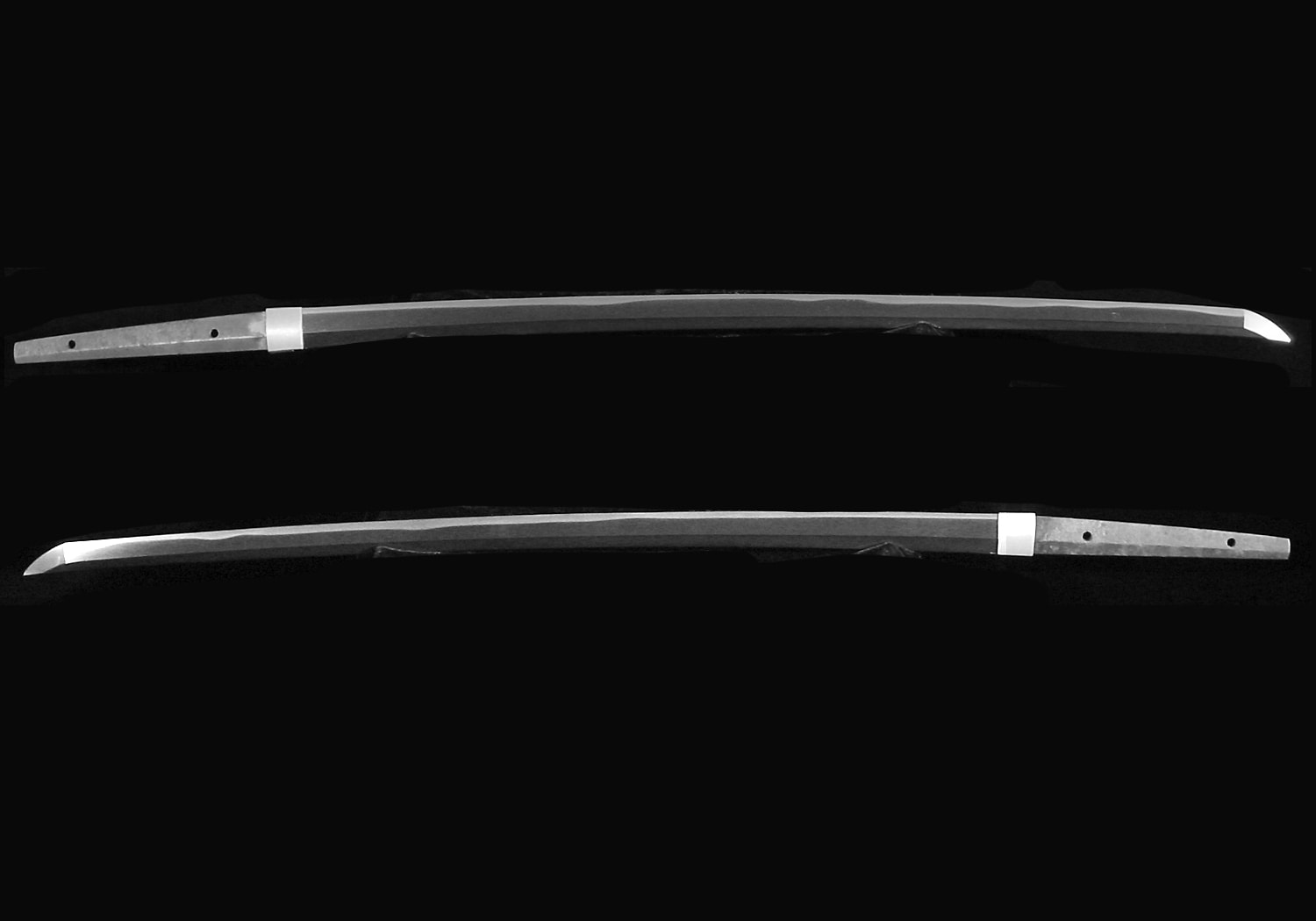
Across the four blades the hand is read at three points of the early- range. The core is the signed Oei-period , with a and a thick, sturdy , of standard proportions and without , on which the -and- Yamato manner is at its clearest. Beside it stands a wide that carries the Oei at its most legible: the somewhat broad, the blade large and relative to its width, with slight , the shallow and -tinged and, along the edge, intermittent that the published sources describe as strongly lustrous, 「刃縁に光の強い二重刃が断続的にきらめく」, sparkling in and out of the temper above a bright . The latest is the Kyoroku 2 , a blade with and an elongated , its tending to , its mixed with and , the file marks cut in taka-no-. The published sources read it together with those file marks as 「末手掻の特色をよく示したもの」, a piece that well shows the features of late , and value its Kyoroku date as material. The two-character signatures and the long -ju inscriptions mark the name across that span.
What sets the work apart within its own school is best drawn from his own attested traits rather than by contrast. His is a quieter, well-worked that only flows and leans toward near the , and a whose interest lies in the linked small , the and the lustrous rather than in any departure into a wide irregular pattern. The earlier generations of the line keep a more emphatically standing grain and a stronger , while this Oei hand holds the calm line and reads at close range; the published sources draw the distinction through the Oei and the manner of the signature. The published sources read the wide as 「室町初期手掻派の特色を顕現した典型作」, a typical work that fully manifests the distinctive features of the early- school, which is the standing the corpus supports: a representative late-Tegai hand of the Oei era, sound in and , holding the school's Yamato grammar at a moment when the five traditions had effectively narrowed to this one continuing line.
For the collector the record is small and entirely at the level. Four blades by this Kanekiyo hold papers, with no National Treasure, no Important Cultural Property and no among them, and none carries a recorded provenance or a named institutional holder, so the honest picture is of a smith known from a handful of designated works rather than from a roll of famous pieces. Of the four, two sit in the broadly tradeable tier, which means that an example reaches the market only from time to time and with patience, not that one is readily found; the signed , the and the dated are the forms in which he survives. A signed, dated, blade of late is uncommon on its own terms, and the Kyoroku in particular, with its full -ju signature and era date, is the kind of piece a collector encounters seldom and keeps as a fixed point for the school. He is acquirable in a way the great names are not, but a recorded example remains a deliberate find rather than a casual one.