War at home and trade abroad made Muromachi Bizen the busiest forge region in Japan: a century of Sengoku demand after the Ōnin War, and export missions to Ming China carrying blades by the tens of thousands.
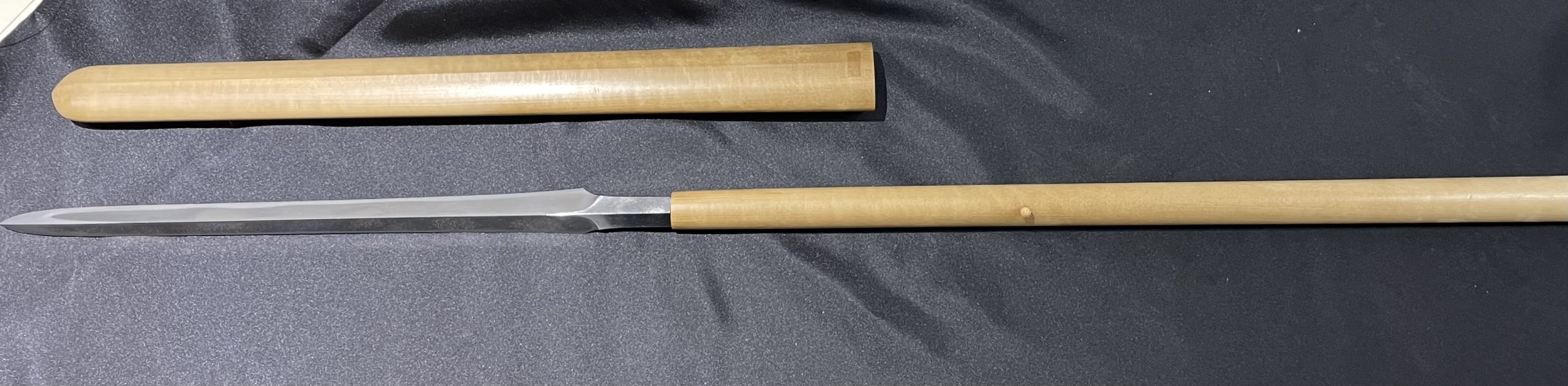
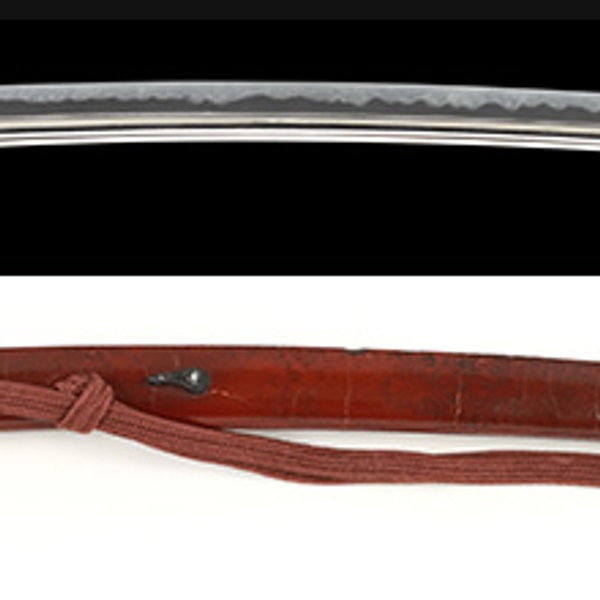
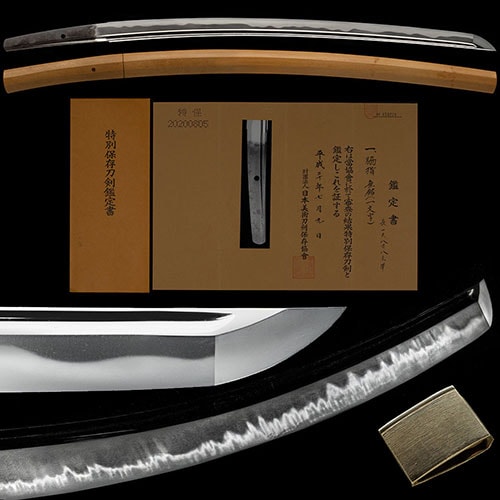
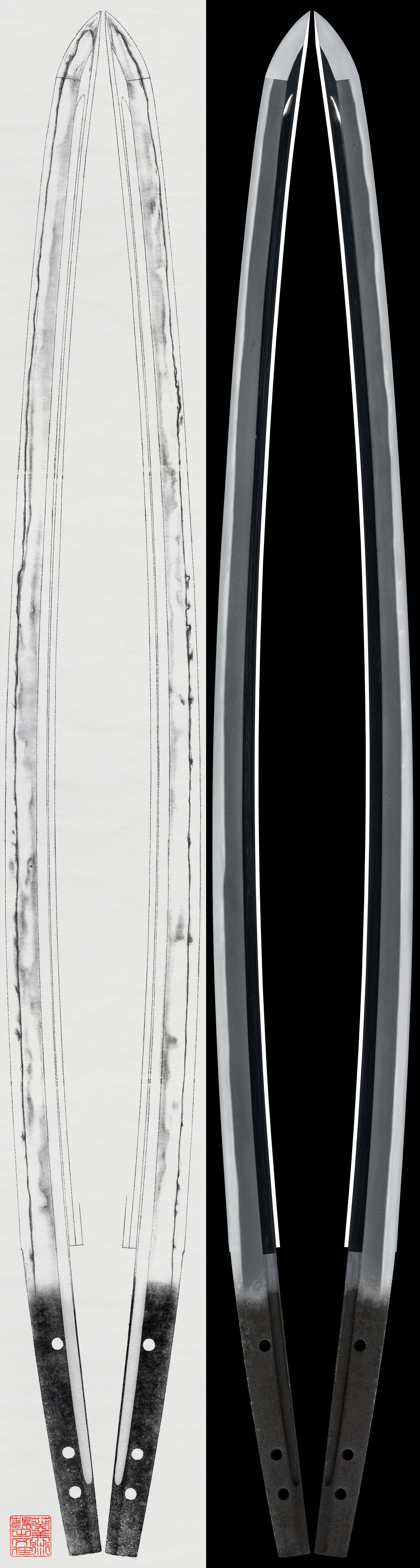
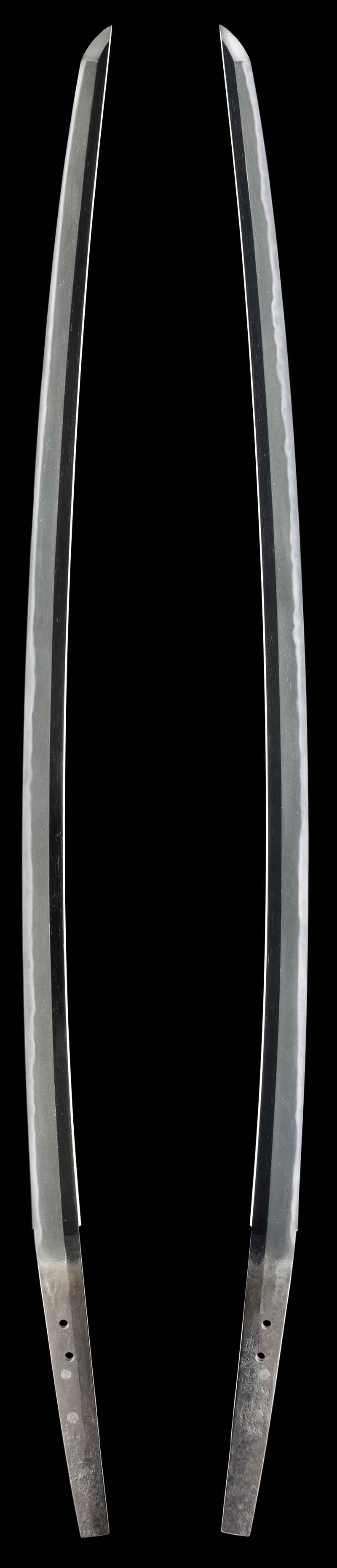
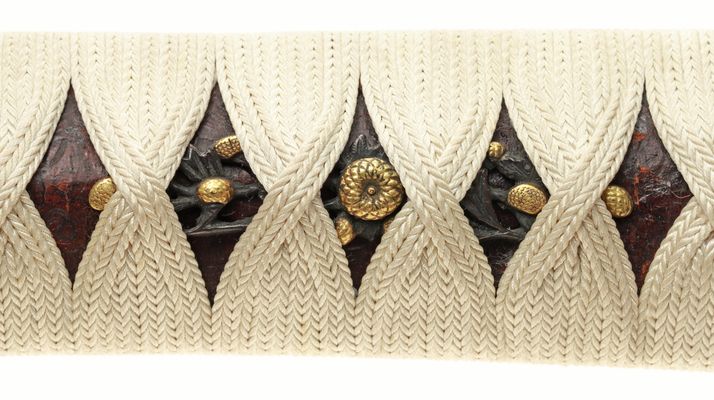
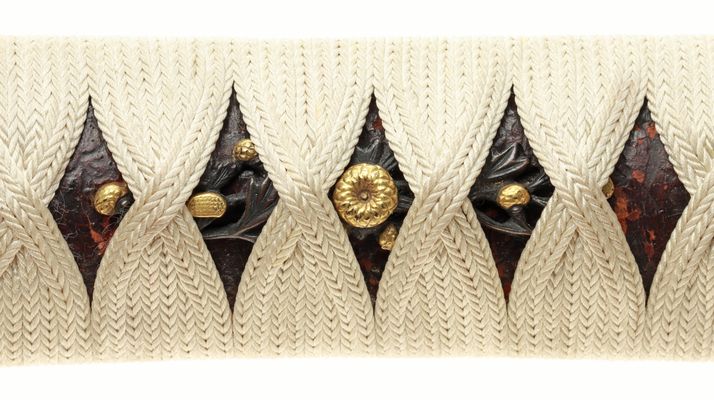
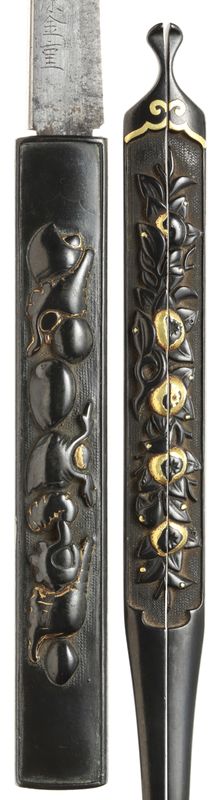
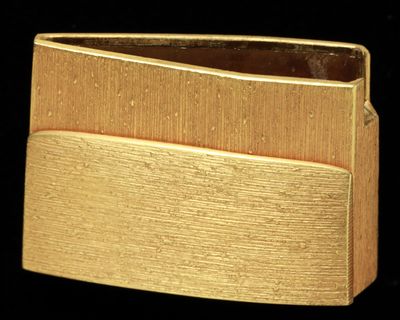
This beautiful katana by Arimitsu, a smith of the Bizen Osafune school, dates to the Bunmei era (1478). It features a graceful form reminiscent of a kodachi, with a bo-hi carving and a short, robust tang. The blade comes with a gold-foiled double habaki, shirasaya, and an aikuchi koshirae with a tea-colored leather-wrapped saya.
 NihontoWatch
mei · Osafune · Muromachi · nagasa 65.5cm · sori 1.82cm











Bizen-den · Bizen · around 1361-1375
Tōken Taikan top 21%
2 pieces on the market now
Arimitsu (在光) was a swordsmith of the Sue-Bizen tradition working at Osafune. Reference works enumerate six smiths bearing this same name. Among the representative masters are a Zaiko who held the honorary title Izumo no Kami, active chiefly around the Eisho era (1504--1521), and another known as Kurozaemon no Jo, active around the Tenbun era (1532--1555). Izumo no Kami Zaiko stands as a figure of particular note: just as Seki produced Izumi no Kami Kanesada, so too Osafune in the koto period produced smiths granted court titles, yet among works by smiths whose names include the character mitsu (光), examples bearing such a conferred title are exceedingly few. The Kurozaemon line is documented through commissions that record both the smith's common title and the names of patrons, offering valuable evidence of the workshop's clientele during the final decades of Bizen production.
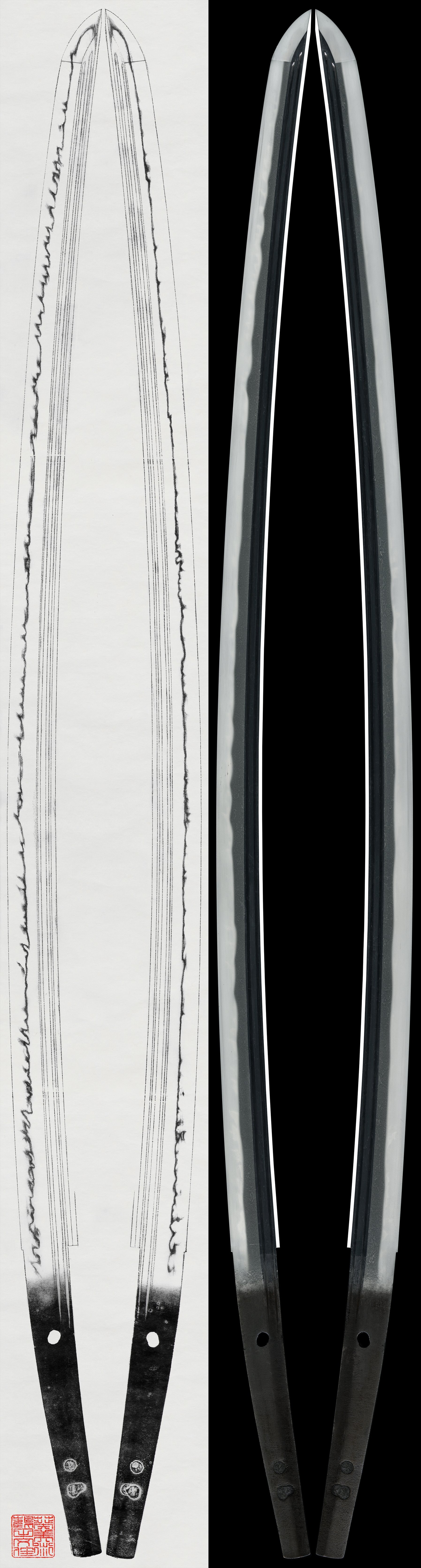
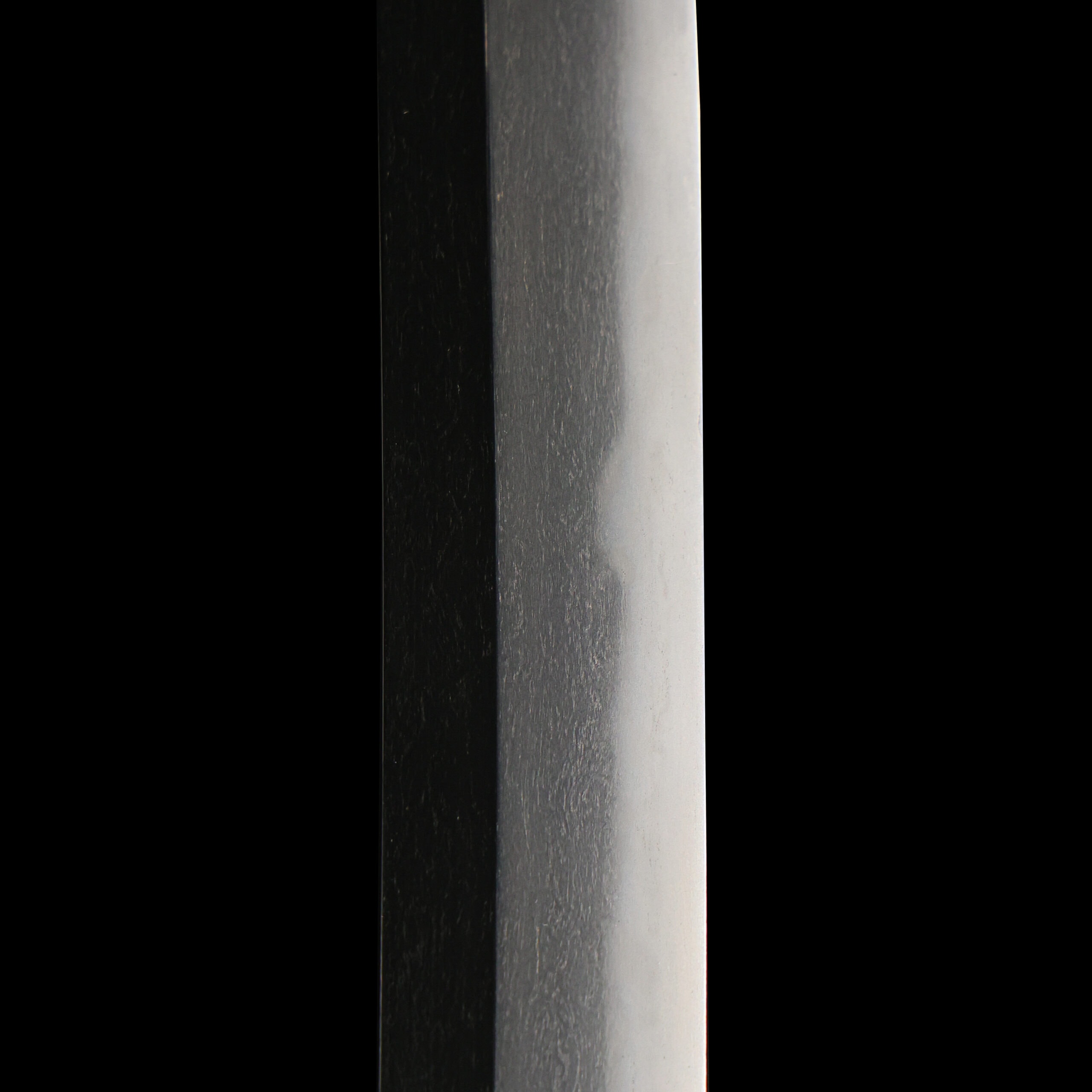
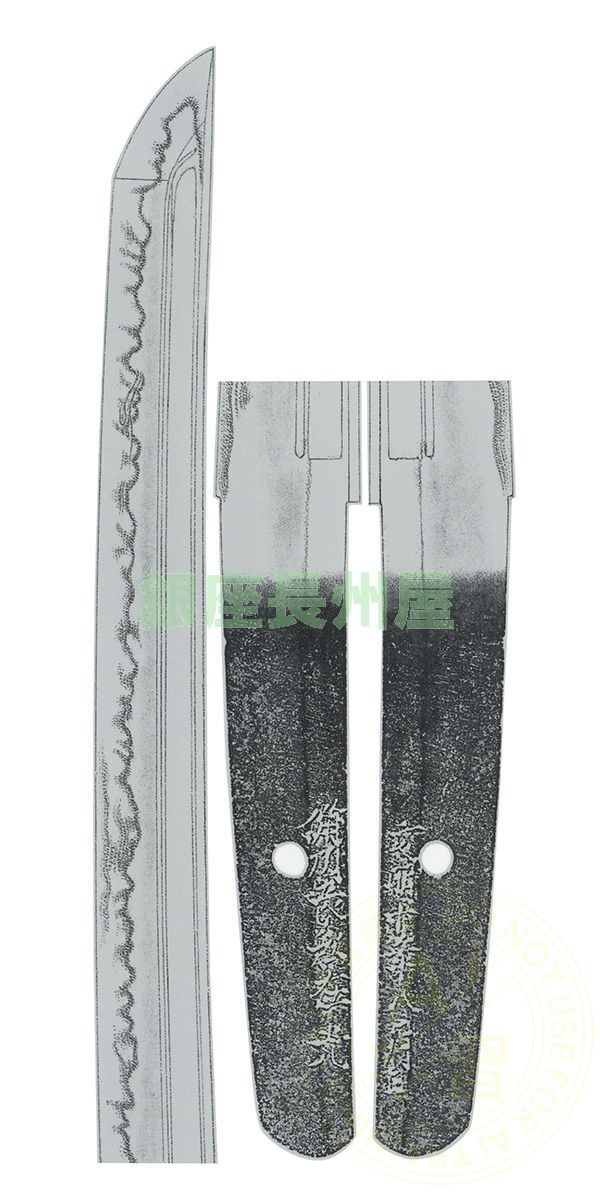
The workmanship of the Arimitsu line displays the characteristic dekiguchi of Sue-Bizen at its most accomplished. The forging is tightly packed ko-itame mixed with ko-mokume, with very fine ji-nie, delicate chikei, and vivid midare-utsuri standing out distinctly. The tempering centers on gunome with a widened koshi profile (koshi-biraki), intermixed with choji, ko-gunome, togariba, and angular forms, in places becoming a compound (fukushiki) midare. Within this tempered edge, ashi and yo are active, with nie adhering to a tightened nioiguchi and fine sunagashi and partial kinsuji running through. Certain works display yubashiri and small tobiyaki, imparting further variation. The Kurozaemon generation also produced blades in chu-suguha mixed with gunome, showing the broader stylistic range available within the lineage. Blade forms are typically compact, with strong sakizori and short ubu tangs that do not taper -- features constituting the classic Sue-Bizen uchigatana shape.
The NBTHK consistently praises works of this lineage for their careful execution and bright, clear impression in both ji and ha. Blades retain ample nikuoki and are frequently noted as preserved in kenzen condition. The forging is described as well-kneaded, and the nioiguchi is characteristically saeru -- clear and bright. Since extant works by these smiths are comparatively few, each authenticated example is regarded as fully demonstrating the high level of technique within the Arimitsu line and is especially precious as reference material, with dated inscriptions providing important documentary value for the study of late Muromachi-period Bizen production.
Where Arimitsu stands among comparable artisans: across all of nihontō, and within tradition, era, and period. The tiers (Foremost · Leading · Major · Notable) weigh official designations from the NBTHK and Japan's Agency for Cultural Affairs, together with historical honors of lasting repute such as the Sansaku and Meibutsu-chō.
Select a lens to see how it's measured.
Bizen-den · Bizen
Phase: Sōden-Bizen相伝備前· 1330–1394
237 pieces on the market now
The Soden Bizen school encompasses the group of Nanbokucho-period Osafune smiths in Bizen Province whose work absorbed the technical influence of the Soshu-den, producing a distinctive synthesis that stands apart from both orthodox Bizen and pure Sagami practice. The school divides into two principal lineages: the Kanemitsu group, representing the direct main line of Osafune that descends from Mitsutada through Nagamitsu and Kagemitsu; and the Chogi group, a collateral branch whose members carried the Soshu idiom to its most expressive extremes within Bizen. Kanemitsu, the chakuryu heir of Kagemitsu, pioneered the broad, relaxed notare-based midare that defines the mature Nanbokucho Osafune manner, while Chogi -- described by the NBTHK as the smith "who departs furthest from Bizen" among Bizen makers -- pushed nie-dominant forging to a level that rivals the output of the great Sagami smiths themselves. Together with disciples and contemporaries including Tomomitsu, Motomitsu, Masamitsu, Yoshimitsu, Kanenaga, Nagashige, and Nagamori, they constitute one of the most prolific and technically accomplished groups in the history of Japanese swordsmithing. The school's collective technical identity is anchored in a shared jigane of itame-hada mixed with mokume, with fine ji-nie adhering thickly, chikei entering well, and midare-utsuri standing out -- a persistent Bizen hallmark that survives even in the most Soshu-inflected work. The sugata overwhelmingly reflects the grand Nanbokucho taihai: wide mihaba with little taper between base and tip, and an extended chu-kissaki or o-kissaki conveying martial vigor. Within this shared framework, two distinct temperaments emerge.
" Yoshimitsu likewise inherits the small-pattern tendency, producing ko-gunome mixed with ko-choji whose restraint the NBTHK praises as "upper rank" Soden Bizen. The Chogi lineage, by contrast, emphasizes powerful nie in both ji and ha: Chogi's flamboyant large-scale midare weaves together gunome, choji, togariba, and koshi-hiraki forms with tobiyaki and yubashiri scattering freely, while kinsuji and sunagashi streak through the hardened edge. " Nagashige, now thought to be Chogi's elder brother rather than his junior, works a gentler, smaller-patterned midare yet with nie so strong as to "even surpass Chogi," while Nagamori occupies an intermediate position, his "somewhat smaller patterning" accompanied by rich internal activity. The historical significance of the Soden Bizen school lies in its demonstration that the Soshu influence, far from merely displacing Bizen conventions, catalyzed an extraordinary expansion of the Osafune repertoire. " The NBTHK's evaluative language across the school converges on consistent themes: the forging is "meticulous" and "excellent-quality," the nioiguchi "bright and clear," and the finest examples display a kenzen condition that attests to the soundness of Bizen steel at its peak. The abundance of dated inscriptions -- from Kanemitsu's forty-five-year span through Masamitsu's four-decade career extending into the early Muromachi period -- provides an unusually well-documented chronological framework, with later works by Masamitsu and Yoshimitsu pointing toward the subsequent development of Oei Bizen. Within the broader canon, the Soden Bizen school stands as the fullest realization of the creative possibilities that emerged when two of Japan's greatest forging traditions met and merged. Learn more →
| Smith | Era | Designated |
|---|---|---|
| Mitsutada光忠 | 1238-1239 | 60 |
| Nagamitsu長光 | 1274-1304 | 244 |
| Kagemitsu景光 | 1303-1336 | 143 |
| Kanemitsu兼光 | 1323-1370 | 231 |
| Sanenaga眞長 | 1299-1309 | 64 |
Bizen in the Muromachi period
War at home and trade abroad made Muromachi Bizen the busiest forge region in Japan: a century of Sengoku demand after the Ōnin War, and export missions to Ming China carrying blades by the tens of thousands.
A Hozon-certified blade judged to show notably superior workmanship and a better state of preservation. The bar is higher: re-tempered blades and most unsigned Muromachi/Edo works are excluded.
The NBTHK (Nihon Bijutsu Tōken Hozon Kyōkai, the Society for the Preservation of Japanese Art Swords) is a public-interest incorporated foundation founded in 1948 and supervised by Japan’s Agency for Cultural Affairs (Bunkachō); it is based at the Japanese Sword Museum in Tokyo. Its expert panels physically examine each submitted work (shinsa) and issue a certificate (kanteishō) ranking it by artistic and historical merit. NBTHK papers are the most widely recognized standard of authentication for Japanese swords and fittings.
NBTHK official siteIf, due to our fault, the item differs significantly from its proper condition, the item may be returned. Cooling-off is within one week of the item's arrival.

Price on request
This beautiful katana by Arimitsu, a smith of the Bizen Osafune school, dates to the Bunmei era (1478). It features a graceful form reminiscent of a kodachi, with a bo-hi carving and a short, robust tang. The blade comes with a gold-foiled double habaki, shirasaya, and an aikuchi koshirae with a tea-colored leather-wrapped saya.
NihontoWatchmei · Osafune · Muromachi · nagasa 65.5cm · sori 1.82cm
Bizen-den · Bizen · around 1361-1375
Tōken Taikan top 21%
2 pieces on the market now
Arimitsu (在光) was a swordsmith of the Sue-Bizen tradition working at Osafune. Reference works enumerate six smiths bearing this same name. Among the representative masters are a Zaiko who held the honorary title Izumo no Kami, active chiefly around the Eisho era (1504--1521), and another known as Kurozaemon no Jo, active around the Tenbun era (1532--1555). Izumo no Kami Zaiko stands as a figure of particular note: just as Seki produced Izumi no Kami Kanesada, so too Osafune in the koto period produced smiths granted court titles, yet among works by smiths whose names include the character mitsu (光), examples bearing such a conferred title are exceedingly few. The Kurozaemon line is documented through commissions that record both the smith's common title and the names of patrons, offering valuable evidence of the workshop's clientele during the final decades of Bizen production.
The workmanship of the Arimitsu line displays the characteristic dekiguchi of Sue-Bizen at its most accomplished. The forging is tightly packed ko-itame mixed with ko-mokume, with very fine ji-nie, delicate chikei, and vivid midare-utsuri standing out distinctly. The tempering centers on gunome with a widened koshi profile (koshi-biraki), intermixed with choji, ko-gunome, togariba, and angular forms, in places becoming a compound (fukushiki) midare. Within this tempered edge, ashi and yo are active, with nie adhering to a tightened nioiguchi and fine sunagashi and partial kinsuji running through. Certain works display yubashiri and small tobiyaki, imparting further variation. The Kurozaemon generation also produced blades in chu-suguha mixed with gunome, showing the broader stylistic range available within the lineage. Blade forms are typically compact, with strong sakizori and short ubu tangs that do not taper -- features constituting the classic Sue-Bizen uchigatana shape.
The NBTHK consistently praises works of this lineage for their careful execution and bright, clear impression in both ji and ha. Blades retain ample nikuoki and are frequently noted as preserved in kenzen condition. The forging is described as well-kneaded, and the nioiguchi is characteristically saeru -- clear and bright. Since extant works by these smiths are comparatively few, each authenticated example is regarded as fully demonstrating the high level of technique within the Arimitsu line and is especially precious as reference material, with dated inscriptions providing important documentary value for the study of late Muromachi-period Bizen production.
Where Arimitsu stands among comparable artisans: across all of nihontō, and within tradition, era, and period. The tiers (Foremost · Leading · Major · Notable) weigh official designations from the NBTHK and Japan's Agency for Cultural Affairs, together with historical honors of lasting repute such as the Sansaku and Meibutsu-chō.
Select a lens to see how it's measured.
Bizen-den · Bizen
Phase: Sōden-Bizen相伝備前· 1330–1394
237 pieces on the market now
The Soden Bizen school encompasses the group of Nanbokucho-period Osafune smiths in Bizen Province whose work absorbed the technical influence of the Soshu-den, producing a distinctive synthesis that stands apart from both orthodox Bizen and pure Sagami practice. The school divides into two principal lineages: the Kanemitsu group, representing the direct main line of Osafune that descends from Mitsutada through Nagamitsu and Kagemitsu; and the Chogi group, a collateral branch whose members carried the Soshu idiom to its most expressive extremes within Bizen. Kanemitsu, the chakuryu heir of Kagemitsu, pioneered the broad, relaxed notare-based midare that defines the mature Nanbokucho Osafune manner, while Chogi -- described by the NBTHK as the smith "who departs furthest from Bizen" among Bizen makers -- pushed nie-dominant forging to a level that rivals the output of the great Sagami smiths themselves. Together with disciples and contemporaries including Tomomitsu, Motomitsu, Masamitsu, Yoshimitsu, Kanenaga, Nagashige, and Nagamori, they constitute one of the most prolific and technically accomplished groups in the history of Japanese swordsmithing. The school's collective technical identity is anchored in a shared jigane of itame-hada mixed with mokume, with fine ji-nie adhering thickly, chikei entering well, and midare-utsuri standing out -- a persistent Bizen hallmark that survives even in the most Soshu-inflected work. The sugata overwhelmingly reflects the grand Nanbokucho taihai: wide mihaba with little taper between base and tip, and an extended chu-kissaki or o-kissaki conveying martial vigor. Within this shared framework, two distinct temperaments emerge.
" Yoshimitsu likewise inherits the small-pattern tendency, producing ko-gunome mixed with ko-choji whose restraint the NBTHK praises as "upper rank" Soden Bizen. The Chogi lineage, by contrast, emphasizes powerful nie in both ji and ha: Chogi's flamboyant large-scale midare weaves together gunome, choji, togariba, and koshi-hiraki forms with tobiyaki and yubashiri scattering freely, while kinsuji and sunagashi streak through the hardened edge. " Nagashige, now thought to be Chogi's elder brother rather than his junior, works a gentler, smaller-patterned midare yet with nie so strong as to "even surpass Chogi," while Nagamori occupies an intermediate position, his "somewhat smaller patterning" accompanied by rich internal activity. The historical significance of the Soden Bizen school lies in its demonstration that the Soshu influence, far from merely displacing Bizen conventions, catalyzed an extraordinary expansion of the Osafune repertoire. " The NBTHK's evaluative language across the school converges on consistent themes: the forging is "meticulous" and "excellent-quality," the nioiguchi "bright and clear," and the finest examples display a kenzen condition that attests to the soundness of Bizen steel at its peak. The abundance of dated inscriptions -- from Kanemitsu's forty-five-year span through Masamitsu's four-decade career extending into the early Muromachi period -- provides an unusually well-documented chronological framework, with later works by Masamitsu and Yoshimitsu pointing toward the subsequent development of Oei Bizen. Within the broader canon, the Soden Bizen school stands as the fullest realization of the creative possibilities that emerged when two of Japan's greatest forging traditions met and merged. Learn more →
| Smith | Era | Designated |
|---|---|---|
| Mitsutada光忠 | 1238-1239 | 60 |
| Nagamitsu長光 | 1274-1304 | 244 |
| Kagemitsu景光 | 1303-1336 | 143 |
| Kanemitsu兼光 | 1323-1370 | 231 |
| Sanenaga眞長 | 1299-1309 | 64 |
Bizen in the Muromachi period
War at home and trade abroad made Muromachi Bizen the busiest forge region in Japan: a century of Sengoku demand after the Ōnin War, and export missions to Ming China carrying blades by the tens of thousands.
A Hozon-certified blade judged to show notably superior workmanship and a better state of preservation. The bar is higher: re-tempered blades and most unsigned Muromachi/Edo works are excluded.
The NBTHK (Nihon Bijutsu Tōken Hozon Kyōkai, the Society for the Preservation of Japanese Art Swords) is a public-interest incorporated foundation founded in 1948 and supervised by Japan’s Agency for Cultural Affairs (Bunkachō); it is based at the Japanese Sword Museum in Tokyo. Its expert panels physically examine each submitted work (shinsa) and issue a certificate (kanteishō) ranking it by artistic and historical merit. NBTHK papers are the most widely recognized standard of authentication for Japanese swords and fittings.
NBTHK official siteIf, due to our fault, the item differs significantly from its proper condition, the item may be returned. Cooling-off is within one week of the item's arrival.
Price on request