Sixty years of war between two courts drove blades long and broad, and Osafune met the demand: Kanemitsu and Chōgi led forges serving the provincial warriors who did the fighting, while Sōshū influence arrived with the armies to create Sōden-Bizen.
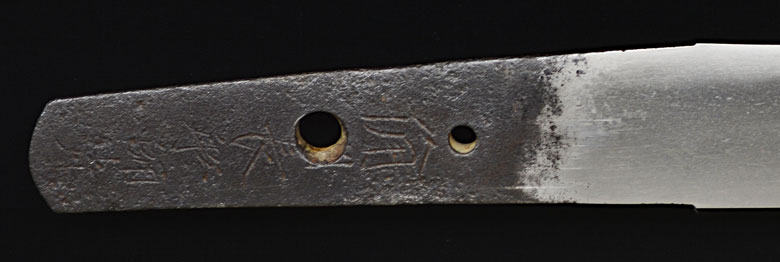
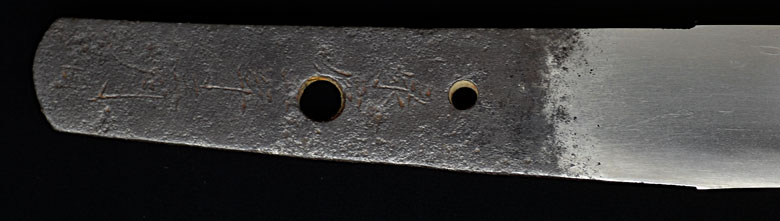
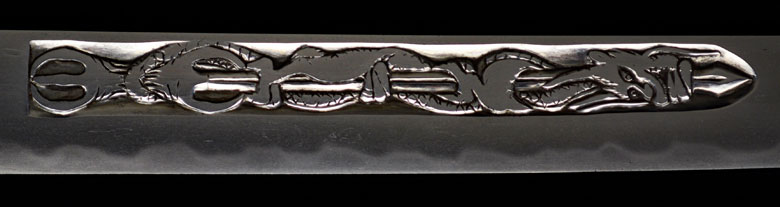
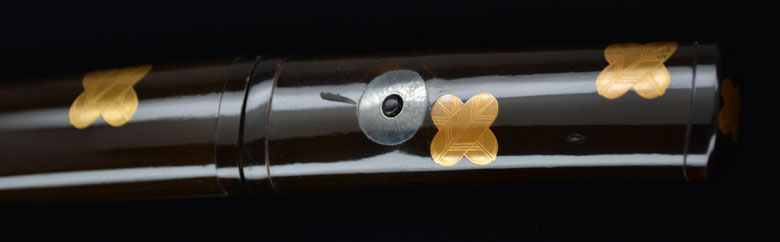
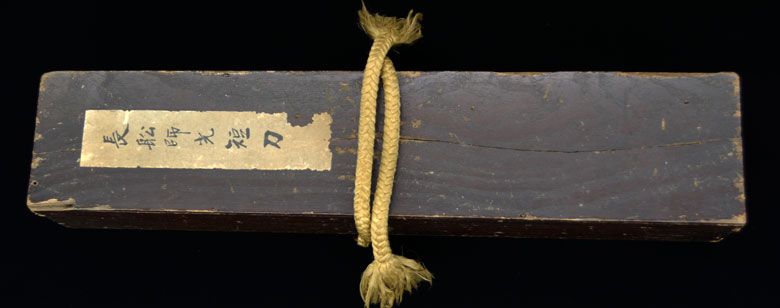
This is a rare tanto by Osafune Morimitsu, a master smith of the Nanbokucho period and a direct descendant of the Osafune lineage. It features a distinctive small gunome-midare hamon with nioi-deki, showcasing all the elements of a fine Bizen sword. The blade also boasts a splendid Bizen carving reminiscent of Kanemitsu, and comes with a well-preserved koshirae and a wooden box.
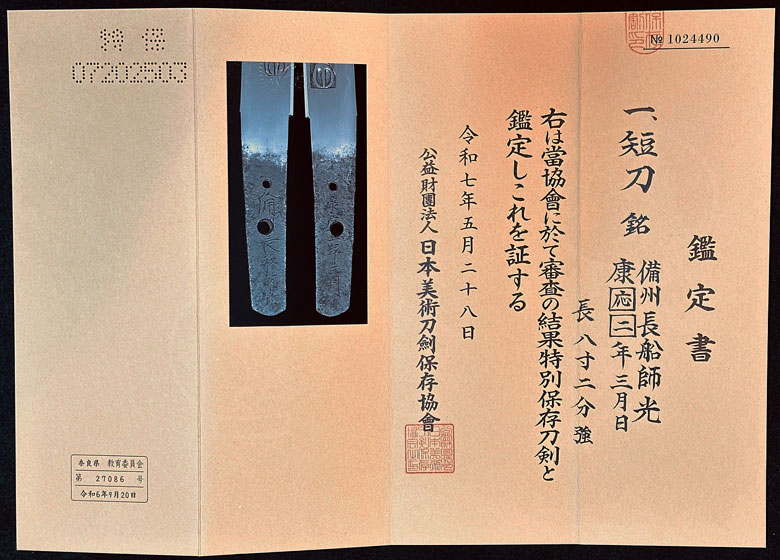
Certificate reading — 銘 備州長船師光 康應二年三月日
Osafune · Nanbokucho · nagasa 24.8cm · sori 0.1cm


Bizen Osafune, Kozori group · Bizen · around 1375-1390
Fujishiro Jo saku · Tōken Taikan top 23%
1 piece on the market now
Moromitsu is a Bizen Osafune smith of the late Nanbokucho period, and the published sources hand him down in the Meikan as the son of Rinko and the father of the Oei-Bizen master Morimitsu. Signed and dated tachi survive from the Eiwa, Oan and Shitoku eras through Eitoku and Meitoku, and the references read the present blades as the first generation of the name, a hand earlier than the Oei-dated Moromitsu who carried it on. He belongs to the group of late-Nanbokucho Osafune smiths the published record collectively calls Kozori, the small-curvature makers who worked at the periphery of the great workshop, and the NBTHK names him plainly as one of its leading hands, 「南北朝後期の, 所謂小反り物と呼ばれる刀工達の, 代表的な一人である」[[c:1]]. The line is recorded as continuing for several generations into the Muromachi period, but it is this first Moromitsu whose dated tachi anchor the group, the Eitoku piece of 1381 and the Shitoku and Eiwa blades among the few firmly dated witnesses to Osafune work just before the Oei flowering.
His characteristic hand is a small-patterned midare built on a shallow ko-notare. Into that quiet base he sets ko-gunome, gunome running two by two in sequence, slight togariba and a little choji, the whole kept small and held down so that the temper, as the published sources put it on his most archaic tachi, lies low across the blade. Ko-ashi and yo enter, the temper is carried in nioi with ko-nie adhering, and fine sunagashi run through the pattern, on his best work joined by kinsuji. The reading the NBTHK return again and again is one of restraint: his is the subdued register of Bizen, 「刃文は盛光, 康光に比して地味であり, いわゆる小反りの作域のものである」[[c:2]], a manner more reticent than that of his son Morimitsu and of Yasumitsu, who would temper the same Bizen idea in the bolder, more decorative pattern of Oei-Bizen. The scale itself is the tell. Where the mainstream Osafune of the Nanbokucho height reaches for height and flourish, Moromitsu compacts everything, the midare running in small forms that demand to be read closely, and the published sources judge the result, on a dated tachi shortened only a little, 「いかにも師光の持味を発揮した出来の宜しい一口といえよう」[[c:3]].
The jigane is an itame, often standing and flowing toward the edge, mixed with mokume and on the finest blades forged tight with the grain standing finely. Over it lie ji-nie, frequent chikei and patches of ji-madara, and out of that Bizen steel rises the utsuri, sometimes faint, on his best late tachi a conspicuous midare-utsuri, and on one small Eitoku tachi a straight sugu-utsuri standing clear. The published record reads this jigane as the proof of the Bizen-den beneath the quiet temper, and on the Meitoku tachi of 1391 it goes further, praising a jigane bright and clear with a blue-black cast, 「青黒い色調に冴えた地鉄が強く, 総じて優れた出来の一口である」[[c:4]]. The bearing of these blades is archaic. They keep koshizori with pronounced funbari, the kasane often thick for the width, and on the oldest the chu-kissaki compacts toward an ikubi profile, all of which the NBTHK reads as marks of the late Nanbokucho date. The boshi answers the small midare with a midare-komi that tends to a pointed tip or settles into a ko-maru, the very point often brushed with hakikake; many of the tachi carry a bo-hi, and several add devotional carving, a bonji, a sankoken, a kurikara cut in grass style at the foot of the groove.
The corpus admits a reading in three registers without straining the evidence. The staple is the subdued small-pattern midare just described, the work the published sources call the typical Kozori manner. A second, narrower register is his most varied, set down on the Shitoku-dated tachi: there the temper opens into ko-choji mixed with ko-gunome, ko-notare and pointed elements, a saka-ashi tendency appearing here and there, ko-ashi entering well and the nioiguchi full and rounded, a piece the NBTHK reads as more varied in range while keeping a high degree of completeness. A third register widens past the Kozori norm altogether. On one signed tachi the gunome takes choji into itself with the valleys opening toward the koshi, and the deki turns flamboyant. The NBTHK frames it as the exception that proves the rule, observing first that 「小反り物の作風は総体に小づんだ乱れ刃をあらわすものが一般的である」[[c:5]] and then that this blade instead 「焼きに高低のある華やかな出来口を示しており」[[c:6]], a temper of marked height variation that 「宛ら応永備前を想わせる作風を見せている」[[c:7]]. It is on that threshold that the smith is most clearly located, the choji-mixed gunome and the opening midare already foreshadowing the work his son would bring to its flowering.
What sets Moromitsu apart is read best from his own blades rather than by contrast. His bright midare-utsuri over standing itame, his small-pattern ko-notare carrying ko-gunome and slight choji, and his midare-komi boshi place him squarely in the Bizen-den, while the smallness and restraint of the whole separate him from the Osafune mainstream of the Nanbokucho height and from his own bolder successors. The published sources weave his lineage into nearly every entry, the Meikan giving him as 「銘鑑に倫光子, 盛光の父とあり」[[c:8]], son of Rinko and father of Morimitsu, and they place him at the hinge of the school's history, the last quiet phase of Nanbokucho Osafune and the first intimation of Oei-Bizen carried in a single hand. The faint dating spread of his signed works, Eiwa through Meitoku in the present blades and on to Oei in the references, gives the group its chronological spine, so that his blades serve the study of the period as much as the eye.
Moromitsu survives almost entirely as signed and dated tachi, and seven of his blades carry the Juyo designation; he holds no National Treasure or Important Cultural Property, so his record runs through the Juyo tier rather than the patrimony preserved in museums and shrines. Fujishiro rates him Jo-saku. The value of the surviving work lies as much in its documentary weight as in its beauty: ubu, signed, dated blades are read in entry after entry as fine reference material for the Kozori group and for the Bizen smiths standing at the threshold of Oei, the rare Eitoku and Shitoku dates singled out as precious, the NBTHK calling the Shitoku tachi 「とりわけ至徳年紀が貴重な同工の優品である」[[c:9]]. Provenance is thin and worth stating plainly: of the recorded whereabouts, one of his finest tachi, sound in sugata, ji and ha, is an old treasured piece of the Shonai Sakai family, 「庄内酒井家の旧蔵品である」[[c:10]]. For a private collector the Kozori Moromitsu is not beyond reach in the way a National Treasure is, his designated work sitting in the Juyo tier rather than locked in public hands, yet a signed and dated tachi by the first-generation hand comes to market only rarely, a quiet landmark of late-Nanbokucho Osafune when it does.

Where Moromitsu stands among comparable artisans: across all of nihontō, and within tradition, era, and period. The tiers (Foremost · Leading · Major · Notable) weigh official designations from the NBTHK and Japan's Agency for Cultural Affairs, together with historical honors of lasting repute such as the Sansaku and Meibutsu-chō.
Select a lens to see how it's measured.
Years he was demonstrably active, proven by signed-and-dated blades
Bizen-den · Bizen
26 pieces on the market now
The Kozori (小反り) form a loose body of Bizen smiths who worked at and around Osafune in the closing decades of the Nanbokucho period and on into early Muromachi, and the NBTHK defines them less by descent than by exclusion: they are the late-Osafune hands who fall outside the specific lineages of Kanemitsu, Chogi, Motoshige and the Omiya group, gathered under one name as a convenience. The reading of the name itself has been explained in several ways, and the published sources are candid that it resists a clean definition; the prevailing sense is the ko-sori, the slight or shallow reverse-curvature of the blades, the shape running to a deep koshizori with marked funbari and a small point in the older pieces and growing heavy in the kasane toward Oei. The body has no single founder. Smiths such as Moromitsu (師光), recorded as the father of the Oei master Morimitsu, anchor the group through dated tachi; Iesuke and Iemori carry Hatakeda blood; Nariie descends from Kagehide; Morisuke, Shigeyoshi, Tsunehiro, Hidemitsu, Motomasa and others fill out the periphery, several of whose lines run several generations and whose precise generation-by-generation reading the institution leaves to further study. Across these hands runs a shared vocabulary, and the recurring word for it is scale. The jigane is the constant: an itame mixed with mokume and nagare, the grain standing a little (hada-tachi), fine ji-nie attaching, dark chikei-toned and at times jifu-like passages crossing the steel, and over it the midare-utsuri (sometimes a bo-utsuri or straight sugu-utsuri) that places the group squarely in the Bizen-den. The temper is nioi-based with ko-nie, built on a shallow ko-notare into which the smiths set ko-gunome running connected and threaded, pointed togariba, angular squared elements, open-waisted koshi-biraki gunome and modest choji, the whole kept small and crowded (kozumu), with ko-ashi and yo entering and fine sunagashi and kinsuji playing through. The boshi answers in midare-komi, pointing or settling to a ko-maru with hakikake.
Within the shared idiom each hand has its tell: Moromitsu tempers the most subdued, low-lying midare; Nariie's gunome crowds where Kanemitsu's opens; Hidemitsu and Hidemitsu of the Koreha branch lean to a reverse-slanting saka-gakari and saka-ashi near the Aoe manner, and turn now and then to a quiet chu-suguha; Tsunehiro favours a kataochi-like gunome; Iesuke and Iemori, working into Oei, open the valleys toward the early-Muromachi pattern. A collector seeks Kozori for legibility rather than flourish. Many of the best survivors are ubu, signed and dated tachi, and that dated file (Joji, Oan, Eiwa, Shitoku, Eitoku, Meitoku into Oei) gives the late history of Osafune a year-by-year spine, prized as reference material for the period; the names also map a province pulled between the Northern and Southern courts, Morisuke's Joji dates reading as Northern Court alignment. To kantei the group is to read it against its neighbours: the small, crowded, nioi-toned midare and the standing itame with kawarigane chikei separate it from the bolder, more uniform gunome of the Kanemitsu mainline of the Nanbokucho height, while the open koshi-biraki valleys and the heavier, sakizori late sugata point forward to and distinguish it from the more decorative Oei-Bizen of Morimitsu and Yasumitsu (a threshold several Kozori blades, in NBTHK phrasing, already anticipate). Among the members the institution ranks Moromitsu and Nariie high (Nariie held equal to the Kanemitsu pupil Masamitsu), Iesuke beside the leading Oei names, and Hidemitsu the leading hand of the Koreha branch. Provenance, though thinly recorded for some, reaches real houses: blades descend through the Kuroda, Kaga Maeda, Shonai Sakai and Hojo families, with examples in the Hayashibara Museum and the national museums, and the occasional Imperial line. A signed, dated Kozori blade comes to hand only from time to time, a quiet, datable window onto Osafune as it closed its Nanbokucho age. Learn more →
| Smith | Era | Designated |
|---|---|---|
| Hidemitsu秀光 | 1375-1392 | 19 |
| Iesuke家助 | 1394-1428 | 11 |
| Nariie成家 | 1352-1362 | 21 |
| Iemori家守 | 1377-1406 | 15 |
| Moromitsu師光 | 1375-1390 | 7 |
Sixty years of war between two courts drove blades long and broad, and Osafune met the demand: Kanemitsu and Chōgi led forges serving the provincial warriors who did the fighting, while Sōshū influence arrived with the armies to create Sōden-Bizen.
A Hozon-certified blade judged to show notably superior workmanship and a better state of preservation. The bar is higher: re-tempered blades and most unsigned Muromachi/Edo works are excluded.
The NBTHK (Nihon Bijutsu Tōken Hozon Kyōkai, the Society for the Preservation of Japanese Art Swords) is a public-interest incorporated foundation founded in 1948 and supervised by Japan’s Agency for Cultural Affairs (Bunkachō); it is based at the Japanese Sword Museum in Tokyo. Its expert panels physically examine each submitted work (shinsa) and issue a certificate (kanteishō) ranking it by artistic and historical merit. NBTHK papers are the most widely recognized standard of authentication for Japanese swords and fittings.
NBTHK official siteCooling-off available within one week after arrival, Japan domestic only. Defective items may be returned; no refund if condition differs from sale or item was used.
This is a rare tanto by Osafune Morimitsu, a master smith of the Nanbokucho period and a direct descendant of the Osafune lineage. It features a distinctive small gunome-midare hamon with nioi-deki, showcasing all the elements of a fine Bizen sword. The blade also boasts a splendid Bizen carving reminiscent of Kanemitsu, and comes with a well-preserved koshirae and a wooden box.
Certificate reading — 銘 備州長船師光 康應二年三月日
Osafune · Nanbokucho · nagasa 24.8cm · sori 0.1cm


Bizen Osafune, Kozori group · Bizen · around 1375-1390
Fujishiro Jo saku · Tōken Taikan top 23%
1 piece on the market now
Moromitsu is a Bizen Osafune smith of the late Nanbokucho period, and the published sources hand him down in the Meikan as the son of Rinko and the father of the Oei-Bizen master Morimitsu. Signed and dated tachi survive from the Eiwa, Oan and Shitoku eras through Eitoku and Meitoku, and the references read the present blades as the first generation of the name, a hand earlier than the Oei-dated Moromitsu who carried it on. He belongs to the group of late-Nanbokucho Osafune smiths the published record collectively calls Kozori, the small-curvature makers who worked at the periphery of the great workshop, and the NBTHK names him plainly as one of its leading hands, 「南北朝後期の, 所謂小反り物と呼ばれる刀工達の, 代表的な一人である」[[c:1]]. The line is recorded as continuing for several generations into the Muromachi period, but it is this first Moromitsu whose dated tachi anchor the group, the Eitoku piece of 1381 and the Shitoku and Eiwa blades among the few firmly dated witnesses to Osafune work just before the Oei flowering.
His characteristic hand is a small-patterned midare built on a shallow ko-notare. Into that quiet base he sets ko-gunome, gunome running two by two in sequence, slight togariba and a little choji, the whole kept small and held down so that the temper, as the published sources put it on his most archaic tachi, lies low across the blade. Ko-ashi and yo enter, the temper is carried in nioi with ko-nie adhering, and fine sunagashi run through the pattern, on his best work joined by kinsuji. The reading the NBTHK return again and again is one of restraint: his is the subdued register of Bizen, 「刃文は盛光, 康光に比して地味であり, いわゆる小反りの作域のものである」[[c:2]], a manner more reticent than that of his son Morimitsu and of Yasumitsu, who would temper the same Bizen idea in the bolder, more decorative pattern of Oei-Bizen. The scale itself is the tell. Where the mainstream Osafune of the Nanbokucho height reaches for height and flourish, Moromitsu compacts everything, the midare running in small forms that demand to be read closely, and the published sources judge the result, on a dated tachi shortened only a little, 「いかにも師光の持味を発揮した出来の宜しい一口といえよう」[[c:3]].
The jigane is an itame, often standing and flowing toward the edge, mixed with mokume and on the finest blades forged tight with the grain standing finely. Over it lie ji-nie, frequent chikei and patches of ji-madara, and out of that Bizen steel rises the utsuri, sometimes faint, on his best late tachi a conspicuous midare-utsuri, and on one small Eitoku tachi a straight sugu-utsuri standing clear. The published record reads this jigane as the proof of the Bizen-den beneath the quiet temper, and on the Meitoku tachi of 1391 it goes further, praising a jigane bright and clear with a blue-black cast, 「青黒い色調に冴えた地鉄が強く, 総じて優れた出来の一口である」[[c:4]]. The bearing of these blades is archaic. They keep koshizori with pronounced funbari, the kasane often thick for the width, and on the oldest the chu-kissaki compacts toward an ikubi profile, all of which the NBTHK reads as marks of the late Nanbokucho date. The boshi answers the small midare with a midare-komi that tends to a pointed tip or settles into a ko-maru, the very point often brushed with hakikake; many of the tachi carry a bo-hi, and several add devotional carving, a bonji, a sankoken, a kurikara cut in grass style at the foot of the groove.
The corpus admits a reading in three registers without straining the evidence. The staple is the subdued small-pattern midare just described, the work the published sources call the typical Kozori manner. A second, narrower register is his most varied, set down on the Shitoku-dated tachi: there the temper opens into ko-choji mixed with ko-gunome, ko-notare and pointed elements, a saka-ashi tendency appearing here and there, ko-ashi entering well and the nioiguchi full and rounded, a piece the NBTHK reads as more varied in range while keeping a high degree of completeness. A third register widens past the Kozori norm altogether. On one signed tachi the gunome takes choji into itself with the valleys opening toward the koshi, and the deki turns flamboyant. The NBTHK frames it as the exception that proves the rule, observing first that 「小反り物の作風は総体に小づんだ乱れ刃をあらわすものが一般的である」[[c:5]] and then that this blade instead 「焼きに高低のある華やかな出来口を示しており」[[c:6]], a temper of marked height variation that 「宛ら応永備前を想わせる作風を見せている」[[c:7]]. It is on that threshold that the smith is most clearly located, the choji-mixed gunome and the opening midare already foreshadowing the work his son would bring to its flowering.
What sets Moromitsu apart is read best from his own blades rather than by contrast. His bright midare-utsuri over standing itame, his small-pattern ko-notare carrying ko-gunome and slight choji, and his midare-komi boshi place him squarely in the Bizen-den, while the smallness and restraint of the whole separate him from the Osafune mainstream of the Nanbokucho height and from his own bolder successors. The published sources weave his lineage into nearly every entry, the Meikan giving him as 「銘鑑に倫光子, 盛光の父とあり」[[c:8]], son of Rinko and father of Morimitsu, and they place him at the hinge of the school's history, the last quiet phase of Nanbokucho Osafune and the first intimation of Oei-Bizen carried in a single hand. The faint dating spread of his signed works, Eiwa through Meitoku in the present blades and on to Oei in the references, gives the group its chronological spine, so that his blades serve the study of the period as much as the eye.
Moromitsu survives almost entirely as signed and dated tachi, and seven of his blades carry the Juyo designation; he holds no National Treasure or Important Cultural Property, so his record runs through the Juyo tier rather than the patrimony preserved in museums and shrines. Fujishiro rates him Jo-saku. The value of the surviving work lies as much in its documentary weight as in its beauty: ubu, signed, dated blades are read in entry after entry as fine reference material for the Kozori group and for the Bizen smiths standing at the threshold of Oei, the rare Eitoku and Shitoku dates singled out as precious, the NBTHK calling the Shitoku tachi 「とりわけ至徳年紀が貴重な同工の優品である」[[c:9]]. Provenance is thin and worth stating plainly: of the recorded whereabouts, one of his finest tachi, sound in sugata, ji and ha, is an old treasured piece of the Shonai Sakai family, 「庄内酒井家の旧蔵品である」[[c:10]]. For a private collector the Kozori Moromitsu is not beyond reach in the way a National Treasure is, his designated work sitting in the Juyo tier rather than locked in public hands, yet a signed and dated tachi by the first-generation hand comes to market only rarely, a quiet landmark of late-Nanbokucho Osafune when it does.

Where Moromitsu stands among comparable artisans: across all of nihontō, and within tradition, era, and period. The tiers (Foremost · Leading · Major · Notable) weigh official designations from the NBTHK and Japan's Agency for Cultural Affairs, together with historical honors of lasting repute such as the Sansaku and Meibutsu-chō.
Select a lens to see how it's measured.
Years he was demonstrably active, proven by signed-and-dated blades
Bizen-den · Bizen
26 pieces on the market now
The Kozori (小反り) form a loose body of Bizen smiths who worked at and around Osafune in the closing decades of the Nanbokucho period and on into early Muromachi, and the NBTHK defines them less by descent than by exclusion: they are the late-Osafune hands who fall outside the specific lineages of Kanemitsu, Chogi, Motoshige and the Omiya group, gathered under one name as a convenience. The reading of the name itself has been explained in several ways, and the published sources are candid that it resists a clean definition; the prevailing sense is the ko-sori, the slight or shallow reverse-curvature of the blades, the shape running to a deep koshizori with marked funbari and a small point in the older pieces and growing heavy in the kasane toward Oei. The body has no single founder. Smiths such as Moromitsu (師光), recorded as the father of the Oei master Morimitsu, anchor the group through dated tachi; Iesuke and Iemori carry Hatakeda blood; Nariie descends from Kagehide; Morisuke, Shigeyoshi, Tsunehiro, Hidemitsu, Motomasa and others fill out the periphery, several of whose lines run several generations and whose precise generation-by-generation reading the institution leaves to further study. Across these hands runs a shared vocabulary, and the recurring word for it is scale. The jigane is the constant: an itame mixed with mokume and nagare, the grain standing a little (hada-tachi), fine ji-nie attaching, dark chikei-toned and at times jifu-like passages crossing the steel, and over it the midare-utsuri (sometimes a bo-utsuri or straight sugu-utsuri) that places the group squarely in the Bizen-den. The temper is nioi-based with ko-nie, built on a shallow ko-notare into which the smiths set ko-gunome running connected and threaded, pointed togariba, angular squared elements, open-waisted koshi-biraki gunome and modest choji, the whole kept small and crowded (kozumu), with ko-ashi and yo entering and fine sunagashi and kinsuji playing through. The boshi answers in midare-komi, pointing or settling to a ko-maru with hakikake.
Within the shared idiom each hand has its tell: Moromitsu tempers the most subdued, low-lying midare; Nariie's gunome crowds where Kanemitsu's opens; Hidemitsu and Hidemitsu of the Koreha branch lean to a reverse-slanting saka-gakari and saka-ashi near the Aoe manner, and turn now and then to a quiet chu-suguha; Tsunehiro favours a kataochi-like gunome; Iesuke and Iemori, working into Oei, open the valleys toward the early-Muromachi pattern. A collector seeks Kozori for legibility rather than flourish. Many of the best survivors are ubu, signed and dated tachi, and that dated file (Joji, Oan, Eiwa, Shitoku, Eitoku, Meitoku into Oei) gives the late history of Osafune a year-by-year spine, prized as reference material for the period; the names also map a province pulled between the Northern and Southern courts, Morisuke's Joji dates reading as Northern Court alignment. To kantei the group is to read it against its neighbours: the small, crowded, nioi-toned midare and the standing itame with kawarigane chikei separate it from the bolder, more uniform gunome of the Kanemitsu mainline of the Nanbokucho height, while the open koshi-biraki valleys and the heavier, sakizori late sugata point forward to and distinguish it from the more decorative Oei-Bizen of Morimitsu and Yasumitsu (a threshold several Kozori blades, in NBTHK phrasing, already anticipate). Among the members the institution ranks Moromitsu and Nariie high (Nariie held equal to the Kanemitsu pupil Masamitsu), Iesuke beside the leading Oei names, and Hidemitsu the leading hand of the Koreha branch. Provenance, though thinly recorded for some, reaches real houses: blades descend through the Kuroda, Kaga Maeda, Shonai Sakai and Hojo families, with examples in the Hayashibara Museum and the national museums, and the occasional Imperial line. A signed, dated Kozori blade comes to hand only from time to time, a quiet, datable window onto Osafune as it closed its Nanbokucho age. Learn more →
| Smith | Era | Designated |
|---|---|---|
| Hidemitsu秀光 | 1375-1392 | 19 |
| Iesuke家助 | 1394-1428 | 11 |
| Nariie成家 | 1352-1362 | 21 |
| Iemori家守 | 1377-1406 | 15 |
| Moromitsu師光 | 1375-1390 | 7 |
Sixty years of war between two courts drove blades long and broad, and Osafune met the demand: Kanemitsu and Chōgi led forges serving the provincial warriors who did the fighting, while Sōshū influence arrived with the armies to create Sōden-Bizen.
A Hozon-certified blade judged to show notably superior workmanship and a better state of preservation. The bar is higher: re-tempered blades and most unsigned Muromachi/Edo works are excluded.
The NBTHK (Nihon Bijutsu Tōken Hozon Kyōkai, the Society for the Preservation of Japanese Art Swords) is a public-interest incorporated foundation founded in 1948 and supervised by Japan’s Agency for Cultural Affairs (Bunkachō); it is based at the Japanese Sword Museum in Tokyo. Its expert panels physically examine each submitted work (shinsa) and issue a certificate (kanteishō) ranking it by artistic and historical merit. NBTHK papers are the most widely recognized standard of authentication for Japanese swords and fittings.
NBTHK official siteCooling-off available within one week after arrival, Japan domestic only. Defective items may be returned; no refund if condition differs from sale or item was used.