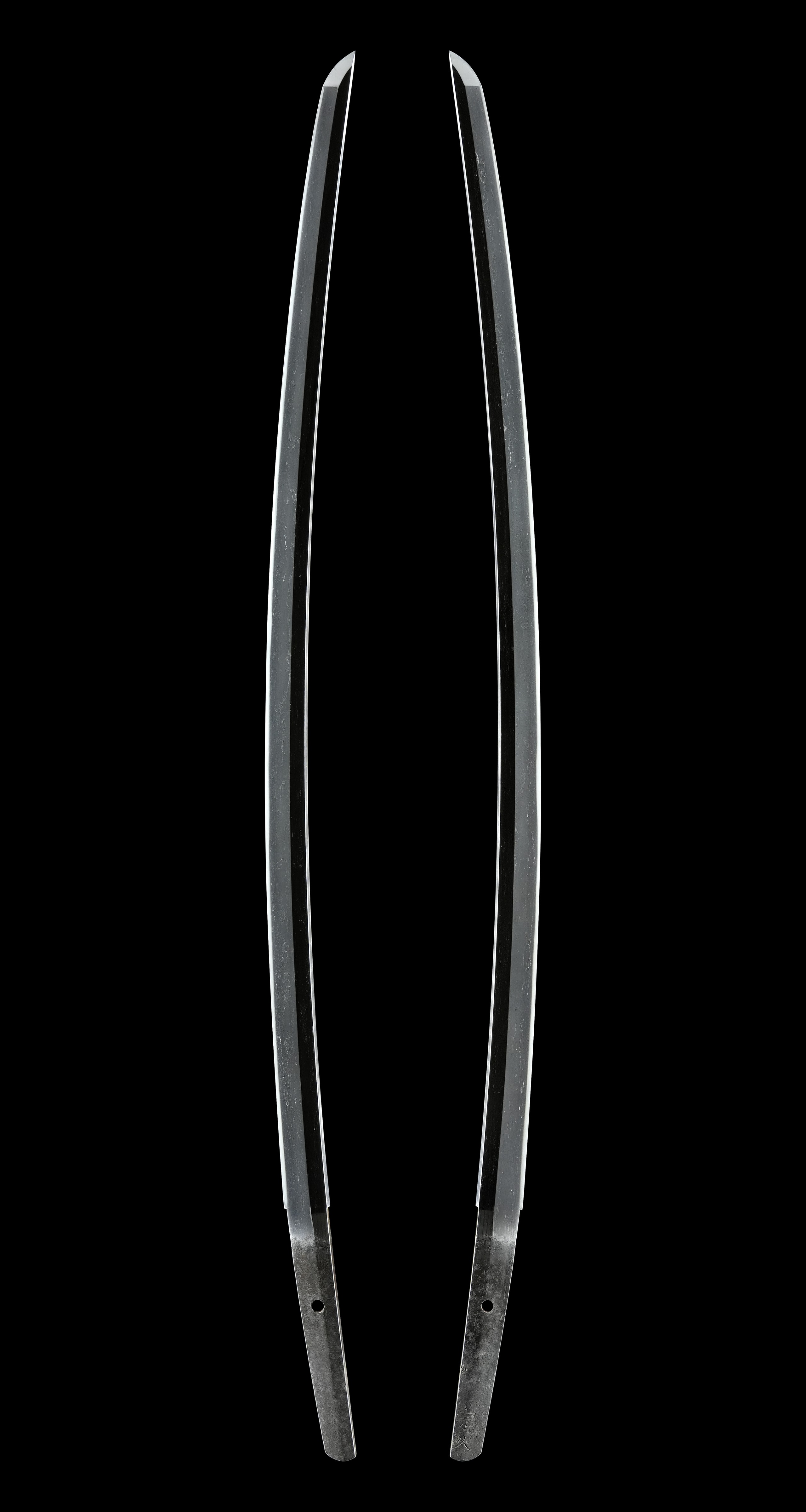
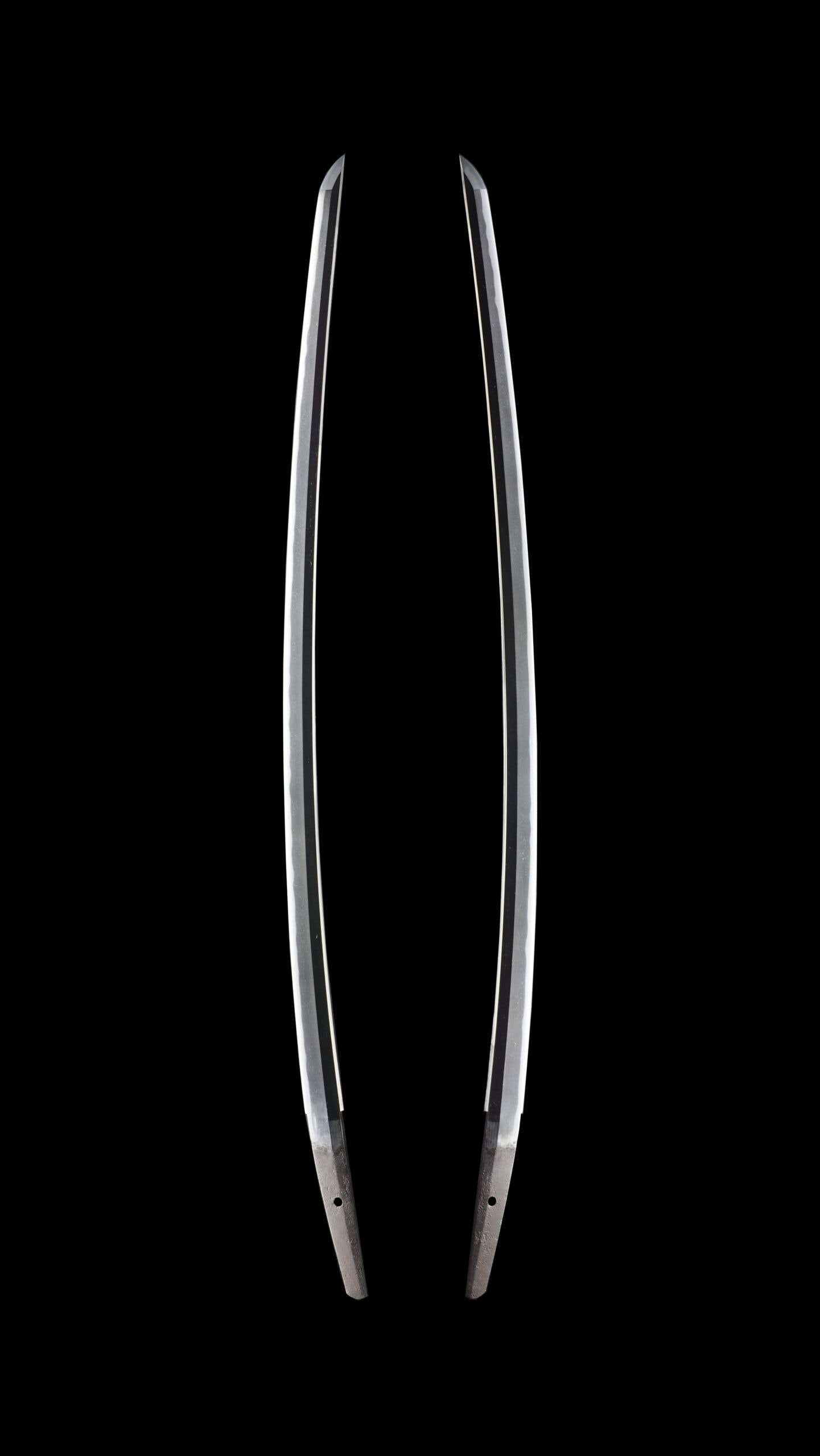
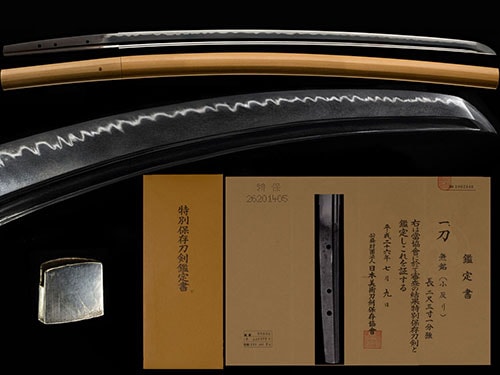
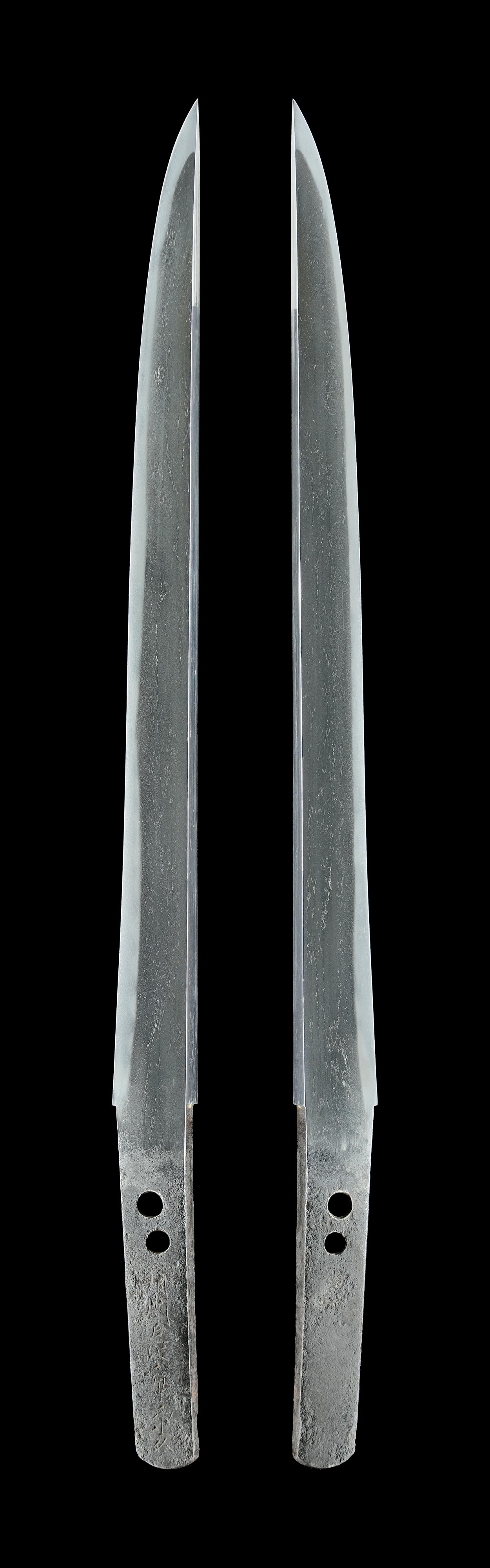
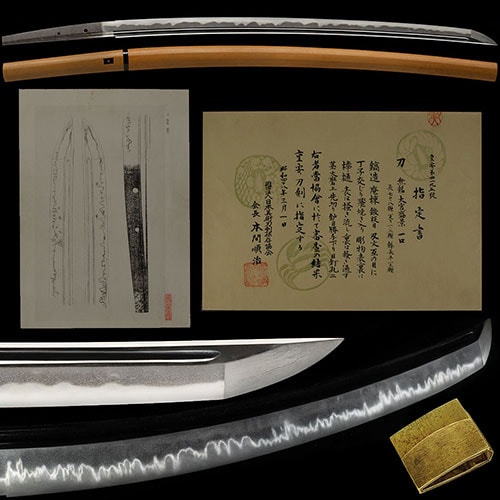
Nariie worked at in in the later period, and the dated swords that fix his hand carry year-signatures running from Bunna and Joji through Koan, and Eiwa, with one signed and dated Koan 2 (1362). The biographical records make him a descendant of Kagehide, the younger brother of Mitsutada, but the published sources set that pedigree aside and place him by his workmanship among the smiths, the hands of the later fourteenth century who stand outside the direct line of Kanemitsu. The term is itself loosely drawn, the allows, a convenience that gathers the late smiths not tied as pupils to the Kanemitsu workshop. What the commentary returns to, blade after blade, is the relation to Kanemitsu read in both his manner and the script of his signature, a relation it declines to settle: 「兼光との関係も考えられ、今後の検討が俟たれるところである」, that the connection is to be considered and the matter awaits further study. He is a smith known almost entirely from , his name reaching the published record at Important Cultural Property and twenty .
The hand that distinguishes him is a -based that at first glance is taken for Kanemitsu and is told from him on a closer look. Over the body he tempers small , and pointed , square-shouldered and waist-open also entering, the whole running, in the recurring phrase of the published sources, small and crowded (). The institution describes his favoured temper plainly, 「のたれや互の目交じりの乱れ刃を得意とし」, a of and mixed; what individualizes it is the variety of packed into a small pattern rather than any single shape. The judges set this against Kanemitsu directly. On one the commentary writes that the blade resembles Kanemitsu at a glance, then adds 「焼刃の互の目がこずむ傾向が窺われ」, that the of the temper is seen to crowd, and finds in that crowding the mark by which it is to be read as Nariie. The work falls a little short of Kanemitsu's breadth, the sources repeat, though not of his skill.
His is an carrying and , the grain standing a little, with attaching fine and entering of an irregular changing-steel cast, sometimes coarse altered steel running thick through the surface, sometimes a tone crossing it. A rises, pale, the reflection of the period; on the most crowded small-pattern blades it reads instead as a straight , and the is carried as much by the standing and that kawarigane as by the reflection. Through the and enter well, the temper is -prevailing with , and and play finely along it. The runs into the and points, returning to a or burning out in a , brushing the turn. A , on several blades carried with a or beside the trace of a , runs through the body. The is the broad shape of the late : a wide body with little taper from to point, a large , the curvature shallow, the build heavy in the hand, most often reached by that has left the blade .
The oeuvre divides on the . A small group of pieces keeps the original shape and the long signature with its year-date, the and the broad, -shortened among them, and these are the documentary anchor for everything else. The far larger part is and , attributed to him by the workmanship alone, and it is on these that the argument is made and remade: a blade is read first as Kanemitsu's school, then resolved to Nariie by the smaller, more cluttered pattern, the mixture of many -types, and a touch of the rustic in the and . The year-dates carry their own weight in the scholarship. The records give him dates from Bunna and Koan that run relatively early for a smith, and the marks them, treating the Koan 2 as a good document and noting that such comparatively early signatures bear on where, within the loose grouping, his work should sit.
Within that grouping the published sources rank him high. They hold his skill equal to or above that of Masamitsu, a Kanemitsu pupil of his own generation, 「彼の技術は同年代の兼光一門の政光に比して優るとも劣らず」, and on one blade call him a representative smith of the group at the height of the period. The comparison that frames him is therefore never a borrowing but a measure: he is placed beside Kanemitsu to be distinguished from him, his own typical traits leading the reading. His crowds where Kanemitsu's opens; his takes a changing-steel and a pale where the Kanemitsu line runs cleaner; his temper gathers many small where theirs is more uniform. These are the features the judges name as his, and the resemblance survives in the prose only as the thing they are correcting.
The Fujishiro appraisal places Nariie at Chu-jo , and his designated record stands at one Important Cultural Property and twenty , with no National Treasure or among them. The Important Cultural Property is patrimony, held outside the market as such designations are; the blades, almost all , are what a private collector might realistically hope to meet, and they come to hand only from time to time. Provenance is thinly recorded for his work: one is documented as having been carried by Imai Sadahiro, the castle elder of the Nishio domain in , at the battle of Toba-Fushimi in the Boshin War, and descended with its red stone-grain lacquer scabbard mounting. Beyond that the owners of his blades are largely unrecorded, and what survives is best described as held in long-private hands. For a master read always against Kanemitsu, a signed and dated example is the rarer find, the the more usual one, and either is encountered with patience rather than at will.