Sixty years of war between two courts drove blades long and broad, and Osafune met the demand: Kanemitsu and Chōgi led forges serving the provincial warriors who did the fighting, while Sōshū influence arrived with the armies to create Sōden-Bizen.
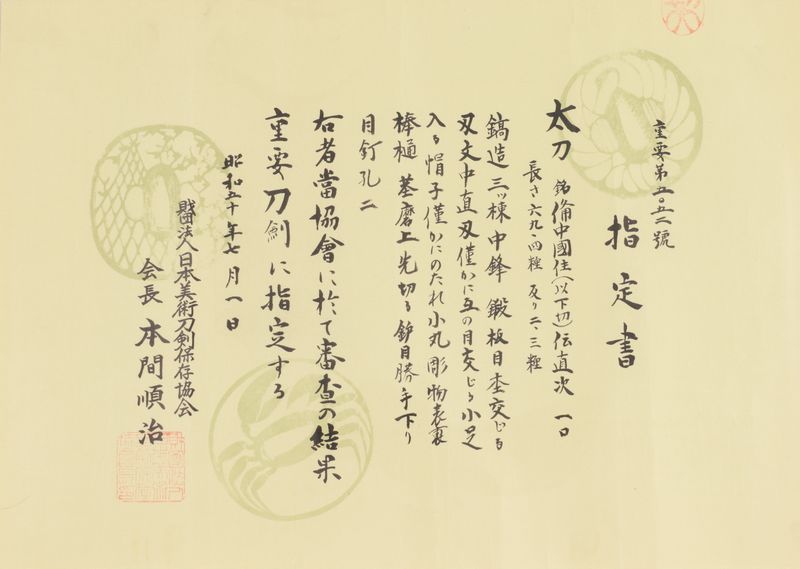
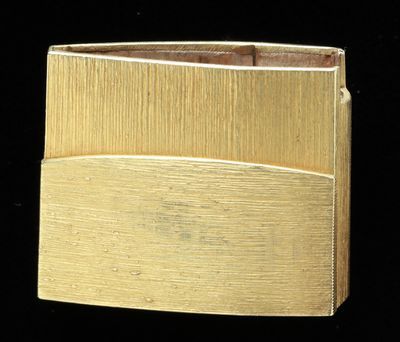
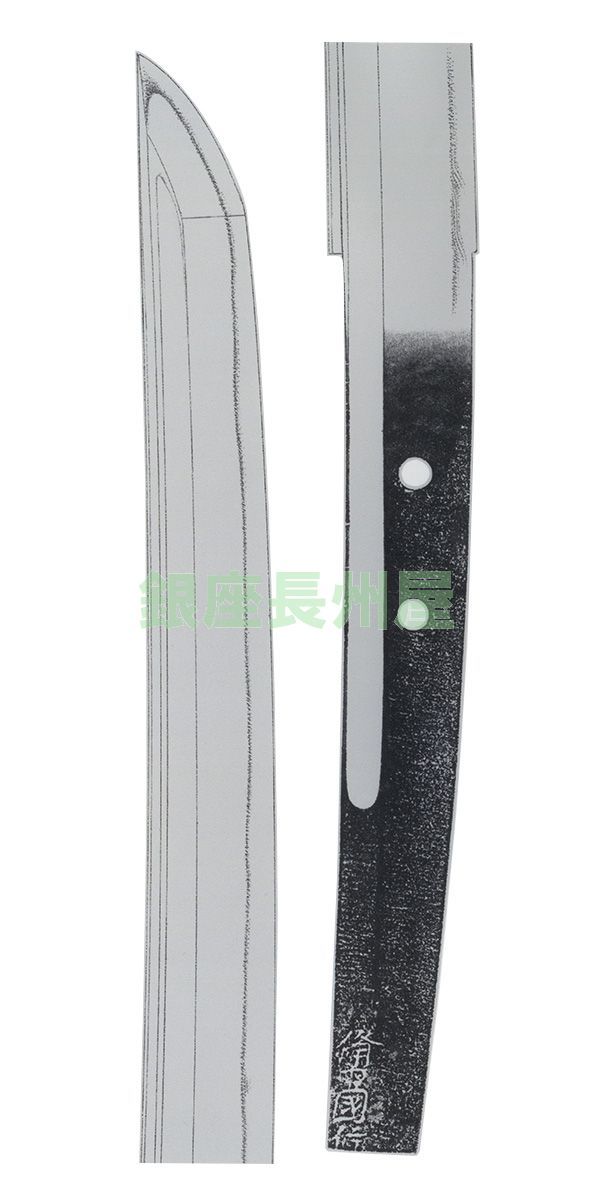
磨り上げによって「備中國住」のみが残されている、佐藤寒山博士が鎌倉末期元徳から南北朝初期の青江直次と鑑定して御鞘書された太刀。青江は高梁川下流域の子位荘(こいのしょう)青江郷(注1)。鎌倉初期、この地に居住した貞次や恒次は、高梁川上流域(注2)で産した良鋼を以て名刀を打ち、後鳥羽上皇の御番鍛冶として向鎚を勤めた。直次はその末裔で左兵衛尉を任官した名手。建武の新政後、激闘する武士たちの干戈の音を聞きつつ(注3)飽くまで篤実に作刀し、建武二年十月日紀の「備中国住人左兵衛尉直次作」の太刀(重文)や、大徳川伝来で本阿弥光温極めの「直次磨上之 本阿(花押)」の刀(重美)等の名作を遺している。 この太刀は身幅重ね充分で、棒樋が掻かれて姿引き締まり、腰反り高く中鋒の、典雅にして美しい造り込み。杢目交じりの板目肌に青江特有の澄肌を微かに交えた地鉄は地景が太く入って肌起ち、生気が漲って晴々とした鉄色は微かに青みを帯びて冴える。中直刃の刃文は僅かに小互の目を交え、小沸が柔らかく付いて匂口締まりごころに明るく、小足、葉が盛んに入り、刃中も澄む。帽子は焼を充分に残し、浅く弛んで突き上げて小丸に返り、青江、別けても左兵衛尉直次の特色が顕著。茎に小振りに刻された「備中國住」の四字銘には衒いがなく好感がもてる。足利尊氏、楠木正成、新田義貞などの英雄が躍動した時代を偲ばせる、愛刀家の夢ともいうべき逸品である。 注1...現倉敷市。青江は倉敷駅に近く、伯備線沿い。 注2...神代郷や野馳郷(岡山県阿哲郡)、新見荘(同県新見市)の良質の鉄は租税として納められた。 注3...後醍醐天皇勢と足利尊氏勢が熾烈な攻防を繰り広げた備中福山城 は青江郷のすぐ近くである。
Offered by Choshuya
This piece has sold
Get an email when a new Aoe Naotsugu piece hits the market.


Aoe (Bitchu) · Bitchu · around 1288-1350
Fujishiro Jo saku · Tōken Taikan top 3%
1 piece on the market now
In Gentoku 1 (1329), in the twelfth month, Naotsugu (直次) of Bitchū signed a small hira-zukuri tantō "Bitchū-shū jū Sahyōe-no-jō Naotsugu"[[c:1]] with the date cut on the reverse, and the NBTHK calls it a fine piece that demonstrates the smith's high technique[[c:2]]. He belongs to the Aoe school of Bitchū, which forged along the lower reaches of the Takahashi river. The published sources divide its production in two: work to about the middle of Kamakura is called Ko-Aoe, and what follows, on into Nanbokuchō, simply Aoe. The Meikan places Naotsugu's activity around the Karyaku era (1326-29); he styled himself Saemon-no-jō and Sahyōe-no-jō, and together with Yoshitsugu he is counted among the representative smiths of the school in the passage from the very end of Kamakura into the opening of Nanbokuchō. His base, as the published record says of the Aoe smiths of this time, is suguha, with many of his blades built fundamentally upon it.
What distinguishes the hand is a controlled chū-suguha rather than the flamboyant chōji of an earlier Bizen. The nioiguchi tightens and brightens, ko-gunome and small angular gunome enter the temper, and faint ashi run toward the base with the reverse slant the school is known for, the saka-ashi that the published sources read as the mark of so-called Sue-Aoe. On the widest of his katana the edge is a naka-suguha with a tight nioiguchi, saka-ashi, ko-ashi and yō, and the nioiguchi is bright and clear; the bōshi rises a little before its return, a slight tsukiage that ends in a pointed turn. He keeps the suguha quiet and lets the jigane and the slant carry the work, and on the Kitaguchi katana the judges find in all of these points the characteristic features of this craftsman and his school[[c:3]].
The jigane shows the Bitchū steel at full strength. A ko-itame mixed with mokume tightens into the so-called chirimen-hada, the crêpe-like surface texture of the school, and through it run the patchy jifu and the clear sumihada patches that are among Aoe's surest tells. On the tantō the forging packs down finely, thick ji-nie gathers, and a faint midare-utsuri rises across it; on the unsigned katana the grain stands more openly, with sumihada mixed in and a rather coarse nie on the edge. The temper on the Gentoku tantō is carried down into the ha-machi, a yakikomi the judges single out, and the bright, clear sharpness of its nioiguchi is what they note above all, the hardened edge keeping its line tight and luminous[[c:4]]. The bōshi runs straight or with a shallow notare and turns back in a ko-maru or, more characteristically, with the tip drawn to a point.
His surviving work falls into two registers by form. The signed and dated pieces are the documentary core: the Gentoku 1 tantō headed by the Sahyōe-no-jō title, ubu with the long mei cut by a slender chisel and the date on the reverse, and the wide-bodied katana signed "Bitchū no kuni jūnin Naotsugu saku," their long signatures preserved through shortening by being folded back into an orikaeshi-mei. The published sources note that among his works the signatures including the Sahyōe-no-jō title are rare[[c:5]], the surviving examples of that type carrying dates of Gentoku, Shōkei and Kenmu, so the office title and the year together fix both the man and the moment. The second register is the shortened tachi attributed to him by sight, ō-suriage and mumei or with only a fragment of the province inscription left at the tang tip; here the faint, reverse-slanting ko-ashi on a standard chū-suguha are read as the well-expressed mark of Sue-Aoe, the attribution and the period alike judged secure. The Meikan reads a first and a second generation under the name, the second dated Ryakuō into Enbun, and the early designations follow it; the modern texts instead describe one Naotsugu "active from late Kamakura into early Nanbokuchō"[[c:6]], and the record is kept here as one.
What sets him apart within the school is stated in his own work rather than borrowed from a comparison. The published sources call one tantō a clear expression of the characteristics of the late-Kamakura Aoe school, Naotsugu in particular[[c:7]], and another the very type of the late-Kamakura suguha Aoe blade[[c:8]], the ko-maru bōshi and the steep ō-sujikai filing named as the school's own viewing points. His chū-suguha with its quiet reverse slant stands just before the school's Nanbokuchō peak, where the suguha turns to nioi-deki and the characteristic saka-chōji-midare appears; his manner is the standard Sue-Aoe work that the peak would carry further. On the unsigned katana attributed to him the judges find the jigane good and the workmanship good[[c:9]], allowing only that the nioiguchi shows a slight cloudiness, and they note that the former tachi silhouette and the workmanship make both the period assessment and the attribution untroubled. The bare two-character mei and the ō-sujikai file marks of the Niigata tantō are called typical, the signature characters and the filing alike following the established conventions of the school[[c:10]].
The record that survives him is almost wholly in the designated tiers. Twenty of his works carry an official designation: two Important Cultural Properties, three prewar Jūyō Bijutsuhin, five Tokubetsu-Jūyō and ten Jūyō; Fujishiro rates him Jō-saku. The published sources praise the quality of execution repeatedly, the Kitaguchi katana judged thoroughly healthy in both ji and ha[[c:11]] and the Tokubetsu-Jūyō katana a piece that clearly expresses the style of the Aoe school of this period, of particularly excellent workmanship[[c:12]]. His two Important Cultural Properties rest in institutional care, among them the Kyoto National Museum, and provenance recorded against his Jūyō Bijutsuhin runs through the Owari Tokugawa and Tokugawa Iesato; beyond those, what a collector may realistically encounter is one of the Tokubetsu-Jūyō or Jūyō pieces: a signed and dated tantō in which the late-Kamakura Aoe manner is set down whole, or a shortened katana whose folded-back signature still names the smith. They come to light only from time to time, and a signed and dated example, ubu and clear in both its characters and its file marks, is the kind of thing the published sources themselves treat as material of high documentary value.

Where Naotsugu stands among comparable artisans: across all of nihontō, and within tradition, era, and period. The tiers (Foremost · Leading · Major · Notable) weigh official designations from the NBTHK and Japan's Agency for Cultural Affairs, together with historical honors of lasting repute such as the Sansaku and Meibutsu-chō.
Select a lens to see how it's measured.
Years he was demonstrably active, proven by signed-and-dated blades
Bizen-den · Bitchu
21 pieces on the market now
The Aoe school arose in Bitchu Province, a region celebrated for iron production since antiquity. The early eleventh-century miscellany Shin Sarugaku-ki already lists "the swords of Bitchu" among the noted products of the provinces, and roughly two centuries later the Aoe swordsmiths emerged as heirs to that high reputation, flourishing chiefly in the lower basin of the Takahashi River in such locales as Koji and Manju. The school is traditionally said to have begun with Yasutsugu around the Shoan era, and thereafter it prospered greatly down to the later part of the Nanbokucho period. Within this lineage, works produced up through approximately the mid-Kamakura period are distinguished as Ko-Aoe, while those from the late Kamakura period onward through the Nanbokucho era are broadly termed Aoe. Representative smiths of the Nanbokucho phase include Tsugunao, Tsuguyoshi, Moritsugu, and Naotsugu, yet a great many surviving blades are mumei and attributed to the school collectively rather than to individual hands, reflecting the depth and continuity of the tradition as a whole. The NBTHK identifies two principal modes of Aoe workmanship. The first is a suguha-based temper in which the nioiguchi tends toward tightness, producing a bright and clear effect; the second is the distinctive saka-choji-midare that reached full maturity around the Enbun era (1356-1361), during the height of the Nanbokucho period. Ko-Aoe works are generally ko-nie-deki, with a somewhat shizumi (subdued) nioiguchi in suguha mixed with small undulations; by the late Kamakura period the nie becomes calmer, and in Nanbokucho pieces the nioiguchi tightens and the construction shifts to nioi-deki. It is specifically noted that whereas smiths of other provinces in this period display nie-deki under the influence of the Soshu tradition, Aoe works remain nioi-deki -- a hallmark distinction.
The forging characteristically shows ko-itame mixed with mokume, with finely standing grain producing the so-called chirimen-hada (crepe-like texture); jifu (patchy, mottled surface features) and sumihada (sooty-toned areas) are frequently intermingled. The jihada regularly exhibits midare-utsuri, and toward the cutting edge a layered, streak-like utsuri known as dan-utsuri is a major highlight of the school. Fine ji-nie adheres thickly, with chikei entering well. Overall, when compared with Bizen works of the same era, Aoe blades present a somewhat restrained and austere taste. Across the tradition's long arc from the late Heian period to the close of the Nanbokucho era, the NBTHK consistently praises Aoe works for the brightness and clarity of both ji and ha, frequently employing the term saeru (clear, brilliant) to describe the nioiguchi. Blades are commended for being kenzen (sound and well-preserved), for retaining ample nikuoki (blade "flesh"), and for conveying an atmosphere of sincerity and quiet elegance. The recurring evaluative language -- "the salient points of Aoe are conspicuously displayed," "an especially fine example even among works attributed to this school[[c:1]]" -- underscores the NBTHK's regard for the tradition as one producing consistently high-caliber work whose collective identity is immediately recognizable. The school's Nanbokucho-period output, with its wide mihaba, imposing o-kissaki, and bold boshi that rises and returns with a pointed tendency, conveys the powerful period character of that age, while earlier Ko-Aoe pieces are valued for their thoroughly archaic feeling and deep flavor. Taken together, the Aoe school represents one of the major traditions of western Japan, distinguished by its refined forging, luminous suguha, and the singular visual drama of its utsuri effects. Learn more →
| Smith | Era | Designated |
|---|---|---|
| Tsugunao次直 | 1345-1361 | 26 |
| Masatsune正恒 | 1213-1219 | 31 |
| Naotsugu直次 | 1288-1350 | 20 |
| Yasutsugu康次 | 1211-1213 | 10 |
| Kanetsugu包次 | 1211-1213 | 9 |
Bizen in the Nanbokuchō period
Sixty years of war between two courts drove blades long and broad, and Osafune met the demand: Kanemitsu and Chōgi led forges serving the provincial warriors who did the fighting, while Sōshū influence arrived with the armies to create Sōden-Bizen.
A blade of top-grade workmanship and condition, formally judged to rank with a nationally recognized Important Art Object (Jūyō Bijutsuhin). Awarded only at the NBTHK’s competitive annual examination.
Of Japan’s roughly 2.5 million registered swords, only 12,348 (about 1 in 202) have ever attained Jūyō.
The NBTHK (Nihon Bijutsu Tōken Hozon Kyōkai, the Society for the Preservation of Japanese Art Swords) is a public-interest incorporated foundation founded in 1948 and supervised by Japan’s Agency for Cultural Affairs (Bunkachō); it is based at the Japanese Sword Museum in Tokyo. Its expert panels physically examine each submitted work (shinsa) and issue a certificate (kanteishō) ranking it by artistic and historical merit. NBTHK papers are the most widely recognized standard of authentication for Japanese swords and fittings.
NBTHK official siteIf, due to our fault, the item differs significantly from its proper condition, the item may be returned. Cooling-off is within one week of the item's arrival.