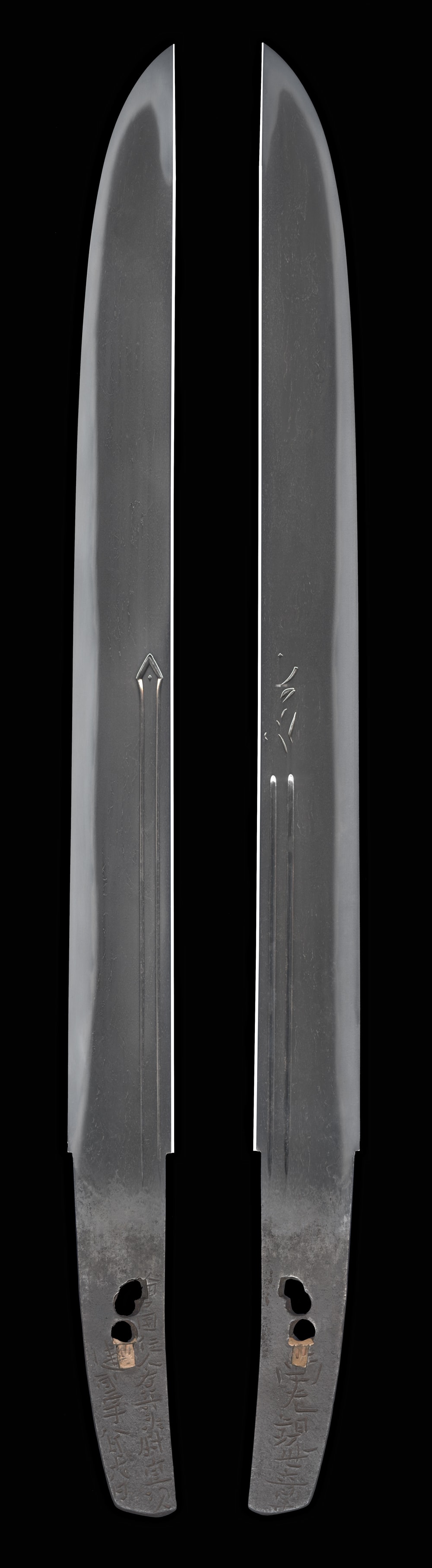
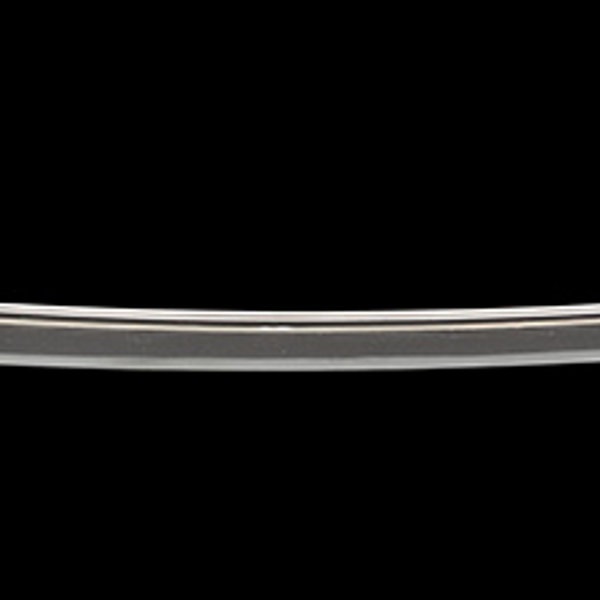
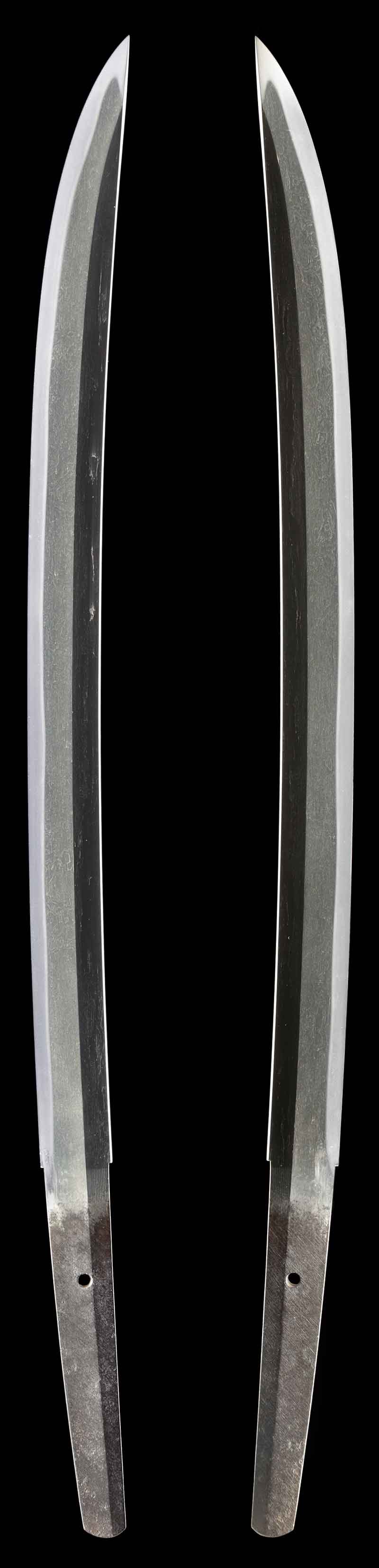
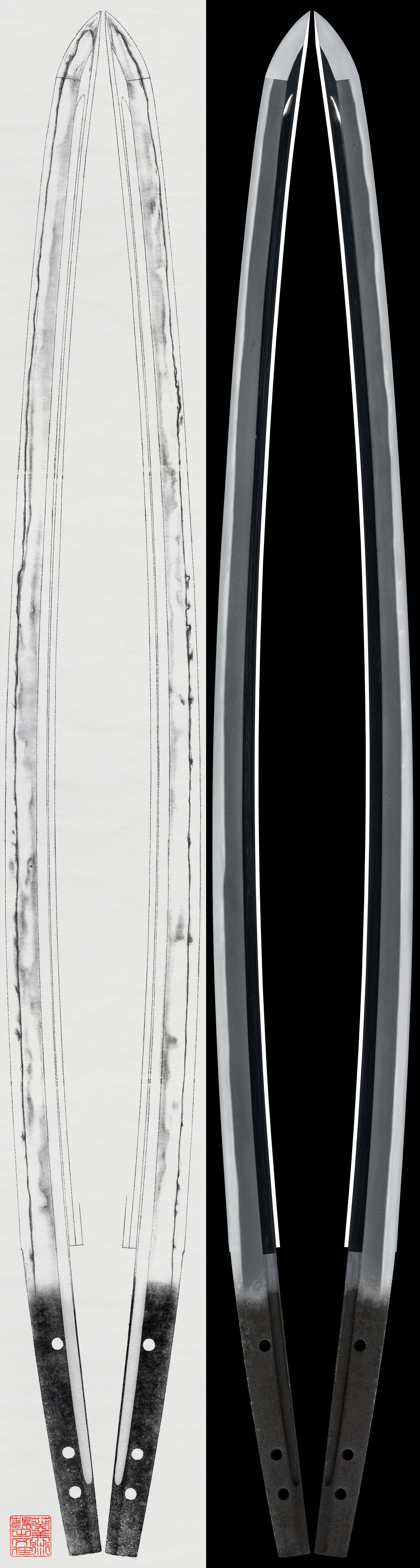
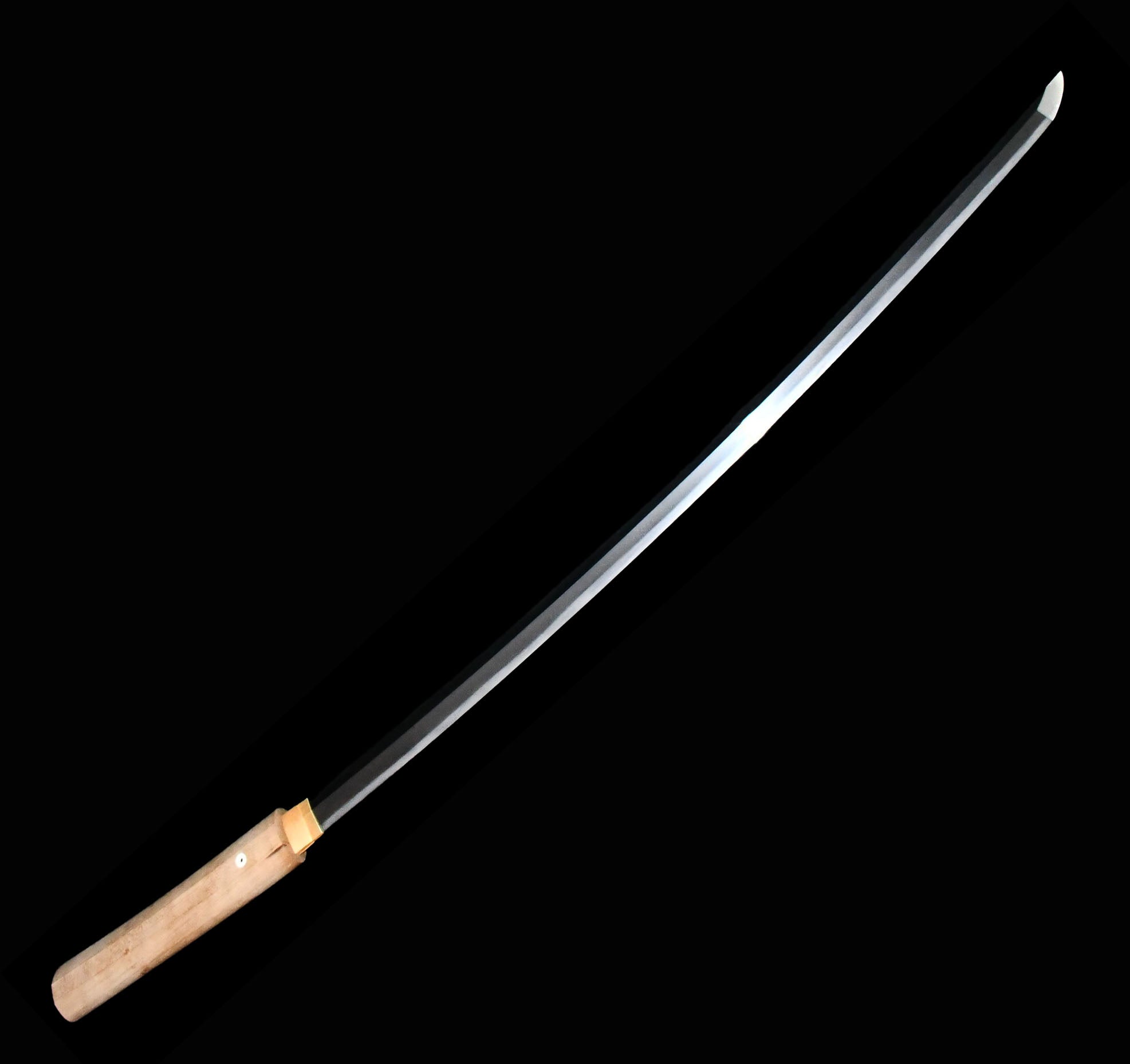
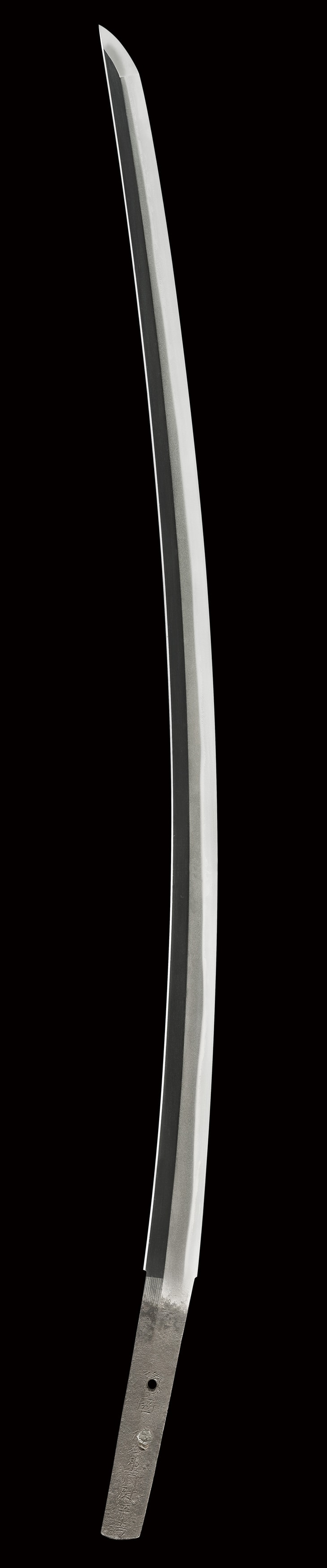
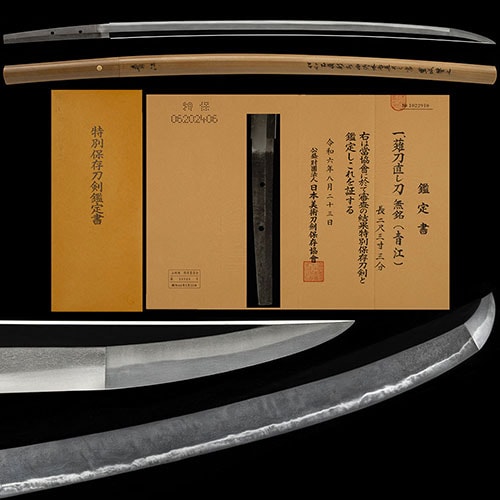
This is a large o-suriage mumei katana from the Bitchu Aoe school, attributed to Naotsugu of the Kenmu era (Nanbokucho period). It features a wide body, deep curvature, and a powerful form with rich niku. The jihada shows a beautiful itame-mokume with suji-utsuri and midare-utsuri, while the hamon is a soft nioiguchi suguha with frequent ashi and thick nie, displaying excellent clarity and activity.
suriage-mumei · Aoe · Nanbokucho · nagasa 72cm · sori 2.2cm


An Important Sword — top-grade workmanship and condition, formally judged to rank with a nationally-recognized Important Art Object (Jūyō Bijutsuhin). Awarded only at the NBTHK’s competitive annual examination.
Highly selective: of Japan’s ~2.5 million registered swords, only 12,368 — about 1 in 202 — have ever attained Jūyō.
The NBTHK (Nihon Bijutsu Tōken Hozon Kyōkai — The Society for the Preservation of Japanese Art Swords) is a public-interest incorporated foundation founded in 1948 and supervised by Japan’s Agency for Cultural Affairs (Bunkachō); it is based at the Japanese Sword Museum in Tokyo. Its expert panels physically examine each submitted work (shinsa) and issue a certificate (kanteishō) ranking it by artistic and historical merit. NBTHK papers are the most widely recognized standard of authentication for Japanese swords and fittings.
NBTHK official siteCooling-off available within one week after arrival, Japan domestic only. Defective items may be returned; no refund if condition differs from sale or item was used.
Aoe (Bitchu) · Bitchu · around 1335-1364
Naotsugu, one of the representative Aoe smiths of the very end of Kamakura into the opening of Nanbokucho, the Meikan placing his activity around Karyaku (1326-29); his dated works run from Gentoku, the oldest, through Shokei, Kenmu, Ryakuo and Jowa into Kannō, and on the Gentoku and Kenmu pieces the mei carries the title Sahyoe-no-jo. His base is the suguha of this Aoe generation: a hoso or chu-suguha with the nioiguchi tight, bright and clear, ko-gunome and saka-ashi entering, over a tightly knit ko-itame with thick ji-nie, fine chikei, jifu and the clear sumihada patches of the school, with faint utsuri. Tanto take mitsu-mune, little or inward curvature and a furisode nakago with a boldly struck long mei; the o-sujikai filing is the school's own. The o-suriage mumei katana attributed to him by the Hon'ami take the wide, large-pointed grand Nanbokucho shape with saka-choji.
Where Naotsugu stands among comparable artisans: across all of nihontō, and within tradition, era, and period. The tiers (Foremost · Leading · Major · Notable) weigh official designations from the NBTHK and Japan's Agency for Cultural Affairs, together with historical honors of lasting repute such as the Sansaku and Meibutsu-chō.
Select a lens to see how it's measured.
Years he was demonstrably active, proven by signed-and-dated blades
Bizen-den · Bitchu
Phase: Chū-Aoe中青江· 1235–1334
The Chu-Aoe school represents the middle and culminating phase of the Aoe tradition of Bitchu Province, encompassing smiths active from the late Kamakura period through the Nanbokucho era. The lineage traces its origins to an ancient swordmaking heritage in the lower basin of the Takahashi River, a tradition already celebrated in the eleventh-century Shin Sarugakki, which counted "the swords of Bitchu" among the notable products of the provinces. Learn more →
| Smith | Era | Designated |
|---|---|---|
| Tsugunao次直 | 1345-1361 | 27 |
| Naotsugu直次 | 1335-1364 | 15 |
| Yoshitsugu吉次 | 1326-1332 | 17 |
| Moritsugu守次 | 1356-1361 | 9 |
| Tsuguyoshi次吉 | 1338-1358 | 20 |
This is a large o-suriage mumei katana from the Bitchu Aoe school, attributed to Naotsugu of the Kenmu era (Nanbokucho period). It features a wide body, deep curvature, and a powerful form with rich niku. The jihada shows a beautiful itame-mokume with suji-utsuri and midare-utsuri, while the hamon is a soft nioiguchi suguha with frequent ashi and thick nie, displaying excellent clarity and activity.
suriage-mumei · Aoe · Nanbokucho · nagasa 72cm · sori 2.2cm


An Important Sword — top-grade workmanship and condition, formally judged to rank with a nationally-recognized Important Art Object (Jūyō Bijutsuhin). Awarded only at the NBTHK’s competitive annual examination.
Highly selective: of Japan’s ~2.5 million registered swords, only 12,368 — about 1 in 202 — have ever attained Jūyō.
The NBTHK (Nihon Bijutsu Tōken Hozon Kyōkai — The Society for the Preservation of Japanese Art Swords) is a public-interest incorporated foundation founded in 1948 and supervised by Japan’s Agency for Cultural Affairs (Bunkachō); it is based at the Japanese Sword Museum in Tokyo. Its expert panels physically examine each submitted work (shinsa) and issue a certificate (kanteishō) ranking it by artistic and historical merit. NBTHK papers are the most widely recognized standard of authentication for Japanese swords and fittings.
NBTHK official siteCooling-off available within one week after arrival, Japan domestic only. Defective items may be returned; no refund if condition differs from sale or item was used.
Aoe (Bitchu) · Bitchu · around 1335-1364
Naotsugu, one of the representative Aoe smiths of the very end of Kamakura into the opening of Nanbokucho, the Meikan placing his activity around Karyaku (1326-29); his dated works run from Gentoku, the oldest, through Shokei, Kenmu, Ryakuo and Jowa into Kannō, and on the Gentoku and Kenmu pieces the mei carries the title Sahyoe-no-jo. His base is the suguha of this Aoe generation: a hoso or chu-suguha with the nioiguchi tight, bright and clear, ko-gunome and saka-ashi entering, over a tightly knit ko-itame with thick ji-nie, fine chikei, jifu and the clear sumihada patches of the school, with faint utsuri. Tanto take mitsu-mune, little or inward curvature and a furisode nakago with a boldly struck long mei; the o-sujikai filing is the school's own. The o-suriage mumei katana attributed to him by the Hon'ami take the wide, large-pointed grand Nanbokucho shape with saka-choji.
Where Naotsugu stands among comparable artisans: across all of nihontō, and within tradition, era, and period. The tiers (Foremost · Leading · Major · Notable) weigh official designations from the NBTHK and Japan's Agency for Cultural Affairs, together with historical honors of lasting repute such as the Sansaku and Meibutsu-chō.
Select a lens to see how it's measured.
Years he was demonstrably active, proven by signed-and-dated blades
Bizen-den · Bitchu
Phase: Chū-Aoe中青江· 1235–1334
The Chu-Aoe school represents the middle and culminating phase of the Aoe tradition of Bitchu Province, encompassing smiths active from the late Kamakura period through the Nanbokucho era. The lineage traces its origins to an ancient swordmaking heritage in the lower basin of the Takahashi River, a tradition already celebrated in the eleventh-century Shin Sarugakki, which counted "the swords of Bitchu" among the notable products of the provinces. Learn more →
| Smith | Era | Designated |
|---|---|---|
| Tsugunao次直 | 1345-1361 | 27 |
| Naotsugu直次 | 1335-1364 | 15 |
| Yoshitsugu吉次 | 1326-1332 | 17 |
| Moritsugu守次 | 1356-1361 | 9 |
| Tsuguyoshi次吉 | 1338-1358 | 20 |