In the Sengoku era the school served a second warrior court: the Later Hōjō at Odawara, whose patronage kept the Tsunahiro line forging hitatsura for the uchigatana age until the castle fell to Hideyoshi in 1590.
 NihontoWatchNihontoWatch
Although generally considered the greatest among all schools of swordsmithing, the Soshu School’s need to adapt to the greater demand for practical weapons resulted in a shift in swordsmithing practices, moving from singular artisans producing masterpieces under a unified school to a conglomerate of semi-autonomous lineages of smiths producing large volumes of swords under an “assembly-line” format. Among these smiths was the Hiromasa sub-group, of which a tanto dating to the late Muromachi Period will be discussed. Looking at the blade’s dimensions, a thinner frame is evident, lacking significant curvature, as is typical of works of the era. A significant taper can be noticed, likely to pry into openings in an opponent’s armor, corresponding to a functional design evolving based on battlefield observations and a greater shift toward line infantry fighting. The surface grain of the dagger consists of a coarse o-itame with burls of o-mokume interspersed in clusters along the center of the ji. The jiba is particularly dark, with the presence of large chikei patches blotting the surface of the steel. Muneyaki is also present along the top ridge of the dagger, on account of the nature of the tanto’s hamon. Approaching the yakiba, the hamon is composed of a choji-based hitatsura with spots of notare in nioi-deki. Activities are separated throughout the hamon, with hataraki placed primarily along the habuchi, including thin lines of sunagashi, ko-ashi throughout the length of the blade, and kinsuji along the nioi-guchi. On the other hand, tempered spots along the ji are generally inactive, resulting in a greyish, homogeneous appearance. This flamboyant temper continues into the kissaki, culminating in a notare-komi boshi that terminates in a long, broad kaeri turnback. With the aesthetic features of the blade discussed, relevant measurements will be listed below. The nakago of the blade is ubu with a kuri-jiri tip. The tang is signed along the tanto-omote with the goji-mei signature “Hiromasa, Resident of Soshu” (相州住広正). Two mekugi-ana have been punched into the nakago, implying a history of altered fittings within the sword’s lifetime. The blade’s shape is in hira-zukuri, with a mitsu-mune. This is the most common shape seen in tanto, originating in the Heian Period and continuing in use up into the present day. Due to the period of this blade’s manufacture, better-tested geometries were likely used to produce blades, foregoing experimentation due to the sheer number of swords required to supply grand armies. Similarly, the lack of horimono on this blade is likely due to these extenuating circumstances. The blade is currently rated “Hozon” by the NBTHK, confirming a baseline degree of quality expected for Japanese swords of all eras. In addition, the appraisal also supplies an accurate attribution based on the physical features of the blade. Following the splintering of the Masamune no Juttetsu, alongside the ignition of civil war throughout the entirety of Japan with the rise of the Muromachi Period, the majority of the Soshu School’s masters left Sagami Province to either found their own schools or find greener pastures throughout the country, leaving a small contingent of swordsmiths within the city of Kamakura to continue in the school’s name. Originating in the Nanbokucho Period with the swordsmiths Hiromitsu and Akihiro, a change in identity is made apparent with their succession as grandmasters of the school, moving from a vibrant nie-based jigane and active notare-based hamon into a whitish, quieter jigane compensated for with an incredibly flamboyant hitatsura hamon. After this change, both masters ended up taking new students, with Hiromitsu in particular taking on both Masahiro and Hiromasa as his students, with the two eventually founding two separate forks in the Hiromitsu branch, which both continued extensively into the Muromachi Period. Of these two students, the first-generation Hiromasa operated from 1356 CE to 1361 CE, often collaborating with his peers under both Nanbokucho Period masters, eventually taking on a successor of the same name. This successor later cemented the separation between the two branches, with successive Hiromasa smiths continuing to adapt to the increasingly bloody Muromachi Period’s requirements. Following in the footsteps of the swordsmiths of the Mino Seki and Bizen Osafune schools, the Hiromasa branch, alongside the Masahiro and later, the Fuyuhiro branch, began shifting from individual works toward the production of kazu-uchi-mono, those being practical swords often put together by concurrent generations of a swordsmithing lineage, resulting in personal examples of each smith’s work remaining rare in the later Muromachi Period. Although fragmented through the early 15th century, this particular lineage of the Soshu School gains traction by the year 1466 CE, maintaining an uninterrupted line of swordmakers from this period up into the year 1573 CE, which marked the end of the Muromachi Period with Oda Nobunaga’s march into Kyoto, and by extension, the end of the Hiromasa branch of Soshu School smiths. Based on the physical characteristics of this dagger, the blade was likely forged during this timeframe, placing the work squarely in the late Muromachi Period, making this blade one of the final examples of the mainline Soshu School, highlighting its resilience even after the diaspora of its chronicled prodigies. In addition, the rare use of a hitatsura hamon elevates the work above typical examples from this time period, providing a unique angle for appreciation among its peers. Photographs from Charlie White’s Facebook page; Blade in Possession of Charlie White, article by Nicholas Zogu
Offered by Tosa Touken Do
2 on the market
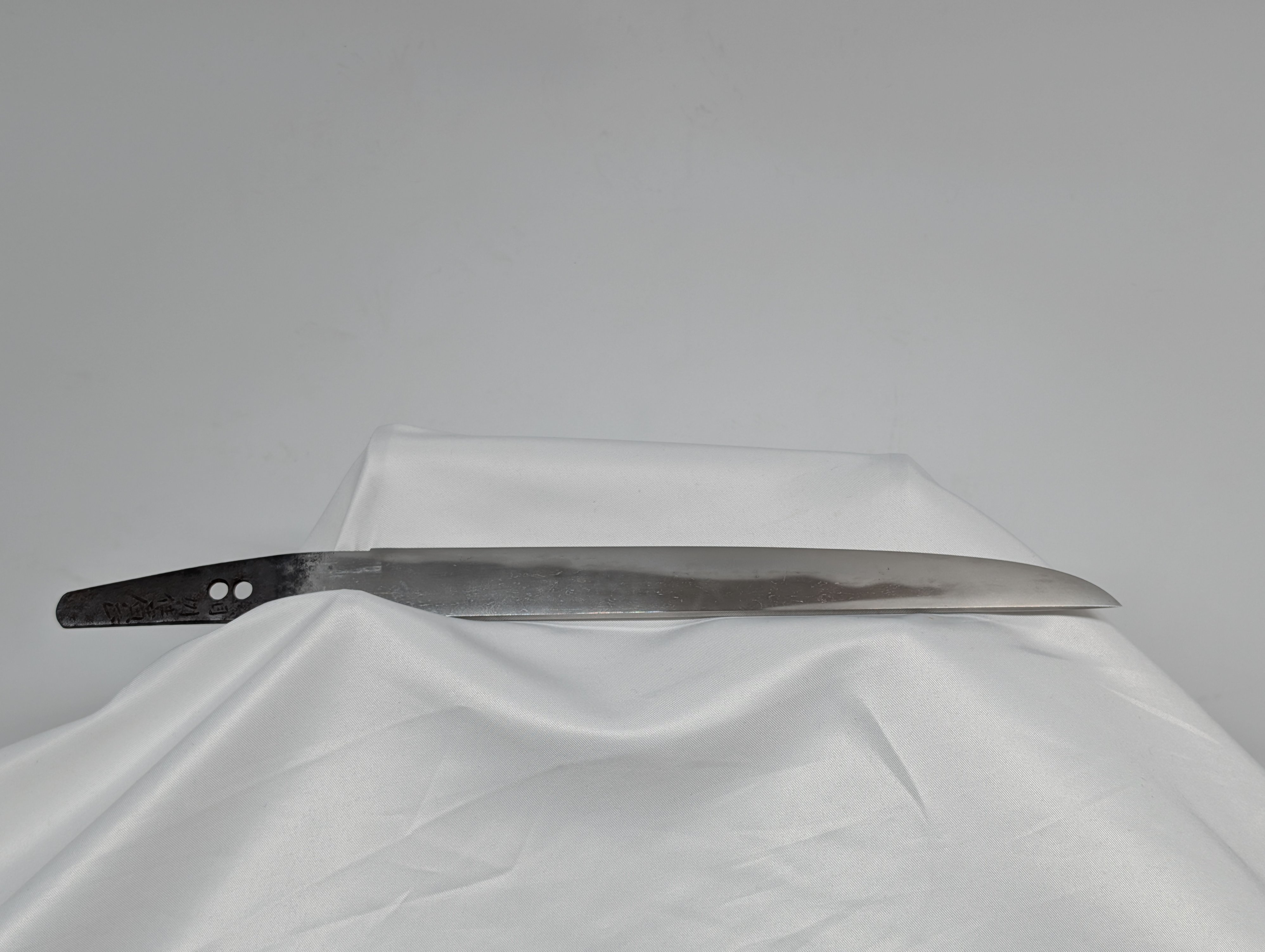
Soshu-den · Sagami · around 1469-1487
Tōken Taikan top 37%
2 pieces on the market now
Where Hiromasa stands among comparable artisans: across all of nihontō, and within tradition, era, and period. The tiers (Foremost · Leading · Major · Notable) weigh official designations from the NBTHK and Japan's Agency for Cultural Affairs, together with historical honors of lasting repute such as the Sansaku and Meibutsu-chō.
Select a lens to see how it's measured.
Years he was demonstrably active, proven by signed-and-dated blades
Soshu-den · Sagami
Phase: Sue-Sōshū末相州· 1356–1868
21 pieces on the market now
When the great Kamakura masters had passed and the country slid into the wars of the late Muromachi, a residual Soshu-den held on in Sagami under a new patron. The Later Hojo, ruling from Odawara castle, kept smiths at hand, and it was from this orbit that the leading name of the window emerged: Tsunahiro, transmitted as a retained smith of the Odawara Hojo who took the character tsuna from Hojo Ujitsuna. The first generation's earliest dated works fall in the Tenbun era, and the line runs forward in the conventional reckoning through Tensho, Keicho, Kan'ei, and Manji, the third generation drawn west to Tsugaru by Tamenobu to forge daisho before returning home. Around him stood a wider Sagami population working the same idiom: Hirotsugu of Kamakura, whose strongest hands cluster near the Meio and Tenbun years; Hiromasa and Soso, names carried across several indistinct generations; Masahiro, reaching back toward Joji; and the Odawara group of Yasuharu, Yasukuni, and Fusamune, the last praised above all for his carving. These smiths inherited the manner of the Nanbokucho apex at a remove of generations rather than by direct descent from the mainline of Masamune and Sadamune. The signature of the phase is the open declaration of the full temper. The forging stays itame mixed with mokume, the grain inclined to stand (hadadachi-gokoro), with ji-nie and chikei; over it the smiths ran a notare-and-gunome ground that climbs the upper half into hitatsura, tobiyaki and muneyaki firing across ji and mune, sunagashi and kinsuji threading the ha. This is the hitatsura and o-midare learned from Hiromitsu and Akihiro, but pushed toward display: the Hirotsugu katana of the 61st Juyo runs its temper so high it reaches the shinogi, mixing choji, togariba, and yahazu-gata into a demonstrative yakidaka pattern.
The contrast with the classic apex is precise and the appraisers mark it. Where Masamune raised nie to its deepest refinement over a bright, clear steel, the Sue-Soshu ji tends to shirake, a whitish cast standing in for that clarity, and the nioiguchi inclines to shizumi, a sunken or subdued quality rather than depth. The 238th Jubi record states the point plainly for the first-generation Tsunahiro: the ji and ha carry abundant nie, yet the very shape of the hamon departs from that of Hiromitsu and Akihiro. The temper is broader and busier across the surface, but it lacks the quiet command and the leaping interior activity of the original. To kantei the window is to separate this demonstrative late temper from the classic Soshu-den it imitates: a standing itame with shirake, a wide hitatsura worked with yahazu and crescent tobiyaki, a nioiguchi that sinks rather than deepens, and signatures reading Soshu-ju with full given names rather than the o-suriage mumei of the great forebears. The named hands carry the distinctions, Fusamune through his dense, precise horimono of kurikara and bonji, Tsunahiro through his crescent tobiyaki and high monouchi fire, Hirotsugu through a hitatsura vigorous enough to recall Hasebe. Provenance keeps these blades close to power: several are recorded in Honma's inventory of the Imperial collection, one bearing the ownership inscription of Akimoto Yoshihide of Kozuke, another the Hachiman Daibosatsu invocation of a Sengoku warrior, the Tsunahiro commission tied by its dated nakago to the Tsugaru house. Learn more →
| Smith | Era | Designated |
|---|---|---|
| Fusamune總宗 | 1504-1521 | 5 |
| Tsunahiro綱廣 | 1532-1555 | 14 |
| Hiromasa廣正 | 1444-1456 | 4 |
| Tsunaie綱家 | 1532-1555 | 3 |
| Hirotsugu廣次 | 1492-1501 | 4 |
Sōshū in the Muromachi period
In the Sengoku era the school served a second warrior court: the Later Hōjō at Odawara, whose patronage kept the Tsunahiro line forging hitatsura for the uchigatana age until the castle fell to Hideyoshi in 1590.
Certifies a genuine blade worth preserving: a signature confirmed correct, or, if unsigned, an era, province, and school that the NBTHK can reliably identify.
The NBTHK (Nihon Bijutsu Tōken Hozon Kyōkai, the Society for the Preservation of Japanese Art Swords) is a public-interest incorporated foundation founded in 1948 and supervised by Japan’s Agency for Cultural Affairs (Bunkachō); it is based at the Japanese Sword Museum in Tokyo. Its expert panels physically examine each submitted work (shinsa) and issue a certificate (kanteishō) ranking it by artistic and historical merit. NBTHK papers are the most widely recognized standard of authentication for Japanese swords and fittings.
NBTHK official siteAs a rule, we do not accept returns from overseas. Once a deposit is paid, we hold the item for up to 3 months. The deposit is non-refundable.
$4,500