NihontoWatch MonNihontoWatchBETA
MarketEncyclopedia
NihontoWatch Mon

NihontoWatchBETA

Market
Encyclopedia
Overview·Kantei·Honors·Designations·Provenance·Blade Forms·Signatures·Lineage·School
OverviewKanteiHonorsDesignationsProvenanceBlade FormsSignaturesLineageSchool
  1. Schools
  2. Naotsuna
  3. Naotsuna

Naotsuna

直綱

Tokujū
Vol. 4, No. 40 · Tachi

Naotsuna

直綱

74 ranked works

正宗十哲
ProvinceIwamiEraKenmu (1334–1338)PeriodNanbokuchōSchoolNaotsunaTraditionSoshu-denGeneration1stTeacherMasamuneFujishiroJo-jo sakuToko Taikan800(top 14%)TypeSwordsmithCodeNAO211
3Jūyō Bijutsuhin
2Tokubetsu Jūyō69Jūyō Tōken

Overview

Naotsuna worked in Iwami, the western province the swordbooks call Sekishu, during the period, signing his blades with the residence Sekishu-ju or Sekishu Dewa-ju. The old tradition counts him among the Masamune-jittetsu, the ten noted disciples of Masamune, and the published sources have transmitted that account from the period onward. They do not accept it on its face. Of the first generation they write that he 'is counted among the so-called Masamune Jittetsu, yet seen in terms of chronology a direct connection seems somewhat forced, and the question must await further careful study', for no extant work bears a date earlier than the Eiwa era. What can be fixed is the manner: this is the tradition carried west to Iwami, and the published sources read its current as running together with and .

His hand is read from workmanship rather than from signature, because signed Naotsuna are scarce. The published record notes plainly that 'signed works by Naotsuna are comparatively few', and most of what survives is and , so the few signed carry a weight beyond their number. The tell the judges name is a temper of squared-off, lined-up , the angular teeth running in step with one another, mixed with small , small and pointed . Over a well-'d he lays vigorous and frequent , with and entering often. The published commentary draws the whole picture together on one shortened blade: the of flowing with and , worked with 'a distinctive linked and , with and , is the characteristic point of interest of Sekishu Naotsuna'. That sentence is the heart of his .

The is the constant beneath the temper. It is an that flows and stands, mixed with , the open rather than packed, with adhering and entering well, and a steel tone that runs darkish, at times with a slight whitish cast. Over that the activity belongs wholly to : gathers thickly, and drift into the upper half, and on some blades a -like line doubles the while the tends to sink. The answers the below, running in irregular and swept with , pointed on one face and small-round on the other, often closing in a -like sweep. Most of the carry a cut through both sides, now and then with a beside it.

The record divides cleanly into two registers of the one hand. The first is the small body of signed , several of them judged the work of the first generation and prized for being signed at all. The keystone is the inscribed Naotsuna in two large characters, which the published sources call 'appraised as the work of the first generation and, being signed, exceedingly valuable', and whose -based temper with pointed elements they liken to and . The second register, far the larger, is the attributed to Sekishu Naotsuna from the workmanship alone. A second , a shortened bearing a long , shows the angular lined up across the blade with that characteristic activity. Across these the signatures themselves differ from blade to blade, which is one reason the swordbooks have never fixed which pieces are first generation and which second, placing the generations variously at Kenmu, Eiwa and Oei.

Within the tradition his work is set beside Kaneuji and , the published sources holding that his temper 'shares an underlying current with and of the -'. What separates him is not borrowed but his own: the lined-up angular and the abundant and over a dark, flowing are the features by which an unsigned blade is judged his, where a hand would show a more refined and a smith a bright packed with . He stands as the figure who took the manner out to Iwami and gave it a recognizable provincial accent, the linked his signature where the cut signature is missing.

For the collector he is a smith met almost entirely through attribution. Fujishiro grades him Jo-jo . He has no National Treasures and no Important Cultural Properties; his record runs instead through two pieces at the rank, some sixty-nine at the , and three prewar Bijutsuhin recording signed and a , several from named houses. His blades are held in institutions and long-standing collections grounded in their own provenance, among them the Tokugawa Art Museum and the Tokyo Museum, with documented owners reaching back to the Tokugawa and Uesugi families, the Takatsukasa house, Ikeda Toshitaka and Tachibana Tadazane. Most designated blades, in private hands as in public, are held rather than traded, and a signed Naotsuna is rarer still than the count of designations suggests, since so little of his work is signed. An carrying his linked comes to a private collector from time to time and with patience; an , signed judged the first generation is among the scarcer things one could hope to encounter, and a quiet document of how the tradition travelled to the far west.
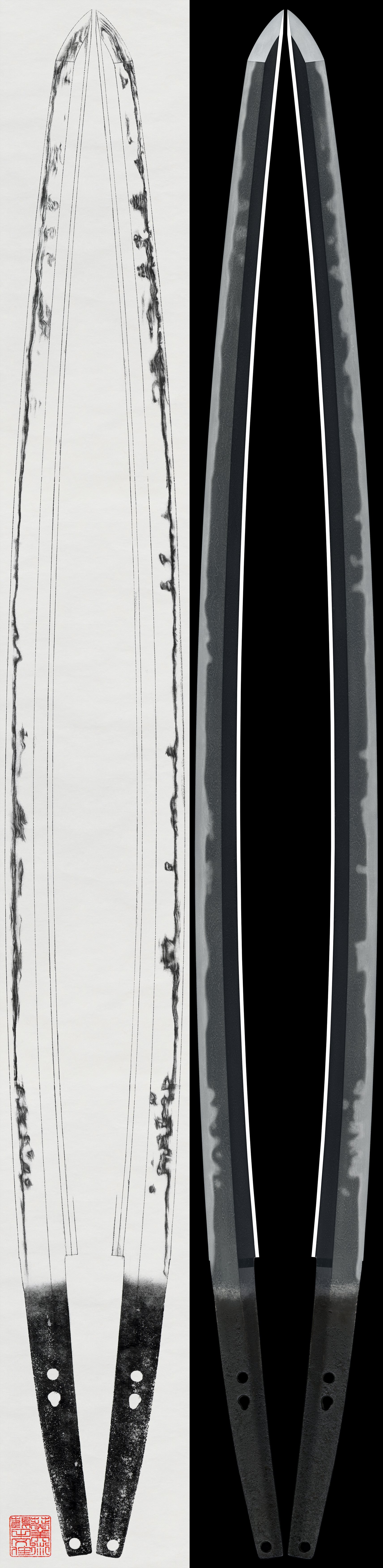

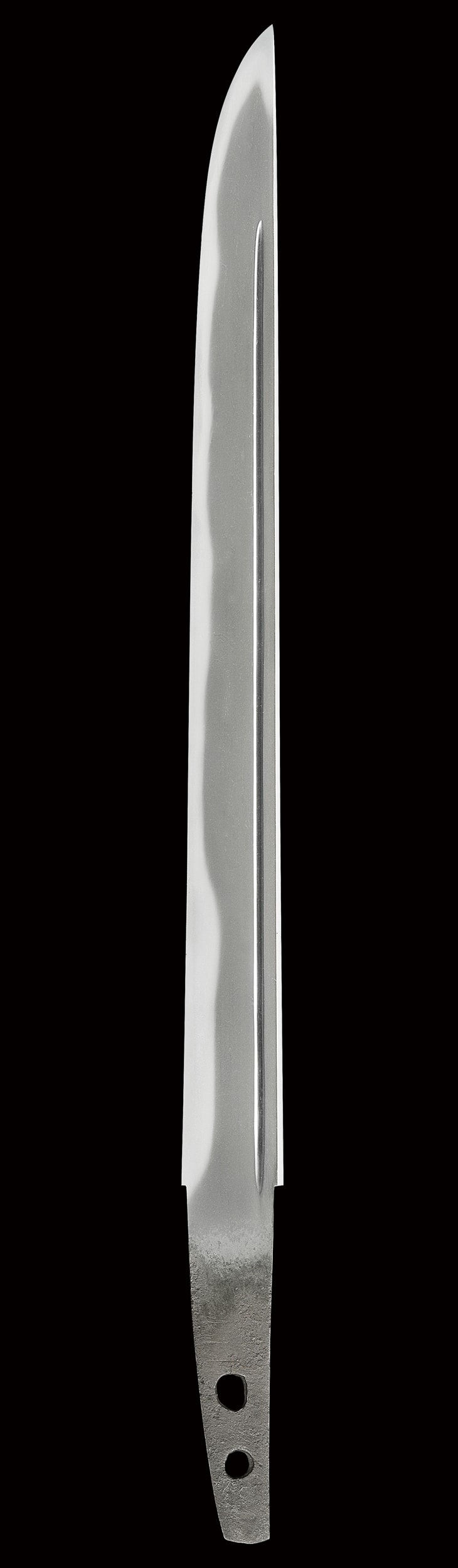
Kantei

one Soshu-den Sekishu hand in two registers: the rare ubu, two-character signed tachi judged the first generation, his anchor; set against the predominant o-suriage mumei katana attributed to Sekishu Naotsuna from the linked angular gunome, the heavy sunagashi and the dark flowing itame

Naotsuna is the Sekishu (Iwami) smith of the period whom the old swordbooks count among the Masamune-jittetsu, the ten noted disciples of Masamune, a tradition the published sources cite from the period onward yet treat with open caution, since the oldest dated work descends no earlier than the Eiwa era and the chronology will not bear a direct link to Masamune. His record is overwhelmingly one of attribution: of the surviving blades all but a few are and , with only three or so signed to anchor the hand, so the name is read more from workmanship than from signature. That workmanship is - carried to Iwami. Over a standing that flows, mixed with , the steel tone darkish, with and , he tempers a notare-based whose tell is a run of squared-off, lined-up with pointed elements, abundant and , profuse and frequent , the well gathered, the swept into a -like point. The published sources say this current runs together with and within the tradition. Two or three generations bear the name across the into the , and the swordbooks have not settled which signed pieces are first and which second.

Diagnostic discriminators

unique vs his own gunome generally

unique vs his dark, flowing standing itame vs a packed Bizen ground

Observation by phase

The signed tachi (his anchor, judged the first generation)

His anchor is the small body of signed , several appraised as the work of the first generation. They are with , the somewhat narrow, the slightly shallow and high at the hips, a . The ground is an that flows and stands, with mixed in, adhering and entering, the steel tone darkish overall. Over it the temper is a small and with pointed elements, the published sources calling it a distinctive make, well gathered in , vigorous running and entering, and appearing in the upper half. The sweeps with into a -like point. The Tokuju signed in two large characters, judged the and exceedingly valuable for being signed, is the keystone; the published sources say its current runs together with and of the tradition. The signatures themselves differ from blade to blade, which is part of why the generations remain unsettled.

Sugata 姿
Jigane 地鉄
Hamon 刃文
Bōshi 帽子

The o-suriage mumei katana (mainstream Sekishu Naotsuna attribution)

The body of his record is the attributed to Sekishu Naotsuna. These are wide-bodied, several with an elongated or large , greatly shortened yet retaining a fair curvature. The ground is an mixed with that stands, with thick , well entering, a slight whitish cast and a dark iron tone. The temper is the tell: a of squared-off, lined-up mixed with , small and pointed elements, and entering frequently, well adhering, running, here and there, in places a -like line and a that tends to sink. The runs in as , swept, often pointed on one side and small-round on the other, with a tendency. Most carry a carved through both sides, sometimes with a . The published sources affirm these attributions as highly appropriate, since the flowing with and , the distinctive linked and pointed elements, and the and are the characteristic points of interest of Sekishu Naotsuna; the older, finer such pieces they judge the work of the first generation.

Sugata 姿
Jigane 地鉄
Hamon 刃文
Bōshi 帽子
Scholarship

The published sources record that there are several smiths named Naotsuna (Ishikawa Naotsuna), the old tradition books placing the first generation at Kenmu, the second at Eiwa and the third at Oei; that the first is transmitted as a Masamune pupil and counted among the Jittetsu; and that, judged by chronology and by style, a direct link to Masamune is difficult, so the matter is left for further study.

Because no extant work bears a date earlier than Eiwa and the manner of signing comes in several styles, the published sources find that no firm conclusion can yet be drawn dividing the generations; signed Naotsuna being comparatively few and most attributions o-suriage mumei, an o-suriage mumei katana showing his linked gunome with abundant nie and sunagashi is judged appropriately his, and the transmission is to be accepted.

Honors

正宗十哲Masamune Juttetsu (Ten Brilliant Students of Masamune)

Traditionally one of the Ten (chronologically doubtful)

The Ten Brilliant Students of Masamune — an -period construct first attested in the Shōsan (刀剣正纂, 1862), which itself already disclaims the grouping as later conjecture. Several members cannot have been actual students on chronology (Kanemitsu, Chōgi, Kinjū, Naotsuna), and Norishige is now considered a fellow student under Kunimitsu — yet invoke the roster constantly, and it remains core collector vocabulary. Roster variants exist (Sadamune in place of Naotsuna; Kongōbyōe Moritaka swapped in for Kunitsugu or Naotsuna); this honor tags the standard ten.

Designations

Kokuhō—
Jūyō Bunkazai—
Jūyō Bijutsuhin3
Gyobutsu—
Tokubetsu Jūyō2
Jūyō Tōken69

Elite Standing

0.24 across 74 designated works

Top 10% among smiths

Provenance

8 documented provenances across certified works by Naotsuna

Provenance Standing

3 works held in elite collections across 8 documented provenances

Top 19% among smiths

Raw score: 2.10 / 10

Blade Forms

Distribution across 74 ranked works

Signatures

Signature types across 74 ranked works

Currently Available

Lineage

TeacherMasamune
Naotsuna
Students (6)
  1. 1.Sadatsuna貞綱1 for sale8designated
  2. 2.Kanetsuna兼綱1designated
  3. 3.Masatsuna正綱1designated
  4. 4.Naoshige直重1designated
  5. 5.Naotsuna直綱
  6. 6.Sadatsuna貞綱2designated

Naotsuna School

Other artisans of the Naotsuna school

  1. 1.Sadatsuna貞綱1 for sale8designated
  2. 2.Kanetsuna兼綱1designated
  3. 3.Naoshige直重1designated
  4. 4.Masatsuna正綱1designated
  5. 5.Suesada末貞1designated
  6. 6.Sadatsuna貞綱2designated