NihontoWatch MonNihontoWatch
MarketEncyclopediaKantei
NihontoWatch MonNihontoWatch
Market
Encyclopedia
Kantei
Overview·Historical importance·Designations·Kantei·Provenance·Blade Forms·Signatures·Lineage·School
OverviewHistorical importanceDesignationsKanteiProvenanceBlade FormsSignaturesLineageSchool
  1. Schools
  2. Sa
  3. Sue-Sa
  4. Yasuyoshi

Sa Yasuyoshi

安吉

Tokujū
Vol. 14, No. 32 · Wakizashi

Sa Yasuyoshi

安吉

45 ranked works

Leading smith
ProvinceChikuzenEraShohei (1346–1370)PeriodNanbokuchōSchoolSaTraditionSoshu-denGeneration2ndTeacherSaFujishiroJo-jo sakuToko Taikan900(top 10%)TypeSwordsmithCodeYAS586
6Jūyō Bunkazai
4Jūyō Bijutsuhin
2Gyobutsu
3Tokubetsu Jūyō30Jūyō Tōken

Overview

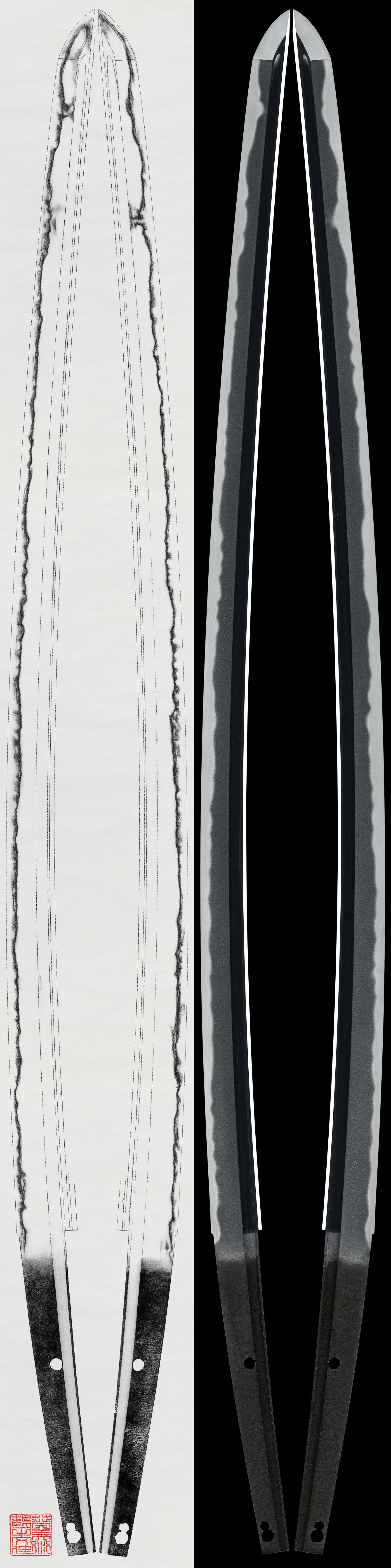
A dated Shohei 17 (1362) and signed Choshu ju Yasuyoshi, today a Bijutsuhin, anchors nearly everything the published sources say about Yasuyoshi of . Its hand is identical to his customary signature, and on that identity rests the account repeated at the head of entry after entry: Yasuyoshi was the son of O- (大左), succeeded him as the second generation of the line, and later moved from to Nagato. His dated work runs from Shohei 17 into the Joji era. The name did not end with him, for descendants or pupils carried it in Nagato into the early period, the line the sources call Choshu- (長州左). Across half a century of designations the assigns him one constant character, stated in almost the words each time: his is the work in which, "within the family a temperament intermingles".

The signed record has a strict shape. Every signed Yasuyoshi is a wide, or in , thin in and shallow in , the full mid- stance; where O-'s stay small, his run large. The published sources state plainly that no authenticated signed exists, so his and survive as attributions. The itself is a large two-character signature cut with a somewhat thick chisel below the at the center of the . On occasion it is prefixed with the character , a form headed by the Hitotsuyanagi Yasuyoshi (一柳安吉), an Important Cultural Property. The record is just as exact about an absence: works signed Yasuyoshi (左安吉) and Choshu ju Yasuyoshi both survive, but "one does not see examples signed Chikushu ju Yasuyoshi".

His is an that flows and often stands, mixed with , with attached. Over it rises a whitish , a , or a near the edge, and the published sources name this flowing, standing forging with its whitish cast the viewing point of the smith. The is a shallow mixed with , and pointed elements, -dominant with . enter, fine runs through, and appear here and there. The runs or thrusts up in fashion, leans slightly toward the edge, and ends pointed with light and a rather long return. Set against his father the judgment is plain: the brilliance of and falls short of O-, one early entry stating without ceremony that "his skill as well does not reach his father", and the , lacking O-'s sharpness, often falls into a leaning tendency. These qualities form the stated trap. -dominant with set in, his work "at first sight strays among pieces such as Kanemitsu", and the standing only strengthens the impression.

Two registers complicate the portrait at its edges. A minority of his smallest , nearly O-'s own size with a slightly withered , keep close to the master: dust-fine thick , fine , at times a , a bright clear with and sweeping through, the pointed, a make the published sources call "truly mistakable for O-". On the signed Yasuyoshi, the character is fluent and close to O-'s own hand while the two characters of Yasuyoshi show a somewhat naive chisel; whether such pieces prove the tradition that O- himself signed Yasuyoshi in his last years, or are instead Yasuyoshi's earliest work, the leaves open for future study. At the other edge stand the Nagato years. Blades read as the Choshu Yasuyoshi differ from his usual -dominant hand: and take strongly, the grows bold with mixing in, sweeps with entering, and the thrusts up to a point. Oei-dated work is judged plainly a successor generation, while the Eiwa-dated pieces stand unresolved between the founder's last years and a second generation, a question the published sources repeat as a subject for future research.

On unsigned blades of the type his own marks decide the attribution. Where the flowing, standing carries a whitish , where the temper turns -dominant in small patterns, and where the thrusting pointed softens into a lean, the work is likened to Yasuyoshi within the school, and several have been so appraised. The pointed is the -family inheritance he never gives up; the softness of the edge is his own. The recent entries single out "the deep carrying a soft feeling" and the rich activity working inside the , finding in them a strength that remains his even where the brilliance does not match his father's.

Fujishiro rates him Jo-jo , and the record is unusually legible: forty-five designated works are on record, thirty-six of them signed against seven unsigned. Six blades are Important Cultural Properties, headed by the Hitotsuyanagi Yasuyoshi; four are Bijutsuhin, among them the dated Shohei 17 ; and thirty-three stand in the and tiers, one praised as "the very finest within this smith's work". Fourteen blades carry recorded provenance: examples passed in the Ikeda and Inshu Ikeda houses, the Tosa Yamauchi and the Maeda, one certified in the ownership of Tokugawa Iesato, and another treasured by Motoda Nagazane, the Confucian scholar of Kumamoto. Of recorded whereabouts today, blades rest in the Tokugawa Art Museum, the Fukuoka City Museum, the Tokyo National Museum and the Sano Art Museum. The Important Cultural Properties are patrimony and will remain where they are; much of the rest is held by institutions or in long private keeping, and a signed Yasuyoshi coming into open hands is an uncommon event, appearing only rarely and rewarding patience.

Historical importance

Where Yasuyoshi stands among comparable artisans: across all of nihontō, and within tradition, era, and period. The tiers (Foremost · Leading · Major · Notable) weigh official designations from the NBTHK and Japan's Agency for Cultural Affairs, together with historical honors of lasting repute such as the Sansaku and Meibutsu-chō.

随一
Foremost
屈指
Leading
有数
Major
著名
Notable

Select a lens to see how it's measured.

Designations

Kokuhō—
Jūyō Bunkazai6
Jūyō Bijutsuhin4
Gyobutsu2
Tokubetsu Jūyō3
Jūyō Tōken30

Elite Standing

Kantei

Provenance

Blade Forms

Distribution across 45 ranked works

Signatures

Signature types across 45 ranked works

Currently Available

Lineage

TeacherSa
Yasuyoshi
Students (6)
  1. 1.Sadayoshi貞吉23designated
  2. 2.Yasuyoshi安吉1 for sale3designated
  3. 3.Akikuni顯國2designated
  4. 4.Nobushige信重
  5. 5.Yasuyoshi安吉1designated
  6. 6.Yukiaki行觀2designated

Sa School

Other artisans of the Sa school

  1. 1.Sa左73designated
  2. 2.Kunihiro國弘1 for sale48designated
  3. 3.Yoshisada吉貞1 for sale48designated
  4. 4.Hiroyasu弘安24designated
  5. 5.Hiroyuki弘行32designated
  6. 6.Yukihiro行弘10designated
  7. 7.Sadayoshi貞吉23designated
  8. 8.Sadayuki定行1 for sale3designated
  9. 9.Yoshihiro吉弘4designated
  10. 10.Hiroyoshi弘吉2designated
  11. 11.Kunitada國忠1designated
  12. 12.Sadaaki貞秋1designated

More Sue-Sa works

View all →
Katana Yamadaiya
Tokuho
Katana - Tokuho - by Sa Kunihiro - Tokubetsu Hozon Token: Mumei (Attributed to Sakon Kunihiro)Katana - Tokuho - by Sa Kunihiro - Tokubetsu Hozon Token: Mumei (Attributed to Sakon Kunihiro)

Katana

BySa Kunihiro
¥1,650,000
Hyozaemon
Tokuho
Tokuho - by Sue-Sa School - Naginata-naoshi Wakizashi: Soshu High-Grade WorkTokuho - by Sue-Sa School - Naginata-naoshi Wakizashi: Soshu High-Grade Work

Naginata-naoshi Wakizashi: Soshu High-Grade Work

BySue-Sa School
Ask
Aoi Art
Jūyō
Katana - Jūyō - by Sa Yoshisada - Mumei (Unsigned) Sa YoshisadaKatana - Jūyō - by Sa Yoshisada - Mumei (Unsigned) Sa Yoshisada

Katana

BySa Yoshisada
¥5,000,000
Eirakudo
Jūyō
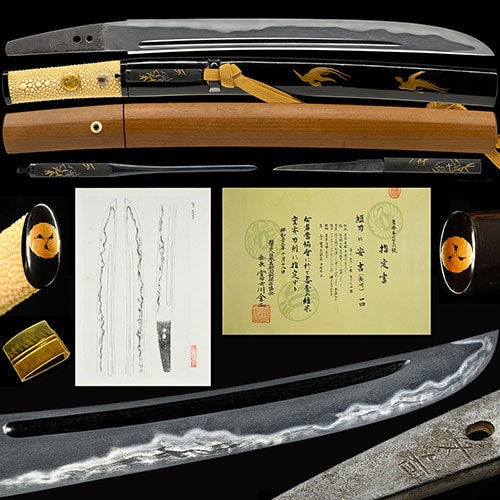
Tanto - Jūyō - by Sa Yasuyoshi - Mei Yasuyoshi Tanto Juyo TokenTanto - Jūyō - by Sa Yasuyoshi - Mei Yasuyoshi Tanto Juyo Token

Tantō

BySa Yasuyoshi
¥9,500,000
Choshuya
Katana - by Sue-Sa School - O-suriage Mumei: O-Sa IchimonKatana - by Sue-Sa School - O-suriage Mumei: O-Sa Ichimon

Katana

BySue-Sa School
Ask
World Seiyudo
Tokuho
Wakizashi - Tokuho - by Sa Sadayuki - Wakizashi with Shumei by Sano Sadayuki, NBTHK Tokubetsu Hozon TokenWakizashi - Tokuho - by Sa Sadayuki - Wakizashi with Shumei by Sano Sadayuki, NBTHK Tokubetsu Hozon Token

Wakizashi

BySa Sadayuki
¥1,500,000
Nipponto
Tokuho
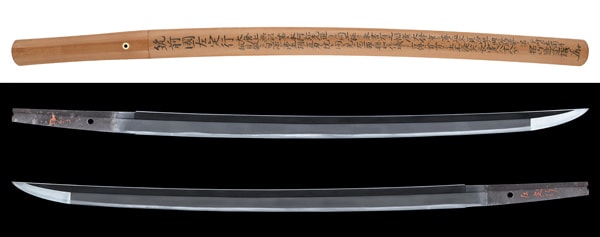
Tanto - Tokuho - by Hirado Sa School - Den (Attributed) Tanto by Hirado Sa (Yasuyoshi)Tanto - Tokuho - by Hirado Sa School - Den (Attributed) Tanto by Hirado Sa (Yasuyoshi)

Tantō

ByHirado Sa School
¥680,000

More from the Sa school

View all →
Kusanagi
Tokuho
Katana - Tokuho - by Sa School - Tokubetsu Hozon Token by Sa Yoshisada, a Jojo-saku smith and son of Samonji; a magnificent Soshu-den work.Katana - Tokuho - by Sa School - Tokubetsu Hozon Token by Sa Yoshisada, a Jojo-saku smith and son of Samonji; a magnificent Soshu-den work.

Katana

BySa School
¥1,800,000
Choshuya
Tokuho
Katana - Tokuho - by Sa School - O-suriage Mumei O-Sa SchoolKatana - Tokuho - by Sa School - O-suriage Mumei O-Sa School

Katana

BySa School
Ask
Nipponto
Tokuho
Katana - Tokuho - by Sa School - Mumei, Saki Yoshiyoshi, Sano YoshisadaKatana - Tokuho - by Sa School - Mumei, Saki Yoshiyoshi, Sano Yoshisada

Katana

BySa School
¥1,750,000

More from the Sōshū tradition

View all →
Aoi Art
Tokuho
Katana - Tokuho - by Gō Yoshihiro - Mumei (Unsigned) Den Go YoshihiroKatana - Tokuho - by Gō Yoshihiro - Mumei (Unsigned) Den Go Yoshihiro

Katana

ByGō Yoshihiro
¥35,000,000
Tsuruginoya
Tokujū
Katana - Tokuju - by Soshu Yukimitsu - Soshu YukimitsuKatana - Tokuju - by Soshu Yukimitsu - Soshu Yukimitsu

Katana

BySoshu Yukimitsu
Ask
Samurai Nippon
Jūyō
Tanto - Jūyō - by Soshu Yukimitsu - Soshu Yukimitsu (Ubu Mumei)Tanto - Jūyō - by Soshu Yukimitsu - Soshu Yukimitsu (Ubu Mumei)

Tantō

BySoshu Yukimitsu
¥6,700,000
Mandarin Mansion
Jūyō
Tachi - Jūyō - by Soshu Yukimitsu - Juyo Soshu Yukimitsu TachiTachi - Jūyō - by Soshu Yukimitsu - Juyo Soshu Yukimitsu Tachi

Tachi

BySoshu Yukimitsu
Ask
Eirakudo
Tokuho
Katana - Tokuho - by Shintogo Kunimitsu - Shintogo Kunimitsu - Tokubetsu Hozon TokenKatana - Tokuho - by Shintogo Kunimitsu - Shintogo Kunimitsu - Tokubetsu Hozon Token

Katana

ByShintogo Kunimitsu
¥7,500,000
Eirakudo
Tokuho
Katana - Tokuho - by Soshu Norishige - Norishige - Tokubetsu Hozon TokenKatana - Tokuho - by Soshu Norishige - Norishige - Tokubetsu Hozon Token

Katana

BySoshu Norishige
¥6,500,000
Choshuya
Jūyō
Tanto - Jūyō - by Soshu Norishige - Unsigned (Ubu-nakago) NorishigeTanto - Jūyō - by Soshu Norishige - Unsigned (Ubu-nakago) Norishige

Tantō

BySoshu Norishige
¥6,500,000
Eirakudo
Jūyō
Tanto - Jūyō - by Soshu Yukimitsu - Sosyu Yukimitsu Tanto Juyo TokenTanto - Jūyō - by Soshu Yukimitsu - Sosyu Yukimitsu Tanto Juyo Token

Tantō

BySoshu Yukimitsu
Ask

Yasuyoshi

Yasuyoshi(安吉) was a Japanese swordsmith of the Sa school in Chikuzen province, active during the Shohei (1346-1370) ND period.

The work follows the Soshu-den tradition.

Designated works by Yasuyoshi include 6 Jūyō Bunkazai (Important Cultural Property), 3 Tokubetsu Jūyō, 30 Jūyō.