NihontoWatch Mon

NihontoWatchBETA

Market
Encyclopedia
NihontoWatch Mon

NihontoWatchBETA

Market
Encyclopedia

Description

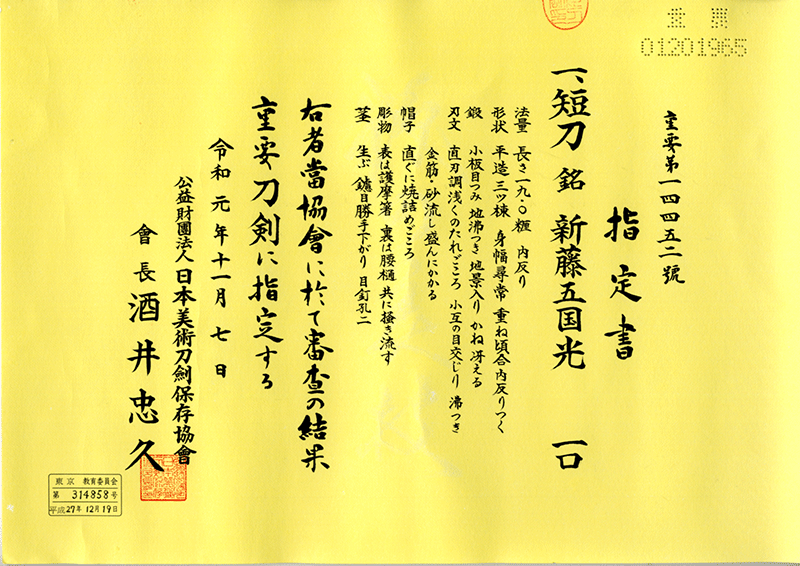
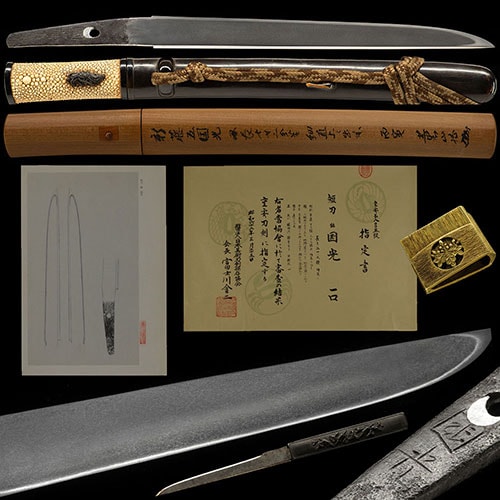
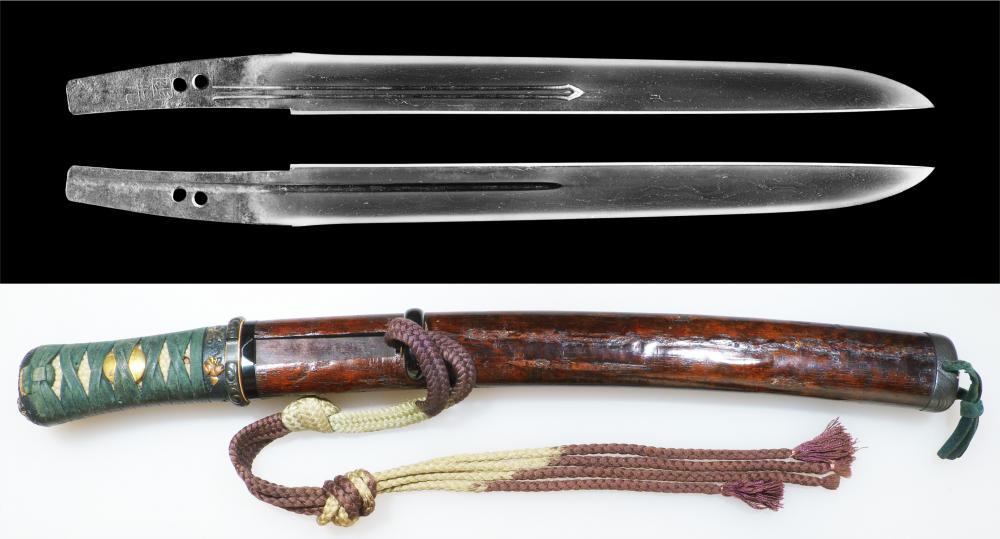
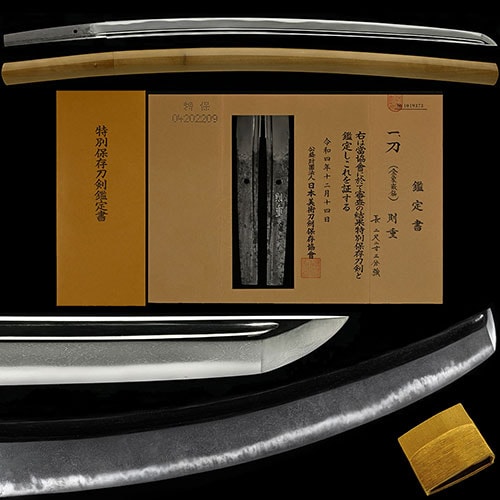
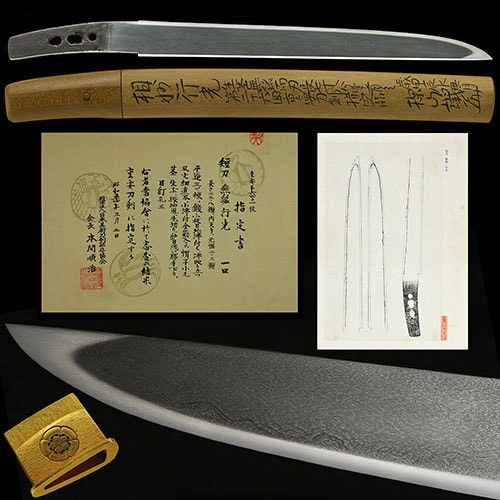
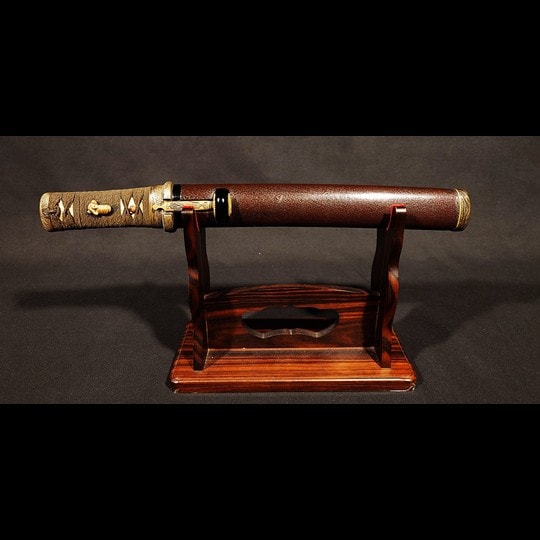
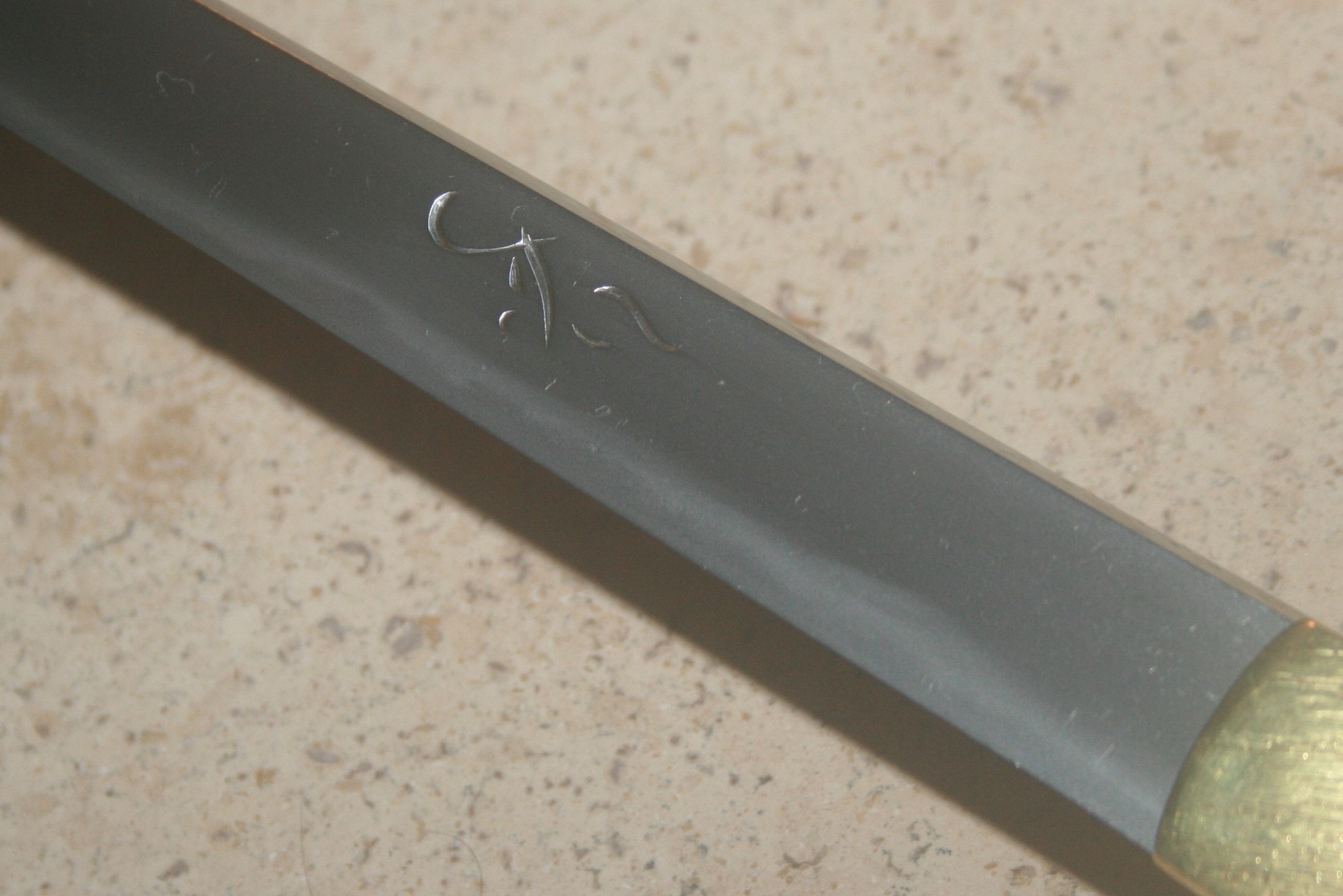
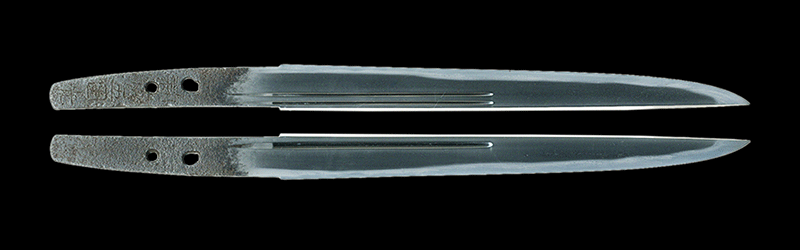
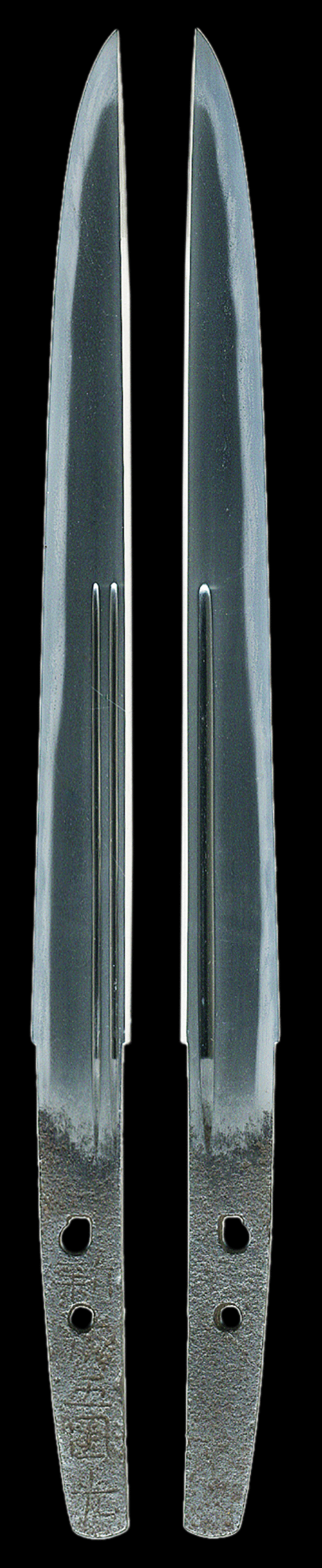
This is a Juyo Token designated tanto by Shintogo Kunimitsu, an important smith from the Kamakura period active in Sagami Province. He is known as the founder of the Soshu tradition and a master of tanto, with many existing works being short swords. This piece is particularly valuable for its rare long signature and excellent preservation.

NBTHK Setsumei

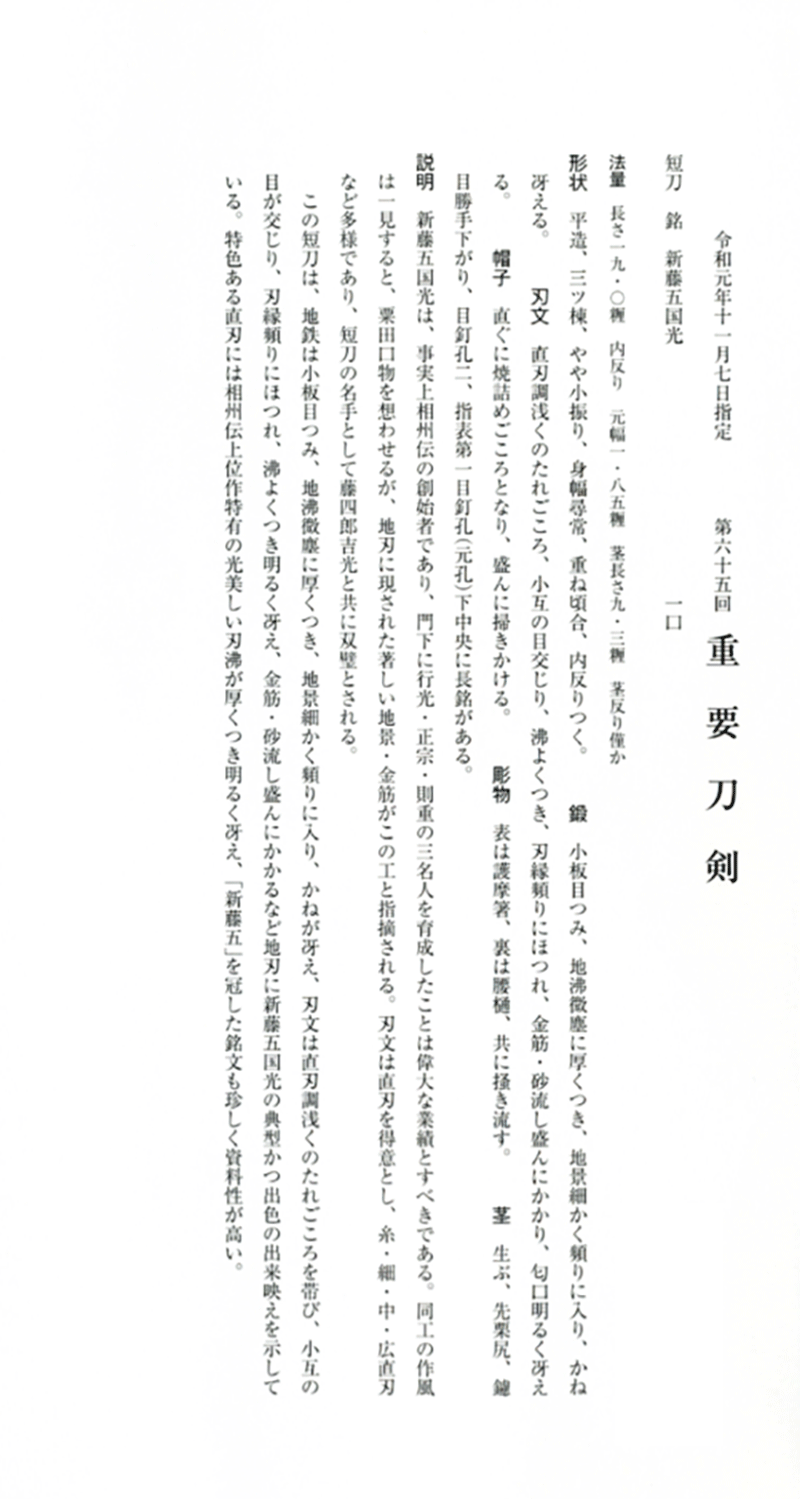
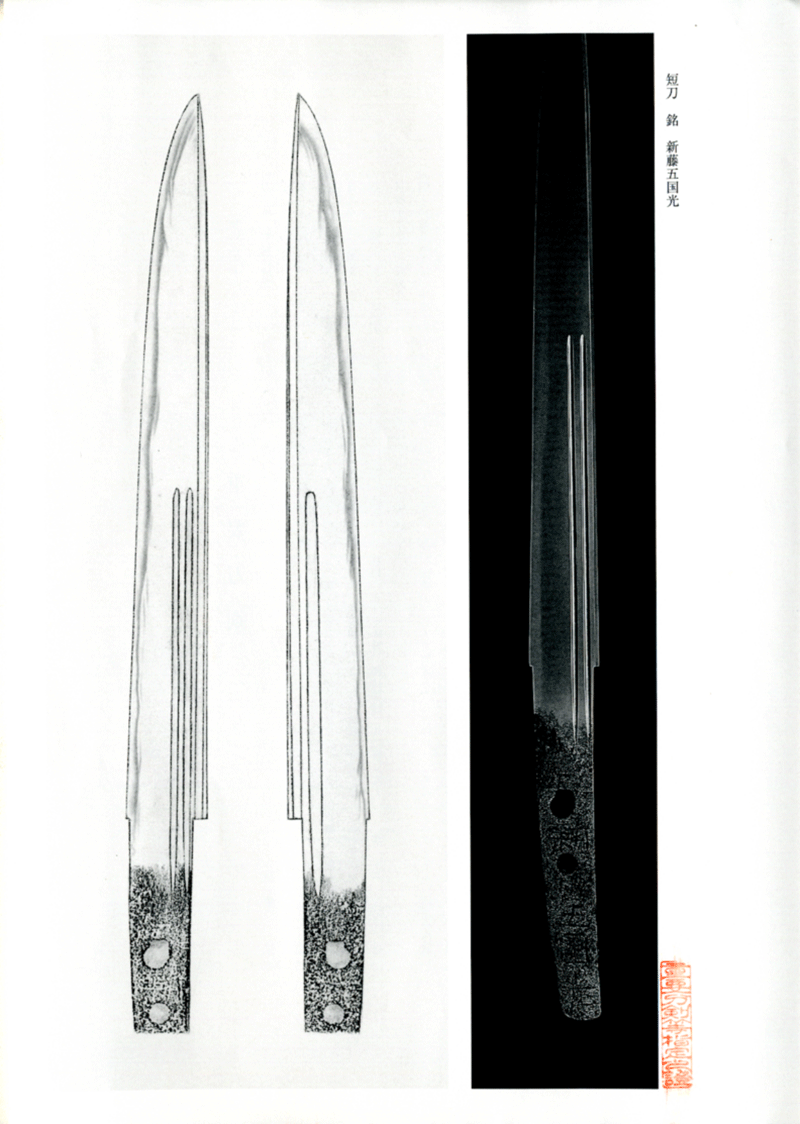
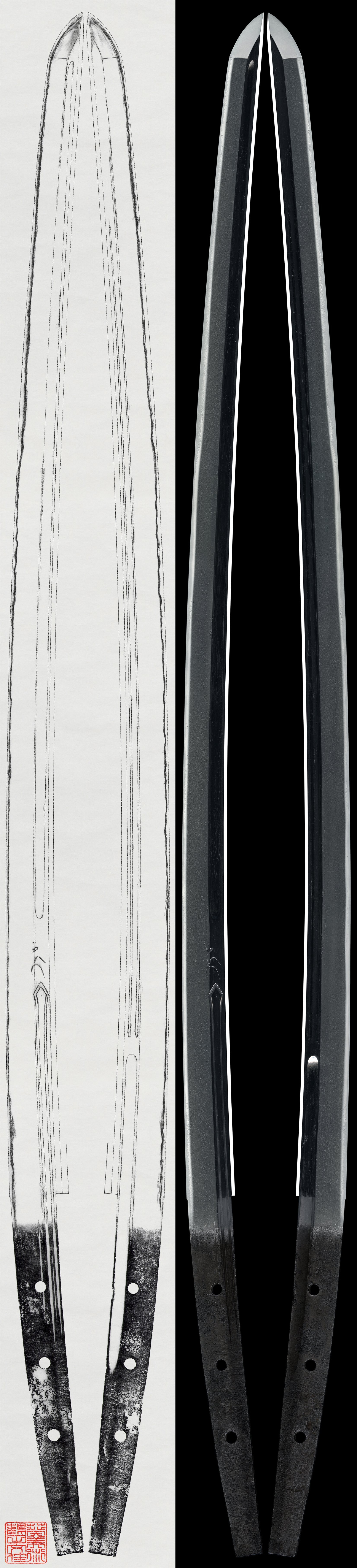
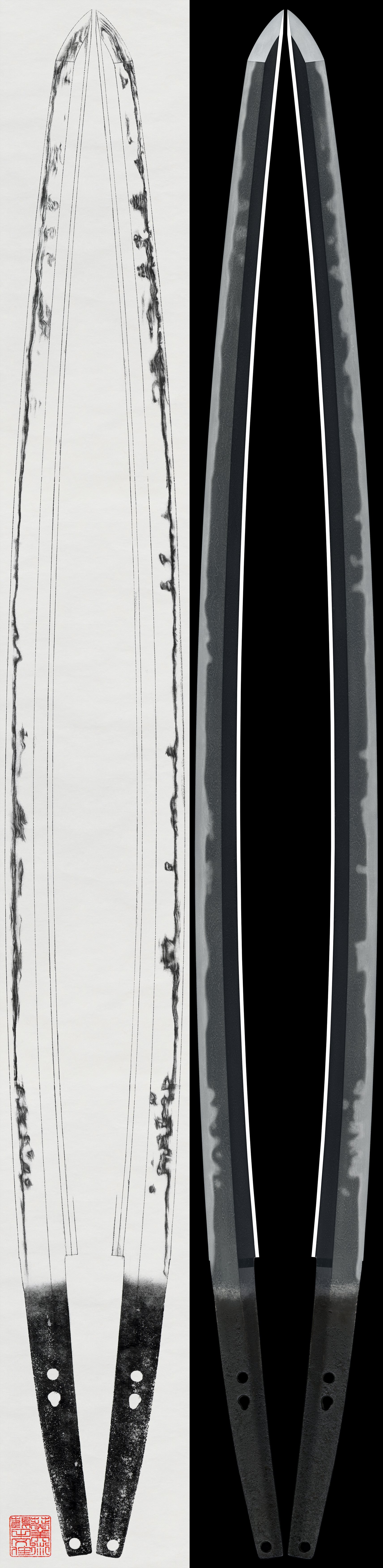
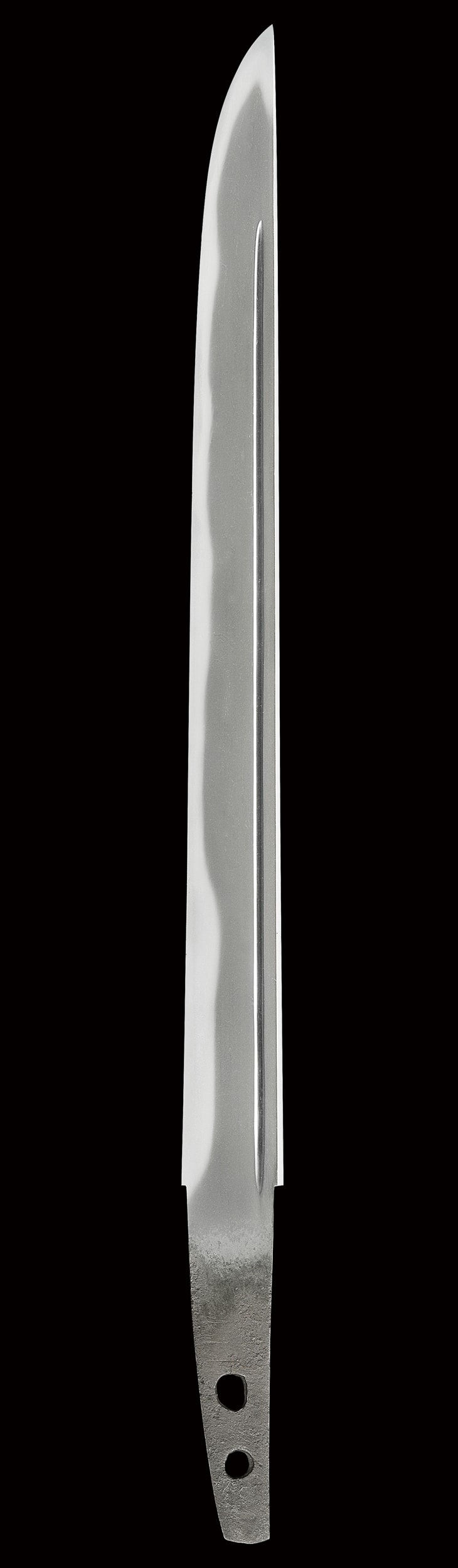
Jūyō-Tōken, 65th Session — Designated November 7, 2019 Tantō, mei: Shintōgo Kunimitsu (新藤五国光) Measurements Nagasa 19.0 cm, sori: uchizori (not stated), motohaba 1.85 cm, nakago-nagasa 9.3 cm, nakago-sori slight Description Keijō: hira-zukuri with mitsu-mune; somewhat smallish; mihaba standard; kasane moderate; exhibits uchizori. Kitae: ko-itame well-packed; ji-nie adheres densely in fine particles; fine chikei enter delicately and frequently; the steel is clear (saeru). Hamon: suguha-chō with a shallow notare-tendency, mixed with ko-gunome; nie attaches well; the habuchi shows frequent hotsure; kinsuji and sunagashi appear vigorously; the nioiguchi is bright and clear. Bōshi: tempered straight, tending toward yakitsume; vigorous hakikake. Horimono: Omote: gomabashi; Ura: koshi-hi; both carved kaki-nagashi. Nakago: ubu; kurijiri; yasurime katte-sagari; two mekugi-ana; a long signature is cut on the sashi-omote, centered below the first (original) mekugi-ana. Artisan Shintōgo Kunimitsu Era Late Kamakura period Explanation Shintōgo Kunimitsu was, in practical terms, the founder of the Sōshū tradition (Sōshū-den). That he fostered three great masters—Yukimitsu, Masamune, and Norishige—among his followers should be regarded as a truly outstanding achievement. At a glance, his style can recall Awataguchi works; however, the conspicuous chikei and kinsuji manifested in the jiba are points by which this smith is identified. He excelled especially in suguha, producing a wide range such as “threadlike,” “fine,” “medium,” and “wide” suguha. As a master of tantō, he is often ranked as one of the two supreme makers together with Tōshirō Yoshimitsu. This tantō shows ko-itame that is tightly forged, with densely adhering fine ji-nie; fine chikei enter minutely and with great frequency; and the steel is clear. The hamon is basically suguha-chō with a shallow notare-tendency and mixed ko-gunome; the habuchi displays frequent hotsure; the nie attaches well, producing a bright and clear effect; and kinsuji and sunagashi are applied vigorously. Altogether, the jiba presents a typical yet particularly distinguished example of Shintōgo Kunimitsu’s workmanship. Moreover, in this distinctive suguha, the beautiful, brilliant ha-nie characteristic of the highest level Sōshū works adheres thickly, yielding a bright and clear appearance. The inscription that bears the prefix “Shintōgo” is also rare, giving this piece high documentary value as reference material.

NihontoWatch MonNihontoWatchBETA
MarketEncyclopedia
Swords›Sōshū-den›Soshu›Kunimitsu›Koto: Shintogo Kunimitsu
tantoJūyō
Shintogo Kunimitsu

Koto: Shintogo Kunimitsu

mei · Soshu · Kamakura · nagasa 19cm

SOLD
Shintogo Kunimitsu — 1 of 6
Shintogo Kunimitsu — 2 of 6
Shintogo Kunimitsu — 3 of 6
Shintogo Kunimitsu — 4 of 6
Shintogo Kunimitsu — 5 of 6
Shintogo Kunimitsu — 6 of 6
1 / 6
1 / 6
Shintogo Kunimitsu — 1 of 6Shintogo Kunimitsu — 2 of 6Shintogo Kunimitsu — 3 of 6Shintogo Kunimitsu — 4 of 6Shintogo Kunimitsu — 5 of 6Shintogo Kunimitsu — 6 of 6
Measurements & details
Smith
Shintogo Kunimitsu
Type
Tanto
School
Soshu
Period
Around 1293–1322(Einin)
Province
Sagami
Signature
Signed(84% of this smith's designated works are signed)
Measurements
Nagasa 19cmMotohaba 1.85cmKasane 0.4cm
Description

This is a Juyo Token designated tanto by Shintogo Kunimitsu, an important smith from the Kamakura period active in Sagami Province. He is known as the founder of the Soshu tradition and a master of tanto, with many existing works being short swords. This piece is particularly valuable for its rare long signature and excellent preservation.

NBTHK Zufu Commentary

Juyo #65

AI translation — may contain errors

-, 65th Session — Designated November 7, 2019

, : Kunimitsu (新藤五国光)

Measurements 19.0 cm, : (not stated), 1.85 cm, 9.3 cm, slight

Description Keijō: with ; somewhat smallish; standard; moderate; exhibits . : well-packed; adheres densely in fine particles; fine enter delicately and frequently; the steel is clear (). : with a shallow -tendency, mixed with ; attaches well; the shows frequent ; and appear vigorously; the is bright and clear. : tempered straight, tending toward ; vigorous . : : ; : ; both carved kaki-nagashi. : ; ; ; two ; a long signature is cut on the , centered below the first (original) .

Artisan Kunimitsu

Era Late period

Explanation Kunimitsu was, in practical terms, the founder of the tradition (Sōshū-den). That he fostered three great masters—Yukimitsu, Masamune, and Norishige—among his followers should be regarded as a truly outstanding achievement. At a glance, his style can recall works; however, the conspicuous and manifested in the are points by which this smith is identified. He excelled especially in , producing a wide range such as “threadlike,” “fine,” “medium,” and “wide” . As a master of , he is often ranked as one of the two supreme makers together with Tōshirō Yoshimitsu.

This shows that is tightly forged, with densely adhering fine ; fine enter minutely and with great frequency; and the steel is clear. The is basically with a shallow -tendency and mixed ; the displays frequent ; the attaches well, producing a bright and clear effect; and and are applied vigorously. Altogether, the presents a typical yet particularly distinguished example of Kunimitsu’s workmanship.

Moreover, in this distinctive , the beautiful, brilliant characteristic of the highest level works adheres thickly, yielding a bright and clear appearance. The inscription that bears the prefix “” is also rare, giving this piece high documentary value as reference material.

About the maker

Kunimitsu

國光

Soshu (Sagami, Kamakura) · Sagami · around 1293-1322

Fujishiro Sai-jo saku · Tōken Taikan top 3%

2 pieces on the market now

›

In the tenth month of Einin 1 (1293), a blade left the Kamakura forge of Shintogo Kunimitsu bearing the long signature Kamakura junin Shintogo Kunimitsu saku[[c:1]], the oldest of his dated works. The published sources count Awataguchi Kunitsuna and the Bizen smiths Kunimune and Sukezane as the pioneers of Kamakura sword-making, settlers from older centers; the first smith of Sagami itself, who cut his Kamakura residence and his dates into the nakago, was Kunimitsu[[c:2]]. His designation texts open with one standing sentence for half a century: he is the de facto founder of the Soshu tradition, and the raising of the three masters Yukimitsu, Masamune and Norishige is counted his great achievement[[c:3]]. Tradition makes him the son of Awataguchi Kunitsuna and a pupil of Bizen Saburo Kunimune, a transmission the sources say still leaves room for study. His dated work runs to Gentoku 3 (1331), and a tanto of Showa 4 (1315) signed with the Buddhist name Koshin is read as late work, beside the dates of Kagen and Tokuji.

What survives is, before all else, the tanto: hira-zukuri and mitsu-mune, of ordinary width with uchizori, ubu and signed with the two-character mei. The sources state his formula in a single sentence: at a glance the work suggests Awataguchi, but the conspicuous chikei and kinsuji expressed in ji and ha point to this smith[[c:4]]. He excels in suguha across its whole range, ito, hoso, chu and hiro[[c:5]]; as a master of the tanto he is paired with Toshiro Yoshimitsu, the two named twin peaks (短刀の名手として藤四郎吉光と双璧). The temper is bright with small nie, crossed by fine kinsuji that flicker; the appraisers have called this play the old man's whiskers (翁の髭) from of old and count it the great point of his work. Honma adds a habit of the hand: the temper ordinarily hardens down past the machi toward the mune; a few authentic pieces instead drop the yaki slightly there. The boshi runs sugu to a calm ko-maru, at times lightly swept; suken, bonji and gomabashi are carved on many blades, and the kanmuri-otoshi construction recurs.

The jigane is where his Awataguchi schooling shows. He forges a ko-itame or a tightly knit itame, and lays over it ji-nie thick and often mijin, minutely fine; chikei enter incessantly, the steel is clear, and nie-utsuri frequently stands. The standing hada that came to mark the mature Soshu tradition is almost wholly absent in his own blades, and grows only by degrees in the men after him; the sources note it chiefly in his rare midare work, while the norm is a surface so refined it passes for Awataguchi until the chikei and kinsuji betray it. The ha-nie of these quiet lines is singled out as well, the light-beautiful nie the texts call particular to the upper rank of Soshu work[[c:6]]. From this refined, nie-laden suguha his three pupils drew out the nie-midare of the mature tradition.

Tachi are another matter: the sources repeat that nearly everything extant is tanto and the tachi exceedingly rare[[c:7]]; the survivors are slender, with high koshizori, funbari and a compact point, forged exactly as the tanto. At their head stands the meibutsu Mutsu Shintogo, an ubu signed tachi of 76.1 cm with layered horimono, heirloom of the Date of Sendai, by tradition a grant from the Emperor Go-Mizunoo, and listed in the addenda of the Kyoho Meibutsu-cho as no meibutsu, yet a fine tool[[c:8]]. The osuriage mumei katana attributed to him belong here too, and the sources are explicit that such a judgment names Kunimitsu and his three sons collectively[[c:9]]. One such blade carries a Kyoho 7 (1722) origami of Hon'ami Kochu at seventy gold pieces. A small minority departs from the suguha norm altogether: a Juyo Bijutsuhin tanto tempers its lower half in a large midare, the text stating plainly that his midareba is scarce and this piece well made. Honma reads in that scarcity the proof of the school: midareba exists, if rarely, in Kunimitsu, and suguha, if most rarely, in Masamune, the two together confirming the relation of master and pupil. A single katakiriha tanto, retempered, is the only one of its construction in his work.

The name ran on past the founder. The old registers give him three sons, Kunihiro, Kunishige and Kuniyasu, all said to have signed Kunimitsu later, and only Kunihiro is met with under his own name; since the hands cannot yet be divided by workmanship, the sources divide them by the mei. The founder's two-character signature follows the rule the appraisers call saji kitakanmuri (左字北冠), the interior of the kuni character cut in the left-hand manner with the crown set toward the mune, in both a fine and a thicker chisel, and the texts admit rare authentic exceptions. On tachi the mei sits on the haki-omote toward the mune; an ubu signed odachi of 96.1 cm is read as Kunihiro's Kunimitsu mei from its workmanship and deep, bold carving. The carving is itself a legacy: the layered horimono later seen in Sadamune is judged to begin with Shintogo, and the work on his blades is connected with Daishinbo Yukei, transmitted as his pupil and a master of the chisel.

Much of this oeuvre is patrimony. Four blades hold the rank of National Treasure and ten more are Important Cultural Properties, preserved in museums, shrines and long-held collections; seven are prewar Juyo Bijutsuhin, among them tanto of the Seikado and the Kurokawa Institute. The provenance roll runs deep. The meibutsu Kojiri-toshi Shintogo passed from Toyotomi Hideyoshi's Osaka treasury through the fire of the summer siege, was retempered by the first Yasutsugu, and descended in the Tokugawa shogun house; his tanto are handed down in the Uesugi of Yonezawa, the Echizen Matsudaira, the Satake, the Hosokawa and the Ogasawara, and one blade entered the collection of W. A. Compton in recent times. Fujishiro rates him Sai-jo saku, and seventy-two designated works stand on record, the great majority signed with the two-character mei in an ubu nakago, the long signature met only a few times. What a private collector may realistically encounter is the Tokubetsu Juyo and Juyo tier, eight and forty-two blades, fifty in the two tiers together, most of them signed tanto of the classic refined manner. Such pieces are held closely and reach the market only rarely; when one does appear, it carries the signed work of the smith in whose forge the Soshu tradition began.

Historical importance

Where Kunimitsu stands among comparable artisans: across all of nihontō, and within tradition, era, and period. The tiers (Foremost · Leading · Major · Notable) weigh official designations from the NBTHK and Japan's Agency for Cultural Affairs, together with historical honors of lasting repute such as the Sansaku and Meibutsu-chō.

随一
Foremost
屈指
Leading
有数
Major
著名
Notable

Select a lens to see how it's measured.

Designation record
69 designated works
Kokuhō (National Treasure)
4
Jūyō Bunkazai
10
Jūyō Bijutsuhin
5
Gyobutsu (Imperial)
1
Tokubetsu Jūyō
8
Jūyō
41
2 works by Kunimitsu on the market→
Kunimitsu — full profileSoshu (Sagami, Kamakura) school

Dated Works

Years he was demonstrably active, proven by signed-and-dated blades

Active period
1312–1322Editorial estimate: 1293–1322
3 of 47 designated works carry a date
1310
1320
1330
About the school

Soshu

相州

Soshu-den · Sagami

Phase: Sōshū相州· 1288–1385

43 pieces on the market now

›

Steel "bright and clear," with thick ji-nie and chikei entering frequently, is the constant the NBTHK returns to in nearly every blade of this phase, and it marks the moment the Soshu tradition reached its summit in Sagami. Learn more →

34 recorded smiths840 designated works
Leading smiths
SmithEraDesignated
Masamune正宗1288-129384
Sadamune貞宗1329-133186
Go Yoshihiro義弘1299-130254
Akihiro秋廣1346-137027
Kunimitsu國光1293-132269
Explore the Soshu school →
NBTHK Certificate
Jūyō Tōken重要刀剣
Important Sword
›

A blade of top-grade workmanship and condition, formally judged to rank with a nationally recognized Important Art Object (Jūyō Bijutsuhin). Awarded only at the NBTHK’s competitive annual examination.

Of Japan’s roughly 2.5 million registered swords, only 12,307 (about 1 in 203) have ever attained Jūyō.

About the NBTHK›

The NBTHK (Nihon Bijutsu Tōken Hozon Kyōkai, the Society for the Preservation of Japanese Art Swords) is a public-interest incorporated foundation founded in 1948 and supervised by Japan’s Agency for Cultural Affairs (Bunkachō); it is based at the Japanese Sword Museum in Tokyo. Its expert panels physically examine each submitted work (shinsa) and issue a certificate (kanteishō) ranking it by artistic and historical merit. NBTHK papers are the most widely recognized standard of authentication for Japanese swords and fittings.

NBTHK official site→
Seller
I
Iida Koendo
Established 1880 · 146 yrs on the market
🇯🇵Ships from Japan
›
✓Verified dealeriidakoendo.com
✓Ships worldwide✓English supportWire transfer
Return policy

Customer-initiated returns accepted within two days of arrival; return shipping paid by customer and fees non-refundable. Returns/refunds unavailable for overseas deliveries.

View all of Iida Koendo’s listings→View this item on the dealer’s site→

More works by Shintogo Kunimitsu

View all →
Eirakudo
Tokuho
Katana - Tokuho - by Shintogo Kunimitsu - Shintogo Kunimitsu Katana - Tokubetsu Hozon TokenKatana - Tokuho - by Shintogo Kunimitsu - Shintogo Kunimitsu Katana - Tokubetsu Hozon Token

Katana

ByShintogo Kunimitsu
¥7,500,000
Aoi Art
Tokuho
Katana - Tokuho - by Shintogo Kunimitsu - Mumei (Attributed to Shintogo) - NBTHK Tokubetsu Hozon TokenKatana - Tokuho - by Shintogo Kunimitsu - Mumei (Attributed to Shintogo) - NBTHK Tokubetsu Hozon Token

Katana

ByShintogo Kunimitsu
¥7,800,000

Previously sold by Shintogo Kunimitsu

Eirakudo
Jūyō
Tanto - Jūyō - by Shintogo Kunimitsu - Kunimitsu Shinto - Juyo TokenTanto - Jūyō - by Shintogo Kunimitsu - Kunimitsu Shinto - Juyo Token
Sold

Tantō

ByShintogo Kunimitsu
SOLD
Shoubudou
Jūyō
Tanto - Jūyō - by Shintogo Kunimitsu - Kunimitsu (Shintogo)Tanto - Jūyō - by Shintogo Kunimitsu - Kunimitsu (Shintogo)
Sold

Tantō

ByShintogo Kunimitsu
SOLD
Hyozaemon
Jūyō
Katana - Jūyō - by Shintogo Kunimitsu - Attributed to Shintogo Kunimitsu, a representative master of Soshu-denKatana - Jūyō - by Shintogo Kunimitsu - Attributed to Shintogo Kunimitsu, a representative master of Soshu-den
Sold

Katana

ByShintogo Kunimitsu
SOLD

More from the Soshu school

View all →
Samurai Nippon
Jūyō
Katana - Jūyō - by Soshu Norishige - Mumei (Attributed to Norishige)Katana - Jūyō - by Soshu Norishige - Mumei (Attributed to Norishige)

Katana

BySoshu Norishige
Ask
Aoi Art
Tokuho
Katana - Tokuho - by Gō Yoshihiro - Mumei (Unsigned) Den Go YoshihiroKatana - Tokuho - by Gō Yoshihiro - Mumei (Unsigned) Den Go Yoshihiro

Katana

ByGō Yoshihiro
¥35,000,000
Tsuruginoya
Tokujū
Katana - Tokuju - by Soshu Yukimitsu - Soshu YukimitsuKatana - Tokuju - by Soshu Yukimitsu - Soshu Yukimitsu

Katana

BySoshu Yukimitsu
Ask
Eirakudo
Jūyō
Tanto - Jūyō - by Soshu Yukimitsu - Soshu Yukimitsu - Juyo TokenTanto - Jūyō - by Soshu Yukimitsu - Soshu Yukimitsu - Juyo Token

Tantō

BySoshu Yukimitsu
Ask
Choshuya
Jūyō
Tanto - Jūyō - by Soshu Norishige - Ubu-nakago Mumei NorishigeTanto - Jūyō - by Soshu Norishige - Ubu-nakago Mumei Norishige

Tantō

BySoshu Norishige
¥6,500,000
Eirakudo
Tokuho
Katana - Tokuho - by Soshu Norishige - Norishige - Tokubetsu Hozon TokenKatana - Tokuho - by Soshu Norishige - Norishige - Tokubetsu Hozon Token

Katana

BySoshu Norishige
¥6,500,000
Aoi Art
Tokuho
Tanto - Tokuho - by Sue-Soshu Hiromasa - Hiromasa (Sagami, Late Muromachi Period)Tanto - Tokuho - by Sue-Soshu Hiromasa - Hiromasa (Sagami, Late Muromachi Period)

Tantō

BySue-Soshu Hiromasa
Starting Bid¥700,000
Samurai Nippon
Jūyō
Tanto - Jūyō - by Soshu Yukimitsu - Soshu Yukimitsu (Ubu Mumei)Tanto - Jūyō - by Soshu Yukimitsu - Soshu Yukimitsu (Ubu Mumei)

Tantō

BySoshu Yukimitsu
¥6,700,000

More from the Sōshū tradition

View all →
Toukentakarado
Tokuho
Wakizashi - Tokuho - by Sa Kunihiro - Mumei Attributed to Den Sa KunihiroWakizashi - Tokuho - by Sa Kunihiro - Mumei Attributed to Den Sa Kunihiro

Wakizashi

BySa Kunihiro
¥1,500,000
Katana Yamadaiya
Tokuho
Katana - Tokuho - by Sa Kunihiro - Tokubetsu Hozon Token: Mumei (Attributed to Sakunihiro)Katana - Tokuho - by Sa Kunihiro - Tokubetsu Hozon Token: Mumei (Attributed to Sakunihiro)

Katana

BySa Kunihiro
¥1,650,000
Choshuya
Tokuho
Katana - Tokuho - by Soshu Norishige - Unsigned (O-suriage) NorishigeKatana - Tokuho - by Soshu Norishige - Unsigned (O-suriage) Norishige

Katana

BySoshu Norishige
Ask
Mandarin Mansion
Jūyō
Tachi - Jūyō - by Soshu Yukimitsu - Sōshū YukimitsuTachi - Jūyō - by Soshu Yukimitsu - Sōshū Yukimitsu

Tachi

BySoshu Yukimitsu
Ask
Token-Net
Jūyō
Tachi - Jūyō - by Naotsuna - Sekishu Dewan Naotsuna Saku (Iwami)Tachi - Jūyō - by Naotsuna - Sekishu Dewan Naotsuna Saku (Iwami)

Tachi

ByNaotsuna
¥5,800,000
Onihonto
Tokuho
Tanto - Tokuho - by Sa Yasuyoshi - YasuyoshiTanto - Tokuho - by Sa Yasuyoshi - Yasuyoshi

Tantō

BySa Yasuyoshi
¥16,000
Aoi Art
Tokuho
Katana - Tokuho - by Sa Sadayoshi - Unsigned (Attributed to Sa Sadayoshi)Katana - Tokuho - by Sa Sadayoshi - Unsigned (Attributed to Sa Sadayoshi)

Katana

BySa Sadayoshi
Starting Bid¥1,300,000
Yazawa Shokai
Katana - by Sa Kunihiro - Chikuzen Sa Kunihiro - Shohei Period (Nanbokucho Era) - Nagasa 69.3cm, Sori 1.9cmKatana - by Sa Kunihiro - Chikuzen Sa Kunihiro - Shohei Period (Nanbokucho Era) - Nagasa 69.3cm, Sori 1.9cm

Katana

BySa Kunihiro
¥1,000,000

Swords

  • Katana
  • Wakizashi
  • Tantō
  • Tachi
  • Naginata
  • Yari

Fittings

  • Tsuba
  • Fuchi-Kashira
  • Kozuka
  • Menuki

Armor

  • Kabuto
  • Samurai Armor

By Certification

  • Tokujū
  • Jūyō
  • Tokuho
  • Hozon

Resources

  • Dealer Directory
  • Artist Directory
  • Glossary
  • Browse All
Nihontowatch© 2026
TermsPrivacyCookiesAbout

Description

This is a Juyo Token designated tanto by Shintogo Kunimitsu, an important smith from the Kamakura period active in Sagami Province. He is known as the founder of the Soshu tradition and a master of tanto, with many existing works being short swords. This piece is particularly valuable for its rare long signature and excellent preservation.

NBTHK Setsumei

Jūyō-Tōken, 65th Session — Designated November 7, 2019 Tantō, mei: Shintōgo Kunimitsu (新藤五国光) Measurements Nagasa 19.0 cm, sori: uchizori (not stated), motohaba 1.85 cm, nakago-nagasa 9.3 cm, nakago-sori slight Description Keijō: hira-zukuri with mitsu-mune; somewhat smallish; mihaba standard; kasane moderate; exhibits uchizori. Kitae: ko-itame well-packed; ji-nie adheres densely in fine particles; fine chikei enter delicately and frequently; the steel is clear (saeru). Hamon: suguha-chō with a shallow notare-tendency, mixed with ko-gunome; nie attaches well; the habuchi shows frequent hotsure; kinsuji and sunagashi appear vigorously; the nioiguchi is bright and clear. Bōshi: tempered straight, tending toward yakitsume; vigorous hakikake. Horimono: Omote: gomabashi; Ura: koshi-hi; both carved kaki-nagashi. Nakago: ubu; kurijiri; yasurime katte-sagari; two mekugi-ana; a long signature is cut on the sashi-omote, centered below the first (original) mekugi-ana. Artisan Shintōgo Kunimitsu Era Late Kamakura period Explanation Shintōgo Kunimitsu was, in practical terms, the founder of the Sōshū tradition (Sōshū-den). That he fostered three great masters—Yukimitsu, Masamune, and Norishige—among his followers should be regarded as a truly outstanding achievement. At a glance, his style can recall Awataguchi works; however, the conspicuous chikei and kinsuji manifested in the jiba are points by which this smith is identified. He excelled especially in suguha, producing a wide range such as “threadlike,” “fine,” “medium,” and “wide” suguha. As a master of tantō, he is often ranked as one of the two supreme makers together with Tōshirō Yoshimitsu. This tantō shows ko-itame that is tightly forged, with densely adhering fine ji-nie; fine chikei enter minutely and with great frequency; and the steel is clear. The hamon is basically suguha-chō with a shallow notare-tendency and mixed ko-gunome; the habuchi displays frequent hotsure; the nie attaches well, producing a bright and clear effect; and kinsuji and sunagashi are applied vigorously. Altogether, the jiba presents a typical yet particularly distinguished example of Shintōgo Kunimitsu’s workmanship. Moreover, in this distinctive suguha, the beautiful, brilliant ha-nie characteristic of the highest level Sōshū works adheres thickly, yielding a bright and clear appearance. The inscription that bears the prefix “Shintōgo” is also rare, giving this piece high documentary value as reference material.

NihontoWatch MonNihontoWatchBETA
MarketEncyclopedia
Swords›Sōshū-den›Soshu›Kunimitsu›Koto: Shintogo Kunimitsu
tantoJūyō
Shintogo Kunimitsu

Koto: Shintogo Kunimitsu

mei · Soshu · Kamakura · nagasa 19cm

SOLD
Shintogo Kunimitsu — 1 of 6
Shintogo Kunimitsu — 2 of 6
Shintogo Kunimitsu — 3 of 6
Shintogo Kunimitsu — 4 of 6
Shintogo Kunimitsu — 5 of 6
Shintogo Kunimitsu — 6 of 6
1 / 6
1 / 6
Shintogo Kunimitsu — 1 of 6Shintogo Kunimitsu — 2 of 6Shintogo Kunimitsu — 3 of 6Shintogo Kunimitsu — 4 of 6Shintogo Kunimitsu — 5 of 6Shintogo Kunimitsu — 6 of 6
Measurements & details
Smith
Shintogo Kunimitsu
Type
Tanto
School
Soshu
Period
Around 1293–1322(Einin)
Province
Sagami
Signature
Signed(84% of this smith's designated works are signed)
Measurements
Nagasa 19cmMotohaba 1.85cmKasane 0.4cm
Description

This is a Juyo Token designated tanto by Shintogo Kunimitsu, an important smith from the Kamakura period active in Sagami Province. He is known as the founder of the Soshu tradition and a master of tanto, with many existing works being short swords. This piece is particularly valuable for its rare long signature and excellent preservation.

NBTHK Zufu Commentary

Juyo #65

AI translation — may contain errors

-, 65th Session — Designated November 7, 2019

, : Kunimitsu (新藤五国光)

Measurements 19.0 cm, : (not stated), 1.85 cm, 9.3 cm, slight

Description Keijō: with ; somewhat smallish; standard; moderate; exhibits . : well-packed; adheres densely in fine particles; fine enter delicately and frequently; the steel is clear (). : with a shallow -tendency, mixed with ; attaches well; the shows frequent ; and appear vigorously; the is bright and clear. : tempered straight, tending toward ; vigorous . : : ; : ; both carved kaki-nagashi. : ; ; ; two ; a long signature is cut on the , centered below the first (original) .

Artisan Kunimitsu

Era Late period

Explanation Kunimitsu was, in practical terms, the founder of the tradition (Sōshū-den). That he fostered three great masters—Yukimitsu, Masamune, and Norishige—among his followers should be regarded as a truly outstanding achievement. At a glance, his style can recall works; however, the conspicuous and manifested in the are points by which this smith is identified. He excelled especially in , producing a wide range such as “threadlike,” “fine,” “medium,” and “wide” . As a master of , he is often ranked as one of the two supreme makers together with Tōshirō Yoshimitsu.

This shows that is tightly forged, with densely adhering fine ; fine enter minutely and with great frequency; and the steel is clear. The is basically with a shallow -tendency and mixed ; the displays frequent ; the attaches well, producing a bright and clear effect; and and are applied vigorously. Altogether, the presents a typical yet particularly distinguished example of Kunimitsu’s workmanship.

Moreover, in this distinctive , the beautiful, brilliant characteristic of the highest level works adheres thickly, yielding a bright and clear appearance. The inscription that bears the prefix “” is also rare, giving this piece high documentary value as reference material.

About the maker

Kunimitsu

國光

Soshu (Sagami, Kamakura) · Sagami · around 1293-1322

Fujishiro Sai-jo saku · Tōken Taikan top 3%

2 pieces on the market now

›

In the tenth month of Einin 1 (1293), a blade left the Kamakura forge of Shintogo Kunimitsu bearing the long signature Kamakura junin Shintogo Kunimitsu saku[[c:1]], the oldest of his dated works. The published sources count Awataguchi Kunitsuna and the Bizen smiths Kunimune and Sukezane as the pioneers of Kamakura sword-making, settlers from older centers; the first smith of Sagami itself, who cut his Kamakura residence and his dates into the nakago, was Kunimitsu[[c:2]]. His designation texts open with one standing sentence for half a century: he is the de facto founder of the Soshu tradition, and the raising of the three masters Yukimitsu, Masamune and Norishige is counted his great achievement[[c:3]]. Tradition makes him the son of Awataguchi Kunitsuna and a pupil of Bizen Saburo Kunimune, a transmission the sources say still leaves room for study. His dated work runs to Gentoku 3 (1331), and a tanto of Showa 4 (1315) signed with the Buddhist name Koshin is read as late work, beside the dates of Kagen and Tokuji.

What survives is, before all else, the tanto: hira-zukuri and mitsu-mune, of ordinary width with uchizori, ubu and signed with the two-character mei. The sources state his formula in a single sentence: at a glance the work suggests Awataguchi, but the conspicuous chikei and kinsuji expressed in ji and ha point to this smith[[c:4]]. He excels in suguha across its whole range, ito, hoso, chu and hiro[[c:5]]; as a master of the tanto he is paired with Toshiro Yoshimitsu, the two named twin peaks (短刀の名手として藤四郎吉光と双璧). The temper is bright with small nie, crossed by fine kinsuji that flicker; the appraisers have called this play the old man's whiskers (翁の髭) from of old and count it the great point of his work. Honma adds a habit of the hand: the temper ordinarily hardens down past the machi toward the mune; a few authentic pieces instead drop the yaki slightly there. The boshi runs sugu to a calm ko-maru, at times lightly swept; suken, bonji and gomabashi are carved on many blades, and the kanmuri-otoshi construction recurs.

The jigane is where his Awataguchi schooling shows. He forges a ko-itame or a tightly knit itame, and lays over it ji-nie thick and often mijin, minutely fine; chikei enter incessantly, the steel is clear, and nie-utsuri frequently stands. The standing hada that came to mark the mature Soshu tradition is almost wholly absent in his own blades, and grows only by degrees in the men after him; the sources note it chiefly in his rare midare work, while the norm is a surface so refined it passes for Awataguchi until the chikei and kinsuji betray it. The ha-nie of these quiet lines is singled out as well, the light-beautiful nie the texts call particular to the upper rank of Soshu work[[c:6]]. From this refined, nie-laden suguha his three pupils drew out the nie-midare of the mature tradition.

Tachi are another matter: the sources repeat that nearly everything extant is tanto and the tachi exceedingly rare[[c:7]]; the survivors are slender, with high koshizori, funbari and a compact point, forged exactly as the tanto. At their head stands the meibutsu Mutsu Shintogo, an ubu signed tachi of 76.1 cm with layered horimono, heirloom of the Date of Sendai, by tradition a grant from the Emperor Go-Mizunoo, and listed in the addenda of the Kyoho Meibutsu-cho as no meibutsu, yet a fine tool[[c:8]]. The osuriage mumei katana attributed to him belong here too, and the sources are explicit that such a judgment names Kunimitsu and his three sons collectively[[c:9]]. One such blade carries a Kyoho 7 (1722) origami of Hon'ami Kochu at seventy gold pieces. A small minority departs from the suguha norm altogether: a Juyo Bijutsuhin tanto tempers its lower half in a large midare, the text stating plainly that his midareba is scarce and this piece well made. Honma reads in that scarcity the proof of the school: midareba exists, if rarely, in Kunimitsu, and suguha, if most rarely, in Masamune, the two together confirming the relation of master and pupil. A single katakiriha tanto, retempered, is the only one of its construction in his work.

The name ran on past the founder. The old registers give him three sons, Kunihiro, Kunishige and Kuniyasu, all said to have signed Kunimitsu later, and only Kunihiro is met with under his own name; since the hands cannot yet be divided by workmanship, the sources divide them by the mei. The founder's two-character signature follows the rule the appraisers call saji kitakanmuri (左字北冠), the interior of the kuni character cut in the left-hand manner with the crown set toward the mune, in both a fine and a thicker chisel, and the texts admit rare authentic exceptions. On tachi the mei sits on the haki-omote toward the mune; an ubu signed odachi of 96.1 cm is read as Kunihiro's Kunimitsu mei from its workmanship and deep, bold carving. The carving is itself a legacy: the layered horimono later seen in Sadamune is judged to begin with Shintogo, and the work on his blades is connected with Daishinbo Yukei, transmitted as his pupil and a master of the chisel.

Much of this oeuvre is patrimony. Four blades hold the rank of National Treasure and ten more are Important Cultural Properties, preserved in museums, shrines and long-held collections; seven are prewar Juyo Bijutsuhin, among them tanto of the Seikado and the Kurokawa Institute. The provenance roll runs deep. The meibutsu Kojiri-toshi Shintogo passed from Toyotomi Hideyoshi's Osaka treasury through the fire of the summer siege, was retempered by the first Yasutsugu, and descended in the Tokugawa shogun house; his tanto are handed down in the Uesugi of Yonezawa, the Echizen Matsudaira, the Satake, the Hosokawa and the Ogasawara, and one blade entered the collection of W. A. Compton in recent times. Fujishiro rates him Sai-jo saku, and seventy-two designated works stand on record, the great majority signed with the two-character mei in an ubu nakago, the long signature met only a few times. What a private collector may realistically encounter is the Tokubetsu Juyo and Juyo tier, eight and forty-two blades, fifty in the two tiers together, most of them signed tanto of the classic refined manner. Such pieces are held closely and reach the market only rarely; when one does appear, it carries the signed work of the smith in whose forge the Soshu tradition began.
Historical importance

Where Kunimitsu stands among comparable artisans: across all of nihontō, and within tradition, era, and period. The tiers (Foremost · Leading · Major · Notable) weigh official designations from the NBTHK and Japan's Agency for Cultural Affairs, together with historical honors of lasting repute such as the Sansaku and Meibutsu-chō.

随一
Foremost
屈指
Leading
有数
Major
著名
Notable

Select a lens to see how it's measured.

Designation record
69 designated works
Kokuhō (National Treasure)
4
Jūyō Bunkazai
10
Jūyō Bijutsuhin
5
Gyobutsu (Imperial)
1
Tokubetsu Jūyō
8
Jūyō
41
2 works by Kunimitsu on the market→
Kunimitsu — full profileSoshu (Sagami, Kamakura) school

Dated Works

Years he was demonstrably active, proven by signed-and-dated blades

Active period
1312–1322Editorial estimate: 1293–1322
3 of 47 designated works carry a date
1310
1320
1330
About the school

Soshu

相州

Soshu-den · Sagami

Phase: Sōshū相州· 1288–1385

43 pieces on the market now

›

Steel "bright and clear," with thick ji-nie and chikei entering frequently, is the constant the NBTHK returns to in nearly every blade of this phase, and it marks the moment the Soshu tradition reached its summit in Sagami. Learn more →

34 recorded smiths840 designated works
Leading smiths
SmithEraDesignated
Masamune正宗1288-129384
Sadamune貞宗1329-133186
Go Yoshihiro義弘1299-130254
Akihiro秋廣1346-137027
Kunimitsu國光1293-132269
Explore the Soshu school →
NBTHK Certificate
Jūyō Tōken重要刀剣
Important Sword
›

A blade of top-grade workmanship and condition, formally judged to rank with a nationally recognized Important Art Object (Jūyō Bijutsuhin). Awarded only at the NBTHK’s competitive annual examination.

Of Japan’s roughly 2.5 million registered swords, only 12,307 (about 1 in 203) have ever attained Jūyō.

About the NBTHK›

The NBTHK (Nihon Bijutsu Tōken Hozon Kyōkai, the Society for the Preservation of Japanese Art Swords) is a public-interest incorporated foundation founded in 1948 and supervised by Japan’s Agency for Cultural Affairs (Bunkachō); it is based at the Japanese Sword Museum in Tokyo. Its expert panels physically examine each submitted work (shinsa) and issue a certificate (kanteishō) ranking it by artistic and historical merit. NBTHK papers are the most widely recognized standard of authentication for Japanese swords and fittings.

NBTHK official site→
Seller
I
Iida Koendo
Established 1880 · 146 yrs on the market
🇯🇵Ships from Japan
›
✓Verified dealeriidakoendo.com
✓Ships worldwide✓English supportWire transfer
Return policy

Customer-initiated returns accepted within two days of arrival; return shipping paid by customer and fees non-refundable. Returns/refunds unavailable for overseas deliveries.

View all of Iida Koendo’s listings→View this item on the dealer’s site→

More works by Shintogo Kunimitsu

View all →
Eirakudo
Tokuho
Katana - Tokuho - by Shintogo Kunimitsu - Shintogo Kunimitsu Katana - Tokubetsu Hozon TokenKatana - Tokuho - by Shintogo Kunimitsu - Shintogo Kunimitsu Katana - Tokubetsu Hozon Token

Katana

ByShintogo Kunimitsu
¥7,500,000
Aoi Art
Tokuho
Katana - Tokuho - by Shintogo Kunimitsu - Mumei (Attributed to Shintogo) - NBTHK Tokubetsu Hozon TokenKatana - Tokuho - by Shintogo Kunimitsu - Mumei (Attributed to Shintogo) - NBTHK Tokubetsu Hozon Token

Katana

ByShintogo Kunimitsu
¥7,800,000

Previously sold by Shintogo Kunimitsu

Eirakudo
Jūyō
Tanto - Jūyō - by Shintogo Kunimitsu - Kunimitsu Shinto - Juyo TokenTanto - Jūyō - by Shintogo Kunimitsu - Kunimitsu Shinto - Juyo Token
Sold

Tantō

ByShintogo Kunimitsu
SOLD
Shoubudou
Jūyō
Tanto - Jūyō - by Shintogo Kunimitsu - Kunimitsu (Shintogo)Tanto - Jūyō - by Shintogo Kunimitsu - Kunimitsu (Shintogo)
Sold

Tantō

ByShintogo Kunimitsu
SOLD
Hyozaemon
Jūyō
Katana - Jūyō - by Shintogo Kunimitsu - Attributed to Shintogo Kunimitsu, a representative master of Soshu-denKatana - Jūyō - by Shintogo Kunimitsu - Attributed to Shintogo Kunimitsu, a representative master of Soshu-den
Sold

Katana

ByShintogo Kunimitsu
SOLD

More from the Soshu school

View all →
Samurai Nippon
Jūyō
Katana - Jūyō - by Soshu Norishige - Mumei (Attributed to Norishige)Katana - Jūyō - by Soshu Norishige - Mumei (Attributed to Norishige)

Katana

BySoshu Norishige
Ask
Aoi Art
Tokuho
Katana - Tokuho - by Gō Yoshihiro - Mumei (Unsigned) Den Go YoshihiroKatana - Tokuho - by Gō Yoshihiro - Mumei (Unsigned) Den Go Yoshihiro

Katana

ByGō Yoshihiro
¥35,000,000
Tsuruginoya
Tokujū
Katana - Tokuju - by Soshu Yukimitsu - Soshu YukimitsuKatana - Tokuju - by Soshu Yukimitsu - Soshu Yukimitsu

Katana

BySoshu Yukimitsu
Ask
Eirakudo
Jūyō
Tanto - Jūyō - by Soshu Yukimitsu - Soshu Yukimitsu - Juyo TokenTanto - Jūyō - by Soshu Yukimitsu - Soshu Yukimitsu - Juyo Token

Tantō

BySoshu Yukimitsu
Ask
Choshuya
Jūyō
Tanto - Jūyō - by Soshu Norishige - Ubu-nakago Mumei NorishigeTanto - Jūyō - by Soshu Norishige - Ubu-nakago Mumei Norishige

Tantō

BySoshu Norishige
¥6,500,000
Eirakudo
Tokuho
Katana - Tokuho - by Soshu Norishige - Norishige - Tokubetsu Hozon TokenKatana - Tokuho - by Soshu Norishige - Norishige - Tokubetsu Hozon Token

Katana

BySoshu Norishige
¥6,500,000
Aoi Art
Tokuho
Tanto - Tokuho - by Sue-Soshu Hiromasa - Hiromasa (Sagami, Late Muromachi Period)Tanto - Tokuho - by Sue-Soshu Hiromasa - Hiromasa (Sagami, Late Muromachi Period)

Tantō

BySue-Soshu Hiromasa
Starting Bid¥700,000
Samurai Nippon
Jūyō
Tanto - Jūyō - by Soshu Yukimitsu - Soshu Yukimitsu (Ubu Mumei)Tanto - Jūyō - by Soshu Yukimitsu - Soshu Yukimitsu (Ubu Mumei)

Tantō

BySoshu Yukimitsu
¥6,700,000

More from the Sōshū tradition

View all →
Toukentakarado
Tokuho
Wakizashi - Tokuho - by Sa Kunihiro - Mumei Attributed to Den Sa KunihiroWakizashi - Tokuho - by Sa Kunihiro - Mumei Attributed to Den Sa Kunihiro

Wakizashi

BySa Kunihiro
¥1,500,000
Katana Yamadaiya
Tokuho
Katana - Tokuho - by Sa Kunihiro - Tokubetsu Hozon Token: Mumei (Attributed to Sakunihiro)Katana - Tokuho - by Sa Kunihiro - Tokubetsu Hozon Token: Mumei (Attributed to Sakunihiro)

Katana

BySa Kunihiro
¥1,650,000
Choshuya
Tokuho
Katana - Tokuho - by Soshu Norishige - Unsigned (O-suriage) NorishigeKatana - Tokuho - by Soshu Norishige - Unsigned (O-suriage) Norishige

Katana

BySoshu Norishige
Ask
Mandarin Mansion
Jūyō
Tachi - Jūyō - by Soshu Yukimitsu - Sōshū YukimitsuTachi - Jūyō - by Soshu Yukimitsu - Sōshū Yukimitsu

Tachi

BySoshu Yukimitsu
Ask
Token-Net
Jūyō
Tachi - Jūyō - by Naotsuna - Sekishu Dewan Naotsuna Saku (Iwami)Tachi - Jūyō - by Naotsuna - Sekishu Dewan Naotsuna Saku (Iwami)

Tachi

ByNaotsuna
¥5,800,000
Onihonto
Tokuho
Tanto - Tokuho - by Sa Yasuyoshi - YasuyoshiTanto - Tokuho - by Sa Yasuyoshi - Yasuyoshi

Tantō

BySa Yasuyoshi
¥16,000
Aoi Art
Tokuho
Katana - Tokuho - by Sa Sadayoshi - Unsigned (Attributed to Sa Sadayoshi)Katana - Tokuho - by Sa Sadayoshi - Unsigned (Attributed to Sa Sadayoshi)

Katana

BySa Sadayoshi
Starting Bid¥1,300,000
Yazawa Shokai
Katana - by Sa Kunihiro - Chikuzen Sa Kunihiro - Shohei Period (Nanbokucho Era) - Nagasa 69.3cm, Sori 1.9cmKatana - by Sa Kunihiro - Chikuzen Sa Kunihiro - Shohei Period (Nanbokucho Era) - Nagasa 69.3cm, Sori 1.9cm

Katana

BySa Kunihiro
¥1,000,000

Swords

  • Katana
  • Wakizashi
  • Tantō
  • Tachi
  • Naginata
  • Yari

Fittings

  • Tsuba
  • Fuchi-Kashira
  • Kozuka
  • Menuki

Armor

  • Kabuto
  • Samurai Armor

By Certification

  • Tokujū
  • Jūyō
  • Tokuho
  • Hozon

Resources

  • Dealer Directory
  • Artist Directory
  • Glossary
  • Browse All
Nihontowatch© 2026
TermsPrivacyCookiesAbout
NihontoWatch Mon

NihontoWatchBETA

Market
Encyclopedia
NihontoWatch Mon

NihontoWatchBETA

Market
Encyclopedia