NihontoWatch MonNihontoWatchBETA
MarketEncyclopedia
NihontoWatch Mon

NihontoWatchBETA

Market
Encyclopedia
Overview·Kantei·Honors·Designations·Provenance·Blade Forms·Signatures·Lineage·School
OverviewKanteiHonorsDesignationsProvenanceBlade FormsSignaturesLineageSchool
  1. Schools
  2. Soshu
  3. Sōshū
  4. Kunimitsu

Shintogo Kunimitsu

國光

Tokujū
Vol. 7, No. 10 · Tachi

Shintogo Kunimitsu

國光

72 ranked works

享保名物帳
ProvinceSagamiEraEinin (1293–1299)PeriodKamakuraSchoolSoshuTraditionSoshu-denGeneration2ndTeacherKunitsunaFujishiroSai-jo saku(Supreme Work)Toko Taikan1,800(top 3%)TypeSwordsmithCodeKUN539
4Kokuhō
10Jūyō Bunkazai
7Jūyō Bijutsuhin
1Gyobutsu
8Tokubetsu Jūyō42Jūyō Tōken

Overview

In the tenth month of Einin 1 (1293), a blade left the forge of Kunimitsu bearing the long signature junin Kunimitsu (鎌倉住人新藤五国光作), the oldest of his dated works. The published sources count Kunitsuna and the smiths Kunimune and Sukezane as the pioneers of sword-making, settlers from older centers; the first smith of itself, who cut his residence and his dates into the , was Kunimitsu (生えぬきの相模刀工の祖). His designation texts open with one standing sentence for half a century: he is the de facto founder of the tradition, and the raising of the three masters Yukimitsu, Masamune and Norishige is counted his great achievement (事実上の相州伝の創始者であり、門下に行光・正宗・則重の三名人を育成). Tradition makes him the son of Kunitsuna and a pupil of Saburo Kunimune, a transmission the sources say still leaves room for study. His dated work runs to Gentoku 3 (1331), and a of Showa 4 (1315) signed with the Buddhist name Koshin is read as late work, beside the dates of Kagen and Tokuji.

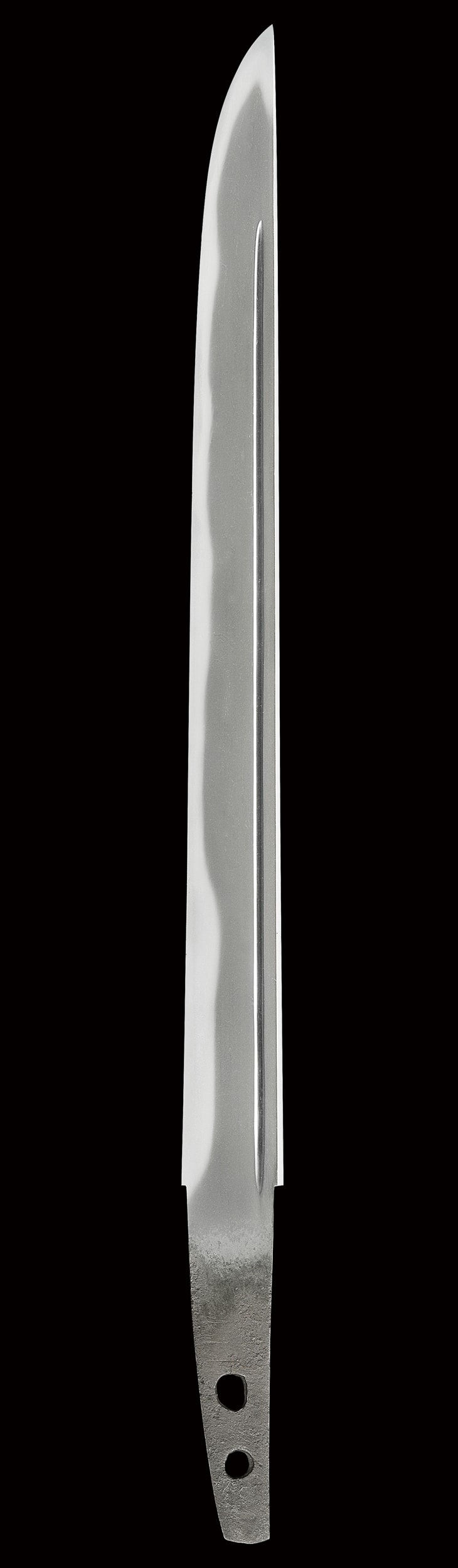
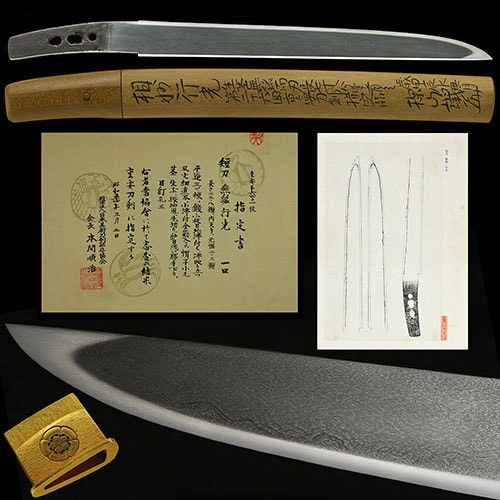
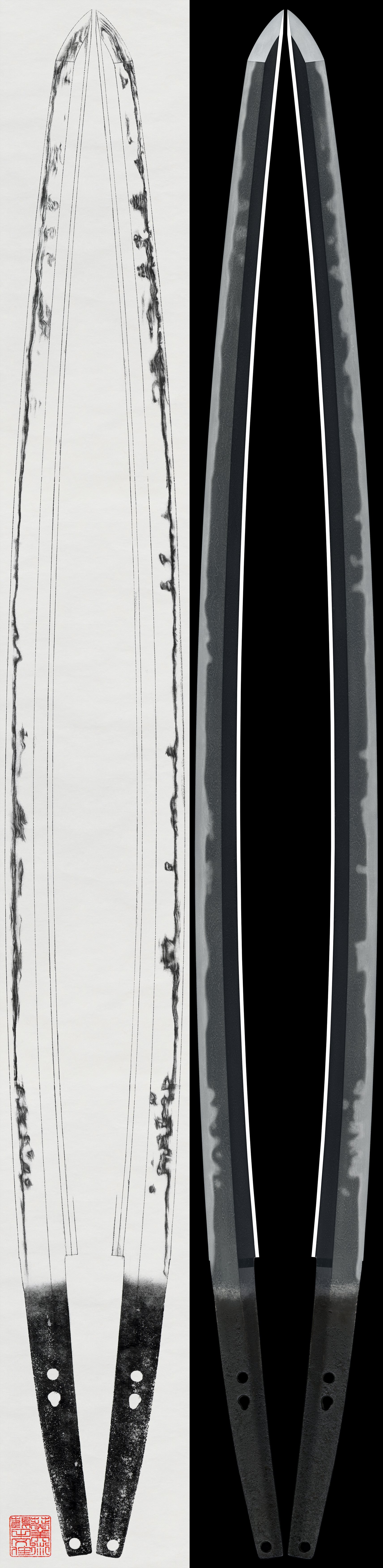
What survives is, before all else, the : and , of ordinary width with , and signed with the two-character . The sources state his formula in a single sentence: at a glance the work suggests , but the conspicuous and expressed in and point to this smith (地刃にあらわされた著しい地景・金筋がこの工と指摘される). He excels in across its whole range, , hoso, chu and hiro (糸・細・中・広直刃など多様); as a master of the he is paired with Toshiro Yoshimitsu, the two named twin peaks (短刀の名手として藤四郎吉光と双璧). The temper is bright with small , crossed by fine that flicker; the appraisers have called this play the old man's whiskers (翁の髭) from of old and count it the great point of his work. Honma adds a habit of the hand: the temper ordinarily hardens down past the toward the ; a few authentic pieces instead drop the slightly there. The runs to a calm , at times lightly swept; , and are carved on many blades, and the construction recurs.

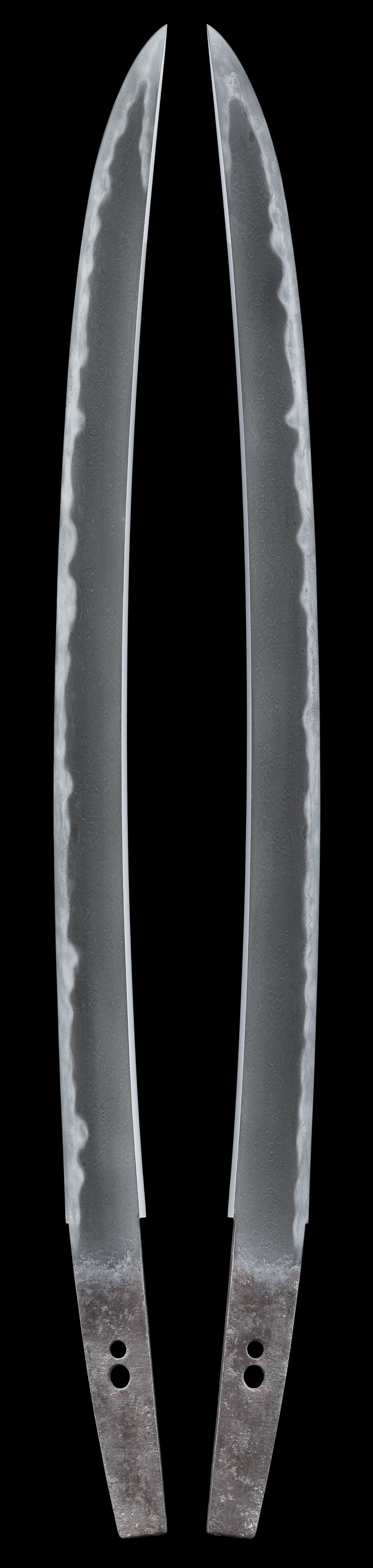
The is where his schooling shows. He forges a or a tightly knit , and lays over it thick and often , minutely fine; enter incessantly, the steel is clear, and frequently stands. The standing that came to mark the mature tradition is almost wholly absent in his own blades, and grows only by degrees in the men after him; the sources note it chiefly in his rare work, while the norm is a surface so refined it passes for until the and betray it. The of these quiet lines is singled out as well, the light-beautiful the texts call particular to the upper rank of work (相州伝上位作特有の光美しい刃沸). From this refined, -laden his three pupils drew out the - of the mature tradition.

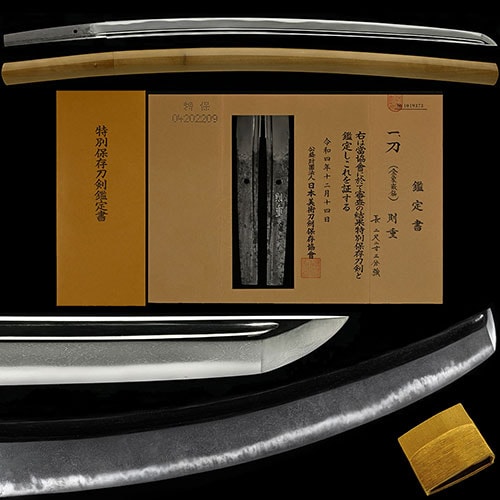
are another matter: the sources repeat that nearly everything extant is and the exceedingly rare (現存するものは短刀が殆んどで、太刀は極めて稀れ); the survivors are slender, with high , and a compact point, forged exactly as the . At their head stands the Mutsu , an signed of 76.1 cm with layered , heirloom of the Date of Sendai, by tradition a grant from the Emperor Go-Mizunoo, and listed in the addenda of the Kyoho -cho as no , yet a fine tool (名物ならざるも能き道具也). The attributed to him belong here too, and the sources are explicit that such a judgment names Kunimitsu and his three sons collectively (国光及びその子三人を指しての鑑定). One such blade carries a Kyoho 7 (1722) of Kochu at seventy gold pieces. A small minority departs from the norm altogether: a Bijutsuhin tempers its lower half in a large , the text stating plainly that his is scarce and this piece well made. Honma reads in that scarcity the proof of the school: exists, if rarely, in Kunimitsu, and , if most rarely, in Masamune, the two together confirming the relation of master and pupil. A single katakiriha , retempered, is the only one of its construction in his work.

The name ran on past the founder. The old registers give him three sons, Kunihiro, Kunishige and Kuniyasu, all said to have signed Kunimitsu later, and only Kunihiro is met with under his own name; since the hands cannot yet be divided by workmanship, the sources divide them by the . The founder's two-character signature follows the rule the appraisers call saji kitakanmuri (左字北冠), the interior of the character cut in the left-hand manner with the crown set toward the , in both a fine and a thicker chisel, and the texts admit rare authentic exceptions. On the sits on the toward the ; an signed of 96.1 cm is read as Kunihiro's Kunimitsu from its workmanship and deep, bold carving. The carving is itself a legacy: the layered later seen in Sadamune is judged to begin with , and the work on his blades is connected with Daishinbo Yukei, transmitted as his pupil and a master of the chisel.

Much of this oeuvre is patrimony. Four blades hold the rank of National Treasure and ten more are Important Cultural Properties, preserved in museums, shrines and long-held collections; seven are prewar Bijutsuhin, among them of the Seikado and the Kurokawa Institute. The provenance roll runs deep. The -toshi passed from Toyotomi Hideyoshi's Osaka treasury through the fire of the summer siege, was retempered by the first Yasutsugu, and descended in the Tokugawa shogun house; his are handed down in the Uesugi of Yonezawa, the Matsudaira, the Satake, the Hosokawa and the Ogasawara, and one blade entered the collection of W. A. Compton in recent times. Fujishiro rates him Sai-jo , and seventy-two designated works stand on record, the great majority signed with the two-character in an , the long signature met only a few times. What a private collector may realistically encounter is the and tier, eight and forty-two blades, fifty in the two tiers together, most of them signed of the classic refined manner. Such pieces are held closely and reach the market only rarely; when one does appear, it carries the signed work of the smith in whose forge the tradition began.

Kantei

one perfected refined nie-suguha manner read across two form registers (the signed ubu tanto norm; the exceedingly rare tachi and the osuriage mumei katana attributed Shintogo), with a rare midare minority and a multi-generation workshop edge, the sons who kept signing Kunimitsu

Kunimitsu of is the de facto creator of the tradition and the master who raised the three great names Yukimitsu, Masamune and Norishige; with Yoshimitsu he is counted one of the two supreme smiths. The papers state his formula in a single sentence: at a glance the work suggests , but the conspicuous and expressed in and point to this smith. Nearly everything that survives is the , , and signed with a two-character in the saji kitakanmuri manner; the is or tight with thick, often , entering incessantly and frequent , and the is his specialty in every width, , hoso, chu and hiro, in bright with the flickering the appraisers call the old man's beard, the temper habitually hardened down into the , the and . are exceedingly rare, and the name ran on in his sons, who later signed Kunimitsu themselves, the dated work spanning Einin 1 (1293) to Gentoku 3 (1331).

Diagnostic discriminators

79% of his works · 18.0× vs Masamune

77% of his works · 2.2× vs Awataguchi Kuniyoshi

41% of his works · 2.4× vs Awataguchi Kuniyoshi

23% of his works · 3.3× vs his pupils Yukimitsu, Masamune and Norishige

Observation by phase

The refined nie-suguha tanto (his signature)

the norm of the name: 51 of his 70 papers are tanto, 47 carry the ubu two-character mei; the signed ubu tanto is what Shintogo Kunimitsu ordinarily means

A , of ordinary proportions with , mostly and signed with the two-character . The is or a tight , the thick and often , entering incessantly, the steel clear, and frequently standing; the standing of his pupils is almost wholly absent. The is across his whole range, and hoso above all, in bright with fine , and light , the at times tight; characteristically the temper is hardened down into the , the habit Honma names this smith's point to see. of , and are frequent, and the construction recurs. The runs to a , at times lightly swept.

Sugata 姿
Jigane 地鉄
Hamon 刃文
Bōshi 帽子

The exceedingly rare tachi and the mumei Shintogo katana

keyed to the form: tachi appear on only 10 of his 70 papers and the osuriage mumei katana on 8; the papers repeat that tanto are nearly all that survives and call the extant tachi exceedingly rare

A slender with high , and a medium or compact point, forged exactly as the : tight or , thick , incessant . The is with a little mixed, , and -like passages in places. The Mutsu , with its layered , stands at the head of the group, and the papers prize every signed example as a rarity. The attributed belong here as well: the papers state that the attribution names Kunimitsu and his three sons collectively, and one such blade carries a 1722 Kochu at seventy gold pieces.

Sugata 姿
Hamon 刃文

The rare midareba

less firmly establishedrarity itself is the marker: the papers call his midareba scarce, and the katakiriha piece the only one of its construction in his work

A small minority departs from the norm. One Jubi tempers the lower half in a large and settles to at the , and the paper states outright that his is scarce and this piece well made; Honma adds the famous symmetry, that exists, if rarely, in Kunimitsu, and , if rarely, in Masamune, and that the two together prove the relation of master and pupil. The single katakiriha , retempered, burns in an manner with . In the ordinary work the seed shows only as a little or shallow mixed into the .

Hamon 刃文

The sons' Kunimitsu, the workshop after the founder

keyed to the mei, not the workmanship: the shodai follows the saji kitakanmuri rule in a fine or thick chisel, and the papers divide the generations by the signature while admitting authentic exceptions

The registers run the name over several generations: the sons Kunihiro, Kunishige and Kuniyasu are all said to have signed Kunimitsu later, and only Kunihiro survives under his own name. The papers state that the hands cannot yet be clearly divided by workmanship and separate them by the : several blades in the founder's manner, the Mutsu among them, are judged one of the sons because the signature plainly differs, and the great 96 cm signed is read as Kunihiro's Kunimitsu from its style and its deep, bold carving. The work of this register keeps the family formula, tight forging, incessant , and the hoso or .

Jigane 地鉄
Hamon 刃文
Scholarship

The registers run the name over several generations: the oldest dated work carries Einin 1 (1293) with the long mei Kamakura junin Shintogo Kunimitsu saku, and the papers note dates reaching Gentoku 3 (1331); the sons Kunihiro, Kunishige and Kuniyasu are all said to have signed Kunimitsu later.

Of the three sons only Kunihiro is met with under his own name; the papers state that apart from Kunihiro no certain work has been seen, and take the abundance of variant Kunimitsu mei as confirming the transmission.

He took the Buddhist name Koshin; the tanto signed Kamakura ju Shintogo Kunimitsu homyo Koshin with a Showa 4 (1315) date is read as late work, and the late dates of Kagen and Tokuji are likewise placed in the founder's last years.

The shodai's two-character mei follows the saji kitakanmuri rule, the inside of the kuni character cut in the left-hand manner with the crown set toward the mune; the papers divide the generations chiefly by the mei and admit rare authentic exceptions to the rule.

Nearly all that survives is tanto; the papers repeat that extant tachi are rare, and the 96 cm signed odachi is judged the Kunimitsu mei of his son Kunihiro from its workmanship and its deep carving.

When an osuriage mumei katana is attributed Shintogo, the papers state outright that the judgment names Kunimitsu and his three sons collectively.

A single katakiriha tanto, retempered, is the only one of its construction in his work; the kanmuri-otoshi construction by contrast recurs and is itself a point of recognition.

Honors

享保名物帳Kyōhō Meibutsu Chō (Catalog of Celebrated Blades)

Recorded, 2 blades (Aizu Shintōgo; "Mutsu Shintōgo" in the addenda)

The family's catalog of celebrated blades (名物) presented to shogun Tokugawa Yoshimune in Kyōhō 4 (1719). Records ~274 blades of – manufacture (168 extant + ~80 burned + ~26 later additions), grouped by smith with valuations and provenance. This honor tags smiths whose work is recorded in the catalog; the detail field carries per-smith counts where the published tally is exact, or 所載 + named blades where only inclusion is verified.

Designations

Kokuhō4
Jūyō Bunkazai10
Jūyō Bijutsuhin7
Gyobutsu1
Tokubetsu Jūyō8
Jūyō Tōken42

Elite Standing

1.01 across 72 designated works

Top 1% among smiths

Provenance

45 documented provenances across certified works by Kunimitsu

Provenance Standing

23 works held in elite collections across 45 documented provenances

Top 2% among smiths

Raw score: 3.90 / 10

Blade Forms

Distribution across 72 ranked works

Signatures

Signature types across 72 ranked works

Currently Available

Lineage

TeacherKunitsuna
Kunimitsu
Students (6)
  1. 1.Masamune正宗1 for sale87designated
  2. 2.Norishige則重8 for sale132designated
  3. 3.Yukimitsu行光4 for sale151designated
  4. 4.Kunihiro國廣15designated
  5. 5.Daishinbo大進房3designated
  6. 6.Kunihiro國廣1 for sale

Soshu School

Other artisans of the Soshu school

  1. 1.Masamune正宗1 for sale87designated
  2. 2.Sadamune貞宗87designated
  3. 3.Akihiro秋廣28designated
  4. 4.Go Yoshihiro義弘2 for sale55designated
  5. 5.Hiromitsu廣光1 for sale45designated
  6. 6.Norishige則重8 for sale132designated
  7. 7.Yukimitsu行光4 for sale151designated
  8. 8.Takagi Sadamune高木貞宗1 for sale40designated
  9. 9.Tametsugu爲繼2 for sale76designated
  10. 10.Kunihiro國廣15designated
  11. 11.Daishinbo大進房3designated
  12. 12.Soso総宗1designated