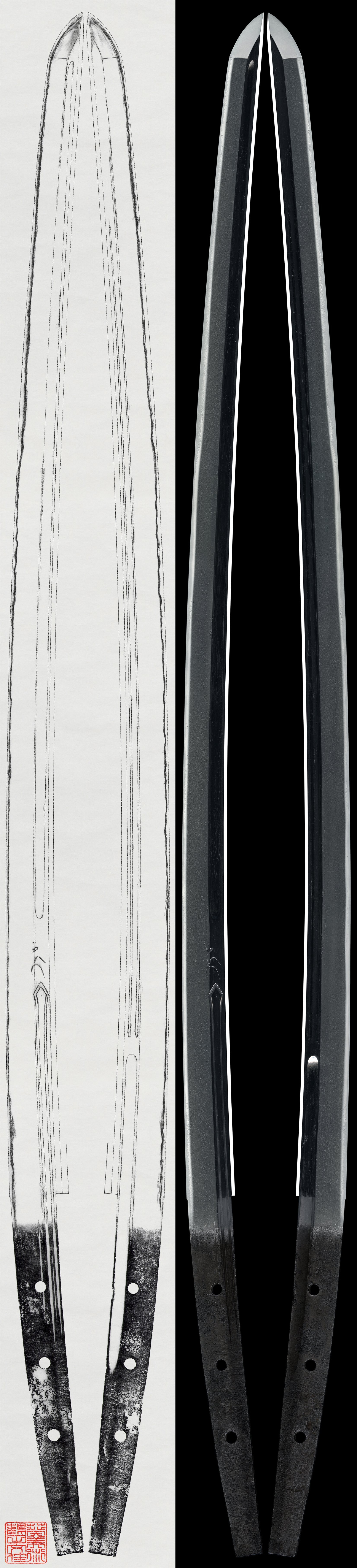
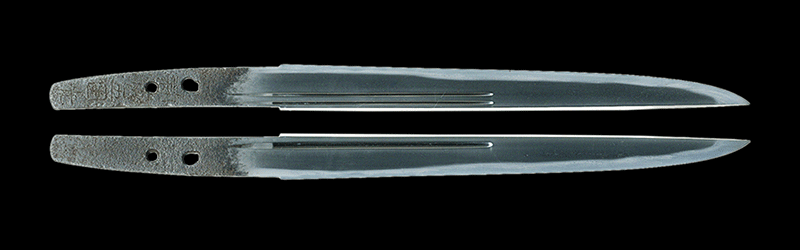
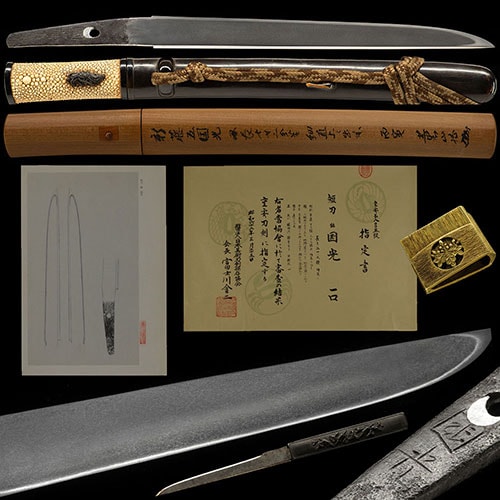
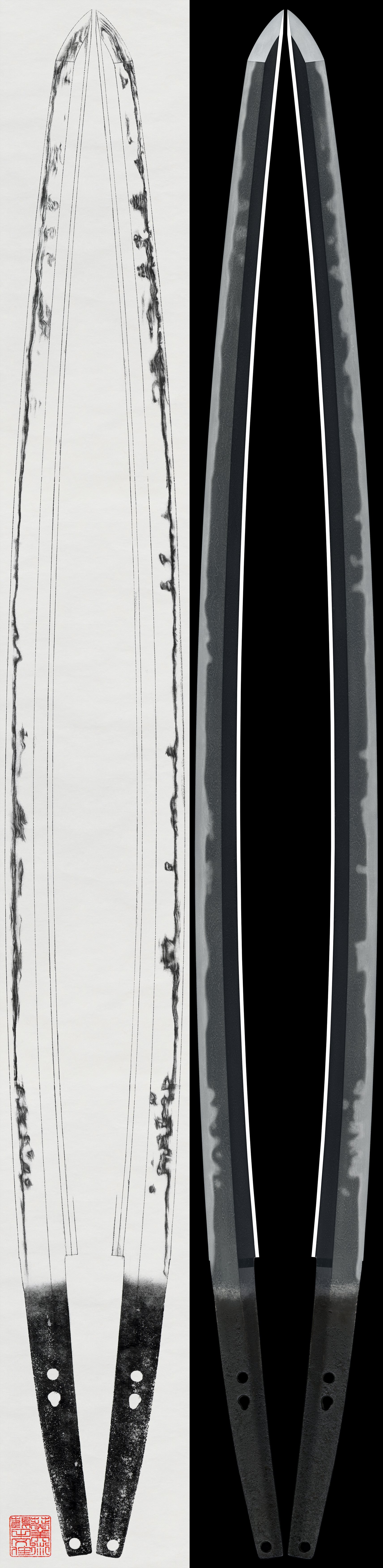
In the tenth month of Einin 1 (1293), a blade left the Kamakura forge of Shintogo Kunimitsu bearing the long signature Kamakura junin Shintogo Kunimitsu saku[[c:1]], the oldest of his dated works. The published sources count Awataguchi Kunitsuna and the Bizen smiths Kunimune and Sukezane as the pioneers of Kamakura sword-making, settlers from older centers; the first smith of Sagami itself, who cut his Kamakura residence and his dates into the nakago, was Kunimitsu[[c:2]]. His designation texts open with one standing sentence for half a century: he is the de facto founder of the Soshu tradition, and the raising of the three masters Yukimitsu, Masamune and Norishige is counted his great achievement[[c:3]]. Tradition makes him the son of Awataguchi Kunitsuna and a pupil of Bizen Saburo Kunimune, a transmission the sources say still leaves room for study. His dated work runs to Gentoku 3 (1331), and a tanto of Showa 4 (1315) signed with the Buddhist name Koshin is read as late work, beside the dates of Kagen and Tokuji.
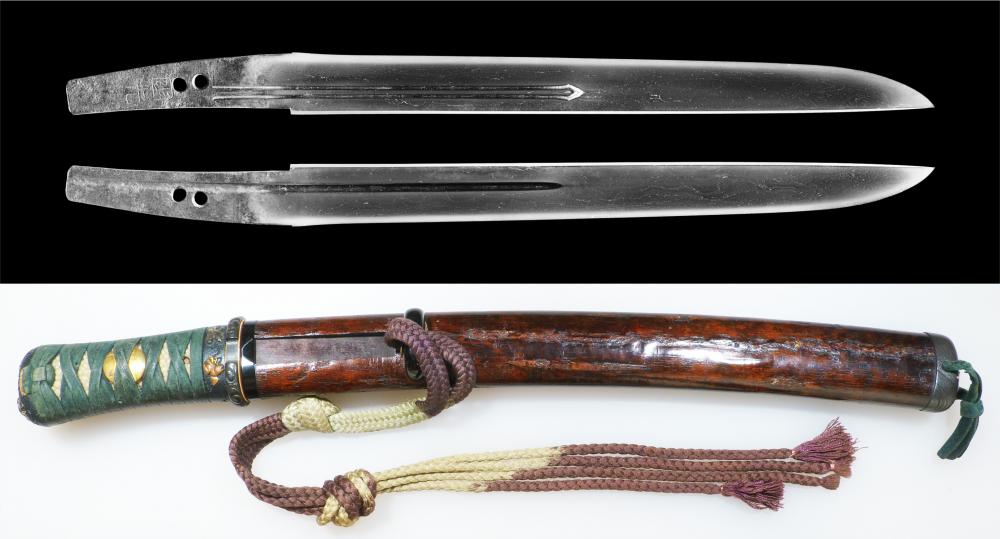
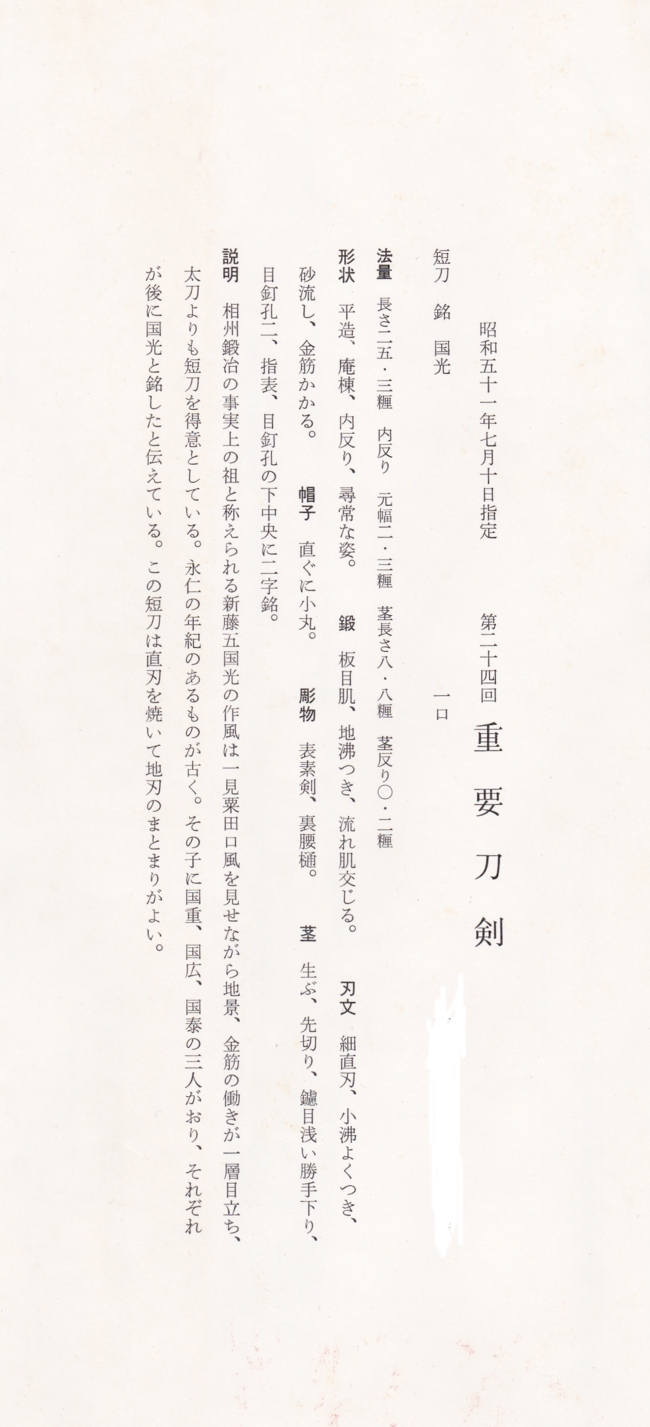
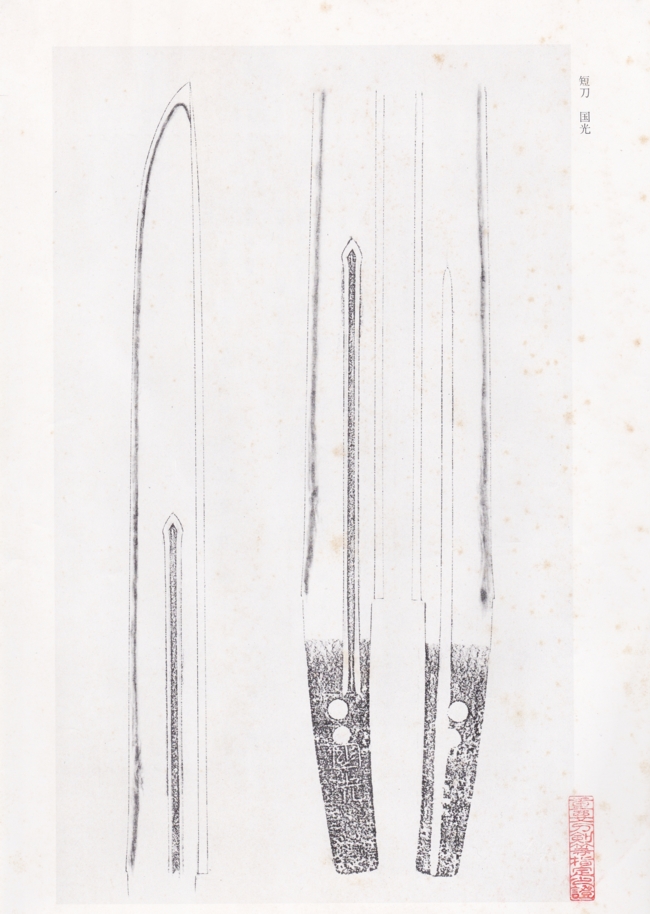
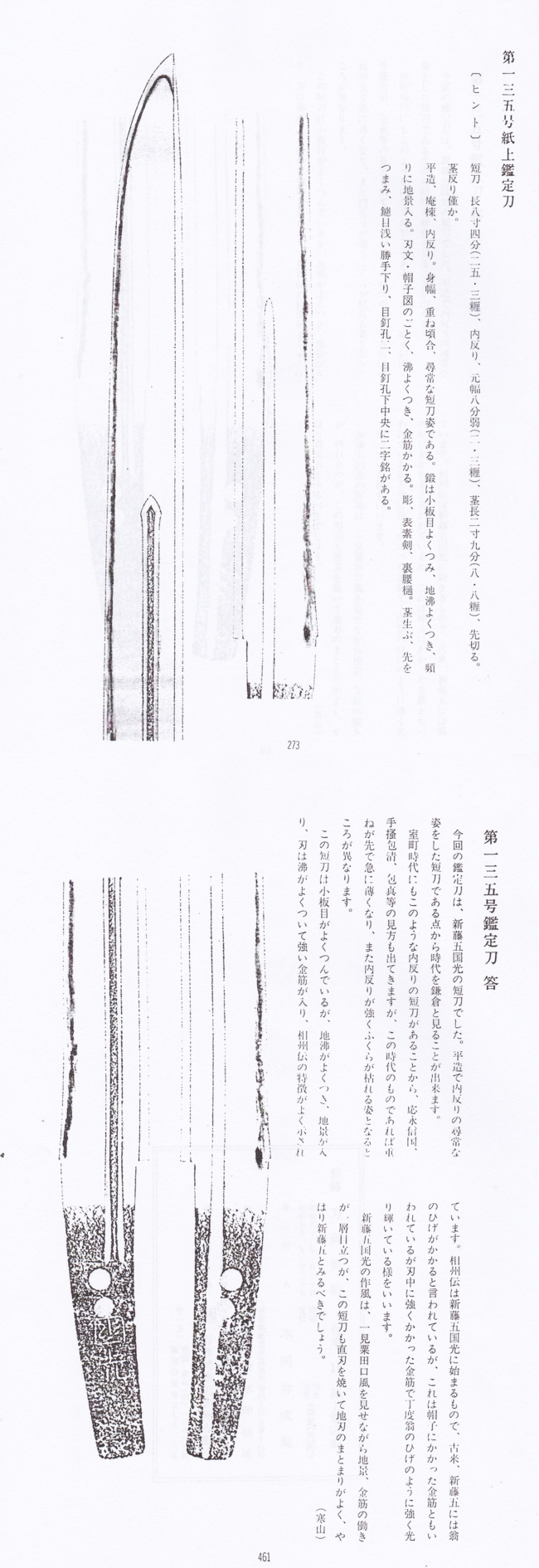
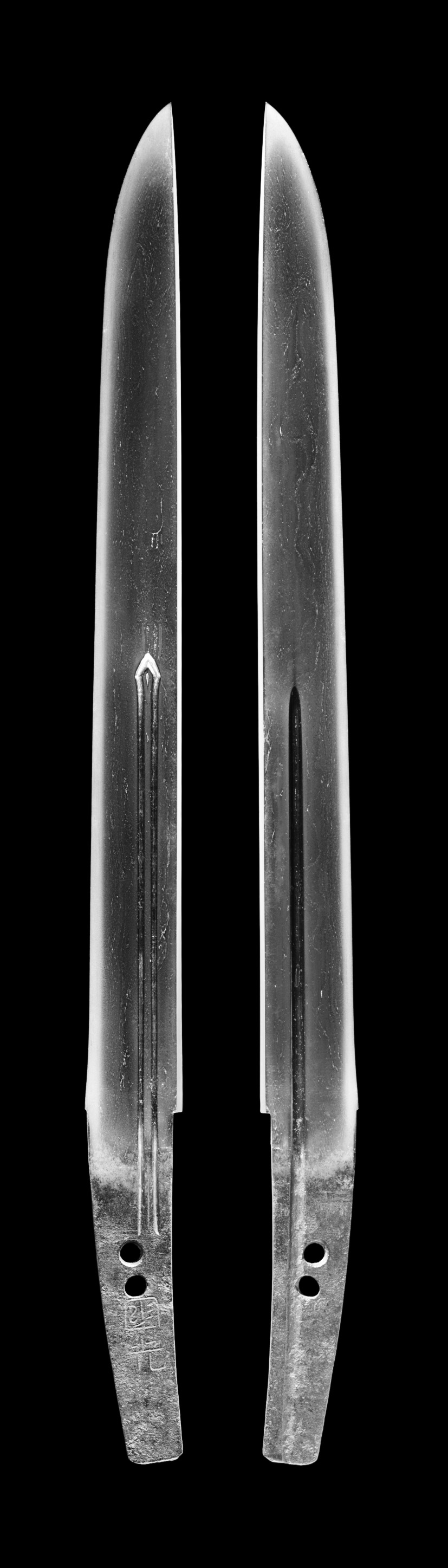
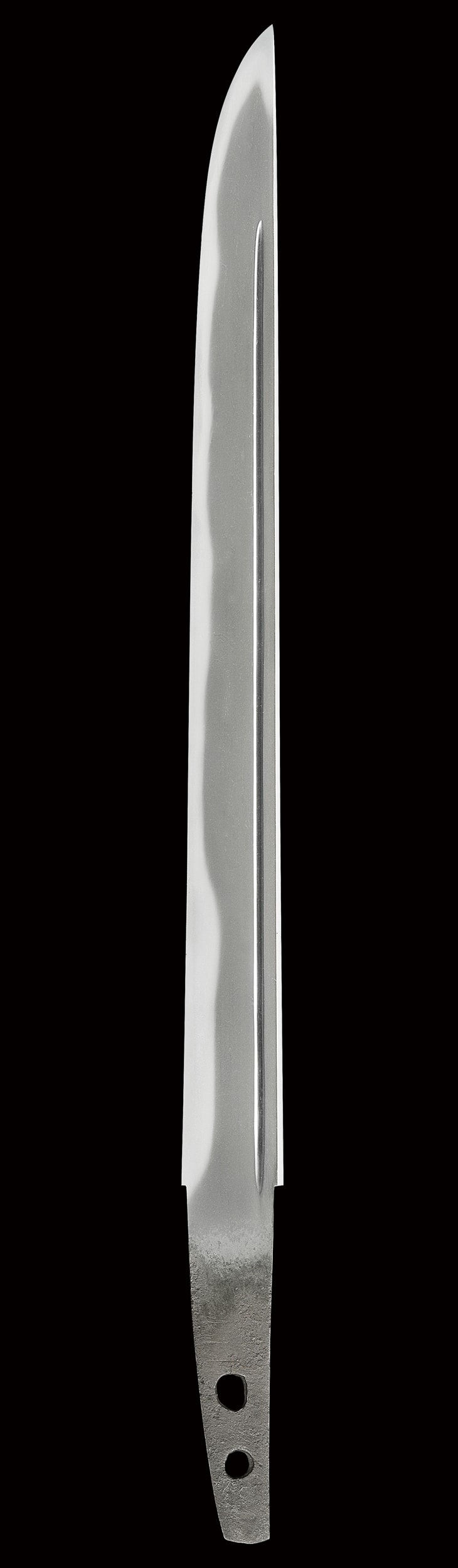
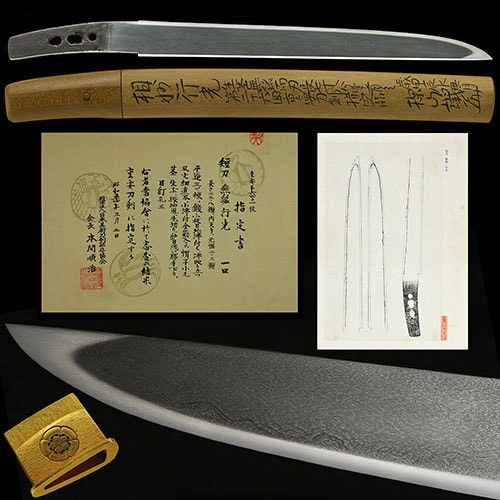
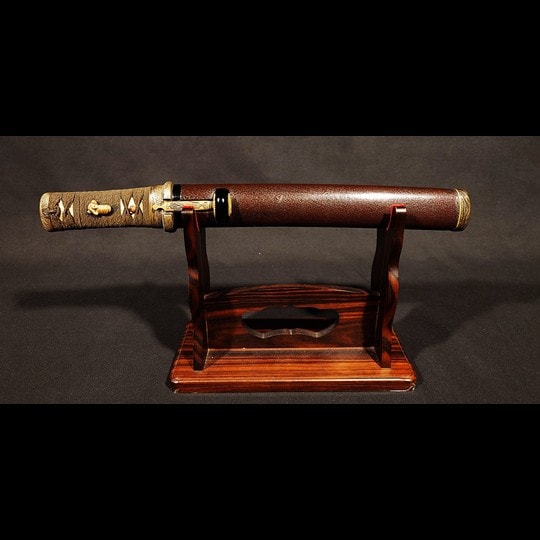
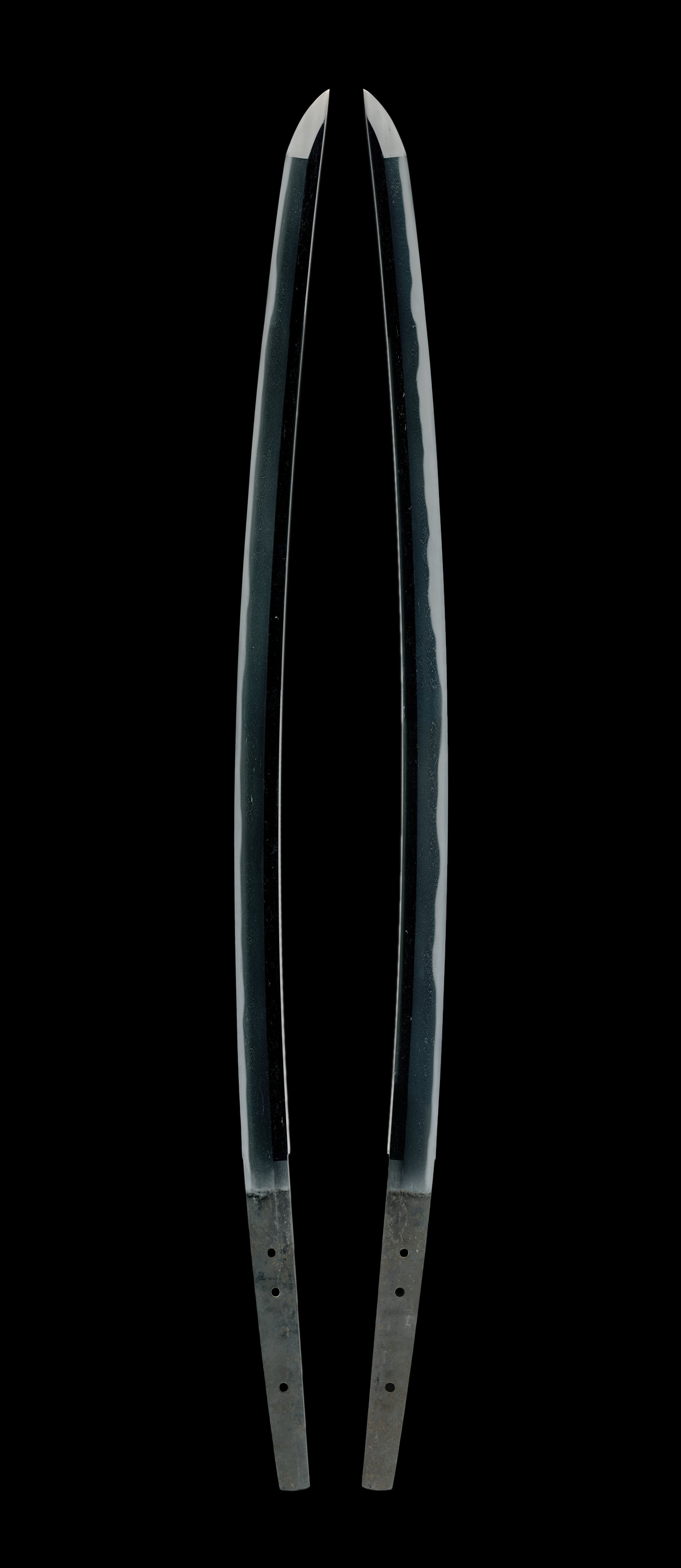
What survives is, before all else, the tanto: hira-zukuri and mitsu-mune, of ordinary width with uchizori, ubu and signed with the two-character mei. The sources state his formula in a single sentence: at a glance the work suggests Awataguchi, but the conspicuous chikei and kinsuji expressed in ji and ha point to this smith[[c:4]]. He excels in suguha across its whole range, ito, hoso, chu and hiro[[c:5]]; as a master of the tanto he is paired with Toshiro Yoshimitsu, the two named twin peaks (短刀の名手として藤四郎吉光と双璧). The temper is bright with small nie, crossed by fine kinsuji that flicker; the appraisers have called this play the old man's whiskers (翁の髭) from of old and count it the great point of his work. Honma adds a habit of the hand: the temper ordinarily hardens down past the machi toward the mune; a few authentic pieces instead drop the yaki slightly there. The boshi runs sugu to a calm ko-maru, at times lightly swept; suken, bonji and gomabashi are carved on many blades, and the kanmuri-otoshi construction recurs.
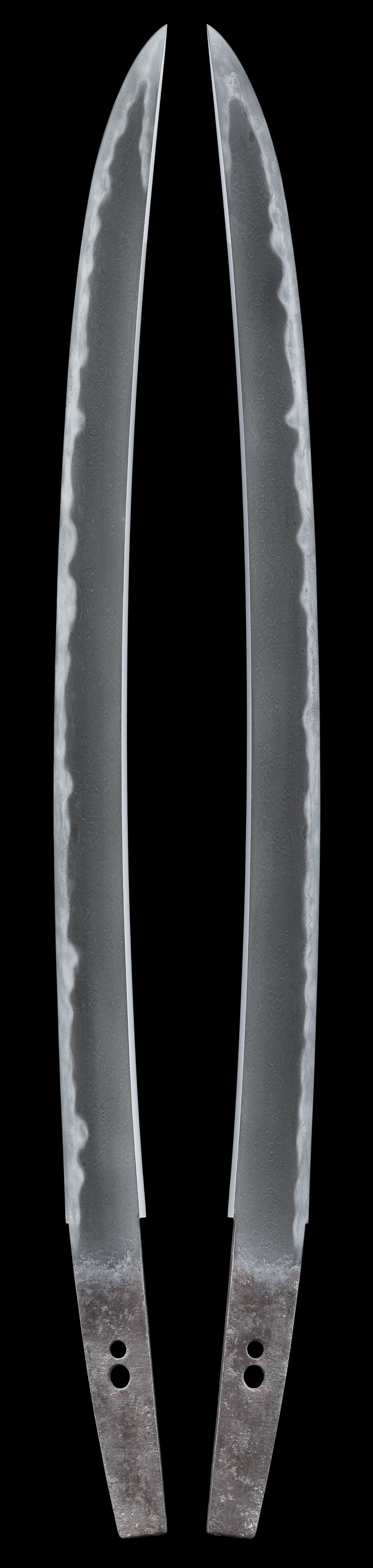
The jigane is where his Awataguchi schooling shows. He forges a ko-itame or a tightly knit itame, and lays over it ji-nie thick and often mijin, minutely fine; chikei enter incessantly, the steel is clear, and nie-utsuri frequently stands. The standing hada that came to mark the mature Soshu tradition is almost wholly absent in his own blades, and grows only by degrees in the men after him; the sources note it chiefly in his rare midare work, while the norm is a surface so refined it passes for Awataguchi until the chikei and kinsuji betray it. The ha-nie of these quiet lines is singled out as well, the light-beautiful nie the texts call particular to the upper rank of Soshu work[[c:6]]. From this refined, nie-laden suguha his three pupils drew out the nie-midare of the mature tradition.
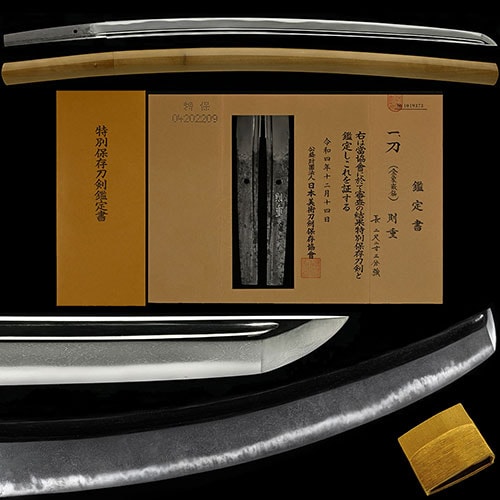
Tachi are another matter: the sources repeat that nearly everything extant is tanto and the tachi exceedingly rare[[c:7]]; the survivors are slender, with high koshizori, funbari and a compact point, forged exactly as the tanto. At their head stands the meibutsu Mutsu Shintogo, an ubu signed tachi of 76.1 cm with layered horimono, heirloom of the Date of Sendai, by tradition a grant from the Emperor Go-Mizunoo, and listed in the addenda of the Kyoho Meibutsu-cho as no meibutsu, yet a fine tool[[c:8]]. The osuriage mumei katana attributed to him belong here too, and the sources are explicit that such a judgment names Kunimitsu and his three sons collectively[[c:9]]. One such blade carries a Kyoho 7 (1722) origami of Hon'ami Kochu at seventy gold pieces. A small minority departs from the suguha norm altogether: a Juyo Bijutsuhin tanto tempers its lower half in a large midare, the text stating plainly that his midareba is scarce and this piece well made. Honma reads in that scarcity the proof of the school: midareba exists, if rarely, in Kunimitsu, and suguha, if most rarely, in Masamune, the two together confirming the relation of master and pupil. A single katakiriha tanto, retempered, is the only one of its construction in his work.
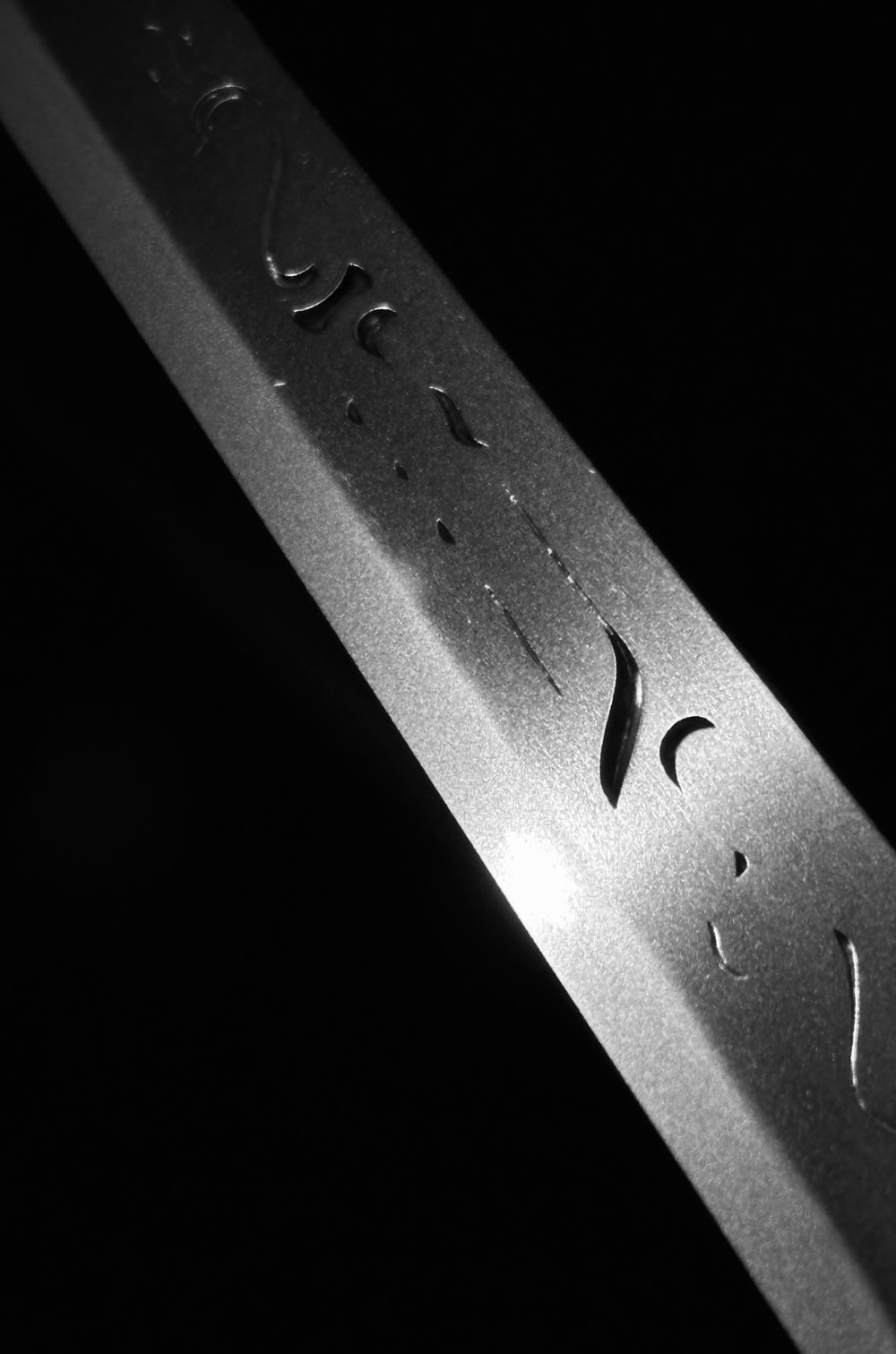
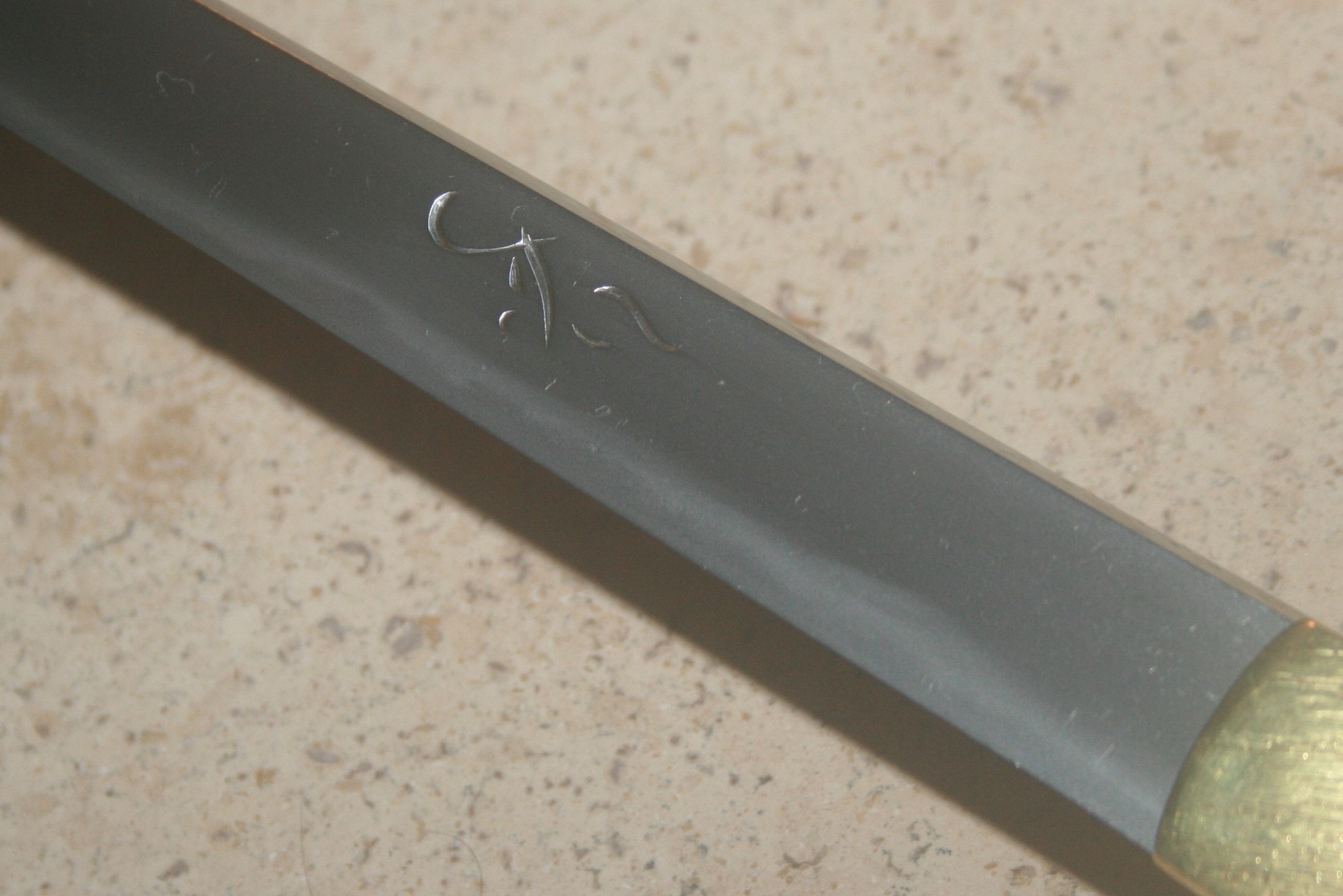
The name ran on past the founder. The old registers give him three sons, Kunihiro, Kunishige and Kuniyasu, all said to have signed Kunimitsu later, and only Kunihiro is met with under his own name; since the hands cannot yet be divided by workmanship, the sources divide them by the mei. The founder's two-character signature follows the rule the appraisers call saji kitakanmuri (左字北冠), the interior of the kuni character cut in the left-hand manner with the crown set toward the mune, in both a fine and a thicker chisel, and the texts admit rare authentic exceptions. On tachi the mei sits on the haki-omote toward the mune; an ubu signed odachi of 96.1 cm is read as Kunihiro's Kunimitsu mei from its workmanship and deep, bold carving. The carving is itself a legacy: the layered horimono later seen in Sadamune is judged to begin with Shintogo, and the work on his blades is connected with Daishinbo Yukei, transmitted as his pupil and a master of the chisel.
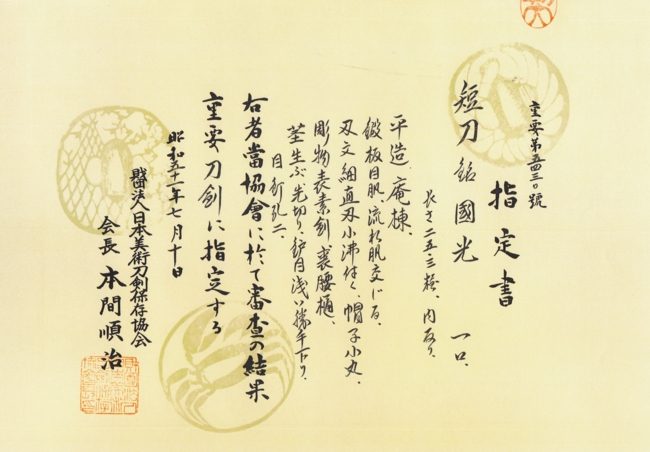
Much of this oeuvre is patrimony. Four blades hold the rank of National Treasure and ten more are Important Cultural Properties, preserved in museums, shrines and long-held collections; seven are prewar Juyo Bijutsuhin, among them tanto of the Seikado and the Kurokawa Institute. The provenance roll runs deep. The meibutsu Kojiri-toshi Shintogo passed from Toyotomi Hideyoshi's Osaka treasury through the fire of the summer siege, was retempered by the first Yasutsugu, and descended in the Tokugawa shogun house; his tanto are handed down in the Uesugi of Yonezawa, the Echizen Matsudaira, the Satake, the Hosokawa and the Ogasawara, and one blade entered the collection of W. A. Compton in recent times. Fujishiro rates him Sai-jo saku, and seventy-two designated works stand on record, the great majority signed with the two-character mei in an ubu nakago, the long signature met only a few times. What a private collector may realistically encounter is the Tokubetsu Juyo and Juyo tier, eight and forty-two blades, fifty in the two tiers together, most of them signed tanto of the classic refined manner. Such pieces are held closely and reach the market only rarely; when one does appear, it carries the signed work of the smith in whose forge the Soshu tradition began.