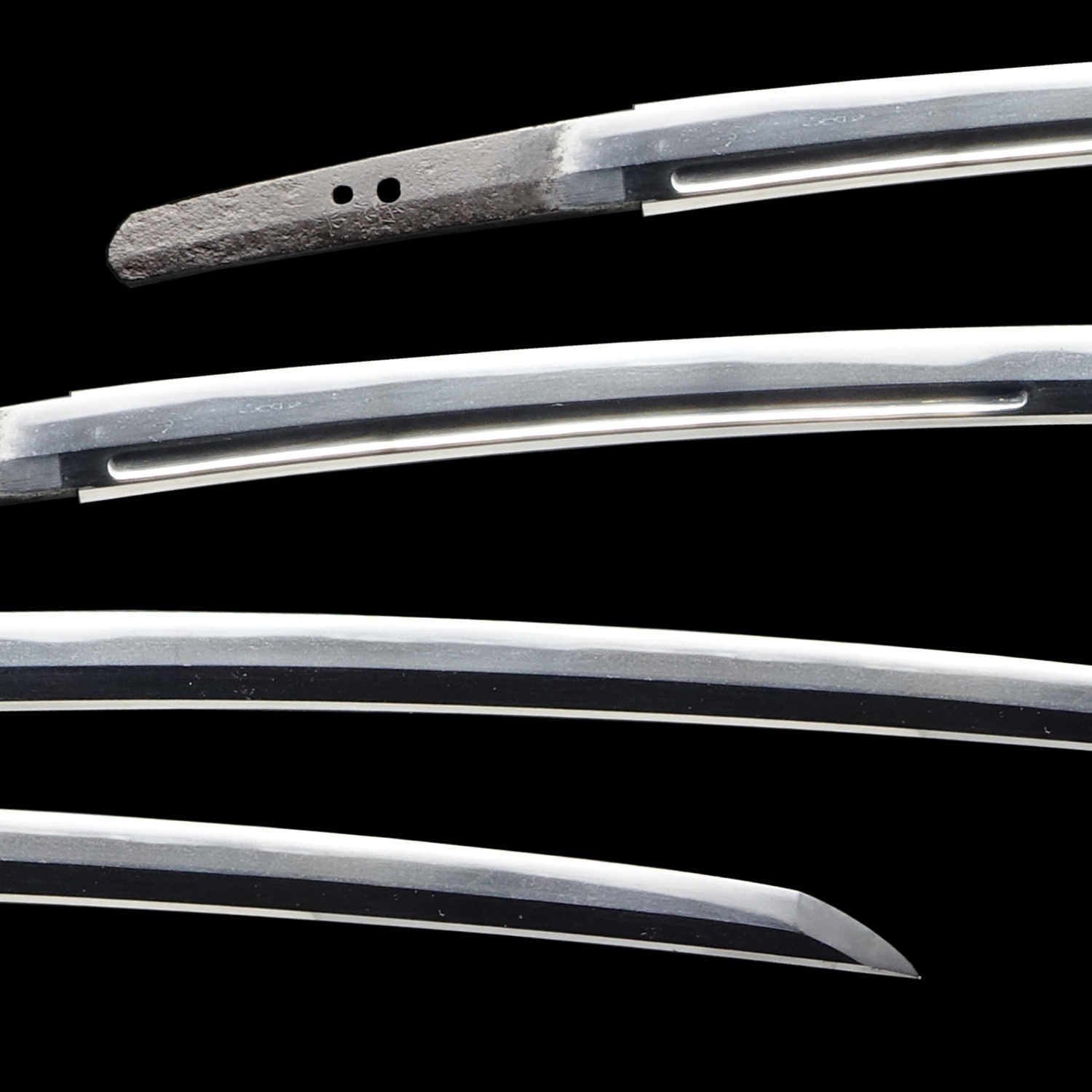
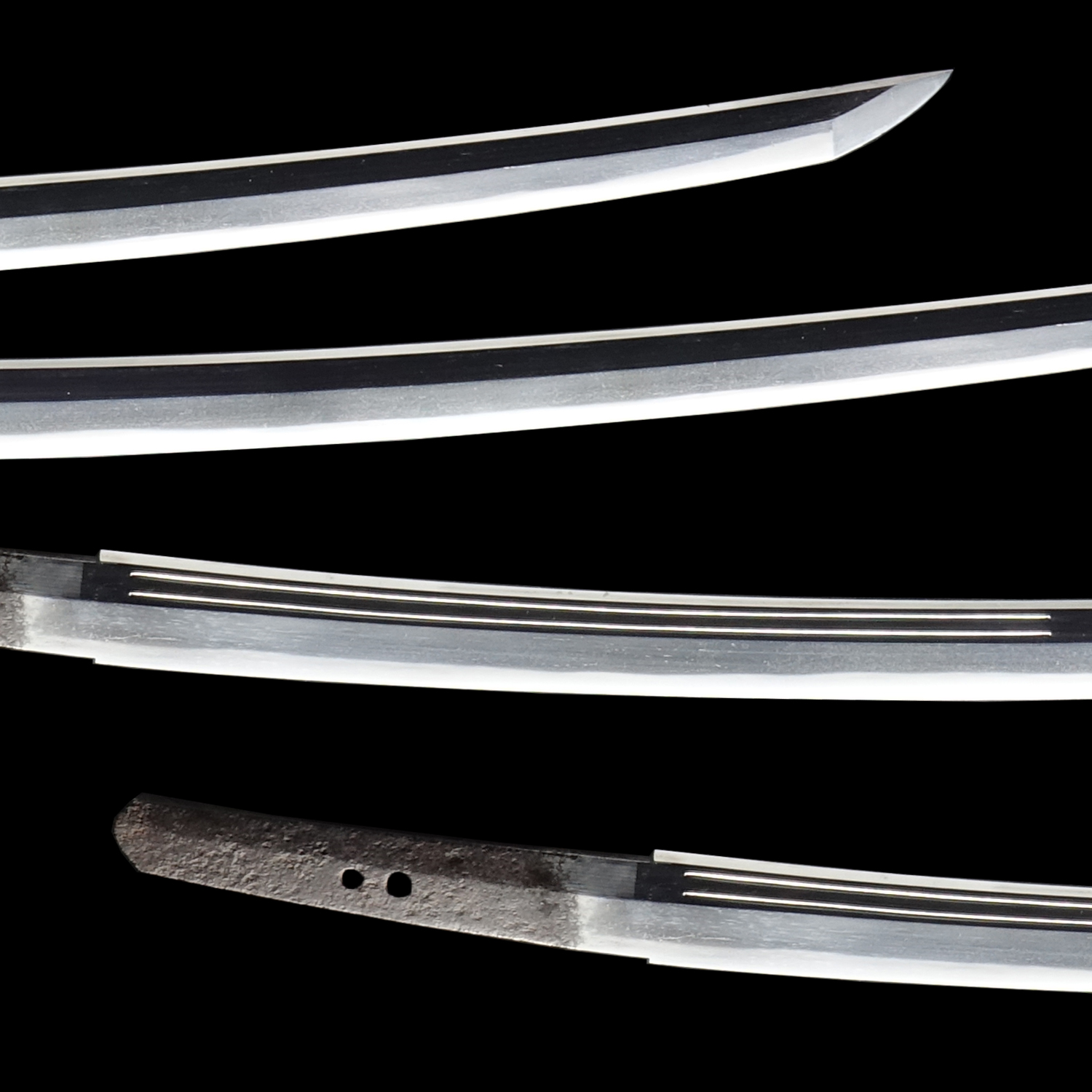
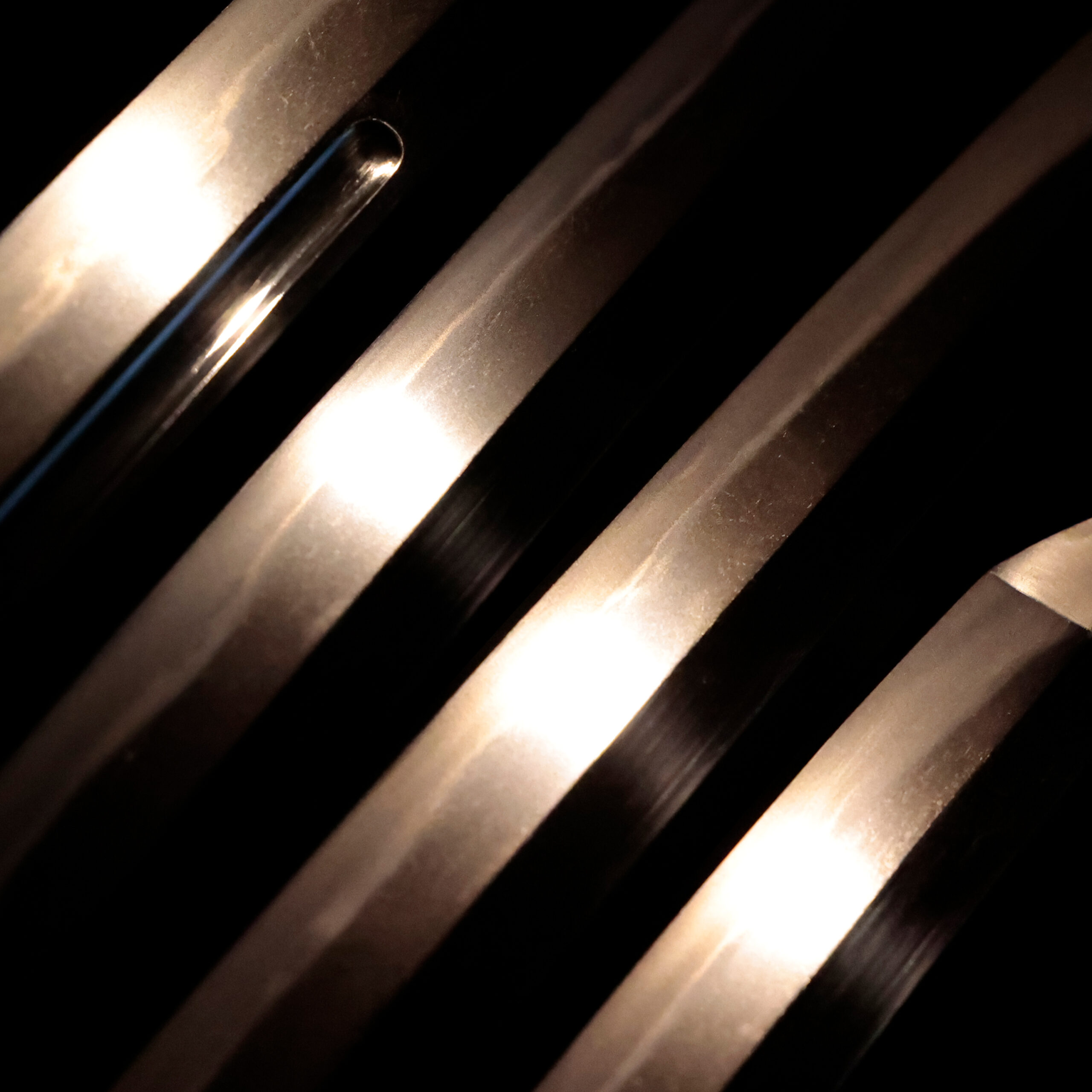
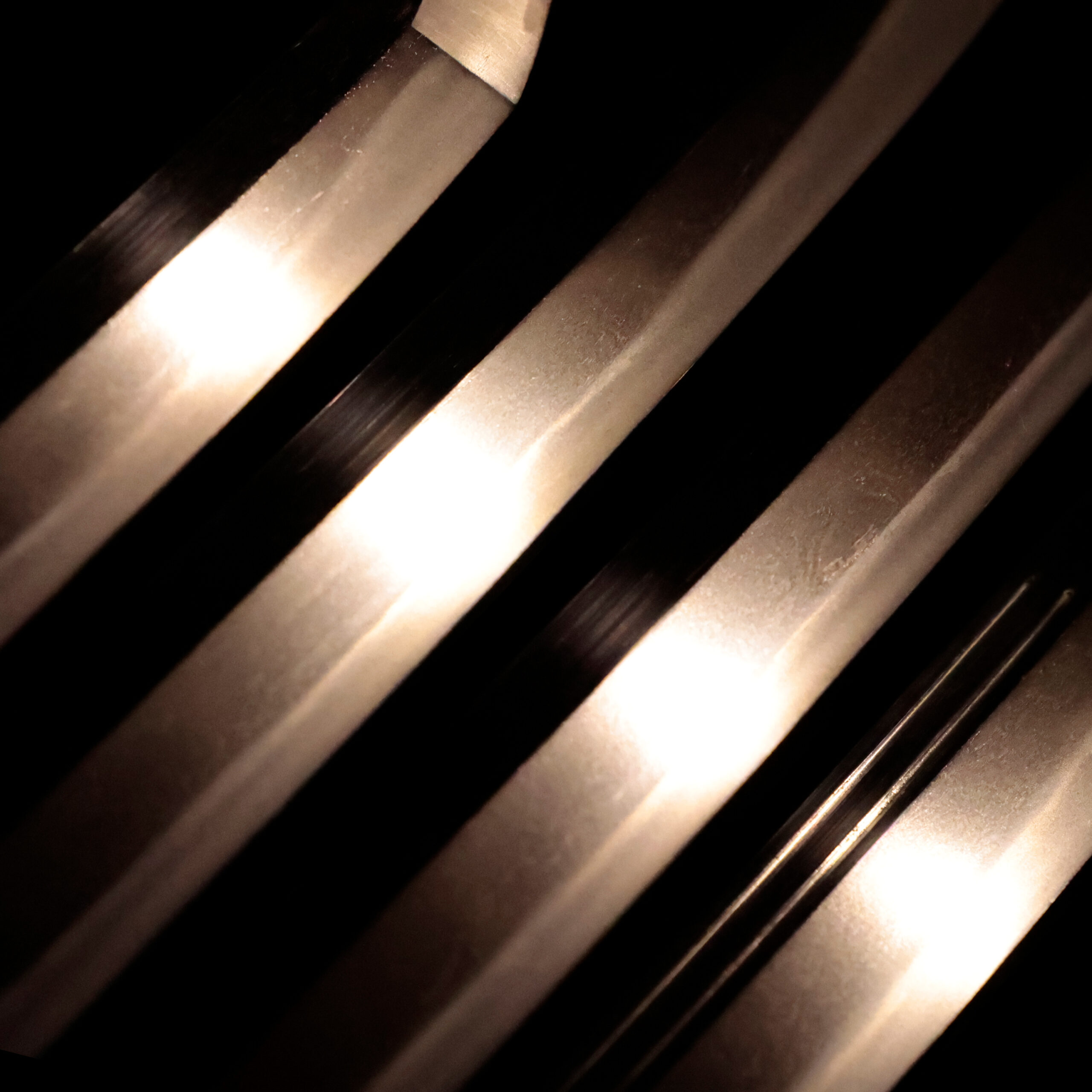
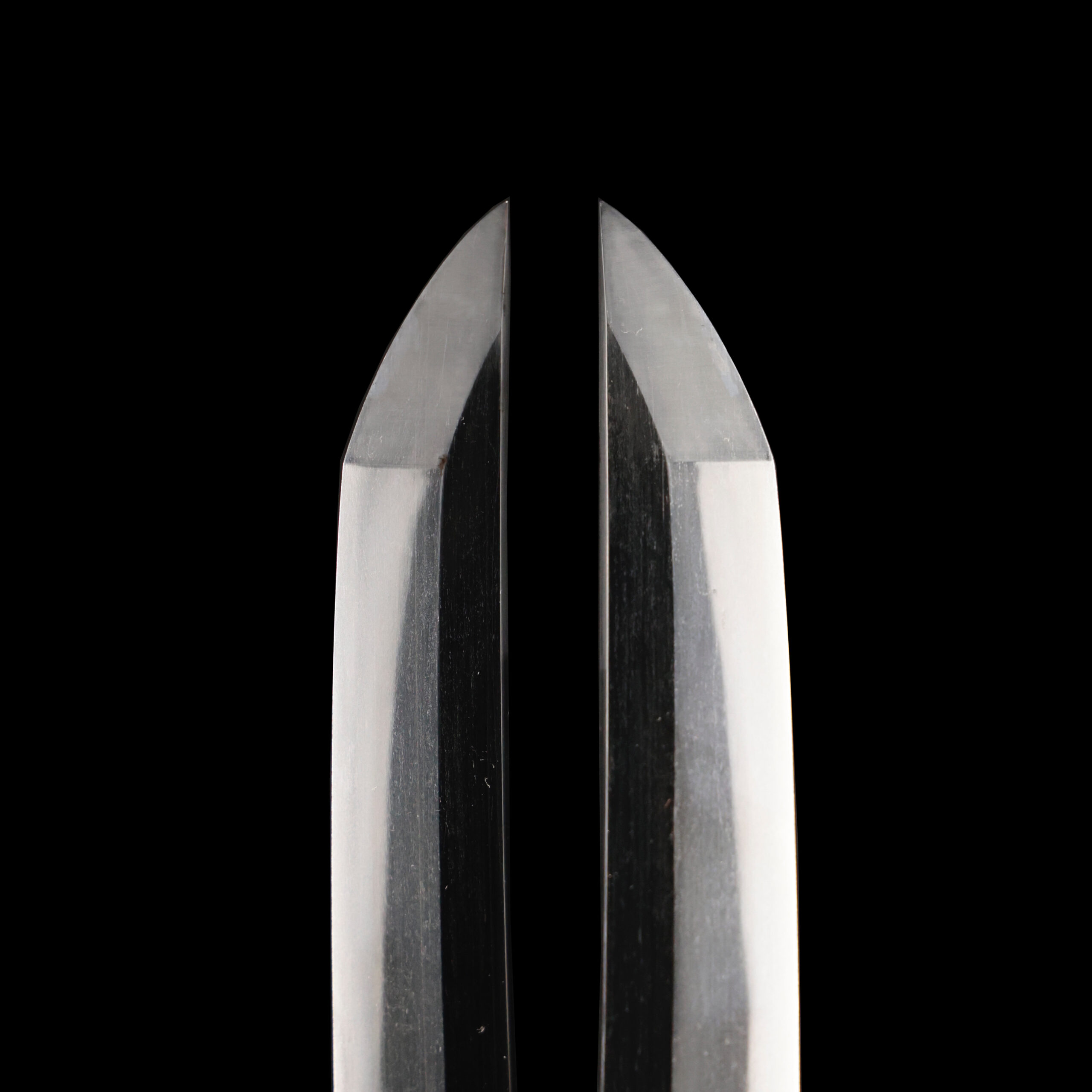
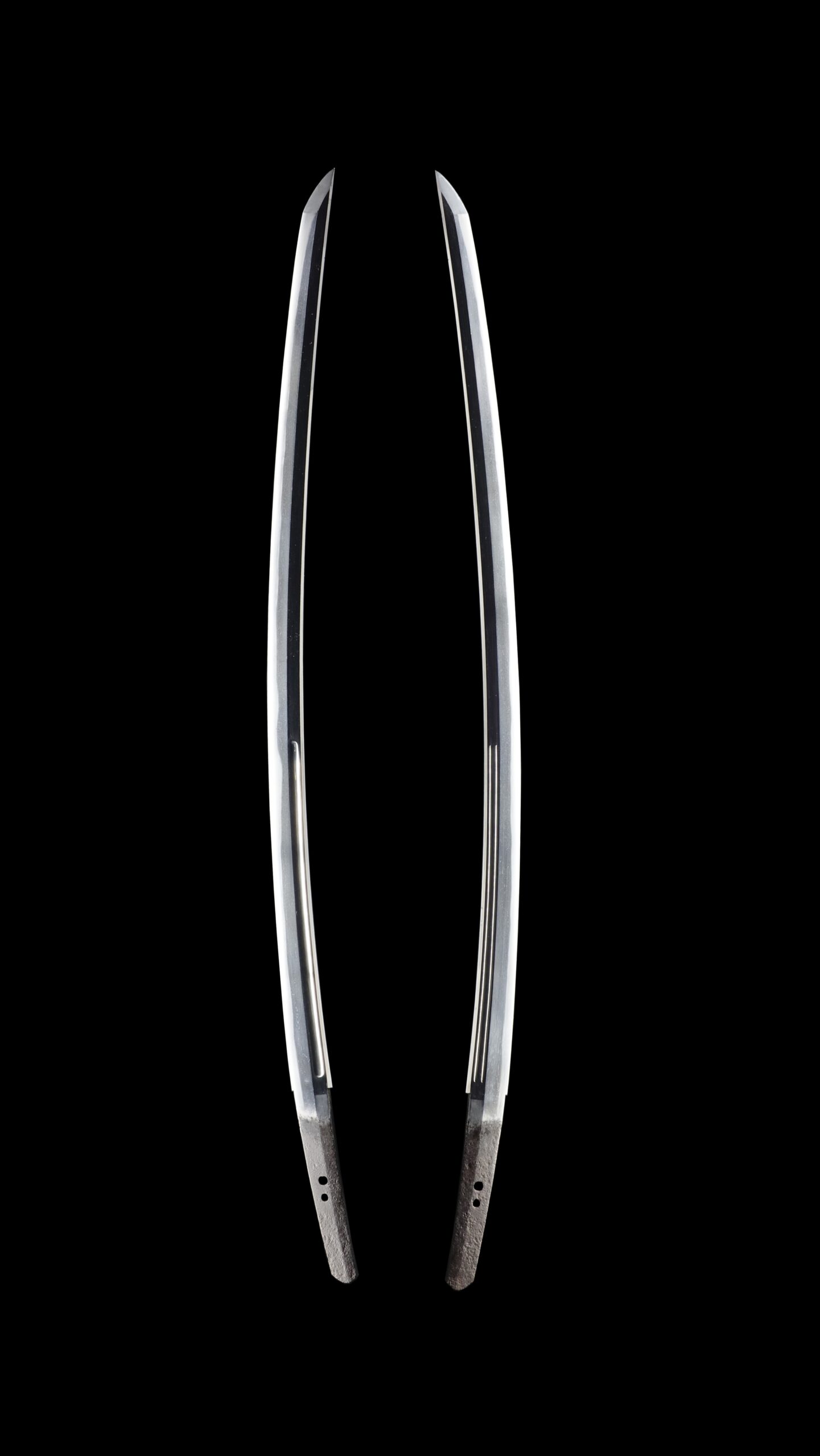
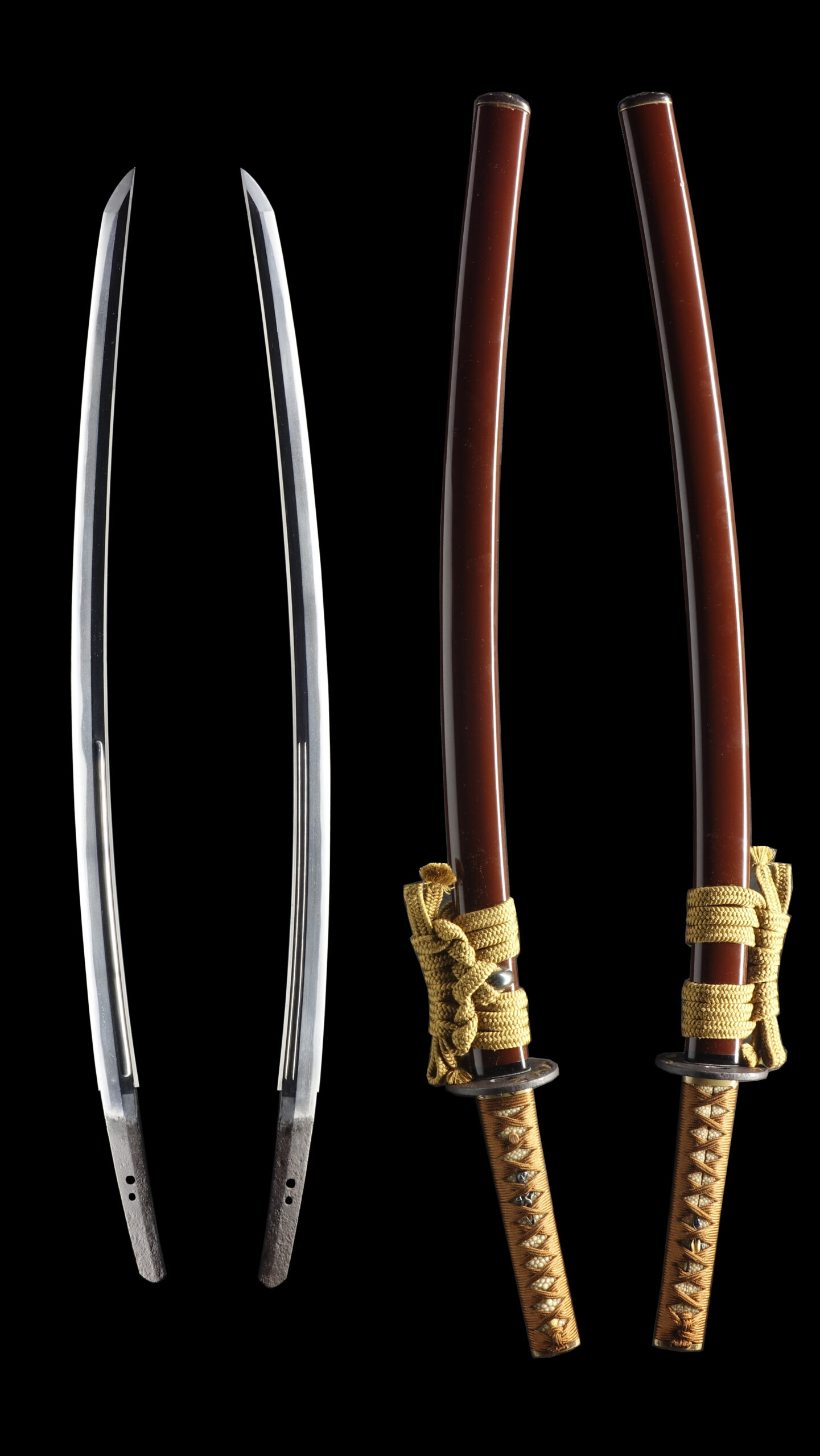
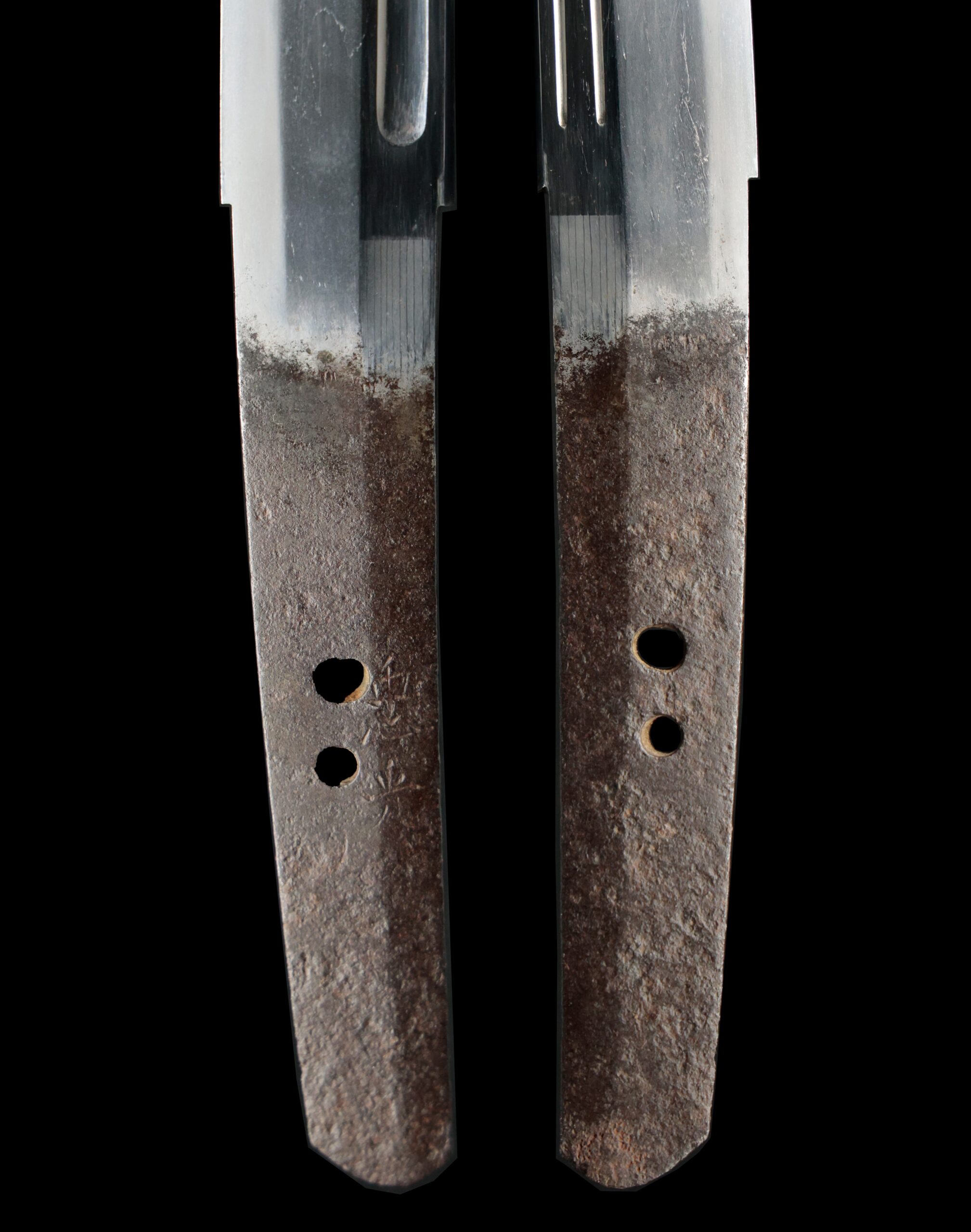
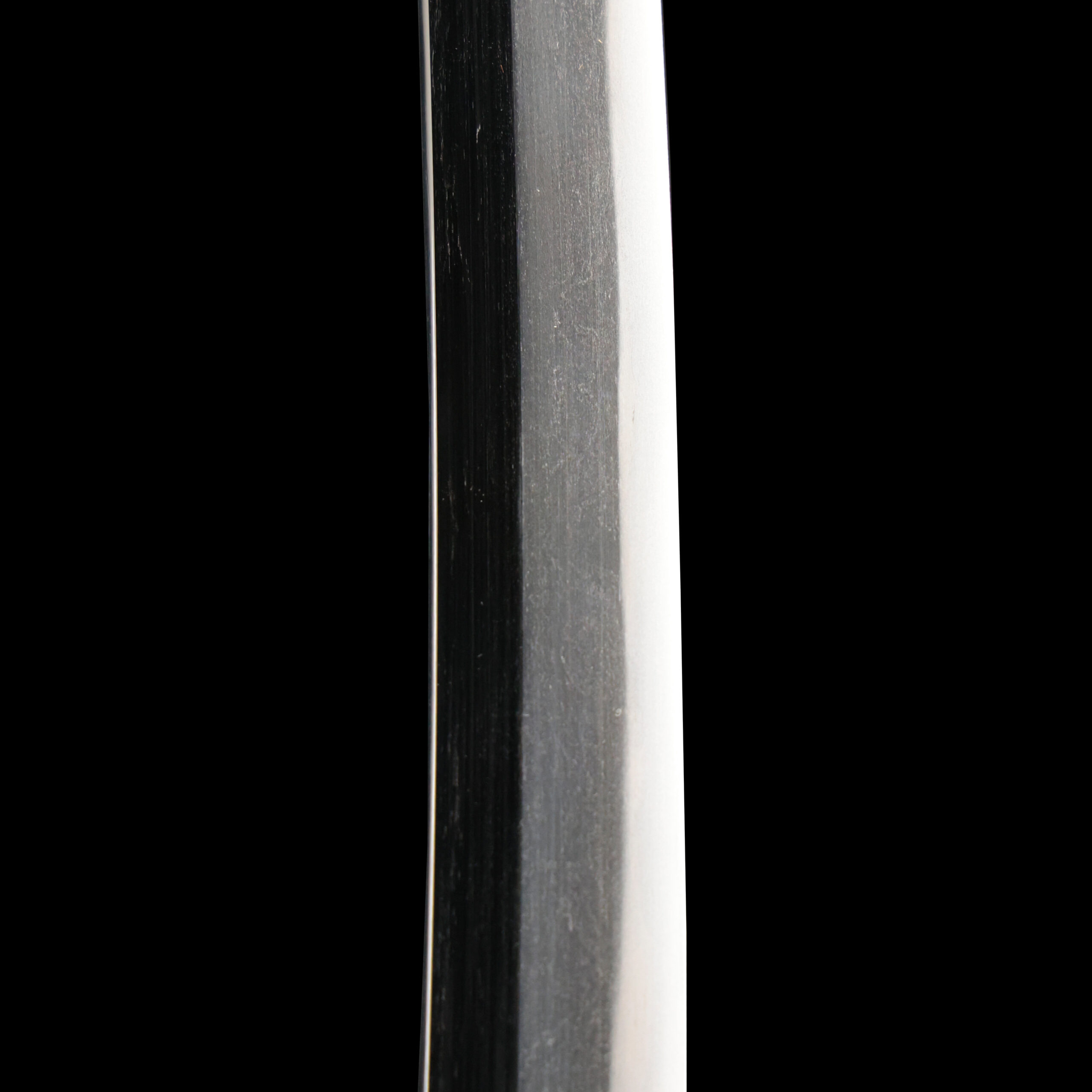
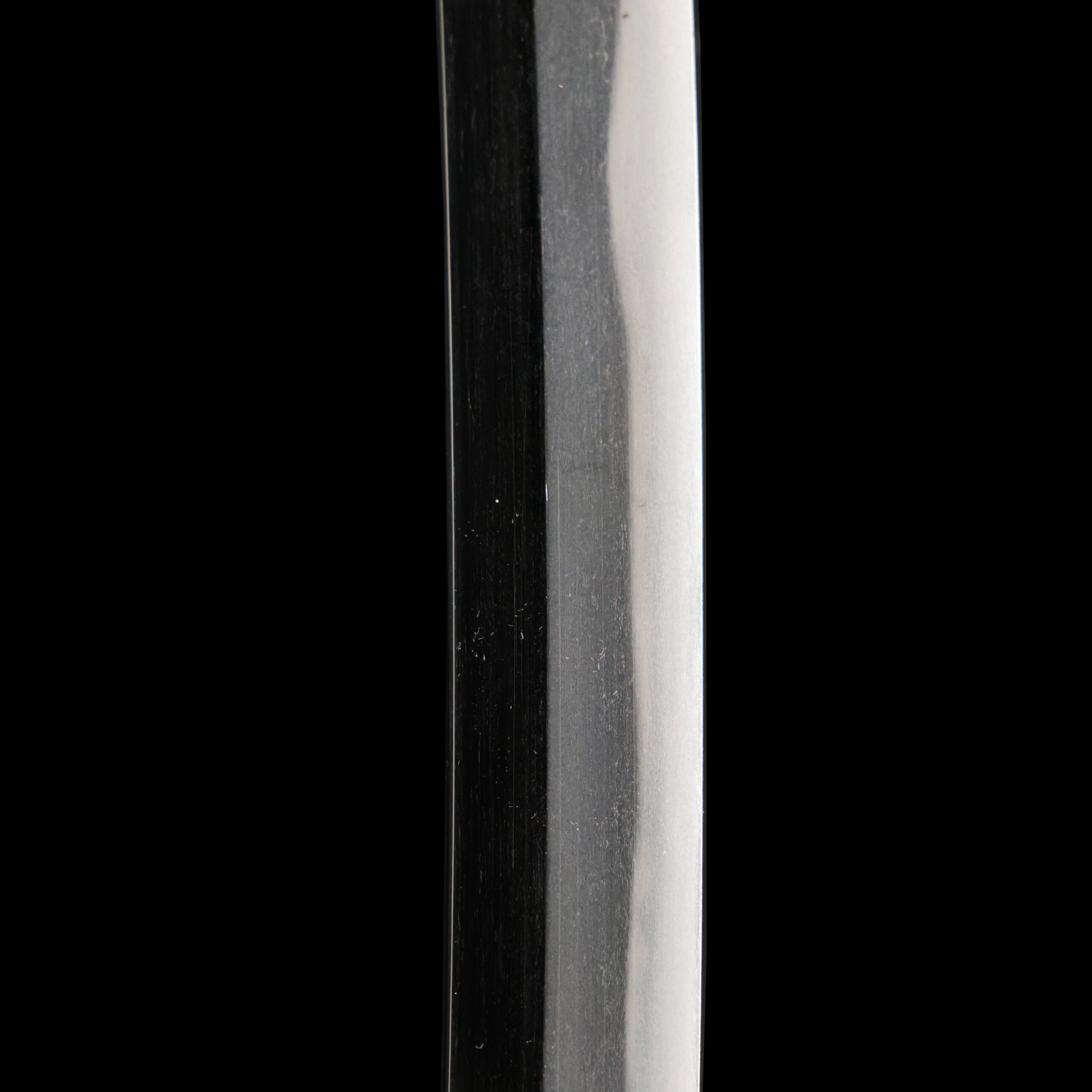
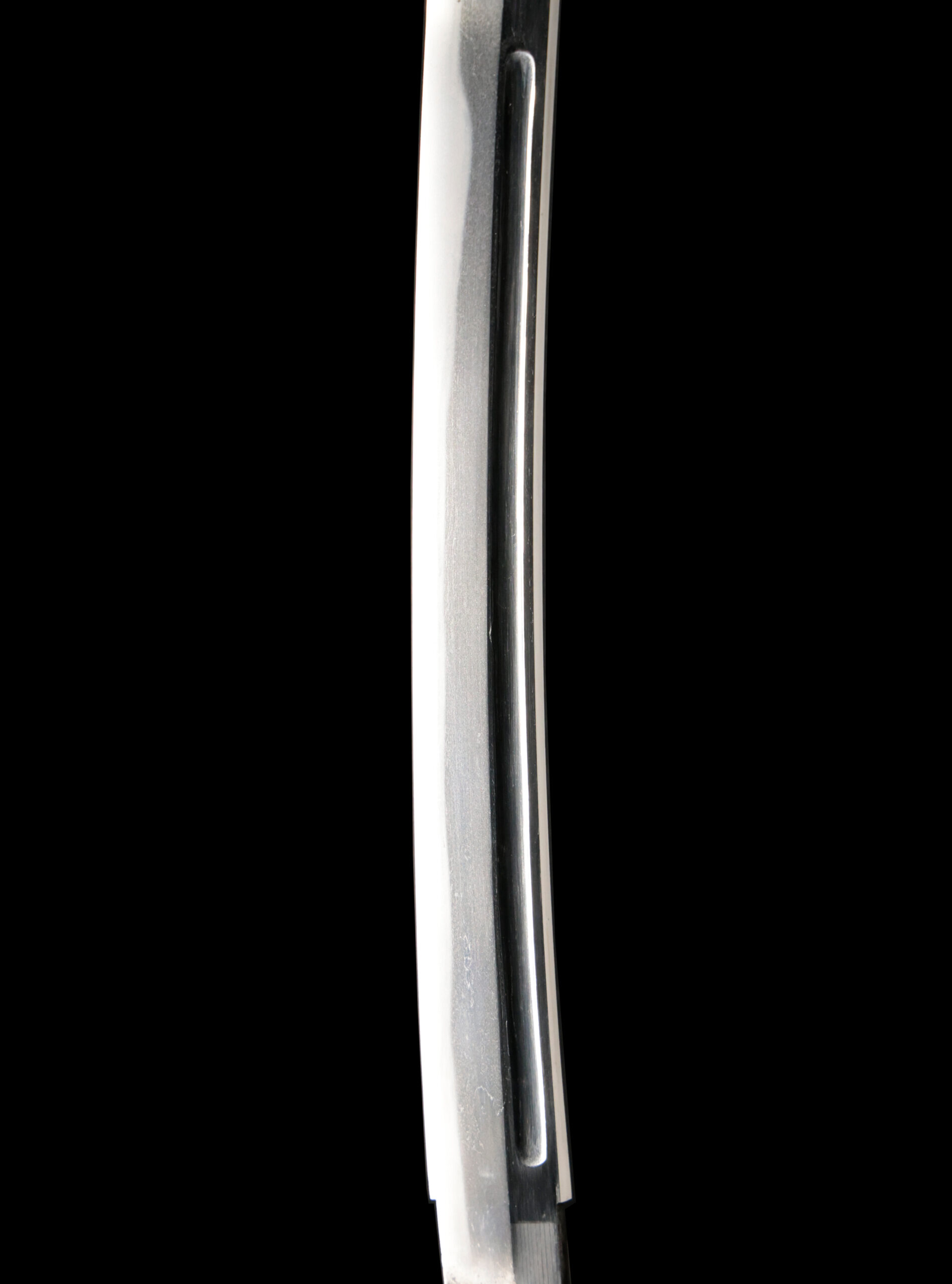
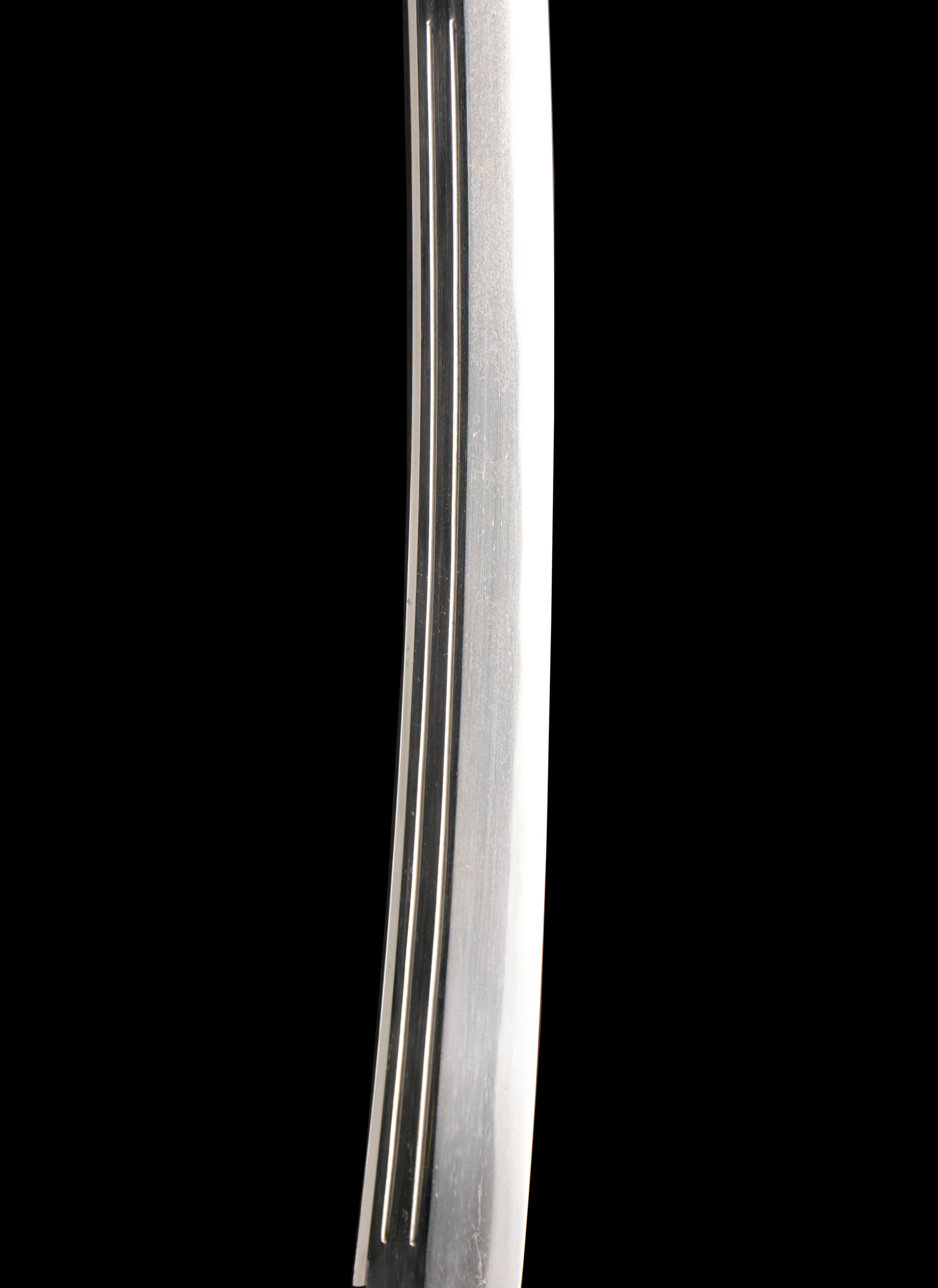
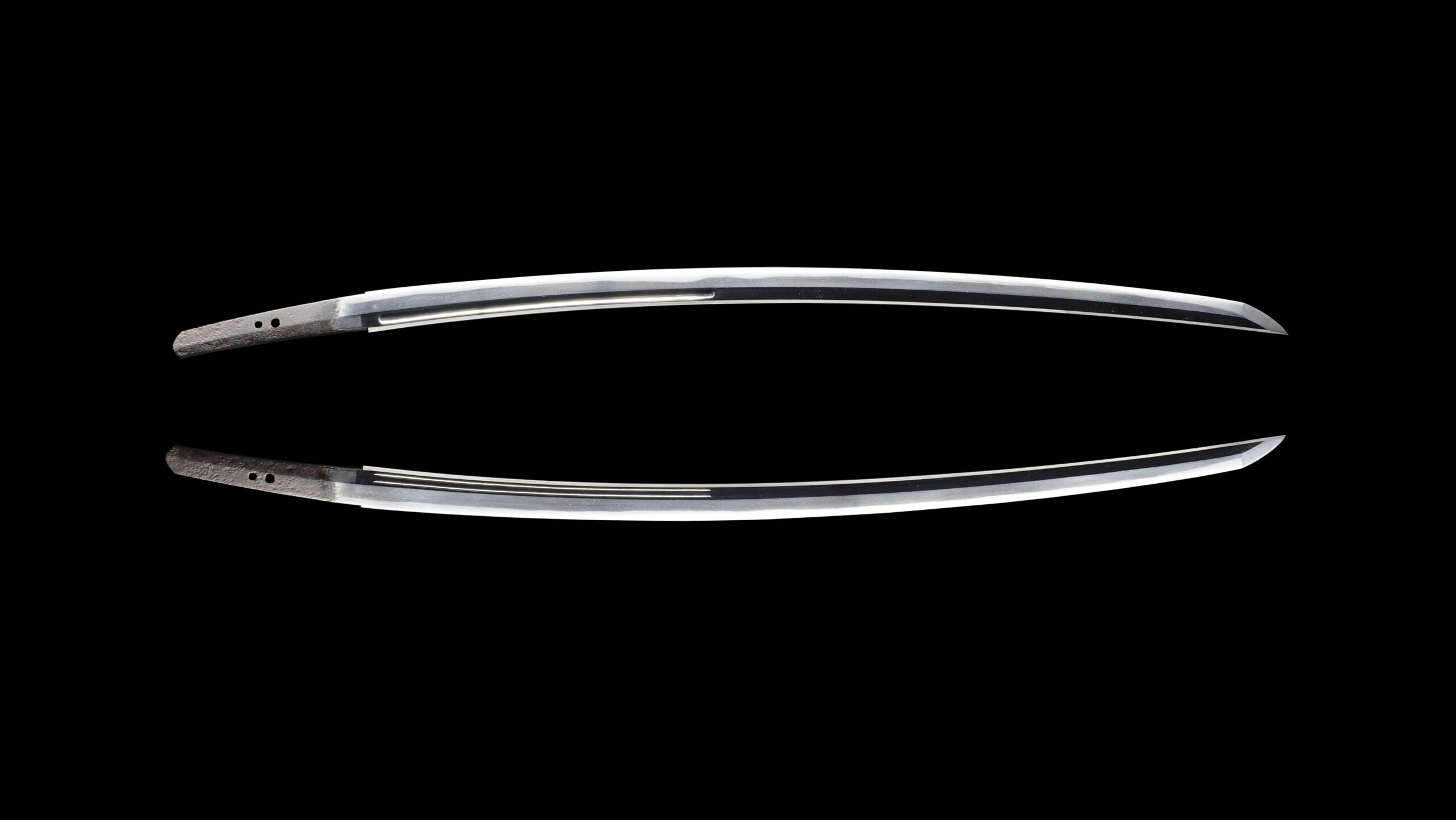
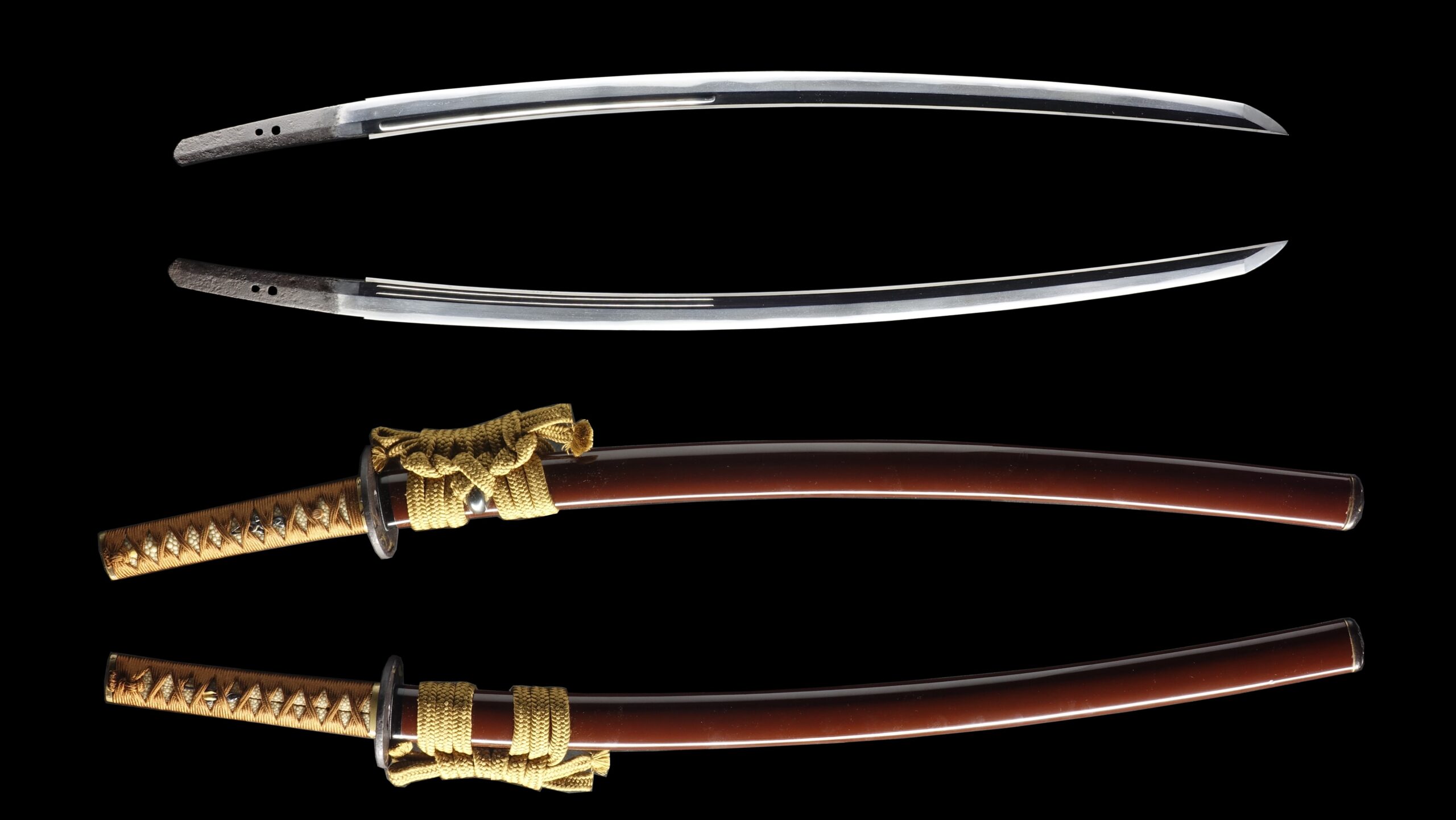
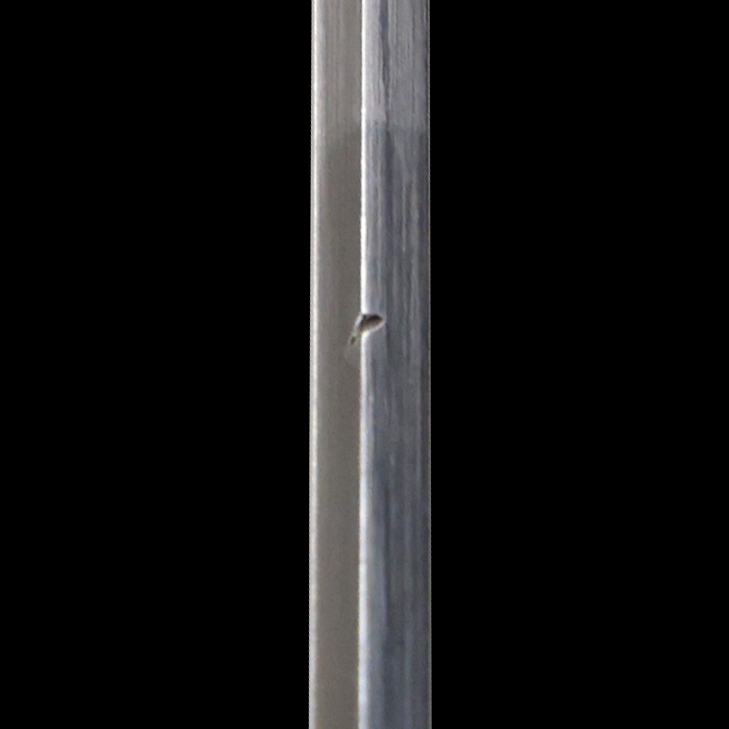
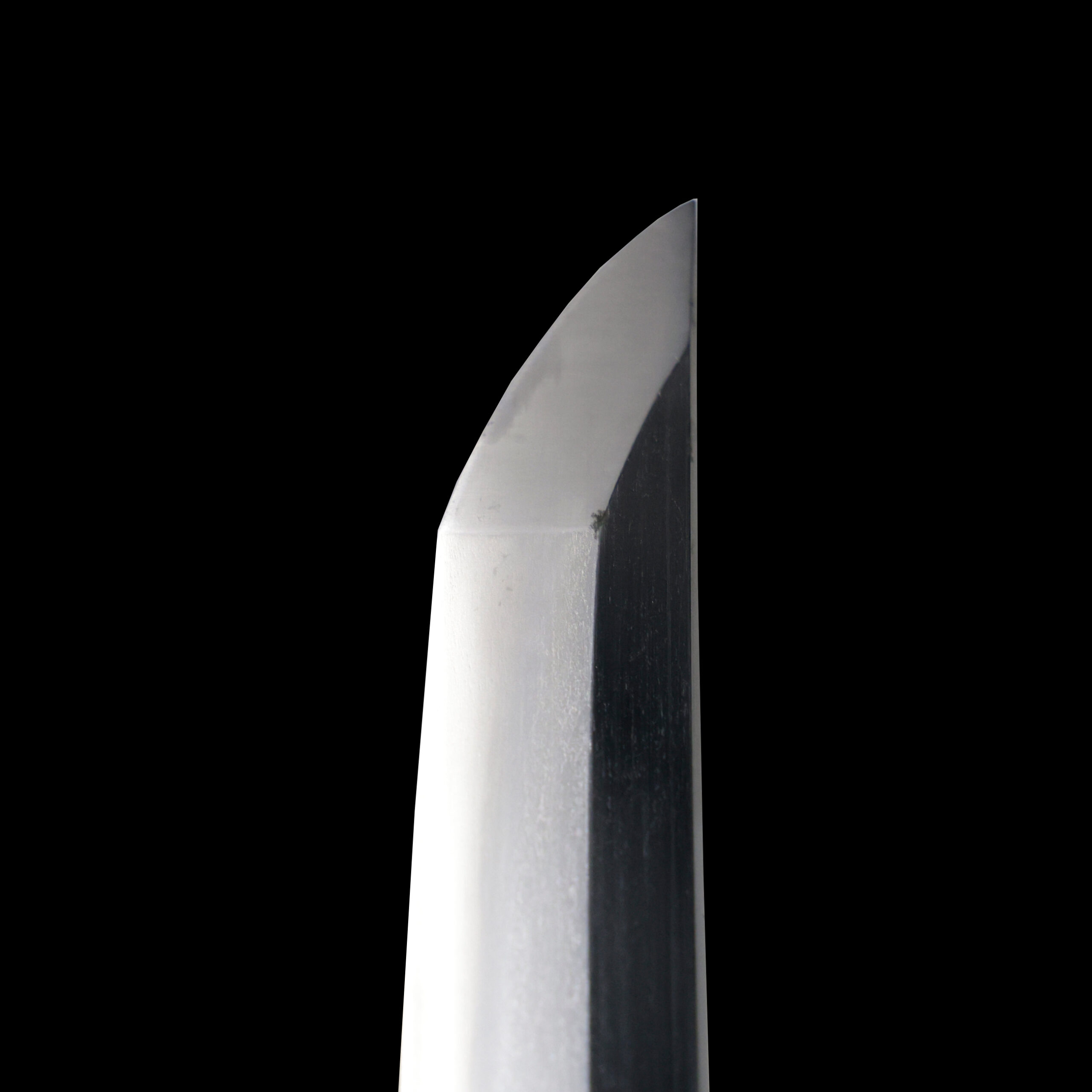
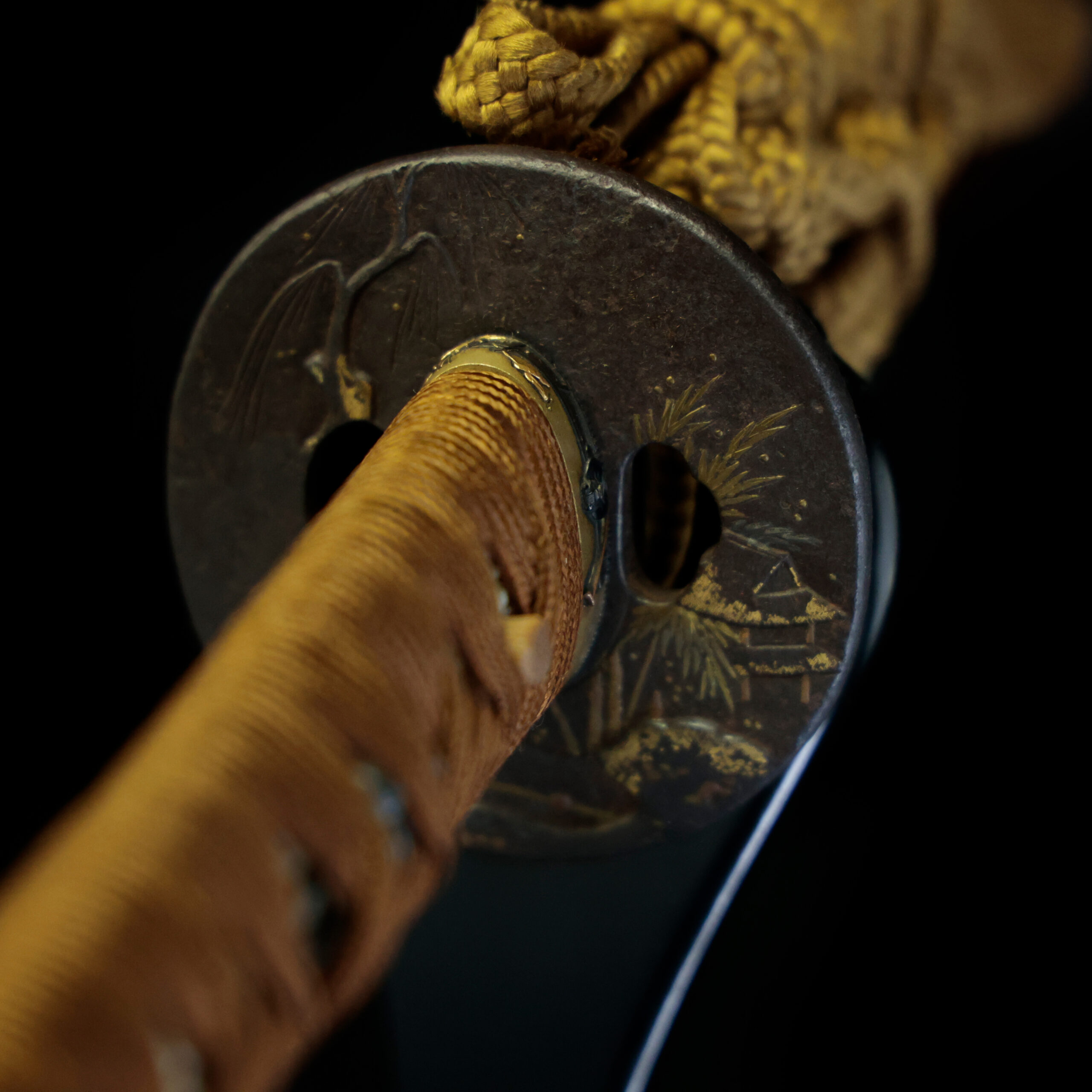
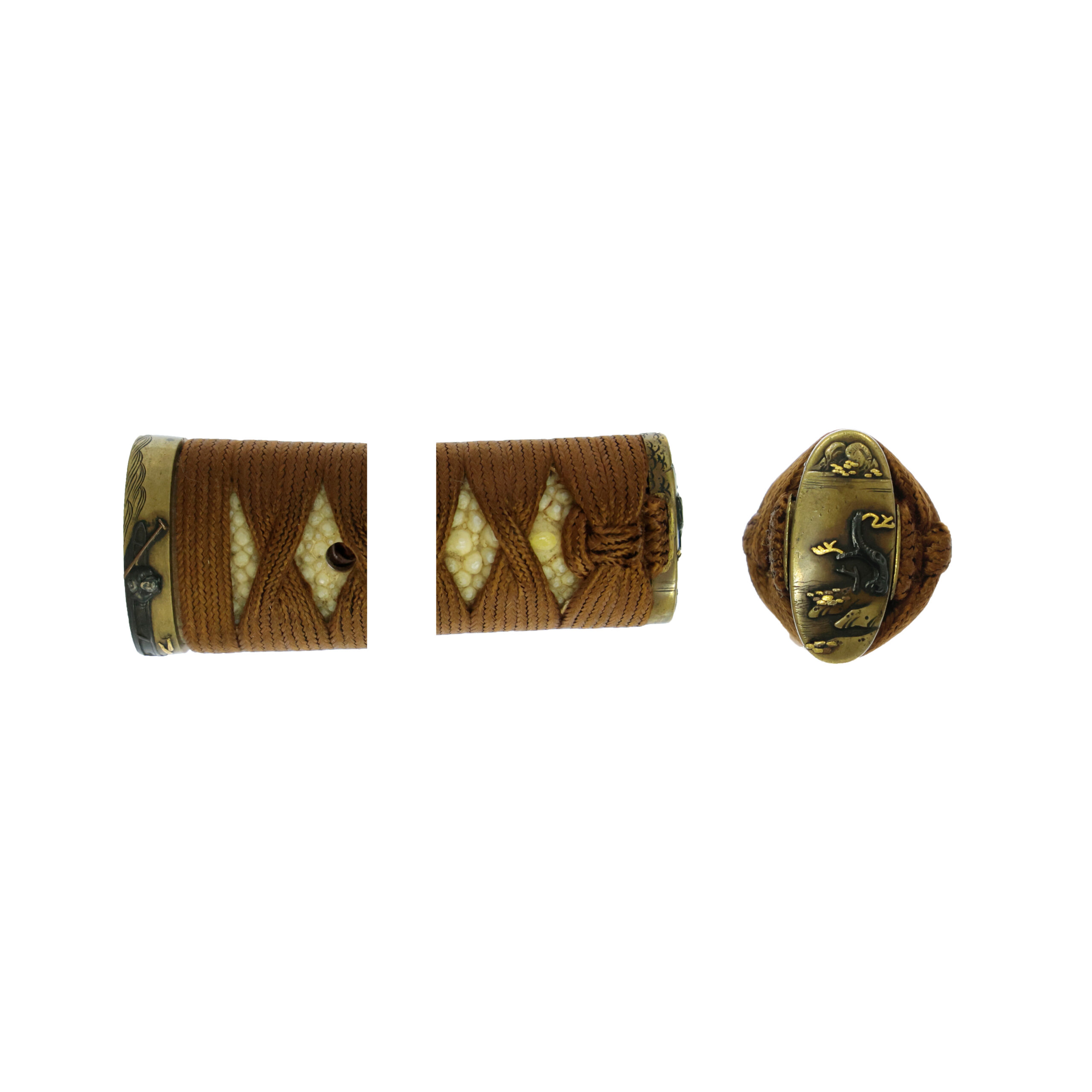
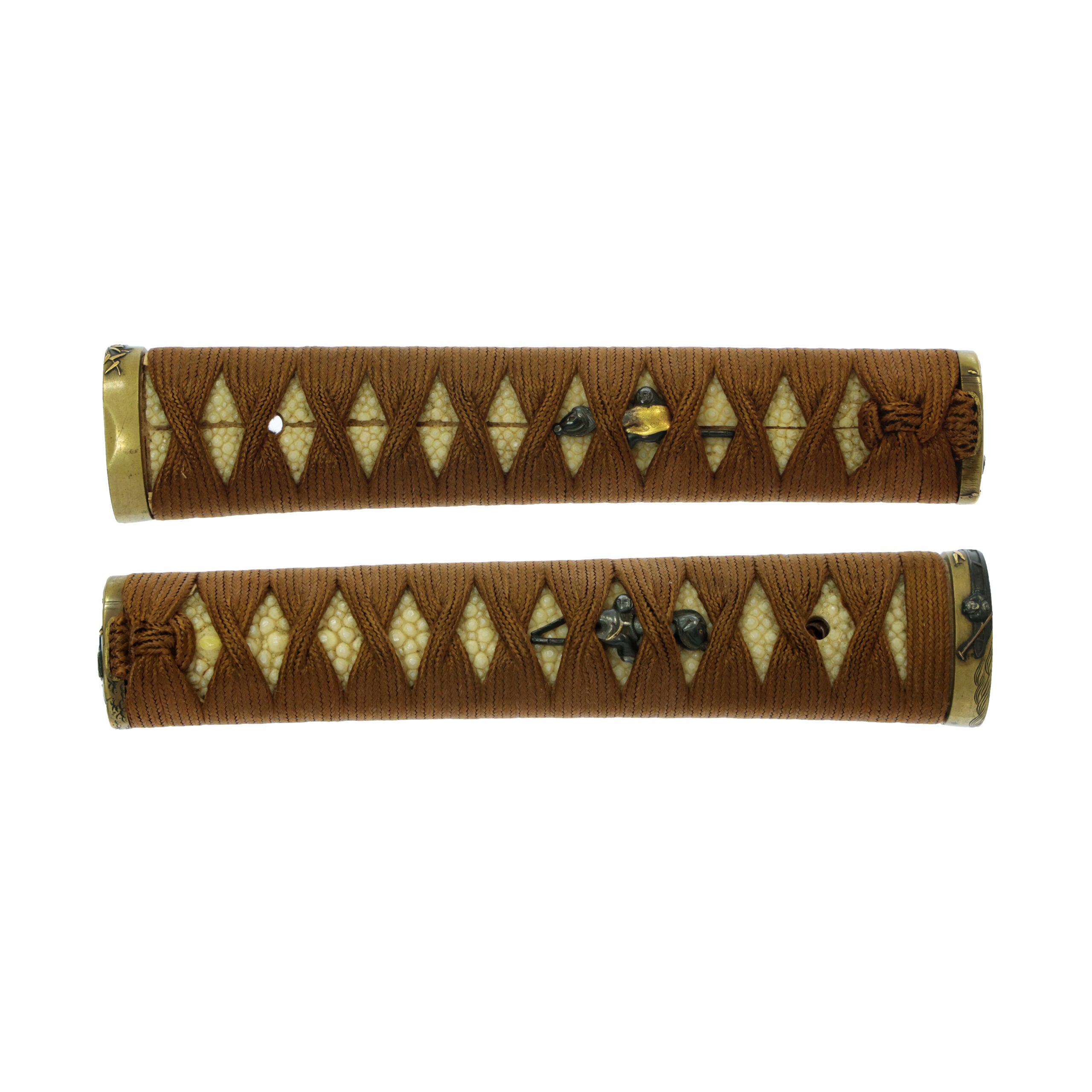
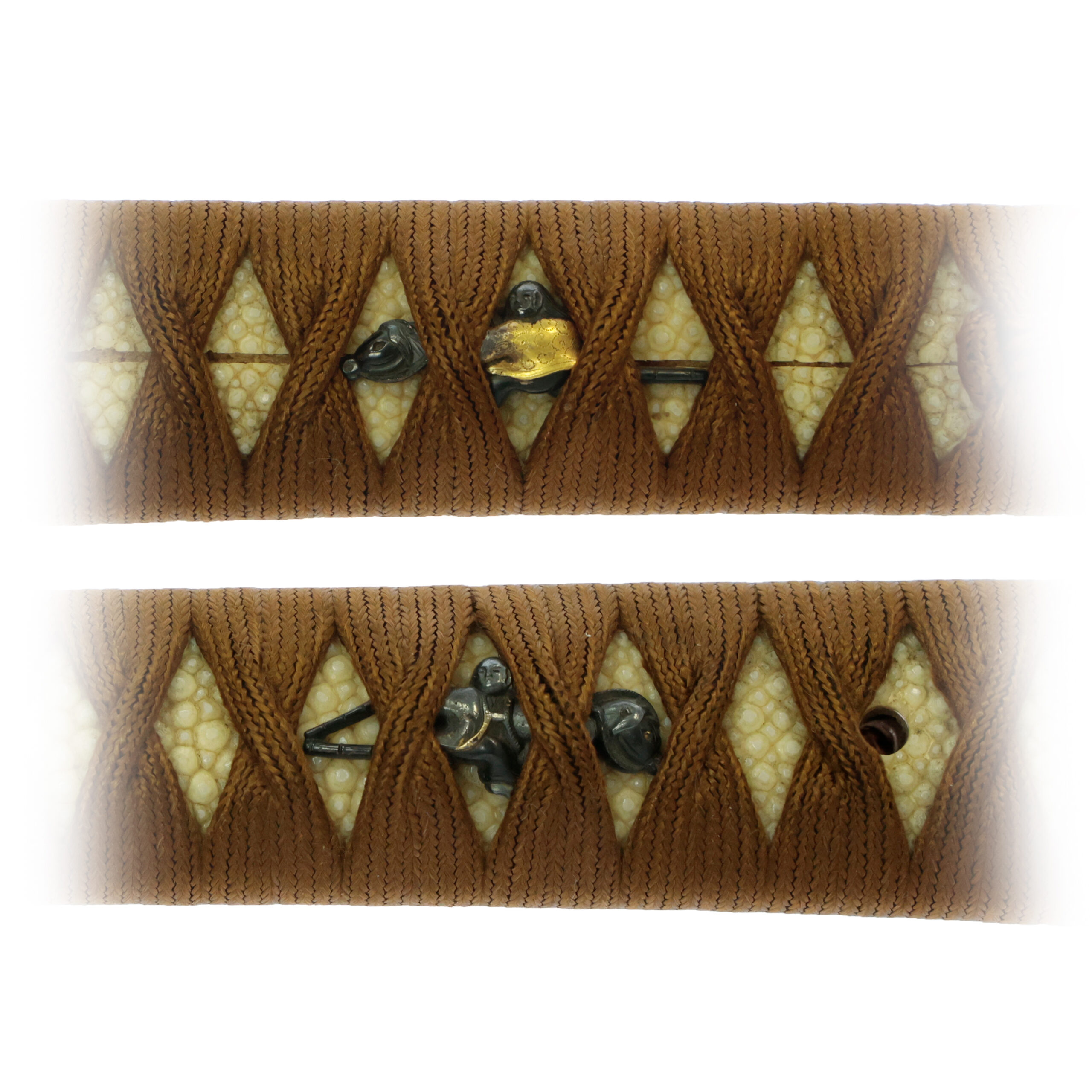
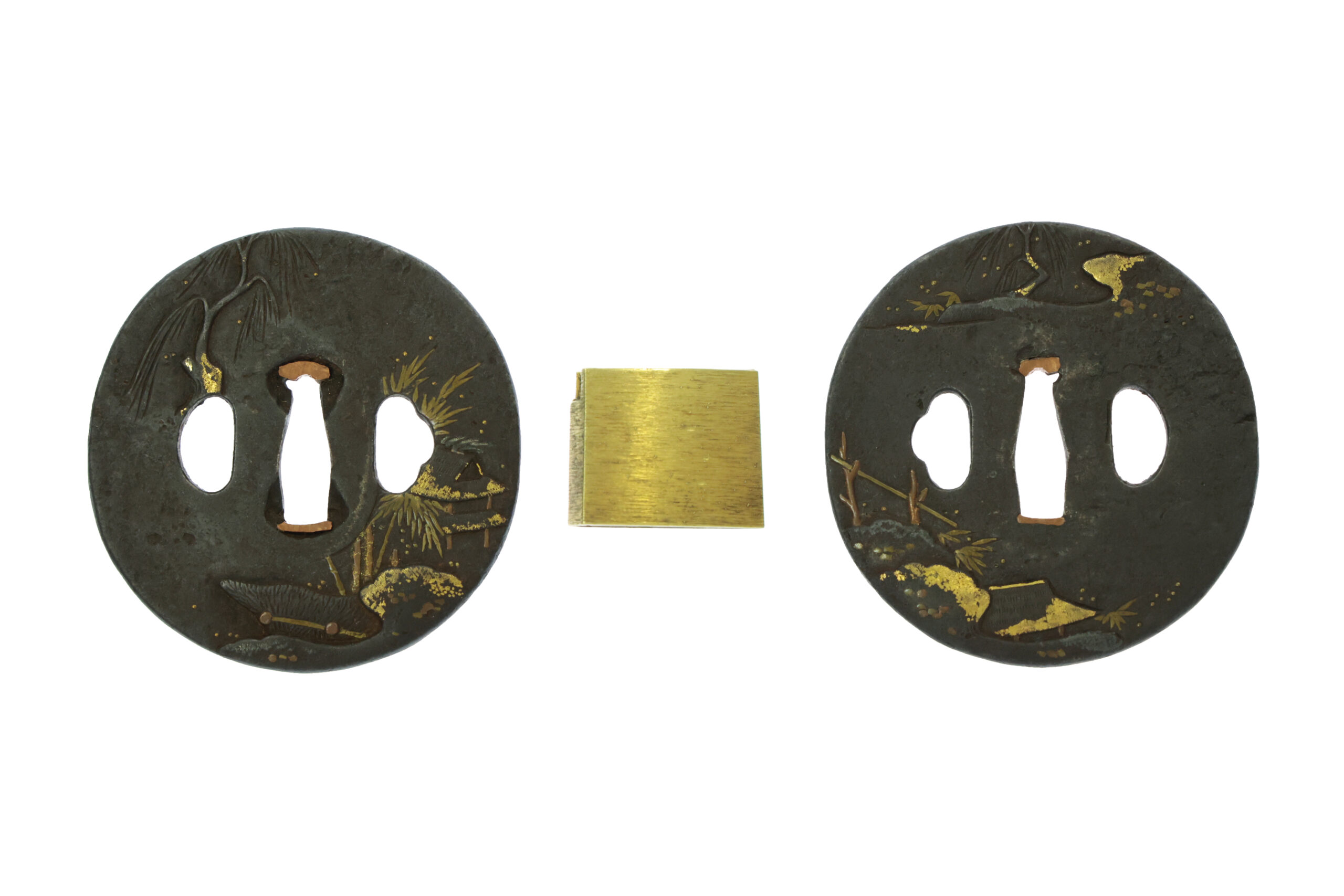
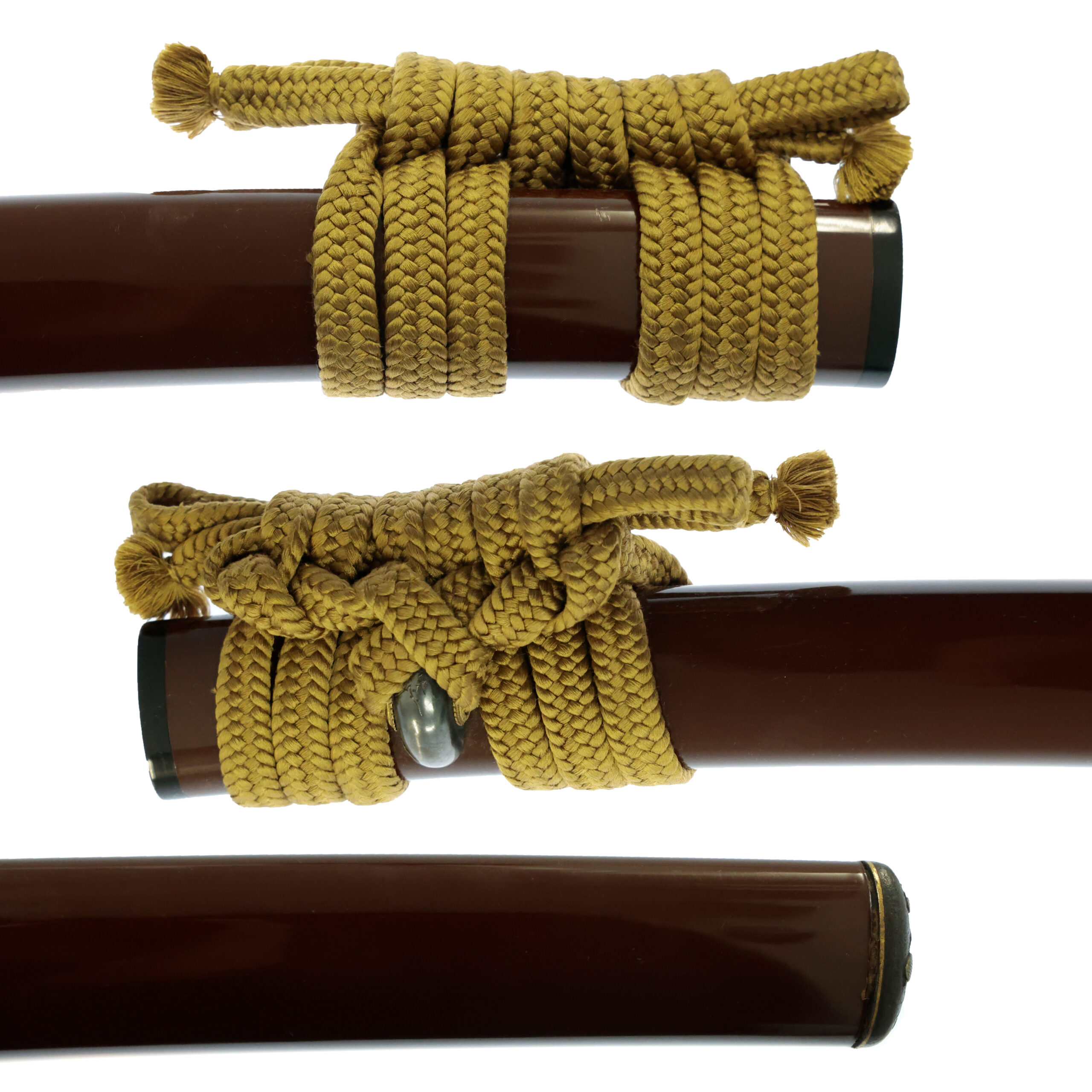
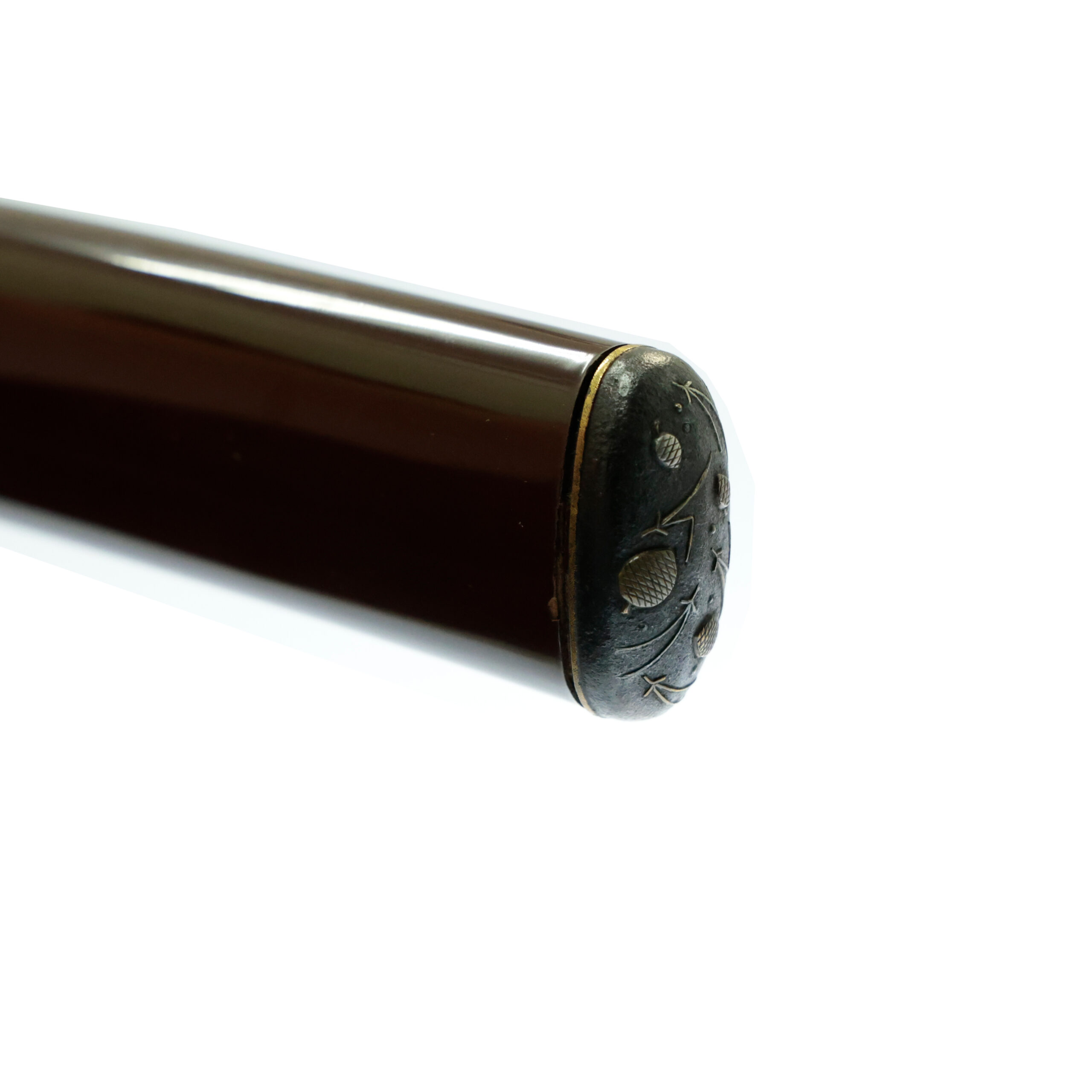
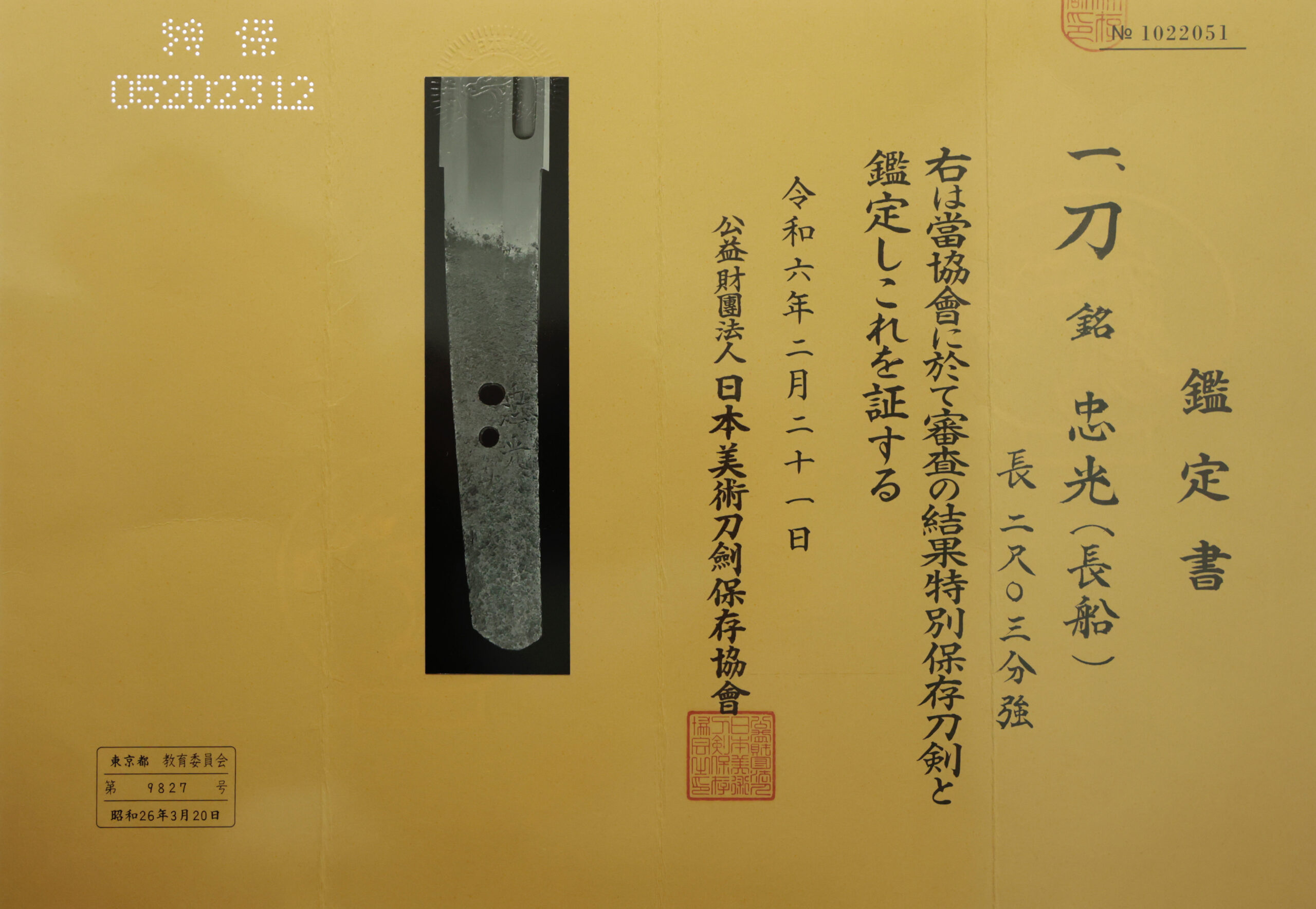
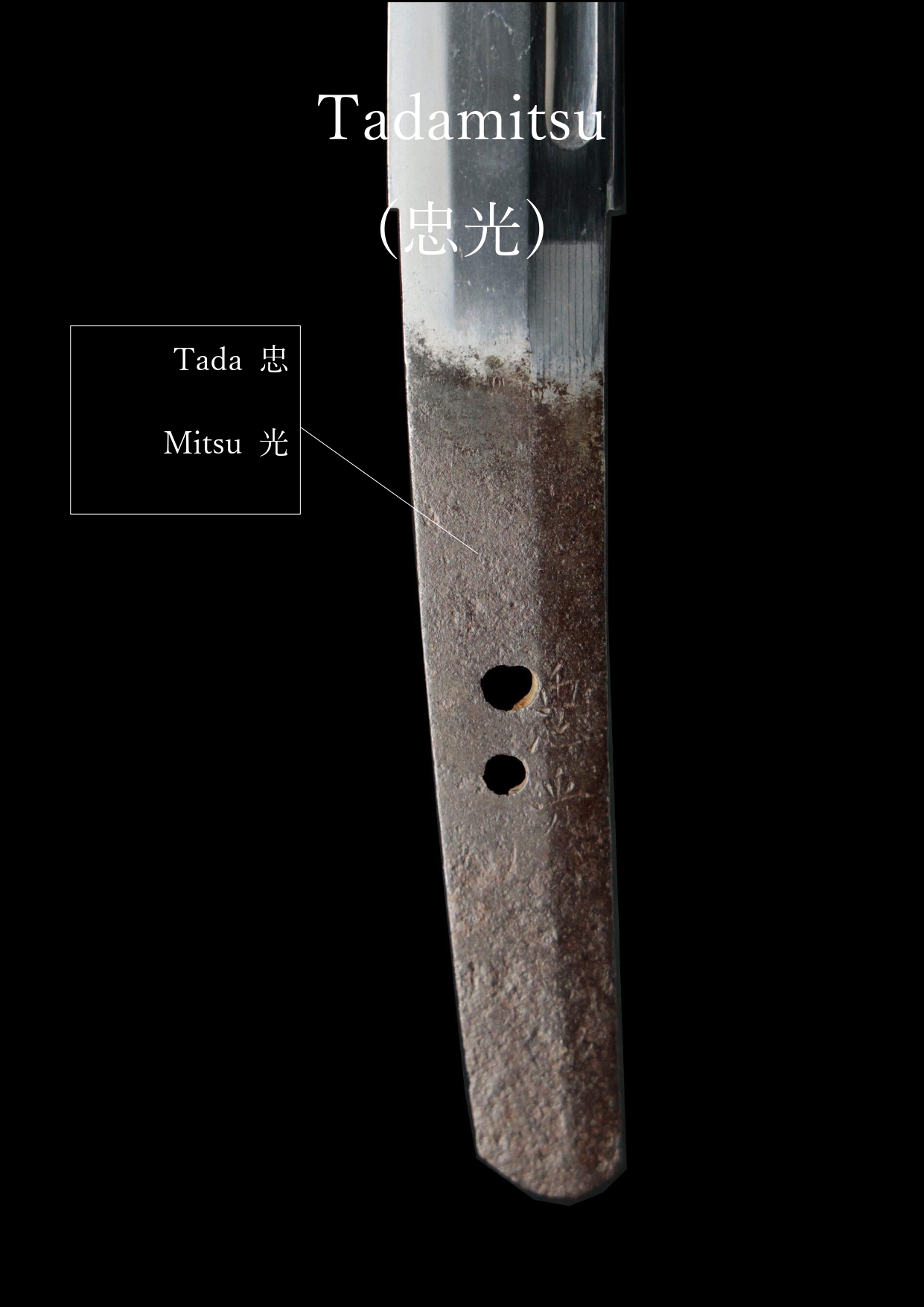
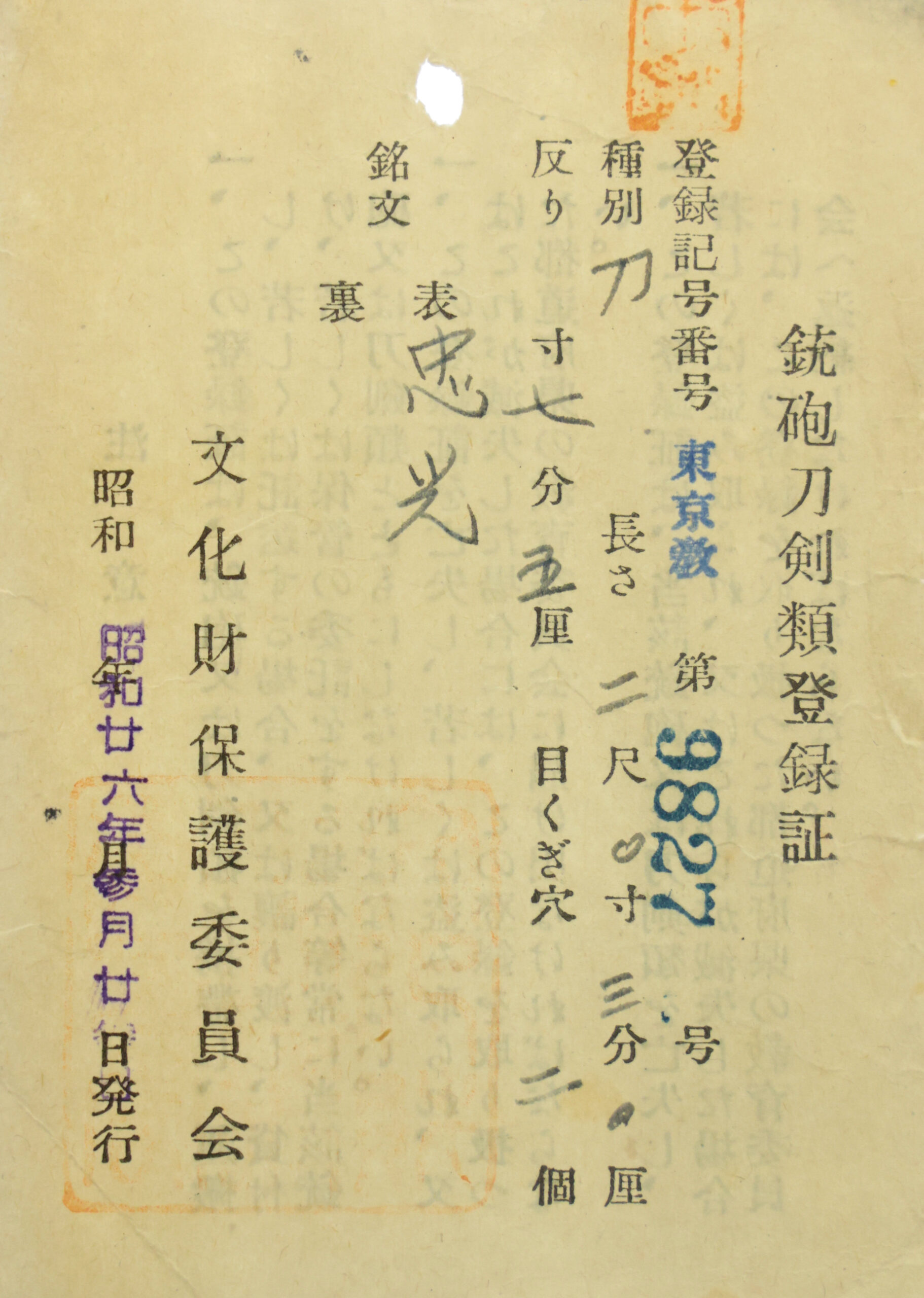
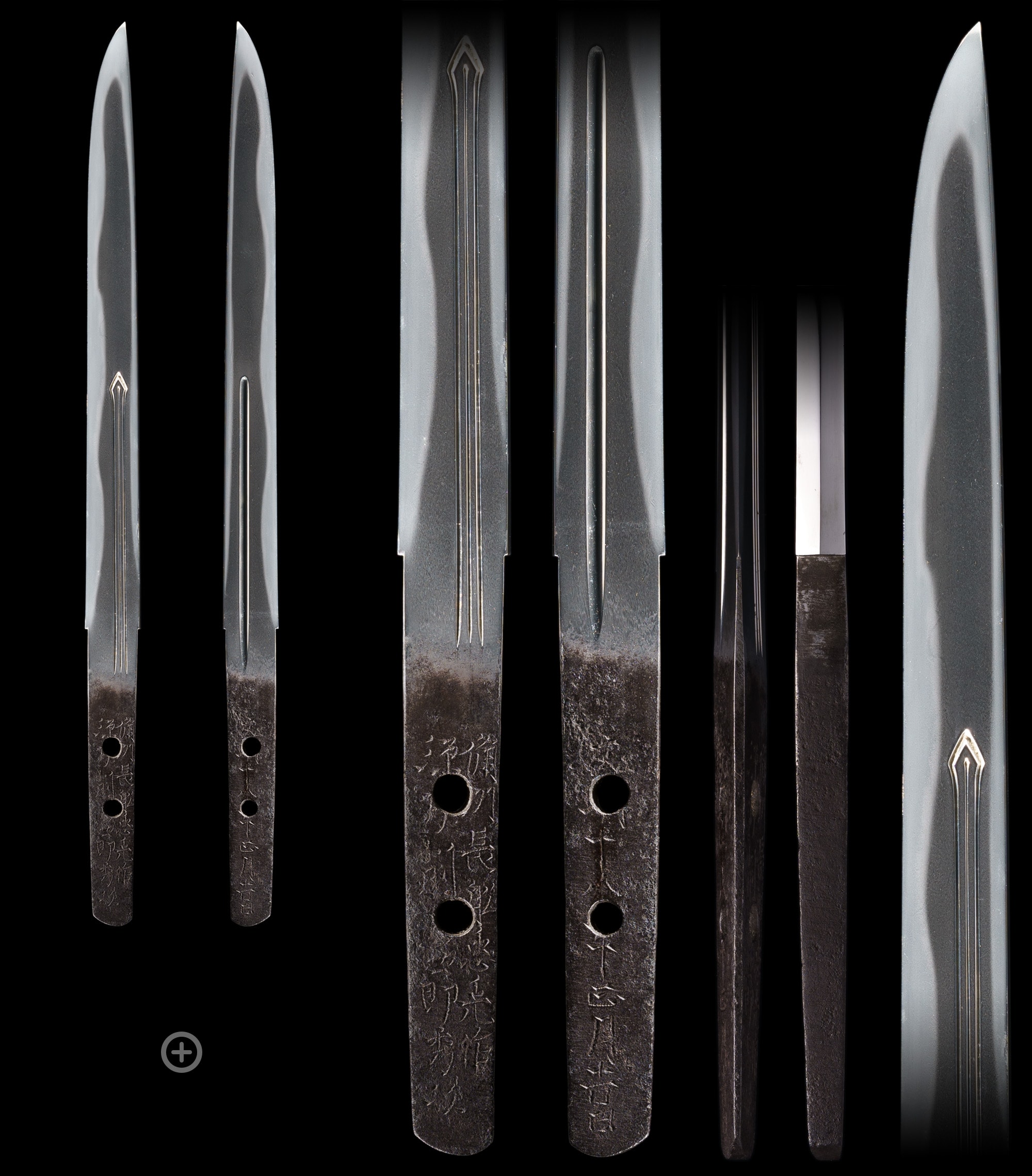
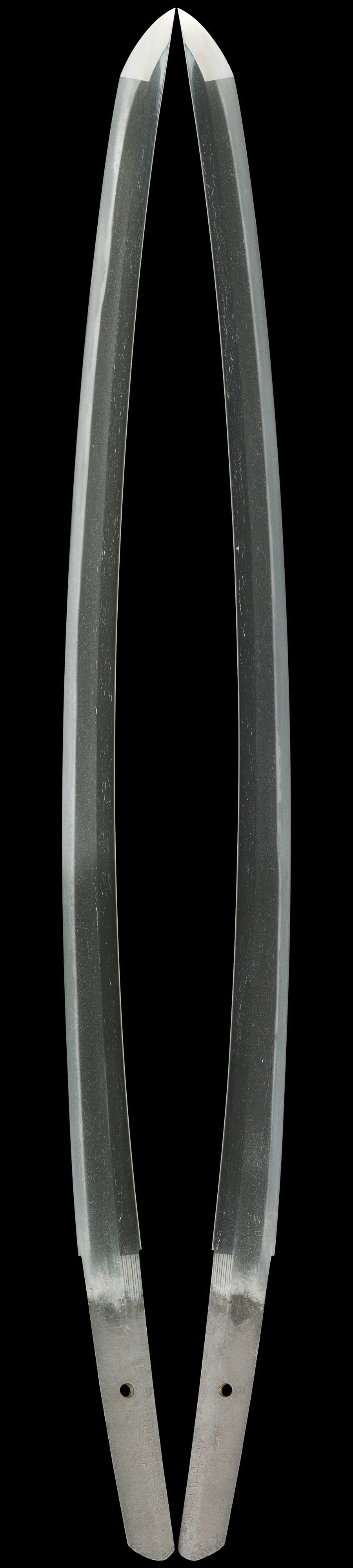
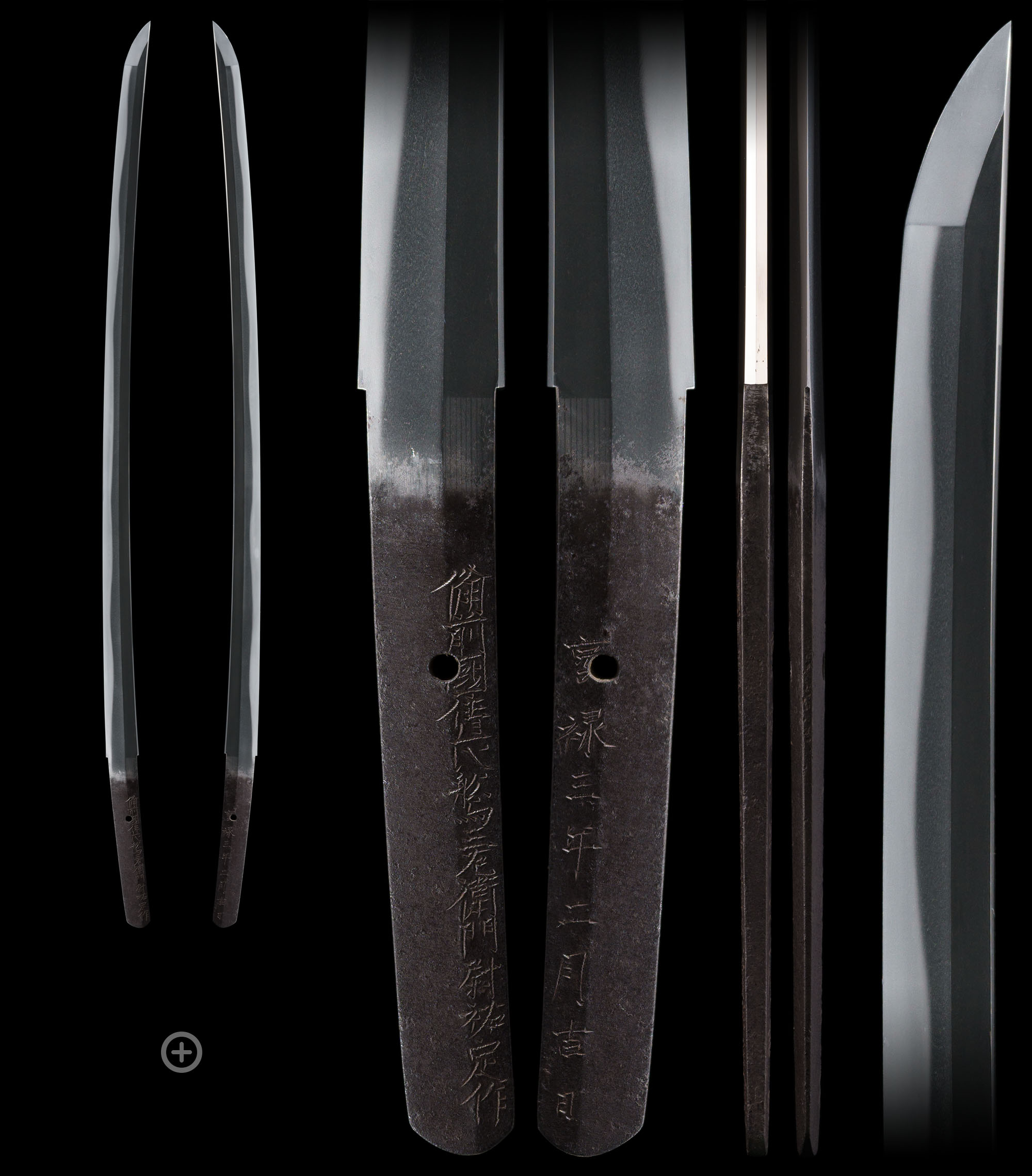
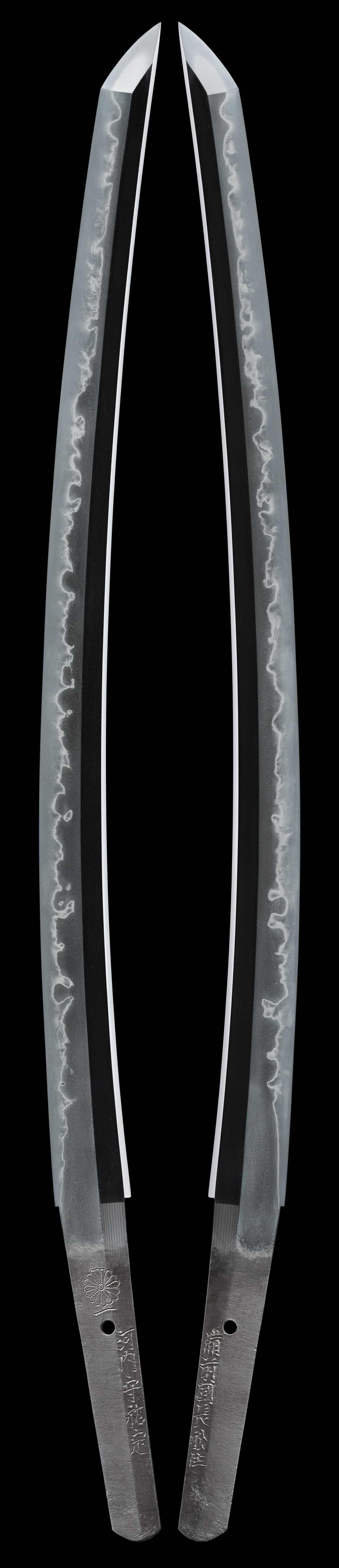
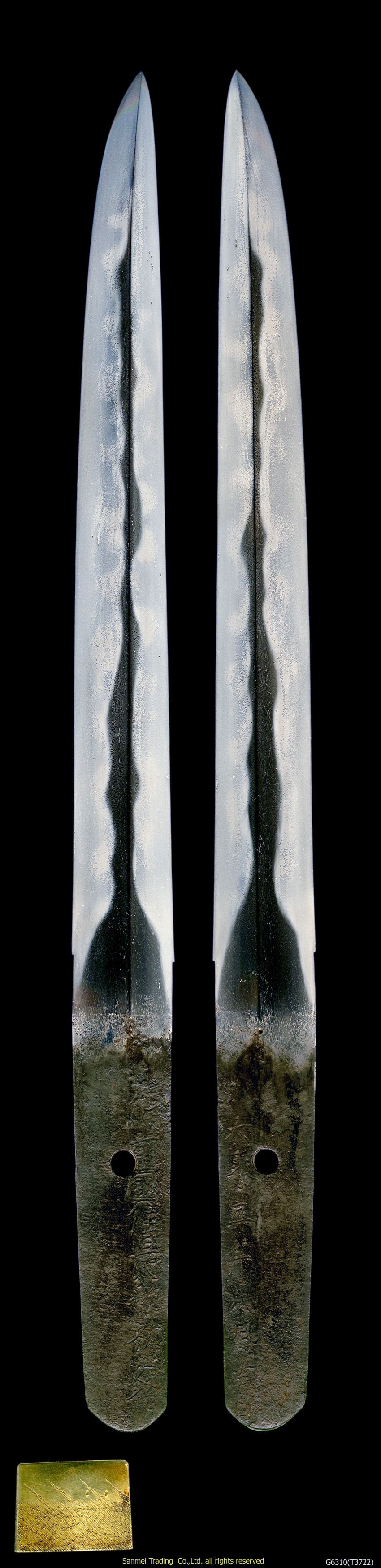
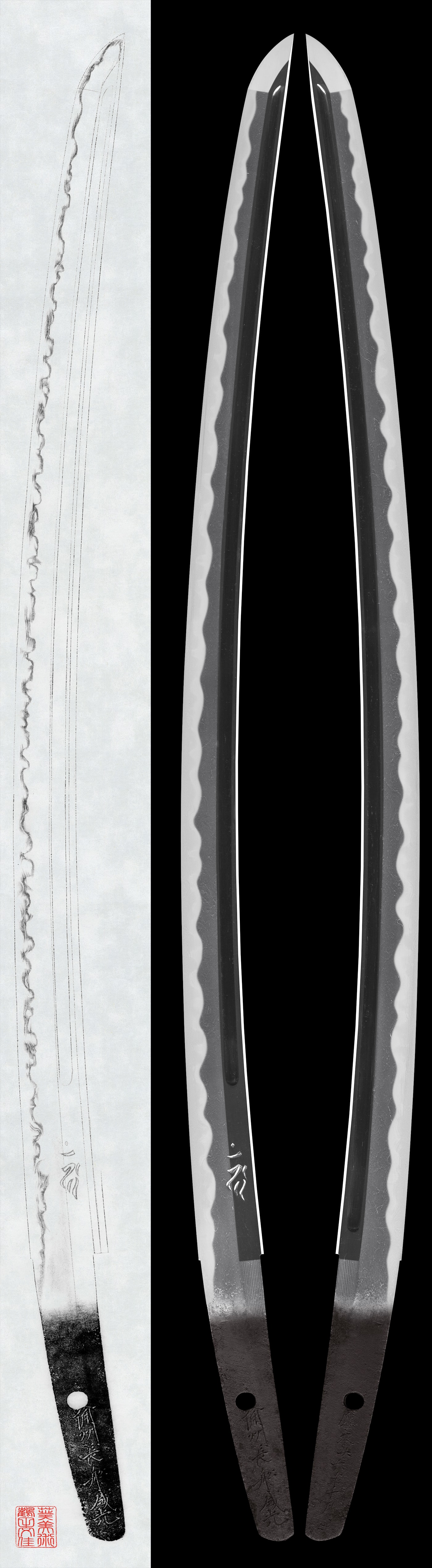
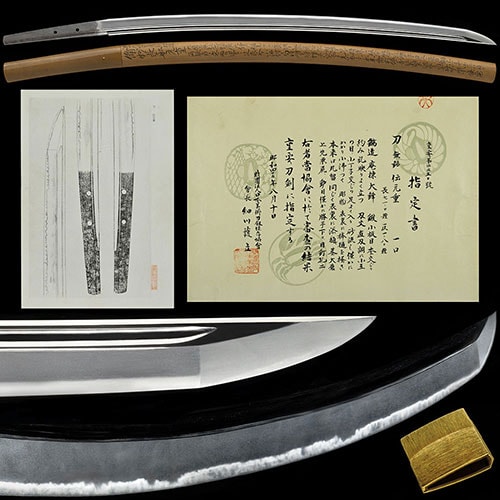
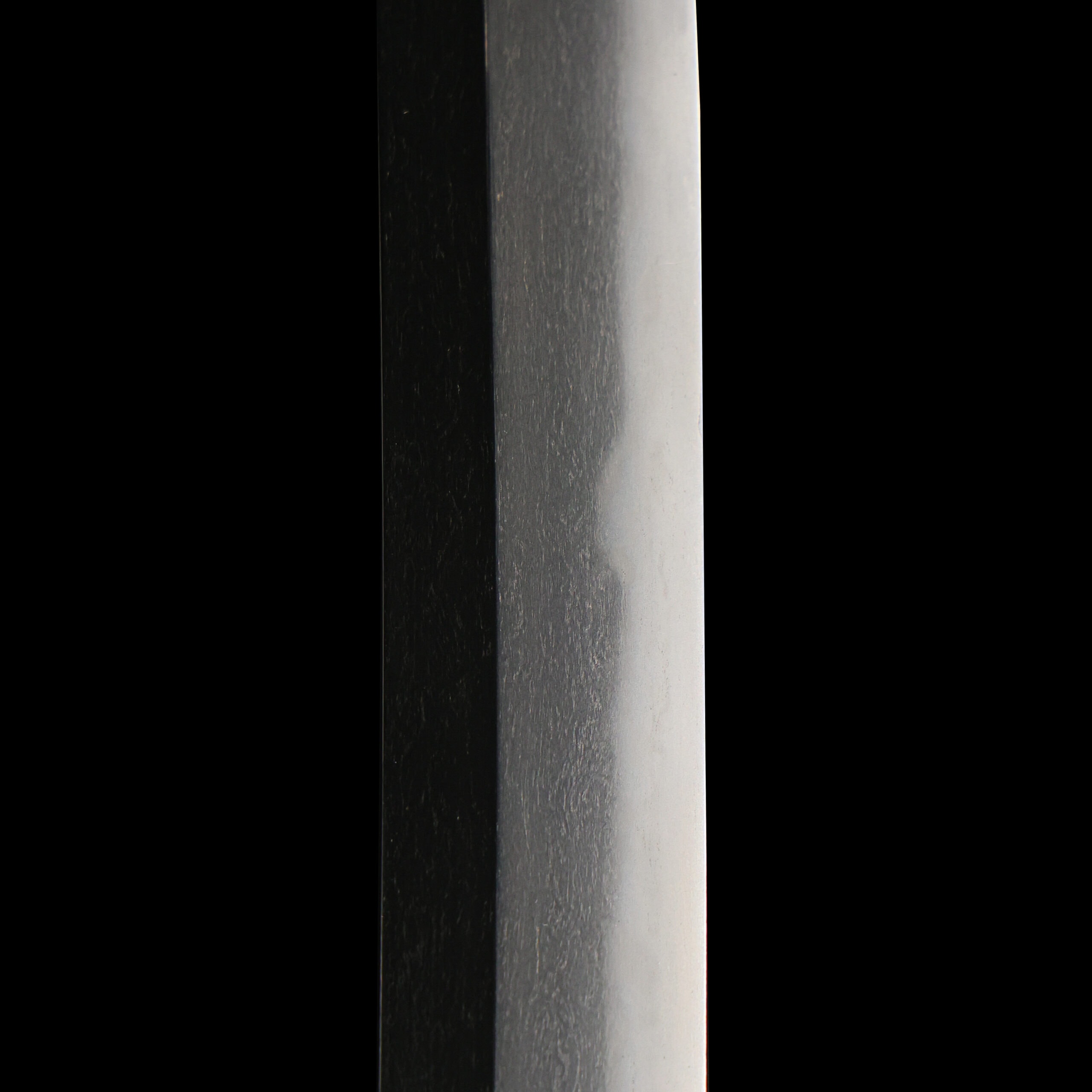
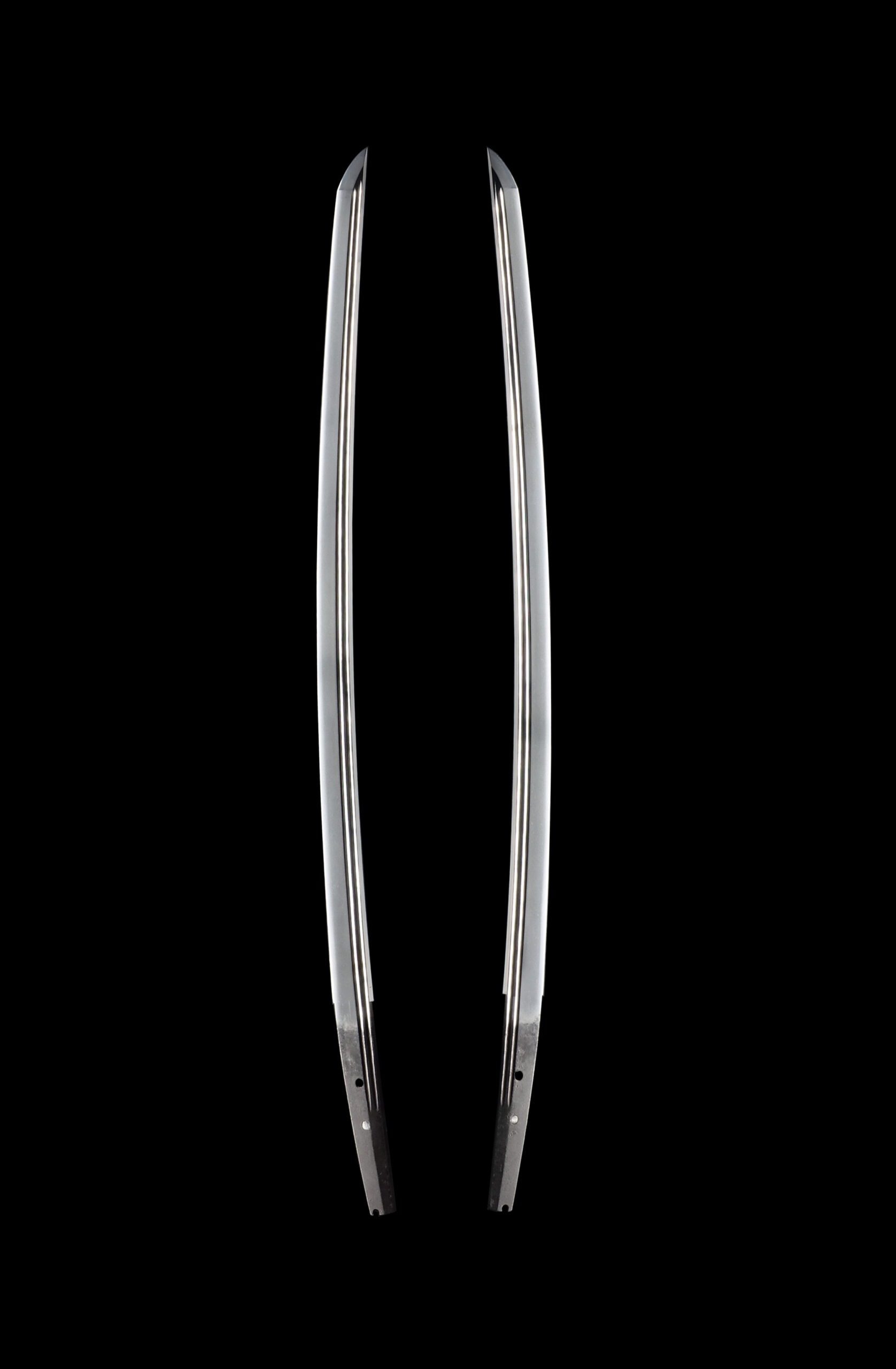
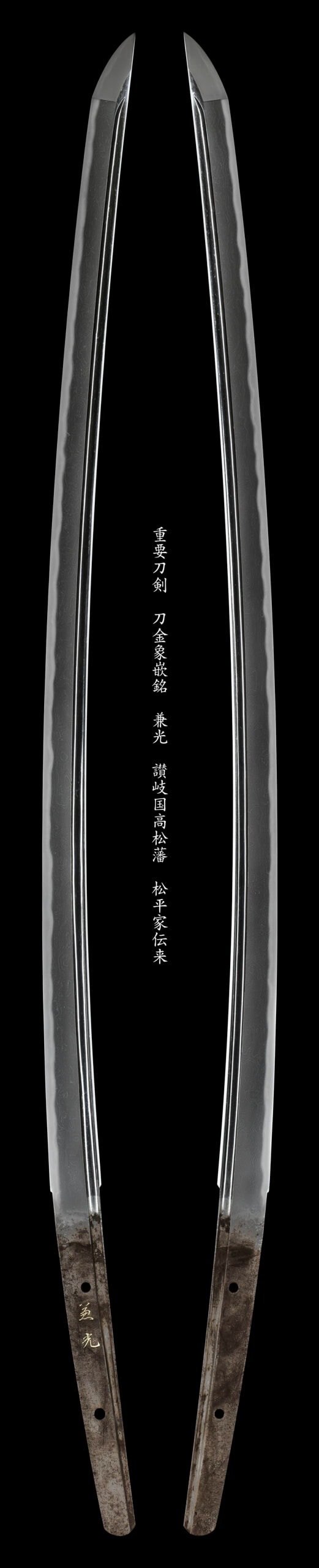
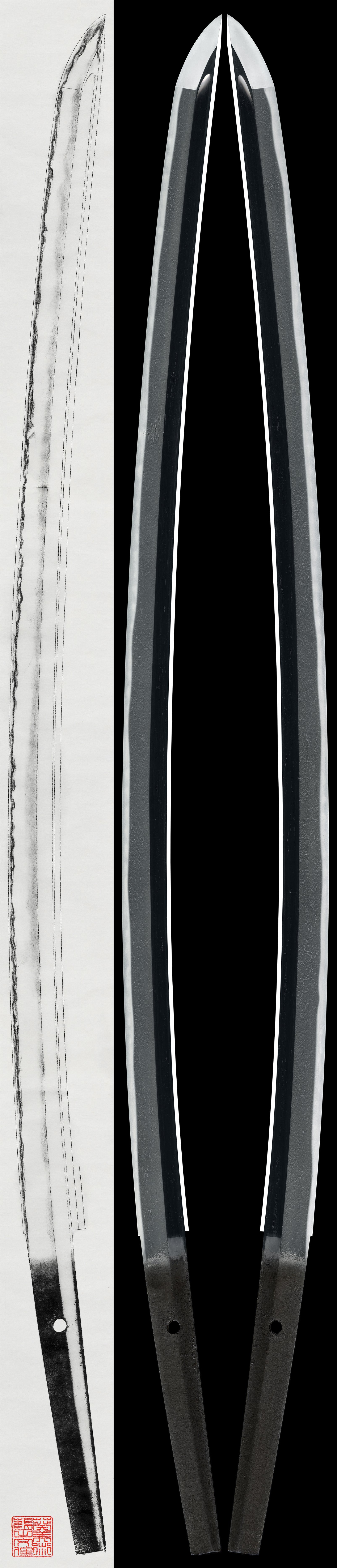
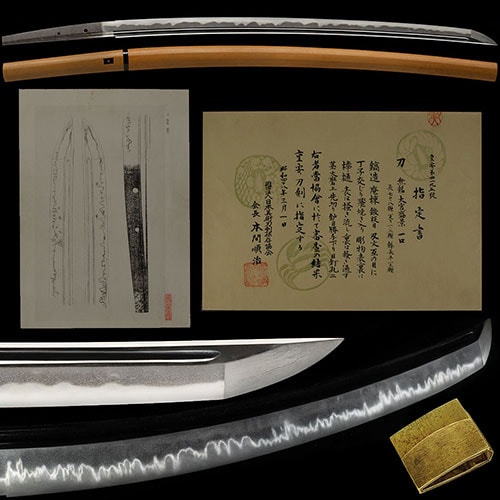
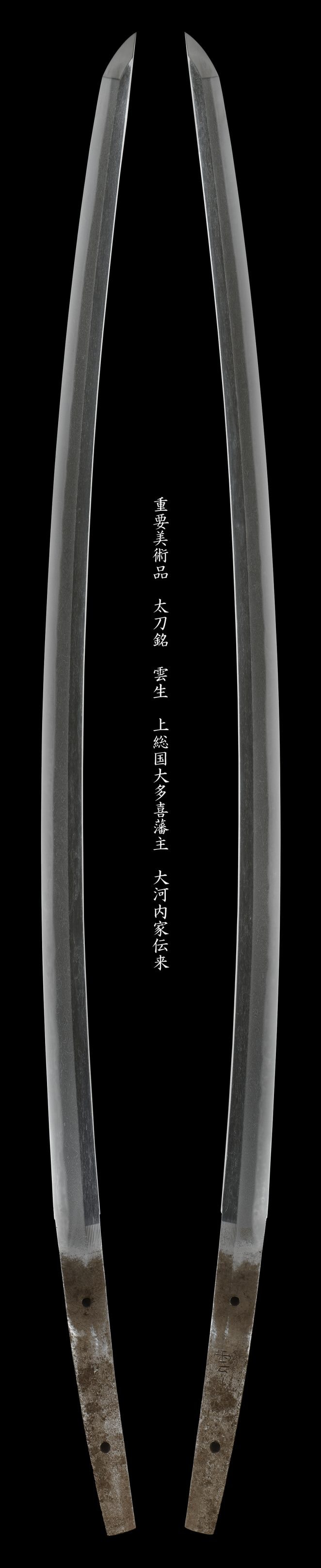
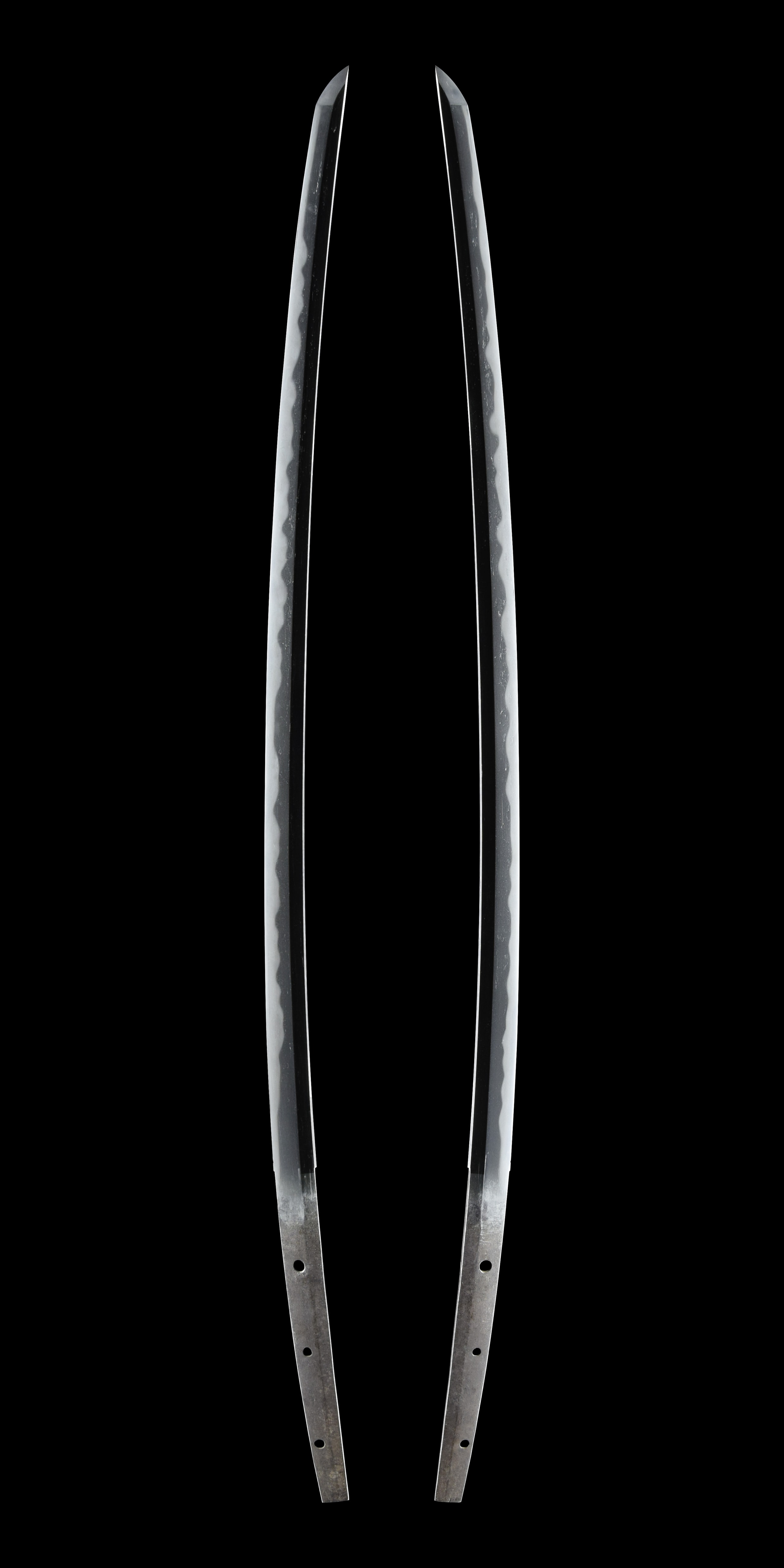
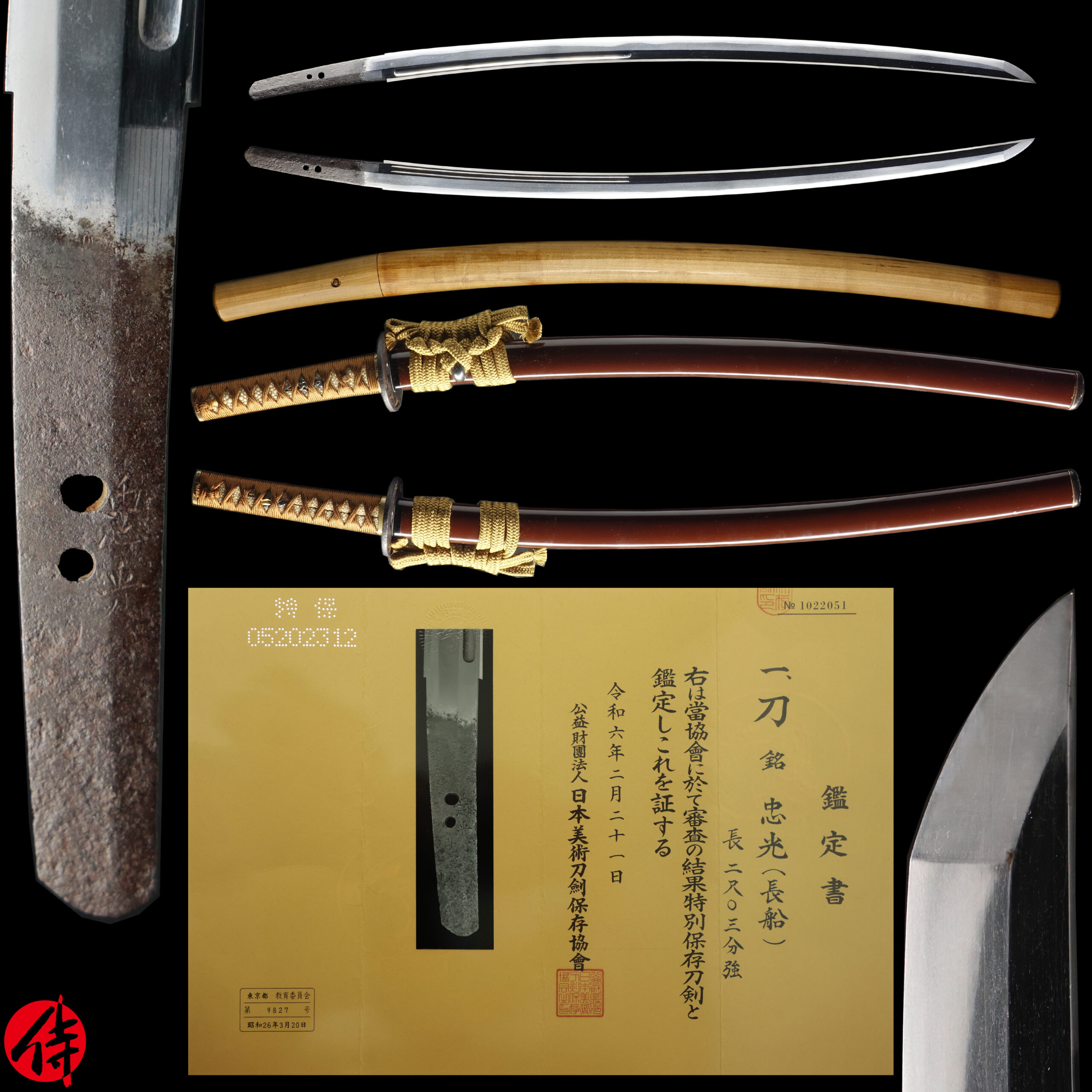
This katana, signed by Osafune Tadamitsu from the late Muromachi period, features a cutting edge length of 61.5 cm and a curvature of 2.27 cm. It is accompanied by an NBTHK Tokubetsu Hozon Certificate, confirming its authenticity and high quality. The blade includes a Gomahashi engraving and a Hi grooving, and comes with a full koshirae mounting and shirasaya.
mei · Osafune · Muromachi · nagasa 61.5cm · sori 2.27cm


Osafune (Sue-Bizen), Bizen · Bizen · around 1469-1521
Fujishiro Jo-jo saku · Tōken Taikan top 17%
Tadamitsu is, with Katsumitsu and Munemitsu, one of the representative Osafune smiths of the late-Muromachi forges collectively called Sue-Bizen. The name itself is old, and the signature compendia place a first generation as far back as the Shoo or Genko eras and count several generations down through Eiroku and Tensho; of those earliest masters no work survives, the oldest examined blade being a Joji-dated piece. The Tadamitsu who is widely known, and whose dated and signed swords fill almost the whole of the surviving record, is the smith bearing the common name Hikobei-jo, working in the Bunmei, Entoku and Meio years (1469 to 1501). The published sources rank him directly: "alongside Katsumitsu and Munemitsu, Tadamitsu is counted among the representative smiths of Sue-Bizen," and, among the several smiths signing the name, "the Tadamitsu who took the title Hikobei-jo is the most accomplished"[[c:1]].
What the published sources name as his individuality is one quality above all: within a school otherwise defined by its flamboyant clove-and-gunome temper, he is the master of the straight edge. They call him plainly "the master of suguha among the Sue-Bizen smiths"[[c:2]], and the reputation recurs across his entries down the decades. His characteristic blade tempers a chu-suguha, at times a broad hiro-suguha shallowly notare, the nioiguchi tight and bright, ko-nie adhering, small ashi and yo worked into the edge, with kinsuji and a little sunagashi; the boshi runs straight into a ko-maru, now and then tempered down rather long. It is a quiet, exacting temper, and it is what a collector reads first in his hand.
The quality that carries that quiet temper is the steel beneath it. His jigane is a well-packed ko-itame with ji-nie and chikei, standing a little in places, and the judges return to its cleanness again and again, calling it in two separate entries "a jigane that is exceedingly clean"[[c:3]]. On the broader itame of his larger blades a faint bo-utsuri or, on the showiest, a midare-utsuri rises in the ji. Within Sue-Bizen he had long been held especially accomplished in forging, the published commentary says, and that refinement of the jigane is the constant on which both his tempers rest.
His is not a one-manner hand, and the second register is the inherently Bizen midareba. "Many of Tadamitsu's best works are skillful suguha," the sources allow, "yet here he has tempered a midare-ba, and in doing so does not fall behind Katsumitsu and Munemitsu" (忠光には直刃の上手な作品が多い … 備前本来の乱れ刃もまた得意). On these he sets an open-waisted gunome mixed with ko-gunome and ko-choji, ashi and yo entering freely, ko-nie adhering, with sunagashi, kinsuji and the occasional tobiyaki, the boshi running midare-komi to a small round or a pointed return. He works almost wholly in the late-Muromachi idiom, the compact katate-uchi uchigatana with sakizori and a short tang, made, as one entry observes, "to suit one-handed draw-cutting"[[c:4]], and his blades carry on both faces the devotional Sue-Bizen carvings, a grass kurikara, bonji, and the shrine name Hachiman Daibosatsu. He is also counted, beside Norimitsu, among the few makers of fine Bizen spears, his yari and omi-yari well refined in a flowing itame.
What sets the Hikobei-jo Tadamitsu apart, then, is named by the judges from within his own work rather than borrowed from a comparison. Where his Osafune contemporaries Katsumitsu and Munemitsu are read through the flamboyant gunome and the open-waisted clove temper, Tadamitsu is read through the bright, tight suguha and the clean jigane that the sources praise as the sign of a superior forger; and when he does turn to the midare, it is the inherently Bizen line, the equal of his peers'. He stands, with them, at the head of late Osafune, and several of his blades are joint works with other smiths bearing the same name, one with Hikosaburo "whose personal name is clearly Tadamitsu," another with Kurozaemon, the circumstance of two Tadamitsu smiths signing a single blade together called particularly intriguing. One Entoku 2 katana even records that he forged on assignment at Iioka-go in Sakushu, a Bizen smith working across the provincial border in Mimasaka.
For the collector he is an unusually knowable name, and an attainable one. Fujishiro grades him Jo-jo saku. He has no National Treasures and no Important Cultural Properties; his standing rests instead on twenty-two blades on record in the Juyo tier, spanning katana, wakizashi, tanto, yari and omi-yari and a wide span of dated years, with three signed tanto preserved in the Imperial collection and one cut with a Yamano Nagahisa gold-inlaid cutting-test inscription. Provenance is recorded for only a handful, among them the Imperial Household and the named owners Ide Tokuichi and the commissioner Watanabe Shinzaemon. Because so few of his blades carry locked designations, a signed and dated Tadamitsu is among the more findable of the great Osafune names; one comes to market from time to time, and a Juyo example, almost always signed and very often dated to the year, is a document of late Bizen at the height of its craft, a sword whose maker and month can be read directly off the tang.
Where Tadamitsu stands among comparable artisans: across all of nihontō, and within tradition, era, and period. The tiers (Foremost · Leading · Major · Notable) weigh official designations from the NBTHK and Japan's Agency for Cultural Affairs, together with historical honors of lasting repute such as the Sansaku and Meibutsu-chō.
Select a lens to see how it's measured.
Years he was demonstrably active, proven by signed-and-dated blades
Bizen-den · Bizen
Phase: Sue-Bizen末備前· 1441–1596
231 pieces on the market now
The last great chapter of Osafune unfolds in the Eisho and Tenbun years of the late Muromachi, when the riverside workshop turned its accumulated craft toward an age of constant war. Where Oei-Bizen had looked backward, reviving the tachi shape and the choji temper of the Kamakura masters under Yasumitsu and Morimitsu, Sue-Bizen faces forward into Sengoku demand. Learn more →
| Smith | Era | Designated |
|---|---|---|
| Mitsutada光忠 | 1238-1239 | 60 |
| Nagamitsu長光 | 1274-1304 | 244 |
| Kagemitsu景光 | 1303-1336 | 143 |
| Kanemitsu兼光 | 1323-1370 | 231 |
| Sanenaga眞長 | 1299-1309 | 64 |
A Hozon-certified blade judged to show notably superior workmanship and a better state of preservation. The bar is higher: re-tempered blades and most unsigned Muromachi/Edo works are excluded.
The NBTHK (Nihon Bijutsu Tōken Hozon Kyōkai, the Society for the Preservation of Japanese Art Swords) is a public-interest incorporated foundation founded in 1948 and supervised by Japan’s Agency for Cultural Affairs (Bunkachō); it is based at the Japanese Sword Museum in Tokyo. Its expert panels physically examine each submitted work (shinsa) and issue a certificate (kanteishō) ranking it by artistic and historical merit. NBTHK papers are the most widely recognized standard of authentication for Japanese swords and fittings.
NBTHK official siteReturns/exchanges limited to defects caused by shipping (except willful misconduct or gross negligence by the company); customers must contact within 72 hours of receiving the product.
This katana, signed by Osafune Tadamitsu from the late Muromachi period, features a cutting edge length of 61.5 cm and a curvature of 2.27 cm. It is accompanied by an NBTHK Tokubetsu Hozon Certificate, confirming its authenticity and high quality. The blade includes a Gomahashi engraving and a Hi grooving, and comes with a full koshirae mounting and shirasaya.
mei · Osafune · Muromachi · nagasa 61.5cm · sori 2.27cm


Osafune (Sue-Bizen), Bizen · Bizen · around 1469-1521
Fujishiro Jo-jo saku · Tōken Taikan top 17%
Tadamitsu is, with Katsumitsu and Munemitsu, one of the representative Osafune smiths of the late-Muromachi forges collectively called Sue-Bizen. The name itself is old, and the signature compendia place a first generation as far back as the Shoo or Genko eras and count several generations down through Eiroku and Tensho; of those earliest masters no work survives, the oldest examined blade being a Joji-dated piece. The Tadamitsu who is widely known, and whose dated and signed swords fill almost the whole of the surviving record, is the smith bearing the common name Hikobei-jo, working in the Bunmei, Entoku and Meio years (1469 to 1501). The published sources rank him directly: "alongside Katsumitsu and Munemitsu, Tadamitsu is counted among the representative smiths of Sue-Bizen," and, among the several smiths signing the name, "the Tadamitsu who took the title Hikobei-jo is the most accomplished"[[c:1]].
What the published sources name as his individuality is one quality above all: within a school otherwise defined by its flamboyant clove-and-gunome temper, he is the master of the straight edge. They call him plainly "the master of suguha among the Sue-Bizen smiths"[[c:2]], and the reputation recurs across his entries down the decades. His characteristic blade tempers a chu-suguha, at times a broad hiro-suguha shallowly notare, the nioiguchi tight and bright, ko-nie adhering, small ashi and yo worked into the edge, with kinsuji and a little sunagashi; the boshi runs straight into a ko-maru, now and then tempered down rather long. It is a quiet, exacting temper, and it is what a collector reads first in his hand.
The quality that carries that quiet temper is the steel beneath it. His jigane is a well-packed ko-itame with ji-nie and chikei, standing a little in places, and the judges return to its cleanness again and again, calling it in two separate entries "a jigane that is exceedingly clean"[[c:3]]. On the broader itame of his larger blades a faint bo-utsuri or, on the showiest, a midare-utsuri rises in the ji. Within Sue-Bizen he had long been held especially accomplished in forging, the published commentary says, and that refinement of the jigane is the constant on which both his tempers rest.
His is not a one-manner hand, and the second register is the inherently Bizen midareba. "Many of Tadamitsu's best works are skillful suguha," the sources allow, "yet here he has tempered a midare-ba, and in doing so does not fall behind Katsumitsu and Munemitsu" (忠光には直刃の上手な作品が多い … 備前本来の乱れ刃もまた得意). On these he sets an open-waisted gunome mixed with ko-gunome and ko-choji, ashi and yo entering freely, ko-nie adhering, with sunagashi, kinsuji and the occasional tobiyaki, the boshi running midare-komi to a small round or a pointed return. He works almost wholly in the late-Muromachi idiom, the compact katate-uchi uchigatana with sakizori and a short tang, made, as one entry observes, "to suit one-handed draw-cutting"[[c:4]], and his blades carry on both faces the devotional Sue-Bizen carvings, a grass kurikara, bonji, and the shrine name Hachiman Daibosatsu. He is also counted, beside Norimitsu, among the few makers of fine Bizen spears, his yari and omi-yari well refined in a flowing itame.
What sets the Hikobei-jo Tadamitsu apart, then, is named by the judges from within his own work rather than borrowed from a comparison. Where his Osafune contemporaries Katsumitsu and Munemitsu are read through the flamboyant gunome and the open-waisted clove temper, Tadamitsu is read through the bright, tight suguha and the clean jigane that the sources praise as the sign of a superior forger; and when he does turn to the midare, it is the inherently Bizen line, the equal of his peers'. He stands, with them, at the head of late Osafune, and several of his blades are joint works with other smiths bearing the same name, one with Hikosaburo "whose personal name is clearly Tadamitsu," another with Kurozaemon, the circumstance of two Tadamitsu smiths signing a single blade together called particularly intriguing. One Entoku 2 katana even records that he forged on assignment at Iioka-go in Sakushu, a Bizen smith working across the provincial border in Mimasaka.
For the collector he is an unusually knowable name, and an attainable one. Fujishiro grades him Jo-jo saku. He has no National Treasures and no Important Cultural Properties; his standing rests instead on twenty-two blades on record in the Juyo tier, spanning katana, wakizashi, tanto, yari and omi-yari and a wide span of dated years, with three signed tanto preserved in the Imperial collection and one cut with a Yamano Nagahisa gold-inlaid cutting-test inscription. Provenance is recorded for only a handful, among them the Imperial Household and the named owners Ide Tokuichi and the commissioner Watanabe Shinzaemon. Because so few of his blades carry locked designations, a signed and dated Tadamitsu is among the more findable of the great Osafune names; one comes to market from time to time, and a Juyo example, almost always signed and very often dated to the year, is a document of late Bizen at the height of its craft, a sword whose maker and month can be read directly off the tang.
Where Tadamitsu stands among comparable artisans: across all of nihontō, and within tradition, era, and period. The tiers (Foremost · Leading · Major · Notable) weigh official designations from the NBTHK and Japan's Agency for Cultural Affairs, together with historical honors of lasting repute such as the Sansaku and Meibutsu-chō.
Select a lens to see how it's measured.
Years he was demonstrably active, proven by signed-and-dated blades
Bizen-den · Bizen
Phase: Sue-Bizen末備前· 1441–1596
231 pieces on the market now
The last great chapter of Osafune unfolds in the Eisho and Tenbun years of the late Muromachi, when the riverside workshop turned its accumulated craft toward an age of constant war. Where Oei-Bizen had looked backward, reviving the tachi shape and the choji temper of the Kamakura masters under Yasumitsu and Morimitsu, Sue-Bizen faces forward into Sengoku demand. Learn more →
| Smith | Era | Designated |
|---|---|---|
| Mitsutada光忠 | 1238-1239 | 60 |
| Nagamitsu長光 | 1274-1304 | 244 |
| Kagemitsu景光 | 1303-1336 | 143 |
| Kanemitsu兼光 | 1323-1370 | 231 |
| Sanenaga眞長 | 1299-1309 | 64 |
A Hozon-certified blade judged to show notably superior workmanship and a better state of preservation. The bar is higher: re-tempered blades and most unsigned Muromachi/Edo works are excluded.
The NBTHK (Nihon Bijutsu Tōken Hozon Kyōkai, the Society for the Preservation of Japanese Art Swords) is a public-interest incorporated foundation founded in 1948 and supervised by Japan’s Agency for Cultural Affairs (Bunkachō); it is based at the Japanese Sword Museum in Tokyo. Its expert panels physically examine each submitted work (shinsa) and issue a certificate (kanteishō) ranking it by artistic and historical merit. NBTHK papers are the most widely recognized standard of authentication for Japanese swords and fittings.
NBTHK official siteReturns/exchanges limited to defects caused by shipping (except willful misconduct or gross negligence by the company); customers must contact within 72 hours of receiving the product.