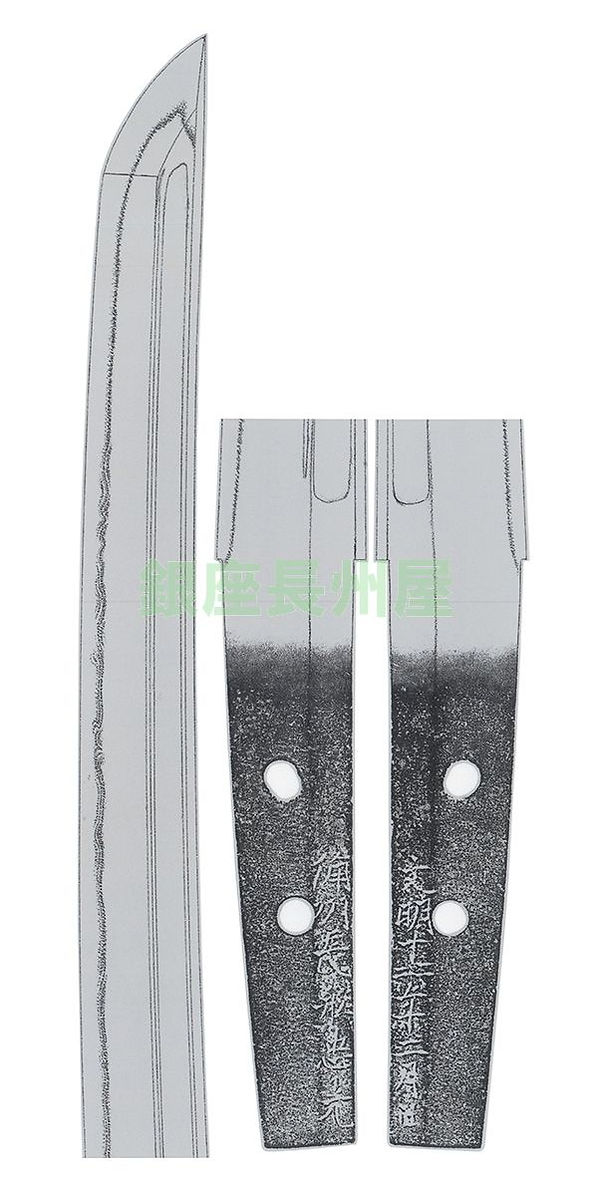
A katana dated Entoku 2 records that Bishū Osafune Hikobei Tadamitsu forged it on assignment at Iioka-gō in Mimasaka, and the published sources take it as clear evidence of the smith whom they rank highest among the many who signed this name. The Meikan places a first Tadamitsu in the Shōō era and counts eight generations down to Eiroku and Tenshō. The earliest work the NBTHK has examined is a Jūyō blade dated Jōji 3. The famous Tadamitsu, however, belongs to the late Muromachi, to the Osafune forges called Sue-Bizen, where he stands with Katsumitsu and Munemitsu among the representative smiths. Smiths of the name sign with several common names, Hikobei no Jō, Shuri no Suke, Kurozaemon and Heiemon no Jō among them, and of these the published sources hold Hikobei no Jō, active in Bunmei, Entoku and Meiō, to be the most skilled.
His reputation rests on suguha. One commentary calls him "the master of suguha among the Sue-Bizen smiths"[[c:1]], another says that "within Sue-Bizen as a whole he is established as skilled in suguha"[[c:2]]. On a typical katana without a personal name, which they read as Hikobei's work, they write that "the jigane is exceptionally clean, and the chū-suguha is well made"[[c:3]]. The jigane is a tight ko-itame with fine ji-nie and chikei, and on a Chōkyō 2 wakizashi the commentary calls it extremely good. Over it he tempers a chū-suguha or hiro-suguha with a bright, tight nioiguchi, ko-nie, small ashi and yō, with a little kinsuji and sunagashi. The bōshi runs straight to a ko-maru. A Meiō-dated katana in hiro-suguha with ko-ashi and yō is called typical and smart in every respect, its ji and ha very healthy.
He worked the Bizen midareba as well. The published sources write that although many of his good works are in suguha, "when he tempers a midareba he is no less skilled than Katsumitsu and Munemitsu"[[c:4]]. On a katana of high curvature they note that "the original Bizen midareba is also his forte"[[c:5]]. There the itame carries a midare-utsuri and the temper is an open-waisted gunome deep in nie, with a bright nioiguchi. Elsewhere the gunome is mixed with chōji and small gunome, ashi and yō entering freely. One katana in the Sengoku shape is judged close in feeling to Oei-Bizen.
His blades are the field swords of the age. A katana under two shaku, with strong sakizori and a tang short for the blade, is explained as a form made "entirely to suit the one-handed draw-cut"[[c:6]]. On both faces the Sue-Bizen devotional carvings appear, a grass kurikara, bonji and the deity name Hachiman Daibosatsu. The published sources take these as "the work of a specialist carver attached to the Osafune group"[[c:7]]. One katana is inscribed with its price, dai senbiki, and the commentary works it out as two hundred and fifty thousand coins, noting that "a thousand hiki was a considerable price for the time"[[c:8]]. A naginata-naoshi carries a gold-inlaid cutting-test inscription by Yamano Nagahisa.
Spears and joint works complete the record. The published sources observe that fine spears of the Kotō period are few, and that "among Bizen work comparatively good pieces are seen from Norimitsu and Tadamitsu"[[c:9]]; several of his yari and ōmi-yari are designated. A katana signed jointly by Hikobei and Hikosaburō is called "a typical and representative work of Sue-Bizen"[[c:10]]. Another, made with Kurozaemon, is noted because "a joint work by two smiths both signing Tadamitsu is of interest"[[c:11]]. Three signed tanto dated Bunmei 10, Bunmei 12 and Meiō 8 are recorded in Honma's inventory of the Imperial collection: a narrow suguha on a takenoko-zori tanto with a maru-mune, a short moroha-zukuri in gunome, and a thick tanto in gunome-midare with a grass kurikara. Honma holds the three to be by one hand, "skilled in both suguha and midare"[[c:12]]. He adds that the two-edged form belongs to the mid-Muromachi and later and "is especially common in Sue-Bizen"[[c:13]].
For the collector, Tadamitsu is graded Jō-jō saku by Fujishiro. His record holds twenty-two blades at Jūyō, katana, wakizashi, tanto and spears, with a Jūyō Bijutsuhin katana of Entoku 3 certified in 1948 to Ide Tokuichi; nearly all are signed and many dated. Recorded provenance is slight, though one Chōkyō 2 katana names its orderer, Watanabe Shinzaemon. Of the Sue-Bizen names his is among those met more often, and a dated Hikobei Tadamitsu in his clean suguha is a realistic though not common encounter for a collector of late Bizen.
 NihontoWatch