War at home and trade abroad made Muromachi Bizen the busiest forge region in Japan: a century of Sengoku demand after the Ōnin War, and export missions to Ming China carrying blades by the tens of thousands.
 NihontoWatchNihontoWatch
備前国長舩忠光は、備前、播磨、美作の守護大名赤松氏に仕えた右京亮勝光や左京進宗光、また彦兵衛尉、与三左衛門尉を輩出した祐定と技を競い、武将の需に応えて槌をふるった。わけても、文明、長享頃を活躍期とする彦兵衛尉の名は、忠光家の棟梁として備前刀史に深く刻まれている。
NihontoWatchOffered by Choshuya
This piece has sold
Get an email when a new Osafune Tadamitsu piece hits the market.
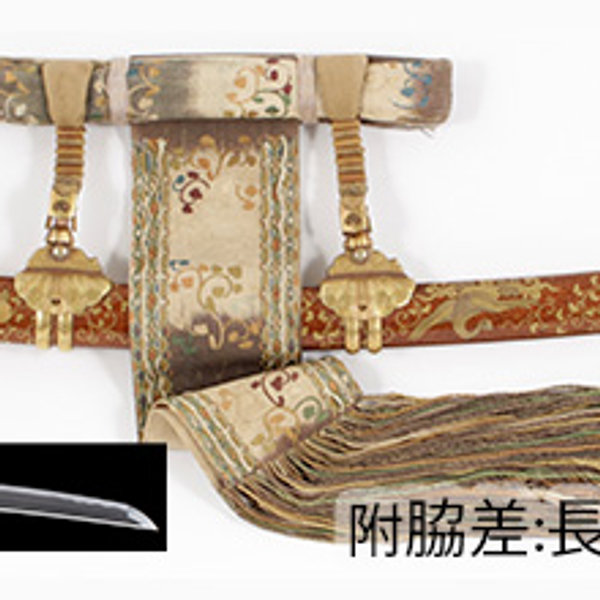
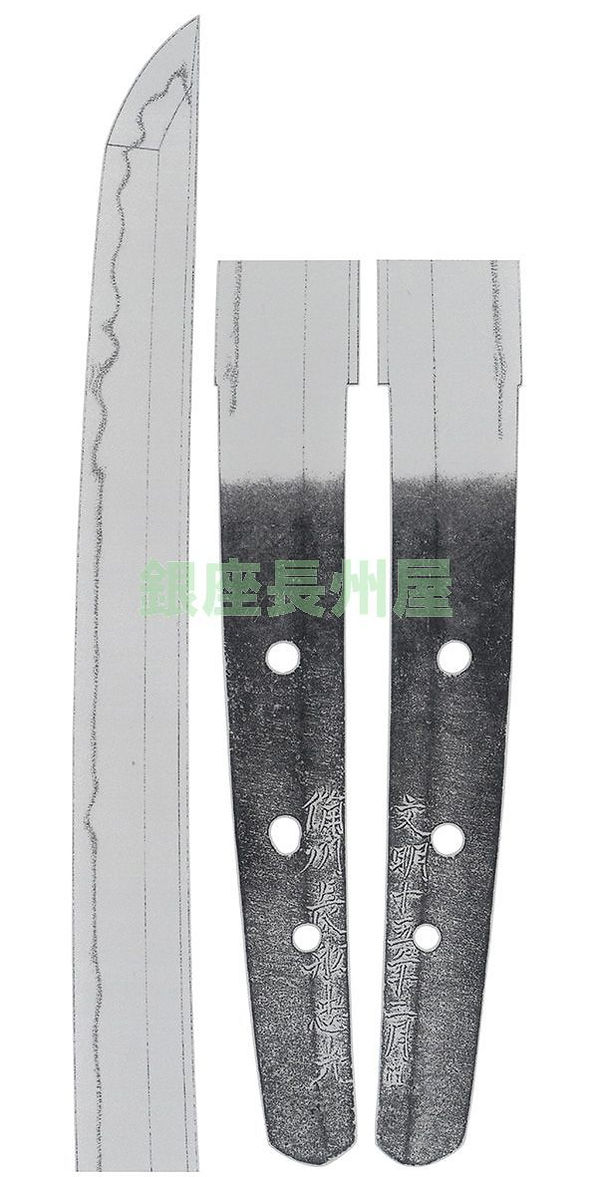
As written by the shop
Osafune (Sue-Bizen), Bizen · Bizen · around 1469-1521
Fujishiro Jo-jo saku · Tōken Taikan top 17%
A katana dated Entoku 2 records that Bishū Osafune Hikobei Tadamitsu forged it on assignment at Iioka-gō in Mimasaka, and the published sources take it as clear evidence of the smith whom they rank highest among the many who signed this name. The Meikan places a first Tadamitsu in the Shōō era and counts eight generations down to Eiroku and Tenshō. The earliest work the NBTHK has examined is a Jūyō blade dated Jōji 3. The famous Tadamitsu, however, belongs to the late Muromachi, to the Osafune forges called Sue-Bizen, where he stands with Katsumitsu and Munemitsu among the representative smiths. Smiths of the name sign with several common names, Hikobei no Jō, Shuri no Suke, Kurozaemon and Heiemon no Jō among them, and of these the published sources hold Hikobei no Jō, active in Bunmei, Entoku and Meiō, to be the most skilled.
His reputation rests on suguha. One commentary calls him "the master of suguha among the Sue-Bizen smiths"[[c:1]], another says that "within Sue-Bizen as a whole he is established as skilled in suguha"[[c:2]]. On a typical katana without a personal name, which they read as Hikobei's work, they write that "the jigane is exceptionally clean, and the chū-suguha is well made"[[c:3]]. The jigane is a tight ko-itame with fine ji-nie and chikei, and on a Chōkyō 2 wakizashi the commentary calls it extremely good. Over it he tempers a chū-suguha or hiro-suguha with a bright, tight nioiguchi, ko-nie, small ashi and yō, with a little kinsuji and sunagashi. The bōshi runs straight to a ko-maru. A Meiō-dated katana in hiro-suguha with ko-ashi and yō is called typical and smart in every respect, its ji and ha very healthy.
He worked the Bizen midareba as well. The published sources write that although many of his good works are in suguha, "when he tempers a midareba he is no less skilled than Katsumitsu and Munemitsu"[[c:4]]. On a katana of high curvature they note that "the original Bizen midareba is also his forte"[[c:5]]. There the itame carries a midare-utsuri and the temper is an open-waisted gunome deep in nie, with a bright nioiguchi. Elsewhere the gunome is mixed with chōji and small gunome, ashi and yō entering freely. One katana in the Sengoku shape is judged close in feeling to Oei-Bizen.
His blades are the field swords of the age. A katana under two shaku, with strong sakizori and a tang short for the blade, is explained as a form made "entirely to suit the one-handed draw-cut"[[c:6]]. On both faces the Sue-Bizen devotional carvings appear, a grass kurikara, bonji and the deity name Hachiman Daibosatsu. The published sources take these as "the work of a specialist carver attached to the Osafune group"[[c:7]]. One katana is inscribed with its price, dai senbiki, and the commentary works it out as two hundred and fifty thousand coins, noting that "a thousand hiki was a considerable price for the time"[[c:8]]. A naginata-naoshi carries a gold-inlaid cutting-test inscription by Yamano Nagahisa.
Spears and joint works complete the record. The published sources observe that fine spears of the Kotō period are few, and that "among Bizen work comparatively good pieces are seen from Norimitsu and Tadamitsu"[[c:9]]; several of his yari and ōmi-yari are designated. A katana signed jointly by Hikobei and Hikosaburō is called "a typical and representative work of Sue-Bizen"[[c:10]]. Another, made with Kurozaemon, is noted because "a joint work by two smiths both signing Tadamitsu is of interest"[[c:11]]. Three signed tanto dated Bunmei 10, Bunmei 12 and Meiō 8 are recorded in Honma's inventory of the Imperial collection: a narrow suguha on a takenoko-zori tanto with a maru-mune, a short moroha-zukuri in gunome, and a thick tanto in gunome-midare with a grass kurikara. Honma holds the three to be by one hand, "skilled in both suguha and midare"[[c:12]]. He adds that the two-edged form belongs to the mid-Muromachi and later and "is especially common in Sue-Bizen"[[c:13]].
For the collector, Tadamitsu is graded Jō-jō saku by Fujishiro. His record holds twenty-two blades at Jūyō, katana, wakizashi, tanto and spears, with a Jūyō Bijutsuhin katana of Entoku 3 certified in 1948 to Ide Tokuichi; nearly all are signed and many dated. Recorded provenance is slight, though one Chōkyō 2 katana names its orderer, Watanabe Shinzaemon. Of the Sue-Bizen names his is among those met more often, and a dated Hikobei Tadamitsu in his clean suguha is a realistic though not common encounter for a collector of late Bizen.
Where Tadamitsu stands among comparable artisans: across all of nihontō, and within tradition, era, and period. The tiers (Foremost · Leading · Major · Notable) weigh official designations from the NBTHK and Japan's Agency for Cultural Affairs, together with historical honors of lasting repute such as the Sansaku and Meibutsu-chō.
Select a lens to see how it's measured.
Years he was demonstrably active, proven by signed-and-dated blades
Bizen-den · Bizen
Phase: Sue-Bizen末備前· 1441–1596
188 pieces on the market now
The last great chapter of Osafune unfolds in the Eisho and Tenbun years of the late Muromachi, when the riverside workshop turned its accumulated craft toward an age of constant war. Where Oei-Bizen had looked backward, reviving the tachi shape and the choji temper of the Kamakura masters under Yasumitsu and Morimitsu, Sue-Bizen faces forward into Sengoku demand. The leading hands carry the same family characters one generation further: the Sukesada group, headed by Yosazaemon-no-jo Sukesada and the Hikobee-jo Sukesada said to be his father, alongside Katsumitsu (often Jirozaemon-no-jo), Munemitsu, Tadamitsu of the Heiroemon-jo line, and the Kiyomitsu smiths Magoemon-no-jo and Gorozaemon-no-jo. The setsumei draw a sharp line through their output. Commissioned blades, chumon-uchi, were signed with full zokumyo, dated, and frequently inscribed with the name of the ordering party, as on the Katsumitsu and Sadamitsu naginata of Meio 8 made for the Miyake of Kojima, a house that fed into the Ukita. Below them ran the bulk trade of kazu-uchimono, the arms that supplied the warring provinces, and it is the chumon-uchi masters that the designations preserve. What the steel does in this window is distinct from every earlier Osafune register. The shape is the uchigatana: wide mihaba with thick kasane, pronounced sakizori, an extended chu-kissaki or o-kissaki, and a short nakago suited to the katate-uchi one-handed draw, a body unlike the koshizori tachi of Ko-Osafune or the broad Nanbokucho profile of Soden-Bizen. The forging tightens into ko-itame over which a midare-utsuri stands faintly rather than vividly, weaker than the bright reflection of the founding generation.
The signature temper is the open-waisted koshi-no-hiraita gunome, splitting at the heads into fukushiki compound midare and mixed with togariba and choji; it is nioi-based with ko-nie and a bright nioiguchi, with ashi, yo, kinsuji and small tobiyaki worked through. Against this, Soden-Bizen had pushed Soshu nie and notare, while the founders had tempered flamboyant choji over a vivid utsuri. Two specialties branch off the gunome base: the Kiyomitsu and Tadamitsu suguha, calm and tightly forged, and the hitatsura of high-tempered pieces with long muneyaki and yubashiri, seen in the warlord-smiths Akamatsu Masanori and Ishikawa Yukihisa. To kantei a Sue-Bizen blade is to read the body first and the temper second. The compact uchigatana sugata with thick kasane and a short tang fixes the late-Muromachi date; the faint utsuri over dense ko-itame keeps it in Bizen; the open-waisted compound gunome names the group. The masters then separate by hand: Katsumitsu is set apart by the abundant choji he folds into the gunome, yielding a more florid, brilliant dekiguchi than his peers; Tadamitsu and the Kiyomitsu smiths are read out by their suguha, with Magoemon-no-jo's itame standing in mokume to distinguish his ground. The cutting reputation is documented directly, as on the Hikobee-jo Sukesada katana of Keicho 5 carrying a tameshi inscription naming the tester Ichihara Hachibee. Provenance threads through the supplementary signatures: Masanori's reward blades cut for his retainers, the Miyake names tying the workshop to the Ukita, and the Shinjuro Sukesada whose few large works may have ended in the Tensho flood. The horimono carried from the mainline, bonji with rendai, Fudo Myoo, and shrine dedications, persist on these blades as a final mark of the line. Learn more →
| Smith | Era | Designated |
|---|---|---|
| Mitsutada光忠 | 1238-1239 | 60 |
| Nagamitsu長光 | 1274-1304 | 254 |
| Kagemitsu景光 | 1303-1336 | 142 |
| Sanenaga眞長 | 1299-1309 | 68 |
| Kanemitsu兼光 | 1323-1370 | 235 |
Bizen in the Muromachi period
War at home and trade abroad made Muromachi Bizen the busiest forge region in Japan: a century of Sengoku demand after the Ōnin War, and export missions to Ming China carrying blades by the tens of thousands.
If, due to our fault, the item differs significantly from its proper condition, the item may be returned. Cooling-off is within one week of the item's arrival.