Sixty years of war between two courts drove blades long and broad, and Osafune met the demand: Kanemitsu and Chōgi led forges serving the provincial warriors who did the fighting, while Sōshū influence arrived with the armies to create Sōden-Bizen.
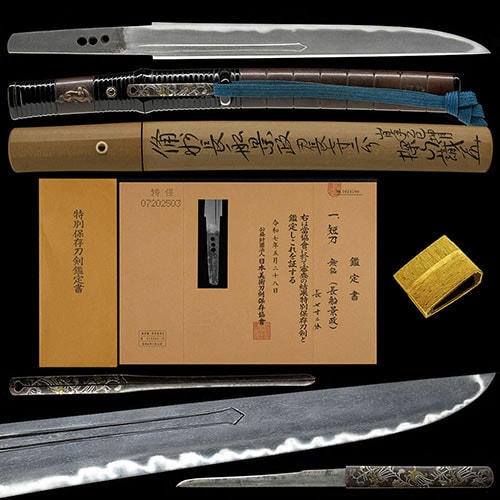
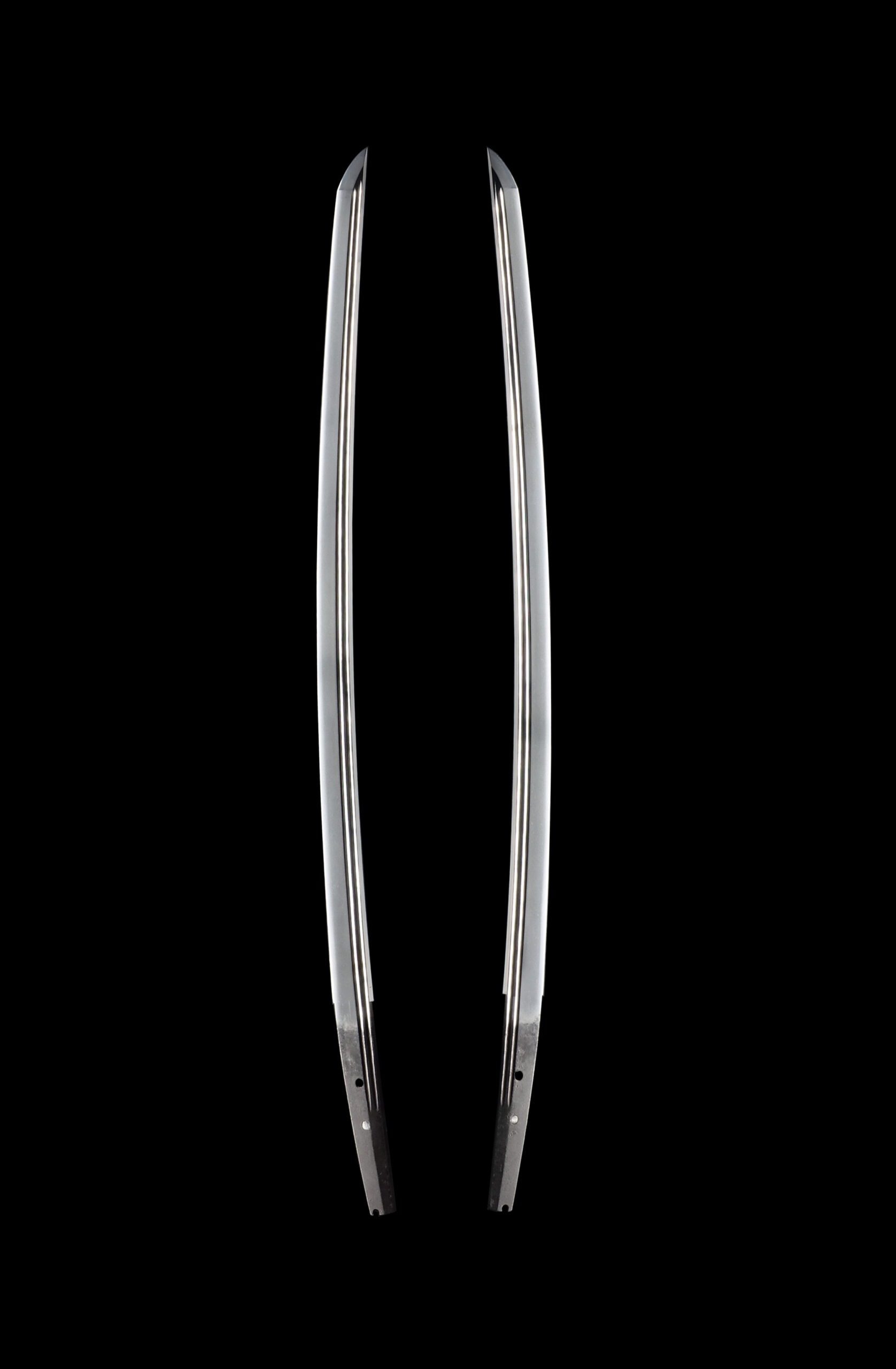
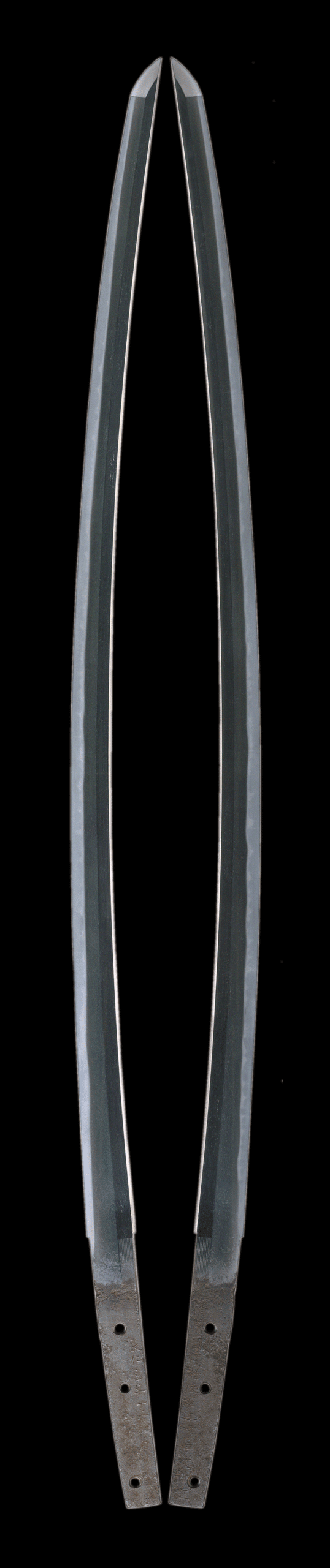
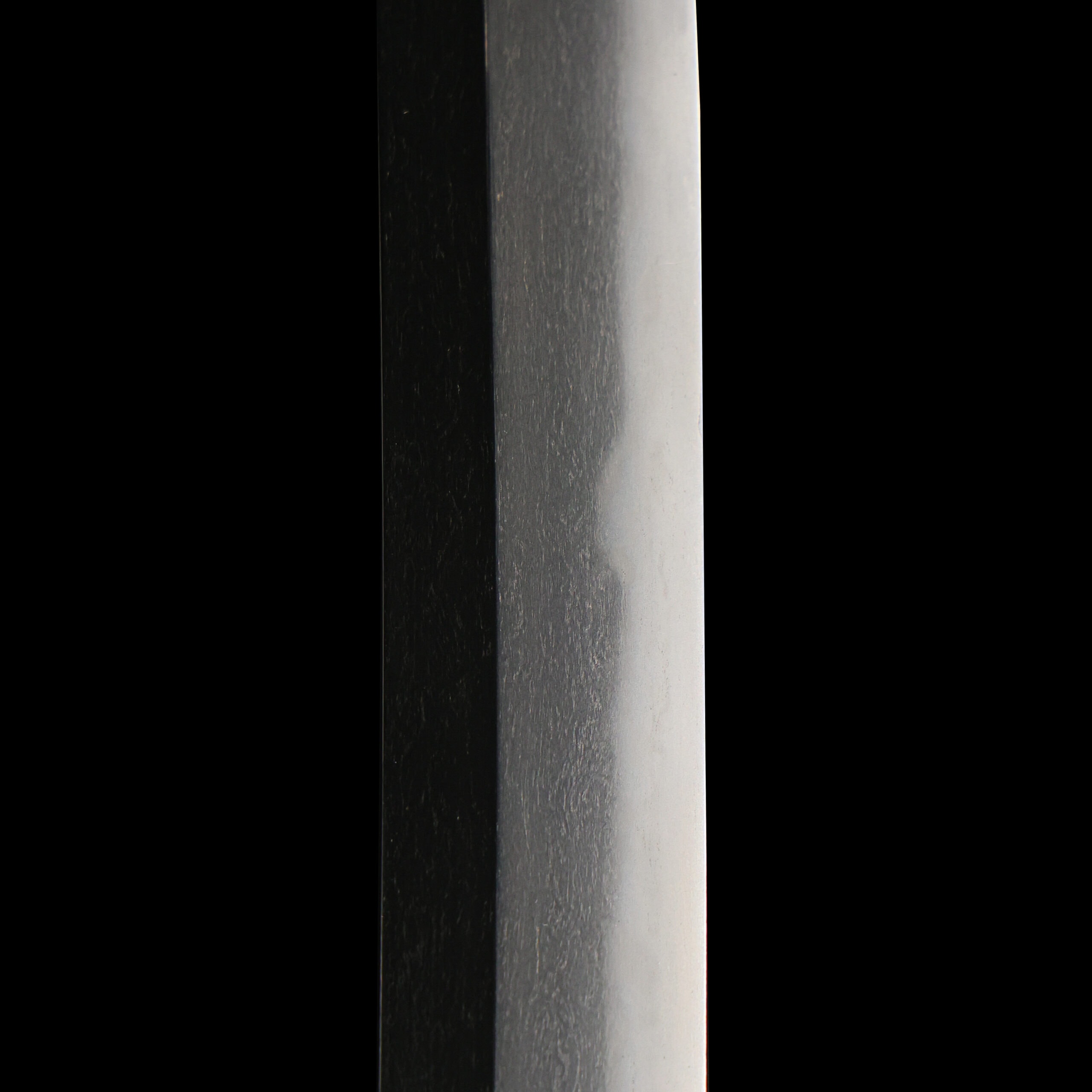
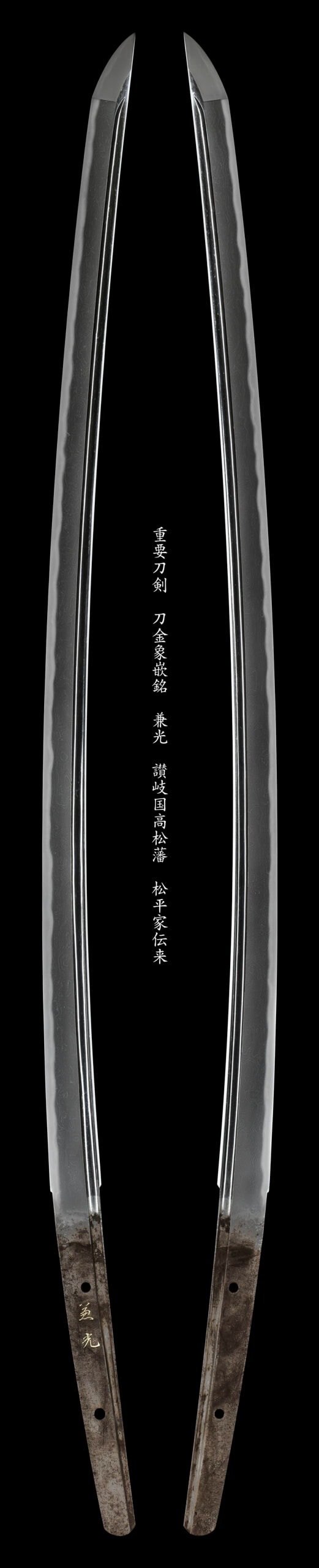
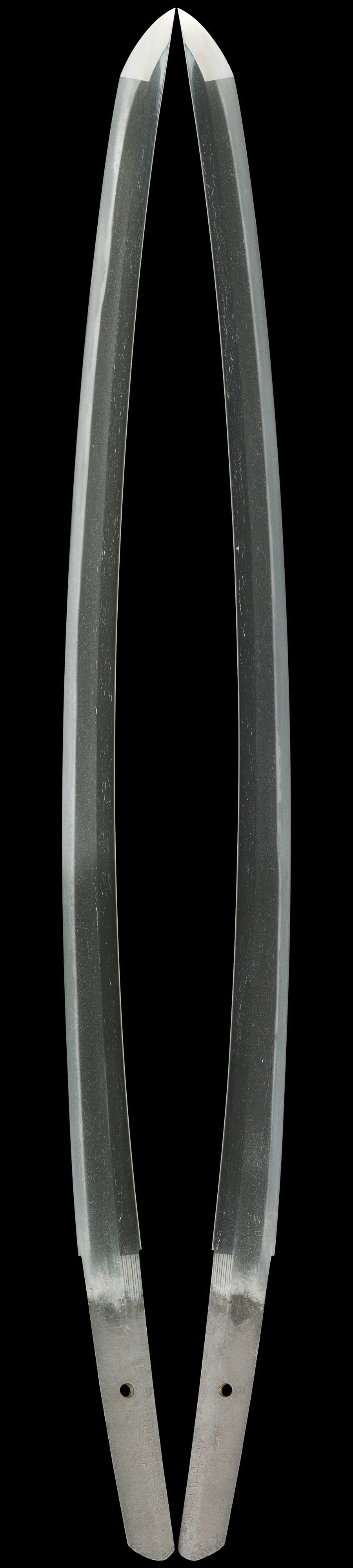
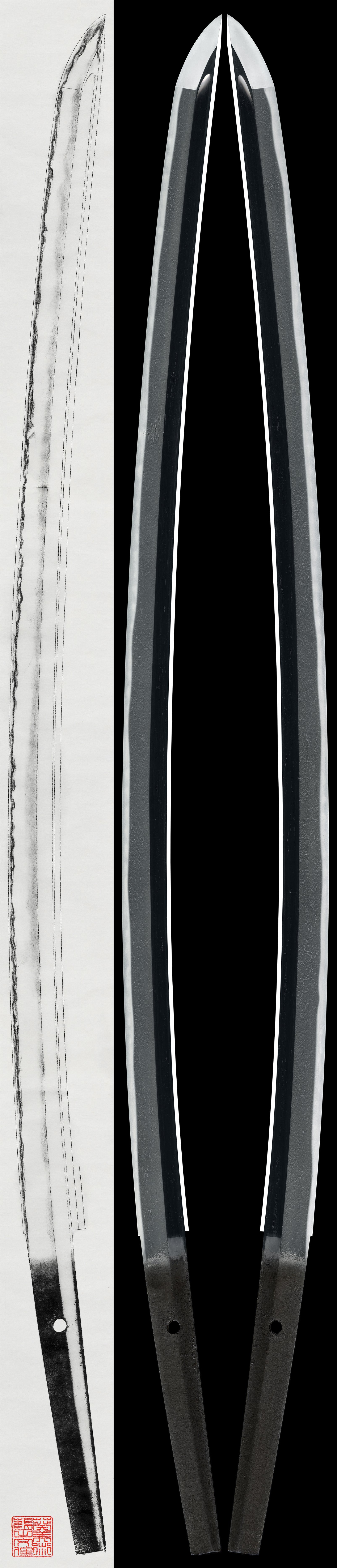
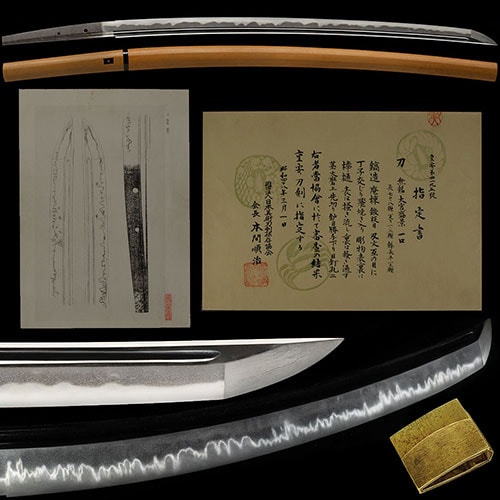
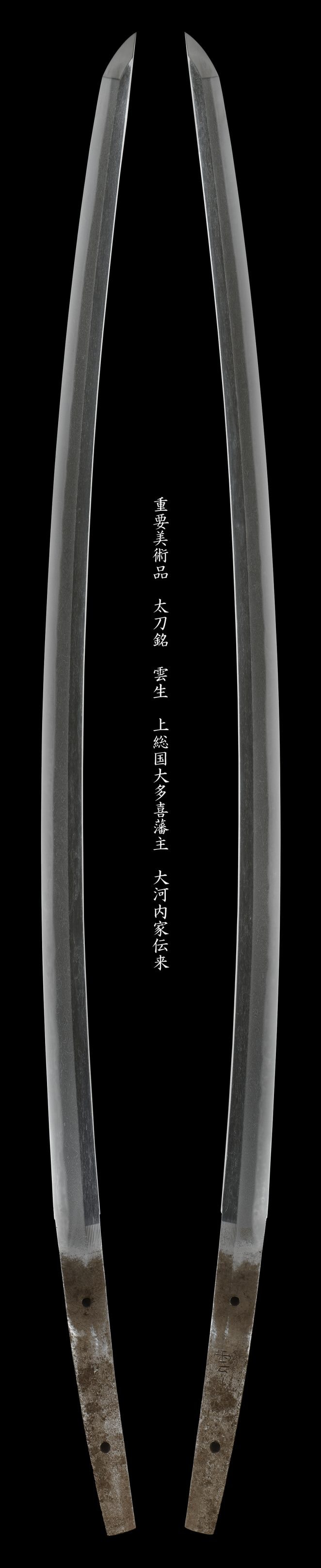
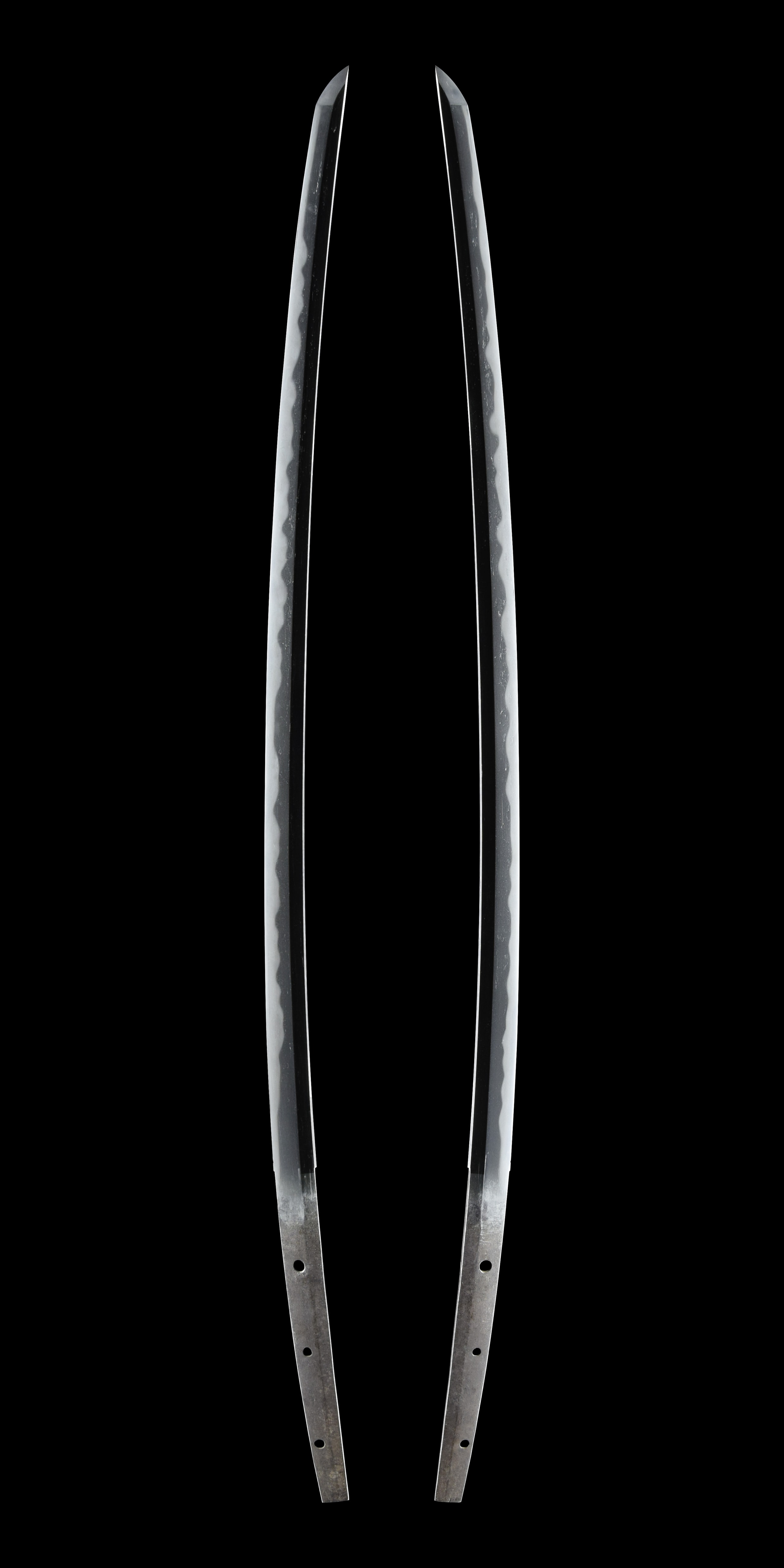
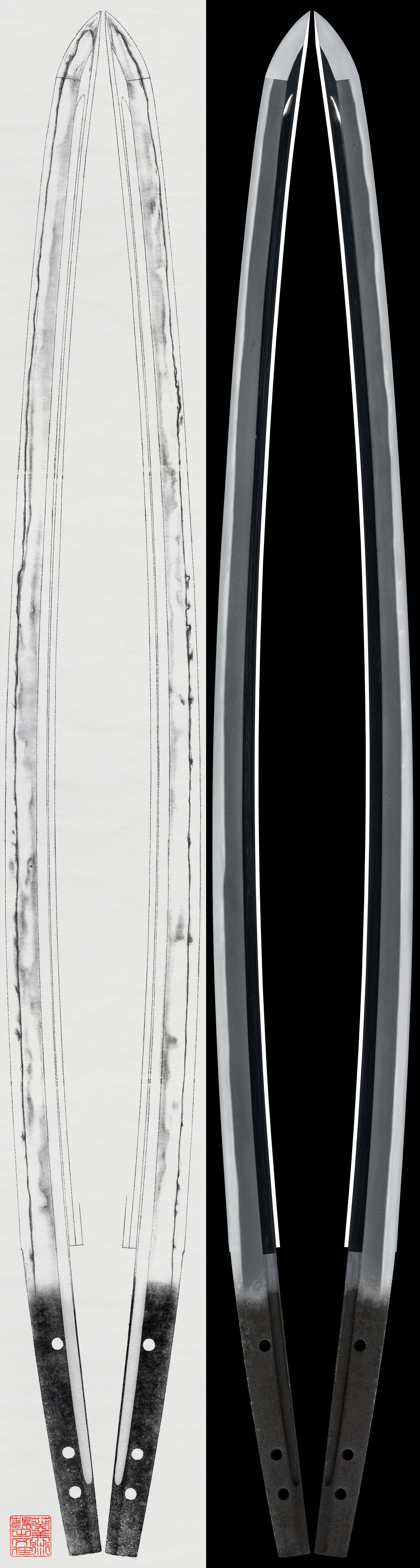
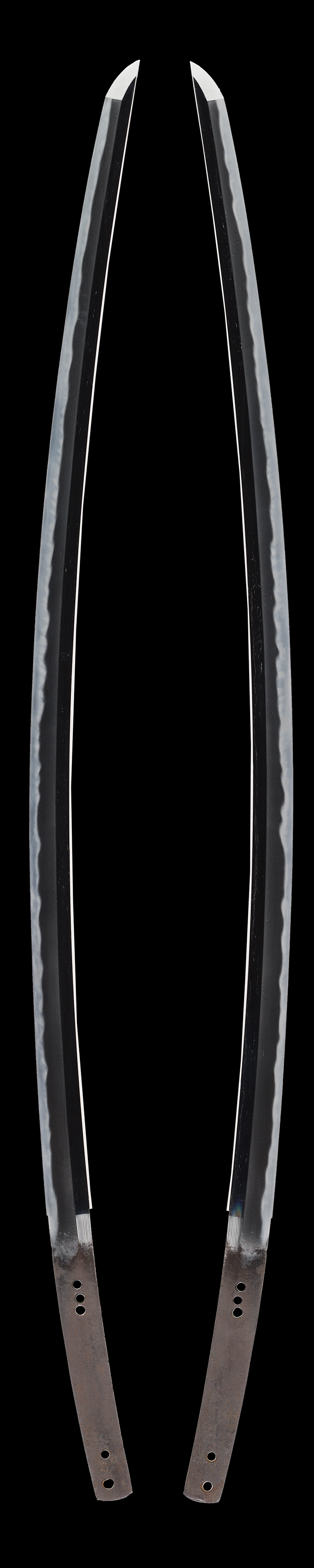
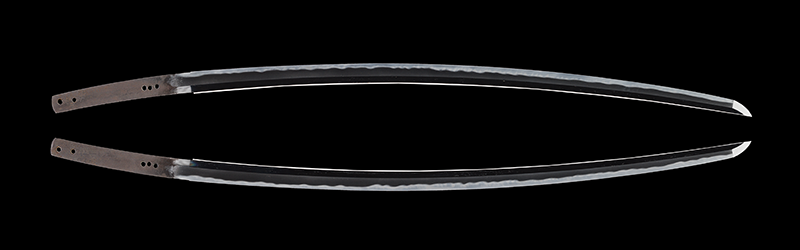
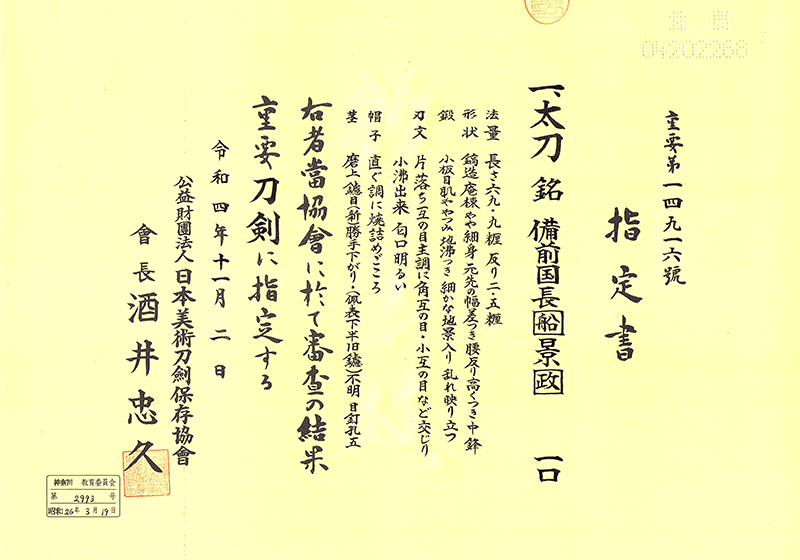
This is a Juyo Token designated Tachi by Kagemasa, an important smith of the Osafune school in Bizen province during the Nanbokucho period. Kagemasa is noted for his skill, with some of his works designated as Imperial Treasures and National Treasures. This blade exhibits a finely forged ko-itame hada with ji-nie, fine chikei, and a bright, clear nioiguchi with katachi-gunome hamon, showing a style similar to Kagemitsu.
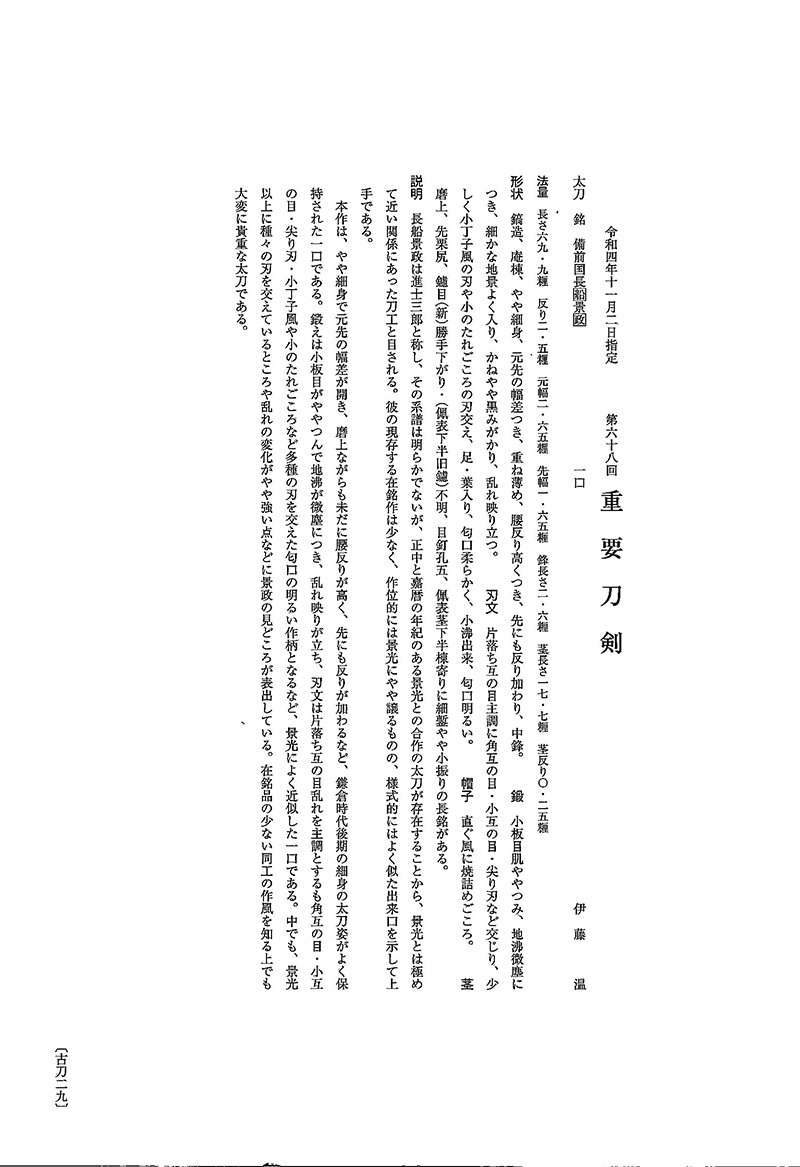
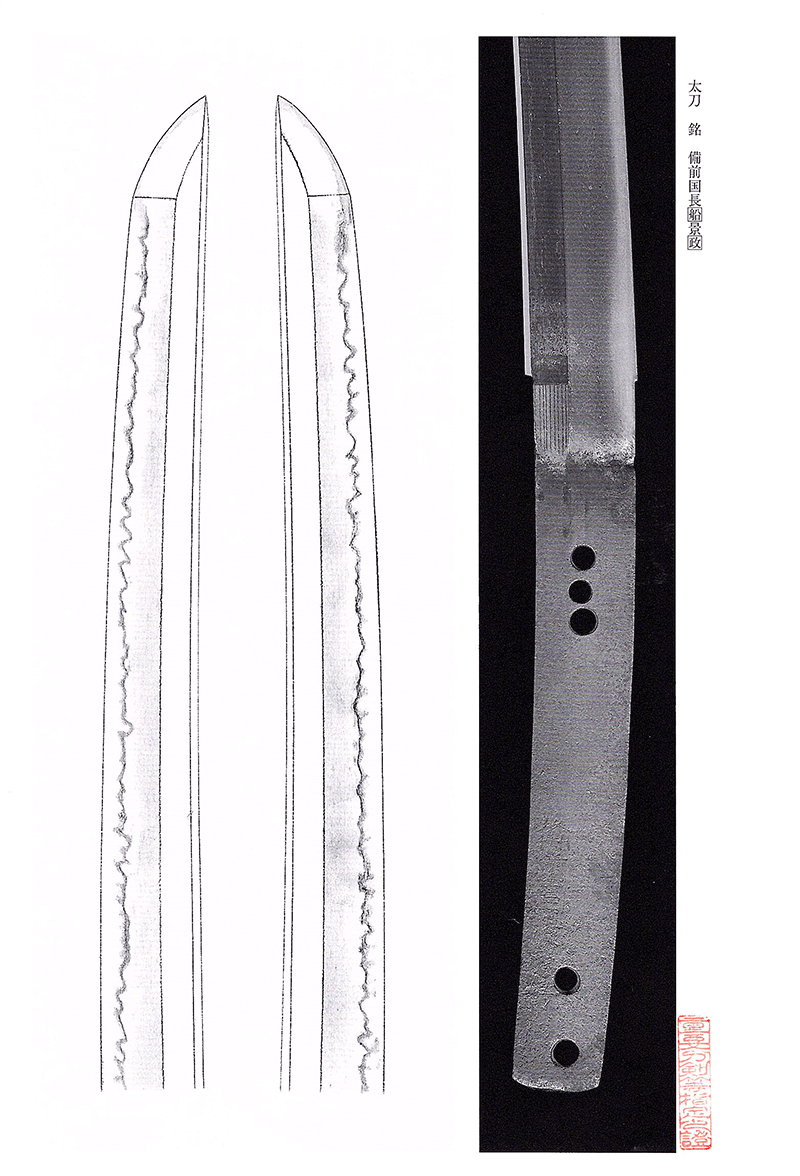
長船景政は進士三郎と称し、その系譜は明らかでないが、正中と嘉暦の年紀のある景光との合作の太刀が存在することから、景光とは極め て近い関係にあった刀工と目される。彼の現存する在銘作は少なく、作位的には景光にやや譲るものの、様式的にはよく似た出来を示して上 手である。 本作は、やや細身で元先の幅差が開き、磨上ながらも未だに腰反りが高く、先にも反りが加わるなど、鎌倉時代後期の細身の太刀姿がよく保 持された一口である。鍛えは小板目がややつんで地沸が微塵につき、乱れ映りが立ち、刃文は片落ち互の目乱れを主調とするも角互の目・小互 の目・尖り刃・小丁子風や小のたれごころなど多種の刃を交えた匂口の明るい作柄となるなど、景光によく近似した一口である。中でも、景光 以上に種々の刃を交えているところや乱れの変化がやや強い点などに景政の見どころが出ている。在銘品の少ない同工の作風を知る上でも 大変に貴重な太刀である。
 NihontoWatch
mei · Osafune · Enbun (1356-1361) ND · nagasa 69.9cm · sori 2.5cm

Osafune (Bizen) · Bizen · around 1317-1327
Fujishiro Jo-jo saku · Tōken Taikan top 8%
2 pieces on the market now
Kagemasa of Osafune, who styled himself Shinshi Saburō, is a mainline Bizen smith of the late Kamakura period whose place in the school is fixed less by his pedigree than by his company. The published sources are candid that his genealogy is not clearly known, telling him variously as Kagemitsu's pupil or his younger brother; what settles the matter is a collaborative tachi he made jointly with Kagemitsu bearing dates of the Shōchū and Karyaku eras, one of them an Imperial gyobutsu and one designated kokuhō. From those joint pieces he is read as a smith who stood in extremely close relation to Kagemitsu, and the surviving dated works run across Bunpō, Shōchū, Karyaku and Kenmu, so that the Jūyō-Bijutsuhin commentary can say plainly that he was "clearly a disciple within the Kagemitsu line"[[c:1]]. His latest date, Ryakuō 3 (1340), carries his hand into the earliest Nanbokuchō generation of Osafune.
His characteristic hand is Kagemitsu's manner brought one half-step short of Kagemitsu's order. Over a finely forged ko-itame he tempers a midare built on angular kaku-gunome and kataochi-style gunome, mixed with ko-gunome, small togariba and a little ko-chōji, the whole inclining in saka-gakari, the reverse-slant of the late Osafune mainline. Ashi and yō enter the ha, fine kinsuji and sunagashi run through it, and the nioiguchi is bright with ko-nie. On the Tokubetsu-Jūyō tachi signed in orikaeshi-mei the published sources gather these features into a single judgment, that "in both ji and ha the distinctive traits of Kagemasa are well expressed"[[c:2]]. The 68th Jūyō tachi sharpens it further, finding his own points of interest precisely where he departs from his model, in that he "mixes an even greater variety of tempering forms than Kagemitsu"[[c:3]] and in "a somewhat stronger degree of variation within the midare, which is where Kagemasa's points of interest emerge"[[c:4]].
The jigane is the proper mainline Osafune steel and the firmest part of his identity. The forging is a closely packed ko-itame, at times mixed with mokume or running a little toward nagare and masame; very fine ji-nie lies on it thickly, fine chikei enter, and over this stands a vivid midare-utsuri, which the sources call the bright, well-refined steel of a "finely wrought forging in the manner of the mainline Osafune"[[c:5]]. The bōshi answers the ha: a midare-komi or notare-komi turning in ko-maru, and on the dated and ubu tachi it takes the sansaku-like form the school shares, so that the cap too "calls Kagemitsu to mind." The steel can tend slightly dark, and the utsuri is the constant that holds across signed and unsigned alike.
The corpus draws two registers and a temporal arc. On tachi the kaku and kataochi-gunome core prevails; on tantō and ken he turns instead to a quiet suguha. The Jūyō-Bijutsuhin tantō of Karyaku 2 (1327) shows an orderly gunome in ko-nie that, set against Kagemitsu, is "larger, opening at the base, mixed with a kataochi tendency"[[c:6]], and carries a sankō-tsuka-ken and gomabashi among its Buddhist carvings; his signed ken runs a narrow hoso-suguha with kinsuji, sunagashi and a nijūba-like yubashiri. Across the period the dated tachi move from Bunpō through Ryakuō 3, the latest reaching the first Nanbokuchō years, and the published sources read a deliberate restraint into them: on more than one blade the ha "shows a slight kozumi-gokoro, a subtly subdued tendency, and this too marks a point of interest in Kagemasa"[[c:7]].
His standing in the school is defined against Kagemitsu at every turn, and the comparison is the whole of the connoisseurship. The published sources are consistent that in rank he yields a little to Kagemitsu while in style he stands very close, skillful and faithful; the 4th Tokubetsu-Jūyō tachi, its signature cut away below the character Kage, is judged beyond doubt his because the workmanship "rivals Kagemitsu"[[c:8]]. It is exactly this small shortfall that does the appraising: a mumei blade that reads like Kagemitsu but stops a touch short of his finish is given to Kagemasa, and most of his surviving work is mumei attributed on that reasoning, eleven signed pieces against eleven unsigned in the official record. He worked, the sources note, in the kataochi-gunome and suguha that were Kagemitsu's own specialties, which is why the two are so hard to part and why his bright midare-utsuri and the slightly freer play of his midare are made to carry the distinction.
Fujishiro grades him Jō-jō saku. Twenty designated works stand on the official record, four in the Tokubetsu-Jūyō tier and sixteen Jūyō, with the Jūyō-Bijutsuhin tantō above them; signed examples are so few that each is treated as study material, the published sources valuing one ubu, single-mekugi-ana tachi dated Ryakuō 3 as "excellent material for research on this smith" and his rare signed ken as a piece prized "for understanding the workmanship of a smith whose signed pieces are scarce"[[c:9]], one "filled with archaic grace and refined dignity"[[c:10]]. Provenance is recorded against three of his blades, among them the tantō once held by Ide Hiroshi of Tokyo and a tachi transmitted in the Sakai family of Wakasa; one signed tachi is now in the Hakutsuru Museum, the rest held in private hands of recorded whereabouts. A Kagemasa is not beyond a collector's reach as the most exalted Osafune names are, his blades sitting in the Tokubetsu-Jūyō and Jūyō tiers rather than held in perpetuity in the museum and shrine collections that hold the school's highest designations; but with so small a signed corpus and so few coming to market, an example appears only from time to time, and a signed, dated, ubu tachi is a landmark when it does.
Where Kagemasa stands among comparable artisans: across all of nihontō, and within tradition, era, and period. The tiers (Foremost · Leading · Major · Notable) weigh official designations from the NBTHK and Japan's Agency for Cultural Affairs, together with historical honors of lasting repute such as the Sansaku and Meibutsu-chō.
Select a lens to see how it's measured.
Years he was demonstrably active, proven by signed-and-dated blades
Bizen-den · Bizen
Phase: Ko-Osafune古長船· 1238–1335
235 pieces on the market now
Three smiths working at the village of Osafune across the second half of the thirteenth century set the terms for every Bizen blade that followed: Mitsutada the founder, his son Nagamitsu, and the closely related Sanenaga, the Sansaku triumvirate whose work opens this phase. Their window runs from the mid-Kamakura period into the early fourteenth century, when leadership passed to Nagamitsu's son Kagemitsu, the third-generation head whose dated tachi, naginata, and tanto carry the phase to its close around the Kenmu years. The setsumei repeatedly fix Kagemitsu by genealogy and date, citing pieces inscribed from Gen'o 1 (1319) and Genko 1 (1321) through Shochu and Kenmu (1325 to 1334); these ubu or lightly shortened, date-bearing blades are what give the founding chapter its firm chronological spine and separate it from the workshop-broad output of the later Nanbokucho and Oei generations. This is the orthodox mainline before the school fanned out: the generation that built the standard, not the ones that later reinterpreted it. The constructional signature of the phase is a tightly packed ko-itame, at times mixed with mokume, carrying fine ji-nie in dense particles, fine chikei, and a vivid midare-utsuri that the examiners single out again and again; one Kagemitsu tachi even pushes the utsuri toward a striped, Aoe-like dan-utsuri with reverse-slanting dark bands. Against the Ko-Bizen root, with its standing jifu-utsuri and thicker ha-nie, this phase reads as more refined and more tightly controlled in the ji. The temper marks the phase's internal turn.
Where Nagamitsu and Mitsutada favored flamboyant choji-midare, Kagemitsu pulls the hand inward to a suguha-based temper carrying ko-gunome, ko-choji, and angular elements, often with a reverse (saka-gakari) tendency, in a nioi-dominant, bright nioiguchi; the setsumei credit him specifically with perfecting kata-ochi gunome, the dropped-shoulder pattern repeatedly named as his completion. The boshi is the gentle sansaku-boshi, a shallow midare-komi or notare turning back in ko-maru. None of this is the powerful nie, scattered tobiyaki, and Soshu-den drama of the later Soden-Bizen, nor the open gunome and pointed candlewick boshi of the Oei revival; it is calmer, nioi-bound, and date-anchored. A collector separates this phase by its named masters and the kantei points the setsumei make explicit: kata-ochi gunome and the sansaku-boshi read Kagemitsu, while reverse-slanting jihan-utsuri and certain boshi forms let the examiners assign proxy daimei hands such as Chikakage and the collaborator Kagemasa, the latter named in a Shochu 2 (1325) joint tachi dedicated to Chichibu Shrine. Tanto are a discriminator in their own right, surviving in number for Kagemitsu where they are scarce for Nagamitsu, including the kanmuri-otoshi and hira-zukuri pieces with devotional bonji and kurikara carvings. Provenance present in the sample carries weight: a Kagemitsu tachi transmitted in the Chikuzen Kuroda family with its old scabbard, an orikaeshi-mei katana recorded in the Shimazu line, and tanto and tachi held in the Imperial collection where Kagemitsu is ranked beside Yoshimitsu, Shintogo Kunishige, and Samonji. These are the works that define the founding core against everything Osafune later became. Learn more →
| Smith | Era | Designated |
|---|---|---|
| Mitsutada光忠 | 1238-1239 | 60 |
| Nagamitsu長光 | 1274-1304 | 244 |
| Kagemitsu景光 | 1303-1336 | 143 |
| Kanemitsu兼光 | 1323-1370 | 231 |
| Sanenaga眞長 | 1299-1309 | 64 |
Bizen in the Nanbokuchō period
Sixty years of war between two courts drove blades long and broad, and Osafune met the demand: Kanemitsu and Chōgi led forges serving the provincial warriors who did the fighting, while Sōshū influence arrived with the armies to create Sōden-Bizen.
A blade of top-grade workmanship and condition, formally judged to rank with a nationally recognized Important Art Object (Jūyō Bijutsuhin). Awarded only at the NBTHK’s competitive annual examination.
Of Japan’s roughly 2.5 million registered swords, only 12,307 (about 1 in 203) have ever attained Jūyō.
The NBTHK (Nihon Bijutsu Tōken Hozon Kyōkai, the Society for the Preservation of Japanese Art Swords) is a public-interest incorporated foundation founded in 1948 and supervised by Japan’s Agency for Cultural Affairs (Bunkachō); it is based at the Japanese Sword Museum in Tokyo. Its expert panels physically examine each submitted work (shinsa) and issue a certificate (kanteishō) ranking it by artistic and historical merit. NBTHK papers are the most widely recognized standard of authentication for Japanese swords and fittings.
NBTHK official siteCustomer-initiated returns accepted within two days of arrival; return shipping paid by customer and fees non-refundable. Returns/refunds unavailable for overseas deliveries.

¥16,500,000
This is a Juyo Token designated Tachi by Kagemasa, an important smith of the Osafune school in Bizen province during the Nanbokucho period. Kagemasa is noted for his skill, with some of his works designated as Imperial Treasures and National Treasures. This blade exhibits a finely forged ko-itame hada with ji-nie, fine chikei, and a bright, clear nioiguchi with katachi-gunome hamon, showing a style similar to Kagemitsu.
長船景政は進士三郎と称し、その系譜は明らかでないが、正中と嘉暦の年紀のある景光との合作の太刀が存在することから、景光とは極め て近い関係にあった刀工と目される。彼の現存する在銘作は少なく、作位的には景光にやや譲るものの、様式的にはよく似た出来を示して上 手である。 本作は、やや細身で元先の幅差が開き、磨上ながらも未だに腰反りが高く、先にも反りが加わるなど、鎌倉時代後期の細身の太刀姿がよく保 持された一口である。鍛えは小板目がややつんで地沸が微塵につき、乱れ映りが立ち、刃文は片落ち互の目乱れを主調とするも角互の目・小互 の目・尖り刃・小丁子風や小のたれごころなど多種の刃を交えた匂口の明るい作柄となるなど、景光によく近似した一口である。中でも、景光 以上に種々の刃を交えているところや乱れの変化がやや強い点などに景政の見どころが出ている。在銘品の少ない同工の作風を知る上でも 大変に貴重な太刀である。
NihontoWatchmei · Osafune · Enbun (1356-1361) ND · nagasa 69.9cm · sori 2.5cm
Osafune (Bizen) · Bizen · around 1317-1327
Fujishiro Jo-jo saku · Tōken Taikan top 8%
2 pieces on the market now
Kagemasa of Osafune, who styled himself Shinshi Saburō, is a mainline Bizen smith of the late Kamakura period whose place in the school is fixed less by his pedigree than by his company. The published sources are candid that his genealogy is not clearly known, telling him variously as Kagemitsu's pupil or his younger brother; what settles the matter is a collaborative tachi he made jointly with Kagemitsu bearing dates of the Shōchū and Karyaku eras, one of them an Imperial gyobutsu and one designated kokuhō. From those joint pieces he is read as a smith who stood in extremely close relation to Kagemitsu, and the surviving dated works run across Bunpō, Shōchū, Karyaku and Kenmu, so that the Jūyō-Bijutsuhin commentary can say plainly that he was "clearly a disciple within the Kagemitsu line"[[c:1]]. His latest date, Ryakuō 3 (1340), carries his hand into the earliest Nanbokuchō generation of Osafune.
His characteristic hand is Kagemitsu's manner brought one half-step short of Kagemitsu's order. Over a finely forged ko-itame he tempers a midare built on angular kaku-gunome and kataochi-style gunome, mixed with ko-gunome, small togariba and a little ko-chōji, the whole inclining in saka-gakari, the reverse-slant of the late Osafune mainline. Ashi and yō enter the ha, fine kinsuji and sunagashi run through it, and the nioiguchi is bright with ko-nie. On the Tokubetsu-Jūyō tachi signed in orikaeshi-mei the published sources gather these features into a single judgment, that "in both ji and ha the distinctive traits of Kagemasa are well expressed"[[c:2]]. The 68th Jūyō tachi sharpens it further, finding his own points of interest precisely where he departs from his model, in that he "mixes an even greater variety of tempering forms than Kagemitsu"[[c:3]] and in "a somewhat stronger degree of variation within the midare, which is where Kagemasa's points of interest emerge"[[c:4]].
The jigane is the proper mainline Osafune steel and the firmest part of his identity. The forging is a closely packed ko-itame, at times mixed with mokume or running a little toward nagare and masame; very fine ji-nie lies on it thickly, fine chikei enter, and over this stands a vivid midare-utsuri, which the sources call the bright, well-refined steel of a "finely wrought forging in the manner of the mainline Osafune"[[c:5]]. The bōshi answers the ha: a midare-komi or notare-komi turning in ko-maru, and on the dated and ubu tachi it takes the sansaku-like form the school shares, so that the cap too "calls Kagemitsu to mind." The steel can tend slightly dark, and the utsuri is the constant that holds across signed and unsigned alike.
The corpus draws two registers and a temporal arc. On tachi the kaku and kataochi-gunome core prevails; on tantō and ken he turns instead to a quiet suguha. The Jūyō-Bijutsuhin tantō of Karyaku 2 (1327) shows an orderly gunome in ko-nie that, set against Kagemitsu, is "larger, opening at the base, mixed with a kataochi tendency"[[c:6]], and carries a sankō-tsuka-ken and gomabashi among its Buddhist carvings; his signed ken runs a narrow hoso-suguha with kinsuji, sunagashi and a nijūba-like yubashiri. Across the period the dated tachi move from Bunpō through Ryakuō 3, the latest reaching the first Nanbokuchō years, and the published sources read a deliberate restraint into them: on more than one blade the ha "shows a slight kozumi-gokoro, a subtly subdued tendency, and this too marks a point of interest in Kagemasa"[[c:7]].
His standing in the school is defined against Kagemitsu at every turn, and the comparison is the whole of the connoisseurship. The published sources are consistent that in rank he yields a little to Kagemitsu while in style he stands very close, skillful and faithful; the 4th Tokubetsu-Jūyō tachi, its signature cut away below the character Kage, is judged beyond doubt his because the workmanship "rivals Kagemitsu"[[c:8]]. It is exactly this small shortfall that does the appraising: a mumei blade that reads like Kagemitsu but stops a touch short of his finish is given to Kagemasa, and most of his surviving work is mumei attributed on that reasoning, eleven signed pieces against eleven unsigned in the official record. He worked, the sources note, in the kataochi-gunome and suguha that were Kagemitsu's own specialties, which is why the two are so hard to part and why his bright midare-utsuri and the slightly freer play of his midare are made to carry the distinction.
Fujishiro grades him Jō-jō saku. Twenty designated works stand on the official record, four in the Tokubetsu-Jūyō tier and sixteen Jūyō, with the Jūyō-Bijutsuhin tantō above them; signed examples are so few that each is treated as study material, the published sources valuing one ubu, single-mekugi-ana tachi dated Ryakuō 3 as "excellent material for research on this smith" and his rare signed ken as a piece prized "for understanding the workmanship of a smith whose signed pieces are scarce"[[c:9]], one "filled with archaic grace and refined dignity"[[c:10]]. Provenance is recorded against three of his blades, among them the tantō once held by Ide Hiroshi of Tokyo and a tachi transmitted in the Sakai family of Wakasa; one signed tachi is now in the Hakutsuru Museum, the rest held in private hands of recorded whereabouts. A Kagemasa is not beyond a collector's reach as the most exalted Osafune names are, his blades sitting in the Tokubetsu-Jūyō and Jūyō tiers rather than held in perpetuity in the museum and shrine collections that hold the school's highest designations; but with so small a signed corpus and so few coming to market, an example appears only from time to time, and a signed, dated, ubu tachi is a landmark when it does.
Where Kagemasa stands among comparable artisans: across all of nihontō, and within tradition, era, and period. The tiers (Foremost · Leading · Major · Notable) weigh official designations from the NBTHK and Japan's Agency for Cultural Affairs, together with historical honors of lasting repute such as the Sansaku and Meibutsu-chō.
Select a lens to see how it's measured.
Years he was demonstrably active, proven by signed-and-dated blades
Bizen-den · Bizen
Phase: Ko-Osafune古長船· 1238–1335
235 pieces on the market now
Three smiths working at the village of Osafune across the second half of the thirteenth century set the terms for every Bizen blade that followed: Mitsutada the founder, his son Nagamitsu, and the closely related Sanenaga, the Sansaku triumvirate whose work opens this phase. Their window runs from the mid-Kamakura period into the early fourteenth century, when leadership passed to Nagamitsu's son Kagemitsu, the third-generation head whose dated tachi, naginata, and tanto carry the phase to its close around the Kenmu years. The setsumei repeatedly fix Kagemitsu by genealogy and date, citing pieces inscribed from Gen'o 1 (1319) and Genko 1 (1321) through Shochu and Kenmu (1325 to 1334); these ubu or lightly shortened, date-bearing blades are what give the founding chapter its firm chronological spine and separate it from the workshop-broad output of the later Nanbokucho and Oei generations. This is the orthodox mainline before the school fanned out: the generation that built the standard, not the ones that later reinterpreted it. The constructional signature of the phase is a tightly packed ko-itame, at times mixed with mokume, carrying fine ji-nie in dense particles, fine chikei, and a vivid midare-utsuri that the examiners single out again and again; one Kagemitsu tachi even pushes the utsuri toward a striped, Aoe-like dan-utsuri with reverse-slanting dark bands. Against the Ko-Bizen root, with its standing jifu-utsuri and thicker ha-nie, this phase reads as more refined and more tightly controlled in the ji. The temper marks the phase's internal turn.
Where Nagamitsu and Mitsutada favored flamboyant choji-midare, Kagemitsu pulls the hand inward to a suguha-based temper carrying ko-gunome, ko-choji, and angular elements, often with a reverse (saka-gakari) tendency, in a nioi-dominant, bright nioiguchi; the setsumei credit him specifically with perfecting kata-ochi gunome, the dropped-shoulder pattern repeatedly named as his completion. The boshi is the gentle sansaku-boshi, a shallow midare-komi or notare turning back in ko-maru. None of this is the powerful nie, scattered tobiyaki, and Soshu-den drama of the later Soden-Bizen, nor the open gunome and pointed candlewick boshi of the Oei revival; it is calmer, nioi-bound, and date-anchored. A collector separates this phase by its named masters and the kantei points the setsumei make explicit: kata-ochi gunome and the sansaku-boshi read Kagemitsu, while reverse-slanting jihan-utsuri and certain boshi forms let the examiners assign proxy daimei hands such as Chikakage and the collaborator Kagemasa, the latter named in a Shochu 2 (1325) joint tachi dedicated to Chichibu Shrine. Tanto are a discriminator in their own right, surviving in number for Kagemitsu where they are scarce for Nagamitsu, including the kanmuri-otoshi and hira-zukuri pieces with devotional bonji and kurikara carvings. Provenance present in the sample carries weight: a Kagemitsu tachi transmitted in the Chikuzen Kuroda family with its old scabbard, an orikaeshi-mei katana recorded in the Shimazu line, and tanto and tachi held in the Imperial collection where Kagemitsu is ranked beside Yoshimitsu, Shintogo Kunishige, and Samonji. These are the works that define the founding core against everything Osafune later became. Learn more →
| Smith | Era | Designated |
|---|---|---|
| Mitsutada光忠 | 1238-1239 | 60 |
| Nagamitsu長光 | 1274-1304 | 244 |
| Kagemitsu景光 | 1303-1336 | 143 |
| Kanemitsu兼光 | 1323-1370 | 231 |
| Sanenaga眞長 | 1299-1309 | 64 |
Bizen in the Nanbokuchō period
Sixty years of war between two courts drove blades long and broad, and Osafune met the demand: Kanemitsu and Chōgi led forges serving the provincial warriors who did the fighting, while Sōshū influence arrived with the armies to create Sōden-Bizen.
A blade of top-grade workmanship and condition, formally judged to rank with a nationally recognized Important Art Object (Jūyō Bijutsuhin). Awarded only at the NBTHK’s competitive annual examination.
Of Japan’s roughly 2.5 million registered swords, only 12,307 (about 1 in 203) have ever attained Jūyō.
The NBTHK (Nihon Bijutsu Tōken Hozon Kyōkai, the Society for the Preservation of Japanese Art Swords) is a public-interest incorporated foundation founded in 1948 and supervised by Japan’s Agency for Cultural Affairs (Bunkachō); it is based at the Japanese Sword Museum in Tokyo. Its expert panels physically examine each submitted work (shinsa) and issue a certificate (kanteishō) ranking it by artistic and historical merit. NBTHK papers are the most widely recognized standard of authentication for Japanese swords and fittings.
NBTHK official siteCustomer-initiated returns accepted within two days of arrival; return shipping paid by customer and fees non-refundable. Returns/refunds unavailable for overseas deliveries.
¥16,500,000