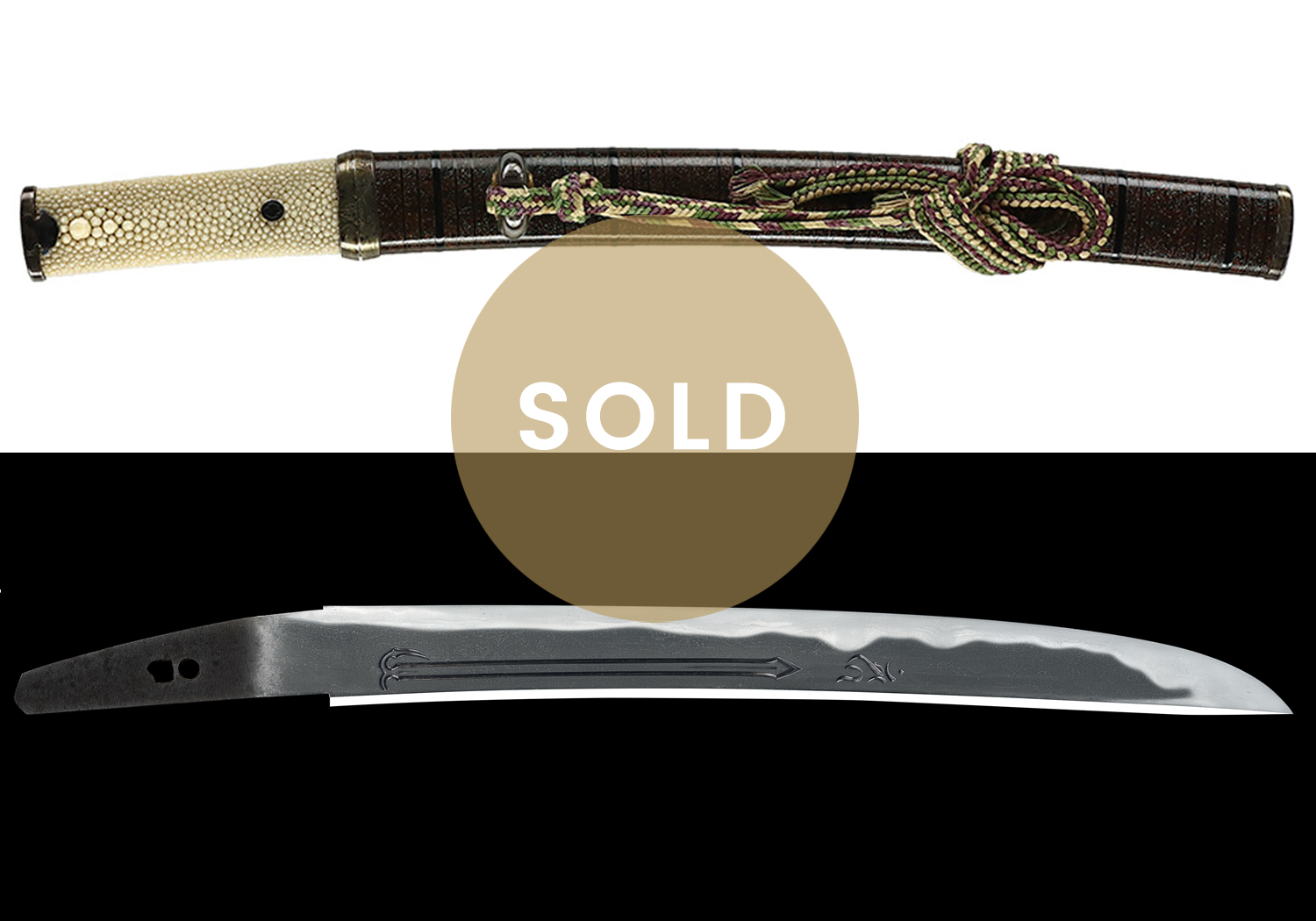
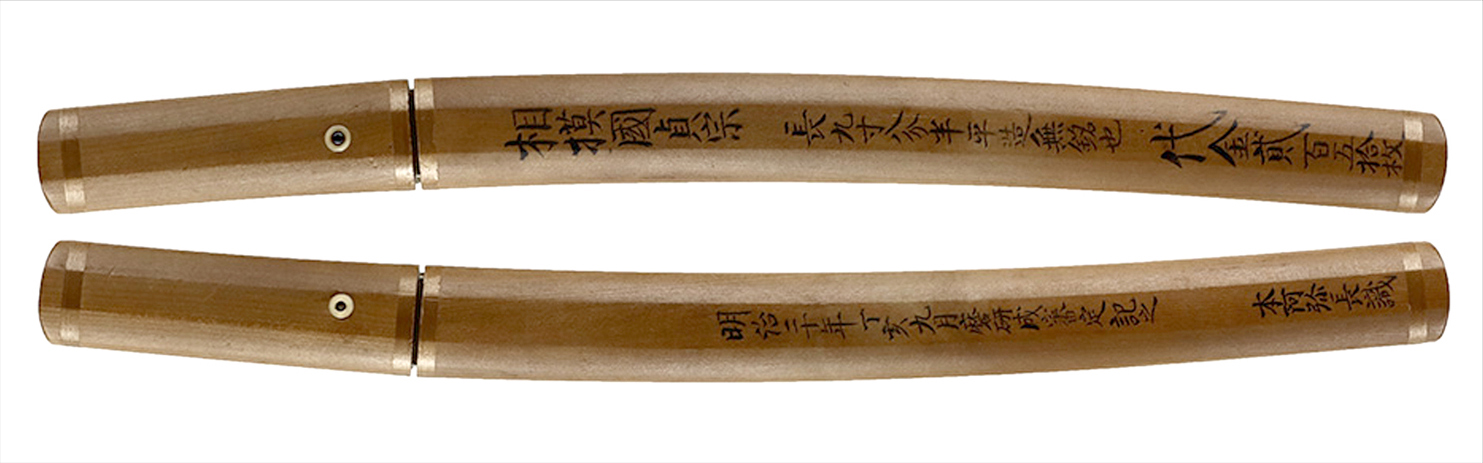
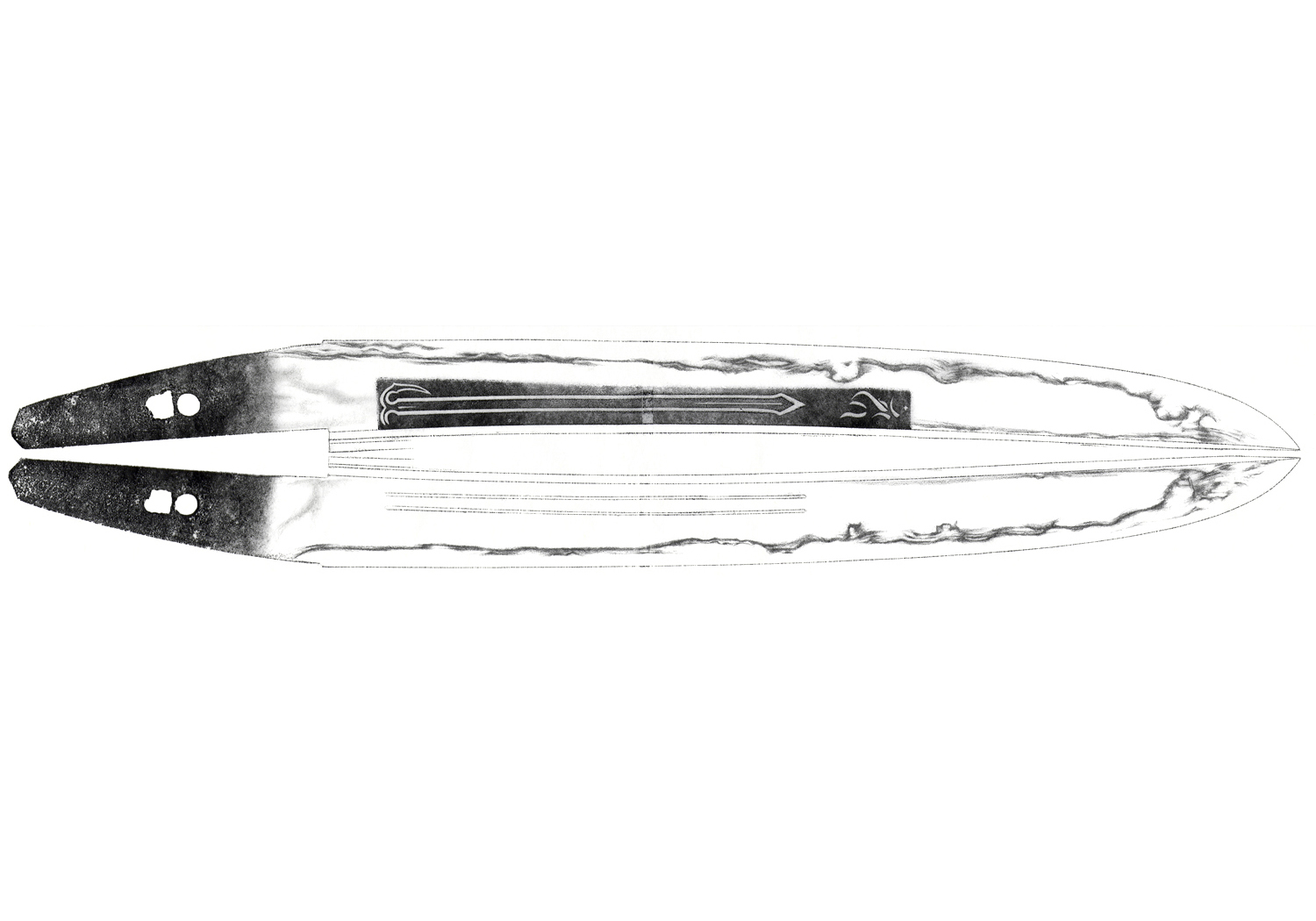
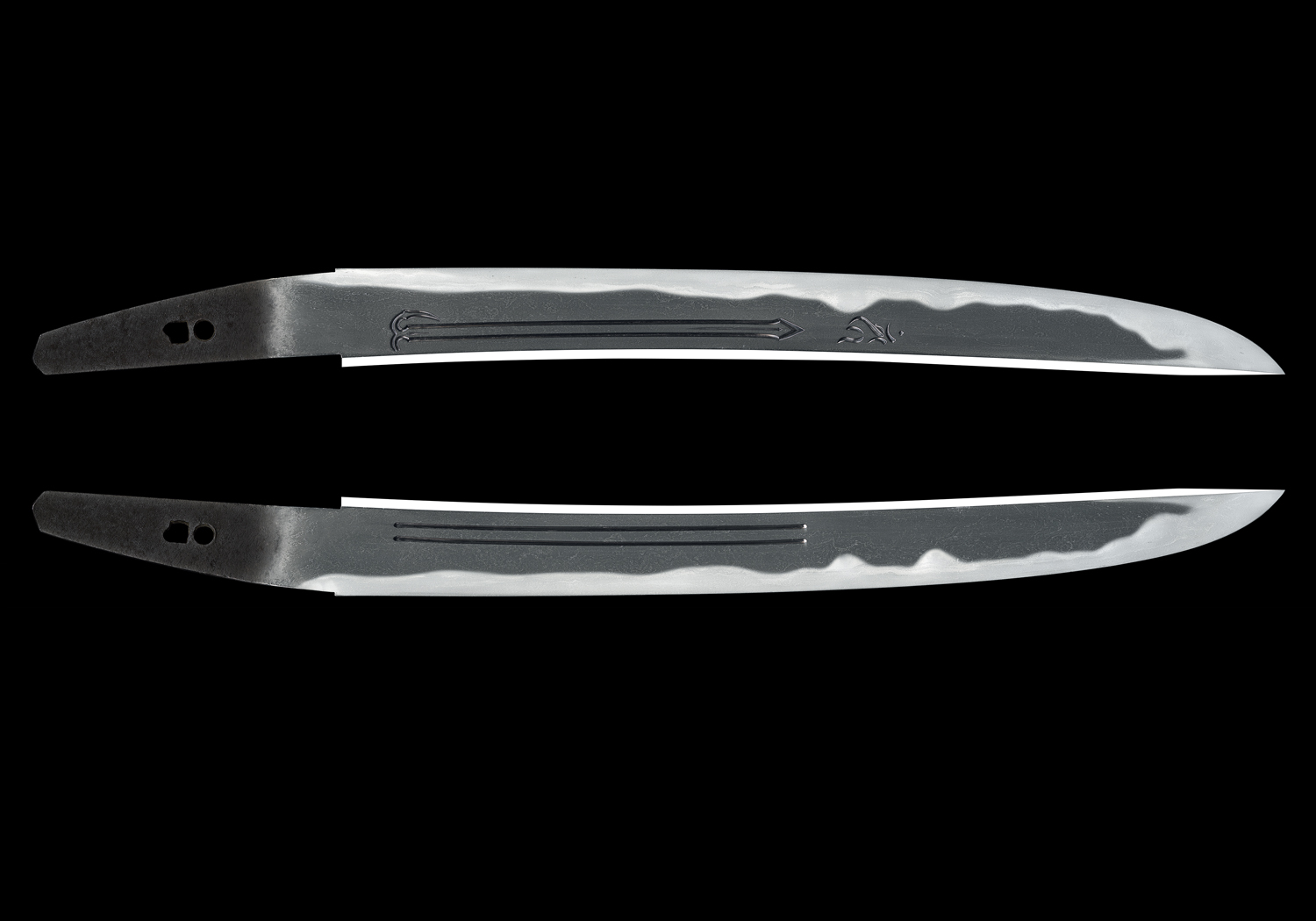
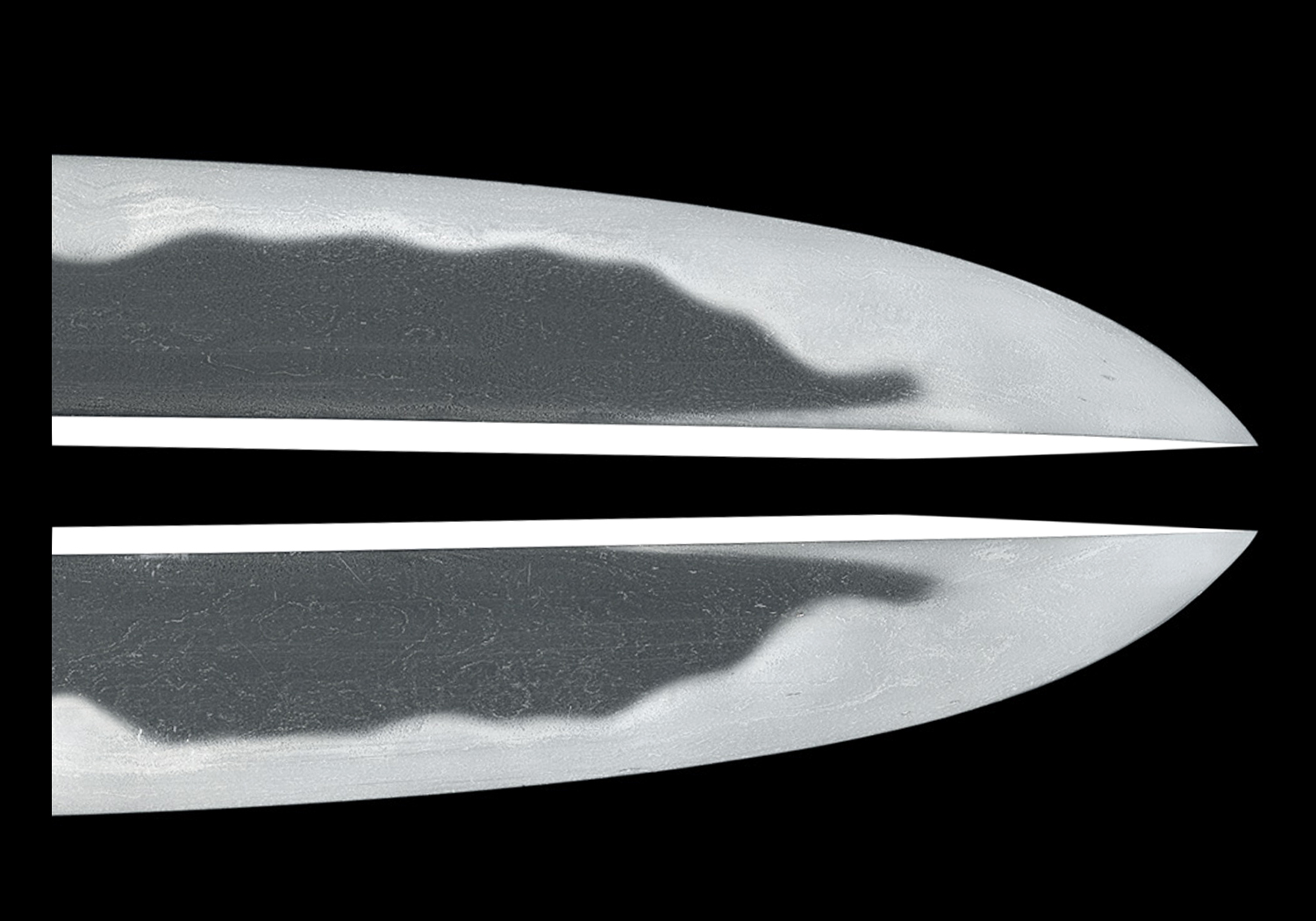
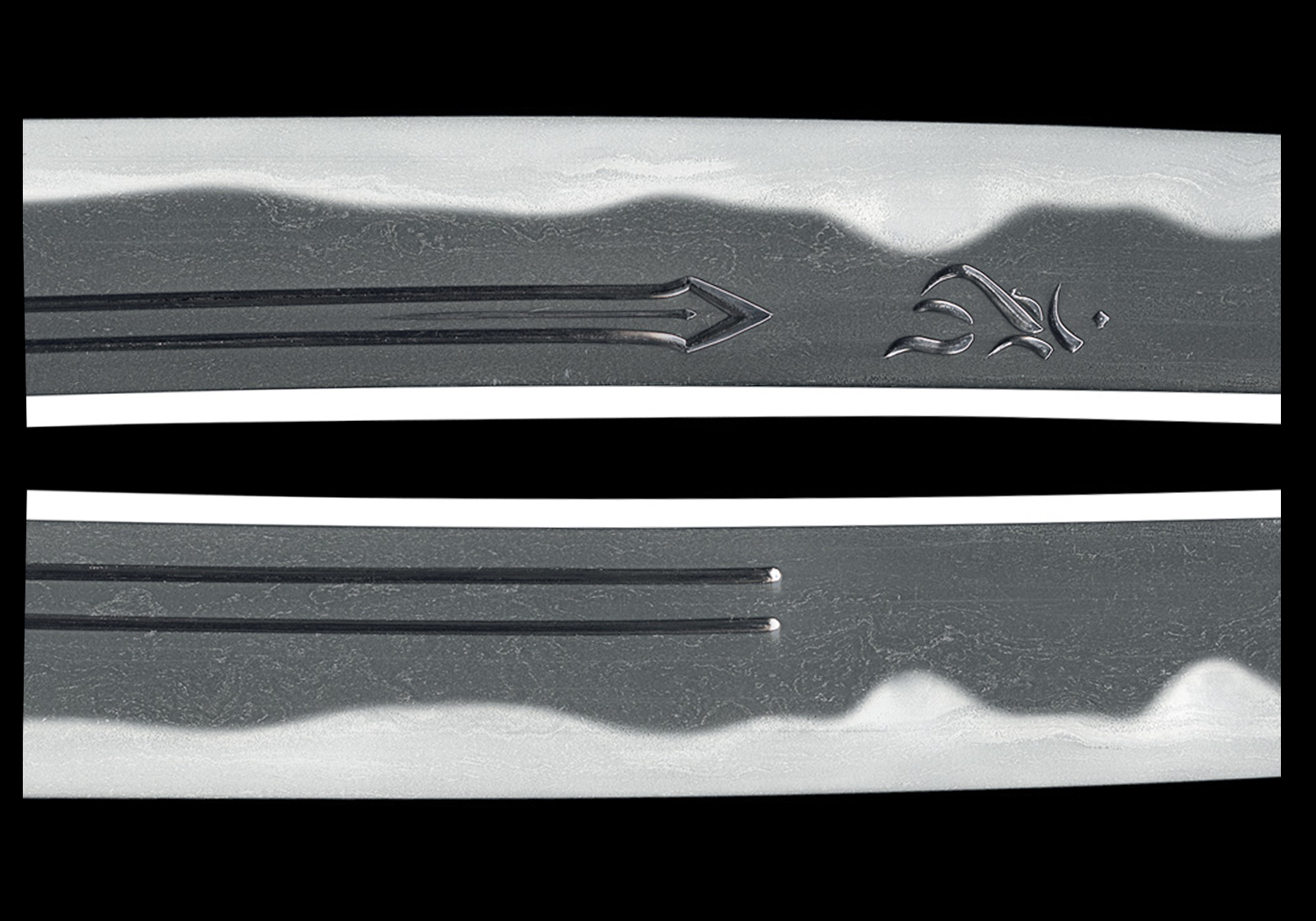
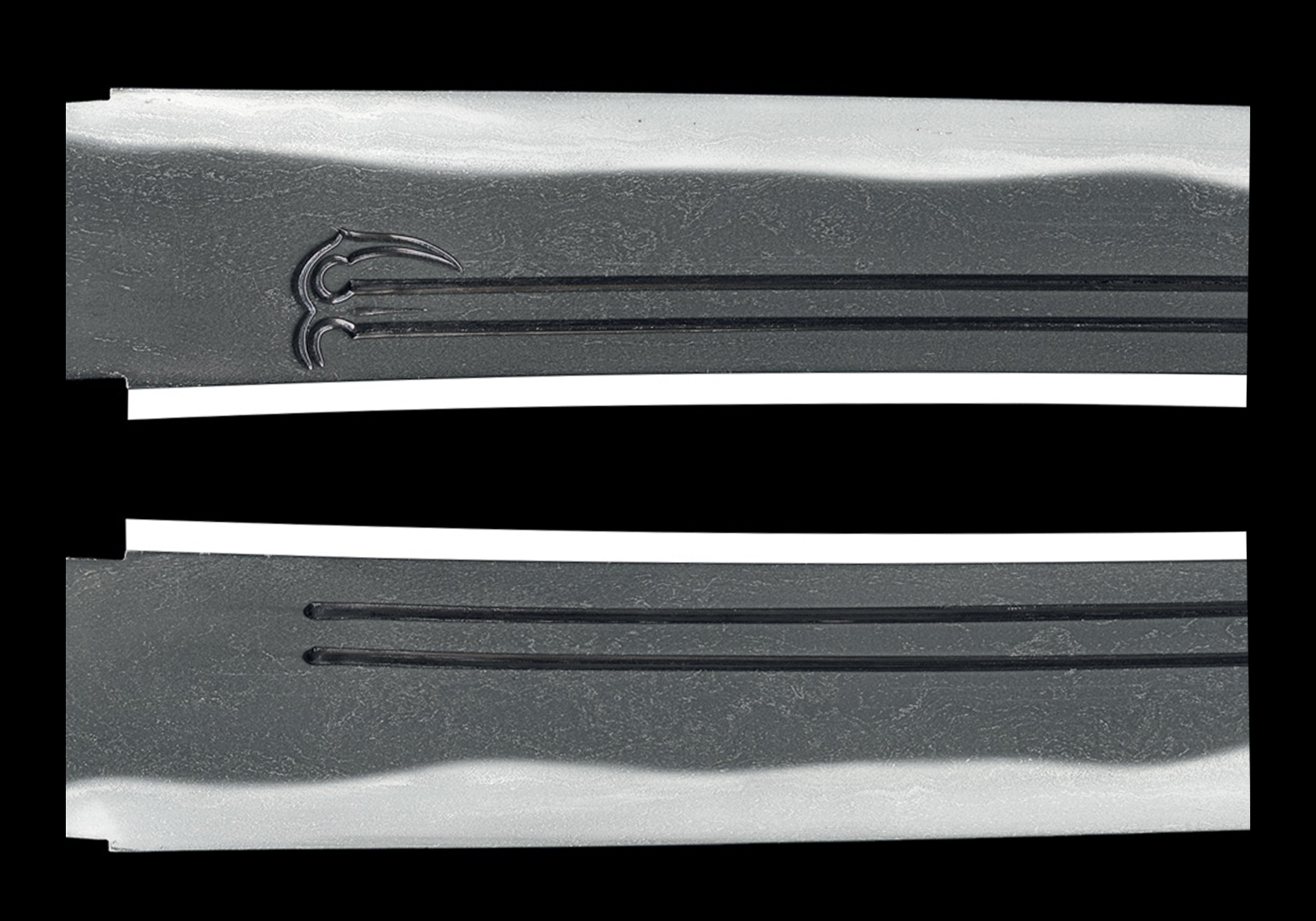
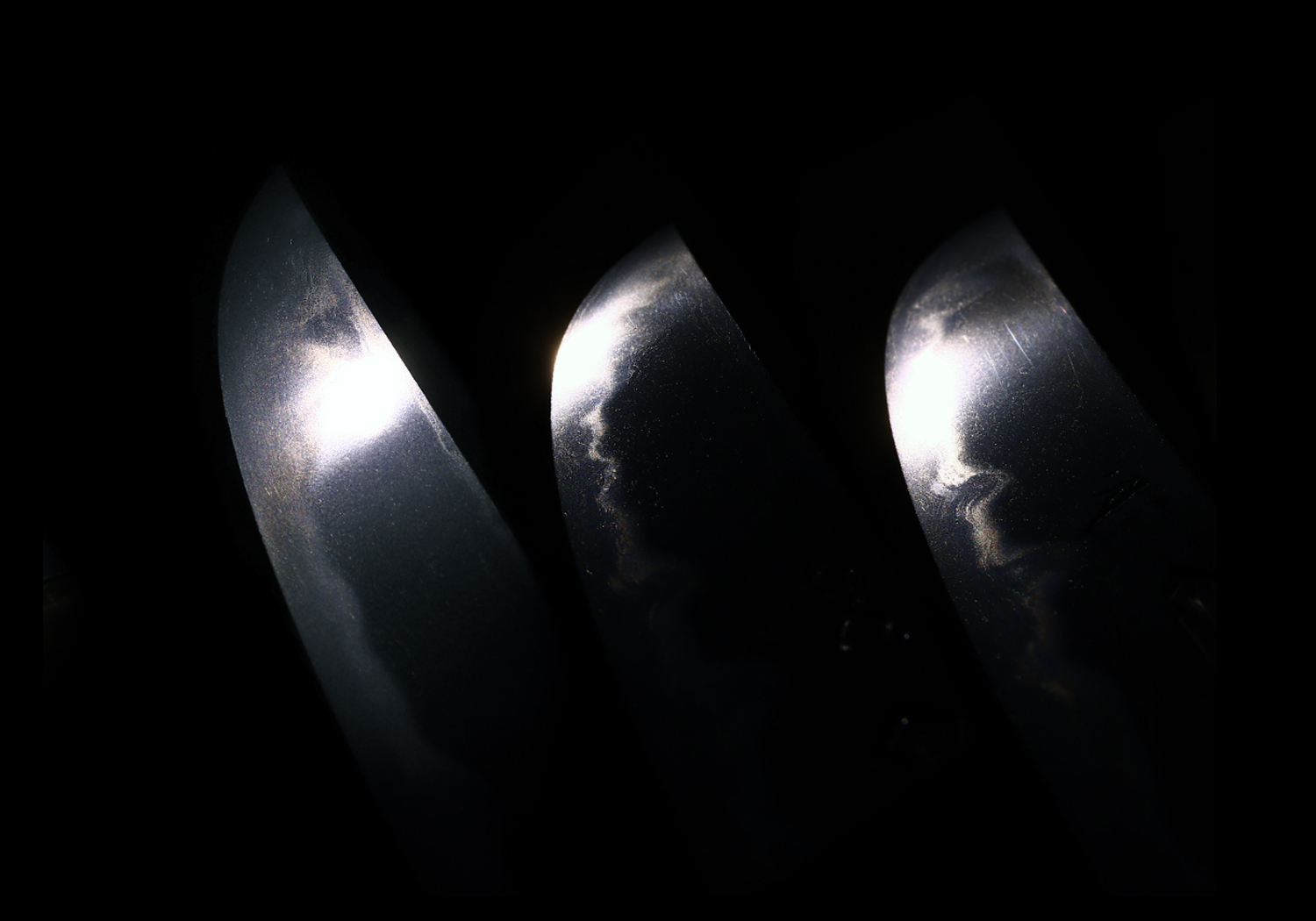
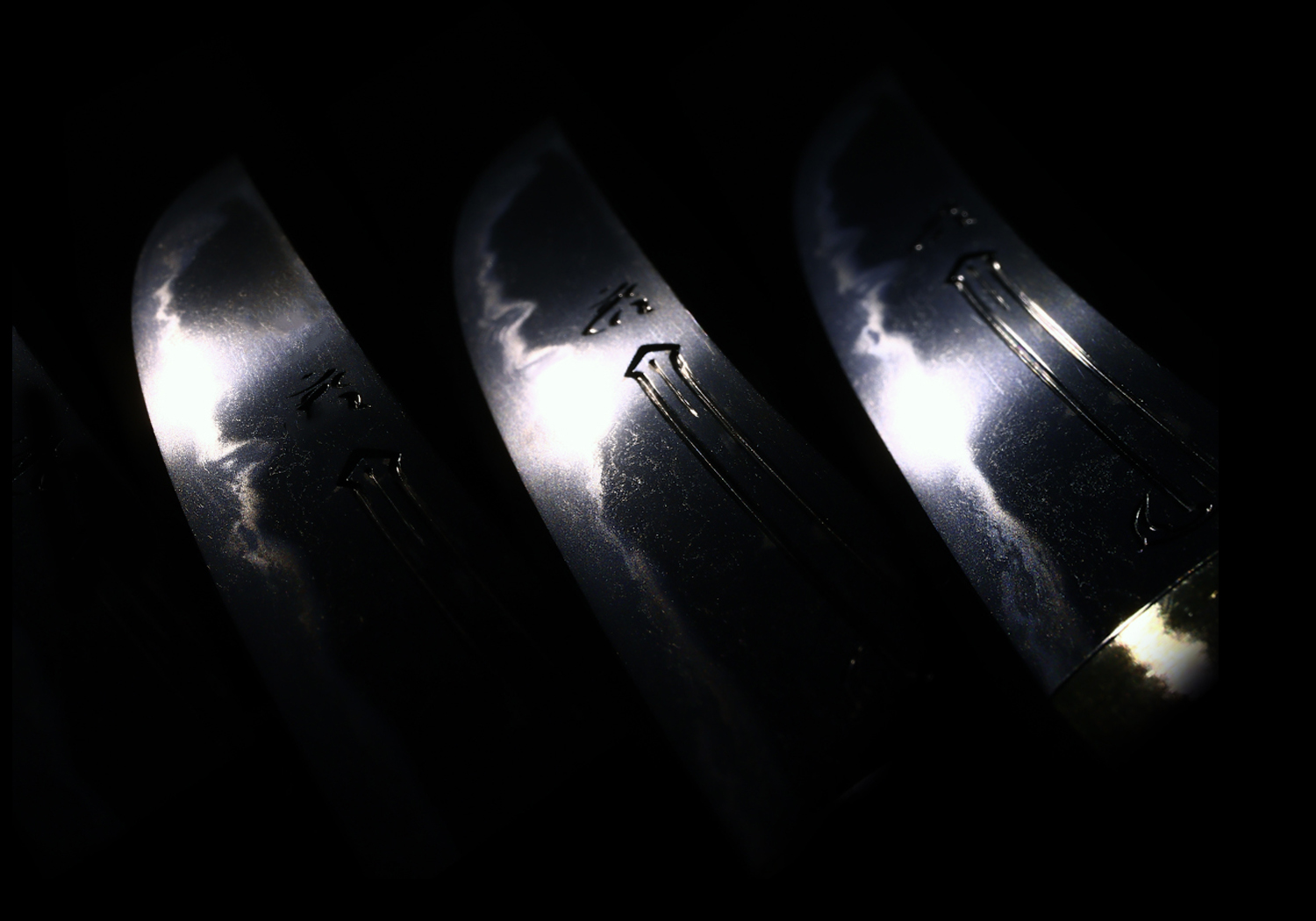
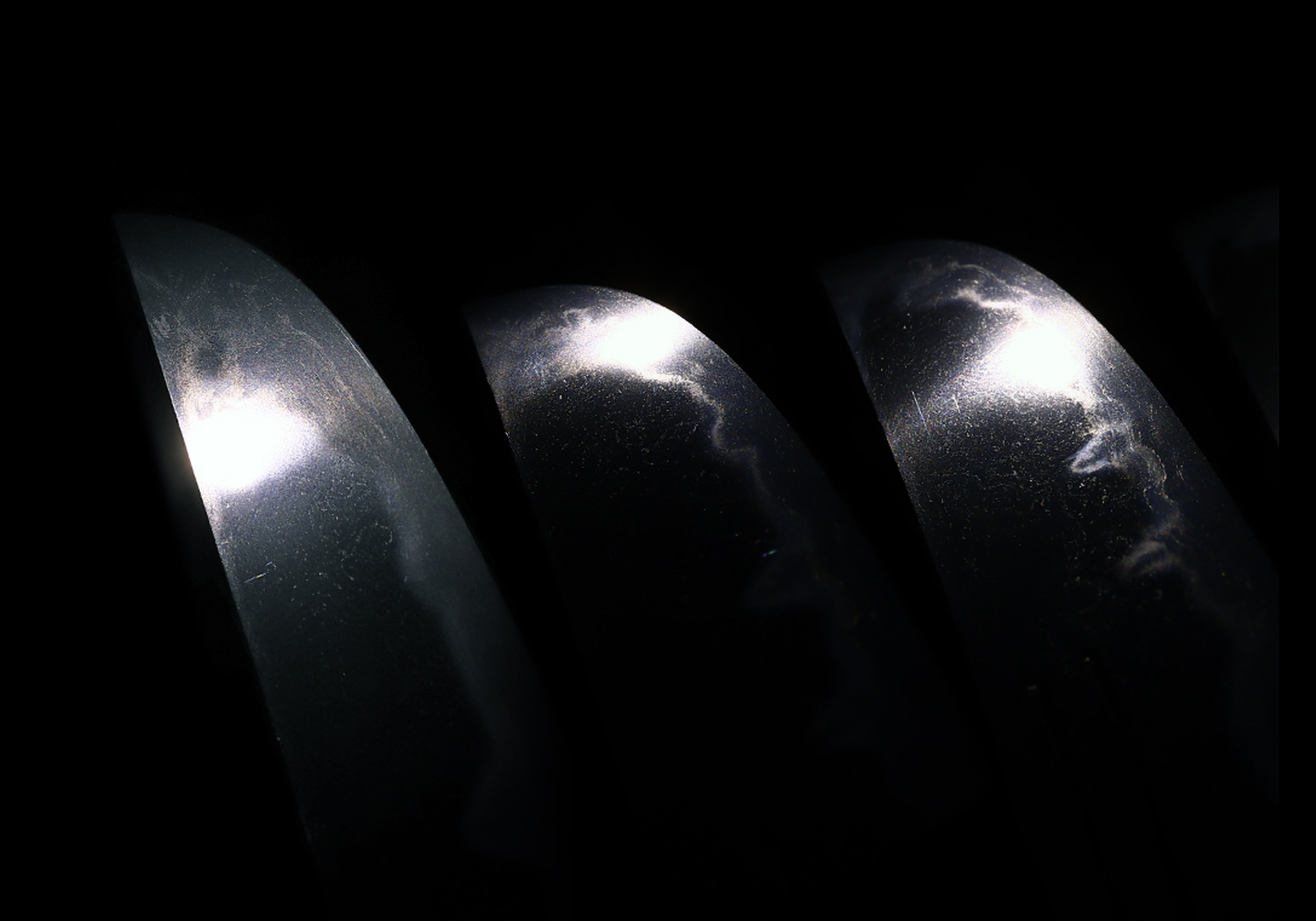
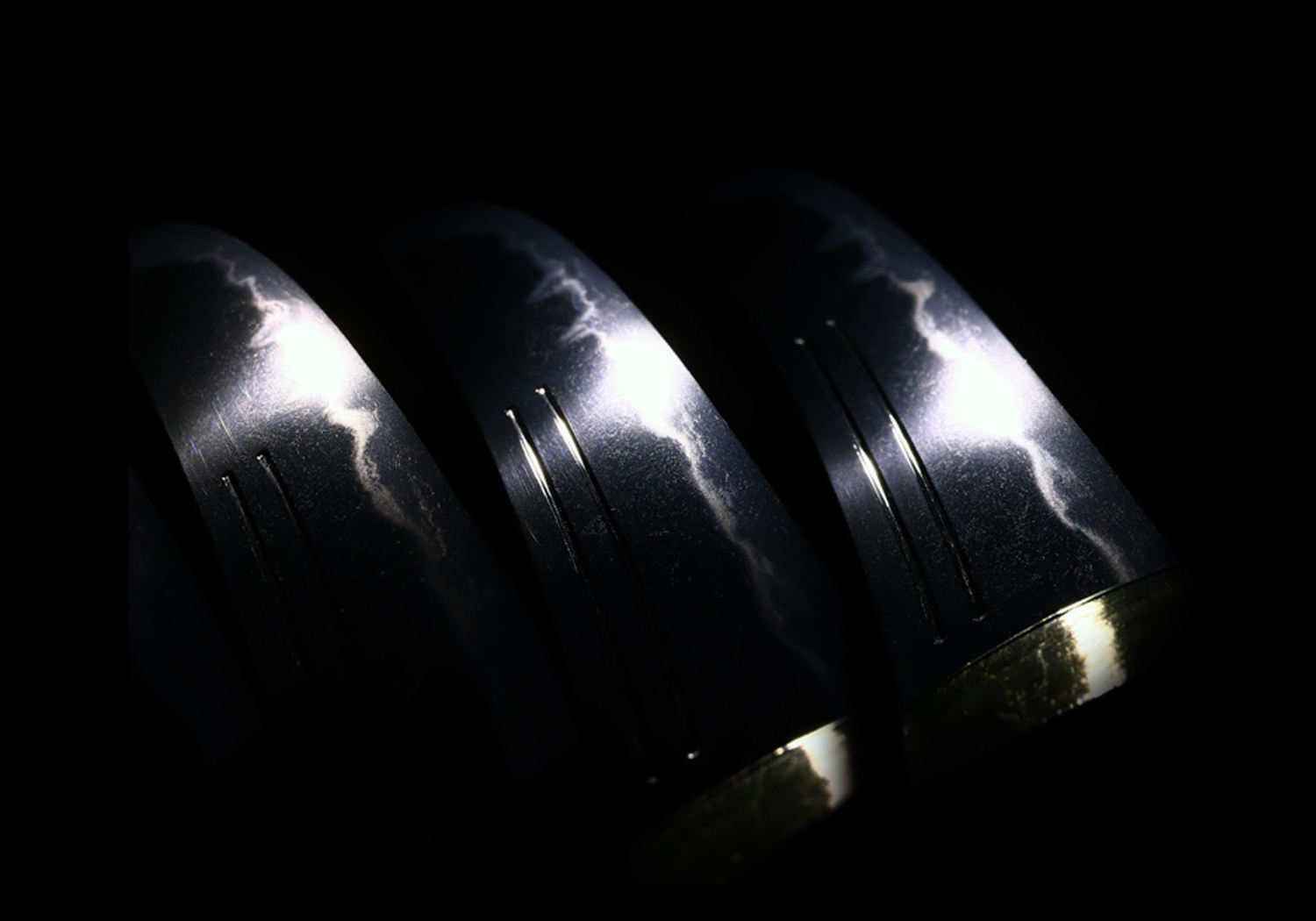
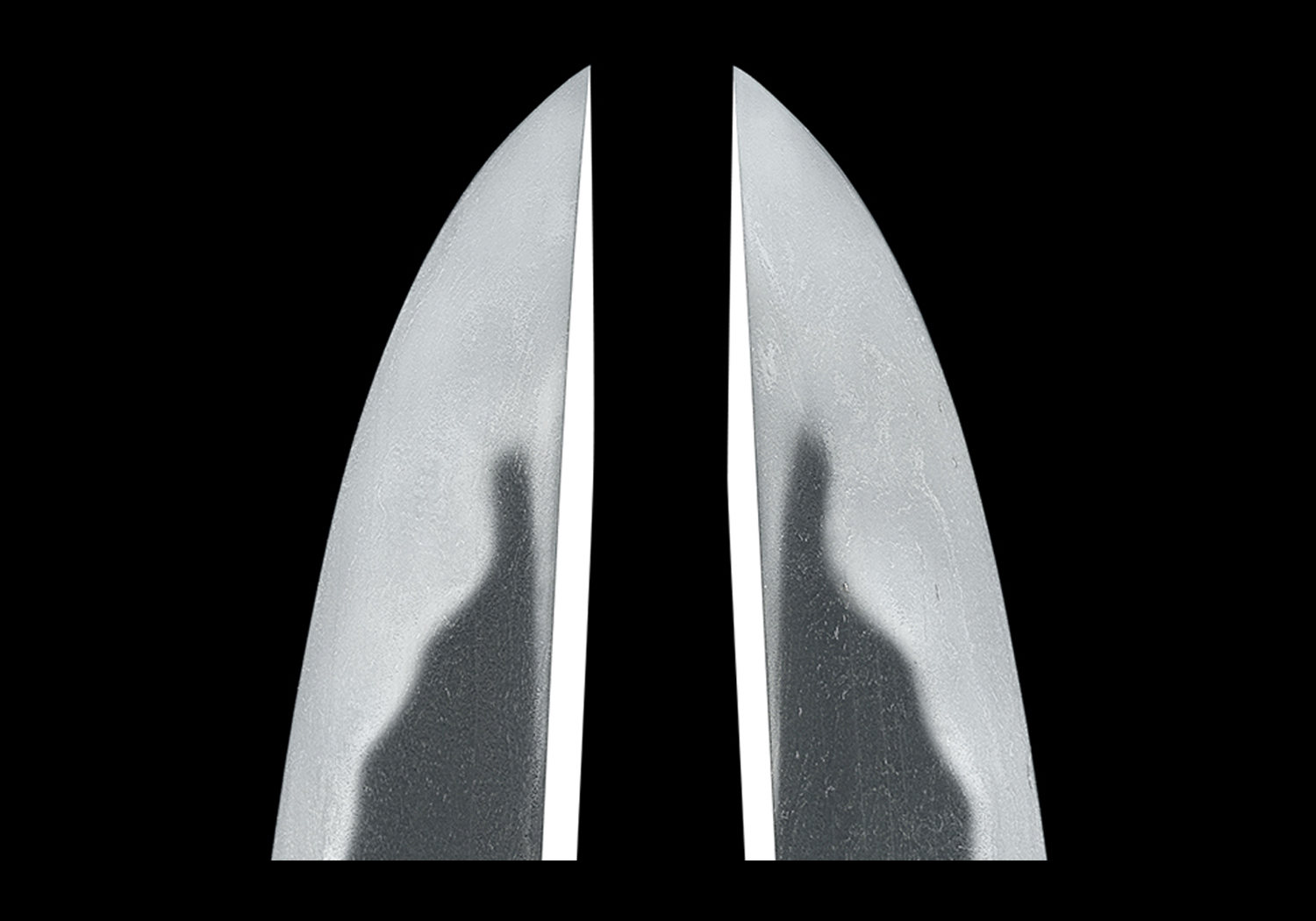
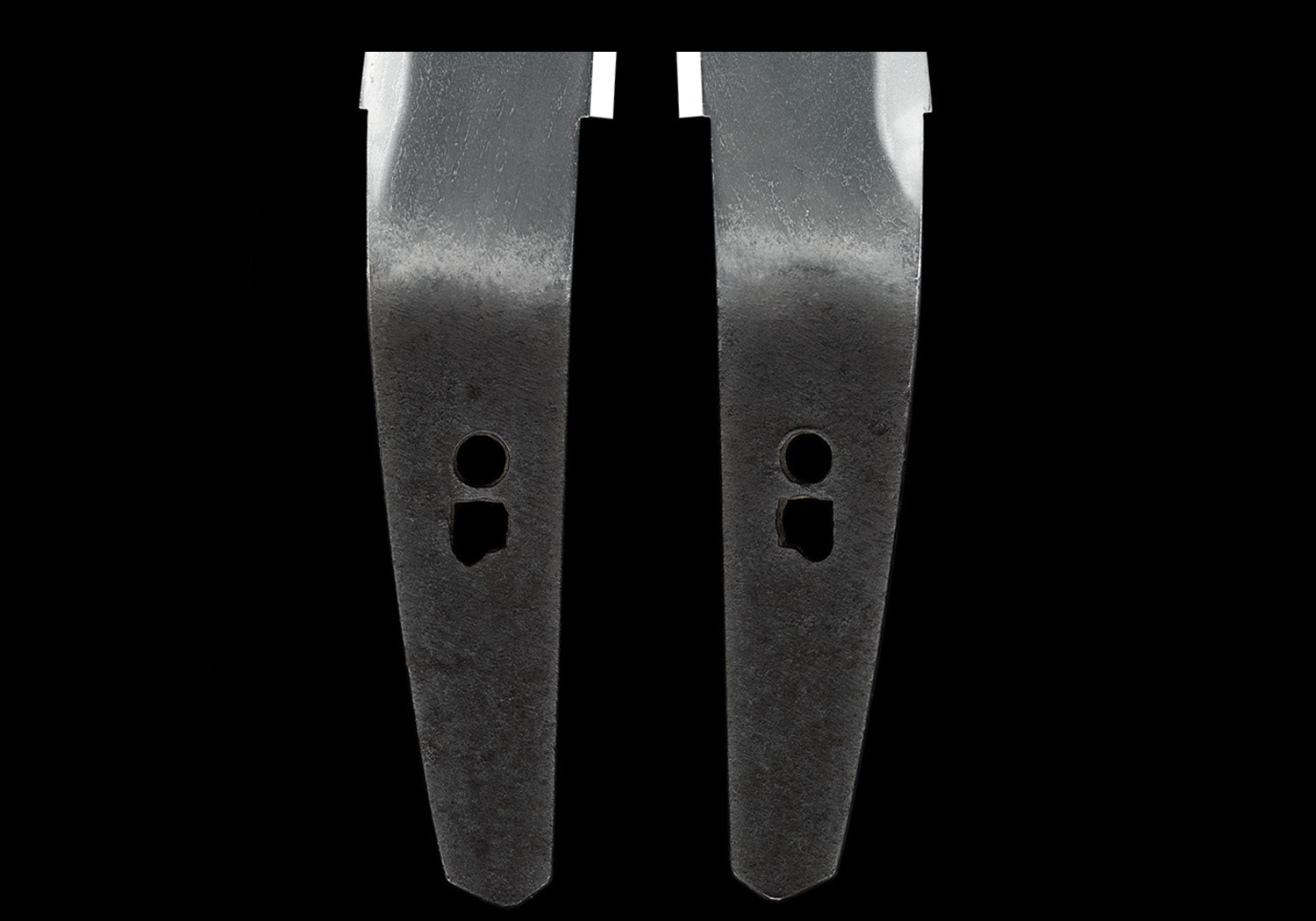
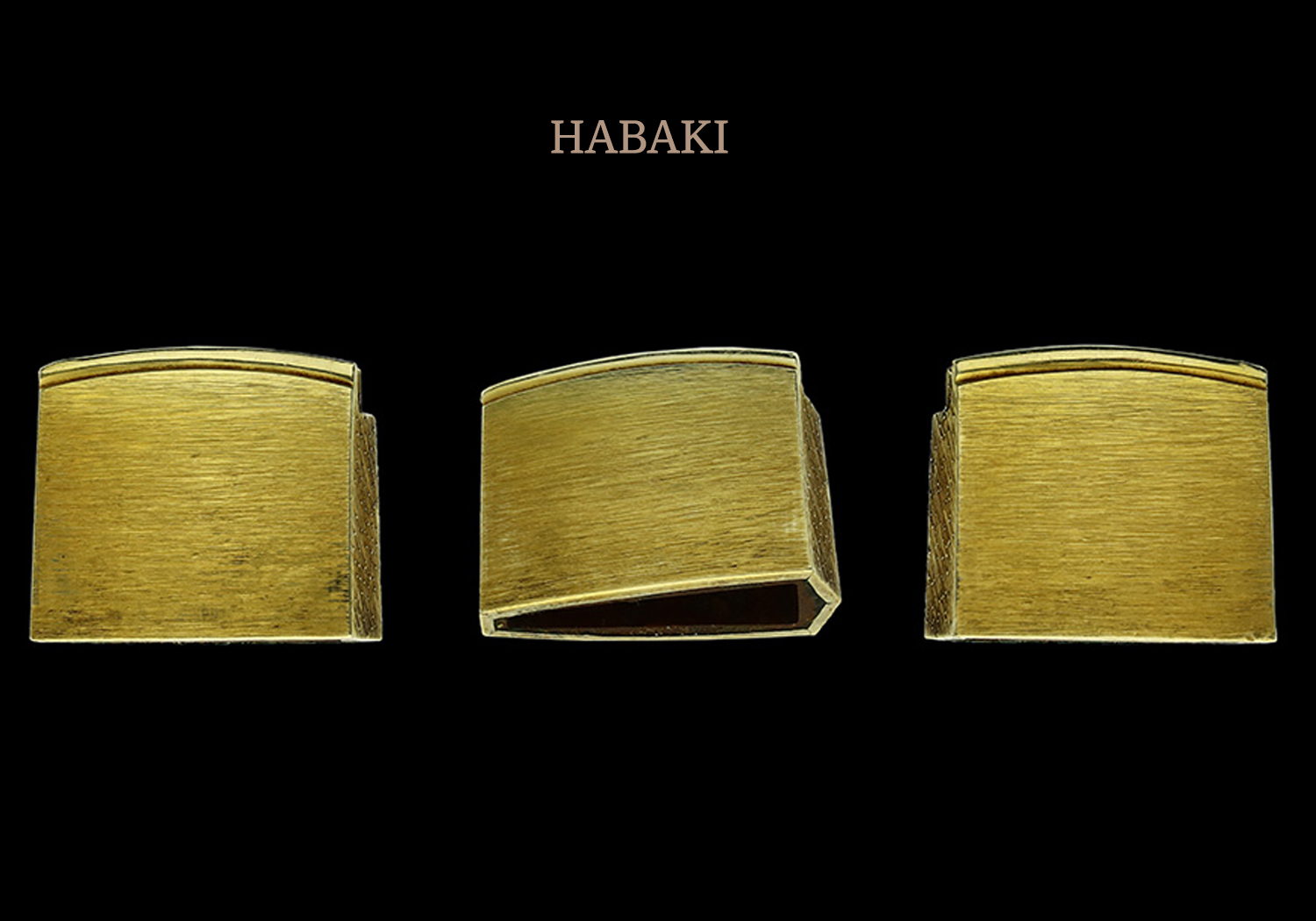
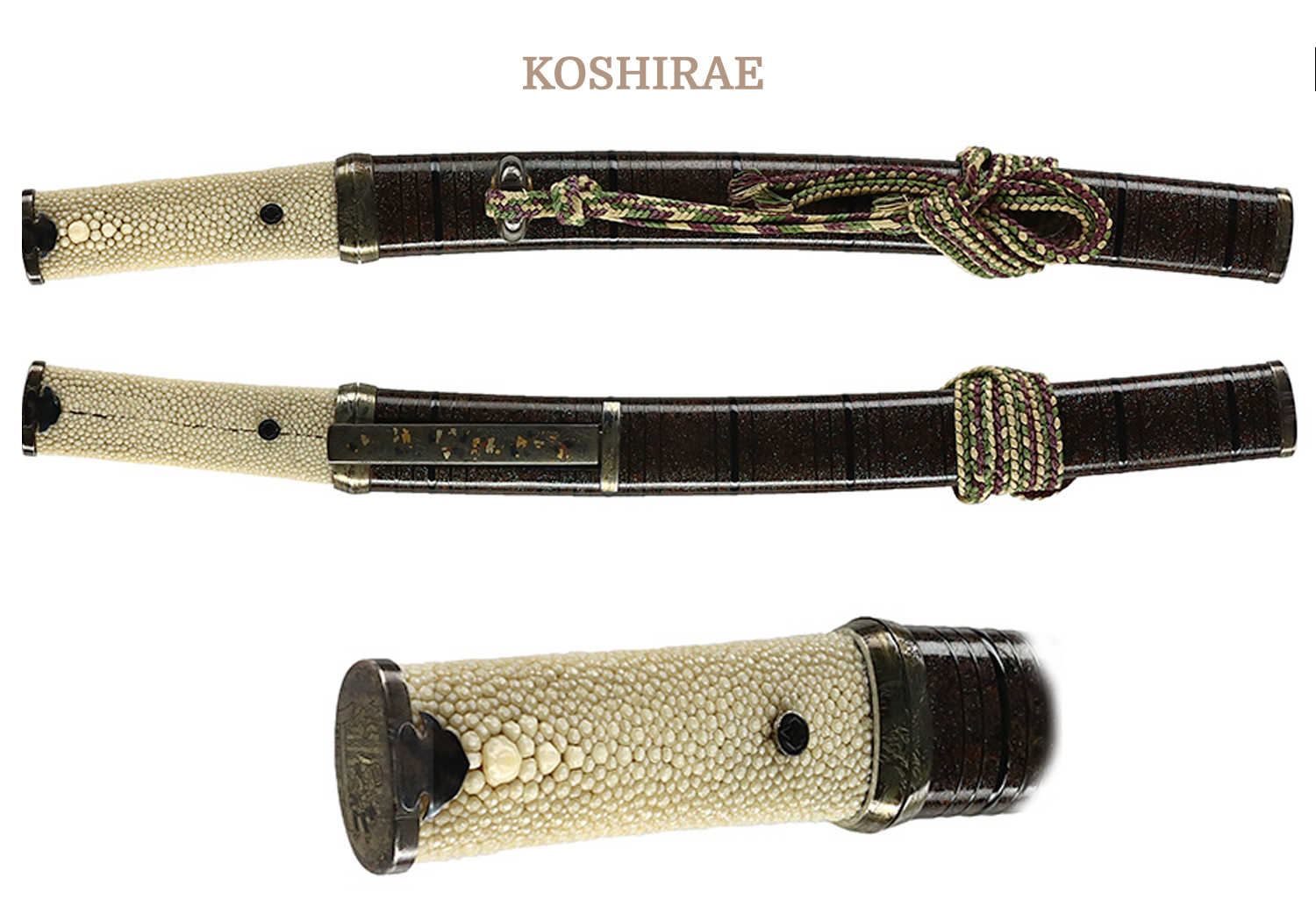
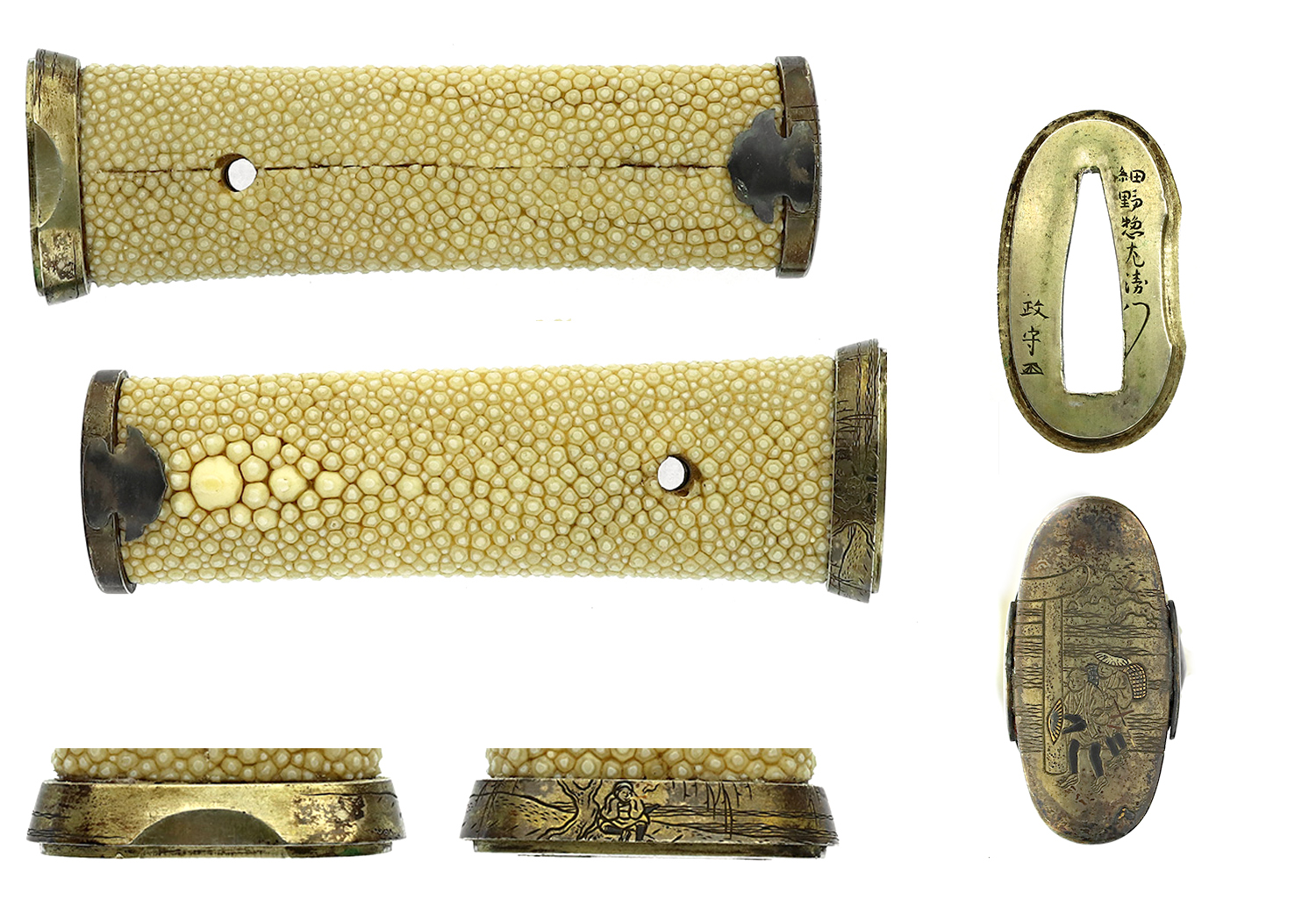
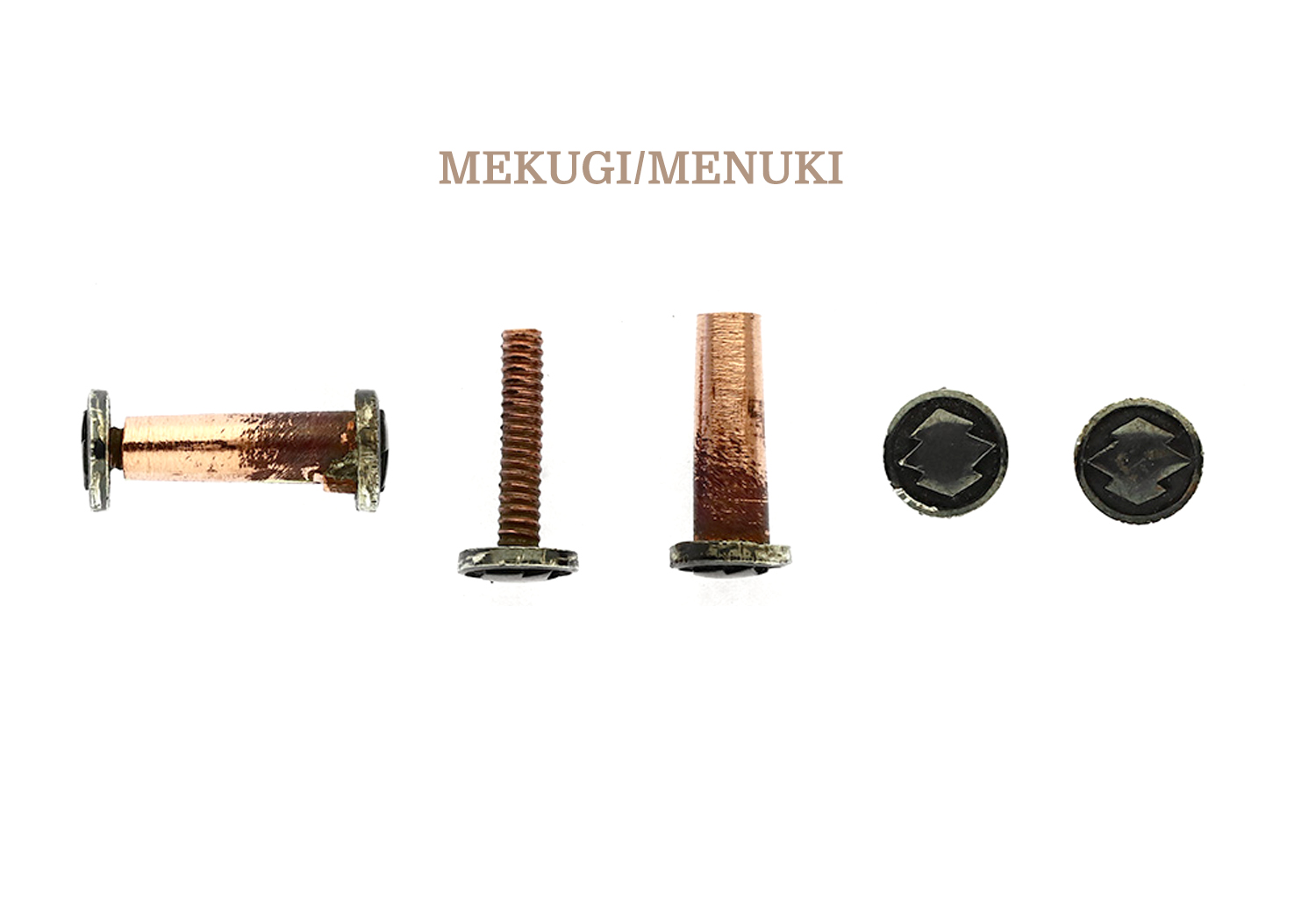
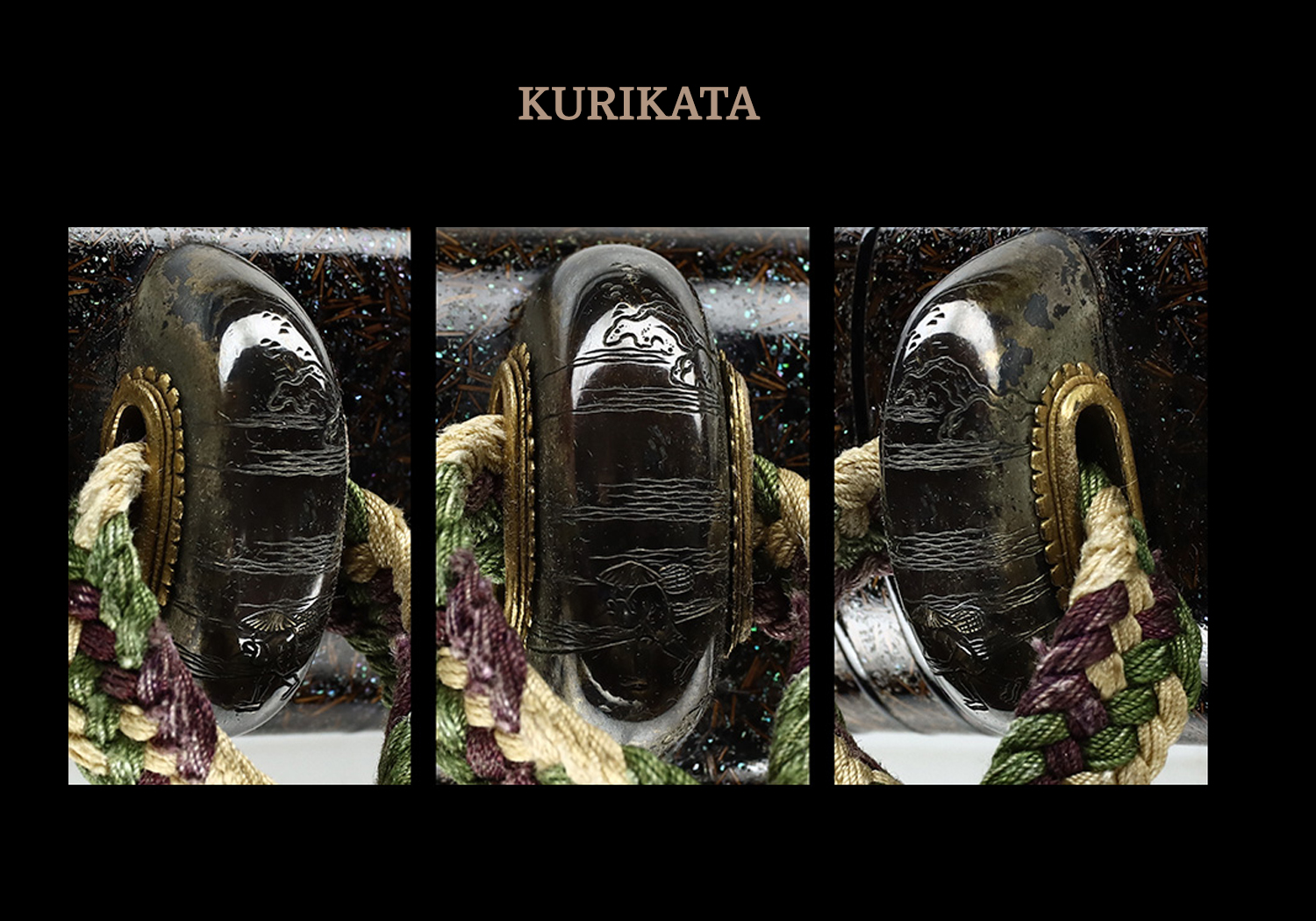
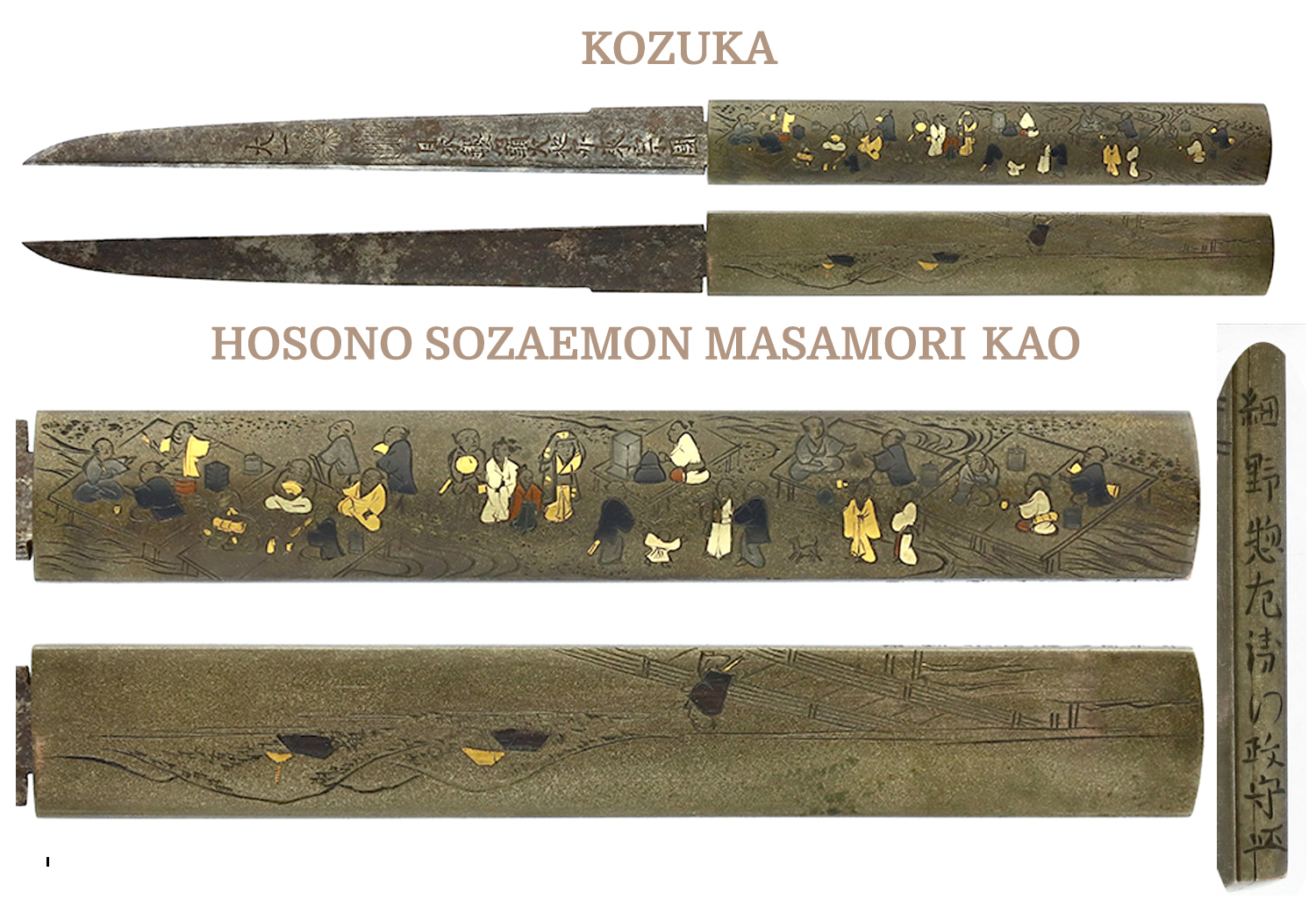
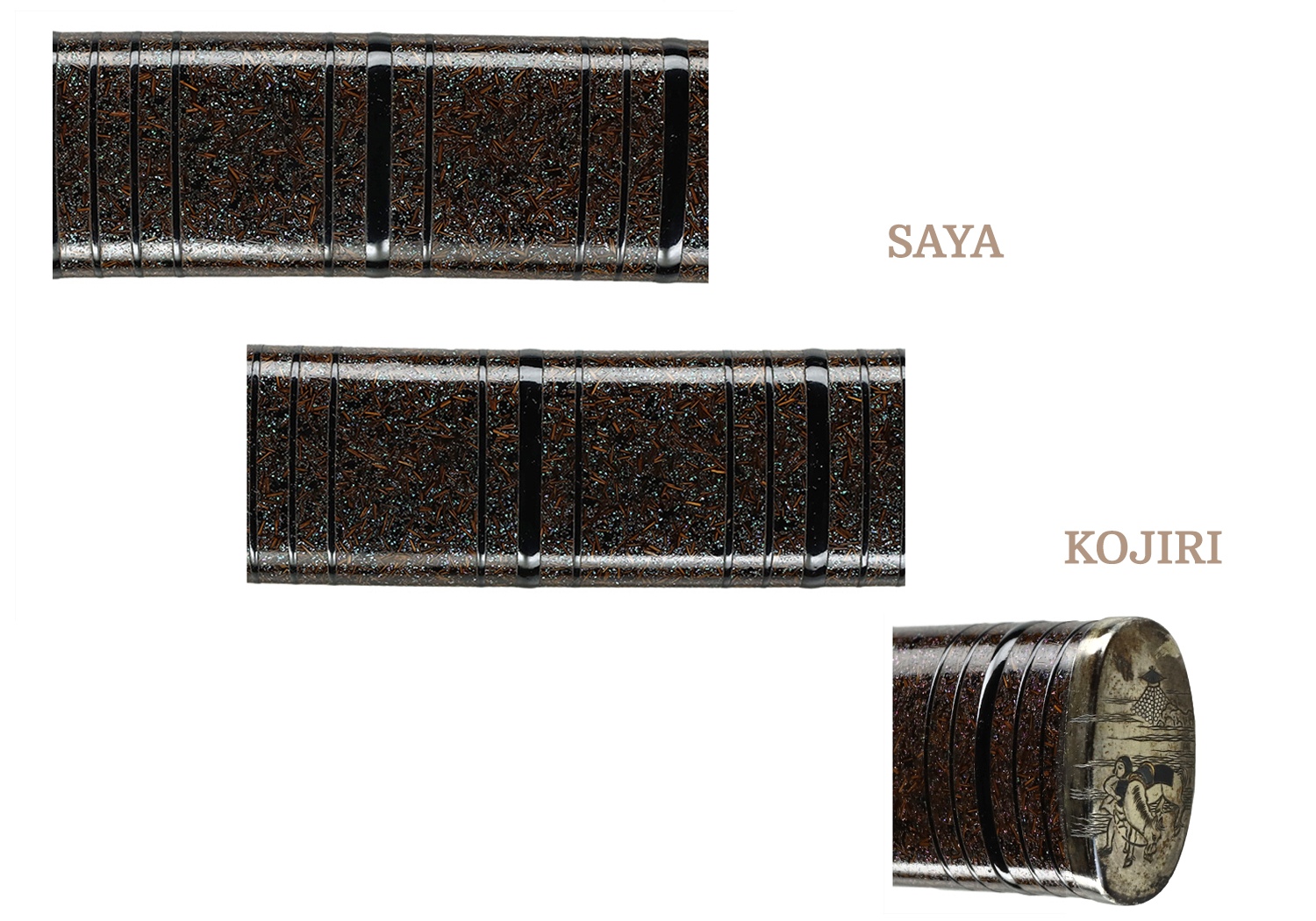
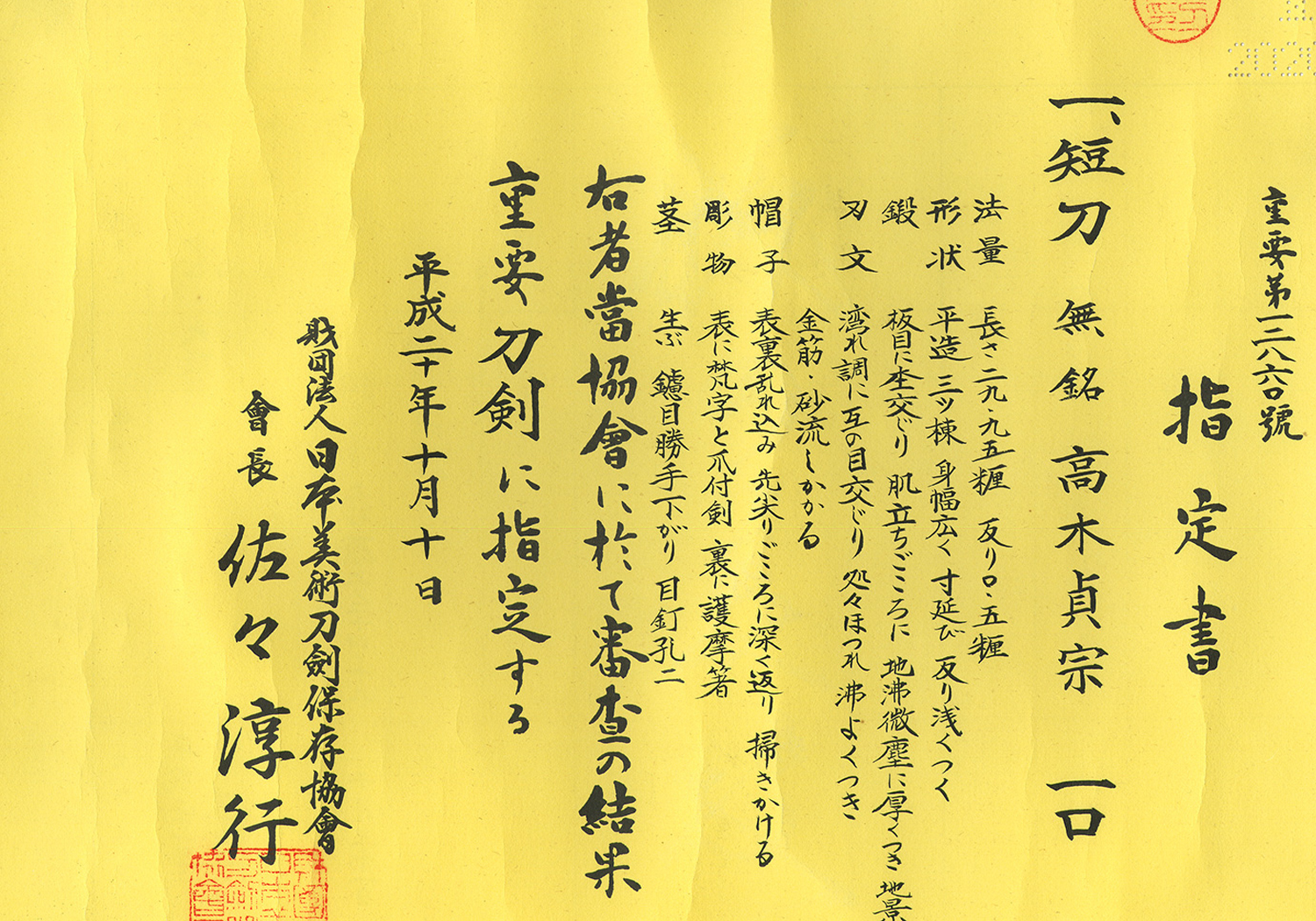
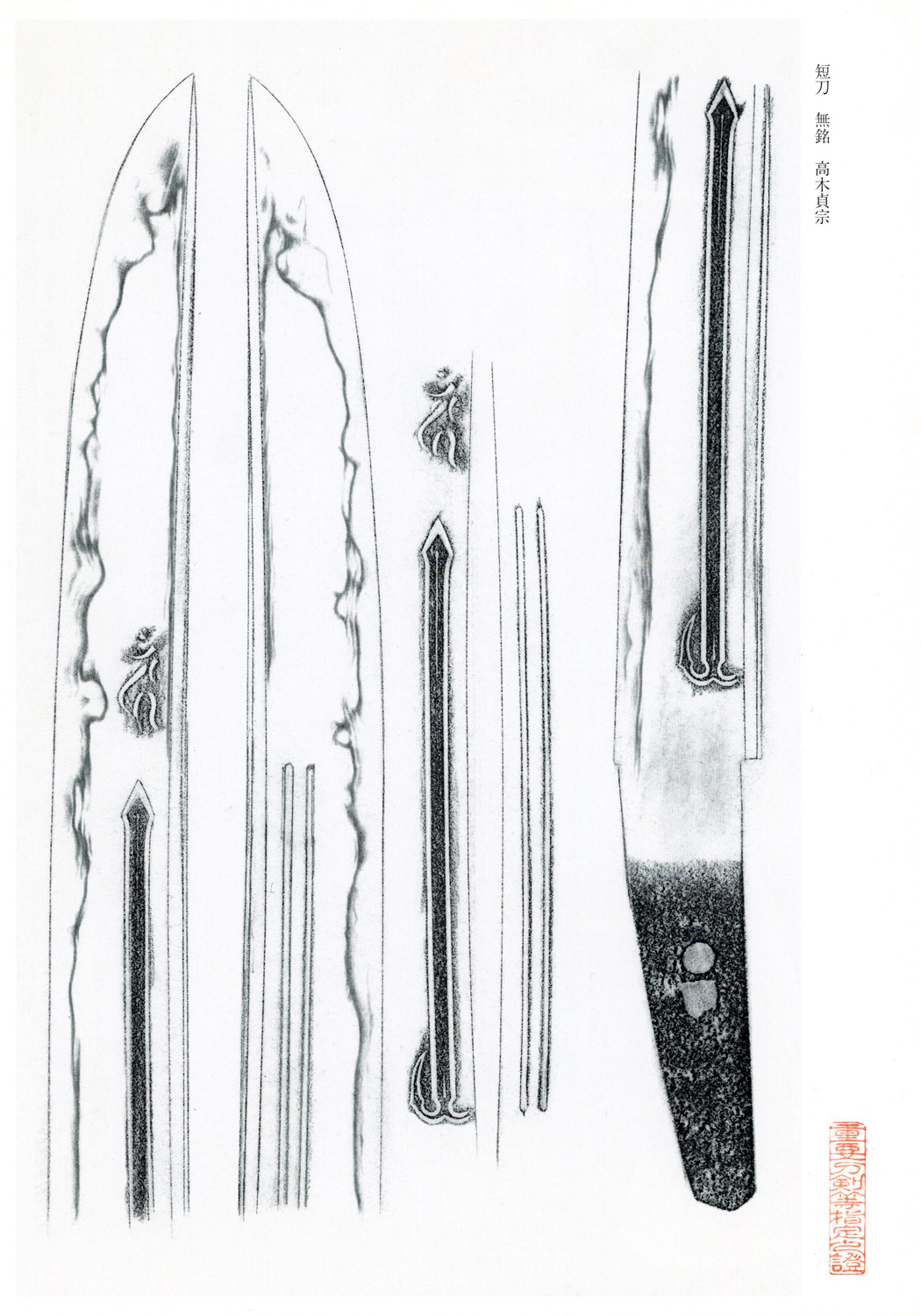
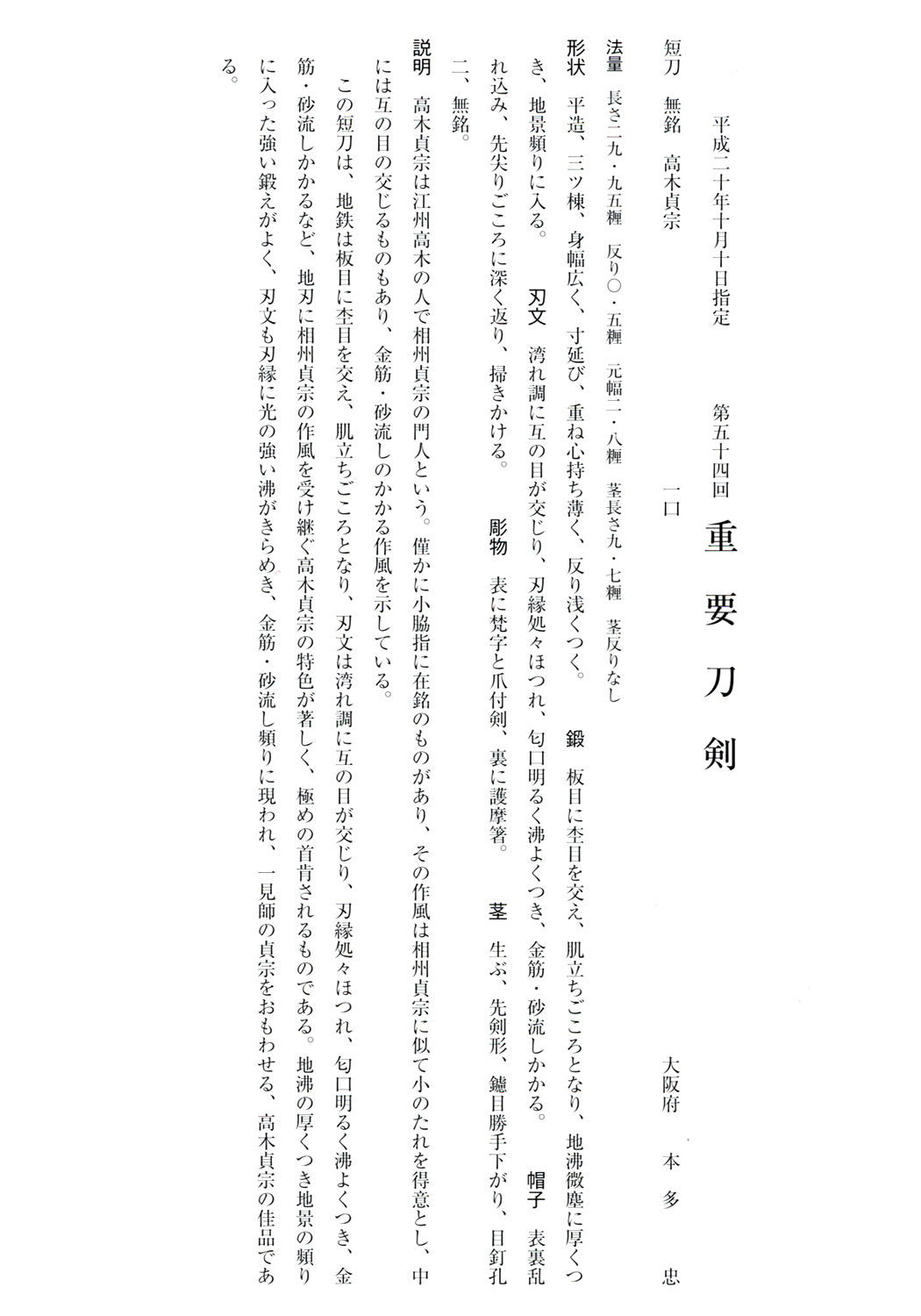
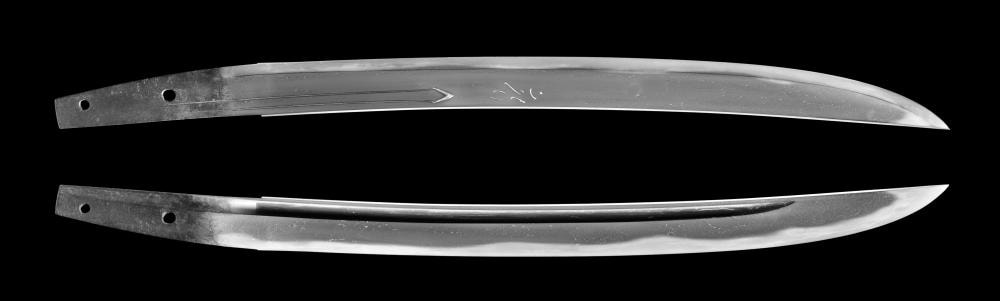
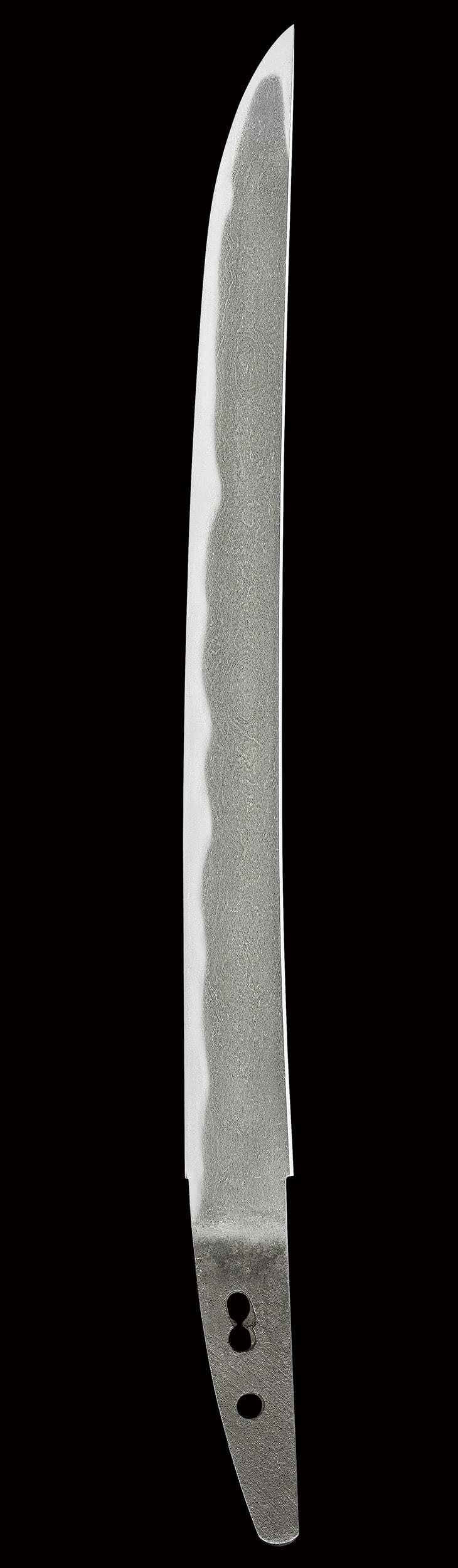
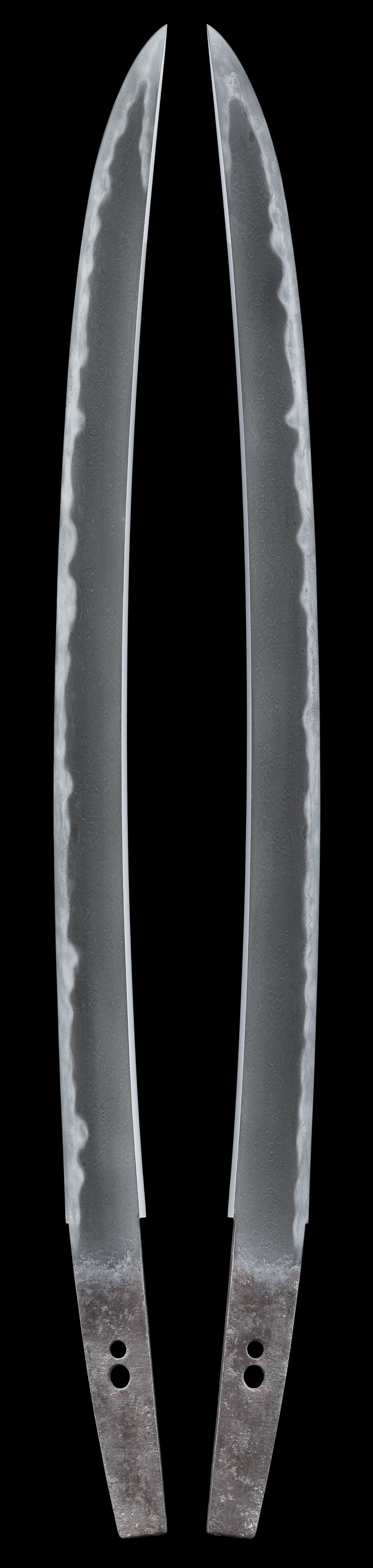
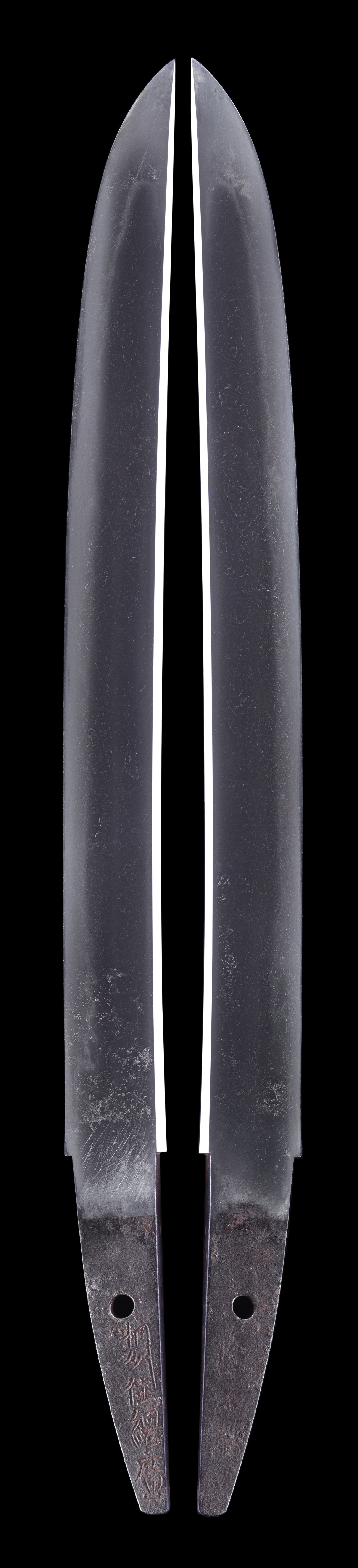
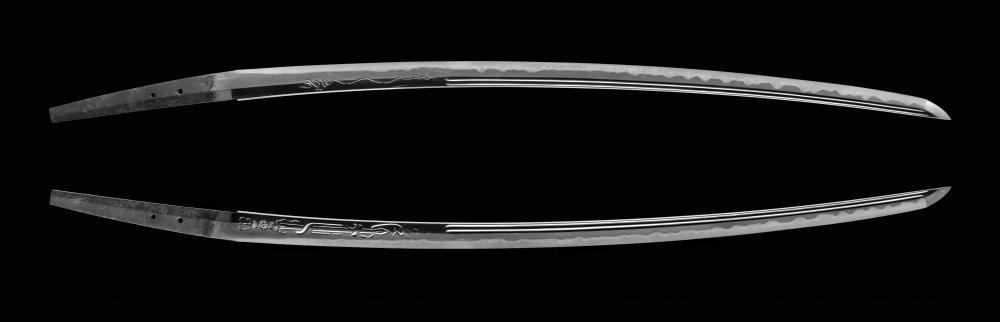
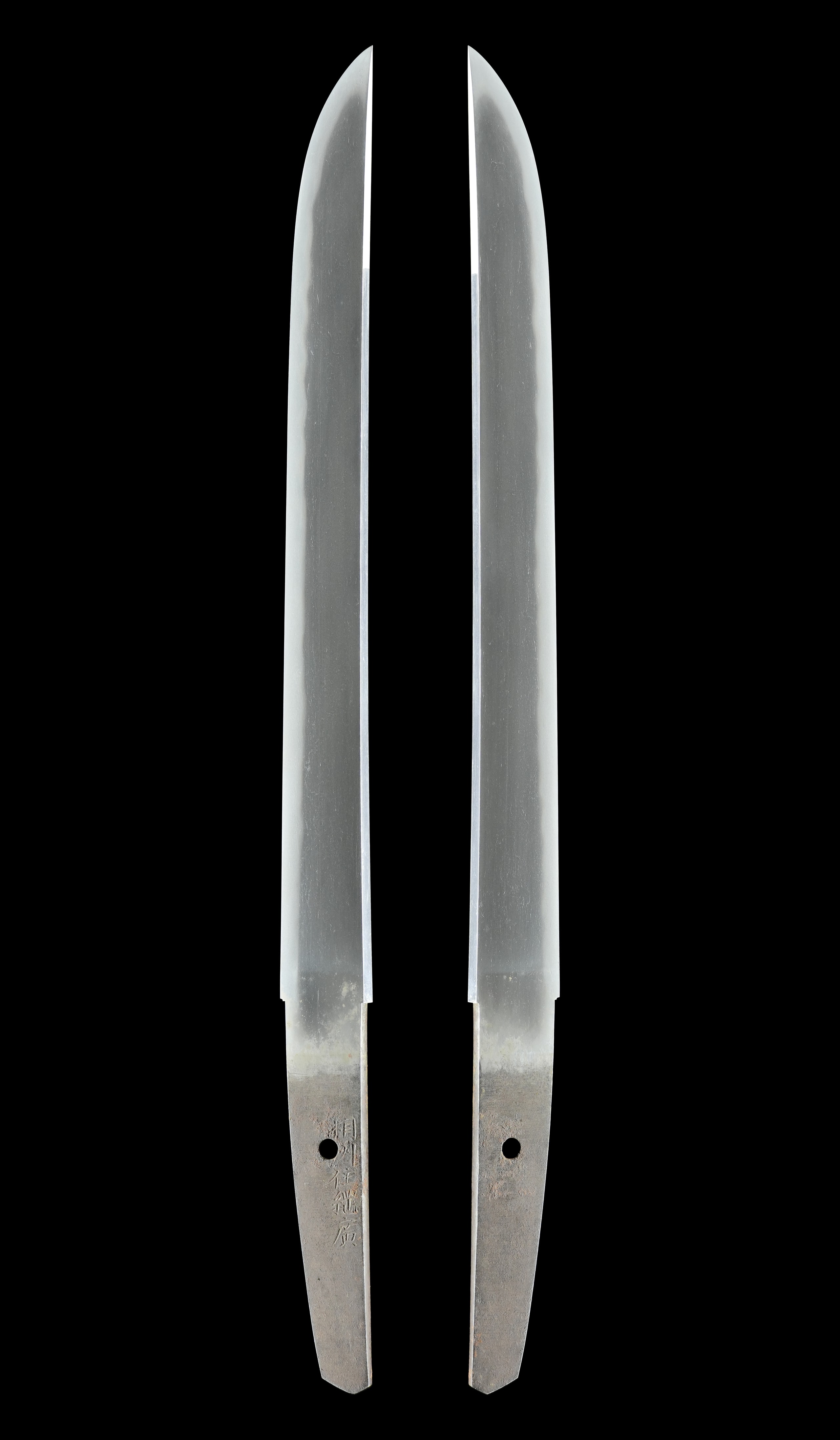
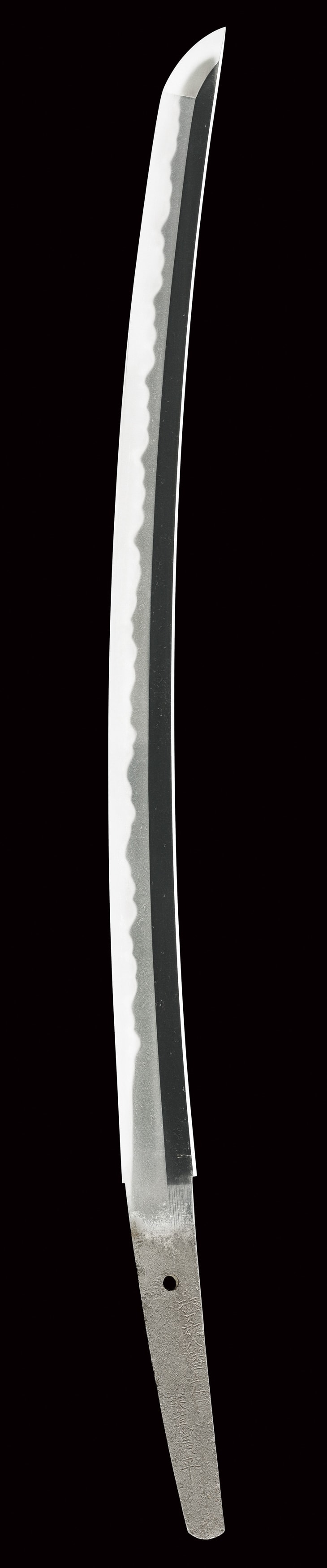
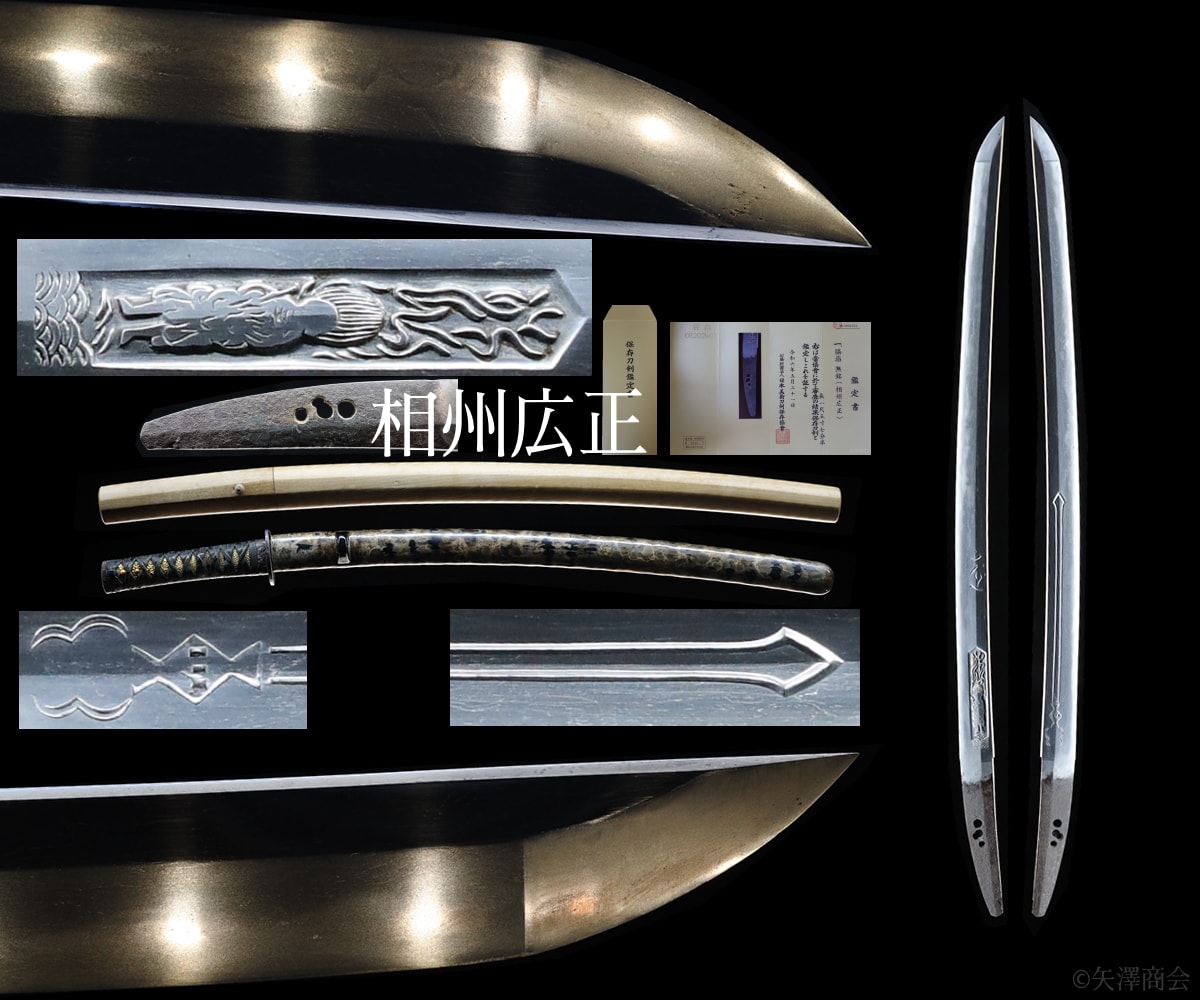
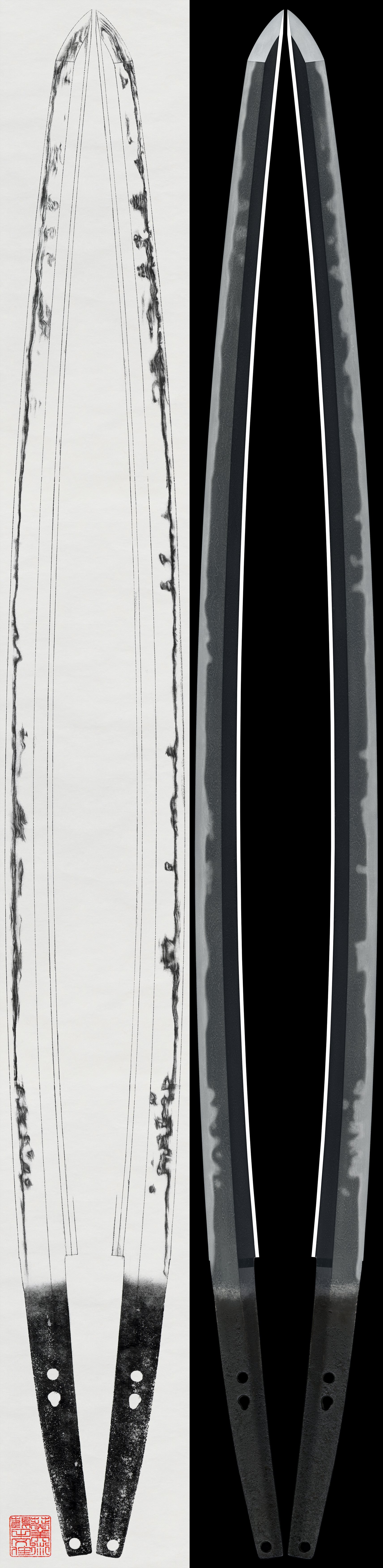
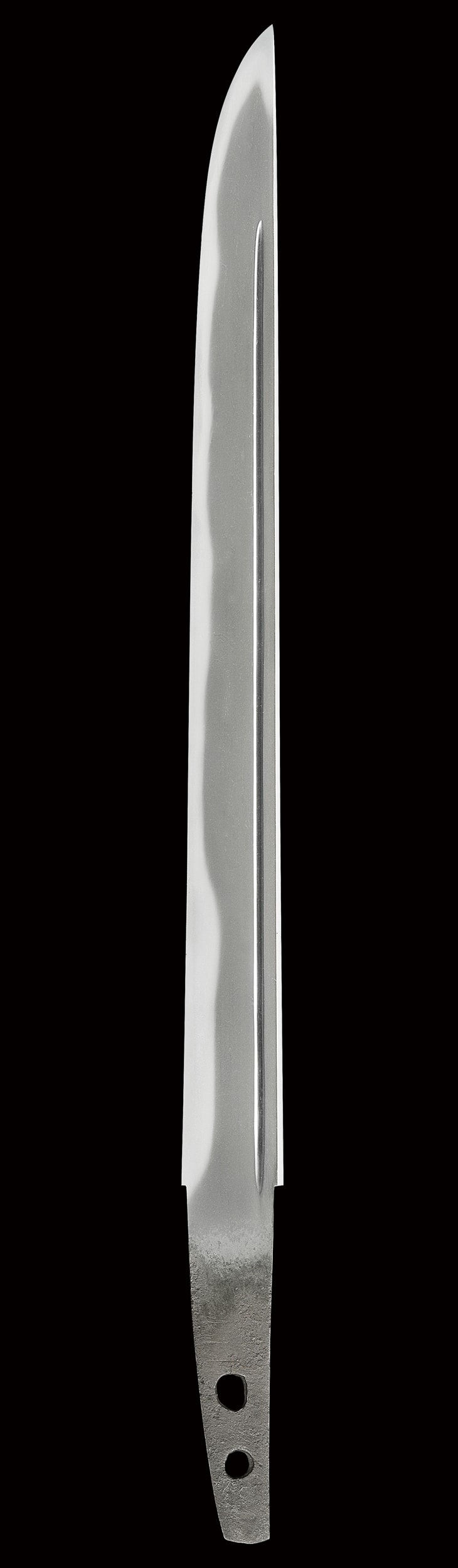
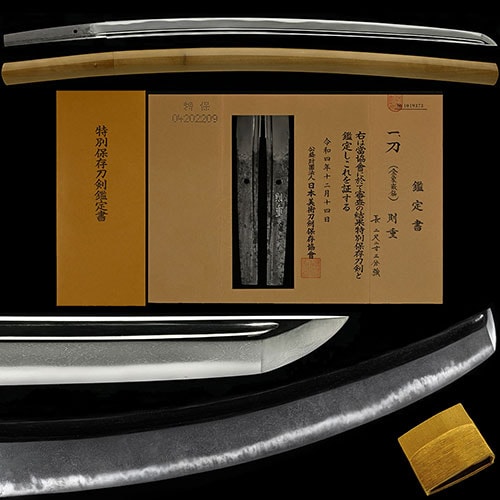
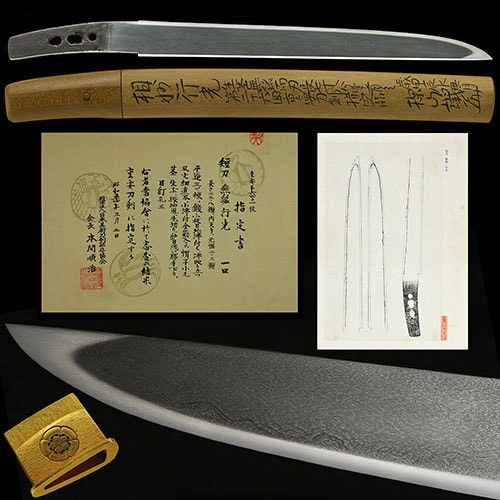
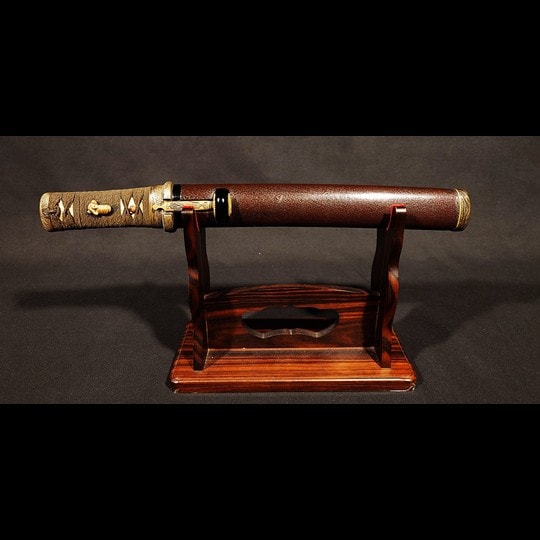
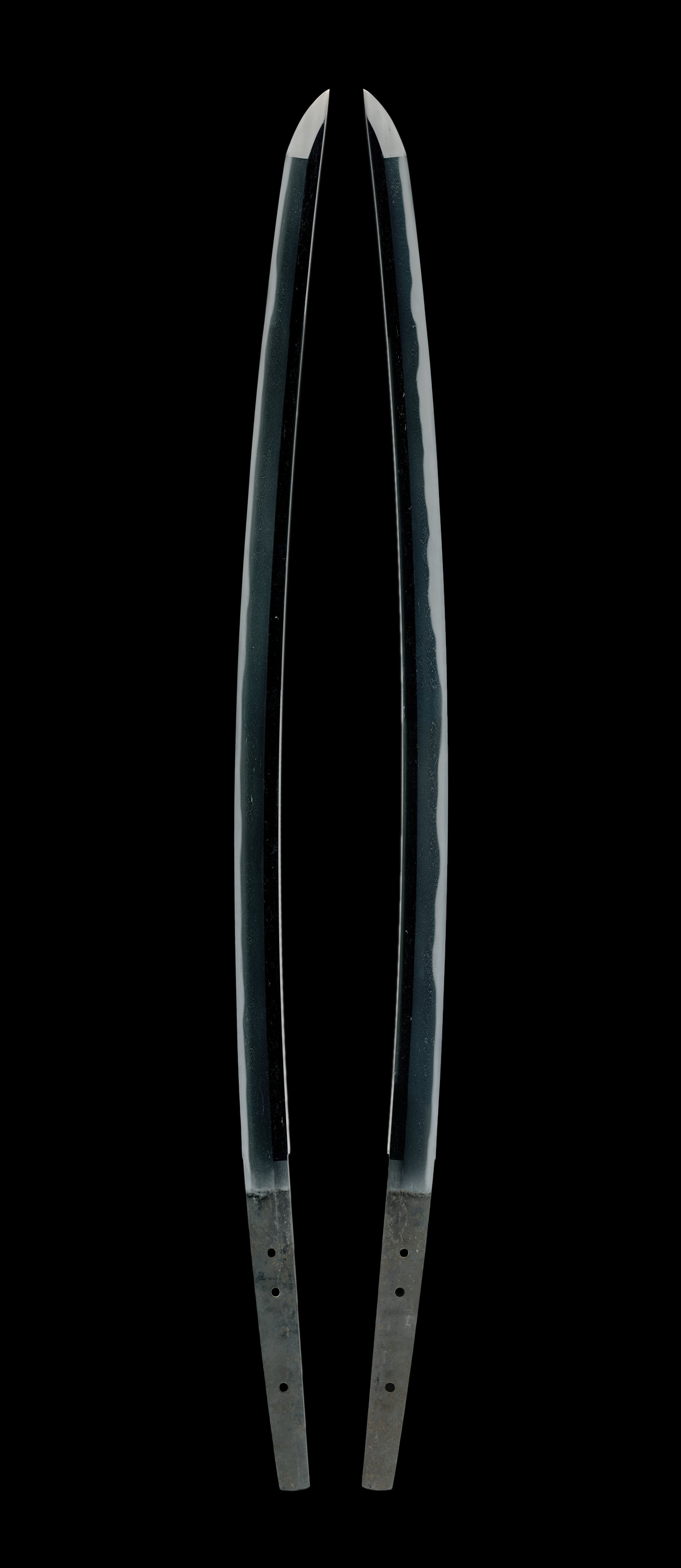
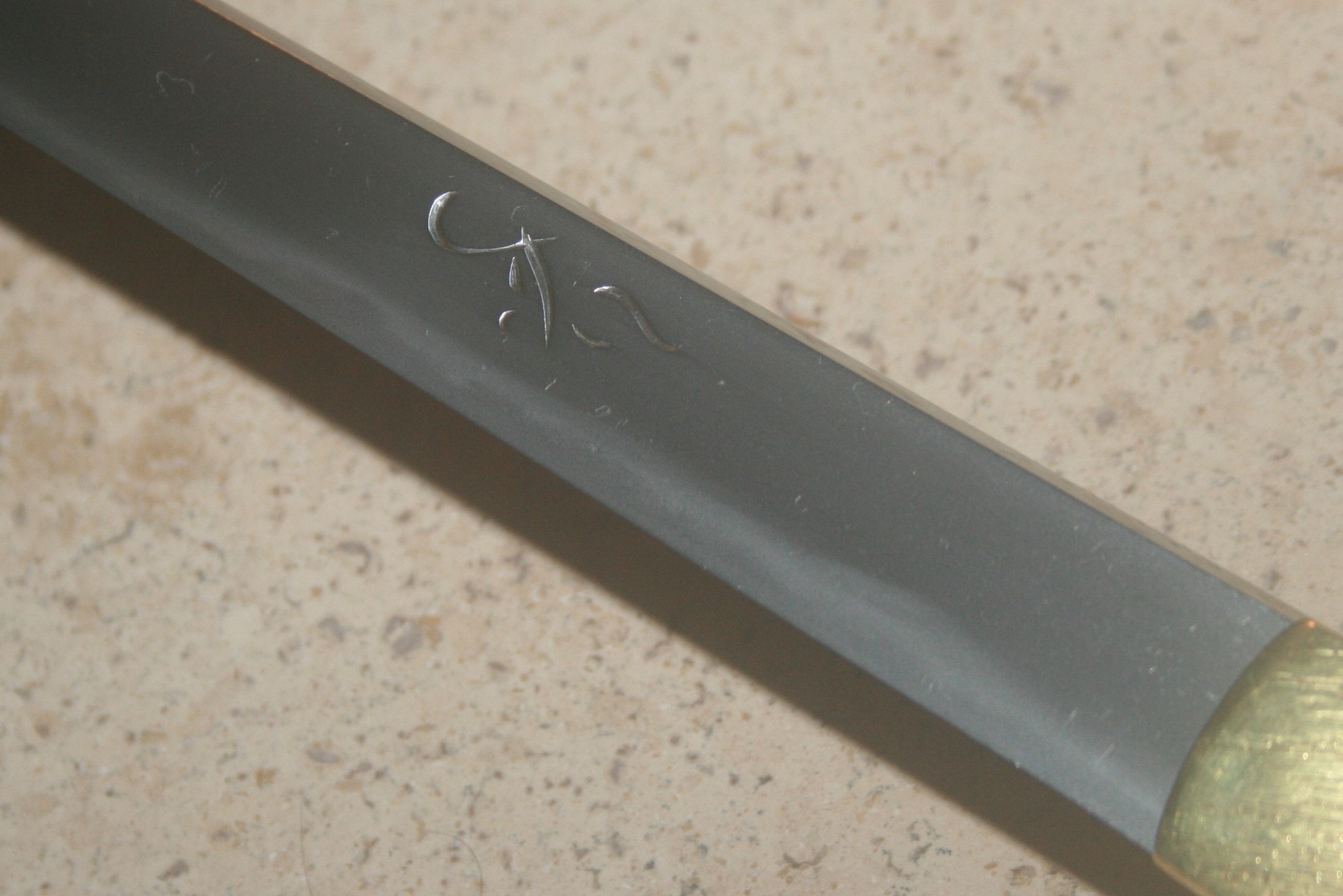
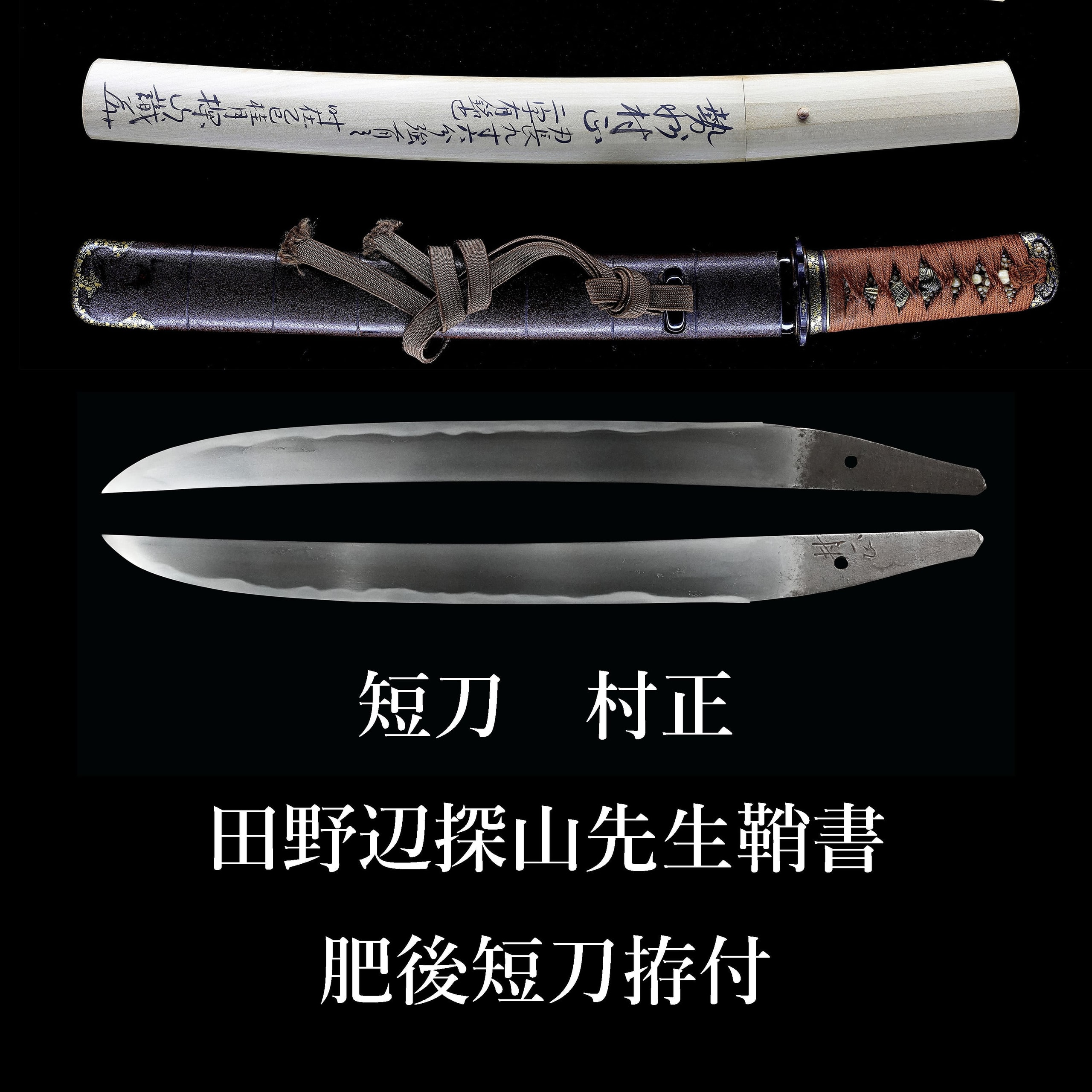
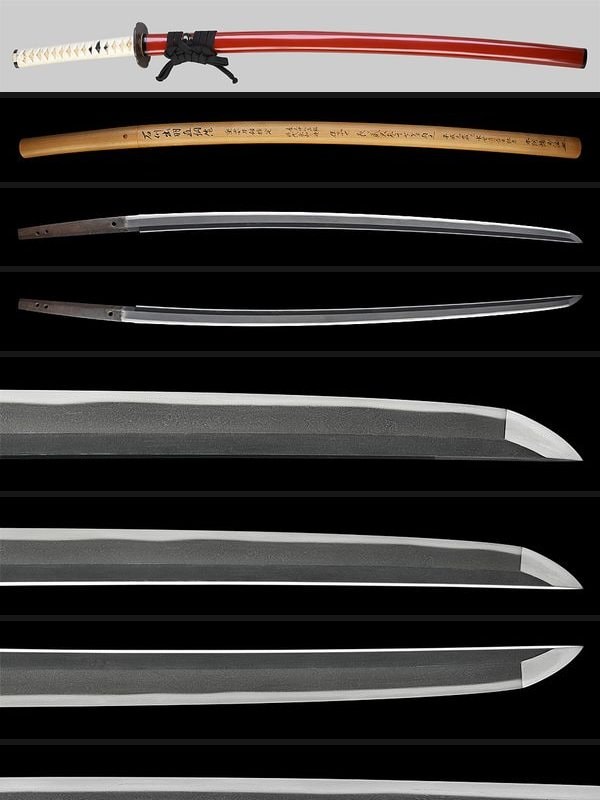
This is a mumei tanto attributed to Takagi Sadamune, a student of Sōshū Sadamune, and comes with NBTHK Juyo Token certification. The blade features a jigane in itame mixed with mokume, and a hamon in notare-chō with gunome, kinsuji, and sunagashi. It is mounted in a beautiful aikuchi koshirae with shibuichi metal kodogu by Hosono Sôzaemon Masamori.
mumei · Sōshū · Nanbokucho · nagasa 29.95cm · sori 0.5cm


Soshu line, working at Takagi in Omi (Goshu) · Omi · around 1356-1368
Fujishiro Jo-jo saku
1 piece on the market now
At its twenty-second Tokubetsu Juyo session the NBTHK designated an o-suriage mumei katana whose explanation opens with the smith himself, recording that Takagi Sadamune was a man of Takagi in Goshu and "is traditionally said to be a disciple of Soshu Sadamune"[[c:1]]. He worked in Omi from the very end of the Kamakura period into early Nanbokucho, taking his name from the place he lived. The relationship to his master is the whole of his identity in the published record. An old theory once held that the two Sadamune were one man, but the published sources reject it: judging by workmanship Takagi falls a degree short of Hikoshiro Sadamune, and "seeing him as a disciple is the settled view of recent years"[[c:2]], a pupil who, like Kyo Nobukuni, carried his teacher's manner faithfully. Genuine signed work is almost absent. The texts count only one or two reliable tanto, with no tachi and no certainly dated piece, so his hand is known from a handful of small signed wakizashi and read into the mumei katana the shinsa attributes to him.
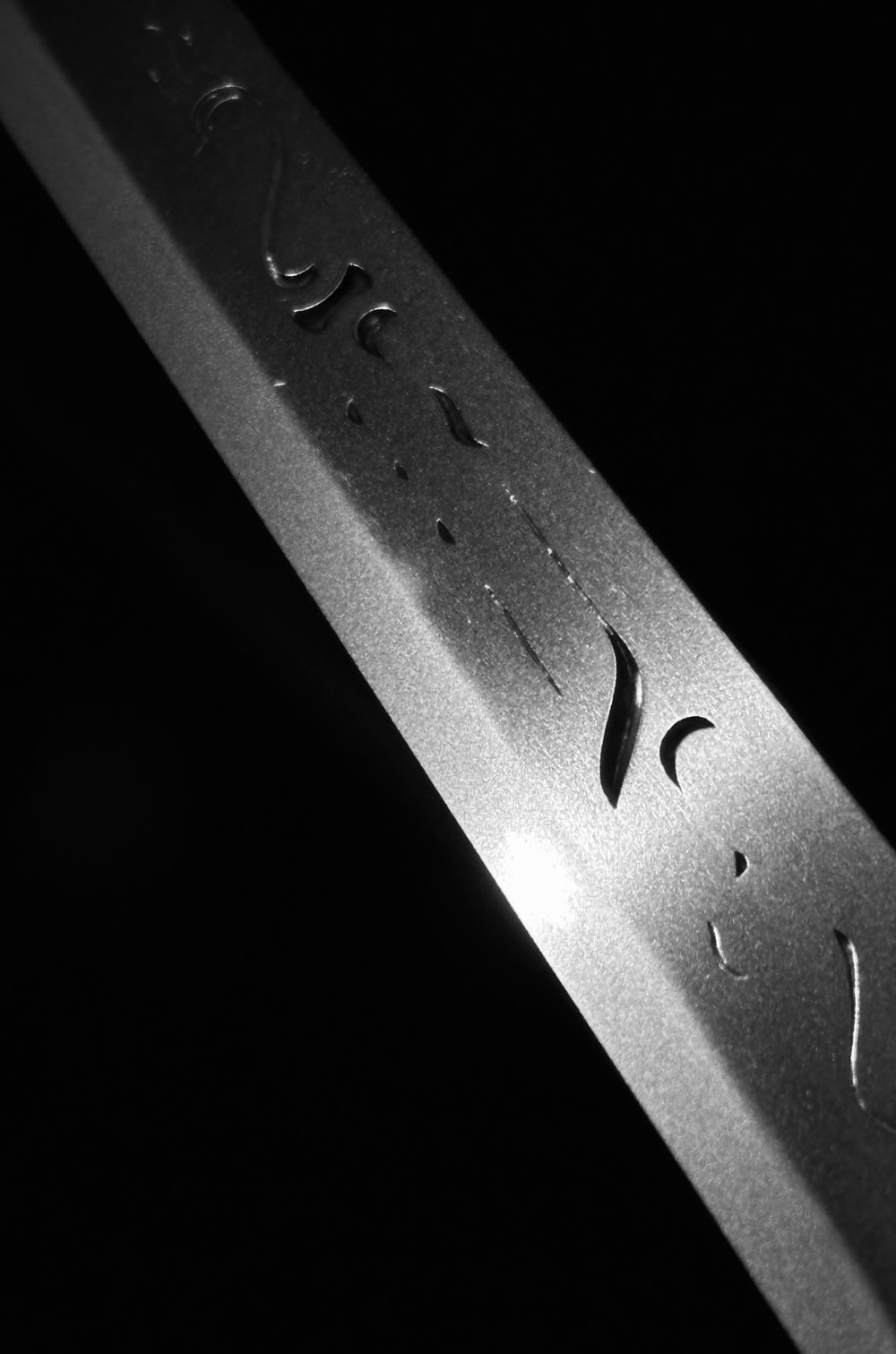
His characteristic hand is a quiet one. The temper the published sources call his specialty is a shallow notare, often a ko-notare, mixed with gunome, ashi and yo entering, the nioi deep and the nie thickly adhered, and over it sunagashi runs abundantly with frequent kinsuji and hotsure and yubashiri along the habuchi. The boshi is midare-komi or runs straight into a ko-maru with hakikake, often tending to a point. Across his blades the chisel is the Soshu devotional program his master made famous: bonji, suken and gomabashi, with a bo-hi carried through the longer pieces, and the published sources affirm that these traits in both ji and ha express the distinctive features of Takagi Sadamune. The carving is what ties the attribution to the Sadamune circle. On one prewar suguha tanto the connoisseur Honma judged the maker precisely from the accomplished bonji and suken and the ken-shaped tang, ranking it "a superior work of the Soshu tradition"[[c:3]].
The jigane is where his hand parts from the master's. He forges an itame, on the better pieces mixing mokume and well-packed with thick ji-nie and entering chikei, but the grain tends to stand a little, and the steel as a whole is calmer. The standing kantei line states the contrast plainly. Set beside Soshu Sadamune, "the forging stands somewhat more, the chikei are fewer in most, the temper takes notare as its principal tone with abundant sunagashi, the workings and variation within the ha are comparatively simple, and the nioiguchi in general tends toward shizumi, the subdued quality that marks a Takagi piece"[[c:4]]. Another text puts it more shortly: "compared with Soshu Sadamune his ji and ha have less brilliance, and his chikei are fewer"[[c:5]]. The few quietest works carry a suguha-cho that turns shallowly to notare with hotsure and ko-nie, calm at first sight yet rich in activity, and his home province surfaces now and then as a coarse, zanguri texture in the hada the texts read as Goshu.
The surviving work divides cleanly into two registers, and the NBTHK dates each blade by the build it shows. Most of the record is the o-suriage mumei katana of the grand Nanbokucho shape: wide in body with little taper, a shallow or rather high sori, a chu-kissaki or an extended o-kissaki, almost always with a bo-hi run through, the period read from the wide construction alone. The other register is the small, ubu format that carries his only signatures, hira-zukuri and kata-kiriha-zukuri tanto and ko-wakizashi, wide and sun-nobi with thin kasane and a three-faceted mune, the nakago ubu with a ken-form tip and katte-sagari file marks. Kata-kiriha-zukuri recurs across this group, a construction that saw only a brief vogue at the end of Kamakura but that the published sources name as a form favored by Soshu Sadamune and the followers said to be his, Amaro Toshinaga and Takagi Sadamune among them. Old oshigata even reproduce Takagi pieces bearing Kenmu-era dates, though none reliable and dated together survives, and Honma recorded that the genuine signed works known to him came to only two tanto, one of them retempered.
What distinguishes him is exactly his nearness to the master, which makes him the kantei trap in person. The published sources warn that an unsigned Takagi katana can at first glance be taken for Soshu Sadamune himself, and that an old suguha tanto on his line was even appraised as a superior Soshu work. The attribution turns not on flamboyance but on the quieter tells the judges name: the standing hada, the fewer chikei, the simpler internal activity and the subdued nioiguchi. He stands at the Kamakura-Nanbokucho turn beside fellow Sadamune followers, carrying the perfected Soshu manner west into Omi rather than founding a manner of his own. His mark is a faithful, slightly quieter Soshu hand, distinguished within the school by his standing itame and shizumi nioiguchi where they fall short of the master's brilliance, and by the bonji and suken carving that anchors the attribution there.
Fujishiro grades him Jo-jo saku. He has no National Treasures and no Important Cultural Properties; his record runs instead through the prewar Juyo Bijutsuhin and the higher modern NBTHK tiers, forty designated works on record, two at Tokubetsu Juyo and thirty-six at Juyo, thirty-eight in the two upper tiers together. Among the prewar pieces is a signed tanto recorded as a treasured possession of the Taiko, Toyotomi Hideyoshi, and several of his mumei katana rest on Hon'ami attributions, one bearing "an origami by Hon'ami Kochu"[[c:6]]. Provenance is recorded for only a handful, running through the Date family, the Mori family, the Hosokawa house and a katana set down as worn by the shogun Tokugawa Ienobu, with examples now held at the Tokugawa Art Museum and the Kurokawa Institute of Ancient Cultures. For the collector almost everything here is held rather than traded. There are no museum-locked National Treasures to set aside, but the prewar designations and the long-held provenances rarely move, and what can realistically be met is the Tokubetsu Juyo and Juyo tier, thirty-eight blades, nearly all o-suriage mumei katana or sun-nobi wakizashi resting on Hon'ami papers. Such a blade comes to light only from time to time, and one carrying his ubu ken-form nakago, the kata-kiriha construction or the Soshu carving is the most knowable kind of Takagi Sadamune a collector could hope to encounter.
Where Takagi Sadamune stands among comparable artisans: across all of nihontō, and within tradition, era, and period. The tiers (Foremost · Leading · Major · Notable) weigh official designations from the NBTHK and Japan's Agency for Cultural Affairs, together with historical honors of lasting repute such as the Sansaku and Meibutsu-chō.
Select a lens to see how it's measured.
Soshu-den · Sagami
46 pieces on the market now
The Soshu school took root in Kamakura, the seat of the Hojo regents in Sagami province, where the demand of the warrior government drew the country's leading smiths to a single town. The published sources count Awataguchi Kunitsuna of Yamashiro and the Bizen masters Kunimune and Sukezane among the immigrant pioneers of Kamakura sword-making, but the first native smith of Sagami, the man who cut his Kamakura residence and his dates into the nakago, was Shintogo Kunimitsu, reckoned the de facto founder of the Soshu-den. Learn more →
| Smith | Era | Designated |
|---|---|---|
| Masamune正宗 | 1288-1293 | 84 |
| Sadamune貞宗 | 1329-1331 | 86 |
| Go Yoshihiro義弘 | 1299-1302 | 54 |
| Akihiro秋廣 | 1346-1370 | 27 |
| Kunimitsu國光 | 1293-1322 | 69 |
We could not find an authenticity certificate on the seller’s listing. Japanese swords and fittings are normally papered by the NBTHK (or the NTHK). Without one, the attribution is the seller’s own assessment and has not been independently verified — treat it with caution and ask the dealer about certification before buying.
Three-day inspection period and seven-day return period; buyer notifies by email within three days of receipt, no reason needed; full refund once item returned undamaged and unaltered.
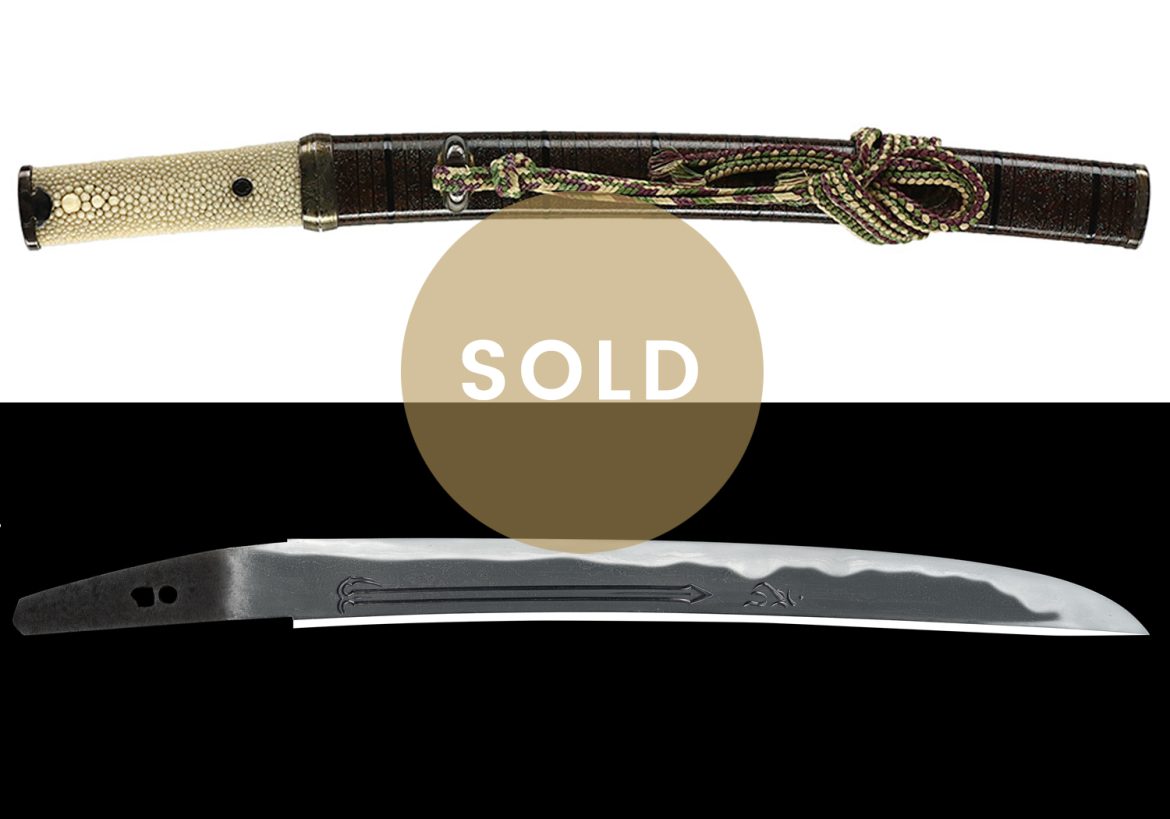
This is a mumei tanto attributed to Takagi Sadamune, a student of Sōshū Sadamune, and comes with NBTHK Juyo Token certification. The blade features a jigane in itame mixed with mokume, and a hamon in notare-chō with gunome, kinsuji, and sunagashi. It is mounted in a beautiful aikuchi koshirae with shibuichi metal kodogu by Hosono Sôzaemon Masamori.
mumei · Sōshū · Nanbokucho · nagasa 29.95cm · sori 0.5cm


Soshu line, working at Takagi in Omi (Goshu) · Omi · around 1356-1368
Fujishiro Jo-jo saku
1 piece on the market now
At its twenty-second Tokubetsu Juyo session the NBTHK designated an o-suriage mumei katana whose explanation opens with the smith himself, recording that Takagi Sadamune was a man of Takagi in Goshu and "is traditionally said to be a disciple of Soshu Sadamune"[[c:1]]. He worked in Omi from the very end of the Kamakura period into early Nanbokucho, taking his name from the place he lived. The relationship to his master is the whole of his identity in the published record. An old theory once held that the two Sadamune were one man, but the published sources reject it: judging by workmanship Takagi falls a degree short of Hikoshiro Sadamune, and "seeing him as a disciple is the settled view of recent years"[[c:2]], a pupil who, like Kyo Nobukuni, carried his teacher's manner faithfully. Genuine signed work is almost absent. The texts count only one or two reliable tanto, with no tachi and no certainly dated piece, so his hand is known from a handful of small signed wakizashi and read into the mumei katana the shinsa attributes to him.
His characteristic hand is a quiet one. The temper the published sources call his specialty is a shallow notare, often a ko-notare, mixed with gunome, ashi and yo entering, the nioi deep and the nie thickly adhered, and over it sunagashi runs abundantly with frequent kinsuji and hotsure and yubashiri along the habuchi. The boshi is midare-komi or runs straight into a ko-maru with hakikake, often tending to a point. Across his blades the chisel is the Soshu devotional program his master made famous: bonji, suken and gomabashi, with a bo-hi carried through the longer pieces, and the published sources affirm that these traits in both ji and ha express the distinctive features of Takagi Sadamune. The carving is what ties the attribution to the Sadamune circle. On one prewar suguha tanto the connoisseur Honma judged the maker precisely from the accomplished bonji and suken and the ken-shaped tang, ranking it "a superior work of the Soshu tradition"[[c:3]].
The jigane is where his hand parts from the master's. He forges an itame, on the better pieces mixing mokume and well-packed with thick ji-nie and entering chikei, but the grain tends to stand a little, and the steel as a whole is calmer. The standing kantei line states the contrast plainly. Set beside Soshu Sadamune, "the forging stands somewhat more, the chikei are fewer in most, the temper takes notare as its principal tone with abundant sunagashi, the workings and variation within the ha are comparatively simple, and the nioiguchi in general tends toward shizumi, the subdued quality that marks a Takagi piece"[[c:4]]. Another text puts it more shortly: "compared with Soshu Sadamune his ji and ha have less brilliance, and his chikei are fewer"[[c:5]]. The few quietest works carry a suguha-cho that turns shallowly to notare with hotsure and ko-nie, calm at first sight yet rich in activity, and his home province surfaces now and then as a coarse, zanguri texture in the hada the texts read as Goshu.
The surviving work divides cleanly into two registers, and the NBTHK dates each blade by the build it shows. Most of the record is the o-suriage mumei katana of the grand Nanbokucho shape: wide in body with little taper, a shallow or rather high sori, a chu-kissaki or an extended o-kissaki, almost always with a bo-hi run through, the period read from the wide construction alone. The other register is the small, ubu format that carries his only signatures, hira-zukuri and kata-kiriha-zukuri tanto and ko-wakizashi, wide and sun-nobi with thin kasane and a three-faceted mune, the nakago ubu with a ken-form tip and katte-sagari file marks. Kata-kiriha-zukuri recurs across this group, a construction that saw only a brief vogue at the end of Kamakura but that the published sources name as a form favored by Soshu Sadamune and the followers said to be his, Amaro Toshinaga and Takagi Sadamune among them. Old oshigata even reproduce Takagi pieces bearing Kenmu-era dates, though none reliable and dated together survives, and Honma recorded that the genuine signed works known to him came to only two tanto, one of them retempered.
What distinguishes him is exactly his nearness to the master, which makes him the kantei trap in person. The published sources warn that an unsigned Takagi katana can at first glance be taken for Soshu Sadamune himself, and that an old suguha tanto on his line was even appraised as a superior Soshu work. The attribution turns not on flamboyance but on the quieter tells the judges name: the standing hada, the fewer chikei, the simpler internal activity and the subdued nioiguchi. He stands at the Kamakura-Nanbokucho turn beside fellow Sadamune followers, carrying the perfected Soshu manner west into Omi rather than founding a manner of his own. His mark is a faithful, slightly quieter Soshu hand, distinguished within the school by his standing itame and shizumi nioiguchi where they fall short of the master's brilliance, and by the bonji and suken carving that anchors the attribution there.
Fujishiro grades him Jo-jo saku. He has no National Treasures and no Important Cultural Properties; his record runs instead through the prewar Juyo Bijutsuhin and the higher modern NBTHK tiers, forty designated works on record, two at Tokubetsu Juyo and thirty-six at Juyo, thirty-eight in the two upper tiers together. Among the prewar pieces is a signed tanto recorded as a treasured possession of the Taiko, Toyotomi Hideyoshi, and several of his mumei katana rest on Hon'ami attributions, one bearing "an origami by Hon'ami Kochu"[[c:6]]. Provenance is recorded for only a handful, running through the Date family, the Mori family, the Hosokawa house and a katana set down as worn by the shogun Tokugawa Ienobu, with examples now held at the Tokugawa Art Museum and the Kurokawa Institute of Ancient Cultures. For the collector almost everything here is held rather than traded. There are no museum-locked National Treasures to set aside, but the prewar designations and the long-held provenances rarely move, and what can realistically be met is the Tokubetsu Juyo and Juyo tier, thirty-eight blades, nearly all o-suriage mumei katana or sun-nobi wakizashi resting on Hon'ami papers. Such a blade comes to light only from time to time, and one carrying his ubu ken-form nakago, the kata-kiriha construction or the Soshu carving is the most knowable kind of Takagi Sadamune a collector could hope to encounter.
Where Takagi Sadamune stands among comparable artisans: across all of nihontō, and within tradition, era, and period. The tiers (Foremost · Leading · Major · Notable) weigh official designations from the NBTHK and Japan's Agency for Cultural Affairs, together with historical honors of lasting repute such as the Sansaku and Meibutsu-chō.

Select a lens to see how it's measured.
Soshu-den · Sagami
46 pieces on the market now
The Soshu school took root in Kamakura, the seat of the Hojo regents in Sagami province, where the demand of the warrior government drew the country's leading smiths to a single town. The published sources count Awataguchi Kunitsuna of Yamashiro and the Bizen masters Kunimune and Sukezane among the immigrant pioneers of Kamakura sword-making, but the first native smith of Sagami, the man who cut his Kamakura residence and his dates into the nakago, was Shintogo Kunimitsu, reckoned the de facto founder of the Soshu-den. Learn more →
| Smith | Era | Designated |
|---|---|---|
| Masamune正宗 | 1288-1293 | 84 |
| Sadamune貞宗 | 1329-1331 | 86 |
| Go Yoshihiro義弘 | 1299-1302 | 54 |
| Akihiro秋廣 | 1346-1370 | 27 |
| Kunimitsu國光 | 1293-1322 | 69 |
We could not find an authenticity certificate on the seller’s listing. Japanese swords and fittings are normally papered by the NBTHK (or the NTHK). Without one, the attribution is the seller’s own assessment and has not been independently verified — treat it with caution and ask the dealer about certification before buying.
Three-day inspection period and seven-day return period; buyer notifies by email within three days of receipt, no reason needed; full refund once item returned undamaged and unaltered.