War at home and trade abroad made Muromachi Bizen the busiest forge region in Japan: a century of Sengoku demand after the Ōnin War, and export missions to Ming China carrying blades by the tens of thousands.
 NihontoWatchNihontoWatch
委託販売お預かり品 特別貴重刀剣 備前國住長船祐定 祐定について 祐定(すけさだ)は、備前国(現在の岡山県)で栄えた長舩派の刀工である。 祐定は末備前を代表する刀工と言われておりますが、南北朝時代末期の明徳二年から江戸時代まで、複数の刀工「祐定」を称した刀が確認されており、祐定と銘を切る刀工は六十人を超えていたとも言われている。 その中でも「与三左衛門尉」「彦兵衛尉」「源兵衛尉」らが高名である。 本刀 、技量の高い仕事が施された拵に入り、鞘から抜けば豪快な焼刃、光に透かせば刃は良く働く。 刀剣鑑賞を愉しませてくれるそんな御刀でございます。 焼き刃を見れば、祐定と鑑定できる祐定特有の焼き刃が確認できます。 美術鑑賞以外にも居合、物斬りもできる一振 ご依頼主様が57万円でご購入されたお品の委託出品となります。 商品の状態 *刃切れ・刃絡み・刃こぼれ・曲がり・撓え・膨れ・匂い切れ・駆け出しなどございません。 物打ち所に刃絡み心の鍛え傷出るも刃先には届いておりません。切先の刃先に見える傷は擦れ傷で鍛え傷ではありません。(擦れ傷は研磨で修復可) 拵入り 鞘、柄ガタツキなし。 登録証及び鑑定書在籍確認済み 内容共に合致 ただし鑑定書は再発行されたことがあるとのことで協会にて現物確認依頼、結果、本旧鑑定書、現物同じものと認められる(2026.7.23日) *時代による、汚れ、細かな擦れ傷,劣化等はご了承ください。写真を参考にしてください。
NihontoWatchOffered by Yazawa Shokai
This piece has sold
Get an email when a new Hachirōjirō Sukesada piece hits the market.

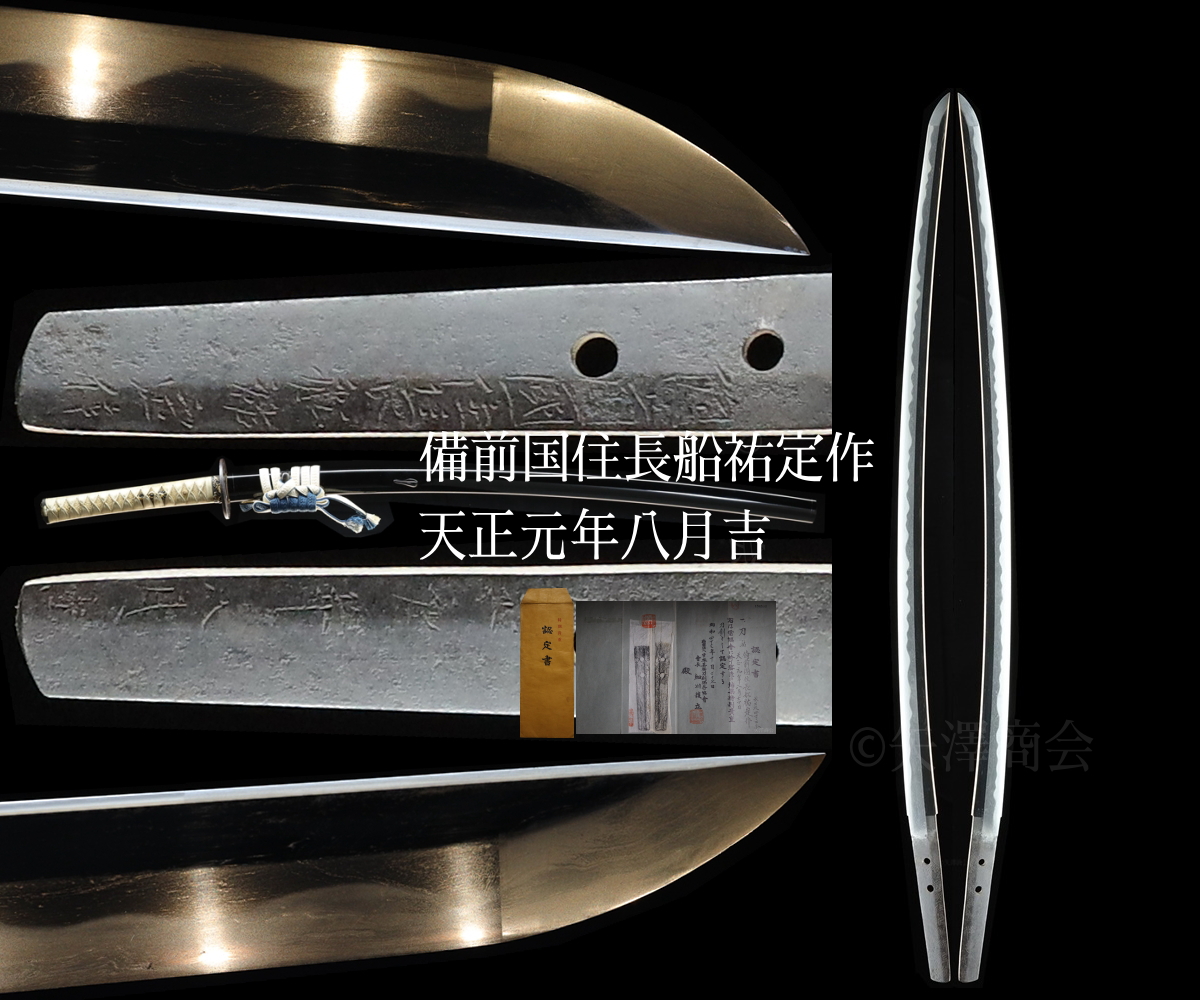



As written by the shop
Bizen-den · Bizen · around 1532-1555
1 piece on the market now
Bizen-den · Bizen
Phase: Sue-Bizen末備前· 1441–1596
53 pieces on the market now
The last great chapter of Osafune unfolds in the Eisho and Tenbun years of the late Muromachi, when the riverside workshop turned its accumulated craft toward an age of constant war. Where Oei-Bizen had looked backward, reviving the tachi shape and the choji temper of the Kamakura masters under Yasumitsu and Morimitsu, Sue-Bizen faces forward into Sengoku demand. The leading hands carry the same family characters one generation further: the Sukesada group, headed by Yosazaemon-no-jo Sukesada and the Hikobee-jo Sukesada said to be his father, alongside Katsumitsu (often Jirozaemon-no-jo), Munemitsu, Tadamitsu of the Heiroemon-jo line, and the Kiyomitsu smiths Magoemon-no-jo and Gorozaemon-no-jo. The setsumei draw a sharp line through their output. Commissioned blades, chumon-uchi, were signed with full zokumyo, dated, and frequently inscribed with the name of the ordering party, as on the Katsumitsu and Sadamitsu naginata of Meio 8 made for the Miyake of Kojima, a house that fed into the Ukita. Below them ran the bulk trade of kazu-uchimono, the arms that supplied the warring provinces, and it is the chumon-uchi masters that the designations preserve. What the steel does in this window is distinct from every earlier Osafune register. The shape is the uchigatana: wide mihaba with thick kasane, pronounced sakizori, an extended chu-kissaki or o-kissaki, and a short nakago suited to the katate-uchi one-handed draw, a body unlike the koshizori tachi of Ko-Osafune or the broad Nanbokucho profile of Soden-Bizen. The forging tightens into ko-itame over which a midare-utsuri stands faintly rather than vividly, weaker than the bright reflection of the founding generation.
The signature temper is the open-waisted koshi-no-hiraita gunome, splitting at the heads into fukushiki compound midare and mixed with togariba and choji; it is nioi-based with ko-nie and a bright nioiguchi, with ashi, yo, kinsuji and small tobiyaki worked through. Against this, Soden-Bizen had pushed Soshu nie and notare, while the founders had tempered flamboyant choji over a vivid utsuri. Two specialties branch off the gunome base: the Kiyomitsu and Tadamitsu suguha, calm and tightly forged, and the hitatsura of high-tempered pieces with long muneyaki and yubashiri, seen in the warlord-smiths Akamatsu Masanori and Ishikawa Yukihisa. To kantei a Sue-Bizen blade is to read the body first and the temper second. The compact uchigatana sugata with thick kasane and a short tang fixes the late-Muromachi date; the faint utsuri over dense ko-itame keeps it in Bizen; the open-waisted compound gunome names the group. The masters then separate by hand: Katsumitsu is set apart by the abundant choji he folds into the gunome, yielding a more florid, brilliant dekiguchi than his peers; Tadamitsu and the Kiyomitsu smiths are read out by their suguha, with Magoemon-no-jo's itame standing in mokume to distinguish his ground. The cutting reputation is documented directly, as on the Hikobee-jo Sukesada katana of Keicho 5 carrying a tameshi inscription naming the tester Ichihara Hachibee. Provenance threads through the supplementary signatures: Masanori's reward blades cut for his retainers, the Miyake names tying the workshop to the Ukita, and the Shinjuro Sukesada whose few large works may have ended in the Tensho flood. The horimono carried from the mainline, bonji with rendai, Fudo Myoo, and shrine dedications, persist on these blades as a final mark of the line. Learn more →
| Smith | Era | Designated |
|---|---|---|
| Sukesada祐定 | 1504-1551 | 72 |
| Sukesada祐定 | 1532-1583 | 18 |
| Sukesada祐定 | 1547-1592 | 8 |
| Sukesada祐定 | 1487-1521 | 5 |
| Sukesada祐定 | 1532-1573 | 3 |
Bizen in the Muromachi period
War at home and trade abroad made Muromachi Bizen the busiest forge region in Japan: a century of Sengoku demand after the Ōnin War, and export missions to Ming China carrying blades by the tens of thousands.
This work carries older NBTHK “Kichō”-era papers, which the NBTHK no longer issues and largely disavows today. To confirm the attribution, submission to an official Japanese examination body (such as the NBTHK or NTHK) for modern certification could be considered.