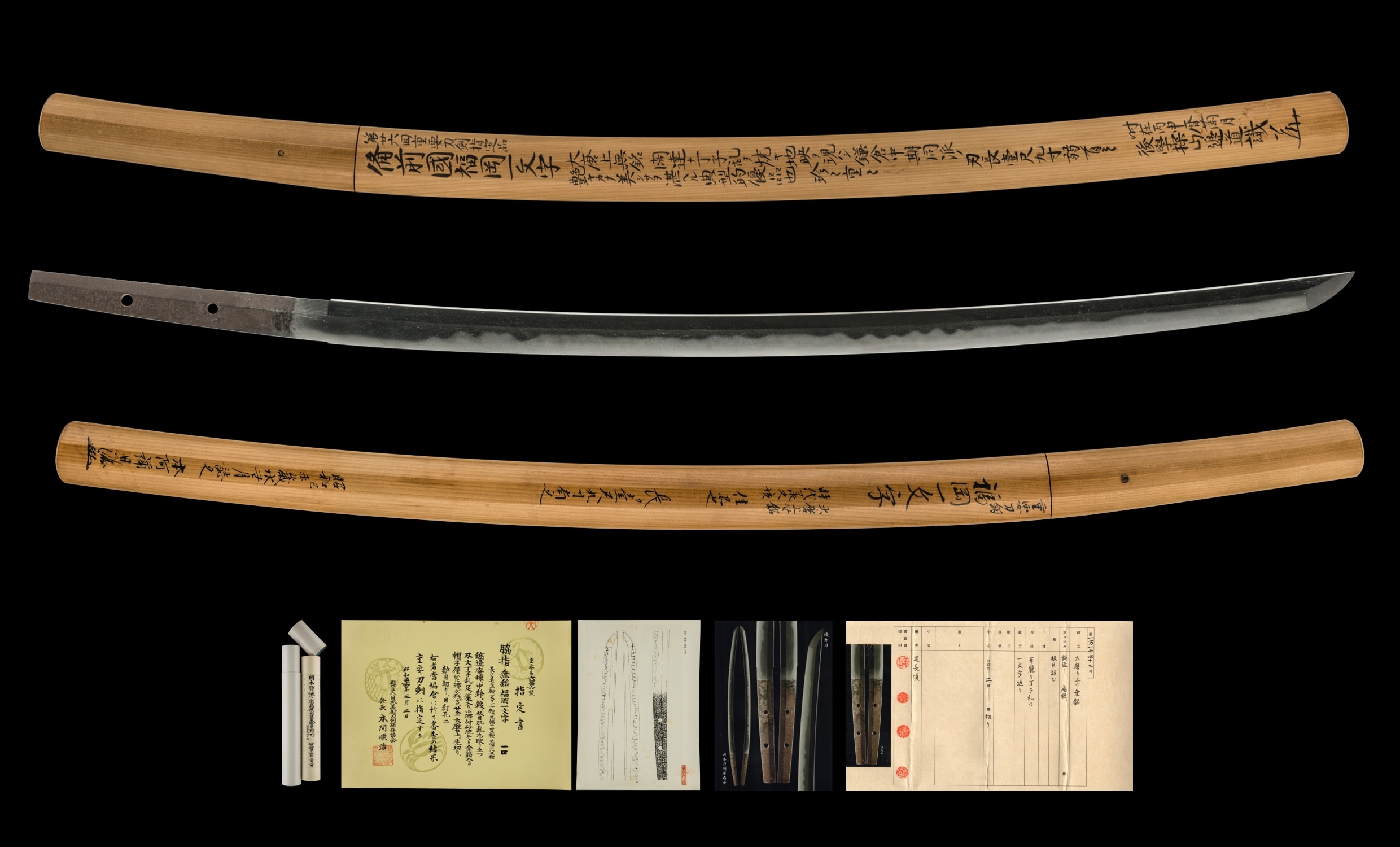
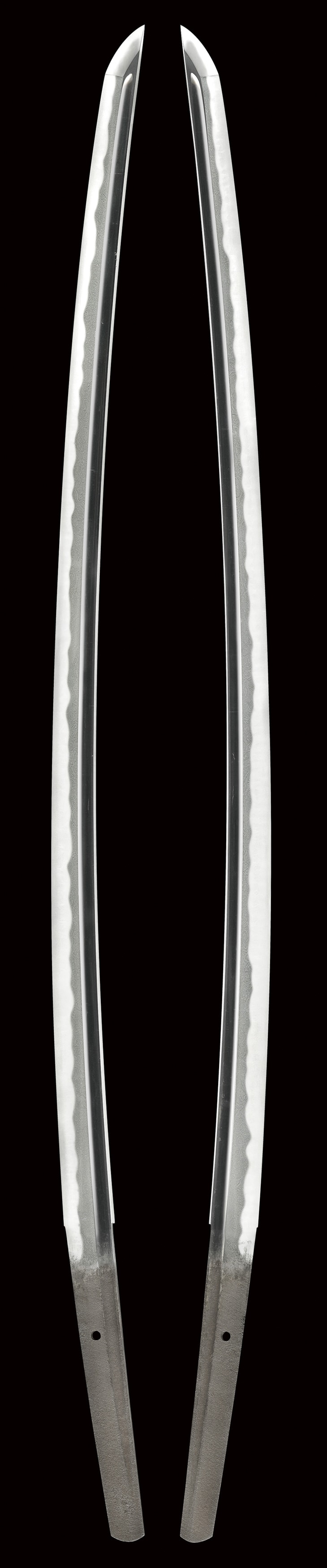
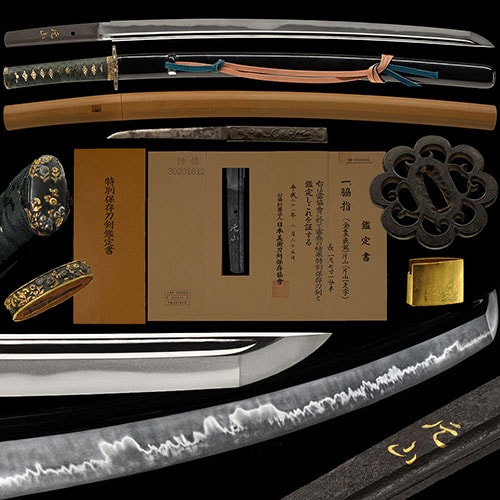
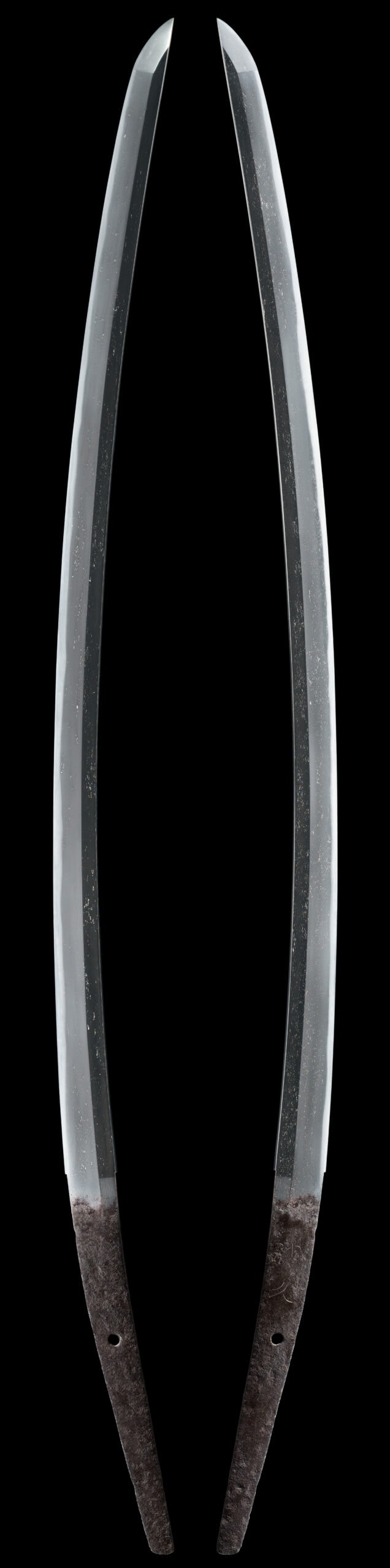
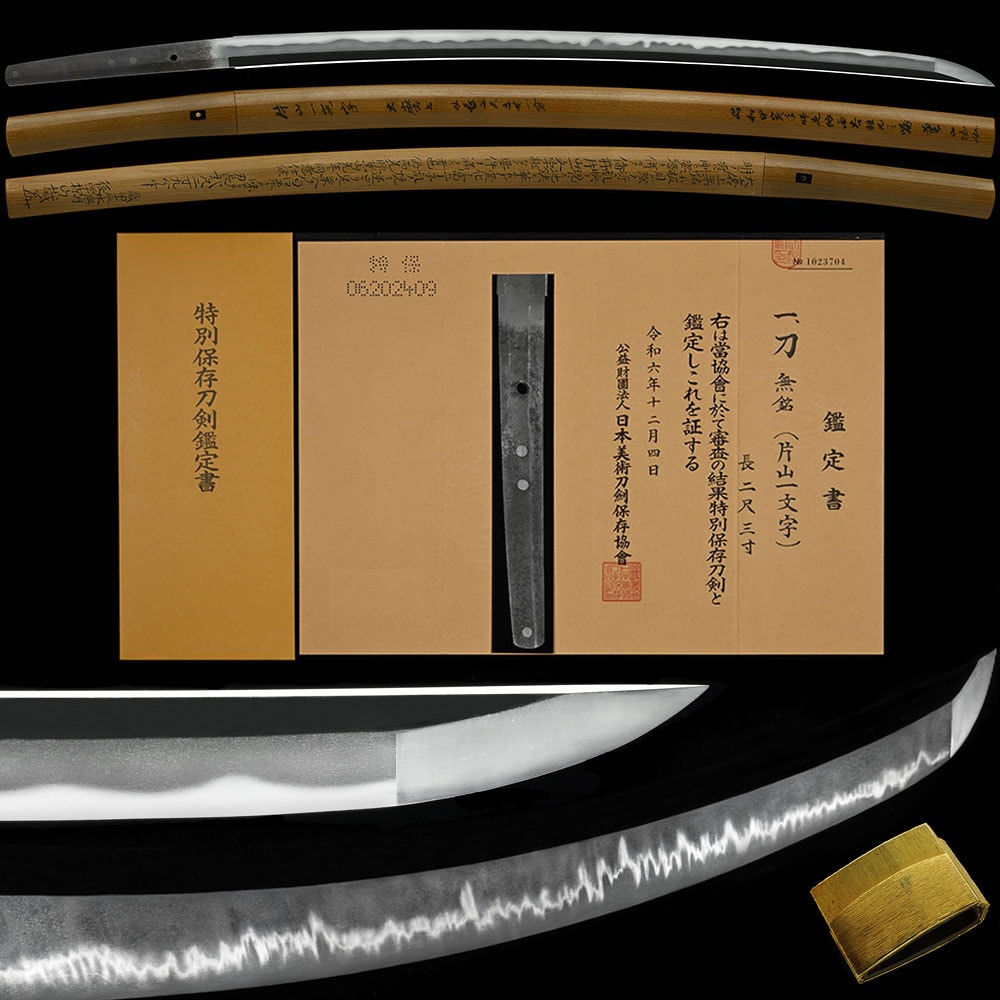
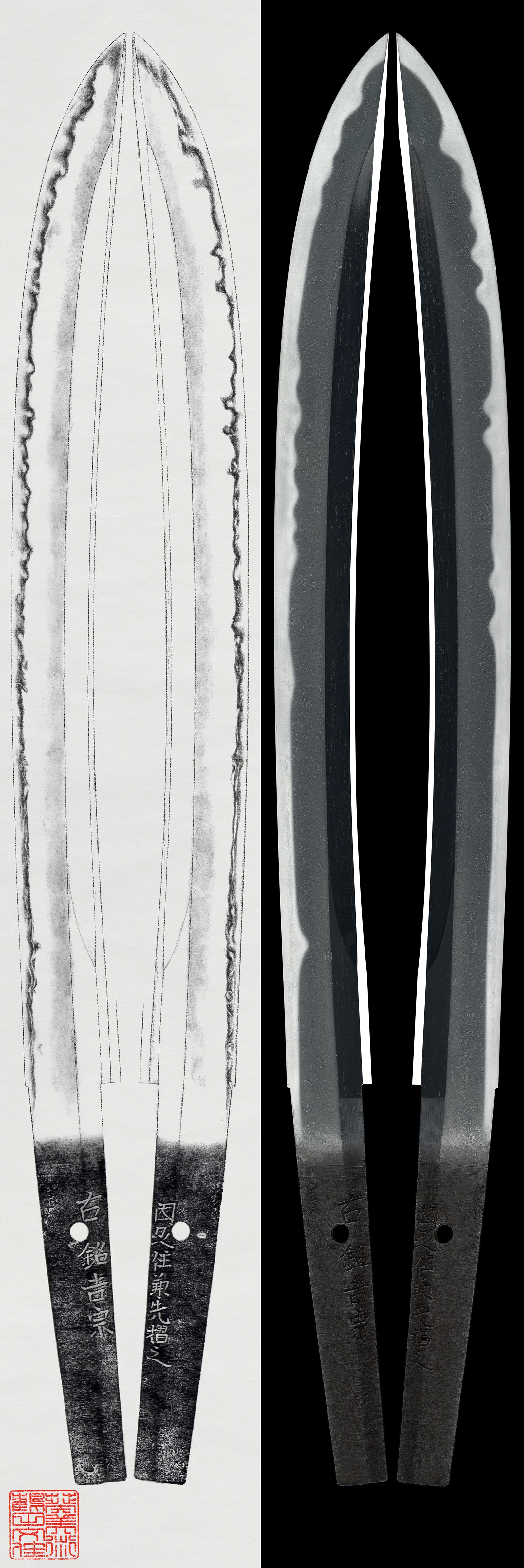
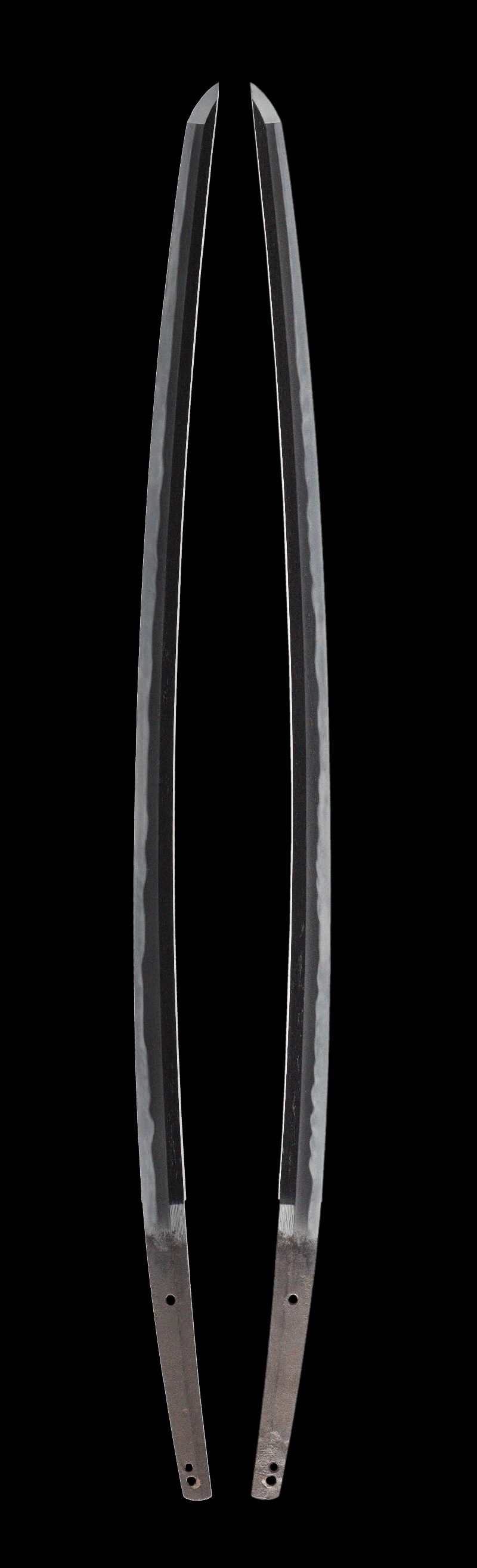
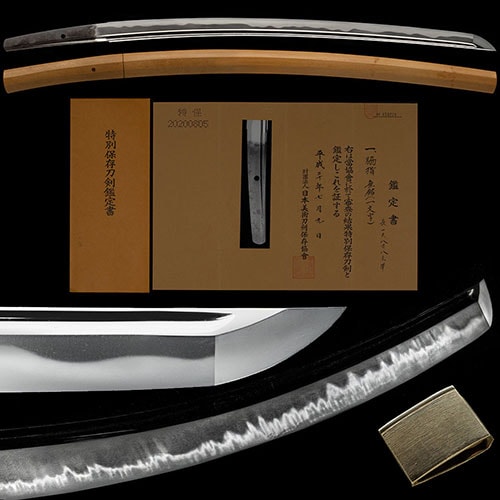
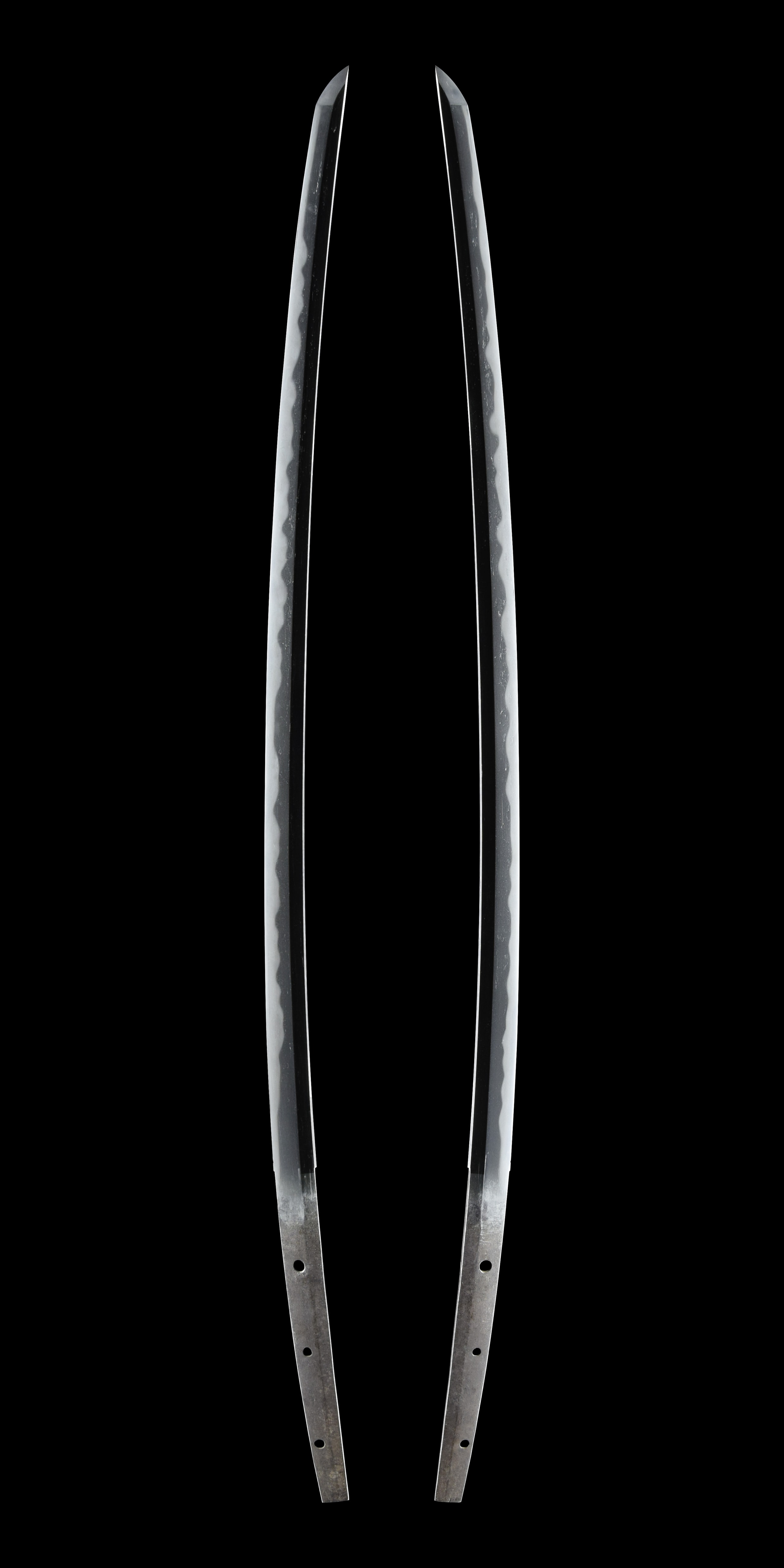
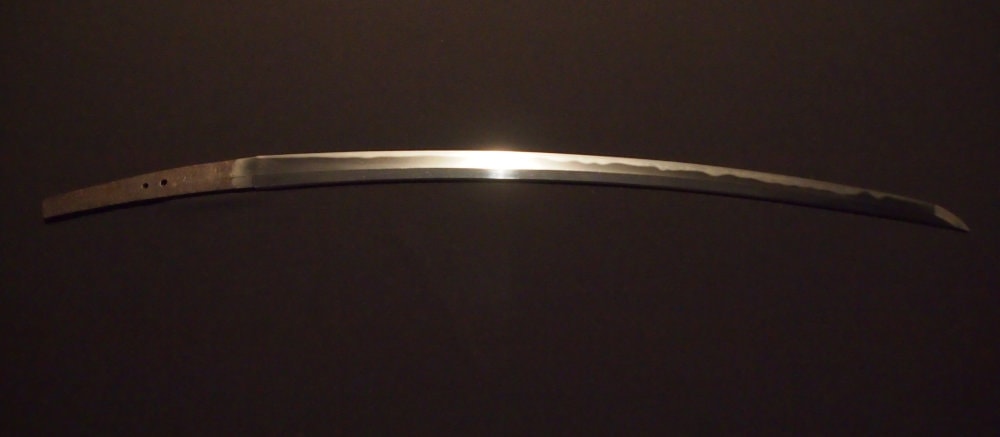
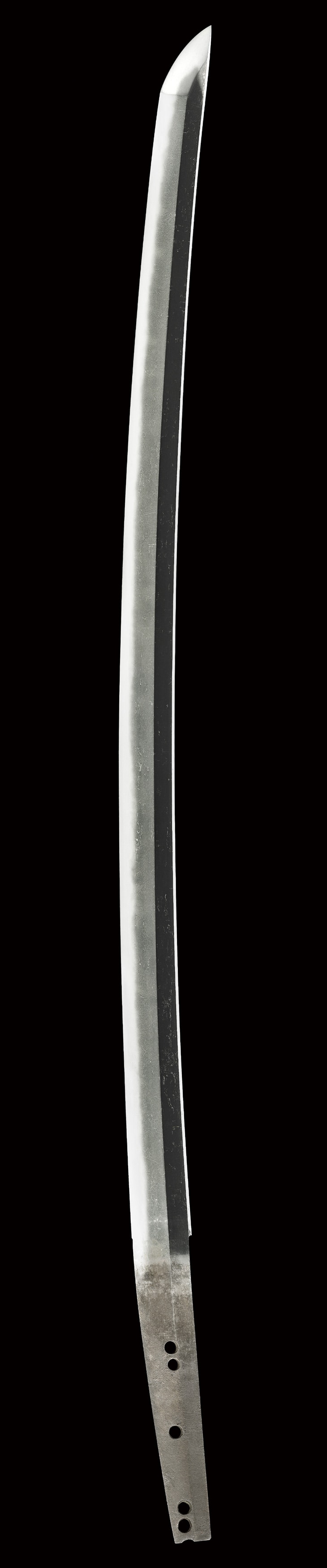
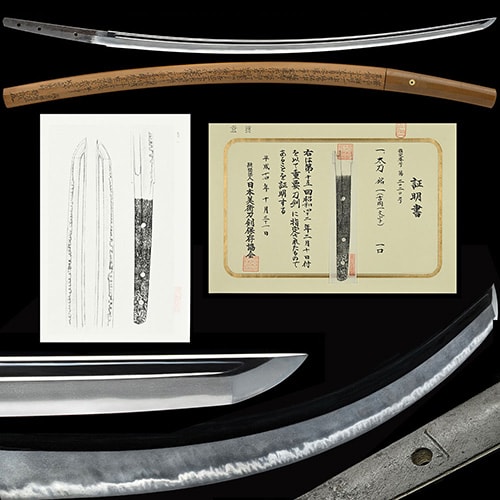
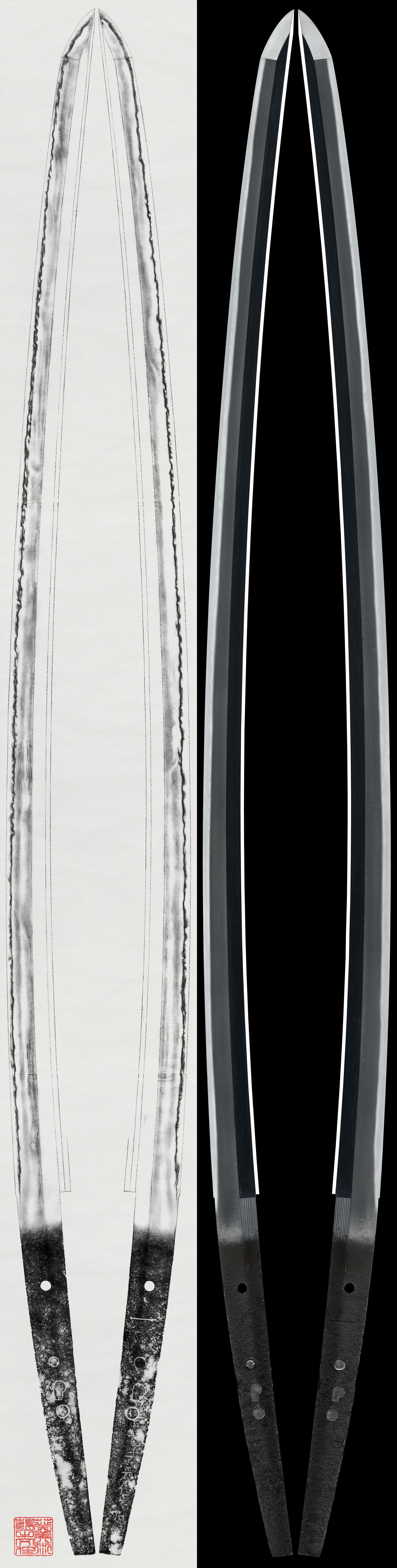
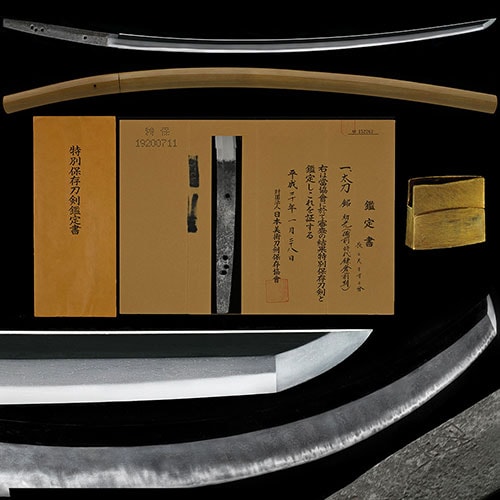
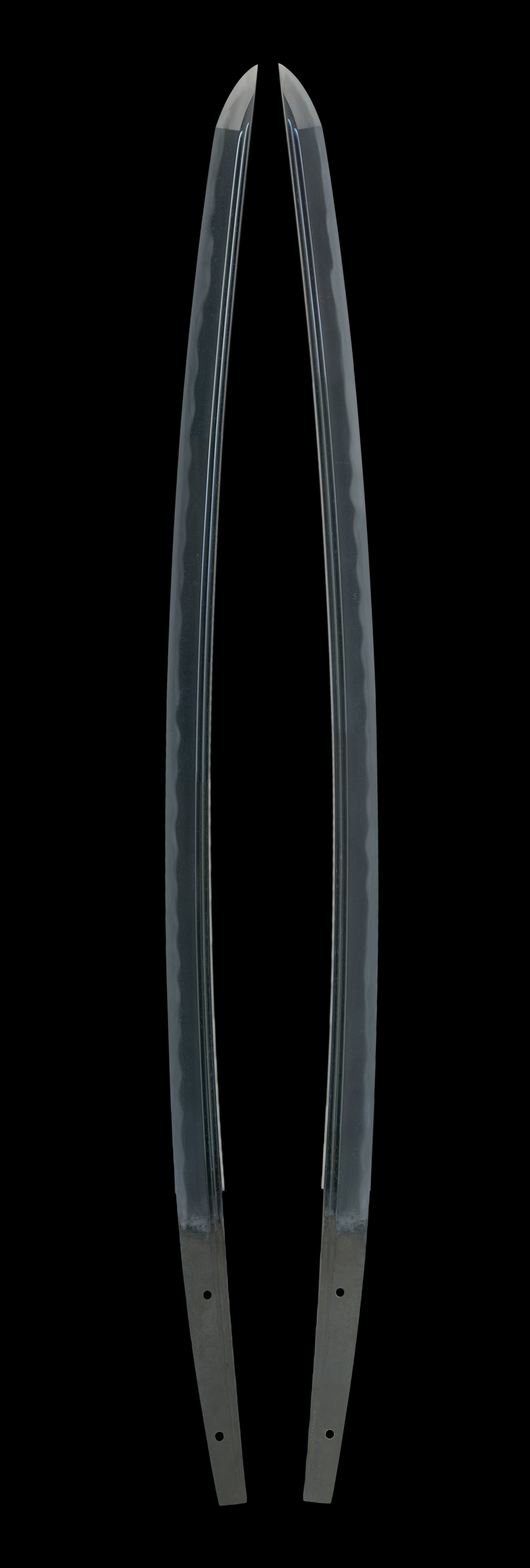
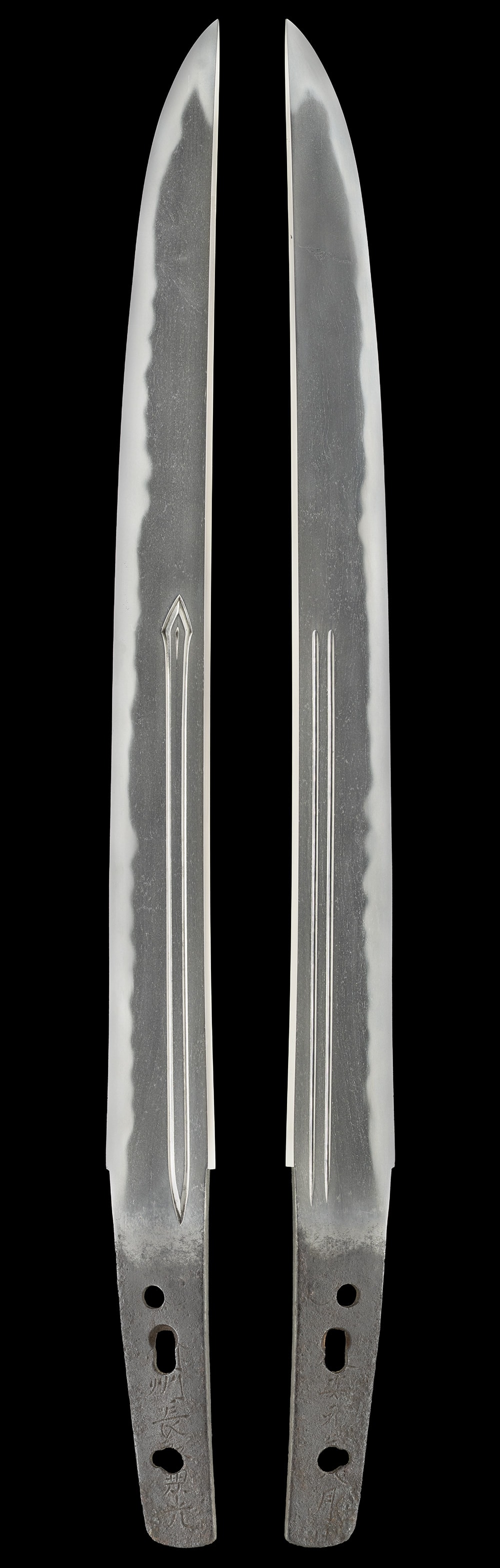
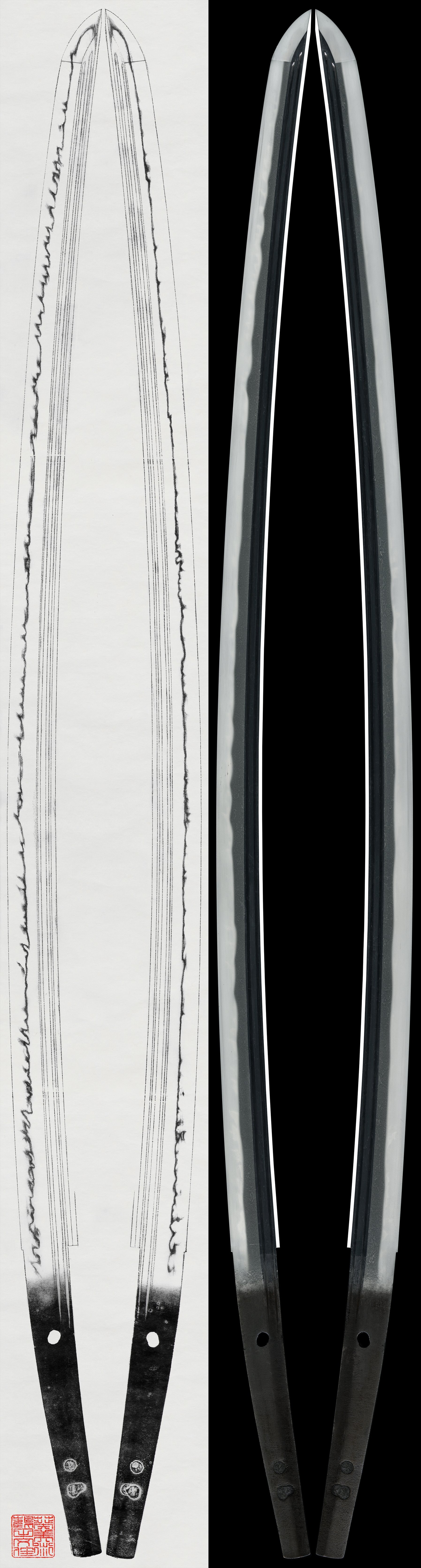
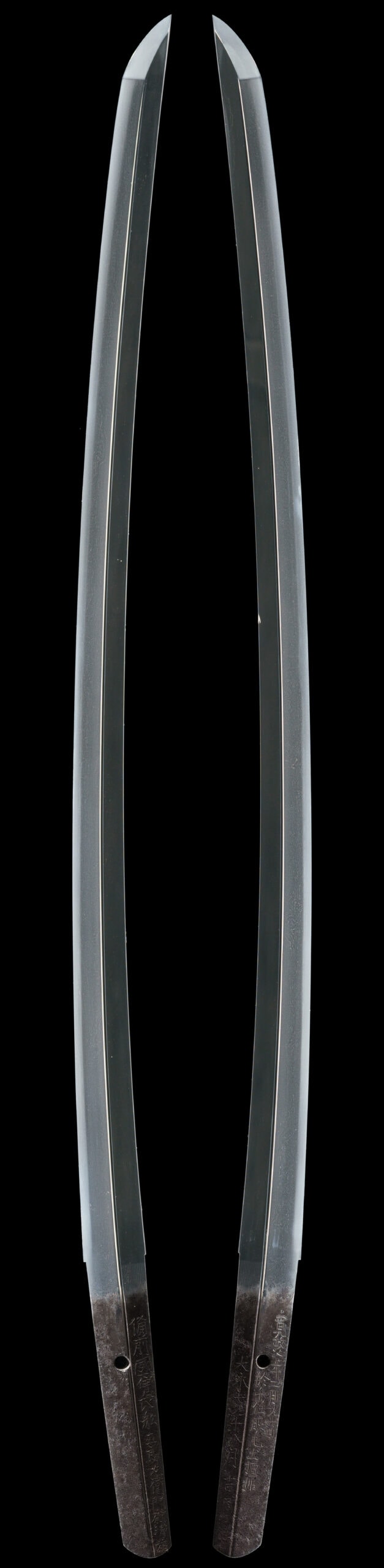
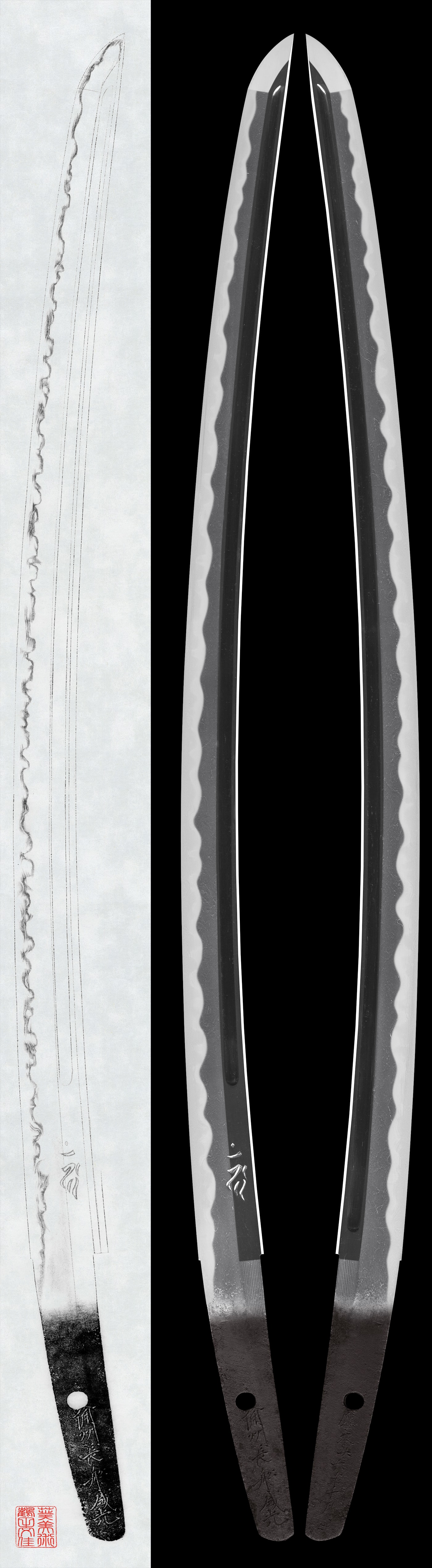
This is a katana by Katayama Ichimonji Norifusa, a swordsmith representing the Ichimonji school in the middle of the Kamakura period. The blade features a brilliant Midare-Utsuri and Saka-Chouji hamon. It is designated as a Juyo Token.
mei · Katayama Ichimonji · Kamakura · nagasa 68.1cm · sori 1.8cm

Katayama Ichimonji (Bizen/Bitchu) · Bizen · around 1249-1256
Fujishiro Jo-jo saku · Tōken Taikan top 1%
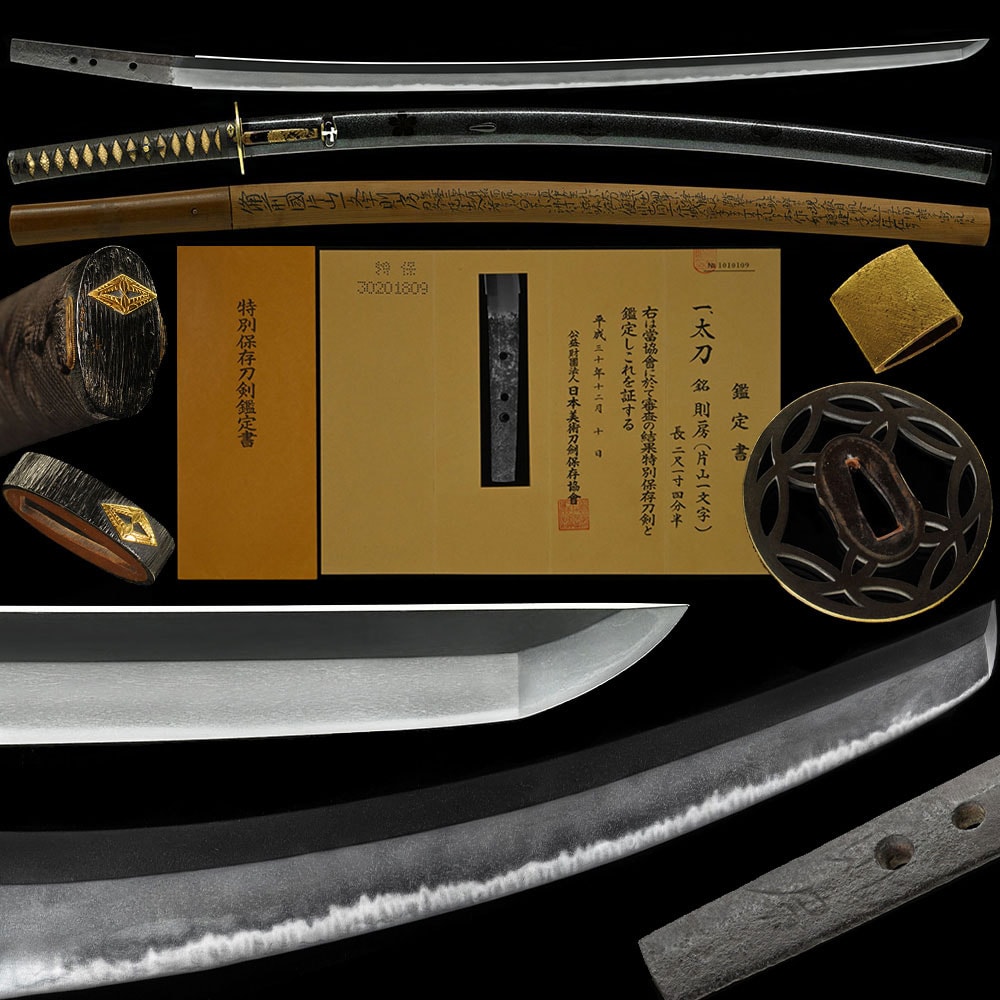
Norifusa worked in the middle of the Kamakura period and is one of the masters who carried the Ichimonji school to its height. The published sources place him with Yoshifusa and Sukezane[[c:1]] as the smiths who tempered the most flamboyant choji-midare of their day, and read him as one of the representative hands of the mid-Kamakura Ichimonji[[c:2]]. He is held to be the son of Sukefusa of the Fukuoka Ichimonji, and because he later moved to the district of Katayama[[c:3]] his line is called the Katayama Ichimonji.
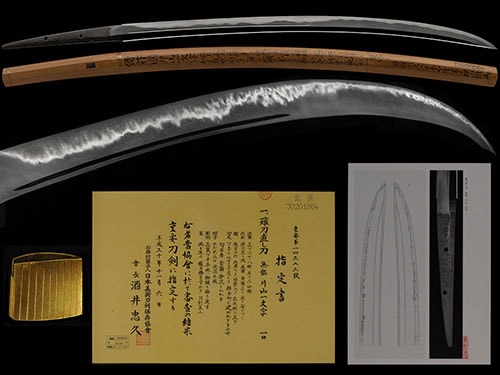
Where that district lay is itself unsettled. The older view placed Katayama in Bitchu, but the published sources now raise the possibility that it was a Katayama near Fukuoka in Bizen[[c:4]], and leave the question open for further study. The name carries a second complication. The signatures show several distinct hands and the workmanship covers a wide range[[c:5]], so that the name is thought to have run for several generations rather than belonging to a single man. The surviving signed pieces are limited to tachi, yet he was famed from of old as a master of the naginata[[c:6]], and many of the mumei works attributed to that form carry his name.
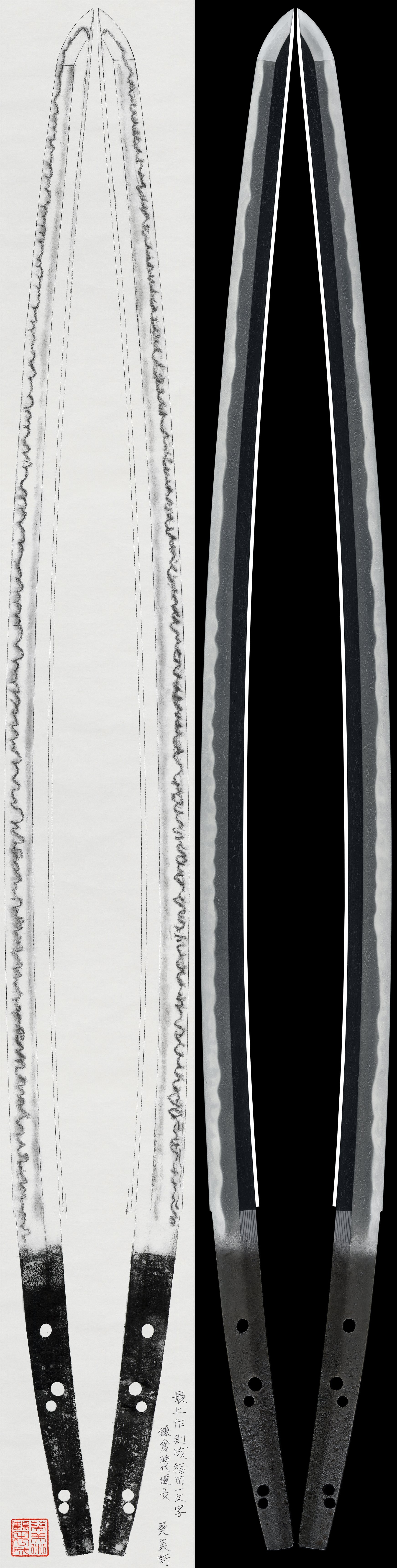
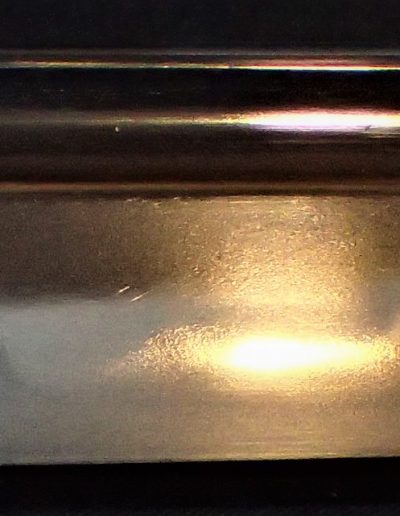
The forging is an itame, well packed in the finer pieces and standing in the bolder ones, with mokume mixed in and fine chikei entering. Over it stands the feature the school is read by: a clear midare-utsuri, the steel bright and cold, the ji-nie laid down to a fine mist. This vivid utsuri over a lively itame is the floor on which everything else is built, and it is named again and again in the published sources as the first thing that marks a Norifusa.
The hamon is a choji-midare with gunome mixed in, ashi and yo entering well, in deep nioi with ko-nie, a little sunagashi and kinsuji, and here and there tobiyaki and muneyaki along the upper half. The recognition point is set out plainly: his merit lies in a jigane that is strong and clear, a choji-midare that leans back, and fine ashi within the ha[[c:7]]. The back-leaning saka-gakari is what parts him from his peers, for his choji tends to a somewhat smaller pattern than that of Yoshifusa and Sukezane[[c:8]], and that reverse tendency, set against the short fine ashi, is the surest tell of his hand.
The boshi is the point a careful eye holds to. It runs midare-komi to a small round, often turning back with a pointed tendency and brushing out in hakikake, the published sources recording on one blade a boshi that is midare-komi with hakikake, the point of the omote turning back with a pointed tendency[[c:9]]. On the bolder pieces the omote can show a yakitsume tendency while the ura turns in ko-maru and sweeps; the swept, pointed tip is as much his mark as the leaning choji below it, and a flat ko-maru without that brushwork should give the kantei pause.
For the collector Norifusa stands among the least attainable of the koto masters. Fujishiro grades him Jo-jo saku, and his work counts National Treasures and a high tally of Tokubetsu Juyo blades among it, set with the histories of the great houses: a tachi that descended to the Yanagisawa daimyo of Yamatokoriyama, blades held by the Tokugawa shogun house and by Tokugawa Yoshimune and Tsunayoshi, others through the Ikeda and the Takasu Matsudaira, and a naginata recorded in the treasure inventory of the Uesugi. One of the Yanagisawa tachi still carries the memory of a Honami Koshu origami. Almost nothing he made ever reaches the market: the named pieces sit in institutions such as the Kyushu National Museum, the Seikado Bunko Art Museum, the Tokyo Fuji Museum and the Fukuyama Art Museum, and a blade by his hand coming to trade is closer to a once-in-a-career event than a purchase to be planned for.
Where Norifusa stands among comparable artisans: across all of nihontō, and within tradition, era, and period. The tiers (Foremost · Leading · Major · Notable) weigh official designations from the NBTHK and Japan's Agency for Cultural Affairs, together with historical honors of lasting repute such as the Sansaku and Meibutsu-chō.
Select a lens to see how it's measured.
Bizen-den · Bitchu
Phase: Fukuoka Ichimonji福岡一文字· 1207–1288
1 piece on the market now
Centered at Fukuoka in Bizen across the middle Kamakura decades, this window is the loud heart of the Ichimonji school, the moment when the ichi-mark workshops pushed their chōji tempering to its showiest extreme. The setsumei repeatedly name the same triad as its representative hands: Norifusa, Sukezane, and Yoshifusa, a grouping cited again and again as the smiths who forged the most flamboyant chōji-midare of the period. Learn more →
| Smith | Era | Designated |
|---|---|---|
| Norifusa則房 | 1249-1256 | 38 |
| Kageshige景重 | 1394-1428 | 0 |
| Nobutsugu延次 | 1278-1288 | 0 |
| Noritsune則常 | 1394-1428 | 0 |
| Sanetoshi眞利 | 1260-1261 | 0 |
A blade of top-grade workmanship and condition, formally judged to rank with a nationally recognized Important Art Object (Jūyō Bijutsuhin). Awarded only at the NBTHK’s competitive annual examination.
Of Japan’s roughly 2.5 million registered swords, only 12,307 (about 1 in 203) have ever attained Jūyō.
The NBTHK (Nihon Bijutsu Tōken Hozon Kyōkai, the Society for the Preservation of Japanese Art Swords) is a public-interest incorporated foundation founded in 1948 and supervised by Japan’s Agency for Cultural Affairs (Bunkachō); it is based at the Japanese Sword Museum in Tokyo. Its expert panels physically examine each submitted work (shinsa) and issue a certificate (kanteishō) ranking it by artistic and historical merit. NBTHK papers are the most widely recognized standard of authentication for Japanese swords and fittings.
NBTHK official siteReturns/exchanges/cancellations not accepted after shipment except for significant defects; if defective, return/exchange possible within 3 days of arrival (return shipping paid by customer).

This is a katana by Katayama Ichimonji Norifusa, a swordsmith representing the Ichimonji school in the middle of the Kamakura period. The blade features a brilliant Midare-Utsuri and Saka-Chouji hamon. It is designated as a Juyo Token.
mei · Katayama Ichimonji · Kamakura · nagasa 68.1cm · sori 1.8cm

Katayama Ichimonji (Bizen/Bitchu) · Bizen · around 1249-1256
Fujishiro Jo-jo saku · Tōken Taikan top 1%
Norifusa worked in the middle of the Kamakura period and is one of the masters who carried the Ichimonji school to its height. The published sources place him with Yoshifusa and Sukezane[[c:1]] as the smiths who tempered the most flamboyant choji-midare of their day, and read him as one of the representative hands of the mid-Kamakura Ichimonji[[c:2]]. He is held to be the son of Sukefusa of the Fukuoka Ichimonji, and because he later moved to the district of Katayama[[c:3]] his line is called the Katayama Ichimonji.
Where that district lay is itself unsettled. The older view placed Katayama in Bitchu, but the published sources now raise the possibility that it was a Katayama near Fukuoka in Bizen[[c:4]], and leave the question open for further study. The name carries a second complication. The signatures show several distinct hands and the workmanship covers a wide range[[c:5]], so that the name is thought to have run for several generations rather than belonging to a single man. The surviving signed pieces are limited to tachi, yet he was famed from of old as a master of the naginata[[c:6]], and many of the mumei works attributed to that form carry his name.
The forging is an itame, well packed in the finer pieces and standing in the bolder ones, with mokume mixed in and fine chikei entering. Over it stands the feature the school is read by: a clear midare-utsuri, the steel bright and cold, the ji-nie laid down to a fine mist. This vivid utsuri over a lively itame is the floor on which everything else is built, and it is named again and again in the published sources as the first thing that marks a Norifusa.
The hamon is a choji-midare with gunome mixed in, ashi and yo entering well, in deep nioi with ko-nie, a little sunagashi and kinsuji, and here and there tobiyaki and muneyaki along the upper half. The recognition point is set out plainly: his merit lies in a jigane that is strong and clear, a choji-midare that leans back, and fine ashi within the ha[[c:7]]. The back-leaning saka-gakari is what parts him from his peers, for his choji tends to a somewhat smaller pattern than that of Yoshifusa and Sukezane[[c:8]], and that reverse tendency, set against the short fine ashi, is the surest tell of his hand.
The boshi is the point a careful eye holds to. It runs midare-komi to a small round, often turning back with a pointed tendency and brushing out in hakikake, the published sources recording on one blade a boshi that is midare-komi with hakikake, the point of the omote turning back with a pointed tendency[[c:9]]. On the bolder pieces the omote can show a yakitsume tendency while the ura turns in ko-maru and sweeps; the swept, pointed tip is as much his mark as the leaning choji below it, and a flat ko-maru without that brushwork should give the kantei pause.
For the collector Norifusa stands among the least attainable of the koto masters. Fujishiro grades him Jo-jo saku, and his work counts National Treasures and a high tally of Tokubetsu Juyo blades among it, set with the histories of the great houses: a tachi that descended to the Yanagisawa daimyo of Yamatokoriyama, blades held by the Tokugawa shogun house and by Tokugawa Yoshimune and Tsunayoshi, others through the Ikeda and the Takasu Matsudaira, and a naginata recorded in the treasure inventory of the Uesugi. One of the Yanagisawa tachi still carries the memory of a Honami Koshu origami. Almost nothing he made ever reaches the market: the named pieces sit in institutions such as the Kyushu National Museum, the Seikado Bunko Art Museum, the Tokyo Fuji Museum and the Fukuyama Art Museum, and a blade by his hand coming to trade is closer to a once-in-a-career event than a purchase to be planned for.
Where Norifusa stands among comparable artisans: across all of nihontō, and within tradition, era, and period. The tiers (Foremost · Leading · Major · Notable) weigh official designations from the NBTHK and Japan's Agency for Cultural Affairs, together with historical honors of lasting repute such as the Sansaku and Meibutsu-chō.
Select a lens to see how it's measured.
Bizen-den · Bitchu
Phase: Fukuoka Ichimonji福岡一文字· 1207–1288
1 piece on the market now
Centered at Fukuoka in Bizen across the middle Kamakura decades, this window is the loud heart of the Ichimonji school, the moment when the ichi-mark workshops pushed their chōji tempering to its showiest extreme. The setsumei repeatedly name the same triad as its representative hands: Norifusa, Sukezane, and Yoshifusa, a grouping cited again and again as the smiths who forged the most flamboyant chōji-midare of the period. Learn more →
| Smith | Era | Designated |
|---|---|---|
| Norifusa則房 | 1249-1256 | 38 |
| Kageshige景重 | 1394-1428 | 0 |
| Nobutsugu延次 | 1278-1288 | 0 |
| Noritsune則常 | 1394-1428 | 0 |
| Sanetoshi眞利 | 1260-1261 | 0 |
A blade of top-grade workmanship and condition, formally judged to rank with a nationally recognized Important Art Object (Jūyō Bijutsuhin). Awarded only at the NBTHK’s competitive annual examination.
Of Japan’s roughly 2.5 million registered swords, only 12,307 (about 1 in 203) have ever attained Jūyō.
The NBTHK (Nihon Bijutsu Tōken Hozon Kyōkai, the Society for the Preservation of Japanese Art Swords) is a public-interest incorporated foundation founded in 1948 and supervised by Japan’s Agency for Cultural Affairs (Bunkachō); it is based at the Japanese Sword Museum in Tokyo. Its expert panels physically examine each submitted work (shinsa) and issue a certificate (kanteishō) ranking it by artistic and historical merit. NBTHK papers are the most widely recognized standard of authentication for Japanese swords and fittings.
NBTHK official siteReturns/exchanges/cancellations not accepted after shipment except for significant defects; if defective, return/exchange possible within 3 days of arrival (return shipping paid by customer).