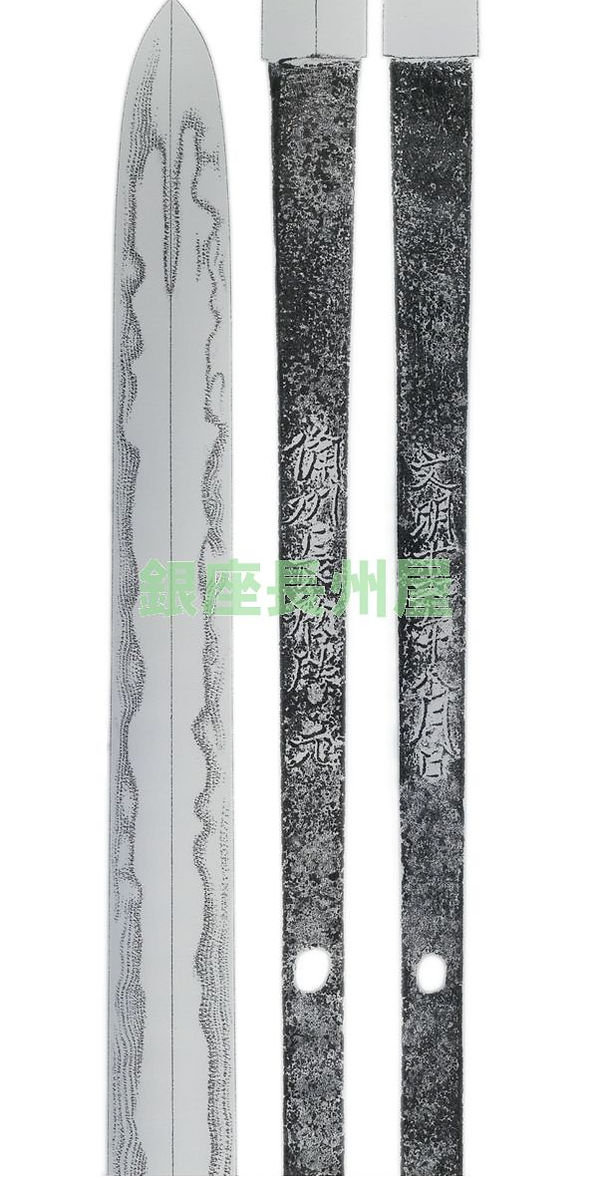
A katana dated the second month of Bunmei 16 (1484), signed in a large long mei Bizen no kuni ju Osafune Ukyo-no-suke Katsumitsu and incised below its bo-hi with the prayer-texts Tenka-taihei kokudo-an'on and Fuki-manpuku kai-ryo-mansoku, is the one work of this smith raised to Tokubetsu Juyo. Katsumitsu is one of the representative names of the mid- and late-Muromachi Osafune smiths called Sue-Bizen, and the published sources record more than ten smiths signing it from the middle of the Muromachi period onward. The signature compendia single out those who added a common name to the mei, above all Ukyo-no-suke Katsumitsu and his son Jirozaemon-no-jo. Ukyo-no-suke, the maker of this record, is placed ahead of his son in seniority and named the elder brother of Sakyo-no-shin Munemitsu (右京亮と銘するものは次郎左衛門尉よりは先輩であり). The same entry counts his technique among the best of Sue-Bizen[[c:1]].
His characteristic hand is the compound gunome of Sue-Bizen, carried higher and brighter with chōji. The published sources say that while his work often shows that gunome, he is especially adept, compared with the other Sue-Bizen smiths, at a more flamboyant effect with abundant chōji mixed into the midare[[c:2]]. On the Tokubetsu Juyo katana the temper mixes open-waisted gunome, chōji, ko-gunome and ko-chōji, with ashi and yō entering well, nioi prevailing with ko-nie, and yubashiri and a bright nioiguchi. The NBTHK reads it as showing the typical manner of Katsumitsu within Sue-Bizen work[[c:3]]. A solo katana of Bunmei 10 tempers chōji, ko-chōji and togariba in a high yakiba, with kinsuji, sunagashi and small tobiyaki in the lower half.
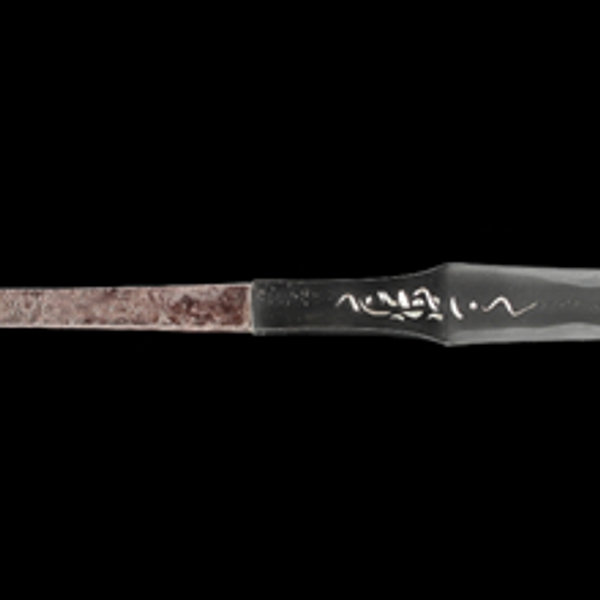
The jigane is a ko-itame or an itame mixed with mokume, well packed and flowing in places, with ji-nie that on the Bunmei 10 katana is fine as dust and with fine chikei. A midare-utsuri rises over it on most of his blades. Of a Bunmei 18 wakizashi made with Munemitsu, the published sources write that its midare-utsuri is clearer than on Bizen work of the same period and its temper rich in variation with conspicuous chōji[[c:4]]. The bōshi enters in midare and turns back in a ko-maru or with a pointed tendency. Both faces carry the devotional carving of the school: bō-hi in maru-dome with bonji below, kurikara, a sankō-tsuki-ken and the shrine name Hachiman Daibosatsu. The published sources take these to be the work of the school's specialist carvers. The shape is the late-Muromachi katate-uchi uchigatana, broad and thick with sakizori and a short tang with a flared end.
Most of his record is joint work. Eight of his ten NBTHK-designated blades are collaborations, seven of them with his younger brother Sakyo-no-shin Munemitsu, the two names cut in two lines, most over dates of the Bunmei era. Several were forged away from Osafune, at Kusakabe in Bitchu and at Kojima in Bizen. Two more Kusakabe pieces stand outside that record. A katana of Bunmei 18 (1486), tempered in a gunome of ko-nie mixed with chōji, was certified Juyo Bijutsuhin; the published sources name the pair as sons of Rokurozaemon Sukemitsu whose joint works are met comparatively often, and call this blade their representative work[[c:5]]. A wakizashi dated Bunmei 19 (1487), tempered in gunome mixed with chōji over an itame jigane, is designated an Important Cultural Property. The published sources call the Kojima wakizashi valuable material for tracing the brothers' movements[[c:6]]. They add that joint works of the two are by no means rare, yet because both smiths were highly skilled they are what sword lovers prize most[[c:7]]. A katana of Bunmei 16 adds Hikobei Tadamitsu as a third hand. Of it the NBTHK writes that it has scarcely seen another joint sword including Tadamitsu[[c:8]].
Beside the chōji-rich gunome he also tempers a calm suguha-based line, and the published sources compare it with the work of Tadamitsu. The three-way katana tempers a suguha-chō with ko-gunome, ashi and yō, sunagashi and kinsuji. The Kojima wakizashi of Bunmei 16 has a suguha base with shallow notare, hotsure and fine sunagashi, and the commentary calls it work especially often seen on Tadamitsu[[c:9]]. A katana forged with Munemitsu at Kojima in the same year tempers a suguha with a little gunome in ko-nie, the bōshi straight with a round turnback, and is valued for its inscription as much as its workmanship[[c:10]]. Another joint katana with Munemitsu tempers a chū-suguha with small ashi and a tight nioiguchi over a clean, well-packed ko-itame, carved with a suken and bonji at the waist. The NBTHK calls it typical and representative of the uchigatana of its day[[c:11]]. A tantō of Bunmei 11, made with Gorozaemon-no-jo Norimitsu when the elder smith was seventy-four, is broad, extended and very thick, with strong uchizori. It tempers a chū-suguha with a ko-gunome feeling in bright, clear ko-nie, and the NBTHK finds in it a vein of workmanship akin to Tadamitsu of the same school.
He has no National Treasures; his one Important Cultural Property is that Kusakabe wakizashi, held at the Tōshōgū in Tochigi. His NBTHK record is one Tokubetsu Juyo and nine Juyo blades, all signed and dated, most of them in the Bunmei era, and Fujishiro ranks him Sai-jo saku. The Tokubetsu Juyo katana, first designated Juyo in the seventh session, is called a rare work robust in build for its time and an excellent blade showing Katsumitsu at his best[[c:12]]. Its prayer-text inscriptions have no parallel elsewhere and were presumably made to a special order, though later smiths imitated them[[c:13]]. The Bunmei 11 tantō is accompanied by a mounting by Ishiguro Masami bearing the crests of the Okubo family, from whom it descends. Outside these, the Juyo blades are the works a collector may realistically meet, and a signed and dated Katsumitsu reaches the market only from time to time.
 NihontoWatch