War at home and trade abroad made Muromachi Bizen the busiest forge region in Japan: a century of Sengoku demand after the Ōnin War, and export missions to Ming China carrying blades by the tens of thousands.
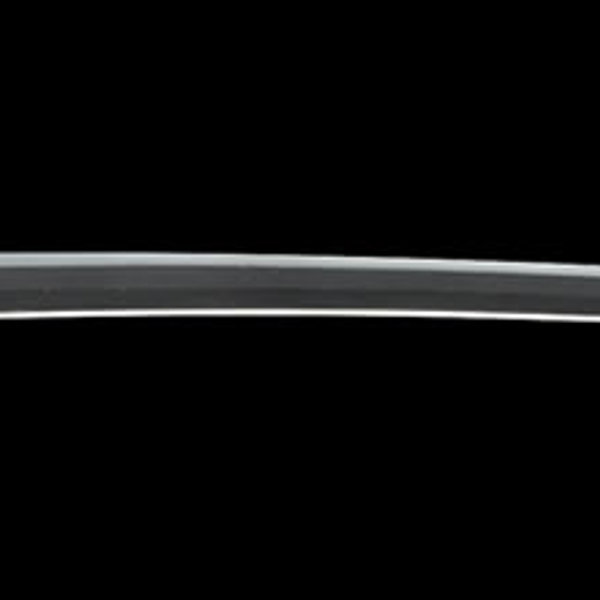
This katana is signed Katsumitsu and dated Bunmei 18th year (1486), a period when Katsumitsu, along with his brother Munemitsu, served the warlord Akamatsu Masanori. The blade is noted for its exceptionally thick original nakago, suggesting it was likely used as a companion sword (sashizoe) to a tachi, designed for quick drawing. Its short nakago also indicates suitability for single-handed use.
mei · Muromachi

Osafune (Sue-Bizen), Bizen · Bizen · around 1469-1487
Fujishiro Sai-jo saku · Tōken Taikan top 14%
5 pieces on the market now
A katana dated to the second month of Bunmei 16 (1484), signed in a large long mei Bizen no kuni ju Osafune Ukyo-no-suke Katsumitsu and carved on both faces with the prayer-texts Tenka-taihei kokudo-an'on and Fuki-manpuku kai-ryo-mansoku, stands as the recognized height of this smith's hand and is the one of his works to reach the Tokubetsu Juyo rank. Its maker is the principal bearer of a crowded name. Katsumitsu is one of the representative names of the late-Muromachi Osafune forges collectively called Sue-Bizen, a name carried by more than a dozen smiths from the middle of the Muromachi period onward. The published sources single out those who cut a personal name above the mei, chief among them Ukyo-no-suke Katsumitsu and his son Jirozaemon-no-jo Katsumitsu, and they place Ukyo-no-suke ahead of his son in seniority, the elder brother of Sakyo-no-shin Munemitsu and counted among the most skilled of the Sue-Bizen makers (右京亮と銘するものは次郎左衛門尉よりは先輩であり) and[[c:1]].
The characteristic hand is a high, bright temper built on the open-waisted gunome that is the diagnostic Sue-Bizen line. Over a jigane of itame mixed with mokume, well packed and in places flowing, with ji-nie attaching and chikei entering, the smith sets a koshi-no-hiraita gunome into which he mixes choji, ko-gunome and ko-choji, ashi and yo entering well, the work nioi-prevailing with ko-nie, togariba and small tobiyaki interspersed, the nioiguchi clear and bright. What the published sources name as his individuality is a matter of degree within that shared idiom: he is particularly adept at a more flamboyant workmanship in which abundant choji are intermingled within the midare[[c:2]], with the choji more conspicuous than on his Sue-Bizen fellows. On the Tokubetsu Juyo katana the same temper is read as the typical work of Katsumitsu among the Sue-Bizen makers[[c:3]], the bright, varied midare a superior achievement of his hand.
The jigane is the constant beneath that flamboyance. It is the itame to ko-itame of late Osafune, ji-nie attaching, chikei entering, on the finest pieces the ji-nie fine as dust, in places a little standing or flowing. A midare-utsuri rises clearly on this steel, and the sources note that on his blades it stands more vivid than on comparable contemporary Bizen, the temper conspicuous in its choji and rich in variation. The boshi answers the hamon, running midare-komi to a ko-maru or a pointed tendency, with a turnback. Across both faces lie the devotional carvings of Sue-Bizen, a bo-hi finished in maru-dome with bonji beneath, a kurikara, suken, bonji and shrine names such as Hachiman Daibosatsu, which the sources are careful to call the work of the school's specialist horimonoshi rather than the smith's own hand. The shape is the canonical late-Muromachi uchigatana, the body broad with sakizori added, the kasane on the thicker side, the tang short and made for one-handed use.
Katsumitsu is, above all, the great collaborator of the house, and his record is largely one of joint work. With his younger brother Sakyo-no-shin Munemitsu he cut blades signing the two names together across two columns, dated through the Bunmei era, and several of these were forged away from Osafune, at Kusakabe in Bitchu and at Kojima in Bizen, the sources reading the Kojima pieces as valuable material for tracing the smiths' movements. On these joint blades the temper runs a small notare with gunome and small togari, or choji mixed into gunome, sunagashi running, the nioiguchi tight with ko-nie, the boshi midare-komi to a small round. The two are held in high regard precisely because both hands are skilled, so that collectors prize the joint work most highly[[c:4]],[[c:5]]. One katana of Bunmei 16 adds a third hand, Hikobei-no-jo Tadamitsu, in a three-way collaboration the sources say they have scarcely seen elsewhere[[c:6]], its suguha-toned temper carrying ko-gunome with ashi and yo, sunagashi and kinsuji.
Within his own school what sets Katsumitsu apart is the reach of his hand rather than a single tell. Orthogonal to the flamboyant gunome is a deliberately calm register the sources read as a mark of true skill, and Katsumitsu commands it on his own dated blades. A Bunmei 16 wakizashi forged with his brother Munemitsu at Kojima tempers a suguha base shallowly undulating with a ko-gunome feeling, ashi and yo entering, hotsure and fine sunagashi, the nioiguchi tightening with ko-nie, which the sources align especially with the kind often seen on Tadamitsu[[c:7]]. A Bunmei 11 tanto, a joint work with Gorozaemon-no-jo Norimitsu, wide for its length with a thick kasane and a strong uchizori, tempers a chu-suguha with a ko-gunome feeling over a well-packed ko-itame jigane in which a midare-utsuri rises, ko-nie thick, kinsuji and sunagashi fine, the nioiguchi clear and bright, the boshi straight into a small round with a long turnback, which the sources align with the line of Tadamitsu[[c:8]]. His bright, choji-mixed gunome and his command of a clear suguha mark the upper edge of late-Bizen workmanship.
Katsumitsu was a productive smith and signed and dated work survives in fair number, yet little of it can ever change hands. Fujishiro grades him Sai-jo saku. He has no National Treasures and no Important Cultural Properties; his record on the official rolls runs through one Tokubetsu Juyo and seven Juyo blades, the eight designated works on record all bearing his signature and a date. The single piece raised to Tokubetsu Juyo is the Bunmei 16 katana with the rare prayer-text inscriptions, called a rare work of unusually healthy bearing and the smith's superior achievement[[c:9]]; those incised prayer-texts are noted as without parallel, evidently made to special order and later imitated. The patrimony continues in long-held collections grounded in the blades' own provenance, with one katana preserved in the Imperial collection and a dated Bunmei 11 tanto in its mounting descending in the Okubo family. Beyond these, of the works on record only the small number in the Tokubetsu Juyo and Juyo tiers can be encountered, so a signed Katsumitsu reaches the market only from time to time, and a dated, devotionally carved example of his bright choji-mixed midare is a rewarding thing for a collector of late Bizen to come upon.
Where Katsumitsu stands among comparable artisans: across all of nihontō, and within tradition, era, and period. The tiers (Foremost · Leading · Major · Notable) weigh official designations from the NBTHK and Japan's Agency for Cultural Affairs, together with historical honors of lasting repute such as the Sansaku and Meibutsu-chō.
Select a lens to see how it's measured.
Years he was demonstrably active, proven by signed-and-dated blades
Bizen-den · Bizen
Phase: Sue-Bizen末備前· 1441–1596
18 pieces on the market now
The last great chapter of Osafune unfolds in the Eisho and Tenbun years of the late Muromachi, when the riverside workshop turned its accumulated craft toward an age of constant war. Where Oei-Bizen had looked backward, reviving the tachi shape and the choji temper of the Kamakura masters under Yasumitsu and Morimitsu, Sue-Bizen faces forward into Sengoku demand. The leading hands carry the same family characters one generation further: the Sukesada group, headed by Yosazaemon-no-jo Sukesada and the Hikobee-jo Sukesada said to be his father, alongside Katsumitsu (often Jirozaemon-no-jo), Munemitsu, Tadamitsu of the Heiroemon-jo line, and the Kiyomitsu smiths Magoemon-no-jo and Gorozaemon-no-jo. The setsumei draw a sharp line through their output. Commissioned blades, chumon-uchi, were signed with full zokumyo, dated, and frequently inscribed with the name of the ordering party, as on the Katsumitsu and Sadamitsu naginata of Meio 8 made for the Miyake of Kojima, a house that fed into the Ukita. Below them ran the bulk trade of kazu-uchimono, the arms that supplied the warring provinces, and it is the chumon-uchi masters that the designations preserve. What the steel does in this window is distinct from every earlier Osafune register. The shape is the uchigatana: wide mihaba with thick kasane, pronounced sakizori, an extended chu-kissaki or o-kissaki, and a short nakago suited to the katate-uchi one-handed draw, a body unlike the koshizori tachi of Ko-Osafune or the broad Nanbokucho profile of Soden-Bizen. The forging tightens into ko-itame over which a midare-utsuri stands faintly rather than vividly, weaker than the bright reflection of the founding generation.
The signature temper is the open-waisted koshi-no-hiraita gunome, splitting at the heads into fukushiki compound midare and mixed with togariba and choji; it is nioi-based with ko-nie and a bright nioiguchi, with ashi, yo, kinsuji and small tobiyaki worked through. Against this, Soden-Bizen had pushed Soshu nie and notare, while the founders had tempered flamboyant choji over a vivid utsuri. Two specialties branch off the gunome base: the Kiyomitsu and Tadamitsu suguha, calm and tightly forged, and the hitatsura of high-tempered pieces with long muneyaki and yubashiri, seen in the warlord-smiths Akamatsu Masanori and Ishikawa Yukihisa. To kantei a Sue-Bizen blade is to read the body first and the temper second. The compact uchigatana sugata with thick kasane and a short tang fixes the late-Muromachi date; the faint utsuri over dense ko-itame keeps it in Bizen; the open-waisted compound gunome names the group. The masters then separate by hand: Katsumitsu is set apart by the abundant choji he folds into the gunome, yielding a more florid, brilliant dekiguchi than his peers; Tadamitsu and the Kiyomitsu smiths are read out by their suguha, with Magoemon-no-jo's itame standing in mokume to distinguish his ground. The cutting reputation is documented directly, as on the Hikobee-jo Sukesada katana of Keicho 5 carrying a tameshi inscription naming the tester Ichihara Hachibee. Provenance threads through the supplementary signatures: Masanori's reward blades cut for his retainers, the Miyake names tying the workshop to the Ukita, and the Shinjuro Sukesada whose few large works may have ended in the Tensho flood. The horimono carried from the mainline, bonji with rendai, Fudo Myoo, and shrine dedications, persist on these blades as a final mark of the line. Learn more →
| Smith | Era | Designated |
|---|---|---|
| Katsumitsu勝光 | 1490-1529 | 28 |
| Katsumitsu勝光 | 1469-1487 | 9 |
| Katsumitsu勝光 | 1528-1532 | 0 |
| Katsumitsu勝光 | 1492-1501 | 2 |
War at home and trade abroad made Muromachi Bizen the busiest forge region in Japan: a century of Sengoku demand after the Ōnin War, and export missions to Ming China carrying blades by the tens of thousands.
We could not find an authenticity certificate on the seller’s listing. Japanese swords and fittings are normally papered by the NBTHK (or the NTHK). Without one, the attribution is the seller’s own assessment and has not been independently verified — treat it with caution and ask the dealer about certification before buying.
If, due to our fault, the item differs significantly from its proper condition, the item may be returned. Cooling-off is within one week of the item's arrival.
This katana is signed Katsumitsu and dated Bunmei 18th year (1486), a period when Katsumitsu, along with his brother Munemitsu, served the warlord Akamatsu Masanori. The blade is noted for its exceptionally thick original nakago, suggesting it was likely used as a companion sword (sashizoe) to a tachi, designed for quick drawing. Its short nakago also indicates suitability for single-handed use.
mei · Muromachi

Osafune (Sue-Bizen), Bizen · Bizen · around 1469-1487
Fujishiro Sai-jo saku · Tōken Taikan top 14%
5 pieces on the market now
A katana dated to the second month of Bunmei 16 (1484), signed in a large long mei Bizen no kuni ju Osafune Ukyo-no-suke Katsumitsu and carved on both faces with the prayer-texts Tenka-taihei kokudo-an'on and Fuki-manpuku kai-ryo-mansoku, stands as the recognized height of this smith's hand and is the one of his works to reach the Tokubetsu Juyo rank. Its maker is the principal bearer of a crowded name. Katsumitsu is one of the representative names of the late-Muromachi Osafune forges collectively called Sue-Bizen, a name carried by more than a dozen smiths from the middle of the Muromachi period onward. The published sources single out those who cut a personal name above the mei, chief among them Ukyo-no-suke Katsumitsu and his son Jirozaemon-no-jo Katsumitsu, and they place Ukyo-no-suke ahead of his son in seniority, the elder brother of Sakyo-no-shin Munemitsu and counted among the most skilled of the Sue-Bizen makers (右京亮と銘するものは次郎左衛門尉よりは先輩であり) and[[c:1]].
The characteristic hand is a high, bright temper built on the open-waisted gunome that is the diagnostic Sue-Bizen line. Over a jigane of itame mixed with mokume, well packed and in places flowing, with ji-nie attaching and chikei entering, the smith sets a koshi-no-hiraita gunome into which he mixes choji, ko-gunome and ko-choji, ashi and yo entering well, the work nioi-prevailing with ko-nie, togariba and small tobiyaki interspersed, the nioiguchi clear and bright. What the published sources name as his individuality is a matter of degree within that shared idiom: he is particularly adept at a more flamboyant workmanship in which abundant choji are intermingled within the midare[[c:2]], with the choji more conspicuous than on his Sue-Bizen fellows. On the Tokubetsu Juyo katana the same temper is read as the typical work of Katsumitsu among the Sue-Bizen makers[[c:3]], the bright, varied midare a superior achievement of his hand.
The jigane is the constant beneath that flamboyance. It is the itame to ko-itame of late Osafune, ji-nie attaching, chikei entering, on the finest pieces the ji-nie fine as dust, in places a little standing or flowing. A midare-utsuri rises clearly on this steel, and the sources note that on his blades it stands more vivid than on comparable contemporary Bizen, the temper conspicuous in its choji and rich in variation. The boshi answers the hamon, running midare-komi to a ko-maru or a pointed tendency, with a turnback. Across both faces lie the devotional carvings of Sue-Bizen, a bo-hi finished in maru-dome with bonji beneath, a kurikara, suken, bonji and shrine names such as Hachiman Daibosatsu, which the sources are careful to call the work of the school's specialist horimonoshi rather than the smith's own hand. The shape is the canonical late-Muromachi uchigatana, the body broad with sakizori added, the kasane on the thicker side, the tang short and made for one-handed use.
Katsumitsu is, above all, the great collaborator of the house, and his record is largely one of joint work. With his younger brother Sakyo-no-shin Munemitsu he cut blades signing the two names together across two columns, dated through the Bunmei era, and several of these were forged away from Osafune, at Kusakabe in Bitchu and at Kojima in Bizen, the sources reading the Kojima pieces as valuable material for tracing the smiths' movements. On these joint blades the temper runs a small notare with gunome and small togari, or choji mixed into gunome, sunagashi running, the nioiguchi tight with ko-nie, the boshi midare-komi to a small round. The two are held in high regard precisely because both hands are skilled, so that collectors prize the joint work most highly[[c:4]],[[c:5]]. One katana of Bunmei 16 adds a third hand, Hikobei-no-jo Tadamitsu, in a three-way collaboration the sources say they have scarcely seen elsewhere[[c:6]], its suguha-toned temper carrying ko-gunome with ashi and yo, sunagashi and kinsuji.
Within his own school what sets Katsumitsu apart is the reach of his hand rather than a single tell. Orthogonal to the flamboyant gunome is a deliberately calm register the sources read as a mark of true skill, and Katsumitsu commands it on his own dated blades. A Bunmei 16 wakizashi forged with his brother Munemitsu at Kojima tempers a suguha base shallowly undulating with a ko-gunome feeling, ashi and yo entering, hotsure and fine sunagashi, the nioiguchi tightening with ko-nie, which the sources align especially with the kind often seen on Tadamitsu[[c:7]]. A Bunmei 11 tanto, a joint work with Gorozaemon-no-jo Norimitsu, wide for its length with a thick kasane and a strong uchizori, tempers a chu-suguha with a ko-gunome feeling over a well-packed ko-itame jigane in which a midare-utsuri rises, ko-nie thick, kinsuji and sunagashi fine, the nioiguchi clear and bright, the boshi straight into a small round with a long turnback, which the sources align with the line of Tadamitsu[[c:8]]. His bright, choji-mixed gunome and his command of a clear suguha mark the upper edge of late-Bizen workmanship.
Katsumitsu was a productive smith and signed and dated work survives in fair number, yet little of it can ever change hands. Fujishiro grades him Sai-jo saku. He has no National Treasures and no Important Cultural Properties; his record on the official rolls runs through one Tokubetsu Juyo and seven Juyo blades, the eight designated works on record all bearing his signature and a date. The single piece raised to Tokubetsu Juyo is the Bunmei 16 katana with the rare prayer-text inscriptions, called a rare work of unusually healthy bearing and the smith's superior achievement[[c:9]]; those incised prayer-texts are noted as without parallel, evidently made to special order and later imitated. The patrimony continues in long-held collections grounded in the blades' own provenance, with one katana preserved in the Imperial collection and a dated Bunmei 11 tanto in its mounting descending in the Okubo family. Beyond these, of the works on record only the small number in the Tokubetsu Juyo and Juyo tiers can be encountered, so a signed Katsumitsu reaches the market only from time to time, and a dated, devotionally carved example of his bright choji-mixed midare is a rewarding thing for a collector of late Bizen to come upon.
Where Katsumitsu stands among comparable artisans: across all of nihontō, and within tradition, era, and period. The tiers (Foremost · Leading · Major · Notable) weigh official designations from the NBTHK and Japan's Agency for Cultural Affairs, together with historical honors of lasting repute such as the Sansaku and Meibutsu-chō.
Select a lens to see how it's measured.
Years he was demonstrably active, proven by signed-and-dated blades
Bizen-den · Bizen
Phase: Sue-Bizen末備前· 1441–1596
18 pieces on the market now
The last great chapter of Osafune unfolds in the Eisho and Tenbun years of the late Muromachi, when the riverside workshop turned its accumulated craft toward an age of constant war. Where Oei-Bizen had looked backward, reviving the tachi shape and the choji temper of the Kamakura masters under Yasumitsu and Morimitsu, Sue-Bizen faces forward into Sengoku demand. The leading hands carry the same family characters one generation further: the Sukesada group, headed by Yosazaemon-no-jo Sukesada and the Hikobee-jo Sukesada said to be his father, alongside Katsumitsu (often Jirozaemon-no-jo), Munemitsu, Tadamitsu of the Heiroemon-jo line, and the Kiyomitsu smiths Magoemon-no-jo and Gorozaemon-no-jo. The setsumei draw a sharp line through their output. Commissioned blades, chumon-uchi, were signed with full zokumyo, dated, and frequently inscribed with the name of the ordering party, as on the Katsumitsu and Sadamitsu naginata of Meio 8 made for the Miyake of Kojima, a house that fed into the Ukita. Below them ran the bulk trade of kazu-uchimono, the arms that supplied the warring provinces, and it is the chumon-uchi masters that the designations preserve. What the steel does in this window is distinct from every earlier Osafune register. The shape is the uchigatana: wide mihaba with thick kasane, pronounced sakizori, an extended chu-kissaki or o-kissaki, and a short nakago suited to the katate-uchi one-handed draw, a body unlike the koshizori tachi of Ko-Osafune or the broad Nanbokucho profile of Soden-Bizen. The forging tightens into ko-itame over which a midare-utsuri stands faintly rather than vividly, weaker than the bright reflection of the founding generation.
The signature temper is the open-waisted koshi-no-hiraita gunome, splitting at the heads into fukushiki compound midare and mixed with togariba and choji; it is nioi-based with ko-nie and a bright nioiguchi, with ashi, yo, kinsuji and small tobiyaki worked through. Against this, Soden-Bizen had pushed Soshu nie and notare, while the founders had tempered flamboyant choji over a vivid utsuri. Two specialties branch off the gunome base: the Kiyomitsu and Tadamitsu suguha, calm and tightly forged, and the hitatsura of high-tempered pieces with long muneyaki and yubashiri, seen in the warlord-smiths Akamatsu Masanori and Ishikawa Yukihisa. To kantei a Sue-Bizen blade is to read the body first and the temper second. The compact uchigatana sugata with thick kasane and a short tang fixes the late-Muromachi date; the faint utsuri over dense ko-itame keeps it in Bizen; the open-waisted compound gunome names the group. The masters then separate by hand: Katsumitsu is set apart by the abundant choji he folds into the gunome, yielding a more florid, brilliant dekiguchi than his peers; Tadamitsu and the Kiyomitsu smiths are read out by their suguha, with Magoemon-no-jo's itame standing in mokume to distinguish his ground. The cutting reputation is documented directly, as on the Hikobee-jo Sukesada katana of Keicho 5 carrying a tameshi inscription naming the tester Ichihara Hachibee. Provenance threads through the supplementary signatures: Masanori's reward blades cut for his retainers, the Miyake names tying the workshop to the Ukita, and the Shinjuro Sukesada whose few large works may have ended in the Tensho flood. The horimono carried from the mainline, bonji with rendai, Fudo Myoo, and shrine dedications, persist on these blades as a final mark of the line. Learn more →
| Smith | Era | Designated |
|---|---|---|
| Katsumitsu勝光 | 1490-1529 | 28 |
| Katsumitsu勝光 | 1469-1487 | 9 |
| Katsumitsu勝光 | 1528-1532 | 0 |
| Katsumitsu勝光 | 1492-1501 | 2 |
War at home and trade abroad made Muromachi Bizen the busiest forge region in Japan: a century of Sengoku demand after the Ōnin War, and export missions to Ming China carrying blades by the tens of thousands.
We could not find an authenticity certificate on the seller’s listing. Japanese swords and fittings are normally papered by the NBTHK (or the NTHK). Without one, the attribution is the seller’s own assessment and has not been independently verified — treat it with caution and ask the dealer about certification before buying.
If, due to our fault, the item differs significantly from its proper condition, the item may be returned. Cooling-off is within one week of the item's arrival.