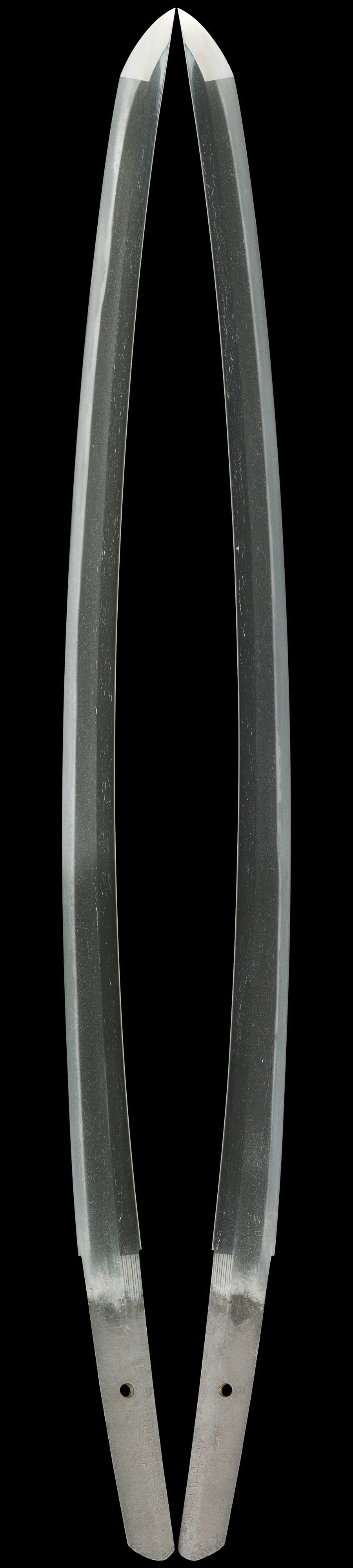
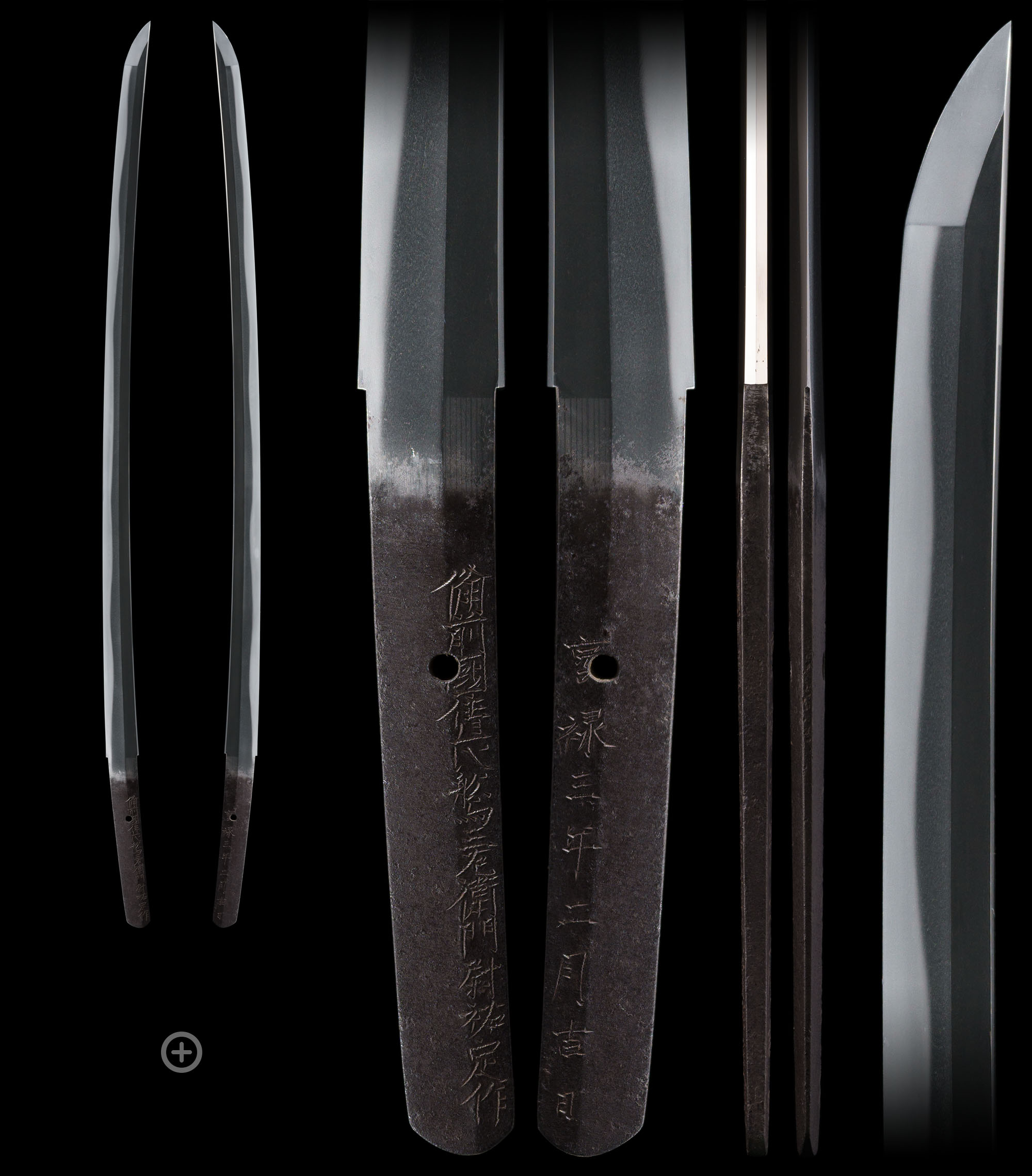
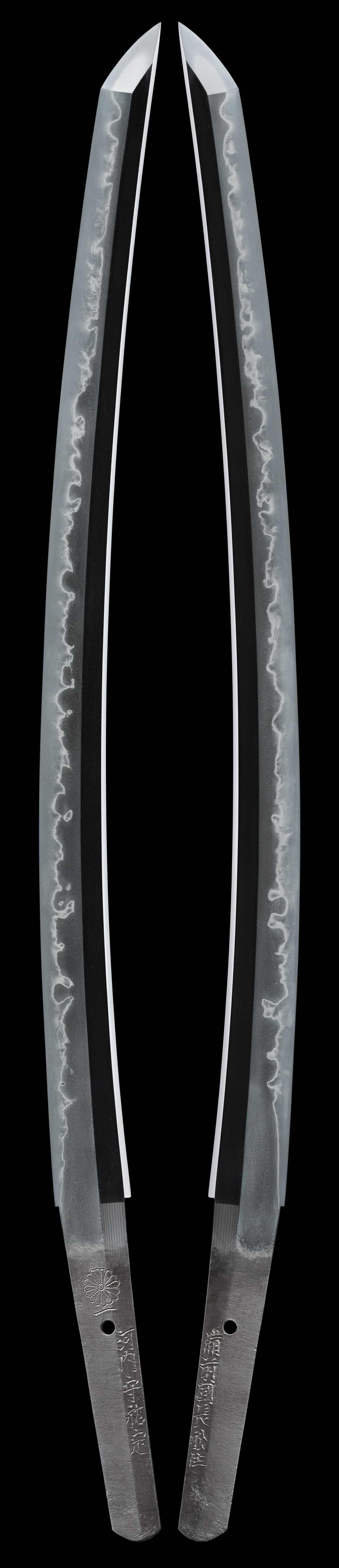
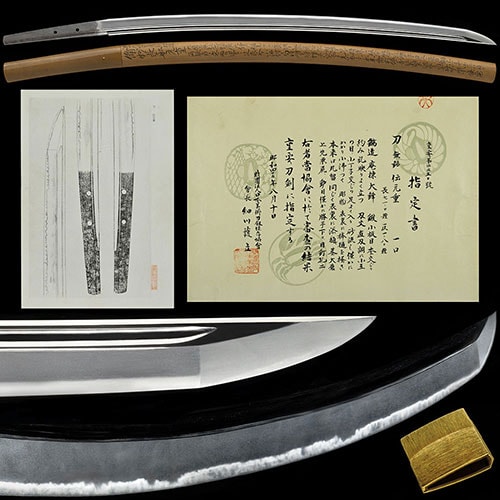
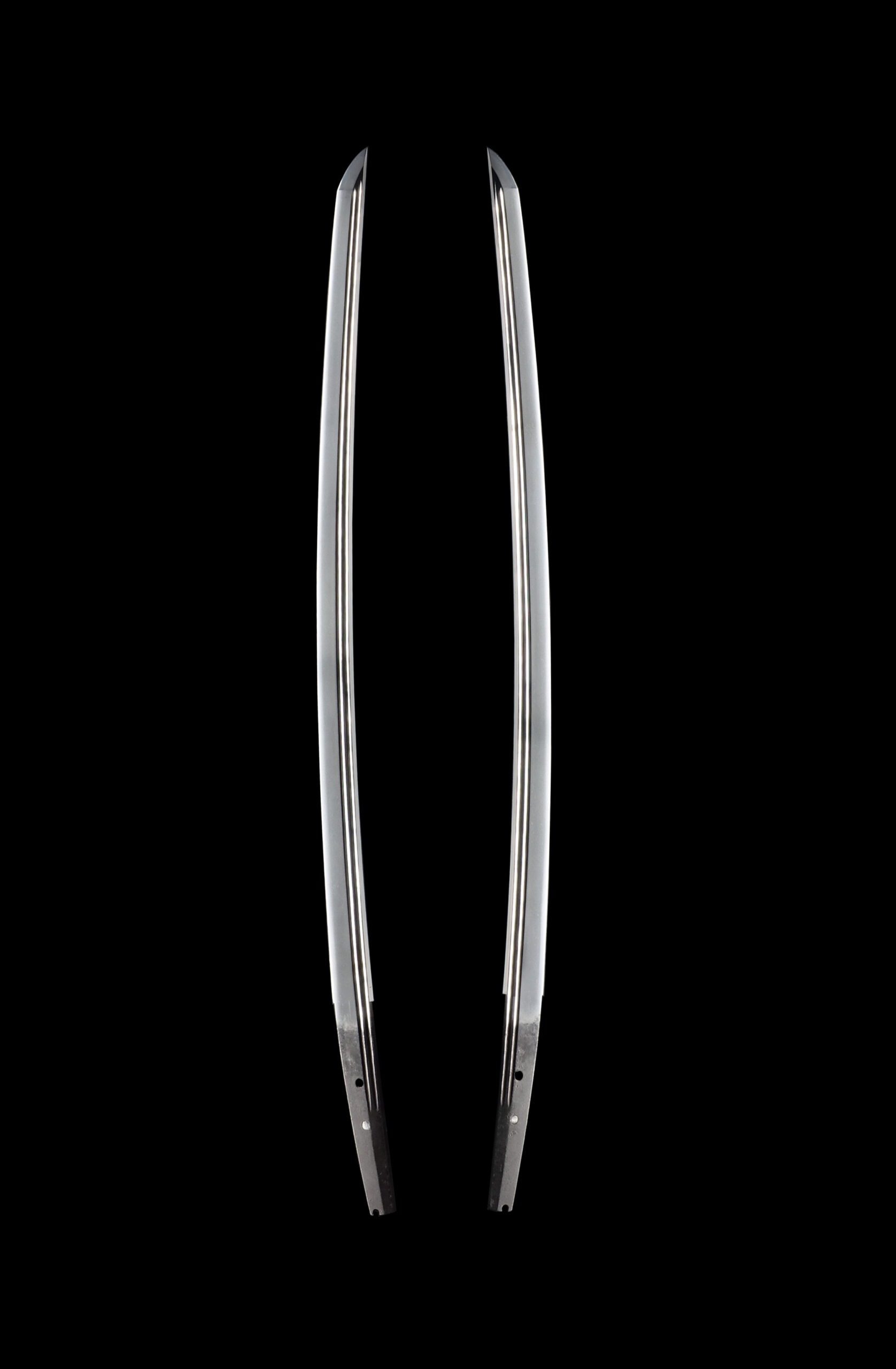
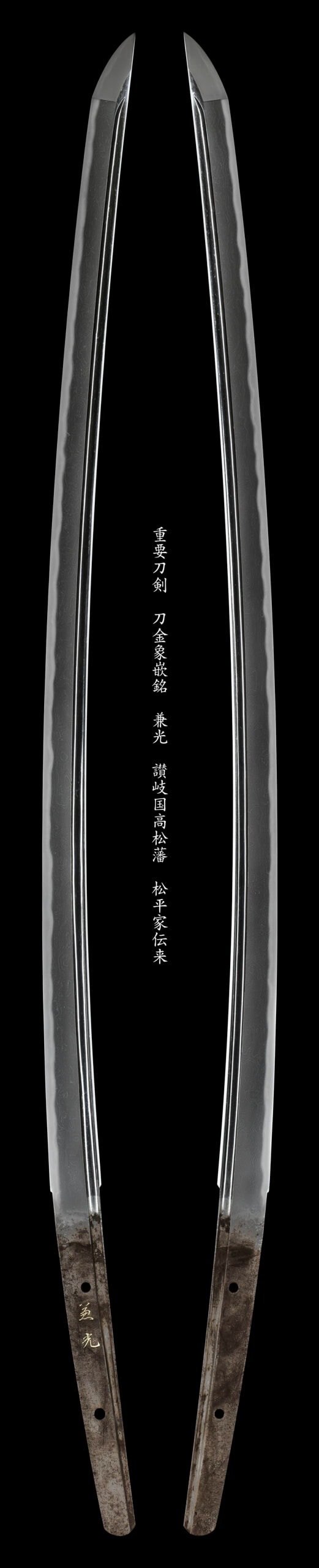
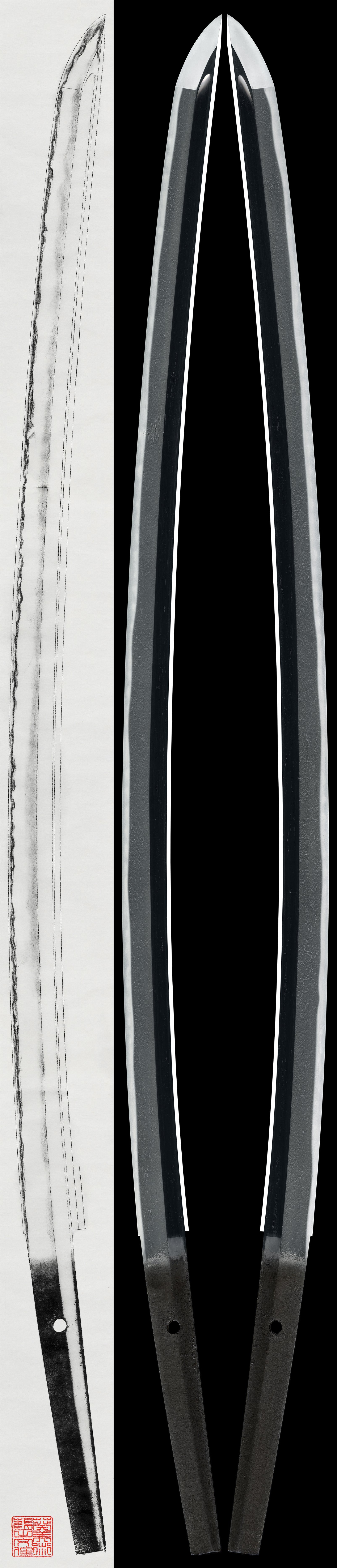
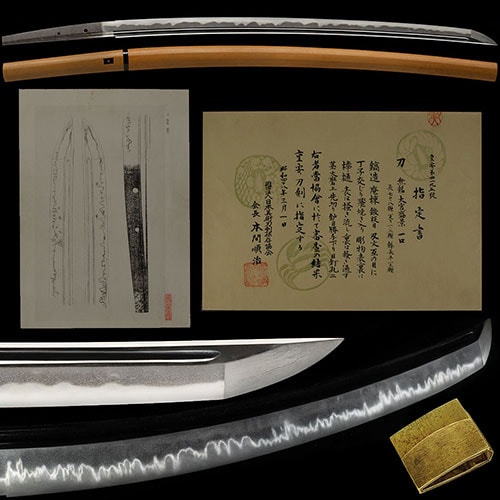
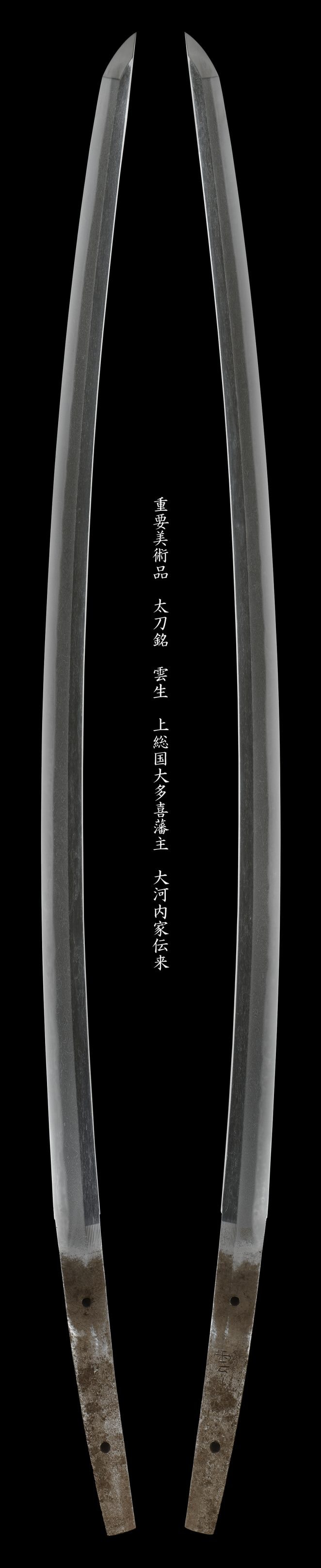
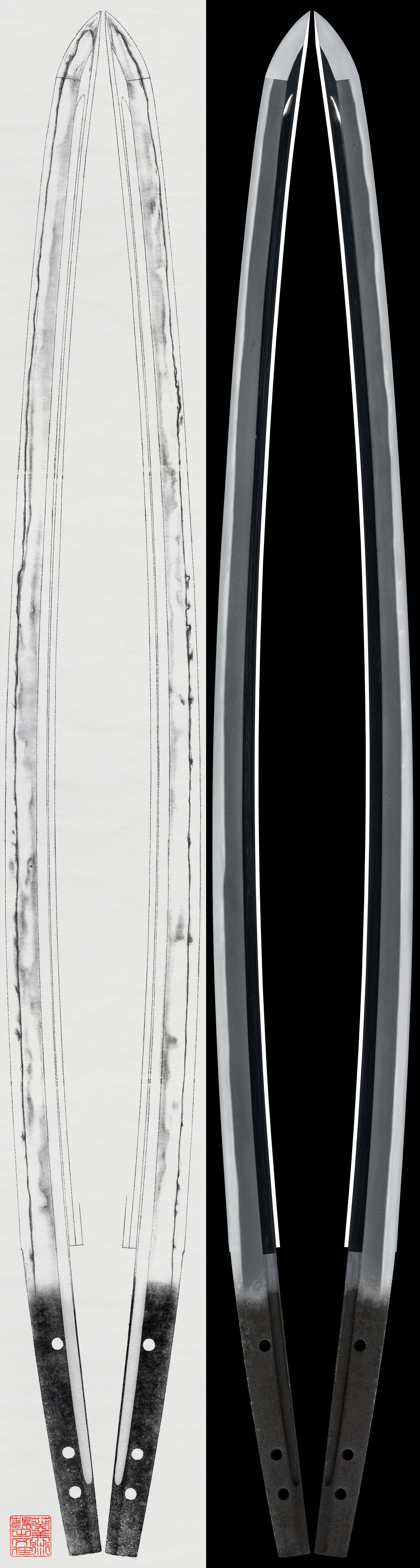
A dated to the second month of Bunmei 16 (1484), signed in a large long no ju Ukyo-no- Katsumitsu and carved on both faces with the prayer-texts Tenka-taihei kokudo-an'on and Fuki-manpuku -ryo-mansoku, stands as the recognized height of this smith's hand and is the one of his works to reach the rank. Its maker is the principal bearer of a crowded name. Katsumitsu is one of the representative names of the late- forges collectively called , a name carried by more than a dozen smiths from the middle of the period onward. The published sources single out those who cut a personal name above the , chief among them Ukyo-no- Katsumitsu and his son Jirozaemon-no-jo Katsumitsu, and they place Ukyo-no- ahead of his son in seniority, the elder brother of Sakyo-no- Munemitsu and counted among the most skilled of the makers (右京亮と銘するものは次郎左衛門尉よりは先輩であり) and.
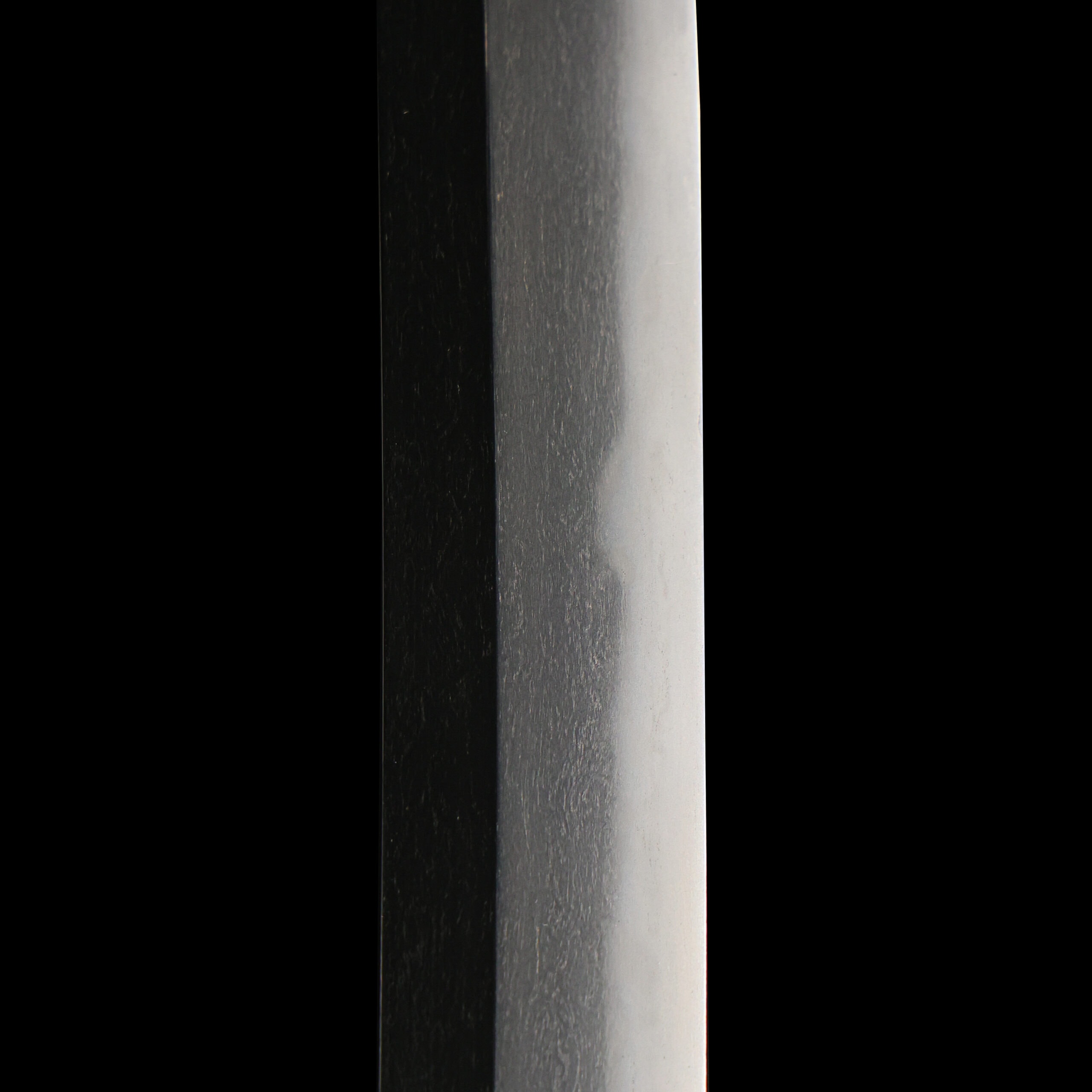
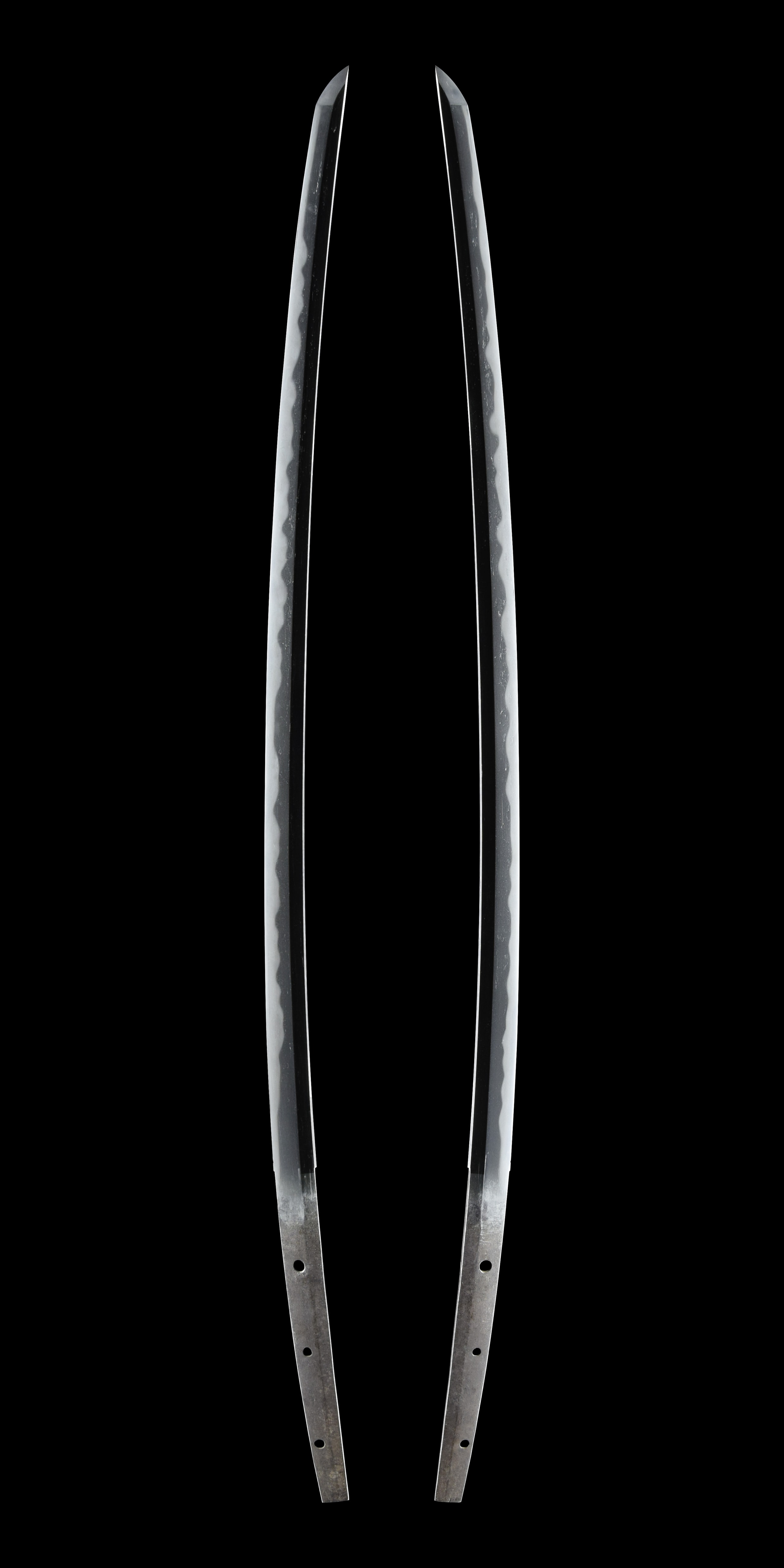
The characteristic hand is a high, bright temper built on the open-waisted that is the diagnostic line. Over a of mixed with , well packed and in places flowing, with attaching and entering, the smith sets a into which he mixes , and , and entering well, the work -prevailing with , and small interspersed, the clear and bright. What the published sources name as his individuality is a matter of degree within that shared idiom: he is particularly adept at a more flamboyant workmanship in which abundant are intermingled within the , with the more conspicuous than on his fellows. On the the temper is read as the typical work of Katsumitsu among the makers, the bright, varied a superior achievement of his hand.
The is the constant beneath that flamboyance. It is the to of late , attaching, entering, on the finest pieces the fine as dust, in places a little standing or flowing. A rises clearly on this steel, and the sources note that on his blades it stands more vivid than on comparable contemporary , the temper conspicuous in its and rich in variation. The answers the , running to a or a pointed tendency, with a turnback. Across both faces lie the devotional carvings of , a finished in with beneath, a , , and shrine names such as , which the sources are careful to call the work of the school's specialist horimonoshi rather than the smith's own hand. The shape is the canonical late- , the body broad with added, the on the thicker side, the tang short and made for one-handed use.
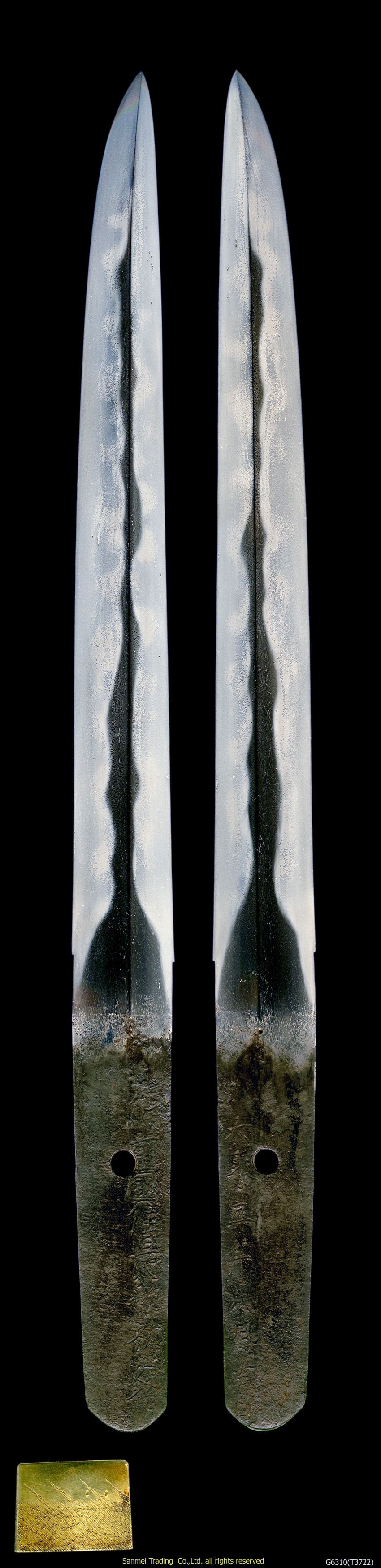
Katsumitsu is, above all, the great collaborator of the house, and his record is largely one of joint work. With his younger brother Sakyo-no- Munemitsu he cut blades signing the two names together across two columns, dated through the Bunmei era, and several of these were forged away from , at Kusakabe in and at Kojima in , the sources reading the Kojima pieces as valuable material for tracing the smiths' movements. On these joint blades the temper runs a small with and small , or mixed into gunome, running, the tight with , the to a small round. The two are held in high regard precisely because both hands are skilled, so that collectors prize the joint work most highly,. One of Bunmei 16 adds a third hand, Hikobei-no-jo Tadamitsu, in a three-way collaboration the sources say they have scarcely seen elsewhere, its -toned temper carrying with and , and .
Within his own school what sets Katsumitsu apart is the reach of his hand rather than a single tell. Orthogonal to the flamboyant is a deliberately calm register the sources read as a mark of true skill, and Katsumitsu commands it on his own dated blades. A Bunmei 16 forged with his brother Munemitsu at Kojima tempers a base shallowly undulating with a feeling, and entering, and fine , the tightening with , which the sources align especially with the kind often seen on Tadamitsu. A Bunmei 11 , a joint work with Gorozaemon-no-jo Norimitsu, wide for its length with a thick and a strong , tempers a with a feeling over a well-packed in which a rises, thick, and fine, the clear and bright, the straight into a small round with a long turnback, which the sources align with the line of Tadamitsu. His bright, -mixed and his command of a clear mark the upper edge of late- workmanship.
Katsumitsu was a productive smith and signed and dated work survives in fair number, yet little of it can ever change hands. Fujishiro grades him Sai-jo . He has no National Treasures and no Important Cultural Properties; his record on the official rolls runs through one and seven blades, the eight designated works on record all bearing his signature and a date. The single piece raised to is the Bunmei 16 with the rare prayer-text inscriptions, called a rare work of unusually healthy bearing and the smith's superior achievement; those incised prayer-texts are noted as without parallel, evidently made to special order and later imitated. The patrimony continues in long-held collections grounded in the blades' own provenance, with one preserved in the Imperial collection and a dated Bunmei 11 in its mounting descending in the Okubo family. Beyond these, of the works on record only the small number in the and tiers can be encountered, so a signed Katsumitsu reaches the market only from time to time, and a dated, devotionally carved example of his bright -mixed is a rewarding thing for a collector of late to come upon.