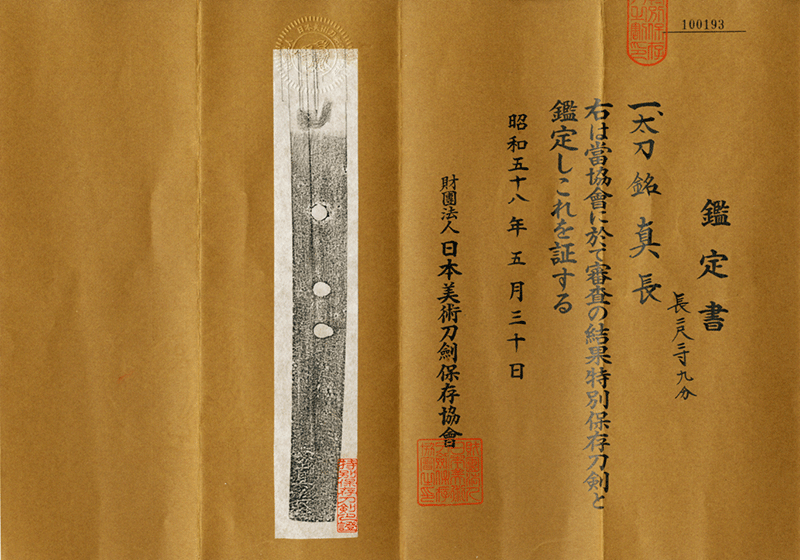
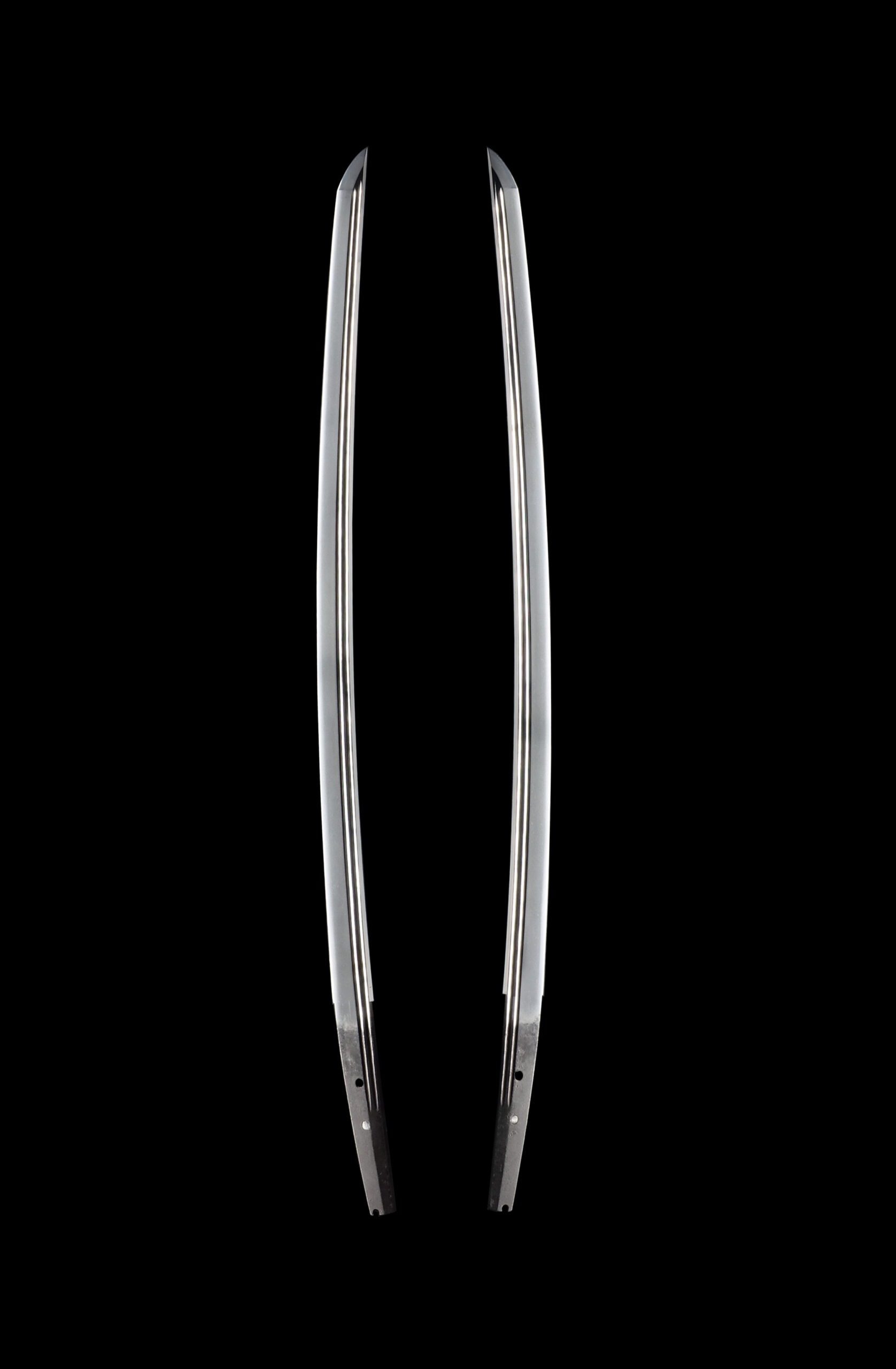
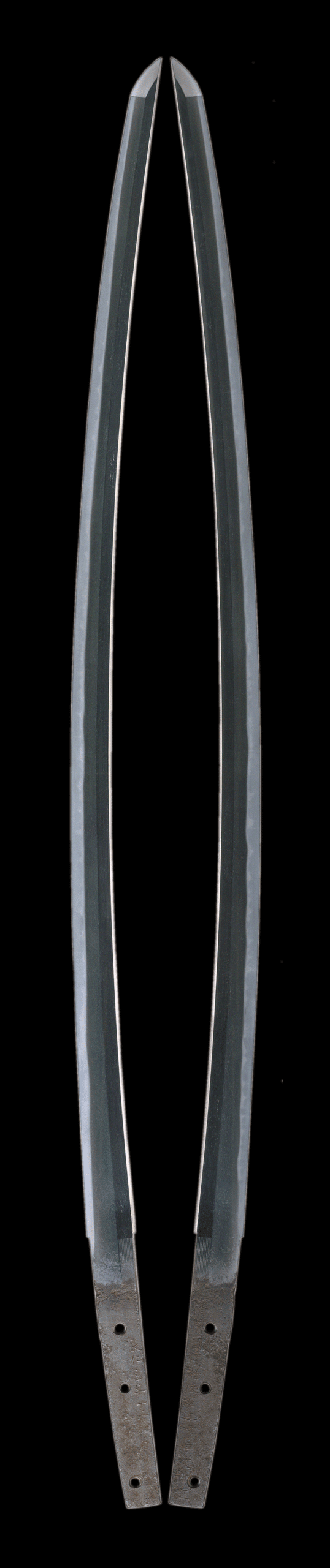
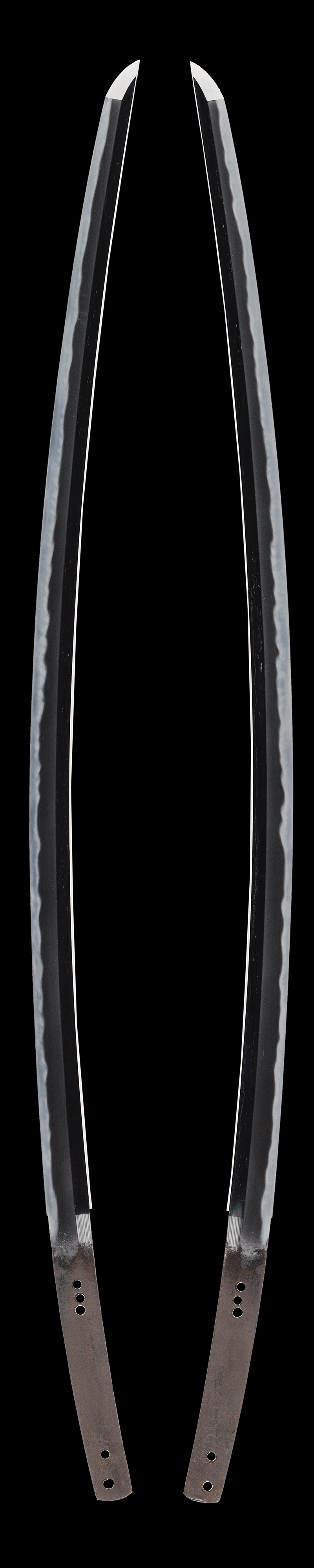
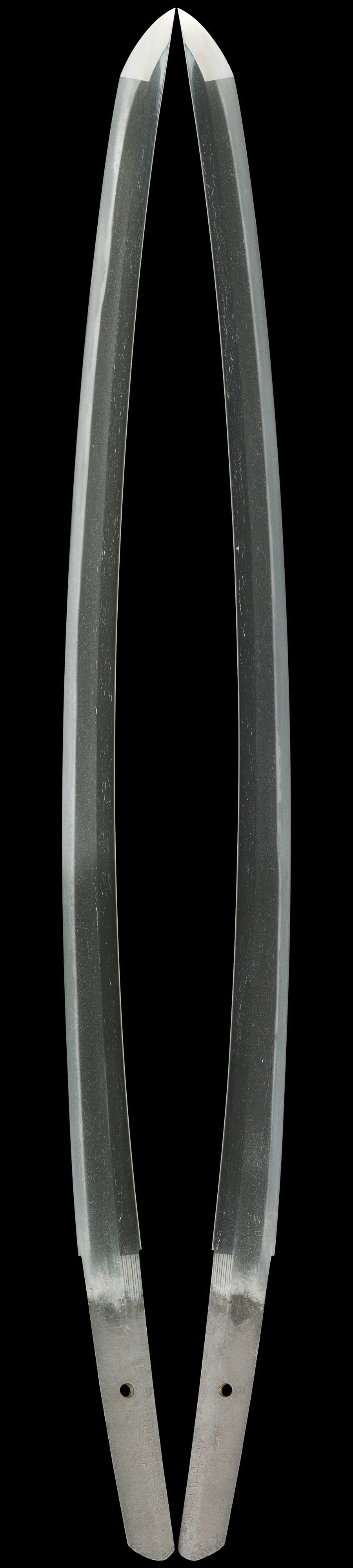
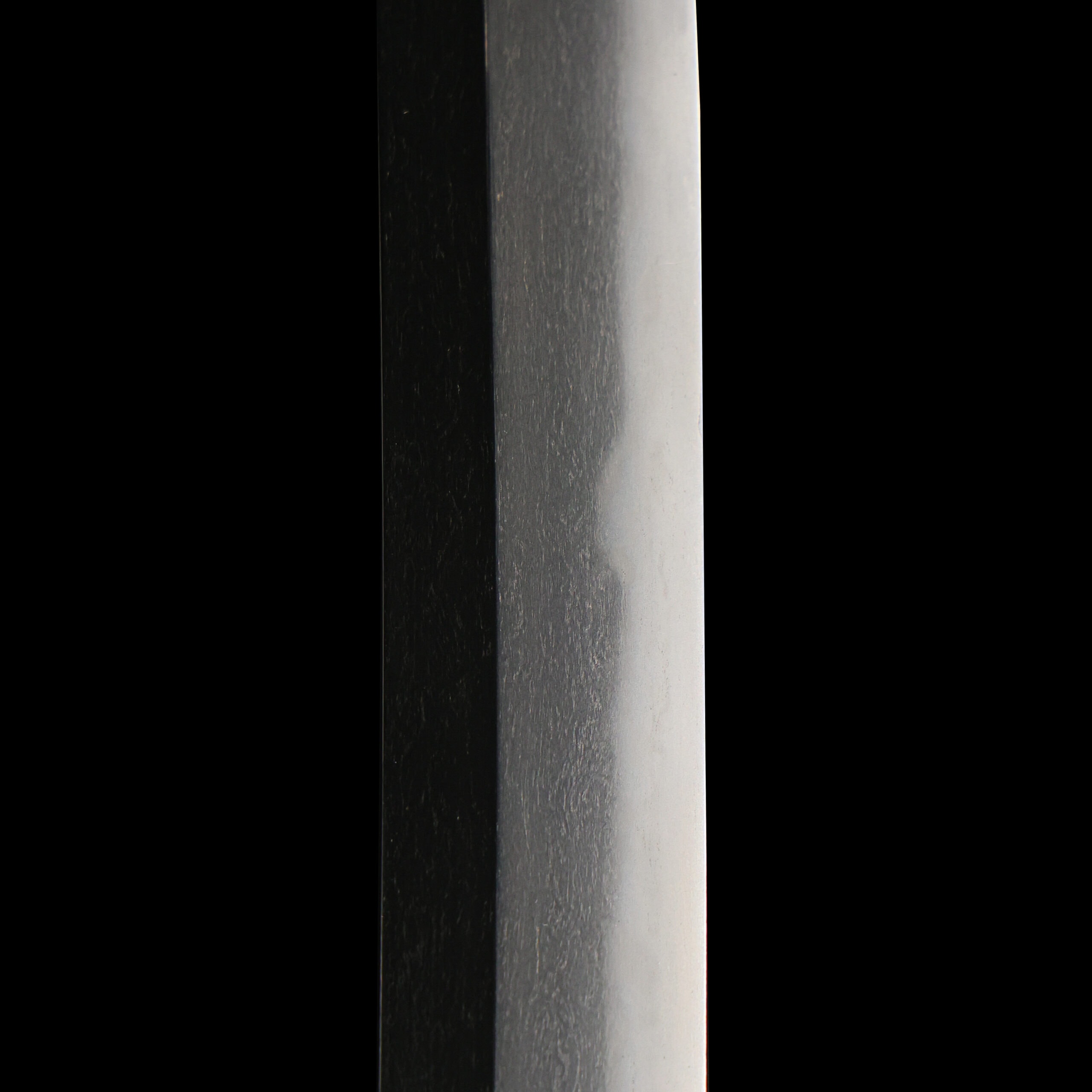
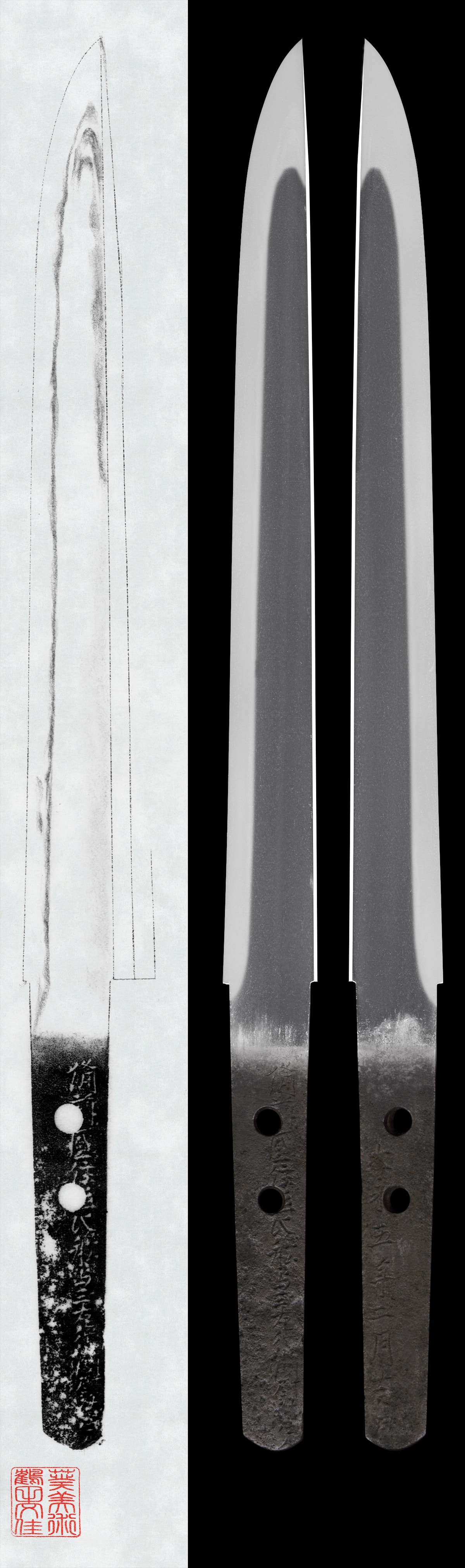
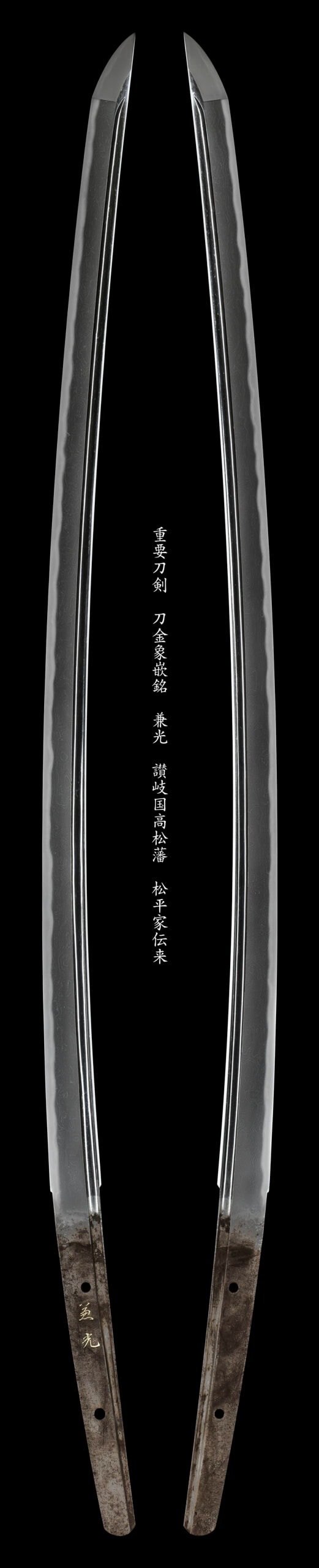
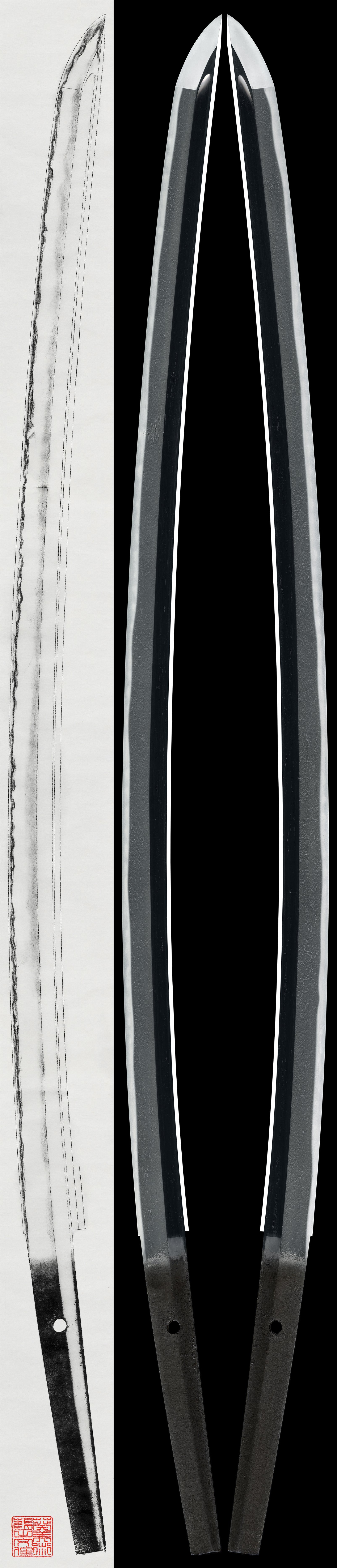
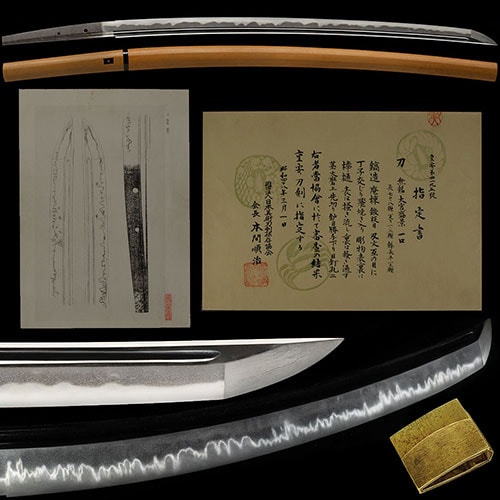
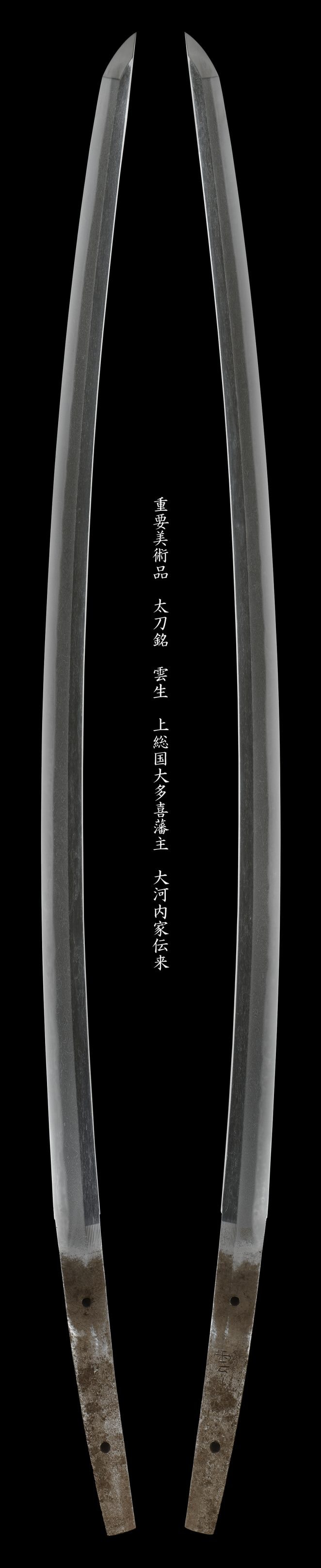
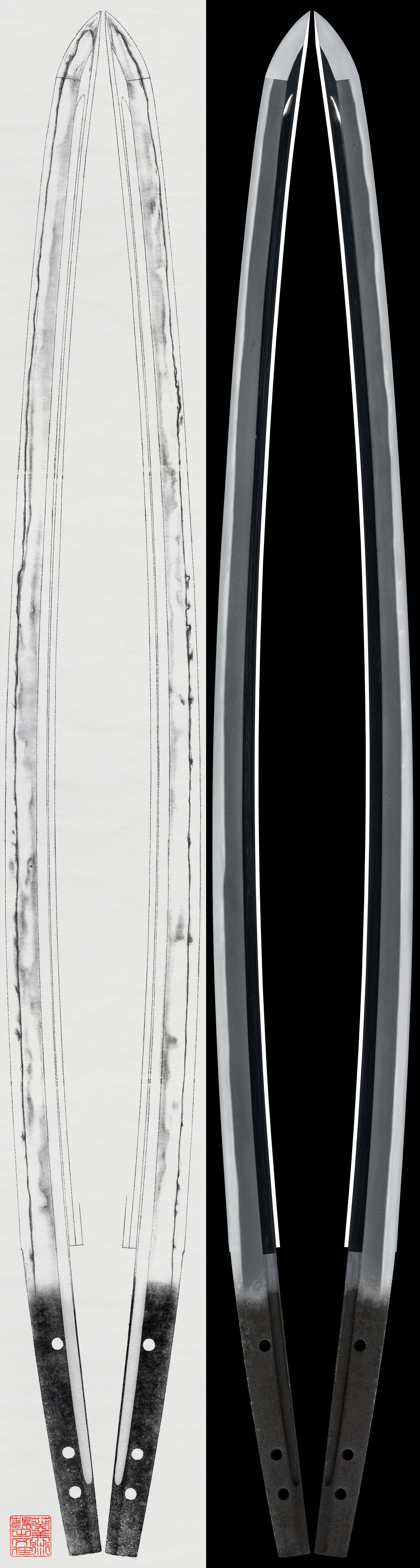
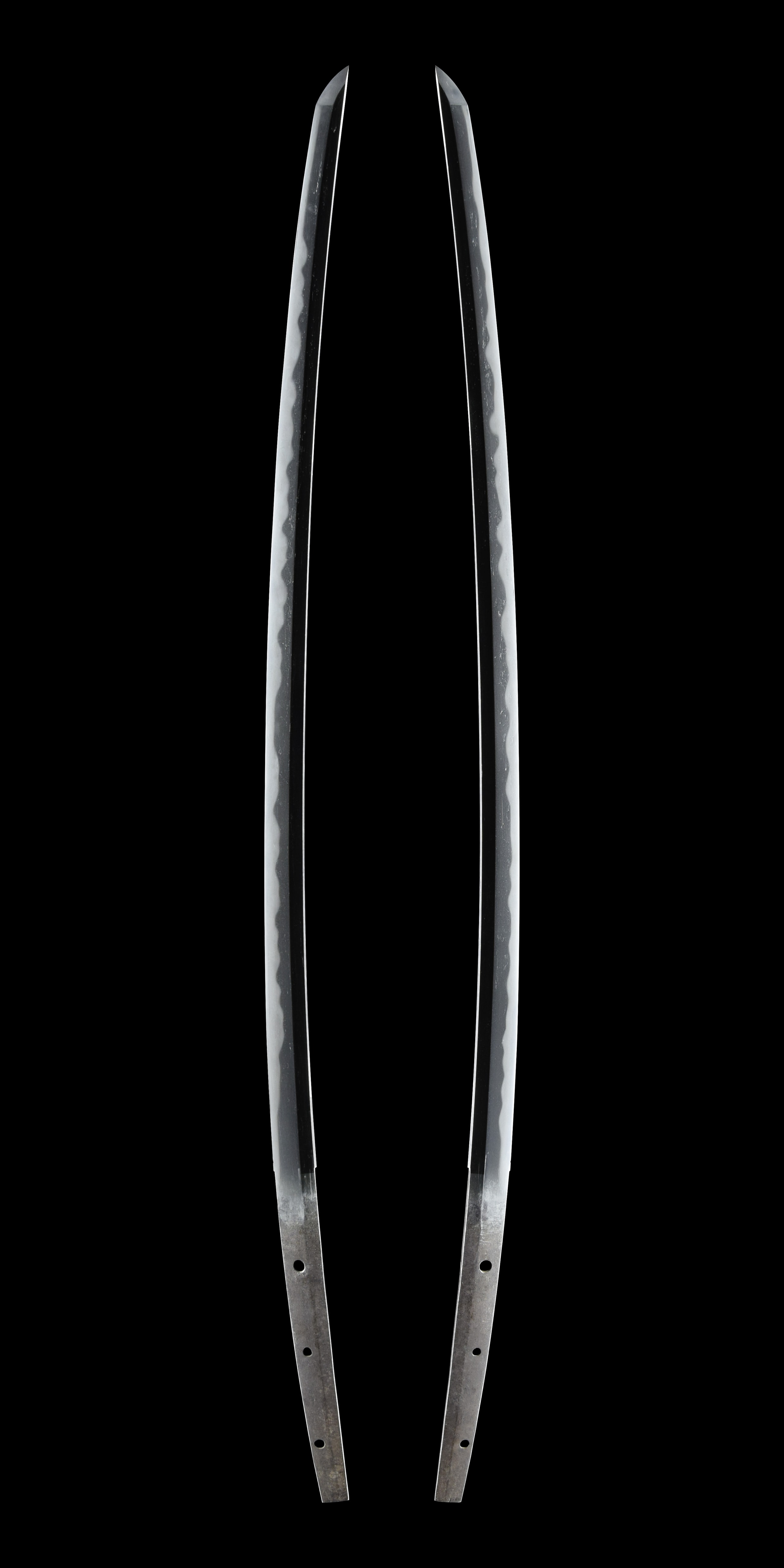
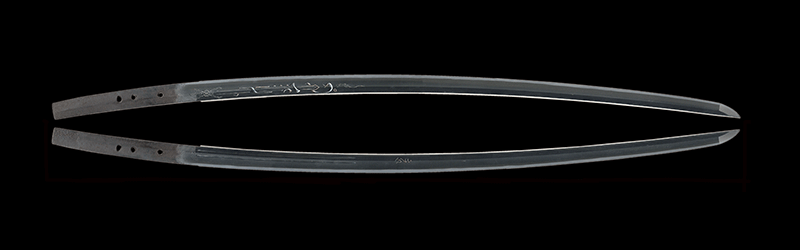
This is a tachi by Sanenaga of the Osafune school, dating to the Kamakura period. The blade is signed with a two-character mei and is designated as Tokubetsu Hozon Token by the NBTHK. It features a refined sugata with a high sori and a chū-kissaki, along with a clear and well-forged ko-itame hada and a tight nioiguchi with gunome-midare and notare.
mei · Osafune · Kamakura · nagasa 69.5cm · sori 2.1cm


Osafune (Bizen) · Bizen · around 1299-1309
Fujishiro Sai-jo saku · Tōken Taikan top 5%
1 piece on the market now
Sanenaga is the quiet member of the Osafune mainline, recorded in the Kokon Mei Zukushi as a son of Mitsutada and the younger brother of Nagamitsu, and active in the late Kamakura period. Where his father and brother are read by their flamboyant choji, Sanenaga is the smith in whom the school's calm straight temper finds its surest hand, and it is in suguha that his work is most confidently identified. The published sources return to the same description again and again: within the Osafune group of his time he excelled at a gentle suguha-toned temper, and a hallmark of his work is the well-tightened nioiguchi.
The signature that survives is itself part of the study of him. Blades carry both a two-character signature and a longer one, and among the long signatures are dated works inscribed Shoan, Kagen, Tokuji and Engyo. The Kokon Mei Zukushi places the first Sanenaga in the Bun'ei and Koan years and treats the dated long signatures of Shoan and after as a second generation, though the question of one against two generations is still left open in the published record. The undated two-character pieces are read as the earlier hand, the dated long signatures as the later, and this division gives the connoisseur a rare double anchor of style and date.
The jigane is the refined ko-itame of the direct line, tightly forged and often mixed with mokume and itame, with ji-nie lying microscopically fine and delicate chikei entering the steel. Over it a midare-utsuri stands up vividly, and on some blades a more linear, suji-like utsuri runs toward the edge before breaking into the midare form higher up. This is the bright, well-knit jigane the appraisers expect of the Osafune mainline, and it is the floor on which Sanenaga's tempering is read.
The hamon is built on a chu-suguha mixed with ko-choji, ko-gunome and a little ko-notare, into which ko-ashi and yo enter; the nioiguchi tends to tighten and carries slight ko-nie, with fine sunagashi at times, and it comes up bright and clear. The boshi is the calm point that completes the picture: it goes in with a shallow notare and turns back small in ko-maru[[c:1]], the composed turnback that suits the tightened straight temper below it. It is this quiet, controlled finish, jigane, hamon and boshi all of a piece, that the published sources call his typical manner.
A second and rarer manner exists. On a small number of blades the temper opens into a comparatively flamboyant midare of choji and gunome, somewhat saka-gakari, close enough that it can be mistaken for his brother Nagamitsu[[c:2]]. The tell that keeps the two apart is the nioiguchi, which on Sanenaga stays tighter and cooler in every case; the appraisers note that whichever manner appears, the nioiguchi remains characteristically tight. A few kodachi also survive under his name, an uncommon survival shared in the school chiefly with Mitsutada and Nagamitsu.
For the collector, Sanenaga is Sai-jo saku in Fujishiro's grading, and the record of him is largely a record of the great houses. A signed tachi was transmitted in the Satsuma Shimazu family, carrying a Hon'ami Kotsune origami noted in the family's 1928 sale catalog; another came down through the Kaga Maeda family with a Hon'ami appraisal, and a signed tachi with its koshirae passed through the Odawara Okubo house. Ten of his blades stand in the Tokuju tier and forty-two more in Juyo, and his work is held in the Imperial collection and through the Date, Shimazu, Maeda and Hosokawa houses. Within his own family he is the counterweight to his brother: where Nagamitsu is plump and flamboyant, Sanenaga is the disciplined hand that shows how refined a plain Bizen suguha can be made, and a blade in his calm manner is among the harder Osafune names to bring to hand.
Where Sanenaga stands among comparable artisans: across all of nihontō, and within tradition, era, and period. The tiers (Foremost · Leading · Major · Notable) weigh official designations from the NBTHK and Japan's Agency for Cultural Affairs, together with historical honors of lasting repute such as the Sansaku and Meibutsu-chō.
Select a lens to see how it's measured.
Years he was demonstrably active, proven by signed-and-dated blades
Bizen-den · Bizen
Phase: Ko-Osafune古長船· 1238–1335
222 pieces on the market now
Three smiths working at the village of Osafune across the second half of the thirteenth century set the terms for every Bizen blade that followed: Mitsutada the founder, his son Nagamitsu, and the closely related Sanenaga, the Sansaku triumvirate whose work opens this phase. Their window runs from the mid-Kamakura period into the early fourteenth century, when leadership passed to Nagamitsu's son Kagemitsu, the third-generation head whose dated tachi, naginata, and tanto carry the phase to its close around the Kenmu years. Learn more →
| Smith | Era | Designated |
|---|---|---|
| Mitsutada光忠 | 1238-1239 | 60 |
| Nagamitsu長光 | 1274-1304 | 244 |
| Kagemitsu景光 | 1303-1336 | 144 |
| Kanemitsu兼光 | 1323-1370 | 233 |
| Sanenaga眞長 | 1299-1309 | 64 |
A Hozon-certified blade judged to show notably superior workmanship and a better state of preservation. The bar is higher: re-tempered blades and most unsigned Muromachi/Edo works are excluded.
The NBTHK (Nihon Bijutsu Tōken Hozon Kyōkai, the Society for the Preservation of Japanese Art Swords) is a public-interest incorporated foundation founded in 1948 and supervised by Japan’s Agency for Cultural Affairs (Bunkachō); it is based at the Japanese Sword Museum in Tokyo. Its expert panels physically examine each submitted work (shinsa) and issue a certificate (kanteishō) ranking it by artistic and historical merit. NBTHK papers are the most widely recognized standard of authentication for Japanese swords and fittings.
NBTHK official siteCustomer-initiated returns accepted within two days of arrival; return shipping paid by customer and fees non-refundable. Returns/refunds unavailable for overseas deliveries.
This is a tachi by Sanenaga of the Osafune school, dating to the Kamakura period. The blade is signed with a two-character mei and is designated as Tokubetsu Hozon Token by the NBTHK. It features a refined sugata with a high sori and a chū-kissaki, along with a clear and well-forged ko-itame hada and a tight nioiguchi with gunome-midare and notare.
mei · Osafune · Kamakura · nagasa 69.5cm · sori 2.1cm


Osafune (Bizen) · Bizen · around 1299-1309
Fujishiro Sai-jo saku · Tōken Taikan top 5%
1 piece on the market now
Sanenaga is the quiet member of the Osafune mainline, recorded in the Kokon Mei Zukushi as a son of Mitsutada and the younger brother of Nagamitsu, and active in the late Kamakura period. Where his father and brother are read by their flamboyant choji, Sanenaga is the smith in whom the school's calm straight temper finds its surest hand, and it is in suguha that his work is most confidently identified. The published sources return to the same description again and again: within the Osafune group of his time he excelled at a gentle suguha-toned temper, and a hallmark of his work is the well-tightened nioiguchi.
The signature that survives is itself part of the study of him. Blades carry both a two-character signature and a longer one, and among the long signatures are dated works inscribed Shoan, Kagen, Tokuji and Engyo. The Kokon Mei Zukushi places the first Sanenaga in the Bun'ei and Koan years and treats the dated long signatures of Shoan and after as a second generation, though the question of one against two generations is still left open in the published record. The undated two-character pieces are read as the earlier hand, the dated long signatures as the later, and this division gives the connoisseur a rare double anchor of style and date.
The jigane is the refined ko-itame of the direct line, tightly forged and often mixed with mokume and itame, with ji-nie lying microscopically fine and delicate chikei entering the steel. Over it a midare-utsuri stands up vividly, and on some blades a more linear, suji-like utsuri runs toward the edge before breaking into the midare form higher up. This is the bright, well-knit jigane the appraisers expect of the Osafune mainline, and it is the floor on which Sanenaga's tempering is read.
The hamon is built on a chu-suguha mixed with ko-choji, ko-gunome and a little ko-notare, into which ko-ashi and yo enter; the nioiguchi tends to tighten and carries slight ko-nie, with fine sunagashi at times, and it comes up bright and clear. The boshi is the calm point that completes the picture: it goes in with a shallow notare and turns back small in ko-maru[[c:1]], the composed turnback that suits the tightened straight temper below it. It is this quiet, controlled finish, jigane, hamon and boshi all of a piece, that the published sources call his typical manner.
A second and rarer manner exists. On a small number of blades the temper opens into a comparatively flamboyant midare of choji and gunome, somewhat saka-gakari, close enough that it can be mistaken for his brother Nagamitsu[[c:2]]. The tell that keeps the two apart is the nioiguchi, which on Sanenaga stays tighter and cooler in every case; the appraisers note that whichever manner appears, the nioiguchi remains characteristically tight. A few kodachi also survive under his name, an uncommon survival shared in the school chiefly with Mitsutada and Nagamitsu.
For the collector, Sanenaga is Sai-jo saku in Fujishiro's grading, and the record of him is largely a record of the great houses. A signed tachi was transmitted in the Satsuma Shimazu family, carrying a Hon'ami Kotsune origami noted in the family's 1928 sale catalog; another came down through the Kaga Maeda family with a Hon'ami appraisal, and a signed tachi with its koshirae passed through the Odawara Okubo house. Ten of his blades stand in the Tokuju tier and forty-two more in Juyo, and his work is held in the Imperial collection and through the Date, Shimazu, Maeda and Hosokawa houses. Within his own family he is the counterweight to his brother: where Nagamitsu is plump and flamboyant, Sanenaga is the disciplined hand that shows how refined a plain Bizen suguha can be made, and a blade in his calm manner is among the harder Osafune names to bring to hand.
Where Sanenaga stands among comparable artisans: across all of nihontō, and within tradition, era, and period. The tiers (Foremost · Leading · Major · Notable) weigh official designations from the NBTHK and Japan's Agency for Cultural Affairs, together with historical honors of lasting repute such as the Sansaku and Meibutsu-chō.
Select a lens to see how it's measured.
Years he was demonstrably active, proven by signed-and-dated blades
Bizen-den · Bizen
Phase: Ko-Osafune古長船· 1238–1335
222 pieces on the market now
Three smiths working at the village of Osafune across the second half of the thirteenth century set the terms for every Bizen blade that followed: Mitsutada the founder, his son Nagamitsu, and the closely related Sanenaga, the Sansaku triumvirate whose work opens this phase. Their window runs from the mid-Kamakura period into the early fourteenth century, when leadership passed to Nagamitsu's son Kagemitsu, the third-generation head whose dated tachi, naginata, and tanto carry the phase to its close around the Kenmu years. Learn more →
| Smith | Era | Designated |
|---|---|---|
| Mitsutada光忠 | 1238-1239 | 60 |
| Nagamitsu長光 | 1274-1304 | 244 |
| Kagemitsu景光 | 1303-1336 | 144 |
| Kanemitsu兼光 | 1323-1370 | 233 |
| Sanenaga眞長 | 1299-1309 | 64 |
A Hozon-certified blade judged to show notably superior workmanship and a better state of preservation. The bar is higher: re-tempered blades and most unsigned Muromachi/Edo works are excluded.
The NBTHK (Nihon Bijutsu Tōken Hozon Kyōkai, the Society for the Preservation of Japanese Art Swords) is a public-interest incorporated foundation founded in 1948 and supervised by Japan’s Agency for Cultural Affairs (Bunkachō); it is based at the Japanese Sword Museum in Tokyo. Its expert panels physically examine each submitted work (shinsa) and issue a certificate (kanteishō) ranking it by artistic and historical merit. NBTHK papers are the most widely recognized standard of authentication for Japanese swords and fittings.
NBTHK official siteCustomer-initiated returns accepted within two days of arrival; return shipping paid by customer and fees non-refundable. Returns/refunds unavailable for overseas deliveries.