The twentieth century nearly killed the craft twice: wartime distortion, then the occupation ban. The NBTHK’s founding in 1948 and licensed forging from 1953 rebuilt the sword as an art, crowned by Living National Treasures and the mukansa rank.
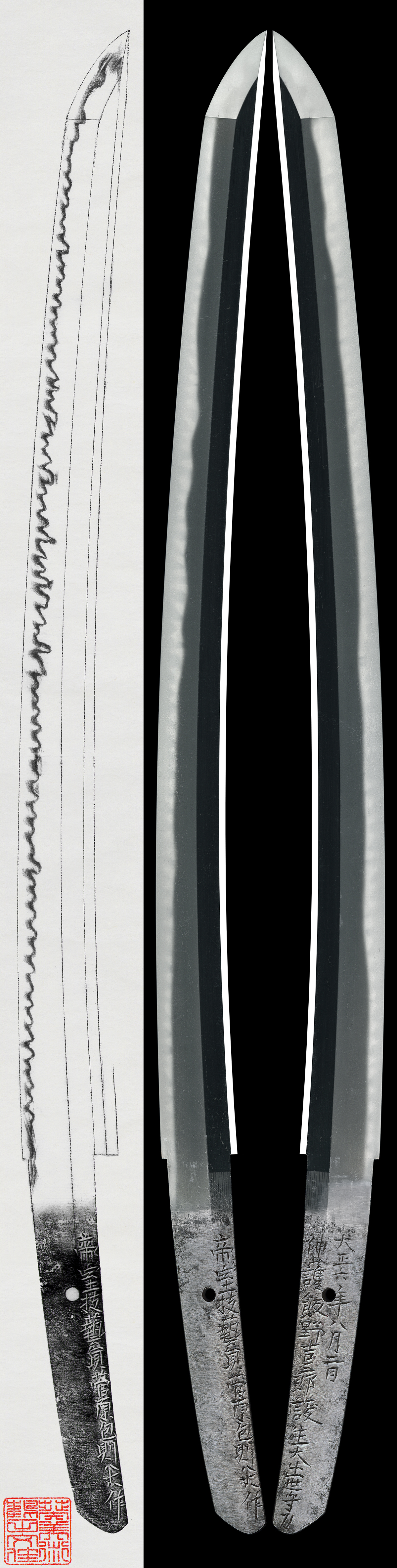
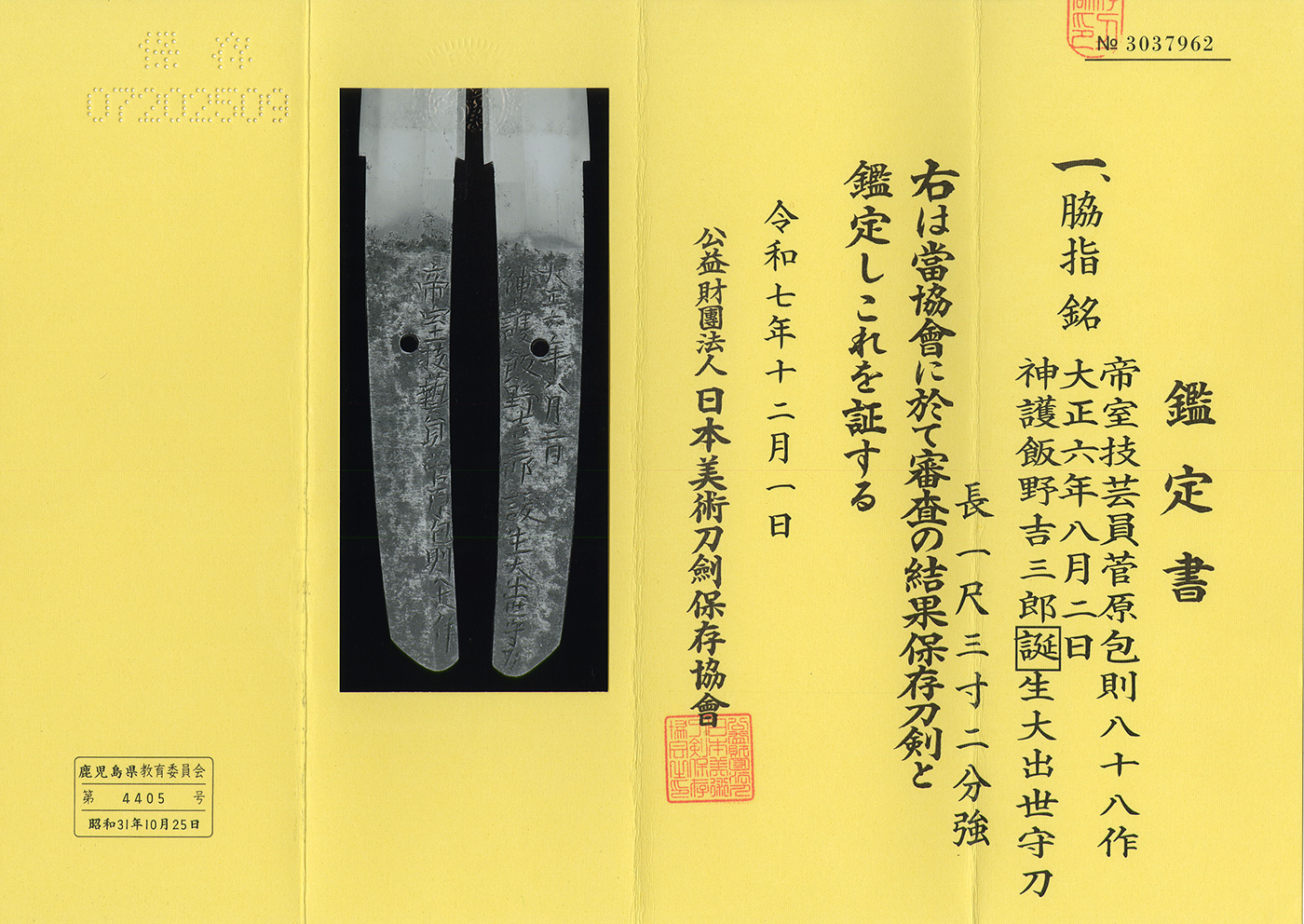
Wakizashi in Shirasaya with Koshirae (NBTHK Hozon Token) (We divide 4 sections for each sword as Saijyo Saku, Jyojyo Saku, Jyo Saku and Regular Saku). This blade is ranked as Jyojyo Saku among the works of Sugawara Kanenori, an Imperial Household Artist. Shape: A beautifully proportioned wakizashi with standard mihaba, noticeable curvature, and an elongated kissaki. Jigane: Beautifully refined and exceptionally well-forged ko-itame hada, displaying fine-quality steel. Hamon: Gunome-choji with abundant ashi activity. The boshi displays a midare-komi pattern. Features: This wakizashi was made by Sugawara Kanenori, an Imperial Household Artist, at the age of 88. Kanenori was born in 1830 in Hoki Province, present-day Tottori Prefecture. His original name was Miyamoto Shigahiko. At the age of 22, he became an apprentice to Yokoyama Sukekane, a swordsmith of the Osafune school in Bizen Province, where he learned the art of sword forging. He adopted the character "Kane" from his master's name and began signing his works Kanenori. In 1866, Kanenori forged a sword for Emperor Komei. The following year, he received the honorary title of Noto no Kami. Following the beginning of the Meiji period, restrictions on sword wearing and the decline in demand for swords greatly reduced his opportunities to forge blades. He returned to Kurayoshi, where he endured financial hardship and supported himself by making agricultural tools and kitchen knives. Later, he was given the opportunity to forge sacred treasures for Ise Grand Shrine at Yasukuni Shrine. His workmanship received high praise from Emperor Meiji. In recognition of his achievements, Kanenori was appointed a Teishitsu Gigeiin (Imperial Household Artist) in April 1907, together with the first-generation Gassan Sadakazu. He subsequently produced numerous swords, particularly tanto. Kanenori passed away on October 24, 1926, at the age of 97. Iino Kichisaburo (August 30, 1867 – February 3, 1944) was a religious leader born into a samurai family of the Iwamura Domain in Mino Province, present-day Gifu Prefecture. He was a prominent figure in Japan's new religious movements and was sometimes referred to as the "Japanese Rasputin." He founded a religious organization known as the Dai Nippon Seishindan. Through his connections with Shimoda Utako, an educator and poet who also came from Gifu Prefecture, Iino developed influential relationships with political and business leaders as well as members of the Imperial Household. Through his religious prayers and predictions, he came to exercise considerable influence. NBTHK Hozon Certificate Aoi-Art estimation Paper whole Oshigata
Kanenori包則
Offered by Aoi Art
3 on the market


As written by the shop
Hoki · around 1861-1864
3 pieces on the market now
Shōwa to the present: destruction and revival
The twentieth century nearly killed the craft twice: wartime distortion, then the occupation ban. The NBTHK’s founding in 1948 and licensed forging from 1953 rebuilt the sword as an art, crowned by Living National Treasures and the mukansa rank.
Certifies a genuine blade worth preserving: a signature confirmed correct, or, if unsigned, an era, province, and school that the NBTHK can reliably identify.
The NBTHK (Nihon Bijutsu Tōken Hozon Kyōkai, the Society for the Preservation of Japanese Art Swords) is a public-interest incorporated foundation founded in 1948 and supervised by Japan’s Agency for Cultural Affairs (Bunkachō); it is based at the Japanese Sword Museum in Tokyo. Its expert panels physically examine each submitted work (shinsa) and issue a certificate (kanteishō) ranking it by artistic and historical merit. NBTHK papers are the most widely recognized standard of authentication for Japanese swords and fittings.
NBTHK official siteIf you wish to return an item, please notify us within 3 days of receipt. After this period we cannot accept cancellations. Please ship the return to us within 5 business days. Cancellation is conditional on the item being kept in the same condition as at the time of sale, so please handle it with care.
Auction status: live on sword-auction.com.