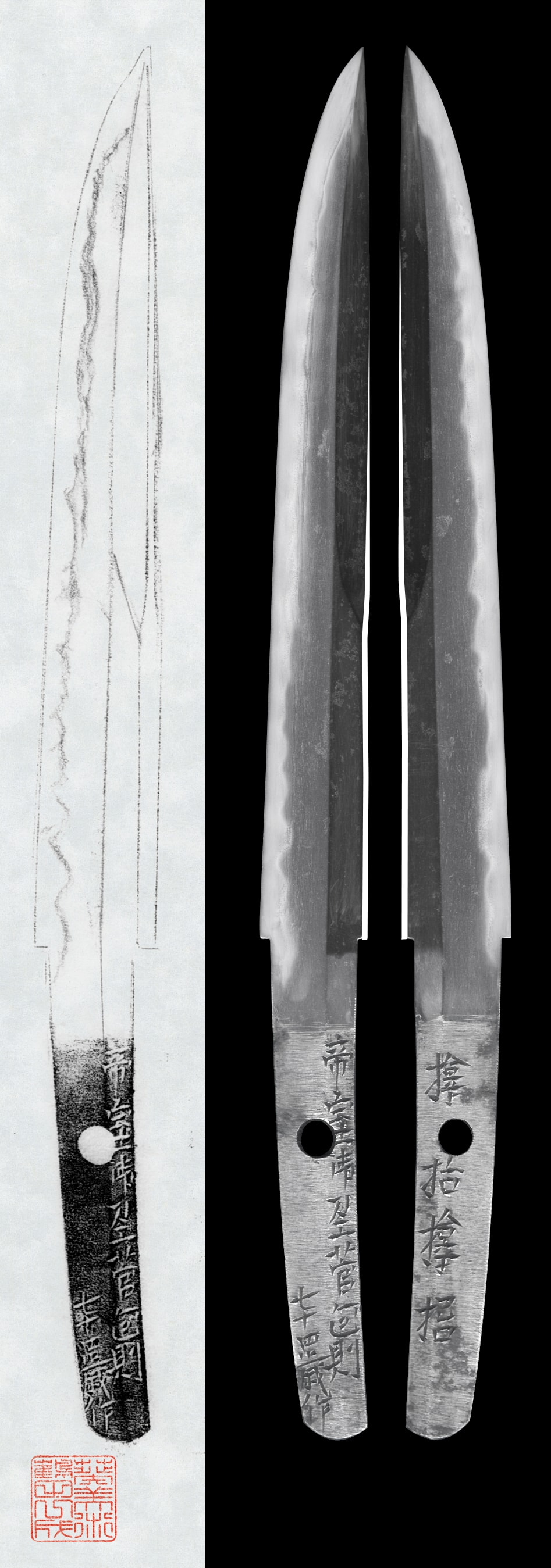
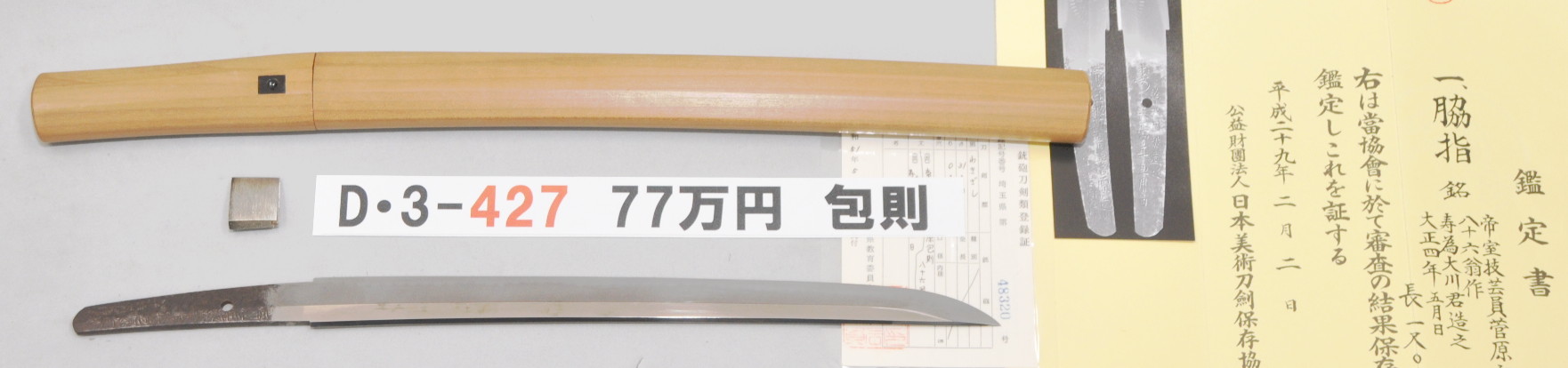
This is a tanto by Kanenori, a Teishitsu Gigeiin (Imperial Art Expert). It is signed on the front 'Teishitsu Gigeiin Sugawara Kanenori Hachijurokuo Saku' and on the back 'Kotobuki Oikawa Kimihito no Tame Taisho Gonen Gogatsu Hi'. The blade is in excellent condition with no rust or chips, features a shobu-zukuri shape, and a tight itame-hada with mokume. The hamon is suguha mixed with gunome. It comes with an NBTHK Hozon Token certificate.
 NihontoWatch
mei · Taisho · nagasa 31cm · sori 0.2cm
Hoki · around 1861-1864
2 pieces on the market now
Certifies a genuine blade worth preserving: a signature confirmed correct, or, if unsigned, an era, province, and school that the NBTHK can reliably identify.
The NBTHK (Nihon Bijutsu Tōken Hozon Kyōkai, the Society for the Preservation of Japanese Art Swords) is a public-interest incorporated foundation founded in 1948 and supervised by Japan’s Agency for Cultural Affairs (Bunkachō); it is based at the Japanese Sword Museum in Tokyo. Its expert panels physically examine each submitted work (shinsa) and issue a certificate (kanteishō) ranking it by artistic and historical merit. NBTHK papers are the most widely recognized standard of authentication for Japanese swords and fittings.
NBTHK official siteThis is a tanto by Kanenori, a Teishitsu Gigeiin (Imperial Art Expert). It is signed on the front 'Teishitsu Gigeiin Sugawara Kanenori Hachijurokuo Saku' and on the back 'Kotobuki Oikawa Kimihito no Tame Taisho Gonen Gogatsu Hi'. The blade is in excellent condition with no rust or chips, features a shobu-zukuri shape, and a tight itame-hada with mokume. The hamon is suguha mixed with gunome. It comes with an NBTHK Hozon Token certificate.
NihontoWatchmei · Taisho · nagasa 31cm · sori 0.2cm
Hoki · around 1861-1864
2 pieces on the market now
Certifies a genuine blade worth preserving: a signature confirmed correct, or, if unsigned, an era, province, and school that the NBTHK can reliably identify.
The NBTHK (Nihon Bijutsu Tōken Hozon Kyōkai, the Society for the Preservation of Japanese Art Swords) is a public-interest incorporated foundation founded in 1948 and supervised by Japan’s Agency for Cultural Affairs (Bunkachō); it is based at the Japanese Sword Museum in Tokyo. Its expert panels physically examine each submitted work (shinsa) and issue a certificate (kanteishō) ranking it by artistic and historical merit. NBTHK papers are the most widely recognized standard of authentication for Japanese swords and fittings.
NBTHK official site