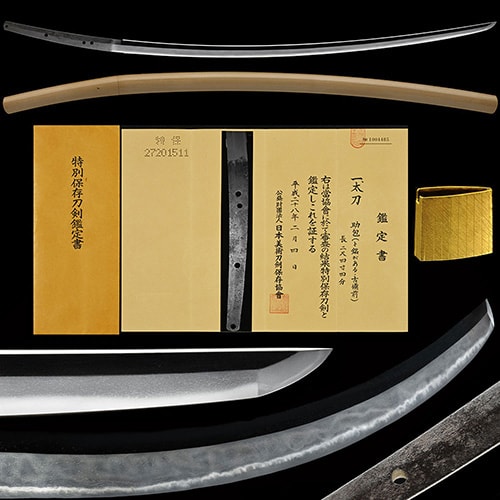
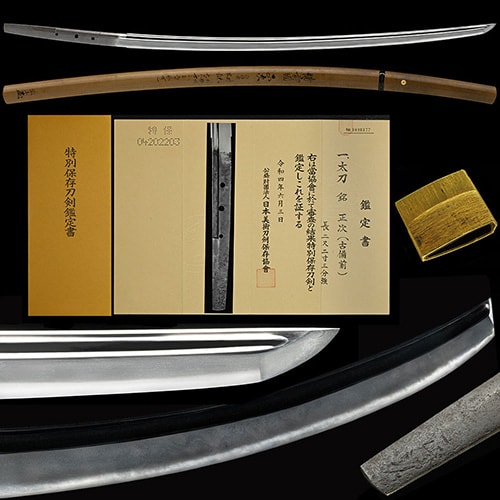
Munetsune is a smith of the tradition, active in Province from the close of the period into the early period. "" is a general designation for the swordsmiths — and their works — spanning from the late through the early period, and Munetsune is counted among them. According to sword signature references (), he is recorded as a son of Munehiro and is placed around the Joo era (1222-1224), with his lineage considered to belong to the line of Masatsune. Surviving signed works are exceptionally rare, making each authenticated example precious as documentary material.
Munetsune's exhibit a slender build with high , pronounced , and a or — a graceful silhouette that clearly expresses the characteristic features of the period. The is well-forged mixed with , with fine adhering closely, entering, and — whether , , or patchy — standing out vividly. The is typically -based or , mixed with and , with abundant and ; adheres well, and fine and appear within the hardened edge. The is characteristically straight, turning back in or tending toward .
Munetsune's blades are possessed of an archaic fragrance and deep taste, revealing a refined, dignified artistic realm that embodies the essential character of . The remarkable preservation of several examples in form — retaining their original with tips and file marks — adds significant documentary value. His finest works are commended for being in both and , with bright steel and richly varied that convey style at its most distinguished.