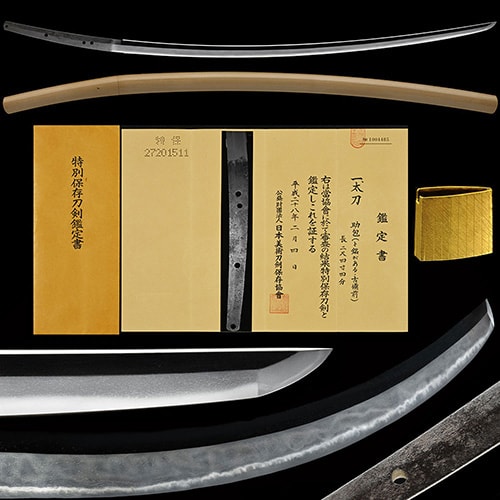
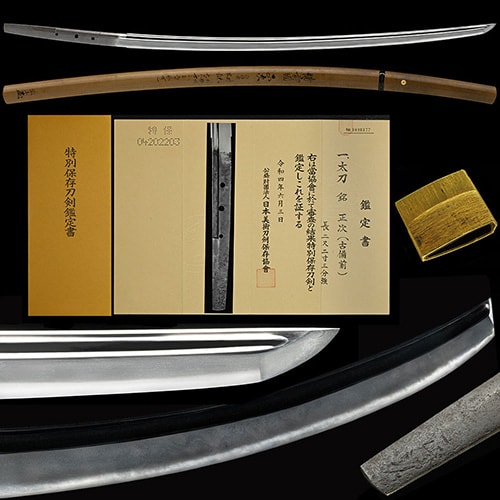
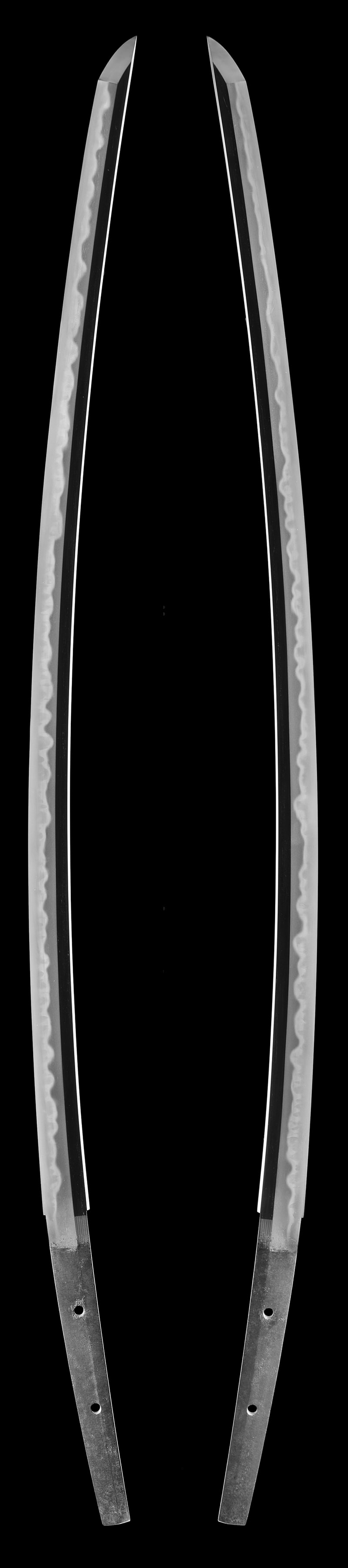
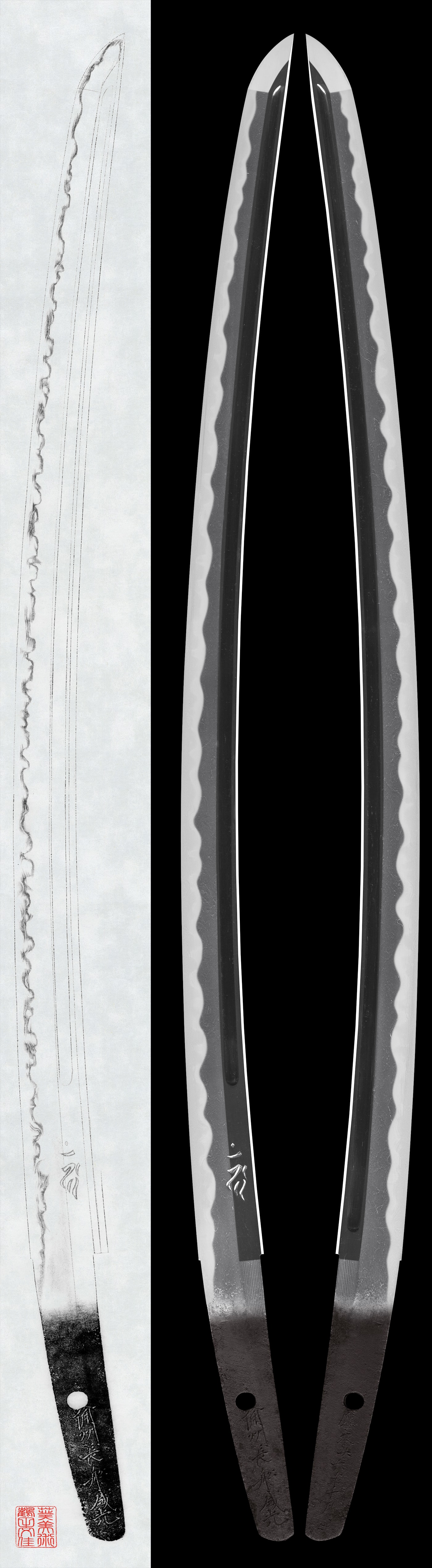
On the of the eighteenth session, signed Yukihide in two characters on an and descended in the Daitokugawa family, the names the trait by which this smith has always been known: the reverse slant of its is "a distinctive manner frequently seen in Yukihide among works". Yukihide is a smith of the close of the period into the beginning of the period, transmitted as of the Tomonari line, and for so early a hand his surviving works are comparatively numerous. Nearly every published entry opens on the adjudication, because the carry the name in both and the school, smiths whose workmanship and manner of signing are, the published sources say, similar yet distinguishable in each; all sixteen designated works on record are read as the hand. The sources add that signatures of both large and small cut survive under the name, so that several smiths appear to have borne it.
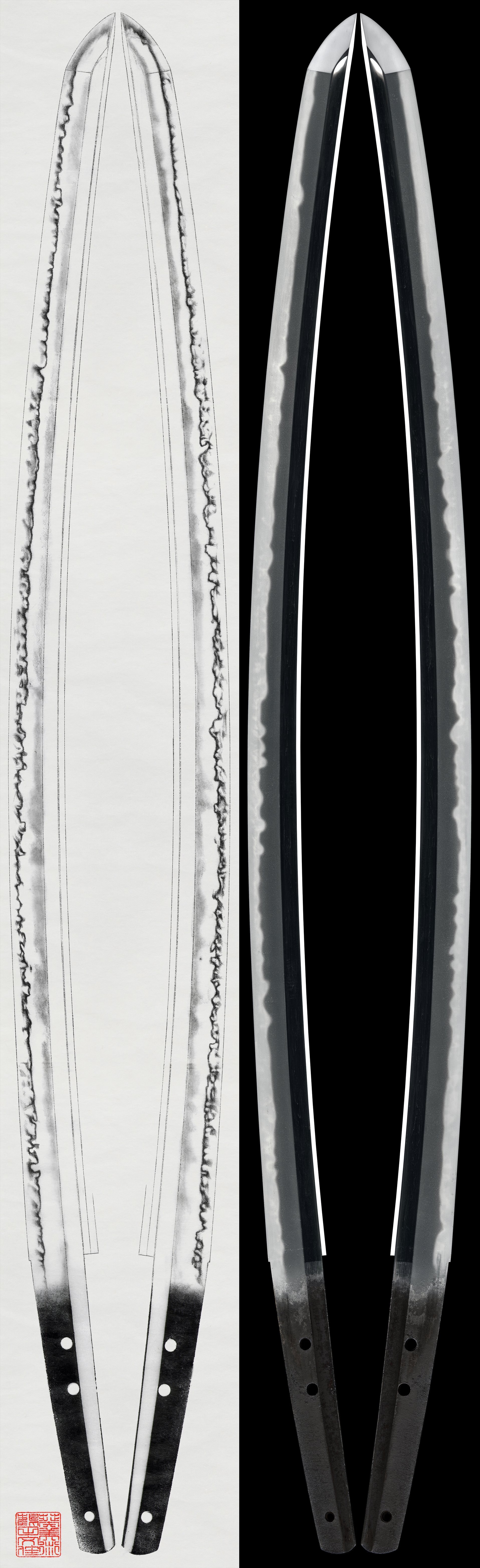
The published record states his two tells in nearly identical words across half a century of designations: "from of old, the mixing of reverse-tinged within the and the appearance of have been held the points of interest" of this smith. The first is the inclination. The and the slant in the reverse direction, the of the central region turn , and mix among the . A entry of 1965, on the from the Tokugawa shogunal house, observes that its , slightly reverse-slanting and mixing in places, shows "a workmanship somewhat unlike the other works, and in this point lies this smith's distinctive trait". The second tell is the doubled edge. A little apart from the , and run in dotted continuation and join into a -like line, conspicuous from the middle of the blade toward the . The notes that this dotted doubling, frequent in Yukihide, is also seen at times in the smiths Naritaka, Tomomura and Sukemura.
The is mixed with , the thick and on the finest pieces dust-fine, with fine entering and a standing or the patchy . On his best work the records single out the splendid "reaching as far as the ". At his most refined the is so closely knit that the entry of 2020 calls it a texture "that at a glance could be mistaken for a Kyoto product". The itself stays quiet: a tone or shallow with , and mixing in, and entering frequently, and attaching well with and . The runs to , on a few pieces in a manner. All of this sits inside the school norm the entries describe, an old style in which flamboyantly irregular pieces are few and the whole carries an archaic fragrance; what marks Yukihide within that norm is the direction in which his quiet leans.
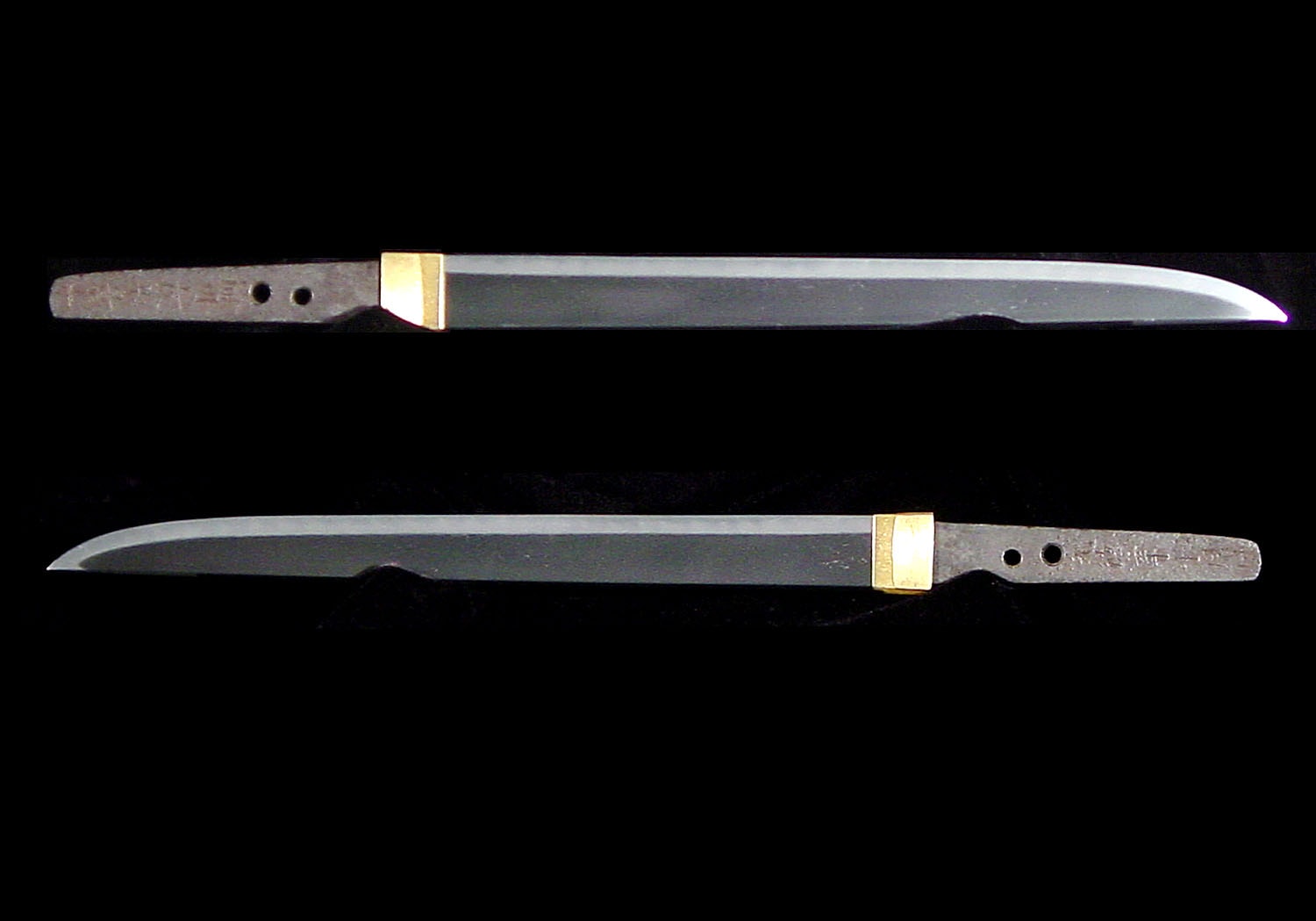
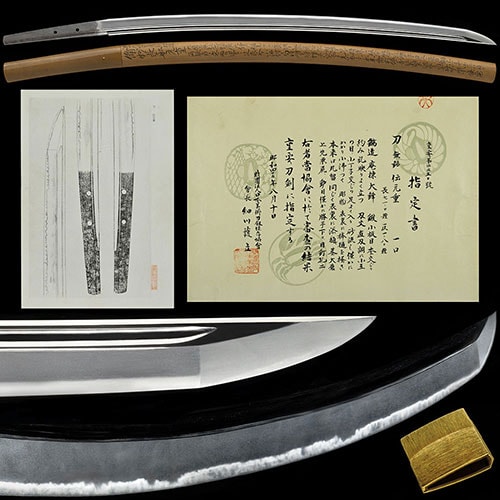
Thirteen of the sixteen designated works are signed, against three unsigned, and the signature never varies in kind: a only, cut on the toward the , generally with a thickish and at times boldly large chisel, though one early entry records a finely chiseled example. A entry of 1970 already counted the extant signed works at fewer than ten, and the sources prize them accordingly, calling a whose characters remain crisp "a precious work for knowing both this smith's range of workmanship and his signature". The is the early , high with , rising to a chu or small ; one long blade of 81.6 cm keeps a wide and thick . The signed works are all , while the three unsigned comprise a , a and a , each adjudicated by the criteria: on the the somewhat tightened with a reverse-leaning in led the judges to conclude that "the attribution to Yukihide is the most appropriate", and two unsigned pieces carry , one of 8 (1668) by Kojo at one hundred fifty , one of Genroku 16 (1703) by Kochu at ten gold pieces. The record is candid in the other direction as well: a of 1979, in the general style of late , is expressly noted as lacking the reverse-tinged seen now and then in this smith.
His place in the school is drawn from both sides. Upstream the transmission makes him of the Tomonari line; no pupil is named after him, and the question the scholarship keeps returning to is not succession but identity, the namesake of nearly the period whose work and signature sit close to his and must be separated blade by blade. The powerful build of the Daitokugawa , wide in with pronounced , is paired in the published record with his only designated , the two showing the imposing silhouette. The three prewar Bijutsuhin certifications, all signed then in Aichi collections, read the way: their commentary calls the -leaning with reverse-tending typical of the smith, while noting of one blade that it tempers, "unusually for Yukihide's work, a -predominant ".
Fujishiro rates him Jo-jo . Sixteen designated works stand on record: three and nine , twelve blades across those two tiers, joined by the three prewar Bijutsuhin and the single holding (Important Cultural Property) designation. The provenance attached to so small a body of work is distinguished: blades descended in the Daitokugawa family, the Tokugawa shogunal house and the Sendai Date family, the last with its mid- mounting of rosewood bearing shishimaru crests in mother-of-pearl, while the long held by a retainer family of the Dewa Shonai domain is famous under the name Kasugai-dome Yukihide, after the brass clamps that once secured old flaws beside its . Of recorded whereabouts today, the Sano Art Museum holds examples, and the remainder rest in private hands in Japan and abroad. With sixteen designated works in all, a Yukihide reaches the market only rarely; when one appears it is most often a , and a signed piece in the manner carries an individual hand of the to transition fixed by its own signature.